
Life, 1913-01-02 · page 11 of 44
Life — January 2, 1913 — page 11: what you’re looking at
What you’re looking at
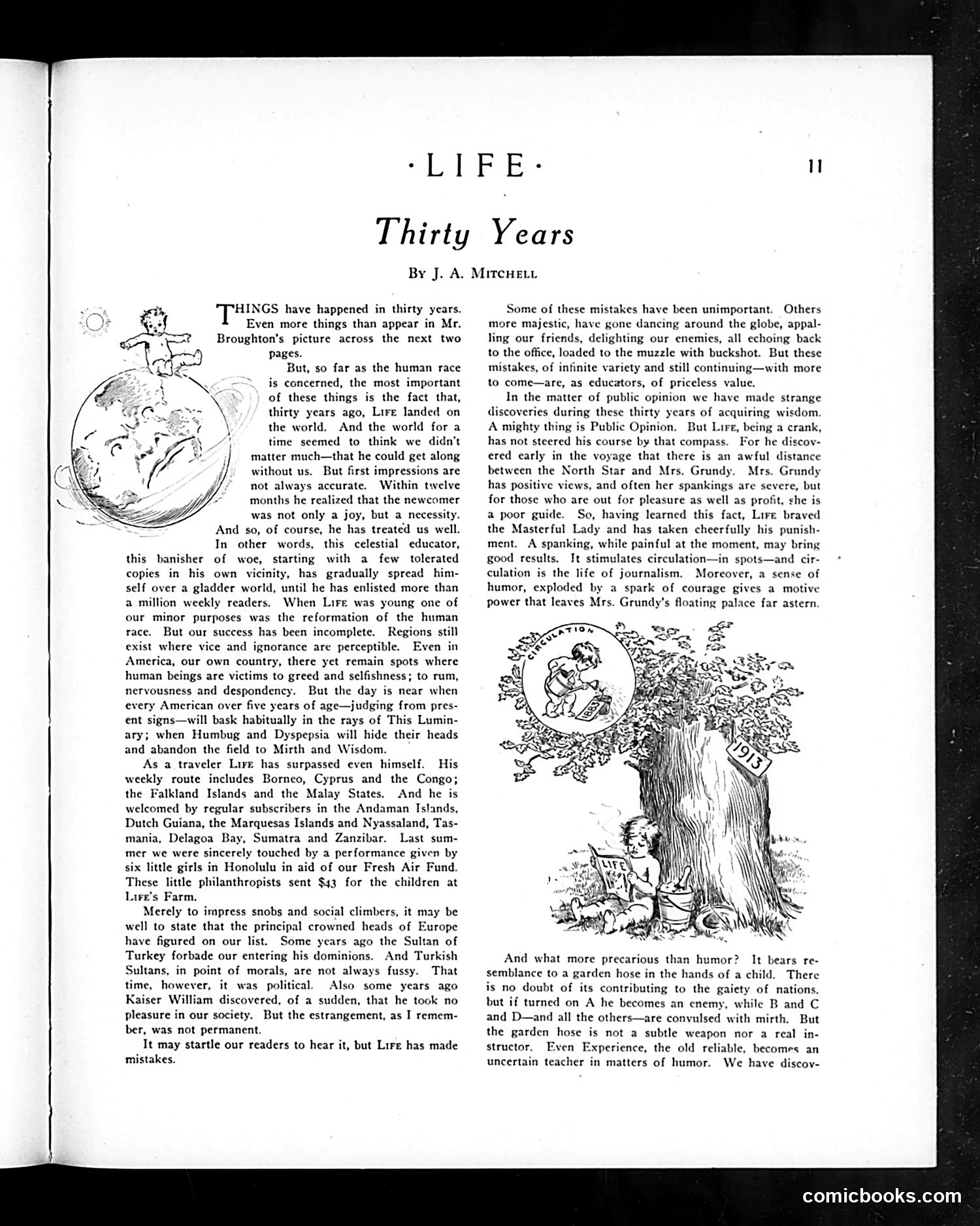
This editorial essay celebrates Life magazine's thirty-year history. The accompanying illustrations are decorative rather than political cartoons—showing whimsical figures (cherubs or children) associated with humor and satire. The text critiques Life's editorial approach: it admits the magazine has made "mistakes" over three decades but argues these served journalism's purpose. Mitchell defends Life's use of humor and satire, noting that public opinion ("Mrs. Grundy") can be an unreliable guide. He specifically mentions the Sultan of Turkey and Kaiser William as figures who opposed Life's influence, suggesting the magazine's satirical coverage had actual political consequences. The essay positions Life as an important educator using comedy to expose social ills and challenge authority.
📄 Transcribed text from this page (OCR, searchable)
Machine-transcribed from the original scan — historical spelling and the odd misread are preserved.
Tines have happened in thirty years. Even more things than appear in Mr. Broughton’s picture across the next two pages. But, so far as the human race is concerned, the most important of these things is the fact that, thirty years ago, Lire landed on the world. And the world for a time scemed to think we didn’t matter much—that he could get along without us. But first impressions are not always accurate. Within twelve months he realized that the newcomer was not only a joy, but a necessity. And so, of course, he has treated us well. In other words, this celestial educator, this banisher of woe, starting with a few tolerated copies in his own vicinity, has gradually spread him- self over a gladder world, until he has enlisted more than a million weekly readers. When Lire was young one of our minor purposes was the reformation of the human race. But our success has been incomplete. Regions still exist where vice and ignorance are perceptible. Even in America, our own country, there yet remain spots where human beings are victims to greed and selfishness; to rum, nervousness and despondency. But the day is near when every American over five years of age—judging from pres- ent signs—will bask habitually in the rays of This Lumin- ary; when Humbug and Dyspepsia will hide their heads and abandon the field to Mirth and Wisdom. As a traveler Lire has surpassed even himself. His weekly route includes Borneo, Cyprus and the Congo; the Falkland Islands and the Malay States. And he is welcomed by regular subscribers in the Andaman Islands, Dutch Guiana, the Marquesas Islands and Nyassaland, Tas- mania, Delagoa Bay, Sumatra and Zanzibar. Last sum- mer we were sincerely touched by a performance given by six little girls in Honolulu in aid of our Fresh Air Fund. These little philanthropists sent $43 for the children at Lire’s Farm. Merely to impress snobs and social climbers, it may be well to state that the principal crowned heads of Europe have figured on our list. Some years ago the Sultan of Turkey forbade our entering his dominions. And Turkish Sultans, in point of morals, are not always fussy. That time, however, it was political. Also some years ago Kaiser William discovered, of a sudden, that he took no pleasure in our society. But the estrangement, as I remem- ber, was not permanent. It may startle our readers to hear it, but Lire has made mistakes. *LIFE: Thirty Years By J. A. MitcHete Some of these mistakes have been unimportant. Others more majestic, have gone dancing around the globe, appal- ling our friends, delighting our enemies, all echoing back to the office, loaded to the muzzle with buckshot. But these mistakes, of infinite variety and still continuing—with more to come—are, as educators, of priceless value. In the matter of public opinion we have made strange discoveries during these thirty years of acquiring wisdom. A mighty thing is Public Opinion, But Lire, being a crank, has not steered his course by that compass. For he discov- ered early in the voyage that there is an awful distance between the North Star and Mrs. Grundy. Mrs. Grundy has positive views, and often her spankings are severe, but for those who are out for pleasure as well as profit, she is a poor guide. So, having learned this fact, Lire braved the Masterful Lady and has taken cheerfully his punish- ment. A spanking, while painful at the moment, may bring good results. It stimulates circulation—in spots—and cir- culation is the life of journalism. Moreover, a sense of humor, exploded by a spark of courage gives a motive power that leaves Mrs. Grundy’s floating palace far astern. And what more precarious than humor? It bears re- semblance to a garden hose in the hands of a child. There is no doubt of its contributing to the gaiety of nations, but if turned on A he becomes an enemy, while B and C and D—and all the others—are convulsed with mirth. But the garden hose is not a subtle weapon nor a real in- structor. Even perience, the old reliable, becomes an uncertain teacher in matters of humor. We have discov- comicbooks.com