
Life, 1913-01-02 · page 26 of 44
Life — January 2, 1913 — page 26: what you’re looking at
What you’re looking at
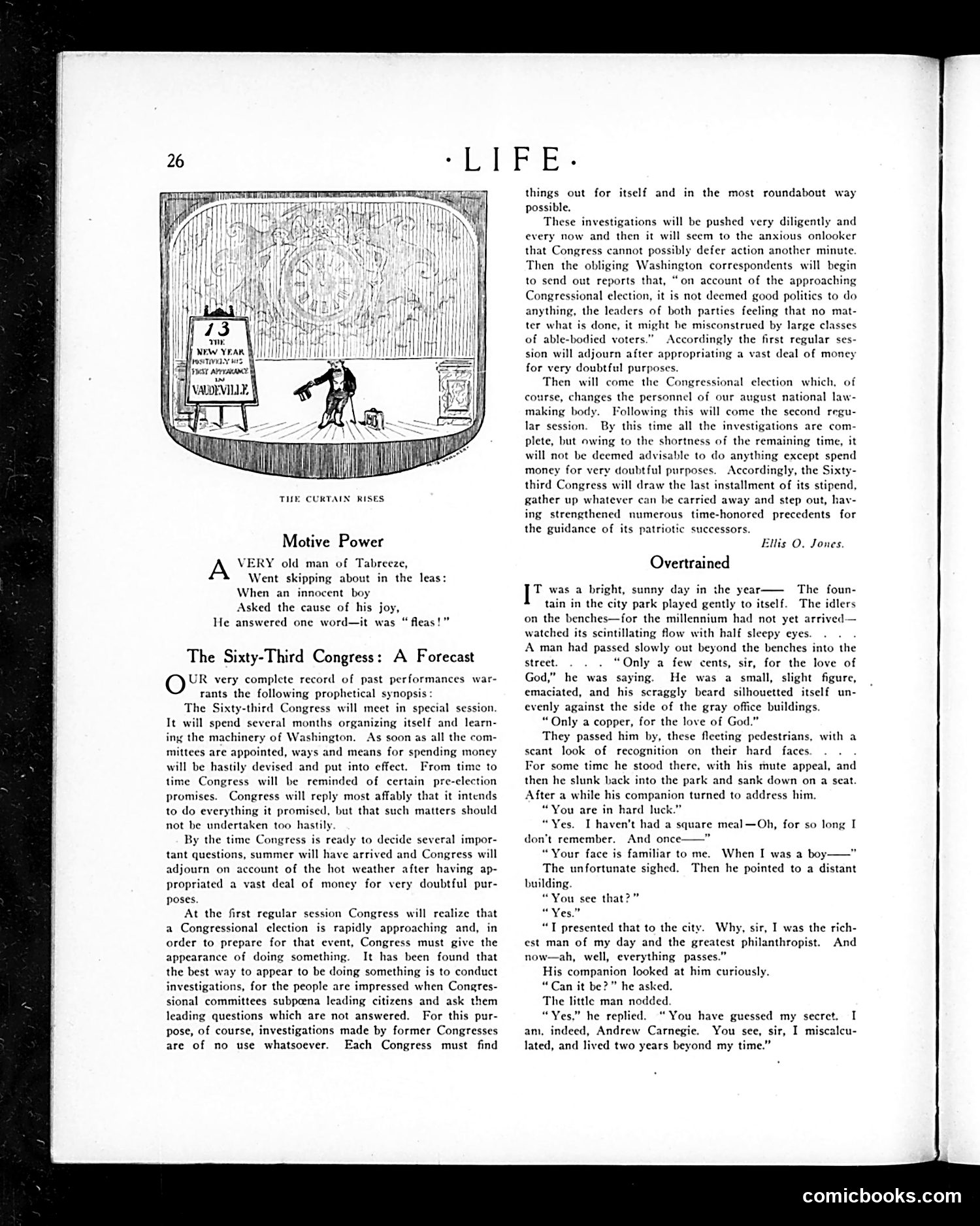
**The Cartoon ("The Curtain Rises"):** A vaudeville stage setup illustrating the joke about an old man from Tabriz who skips about because of fleas—a crude pun suggesting parasites as "motive power." This reflects Life's satirical use of theatrical framing. **"The Sixty-Third Congress: A Forecast":** This is the page's main satirical piece. It lampoons the incoming 63rd Congress as perpetually dysfunctional: committees spend months organizing, promise pre-election reforms they never enact, adjourn for summer heat before accomplishing anything, then conduct pointless investigations timed to appear productive before the next election. The satire attacks Congress for endless procedure without substance, strategic delays blamed on electoral concerns, and wasteful appropriations—suggesting the institution prioritizes re-election over governance. **"Overtrained":** A brief fictional story about a poor man begging in a city park, appears unrelated to the political content. The page reflects Progressive-era skepticism toward legislative effectiveness and political cynicism.
📄 Transcribed text from this page (OCR, searchable)
Machine-transcribed from the original scan — historical spelling and the odd misread are preserved.
a Ue li Bah restivey es A Asse romance VAWDEVILLE THE CURTAIN RISES Motive Power VERY old man of Tabreeze, Went skipping about in the leas: When an innocent boy Asked the cause of his joy, He answered one word—it was “fleas!” The Sixty-Third Congress: A Forecast Ov very complete record of past performances war- rants the following prophetical synopsis : The Sixty-third Congress will meet in special session. It will spend several months organizing itself and learn- ing the machinery of Washington. As soon as all the com- mittees are appointed, ways and means for spending money will be hastily devised and put into effect. From time to time Congress will be reminded of certain pre-election promises. Congress will reply most affably that it intends to do everything it promised, but that such matters should not be undertaken too hastily By the time Congress is ready to decide several impor- tant questions, summer will have arrived and Congress will adjourn on account of the hot weather after having ap- propriated a vast deal of money for very doubtful pur- poses. At the first regular session Congress will realize that a Congressional election is rapidly approaching and, in order to prepare for that event, Congress must give the appearance of doing something. It has been found that the best way to appear to be doing something is to conduct investigations, for the people are impressed when Congres- sional committees subpeena leading citizens and ask them leading questions which are not answered. For this pur- pose, of course, investigations made by former Congresses are of no use whatsoever. Each Congress must find things out for itself and in the most roundabout way possible. These investigations will be pushed very diligently and every now and then it will seem to the anxious onlooker that Congress cannot possibly defer action another minute. Then the obliging Washington correspondents will begin to send out reports that, “on account of the approaching Congressional election, it is not deemed good politics to do anything, the leaders of both parties feeling that no mat- ter what is done, it might he misconstrued by large classes of able-bodied voters.” Accordingly the first regular ses- sion will adjourn after appropriating a vast deal of money for very doubtful purposes. Then will come the Congressional election which, of course, changes the personnel of our august national law- making body. Following this will come the second regu- lar session. By this time all the investigations are com- plete, but owing to the shortness of the remaining time, it will not be deemed advisable to do anything except spend money for very doubtful purposes. Accordingly, the Sixty- third Congress will draw the last installment of its stipend, gather up whatever can be carried away and step out, hav- ing strengthened numerous time-honored precedents for the guidance of its patriotic successors. Ellis O. Jones. Overtrained T was a bright, sunny day in the year—— The foun- tain in the city park played gently to itself. The idlers on the benches—for the millennium had not yet arrived— watched its scintillating flow with half sleepy eyes. , A man had passed slowly out beyond the benches into the street. “Only a few cents, sir, for the love of God,” he was saying. He was a small, slight figure, emaciated, and his scraggly beard silhouetted itself un- evenly against the side of the gray office buildings. “Only a copper, for the love of God.” They passed him by, these flecting pedestrians, with a scant look of recognition on their hard faces. . . - For some time he stood there, with his mute appeal, and then he slunk back into the park and sank down on a scat. After a while his companion turned to address him. “You are in hard luc “Yes. [haven't had a square meal—Oh, for so long I don’t remember. And once——” “Your face is familiar to me. When I was a boy —” The unfortunate sighed. Then he pointed to a distant ding. You see that?” “Yes.” “T presented that to the city. Why, sir, I was the rich- est man of my day and the greatest philanthropist. And now—ah, well, everything passes.” His companion looked at him curiously. “Can it be?” he asked. The little man nodded. “Yes,” he replied. “You have guessed my secret. I am, indeed, Andrew Carnegie. You see, sir, I miscalcu- lated, and lived two years beyond my time.” comicbooks.com