
Life, 1913-01-02 · page 24 of 44
Life — January 2, 1913 — page 24: what you’re looking at
What you’re looking at
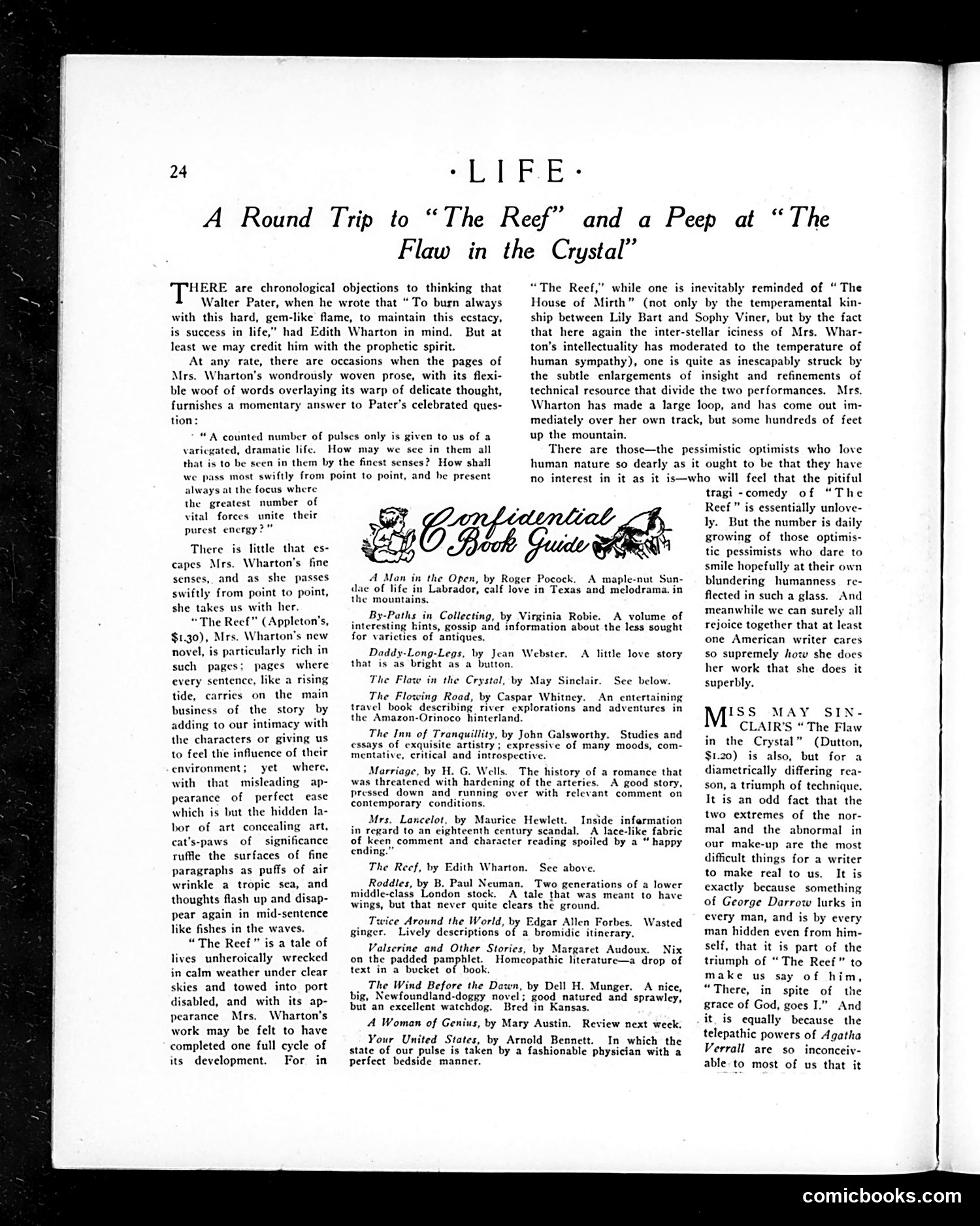
This is a literary criticism page, not a political cartoon. The main content reviews Edith Wharton's novel *"The Reef"* (Appleton's, $1.30), praising her sophisticated prose style and technical skill. The reviewer compares it favorably to her earlier work *"The House of Mirth,"* noting she has achieved greater "refinement of technical resource" while maintaining emotional depth—a progression the critic celebrates. The page also lists other contemporary books reviewed elsewhere, including works by Jean Webster, H.G. Wells, and John Galsworthy. There's a small decorative "Confidentially Book Guide" illustration in the center, but it's ornamental rather than satirical. This is essentially a serious literary supplement from an era when *Life* magazine served educated readers interested in book reviews alongside its better-known humor and satire content.
📄 Transcribed text from this page (OCR, searchable)
Machine-transcribed from the original scan — historical spelling and the odd misread are preserved.
male RE A Round Trip to “The Reef” and a Peep at “The Flaw in the Crystal” HERE are chronological objections to thinking that Walter Pater, when he wrote that “To busn always ith this hard, gem-like flame, to maintain this ecstacy, is success in life,” had Edith Wharton in mind. But at least we may credit him with the prophetic spirit. At any rate, there are occasions when the pages of Mrs. Wharton's wondrously woven prose, with its flexi- ble woof of words overlaying its warp of delicate thought, furnishes a momentary answer to Pater’s celebrated ques- tion: “A counted number of pulses only is given to us of a varicgated, dramatic life. How may we sce in them all that is to be seen in them by the finest senses? How shall we pass most swiftly from point to point, and be present always at the focus where the greatest. number of vital forces unite their purest energy?” There is little that es- “The Reef,” while one is inevitably reminded of “ The House of Mirth” (not only by the temperamental kin- ship between Lily Bart and Sophy Viner, but by the fact that here again the inter-stellar iciness of Mrs. Whar- ton’s intellectuality has moderated to the temperature of human sympathy), one is quite as inescapably struck by the subtle enlargements of insight and refinements of technical resource that divide the two performances, Mrs. Wharton has made a large loop, and has come out im- mediately over her own track, but some hundreds of feet up the mountain. There are those—the pessimistic optimists who love human nature so dearly as it ought to be that they have no interest in it as it is—who will feel that the pitiful tragi -comedy of “The Reef” is essentially unlove- But the number is daily capes Mrs. Wharton's fine senses, and as she passes swiftly from point to point, she takes us with her. The Reef” (Appleton’s, $1.30), Mrs. Wharton's new ly rich in where novel, is particul, such pages; pages every sentence, like a rising tide, carries on the m: business of the story by adding to our intimacy with the characters or giving us to feel the influence of their environment; yet where, with that misleading ap- pearance of perfect ease which is but the hidden la- bor of art concealing art, cat’s-paws of significance ruffle the surfaces of fine paragraphs as puffs of air wrinkle a tropic sea, and thoughts flash up and disap- pear again in mid-sentence like fishes in the waves. “The Reef” is a tale of lives unheroically wrecked in calm weather under clear skies and towed into port disabled, and with its ap- pearance Mrs. Wharton's work may be felt to have completed one full cycle of its development. For in Lone cedential ly. . GB h growing of those optimis tic pessimists who dare to A Man in the Open, by Roger Pocock. A maple-nut Sun- dae of life in Labrador, calf love in Texas and melodrama. in the mountains. _ By-Paths in Collecting, by Virginia Robie. A volume of interesting hints, gossip and information about the less sought for varicties of antiques. Daddy-Long-Legs, vy Jean Webster. that is as bright asa button The Fla The Flowing Road, by Caspar Whitney. An entertaining travel book describing river explorations and adventures in the Amazon-Orinoco hinterland. The Inn of Tranquillity, by John Galsworthy. Studies and essays of exquisite artistry; expressive of many moods, com- mentative, critical and introspective. A little love story in the Crystal, by May Sinclair. See below. Marriage, by H. G. Wells. The history of a romance that was threatened with hardening of the arteries. A good story, pressed down and running over with relevant comment on contemporary conditions. Mrs. Lancelot, by Maurice Hewlett. Inside infarma in regard to an eighteenth century scandal. A lace-like fabric of keen comment and character reading spoiled by a “ happy ending, The Reef, by Edith Wharton. Roddles, by B. Paul Neuman. Two generations of a lower middle-class London stock. A tale that was meant to have wings, but that never quite clears the ground. Twice Around the World, by Edgar Allen Forbes. ginger. Lively descriptions of a bromidic itinerary. Valserine and Other Stories, by Margaret Audoux. Nix on the padded pamphlet. Homeopathic literature—a drop of text in a bucket of book. The Wind Before the Dawn, by Dell H. Munger. A nice, big, Newfoundland-doggy novel; good natured and sprawley, but an excellent watchdog. Bred in Kansas. A Woman of Genius, by Mary Austin. Review next week. Your United States, by Arnold Bennett. In which the state of our pulse is taken by a fashionable physician with a perfect bedside manner. See above. Wasted smile hopefully at their own blundering humanness_ re- flected in such a glass. And meanwhile we can surely all rejoice together that at least one American writer cares so supremely how she does her work that she does it superbly, ISS MAY SIN- CLAIR’S “ The Flaw in the Crystal” (Dutton, $1.20) is also, but for diametrically differing re: son, a triumph of technique. It is an odd fact that the two extremes of the nor- mal and the abnormal in our make-up are the most difficult things for a writer to make real to us. It is exactly because something of George Darrow lurks in every man, and is by every man hidden even from him- self, that it is part of the triumph of “The Reef” to make us say of him, “There, in spite of the grace of God, goes I.” And it. is equally because the telepathic powers of Agatha Verrall are so inconceiv- able to most of us that it comicbooks.com