
Life, 1913-01-02 · page 25 of 44
Life — January 2, 1913 — page 25: what you’re looking at
What you’re looking at
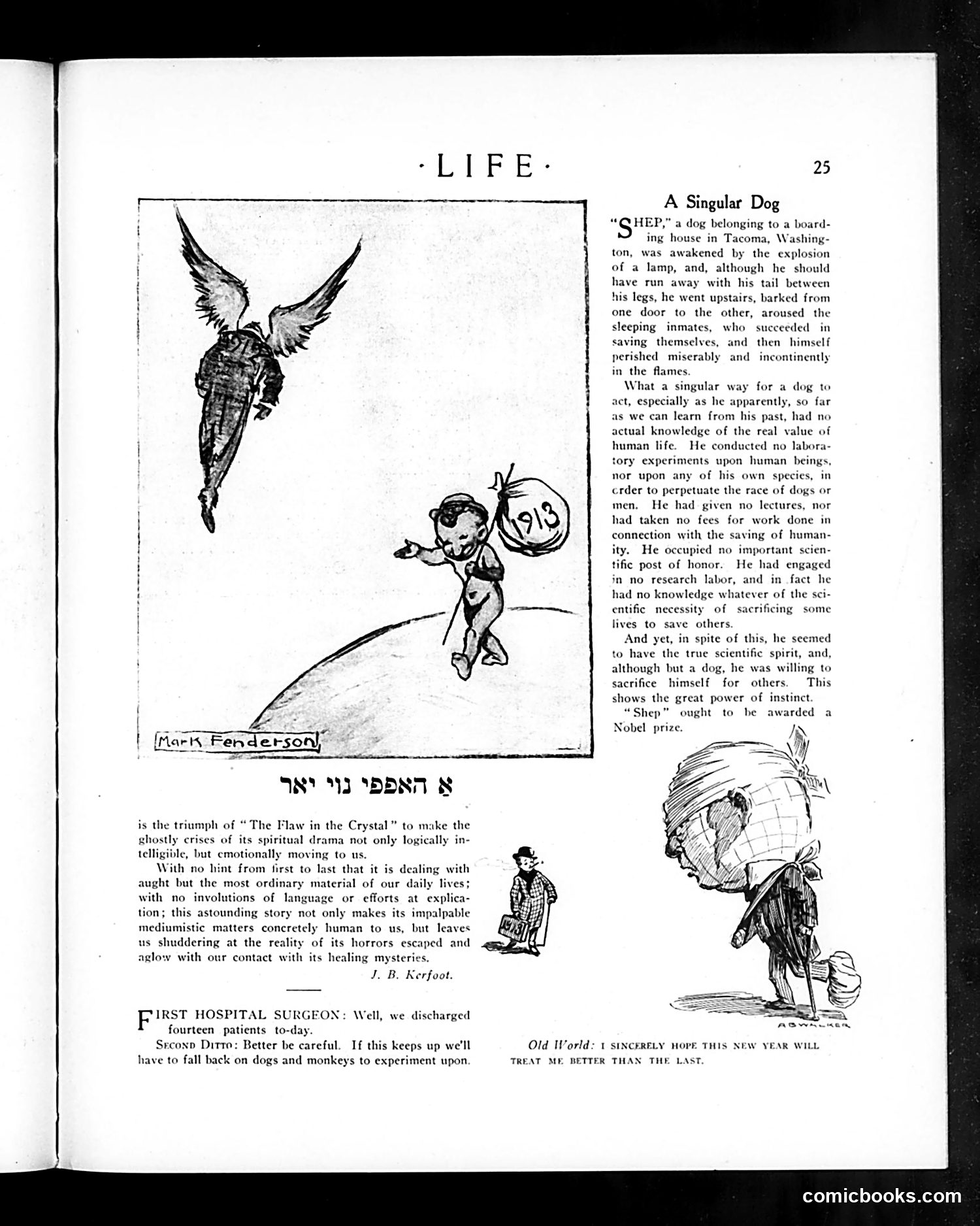
This page satirizes scientific and academic pretension through ironic contrast. The main article describes "Shep," a dog in Tacoma who died saving boarding house residents from a fire—acting heroically without formal training, credentials, or scientific knowledge. The satire targets the era's obsession with credentialism and experimental methodology. Life mocks scientists and academics who demand credentials, published research, and institutional positions to justify moral action. The article suggests Shep possessed genuine "scientific spirit" and selflessness that actual scientists, despite their degrees and laboratories, often lack. The hospital surgeons' joke below reinforces this: they've discharged so many patients they may need to experiment on "dogs and monkeys" instead—implying human subjects are becoming scarce, a dark jab at medical experimentation ethics of the period. The artist, Mark Fenderson, uses this to critique empty intellectualism: pure instinct and compassion matter more than credentials.
📄 Transcribed text from this page (OCR, searchable)
Machine-transcribed from the original scan — historical spelling and the odd misread are preserved.
25 A Singular Dog “QHEP,” a dog belonging to a board- ing house in Tacoma, Washing- ton, was awakened by the explosion of a lamp, and, although he should have run away with his tail between his legs, he went upstairs, barked from one door to the other, aroused the sleeping inmates, who succeeded in saving themselves, and then himself perished miserably and incontinently in the flames. What a singular way for a dog to act, especially as he apparently, so far we can learn from his past, had no actual knowledge of the real value of human life. He conducted no labora- tory experiments upon human beings, nor upon any of his own species, in crder to perpetuate the race of dogs or men. He had given no lectures, nor had taken no fees for work done in connection with the saving of human- ity. He occupied no important scien- tific post of honor. He had engaged in no research labor, and in fact he had no knowledge whatever of the sci- entific necessity of sacrificing some lives to save others. And yet, in spite of this, he seemed to have the true scientific spirit, and, although but a dog, he was willing to sacrifice himself for others. This shows the great power of instinct “Shep” ought to be awarded a ee ~ EE Nobel prize. [rary Fenderson) Sa een IN" 3 (BESTS is the triumph of “ The Flaw in the Crystal” to make the ghostly crises of its spiritual drama not only logically in- telligible, but emotionally moving to us. With no hint from first to last that it is dealing with aught but the most ordinary material of our daily lives; with no involutions of language or efforts at explica- tion; this astounding story not only makes its impalpable mediumistic matters concretely human to us, but leaves us shuddering at the reality of its horrors escaped and aglow with our contact with its healing mysteries. J. B. Kerfoot. IRST HOSPITAL SURGEON: Well, we discharged fourteen patients to-day. Srconn Ditto: Better be careful. If this keeps up we'll Old World: 1 SINCERELY HOPE THIS NEW YEAR WILL have to fall back on dogs and monkeys to experiment upon TREAT ME BETTER THAN THE LAST comicbooks.com