
Life, 1913-01-02 · page 9 of 44
Life — January 2, 1913 — page 9: what you’re looking at
What you’re looking at
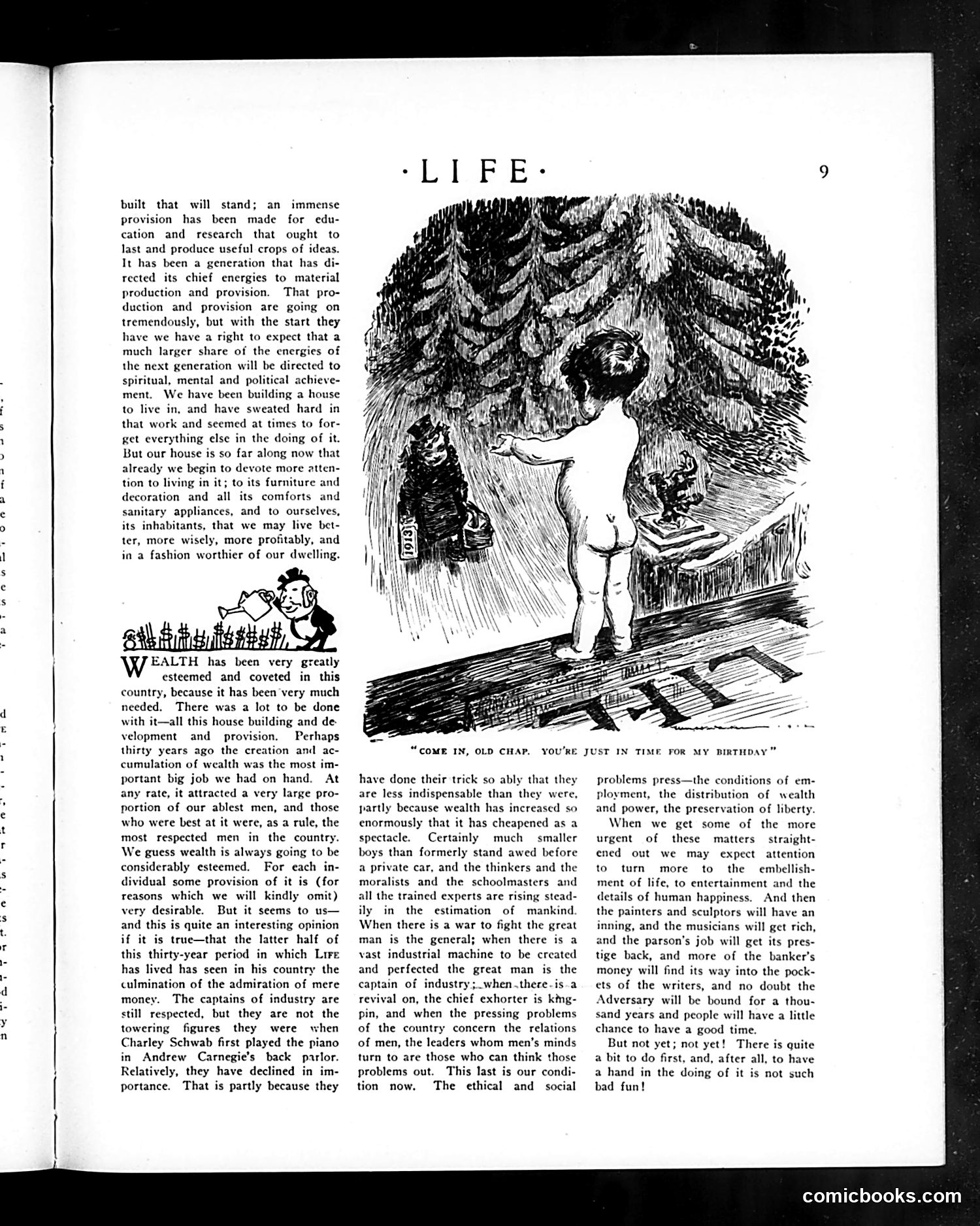
The main cartoon depicts a man entering what appears to be a cave or hollow tree, with the caption "COME IN, OLD CHAP, YOU'RE JUST IN TIME FOR MY BIRTHDAY." The illustration is a visual pun about wealth and hiding places. The accompanying text discusses how wealth has been greatly esteemed in America but has become "less indispensable" than before, and how many wealthy men have lost their fortunes. The cartoon satirizes the idea of the wealthy retreating into obscurity or "hiding out," suggesting that once-respected wealthy figures are now isolated and forgotten—literally living in caves like hermits, reduced from their former prominence. The humor relies on the contrast between the birthday celebration (typically a social, public occasion) and the remote, impoverished setting, mocking the fallen status of the wealthy.
📄 Transcribed text from this page (OCR, searchable)
Machine-transcribed from the original scan — historical spelling and the odd misread are preserved.
built that will stand; an immense provision has been made for edu- cation and research that ought to last and produce useful crops of ideas. It has been a generation that has di- rected its chief energies to material production and provision. That pro- duction and provision are going on tremendously, but with the start they have we have a right to expect that a much larger share of the energies of the next generation will be directed to spiritual, mental and political achieve- ment. We have been building a house to live in, and have sweated hard in that work and seemed at times to for- get everything else in the doing of it. But our house is so far along now that already we begin to devote more atten- tion to living in it; to its furniture and decoration and all its comforts and sanitary appliances, and to ourselves, its inhabitants, that we may live bet- ter, more wisely, more profitably, and in a fashion worthier of our dwelling. (SS UT 174? 3 4 ALTH has been very greatly esteemed and coveted in this country, because it has been very much needed. There was a lot to be done with it—all this house building and de- velopment and provision. Perhaps thirty years ago the creation and ac- cumulation of wealth was the most im- portant big job we had on hand. At any rate, it attracted a very large pro- portion of our ablest men, and those who were best at it were, as a rule, the most respected men in the country. We guess wealth is always going to be considerably esteemed. For each in- dividual some provision of it is (for reasons which we will kindly omit) very desirable. But it seems to us— and this is quite an interesting opinion if it is true—that the latter half of this thirty-year period in which Lire has lived has seen in his country the culmination of the admiration of mere money. The captains of industry are still respected, but they are not the towering figures they were when Charley Schwab first played the piano in Andrew Carnegie’s back parlor. Relatively, they have declined in im- portance. That is partly because they “COME IN, OLD CHAP. have done their trick so ably that they are less indispensable than they were, partly because wealth has increased so enormously that it has cheapened as a spectacle. Certainly much smaller boys than formerly stand awed before a private car, and the thinkers and the moralists and the schoolmasters and all the trained experts are rising stead- ily in the estimation of mankind When there is a war to fight the great man is the general; when there is a vast industrial machine to be created and perfected the great man is the captain of industry; when .there-is a revival on, the chief exhorter is king- pin, and when the pressing problems of the country concern the relations of men, the leaders whom men’s minds turn to are those who can think those problems out. This last is our condi- tion now. The ethical and social YOU'RE JUST IN TIME FOR MY BIRTHDAY” problems press—the conditions of em- ployment, the distribution of wealth and power, the preservation of liberty. When we get some of the more urgent of these matters straight- ened out we may expect attention to turn more to the embellish- ment of life, to entertainment and the details of human happiness. And then the painters and sculptors will have an inning, and the musicians will get rich, and the parson’s job will get its pres- tige back, and more of the banker's money will find its way into the pock- ets of the writers, and no doubt the Adversary will be bound for a thou- sand years and people will have a little chance to have a good time. But not yet; not yet! There is quite a bit to do first, and, after all, to have a hand in the doing of it is not such bad fun! comicbooks.com