
Life, 1913-01-02 · page 14 of 44
Life — January 2, 1913 — page 14: what you’re looking at
What you’re looking at
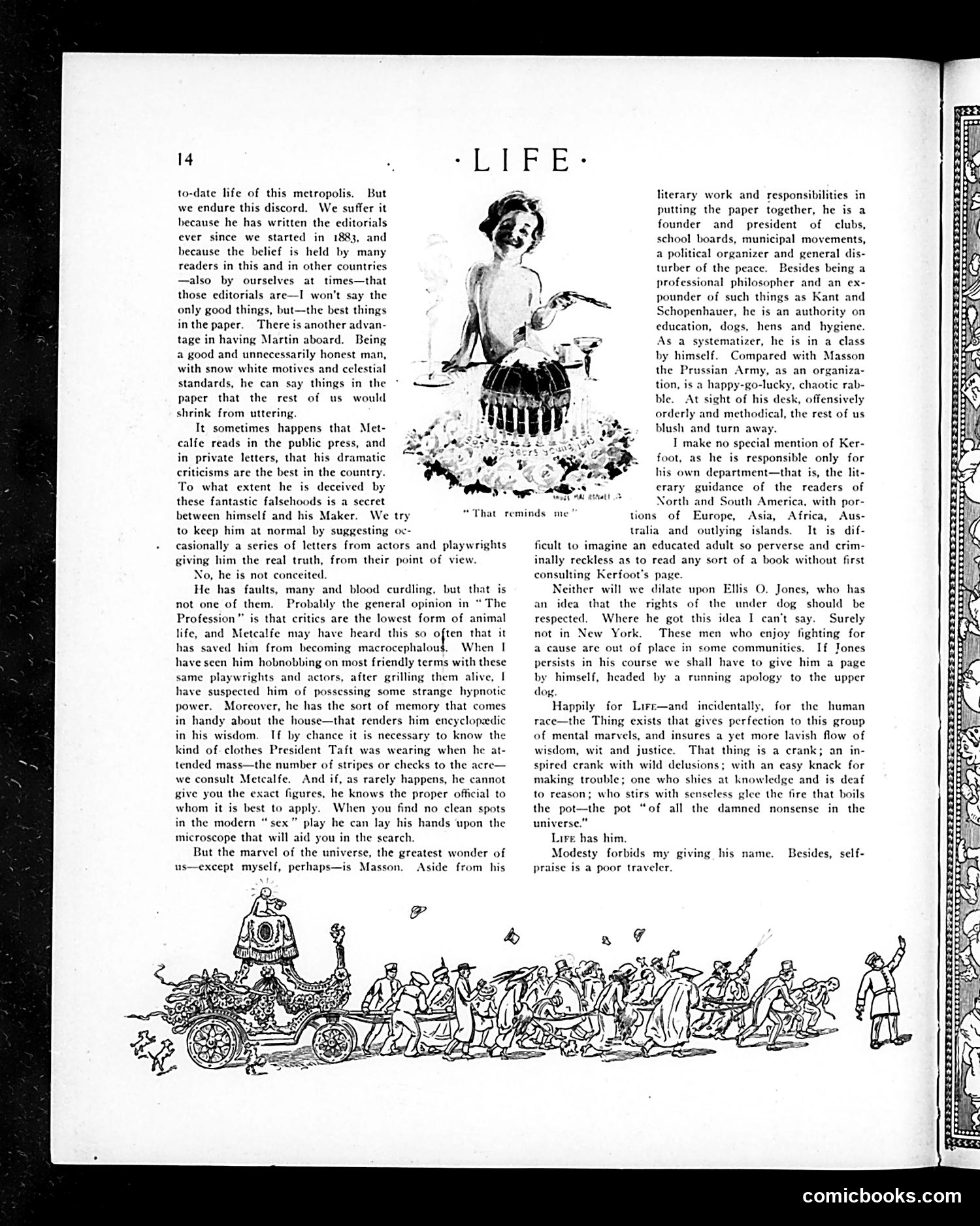
This page is primarily **textual commentary** rather than political cartoon. The main illustration shows a classical cherub or putto figure labeled "That reminds me" — a whimsical image unrelated to the surrounding text. The text discusses **editorial integrity** and attacks on the magazine's credibility. It defends the publication's "white white motives" against "fantastic falsehoods" circulated in private letters, and mentions criticisms from "actors and playwrights." The passage also critiques critics as "the lowest form of animal life," and discusses figures like **Masson** (appears to be a theatrical or literary figure) and **Ellis O. Jones**, defending their right to operate without interference. The **lower illustration** depicts a processional parade or ceremonial scene, its satirical meaning unclear without additional context. This appears to be **defensive editorial commentary** rather than satirical political content.
📄 Transcribed text from this page (OCR, searchable)
Machine-transcribed from the original scan — historical spelling and the odd misread are preserved.
14 to-date life of this metropolis. But we endure this discord. We suffer it because he has written the editorials ever since we started in 1883, and because the belief is held by many readers in this and in other countries —also by ourselves at times—that those editorials are—I won't say the only good things, but—the best things inthe paper. There is another advan- tage in having Martin aboard. Being a good and unnecessarily honest man, with snow white motives and celestial standards, he can say things in the paper that the rest of us would shrink from uttering. It sometimes happens that Met- calfe reads in the public press, and in private letters, that his dramatic criticisms are the best in the country. To what extent he is deceived by these fantastic falsehoods is a secret between himself and his Maker. We try to keep him at normal by suggesting oc- casionally a series of letters from actors and playwrights giving him the real truth, from their point of view. No, he is not conceited. He has faults, many and blood curdling, but that is not one of them. Probably the general opinion in “ The Profession” is that critics are the lowest form of animal life, and Metealfe may have heard this so often that it has saved him from becoming macrocephalous. When | have seen him hobnobbing on most friendly terms with these same playwrights and actors, after grilling them alive, | have suspected him of possessing some strange hypnotic power. Moreover, he has the sort of memory that comes in handy about the house—that renders him encyclopedic in his wisdom. If by chance it is necessary to know the kind of clothes President Taft was wearing when he at- tended mass—the number of stripes or checks to the acre— we consult Metcalfe. And if, as rarely happens, he cannot give you the exact figures, he knows the proper official to whom it is best to apply. When you find no clean spots in the modern “sex” play he can lay his hands upon the microscope that will aid you in the search But the marvel of the universe, the greatest wonder of us—except myself, perhaps—is Masson. Aside from his literary work and responsibilities in putting the paper together, he is a founder and president of clubs, school boards, municipal movements, a political organizer and general dis- turber of the peace. Besides being a professional philosopher and an ex- pounder of such things as Kant and Schopenhauer, he is an authority on ion, dogs, hens and hy: As a systematizer, he is in a class by himself. Compared with Masson the Prussian Army, as an organiza- tion, is a happy-go-lucky, chaotic rab- ble. At sight of his desk, offensively orderly and methodical, the rest of us blush and turn away. I make no special mention of Ker- foot, as he is responsible only for his own department—that the lit- erary guidance of the readers of North and South America, with por- “That reminds me tions of Europe, Asia, Africa, Aus- tralia and outlying islands. It is dif- ficult to imagine an educated adult so perverse and crim- inally reckless as to read any sort of a book without first consulting Kerfoot’s page. Neither will we dilate upon Ellis O. Jones, who has an idea that the rights of the under dog should be respected. Where he got this idea I can’t say. Surely not in New York. These men who enjoy fighting for a cause are out of place in some communiti If Jones persists in his course we shall have to give him a page by himself, headed by a running apology to the upper d Happily for Lirr—and incidentally, for the human race—the Thing exists that gives perfection to this group of mental marvels, and insures a yet more lavish flow of wisdom, wit and justice. That thing is a crank; an in- spired crank with wild delusions; with an easy knack for making trouble; one who shies at knowledge and is deaf to reason; who stirs with senseless glee the fire that boils the pot—the pot “of all the damned nonsense in the universe.” Lire has him. Modesty forbids my giving his name. praise is a poor traveler. Besides, self- comicbooks.com