
Life, 1913-01-02 · page 20 of 44
Life — January 2, 1913 — page 20: what you’re looking at
What you’re looking at
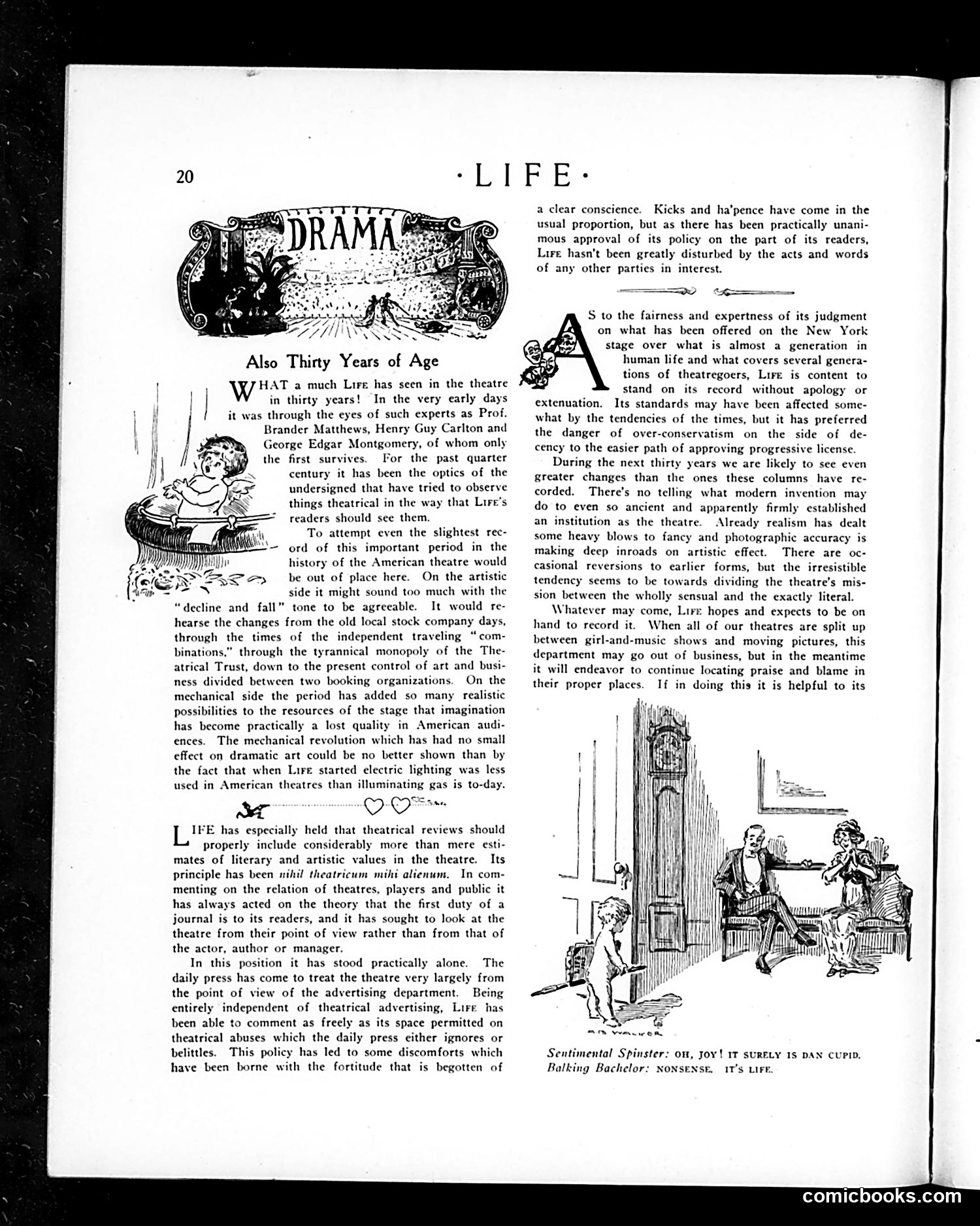
This is an **editorial essay** marking *Life* magazine's 30th anniversary covering American theatre, not primarily a political cartoon page. The small illustration at bottom shows a domestic scene with the caption "Sentimental Spinster" and "Balking Bachelor"—a light satirical sketch about romantic tension, not political commentary. The main text defends *Life*'s theatre criticism approach: it claims independence from theatrical industry advertising (unlike daily newspapers), judges shows by audience perspective rather than professionals', and has maintained moral standards against "progressive license." The essay references real theatrical history—the shift from stock companies to the "Theatrical Trust" monopoly to modern booking organizations—and notes technological change (electric lighting replacing gas). The satire is subtle: *Life* positions itself as the ethical arbiter of theatre, standing "practically alone" against press corruption and theatrical excess. This reflects turn-of-century Progressive-era rhetoric about independent journalism fighting special interests. Modern relevance: concerns about critical independence, industry influence on media, and entertainment standards remain timely.
📄 Transcribed text from this page (OCR, searchable)
Machine-transcribed from the original scan — historical spelling and the odd misread are preserved.
Ale FE Also Thirty Years of Age HAT a much Lire has seen in the theatre in thirty years! In the very early days it was through the eyes of such experts as Prof. Brander Matthews, Henry Guy Carlton and George Edgar Montgomery, of whom only the first survives. For the past quarter century it has been the optics of the undersigned that have tried to observe things theatrical in the way that Lire’s readers should see them. To attempt even the slightest rec- ord of this important period in the history of the American theatre would be out of place here. On the artistic side it might sound too much with the “decline and fall” tone to be agreeable. It would re- hearse the changes from the old local stock company days, through the times of the independent traveling “com- binations,” through the tyrannical monopoly of the The- atrical Trust, down to the present control of art and bus ness divided between two booking organizations. On the mechanical side the period has added so many realistic possibilities to the resources of the stage that imagination has become practically a lost quality in American audi- ences. The mechanical revolution which has had no small effect on dramatic art could be no better shown than by the fact that when Lire started electric lighting was less used in American theatres than illuminating gas is to-day. IFE has especially held that theatrical reviews should properly include considerably more than mere esti- mates of literary and artistic values in the theatre. Its principle has been nihil theatricum mihi alienum. In com- menting on the relation of theatres, players and public it has always acted on the theory that the first duty of a journal is to its readers, and it has sought to look at the theatre from their point of view rather than from that of the actor, author or manager. In this position it has stood practically alone. The daily press has come to treat the theatre very largely from the point of view of the advertising department. Being entirely independent of theatrical advertising, Lire has been able to comment as freely as its space permitted on theatrical abuses which the daily press either ignores or belittles. This policy has led to some discomforts which have been borne with the fortitude that is begotten of a clear conscience. Kicks and ha’pence have come in the usual proportion, but as there has been practically unani- mous approval of its policy on the part of its readers, Lire hasn't been greatly disturbed by the acts and words of any other parties in interest. ED Ge S to the fairness and expertness of its judgment on what has been offered on the New York stage over what is almost a generation in human life and what covers several genera- tions of theatregoers, Lire is content to stand on its record without apology or extenuation. Its standards may have been affected some- what by the tendencies of the times, but it has preferred the danger of over-conservatism on the side of de- cency to the easier path of approving progressive license. During the next thirty years we are likely to see even greater changes than the ones these columns have re- corded. There’s no telling what modern invention may do to even so ancient and apparently firmly established an institution as the theatre. Already realism has dealt some heavy blows to fancy and photographic accuracy is making deep inroads on artistic effect. There are oc- casional reversions to earlier forms, but the irresistible tendency seems to be towards dividing the theatre’s mis- sion between the wholly sensual and the exactly literal. Whatever may come, Lire hopes and expects to be on hand to record it. When all of our theatres are split up between girl-and-music shows and moving pictures, this department may go out of business, but in the meantime it will endeavor to continue locating praise and blame in their proper places. If in doing this it is helpful to its Sentimental Spinster: ow, Joy! 1T SURELY 18 DAN CUPID, Balking Bachelor: NONSENSE, 11's LIFE. comicbooks.com