
Life, 1913-01-02 · page 21 of 44
Life — January 2, 1913 — page 21: what you’re looking at
What you’re looking at
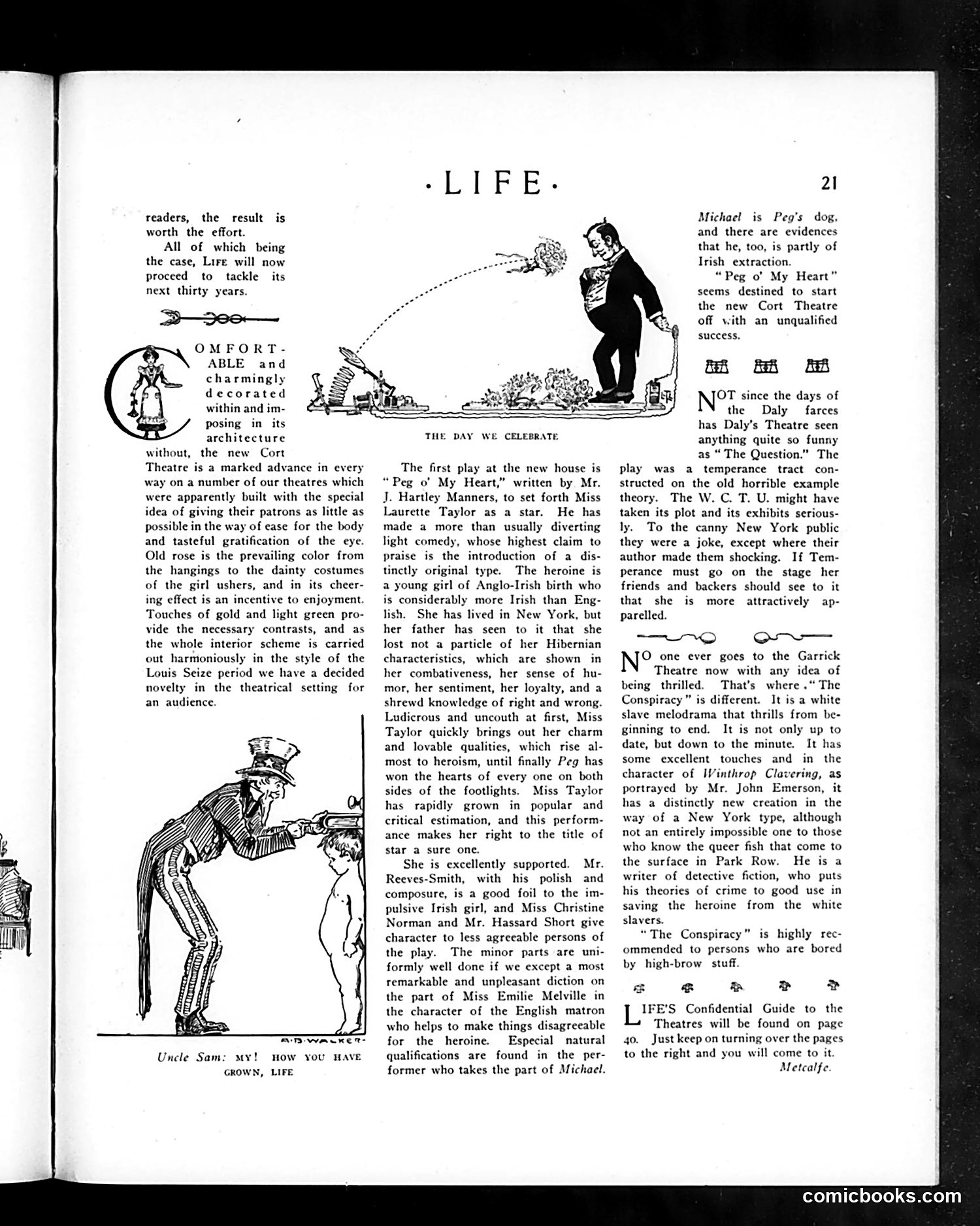
This page reviews several Broadway theatrical productions. The main cartoon depicts **Uncle Sam** (representing America/Life magazine itself) as a child, with the caption "my! how you have grown, life"—a self-congratulatory joke about the magazine's growth and influence. The page primarily discusses the opening of the new **Cort Theatre** and its inaugural production, **"Peg o' My Heart,"** starring **Laurette Taylor**. The review praises both the theater's elegant Louis XVI design and the play itself, which features a distinctly Irish-American female character. Additional reviews cover **"The Question"** (a temperance melodrama the critics found unintentionally comedic) and **"The Conspiracy"** (a white-slave trafficking thriller at the Garrick Theatre). The tone is characteristic of Life's satirical theater criticism—witty, sometimes dismissive, focused on social relevance and performance quality.
📄 Transcribed text from this page (OCR, searchable)
Machine-transcribed from the original scan — historical spelling and the odd misread are preserved.
readers, the result is worth the effort. All of which being the case, Lire will now proceed to tackle its next thirty years, >See OMFORT- ABLE and charmingly decorated within and im- 21 Michael is Peg’s dog, and there are evidences that he, too, is partly of Irish extraction. “Peg o' My Heart” seems destined to start the new Cort Theatre off with an unqualified success, ai GA mA OT since the days of posing in its architecture without, the new Cort Theatre is a marked advance in every way on a number of our theatres which were apparently built with the special idea of giving their patrons as little as possible in the way of ease for the body and tasteful gratification of the eye. Old rose is the prevailing color from the hangings to the dainty costumes of the girl ushers, and in its cheer- ing effect is an incentive to enjoyment. Touches of gold and light green pro- vide the necessary contrasts, and as the whole interior scheme is carried out harmoniously in the style of the Louis Seize period we have a decided novelty in the theatrical setting for an audience. A WAKE Tt Uncle Sam: my! How you HAVE GROWN, LIFE the Daly — farces THE DAY WE CELEBRATE The first play at the new house is “Peg o' My Heart,” written by Mr. J. Hartley Manners, to set forth Miss Laurette Taylor as a star. He has made a more than usually diverting light comedy, whose highest claim to praise is the introduction of a dis- tinctly original type. The heroine is a young girl of Anglo-Irish birth who is considerably more Irish than Eng- lish. She has lived in New York, but her father has seen to it that she lost not a particle of her Hibernian characteristics, which are shown in her combativeness, her sense of hu- mor, her sentiment, her loyalty, and a shrewd knowledge of right and wrong. Ludicrous and uncouth at first, Miss Taylor quickly brings out her charm and lovable qualities, which rise al- most to heroism, until finally Peg has won the hearts of every one on both sides of the footlights. Miss Taylor has rapidly grown in popular and critical estimation, and this perform- ance makes her right to the title of star a sure one. She is excellently supported. Mr. Reeves-Smith, with his polish and composure, is a good foil to the im- pulsive Irish girl, and Miss Christine Norman and Mr. Hassard Short give character to less agreeable persons of the play. The minor parts are uni- formly well done if we except a most remarkable and unpleasant diction on the part of Miss Emilie Melville in the character of the English matron who helps to make things disagreeable for the heroine. Especial natural qualifications are found in the per- former who takes the part of Michael. has Daly’s Theatre seen anything quite so funny as “ The Question.” The play was a temperance tract con- structed on the old horrible example theory. The W. C. T. U. might have taken its plot and its exhibits serious- ly. To the canny New York public they were a joke, except where their author made them shocking. If Tem- perance must go on the stage her friends and backers should see to it that she is more attractively ap- parelled. —_ OD on, O one ever goes to the Garrick Theatre now with any idea of being thrilled. That’s where .“ The Conspiracy” is different. It is a white slave melodrama that thrills from be- ginning to end. It is not only up to date, but down to the minute. It has some excellent touches and in the character of Winthrop Clavering, as portrayed by Mr. John Emerson, it has a distinctly new creation in the way of a New York type, although not an entirely impossible one to those who know the queer fish that come to the surface in Park Row. He is a writer of detective fiction, who puts his theories of crime to good use in saving the heroine from the white slavers. “The Conspiracy” is highly rec- ommended to persons who are bored by high-brow stuff. e cS 2 2 & L' E'S Confidential Guide to the Theatres will be found on page 4o. Just keep on turning over the pages to the right and you will come to it Metcalfe. comicbooks.com