
A complete issue · 44 pages · 1912
Life — October 31, 1912
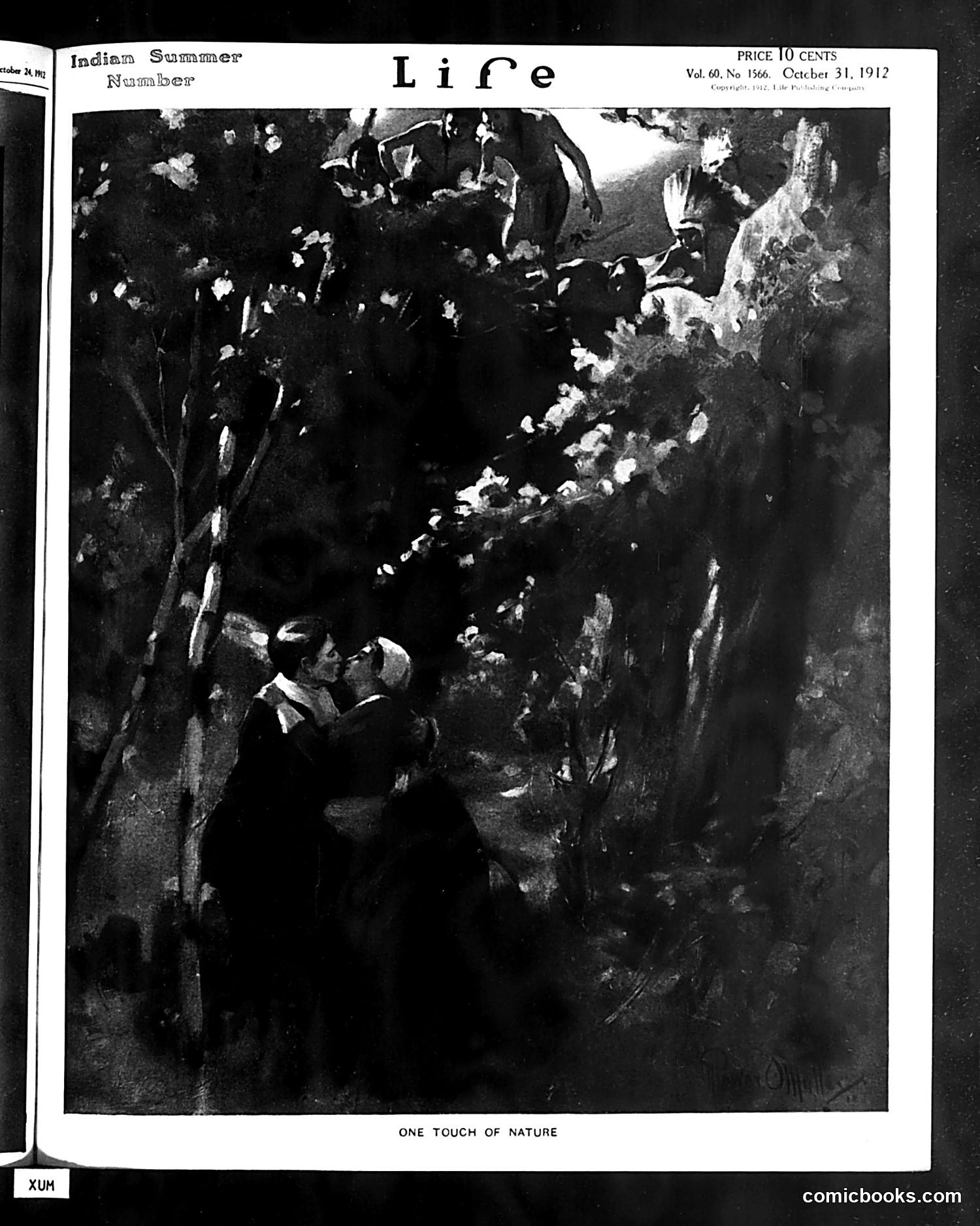
This page from *Life* magazine (October 31, 1912) shows a dark, atmospheric photograph titled "One Touch of Nature." The image depicts figures gathered among flowering plants or vines in what appears to be a natural outdoor setting. Without additional context or captions visible on this page, the specific satirical meaning remains unclear. The title "One Touch of Nature" suggests commentary on human nature or natural instincts, possibly contrasting civilized behavior with primal impulses—a common *Life* magazine theme of this era. The photograph's dramatic lighting and composition suggest it may illustrate a particular social observation or commentary, but the specific political or social reference cannot be determined from the image and limited text alone.
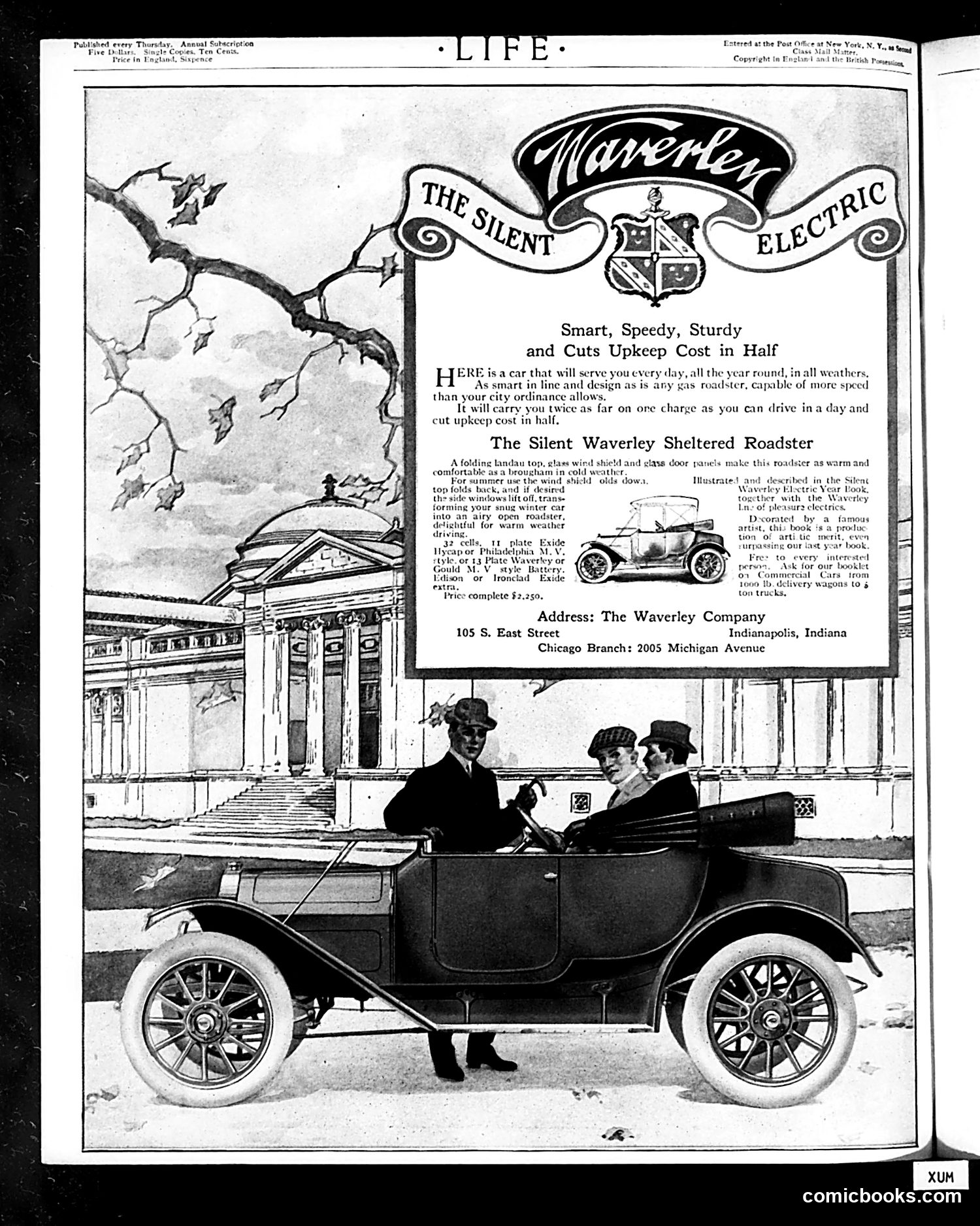
This page is primarily a **Waverley automobile advertisement**, not political satire. The ad promotes "The Silent Waverley Electric" car, emphasizing it as "Smart, Speedy, Sturdy" and claims it "Cuts Upkeep Cost in Half." The main visual shows three well-dressed men with a Waverley roadster parked before what appears to be a civic building. The accompanying illustration depicts the vehicle's "Sheltered Roadster" feature—a folding windshield and convertible top for weather protection. The seasonal imagery on the left (bare tree branches) underscores the car's year-round usability. The ad targets affluent urban drivers seeking reliable, economical transportation. The company's addresses (Indianapolis and Chicago) indicate this is regional marketing from the early automotive era.
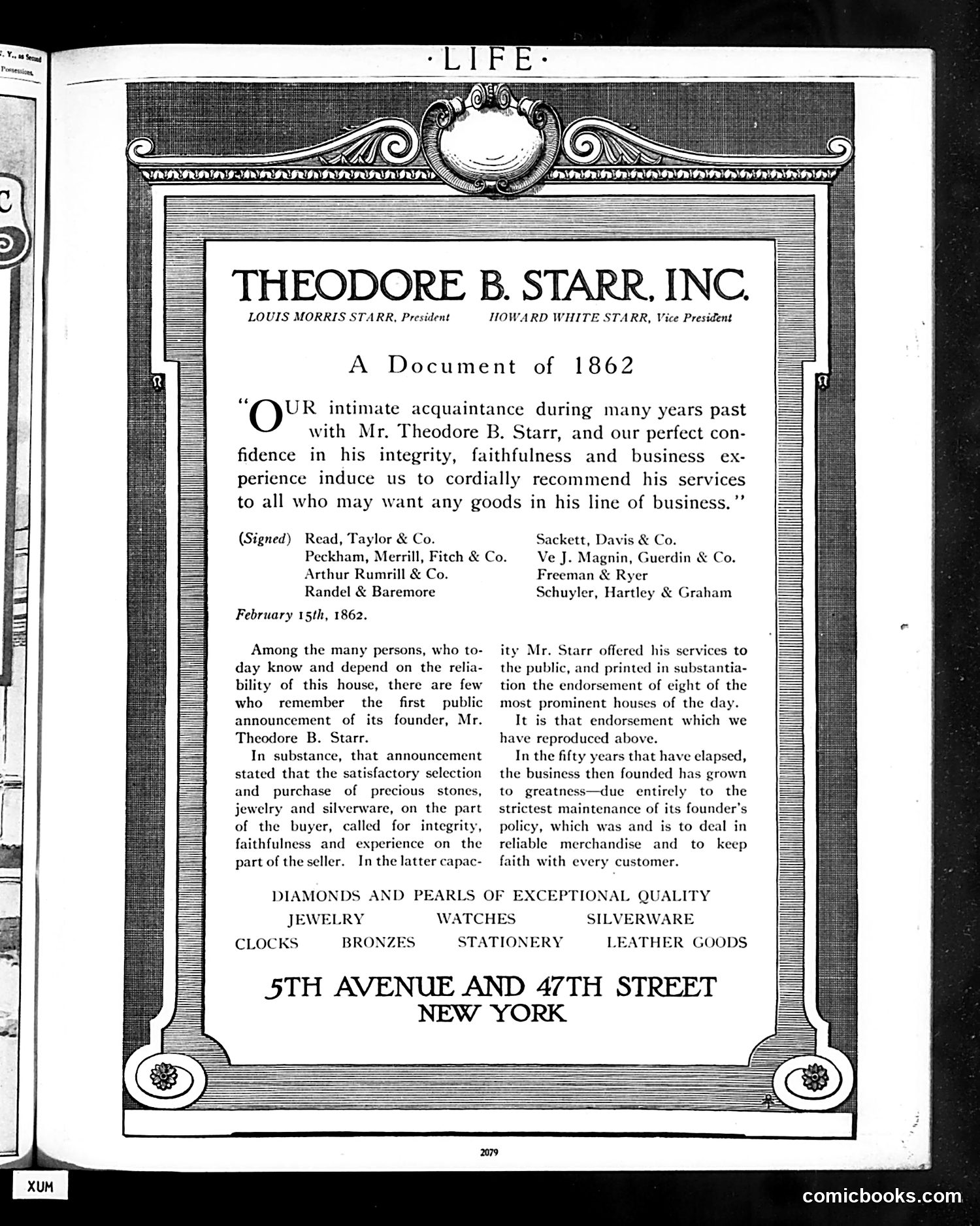
This page is **entirely an advertisement**, not satirical content or a cartoon. It's a formal testimonial for Theodore B. Starr, Inc., a luxury jewelry and goods retailer located at 5th Avenue and 47th Street in New York. The ad reproduces an endorsement document dated February 15, 1862, signed by eight prominent mercantile firms (Read, Taylor & Co.; Peckham, Merrill, Fitch & Co.; and others). These businesses vouch for Theodore B. Starr's integrity and reliability in selling precious stones, jewelry, silverware, and other luxury goods. The advertisement emphasizes that the business has thrived for fifty years by maintaining the founder's original commitment to quality merchandise and customer faith—a pitch emphasizing reliability and established reputation to appeal to wealthy consumers.
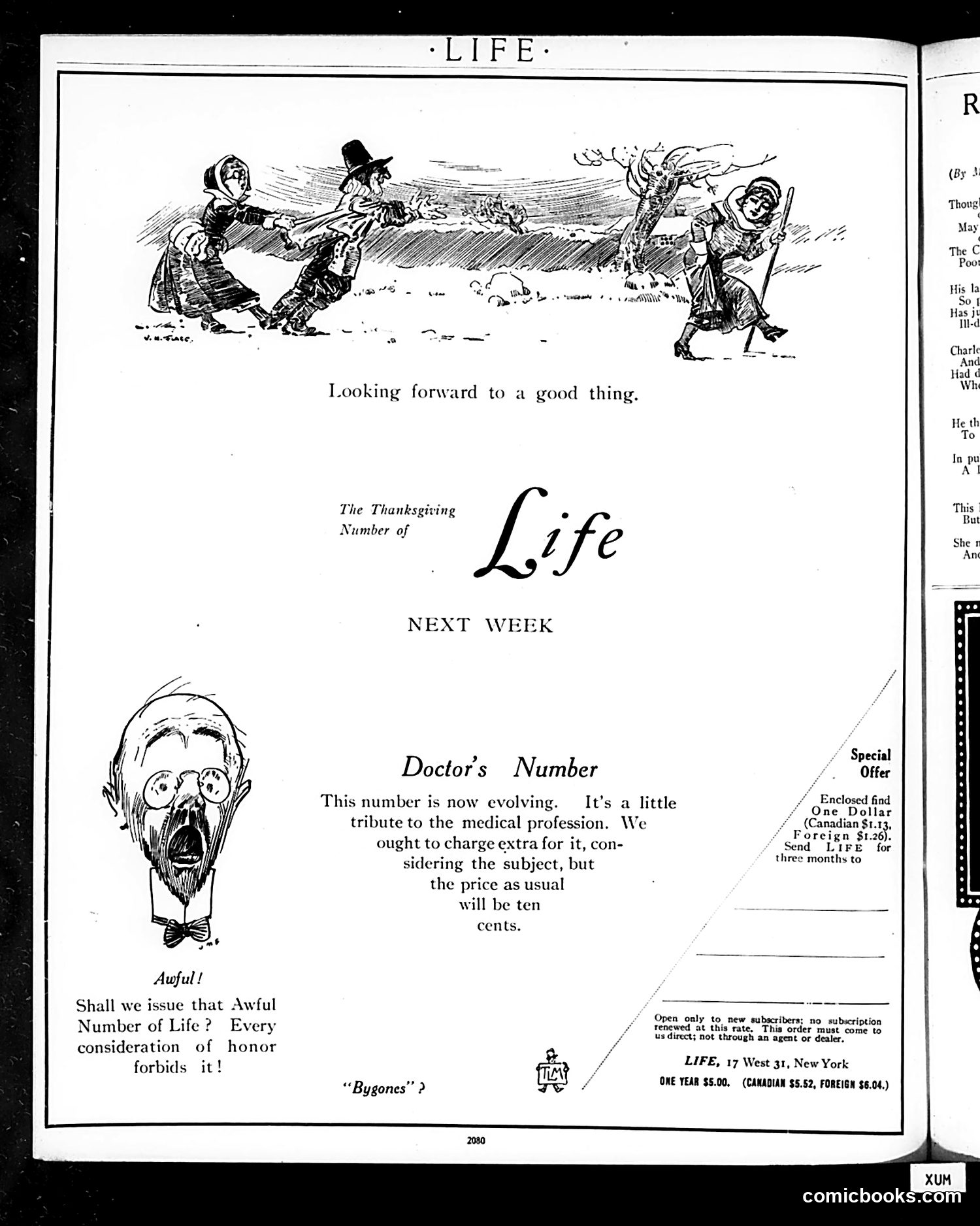
**Top Cartoon**: "Looking forward to a good thing" depicts children playing tug-of-war, likely referencing post-WWI optimism or economic recovery during the prosperous 1920s. **Main Content**: Announces next week's "Thanksgiving Number" of Life magazine. **Bottom Section**: - **"Awful!" cartoon**: A grotesque face with exaggerated features questions whether Life should issue an "Awful Number," suggesting this is satirical commentary on whether such content honors the medical profession. - **"Doctor's Number" announcement**: Life plans to publish a tribute issue to doctors, maintaining their standard ten-cent price despite the special subject matter. The satire appears self-referential—Life playfully questions whether celebrating doctors as "awful" is appropriate, while simultaneously promoting the upcoming issue. The crude caricature style emphasizes the humor in the contradiction.
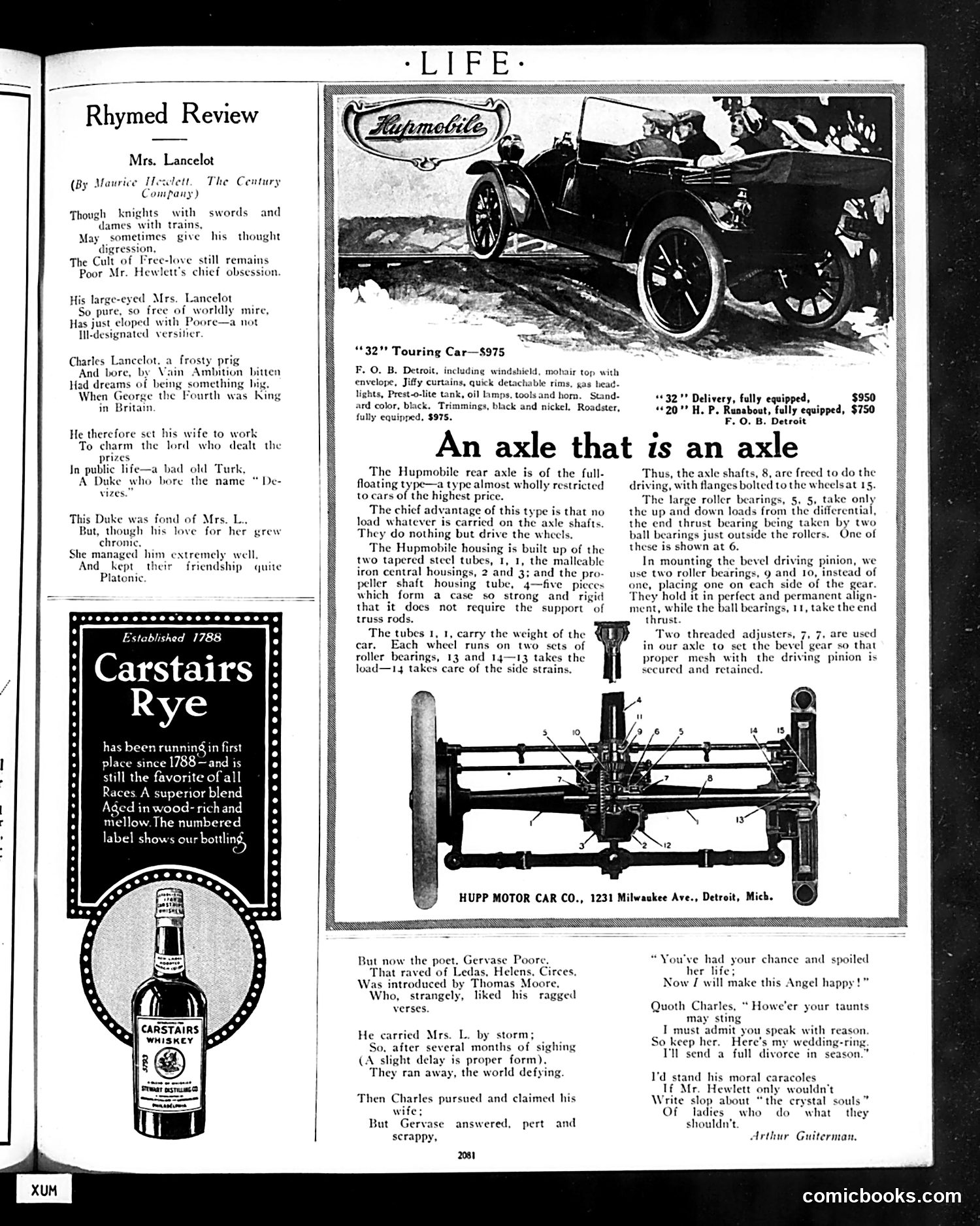
This page is primarily **commercial advertising**, not political satire. The left column contains a "Rhymed Review" of *Mrs. Lancelot* by Maurice Hewlett, a literary work dealing with King Arthur legend and romantic themes. It's a book review in verse form—a common feature in *Life* magazine. The dominant content is **automobile advertising**: a Hupmobile "32" Touring Car ($975) with detailed technical specifications about its axle design. Below that, **Carstairs Rye whiskey** is advertised with a period bottle illustration. The page concludes with poetry (apparently by Arthur Guiterman) about romantic relationships and marriage—possibly connected to the *Mrs. Lancelot* review. No political cartoons or satirical commentary appear here. This is a standard magazine page mixing literature, automotive advertising, and spirits promotion typical of early 20th-century *Life*.
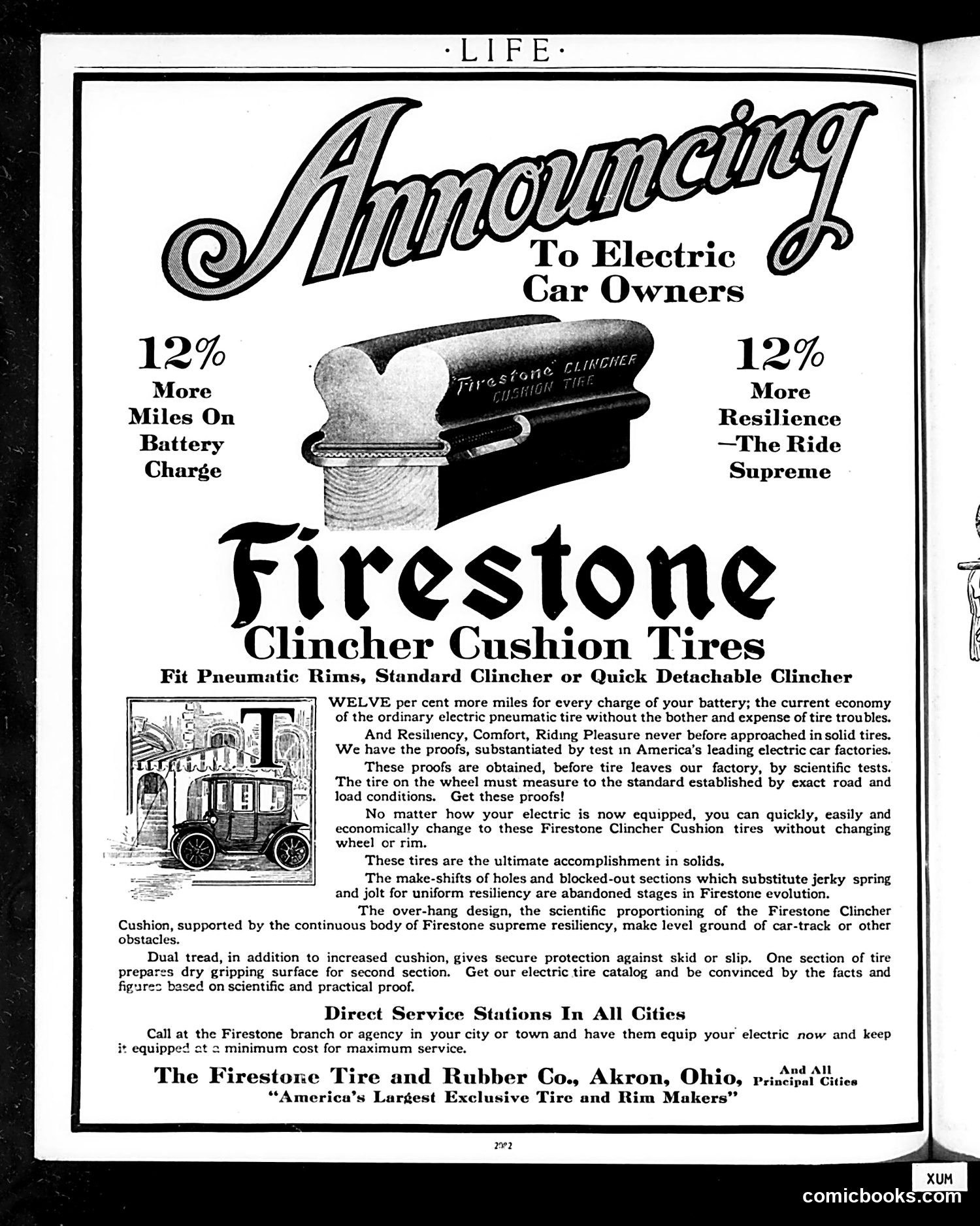
This is **not a cartoon or satire page**—it's a straightforward **advertisement** for Firestone Clincher Cushion Tires, marketed specifically to electric car owners. The ad promotes practical benefits: 12% more miles per battery charge and improved ride comfort. The illustration shows a tire cross-section and an early electric vehicle. The **historical context**: In the 1910s-1920s, electric cars were a viable alternative to gasoline vehicles, particularly popular with urban drivers. Firestone is pitching specialized tires to this market segment, emphasizing how better tires could extend the limited range of electric batteries—a key concern for potential buyers. The page reflects a now-vanished moment when electric vehicles were commercially significant before gasoline engines dominated the market.
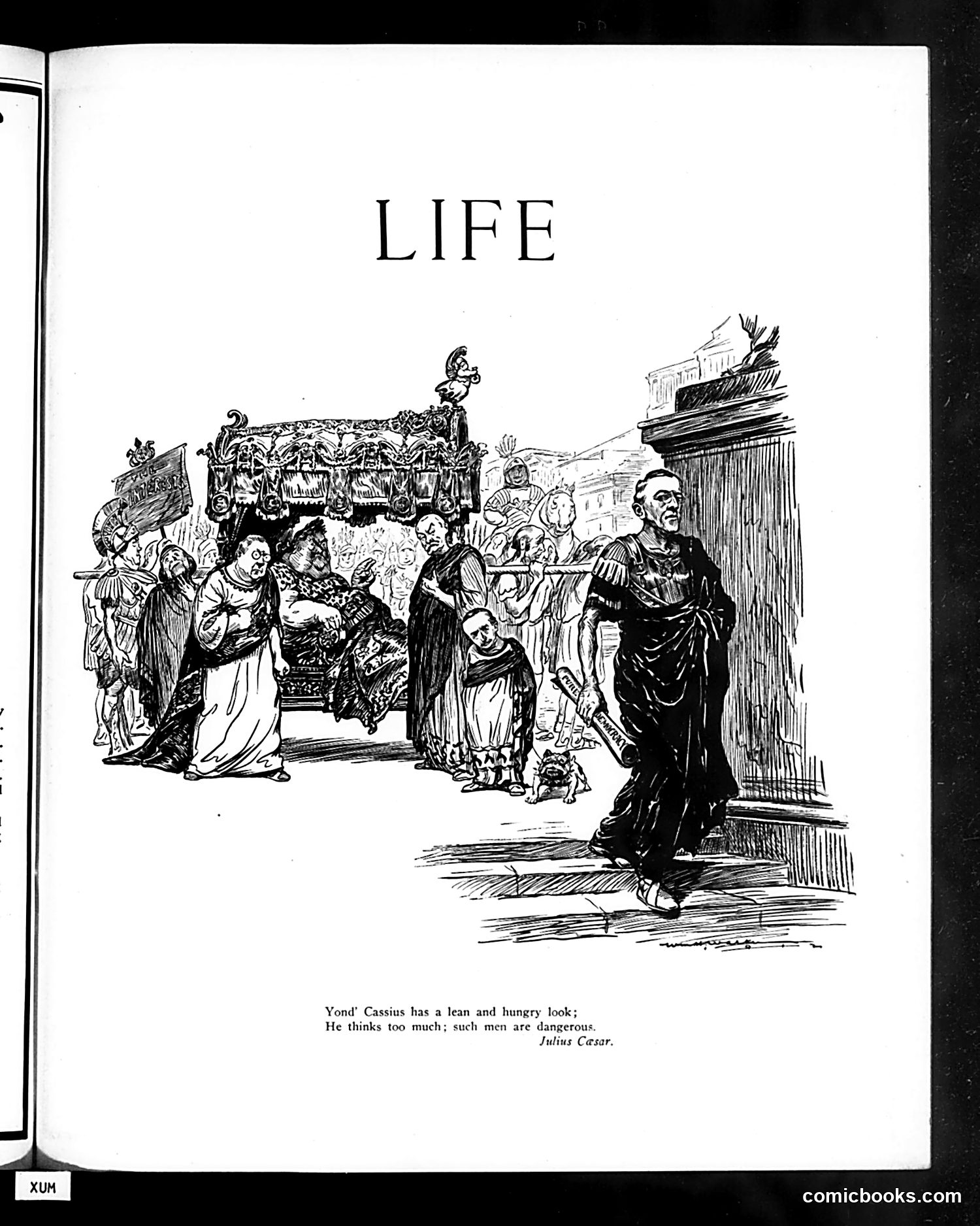
This is a title page for a section called "LIFE" featuring a classical historical scene. The illustration depicts what appears to be a Roman or ancient court setting, with elaborately dressed figures in togas and formal military dress gathered around a central ornate chair or throne. A lean, stern-faced man in dark robes stands prominently on the right, observing the scene. The caption quotes Julius Caesar: "Yond' Cassius has a lean and hungry look; He thinks too much; such men are dangerous." This is a direct reference to Shakespeare's *Julius Caesar*, specifically Antony's famous speech. The satire likely uses this classical allusion to comment on contemporary politics—applying ancient warnings about dangerous, ambitious men to modern figures. Without knowing the specific publication date, the exact political target remains unclear, but the message warns readers to be wary of thin, intellectual conspirators.
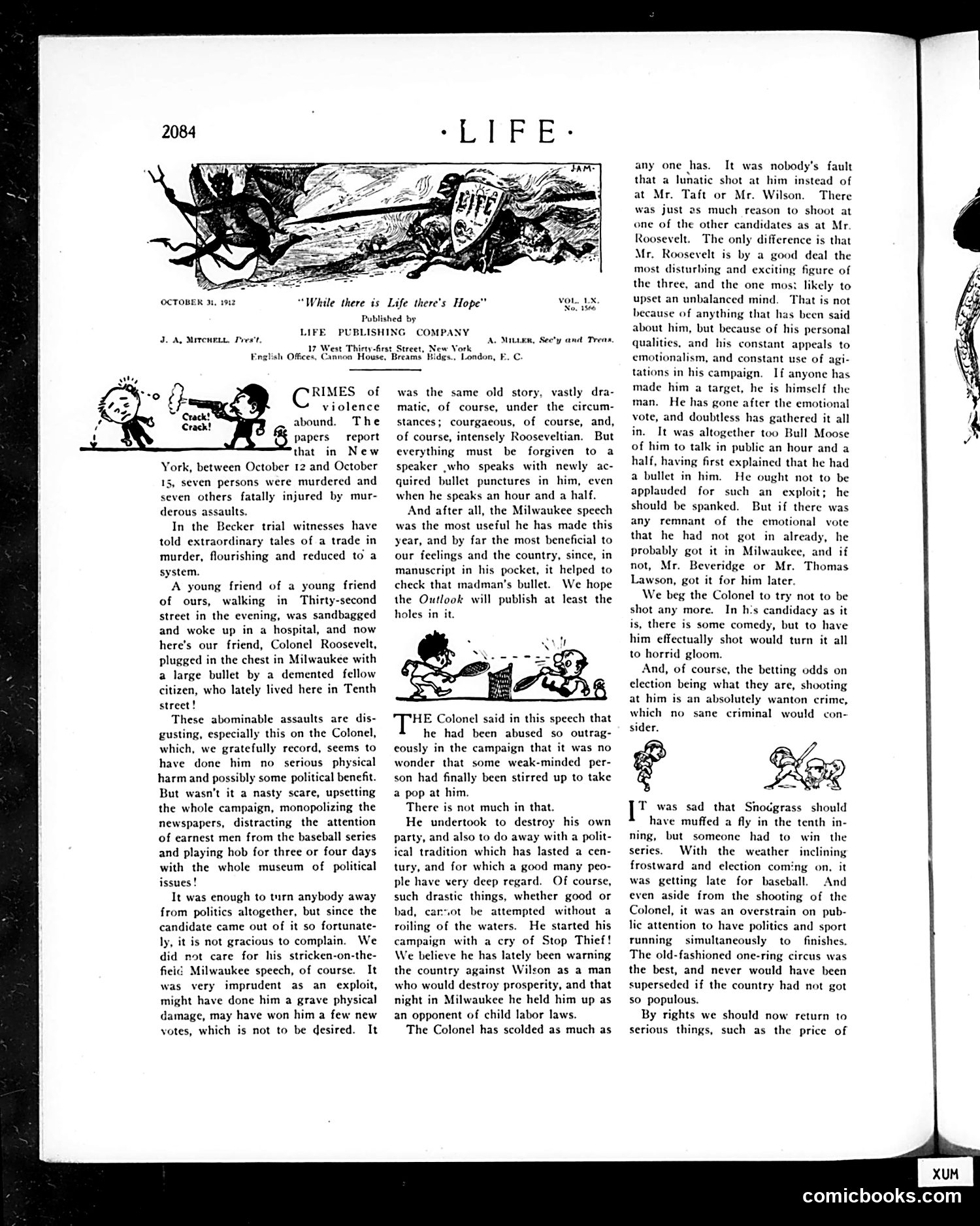
This page satirizes violence during the 1912 U.S. presidential campaign. The headline "While there is Life there's Hope" accompanies commentary on seven murders and assaults occurring in New York between October 12-15, 1912. The text identifies Colonel Roosevelt as a target of criticism. It argues that while Roosevelt's Milwaukee speech was impactful, the emotional intensity of his campaign—his constant appeals to "emotionalism" and "agitation"—may have incited some violence, even if unintentionally. The cartoon illustrations (showing cartoon violence) reinforce the satirical point about the heated campaign rhetoric. The piece ultimately critiques all candidates for engaging in inflammatory language while distancing responsibility for actual violence, suggesting such "wanton crime" has no legitimate place in democratic politics.
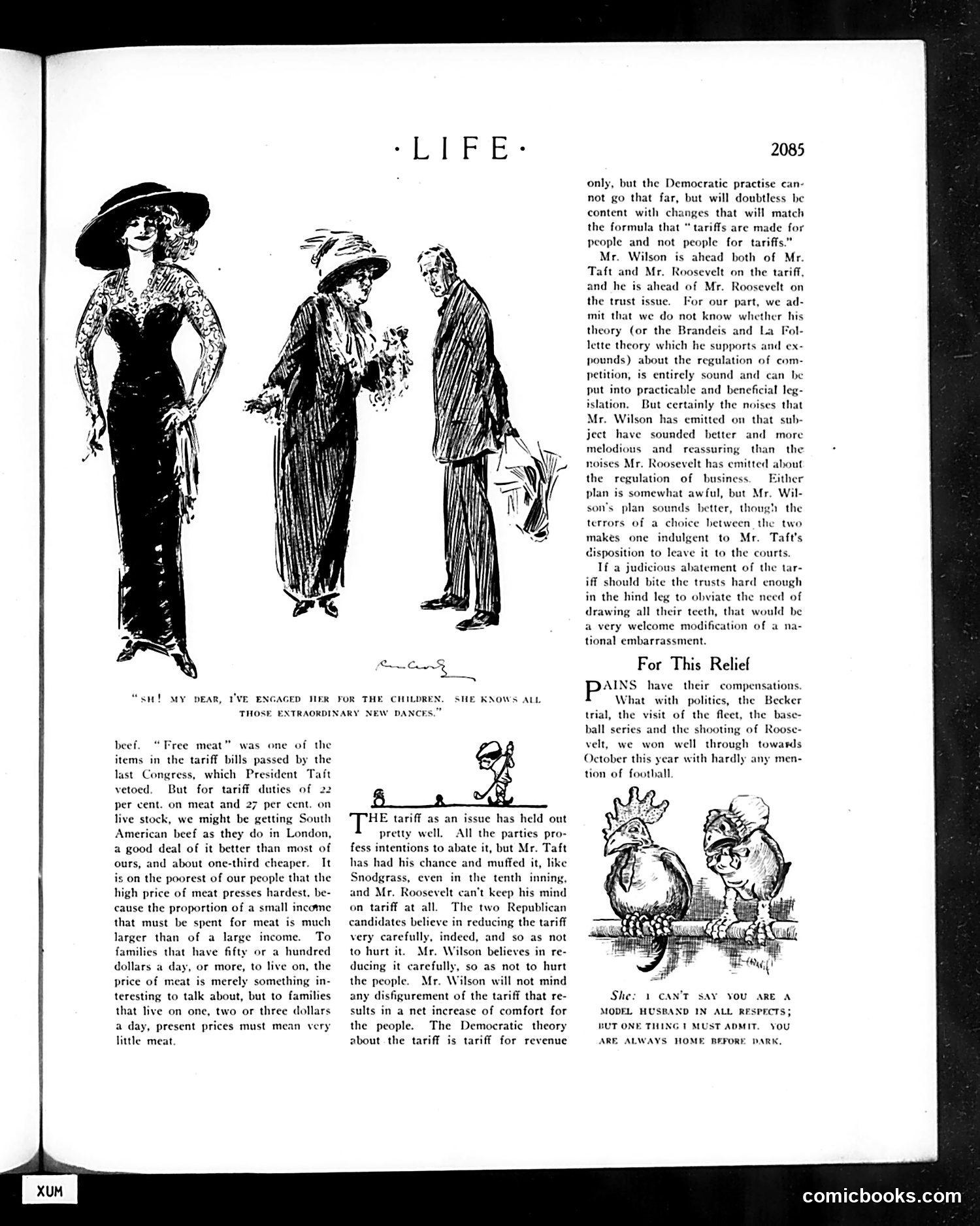
This page satirizes early 20th-century tariff debates. The main cartoon shows a fashionably dressed woman telling two men: "Sir! My dear, I've engaged her for the children. She knows all those extraordinary new dances." The satire targets politicians' competing tariff proposals—specifically those of Taft, Roosevelt, and Wilson (referenced in the text). The woman represents a voter or the nation itself, "hiring" a tariff policy like hiring a governess. The text discusses how "free meat" (a tariff bill item) affects poor families struggling with high food prices, contrasting Republican and Democratic approaches to tariff reduction. The joke critiques how politicians treat complex economic policy as interchangeable fashion choices rather than serious governance affecting working families' budgets.
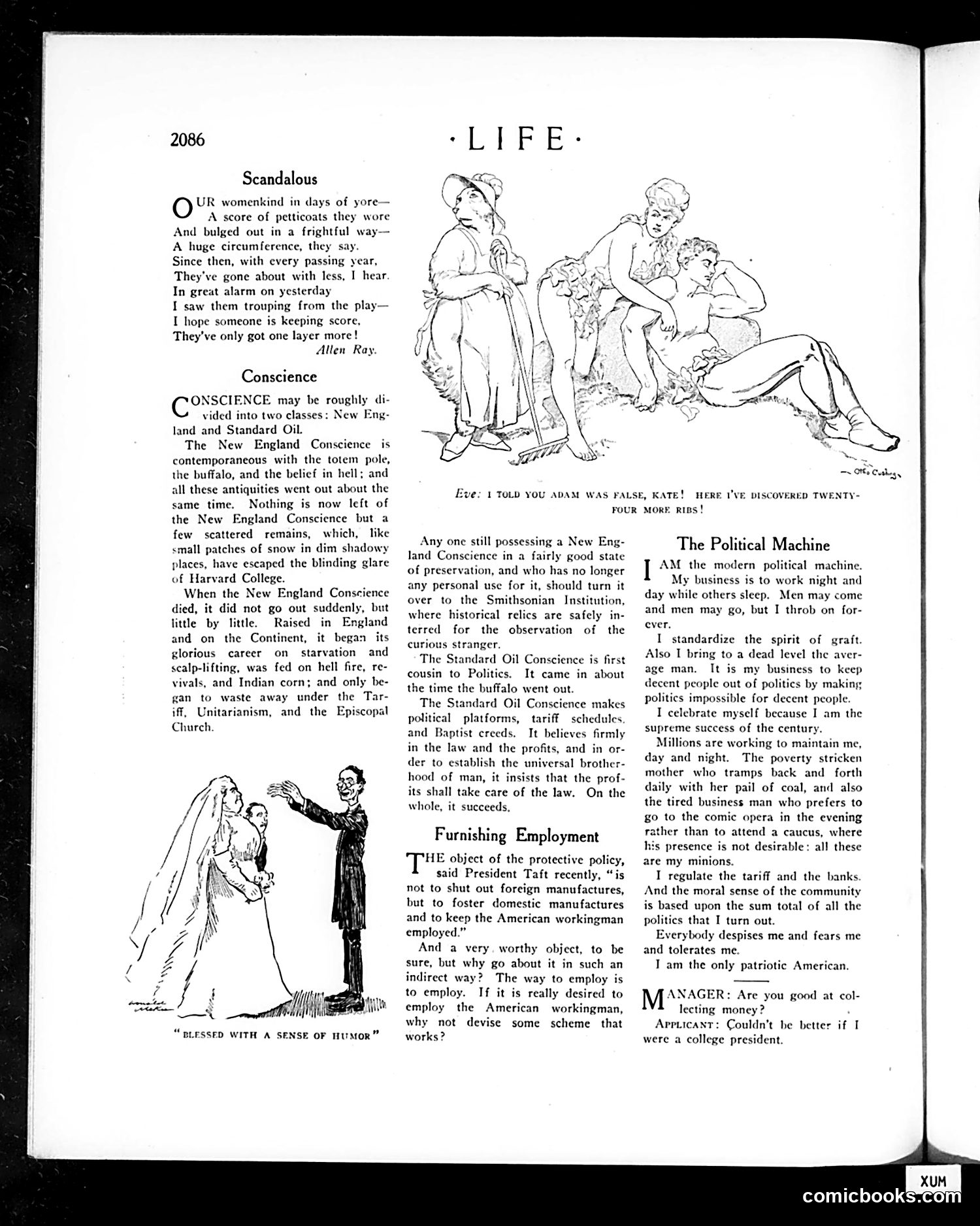
This page contains three satirical pieces: **"Scandalous"** (poem by Alben Key): Mocks women's fashion evolution, noting that women's petticoats have gradually disappeared over decades, leaving "only got one layer more." **"Conscience"**: A lengthy essay satirizing the "New England Conscience"—the moral smugness associated with Puritan New England tradition. It mockingly traces how this conscience evolved into Standard Oil's business ethics and political corruption, suggesting American capitalism appropriated moral language while pursuing profit. **"The Political Machine"**: A first-person monologue where a personified political machine boasts of its power to manipulate voters, suppress reform through tariffs and banks, and keep the working poor distracted with entertainment rather than civic engagement. All pieces critique American hypocrisy: fading morality standards, commercialized ethics, and systemic political corruption.
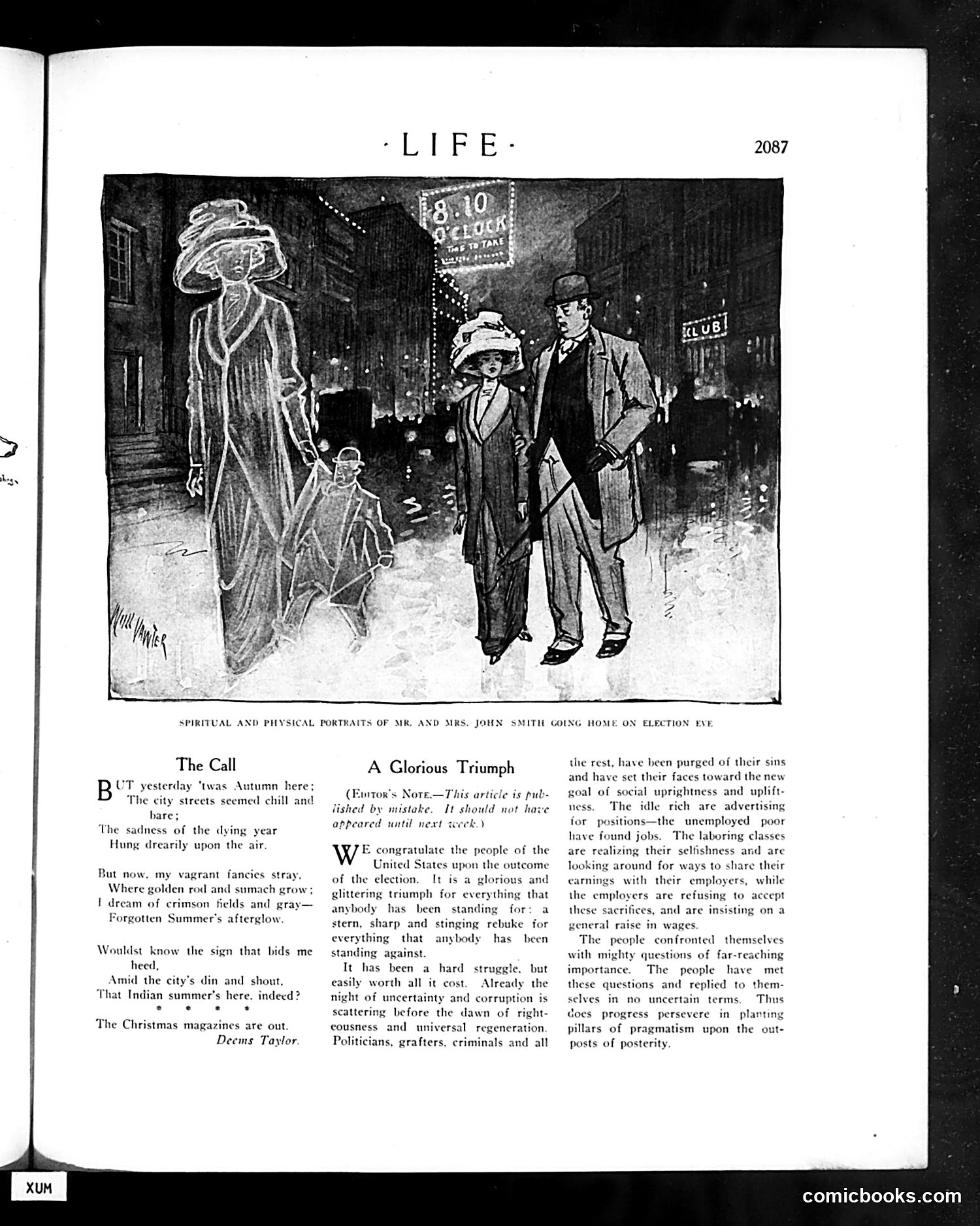
**The Illustration:** The cartoon depicts "Spiritual and Physical Portraits of Mr. and Mrs. John Smith Going Home on Election Eve." On the left, ghostly/ethereal figures represent their "spiritual" selves; on the right, their ordinary physical appearances. The contrast suggests the transformative power of election day on ordinary citizens. **The Articles:** "The Call" (a poem by Deems Taylor) celebrates autumn and Indian summer, apparently using seasonal imagery metaphorically. "A Glorious Triumph" credits the election outcome to popular will triumphing over corruption and uncertainty. The editorial notes social progress—unemployed poor finding work, wage increases, and the wealthy questioning their privilege—suggesting optimism about post-election reforms and renewed faith in democratic institutions and progress.
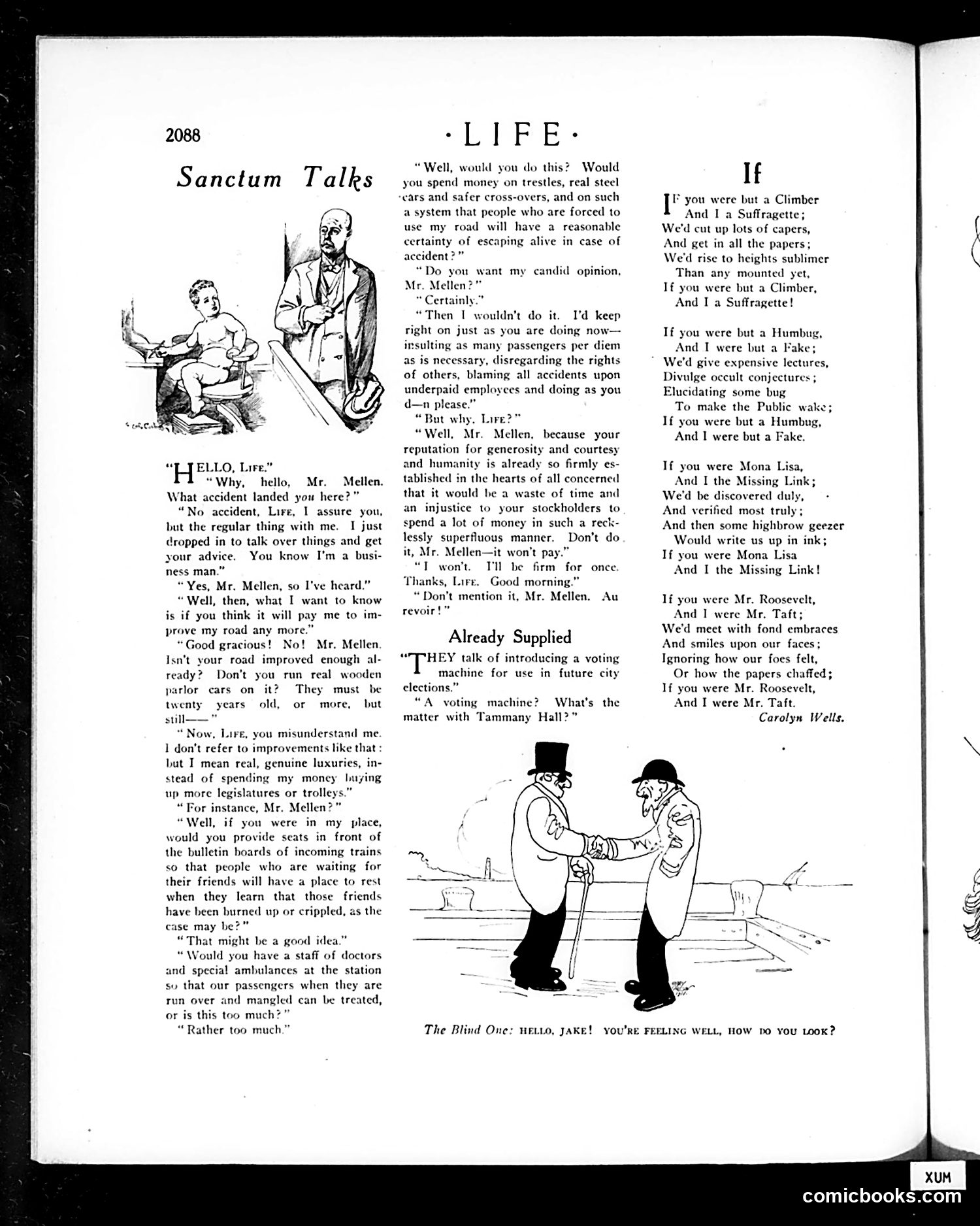
This page contains two satirical pieces about early 20th-century transportation and social commentary. **"Sanctum Talks"** features a dialogue between "Life" and Mr. Mellen (likely Andrew J. Mellen, a railroad executive), who defends unsafe railroad practices. Life criticizes his prioritization of profit over passenger safety, sarcastically praising his "generosity" while condemning wasteful spending on safety improvements. **"Already Supplied"** mocks a "voting machine" proposal for city elections through a crude joke about a "blind" man greeting "Jake," with the caption suggesting election fraud or manipulation. **"If"** is a poem by Carolyn Wells imagining social role reversals—if famous figures switched places—typical of Life's humorous social satire. The cartoons critique corporate negligence and electoral corruption, common Progressive Era concerns.
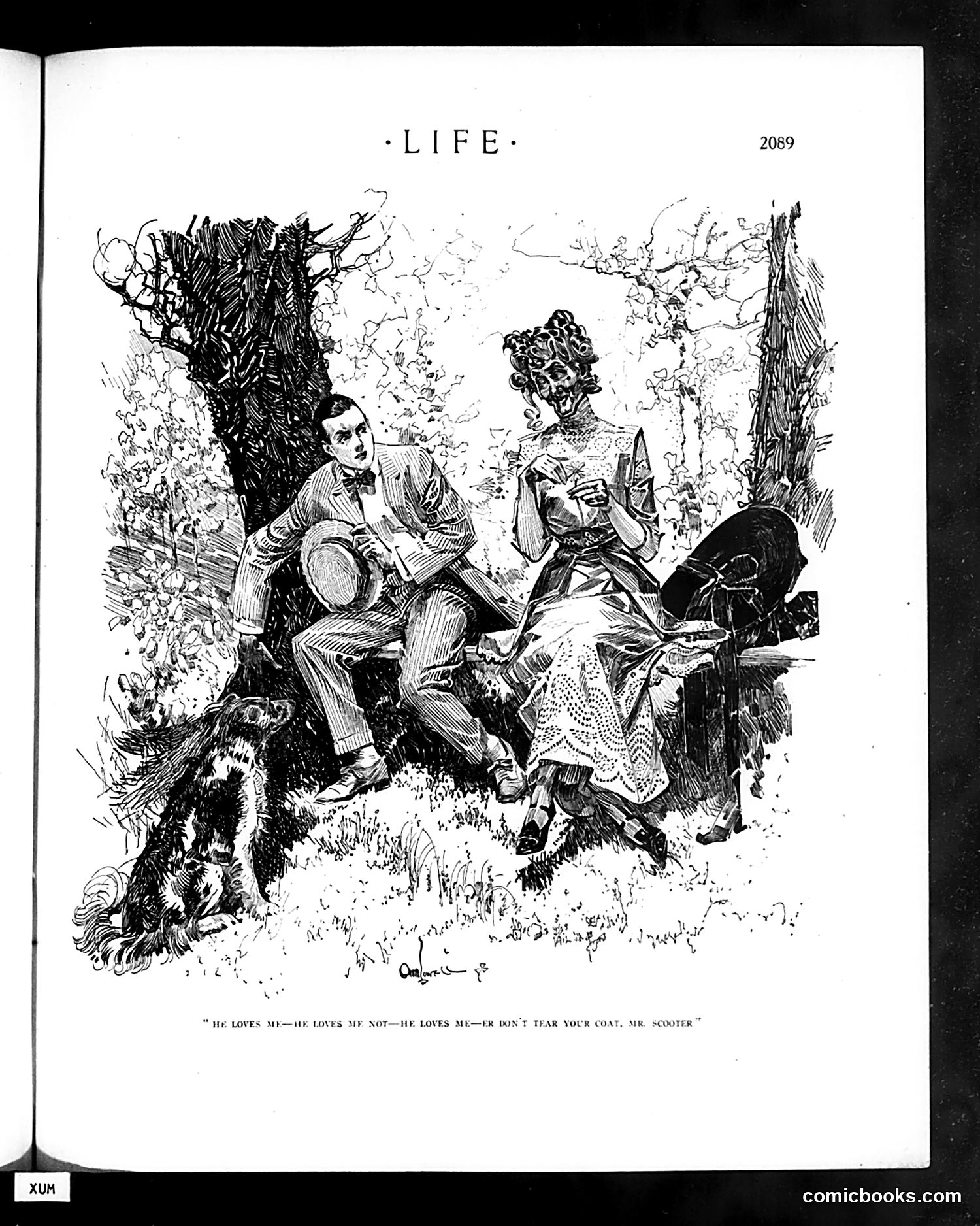
This is a satirical cartoon depicting a romantic scene between a well-dressed man and woman in an outdoor setting with a dog present. The caption reads: "HE LOVES ME—HE LOVES ME NOT—HE LOVES ME—ER ISN'T TEAR YOUR COAT, MR. SCOOTER" The humor appears to be about romantic uncertainty and mixed signals in courtship. The woman is plucking petals (the traditional "he loves me, he loves me not" game), while the man seems more concerned with protecting his coat from the dog. This deflates the romantic moment with practical mundanity—suggesting the man's actual priorities may not align with romantic devotion. The cartoon satirizes the gap between romantic idealization and everyday reality in relationships.
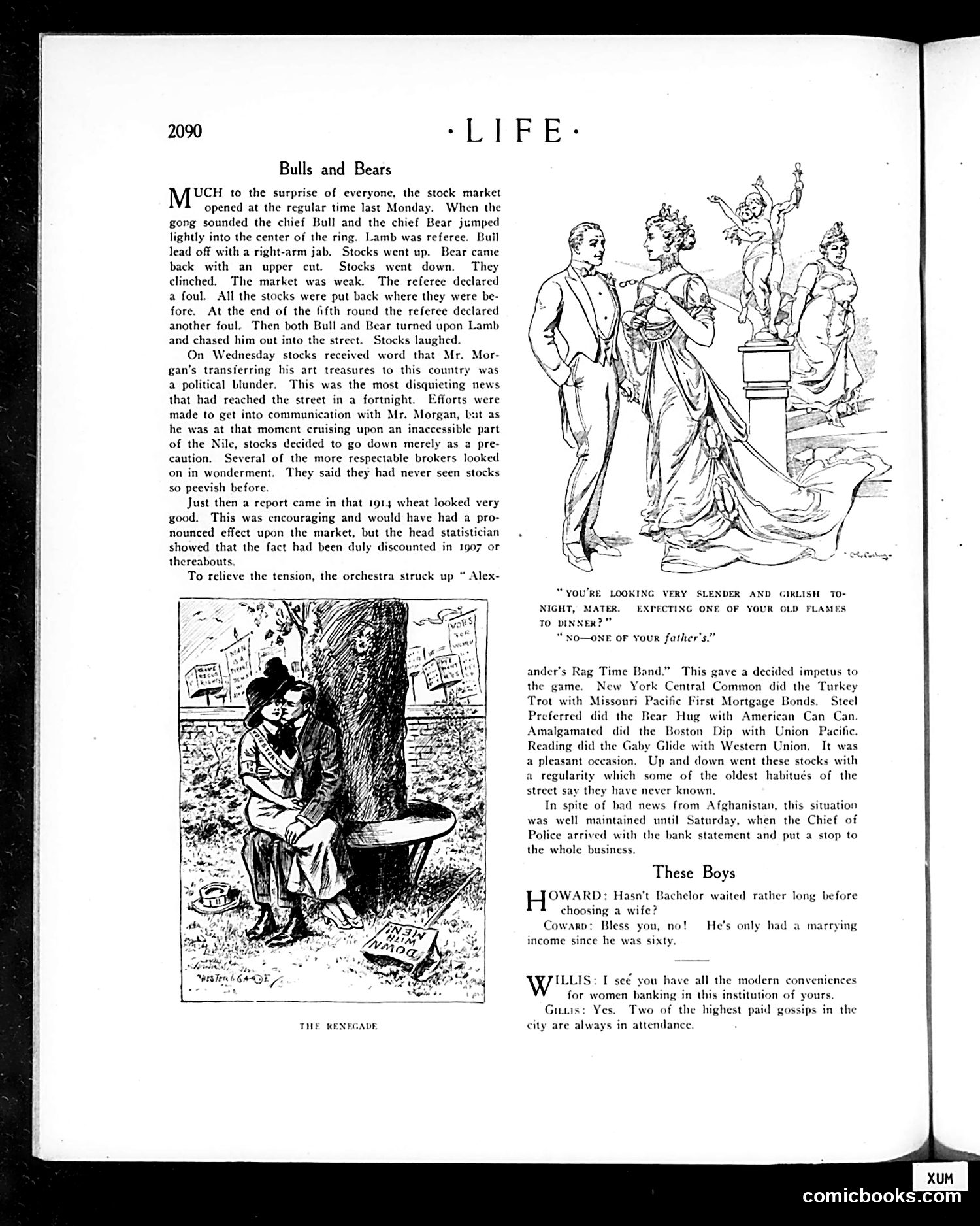
This page satirizes the chaotic 1914 stock market. The main article describes a volatile trading day where the "chief Bull and chief Bear jumped lightly into the center of the pit"—personifying market forces as combatants. Bulls (optimists betting prices rise) and Bears (pessimists betting prices fall) literally fight for control. The left cartoon shows a dejected figure labeled "The Renegade," appearing to represent a trader ruined by market swings. The dialogue sections below mock wealthy brokers' casual indifference to market turmoil—they discuss wives, banking conveniences, and gossip while fortunes shift around them. The satire suggests Wall Street elites remain detached from the chaos they cause, caring more about social status than actual financial consequences.
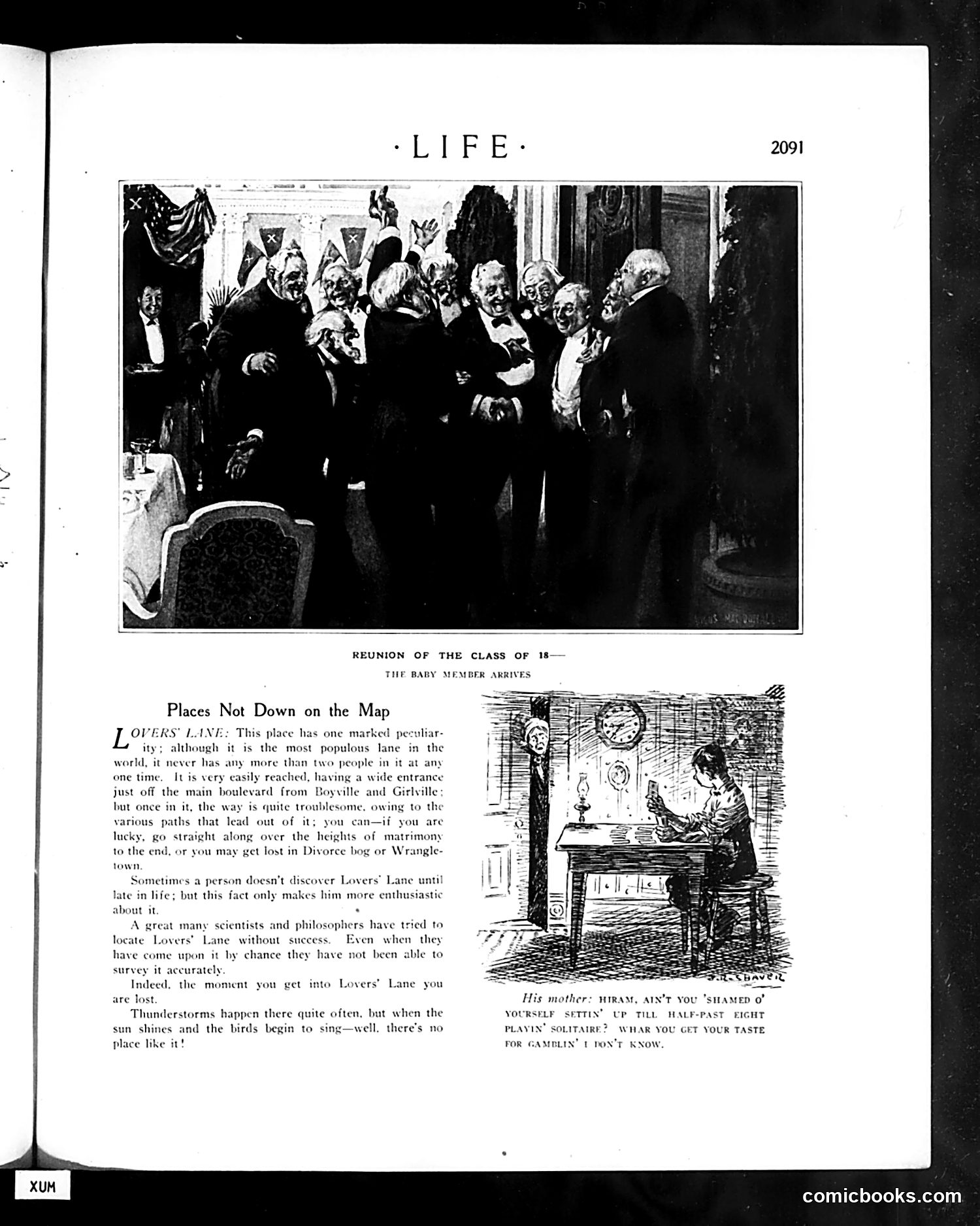
This page contains two satirical pieces about romance and domesticity. The top photograph shows a formal class reunion, captioned "The Baby Member Arrives"—likely joking about a latecomer to a gathering. The main article is a humorous, allegorical essay describing "Lovers' Lane" as an unmappable place that exists between "Boyville and Girlville," with various exits leading to "matrimony," "Divorce bog," or "Wrangletown." It jokes that the location is impossible to navigate accurately and that people become "lost" once they enter—satirizing the irrationality and unpredictability of romantic relationships. The accompanying illustration depicts a mother scolding her son for playing solitaire late into the evening, humorously asking where he acquired a taste for gambling. This appears to be gentle domestic satire about parental concern and youthful behavior. Together, these pieces satirize romance, marriage prospects, and family life through whimsical, allegorical humor typical of early-20th-century Life magazine.
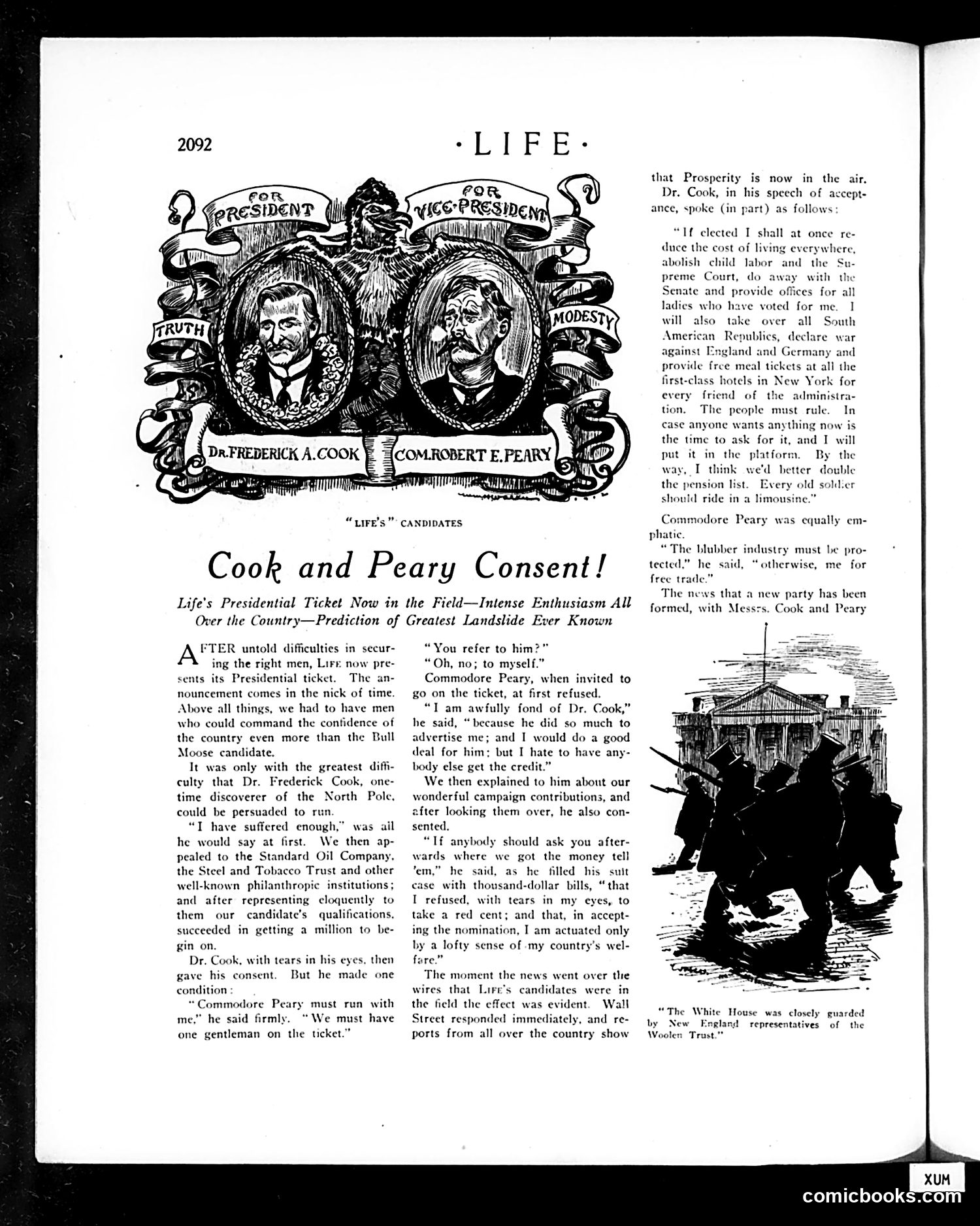
This is political satire mocking the 1912 presidential race. Life magazine humorously proposes Dr. Frederick Cook (the controversial Arctic explorer) and Commodore Robert Peary (his rival) as presidential candidates—a joke because both explorers had disputed claims to discovering the North Pole, making them symbols of fraudulence and self-promotion. The satire targets: - **Corporate influence**: Major trusts (Standard Oil, Steel, Tobacco) fund the campaign, exposing how money controls politics - **Empty political promises**: Cook's acceptance speech promises absurdities (abolishing the Supreme Court, free meals, declaring wars) to show politicians will promise anything - **Moral corruption**: Both candidates reluctantly accept only after being bribed with cash, then deny taking money—satirizing political hypocrisy The joke is that these two discredited, self-serving men perfectly represent American politics as Life saw it: corrupted by corporate money and populated by con artists making impossible promises to voters.
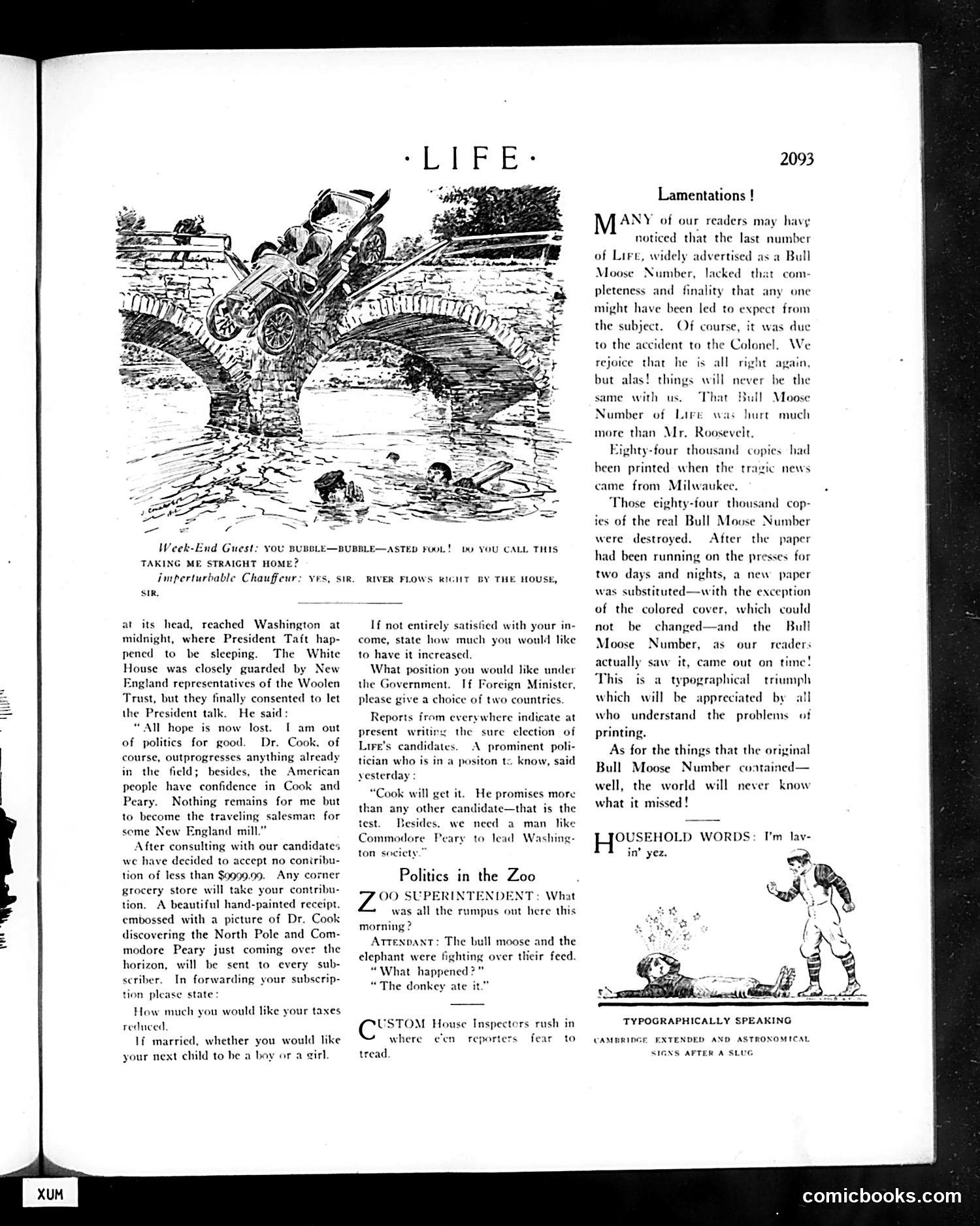
This page from Life magazine contains multiple satirical pieces targeting early 1900s American politics, likely from around 1912 (the "Bull Moose" references suggest Theodore Roosevelt's Progressive Party campaign). **Top cartoon**: Shows a car accident at a bridge with a chauffeur reassuring his passenger they're heading home. The "Imperturbable Chauffeur" joke satirizes nonchalance in dangerous situations—a common motif for poking fun at class differences and servant behavior. **Main text ("Lamentations!")**: Life explains that their recent "Bull Moose Number" (celebrating Roosevelt's third-party candidacy) was largely destroyed in a printing accident in Milwaukee, and a substitute issue ran instead. This is self-deprecating humor about their own publication disaster. **"Politics in the Zoo"**: A brief joke where zoo animals fighting over food mirrors political conflict—the donkey eating the disputed item suggests political figures are as predictable and base as animals. **Bottom section**: Satirizes political campaign fundraising with absurd donation requests and questions about government positions, mocking the transactional nature of Gilded Age politics.
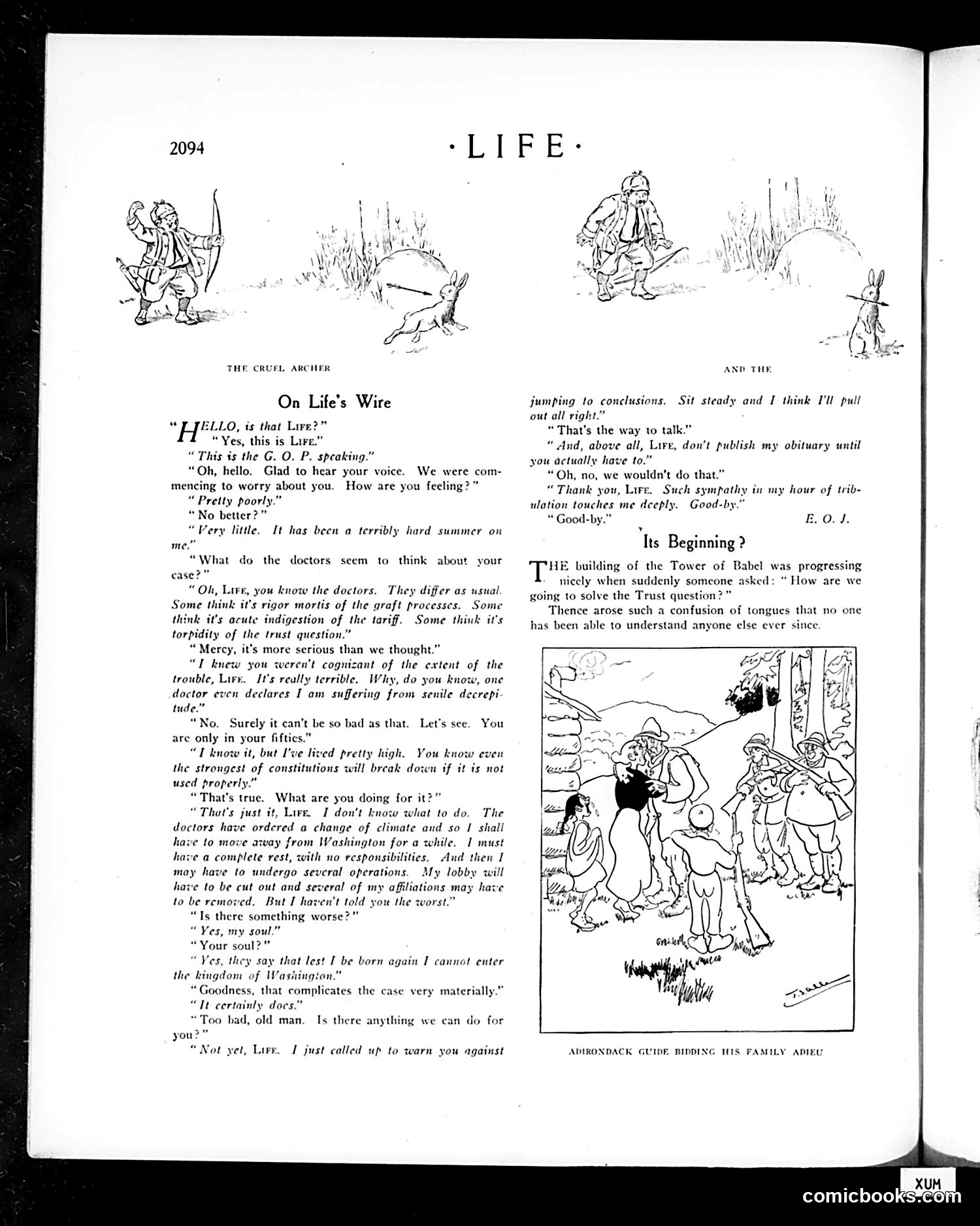
This satirical piece presents a telephone conversation between "Life" (the magazine) and the Republican Party (G.O.P.), personified as a sick patient. The Republican Party describes itself as suffering from multiple ailments: "rigor mortis of the graft processes," "acute indigestion of the tariff," and "torpidity of the trust question"—all references to contemporary political scandals and policy debates of the early 1900s. The satire mocks the GOP's corruption (grafts), protectionist trade policies (tariff troubles), and failure to regulate monopolistic trusts. The "senile decrepitude" diagnosis and prescription for "complete rest" away from Washington suggest the party needs radical reform. The dark joke about needing spiritual rebirth adds moral critique. The accompanying Babel cartoon reinforces the theme: when someone asks how to solve the "Trust question," confusion erupts—suggesting monopoly regulation had become incomprehensibly contentious political territory, rendering rational discourse impossible.
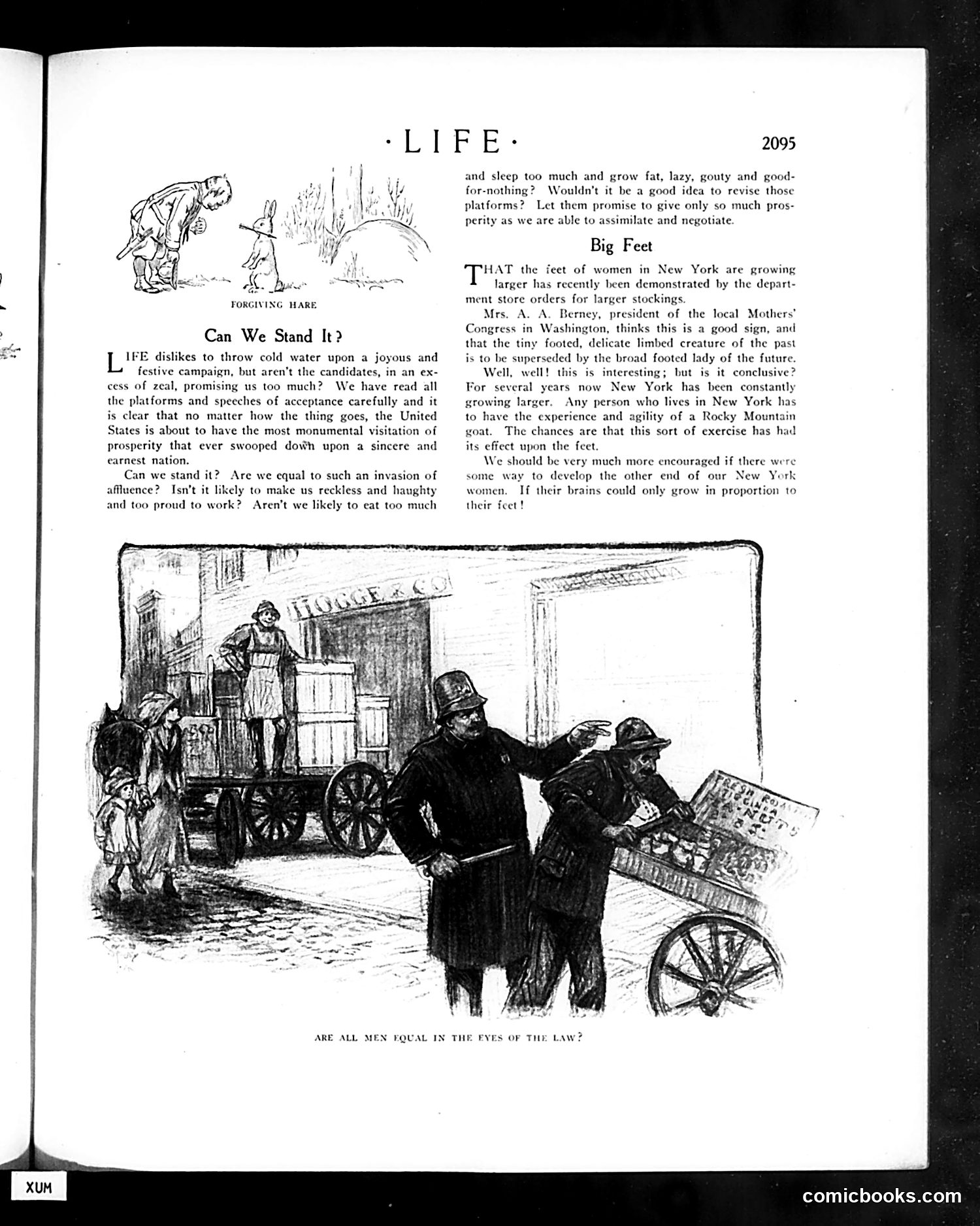
This 1912 *Life* magazine page contains two satirical pieces: **"Can We Stand It?"** mocks campaign promises of prosperity. Politicians claim the winning candidate will bring unprecedented wealth—but the author sarcastically warns this could make Americans lazy, gluttonous, and arrogant. The joke: promises of prosperity are so extravagant they're absurd. **"Big Feet"** responds to a news story that New York women's feet are growing larger (evidenced by increased stocking orders). A women's organization president celebrates this as progress—the "delicate" woman of the past yielding to a stronger modern woman. Life's editor agrees feet may be enlarging from urban exercise, then delivers the punchline: women's *brains* should grow proportionally to their feet. This is misogynistic satire suggesting women lack intelligence—a common trope of the era. The bottom cartoon (caption: "Are All Men Equal in the Eyes of the Law?") appears to depict street vendors or laborers, likely satirizing class inequality, though context is unclear from the image alone.
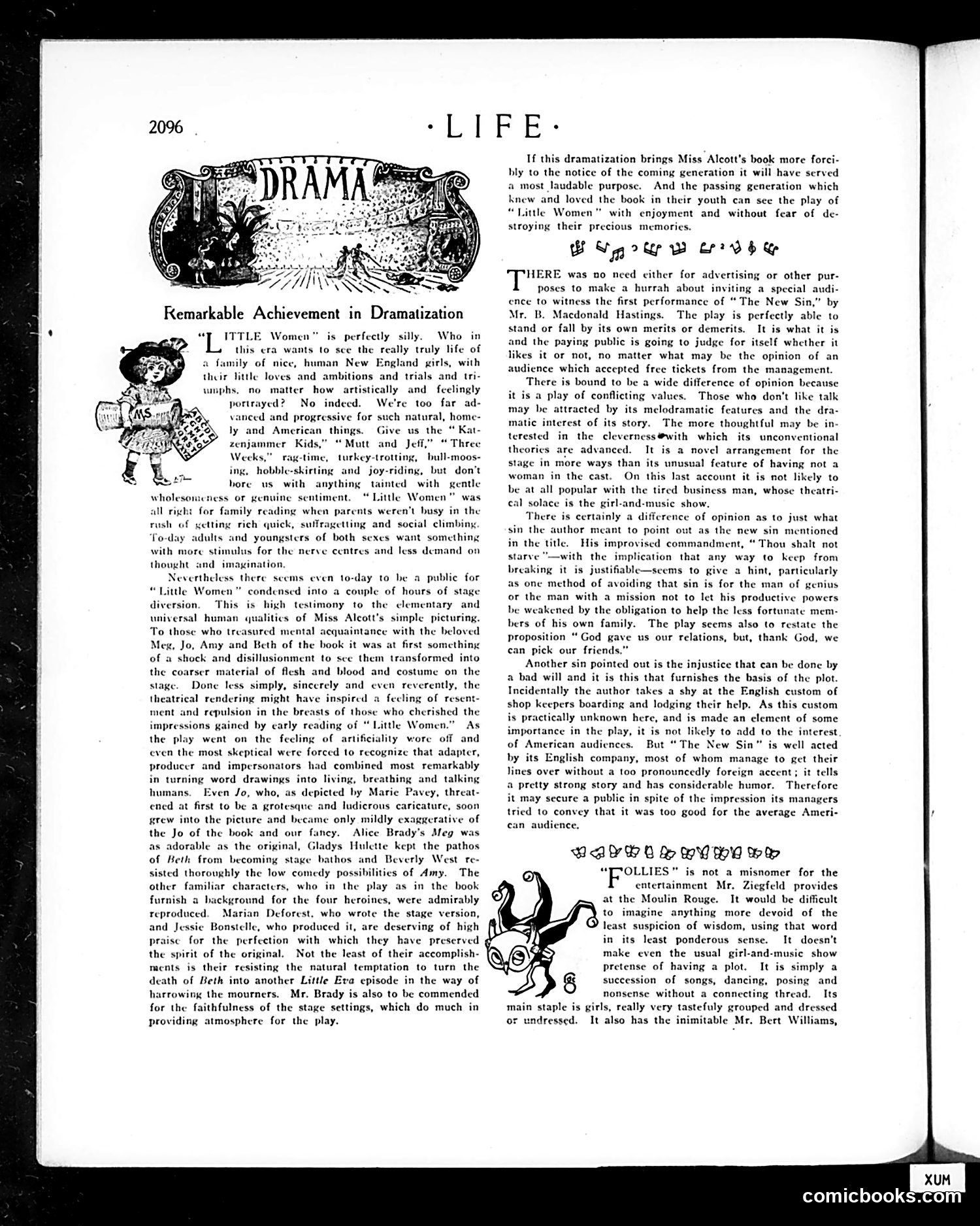
This page reviews theatrical adaptations of two works: Louisa May Alcott's *Little Women* and "The New Sin" by B. Macdonald Hastings. The *Little Women* review is notably **satirical about modern tastes**. The critic opens by mocking contemporary audiences' supposed rejection of wholesome, domestic stories in favor of sensational entertainment ("Mutt and Jeff," "Three Weeks," ragtime, suffragetting). The satire suggests modern readers consider such gentle fare outdated and unstimulating. However, the review praises the stage adaptation's faithfulness to Alcott's original spirit, noting cast members (Marie Pavey as Jo, Alice Brady as Meg) successfully translated the beloved characters into living performances without artificiality. The "New Sin" section begins curtly, indicating the play requires no hype—it must succeed on its own merits, suggesting the critic finds it less naturally appealing than *Little Women*. The small decorative illustrations appear decorative rather than satirical commentary.
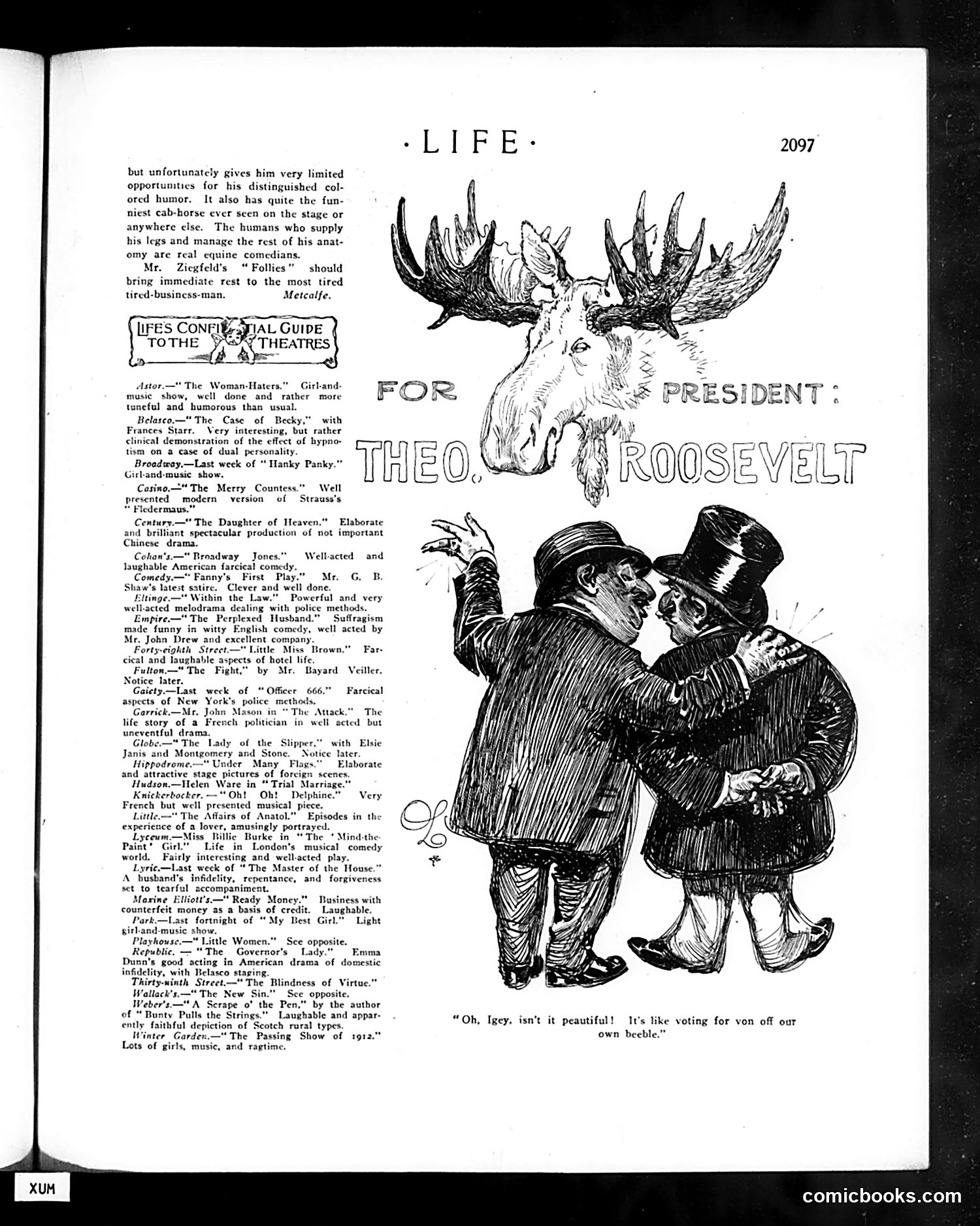
This is a satirical cartoon from Life magazine mocking Theodore Roosevelt's potential presidential ambitions. The central image depicts a moose—a majestic but ungainly animal—presented as a candidate "FOR PRESIDENT." **The Reference:** Roosevelt was famously associated with moose hunting. The cartoon uses the moose as a visual pun to ridicule Roosevelt, perhaps suggesting his candidacy is as absurd or awkward as voting for an animal. **The Caption's Joke:** The dialogue—"Oh, Icey, isn't it peautiful! It's like voting for von off our own beeble"—appears to mock German or immigrant speech patterns (note the fractured English: "von off our own"). This suggests the cartoon may be satirizing Roosevelt's appeal to certain voter demographics or mocking his supporters' reasoning as nonsensical. The overall point: Roosevelt's presidential prospects are presented as ridiculous—fitting material for Life's satirical commentary on American politics and public figures of the era.
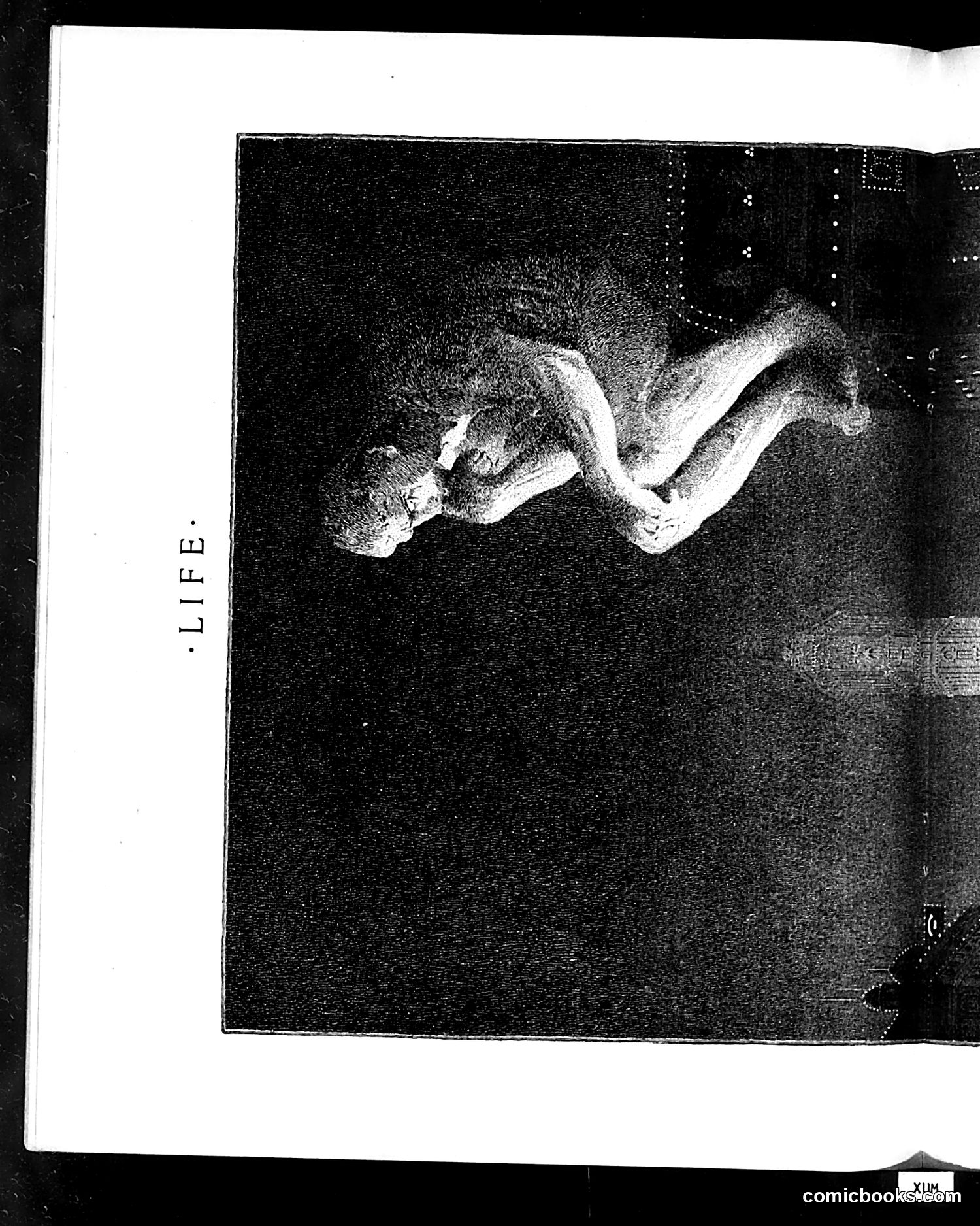
This appears to be a title page or section header from *Life* magazine, featuring the word "LIFE" printed vertically on the left margin. The main image shows a black and white photograph of a reclining figure in a contorted or relaxed pose against a dark background. The photograph quality and grainy texture suggest early-to-mid 20th century printing. Without additional context, caption text, or surrounding content visible, I cannot definitively identify the specific figure, the satirical subject matter, or the intended political or social commentary. The pose and artistic treatment suggest this may relate to commentary on leisure, wealth, or social behavior typical of *Life* magazine's satirical approach, but asserting specifics would require information not clearly present in this image alone.
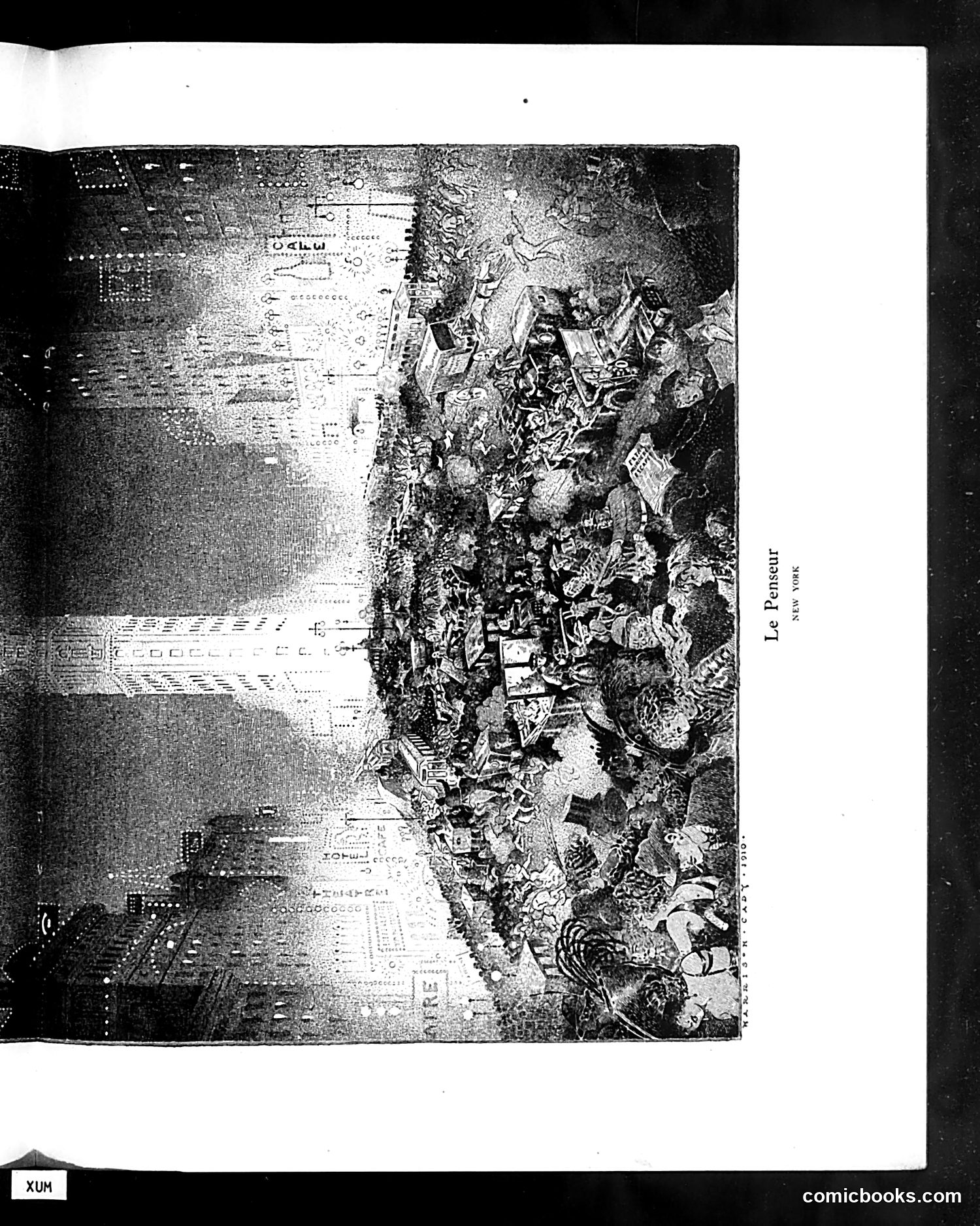
I can see this is a page from *Life* magazine, but the image quality and reproduction make it difficult to read clearly. The visible text is largely illegible due to the poor contrast and OCR errors ("MHOA MAN," "Inasuag aT"). The right margin shows "Le Penseur" (The Thinker) with "NEW YORK" noted, suggesting this may reference Rodin's famous sculpture in some satirical context about New York. However, without being able to clearly read the main text or definitively identify the specific cartoon/illustration details, I cannot reliably explain the satirical content, identify the figures, or convey the intended joke to a modern reader. A higher-quality image would be necessary for accurate analysis.
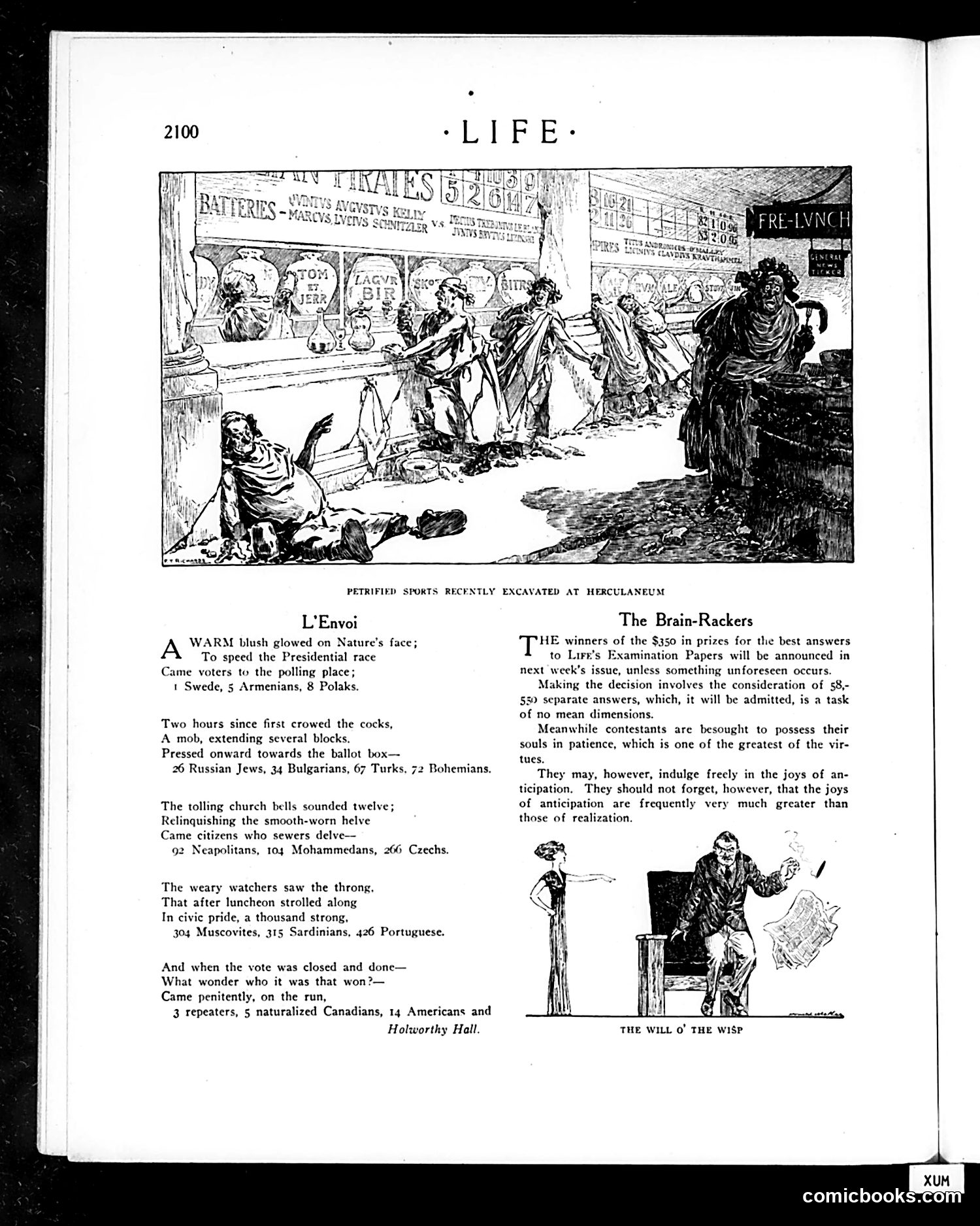
This 1912 *Life* magazine page satirizes turn-of-the-century anxieties about immigration and voting integrity. The poem "L'Envoi" mocks the 1912 Presidential election by cataloging voters by their ethnic origins—Swedes, Armenians, Poles, Russian Jews, Bulgarians, Turks, Bohemians, Neapolitans, Czechs, Portuguese, and others. The final lines reveal the joke's bite: only 3 repeaters, 5 naturalized Canadians, and 14 actual Americans voted, plus "Holworthy Hall" (likely a fictional/satirical name). The satire suggests that immigrant voters—newly naturalized or otherwise—dominated American elections, implying they were either ineligible, fraudulent, or incompetent participants. This reflects nativist concerns of the era that immigrants threatened democratic legitimacy. The ethnic specificity is deliberately stereotyping. The accompanying cartoon shows petrified figures (linking to ancient Herculaneum's preserved bodies)—suggesting immigrants were foreign relics, not proper Americans.
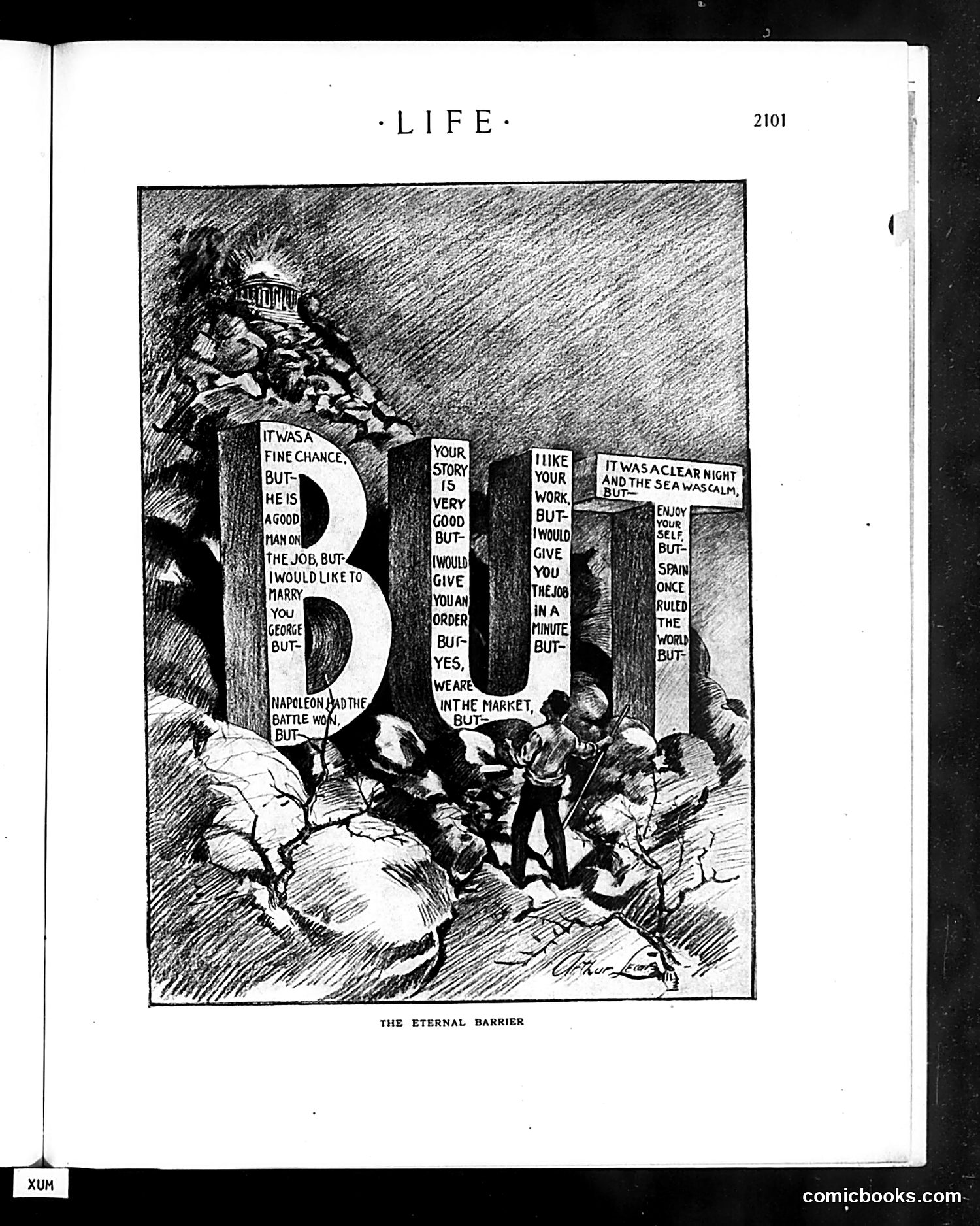
This satirical cartoon depicts a massive wall of large numbers ("3," "5," "0") blocking small human figures below. Each number displays a different "but" excuse: "It was a fine chance, but—he's a good man on the job, but I would like to harry George, but—" and similar qualified statements. The cartoon satirizes bureaucratic obstruction and the eternal excuse-making that prevents action or progress. The "eternal barrier" appears to reference how organizations (likely government or business) hide behind numerical standards, regulations, or administrative procedure, while spouting conditional language that perpetually delays decisions. The specific references are unclear without more context, but the satire targets how qualified praise ("he's good, but...") and procedural walls prevent merit-based advancement or necessary changes—a timeless critique of institutional inertia.
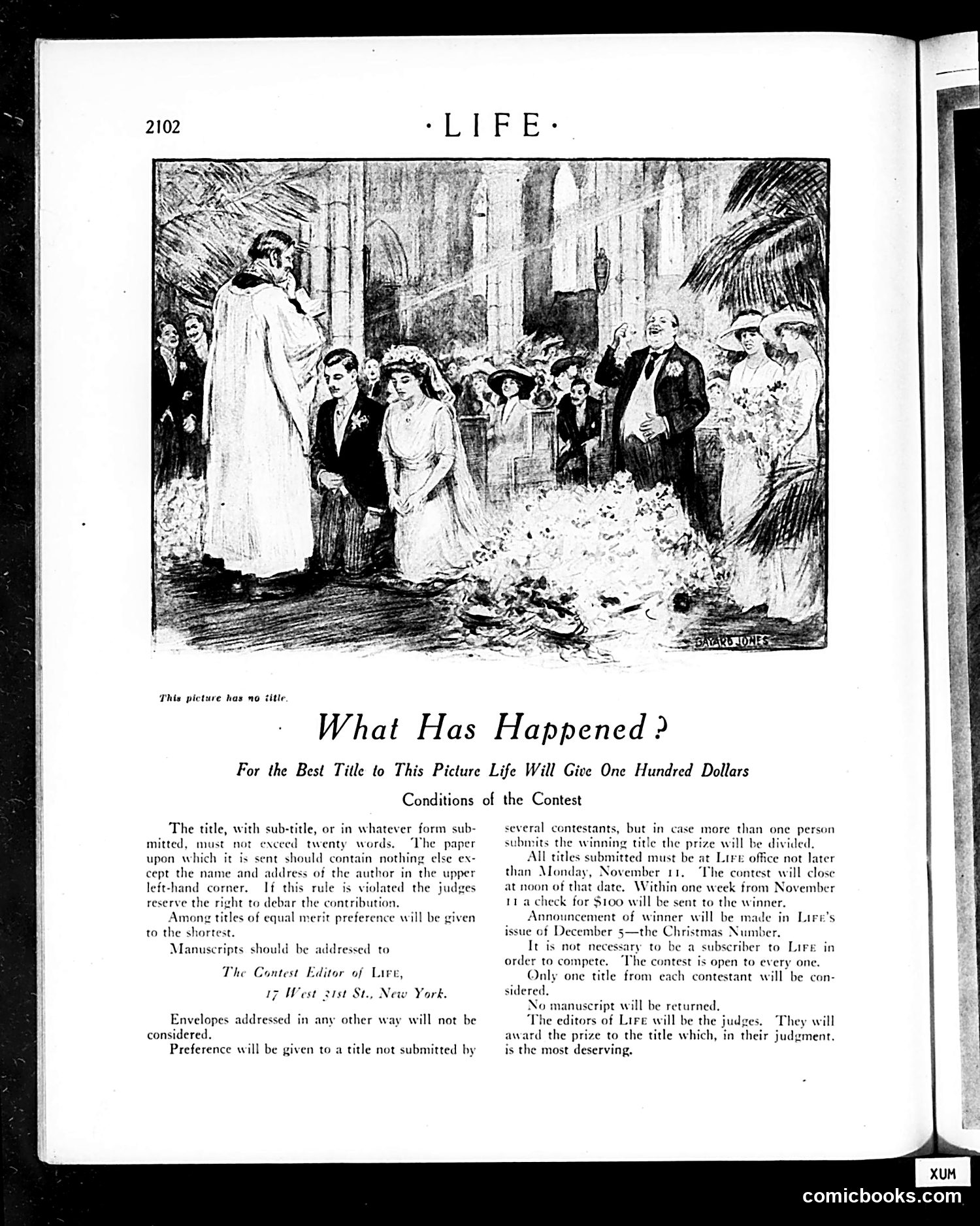
This is a **contest page**, not a political cartoon. Life magazine presents an untitled illustration and invites readers to submit the best caption in twenty words or fewer for a $100 prize. The image depicts what appears to be a **wedding ceremony** in a church or cathedral setting. A priest or clergyman in white robes stands elevated, conducting a service for a young couple (groom in dark suit, bride in white dress with veil). Well-dressed wedding guests surround them, and palm fronds suggest a tropical or warm-climate location. The satire likely hinges on something **incongruous or unexpected** about this wedding scene—though the specific joke is unclear without the intended caption. Readers were challenged to identify the humorous contradiction or surprising element the artist embedded in the illustration. The contest closes November 11, with winners announced in the December Christmas issue.
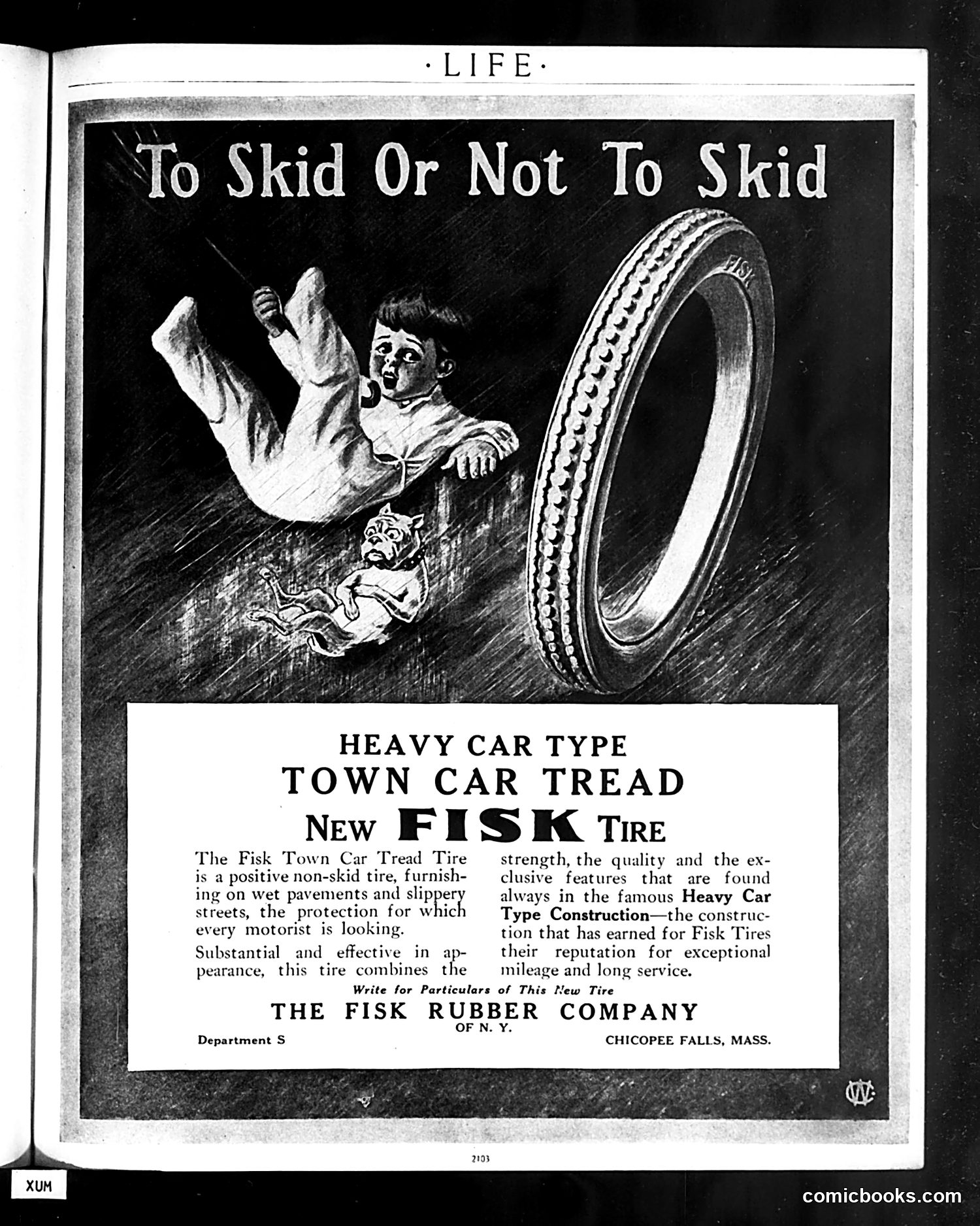
This is primarily a **tire advertisement**, not political satire. The Fisk Rubber Company advertisement promotes their "Town Car Tread" tire by emphasizing safety on wet, slippery streets. The cartoon imagery shows two cherubs or putti (baby figures) riding on or near a large tire, with the headline "To Skid Or Not To Skid" — a playful reference to Hamlet's famous soliloquy. The visual joke is straightforward: the tire prevents skidding, making driving safer and therefore the choice is obvious ("not to skid"). The advertisement claims the Fisk tire is "a positive non-skid tire" offering motorists the "protection" they seek on dangerous road conditions. The cherubs' precarious positioning humorously emphasizes the risks of poor tire traction — even innocent babies wouldn't be safe without proper tires. This reflects early 1900s automobile safety concerns, when tire technology was still developing and road hazards were genuine public concerns.
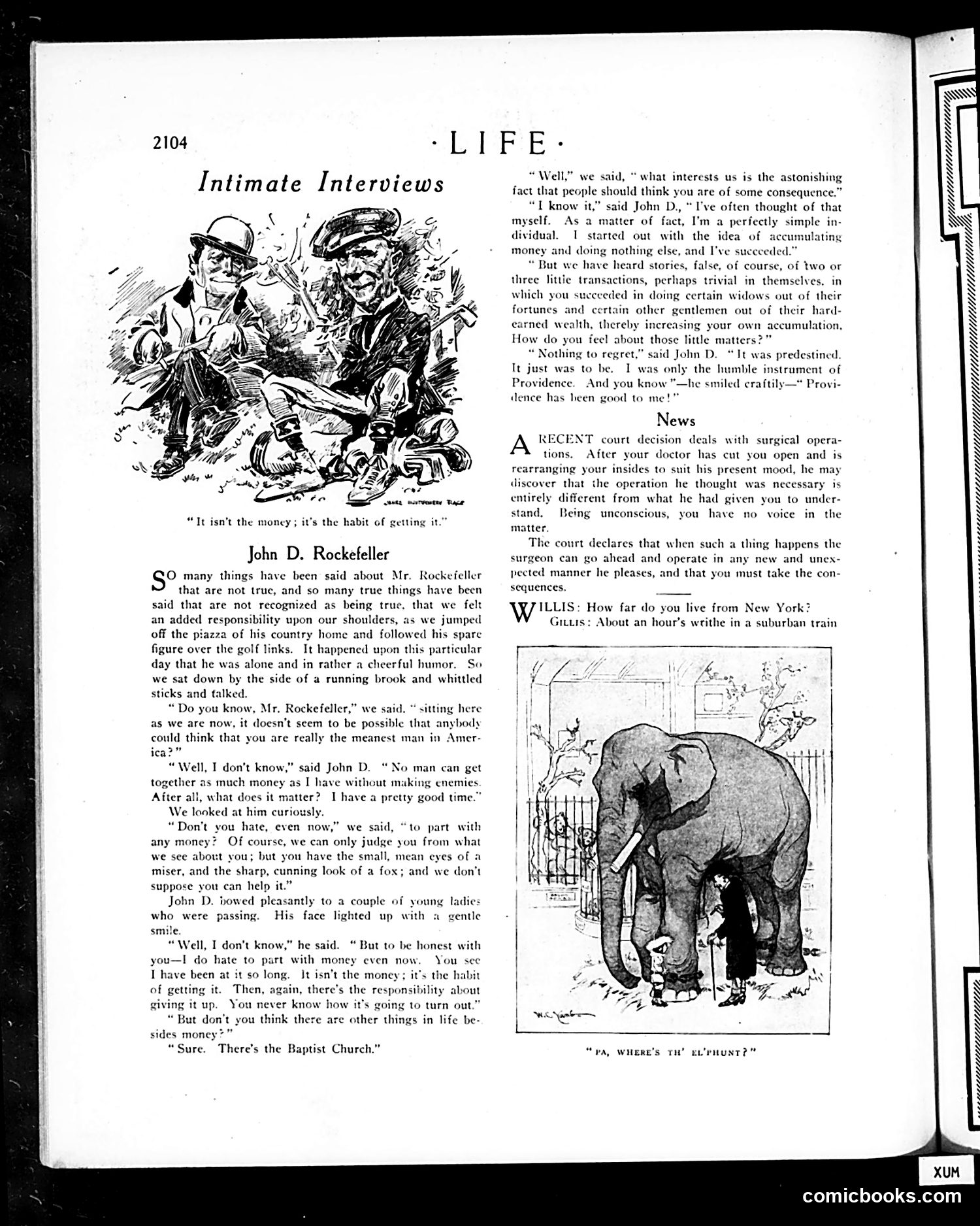
This page satirizes **John D. Rockefeller**, the oil magnate and one of America's wealthiest men. The "Intimate Interview" presents him as brazenly admitting what critics accused him of: ruthlessness in accumulating wealth at others' expense. The satire's humor lies in Rockefeller's casual honesty. When confronted about allegedly defrauding widows and businessmen, he dismisses it as "predestined" and claims he was merely "Providence's instrument"—a transparent excuse. His admission that he "hates to part with money" and that wealth-getting is a compulsive "habit" rather than rational necessity mocks his public image of benevolent philanthropy. The accompanying cartoon (unrelated) shows an elephant in a house, captioned "Pa, where's th' elephant?"—likely a separate joke or advertisement. The "News" section about surgical ethics appears unconnected to the Rockefeller interview.
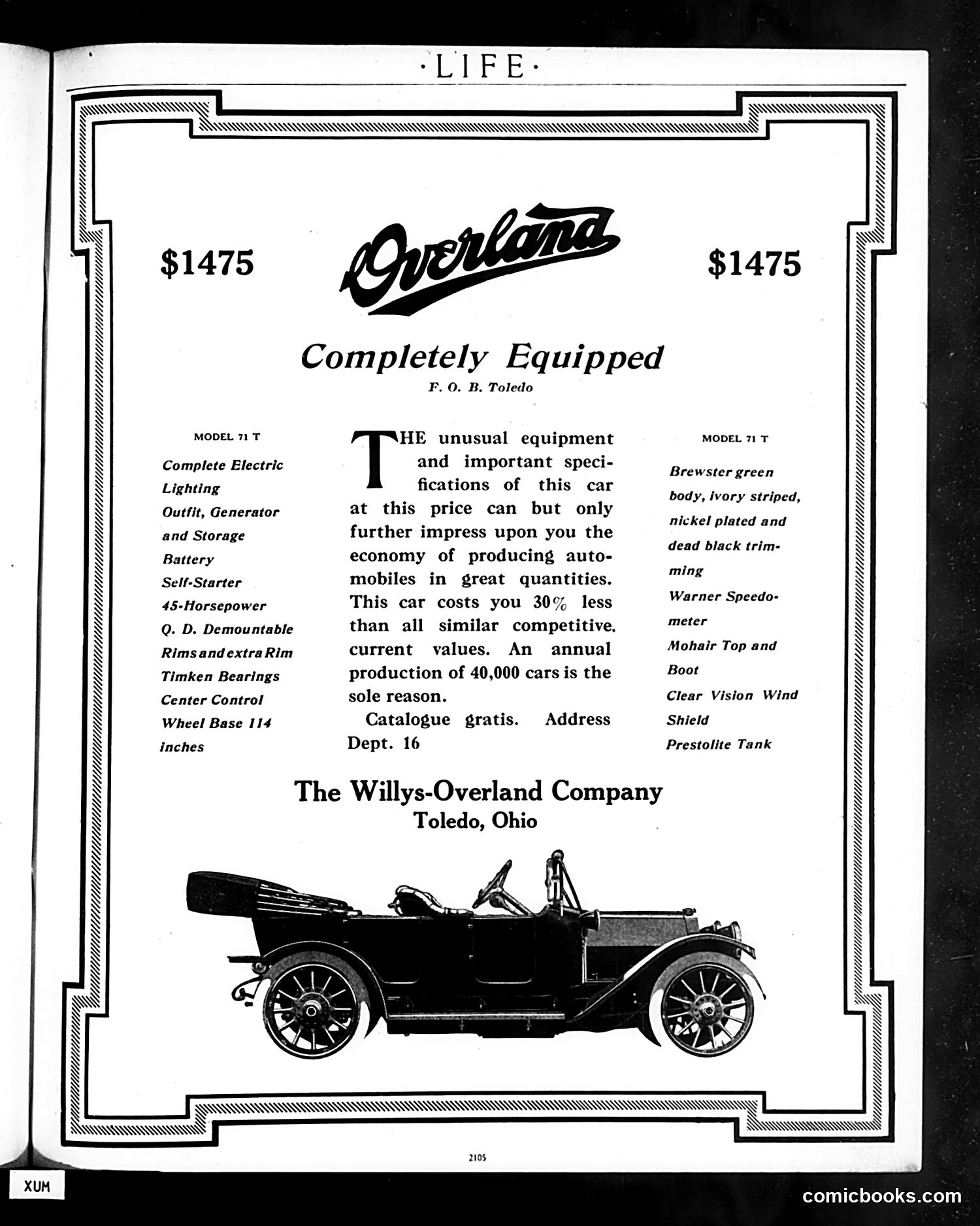
This is **not a cartoon or satire page**—it is a straightforward **automobile advertisement** for the Overland Model 71 T, priced at $1,475. The Willys-Overland Company of Toledo, Ohio advertises their car as "Completely Equipped" with features like electric lighting, a self-starter, 45-horsepower engine, and quality components (Timken bearings, etc.). The key sales pitch emphasizes that the car costs 30% less than competitors while offering comparable features—attributed to high-volume production of 40,000 cars annually. The image shows a side-view illustration of an early 1910s-era open touring car with the characteristic spoke wheels and minimal bodywork of that era. This appears in *Life* magazine's advertising section and contains no political commentary, satire, or caricature—just period automobile marketing targeting middle-class buyers interested in affordable motoring.
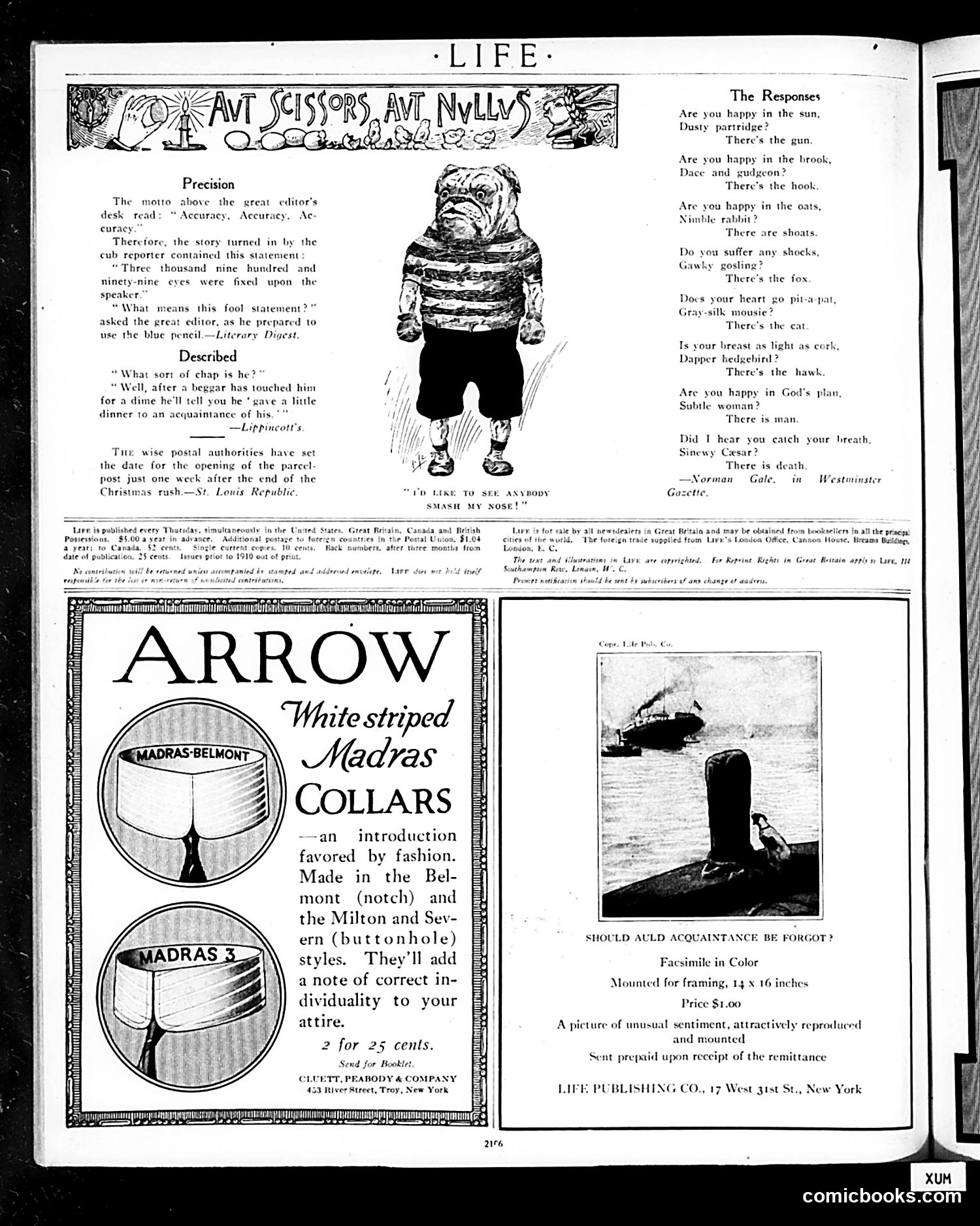
This page mixes satirical editorial content with advertising. The top section contains three brief humorous anecdotes about precision in journalism, character assessment, and postal timing—typical of Life's light satirical humor. The main cartoon depicts a scowling, stocky man in striped shirt and dark pants, captioned "I'D LIKE TO SEE ANYBODY SMASH MY NOSE!" The figure appears to be a generic "tough guy" or working-class character type, used to mock aggressive posturing or mock-belligerence—a common Life cartoon trope of the era. The right side features a separate image titled "Should Auld Acquaintance Be Forgot?"—a silhouette of figures at a dock with a ship, suggesting sentiment or nostalgia, offered as a framed facsimile print for sale. The lower half is dominated by advertisements for Arrow shirt collars and a Life Publishing facsimile service, indicating this is primarily a commercial/advertising page rather than focused editorial content.
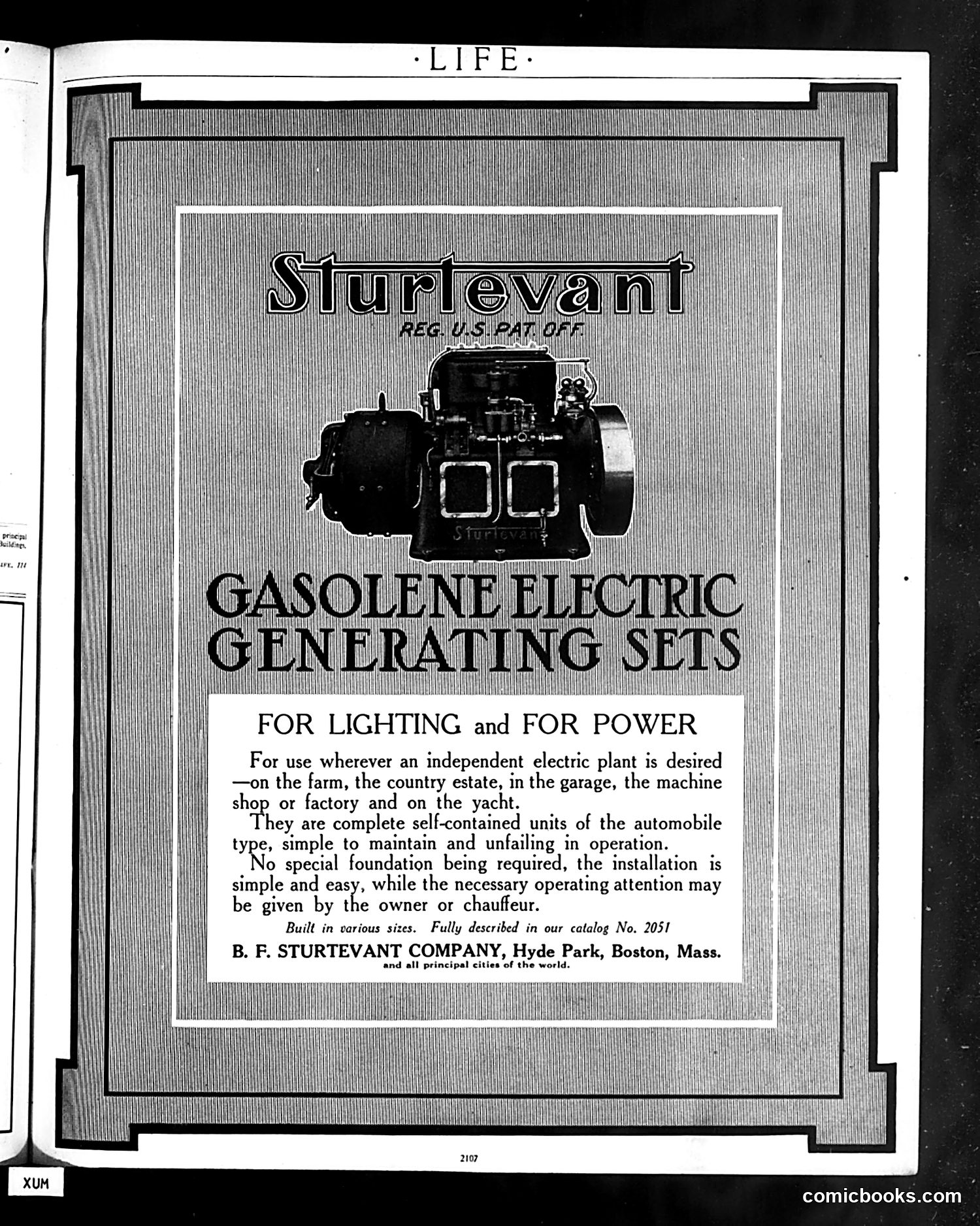
This page is a **product advertisement** for Sturtevant gasoline-electric generating sets, not satirical content. It appeared in *Life* magazine during the early 20th century when the publication carried both humor and ads. The ad promotes portable power generators for rural and industrial use—farms, estates, garages, factories, and yachts. It emphasizes the units are "automobile type," self-contained, and require no special foundation or expertise to operate (owners or chauffeurs could maintain them). There is no political satire or social commentary here. The image shows the mechanical generator itself. This represents a genuine historical product marketed to affluent Americans seeking independent electricity before widespread rural electrification. The ad reflects the era's technological optimism about automotive-based power solutions.
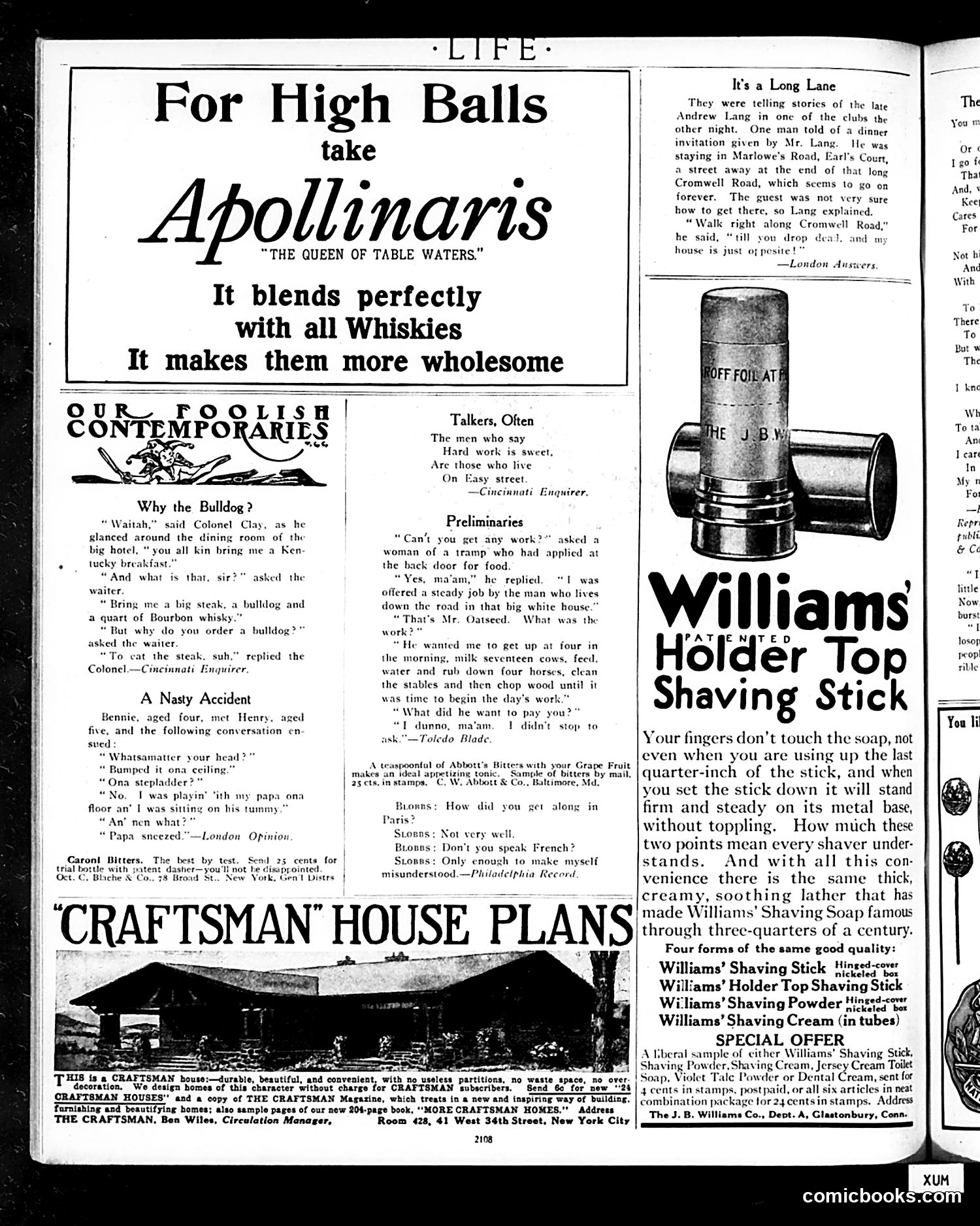
This page from *Life* magazine (a satirical publication) contains several short humorous anecdotes and advertisements, rather than political cartoons. The jokes employ common early-20th-century humor: **"Why the Bulldog"** plays on absurdist logic (ordering a bulldog to eat one's steak). **"A Nasty Accident"** uses children's innocent misunderstandings for comedy. **"It's a Long Lane"** is a gentle anecdote about Andrew Lang (a real Scottish writer) giving vague directions along London's Cromwell Road—the humor lies in the understated punchline that his house is "just opposite" after all that explanation. **"Preliminaries"** depicts class dynamics: a vagrant refuses backbreaking farm labor without even asking the wage, suggesting the work is obviously exploitative. The page is primarily **advertising**: Apollinaris water, Abbott's Bitters, Caroll Bitters, Craftsman House Plans, and Williams' Shaving products dominate the layout. The ads appeal to middle-class aspirations (beautiful homes, refined grooming). The humor is genteel and topical rather than sharp political satire—typical of *Life*'s approach to entertaining educated, middle-class readers.
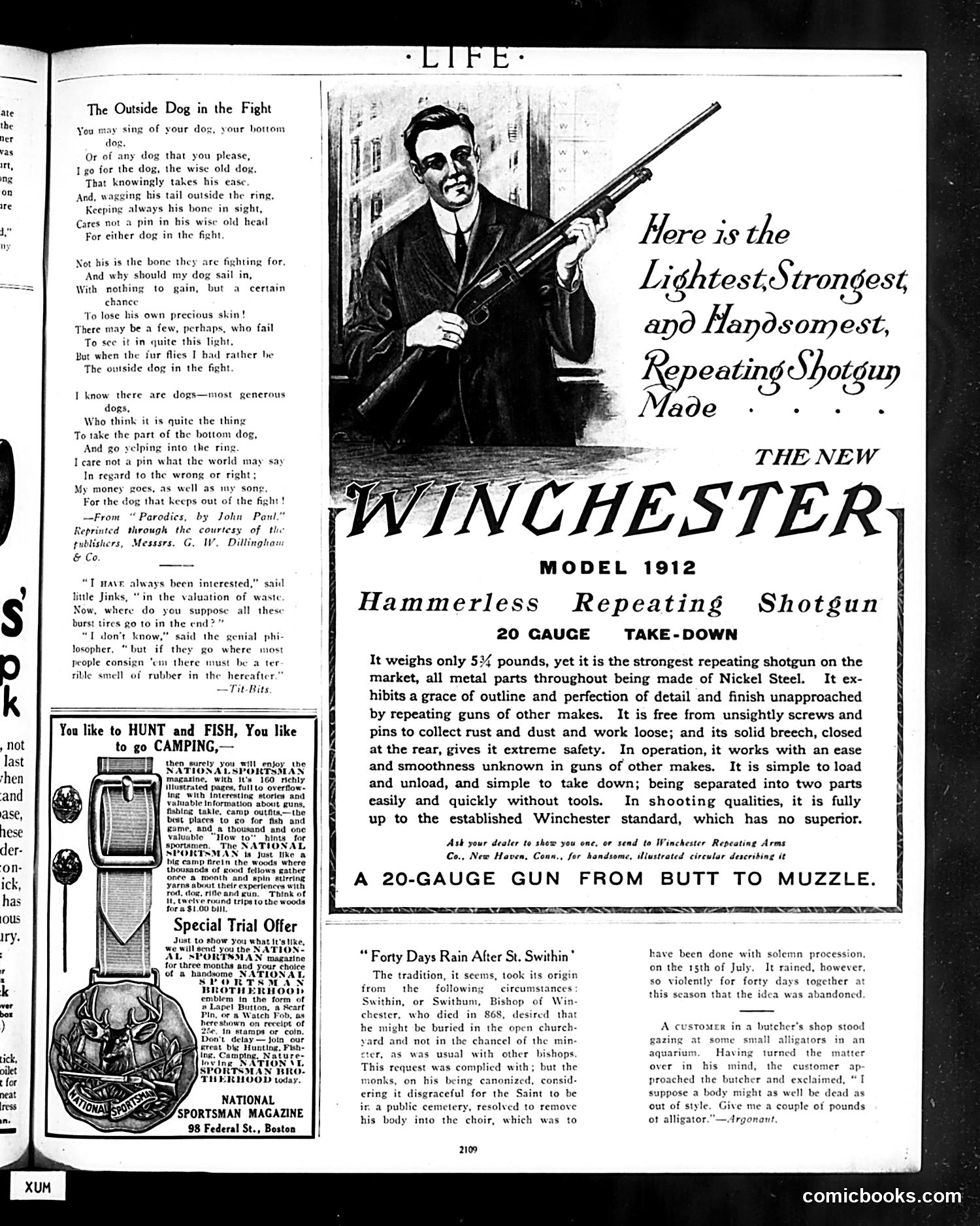
This page mixes satirical poetry with advertising. "The Outside Dog in the Fight" is a poem using dog-fighting metaphor to satirize **political neutrality during social conflict**. The "outside dog" represents someone who stays uninvolved while others fight over bones (resources/principles), keeping his own skin safe. The poem gently mocks this detachment while acknowledging its appeal—"why should my dog sail in" to lose his "precious skin"? It critiques both non-intervention and those who champion underdogs for moral show. The dominant content is a **Winchester Model 1912 shotgun advertisement**, emphasizing its strength, simplicity, and superiority. A well-dressed man displays the gun prominently. Additional filler includes a brief anecdote about waste-tire disposal and a humorous piece about St. Swithin's Day rainfall legend. The page reflects early 20th-century Life: mixing gentle social commentary with commercial promotion, addressing male readers interested in hunting, firearms, and philosophical quips about human nature.
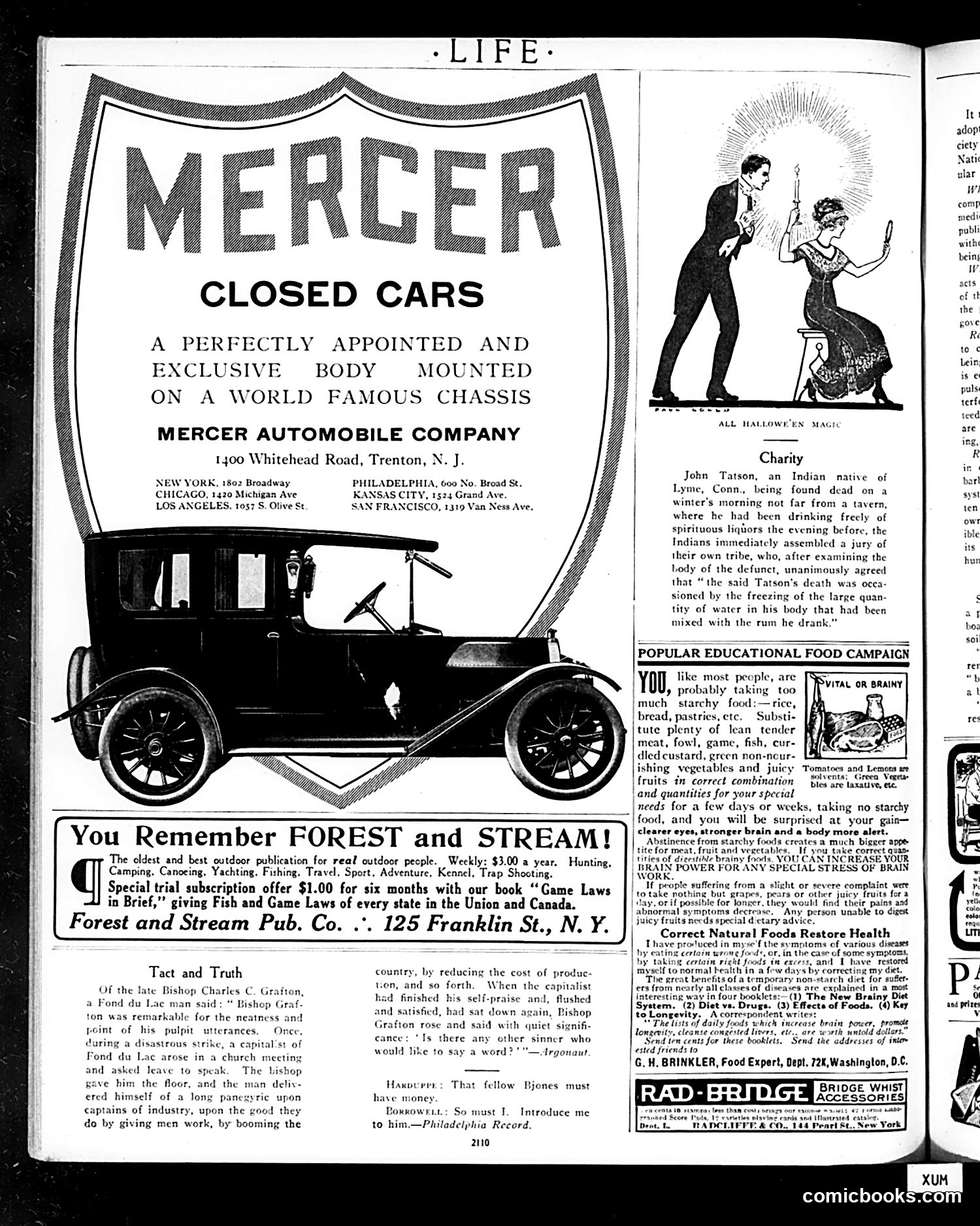
This page is primarily **advertising**, dominated by a Mercer automobile ad featuring a closed-car vehicle. The car advertisement emphasizes luxury and exclusivity—the "perfectly appointed and exclusive body" on a famous chassis, with locations listed in major U.S. cities. The page also contains **two brief humorous anecdotes** ("Tact and Truth" and "Charity"), typical of Life magazine's satirical content. The "Charity" story is a dark joke about an Native American ("Indian native") found frozen to death, with tribal members attributing his death to the large quantity of water mixed with rum he'd consumed—mocking both the stereotype of Native American drinking and the absurdity of the explanation. The remaining content includes period advertisements for **Forest and Stream** magazine, food diet advice, and other consumer products—reflecting early 20th-century magazine layouts mixing editorial content with commercial promotion.
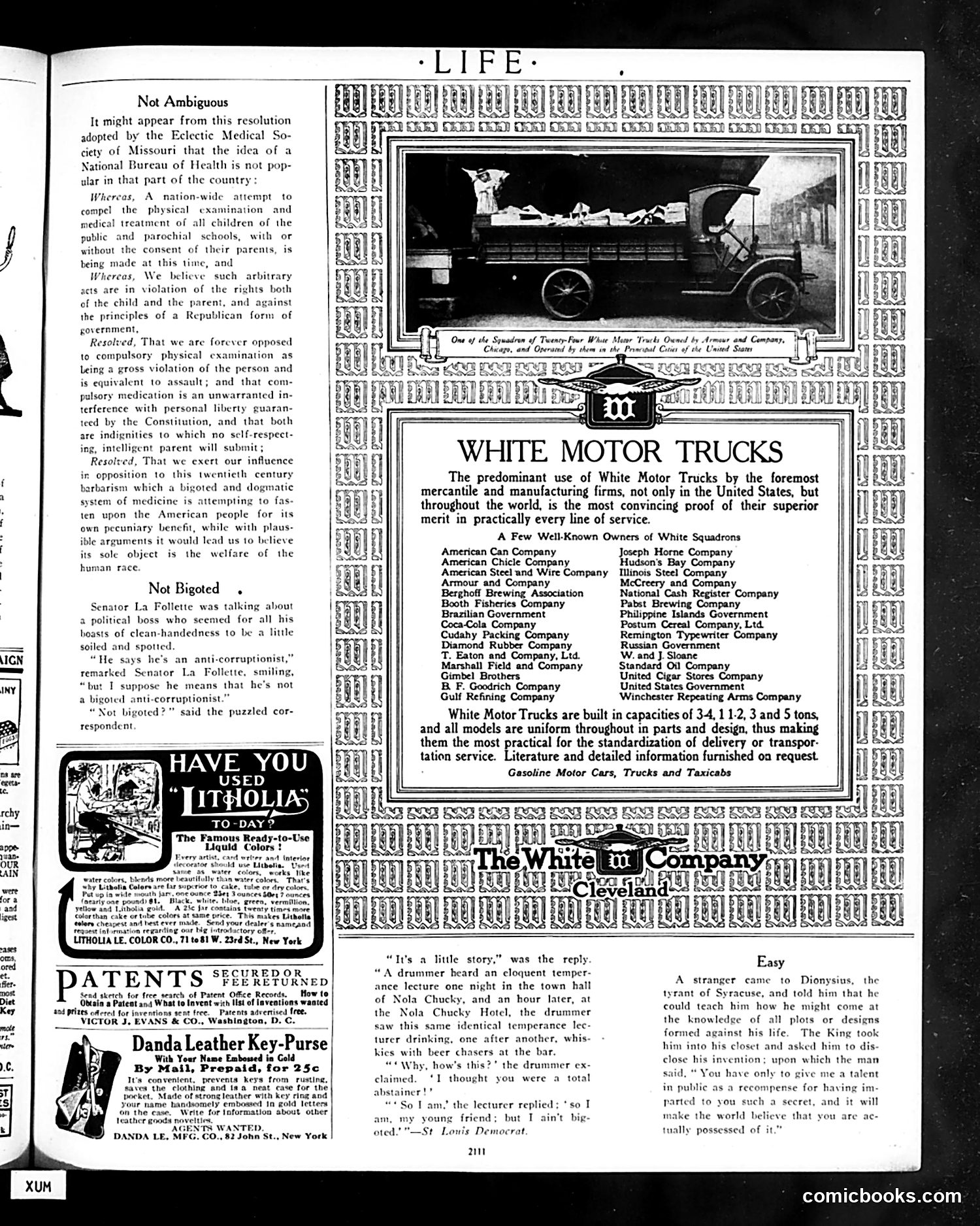
This page is primarily **advertising**, dominated by a large advertisement for White Motor Trucks featuring an illustrated truck and a long list of corporate users (Armour, Coca-Cola, Marshall Field, etc.). The editorial content consists of two brief political commentaries: 1. **"Not Ambiguous"** quotes a resolution from the Eclectic Medical Society of Missouri opposing mandatory physical examinations and medical treatment of schoolchildren, framing it as government overreach and violation of parental rights. This reflects early-20th-century anti-compulsory-health-measure sentiment. 2. **"Not Bigoted"** is a brief anecdote where Senator La Follette makes a wordplay joke: a political boss claims to be "anti-corruption" when he's merely "bigoted anti-corruption"—implying selective enforcement rather than principled opposition. Neither item constitutes a political cartoon. The page represents typical *Life* magazine content: mixing advertising with short satirical takes on contemporary political and social issues, using humor to critique public figures and ideological positions.
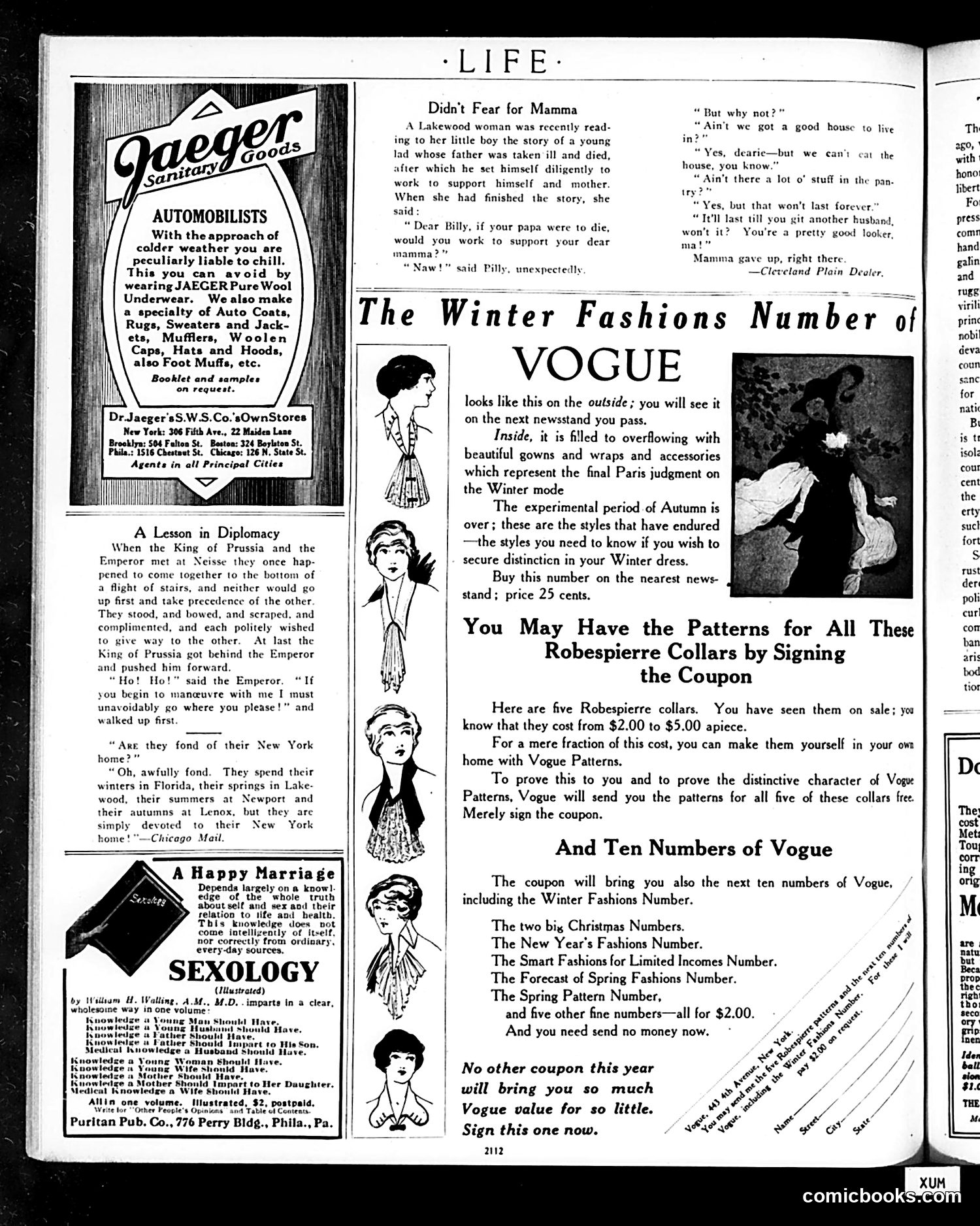
This page contains three distinct sections: advertisements, humorous anecdotes, and fashion promotion. **The Humor:** Two brief jokes appear. One mocks wealthy New Yorkers who spend winters in Florida, springs in Lakewood, summers at Newport, and autumns at Lenox—yet claim to be "devoted to their New York home." The satire targets the pretense of the wealthy elite. The second joke depicts a mother reading her son a moral tale about a boy who worked to support his widowed mother after his father died. When she asks if he'd do the same, he bluntly replies "Naw!"—deflating the sentimental lesson. This reflects period humor mocking children's obvious materialism. **The Fashion Content:** The remaining space promotes Vogue's Winter Fashions issue, highlighting Robespierre collars (a specific style detail) available through coupon patterns. This is straightforward fashion advertising targeting women readers. **The Advertisements:** Supporting materials include thermal underwear (relevant for "cold weather"), a marriage/sex education book, and diplomacy anecdotes—typical Life magazine content from this era.
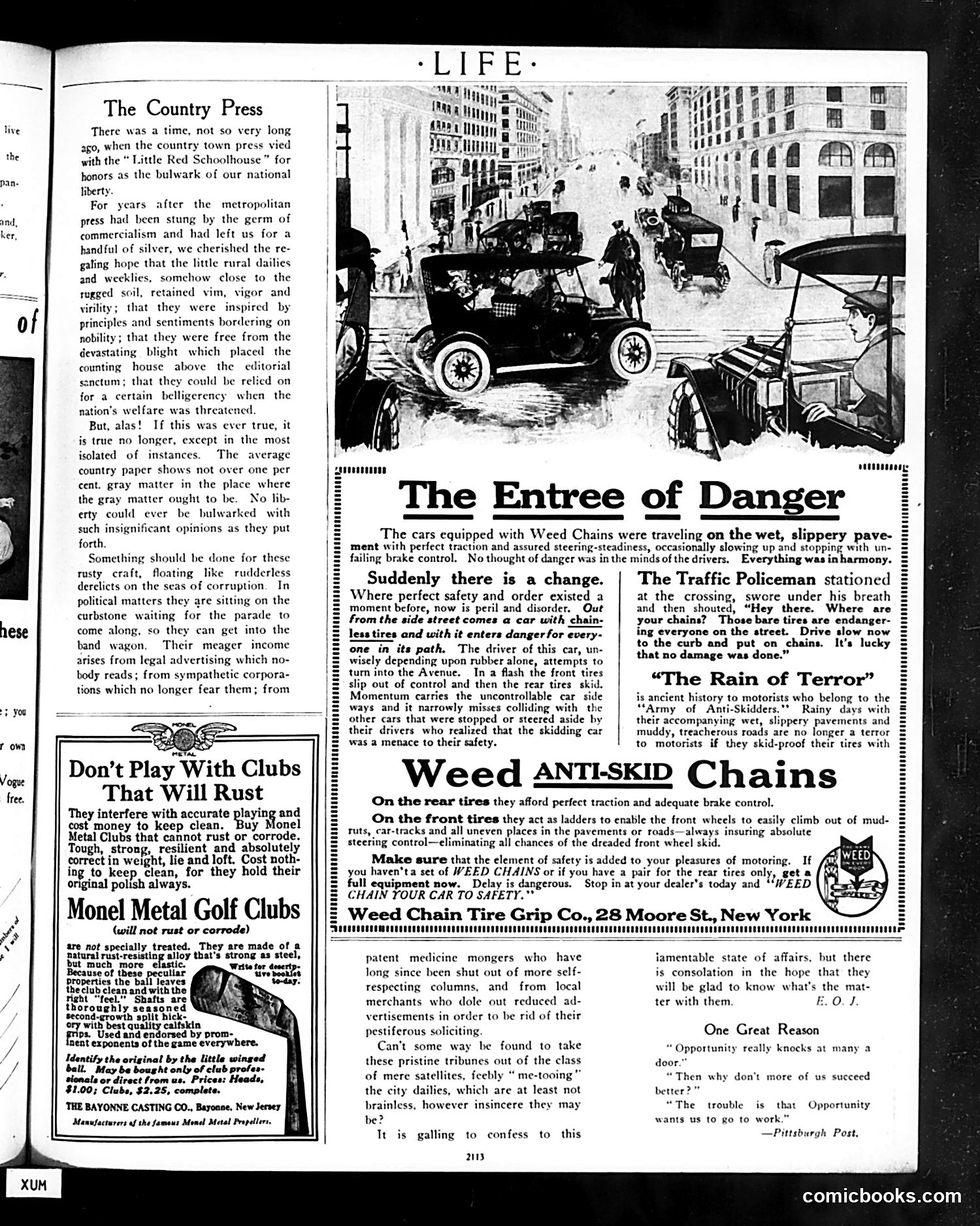
This page combines editorial commentary with period advertising. The main article criticizes rural American newspapers, lamenting that country press—once guardians of liberty and moral authority—has become corrupted by commercialism. The author argues small-town papers now depend on boring legal ads and corporate sympathy rather than publishing bold, principled journalism. The accompanying advertisements are era-specific: Monel Metal golf clubs (rust-resistant alloy, a novelty at the time) and Weed Anti-Skid Chains for automobile tires. The latter includes a cautionary illustrated narrative showing the danger of driving on wet pavement without tire chains—a critical safety concern in the pre-modern tire era. The "traffic policeman" scene depicts the real hazard of uncontrolled skidding on wet streets, positioning chains as essential safety equipment rather than optional accessories.
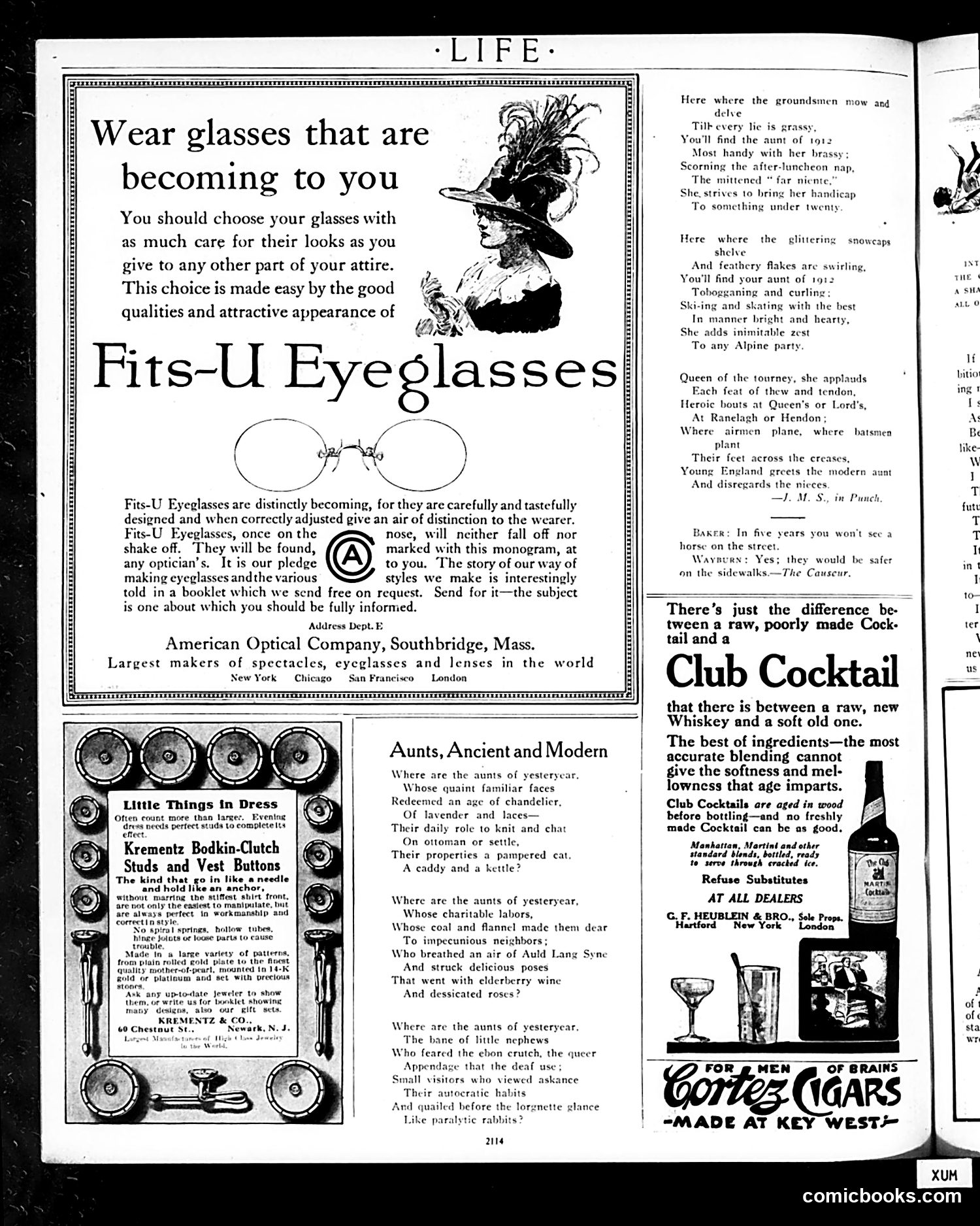
This page contains advertisements and light verse satirizing changing social customs. The main cartoon-like content is the poem "Aunts, Ancient and Modern," which contrasts Victorian-era aunts with their 1912 counterparts. The satire mocks how dramatically female behavior has shifted: older aunts were domestic, sedentary figures (knitting, keeping cats, drinking elderberry wine), while modern 1912 aunts are active athletes—golfing, tobogganing, skiing, attending sporting events with enthusiasm. The poem pokes fun at this transformation by portraying the "new woman" of 1912 as vigorously athletic and public-facing, a stark contrast to the domestic ideal of previous generations. The advertisements for Fits-U Eyeglasses, Krementz studs, and Club Cocktail fill the remainder. A small dialogue joke compares horses disappearing from streets within five years, joking that they'd be "safer on the sidewalks"—likely referencing early automobile adoption. The content reflects early 20th-century social anxieties about changing gender roles and modernization.
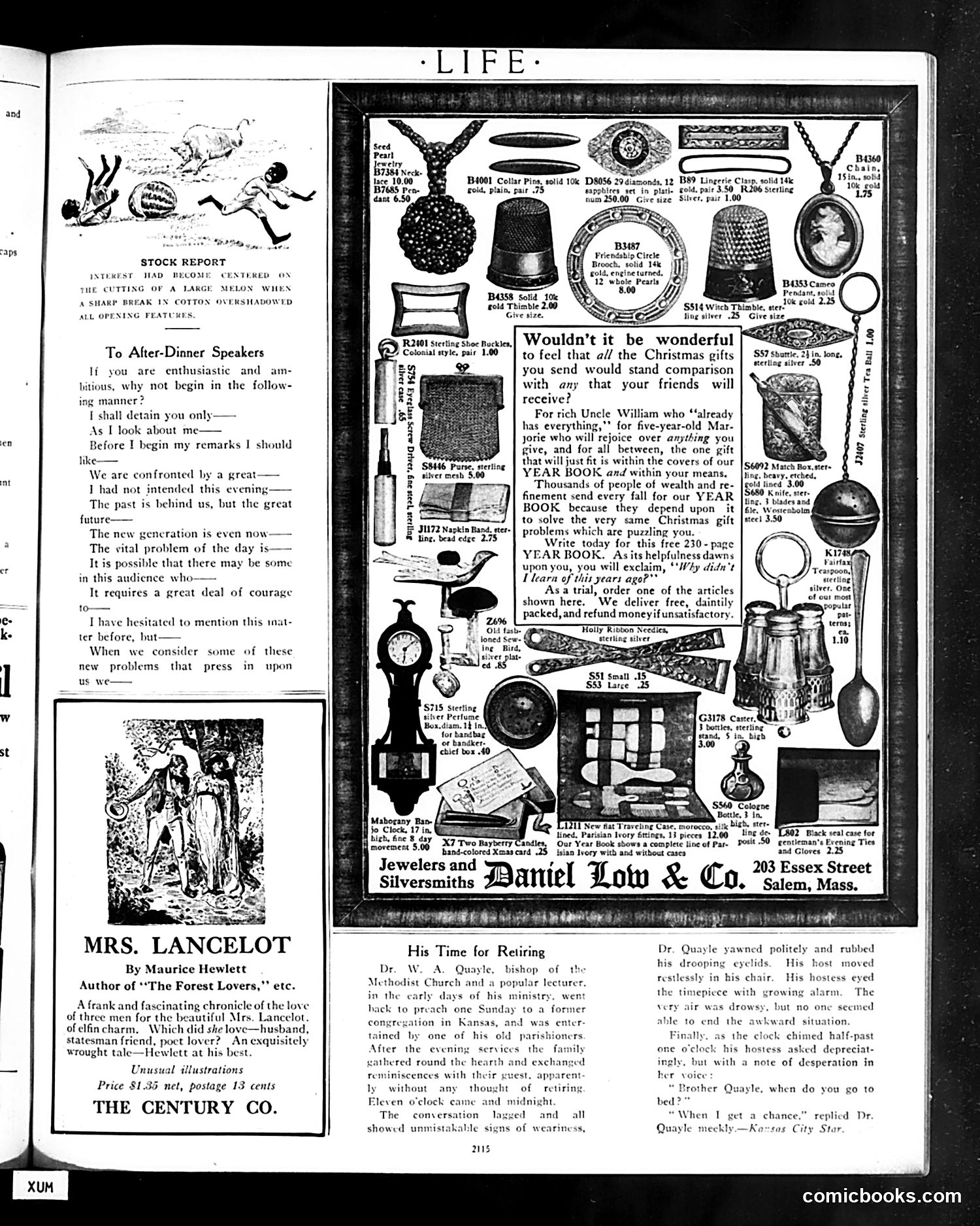
This page is primarily **advertising and literary content** rather than political satire. The main elements are: 1. **"Stock Report" cartoon** (top left): A brief, unclear illustration accompanying text about cotton market fluctuations—appears to be financial/economic humor. 2. **"To After-Dinner Speakers"**: A satirical list of clichéd opening lines that amateur speakers use ("As I look about me," "We are confronted by a great..."). This mocks predictable, boring speech conventions—a timeless social observation about public speaking. 3. **Daniel Low & Co. advertisement**: A large jewelry/gifts catalog featuring Christmas gift suggestions. 4. **"His Time for Retiring"**: A humorous anecdote about Bishop Dr. W.A. Quayle falling asleep at a dinner party, ending with his hostess desperately suggesting bedtime. 5. **Literary advertisement**: For Maurice Hewlett's novel *Mrs. Lancelot*. The page reflects early 20th-century concerns: etiquette anxieties, gift-giving dilemmas, and gentle humor about social fatigue—not political commentary.
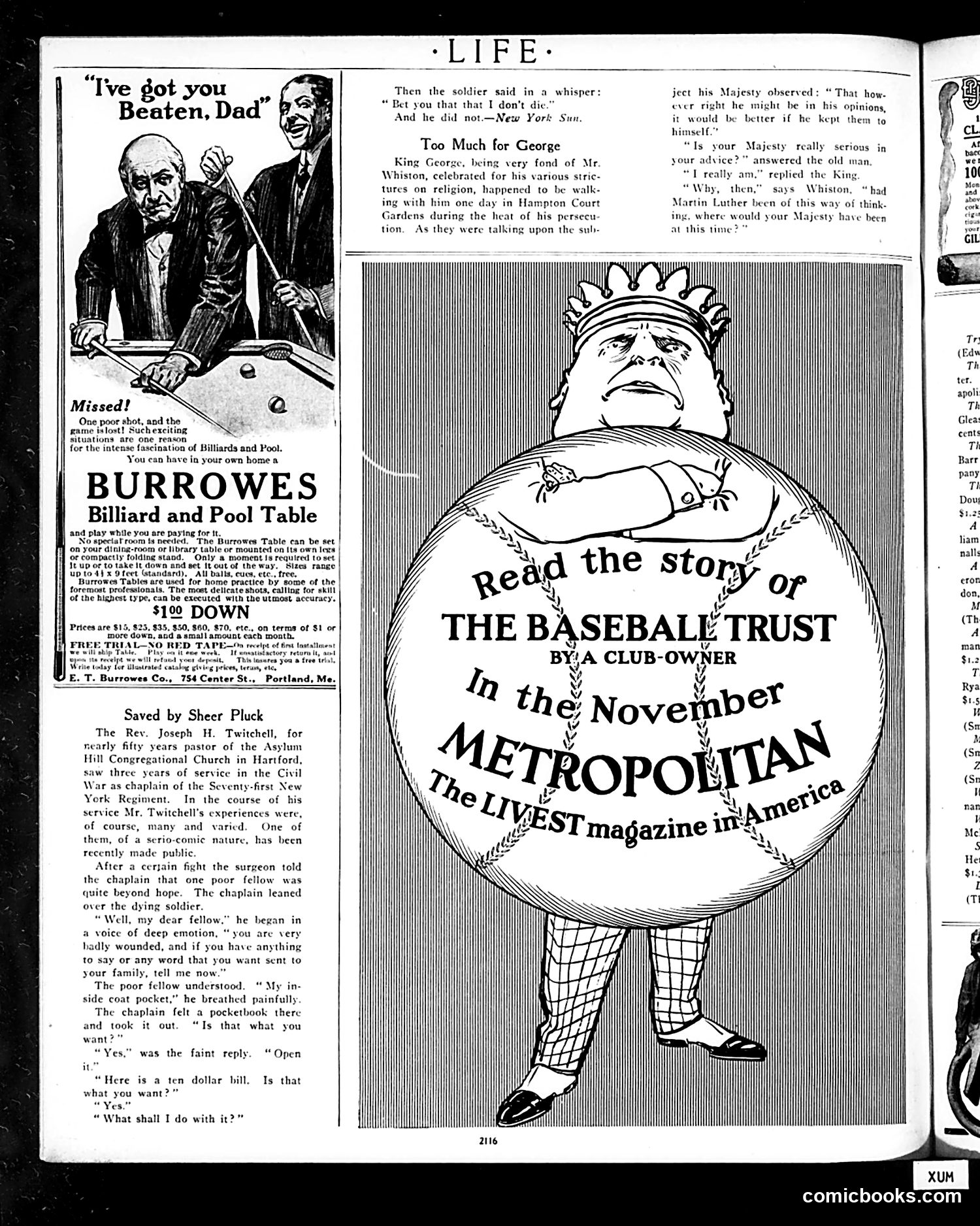
This page contains three distinct items: **Left side:** A billiards/pool table advertisement featuring a comic illustration of a father losing a game to his son ("I've got you beaten, Dad"), used to promote Burrowes brand tables for home use. **Bottom left:** A Civil War anecdote about Reverend Joseph Twitchell, a Union chaplain who finds a dying soldier's money and is shocked when the soldier bets him ten dollars that he'll survive—and does. It's a sentimental "pluck" story emphasizing resilience. **Right side:** A large advertisement for *Metropolitan* magazine featuring a caricatured figure (appears to be a wealthy businessman or magnate) holding text about "The Baseball Trust by a Club-Owner," referencing contemporary concerns about monopolistic control of professional baseball by team owners—a real political issue of the early 1900s. The page mixes humor, advertising, and social commentary typical of *Life* magazine's format during this era.
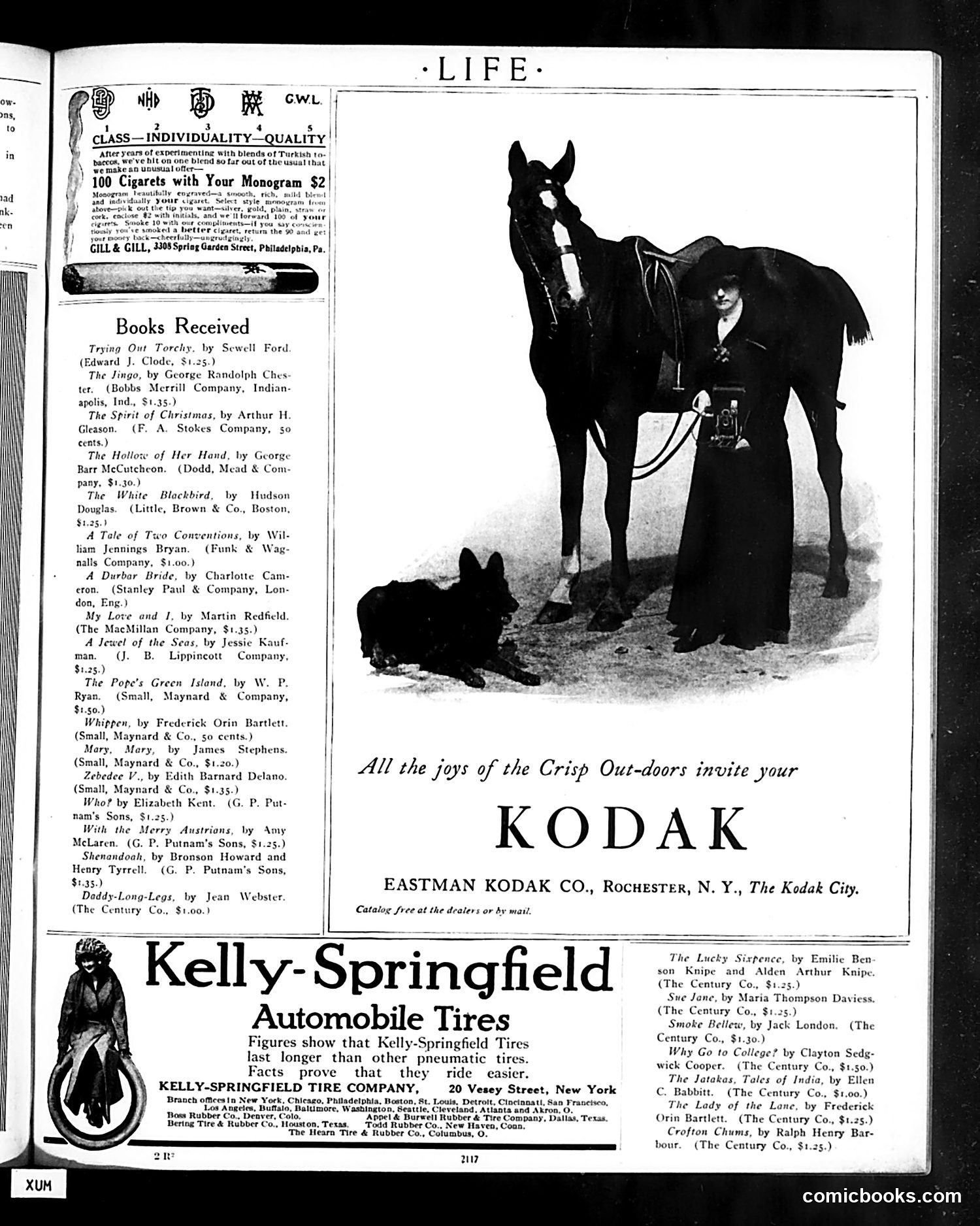
This page is primarily **advertising and book reviews**, not political satire. The main content includes: **Kodak Advertisement** (center-right): Features a horse with saddle and camping gear, promoting outdoor photography. The tagline "All the joys of the Crisp Out-doors invite your KODAK" reflects early 20th-century marketing linking cameras to leisure and nature experiences—this was aspirational lifestyle advertising for a growing middle class. **Kelly-Springfield Automobile Tires** (lower): Advertises tire durability with technical claims about riding comfort, targeting automobile owners (still a luxury market in this era). **Books Received** (left): A book review section listing contemporary publications from publishers like Bobbs Merrill and Century Co., representing popular literature of the period. **Cigarette Advertisement** (upper left): Promotes personalized monogrammed cigarettes as a luxury item. There is **no political cartoon or satirical content** on this page—it's a standard magazine layout mixing advertising with cultural/literary content typical of Life's format during this period.
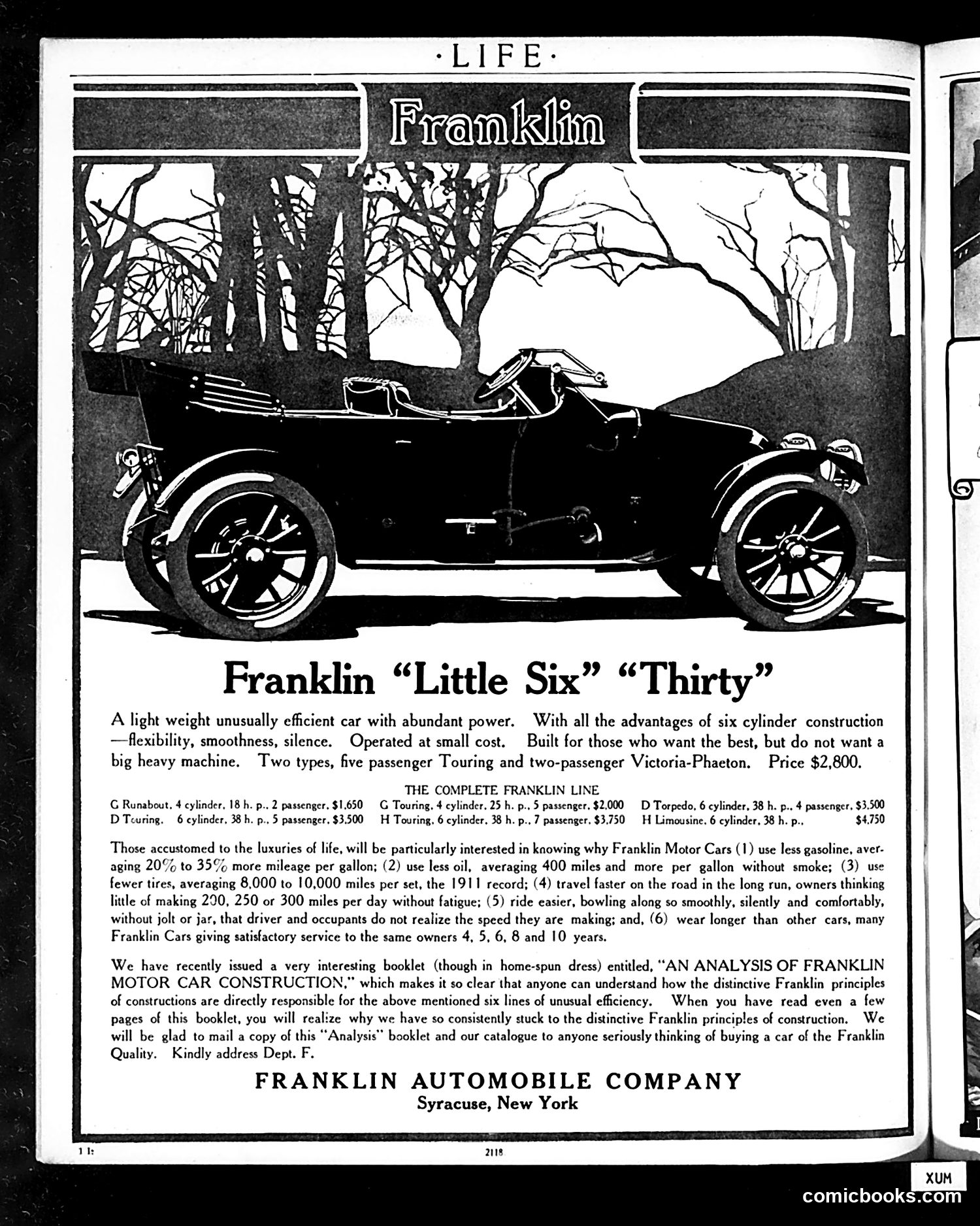
This page is **not a political cartoon or satirical content**—it's a straightforward automobile advertisement from *Life* magazine (likely early 1910s). The ad promotes the Franklin "Little Six" "Thirty," a six-cylinder car priced at $2,800. The image shows the vehicle in profile against a bare-tree landscape. The text emphasizes the car's efficiency: superior fuel economy (20-35% better mileage), low oil consumption, tire durability, and comfort for long-distance driving without fatigue. The ad targets affluent buyers who want quality without excessive bulk or cost. Franklin Motor Company (Syracuse, New York) offers multiple models across price points ($1,650–$4,750) and promises longevity, with many vehicles serving owners 4-10 years. This represents early automotive marketing emphasizing engineering innovation and practical efficiency—standard commercial messaging for the era.
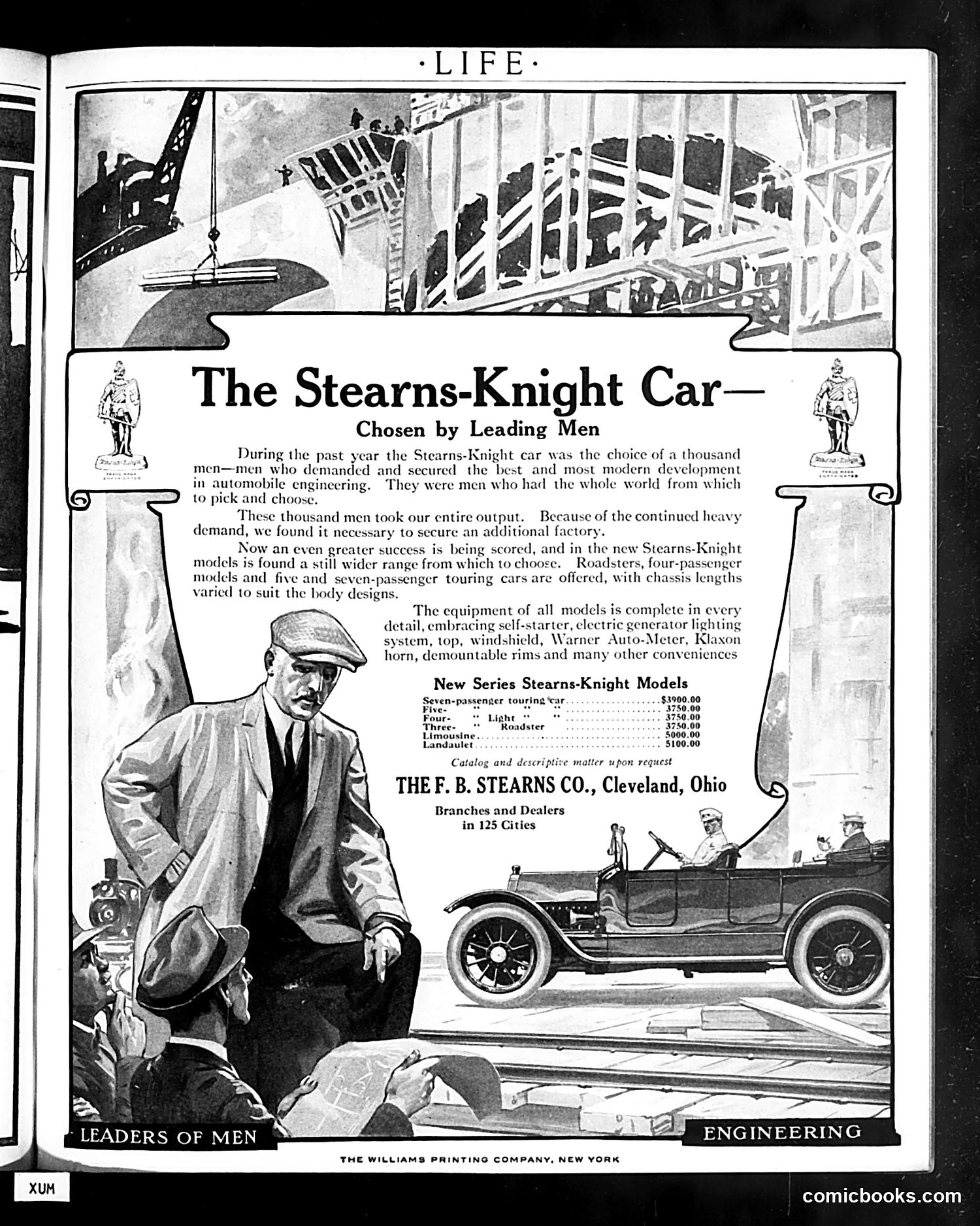
This is **not a cartoon or satire**—it's a full-page automobile advertisement in *Life* magazine. The page advertises the Stearns-Knight Car, manufactured by the F.B. Stearns Company of Cleveland, Ohio. The imagery features a well-dressed businessman in a cap and coat examining the automobile, positioned alongside a detailed drawing of the car itself. The ad emphasizes that "a thousand men" of distinction chose this vehicle, claiming it represents the pinnacle of automotive engineering with modern conveniences like self-starters, electric lighting, and demountable rims. The modest illustration and pricing (ranging from $1,750 to $5,100) reflect early 1910s luxury automobiles marketed to affluent professionals. The tagline "Leaders of Men" and the depiction of the businessman reinforce the car's association with success and status. This appears to be straightforward commercial advertising capitalizing on aspirational messaging common in the era.
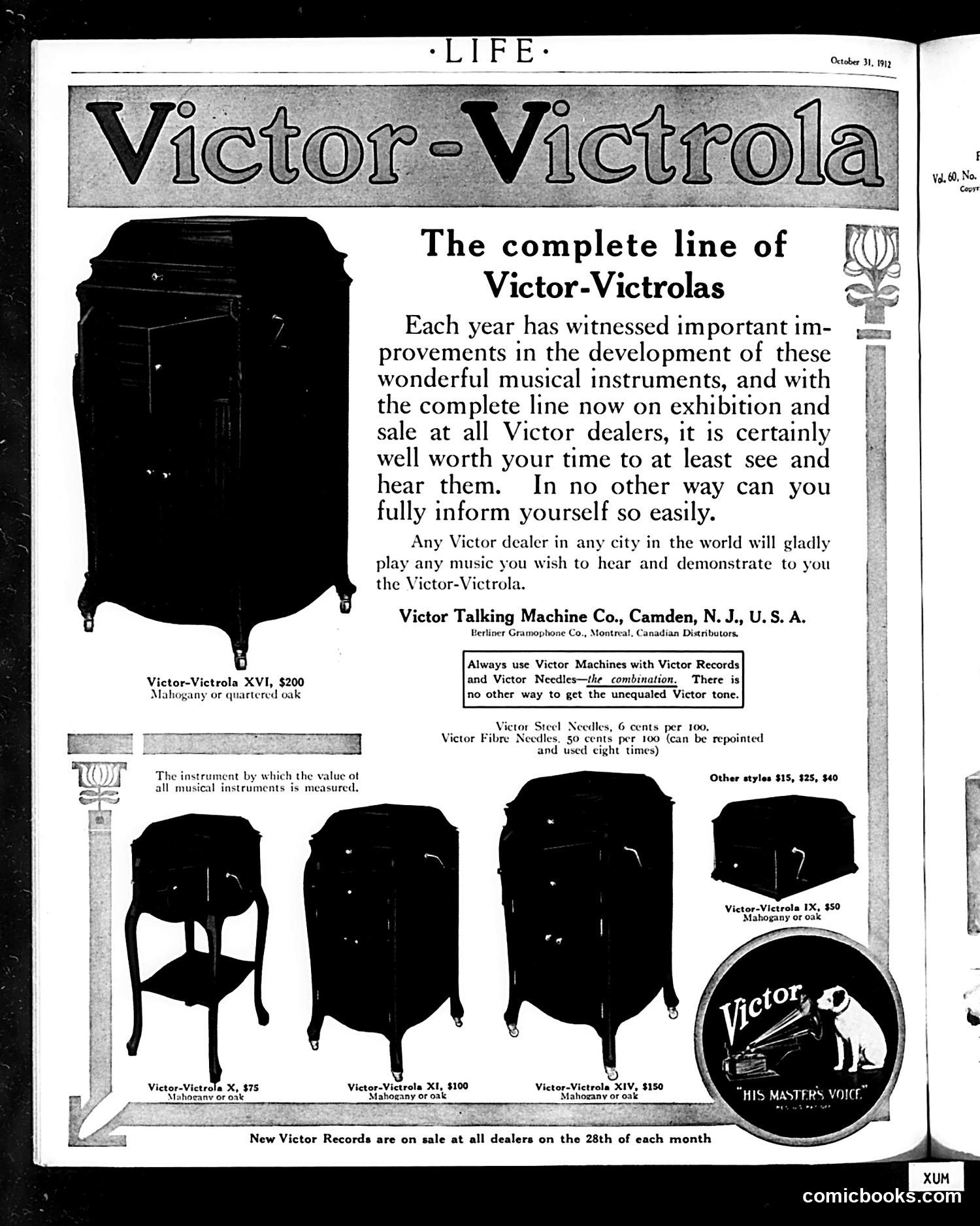
This is a **full-page advertisement**, not satire or political commentary. It promotes Victor-Victrola phonographs—then-revolutionary home music devices—manufactured by the Victor Talking Machine Co. in Camden, New Jersey. The ad showcases a complete product line at various price points ($15–$200), emphasizing annual improvements to these "wonderful musical instruments." It encourages potential customers to visit Victor dealers to hear demonstrations. The iconic "His Master's Voice" logo (dog listening to a gramophone horn) appears in the bottom right, a famous trademark still recognized today. The ad stresses using Victor machines exclusively with Victor Records and Victor Needles—a marketing strategy ensuring brand loyalty and repeat purchases. The page reflects early 20th-century consumer culture and the technological novelty of recorded home entertainment before radio became widespread.