
A complete issue · 48 pages · 1912
Life — October 10, 1912
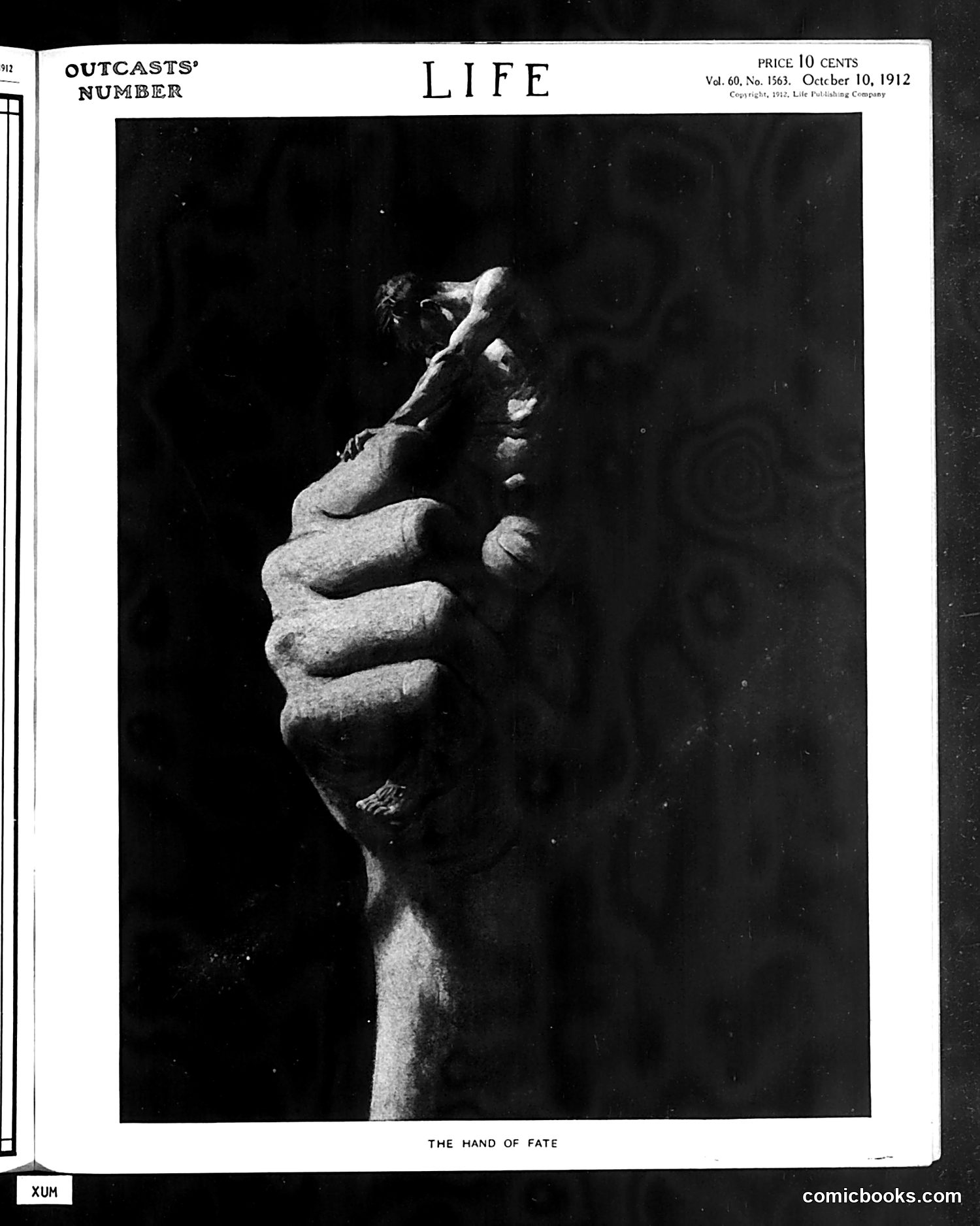
This dramatic image shows a large hand grasping or manipulating a smaller human figure. Titled "The Hand of Fate," this appears to be political commentary from the 1912 election season, though the specific reference remains unclear from the image alone. The symbolism suggests commentary on forces beyond individual control—possibly referencing destiny, political manipulation, or powerful interests controlling events. The vulnerable human figure contrasts starkly with the dominating hand above it. Without additional context from the magazine's text or articles, the precise target of satire cannot be determined with certainty. It may reference a political candidate, social movement, or current event from October 1912, but identifying the specific reference would require speculation beyond what the image itself supports.
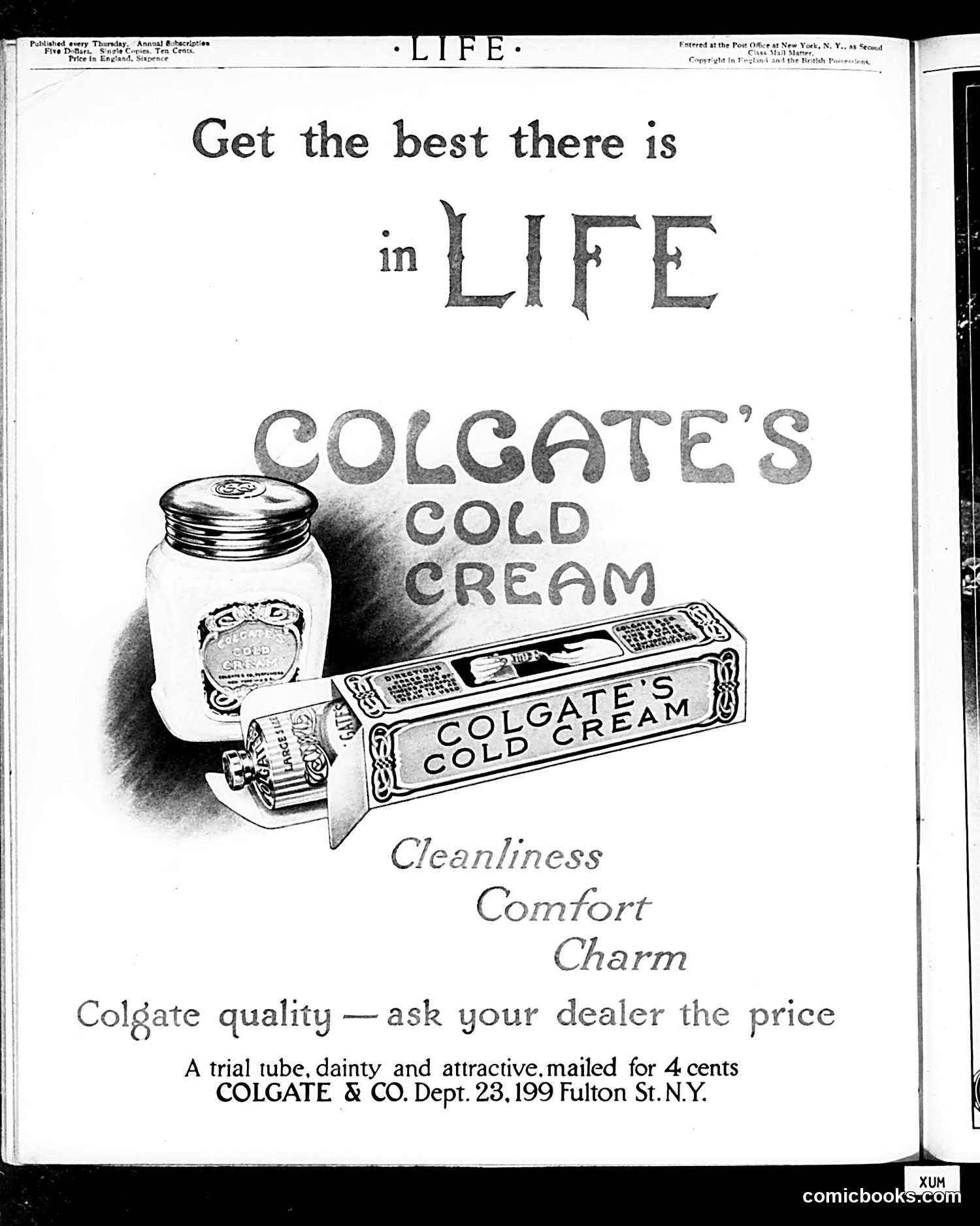
This page is **not a cartoon or satirical content** — it is a straightforward **advertisement for Colgate's Cold Cream**, published in *Life* magazine. The ad features product images (a jar and tube of cold cream) alongside marketing copy emphasizing three qualities: "Cleanliness, Comfort, Charm." The headline "Get the best there is in LIFE" is a clever double entendre, playing on the magazine's title while promoting the product. The ad offers a trial tube for 4 cents, directing readers to contact Colgate & Co. at their New York address. This represents typical early 20th-century magazine advertising, where branded products purchased prominent space in popular publications to reach middle-class consumers, particularly women.
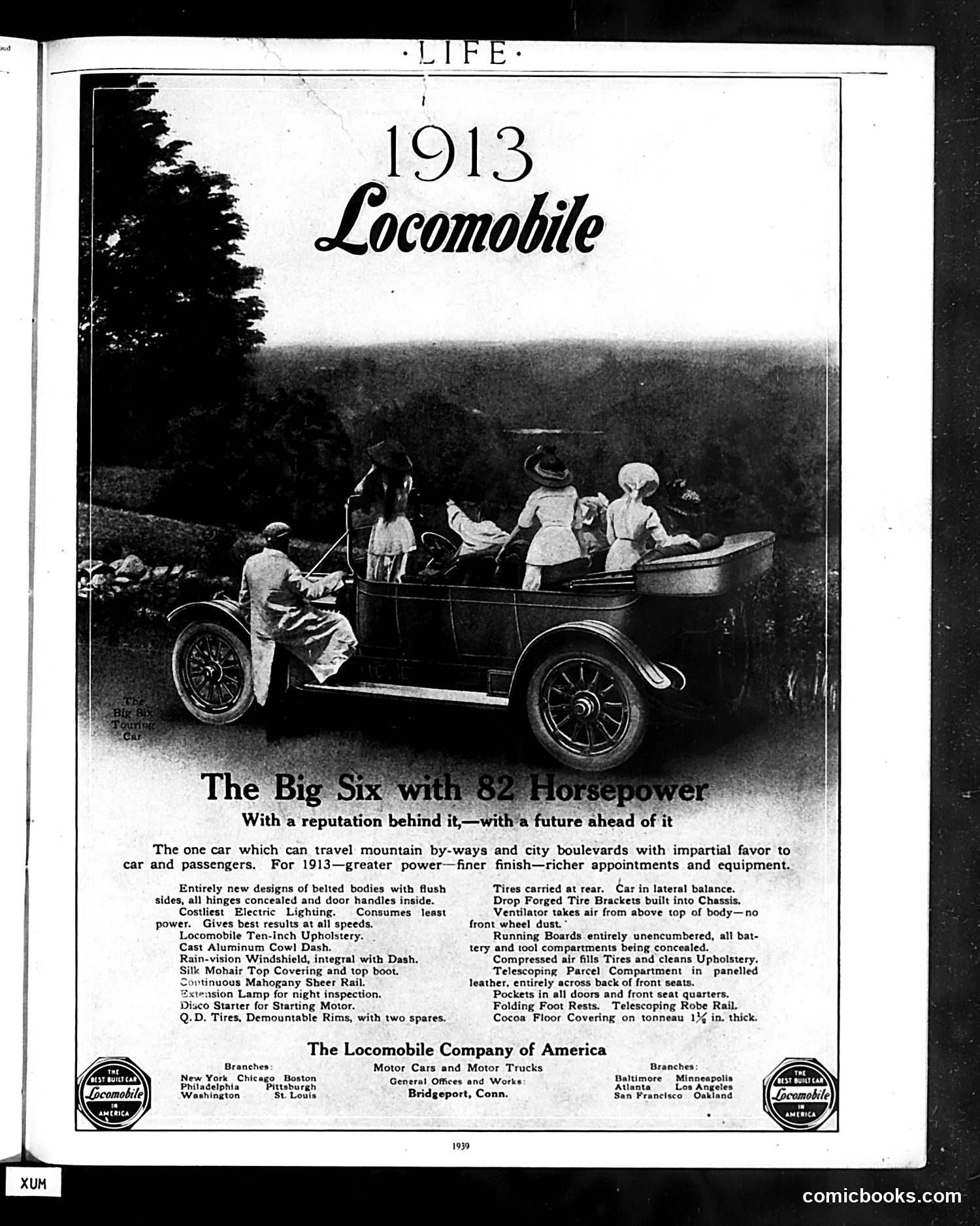
This is **not a political cartoon or satire**—it's a straightforward automobile advertisement from *Life* magazine. The page promotes the 1913 Locomotile "Big Six," a luxury car featuring 82 horsepower. The image shows an open-air touring car carrying well-dressed passengers (appearing to be upper-class men and women in period clothing) on a scenic mountain drive. The advertisement emphasizes engineering features and comfort: enclosed bodies, concealed hinges and door handles, powerful lighting, windshields, and various mechanical innovations. The tagline promises the car can handle "mountain by-ways and city boulevards with impartial favor." This reflects early-1900s automobile marketing targeting wealthy consumers, highlighting both mechanical superiority and the leisure-class lifestyle automobiles enabled.
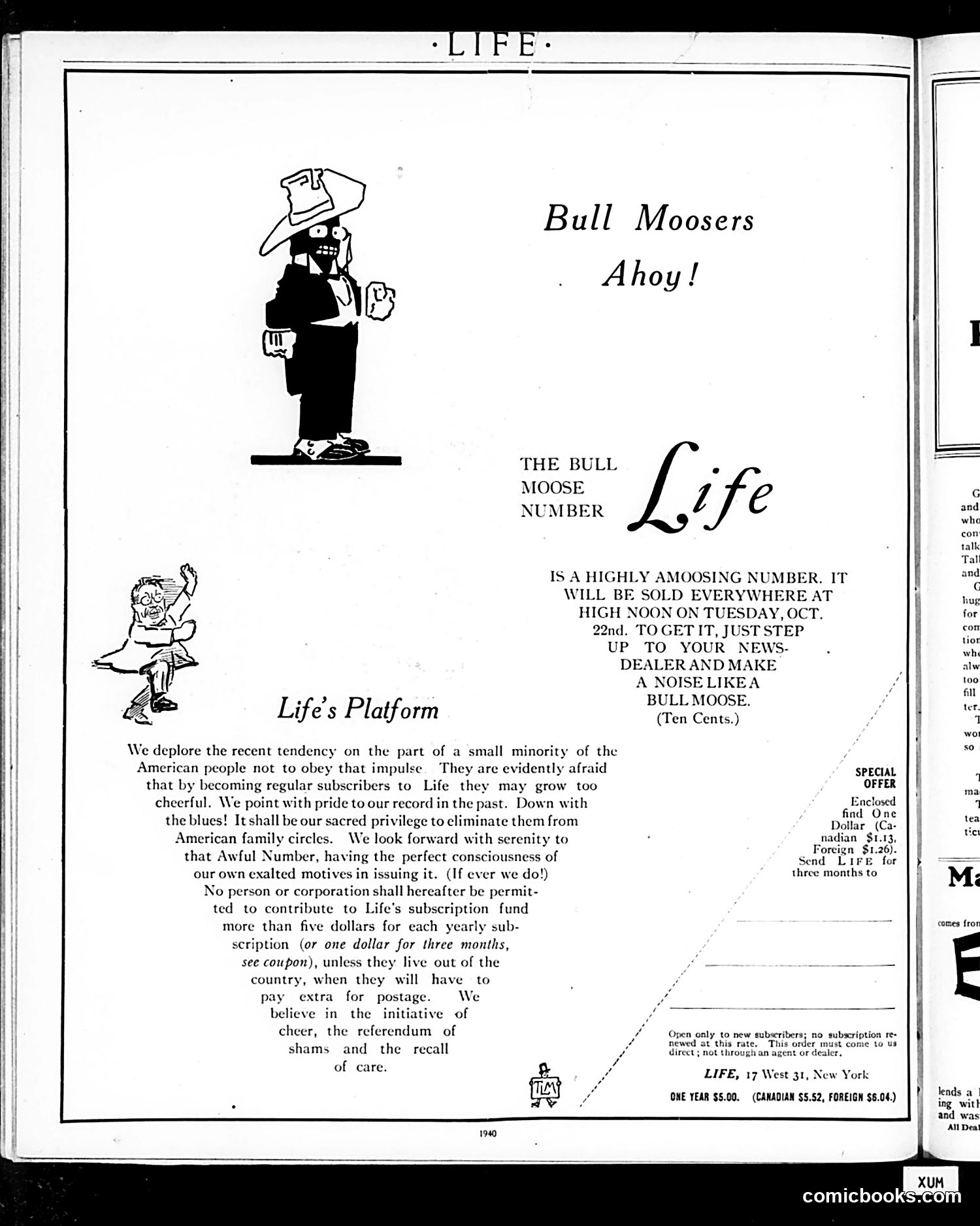
This Life magazine page contains satirical commentary about subscription practices rather than political cartooning. **"Life's Platform"** editorial argues against a "small minority of American people" who refuse to subscribe regularly to Life magazine, claiming such reluctance makes them insufficiently cheerful. The piece sarcastically warns that Life will use "perfect conscience" to eliminate these non-subscribers from "American family circles." The accompanying "Bull Moose" imagery and "Bull Moosers Ahoy!" headline reference Theodore Roosevelt's 1912 Progressive ("Bull Moose") Party campaign, here appropriated as playful branding for Life's subscription drive. The tone is tongue-in-cheek: Life exaggerates its own importance while gently mocking readers who don't subscribe, using historical political imagery for comedic effect.
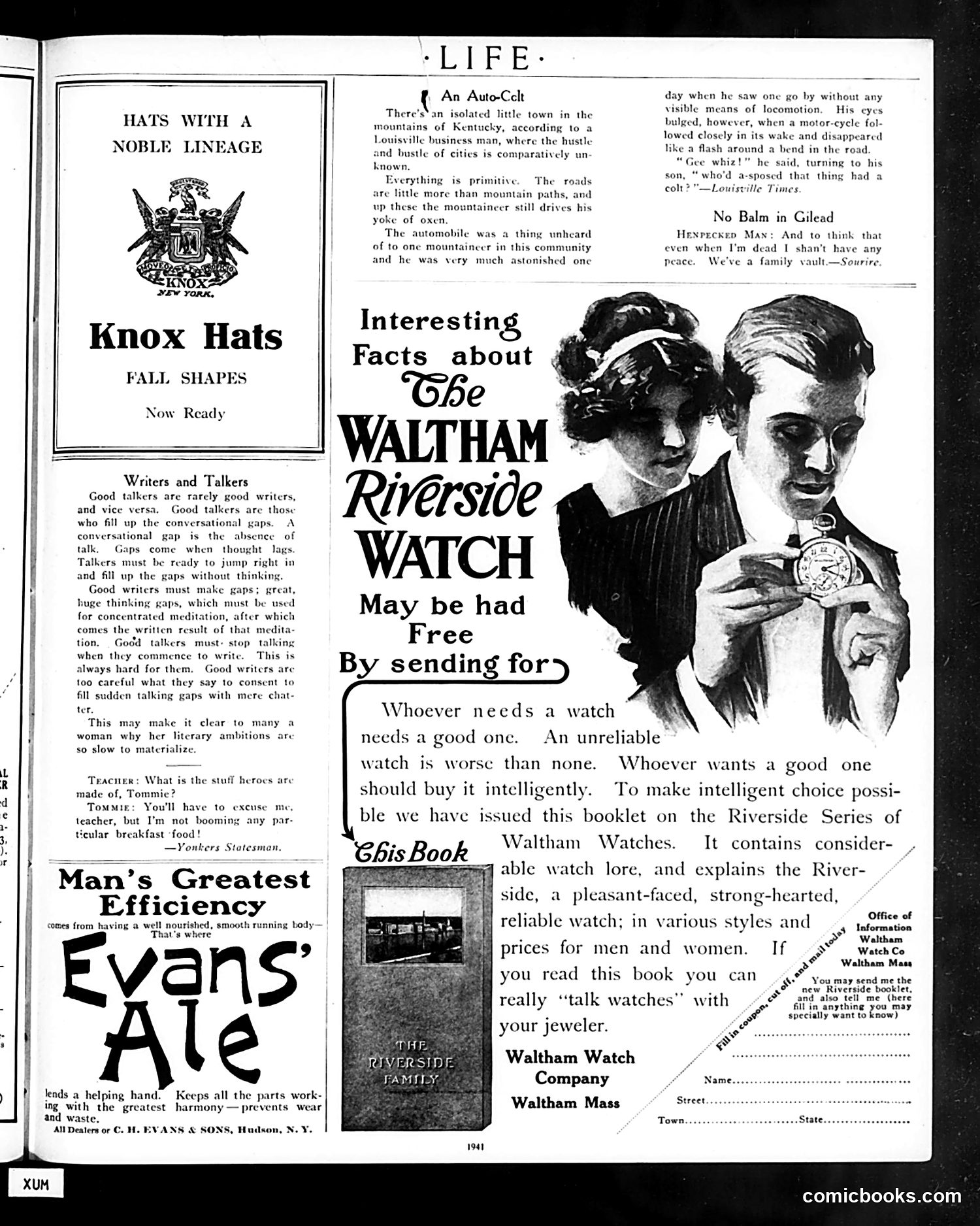
This page is primarily **advertising**, not political satire. It contains four distinct ads: 1. **Knox Hats** — promoting fall hat styles with a heraldic crest 2. **Waltham Riverside Watch** — featuring illustrated portraits of a man and woman displaying watches, with marketing copy emphasizing watch reliability and quality 3. **Evans' Ale** — claiming to promote "Man's Greatest Efficiency" through proper nutrition 4. **"Writers and Talkers"** — a brief editorial piece about conversational gaps in literature The only potentially satirical content is the short "Writers and Talkers" section, which humorously critiques authors' and speakers' ability to maintain engaging conversation. However, this is commentary rather than political cartooning. The page reflects early 1900s consumer advertising and lifestyle editorial content.
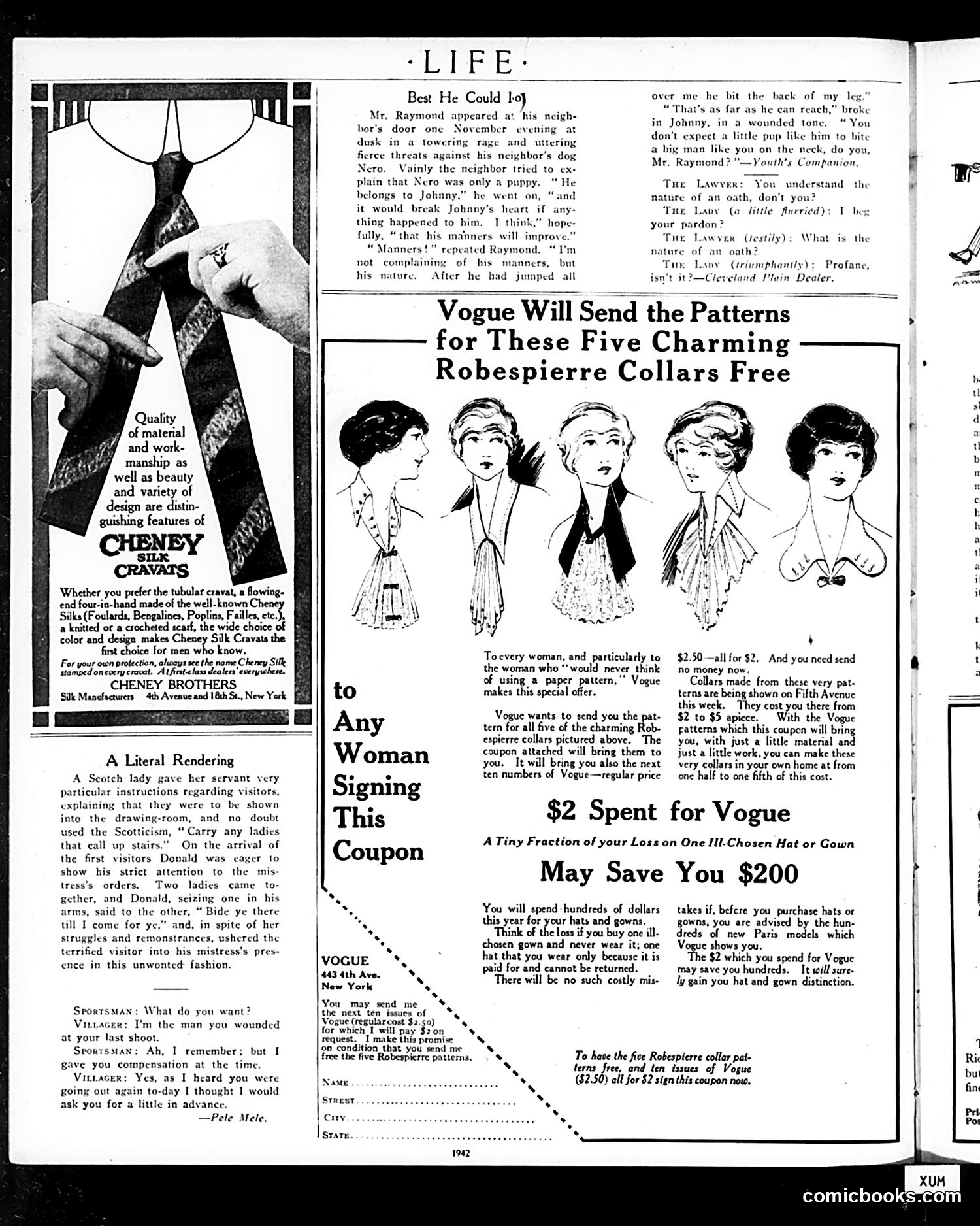
This page is primarily **advertising content** rather than satirical cartoons, though it includes some humorous anecdotes. The top left shows a **Cheney Brothers silk cravat advertisement** featuring a stylized illustration of elegant menswear, emphasizing quality and workmanship. Below that, "A Literal Rendering" is a brief humorous anecdote about a Scottish servant misunderstanding instructions about "stairs"—a wordplay joke rather than political satire. The **dominant feature** is a Vogue magazine advertisement for free Robespierre collar patterns. The ad promises that $2 spent on Vogue patterns could save readers $200 on hats or gowns by enabling home sewing rather than purchasing expensive ready-made garments. This reflects **1942 wartime economics**: the magazine promoted economical home sewing during fabric rationing and financial constraints of World War II.
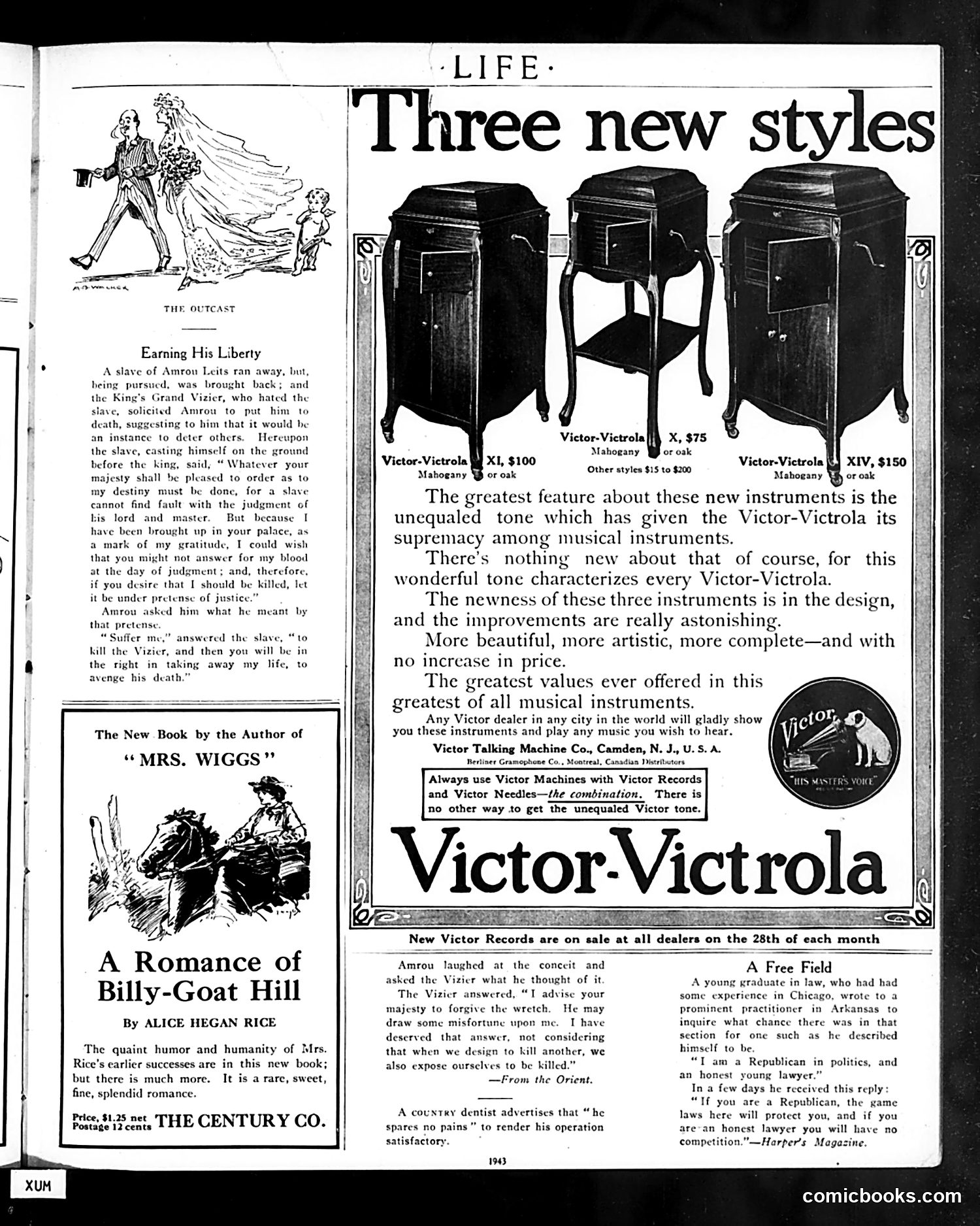
This page is primarily **advertising and literary content**, not political satire. The left side features a short story titled "The Outcast: Earning His Liberty," about a slave named Amron who escapes and is brought before a king's vizier. It's a dramatic narrative (likely fictional allegory rather than specific satire). Below that is a book advertisement for "A Romance of Billy-Goat Hill" by Alice Hegan Rice, published by The Century Co. The dominant right side is a **Victor-Victrola phonograph advertisement** showcasing three new cabinet styles (XI, X, and XIV models) at different prices. The ad emphasizes superior tone quality and design improvements with "no increase in price." The page reflects early 20th-century magazine content: serialized fiction, book promotions, and luxury product advertising targeting middle-class readers.
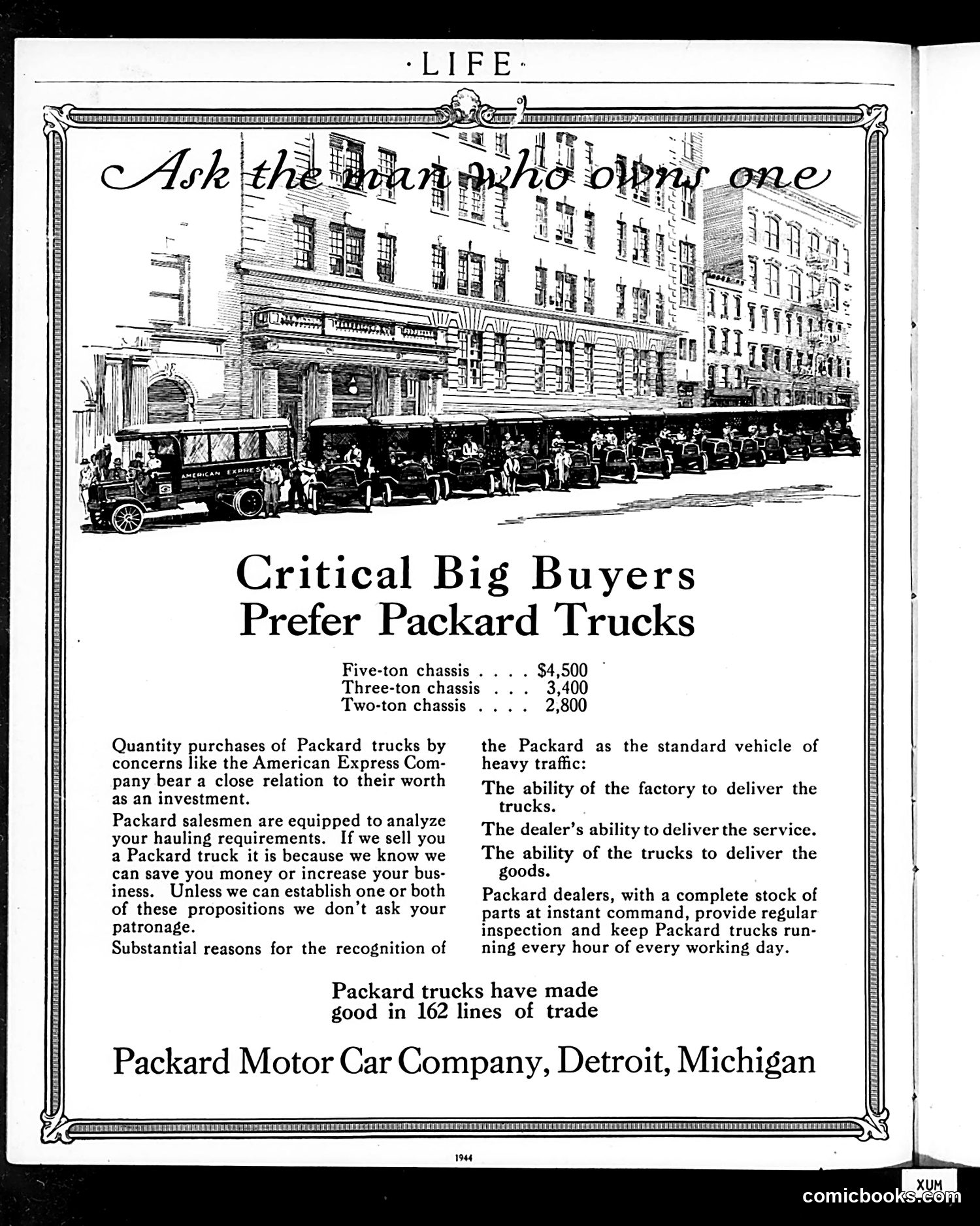
This is primarily a **commercial advertisement**, not editorial satire or political commentary. It promotes Packard Motor Car Company's trucks to business buyers. The ad features an illustration of a long line of Packard trucks outside an urban commercial building, with the headline "Critical Big Buyers Prefer Packard Trucks." The text emphasizes that major companies like American Express purchase Packard vehicles, and argues this reflects sound business judgment. The ad lists three truck chassis prices ($4,500, $3,400, $2,800) and highlights Packard's competitive advantages: factory delivery reliability, dealer service infrastructure, and parts availability. There is **no satire or political cartoon content** on this page—it's straightforward business-to-business advertising typical of Life magazine's commercial pages in 1944.
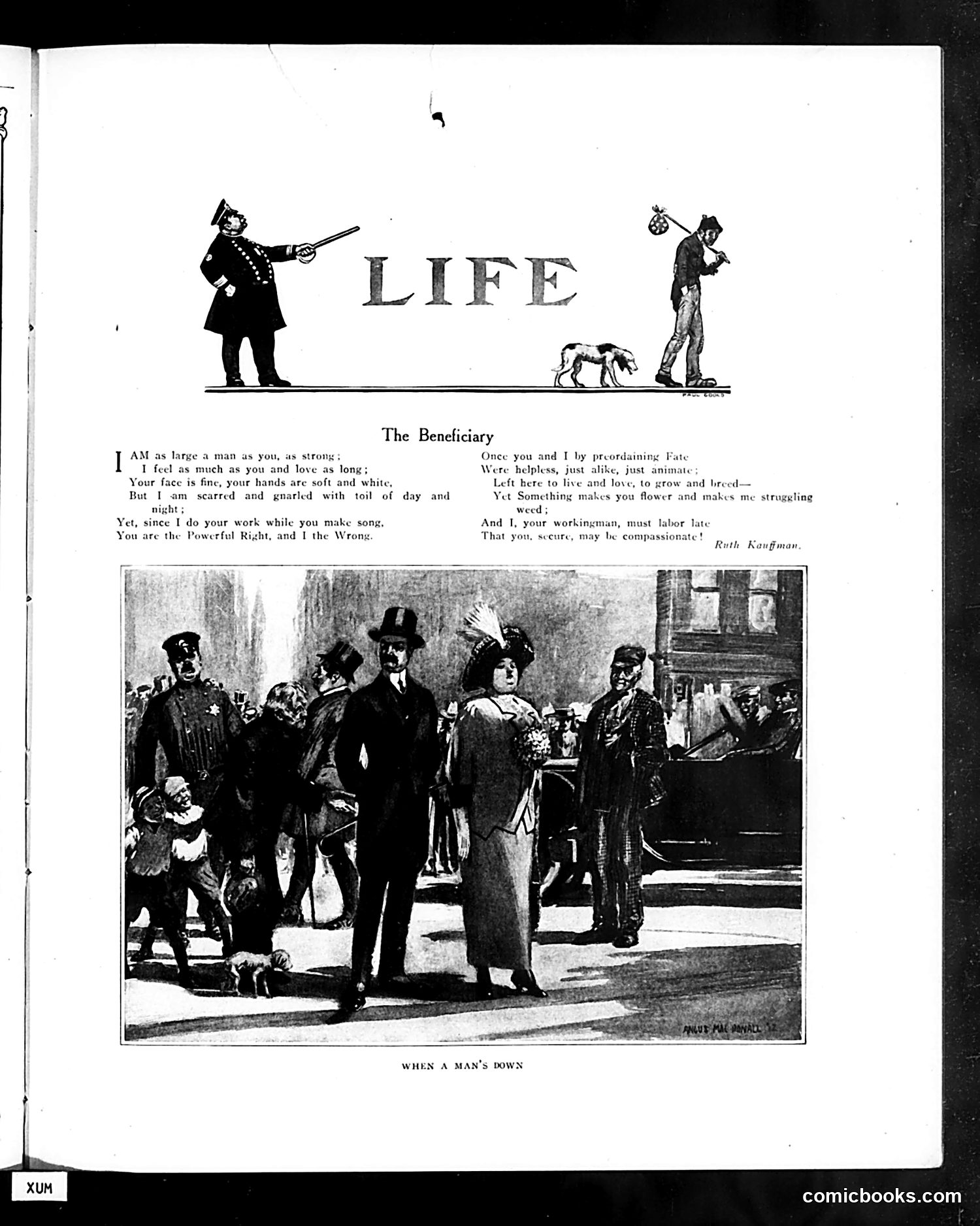
This page presents a satirical poem by Ruth Kaufman titled "The Beneficiary," contrasting two figures: one powerful and scarred (representing military/political authority), the other weak but morally superior. The illustration "When a Man's Down" depicts a formal social scene with well-dressed figures, including military officers and society women. The satire appears to critique class disparity and social hypocrisy—the privileged classes maintaining dignity while others suffer. The poem's theme suggests that true power lies not in physical strength or social status, but in moral character and compassion. The top decorative header shows figures engaged in hunting/violence versus domestic charity, further emphasizing the contrast between destructive and constructive power.
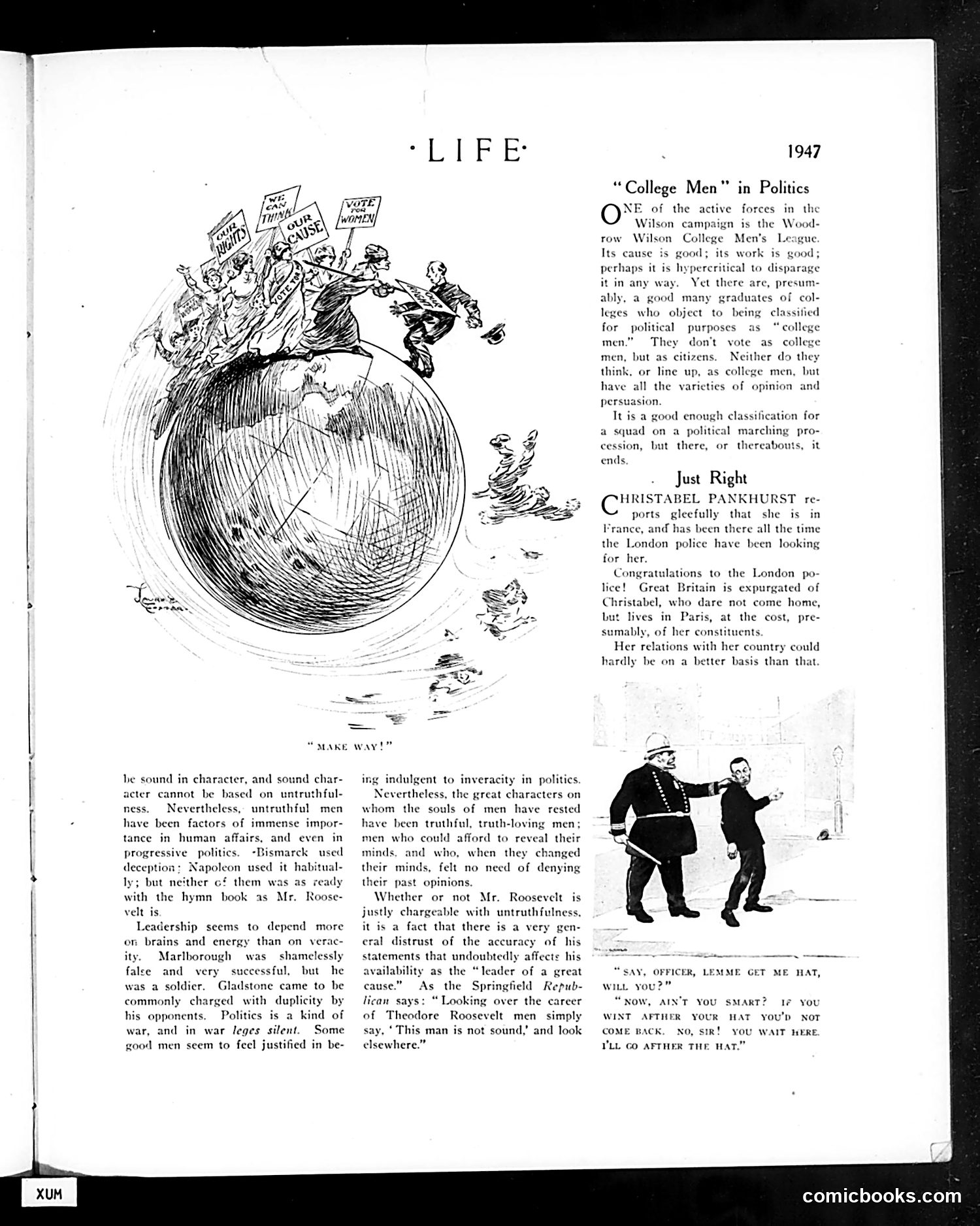
The main cartoon depicts political campaigners riding atop a large globe labeled "MAKE WAY!" — showing politicians literally riding roughshod over the world during the Wilson campaign (likely referring to Woodrow Wilson's era or a contemporary political movement). The accompanying article criticizes the "Woodrow Wilson College Men's League" for classifying college graduates as "college men" engaged in partisan politics. The author argues this contradicts the independent thinking expected of educated citizens — they should vote as citizens, not as a bloc. A secondary cartoon satirizes military bureaucracy: an officer demands a subordinate's hat as a show of authority, illustrating absurd military hierarchy and deference to rank. The "Just Right" section addresses Christabel Pankhurst's exile in France, criticizing Britain for exiling a political figure rather than facing domestic criticism.
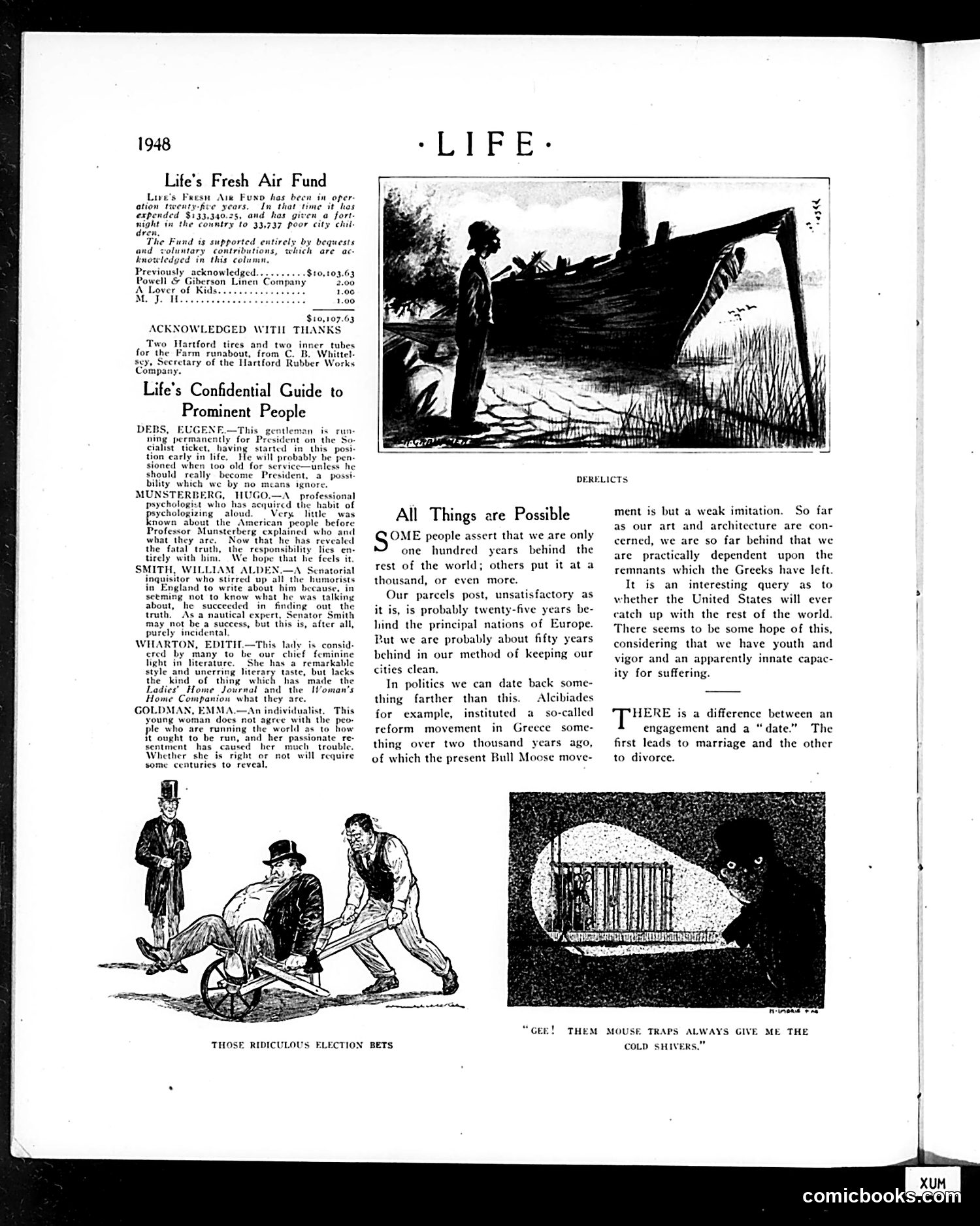
This page contains two distinct sections: **"Life's Fresh Air Fund"** (top left): A charitable appeal listing donors and contributions. This appears to be a legitimate fundraising notice, not satire. **"Derelicts" Section**: The main content features a cartoon titled "Those Ridiculous Election Bets" showing three men examining something on the ground—likely depicting people making absurd wagers on election outcomes. The accompanying article "All Things are Possible" discusses American progress and political reform movements, referencing the Bull Moose movement (Theodore Roosevelt's 1912 progressive party). **"Gee! Them Mouse Traps Always Give Me the Cold Shivers"**: A separate cartoon featuring a mouse trap, using anthropomorphized mice for humorous effect. The page blends satirical commentary on election betting practices with broader social observation, typical of Life's mid-century editorial approach.
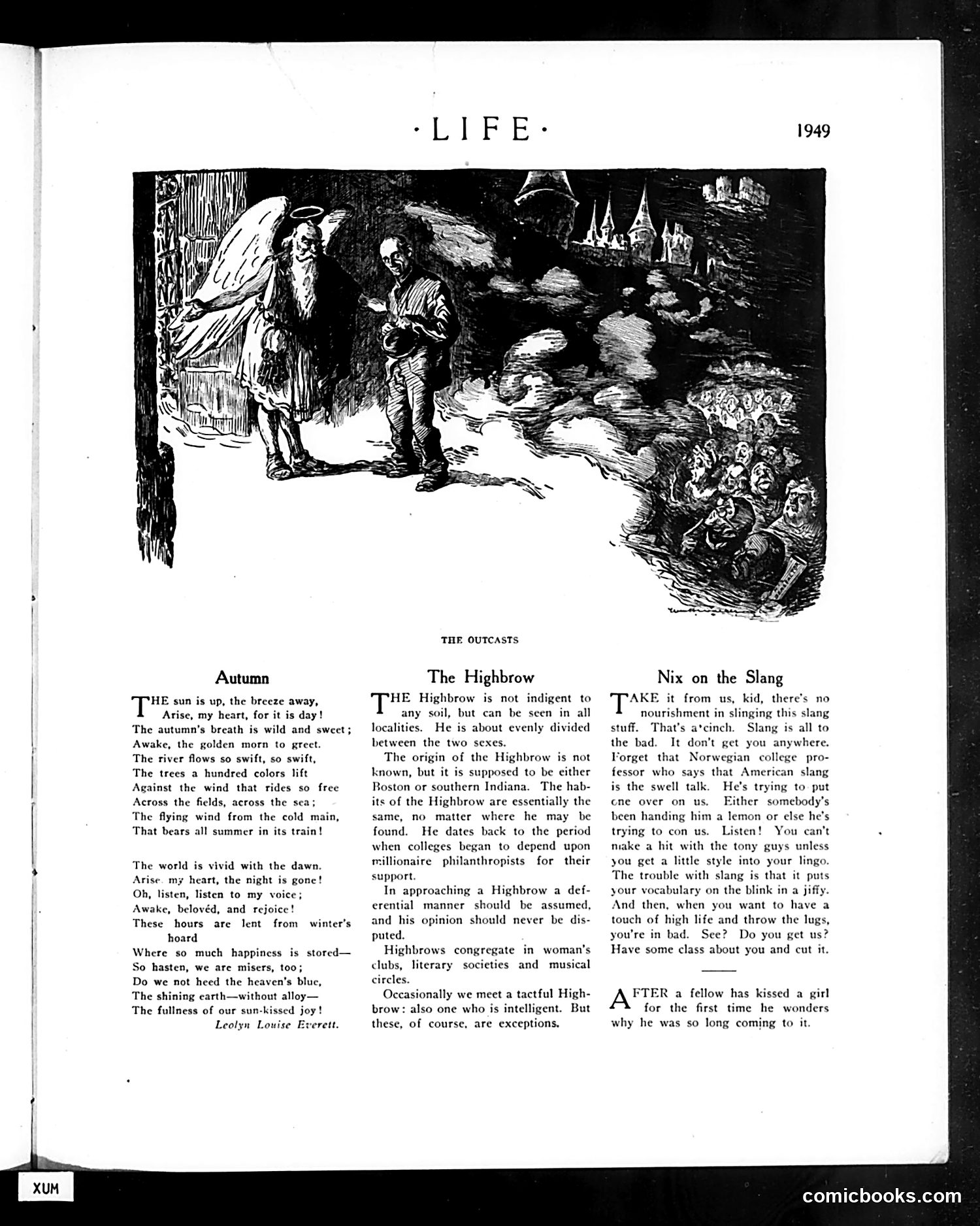
The page features three pieces of humorous social commentary: **The Illustration** at top depicts supernatural/fantastical figures—an angel and what appears to be a devil or demon with other creatures—suggesting a moral or afterlife theme, though its specific reference is unclear from the image alone. **"Autumn"** (poem by Lorelyn Louise Everett) is sentimental verse about fall's beauty and melancholy. **"The Highbrow"** satirizes intellectual pretension. It describes highbrows as geographically distributed across America (not just Boston/Indiana), congregating in women's clubs and literary societies. The satire suggests highbrows are often tactless snobs, occasionally intelligent but mostly exceptions to their type's general mediocrity—mocking mid-century intellectual affectation. **"Nix on the Slang"** humorously dismisses college slang as affected and pretentious, advising against linguistic affectation.
This is a short story, not a cartoon. The narrative depicts a police interrogation scene where a Chief of Police questions a prisoner accused of theft (jewels stolen from "Mrs. Wildeboy de Sykes's residence"). The story satirizes police brutality and coercive interrogation tactics. The Chief employs physical torture (a heated stove), psychological manipulation, and threats to extract a confession, while lecturing the prisoner about "the majesty of the law" and truthfulness. The irony is heavy: the officer violates every legal principle while invoking them, using force while demanding honesty, and framing abuse as justice. The piece criticizes corrupt law enforcement and the gap between stated legal principles and actual police conduct.
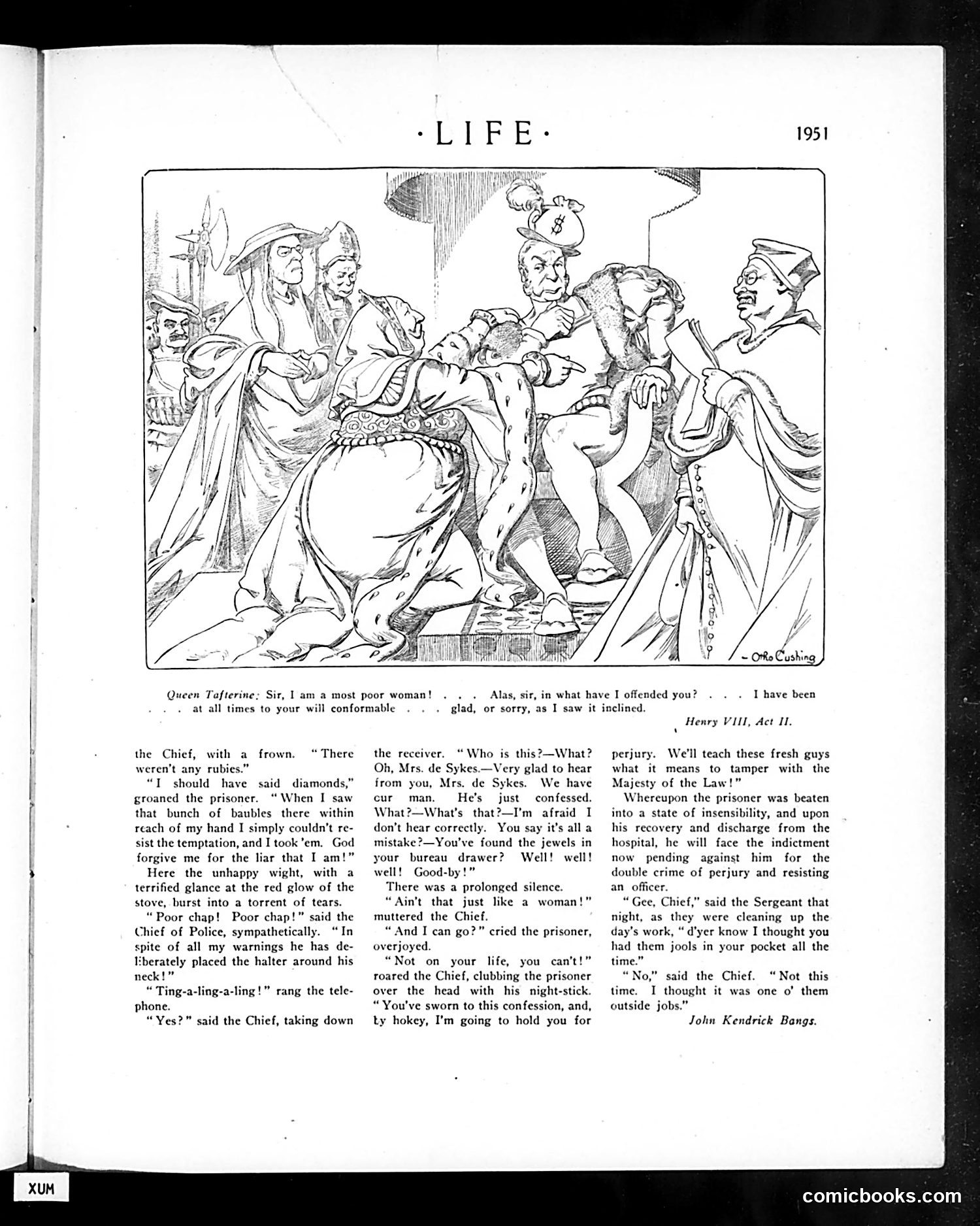
This is a satirical story illustrated by O.R. Cushing, written by John Kendrick Bangs. It depicts a corrupt police chief who extracts a false confession from a poor prisoner accused of stealing jewels. When the actual owner (Mrs. de Sykes) calls to report finding the jewels in her own bureau, the chief refuses to release the prisoner—instead beating him into insensibility to punish him for "perjury" and maintain the appearance of police authority. The satire targets **police corruption and abuse of power**: the chief prioritizes protecting institutional "Majesty of the Law" over actual justice. The irony is sharp—the prisoner is punished not for the crime he didn't commit, but for confessing to it when ordered. The epigraph from Henry VIII adds dark humor, comparing the prisoner's predicament to courtly obedience. This reflects 1951 anxieties about authoritarian policing and the vulnerability of poor defendants to frame-ups and coercion.
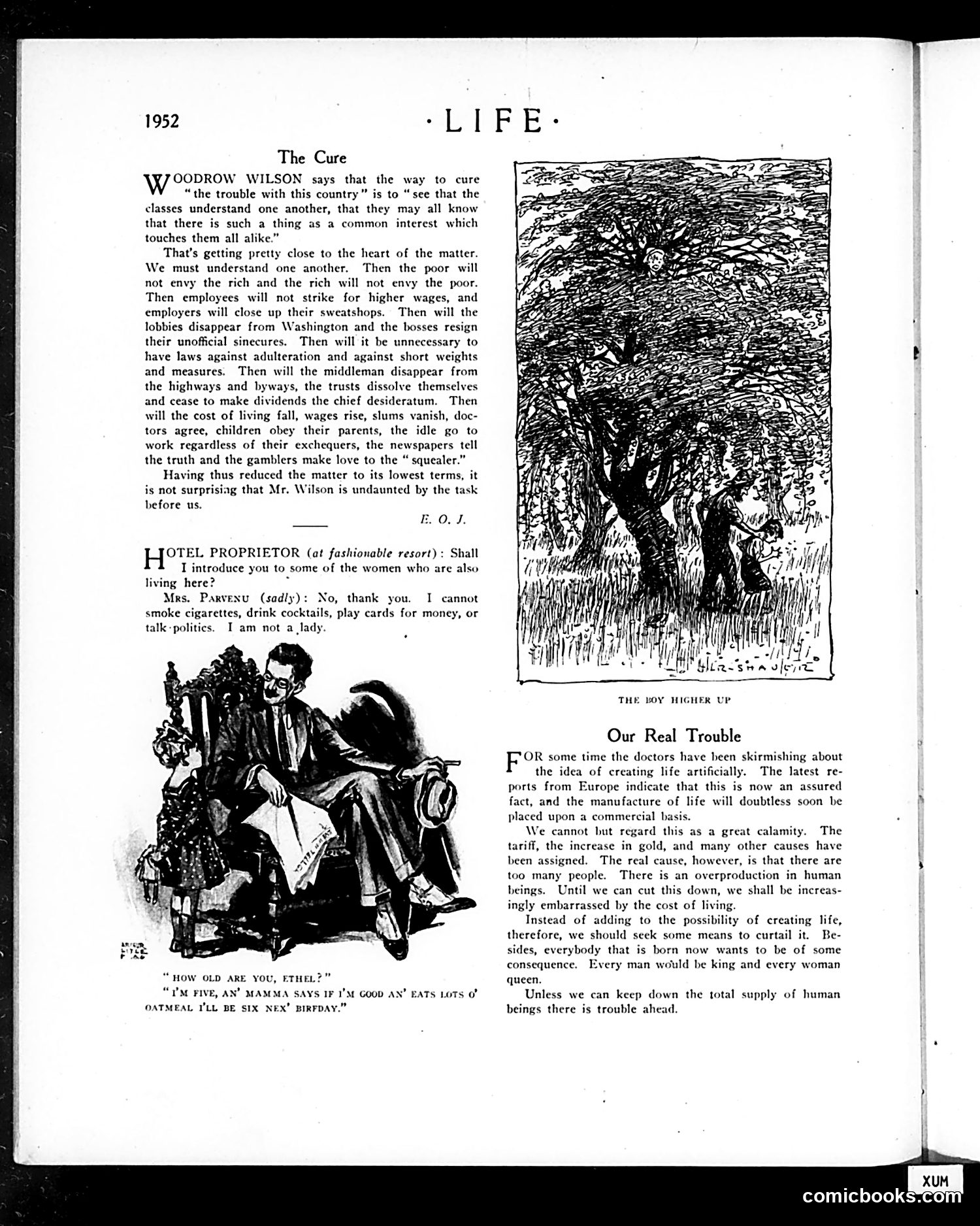
This page contains three satirical pieces mocking idealism and social pretension: **"The Cure"** sardonically quotes Woodrow Wilson's naive solution to class conflict—mutual understanding—then systematically demolishes it. The satire suggests such idealism is laughably insufficient; real economic problems (strikes, trusts, monopolies) won't vanish through goodwill alone. **The dialogue cartoon** features a nouveau-riche woman ("Mrs. Parvenu") at a resort who cannot participate in upper-class activities (smoking, drinking, gambling, political discussion) because she "is not a lady." It mocks social climbing and the artificial barriers of genteel society. **"Our Real Trouble"** ironically treats artificial life creation as catastrophic—not morally, but economically. The satire suggests overpopulation causes poverty and cost-of-living crises. It darkly jokes that the solution isn't creating more life but *curtailing* it, since modern babies "want to be of some consequence"—a sardonic dig at human ambition and entitlement. Overall, the page presents cynical commentary on American social problems and pretensions.
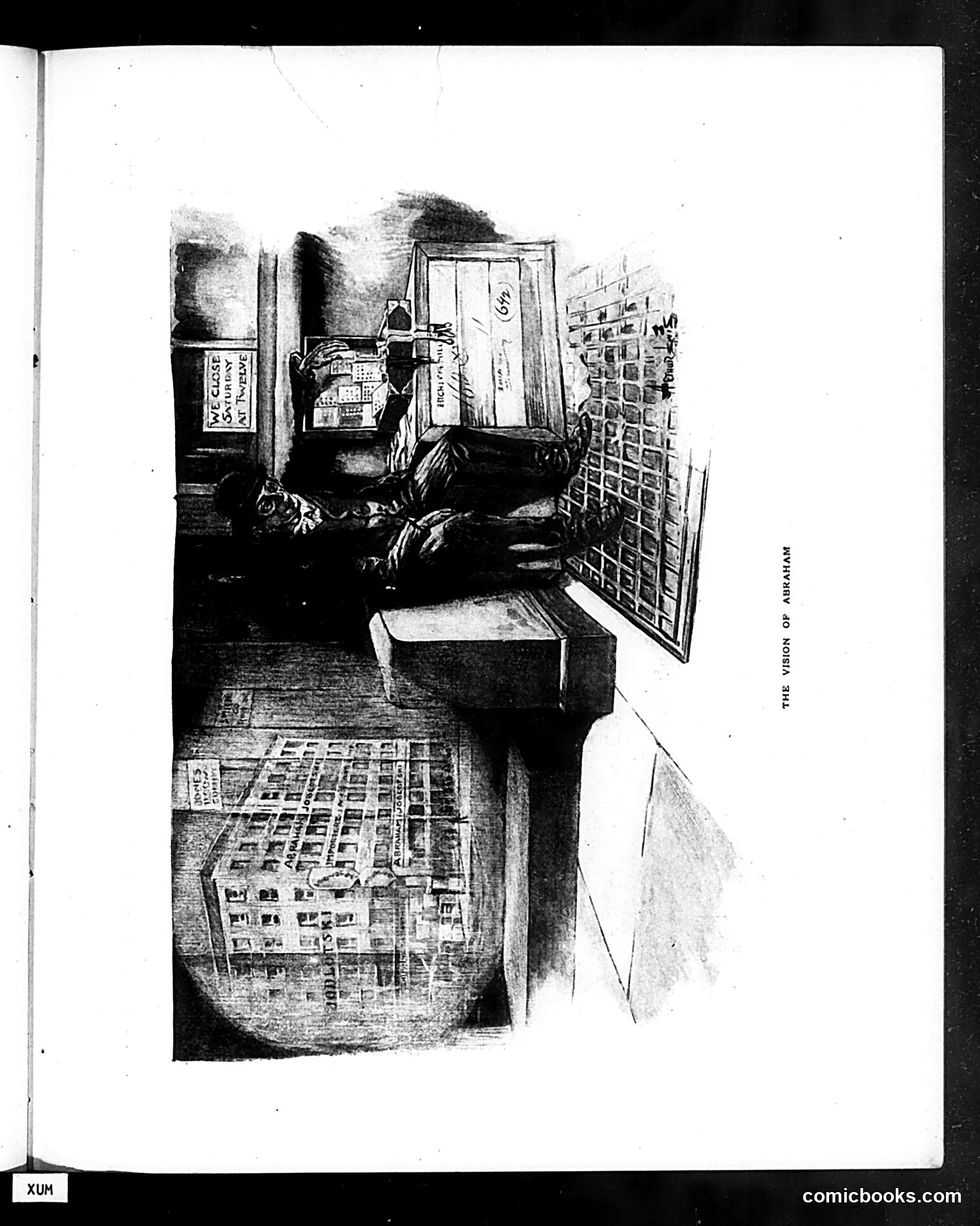
This appears to be a political cartoon satirizing Abraham Lincoln's vision or legacy. The image shows a figure (likely representing Lincoln or his ghost) observing a scene below. The composition suggests a heavenly or spiritual perspective—Lincoln looking down at America from above. The lower portion depicts what appears to be an urban or industrial scene with maps and buildings visible, possibly representing post-Civil War America or contemporary developments Lincoln might witness. Without clearer visibility of specific labels or dates on the buildings and maps shown, the exact target of satire—whether criticizing how Lincoln's ideals were being fulfilled or betrayed in the era when this *Life* magazine was published—remains unclear, though the title suggests ironic commentary on the gap between Lincoln's vision and current American reality.
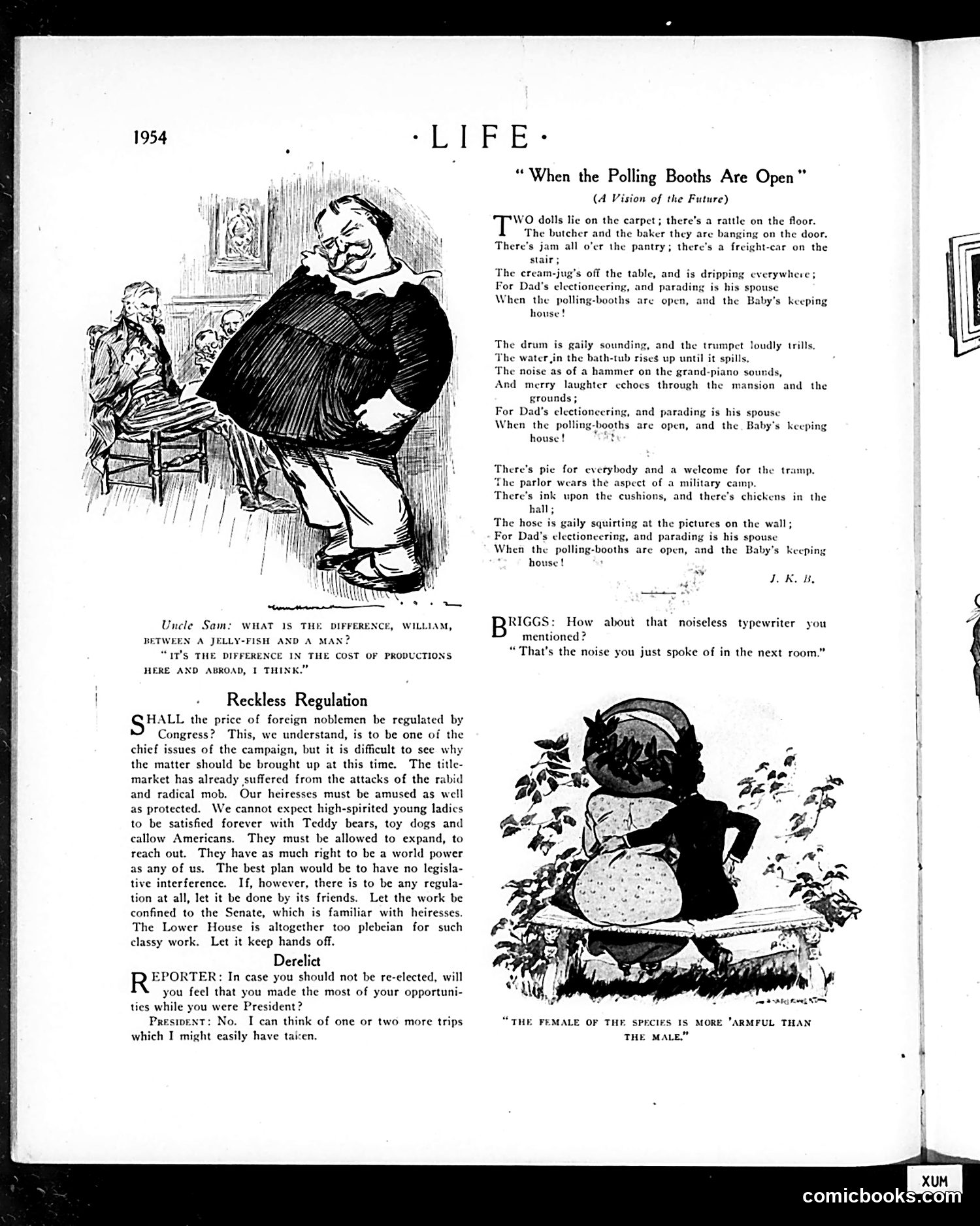
This page contains three satirical pieces mocking American political and social life: **"When the Polling Booths Are Open"** imagines domestic chaos when parents abandon home to campaign during elections—children destroy the house while unsupervised, depicting the "Baby's keeping house" as complete disaster. The satire critiques politicians' prioritization of campaigning over family responsibility. **The Uncle Sam/jelly-fish joke** appears to be a simple non-sequitur gag about production costs. **"Reckless Regulation"** sarcastically defends wealthy American heiresses marrying foreign nobility, mocking both the heiresses' aspirations and Congressional concern about such unions. The piece ridicules the Senate as more "appropriate" for such "classy work" than the House—a jab at aristocratic pretension among the wealthy. **The final cartoon** presents a natural history observation about female animals being more dangerous than males, likely commenting satirically on female political or social power. Overall, the page targets electioneering distraction, class pretension, and gender dynamics in 1950s America.
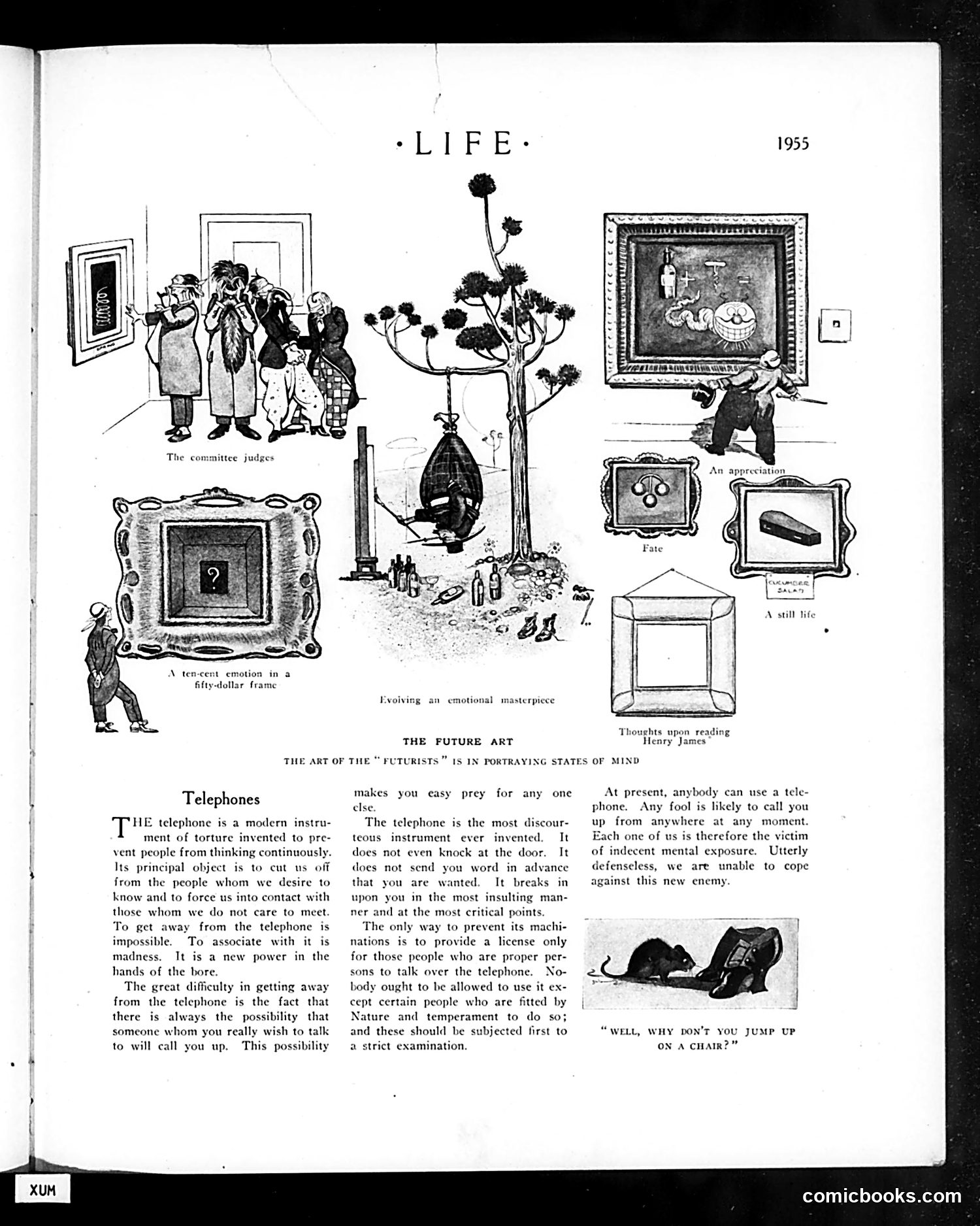
This page satirizes two modern annoyances through a mocking "high art" framework and a bitter complaint essay. The upper section parodies **Futurist art movements** (early 20th-century avant-garde) by presenting mundane modern anxieties as profound artistic subjects: committee judges examining art, a man suspended in a swing surrounded by debris, framed images of fate and coffins. The caption declares futurism concerns "states of mind"—the joke being that artists treat trivial emotional turbulence as deep philosophy. The "Telephones" essay below delivers scathing social commentary disguised as advice. It calls the telephone an "instrument of torture" and "new power in the hands of the bore"—attacking the device's intrusive nature and inability to be refused. The author argues only licensed, properly-temperament people should use phones, since "any fool" can invade your privacy at vulnerable moments. The final cartoon shows someone suggesting a man jump on a chair—likely depicting one of those intrusive, unwanted phone calls forcing absurd reactions. Together, these pieces mock both pretentious modern art and the genuine social friction caused by newly-ubiquitous telephone technology.
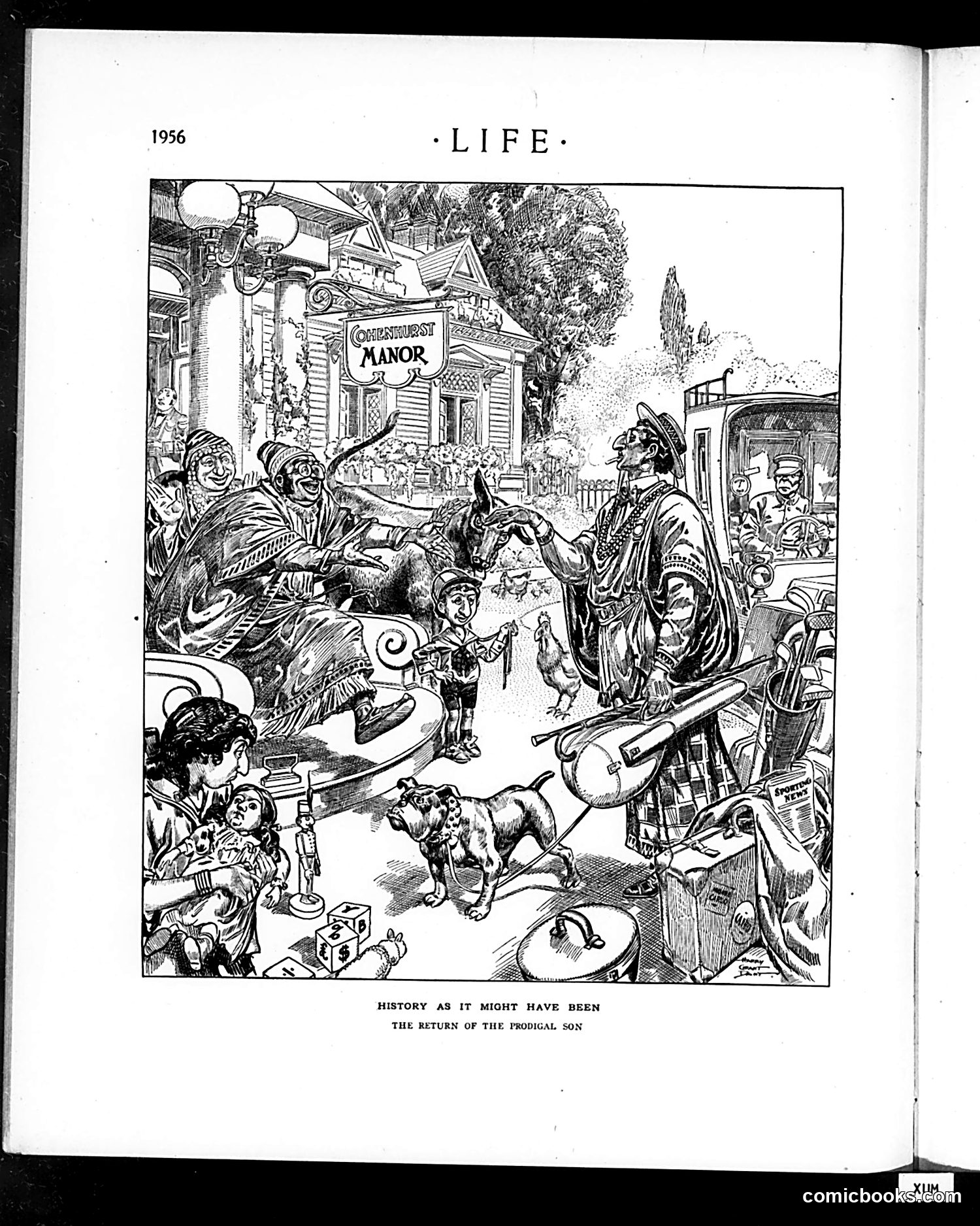
This 1956 *Life* magazine illustration depicts a humorous reimagining of the biblical parable of the Prodigal Son as a modern street scene. The drawing shows costumed figures—appearing to represent classical or historical characters—greeting a child in contemporary dress outside what looks like "Glendhurst Manor." The satire plays on the contrast between high biblical/classical tradition and mundane modern life. The elaborate costumes and formal greeting suggest a grandiose historical reenactment, while the actual setting—a suburban street with lampposts, automobiles, and ordinary people—undercuts any pretense of significance. The joke appears to mock either overwrought historical pageantry or the incongruity of attempting to recreate dignified biblical narratives in banal contemporary America. The title suggests ironic commentary on how such classic stories might actually unfold in modern times.
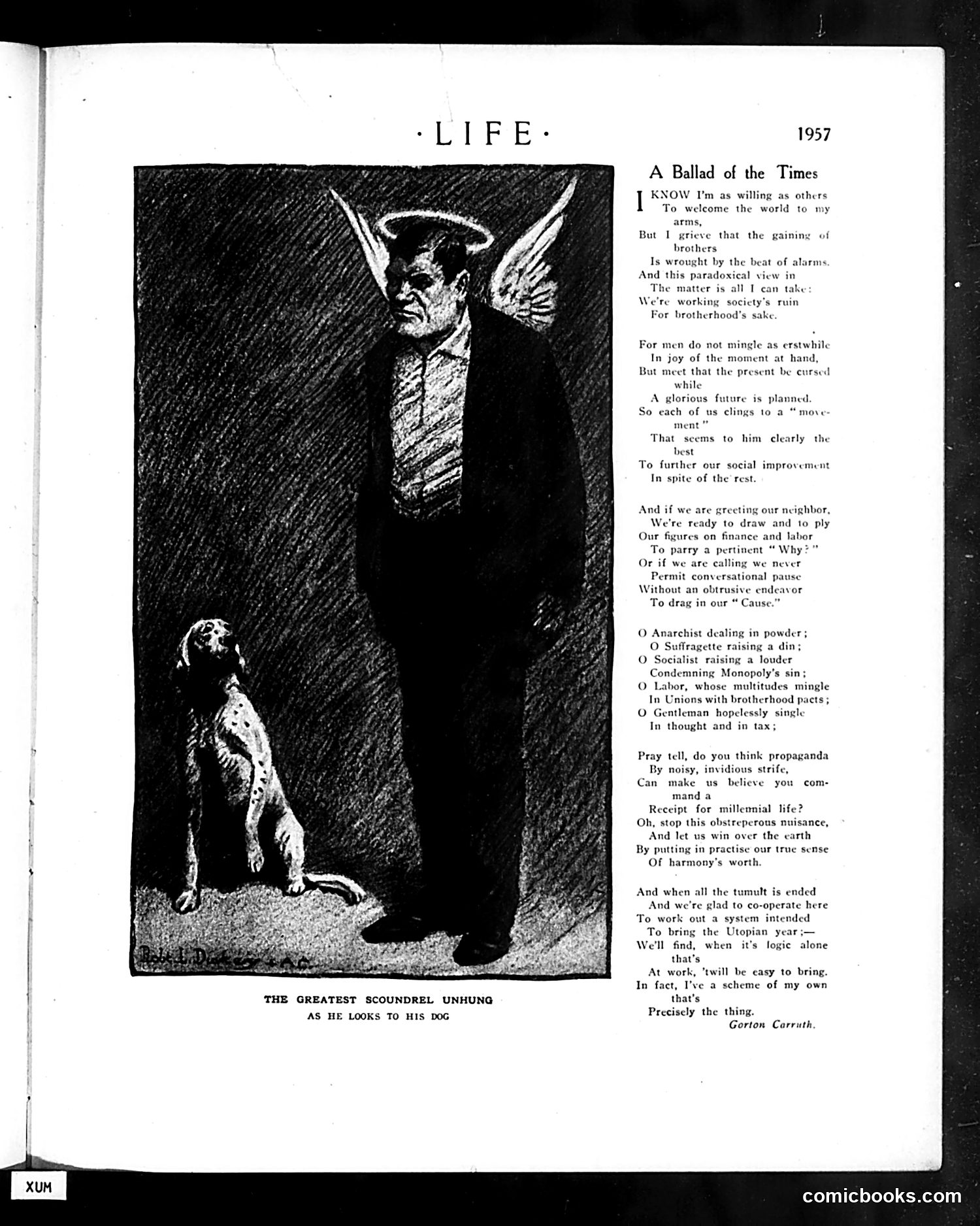
The cartoon depicts a winged, halo'd figure (representing an angel or idealist) gazing at his dog—captioned as "The Greatest Scoundrel Unhung." This visual paradox illustrates the poem's central irony. Poet Gordon Carruth satirizes 1950s American political and social movements. He mocks diverse groups—Anarchists, Suffragettes, Socialists, Labor unions, and wealthy individuals—for pursuing competing ideological "causes" while claiming to work toward brotherhood and social improvement. His critique: these factions so obsessively promote their conflicting agendas through "noisy, invidious strife" that they actually prevent genuine human connection and harmony. The angel-looking-at-a-scoundrel image reinforces the paradox: even idealistic-seeming efforts may be self-serving or counterproductive. Carruth argues that harmonious progress requires abandoning propagandistic arguments in favor of "logic alone"—a somewhat naive Cold War-era plea for rational consensus over ideological passion.
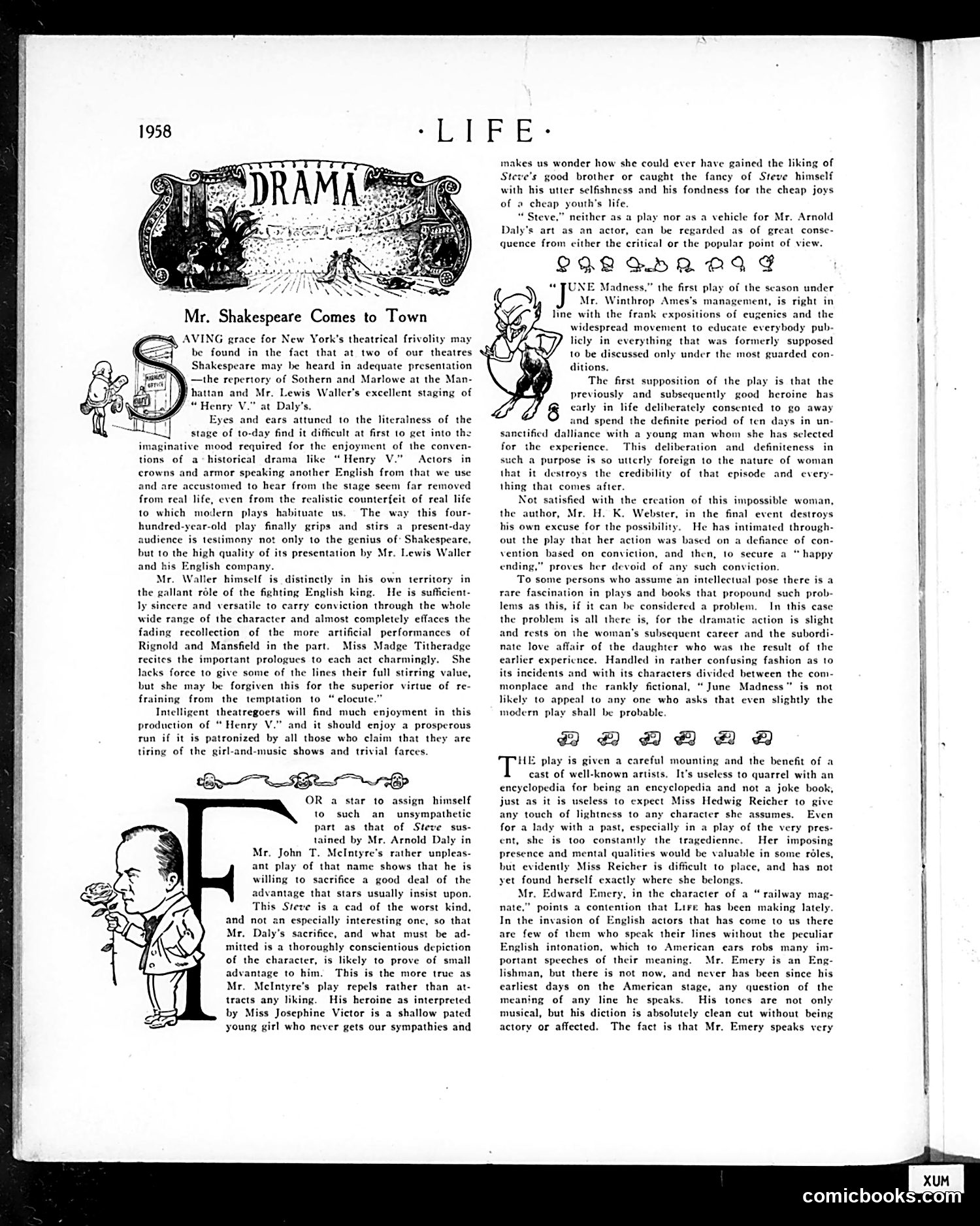
This page reviews three theatrical productions in New York: **"Henry V"** — Lewis Waller's production of Shakespeare receives high praise. The reviewer notes that audiences initially find Shakespeare's archaic language and conventions difficult, but Waller's sincere performance and the company's quality ultimately captivate modern viewers. The critic argues this demonstrates Shakespeare's enduring genius. **"Steve"** — Arnold Daly stars in John T. McIntyre's play about an unsympathetic character. The reviewer criticizes both the play and Daly's sacrifice in taking an unattractive role, suggesting it offers little artistic advantage to the actor or interest to audiences. **"June Madness"** — Winthrop Ames's production addresses eugenic themes and depicts a heroine who deliberately enters a ten-day liaison. The critic notes the play aligns with contemporary movements to publicly discuss previously taboo social topics. The cartoons illustrate these reviews with caricatures of the actors and productions discussed.
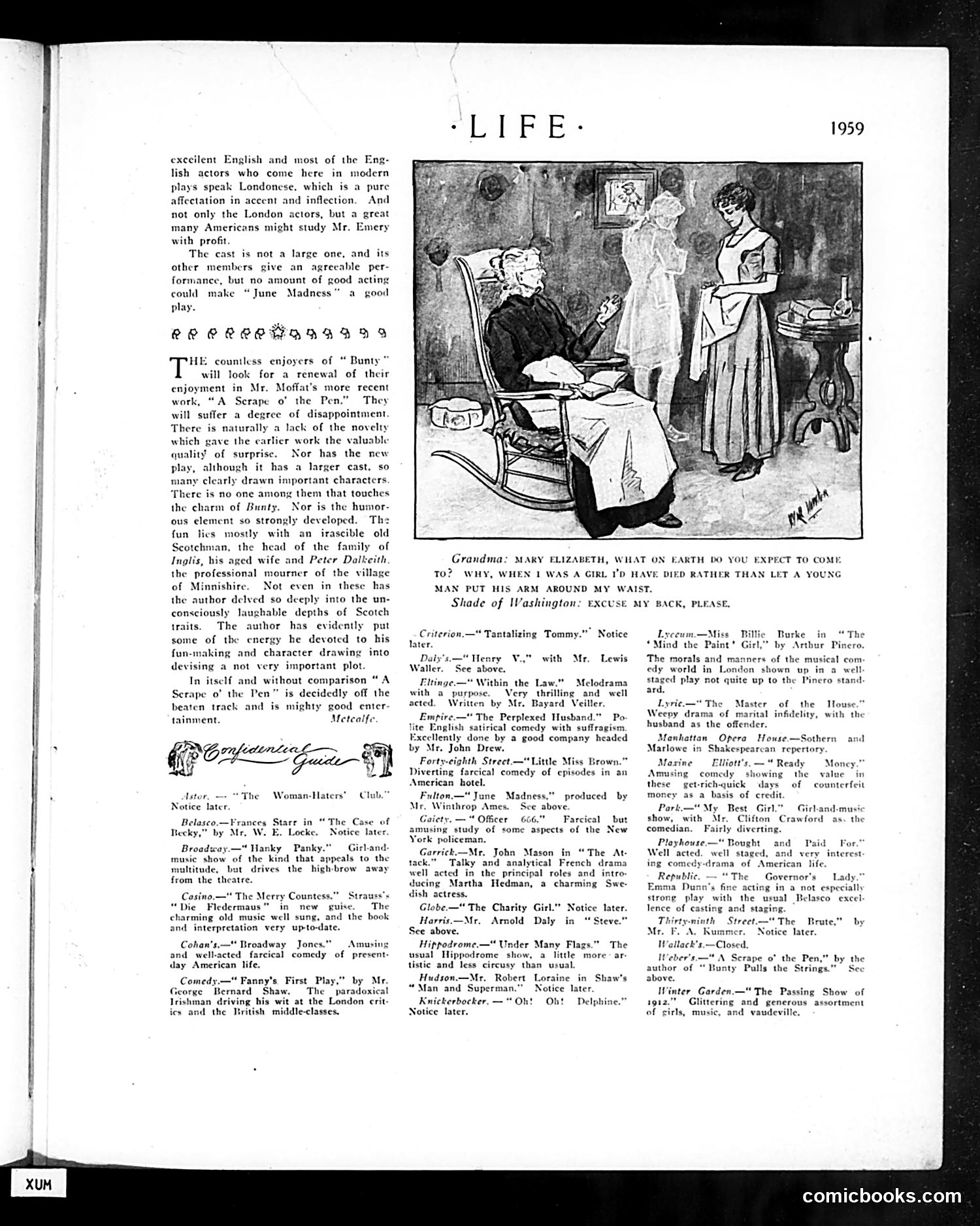
This page from Life magazine contains theater reviews and a single cartoon. The cartoon depicts a grandmother scolding her granddaughter Mary Elizabeth about propriety—specifically objecting to a young man putting his arm around the girl's waist. The satire targets generational hypocrisy about morality and physical intimacy. The grandmother claims she "would have died" rather than allow such contact when young, yet the "Shade of Washington" interrupting to ask her to "excuse my back, please" suggests an implicit criticism: the founding fathers (and earlier generations) were themselves quite physical with women, undermining the grandmother's claim to superior virtue. The joke relies on readers understanding that Victorian-era claims of strict propriety were often contradicted by actual historical behavior. It's a gentle mockery of how each generation judges the next's morality while ignoring their own past.
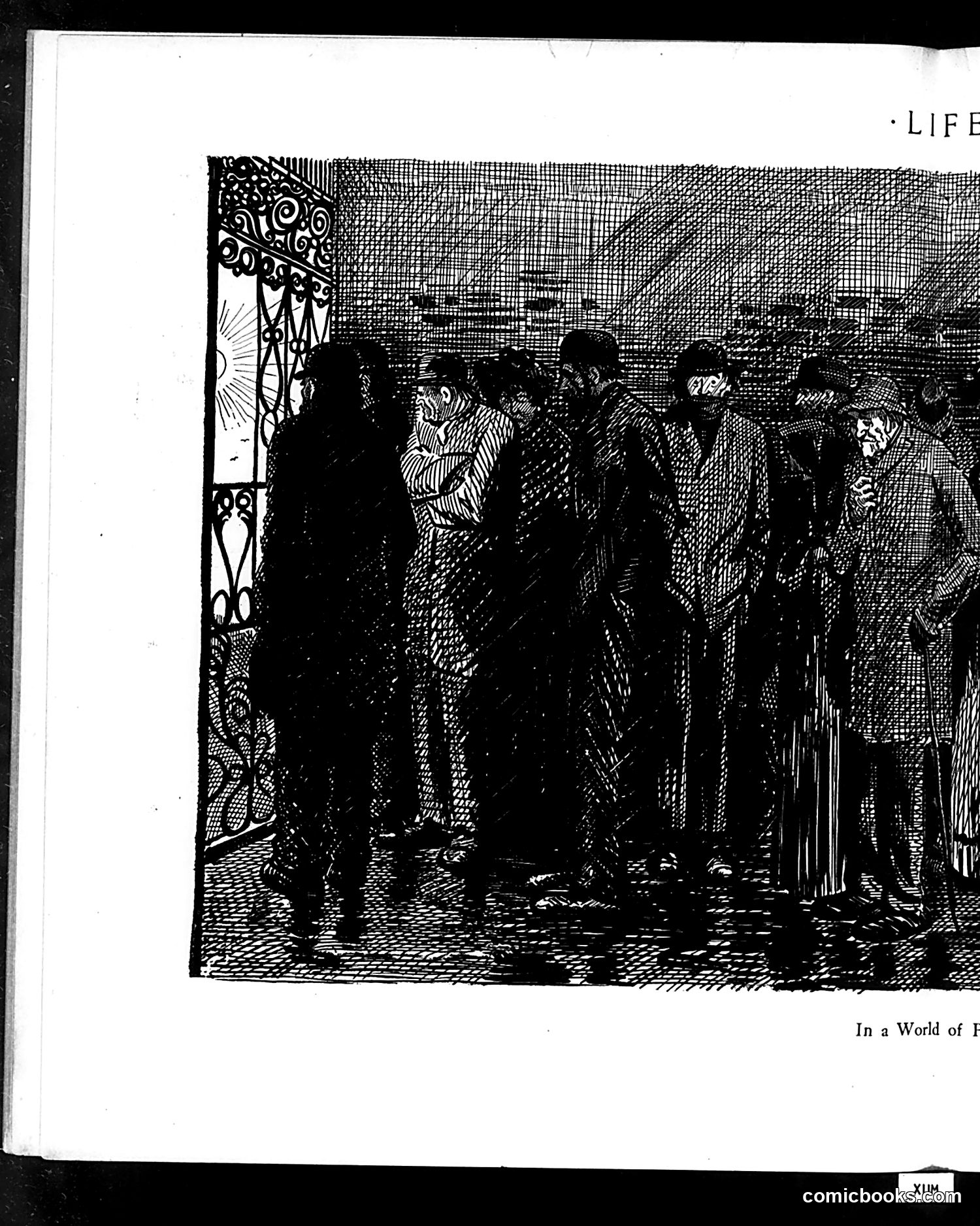
This page from *Life* magazine shows a black and white engraving depicting a crowd of people gathered at what appears to be a formal entrance or doorway, marked by ornate ironwork on the left. The figures are rendered in detailed crosshatching and appear to be dressed in period clothing, suggesting this is historical subject matter. The caption reads "In a World of..." but is cut off, making the specific satirical point unclear without additional context. The densely packed crowd and formal architectural setting suggest this may be commenting on social gathering, exclusivity, or access to privilege—common themes in *Life*'s satire. Without the complete caption or clearer identification of the figures, the exact target of the satire cannot be determined with certainty.
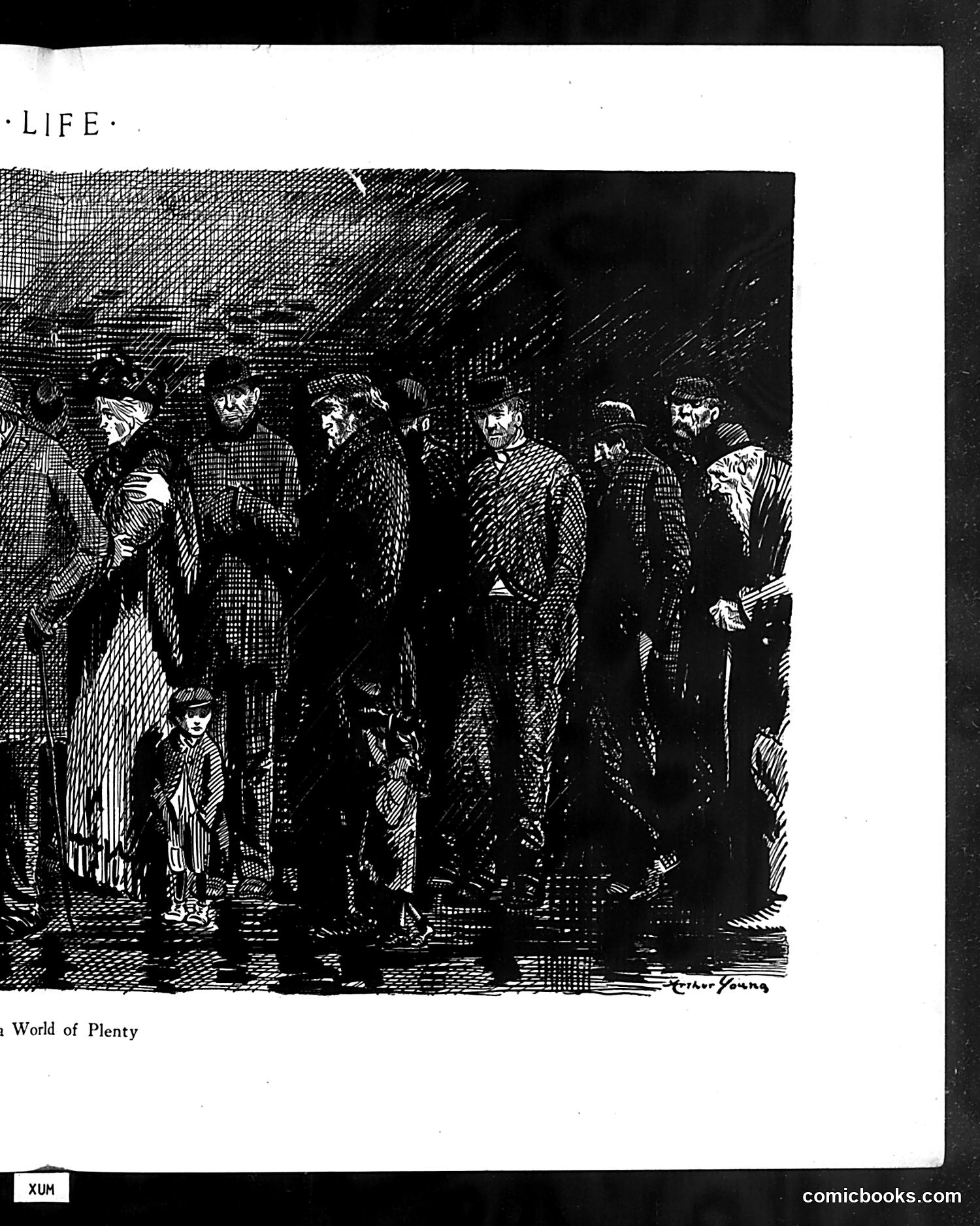
This appears to be a satirical illustration titled "World of Plenty" from *Life* magazine, signed by Arthur Young. The image depicts a crowded, dimly-lit interior scene—possibly a soup kitchen, bread line, or similar charitable establishment during economic hardship. Multiple figures of varying ages, including children, stand together in close quarters, suggesting poverty and food scarcity despite the ironic title. The satire works through contradiction: the caption promises abundance ("World of Plenty"), while the visual reality shows deprivation and overcrowding. This likely critiques either inadequate relief efforts, economic inequality, or broken promises of prosperity—common themes in early 20th-century American social commentary. The dark, crowded composition emphasizes desperation rather than sufficiency.
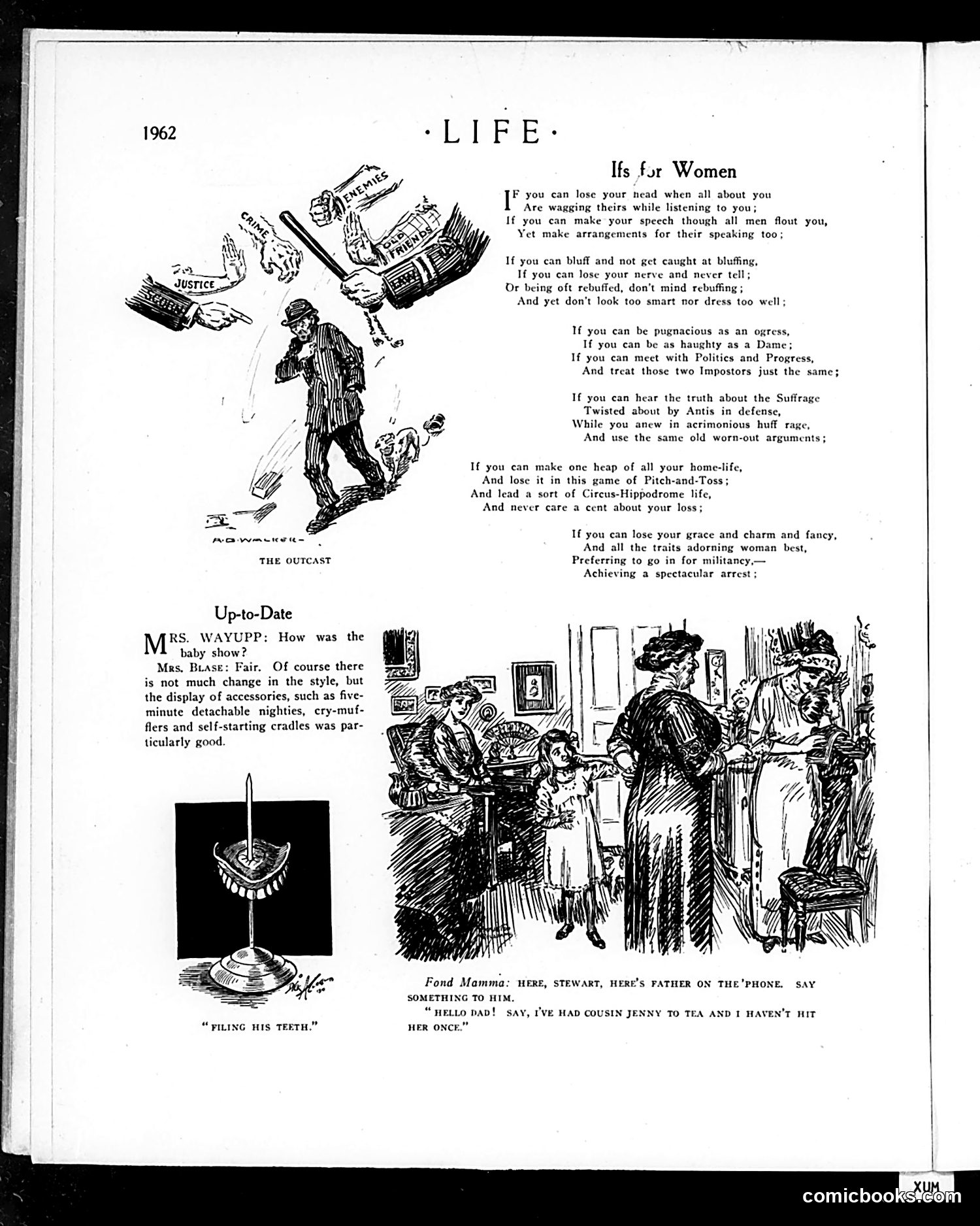
**"The Outcast"** (top): A man juggling various objects labeled with social issues (Justice, etc.) while being pelted—satire on politicians or public figures overwhelmed by competing demands. **"Up-to-Date"** (middle): Mrs. Wayupp and Mrs. Blase discuss a baby show's "accessories" like "five-minute detachable nighties" and "self-starting cradles"—mocking modern consumerism and the commercialization of motherhood through gadgetry. **"Ifs for Women"** (right column): A Kipling-style poem satirizing the women's suffrage movement, particularly the militant "suffragettes" who advocated for voting rights. It mocks their sacrifice of traditional feminine qualities ("grace and charm") for political activism and dramatic arrests. The tone is dismissive of their cause. **"Fond Mamma"** (bottom): A domestic cartoon showing a mother coaching her son on what to tell his father—gentle humor about family communication gaps. The page reflects early 1960s attitudes: skepticism toward women's activism and satirical commentary on modern consumer culture.
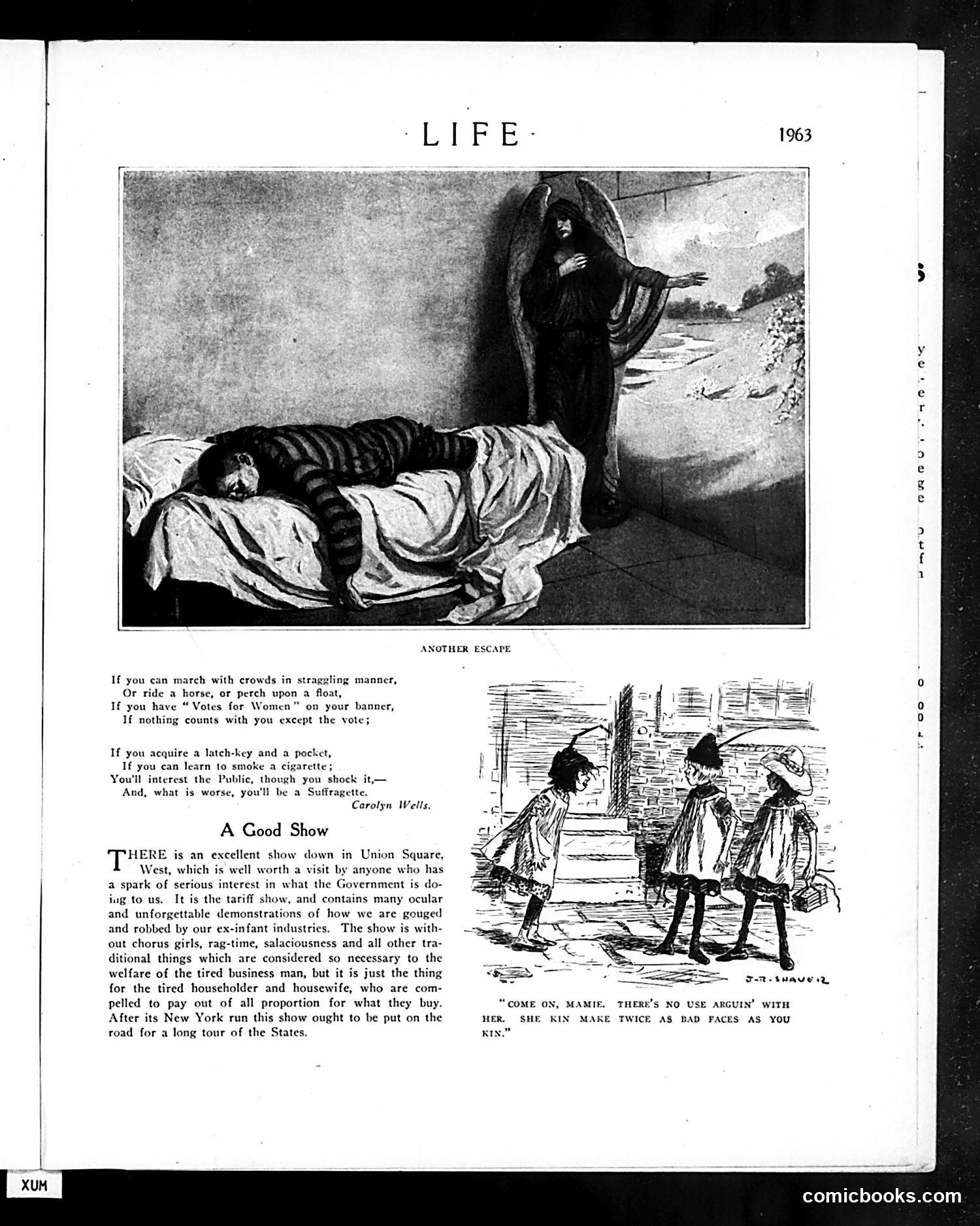
This page contains **two distinct satirical pieces**: **"Another Escape"** (top): A poem by Carolyn Wells mocking the women's suffrage movement. The accompanying illustration shows a woman in dark robes gesturing dramatically over a sleeping man, suggesting women activists are theatrical and disruptive. The poem satirizes suffragettes by listing their characteristics (marching, carrying banners, acquiring independence, smoking) as shocking behavior that will "interest the Public, though you shock it." **"A Good Show"** (bottom): Commentary on a tariff exhibition at Union Square, New York. The author praises this dry government display about protectionist tariffs and industrial price-gouging as genuinely worthwhile for consumers, despite lacking entertainment value. The accompanying cartoon shows children, with one making faces while another urges her to stop, suggesting the tariff discussion is so tedious it requires childish distraction. Both pieces use humor to critique contemporary social issues: women's political activism and economic policy.
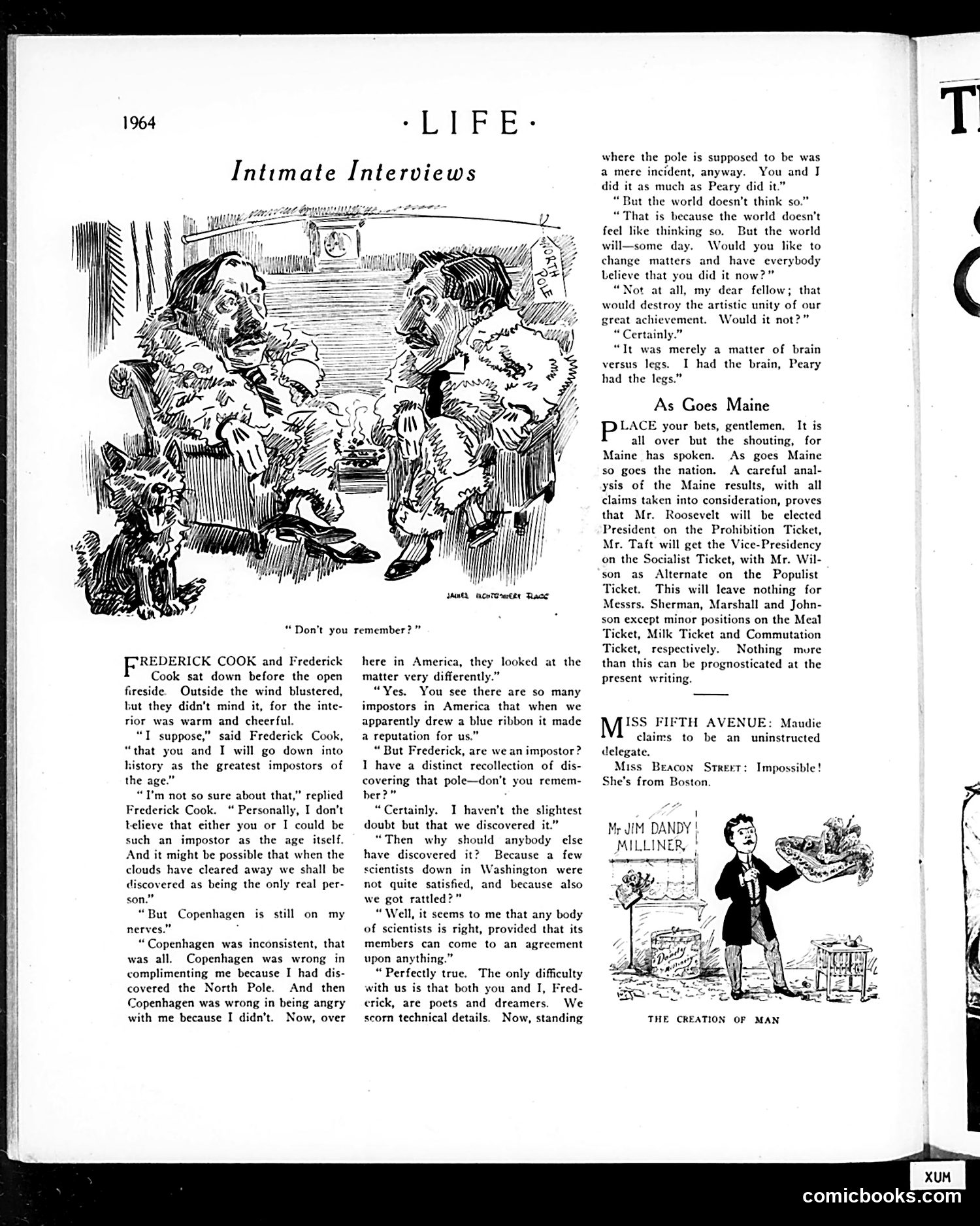
This page contains two satirical pieces lampooning early-20th-century figures and politics: **"Intimate Interviews"** depicts two Frederick Cooks—likely referencing the explorer Frederick Cook, who claimed to have discovered the North Pole but faced disputes with rival explorer Robert Peary. The cartoon shows them as self-aware fraudsters debating whether they're "impostors" while rationalizing their deception. The satire mocks their excuse-making and suggests American society readily accepts false claims if presented confidently ("so many impostors in America"). **"As Goes Maine"** is political satire about a 1912 election prediction based on Maine voting results. It mockingly predicts absurd outcomes: Roosevelt as Prohibition candidate, Taft as Socialist Vice President, and Wilson as Populist alternate. This satirizes how pundits treat early election signals as inevitably predictive, when outcomes remain genuinely uncertain. Both pieces ridicule self-deception, credential fraud, and the public's gullibility in accepting false claims presented with authority.
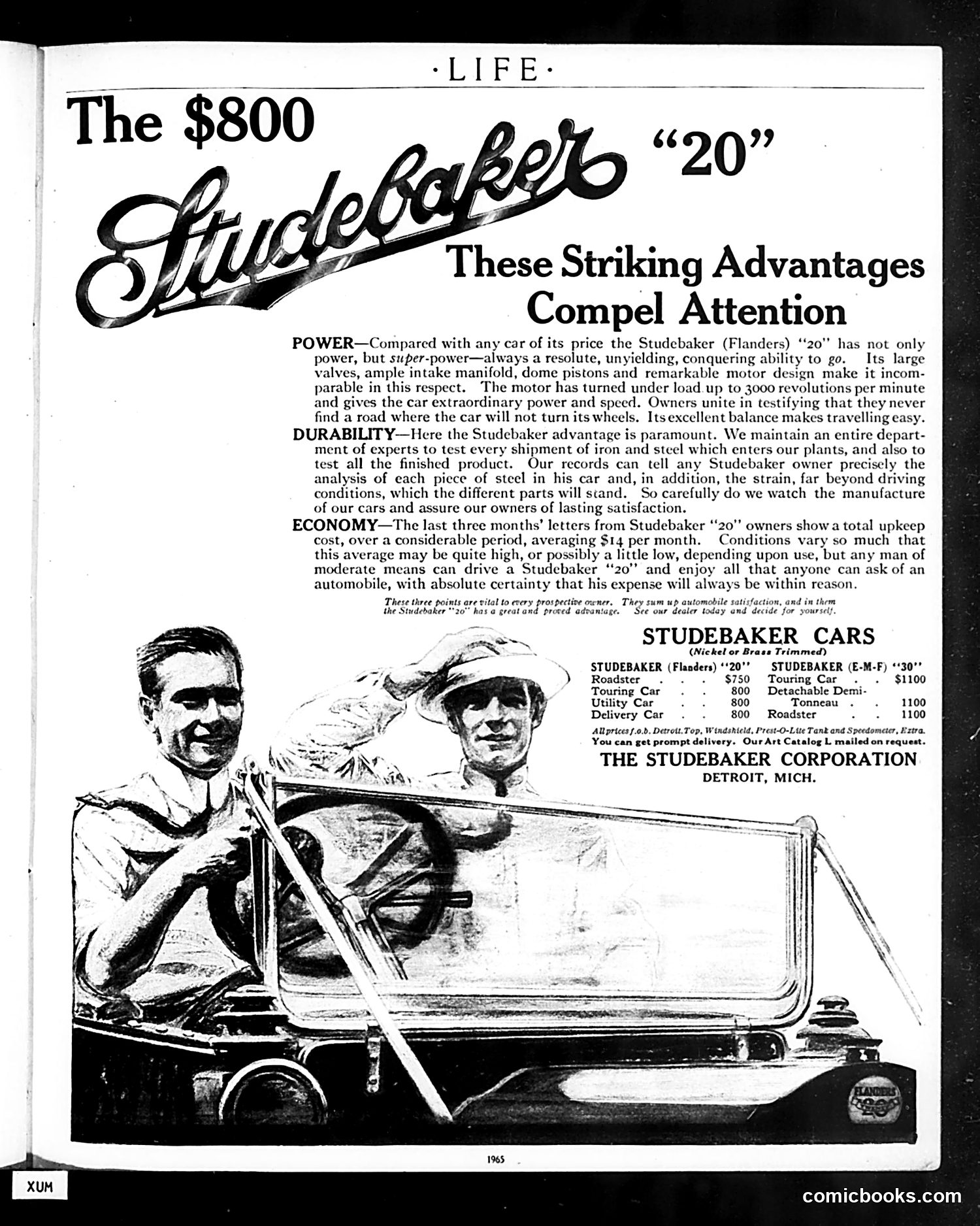
This is a **Studebaker automobile advertisement**, not a political cartoon. It appeared in *Life* magazine (circa 1910s based on styling and pricing). The page promotes the Studebaker "20" model at $800, emphasizing three selling points: POWER, DURABILITY, and ECONOMY. The illustration shows two men in period dress (hats, suits) in an open-air automobile, apparently driving confidently. The satirical or humorous element is subtle—it's typical of early auto advertising's grandiose claims. The text boasts the car can handle "3000 revolutions per minute" and that owners "never find a road where the car will not turn its wheels." The company promises meticulous steel testing and claims owners spend only "$14 per month" upkeep, positioning the vehicle as affordable luxury for "any man of moderate means." The humor, by modern standards, lies in the overwrought earnestness of early automotive marketing rather than any explicit joke or caricature.
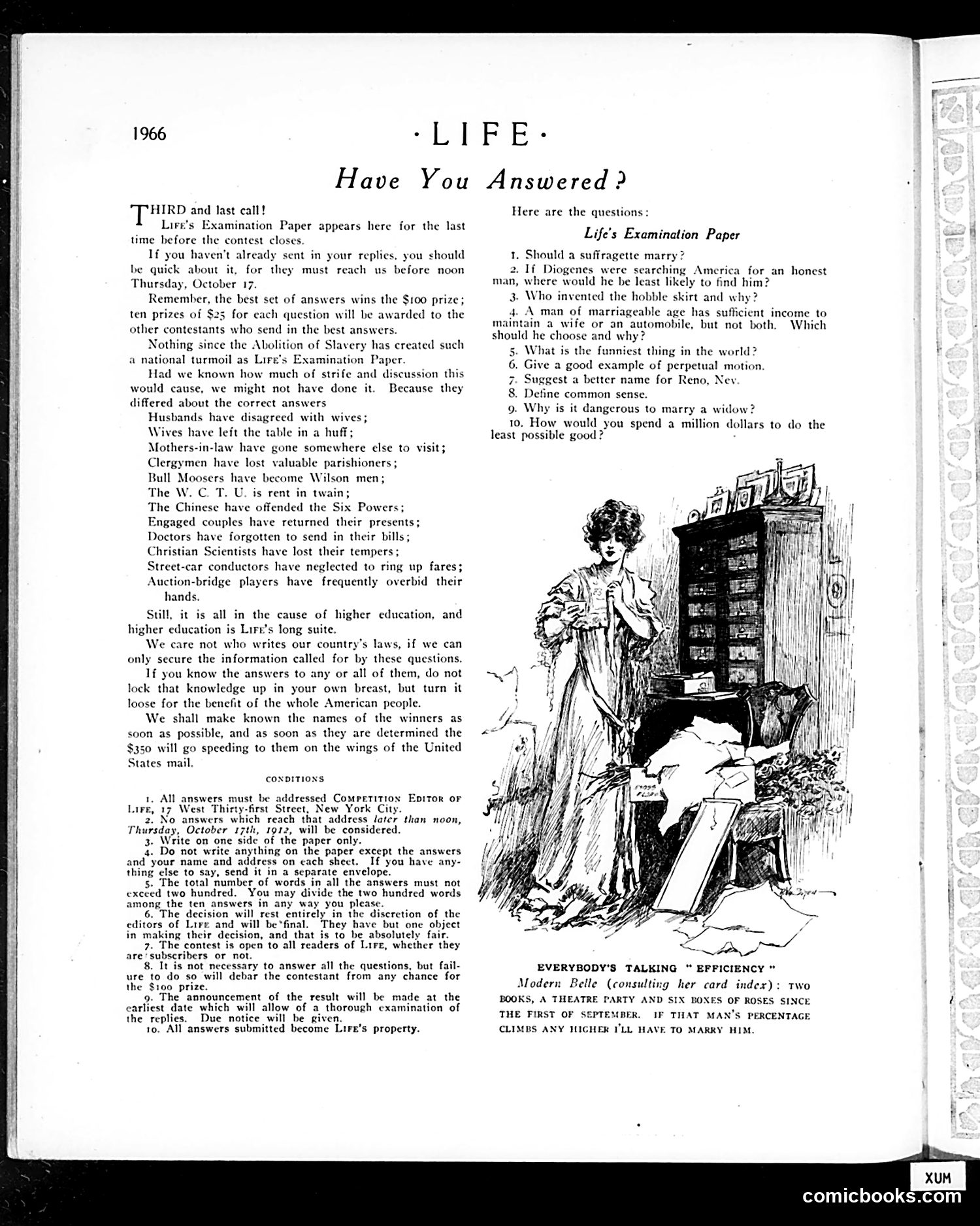
This page announces the final call for Life magazine's reader contest—a satirical "examination paper" that humorously reflects early 20th-century social anxieties and debates. The ten questions lampoon contemporary concerns: women's suffrage ("Should a suffragette marry?"), automobile culture versus marriage, and Reno, Nevada's reputation as a divorce destination. The hobble skirt reference mocks 1910s fashion restrictions. References to "Bull Moosers" becoming "Wilson men" indicate the 1912 presidential split. The accompanying illustration depicts a fashionable woman consulting a large card index—likely representing the modern filing systems and organizational methods that were reshaping American life. The joke is that these supposedly serious "examination" questions are actually frivolous social commentary disguised as intellectual inquiry, poking fun at American preoccupations with progress, morality, and changing social norms. The note that the contest has caused "national turmoil" exaggerates the trivial questions' impact as satire.
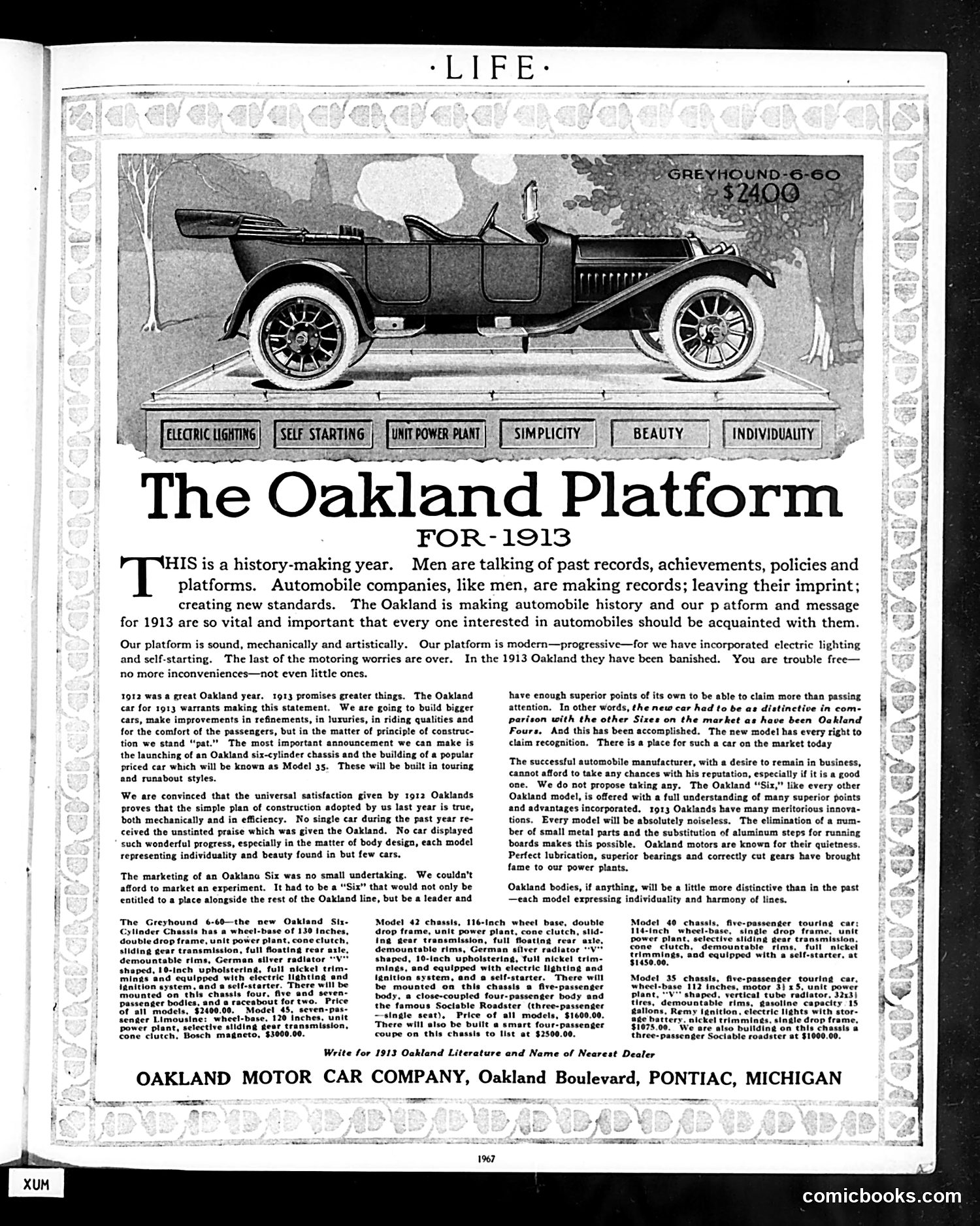
This is **not a cartoon or satire** — it's a full-page automobile advertisement for Oakland Motor Car Company's 1913 models, disguised in editorial language. The page presents the new Oakland "Six" (six-cylinder engine) as a historic achievement worthy of serious discussion alongside political platforms. The language mimics serious journalism ("history-making year," "vital and important"), treating car features like electric lighting and self-starting as major innovations. The satire is subtle: **Life magazine is gently mocking automotive marketing excess** by presenting a commercial product announcement in grandiose, pseudo-political terms. The ad's breathless tone — claiming the Oakland Six represents record-breaking progress — invites readers to recognize the inflated rhetoric typical of early automobile manufacturers competing for market dominance. The actual innovation claims (electric lights, self-starting mechanisms, six-cylinder engines) were genuinely significant for 1913, but the overwrought presentation satirizes how companies oversold incremental improvements.
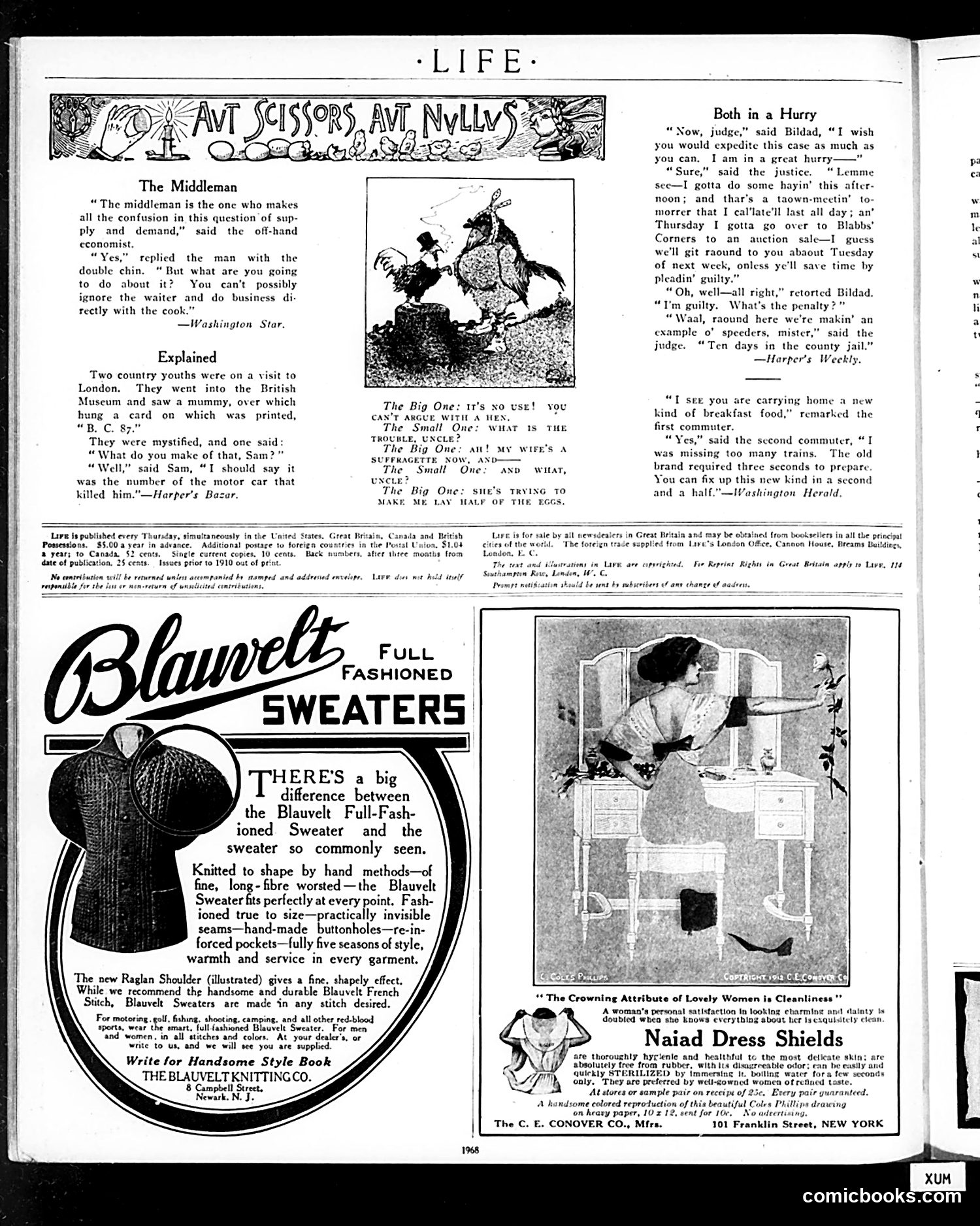
This page contains three separate humorous pieces typical of early 20th-century American satire: **"The Middleman"** mocks economic complaints about inflation. A businessman blames "middlemen" for supply-and-demand confusion, while a rotund figure suggests the real problem is ignoring waiters and cooks—satirizing how people blame abstract economic forces rather than examining their own business practices. **"Both in a Hurry"** depicts a rural judge and litigant who both want to rush through a court case, though the judge lists numerous conflicting obligations (haying, town meetings, auctions). The humor lies in the absurdity: Bildad pleads guilty to avoid delay, and the judge sentences him to jail as "an example of speeders"—satirizing how impatience and poor judicial priorities create injustice. **"Possessions"** shows a dialogue between two commuters about a breakfast food product, appearing to mock consumer culture and commuting culture (one kept missing trains). The page also contains period advertisements for Blauvelt sweaters and Naiad dress shields, typical of *Life*'s commercial content alongside editorial humor.
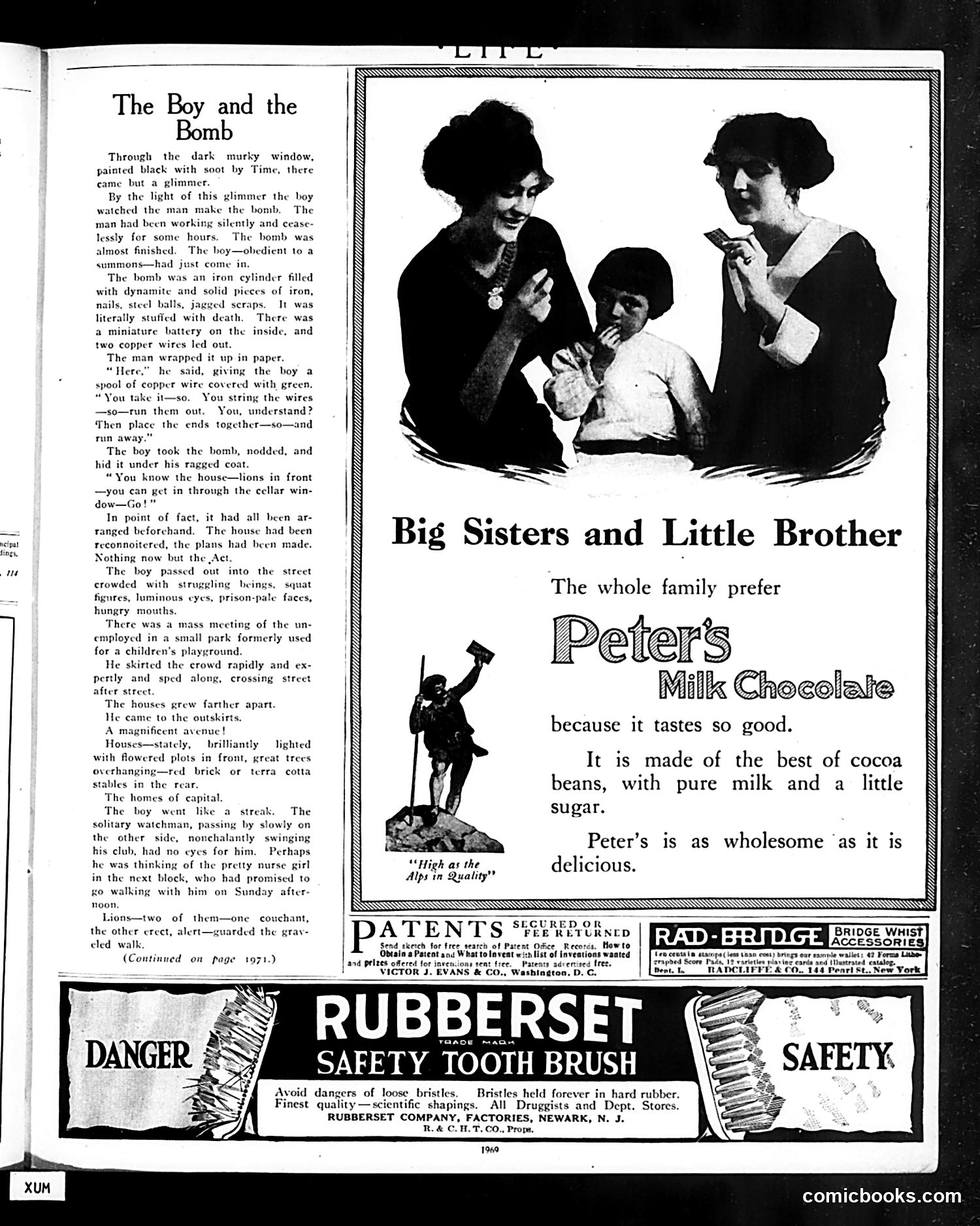
This story depicts anarchist violence during the industrial era—likely referencing actual bomb attacks that occurred in early 20th-century America. The narrative follows a poor boy, recruited by radicals, delivering an explosive device to a wealthy mansion (marked by lions—symbols of capital and privilege). The satire targets **both sides**: the desperate unemployed masses and radical anarchists who resort to terrorism, as well as the wealthy capitalists whose mansions overlook impoverished neighborhoods. The contrast between the "magnificent avenue" of "homes of capital" and the streets of "struggling beings, squat figures, prison-pale faces, hungry mouths" illustrates class division driving such violence. The story appears deliberately provocative—presenting the bombing plot matter-of-factly to shock readers into considering systemic inequality. Life magazine frequently used such satire to critique social injustice during an era of intense labor unrest and actual anarchist attacks in America. The page's **advertisements** (chocolate, patents, toothbrushes) contrast darkly with the violent narrative.
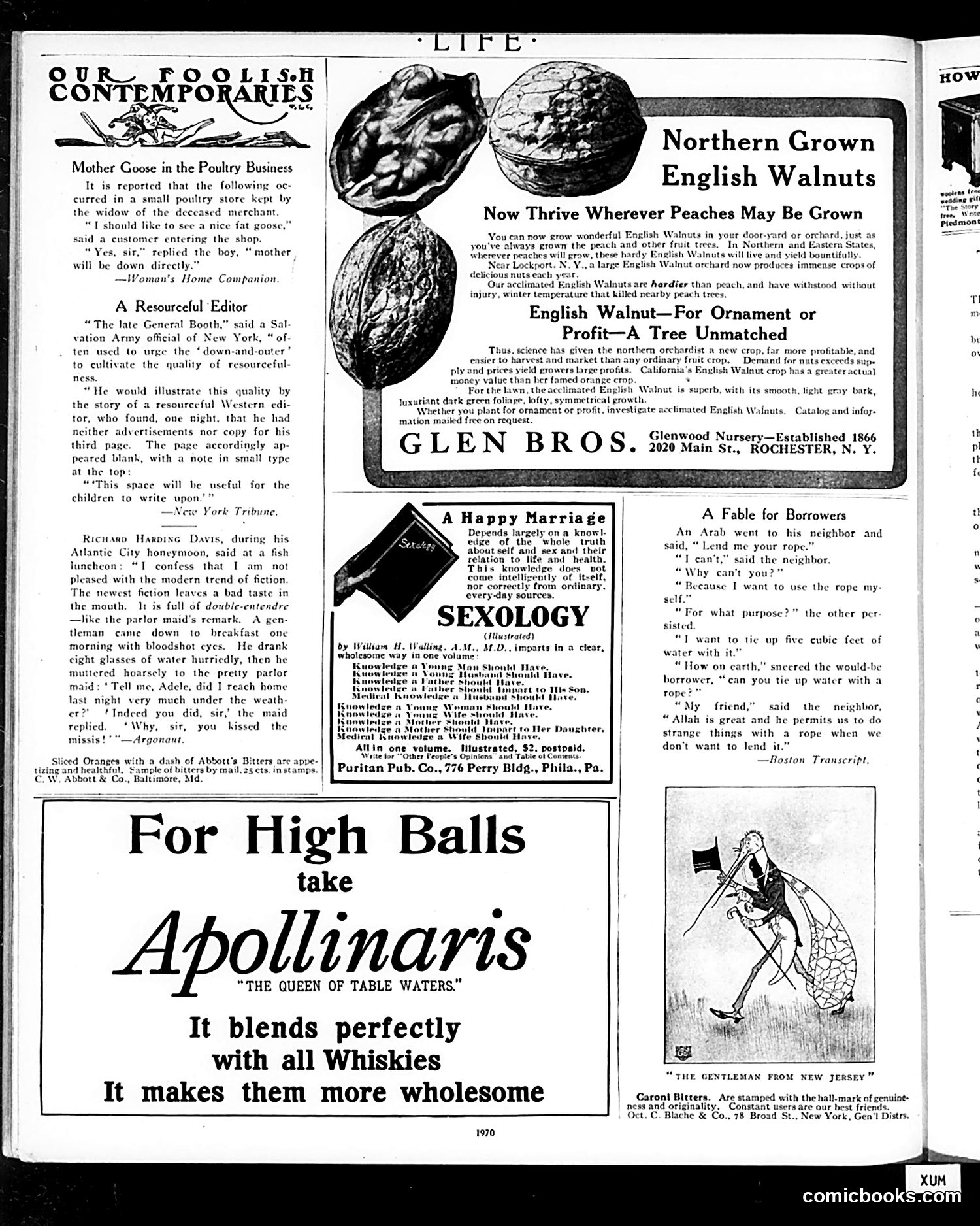
This page from *Life* magazine contains several satirical pieces mocking contemporary foibles: **"Mother Goose in the Poultry Business"** jokes about a widow running a poultry shop, playing on the nursery rhyme character as a businesswoman. The humor relies on incongruity between the fairy-tale character and modern commerce. **"A Resourceful Editor"** praises General Booth of the Salvation Army for encouraging resourcefulness, illustrated with an anecdote about a newspaper editor who left a blank page with a note inviting children to write on it—turning a deadline failure into something useful. **"A Happy Marriage"** features a brief domestic joke: a hungover husband drinks eight glasses of water; the maid reveals he kissed his wife the night before—suggesting conjugal relations caused his condition. The page is primarily **advertising** for English walnuts, Apollinaris water, and a sexology book, with one illustrated fable about borrowing a rope at the bottom. The satire targets human foolishness, resourcefulness, marital life, and consumer culture—typical *Life* magazine fare.
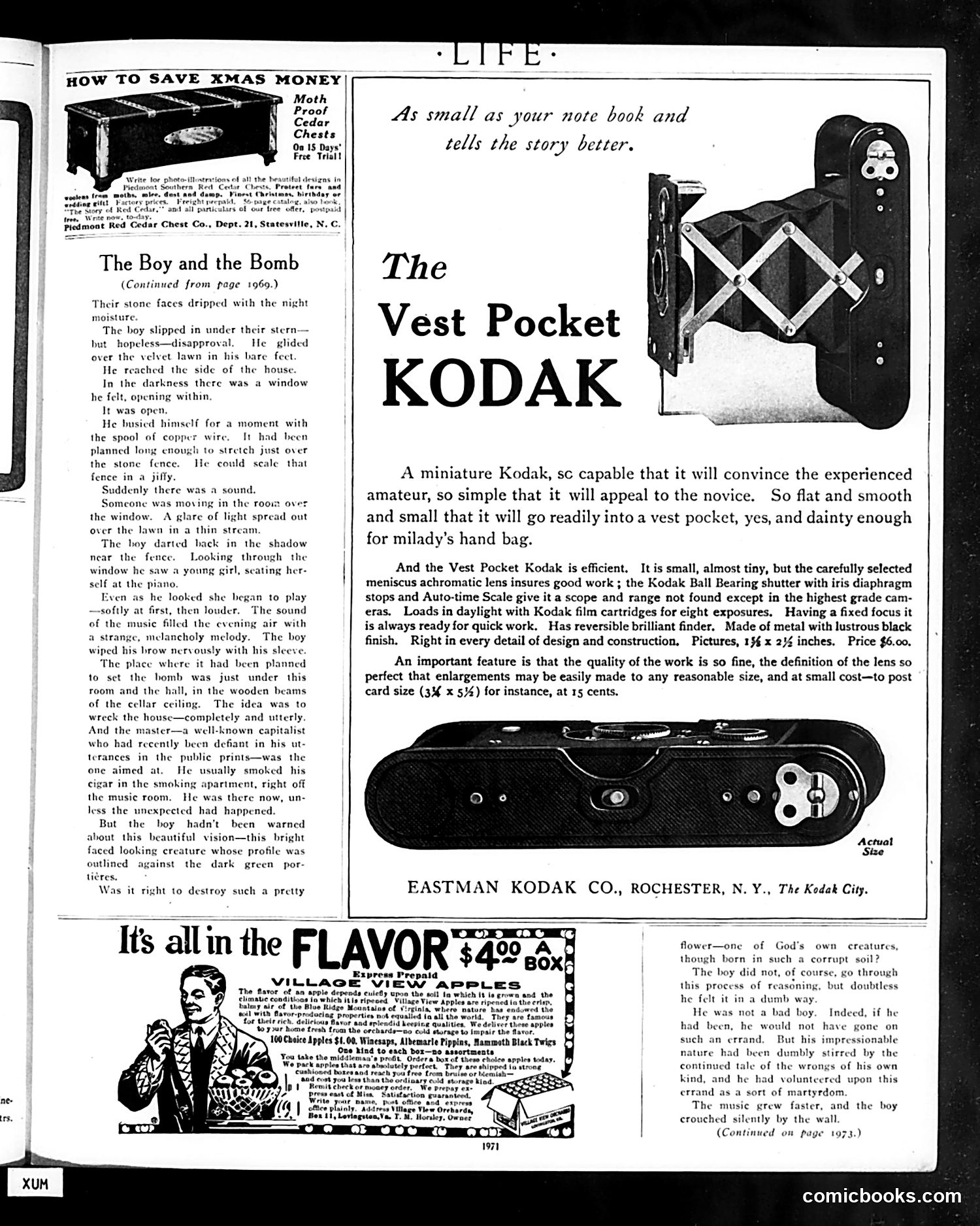
This page primarily contains **advertising and serialized fiction**, not political satire. **"The Boy and the Bomb"** is a serialized story (continued from page 1969) depicting a dramatic scene: an anarchist or radical activist has planted a bomb in a capitalist's home but hesitates when he sees the man's beautiful daughter playing piano. The narrative explores moral conflict—whether destroying an innocent person is justified by political ideology. The **Vest Pocket Kodak advertisement** occupies the page's right half, marketing a miniature camera as a fashionable, portable product for amateur photographers. **The apple advertisement** at bottom promotes "Village View Apples" from Virginia's Blue Ridge Mountains. The political context appears to reflect **early 20th-century anxieties about anarchist violence** and class conflict, presenting a sympathetic but conflicted portrayal of a radical operative. However, without seeing the story's conclusion or knowing the publication date precisely, the intended moral message—whether condemning or romanticizing such activism—remains unclear from this excerpt alone.
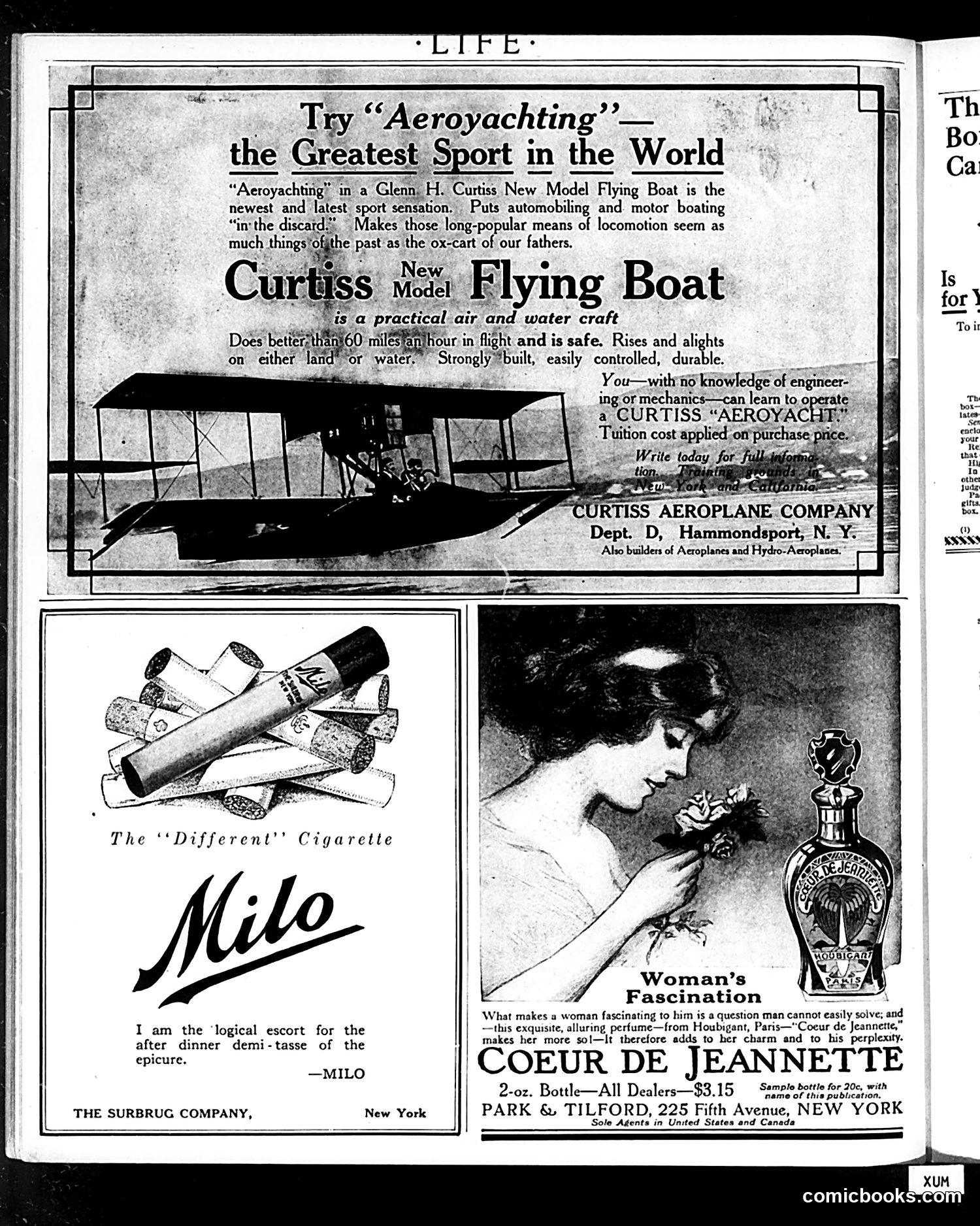
This page is primarily **advertising**, not satire or political commentary. It contains three product advertisements from the early aviation era (likely 1910s-1920s): 1. **Curtiss Flying Boat**: Promotes Glenn Curtiss's new amphibious aircraft as "aeroyachting"—positioning aviation as the latest luxury sport, making automobiles and motorboats obsolete. The hyperbolic language ("greatest sport in the world") reflects the contemporary fascination with early aviation technology. 2. **Milo Cigarettes**: A simple endorsement claiming these cigarettes are the proper accompaniment to after-dinner socializing. 3. **Coeur de Jeannette Perfume**: Uses a romantic illustration and pseudo-philosophical copy about feminine allure to market the fragrance. The page reflects early 20th-century consumer culture and gender norms, with the perfume ad particularly representing period attitudes toward women's appeal and desirability.
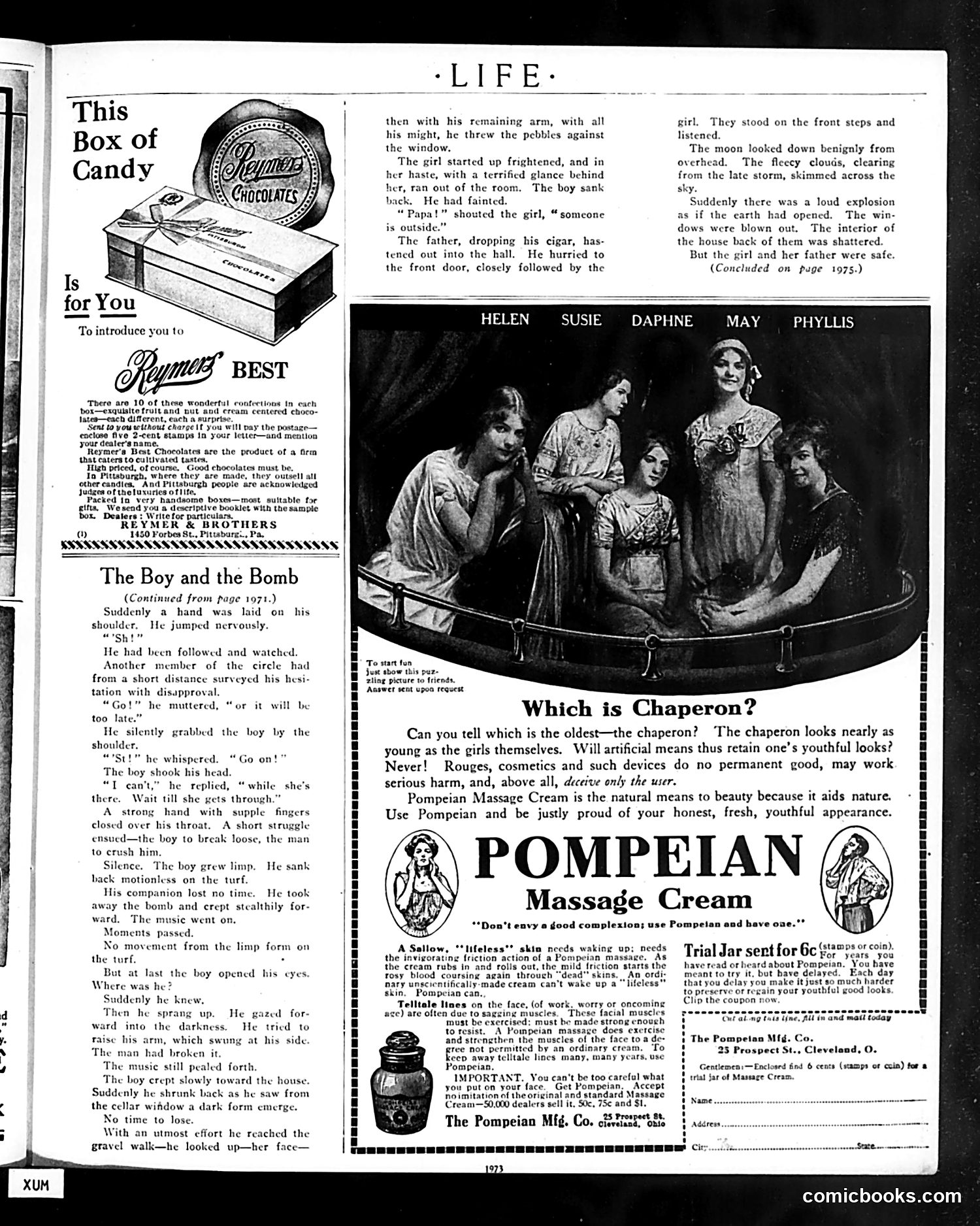
This page contains two unrelated items: **"The Boy and the Bomb"** (left column) is a serialized fiction story about revolutionary violence. A boy is coerced by a conspirator to place a bomb at someone's house. The narrative depicts the bombing's explosion and aftermath—apparently the girl and her father survive, though windows are destroyed. This reflects early 20th-century anxieties about anarchist and radical political violence that were genuine threats during this era. **"Which is Chaperon?"** (center-right) is a visual puzzle and advertisement disguised as social commentary. It challenges readers to identify the oldest woman among five—the joke being that cosmetics supposedly make all appear similarly young. The accompanying Pompeian Massage Cream ad argues against artificial beauty products (rouge, cosmetics), paradoxically promoting instead a "natural" cream that aids beauty. This reflects period attitudes skeptical of heavy makeup while marketing skincare as legitimate self-improvement. The page is primarily **advertising content**, not political satire.
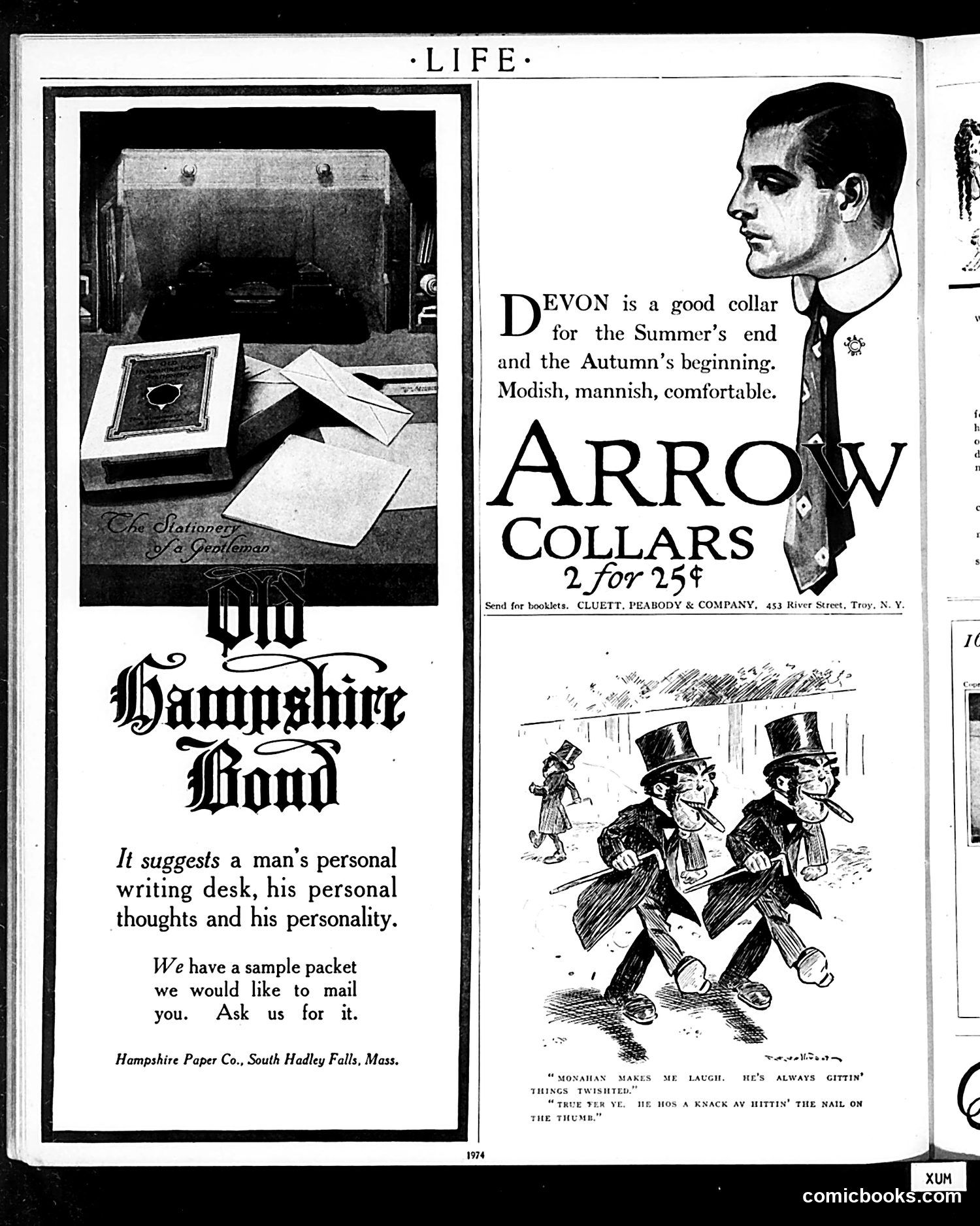
This page contains two advertisements with no political cartoon. **Left side:** Hampshire Bond paper promotes its product by showing a writing desk, suggesting the paper reflects "a man's personal writing desk, his personal thoughts and his personality." It's an appeal to masculine identity through quality stationery. **Right side:** Arrow Collars advertises the "Devon" collar style as appropriate for seasonal transitions (summer to autumn), emphasizing it as "modish, mannish, comfortable." Below is a humorous cartoon showing two working-class men in dialogue, with heavy dialect spelling ("GITTIN'," "YER YE," "HOS"). One character apparently always "twists" things, while the other has a talent for "hittin' the nail on the thumb"—a comedic reference to missing the mark or self-inflicted mistakes. The cartoon trades in period-typical working-class stereotyping through exaggerated accent representation.
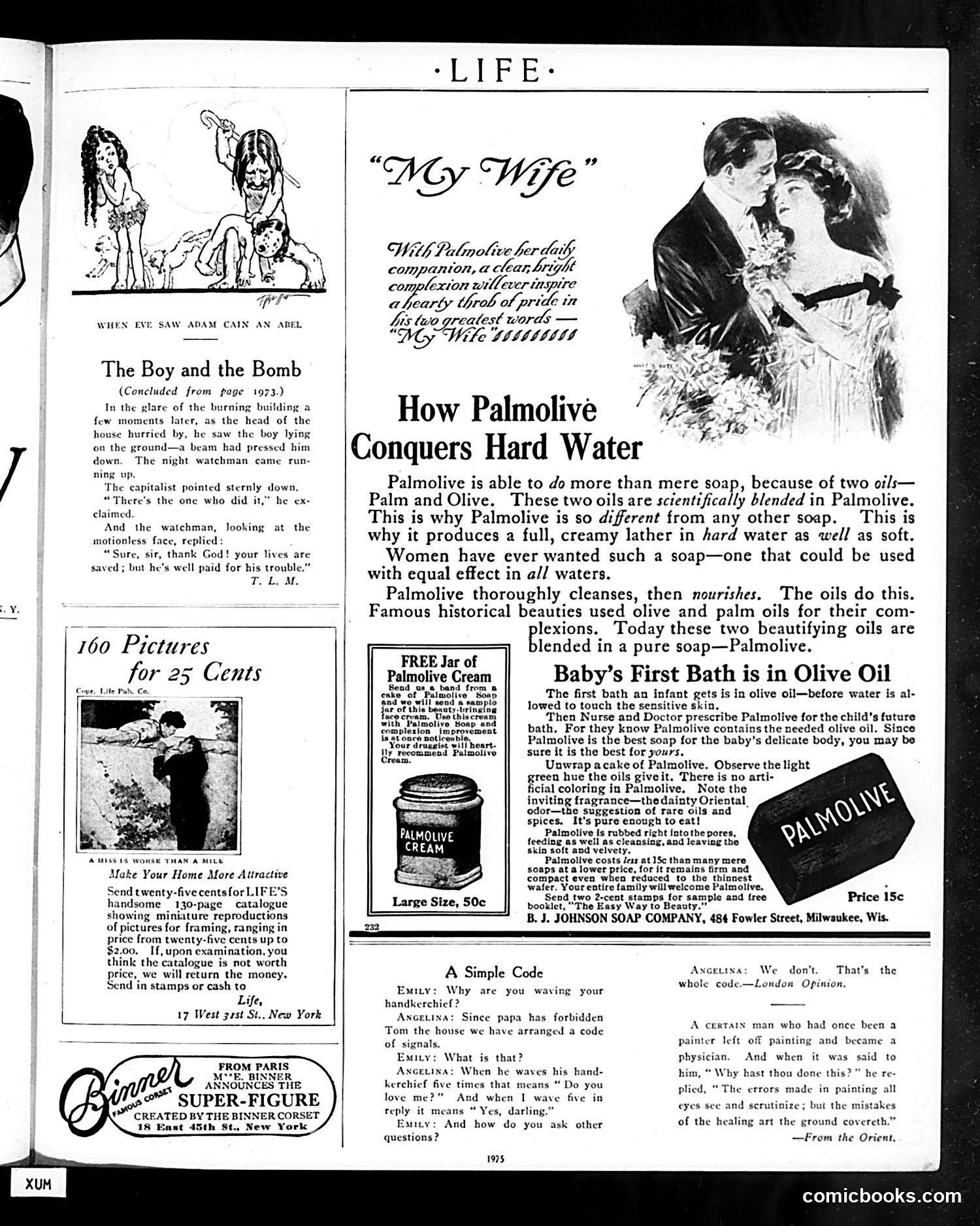
This page is primarily **advertising**, dominated by a large Palmolive soap advertisement that occupies roughly half the space. The small cartoon titled "The Boy and the Bomb" (upper left) appears to be a concluded story about class conflict: a capitalist blames a working boy for a building fire, but the night watchman replies the boy is "well paid for his trouble"—suggesting the boy was set up or sacrificed by his employer. The main content is the **Palmolive advertisement**, which uses pseudo-scientific claims about "Palm and Olive" oils to market soap for hard water, babies, and beauty. This represents early 20th-century advertising's appeal to maternal instinct and pseudoscience. Below sits "A Simple Code," a mild humor piece about a couple using handkerchief signals to communicate secretly since the father forbids their courtship—playing on Victorian-era restrictions on young romance. The page reflects 1920s concerns: industrial class tensions, consumer product marketing, and social propriety around courtship.
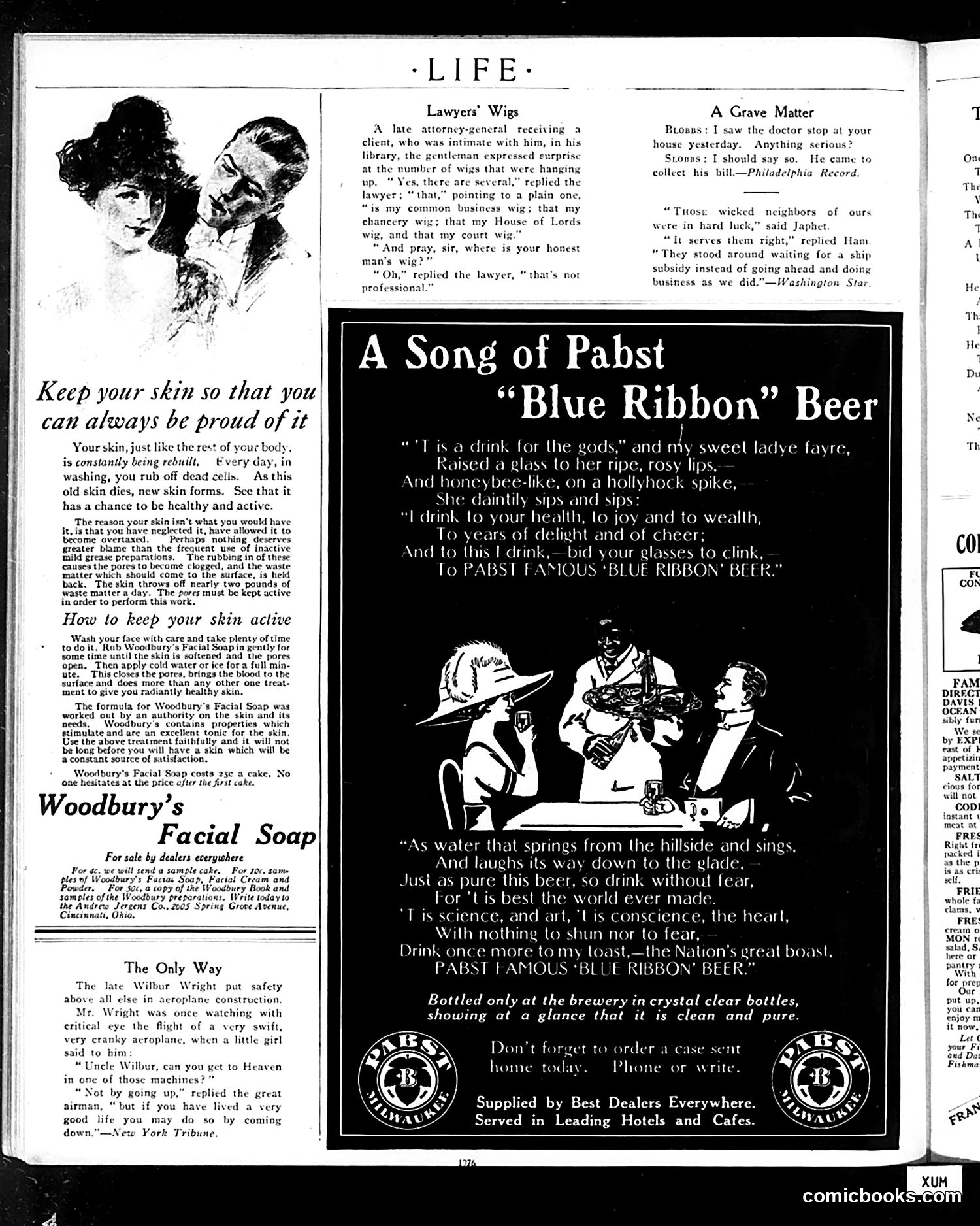
This page from *Life* magazine contains several distinct humorous pieces typical of early 20th-century satirical humor: **"Lawyers' Wigs"** is a brief joke satirizing the legal profession's pretentiousness. A lawyer displays multiple wigs for different court settings (business, chancery, House of Lords, court), but when asked about his "honest man's wig," replies it's "not professional"—implying lawyers cannot be both professional and honest. **"A Grave Matter"** jokes about a doctor's visit being motivated solely by debt collection rather than medical concern, mocking physicians' financial priorities. **"The Only Way"** is an anecdote about aviation pioneer Wilbur Wright making a dark joke about reaching Heaven only through dying ("coming down"), not flying upward. The page is dominated by a large **Pabst "Blue Ribbon" Beer advertisement** featuring verse and imagery of well-dressed patrons toasting the product. This occupies most space—typical for magazines of this era, where advertising substantially subsidized publication costs.
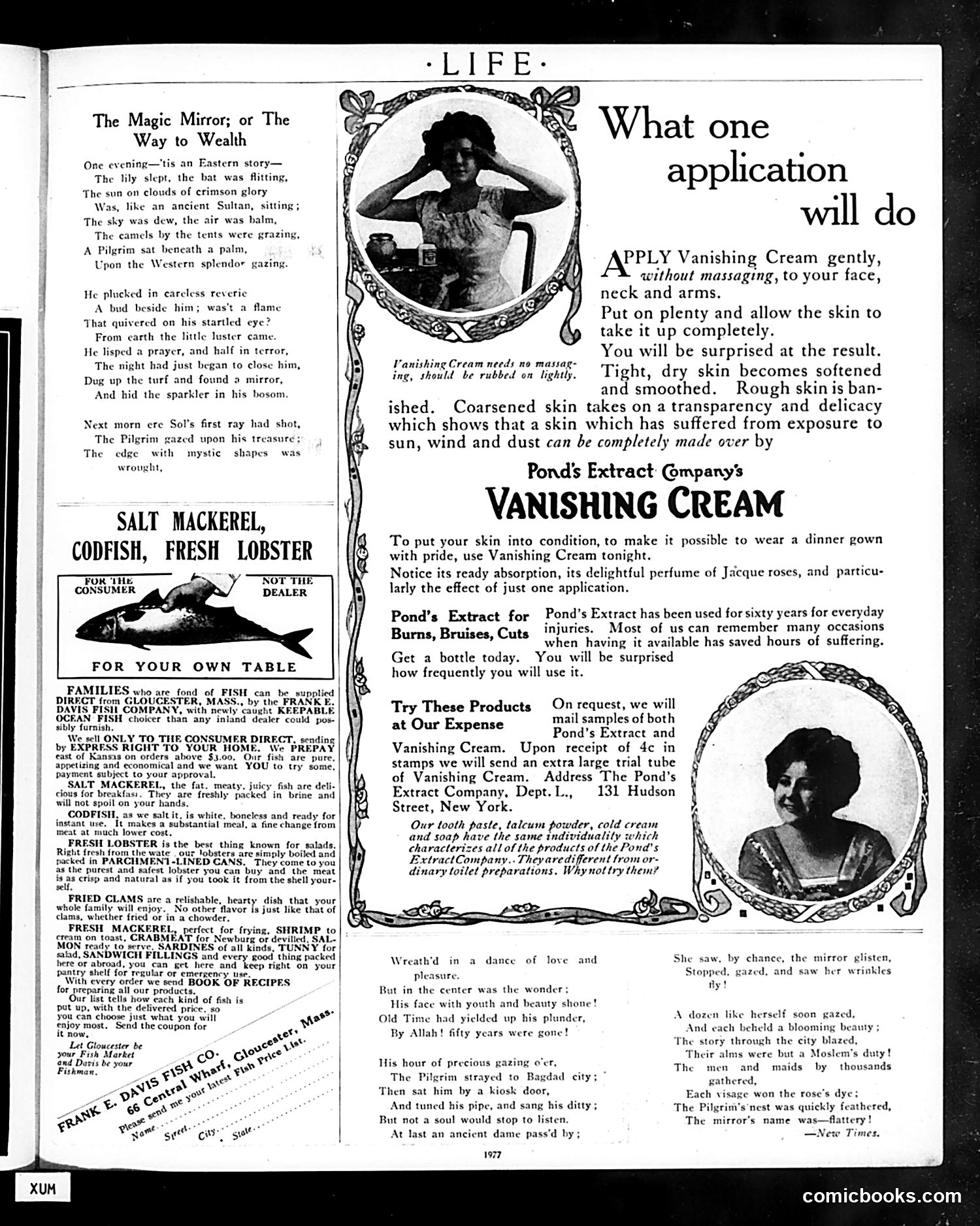
This page contains a romantic Eastern-themed poem about a pilgrim who discovers a magical mirror in the desert. The narrative is largely whimsical fiction with no clear political satire—it's a literary piece about finding treasure and self-reflection (literal and figurative). The page is dominated by **advertisements**: fish from a Massachusetts company (salt mackerel, codfish, lobster) sold directly to consumers, and Pond's Extract Company's Vanishing Cream. The cream ad emphasizes beauty benefits—softening rough skin damaged by sun and wind—using before/after photographs of women. There is no political cartoon or caricature visible. The page functions primarily as a magazine filler combining serialized fiction with commercial advertising, typical of early 20th-century Life magazine content. The "satire" implicit in the mirror poem—that material wealth brings self-knowledge—contrasts ironically with the consumer products below, suggesting Life's editorial position on modern American consumer culture.
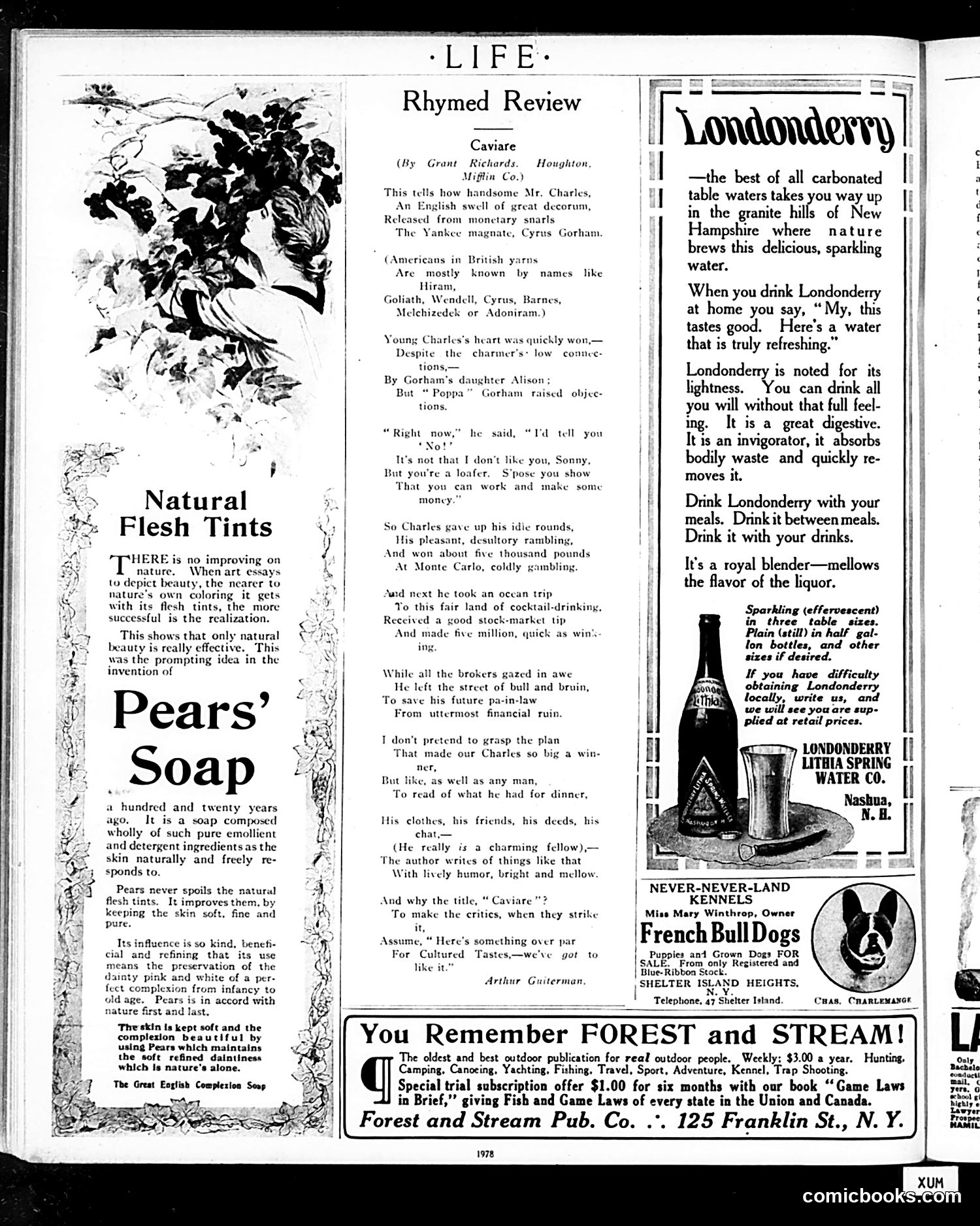
This page is primarily **advertisements and literary content**, not political satire. The main feature is a humorous poem by Arthur Guiterman reviewing a novel called *Caviare* by Grant Richards (published by Houghton Mifflin). The poem satirizes **American stereotypes in British fiction**: wealthy American industrialists are typically given names like "Hiram," "Cyrus Gorham," or "Adoniram." The plot involves a poor English aristocrat ("Charles") winning over a wealthy American businessman's daughter by proving his worth—first through high-stakes gambling at Monte Carlo, then through stock-market speculation in New York. Guiterman's satire targets the **formula of Anglo-American romance novels** where class barriers dissolve through money and financial cleverness. The title *Caviare*—a luxury delicacy—suggests the book aims at "cultured taste" while following predictable plot conventions. The rest of the page contains period advertisements for Pears' Soap, Londonderry water, and French bulldogs—typical Life magazine content from this era.
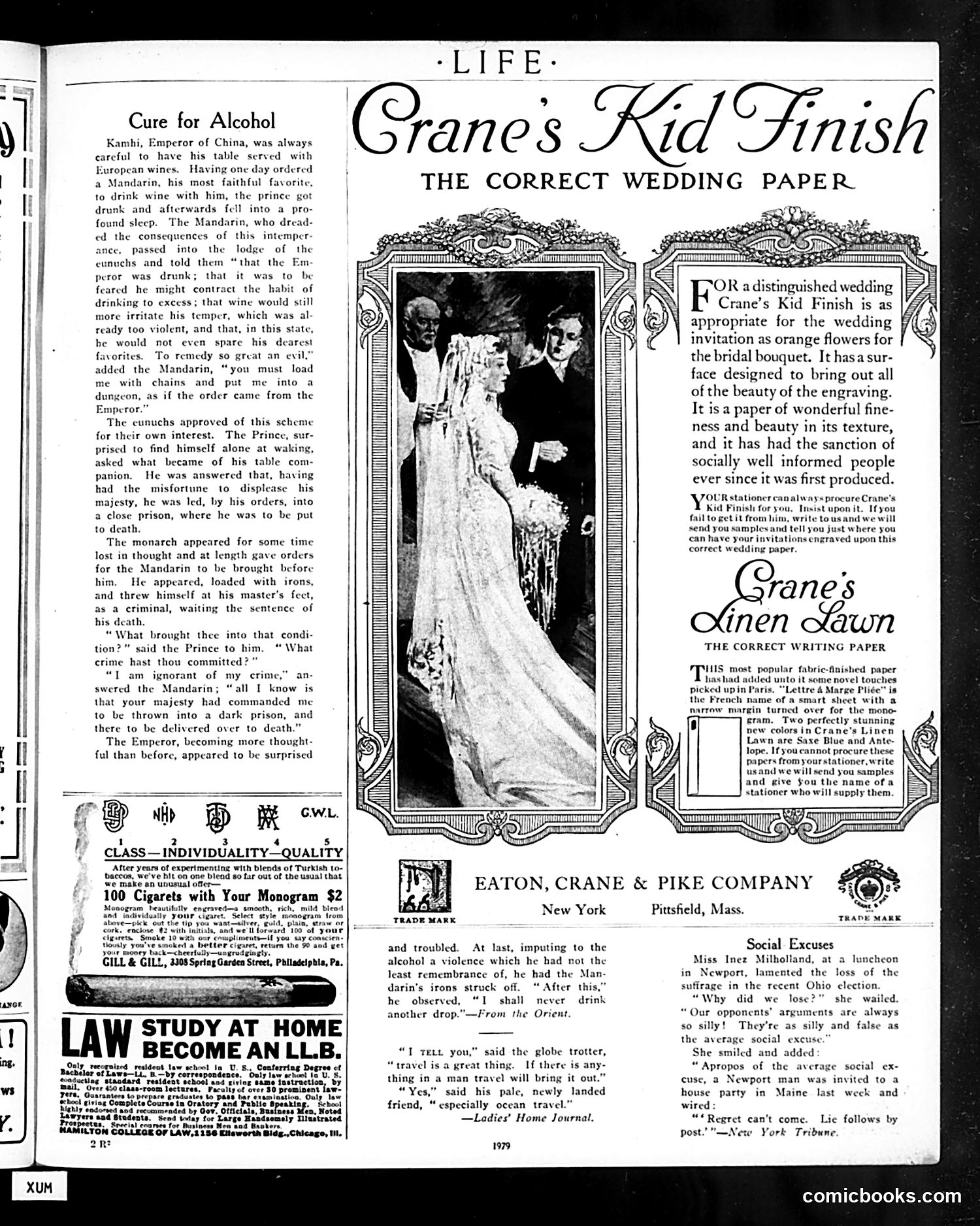
This page presents a satirical anecdote about a Chinese Emperor learning to abstain from drinking. The story, attributed to "the Orient," describes how an Emperor's trusted Mandarin advisor manipulates court eunuchs into imprisoning themselves on false pretenses to frighten the drunk ruler into sobriety. The satire likely critiques both excessive drinking among the wealthy and the manipulative paternalism used to control powerful men. The tale suggests that fear and deception—rather than reason—work to reform alcoholics, mocking both the drinker's weakness and society's methods for addressing it. The page otherwise features advertisements for Crane's wedding stationery products, unrelated to the satirical content above.
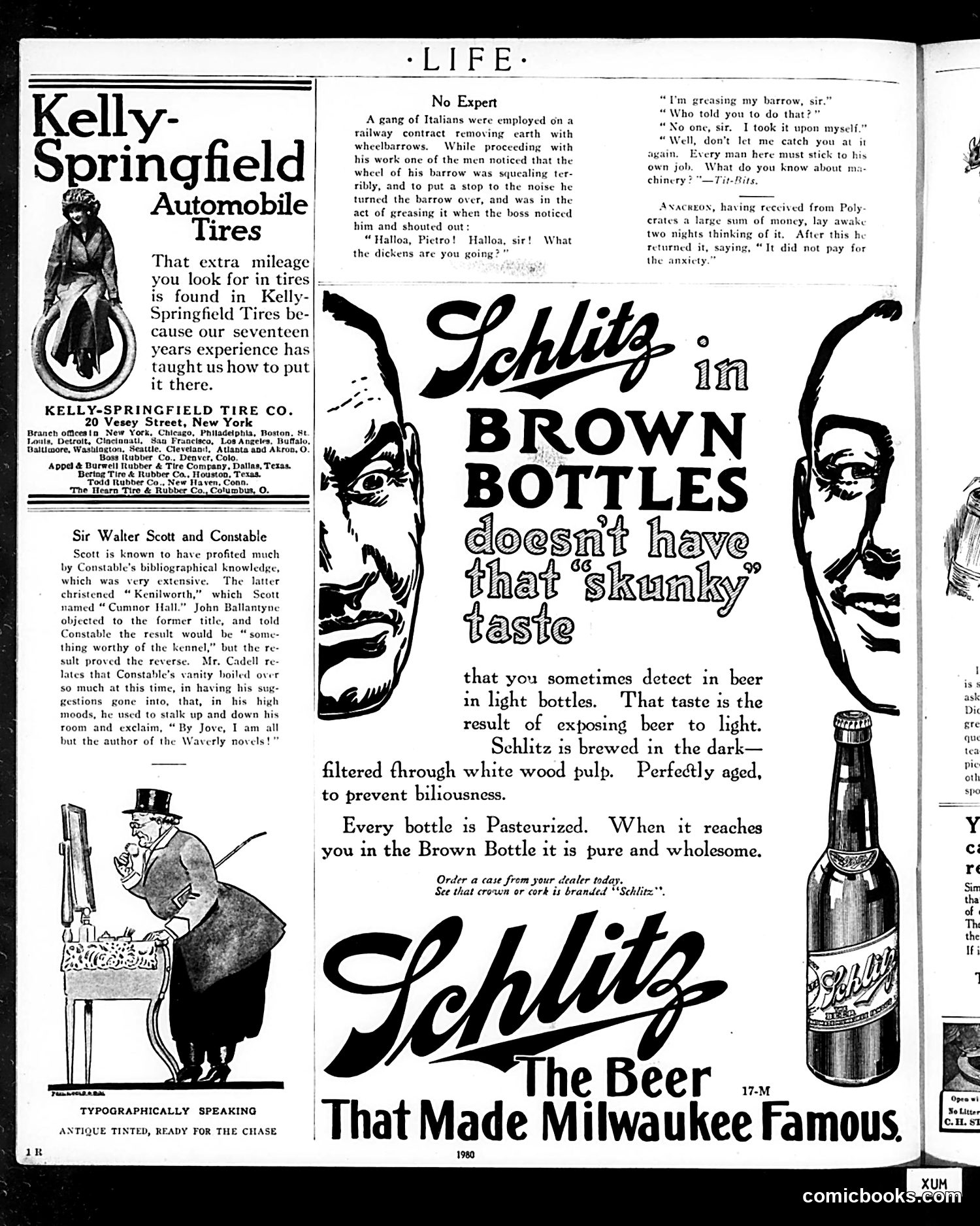
This page mixes advertisements with short humorous anecdotes typical of *Life* magazine's satirical format. **"No Expert"** (center-top) is a joke about an Italian immigrant laborer who greases his wheelbarrow without permission. When caught, he's scolded for not "sticking to his own job"—the irony being the boss then asks *him* about machinery, suggesting the boss himself lacks expertise. **"Typographically Speaking"** (bottom-left) is a cartoon showing a well-dressed man with a shotgun and hunting dog, captioned as "ready for the chase"—likely a visual pun on typography/typesetting that isn't fully clear from the image alone. The remaining content is **advertising**: Kelly-Springfield tires (left), Schlitz beer in brown bottles (center-right, emphasizing protection from light exposure), and a literary anecdote about Sir Walter Scott (left). The page reflects early 20th-century American leisure culture and immigrant labor dynamics.
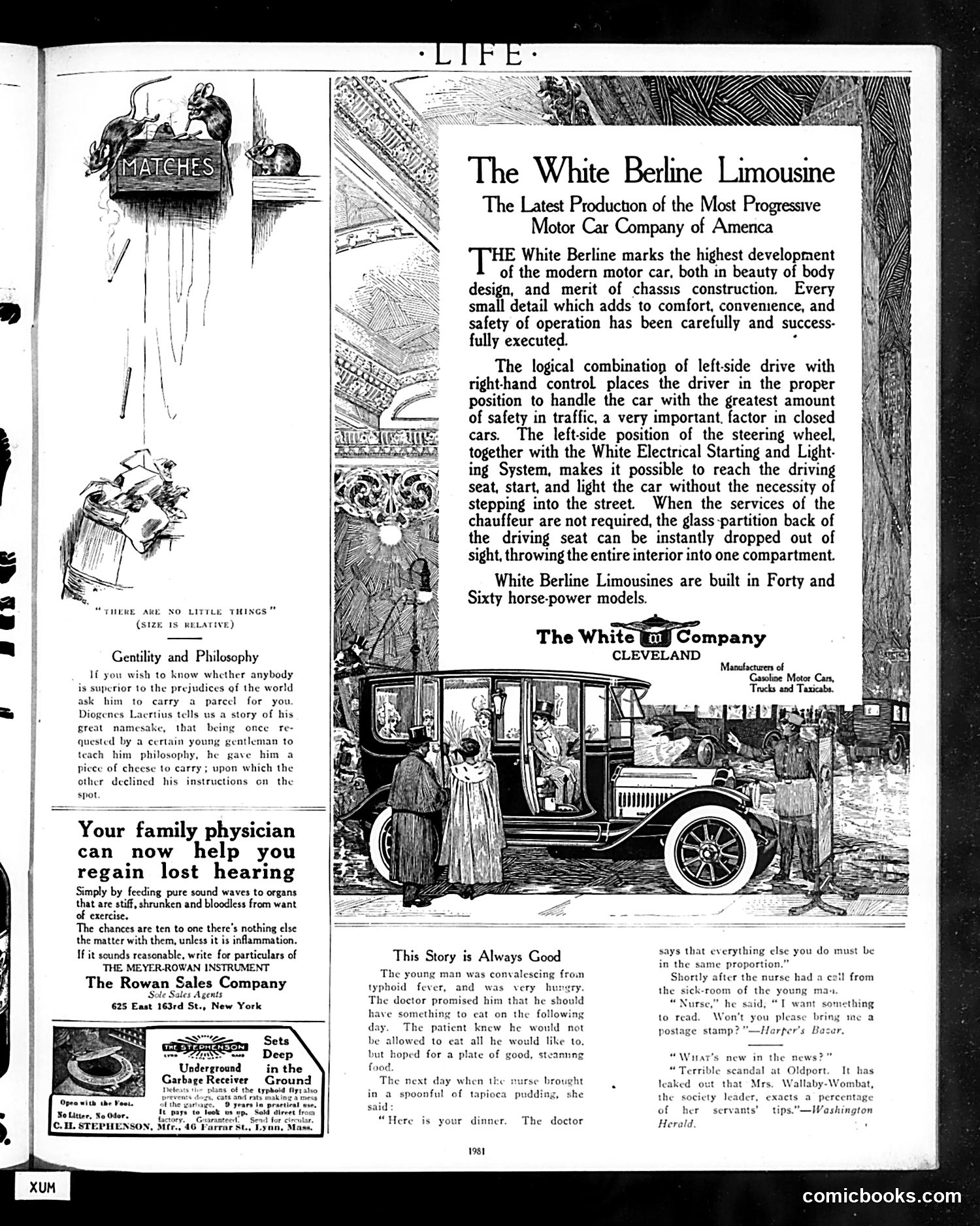
This is primarily an **advertising page** from Life magazine, dominated by a large ad for the White Berline Limousine automobile, featuring an illustration of the car with well-dressed passengers. The page includes one **small cartoon** titled "There Are No Little Things (Size is Relative)" in the upper left. It depicts a Diogenes anecdote: a philosopher refuses to teach a young gentleman because the man won't carry a piece of cheese—he considers the task beneath his dignity. The joke satirizes **pretentious gentility**—the cartoon suggests that those who won't perform humble tasks reveal their true inferiority despite social pretensions. The remaining content consists of period advertisements (for hearing aids, garbage receivers) and a brief humorous story about a typhoid patient promised good food but served only tapioca pudding—mocking false medical promises. This is typical early 20th-century Life magazine content: light social satire mixed with commercial advertisements.
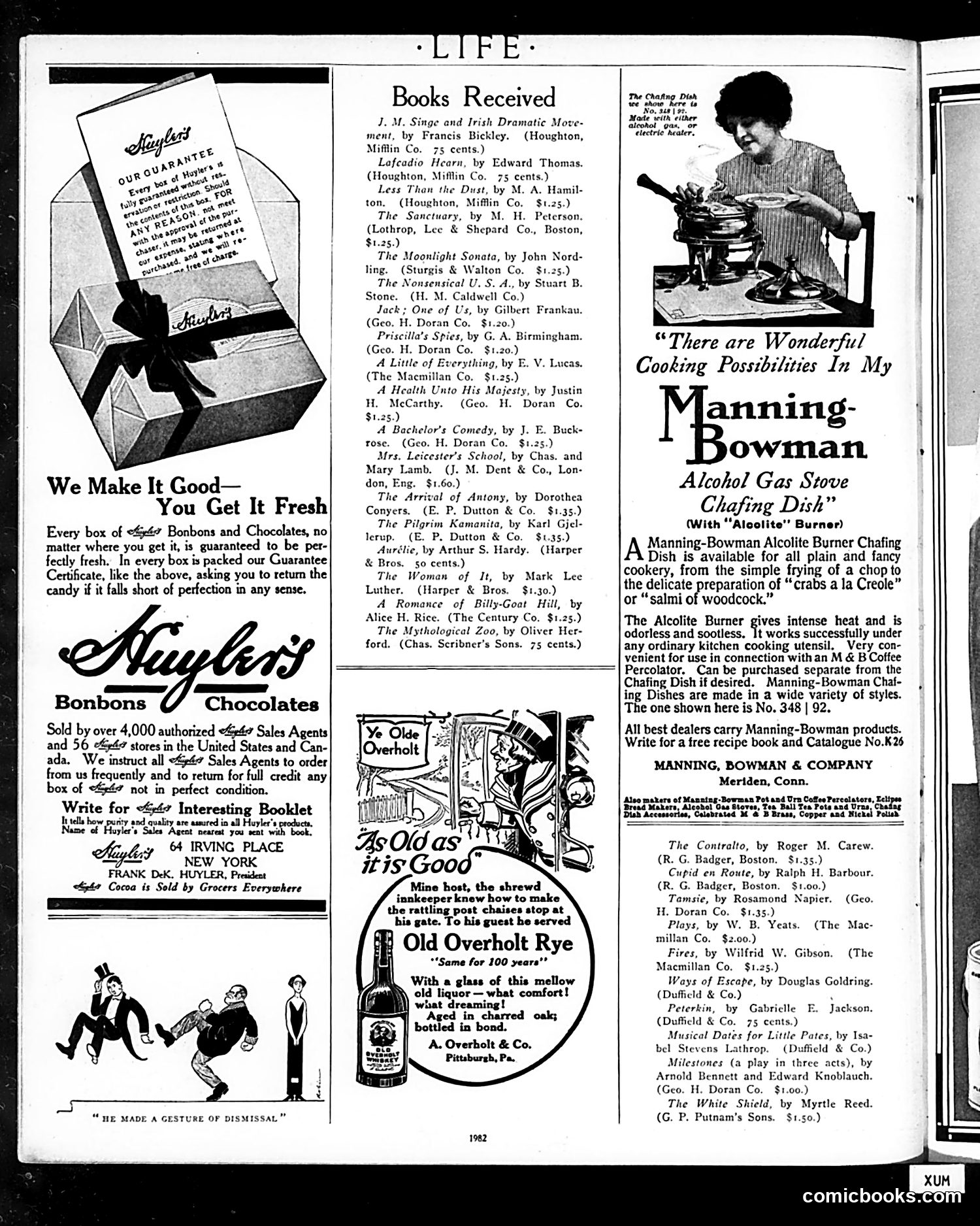
This page is primarily **advertising and book reviews** rather than political satire. The cartoons present are minor commercial illustrations: **Left side:** A small cartoon captioned "HE MADE A GESTURE OF DISMISSAL" accompanies Huyler's chocolate advertisement—a generic domestic scene with no political content. **Center:** An illustration for Old Overholt Rye whiskey shows a colonial-era innkeeper serving liquor to travelers—a nostalgic, romanticized image playing on the product's "100 years" heritage claim. **Right side:** A woman demonstrates a Manning-Bowman chafing dish, a domestic appliance advertisement. The page's primary content is a "Books Received" section listing newly published titles (literary works, biographies) with publishers and prices. This reflects Life's role as a cultural magazine for educated readers. **No significant political satire or social commentary is evident** on this particular page—it's a straightforward mixture of period advertising and literary notices.
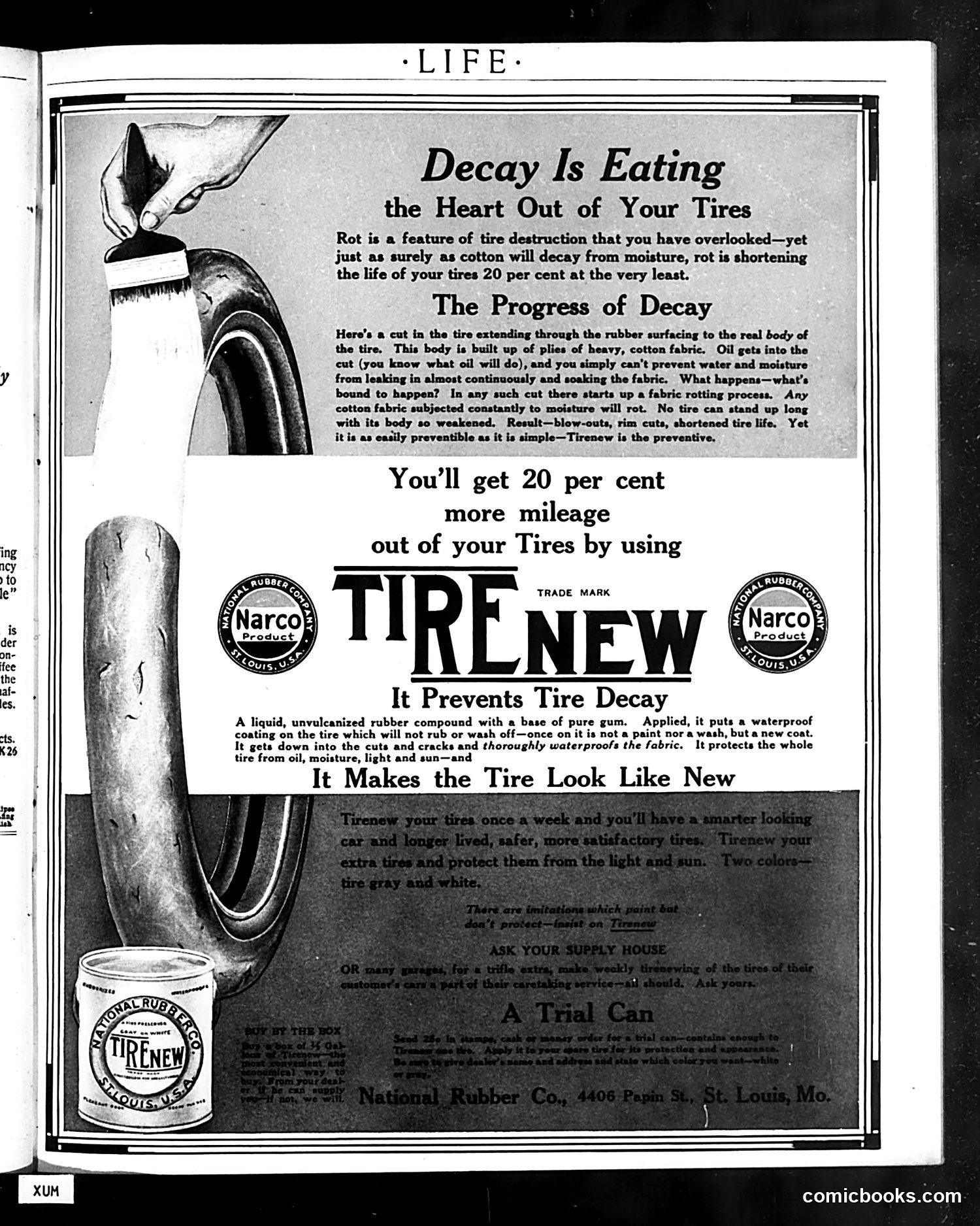
This is a full-page **product advertisement**, not political satire. It promotes "Tirenew," a tire-coating product manufactured by National Rubber Co. of St. Louis. The page uses educational messaging to sell the product: it explains how tire decay occurs (moisture and oil penetrate cuts in rubber, causing the cotton fabric body to rot) and positions Tirenew as the solution. The visual shows a cross-section of a damaged tire and a can of the product. The claim is substantial: users will get 20% more mileage and prevent tire failure. The ad emphasizes the product "makes the tire look like new" and protects against environmental damage (moisture, light, sun). This reflects early-to-mid 20th-century automotive culture when tire maintenance was a significant consumer concern, and waterproof coatings were marketed as technical solutions to mechanical problems.
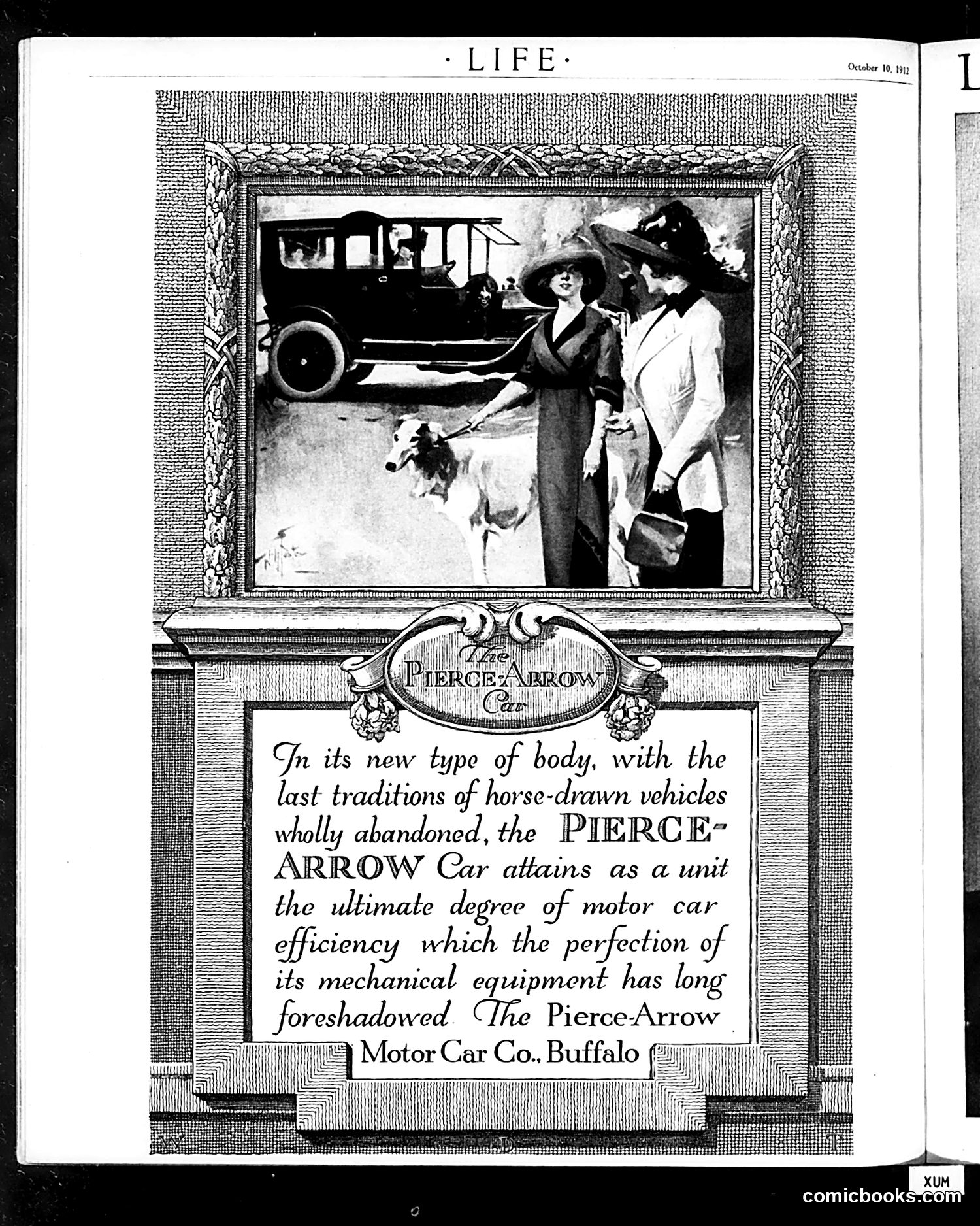
This is a **Pierce-Arrow automobile advertisement**, not political satire. The image shows two fashionably dressed women with a small dog standing beside a Pierce-Arrow motor car, with a chauffeur visible in the vehicle. The ad text emphasizes the car's modern design and mechanical superiority—notably that it has abandoned "the last traditions of horse-drawn vehicles wholly." The appeal is to affluent, stylish consumers (the well-dressed women suggest luxury and status). Published in October 1917, during World War I, this represents the automobile industry's marketing of cars as symbols of modernity and progress, contrasting the new motor age with outdated horse-and-buggy transportation. Pierce-Arrow was a prestigious American luxury brand based in Buffalo.