
Life, 1912-10-10 · page 10 of 48
Life — October 10, 1912 — page 10: what you’re looking at
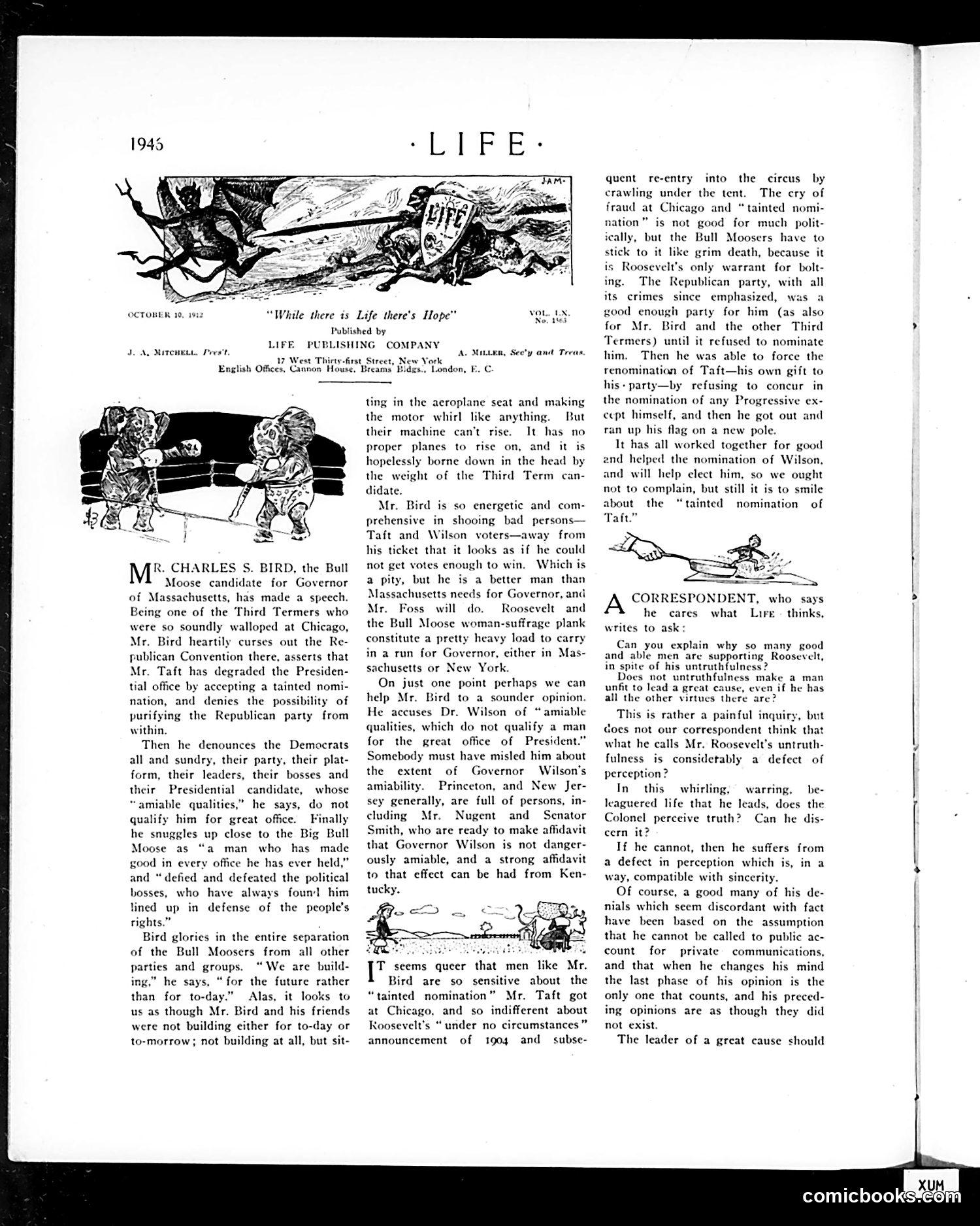
A restored page from Life, 1912-10-10. Page through the whole issue in the reader above.
📄 Transcribed text from this page (OCR, searchable)
Machine-transcribed from the original scan — historical spelling and the odd misread are preserved.
OCTOBER 10, 19%. “While there is Life there's Hope” Published by LIFE PU JA. MavemeLL. Preset. LISHING COMPANY A. Mitten, Seety anit Treas 17 West Thirty-first Street, New York English Offices, Cannon House, Breams’ Id; , London, E. C- M* CHARLES S. BIRD, the Bull Moose candidate for Governor of Massachusetts, has made a speech. Being one of the Third Termers who were so soundly walloped at Chicag: Mr. Bird heartily curses out the Re- publican Convention there, asserts that Mr. Taft has degraded the Presiden- tial office by accepting a tainted nomi- nation, and denies the possibility of purifying the Republican party from within. Then he denounces the Democrats all and sundry, their party, their plat- form, their leaders, their bosses and their Presidential candidate, whose “amiable qualities,” he says, do not qualify him for great office. Finally he snuggles up close to the Big Bull Moose as “a man who has made good in every office he has ever held,” and “defied and defeated the political bosses, who have always found him lined up in defense of the people’s rights.” Bird glories in the entire separation of the Bull Moosers from all other parties and groups. “We are build- ing,” he says, “for the future rather than for to-day.” Alas, it looks to us as though Mr. Bird and his friends were not building either for to-day or to-morrow; not building at all, but sit- ting in the aeroplane seat and making the motor whirl like anything. But their machine can’t rise. It has no proper planes to rise on, and it is hopelessly borne down in the head by the weight of the Third Term can- didate. Mr. Bird is so energetic and com- prehensive in shooing bad persons— Taft and Wilson voters—aw from his ticket that it looks as if he could not get votes enough to win. Which is a pity, but he is a better man than Massachusetts needs for Governor, and Mr. Foss will do. Roosevelt and the Bull Moose woman-suffrage plank constitute a pretty heavy load to carry in a run for Governor, either in Mas- sachusetts or New York. On just one point perhaps we can help Mr. Bird to a sounder opinion. He accuses Dr. Wilson of “amiable qualities, which do not qualify a man for the great office of President.” Somebody must have misled him about the extent of Governor Wilson's amiability. Princeton, and New Jer- sey generally, are full of persons, in- cluding Mr. Nugent and Senator Smith, who are ready to make affidavit that Governor Wilson is not danger- ously amiable, and a strong affidavit to that effect can be had from Ken- tucky. it seems queer that men like Mr. Bird are so sensitive about the “tainted nomination” Mr. Taft got at Chicago, and so indifferent about Koosevelt’s “ under no circumstances” announcement of 1904 and subse- quent re-entry into the circus by crawling under the tent. The ery of fraud at Chicago and “tainted nomi- nation” is not good for much polit- ically, but the Bull Moosers have to stick to it like grim death, because it is Roosevelt's only warrant for bolt- ing. The Republican party, with all its crimes since emphasized, was a good enough party for him (as also for Mr. Bird and the other Third Termers) until it refused to nominate him. Then he was able to force the renomination of Taft—his own his+ party—by refusing to concur in the nomination of any Progress cept himself, and then he got out and ran up his flag on a new pole. It has all worked together for good and helped the nomination of Wilson, and will help elect him, so we ought not to complain, but still it is to smile about the “tainted nomination of Taft. A CORRESPONDENT, who says he cares what Lire. thinks, writes to ask: Can you explain why so many good and able men are supporting Roosevelt, in spite of his untruthfulness? Does not untruthfulness make a man unfit to lead a great cause, even if he has all the other virtues there are? This is rather a painful inquiry, but Coes not our correspondent think that what he calls Mr. Roosevelt's untruth- fulness is considetably a defect of perception? In this whirling, warring, —be- leaguered life that he leads, does the Colonel perceive truth? Can he dis- cern it? If he cannot, then he suffers from a defect in perception which is, in a way, compatible with sincerity. Of course, a good many of his de- nials which seem discordant with fact have been based on the assumption that he cannot be called to public ac- count for private communications, and that when he changes his mind the last phase of his opinion is the only one that counts, and his preced- ing opinions are as though they did not exist. The leader of a great cause should comicbookean