
Life, 1912-10-10 · page 23 of 48
Life — October 10, 1912 — page 23: what you’re looking at
What you’re looking at
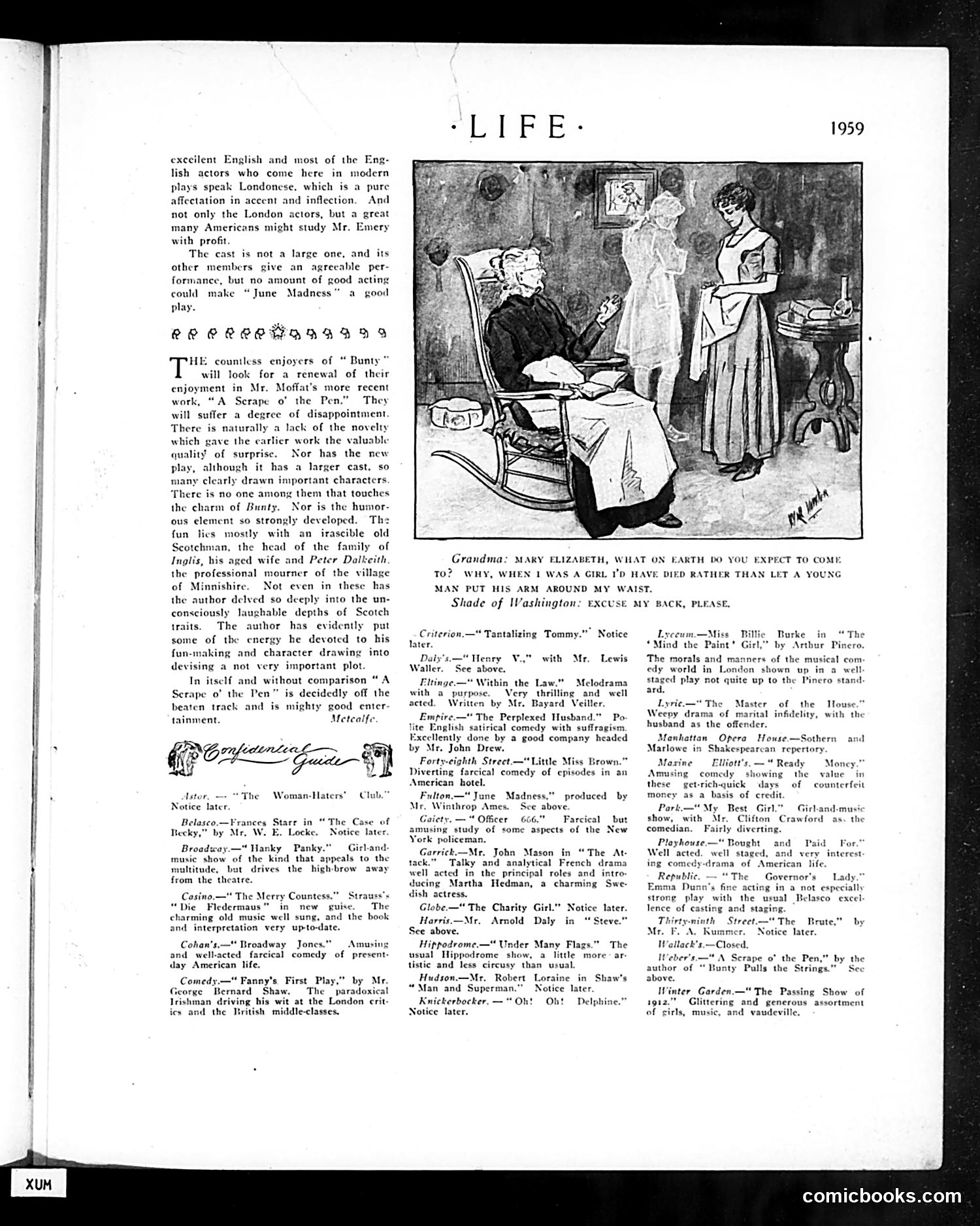
This page from Life magazine contains theater reviews and a single cartoon. The cartoon depicts a grandmother scolding her granddaughter Mary Elizabeth about propriety—specifically objecting to a young man putting his arm around the girl's waist. The satire targets generational hypocrisy about morality and physical intimacy. The grandmother claims she "would have died" rather than allow such contact when young, yet the "Shade of Washington" interrupting to ask her to "excuse my back, please" suggests an implicit criticism: the founding fathers (and earlier generations) were themselves quite physical with women, undermining the grandmother's claim to superior virtue. The joke relies on readers understanding that Victorian-era claims of strict propriety were often contradicted by actual historical behavior. It's a gentle mockery of how each generation judges the next's morality while ignoring their own past.
📄 Transcribed text from this page (OCR, searchable)
Machine-transcribed from the original scan — historical spelling and the odd misread are preserved.
exccilent English and most of the Eng- lish actors who come here in modern plays Londonese, which is a pure affectation in accent and inflection. And not only the London actors, but a great many Americans might study Mr. Emery with profit. The cast is not a large one, and its other members give an agreeable per- formance, but no amount of good acting could make “June Madness” a good play. Re CRERHRISBS9G HE countless enjoyers of “ Bunty will look for a renewal of their enjoyment in Mr. Moffat’s more recent work, “A Scrape 0° the Pen.” They will suffer a degree of disappointment. There is naturally a lack of the novelty which gave the earlier work the valuable quality of surprise, Nor has the new play, although it has a larger cast, so many clearly drawn important characters ‘There is no one among them that touches the charm of Bunty. Nor is the humor- ous element so strongly developed. The fun lies mostly with an irascible old Scotchman, the head of the family of Inglis, his aged wife and Peter Dalkeith the professional mourner of the village of Minnishire. Not even in these has the author delved so deeply into the un- consciously laughable depths of Scotch traits, The author has evidently put some of the energy he devoted to his {un-making and character drawing into devising a not very important plot In itself and without comparison “A Scrape o’ the Pen” is decidedly off the beaten track and is mighty good enter- tainment. Metcalfe ot leh er (POL GH Istor, — “The Woman-Haters’ Club.” Notice later. Belasco.—Frances Starr in “The Case of Recky,” by Mr. W. E. Locke. Notice later Broadway.—" Hanky Panky.” Girl-and. music show of the kind that appeals to the multitude, but drives the high-brow away from the theatre. Casino.—"* The Merry Countess." Strauss’s Die Fledermaus” in new guise. The charming old music well sung, and the book interpretation very up-to-date. Cohan’s.—" Broadway Jones.” — Amusing and well-acted farcical comedy of present- day American life. Comedy.—“ Fanny's First Play,” by Mr. George Bernard Shaw. The paradoxical Irishman driving his wit at the London crit- ics and the British middle-classes, Grandma: MARY ELIZABETH, WHAT ON EARTH DO YOU EXPECT TO CoM TO? WHY, WHEN 1 WAS A GIRL I'D HAVE DIED RATHER THAN LET A YOUNG MAN PUT HIS ARM AROUND MY WAIST. Shade of Washington: excuse MY BACK, PLEAS Criterion.— Tantalizing Tommy.” Notice later. Daly's." Henry V." with Mr. Lewis Waller. See above. Fltinge.—" Within the Law. Melodrama with a purpose. Very thrilling and well acted. Written by Mr. Bayard Veiller. Empire.—" The Perplexed Husband.” Po lite English satirical comedy with suffragism xcellently done by a good company headed by Mr. John Drew. Forty-cighth Strect—"Little Miss Brown.” Diverting farcical comedy of episodes in an American hotel. Fulton.—" June Madness,” produced by Mr. Winthrop Ames. Sce above. Gaiety. —“* Officer 666." Farcical but amusing study of some aspects of the New York policeman. Gorrick—Mr, John Mason in “The At- tack.” Talky and analytical French drama well acted in the principal roles and intro: ducing Martha Hedman, a charming Swe- h actress. Globe—" The Charity Girl.” Notice later. Harris.—Mr. Arnold Daly in “Steve.” See above. Hippodrome.— Under Many Flags.” The usual Hippodrome show, a little more ar. tistic and less circusy than usual, Hudson.—Mr. Robert Loraine in Shaw's “Man and Superman.” Notice later Knickerbocker. —“ Oh! Oh! Delphine.” Notice later. Burke by Arthy Lycoum.—Miss ‘Mind the Paint’ The morals and manners of the musical com: edy world in London shown up in a well staged play not quite up to the I , ard. in “The Pinero. Lyrie.—"The Master of the Mouse.” Weepy drama of marital infidelity, with the husband as the offender. Manhattan Opera House—Sothern and Marlowe in Shakespearcan reper Moxine — Elliott's. — “ Ready Amusing comedy showing the these get-rich-quick days of counterfeit money as a basis of credit Park.—"My Best Girl." Girl-and-muste show, with Mr. Clifton Crawford as. the comedian. Fairly diverting. Ployhouse—" Bought and Paid For.” Well acted. well staged, and very interest ing comedy-drama of American life. Republic. — “The Governor's Lady.” Emma Dunn's fine acting in a not especially strong play with the usual Belasco excel lence of casting and staging. sninth Street.—" The Brute," by Mr. Kummer. Notice later. Wellack's.—Closed. Weber's —" A Scrape 0° the Pen,” by the author of “Bunty Pulls the Strings.” Sec above. Winter Garden.—" The Passing Show of 1912." Glittering and generous assortment of girls, music, and vaudeville, comicbooks.com