
Life, 1912-10-10 · page 16 of 48
Life — October 10, 1912 — page 16: what you’re looking at
What you’re looking at
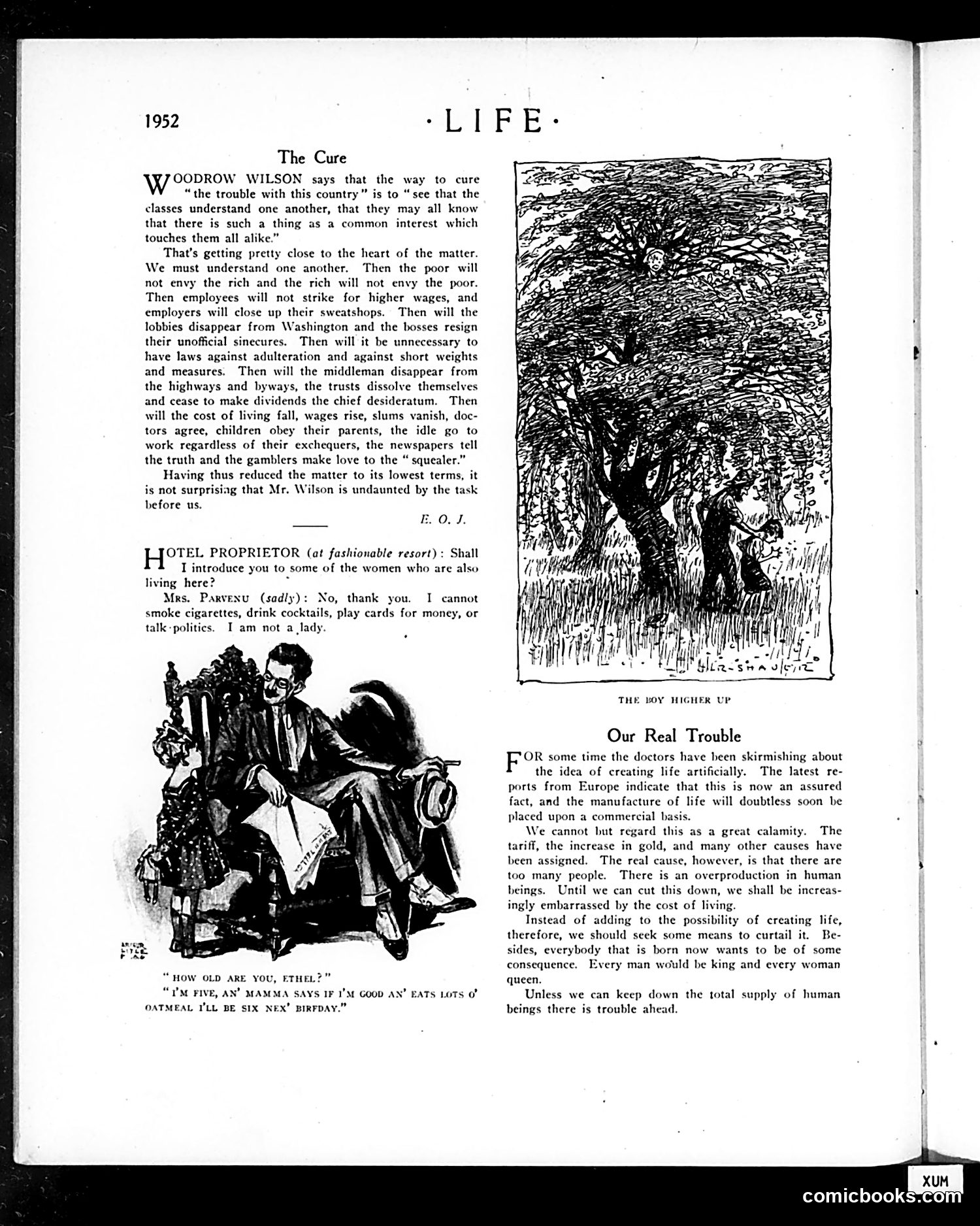
This page contains three satirical pieces mocking idealism and social pretension: **"The Cure"** sardonically quotes Woodrow Wilson's naive solution to class conflict—mutual understanding—then systematically demolishes it. The satire suggests such idealism is laughably insufficient; real economic problems (strikes, trusts, monopolies) won't vanish through goodwill alone. **The dialogue cartoon** features a nouveau-riche woman ("Mrs. Parvenu") at a resort who cannot participate in upper-class activities (smoking, drinking, gambling, political discussion) because she "is not a lady." It mocks social climbing and the artificial barriers of genteel society. **"Our Real Trouble"** ironically treats artificial life creation as catastrophic—not morally, but economically. The satire suggests overpopulation causes poverty and cost-of-living crises. It darkly jokes that the solution isn't creating more life but *curtailing* it, since modern babies "want to be of some consequence"—a sardonic dig at human ambition and entitlement. Overall, the page presents cynical commentary on American social problems and pretensions.
📄 Transcribed text from this page (OCR, searchable)
Machine-transcribed from the original scan — historical spelling and the odd misread are preserved.
1952 The Cure OODROW WILSON says that the way to cure “the trouble with this country” is to “see that the classes understand one another, that they may all know that there is such a thing as a common interest which touches them all alike.” That's getting pretty close to the heart of the matter. We must understand one another, Then the poor will not envy the rich and the rich will not envy the poor. Then employees will not strike for higher wages, and employers will close up their sweatshops. Then will the lobbies disappear from Washington and the bosses resign their unofficial sinecures. Then will it be unnecessary to have laws against adulteration and against short weights and measures. Then will the middleman disappear from the highways and byways, the trusts dissolve themselves and cease to make dividends the chief desideratum. Then will the cost of living fall, wages rise, slums vanish, doc- tors agree, children obey their parents, the idle go to work regardless of their exchequers, the newspapers tell the truth and the gamblers make love to the Having thus reduced the matter to its lowest terms, it is not surprisiag that Mr. Wilson is undaunted by the task before us. En Oud. Hote: PROPRIETOR (at fashionable resort): Shall I introduce you to some of the women who are also living here? . Mrs. Parvenu (sadly): No, thank you. I cannot smoke cigarettes, drink cocktails, play cards for money, or talk-politics. I am not a lady. THE OY HIGHER UP Our Real Trouble } OR some time the doctors have been skirmishing about the idea of creating life artificially. The latest re- ports from Europe indicate that this is now an assured fact, and the manufacture of life will doubtless soon be , placed upon a commercial basis. We cannot but regard this as a great calamity. The tariff, the increase in gold, and many other causes have been assigned. The real cause, however, is that there are ’ too many people. There is an overproduction in human beings. Until we can cut this down, we shall be increas- ingly embarrassed by the cost of living. Instead of adding to the possibility of creating life, therefore, we should seek some means to curtail it. Be- sides, everybody that is born now wants to be of some I consequence. Every man would be king and every woman ? queen. ¥S IF 1’M GOOD A} Unless we can keep down the total supply of human OATMEAL I'LL BE SIX NEX’ BIRFDAY.” beings there is trouble ahead. comicbooks.com