
Life, 1912-10-10 · page 22 of 48
Life — October 10, 1912 — page 22: what you’re looking at
What you’re looking at
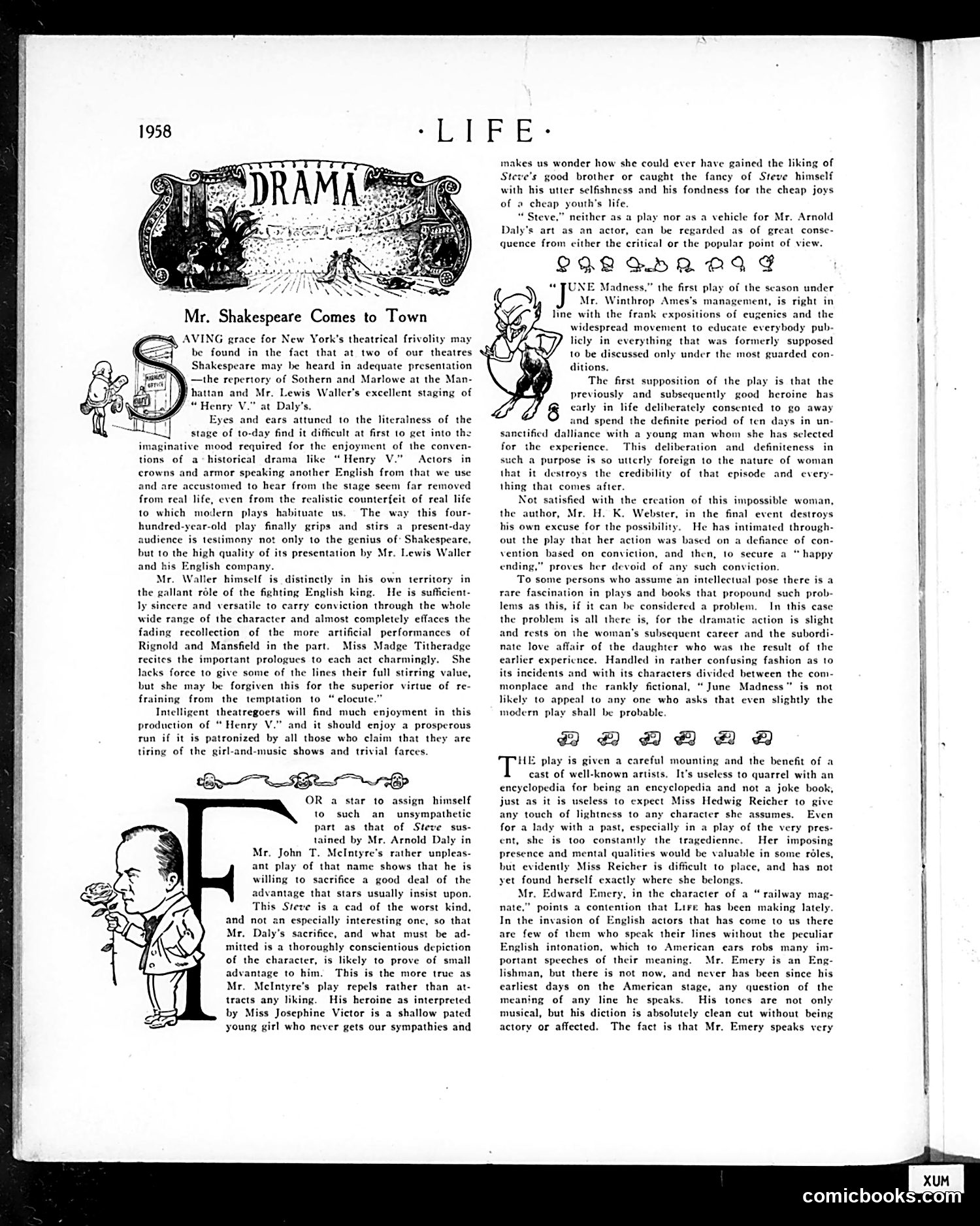
This page reviews three theatrical productions in New York: **"Henry V"** — Lewis Waller's production of Shakespeare receives high praise. The reviewer notes that audiences initially find Shakespeare's archaic language and conventions difficult, but Waller's sincere performance and the company's quality ultimately captivate modern viewers. The critic argues this demonstrates Shakespeare's enduring genius. **"Steve"** — Arnold Daly stars in John T. McIntyre's play about an unsympathetic character. The reviewer criticizes both the play and Daly's sacrifice in taking an unattractive role, suggesting it offers little artistic advantage to the actor or interest to audiences. **"June Madness"** — Winthrop Ames's production addresses eugenic themes and depicts a heroine who deliberately enters a ten-day liaison. The critic notes the play aligns with contemporary movements to publicly discuss previously taboo social topics. The cartoons illustrate these reviews with caricatures of the actors and productions discussed.
📄 Transcribed text from this page (OCR, searchable)
Machine-transcribed from the original scan — historical spelling and the odd misread are preserved.
Mr. Shakespeare Comes to Town AVING grace for New York's theatrical frivolity may be found in the fact that at two of our theatres y be heard in adequate presentation of Sothern and Marlowe at the Man- hattan and Mr. Lewis Waller's excellent staging of “Henry V." at Daly Eyes and ears attuned to the literalness of the stage of to-day find it difficult at first 10 get into the imaginative mood required for the enjoyment of the conven- tions of a historical drama like “Henry V." Actors in crowns and armor speaking another English from that we use and are accustomed to hear from the stage seem far removed from real life, even from the realistic counterfeit of real life to which modern plays habituate us. The way this four- hundred-year-old play finally grips and stirs a present-day audience is testimony not only to the genius of: Shakespeare, but to the high quality of its presentation by Mr. Lewis Waller and his English company. Mr. Waller himself is distinctly in his own territory in the gallant role of the fighting English king. He is sufficient- ly sincere and versatile to carry conviction through the whole wide range of the character and almost completely effaces the fading recollection of the more artificial performances of Rignold and Mansfield in the part. Miss Madge Titheradge recites the important prologucs to each act charmingly. She lacks force to give some of the lines their full stirring value, but she may be forgiven this for the superior virtue of re- fraining from the temptation to “ elocute.” Intelligent theatregoers will find much enjoyment in this production of “Henry V." and it should enjoy a prosperous run if it is patronized by all those who claim that they are tiring of the girl-and-music shows and trivial farces. OR a star to assign himself to such an unsympathetic part as that of Steve sus- tained by Mr. Arnold Daly in Mr. John T. MeIntyre’s rather unpleas- ant play of that name shows that he is willing to sacrifice a good deal of the advantage that stars usually insist upon. This Steve is a cad of the worst kind, and not an especially interesting one, so that Mr. Daly's sacrifice, and what must be ad- mitted is a thoroughly conscientious depiction of the character, is likely to prove of small advantage to him. This is the more truc as Mr. McIntyre’s play repels rather than at- tracts any liking. His heroine as interpreted by Miss Josephine Victor is a shallow pated young girl who never gets our sympathies and oe i oie Oe makes us wonder how she could ever have gained the liking of Steve's good brother or caught the fancy of Steve himself with his utter selfishness and his fondness for the cheap joys of a cheap youth's life. “ Steve,” neither as a play nor as a vehicle for Mr. Arnold Daly’s art as an actor, can be regarded as of great conse- quence from cither the critical or the popular point of view. 29252 09 2 “ TUNE Madness,” the first play of the season under J Mr. Winthrop Ames's management, is right in line with the frank expo: widespread movement to educate everybody pub- licly in everything that was formerly supposed to be discussed only under the most guarded con- ditions. The first supposition of the pl previous! ions of eugenics and the is that the and subsequently good heroine ha & carly in life deliberately consemed to go away and spend the definite period of ten days in un- sanctified dalliance with a young man whom she has selected for the experience. This deliberation and definiteness in such a purpose is so utterly foreign to the nature of woman that it destroys the credibility of that episode and every- thing that comes after. Not satisfied with the ercation of this impossible woman, the author, Mr. H. K. Webster, in the final event destro his own excuse for the possibility. He has intimated through- out the play that her action was based on a defiance of con- vention based on conviction, and then, to secure a “happy ending,” proves her devoid of any such conviction. To some persons who assume an intellectual pose there is a rare fascination in plays and books that propound such prob- lems as this, if it can be considered a problem. In this case the problem is all there is, for the dramatic action is slight and rests on the woman's subsequent career and the subordi- nate love affair of the daughter who was the result of the earlier experience. Handled in rather confusing fashion as 10 its incidents and with its characters divided between the com- monplace and the rankly fictional, “June Madness” is not likely to appeal to any one who asks that even slightly the modern play shall be proba ADH AAAA HE play is given a careful mounting and the benefit of a cast of well-known artists. It's useless to quarrel with an encyclopedia for being an encyclopedia and not a joke book, just as it is useless to expect Miss Hedwig Reicher to give any touch of lightness to any character she assumes. Even for a lady with a past, especially in a play of the very pres- ent, she is too constantly the tragedienne. Her imposing presence and mental qualities would be valuable in some réles, but evidently Miss Reicher is difficult to place, and has not yet found herself exactly where she belongs. Mr, Edward Emery, in the character of a “ railway mag- nate,” points a contention that Lire has been making latel In the invasion of English actors that has come to us there are few of them who speak their lines without the peculiar English intonation, which to American ears robs many im- portant speeches of their meaning. Mr. Emery is an Eng- lishman, but there is not now, and never has been since his carliest days on the American stage, any question of the meaning of any line he speaks. His tones are not onl musical, but his diction is absolutely clean cut without being actory or affected. The fact is that Mr. Emery speaks very le comicbook $.co