
A complete issue · 40 pages · 1912
Life — August 8, 1912
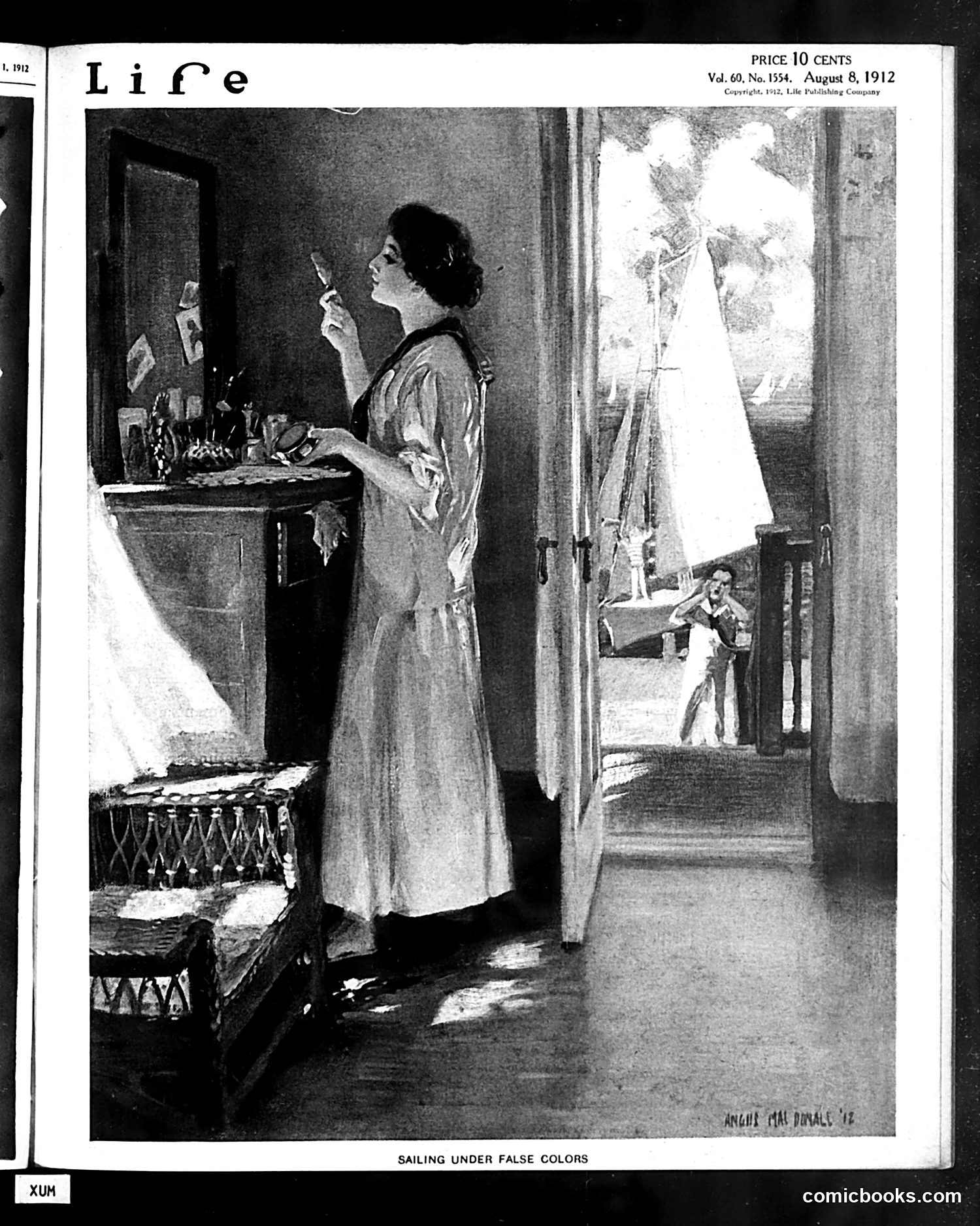
This 1912 Life magazine cartoon satirizes deception in courtship or romance. The illustration shows a woman at her vanity mirror, applying makeup or cosmetics while presenting herself to a man visible through the doorway. The caption "Sailing Under False Colors" (a nautical term meaning flying a false flag to deceive) suggests the woman is misrepresenting her appearance—using cosmetics to create a false impression. This reflects early-20th-century anxieties about women's makeup use. Cosmetics were still controversial and often viewed as deceptive artifice rather than acceptable grooming. The cartoon mocks women for "deceiving" men about their true appearance, playing on contemporary debates about female beauty standards and authenticity in courtship.
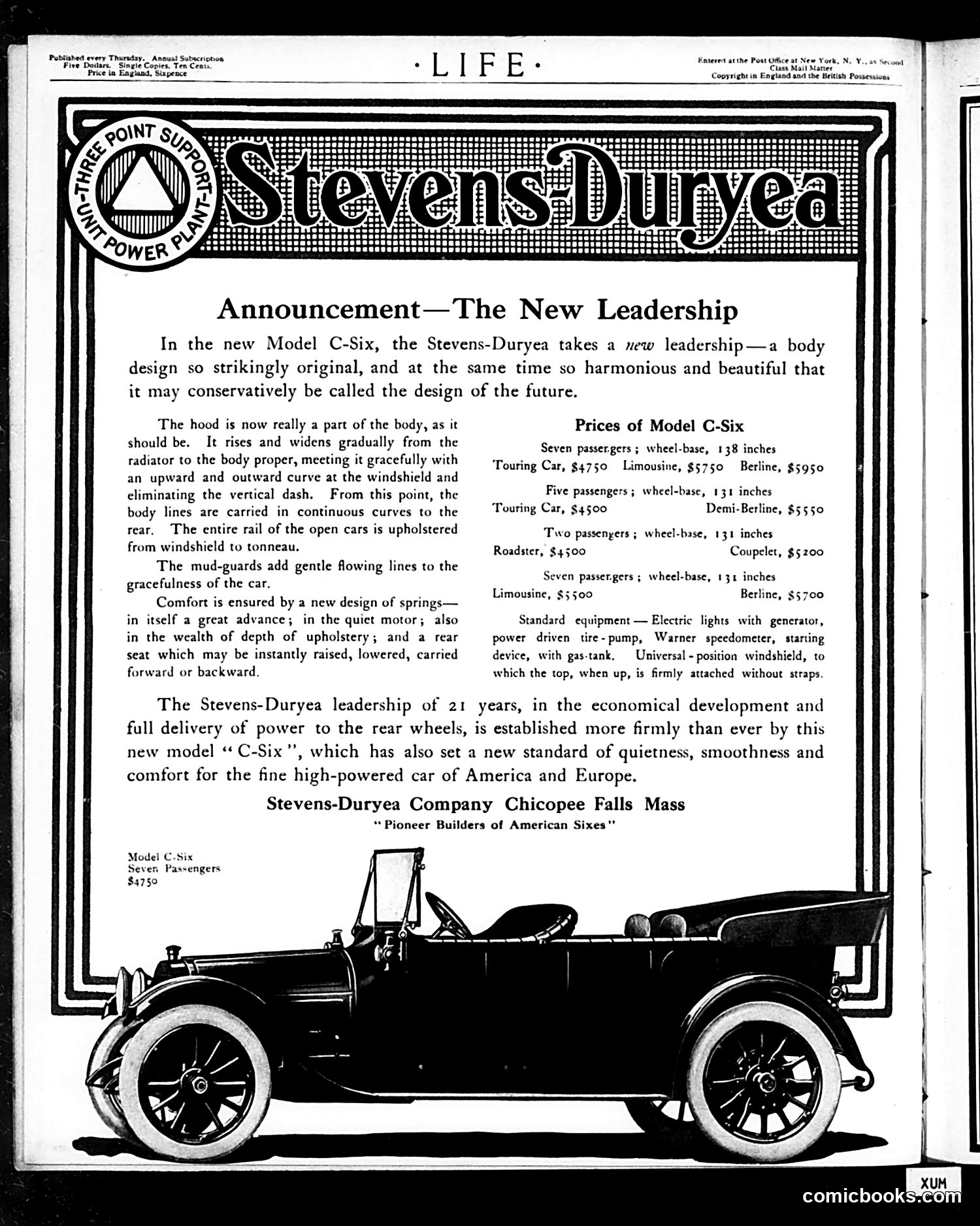
This page is primarily **advertising, not satire or political commentary**. It's a Stevens-Duryea automobile advertisement announcing their new Model C-Six. The ad emphasizes design innovation—describing how the hood integrates with the body, and how graceful curves flow from radiator to rear. Technical features are highlighted: new spring design, quiet motor, comfortable upholstery, and a rear seat that can be raised or lowered. Pricing ranges from $4,500 to $5,950 for various configurations (touring cars, roadsters, limousines). The company tagline calls them "Pioneer Builders of American Sixes." The illustration shows a side-view of the open-air automobile. There's no satire present—this is straightforward early automotive marketing emphasizing luxury and engineering superiority in the pre-WWI era.

This is **not a political cartoon or satirical content**—it's a straightforward **advertisement** for Michelin tire products, specifically their "Quick Detachable Clincher" rim. The page promotes a practical automotive accessory: a clincher rim that easily attaches to any standard quick-detach (Q.D.) clincher rim. The sales pitch emphasizes convenience ("Easiest to fit on any Q.D. Clincher Rim") and quality parity with Michelin's reputation ("As superior to other Tires as Michelin Red Inner Tubes are to other Tubes"). The illustration shows the product being held in a hand to demonstrate its size and usability. The ad includes company locations (Clermont-Ferrand, France; London, England; Turin, Italy; Milltown, N.J.) and directs readers to request "The Motorist's Handbook." This represents early automotive-era advertising in *Life* magazine.
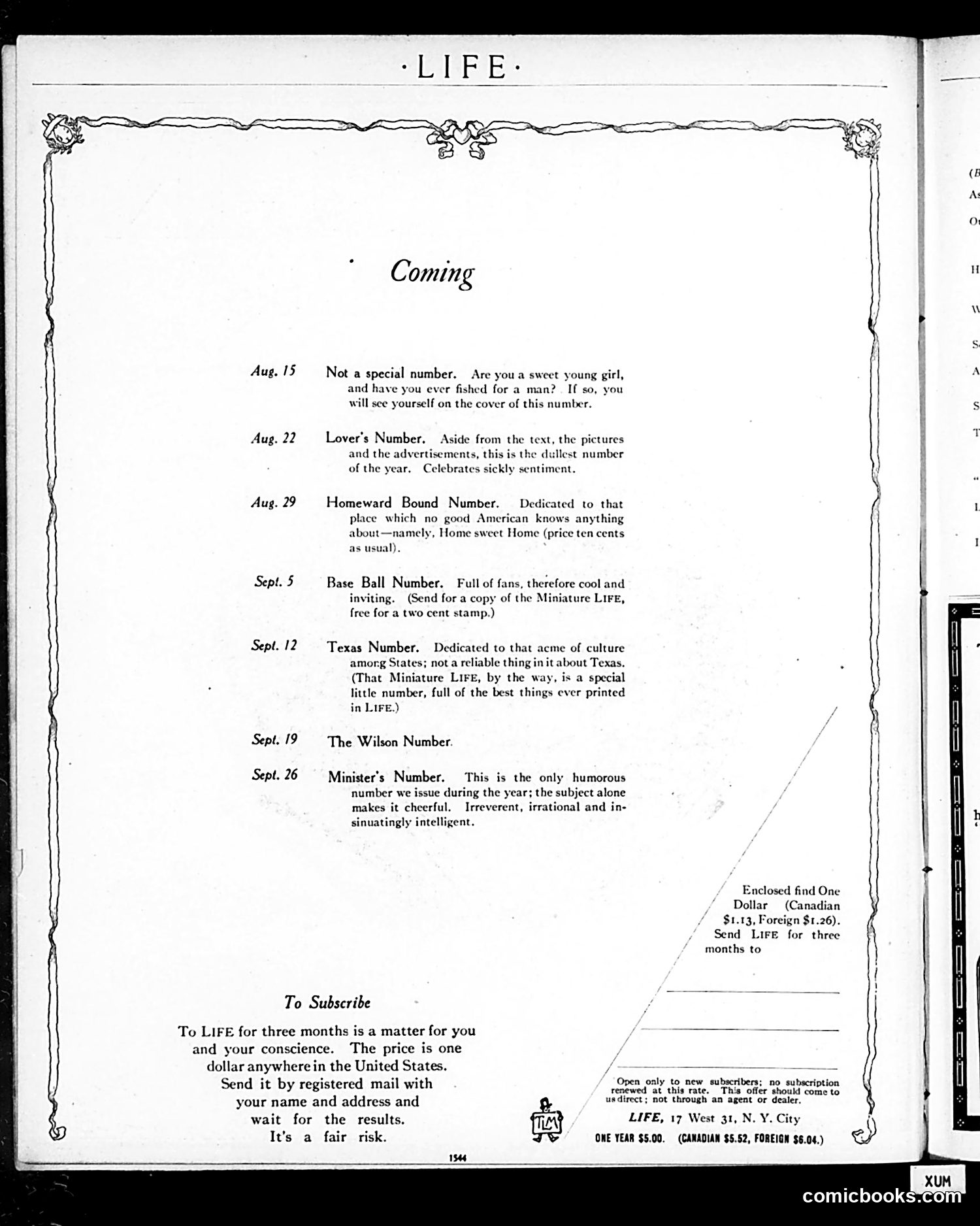
This page is primarily **advertising content** rather than editorial cartoons. It's a "Coming" announcements section promoting upcoming issues of *Life* magazine with tongue-in-cheek descriptions: - **Aug. 15**: "Not a special number" — humorously promising to feature a young woman on the cover - **Aug. 22**: "Lover's Number" — described as the "dullest number of the year" - **Aug. 29**: "Homeward Bound Number" — mocking American domesticity ("Home sweet Home") - **Sept. 5-26**: Various themed issues (Baseball, Texas, Wilson, Minister's issues) The satire is gentle and self-aware, with *Life* poking fun at its own editorial choices and reader expectations. The subscription pitch at bottom emphasizes affordability ($1 in the US) while the humorous tone suggests *Life*'s satirical, irreverent approach to American culture and values.
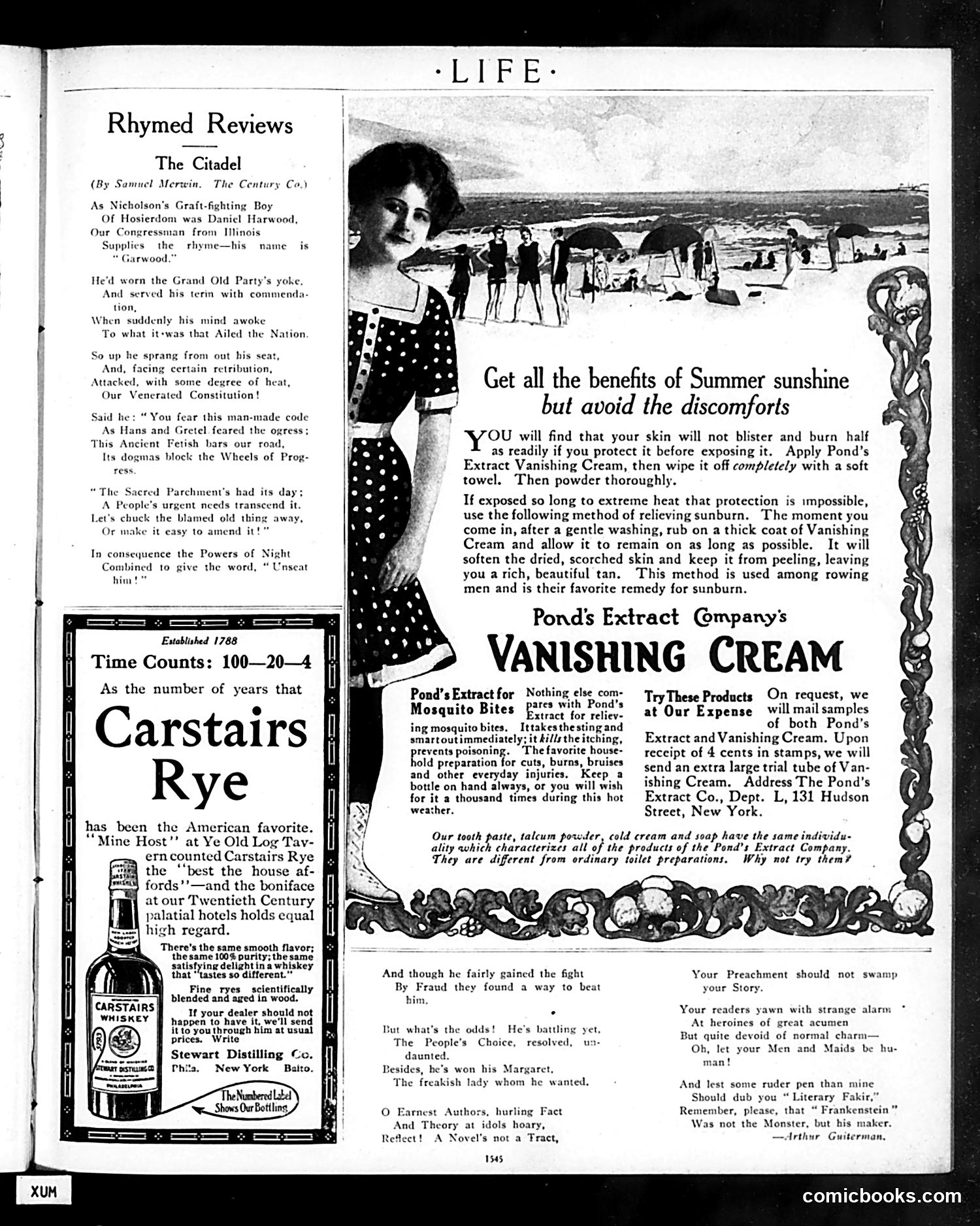
This page is primarily **advertising**, not political satire. The dominant content is a Pond's Extract Company advertisement for Vanishing Cream, featuring a woman in a polka-dot bathing suit at a beach. The ad promises sun protection without "discomforts" like blistering or burning. The left column contains "Rhymed Reviews" discussing "The Citadel" (a Samuel Merwin novel) and mocking a congressman named Garwood from Illinois who opposed the Constitution. Below that is an advertisement for Carstairs Rye whiskey. The bottom of the page includes verse commentary on literary figures and authors, apparently satirizing contemporary writers' debates about "Fact and Theory." The page reflects 1920s-30s consumer culture and light political humor rather than substantial political cartooning.
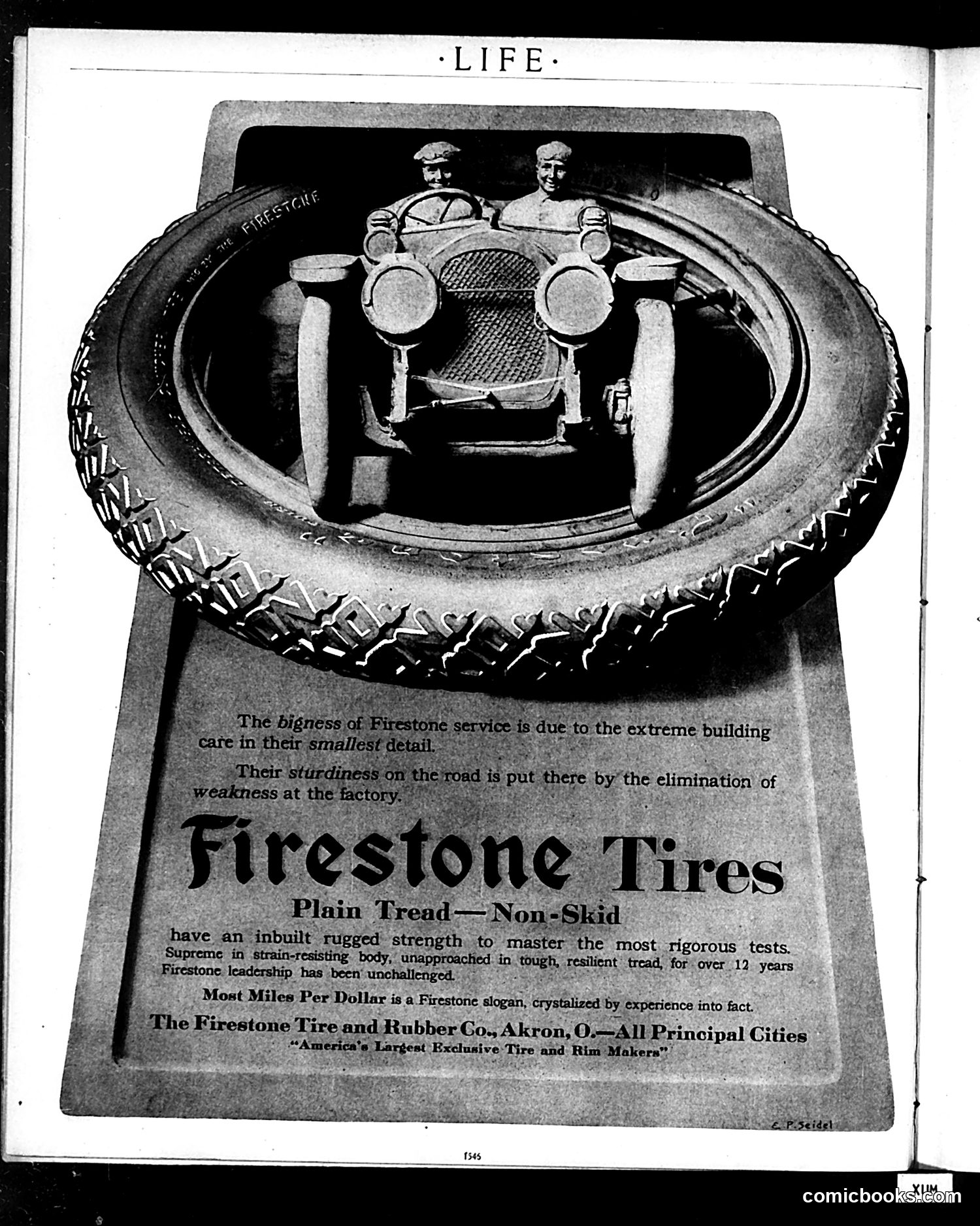
This is **not a political cartoon or satire** — it's a straightforward **advertisement for Firestone Tires** from *Life* magazine. The image shows a racing car viewed through a giant tire, with two drivers visible. The ad emphasizes Firestone's manufacturing quality and durability, claiming their tires endure "rigorous tests" and offer superior "strain-resisting body" and "tough, resilient tread." The headline "Most Miles Per Dollar" was Firestone's actual advertising slogan. The company, based in Akron, Ohio, positioned itself as "America's Largest Exclusive Tire and Rim Maker." The racing context (the car appears to be a race vehicle) was common in tire advertising of this era — manufacturers used competitive racing to demonstrate product reliability and performance to consumers.
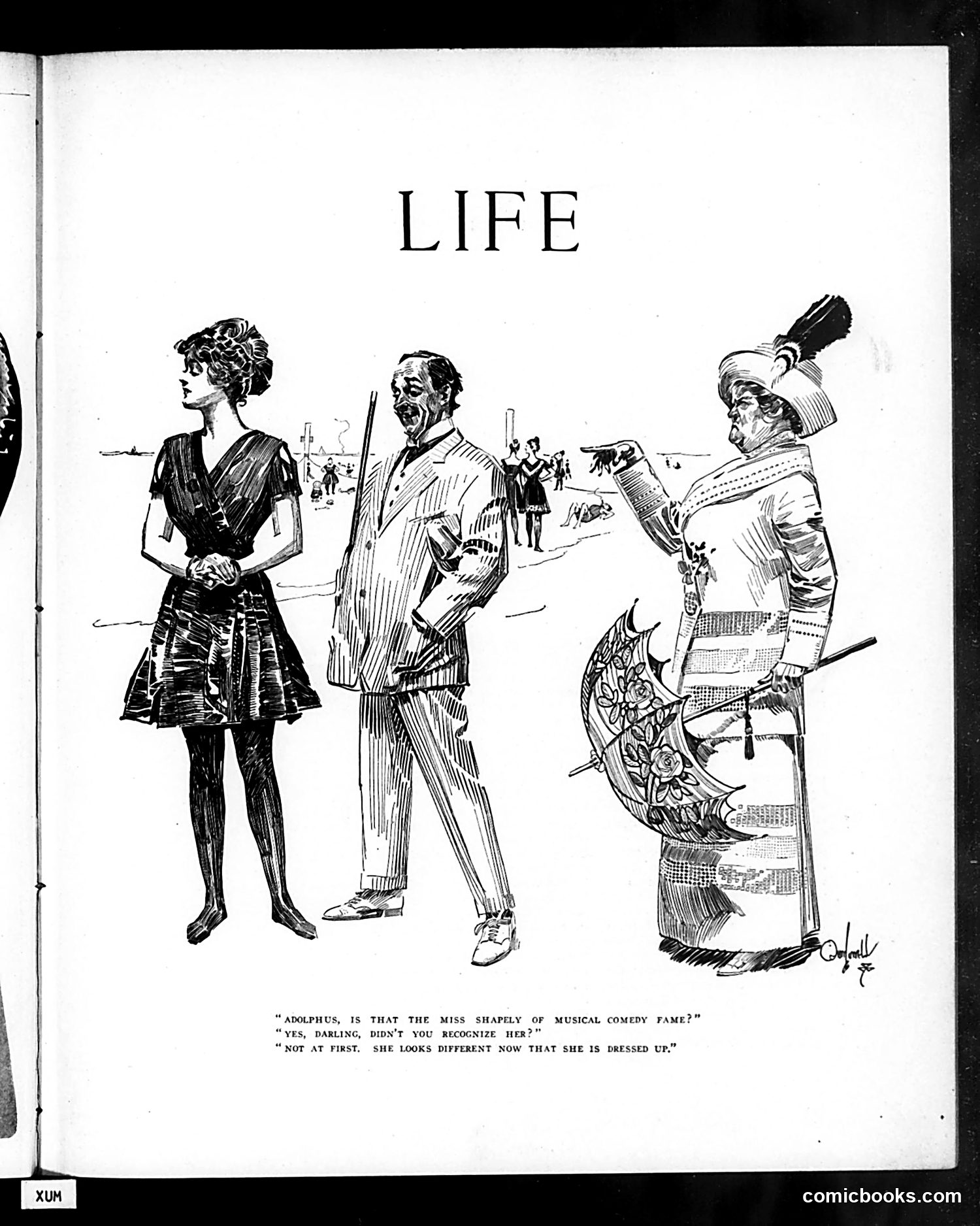
This single-panel cartoon depicts three figures in what appears to be a social setting. The dialogue reads: "Adolphus, is that the Miss Shapely of musical comedy fame?" / "Yes, darling, didn't you recognize her?" / "Not at first. She looks different now that she is dressed up." The satire targets the contrast between a performer's stage appearance versus her respectable public presentation. "Miss Shapely" suggests a chorus girl or musical comedy performer known for her physical attractiveness and costume-based appeal. The joke hinges on the implication that when properly clothed in conventional attire, she becomes unrecognizable—her stage identity depended entirely on revealing costumes rather than inherent fame or talent. This reflects early 20th-century attitudes toward theatrical performers and respectability.
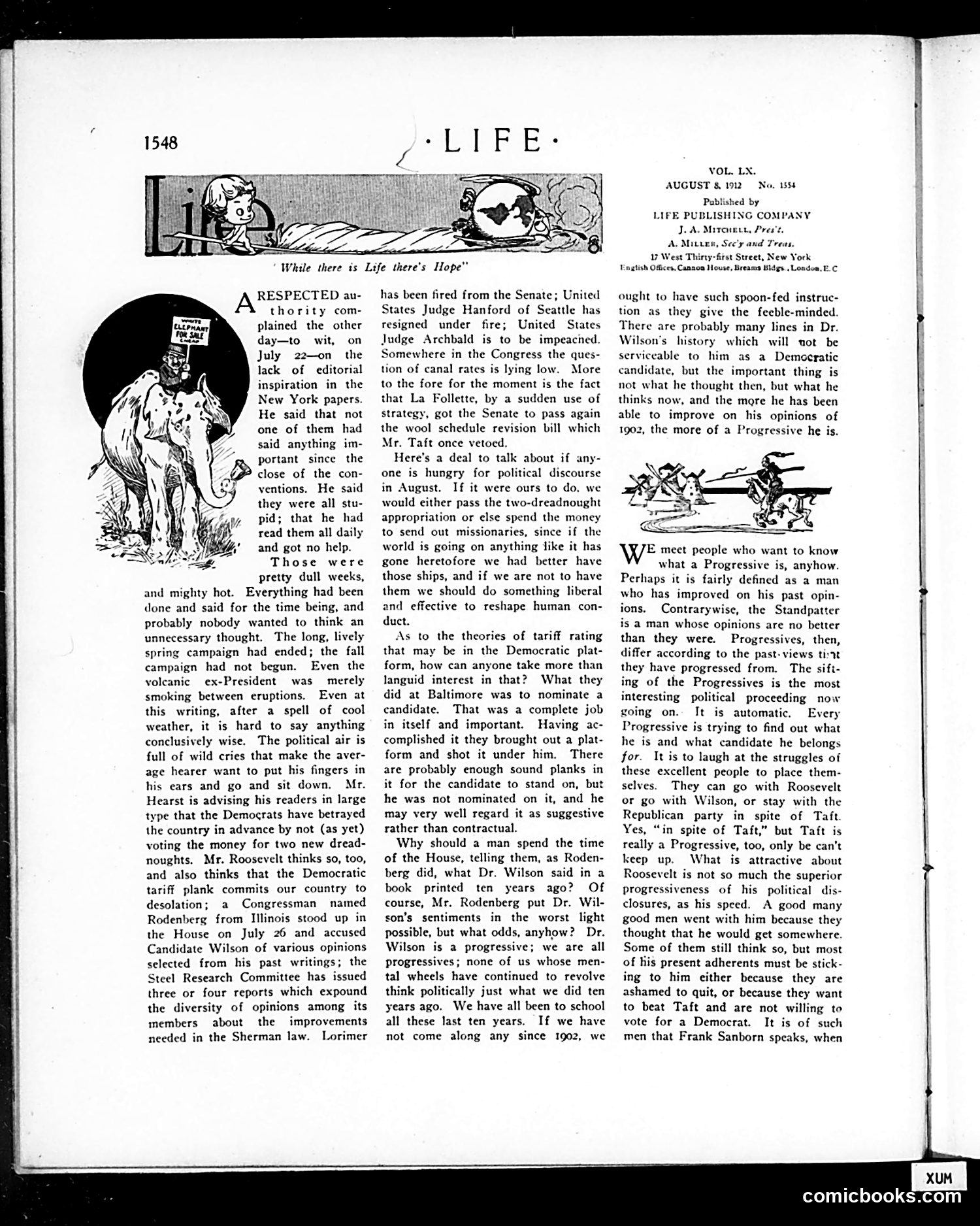
The main cartoon depicts a donkey (representing the Democratic Party) looking disheveled and exhausted after the party's contentious spring and summer campaign season. The accompanying article critiques the Democratic Party's internal divisions and questions what "Progressivism" actually means. The text discusses recent political upheaval: U.S. judges facing scandals, Senate disputes over canal rates, and the failed Democratic platform regarding tariff policy. The article sarcastically examines Progressive ideology, suggesting it's poorly defined and that many claiming the label (including Roosevelt-aligned Republicans) are simply disgruntled politicians rather than genuine ideological reformers. The donkey's bedraggled state visually reinforces the article's message: the Democratic Party is exhausted and confused by the Progressive movement fragmenting American politics.
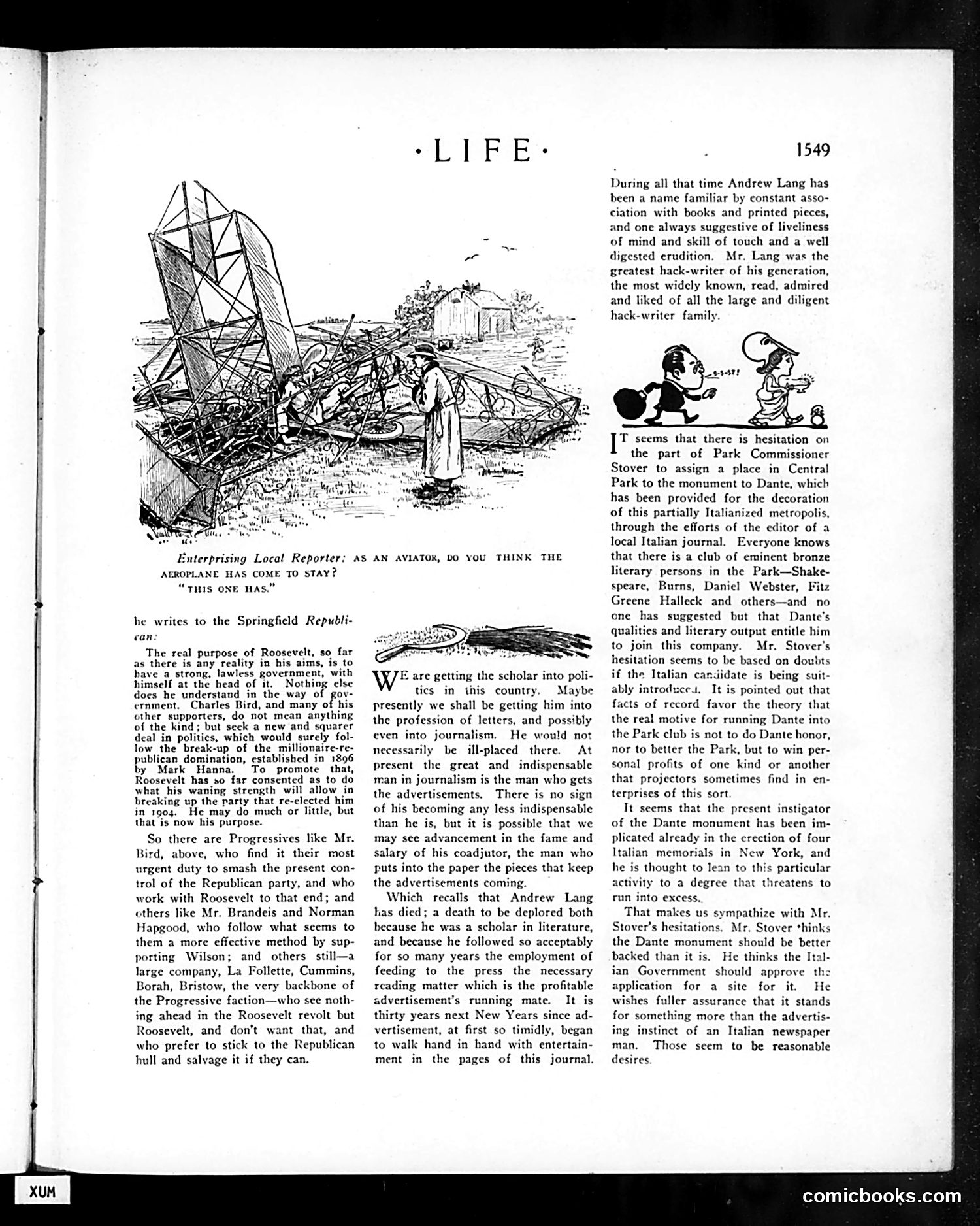
The main cartoon depicts an "Enterprising Local Reporter" as an aviator, with an airplane constructed from makeshift materials. The caption asks: "AS AN AVIATOR, DO YOU THINK THE AEROPLANE HAS OVER ITS START? THIS ONE HAS." This is a visual pun—the reporter's crude flying machine appears to be made partly from printing press equipment and newspaper materials, satirizing ambitious but poorly-equipped local journalists attempting to report on aviation (a cutting-edge technology of the era). The facing text discusses Andrew Lang, a prominent hack-writer and literary figure, and debates about placing a Dante monument in Central Park. The page critiques journalism's relationship to literature and public taste, using the flimsy "aeroplane" as a metaphor for inadequate professional ambition.
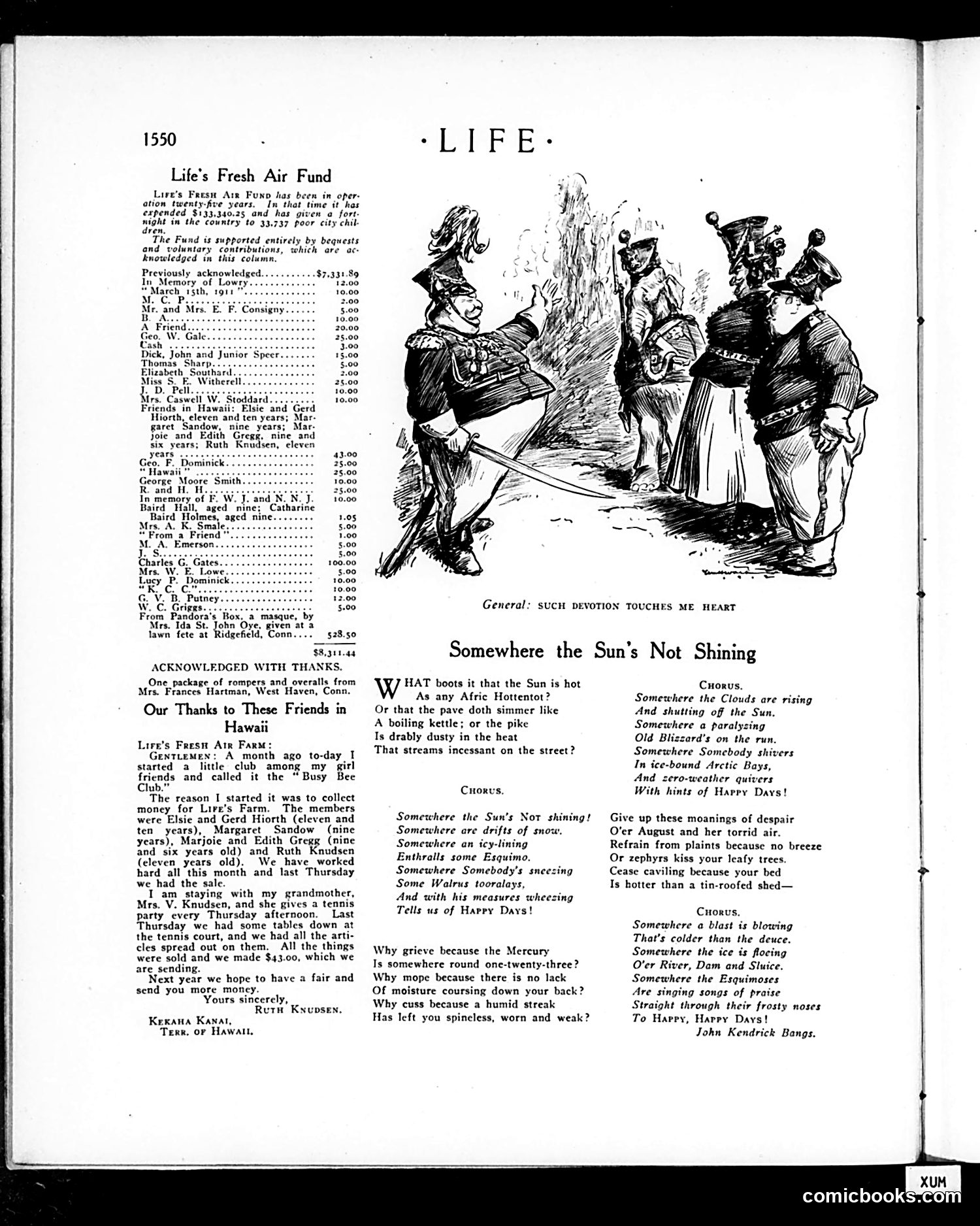
This page contains **Life's Fresh Air Fund** acknowledgments—a charitable fundraising section listing donors—alongside a poem titled "Somewhere the Sun's Not Shining" by John Kendrick Bangs. The cartoon illustrates the poem's theme: it depicts figures enduring harsh weather conditions (suggested by the sketched, windswept artistic style). The poem contrasts tropical heat with cold, snow, and discomfort, using ironic humor to catalog various miserable climates and situations. The chorus repeatedly mentions "Happy Days," creating satirical contrast between the cheerful phrase and genuinely unpleasant conditions described. This appears designed to humorously fundraise for the Fresh Air Fund—a real charitable organization providing relief to poor urban children—by joking about weather while soliciting donations. The cartoon visually reinforces the poem's message about escaping uncomfortable circumstances.
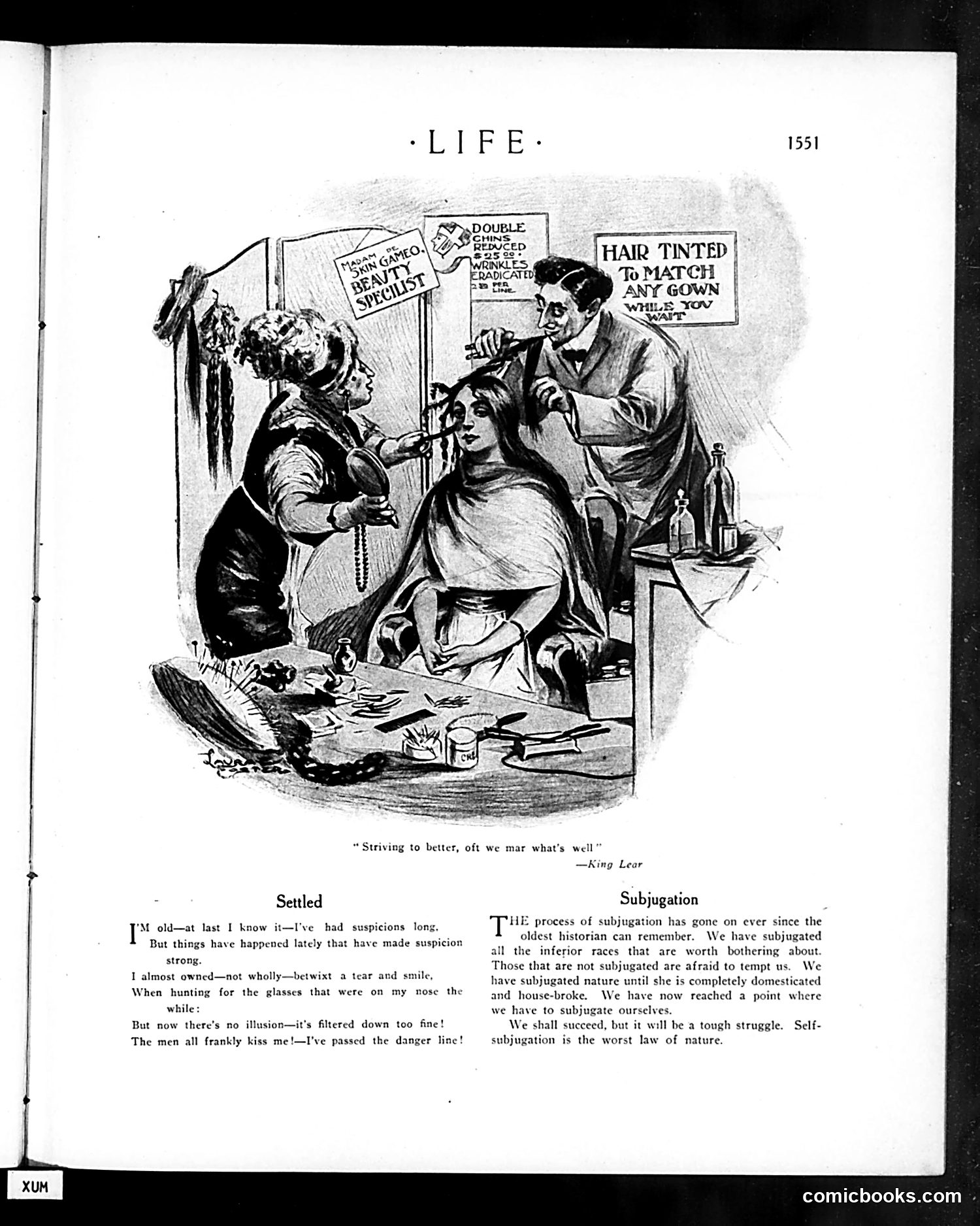
This page satirizes women's beauty treatments and vanity through a barbershop/salon scene. The cartoon depicts a woman undergoing hair treatment while two attendants work on her. Three visible advertisements promise beauty solutions: "Greta Garbo Beauty Specialist," "Double Chin Removed," and "Hair Tinted to Match Any Gown You Wish." The satire targets the contradiction between women's supposed "subjugation" (the right-side essay's topic) and their active pursuit of beauty procedures. The accompanying essays—"Settled" and "Subjugation"—discuss gender dynamics. The cartoon ironically suggests that while women claim oppression, they willingly subject themselves to elaborate and expensive cosmetic procedures, thereby self-subjugating through vanity. This reflects early 20th-century satirical critiques of consumer culture targeting women.
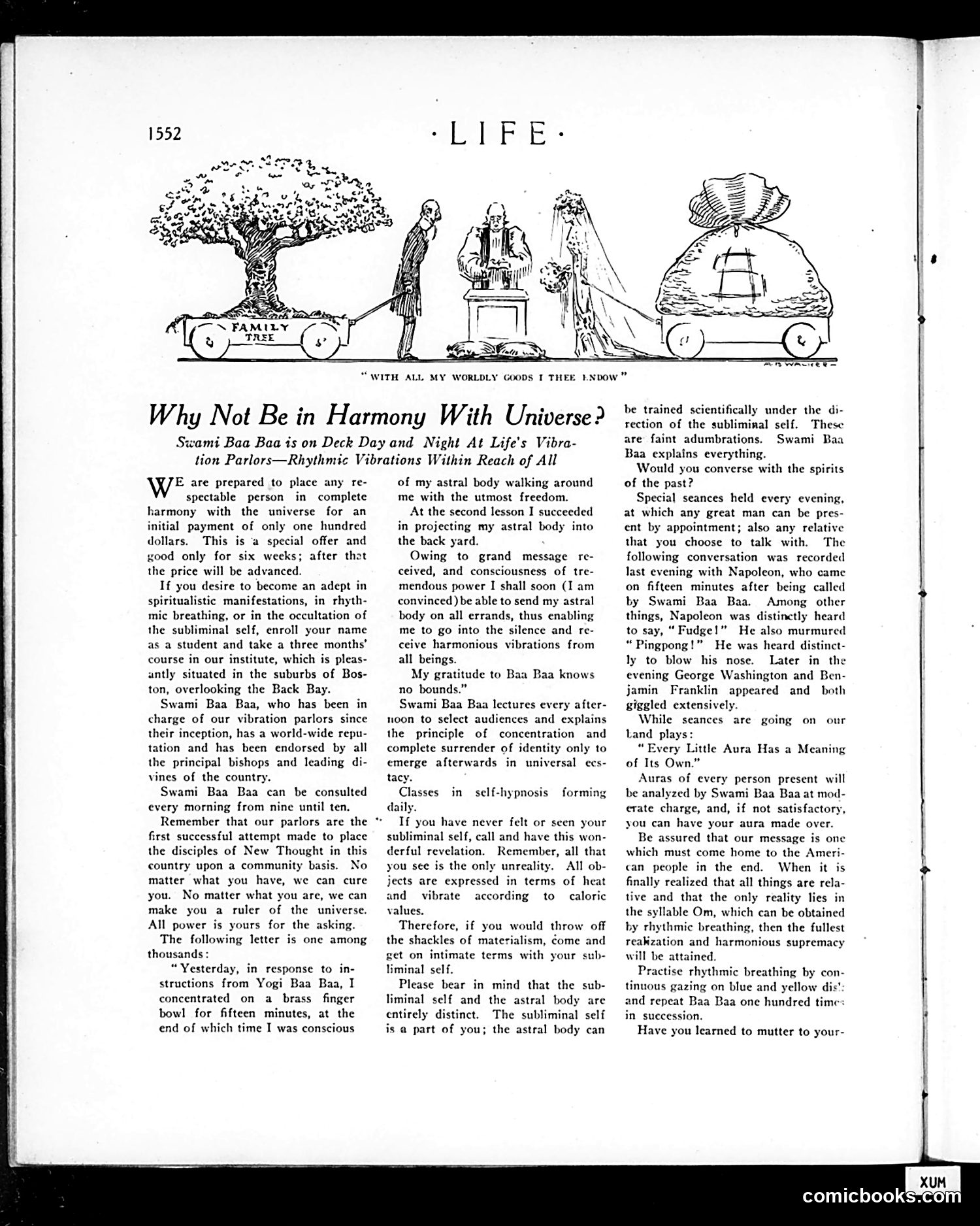
This page satirizes the "New Thought" spiritual movement popular in early 1900s America. The cartoon headline "Why Not Be in Harmony With Universe?" mocks pseudo-scientific spiritualism by depicting a charlatan named "Swami Baa Baa" offering occult instruction. The illustration shows a family tree transformed into a wheeled platform displaying spiritualist paraphernalia (a ship, representing travel to the ethereal realm). The satire targets gullible wealthy Americans paying "only one hundred dollars" for dubious lessons in "rhythmic vibrations" and "astral body" projection. The text humorously recounts testimonials—including a supposed appearance by Napoleon's ghost—exemplifying how Life ridiculed the era's embrace of pseudoscientific spiritualism as both pretentious and financially exploitative humbug marketed to the credulous upper classes.
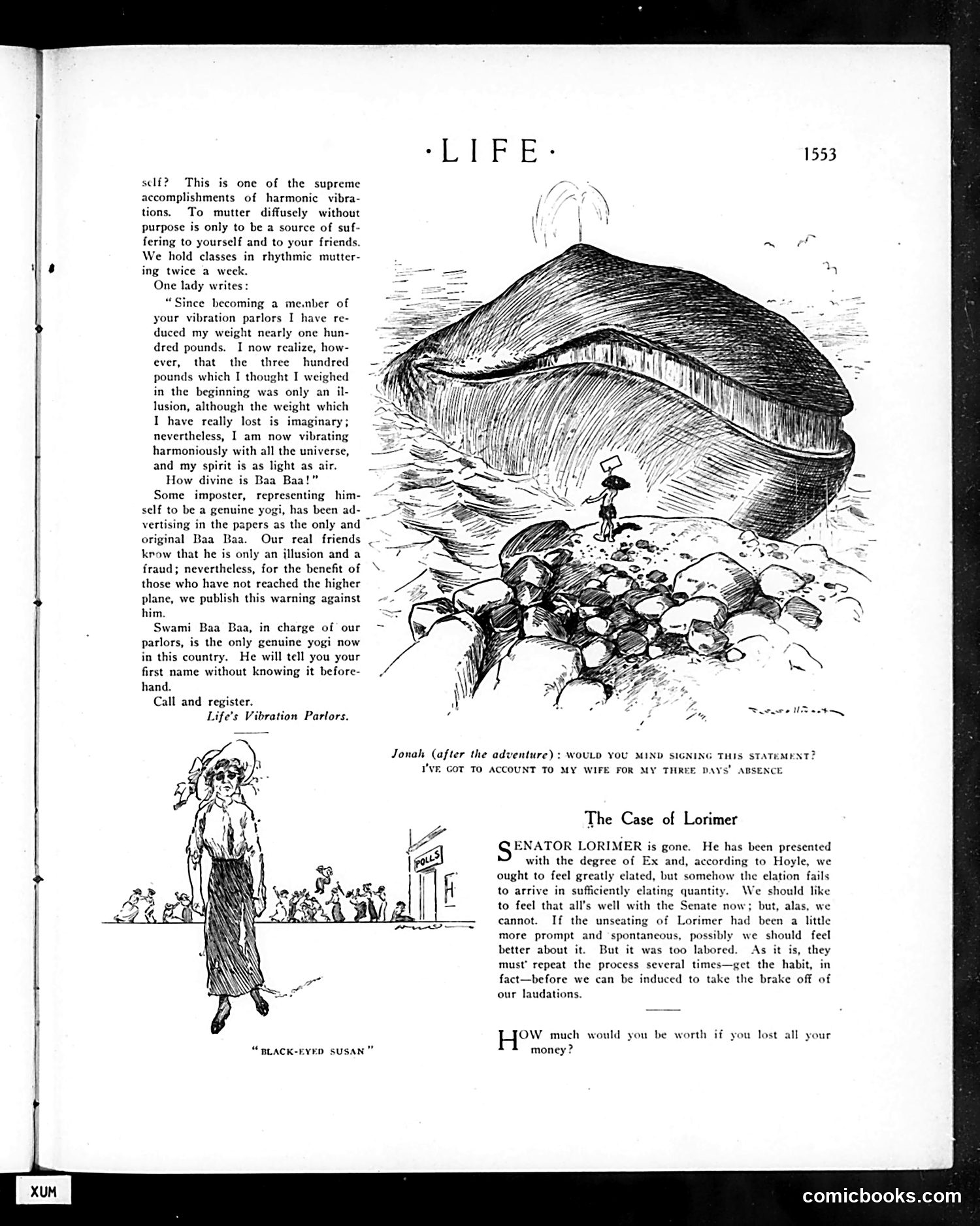
This page satirizes **new-age wellness trends**, particularly "harmonic vibrations" and yoga practitioners. The main text mocks a woman who claims vibration parlors helped her lose weight "imaginary" pounds while achieving spiritual enlightenment ("vibrating harmoniously with all the universe"). The satire targets fraudulent yoga instructors advertising themselves as authentic masters ("Swami Baa Raa"), warning readers against charlatans. The illustration titled **"Black-Eyed Susan"** appears unrelated—likely a separate humorous piece about a woman drawing crowds. **"The Case of Lorimer"** begins a new article about a senator receiving an honorary degree, questioning whether the honor feels meaningful. The page ridicules both wellness fads and credential inflation in early-20th-century America.
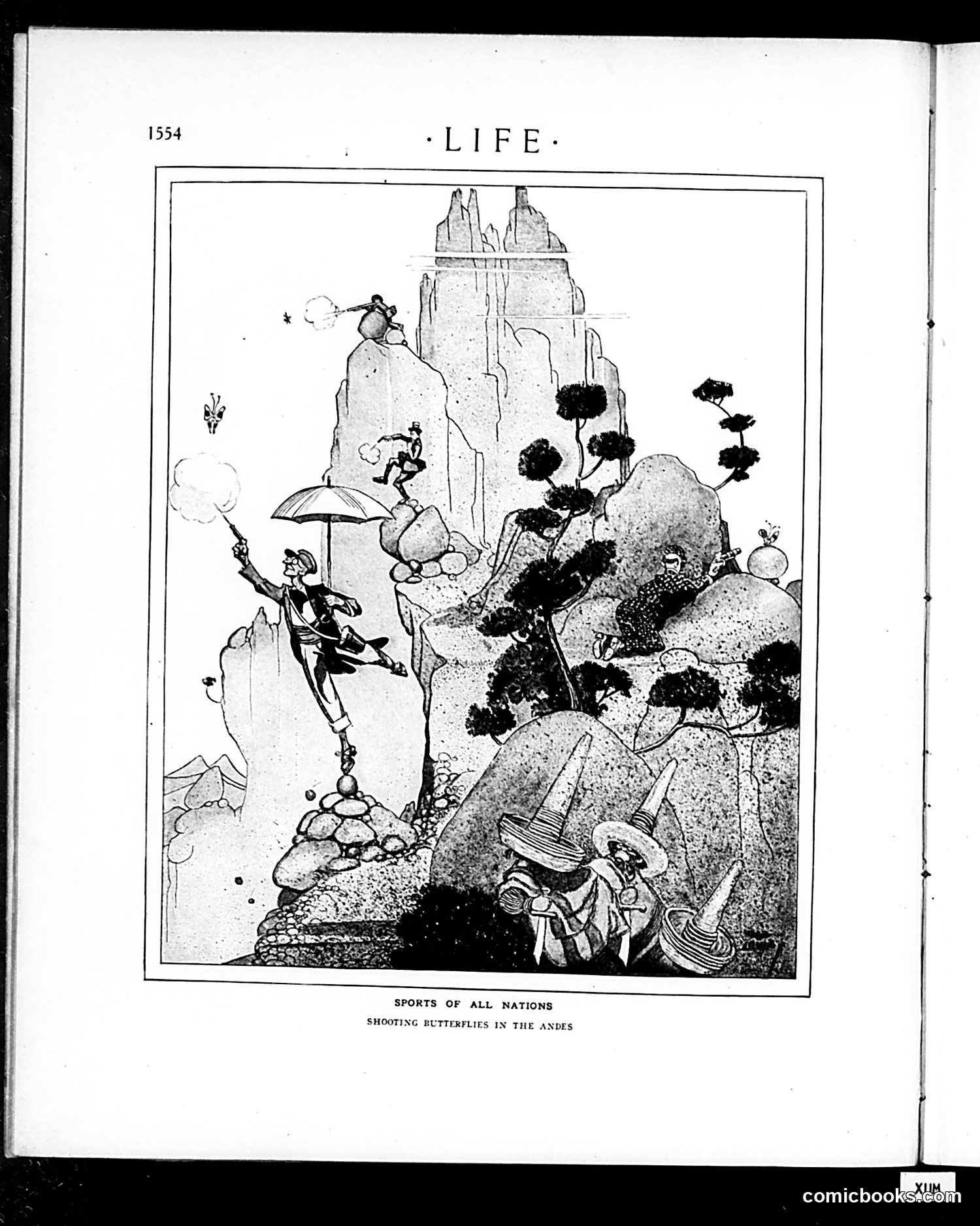
This satirical cartoon depicts wealthy sportsmen engaged in a trivial pursuit—shooting butterflies in the Andes mountains—presented as if it were a serious national sport. The humor lies in mocking the leisure activities of the affluent, particularly the absurdity of traveling to remote locations to hunt harmless insects. The figures shown include men in formal sporting attire with guns, suggesting upper-class hunters. The elaborate landscape with towering rock formations emphasizes the exotic locale, implying that the wealthy undertake expensive expeditions for frivolous entertainment. The satire targets both the pretentiousness of "sports" among the elite and the wasteful nature of such pursuits, contrasting imagined international "competitions" in butterfly-hunting against genuine athletic endeavors.
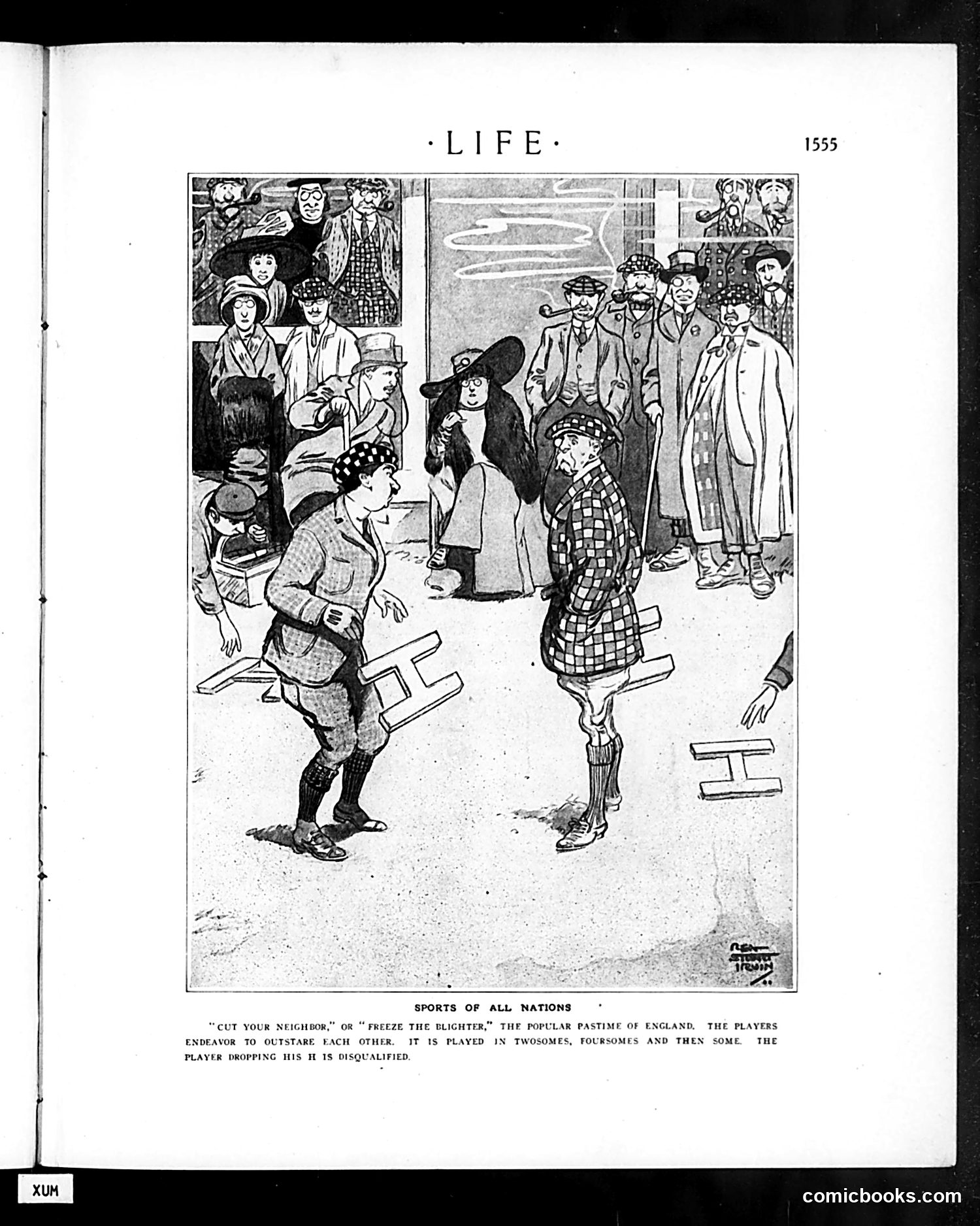
This is a satirical cartoon from *Life* magazine mocking a British social practice. The illustration depicts two figures in an intense staring contest while onlookers gather around them. The text explains the "game" called "Cut Your Neighbor" or "Freeze the Blighter"—a competitive staring match where players attempt to outstare each other in pairs or groups, with the first to look away being disqualified. The satire targets what the artist presents as a peculiar English pastime: a seemingly pointless game of psychological intimidation disguised as sport. By including it in a "Sports of All Nations" feature, *Life* satirizes both British social customs and the broader concept of invented competitive games. The humor relies on presenting this absurd activity as a legitimate national sporting tradition.
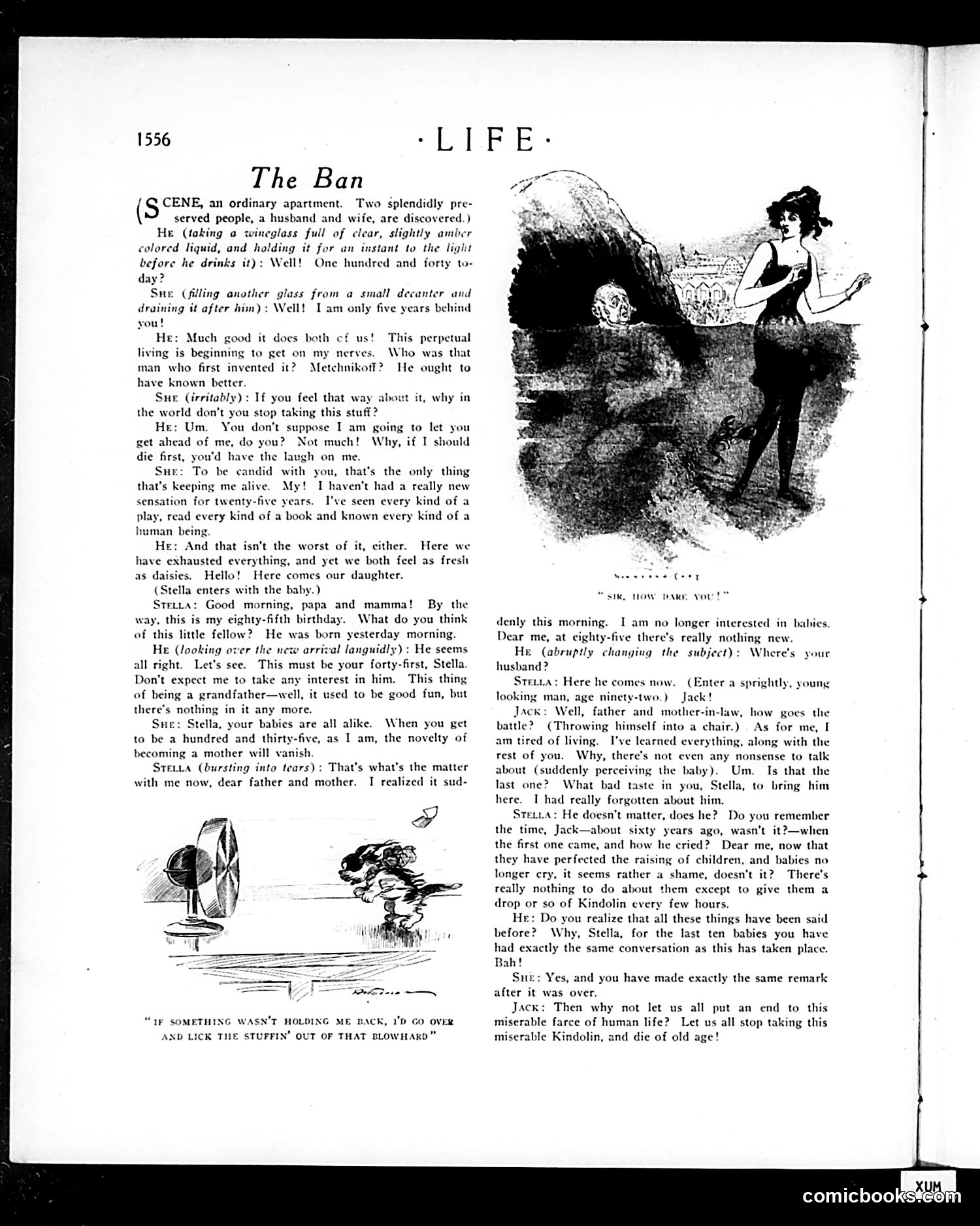
This satirical play imagines a future where a life-extension drug (possibly referencing Élie Metchnikoff, a real biologist who theorized about prolonging life) has made people functionally immortal. The humor derives from depicting this as a *curse* rather than a blessing. The characters—a 140-year-old husband, his 135-year-old wife, their 85-year-old daughter, and her grandson born yesterday—are emotionally exhausted. They've experienced everything possible and find existence meaningless. Even childbirth and child-rearing have become tedious routines. The satire targets Victorian anxieties about progress: technological advancement supposedly improving life instead creates existential despair. The characters' desperate desire for death—prevented only by competitive vanity and habit—inverts typical triumphalism about medical innovation. The joke's dark conclusion (suggesting they stop the drug and "die of old age") mocks the hollow promise of indefinite life extension without addressing meaning or purpose.
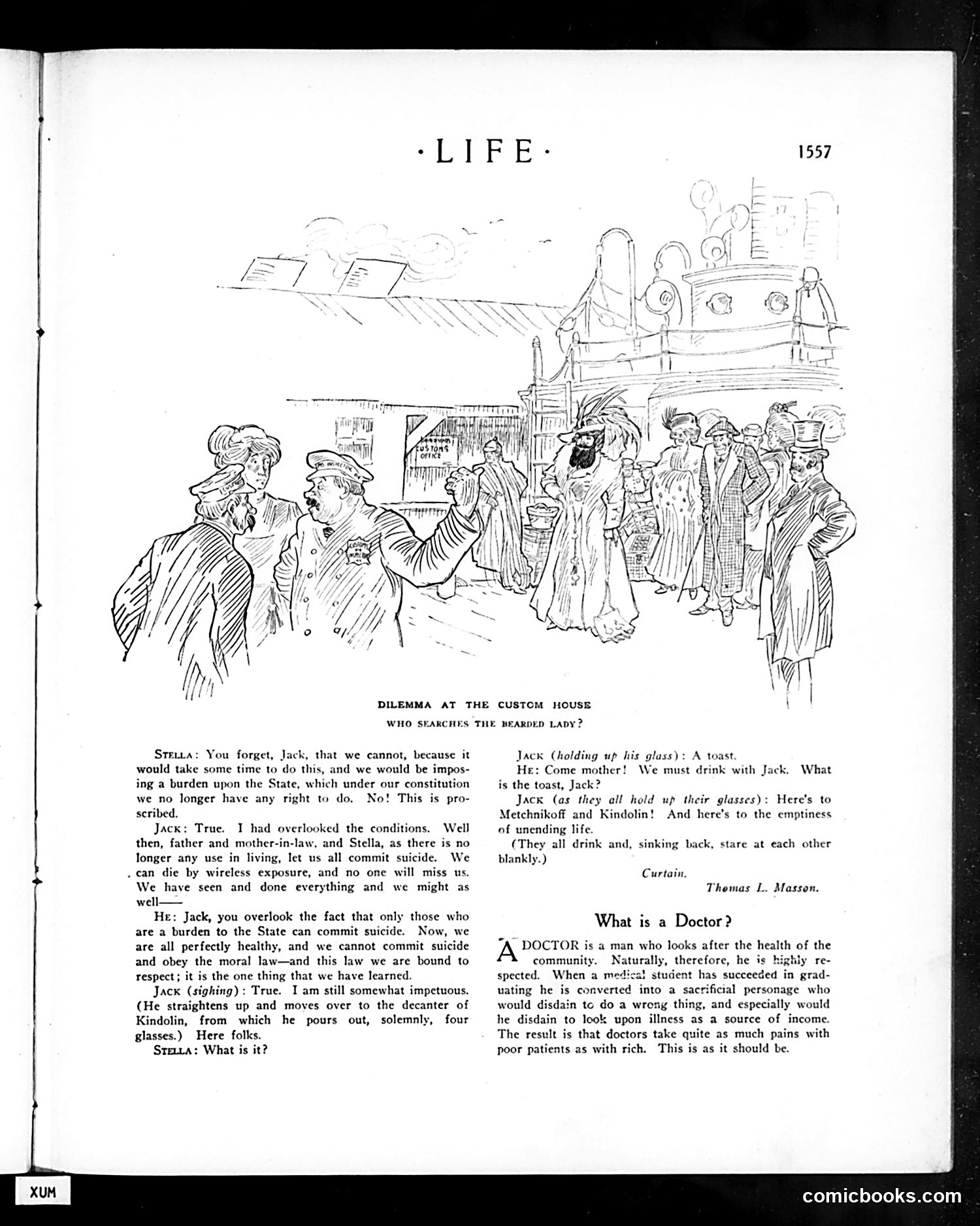
This page contains a satirical sketch titled "Dilemma at the Custom House" about a family debating suicide. The dialogue presents a darkly comic logical trap: they wish to die by "wireless exposure" but discover state law permits only those burdensome to society to commit suicide. Since they're all healthy, the law forbids it—trapping them in life. They resolve by toasting to "Metchnikoff and Kindolin" (likely referencing longevity theories or products of the era) and "the emptiness of unending life." Below this is an unrelated essay, "What is a Doctor?" offering satirical commentary on medical professionals. It ironically praises doctors as selfless figures who should treat poor and rich patients equally—implying contemporary doctors actually did not. The cartoonish illustration depicts multiple figures at a customs house, suggesting bureaucratic entanglement. The satire targets both absurd legal logic and professional hypocrisy common to the period.
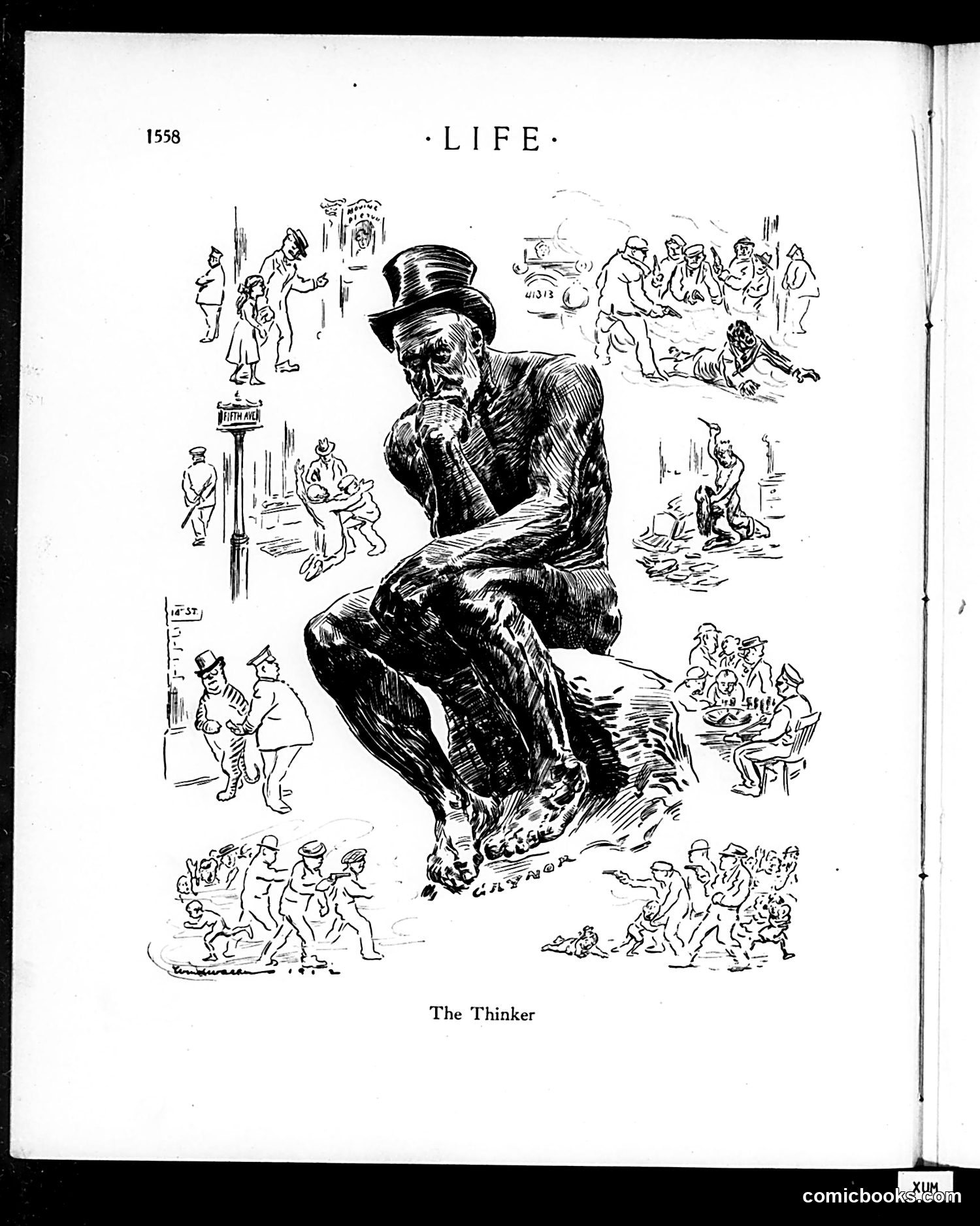
This page features a central figure labeled "The Thinker"—a caricatured man in a top hat and formal coat, depicted in a contemplative pose reminiscent of Rodin's famous sculpture. He's shown surrounded by smaller vignettes depicting various scenes of everyday life: street scenes, social interactions, leisure activities, and public gatherings. The satire appears to critique intellectualism or philosophy divorced from practical reality. The "thinker" sits isolated and absorbed in thought while life happens chaotically around him—suggesting commentary on impractical theorists or disconnected elites observing rather than participating in society. The specific political figure or historical moment remains unclear without additional context from the issue's date.
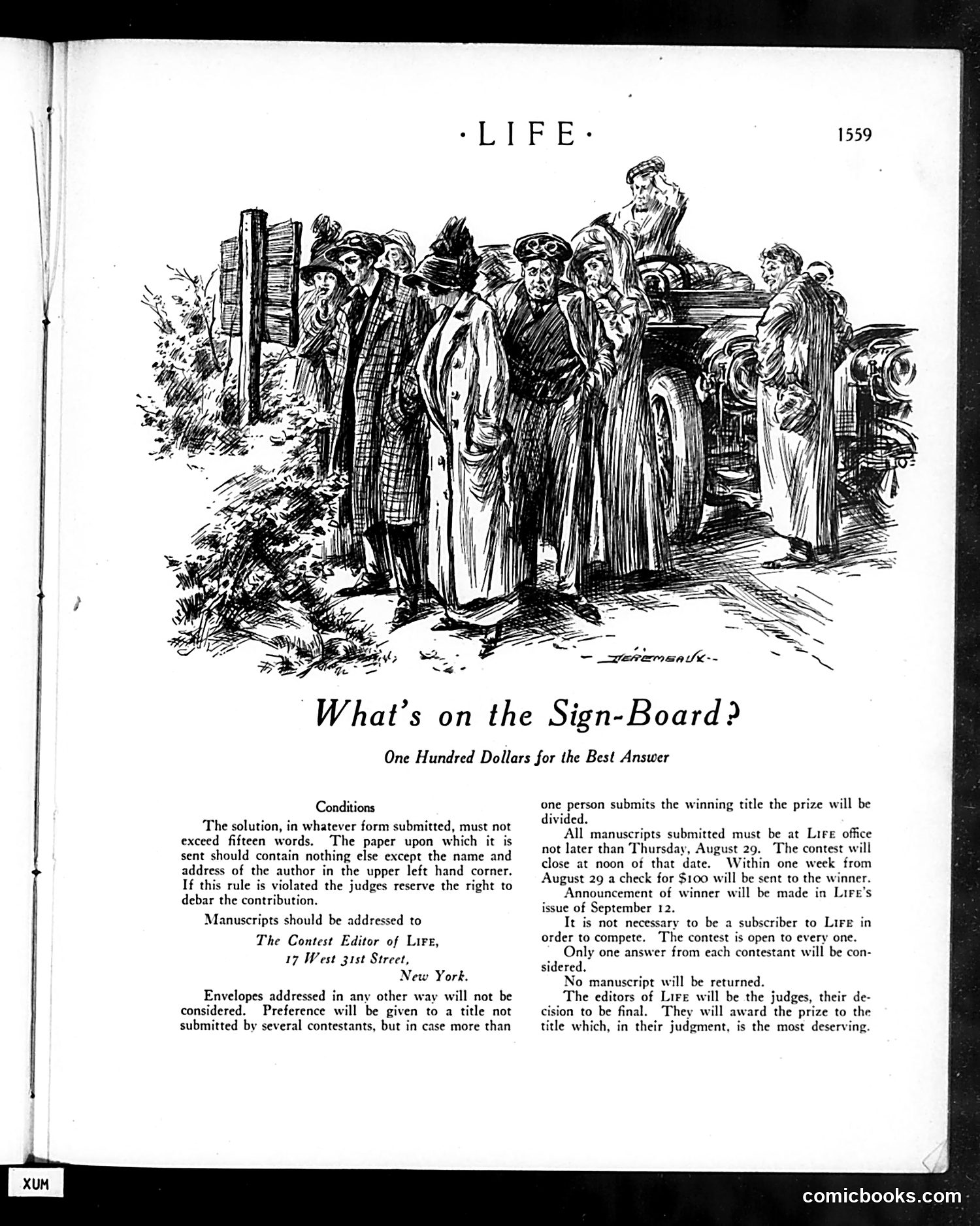
This page announces a reader contest asking what text appears on an unseen sign-board in the accompanying illustration. The sketch shows a group of people—appearing to be working-class or immigrant figures in period dress—gathered around a wooden post or sign, looking at something not visible to us. The contest offers $100 for the best answer (a substantial sum in this era). Entrants must submit a fifteen-word-or-less title/caption. The satire likely plays on the gap between what readers *imagine* the sign says versus what it actually shows—a common device in Life's humor. The specific social or political reference remains unclear without seeing the original sign or knowing the publication date context (marked 1559, likely a page number error). The working-class composition suggests possible commentary on labor, immigration, or urban conditions typical of Life's satirical focus.
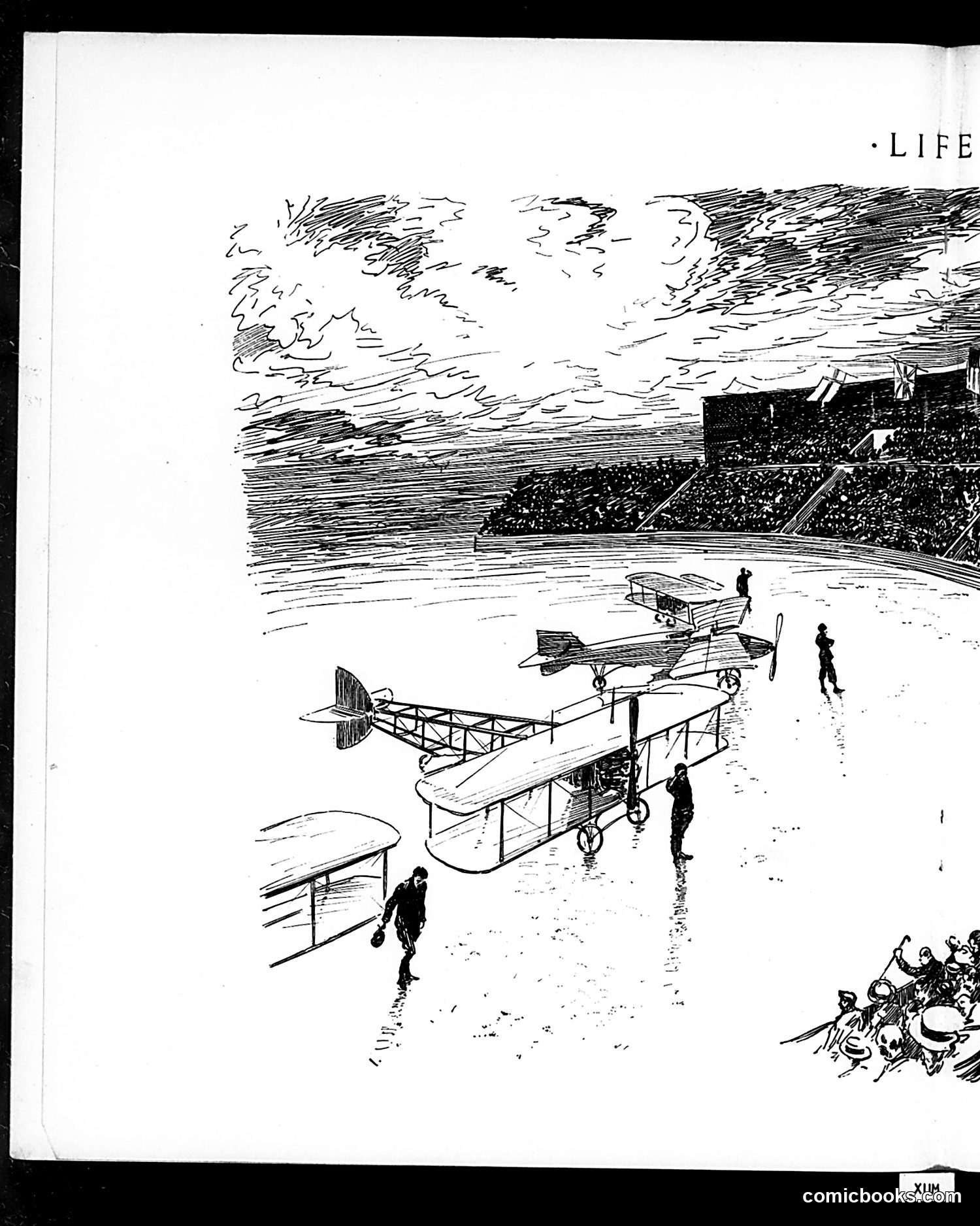
This is a futuristic illustration from *Life* magazine depicting an aviation scene. The image shows early aircraft designs on what appears to be an airfield or landing ground, with spectators in bleachers and several figures walking about. The sketch style emphasizes the experimental nature of early aviation technology. The scene likely satirizes public fascination with aviation as an emerging technology and spectator sport. The stadium seating suggests aviation events were becoming popular public attractions. Without clearer text or identifying details, the specific satirical targets remain unclear, though the cartoon appears to comment on the novelty and excitement surrounding aviation development during aviation's early experimental era.
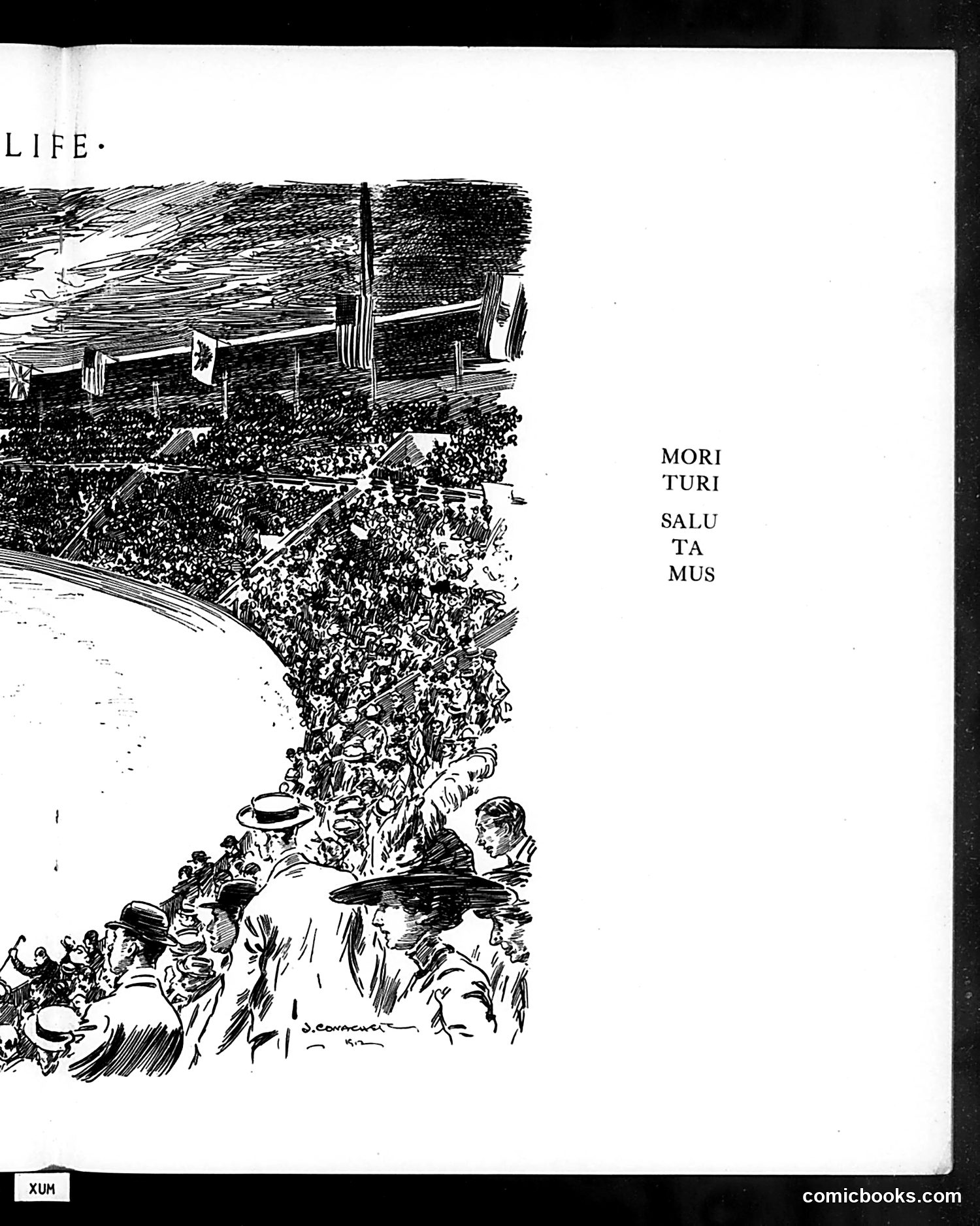
This appears to be a title or section page rather than a complete cartoon. The Latin phrase "MORITURI SALUTAMUS" (We who are about to die salute you) is historically associated with gladiators greeting the Roman emperor before combat. The sketch shows a large crowd of people at what appears to be a public gathering or stadium, with spectators in the foreground wearing hats typical of early 20th-century America. The composition and Latin phrase together suggest satire about American mass gatherings or public spectacles—possibly commenting on how modern audiences participate in potentially dangerous or morally questionable events with the passive acceptance of ancient gladiators. Without additional context or caption text, the specific target of this satire remains unclear.
This page is a book review column titled "Library Table Delicacies"—a metaphorical comparison of books to perishable foods. The critic advises readers to be cautious about fiction during hot weather, comparing poor novels to spoiled fruit and fish. The satire targets the quality of contemporary fiction. Books are categorized as "safe," "fishy," or questionable based on literary merit. For example, J.C. Snaith's *The Principal Girl* is "safe"; Will Levington Comfort's *Fate Knocks at the Door* is "undeniably fishy in places" but acceptable; and certain "pale purple" novels are dismissed as immature and perishable. The column reviews roughly 20 books of the era, mixing serious works (Lawrence Beesley's *Loss of the SS. Titanic*) with lighter fare. The underlying joke is that just as people carefully select fresh produce, readers should discriminate about fiction—not all newly published books deserve attention.
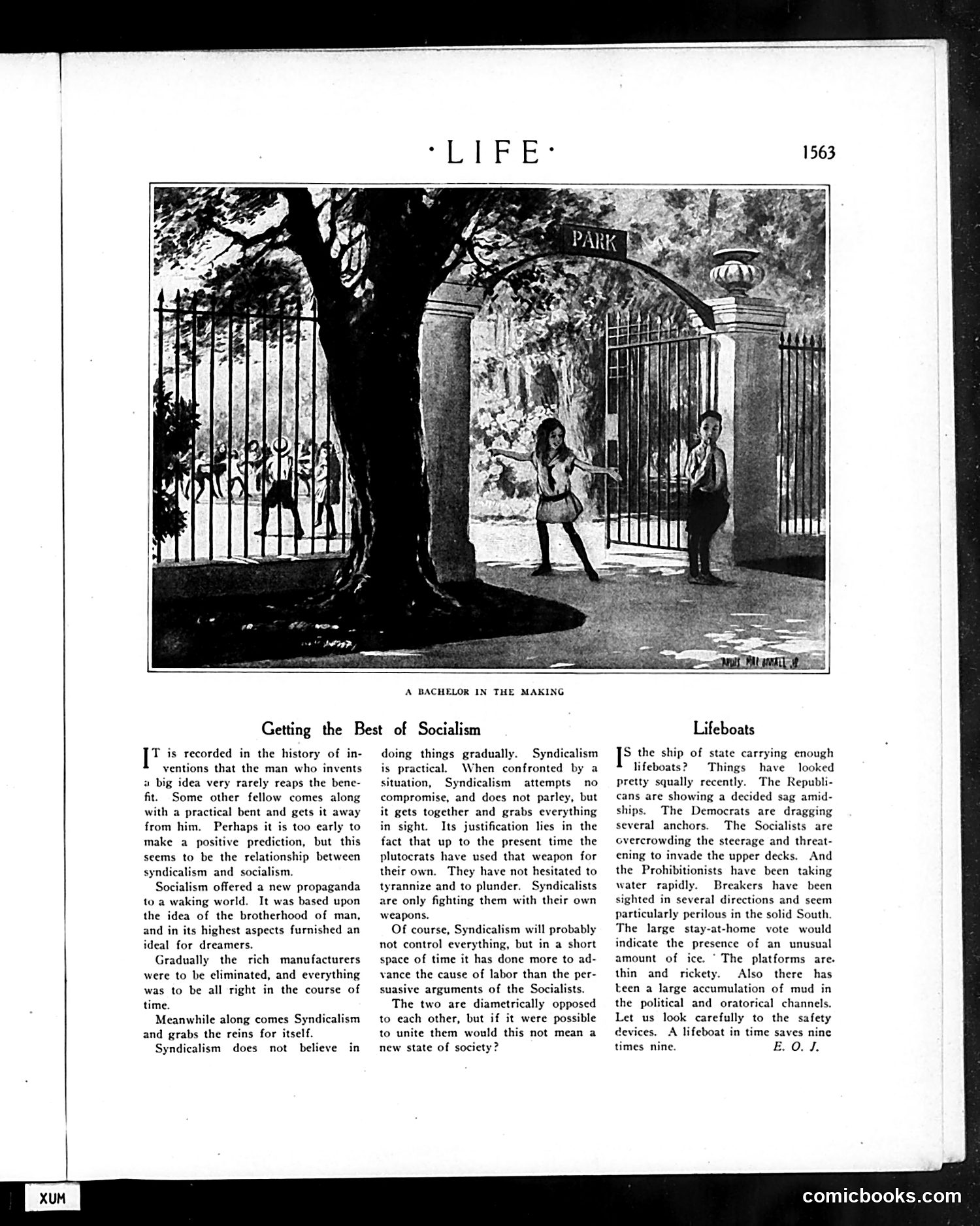
The page contains two political opinion pieces rather than cartoons. **"Getting the Best of Socialism"** contrasts Socialism (idealistic, gradual, based on brotherhood) with Syndicalism (practical, militant, willing to use force immediately). The writer argues that while Socialism offered noble ideals, Syndicalism has proven more effective at advancing labor's cause by adopting the plutocrats' own aggressive tactics. The piece suggests uniting both movements could create a new society. **"Lifeboats"** uses maritime metaphor to critique American politics. The "ship of state" is in trouble: Republicans are "sagging," Democrats "dragging anchors," Socialists "overcrowding steerage," and Prohibitionists "taking water." The writer warns of dangerous "breakers" ahead, particularly in the South, and advises examining political "safety devices"—a veiled call for caution amid political turbulence. The image shows children at a park gate, titled "A Bachelor in the Making"—apparently depicting youthful innocence amid these adult political storms.
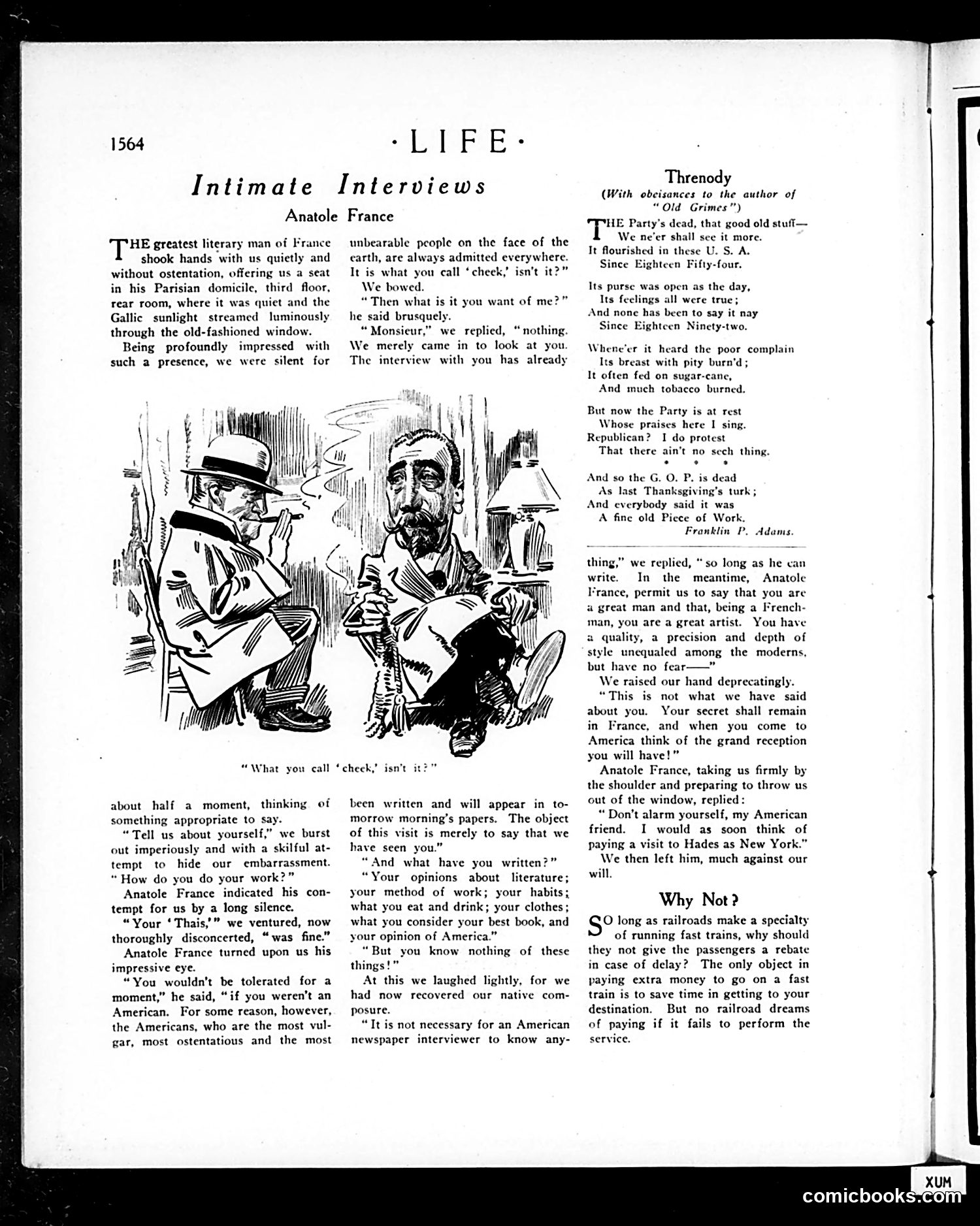
## Main Cartoon: "Intimate Interviews with Anatole France" The illustration depicts two American journalists interviewing the celebrated French author Anatole France in his Paris study. The satire mocks American newspaper interview practices—specifically their aggressive intrusiveness and ignorance. ## The Joke The interviewers admit they know nothing about France's work, opinions, or life, yet brazenly demand personal details anyway. France responds with contempt, calling Americans "vulgar" and "ostentatious" yet paradoxically "tolerated everywhere" due to their shameless "cheek" (audacity). He threatens to throw them out the window. The humor targets American journalism's invasive celebrity-hunting culture and the brazen confidence of reporters who fabricate stories without knowledge—a recognizable practice then as now. ## Secondary Content The page includes "Threnody," a satirical poem mourning the death of the Republican Party (circa 1890s), and a brief editorial about railroad service standards.
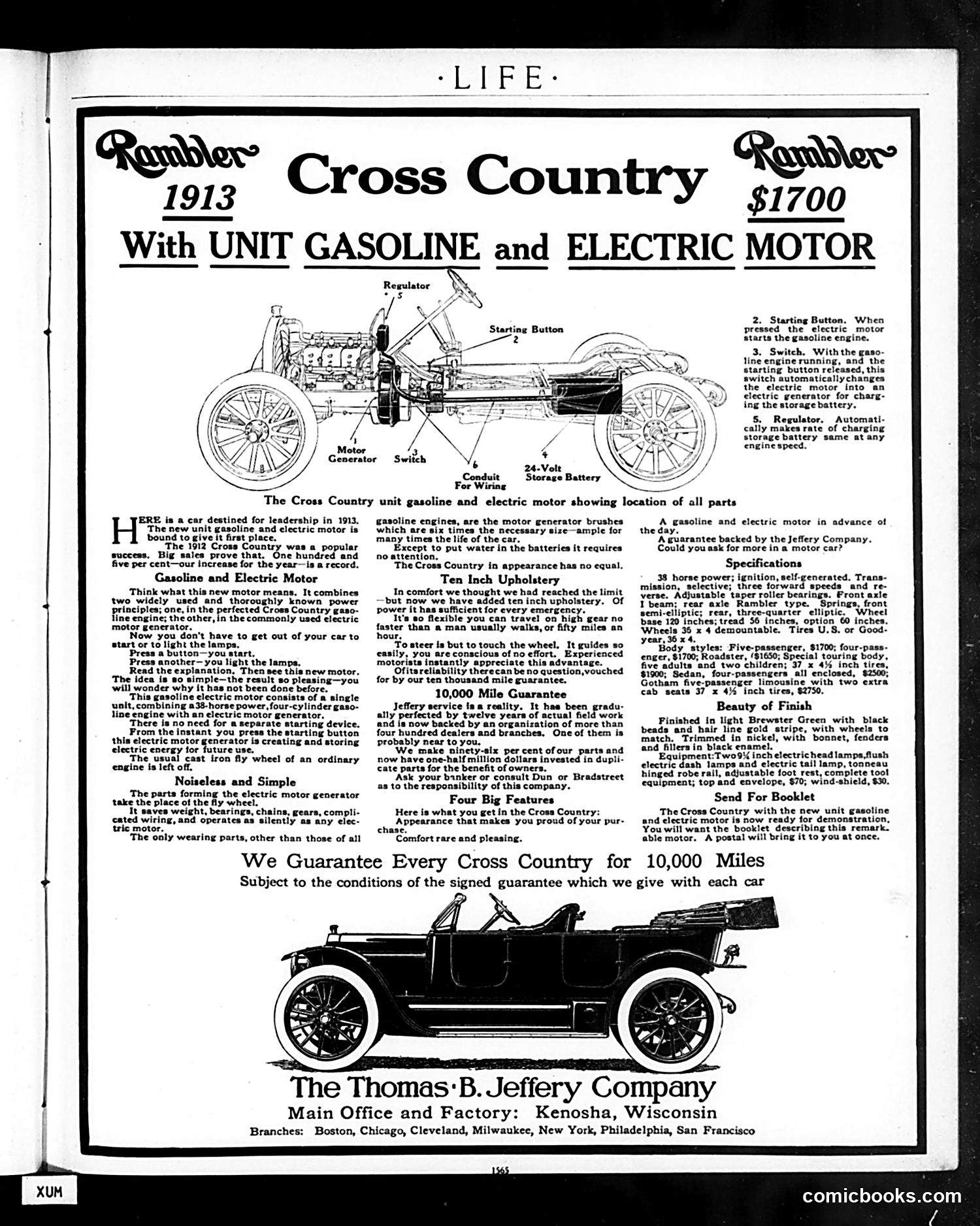
This is **not a cartoon or satire**, but rather a **full-page advertisement** for the Rambler "Cross Country" automobile, priced at $1,700. The ad promotes a hybrid gasoline-electric motor vehicle—a genuine technological innovation of the era. Key features emphasized include: - **Electric starting button** (eliminating hand-cranking, a common frustration) - **Electric headlights** (operated by button, not oil lamps) - **Automatic charging system** for the storage battery - **Noiseless, simple operation** combining gasoline engine with electric motor generator The ad targets affluent buyers by highlighting comfort ("ten inch upholstery"), reliability, and a 10,000-mile guarantee backed by the Thomas-B. Jeffery Company. **Context for modern readers**: This represents a moment before gasoline engines dominated—hybrid and electric vehicles were serious competitors in early 1910s automobiles. The emphasis on ease-of-use (no hand-cranking) and automatic features reflects genuine consumer pain points of the era.
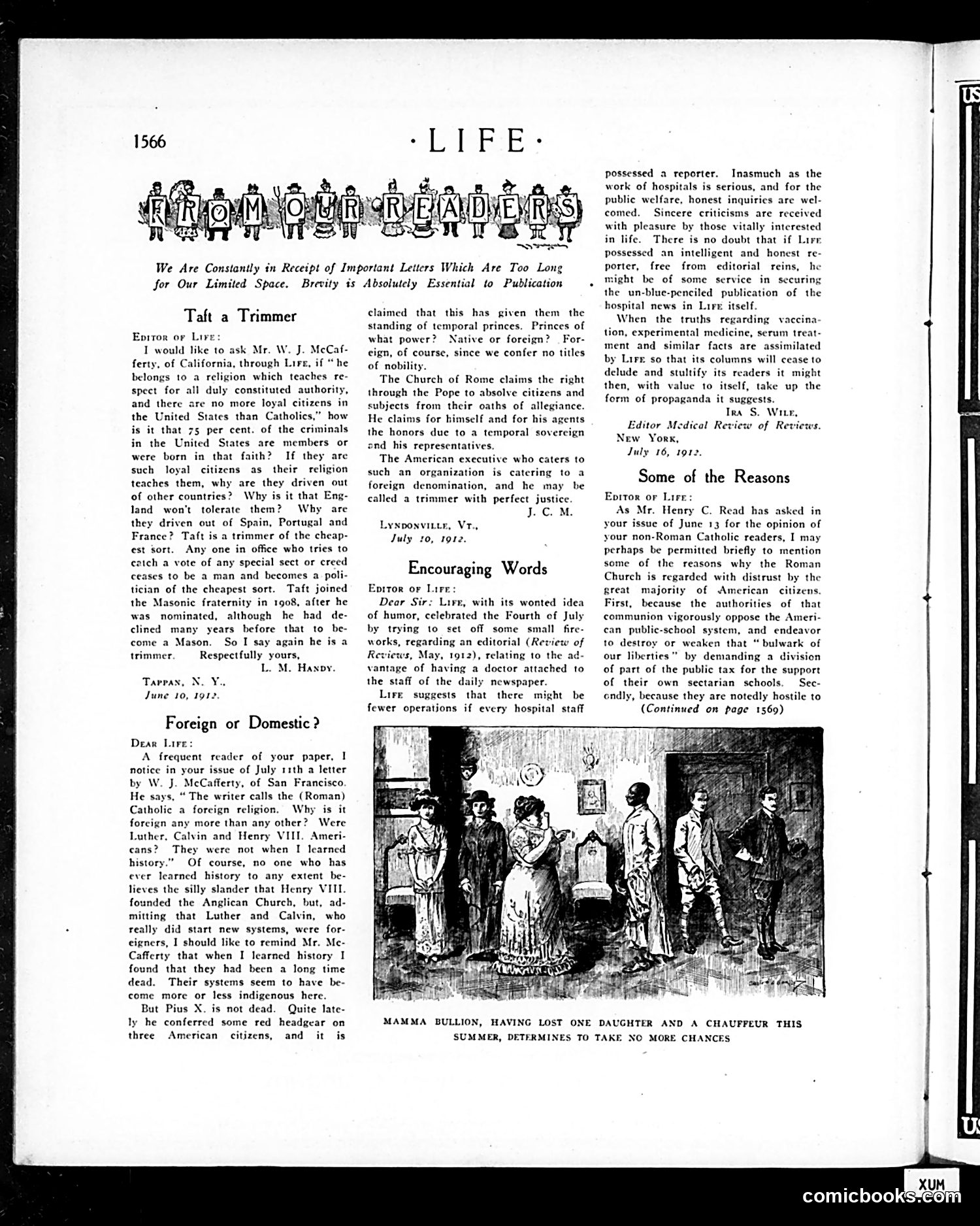
This page features readers' letters debating religious tolerance and political integrity in early 20th-century America. **"Taft a Trimmer"** attacks President William Howard Taft for opportunistically joining the Masonic fraternity in 1908 (after his nomination) when he'd previously declined membership. The writer uses "trimmer" (someone who shifts positions for advantage) to condemn Taft's political expediency. **"Foreign or Domestic?"** responds to Catholic-Protestant tensions. The writer argues Rome's Pope represents a "foreign" power because he grants temporal titles and claims authority over citizens' oaths. Calling the American executive who accommodates Catholicism a "trimmer" mirrors the Taft critique—both suggest pandering to religious interests betrays national loyalty. **The cartoon** (caption: "Mamma Bullion, Having Lost One Daughter and a Chauffeur This Summer, Determines to Take No More Chances") depicts wealth-based anxiety about servants and social standing, unrelated to the religious debate above. These letters reflect 1912's anti-Catholic sentiment and suspicions about papal influence on American governance.
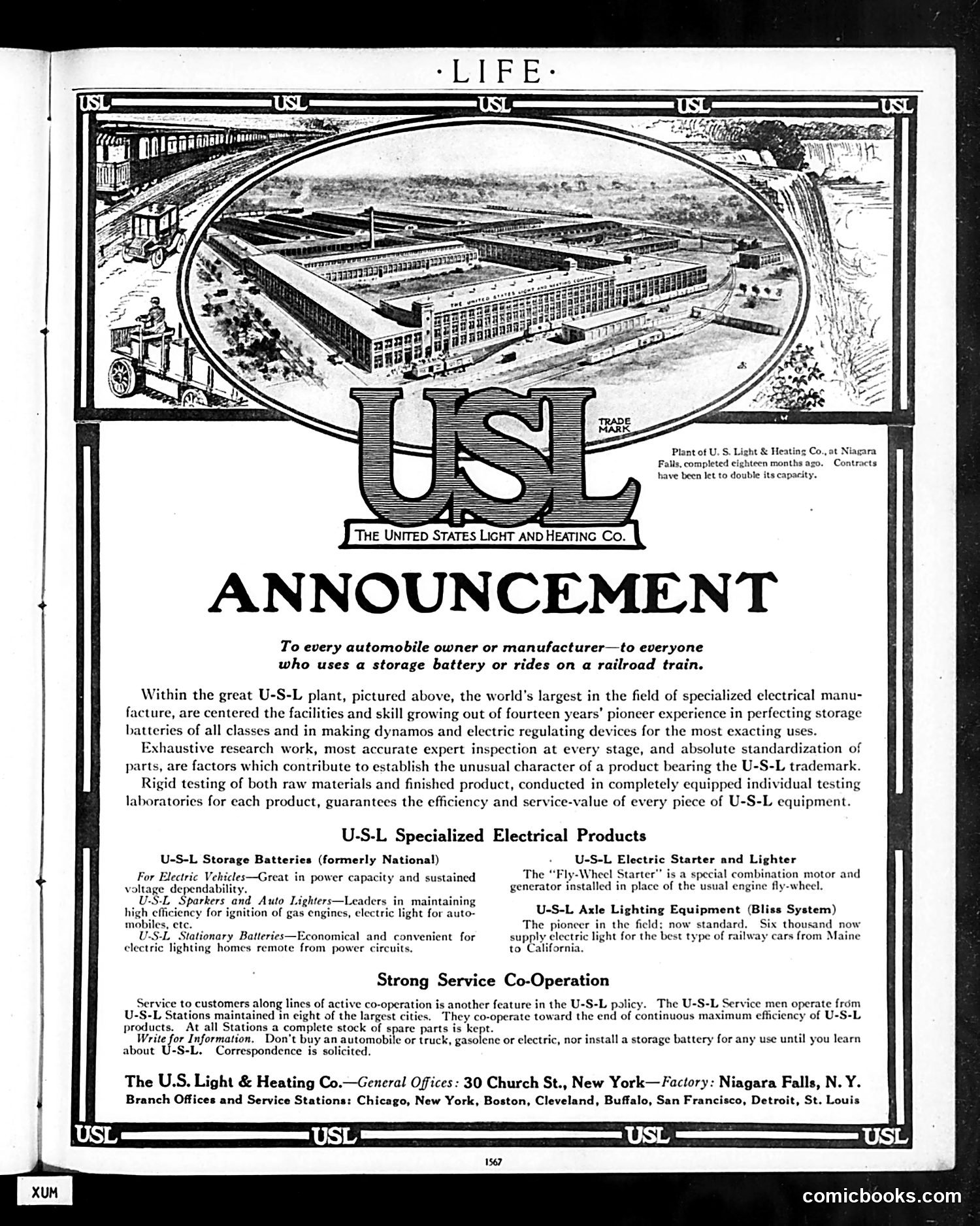
This is not a cartoon or satire—it's a **full-page advertisement** for the U.S. Light & Heating Company, published in *Life* magazine. The page promotes U-S-L's electrical manufacturing facility at Niagara Falls, which specializes in storage batteries and electrical components for early automobiles and railways. The large illustrated image shows the factory complex itself. The "announcement" targets automobile owners, manufacturers, and railroad operators, emphasizing U-S-L's fourteen years of experience, rigorous testing standards, and nationwide service network across eight major cities. Products listed include storage batteries for electric vehicles, engine starters, ignition systems, and railway lighting equipment—reflecting the era when electric automobiles competed seriously with gasoline-powered cars (roughly 1900-1920s). The text's instruction "Don't buy...until you learn about U-S-L" represents typical early advertising rhetoric promoting brand reliability and expert consultation before purchase. This is commercial content, not editorial commentary or satire.
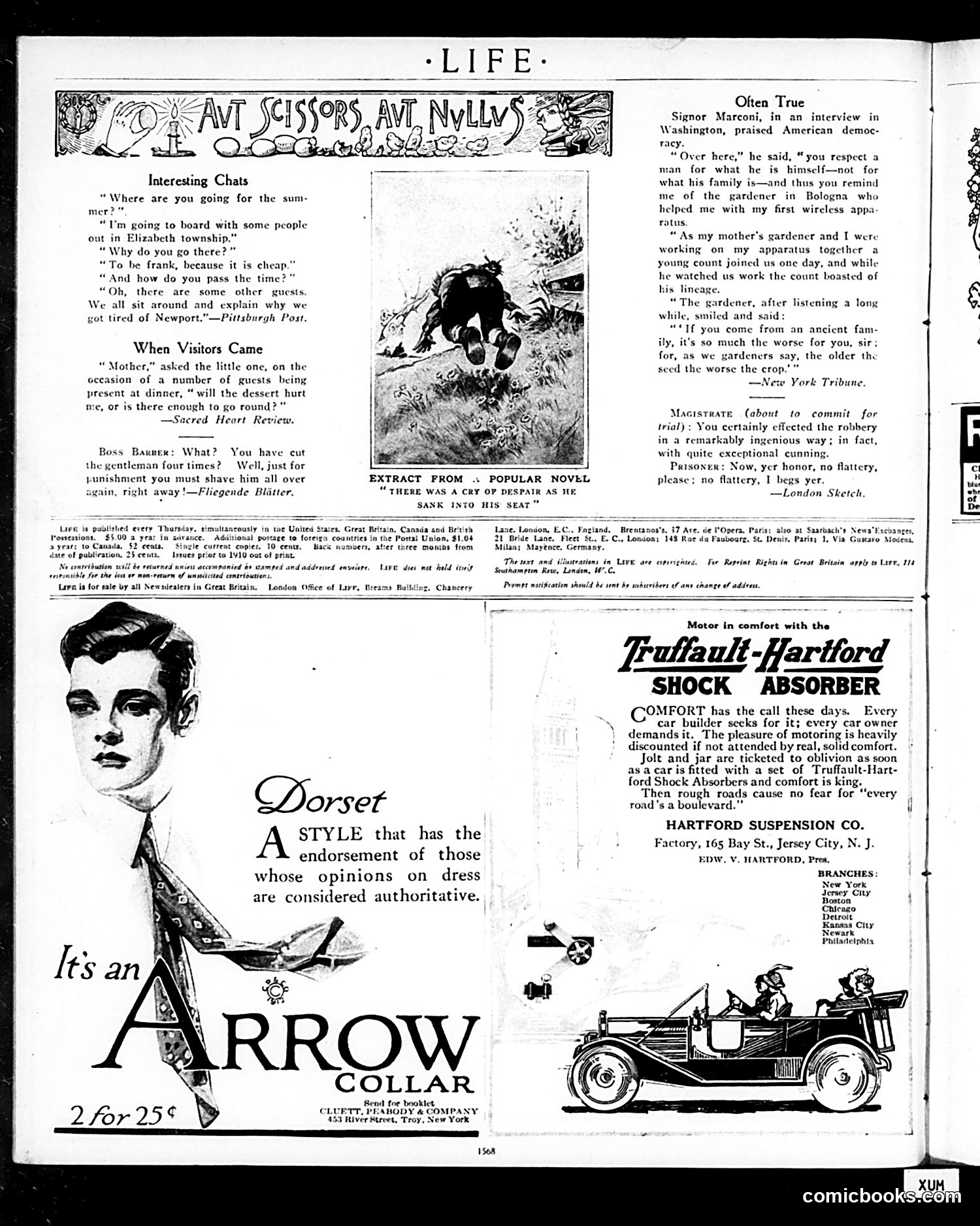
This page from *Life* magazine contains several satirical pieces typical of early 20th-century American humor: **Main Content:** The page features brief humorous anecdotes and jokes rather than political cartoons. The "Often True" section quotes Signor Marconi (the inventor of wireless technology) praising American democracy, contrasting it with European class systems. A gardener's retort—that old family lineage is like old seed that produces worse crops—serves as satire on European aristocratic pretension. **Other Jokes:** Brief comedic exchanges mock summer boarding (Elizabeth township being cheap), dinner guest etiquette, and a magistrate's compliment to a criminal about his "cunning." **Advertisements:** The page is dominated by period ads: Arrow Collar (targeting men concerned with fashion) and the Truffault-Hartford Shock Absorber (promoting automotive comfort). **Overall Context:** Rather than biting political satire, this reflects *Life*'s role as a genteel humor magazine for educated, middle-class readers, combining light social observation with commercial advertising.
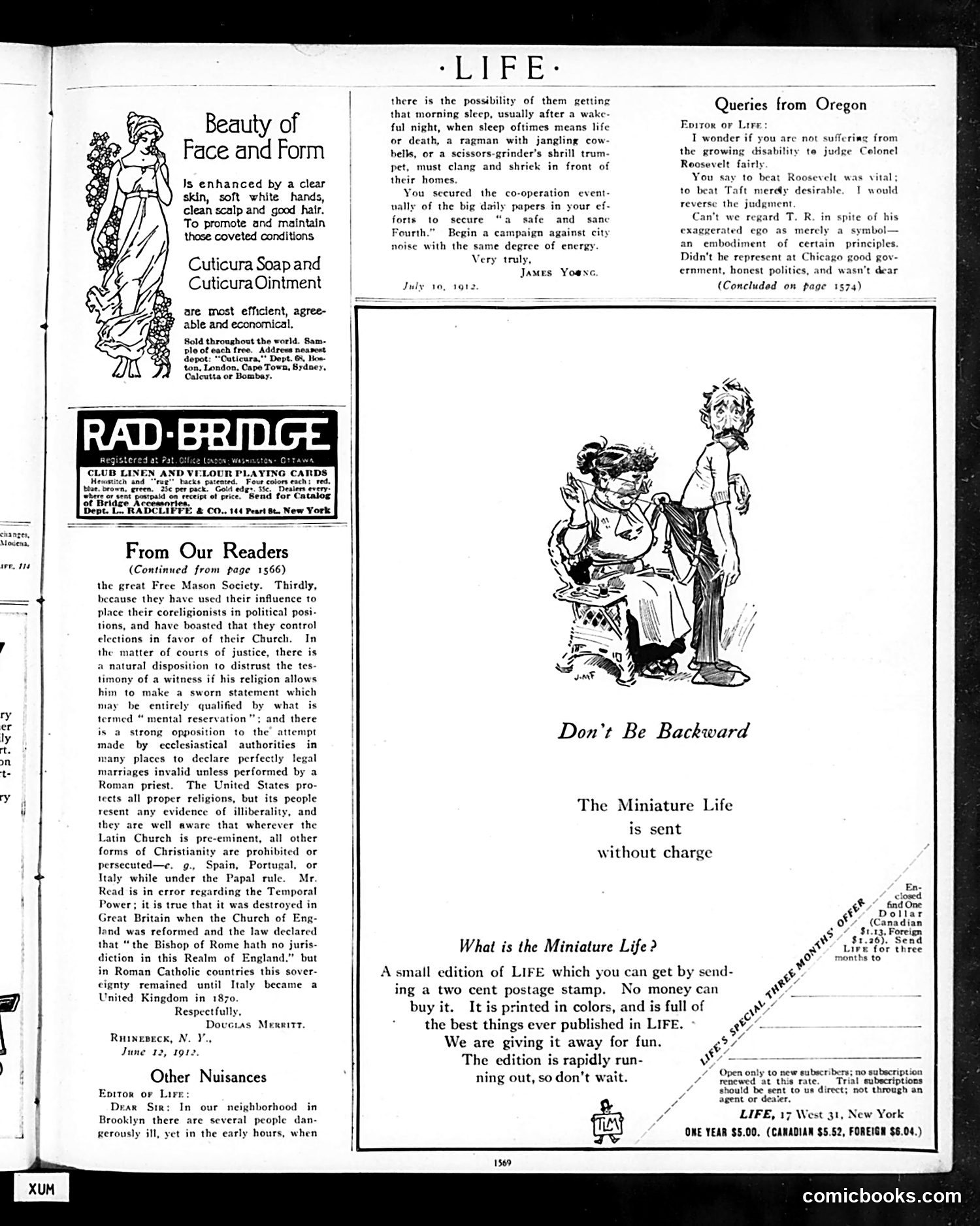
This page primarily contains **reader letters and advertisements** rather than political cartoons. The significant content addresses **1912 election politics**. The "Queries from Oregon" section debates Theodore Roosevelt's presidential campaign. A reader questions whether Life magazine is fairly judging Roosevelt, asking whether beating Taft was merely "desirable" while defeating Roosevelt was "vital." The writer defends T.R. as embodying "good government, honest politics"—despite acknowledging his "exaggerated ego." This reflects the **1912 Republican Party split**: Roosevelt ran as a Progressive ("Bull Moose") candidate against incumbent Taft, fragmenting the Republican vote. The letter suggests Life may have been inconsistent in its editorial position on these rivals. The page also includes the "Don't Be Backward" cartoon: a simple illustration promoting Life's free "Miniature Life" edition, requiring only a two-cent stamp. This is **purely promotional**, not satirical. The remaining content consists of **advertisements** for beauty products (Cuticura) and bridge accessories (Radcliffe & Co.), typical of 1912 magazine pages.
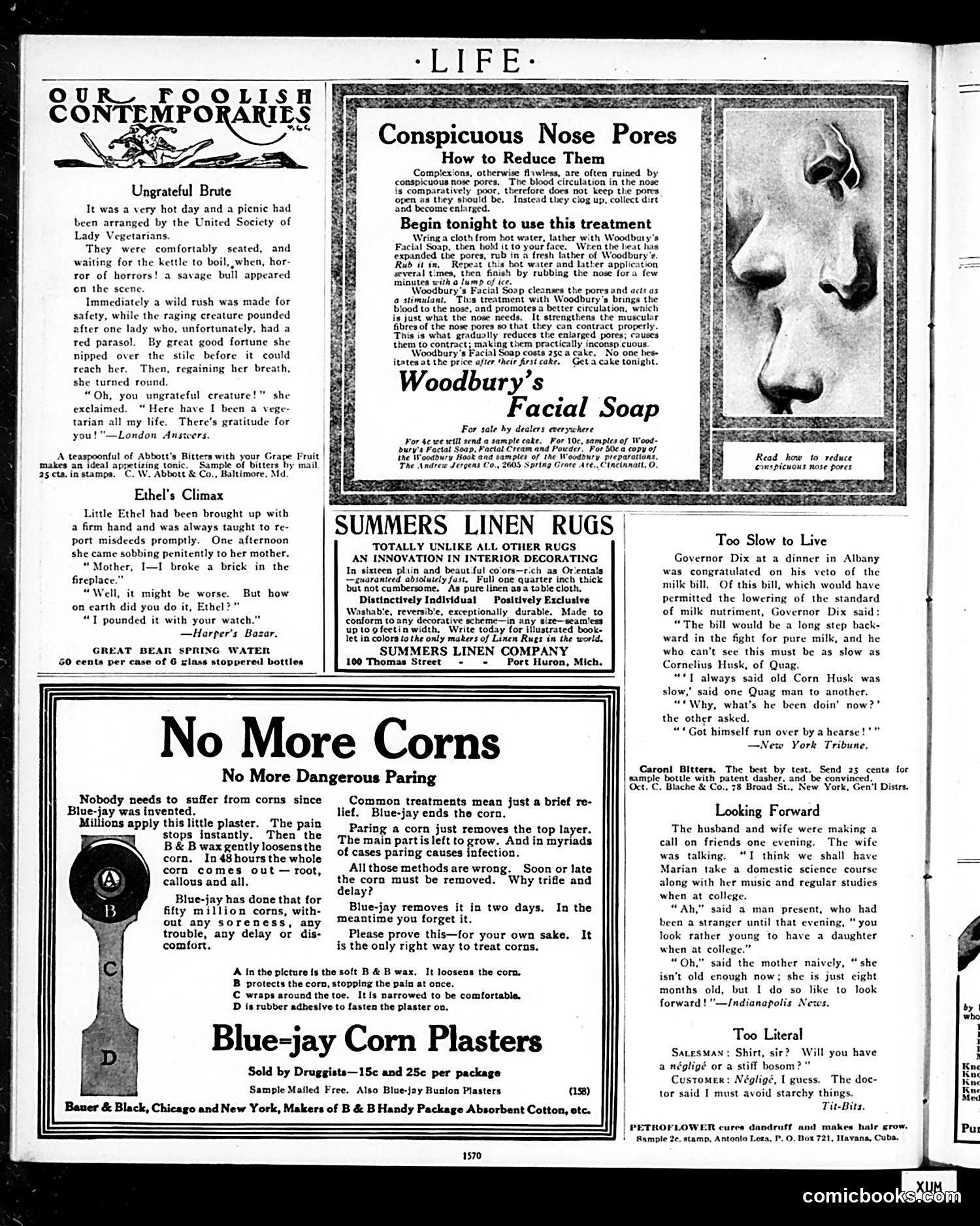
This page features two brief humorous anecdotes rather than political cartoons. "Ungrateful Brute" satirizes vegetarian ideology: a lady from the "United Society of Lady Vegetarians" is chased by a bull she's presumably never eaten. Escaping, she ironically complains the bull is "ungrateful"—the joke being her moral consistency toward animals goes unappreciated. It's gentle mockery of vegetarian earnestness. "Ethel's Climax" plays on strict Victorian child-rearing. A girl, trained to immediately report misbehavior, confesses breaking a brick—but reveals she pulverized it using her mother's watch. The humor relies on the child's innocent obedience creating an absurdly worse outcome than the original offense. Both are lightweight social humor typical of early 20th-century Life magazine, poking fun at contemporary trends (vegetarianism, rigid parenting) without serious political intent. The page is primarily advertisements for beauty products and household goods.
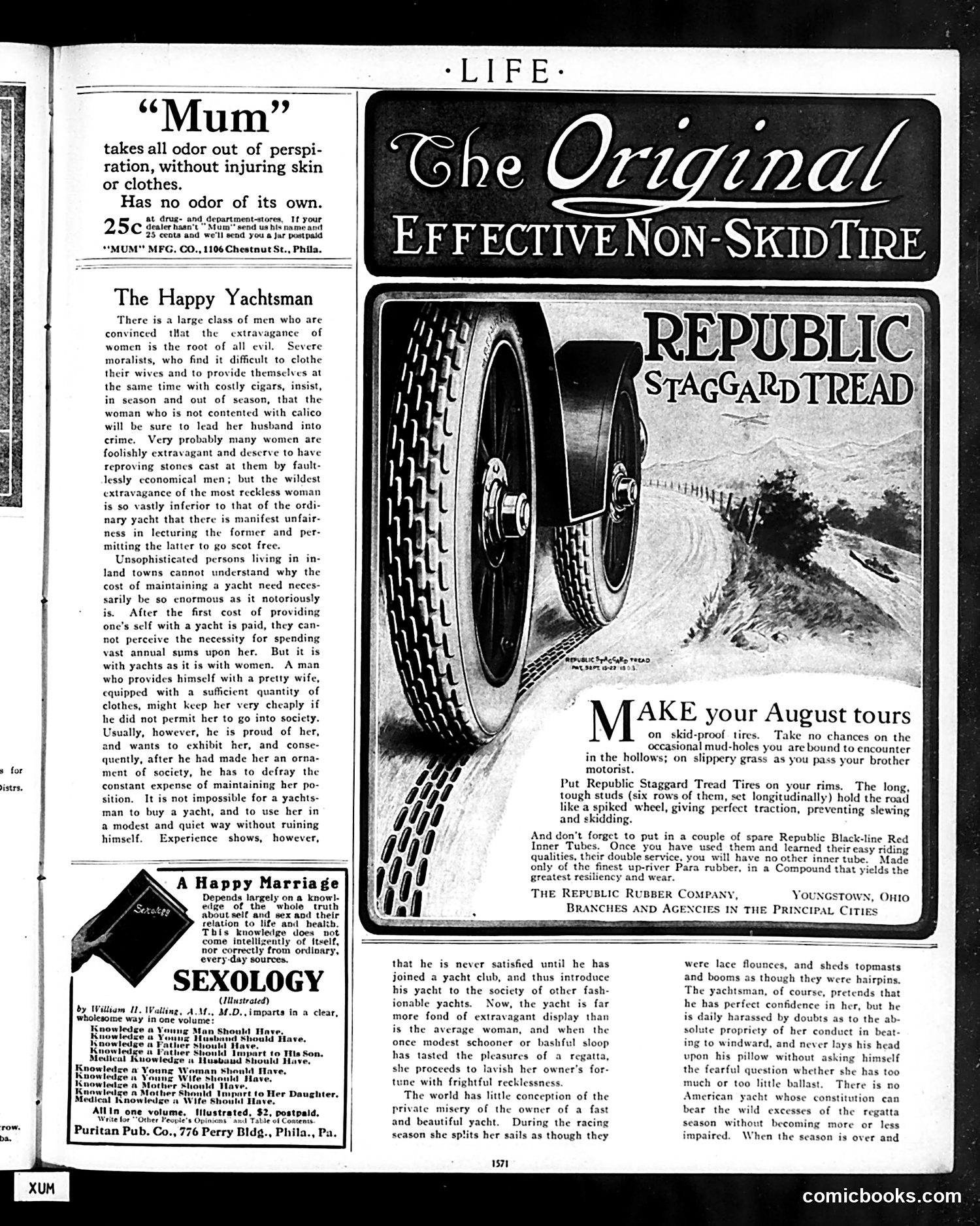
This piece satirizes male hypocrisy regarding spending and morality. The text argues that men who lecture women about extravagance are themselves guilty of far greater excess through yacht ownership. The satire's logic: moralists condemn women for wanting clothes and luxuries as sources of "crime" and ruin, yet yachting—an enormously expensive hobby requiring constant maintenance costs—goes uncriticized. A man maintaining a yacht spends vastly more than any woman's wardrobe, yet society permits this without moral judgment. The author points out the double standard: a man proud of displaying his wife as a "society ornament" must constantly fund her upkeep, much like a yacht owner. Yet one is condemned as wasteful while the other is accepted as normal masculine privilege. **For modern readers**: This critiques how Victorian society blamed women for financial problems while excusing men's comparable or greater extravagances as acceptable status symbols.
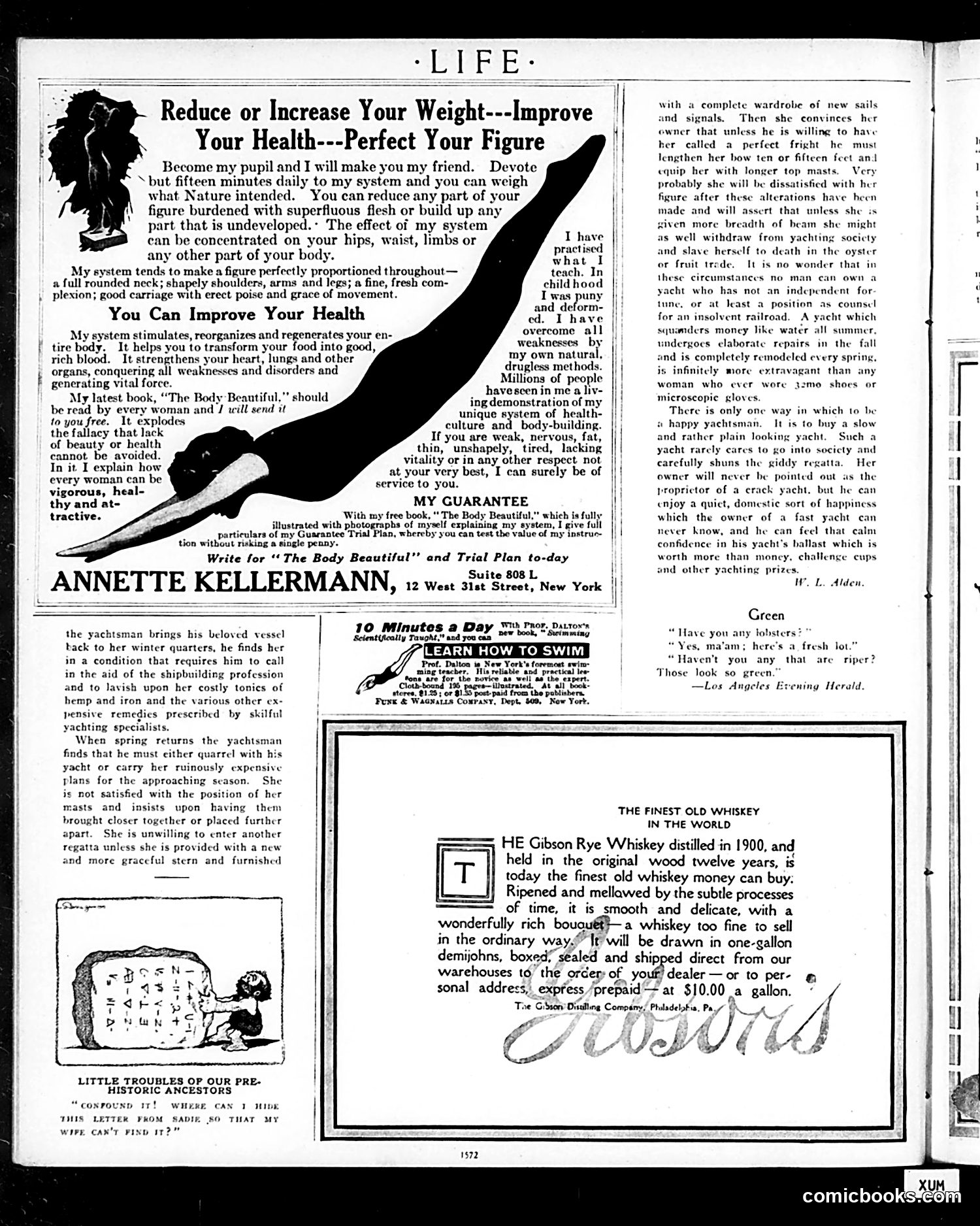
This page primarily contains **advertising and self-promotion** rather than political satire. The dominant content is a health/fitness advertisement by **Annette Kellermann**, a famous swimmer and physical culture advocate of the early 20th century. She promises to help readers reduce or increase weight through her system, claiming she can reshape any body part and cure weaknesses—a typical "miracle cure" advertisement of the era. The small cartoon at bottom-left titled "Little Troubles of Our Prehistoric Ancestors" shows a humorous scene of cavemen struggling to read writing, captioned "Confound it! Where can I hide this letter from Sadie so that my wife can't find it?"—a simple domestic humor joke about marital secrecy, universal across time periods. The other content includes swimming lessons and whiskey advertising. The page reflects early-1900s consumer culture emphasizing physical appearance and dubious health claims.
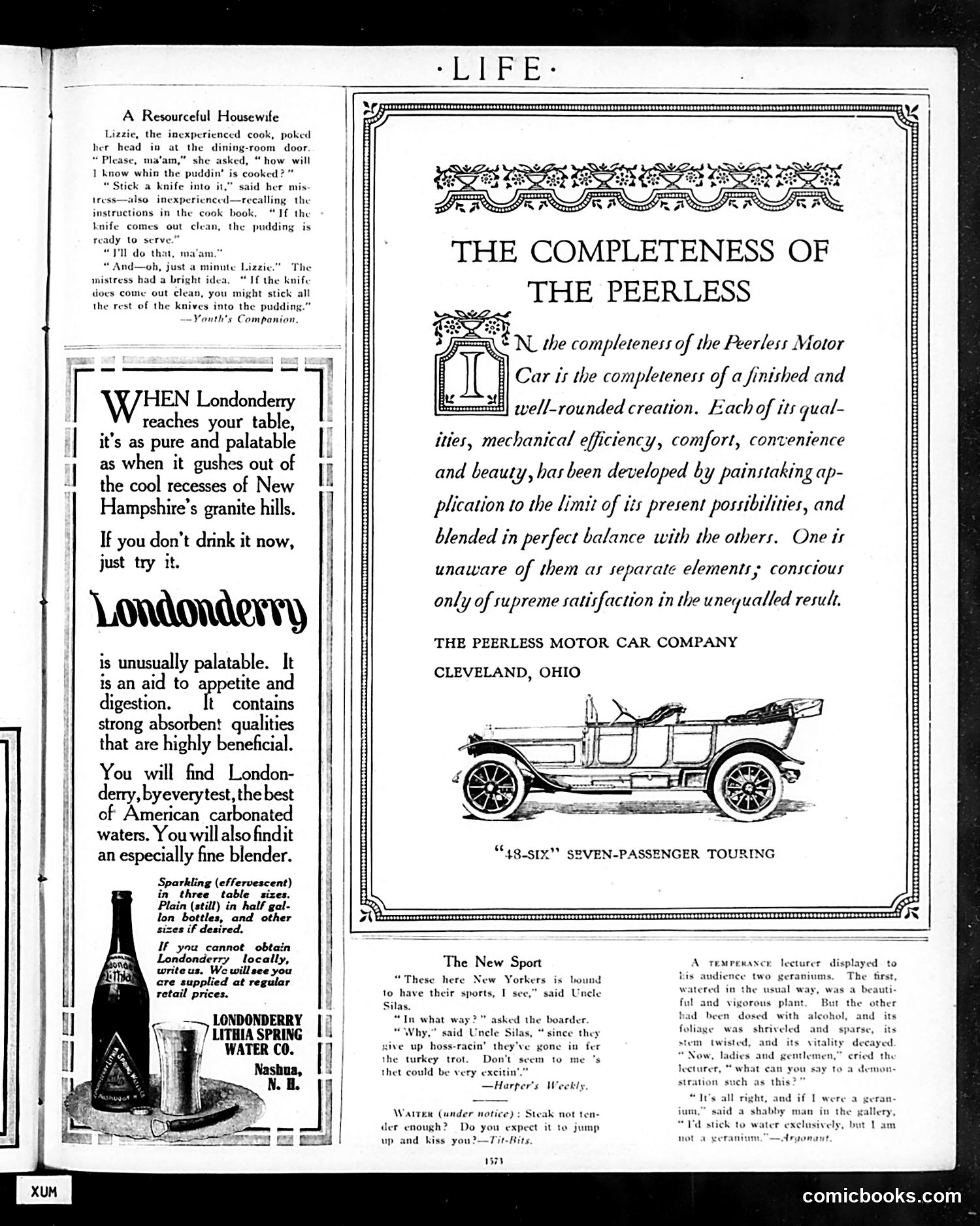
This page mixes humor, advertising, and social commentary typical of early 20th-century Life magazine. **"A Resourceful Housewife"** is a brief domestic joke about an inexperienced cook and mistress. The humor lies in the mistress's illogical "solution"—if one clean knife signals a cooked pudding, she suggests inserting all the knives, apparently thinking this will somehow guarantee doneness. It satirizes the incompetence of both servant and employer. **The advertisements** for Londonderry mineral water and Peerless Motor Cars represent typical magazine content targeting affluent readers with luxury goods. **"The New Sport"** references the "turkey trot," a popular early 1900s dance considered scandalous by conservatives. Uncle Silas's comment that New Yorkers have abandoned horse-racing for the turkey trot gently mocks both rural attitudes and urban fashions—implying that replacing respectable gambling with frivolous dancing represents cultural decline. The joke reflects contemporary anxiety about changing social values and urban entertainment trends.
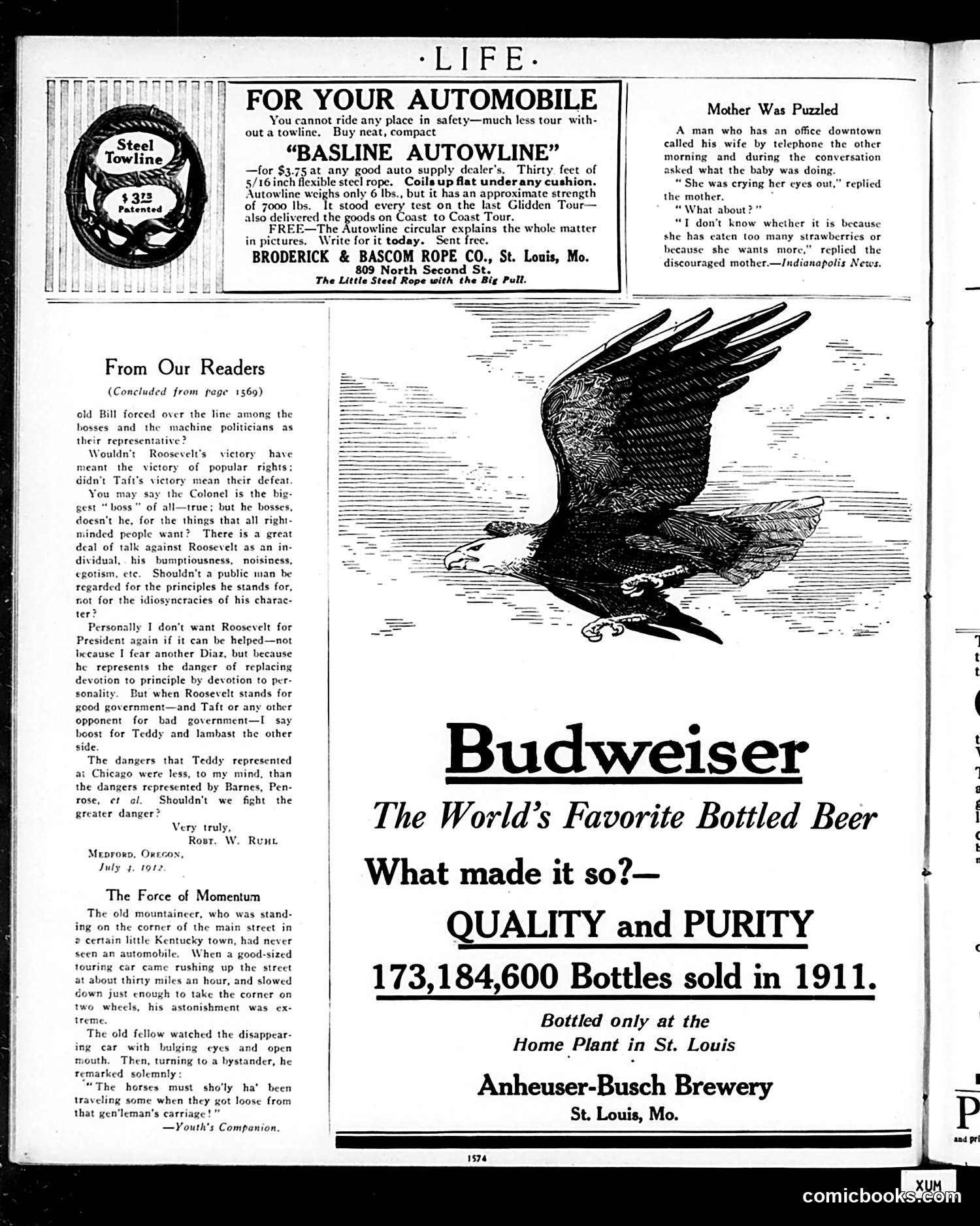
This page contains three distinct elements: **Advertisements:** The top features a "Basline Autowline" (a steel rope towline for automobiles) and a large Budweiser beer ad claiming 173+ million bottles sold in 1911—typical early 1900s product marketing. **"Mother Was Puzzled" Anecdote:** A brief humorous domestic scene where a wife tells her husband the baby cried because she ate too many strawberries. The joke plays on the husband's concern and the mother's matter-of-fact response—light satire of office-worker domesticity. **"From Our Readers" Letters Section:** Readers debate the 1912 presidential election between Theodore Roosevelt and William Howard Taft. One letter defends Roosevelt despite his personal flaws, arguing voters should support candidates based on principles (good government) rather than personality. Another anecdote mocks a Kentucky mountaineer bewildered by an automobile's speed—rural/urban cultural divide humor common to the era. The page reflects early 20th-century American concerns: automobile safety, politics, and rural-urban contrasts.
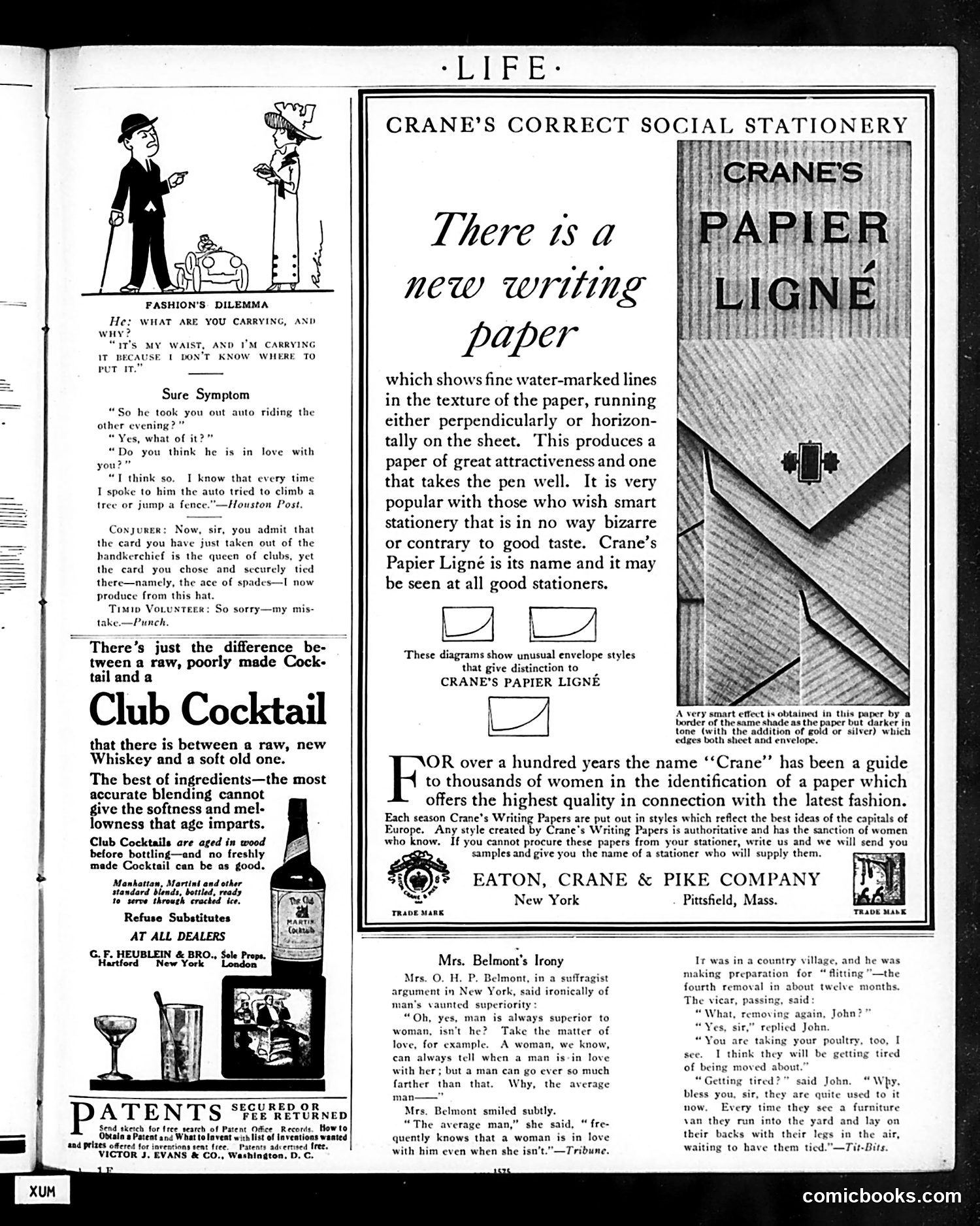
The cartoon titled "Fashion's Dilemma" satirizes women's fashion practicality: a woman carries something at her waist but doesn't know where to put it—the joke being that modern women's clothing has no functional pockets, forcing them to carry items awkwardly. This reflects early 20th-century frustration with restrictive, impractical women's fashion. Below are humorous anecdotes about relationships and class. "Sure Symptom" jokes that a man must be in love if his car repeatedly tries to escape (climb trees/jump fences) when near his date—absurdist humor mocking romantic behavior. "Mrs. Belmont's Irony" quotes the famous suffragist O.H.P. Belmont making a sardonic point about gender: men claim superiority over women, yet women can detect men's love, while men often fail to recognize women's feelings—even false ones. Her subtle smile suggests satisfaction in this logical reversal of male superiority claims. The remainder is advertising for Crane's stationery and Club Cocktails.
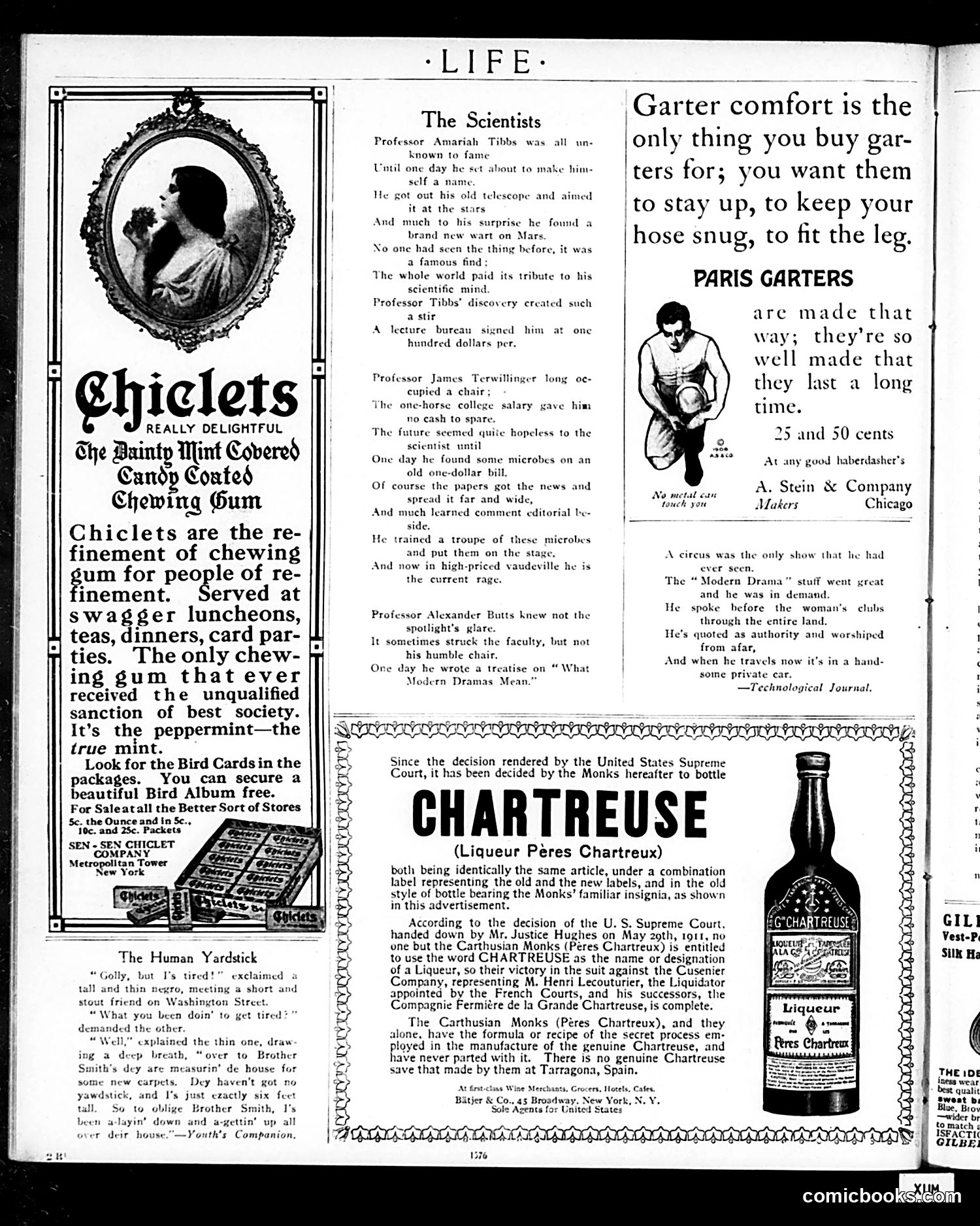
This page combines humor columns with period advertisements. **"The Scientists"** satirizes academic pretension: three professors gain fame and fortune through trivial discoveries—finding a "wart on Mars," discovering microbes on currency, and writing about modern drama. The joke mocks how universities reward scientists for minor findings while underpaying them as faculty. **"The Human Yardstick"** is a brief dialect humor piece playing on racial stereotypes common to early 1900s publications. A tall Black man describes being used as a human measuring stick (six feet tall) to measure carpets because his employer lacked an actual yardstick. The remaining content is advertising for Chiclets gum, Paris Garters (men's hosiery), and Chartreuse liqueur. The Chartreuse ad references a 1911 Supreme Court decision protecting the Monks' exclusive right to use that name for their liqueur.
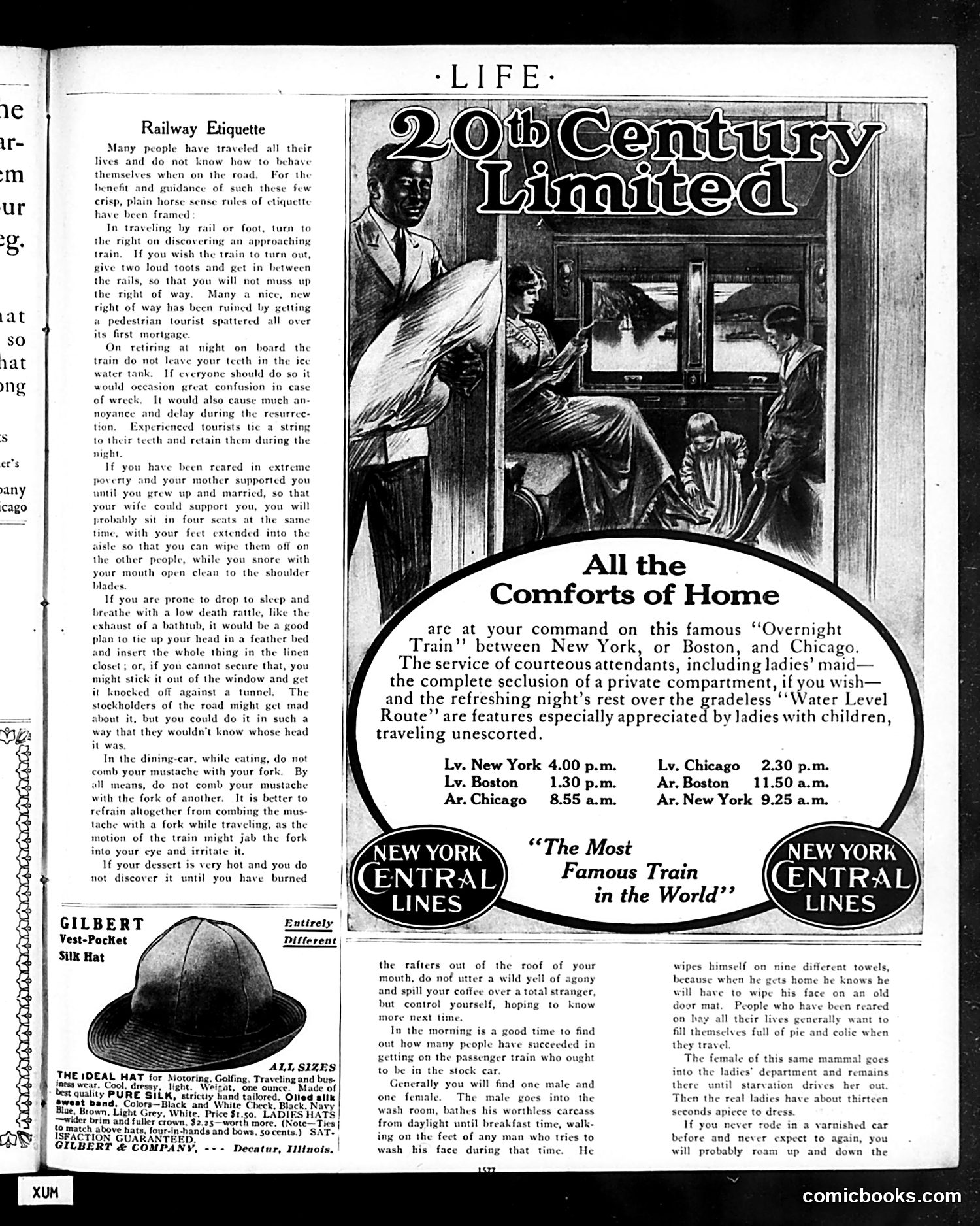
This page satirizes poor passenger behavior on trains through mock-serious "etiquette rules." The humor works by describing genuinely rude conduct—spreading across multiple seats, leaving dentures loose, combing mustaches with forks, snoring loudly—as if offering *helpful advice* to travelers. The satire targets working-class and newly wealthy passengers unfamiliar with railroad travel norms. References like "reared in extreme poverty" and descriptions of sprawling behavior suggest mocking social climbers and uncouth travelers who lack refined manners. The adjacent advertisement for the "20th Century Limited" train ironically reinforces the contrast: while Life ridicules passenger misconduct, the ad promises "all the comforts of home" and courteous service—the civilized alternative to the crude behavior just lampooned. This reflects early 20th-century anxieties about mass transportation mixing social classes.
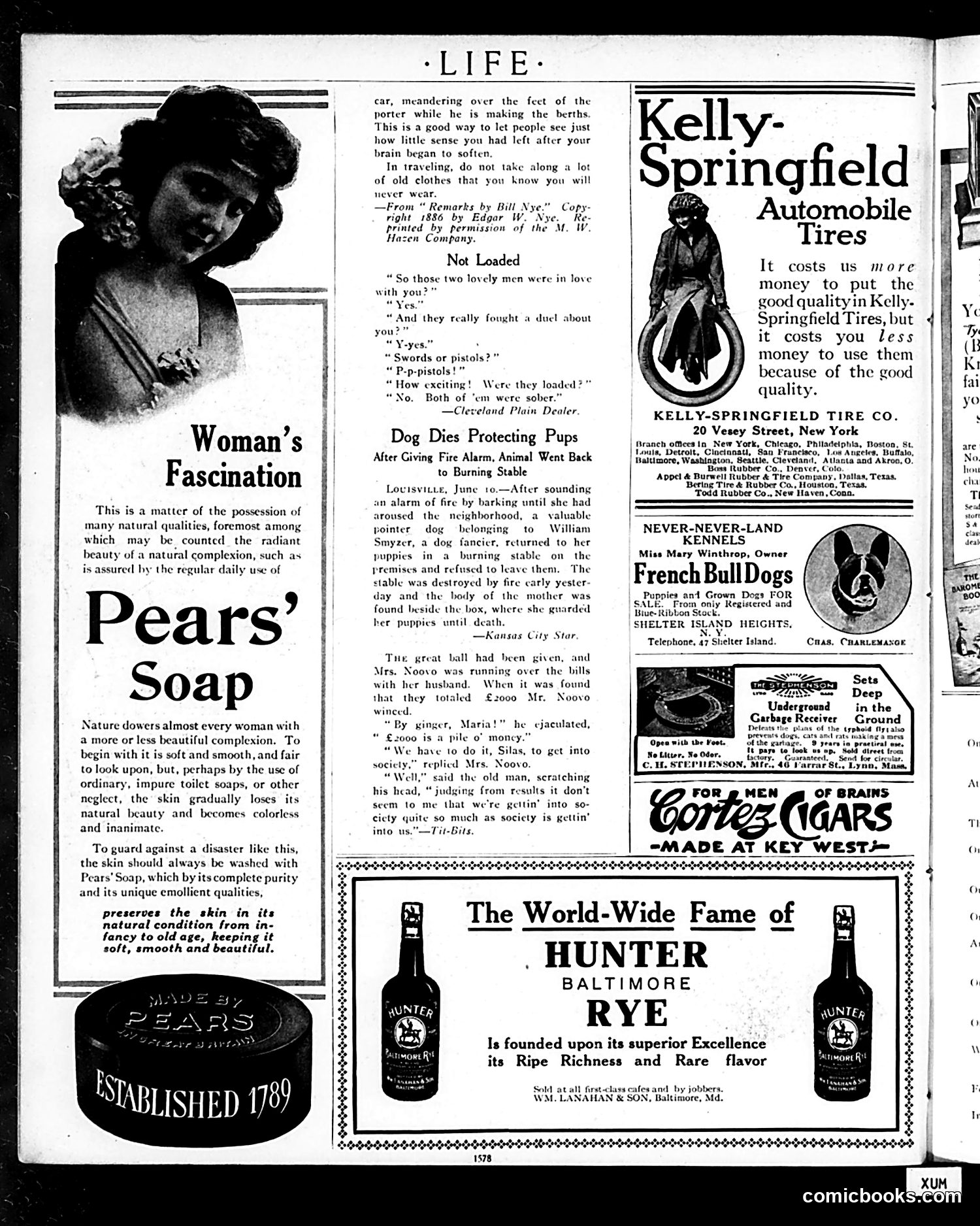
This page is primarily **advertising**, with a small amount of editorial content. The main editorial piece is "**Not Loaded**"—a brief, darkly comedic anecdote from the *Cleveland Plain Dealer*. Two men fight a duel over a woman using pistols that are unloaded, and both survive because "both of 'em were sober." The humor lies in the absurdity: the duel is supposed to be serious, but the unloaded weapons and sobriety render it pointless—suggesting that passion-driven violence is fundamentally ridiculous. "**Dog Dies Protecting Pups**" is a sentimental news story about a pointer who alerts neighbors to a fire, then returns to her burning stable and dies with her puppies rather than abandoning them. This illustrates animal loyalty and maternal devotion. The remainder of the page consists of period advertisements for **Pears' Soap** (emphasizing natural beauty and complexion), **Kelly-Springfield Automobile Tires**, **French Bulldogs**, **Cortez Cigars**, and **Hunter Baltimore Rye** whiskey. These ads reflect early 20th-century consumer marketing focused on quality, luxury, and natural beauty.
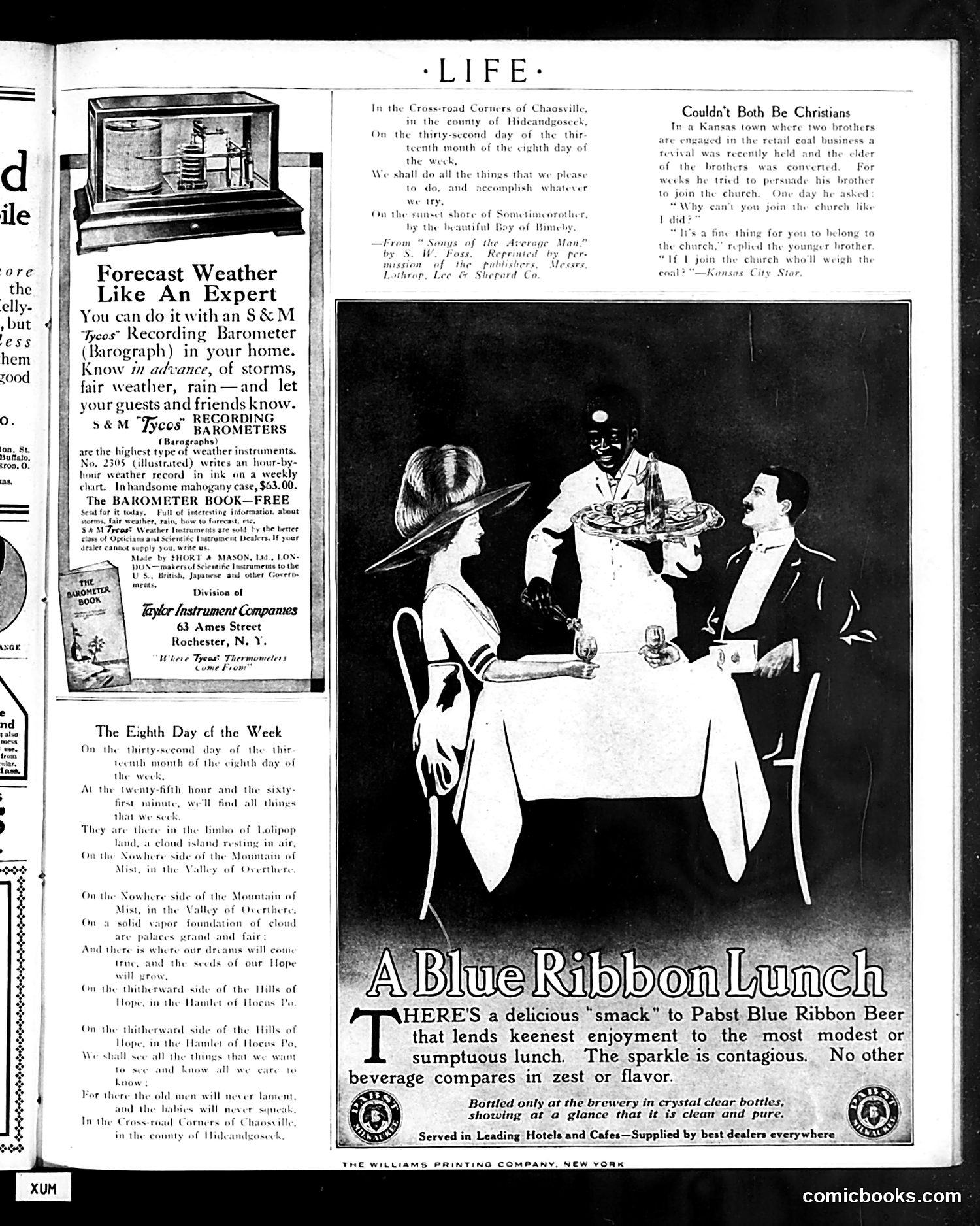
This short humorous story illustrates a practical conflict between religious conviction and economic self-interest in early 20th-century America. **The Setup:** Two brothers run a coal retail business in a Kansas town. The elder brother undergoes religious conversion at a revival meeting and pressures his younger brother to join the church. **The Joke:** When asked why he won't convert, the younger brother poses a pointed question: if he joins the church, "who'll weigh the coal?"—implying his brother will become too honest or morally scrupulous to cheat customers on coal weights, damaging their business profits. **The Satire:** The piece mocks the gap between professed Christian morality and actual commercial practice. It suggests that genuine Christian ethics (honesty, fair dealing) are incompatible with profitable retail business—a cutting commentary on American business ethics and the performative nature of some religious conversion during the period.
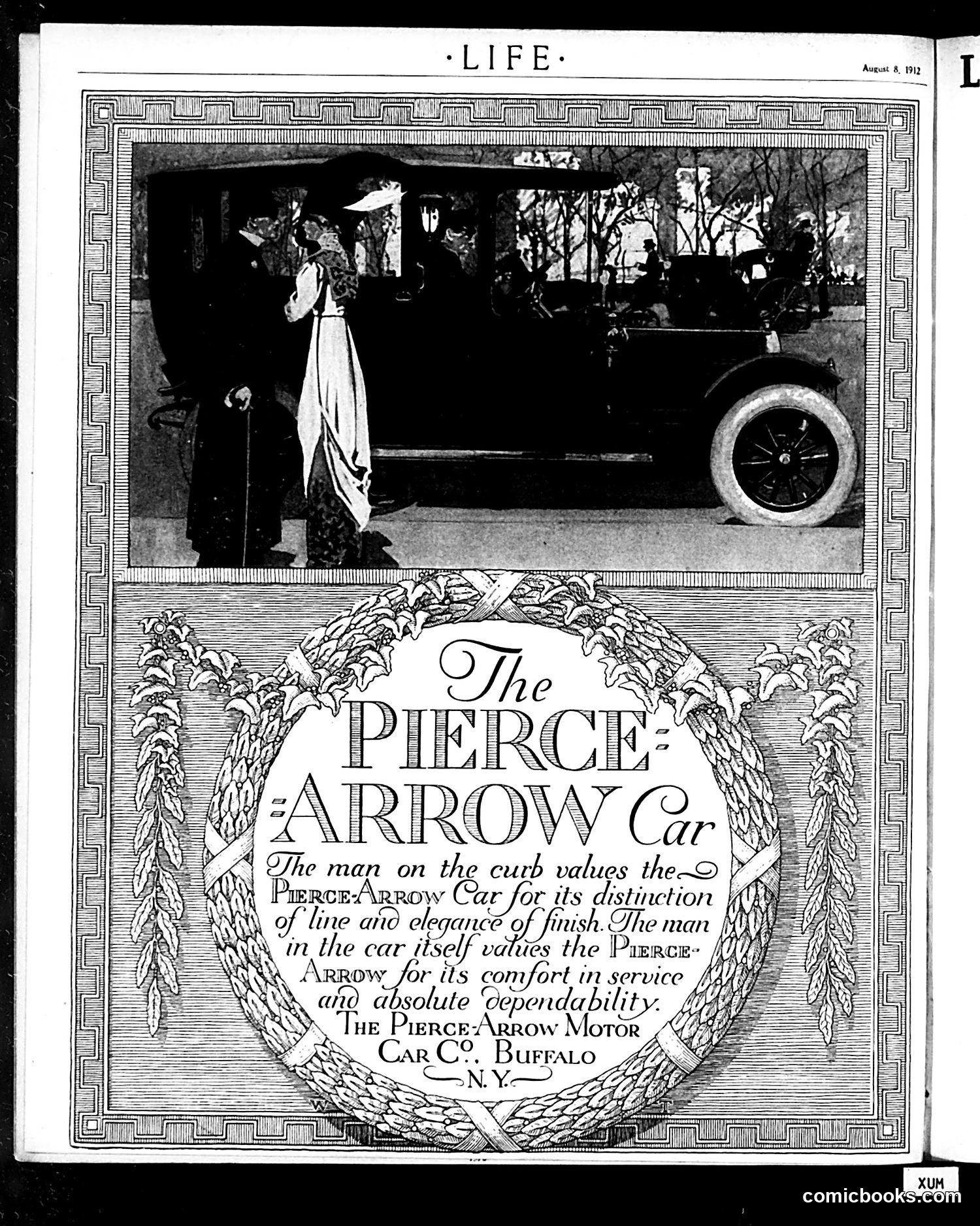
This is a **full-page automobile advertisement**, not political satire. The page features a photograph of a Pierce-Arrow automobile with elegantly dressed figures posed beside it, positioned above decorative text. The ad targets wealthy consumers by emphasizing two distinct appeals: the "man on the curb" values the car's visual "distinction of line and elegance of finish" (status symbol), while the actual owner appreciates its "comfort in service" and "absolute dependability" (practical luxury). The Pierce-Arrow Motor Car Company, based in Buffalo, New York, was a real manufacturer of high-end automobiles popular among the affluent during this era (1912). The ornate decorative border and refined typography reflect the aspirational aesthetic typical of luxury goods advertising in early 20th-century *Life* magazine. This represents straightforward marketing rather than editorial commentary.