
Life, 1912-08-08 · page 22 of 40
Life — August 8, 1912 — page 22: what you’re looking at
What you’re looking at
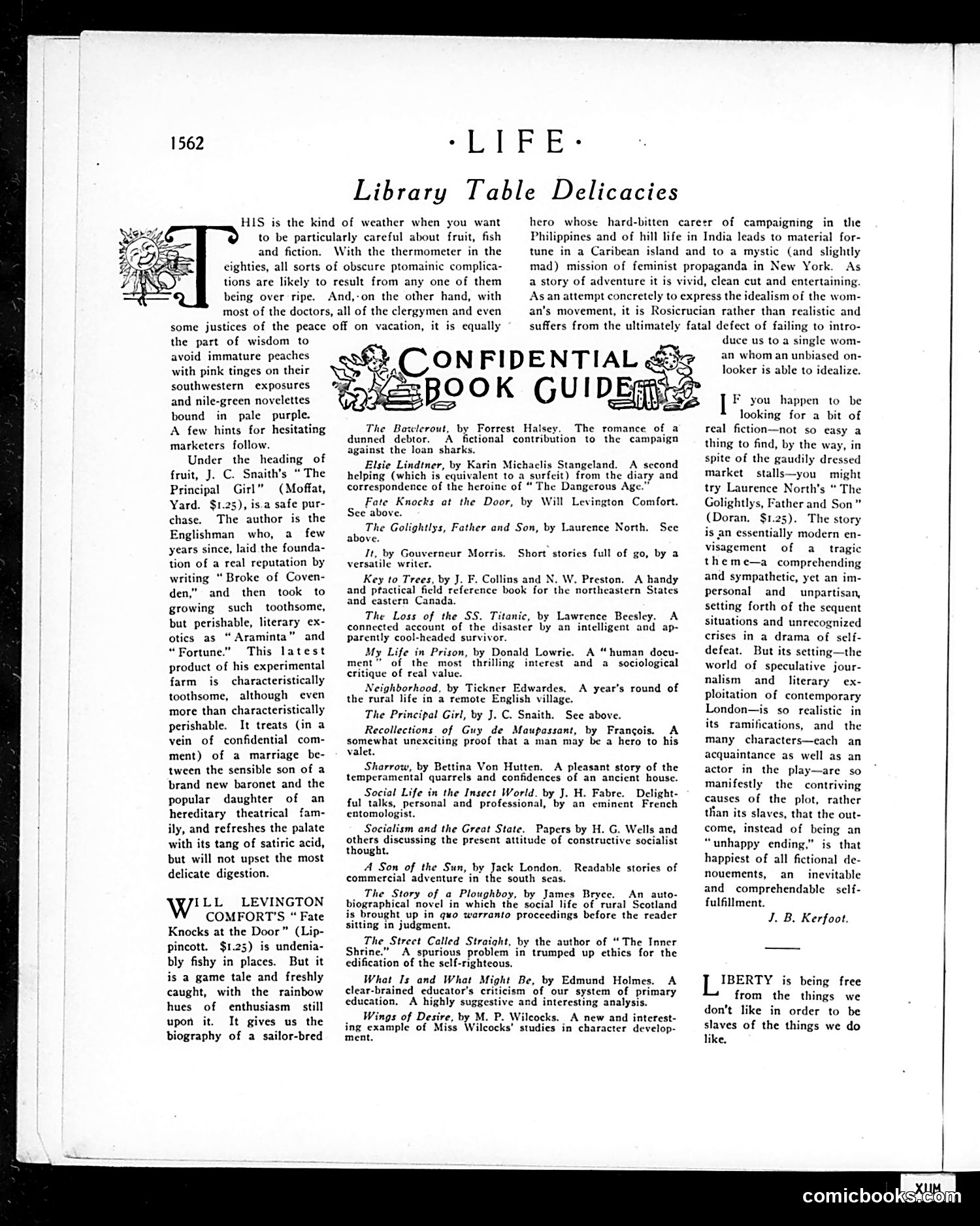
This page is a book review column titled "Library Table Delicacies"—a metaphorical comparison of books to perishable foods. The critic advises readers to be cautious about fiction during hot weather, comparing poor novels to spoiled fruit and fish. The satire targets the quality of contemporary fiction. Books are categorized as "safe," "fishy," or questionable based on literary merit. For example, J.C. Snaith's *The Principal Girl* is "safe"; Will Levington Comfort's *Fate Knocks at the Door* is "undeniably fishy in places" but acceptable; and certain "pale purple" novels are dismissed as immature and perishable. The column reviews roughly 20 books of the era, mixing serious works (Lawrence Beesley's *Loss of the SS. Titanic*) with lighter fare. The underlying joke is that just as people carefully select fresh produce, readers should discriminate about fiction—not all newly published books deserve attention.
📄 Transcribed text from this page (OCR, searchable)
Machine-transcribed from the original scan — historical spelling and the odd misread are preserved.
“TIRES * Library Table Delicacies HIS is the kind of weather when you want to be particularly careful about fruit, fish and fiction, With the thermometer in the hero whose hard-bitten career of campaigning in the Philippines and of hill life in India leads to material for- tune in a Caribean island and to a mystic (and slightly tions are likely to being over ripe. the part of wisdom to avoid immature peache: with pink tinges on their southwestern exposures and nile-green novelettes bound in pale purple. A few hints for hesitating marketers follow. Under the heading of fruit, J. C. Snaith’s “ The Principal Girl” (Moffat, Yard. $1.25), is.a safe pur- chase. The author is the Englishman who, a few years since, laid the founda- tion of a real reputation by writing “ Broke of Coven- | den,” and then took to growing such toothsome, but perishable, literary ex- otics as “Araminta” and “Fortune.” This latest product of his experimental farm is characteristically toothsome, although even more than characteristically perishable. It treats (in a vein of confidential com- ment) of a marriage be- tween the sensible son of a brand new baronet and the popular daughter of an hereditary theatrical fam- ily, and refreshes the palate with its tang of satiric acid, but will not upset the most delicate digestion. ILL LEVINGTON COMFORT'S “Fate Knocks at the Door” (Lip- Pincott. $1.23) is undenia- bly fishy in places. But it is a game tale and freshly caught, with the rainbow hues of enthusiasm still upon it. It gives us the biography of a sailor-bred eighties, all sorts of obscure ptomainic complica- And,-on the other hand, with most of the doctors, all of the clergymen and even some justices of the peace off on vacation, it is equally result from any one of them The Bawlerout, by Forrest Halsey. The romance of a dunned debtor. A fictional contribution to the campaign against the loan sharks. Elsie Lindtner, by Karin Michaclis Stangeland. A second helping (which is equivalent to a surfeit) from the diary and correspondence of the heroine of “ The Dangerous Age.” Fate Knocks at the Door, by Will Levington Comfort. See above. The Golightlys, Father and Son, by Laurence North. See above. It, by Gouverneur Morris. versatile writer. Key to Trees, by J, F. Collins and N, W. Preston. A handy and ptactical ficld reference book for the northeastern States and eastern Canada. The Loss of the SS. Titanic, by Lawrence Beesley. A connceted account of the disaster by an intelligent and ap- parently cool-headed survivor. My Life in Prison, by Donald Lowrie. ment” of the most’ thrilling interest critique of real value. Neighborhood, by Tickner Edwardes. the rural life in a remote English village. The Principal Girl, by J. C. Snaith. See above. Recollections of Guy de Maupassant, by Francois. A somewhat unexciting proof that a man may be a hero to his valet. Sharrow, by Bettina Von Hutten. A pleasant story of the temperamental quarrels and confidences of an ancient house. Social Life in the Insect World. by J. H. Fabre. Delight- ful talks, personal and professional, by an eminent French entomologist. Socialism and the Great State. Papers by H. G. Wells and others discussing the present attitude of constructive socialist thought. A Son of the Sun, by Jack London. commercial adventure in the south seas. The Story of a Ploughboy, by James Bryce. An auto- biographical novel in which the social life of rural Scotland is brought up in quo warranto proceedings before the reader sitting in judgment. The Street Called Straight, by the author of “The Inner Shrine.” A. spurious problem in trumped up ethics for the edification of the self-righteous. What Is and What Might Be, by Edmund Holmes. A clear-brained educator's criticism of our system of primary education. A highly suggestive and interesting analysis. Wings of Desire, by M. P. Wilcocks. A new and interest- ing example of Miss Wilcocks’ studies in character develop- ment. Short stories full of go, by a A “human docu- and a sociological A year’s round of Readable stories of mad) mission of feminist propaganda in New York. As a story of adventure it is vivi As an attempt concretely to express the idealism of the wom- an’s movement, it is Rosicrucian rather than realistic and suffers from the ultimately fatal defect of failing to intro- , clean cut and entertaining. duce us to a single wom- an whom an unbiased on- looker is able to idealize. [* you happen to be looking for a bit of real fiction—not so easy a thing to find, by the way, in spite of the gaudily dressed market stalls—you might try Laurence North's * The Golightlys, Father and Son” (Doran, $1.25). The story is an essentially modern en- visagement of a tragic theme—a_ comprehending and sympathetic, yet an im- personal and unpartisan, setting forth of the sequent situations and unrecognized crises in a drama of self- defeat. But its setting—the world of speculative jour- nalism and literary ex- ploitation of contemporary London—is so realistic in its ramifications, and the many characters—each an acquaintance as well as an actor in the play—are so manifestly the contriving causes of the plot, rather tian its slaves, that the out- come, instead of being an “unhappy ending,” is that happiest of all fictional de- nouements, an_ inevitable and comprehendable self- fulfillment. J. B. Kerfoot. [LJBERTY is being free from the things we don’t like in order to be slaves of the things we do like. comicbooline ud