
Life, 1912-08-08 · page 8 of 40
Life — August 8, 1912 — page 8: what you’re looking at
What you’re looking at
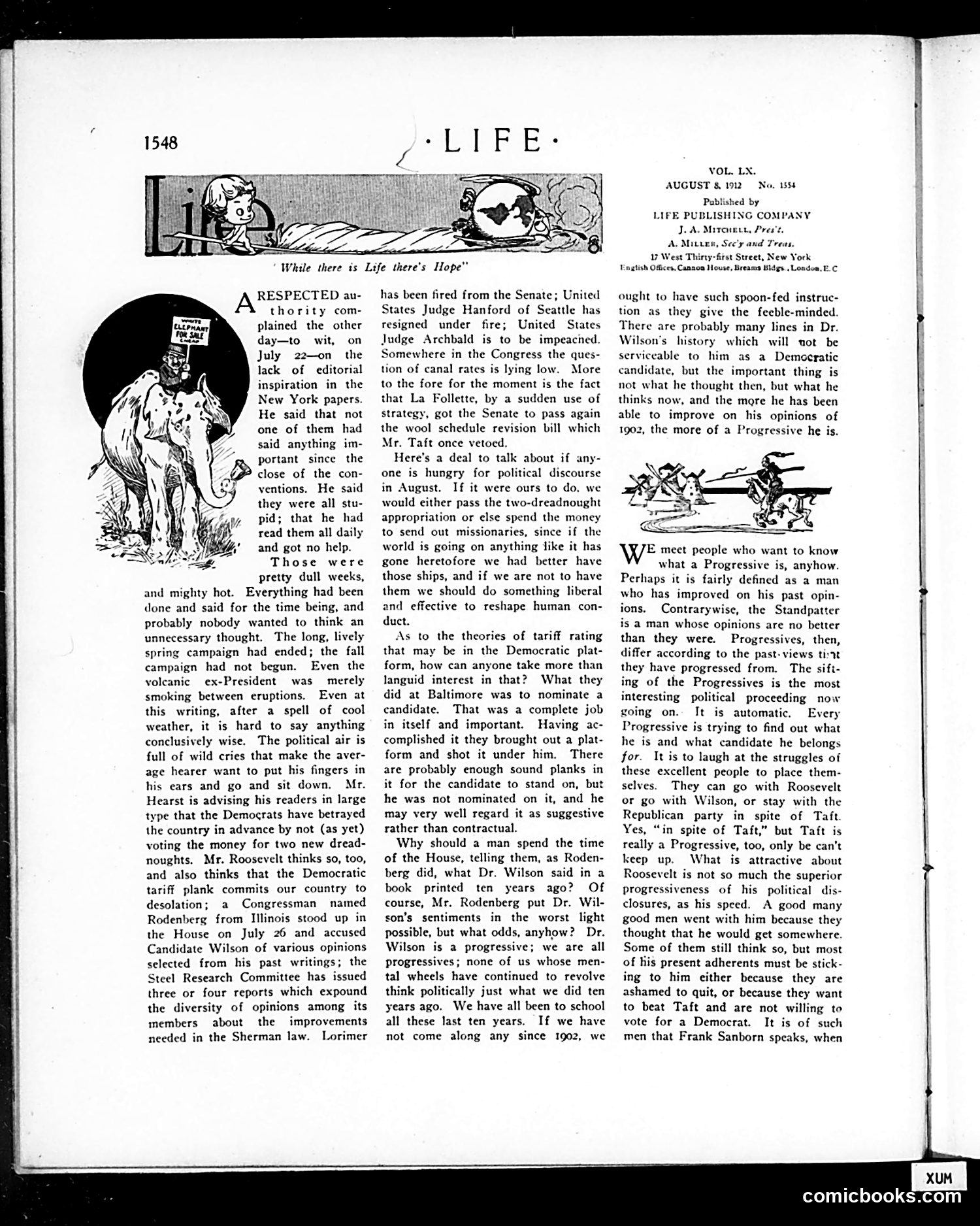
The main cartoon depicts a donkey (representing the Democratic Party) looking disheveled and exhausted after the party's contentious spring and summer campaign season. The accompanying article critiques the Democratic Party's internal divisions and questions what "Progressivism" actually means. The text discusses recent political upheaval: U.S. judges facing scandals, Senate disputes over canal rates, and the failed Democratic platform regarding tariff policy. The article sarcastically examines Progressive ideology, suggesting it's poorly defined and that many claiming the label (including Roosevelt-aligned Republicans) are simply disgruntled politicians rather than genuine ideological reformers. The donkey's bedraggled state visually reinforces the article's message: the Democratic Party is exhausted and confused by the Progressive movement fragmenting American politics.
📄 Transcribed text from this page (OCR, searchable)
Machine-transcribed from the original scan — historical spelling and the odd misread are preserved.
| RESPECTED au- thority com- plained the other day—to wit, on July 22—on the lack of editorial inspiration in the New York papers. He said that not one of them had said anything im- portant since the close of the con- ventions. He said they were all stu- pid; that he had read them all daily and got no help. Those were pretty dull weeks, and mighty hot. Everything had been done and said for the time being, and probably nobody wanted to think an unnecessary thought. The long, lively spring campaign had ended; the fall campaign had not begun. Even the volcanic ex-President was merely smoking between eruptions. Even at this writing, after a spell of cool weather, it is hard to say anything conclusively wise. The political air is full of wild cries that make the aver- age hearer want to put his fingers in his ears and go and sit down. Mr. Hearst is advising his readers in large type that the Democrats have betrayed the country in advance by not (as yet) voting the money for two new dread- noughts. Mr. Roosevelt thinks so, too, and also thinks that the Democratic tariff plank commits our country to desolation; a Congressman named Rodenberg from Illinois stood up in the House on July 26 and accused Candidate Wilson of various opinions selected from his past writings; the Steel Research Committee has issued three or four reports which expound the diversity of opinions among its members about the improvements needed in the Sherman law. Lorimer While there is Life there's Hope” has been fired from the Senate; United States Judge Hanford of Seattle has resigned under fire; United States Judge Archbald is to be impeached. Somewhere in the Congress the ques- tion of canal rates is lying low. More to the fore for the moment is the fact that La Follette, by a sudden use of strategy, got the Senate to pass again the wool schedule revision bill which Mr. Taft once vetoed, Here's a deal to talk about if any- one is hungry for political discourse in August. If it were ours to do, we would either pass the two-dreadnought appropriation or else spend the money to send out missionaries, since if the world is going on anything like it has gone heretofore we had better have those ships, and if we are not to have them we should do something liberal and effective to reshape human con- duct. As to the theories of tariff rating that may be in the Democratic plat- form, how can anyone take more than languid interest in that? What they did at Baltimore was to nominate a candidate. That was a complete job in itself and important. Having ac- complished it they brought out a plat- form and shot it under him. There are probably enough sound planks in it for the candidate to stand on, but he was not nominated on it, and he may very well regard it as suggestive rather than contractual. Why should a man spend the time of the House, telling them, as Roden- berg did, what Dr. Wilson said in a book printed ten years ago? Of course, Mr. Rodenberg put Dr. Wil- son’s sentiments in the worst light possible, but what odds, anyhow? Dr. Wilson is a progressive; we are all progressives; none of us whose men- tal wheels have continued to revolve think politically just what we did ten years ago. We have all been to school all these last ten years. If we have not come along any since 1902, we VOL. LX. AUGUST 8, 1912, Ni Published by LIFE PUBLISHING CoM J.A. Miron, Pres A. Mitten, See’y and Treas. ¥ West Thirty-first Street, New York Engtish Offices, Canaoa House, Breams Bldgs.,Londos,E.C ase PANY ought to have such spoon-fed instruc- tion as they give the feeble-minded. There are probably many lines in Dr. Wilson's history which will aot be serviceable to him as a Democratic candidate, but the important thing is not what he thought then, but what he thinks now, and the more he has been able to improve on his opinions of 1902, the more of a Progressive he is. WE meet people who want to know what a Progressive is, anyhow. Perhaps it is fairly defined as a man who has improved on his past opin- ions. Contrarywise, the Standpatter is a man whose opinions are no better than they were. Progressives, then, differ according to the past: views tistt they have progressed from. The sift- ing of the Progressives is the most interesting political proceeding now going on. It is automatic. Every Progressive is trying to find out what he is and what candidate he belongs for. It is to laugh at the struggles of these excellent people to place them- selves. They can go with Roosevelt or go with Wilson, or stay h the Republican party in spite of Taft. Yes, “in spite of Taft,” but Taft is really a Progressive, too, only be can't keep up. What is attractive about Roosevelt is not so much the superior progressiveness of his political dis- closures, as his speed. A good many good men went with him because they thought that he would get somewhere. Some of them still think so, but most of his present adherents must be stick- ing to him either because they are ashamed to quit, or because they want to beat Taft and are not willing to vote for a Democrat. It is of such men that Frank Sanborn speaks, when comicbooks.com