
Life, 1912-08-08 · page 24 of 40
Life — August 8, 1912 — page 24: what you’re looking at
What you’re looking at
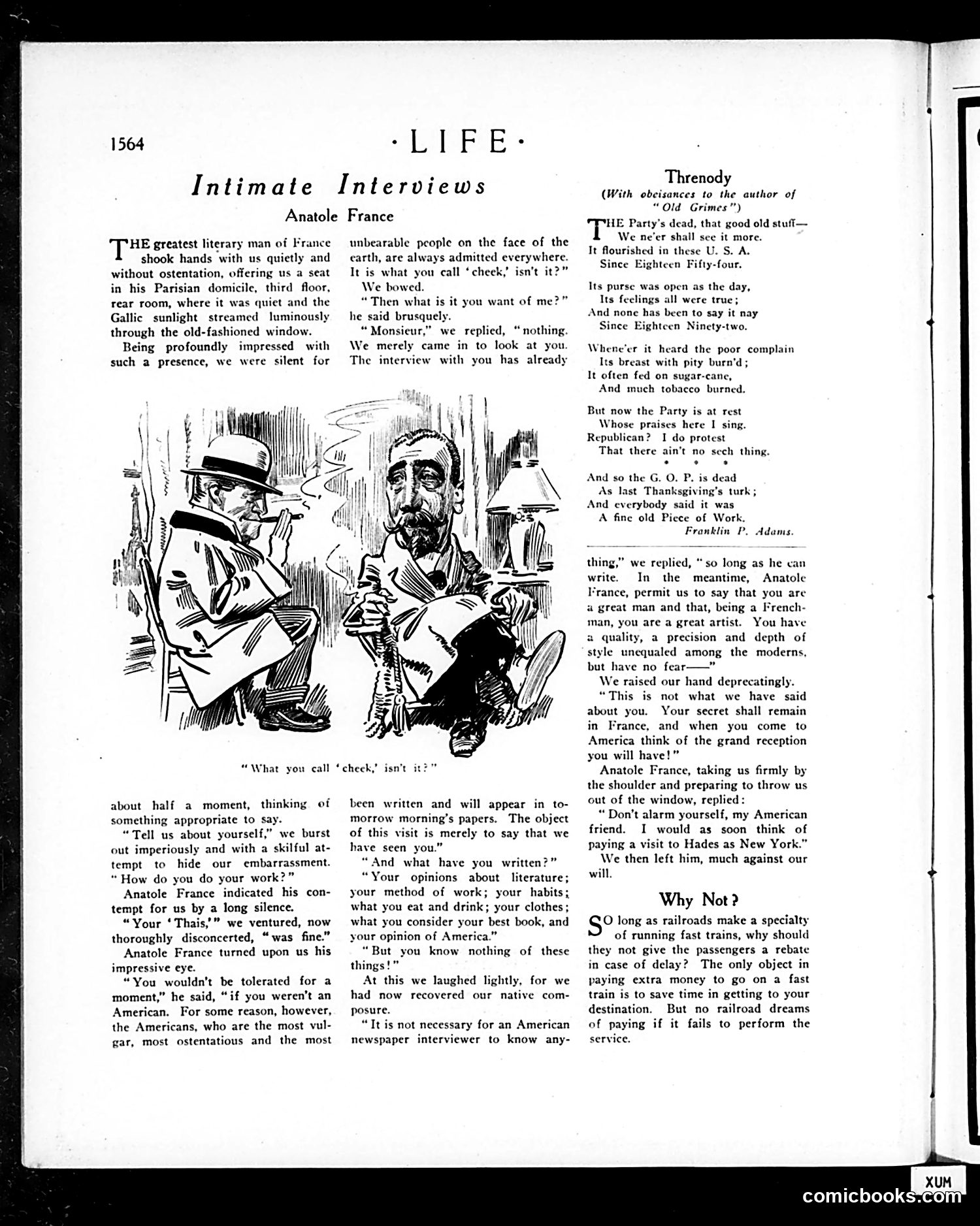
## Main Cartoon: "Intimate Interviews with Anatole France" The illustration depicts two American journalists interviewing the celebrated French author Anatole France in his Paris study. The satire mocks American newspaper interview practices—specifically their aggressive intrusiveness and ignorance. ## The Joke The interviewers admit they know nothing about France's work, opinions, or life, yet brazenly demand personal details anyway. France responds with contempt, calling Americans "vulgar" and "ostentatious" yet paradoxically "tolerated everywhere" due to their shameless "cheek" (audacity). He threatens to throw them out the window. The humor targets American journalism's invasive celebrity-hunting culture and the brazen confidence of reporters who fabricate stories without knowledge—a recognizable practice then as now. ## Secondary Content The page includes "Threnody," a satirical poem mourning the death of the Republican Party (circa 1890s), and a brief editorial about railroad service standards.
📄 Transcribed text from this page (OCR, searchable)
Machine-transcribed from the original scan — historical spelling and the odd misread are preserved.
“DPE Intimate Interviews Anatole France qe greatest literary man of France shook hands with us quietly and without ostentation, offering us a seat in his Parisian domicile, third floor, rear room, where it was quiet and the Gallic sunlight streamed luminously through the old-fashioned window. Being profoundly impressed with such a presence, we were silent for unbearable people on the face of the earth, are always admitted everywhere. It is what you call ‘cheek,’ isn’t it?” We bowed. “Then what is it you want of me?” he said brusquely. “Monsieur,” we replied, “nothing. We merely came in to look at you. The interview with you has already “What you call ‘cheek,’ isn’t it? about half a moment, thinking of something appropriate to say “Tell us about yourself,” we burst out imperiously and with a skilful at- tempt to hide our embarrassment. “How do you do your work?” Anatole France indicated his con- tempt for us by a long silence. “Your ‘ Thais,” we ventured, now thoroughly disconcerted, “was fine.” Anatole France turned upon us his impressive eye. “You wouldn't be tolerated for a moment,” he said, “if you weren’t an American. For some reason, however, the Americans, who are the most vul- gar, most ostentatious and the most been written and will appear in to- morrow morning's papers. The object of this visit is merely to say that we have seen you.” “And what have you written?” “Your opinions about literature; your method of work; your habits; what you eat and drink; your clothes; what you consider your best book, and your opinion of America.” “But you know nothing of these things! At this we laughed lightly, for we had now recovered our native com- posure. “Tt is not necessary for an American newspaper interviewer to know any- Threnody (With obcisances to the author of “Old Grimes”) HE Party's dead, that good old stuff— We ne'er shall see it more. It flourished in these U. S. A. Since Eighteen Fifty-four. Its purse was open as the day, Its feelings all were true; And none has been to say it nay Since Eightcen Ninety-two. Whene’er it heard the poor complain Its breast with pity burn'd; It often fed on sugar-eane, And much tobacco burned. But now the Party is at rest Whose praises here I sing. Republican? I do protest That there ain't no scch thing. 3. O. P. is dead As last Thanksgiving’s turk; And everybody said it was A fine old Piece of Work. Franklin P. Adams. thing,” we replied, “so long as he can write. In the meantime, Anatole France, permit us to say that you are a great man and that, being a French- man, you are a great artist. You have a quality, a precision and depth of style unequaled among the moderns, but have no fear——” We raised our hand deprecatingly. “This is not what we have said about you. Your secret shall remain in France, and when you come to America think of the grand reception you will have!” Anatole France, taking us firmly by the shoulder and preparing to throw us out of the window, replied: “Don’t alarm yourself, my American friend. I would as soon think of paying a visit to Hades as New York.” We then left him, much against our will. Why Not? O long as railroads make a specialty of running fast trains, why should they not give the passengers a rebate in case of delay? The only object in paying extra money to go on a fast train is to save time in getting to your destination. But no railroad dreams of paying if it fails to perform the service. comicbook eae