
A complete issue · 41 pages · 1912
Life — July 25, 1912
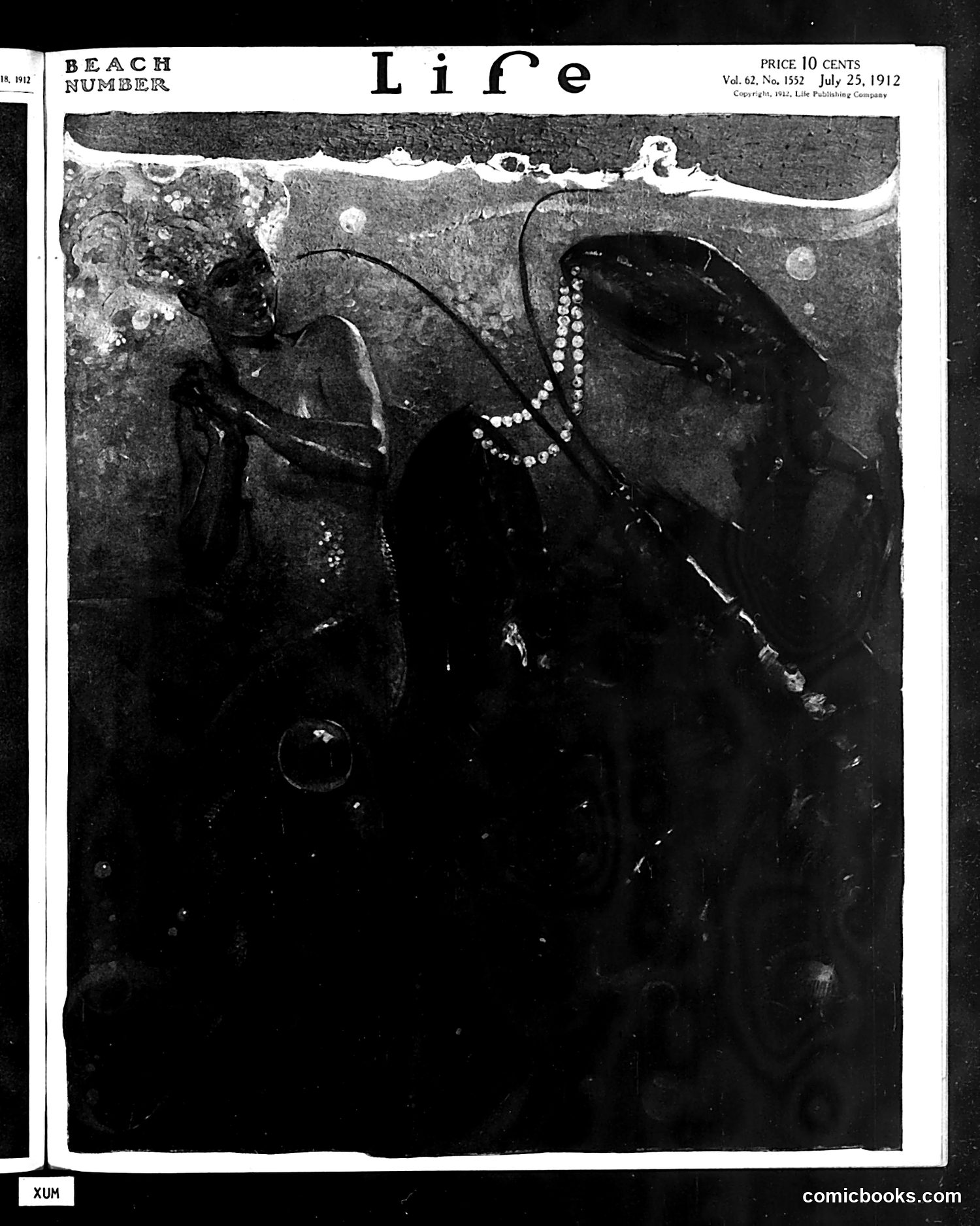
This is the cover of *Life* magazine's "Beach Number" from July 25, 1912 (price: 10 cents). The illustration depicts two women in fashionable bathing attire at the beach, wearing pearl necklaces and styled hair typical of the era. The satire likely concerns **women's beach fashion** of the period—a subject of social commentary in 1912. The elaborate jewelry and styling suggest mockery of how women dressed for beach outings, treating them as formal social occasions rather than practical swimming venues. The "beach number" designation indicates this was a seasonal issue capitalizing on summer leisure culture. Without additional OCR text from the article body, the specific satirical target remains unclear, though the image suggests commentary on women's fashion excess or the performative nature of early 20th-century beach culture.
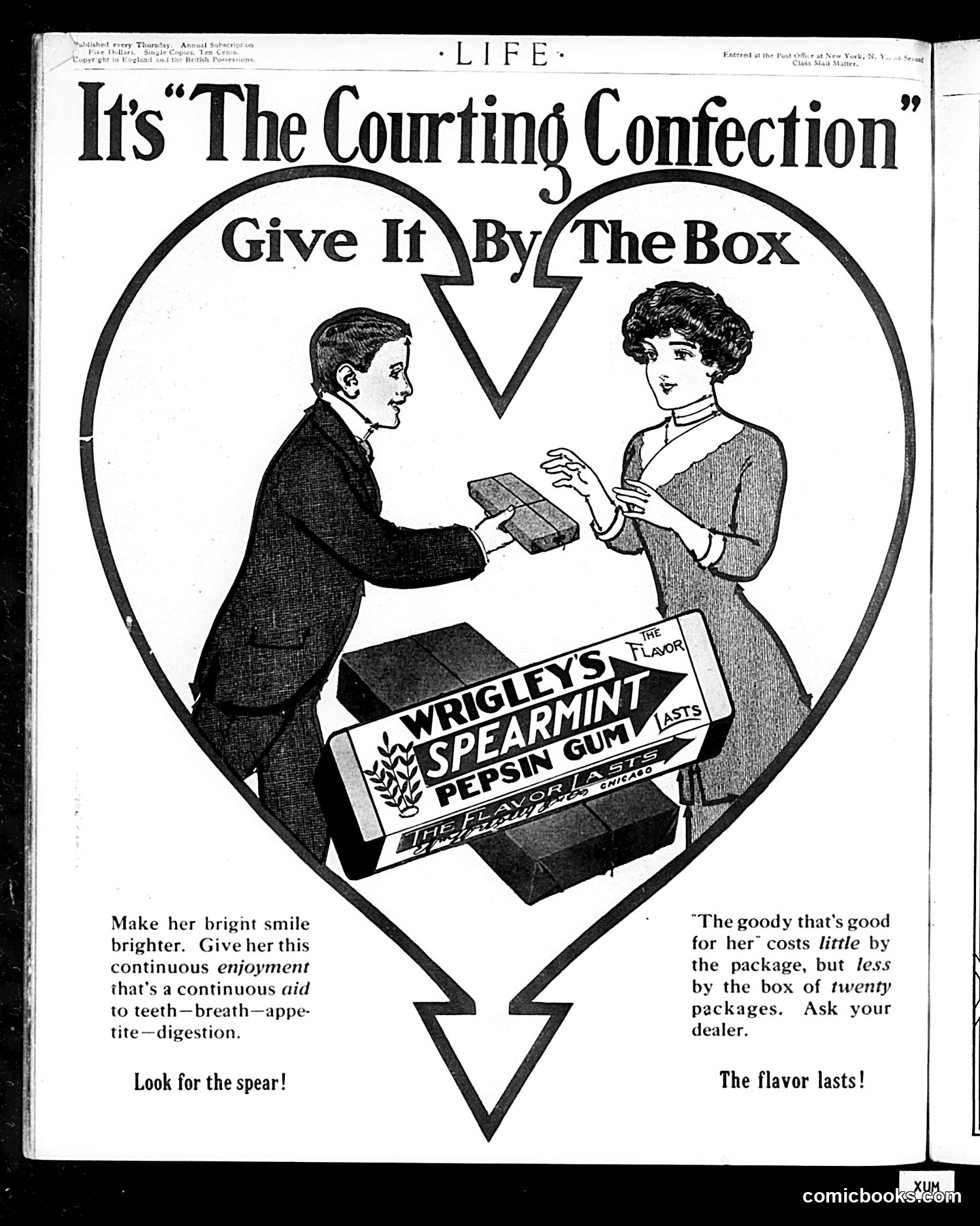
This is a **Wrigley's Spearmint Gum advertisement**, not political satire. The page uses a romantic "courting" scenario to market the product. The illustration shows a young man presenting a box of Wrigley's Spearmint gum to a woman, framed within a heart shape—a visual pun on courtship and romance. The accompanying text positions gum-giving as a romantic gesture: it will "make her bright smile brighter" and provides "continuous enjoyment...a continuous aid to teeth—breath—appetite—digestion." The advertisement emphasizes the value proposition: buying by the box of twenty packages costs less per package than individual purchases. The repeated phrases "Look for the spear!" and "The flavor lasts!" reinforce brand recognition. This reflects early 20th-century advertising strategies using emotional appeals and gendered romance tropes to market consumer products.
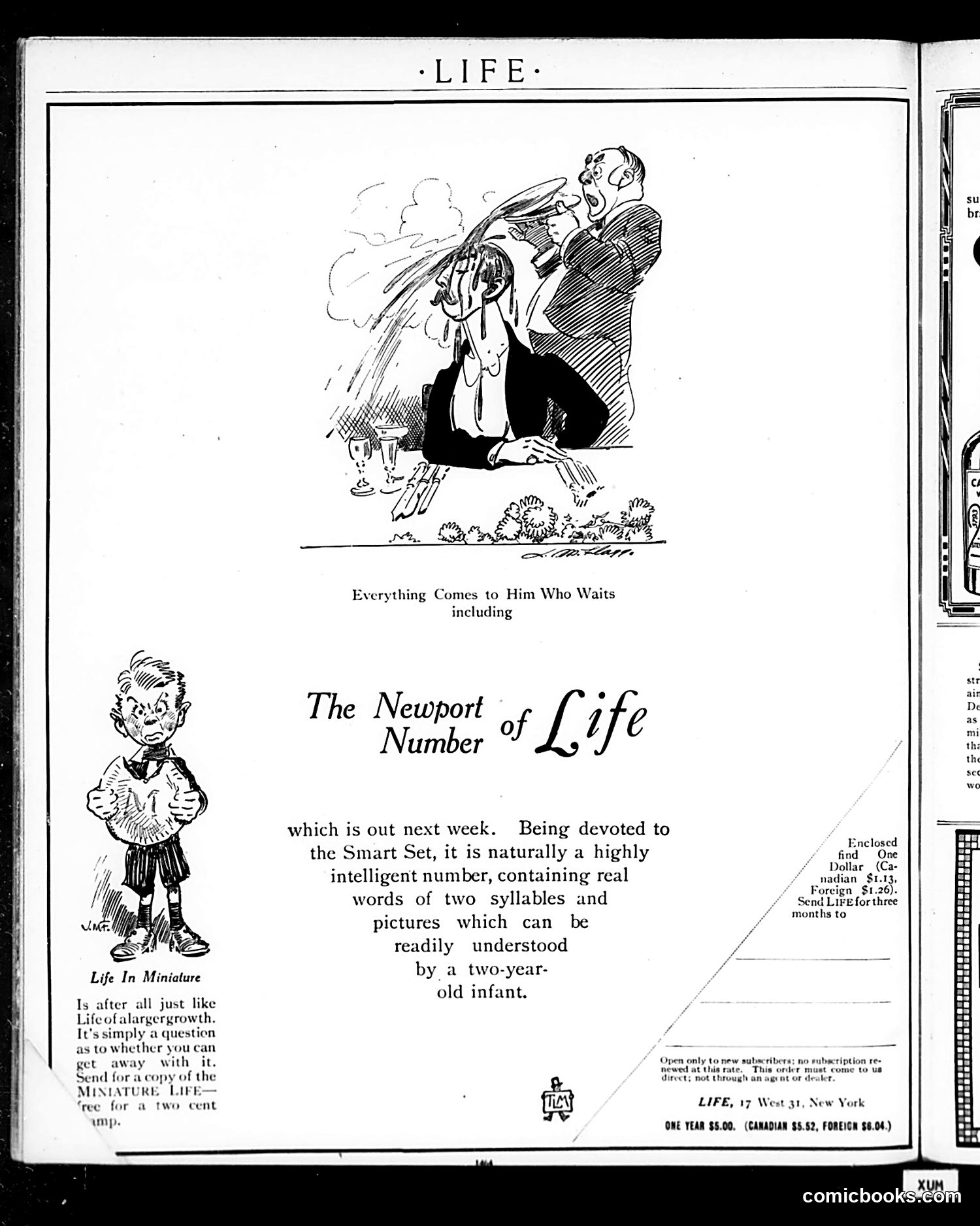
This page is primarily **promotional advertising** for *Life* magazine's upcoming "Newport Number," pitched to wealthy, sophisticated readers ("the Smart Set"). The main cartoon shows a man at a dining table being doused with water by a waiter—likely satirizing the pretensions and mishaps of high society dining at Newport, Rhode Island, the famous vacation destination for the American elite. The humor targets upper-class social situations. The left sidebar advertises "Life in Miniature," a condensed version using simple two-syllable words and pictures for young children, priced at two cents. The overall page emphasizes *Life*'s satirical focus on society's foibles while expanding into new markets—both the sophisticated Newport elite and young readers. The content reflects early 20th-century American humor targeting wealth and social climbing.
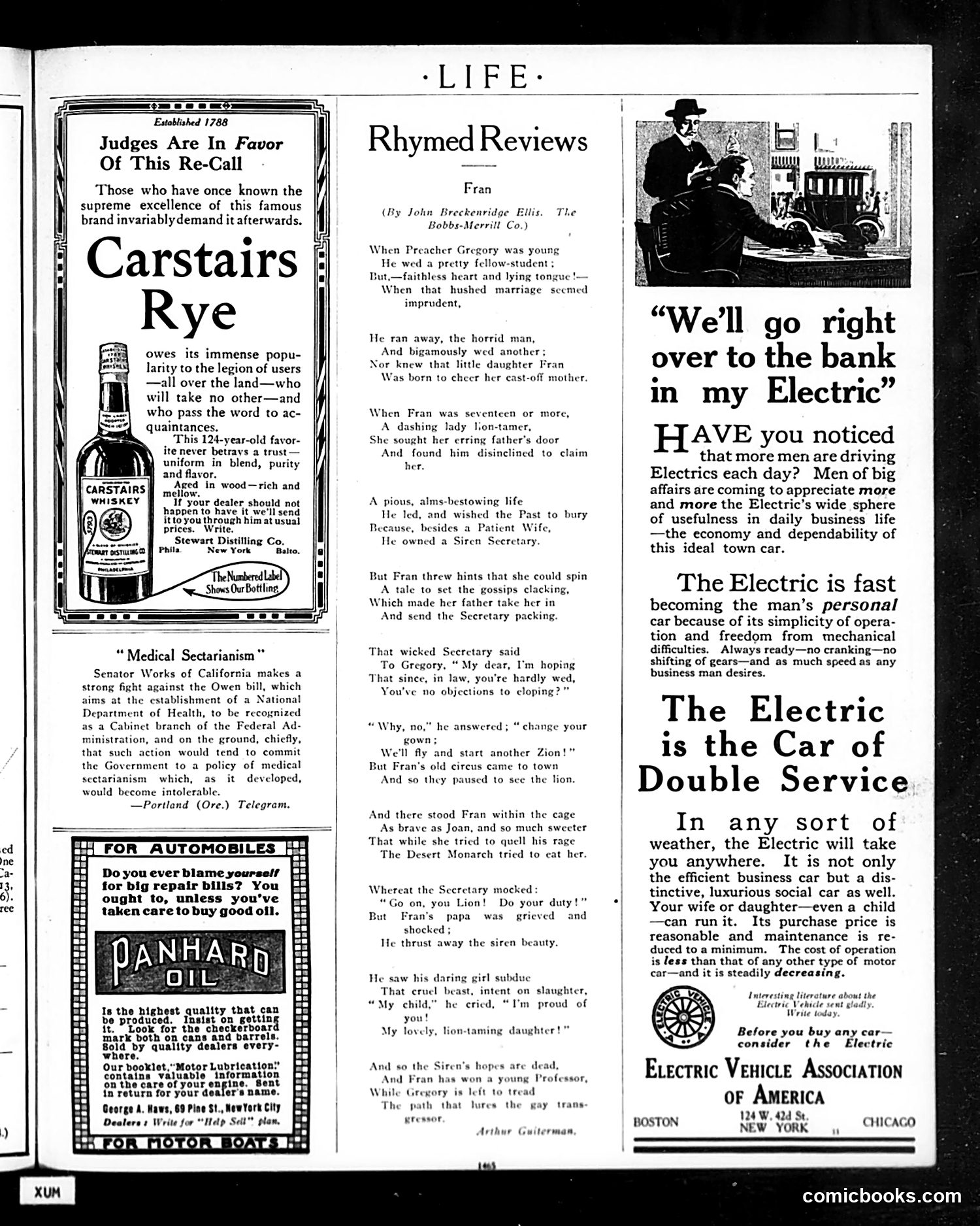
This page combines advertisements with a poem titled "Fran" by John Breckenridge Ellis. The poem satirizes marital infidelity: a man marries a pretty girl, then abandons her for another woman, leaving their daughter with the first wife. The narrative describes the man's subsequent dissolute life—running a circus, owning a "Siren Secretary"—before he ultimately dies, leaving young Fran to inherit his legacy of shame. The surrounding ads (Carstairs Rye whiskey, Panhard Oil, Electric Vehicle Association) are period commercial content typical of early 20th-century Life magazine. The poem's moralistic tone reflects contemporary attitudes toward masculine responsibility and the social consequences of abandonment—a cautionary tale for male readers about family obligations.
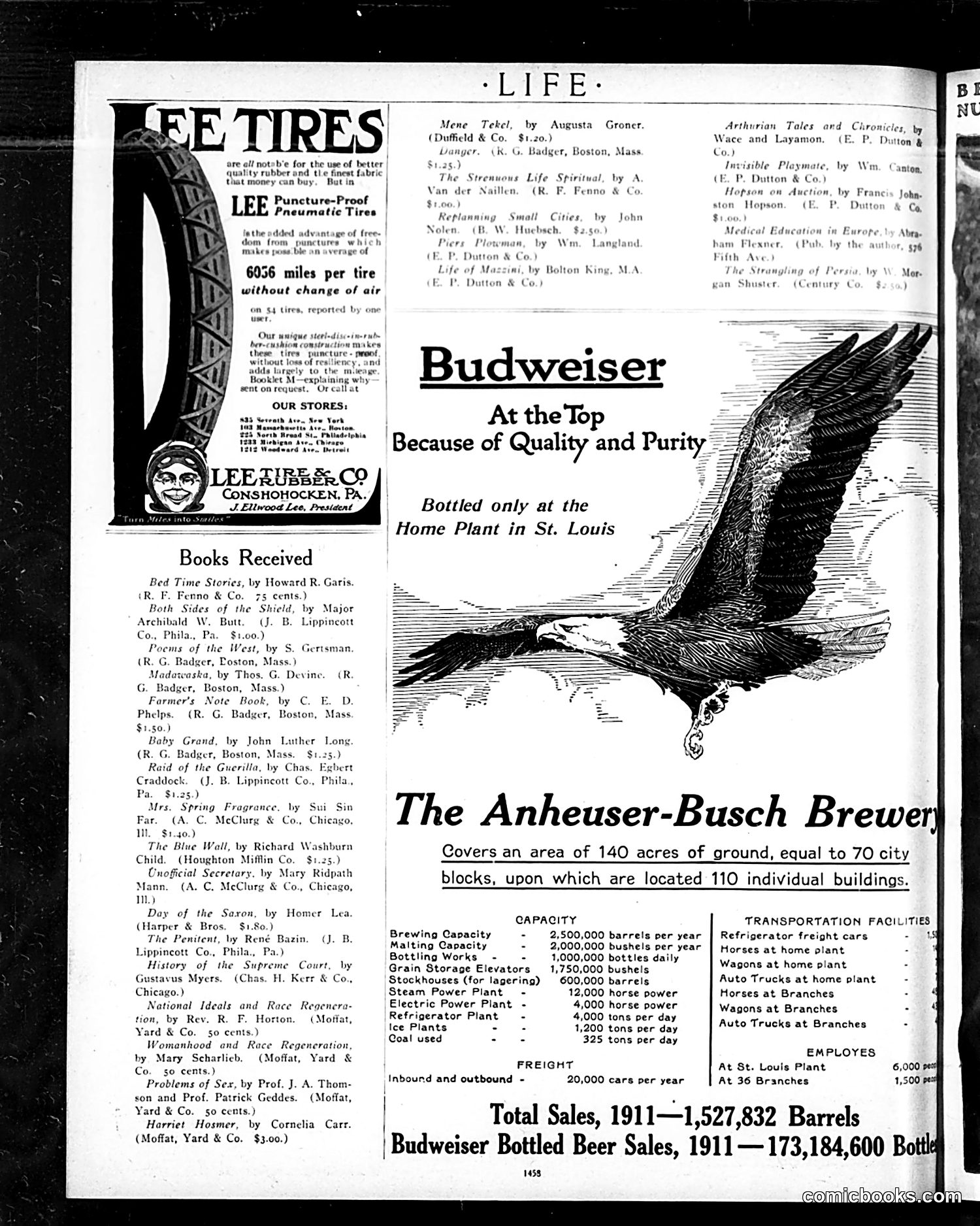
This page is primarily **advertising rather than political satire**. The left side features a Lee Tires advertisement emphasizing puncture-proof pneumatic tires and listing store locations. The dominant right side displays a large Budweiser beer advertisement featuring an eagle holding a beer bottle, promoting the Anheuser-Busch Brewery in St. Louis. The page includes a "Books Received" section listing recently published titles, likely a regular Life magazine feature. **No political cartoon or satirical content appears here.** The eagle imagery in the Budweiser ad is patriotic branding rather than commentary. This represents early 20th-century American magazine advertising before Prohibition, when beer companies advertised openly in major publications.
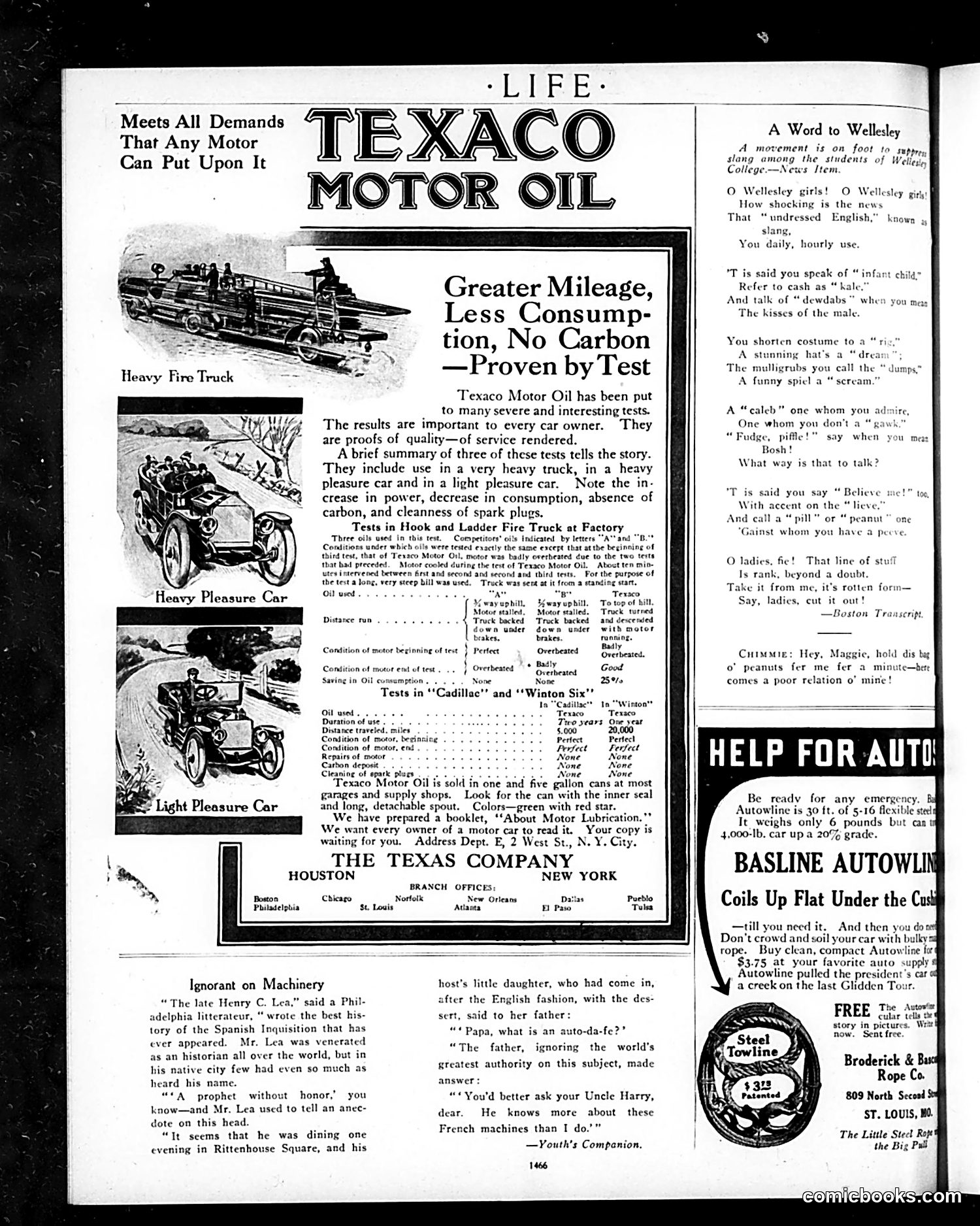
This page is primarily **advertising and editorial content**, not political satire or comics. The dominant feature is a **Texaco Motor Oil advertisement** showcasing test results comparing oil performance across three vehicle types (heavy truck, heavy pleasure car, light pleasure car). The ad claims superior mileage, lower consumption, and reduced carbon buildup—typical early automotive marketing claims. The right column contains miscellaneous content: a "Word to Wellesley" poem addressing college women's slang, a humorous anecdote about someone ignorant of machinery, and advertisements for automotive products (Basline Autowline, Steel Towline). **No significant political or social satire is present.** This appears to be a standard early-20th-century magazine page mixing consumer advertising with light humor and lifestyle content.
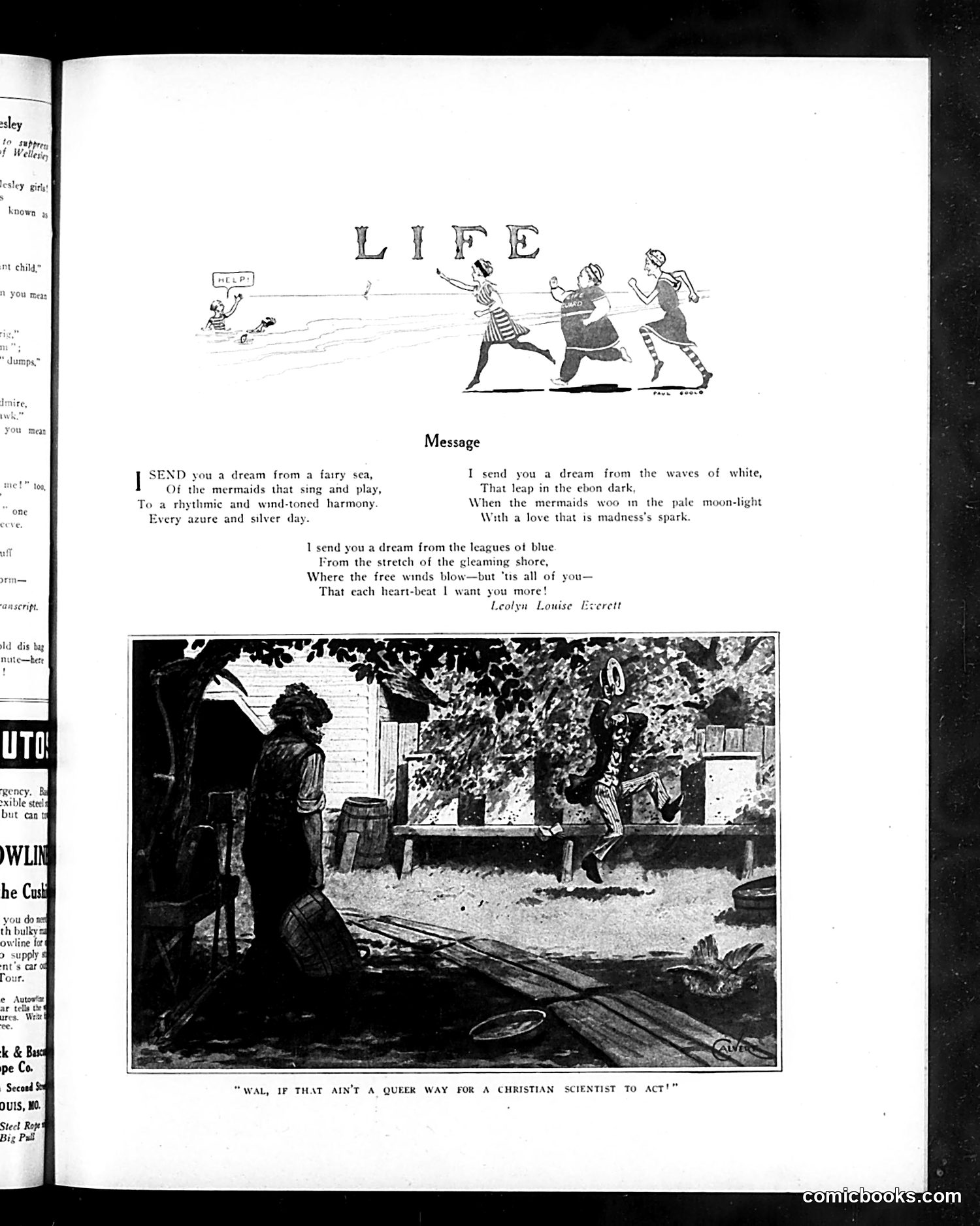
This page features a poetic "Message" by Loelyn Louise Everett, accompanied by whimsical illustrations. The top shows stylized figures of children or dancers accompanying the word "LIFE" with playful movement. The main cartoon below depicts a domestic scene: a man observing a woman tending to what appears to be a garden or yard work. The caption reads: "WAL, IF THAT AIN'T A QUEER WAY FOR A CHRISTIAN SCIENTIST TO ACT!" The joke satirizes Christian Scientists—a religious group known for emphasizing spiritual healing and mind-over-matter philosophy. The humor lies in the contradiction: a Christian Scientist woman is doing ordinary physical labor (yard work) rather than relying purely on spiritual means, mocking the perceived impracticality of the faith's principles in everyday life.
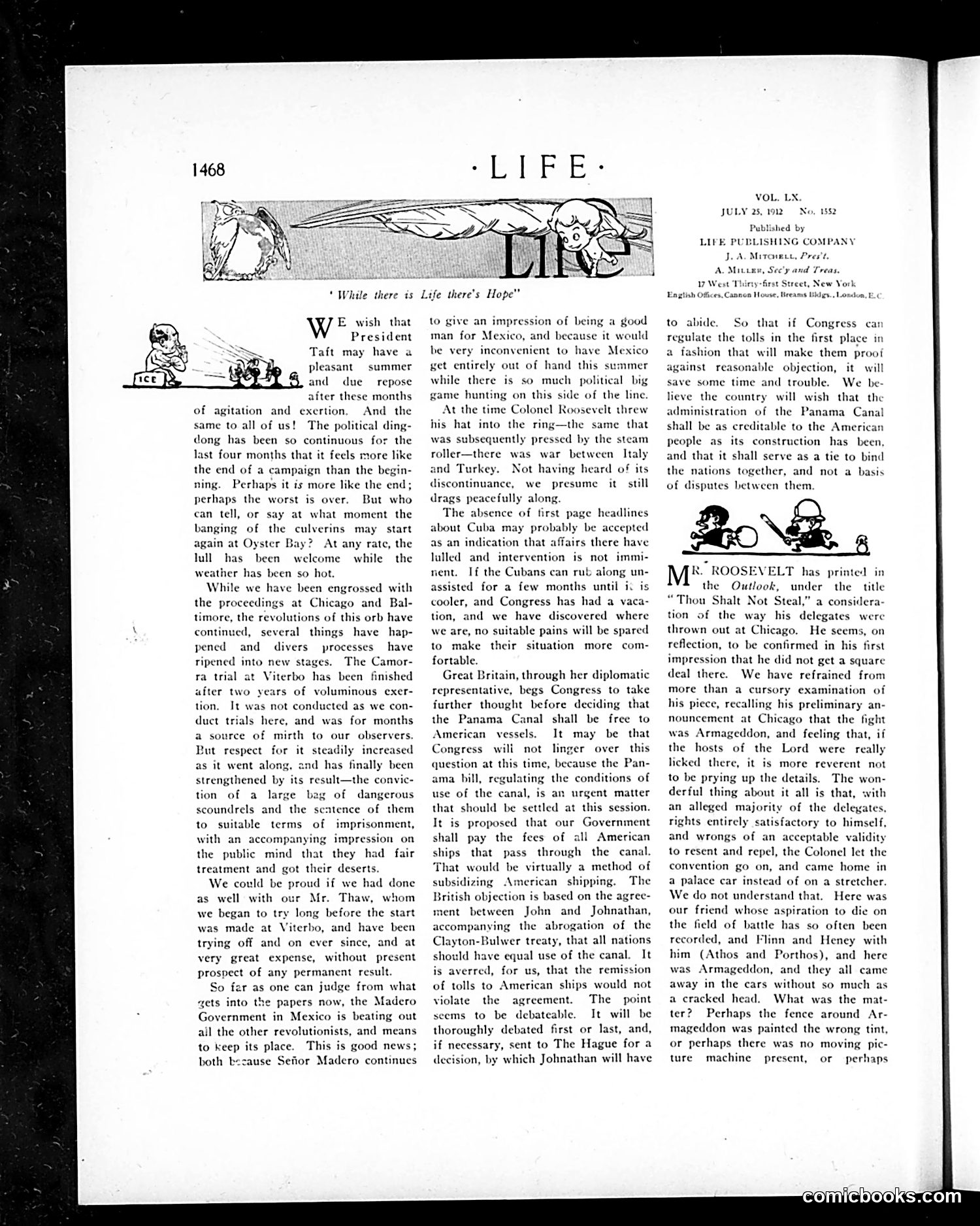
This Life magazine page (July 28, 1912) contains editorial commentary rather than cartoons. The text discusses President Taft's summer plans and Mexican political instability, referencing Colonel Roosevelt's involvement in political activities and comparisons to past diplomatic incidents. The small illustrations appear to be decorative vignettes rather than standalone political cartoons—one shows what looks like a presidential or political figure, another depicts children or small figures. The editorial criticizes the Panama Canal debate, mentioning disagreements between nations over its use, and references Roosevelt's earlier positions on various matters. It touches on diplomatic tensions with Britain regarding canal access rights. Without clearer cartoon imagery or captions, the specific satirical targets remain somewhat obscured, though the general tone suggests criticism of ongoing political maneuvering during the 1912 election year.
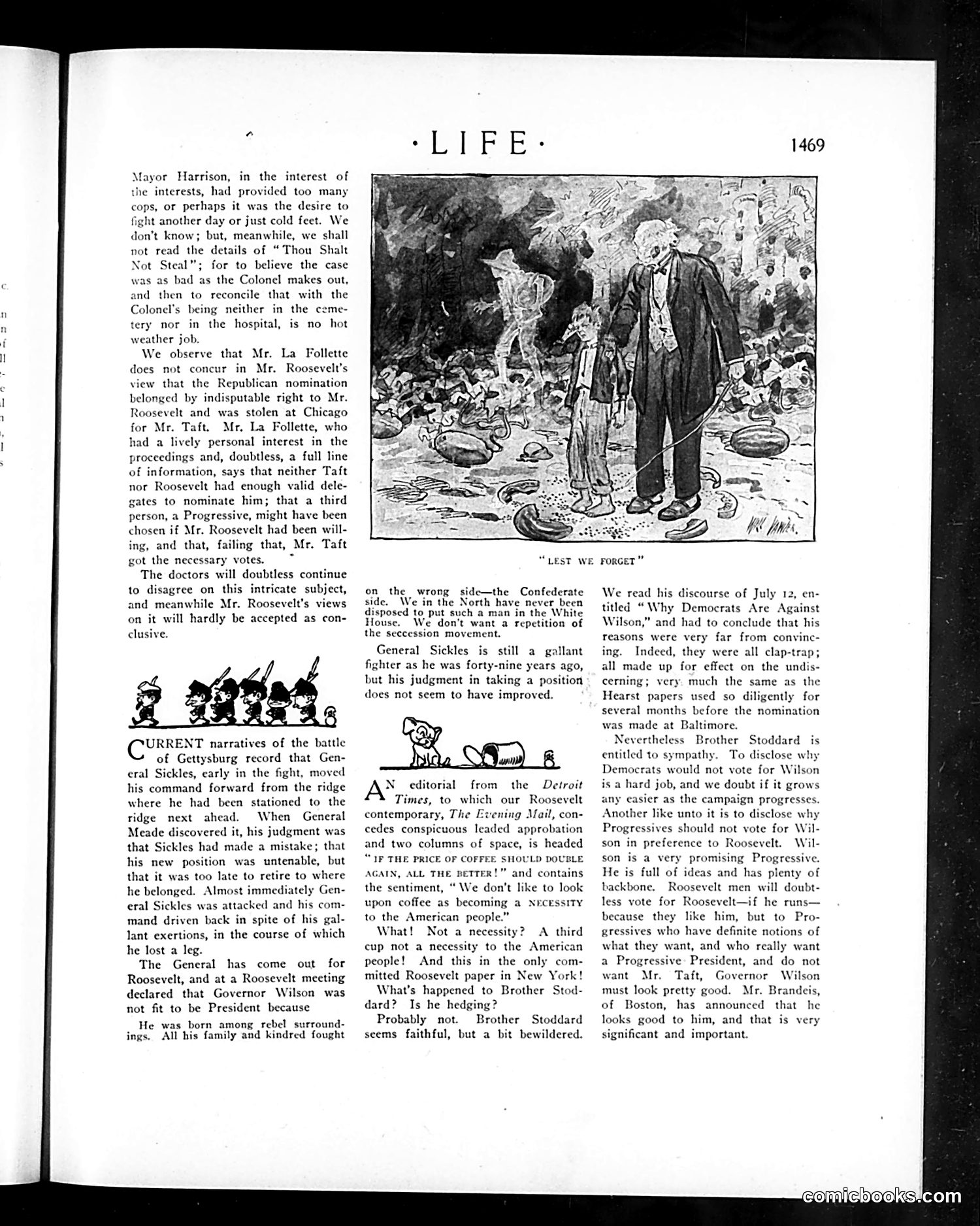
The cartoon depicts a tall figure in formal dress standing among scattered military equipment and debris. Based on the page's text discussing Roosevelt, General Sickles, and political disputes over the 1912 election, this appears to satirize debates about Civil War leadership and Republican Party divisions. The figure likely represents a political leader being reminded of past military failures or controversies—the title "Lest We Forget" suggests historical accountability. The scattered military gear references battlefield consequences. The surrounding text criticizes conflicting accounts of the Battle of Gettysburg and disputes Roosevelt's fitness for office, suggesting the cartoon comments on how leaders justify or obscure past military decisions. The satire implies politicians selectively remember history to suit current political needs.
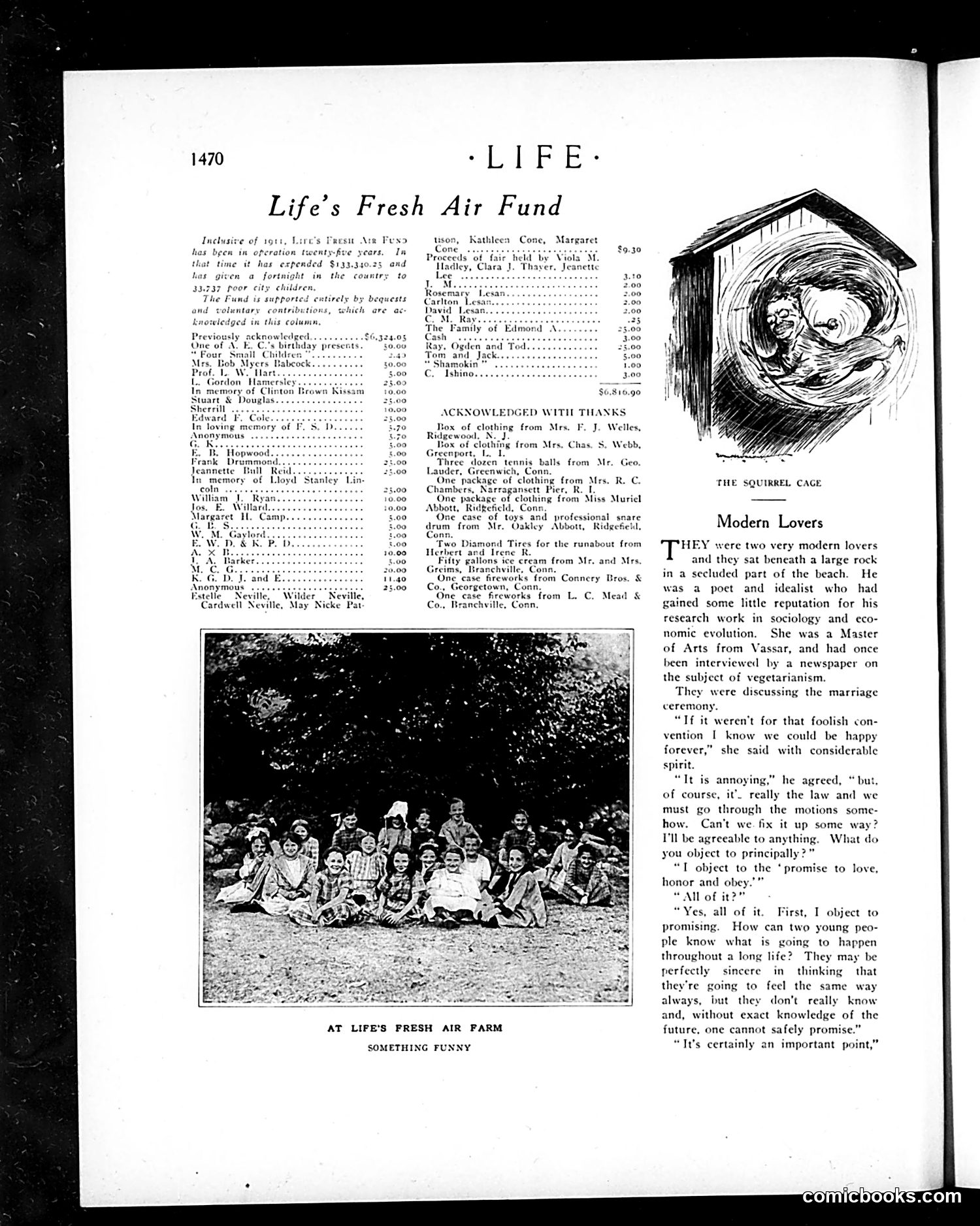
This page contains two distinct elements: **Upper section:** A fundraising list for "Life's Fresh Air Fund," showing donations from readers toward sending poor city children to the countryside for health benefits. The amounts and donor names suggest this was a genuine charitable appeal, not satire. **Lower section:** A photograph labeled "AT LIFE'S FRESH AIR FARM / SOMETHING FUNNY" showing a large group of children and adults at what appears to be an outdoor farm setting, likely documenting the charitable program in action. **Right side:** An unrelated short story titled "Modern Lovers" about two intellectuals debating marriage conventions—he's a poet and sociologist, she studied economics and vegetarianism. Their dialogue satirizes modern attitudes toward traditional marriage vows. The page mixes genuine philanthropy with literary humor typical of Life magazine's format.
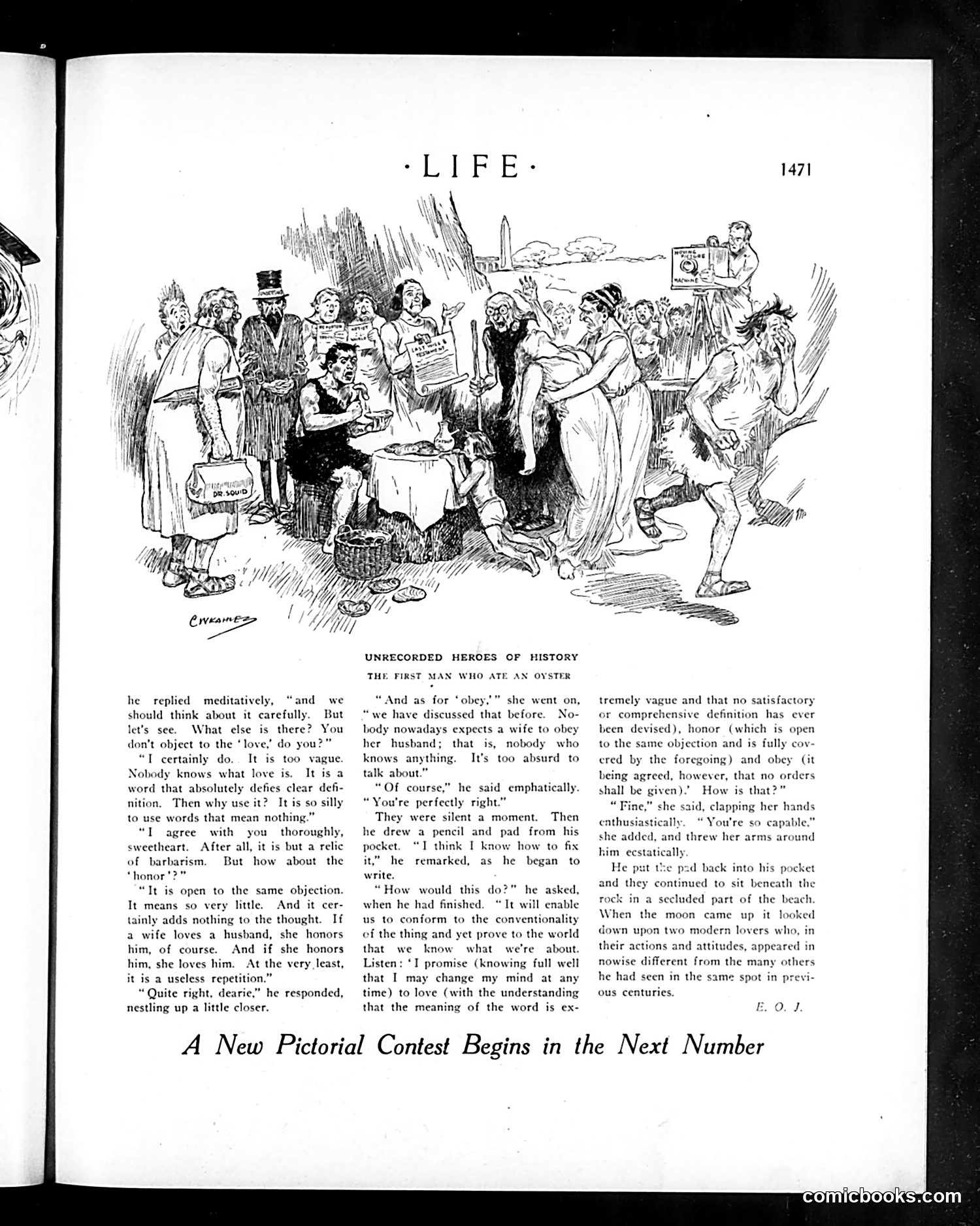
This page from *Life* magazine presents a satirical illustration titled "Unrecorded Heroes of History: The First Man Who Ate an Oyster." The cartoon depicts a chaotic beach scene where a man sits at a table sampling an oyster while a crowd of onlookers—appearing variously astonished, skeptical, and amused—surrounds him. The accompanying dialogue humorously explores the concept of "obedience" in marriage. A couple debates whether a wife should obey her husband, with the man eventually proposing they test the concept through a written agreement about changing social conventions. The satire targets evolving gender roles and marital dynamics of the era, using the absurd premise of the "first oyster eater" as a frame for discussing how unconventional behavior challenges social expectations and definitions of wifely duty.
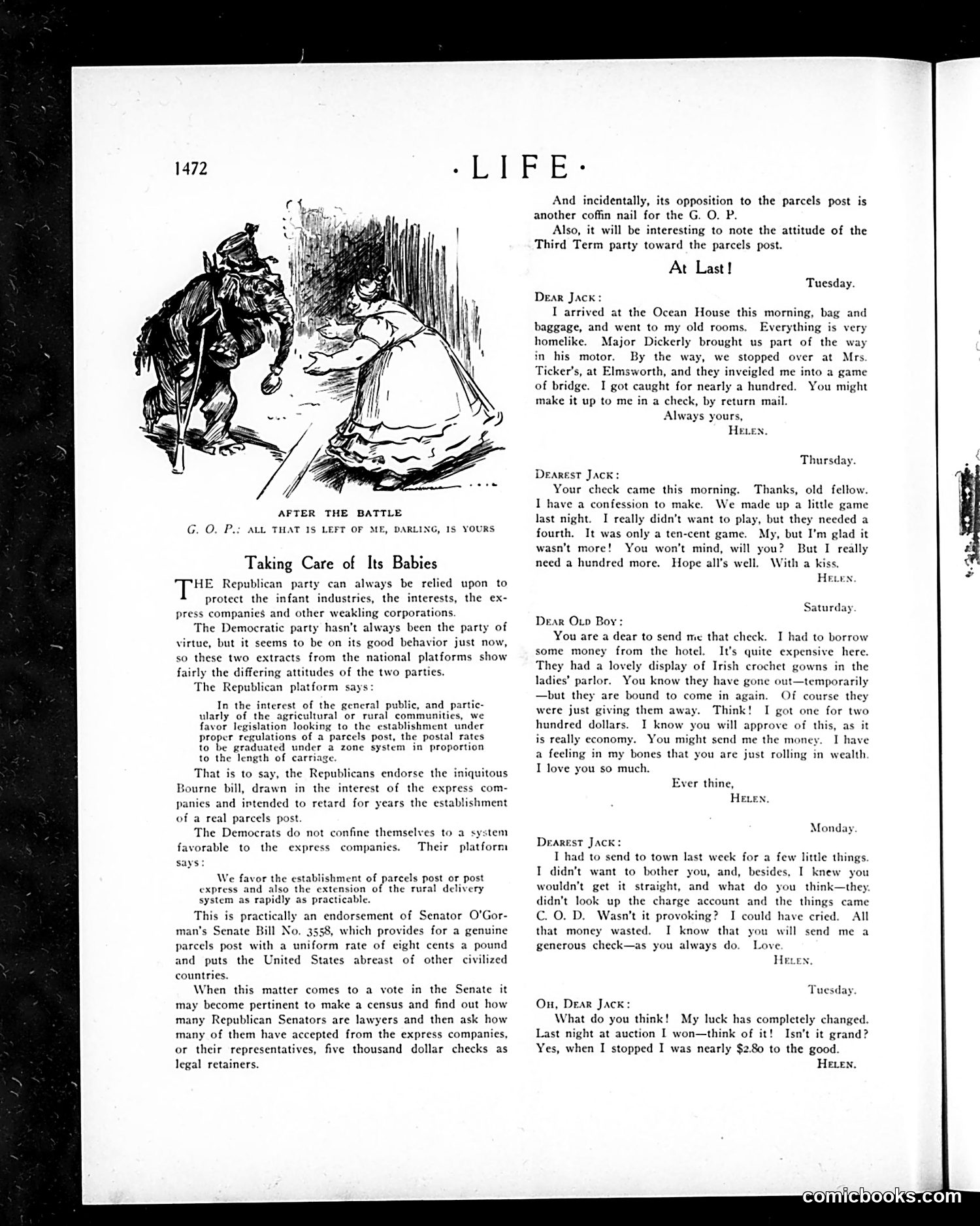
The main cartoon, titled "After the Battle," depicts a dejected figure labeled "G.O.P." (Republican Party) amid wreckage, with the caption "all that is left of me, darling, is yours." This satirizes Republican electoral defeat—likely referencing recent Democratic victories. The accompanying article, "Taking Care of Its Babies," criticizes Republican hypocrisy regarding parcels post and express company regulation. It notes Republicans claim to protect infant industries while actually serving express companies' interests, contrasting this with Democrats' genuinely pro-expansion stance on postal services. The letters from "Helen" and "Jack" appear to be a separate domestic correspondence column, unrelated to the political content.
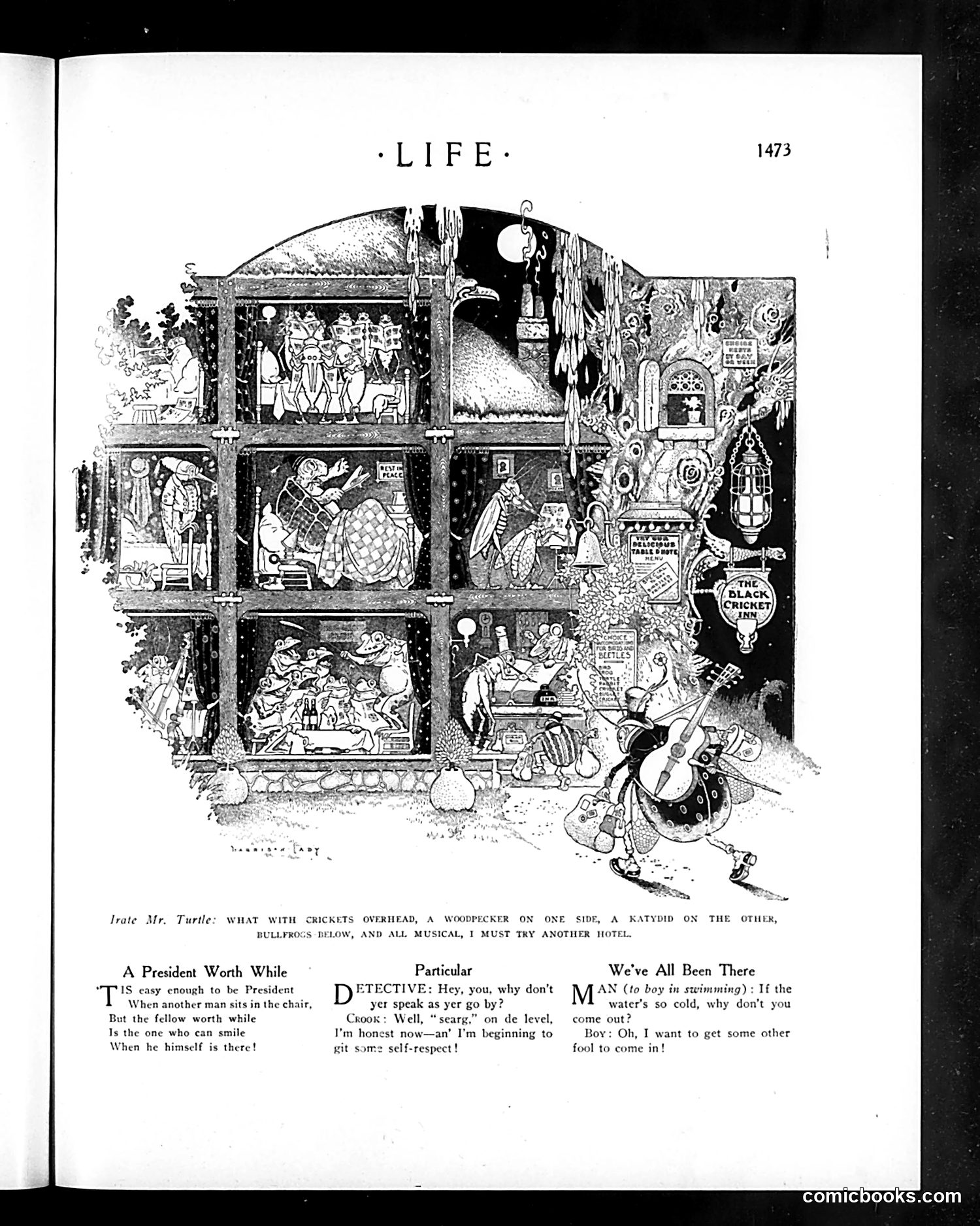
This page from *Life* magazine features a cross-section illustration of a hotel building with multiple rooms showing various activities and guests. The main cartoon depicts "Irate Mr. Turtle" complaining to hotel management about noise disturbances—crickets overhead, a woodpecker on one side, a katydid on the other, and general musical chaos from other guests, forcing him to seek another hotel. Below are three separate comic vignettes with dialogue: 1. **"A President Worth While"** - jokes about presidential qualities 2. **"Particular"** - a detective and crook exchange about honesty and self-respect 3. **"We've All Been There"** - a boy and man discuss swimming in cold water The humor relies on wordplay, everyday social situations, and gentle satire typical of early 20th-century American humor magazines. No specific political figures appear identifiable.
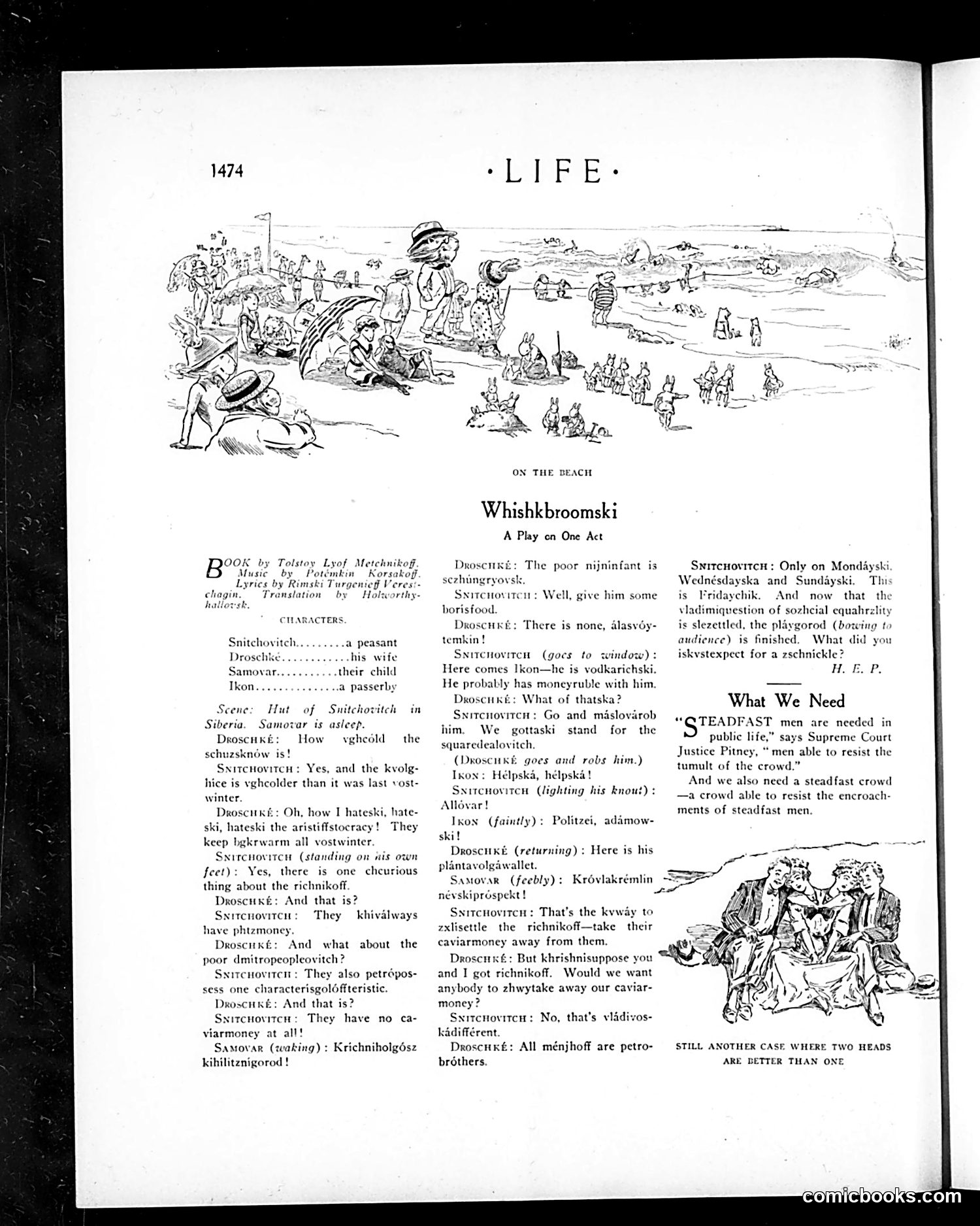
This page satirizes Russian literature and revolutionary politics through absurdist theatrical parody. The "play" mocks Tolstoy, Turgenev, and other celebrated Russian authors by presenting a crude sketch of Russian peasant life filled with intentionally mangled pseudo-Russian dialogue (vodkarichski, caviar-money, etc.). The plot—peasants robbing a wealthy traveler—appears to lampoon socialist rhetoric about redistributing wealth from the rich. The final exchange reveals the satire's bite: the peasants declare they'd never surrender their own riches if roles reversed, exposing the hypocrisy of revolutionary ideology that preaches equality while driven by self-interest. The sidebar article "What We Need" extends this critique to American politics, sarcastically calling for crowds "able to resist the encroachments of steadfast men"—likely referencing contemporary debates over populism versus elite authority. The illustration depicts a crowded beach scene, unrelated to the Russian play text.
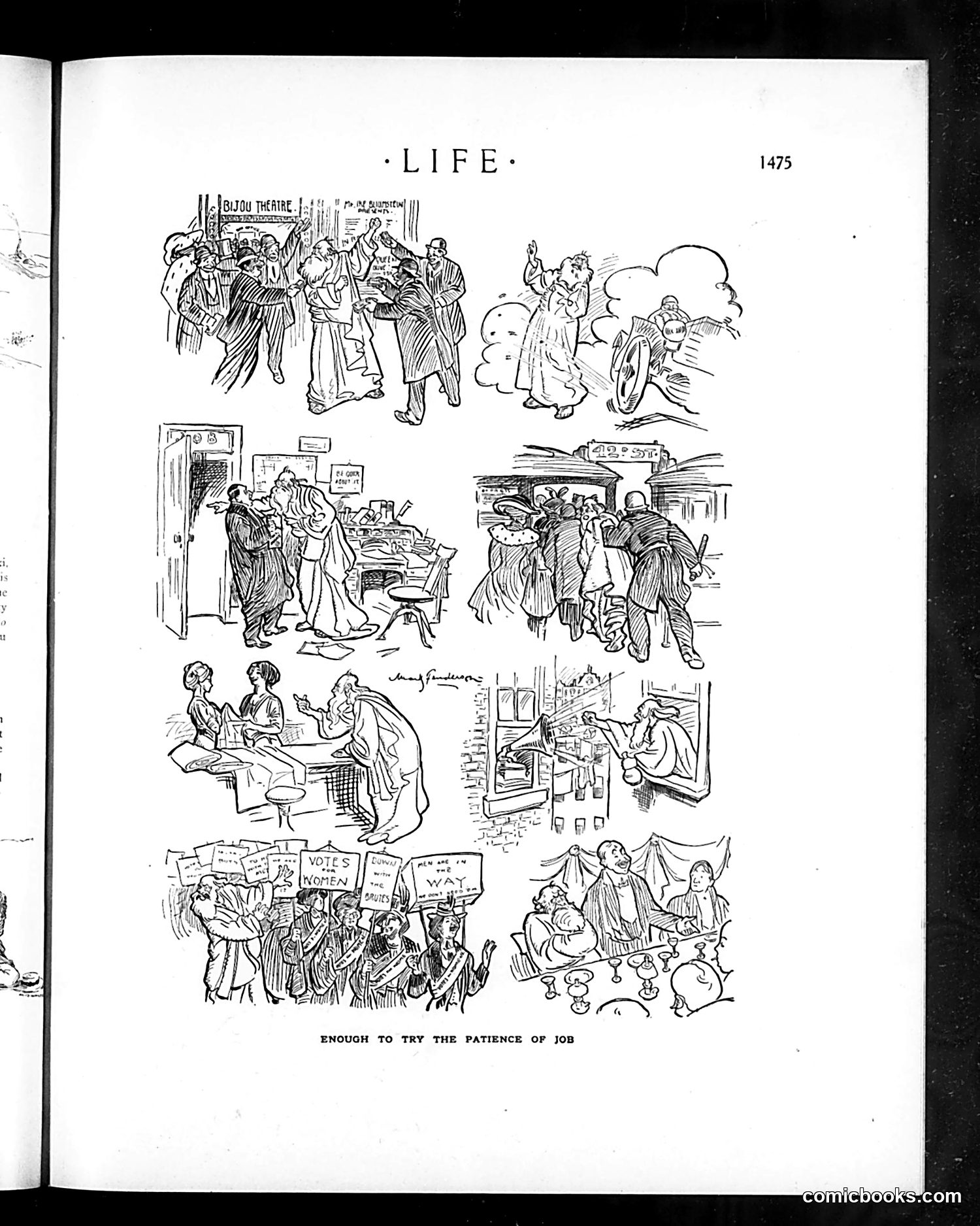
This satirical comic page depicts various frustrations of early 20th-century life, structured around the biblical reference to Job—a figure famous for enduring extreme suffering while maintaining patience. The six vignettes show: - **Theater chaos**: crowded, disorderly patrons - **Traffic accident**: an automobile collision - **Domestic disorder**: messy household management - **Window shopping**: frustrated consumers - **Women's suffrage protest**: demonstrators holding "Votes for Women" signs - **Domestic turmoil**: a chaotic family scene The satire suggests that modern life—from traffic accidents to women's activism—presents enough daily annoyances to test anyone's tolerance. The Job reference implies that contemporary frustrations, while trivial compared to biblical trials, nonetheless accumulate into genuine exasperation. This reflects period anxieties about modernization, women's rights movements, and social change.
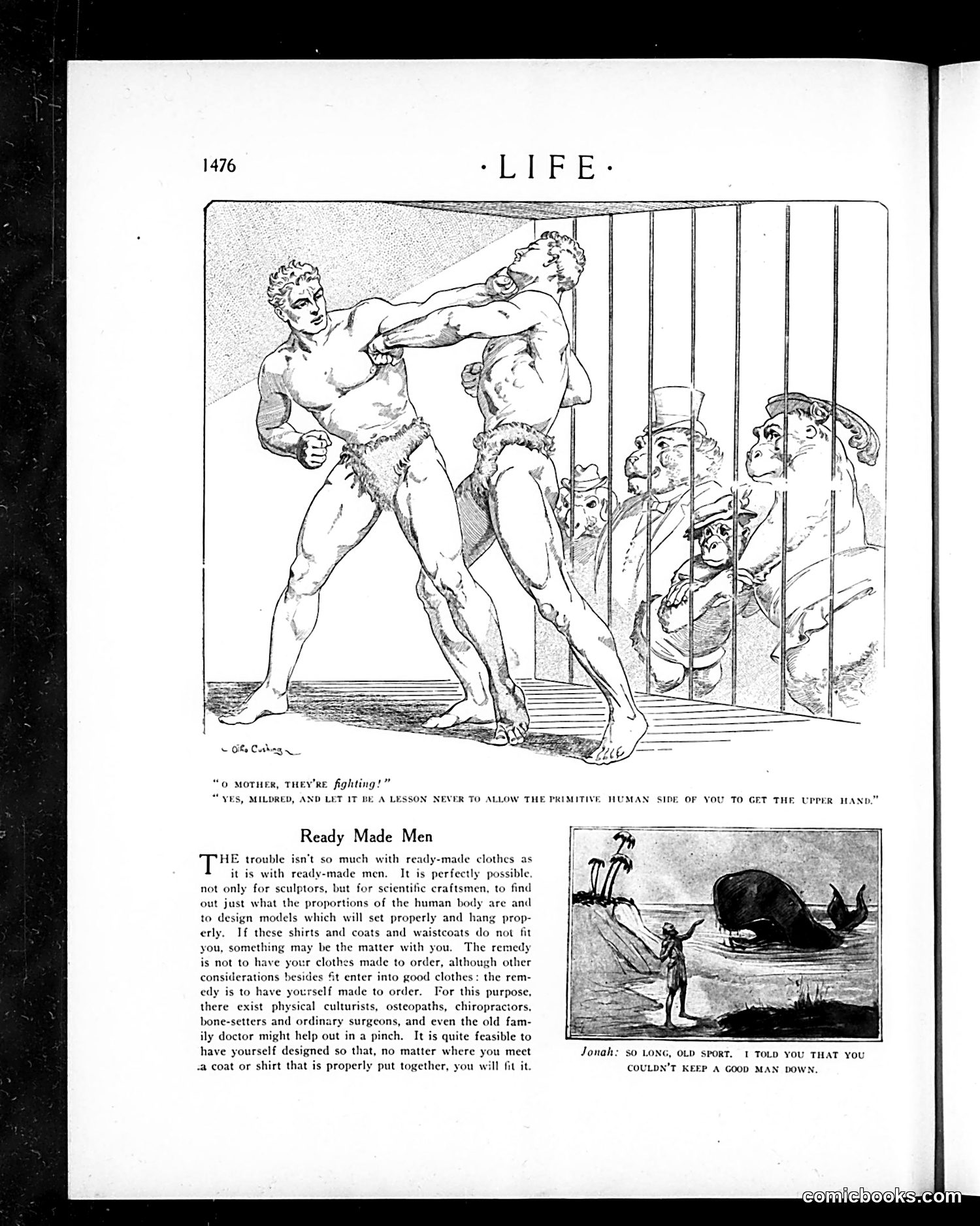
**Top Cartoon**: Two nude male figures fight while children watch from behind bars. The mother tells her daughter Mildred to observe this as a lesson—specifically, not to let your "primitive human side" dominate. This satirizes Victorian-era anxieties about civilized restraint. The fighting men represent base human nature; the caged children represent civilization's constraints. The joke targets middle-class pretensions about suppressing instinct and maintaining propriety. **"Ready Made Men" Article**: A satirical piece mocking the ready-made clothing industry by extending the metaphor absurdly. Instead of blaming poorly-fitting clothes on manufacturing, the text suggests people should remake *themselves*—via physical culturists, chiropractors, and surgeons—to fit standard garments. It's humorous social commentary on both mass production and early-20th-century fads for physical self-improvement and body modification. **Bottom Cartoon**: Jonah, rescued from the sea, tells an old sport he couldn't be kept down. This appears to reference the biblical Jonah story as cultural shorthand for resilience.
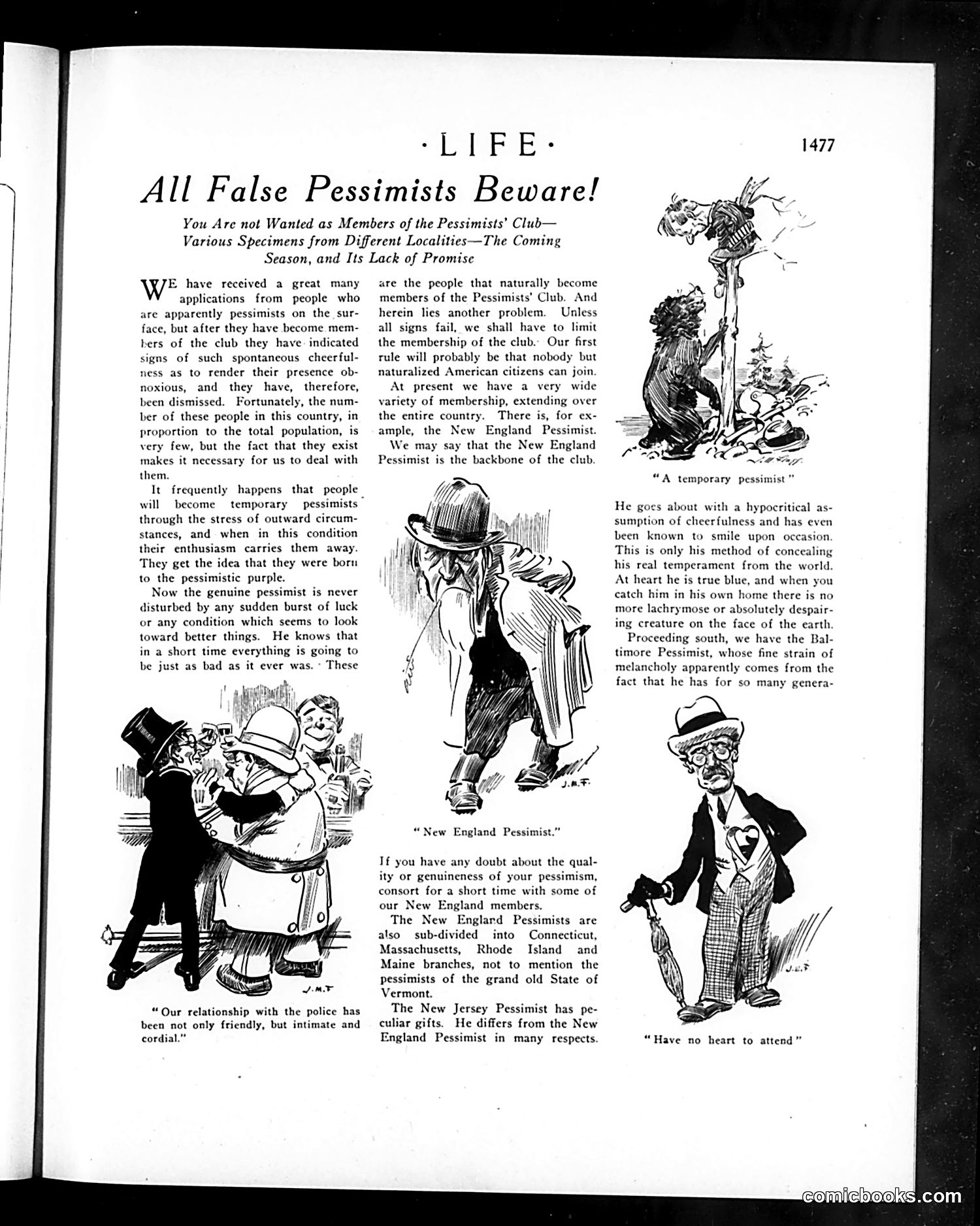
This satire mocks a fictional "Pessimists' Club" that allegedly screens members for *genuine* pessimism. The joke targets Americans who adopt pessimistic attitudes as a fashionable pose during hard times, then abandon it when circumstances improve—"temporary pessimists" the Club must expel. The cartoon catalogs regional pessimist "types": the dour **New England Pessimist** (backbone of the club), the **New Jersey Pessimist** (who hides despair behind false cheerfulness), and the **Baltimore Pessimist** (melancholy by heredity). The caricatured figures—sad men in period dress—illustrate these regional stereotypes. The satire's target is clear: Americans who adopt pessimism superficially rather than embodying it authentically. The Club's tongue-in-cheek "rule" restricting membership to naturalized citizens adds xenophobic humor typical of the era. The piece satirizes both pessimism-as-fashion and American regional stereotyping.
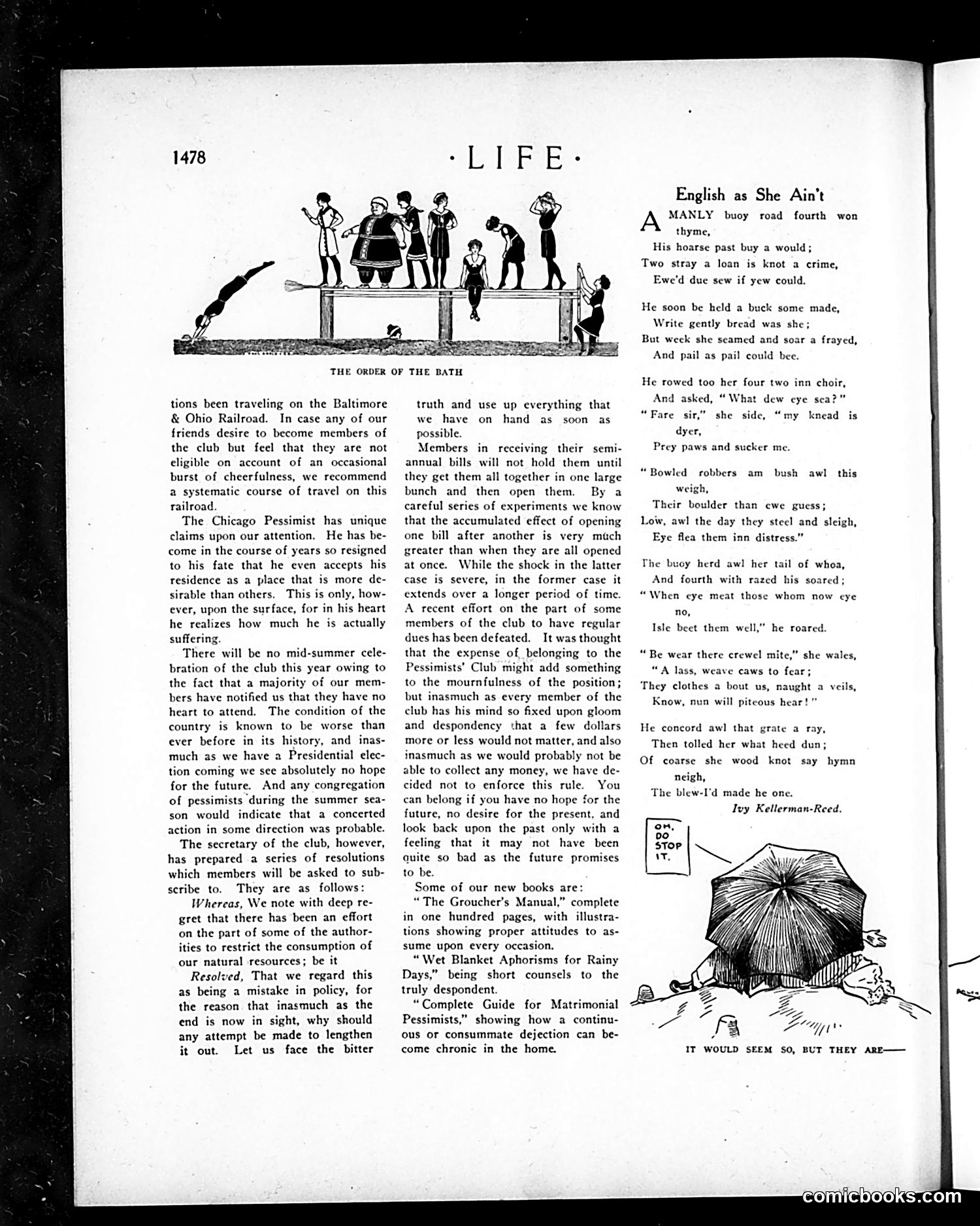
This page satirizes American pessimism through a fictional "Pessimists' Club" whose members are so despondent they won't even gather for celebrations. The club's resolutions mock defeatism—advocating exhausting natural resources since "the end is now in sight" and opening bills separately to prolong suffering. References to the Baltimore & Ohio Railroad suggest travel-induced misery, while a "Chicago Pessimist" exemplifies resigned hopelessness. The cartoon "The Order of the Bath" (top) depicts club members on a platform, likely showing the physical manifestation of their gloom. The right column, "English as She Ain't," is wordplay humor using homophone puns (buoy/boy, won/one, sew/sow) to mock incorrect English spelling and pronunciation. These appear unrelated vignettes sharing only the theme of American social absurdity and incompetence that Life magazine frequently lampooned.
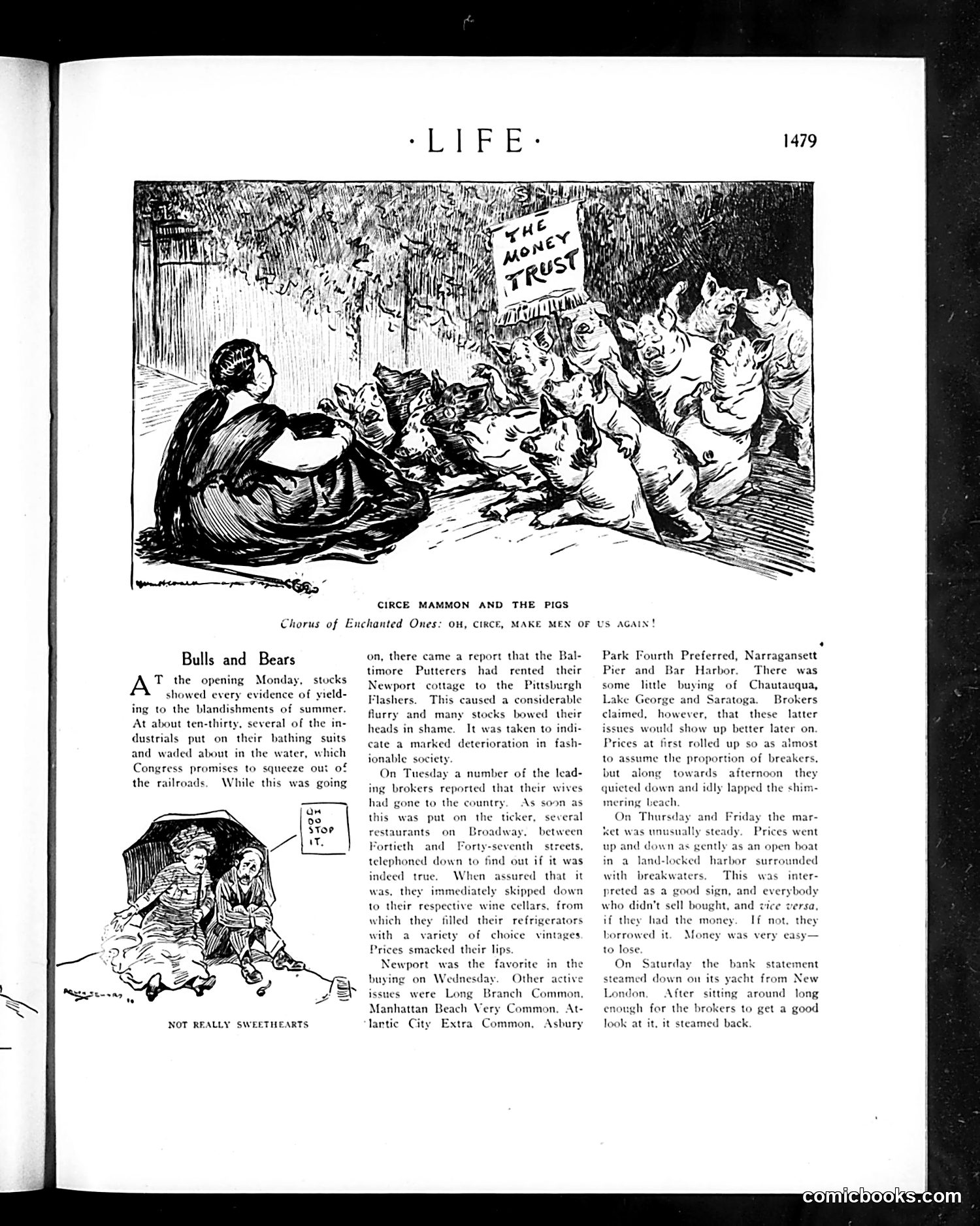
The top cartoon satirizes financial speculation during summer market volatility. "Circe" (the mythological enchantress) represents "Mammon" (wealth/greed), depicted as a woman feeding pigs—the "enchanted ones" are stockbrokers and investors transformed into animals by their obsession with money. The sign reads "The Money Trust," referencing contemporary anxieties about concentrated financial power. The article "Bulls and Bears" mocks the irrational behavior of wealthy elites and brokers during summer trading. It uses absurdist humor: stocks "wading" in water, society matrons fleeing to Newport causing market fluctuations, brokers raiding wine cellars when their wives leave town, and banks theatrically steaming yachts to influence investor confidence. The satire targets the hollow materialism and herd mentality of the financial class—their decisions driven by fashion, gossip, and fear rather than fundamentals. The reference to the "Money Trust" suggests critique of Gilded Age financial manipulation and monopolistic banking practices.
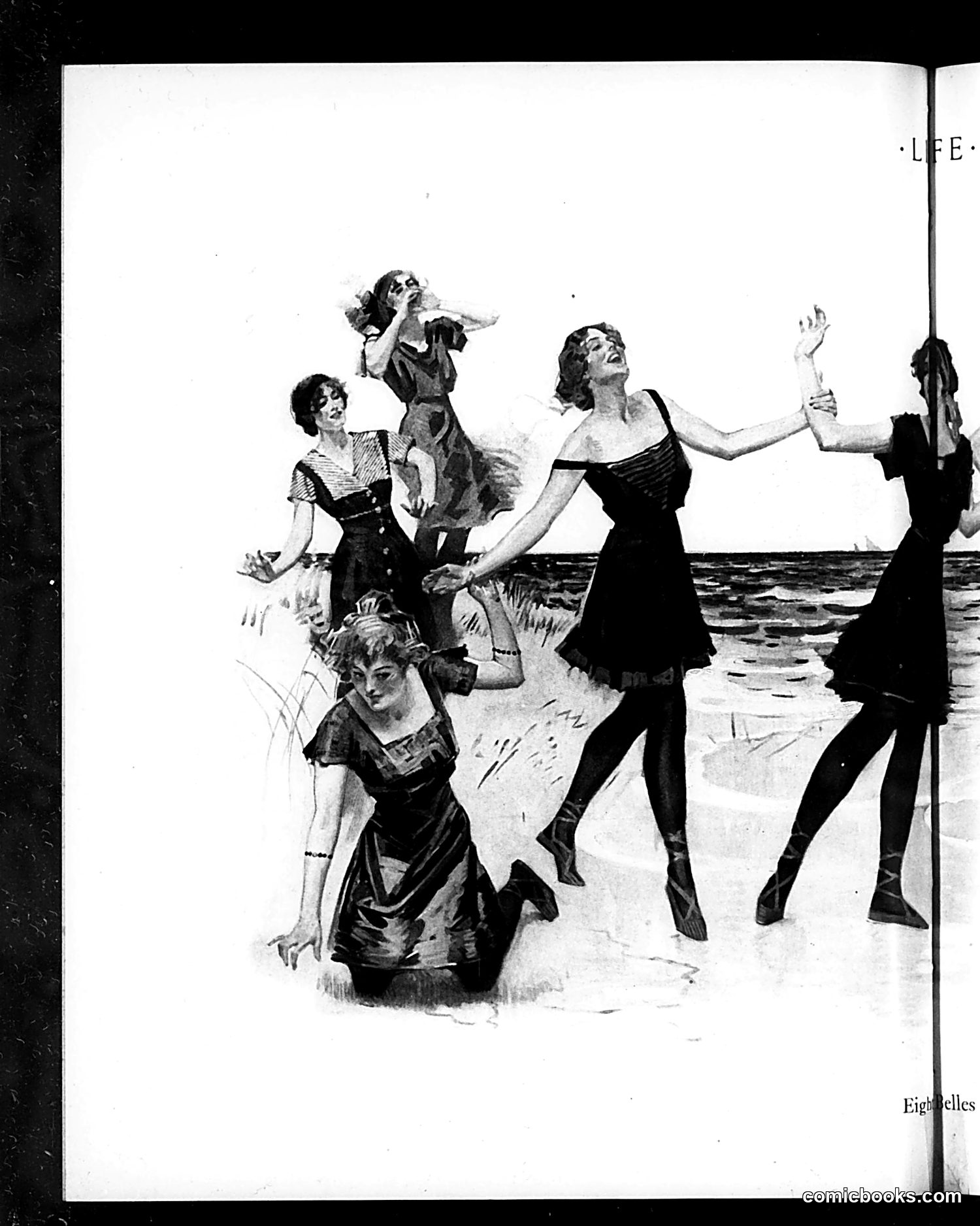
This page from *Life* magazine shows an illustration credited to "Eighbelles" depicting five women in early 20th-century dress at a beach. The women display varying poses and expressions—some animated and exuberant, others more reserved—suggesting different personality types or social attitudes. The OCR text is corrupted and unreadable, so I cannot identify specific satirical targets or the exact social commentary intended. However, the beach setting and contrast between the women's demeanor suggests the cartoon likely comments on **women's changing social roles or attitudes** during this era—possibly contrasting traditional propriety with emerging modern independence. Without legible text, the specific joke or satirical point remains unclear.
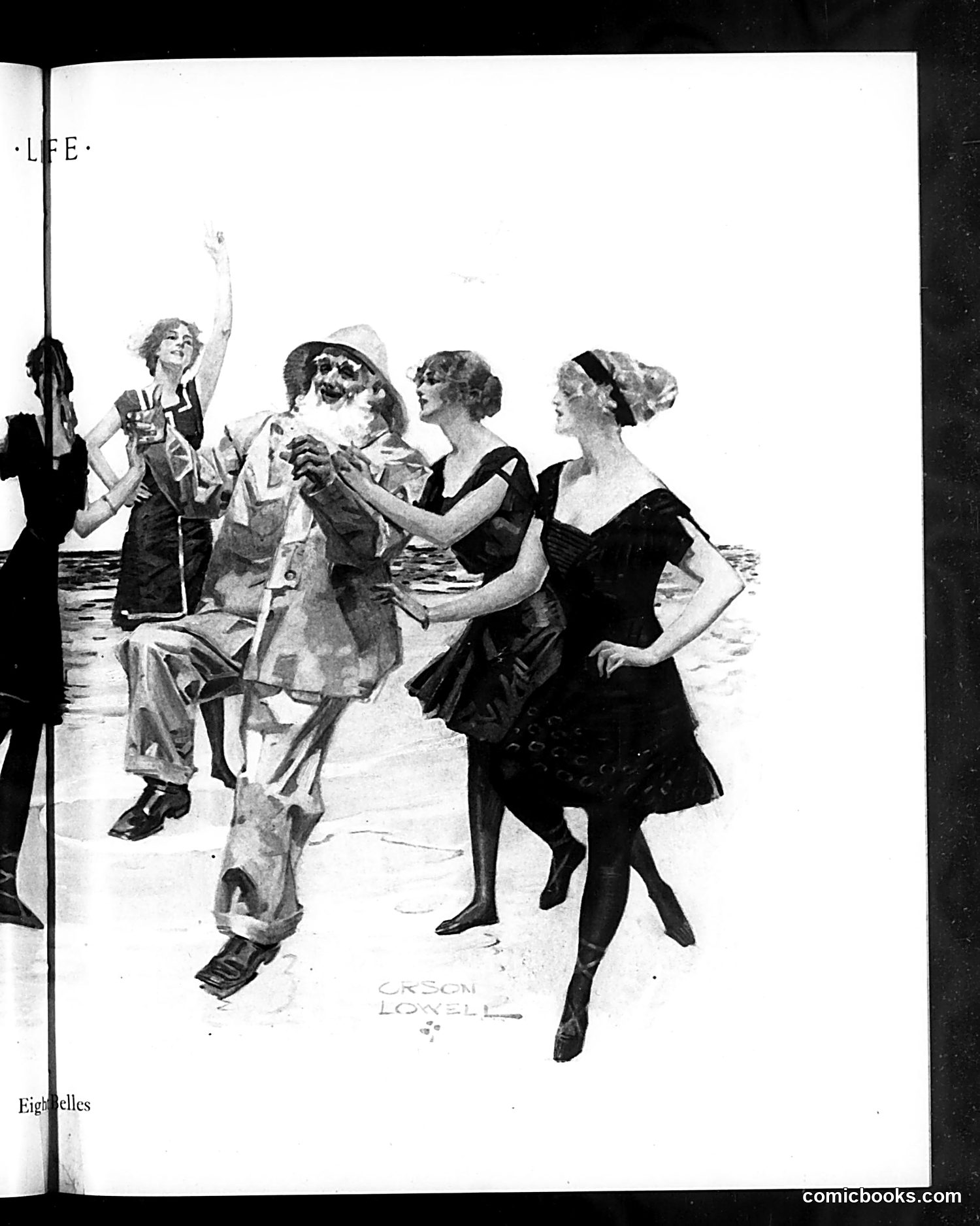
This page from *Life* magazine features an illustration signed by Carsol Lowell showing a comedic beach scene. A caricatured male figure in old-fashioned bathing attire and hat stands amid three elegantly dressed women in 1920s-style black dresses. The man appears disheveled or ridiculous by contrast, with an exaggerated expression suggesting embarrassment or alarm. The satire likely mocks either outdated masculine fashion sensibilities or generational differences in beachwear standards during the Jazz Age. The women's sophisticated modern dress contrasts sharply with the man's absurd appearance, suggesting commentary on changing social norms or the gap between old and new styles. Without additional context, the specific target remains unclear, though it appears to ridicule male fashion vanity or obsolescence.
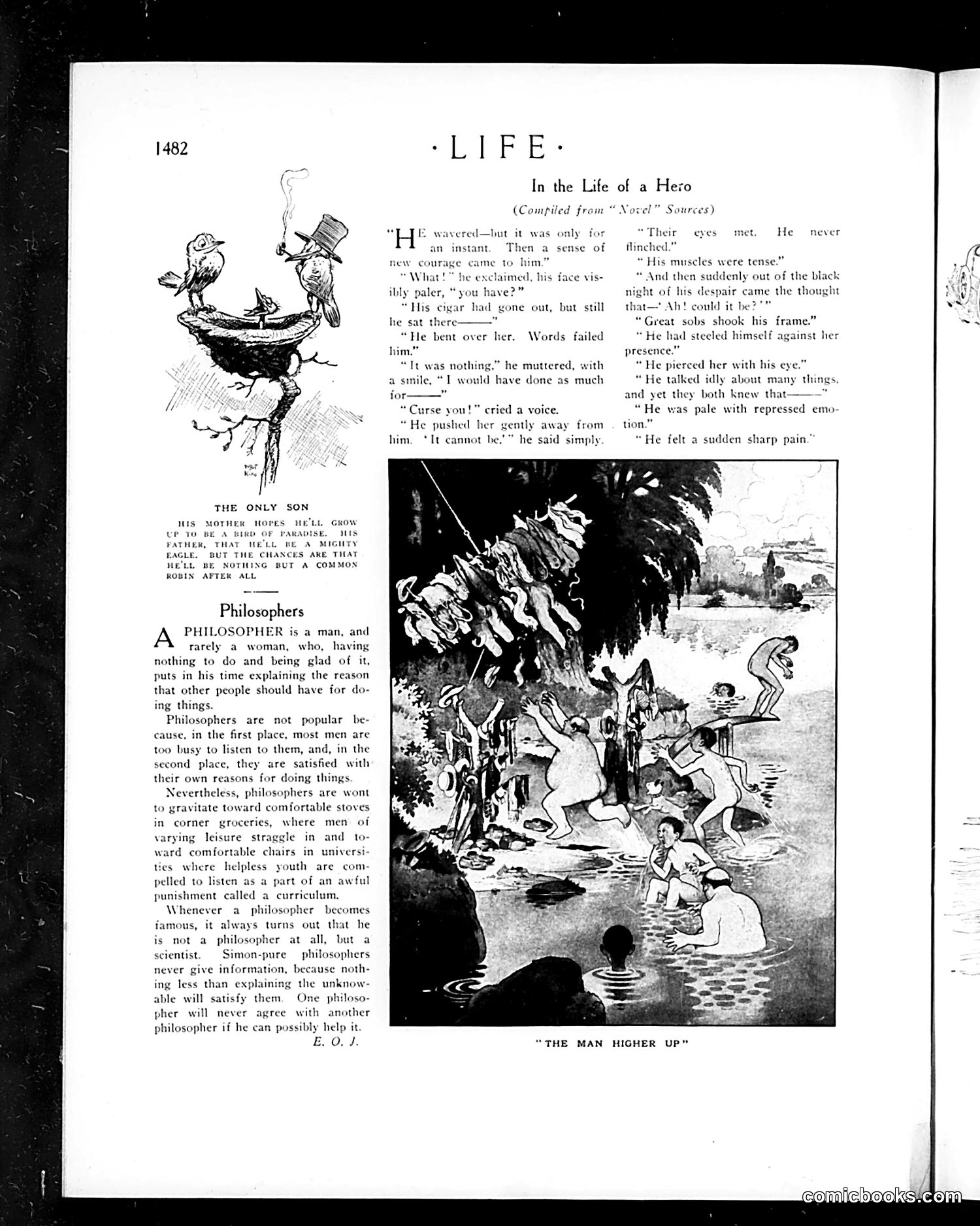
This page contains two satirical pieces: **"The Only Son"** (top left): A brief joke mocking parental aspirations. Parents hope their son becomes exotic ("bird of paradise" or "mighty eagle"), but he'll likely end up ordinary—"a common robin after all." The satire targets middle-class parents' unrealistic hopes for their children. **"Philosophers"** (lower section): A humorous essay defining philosophers as impractical men who waste time explaining things to people too busy to listen. The satire highlights their uselessness, their tendency to gather in corner grocery stores, and their inability to agree on anything. The author notes that "famous philosophers" turn out to be scientists instead—implying pure philosophy produces nothing of value. **"In the Life of a Hero"** (right): Excerpts from melodramatic novel passages, accompanied by illustrations. This appears to mock overwrought romantic fiction with its purple prose ("His muscles were tense," "pierced her with his eye"). The satire targets sentimental literary conventions of the era.
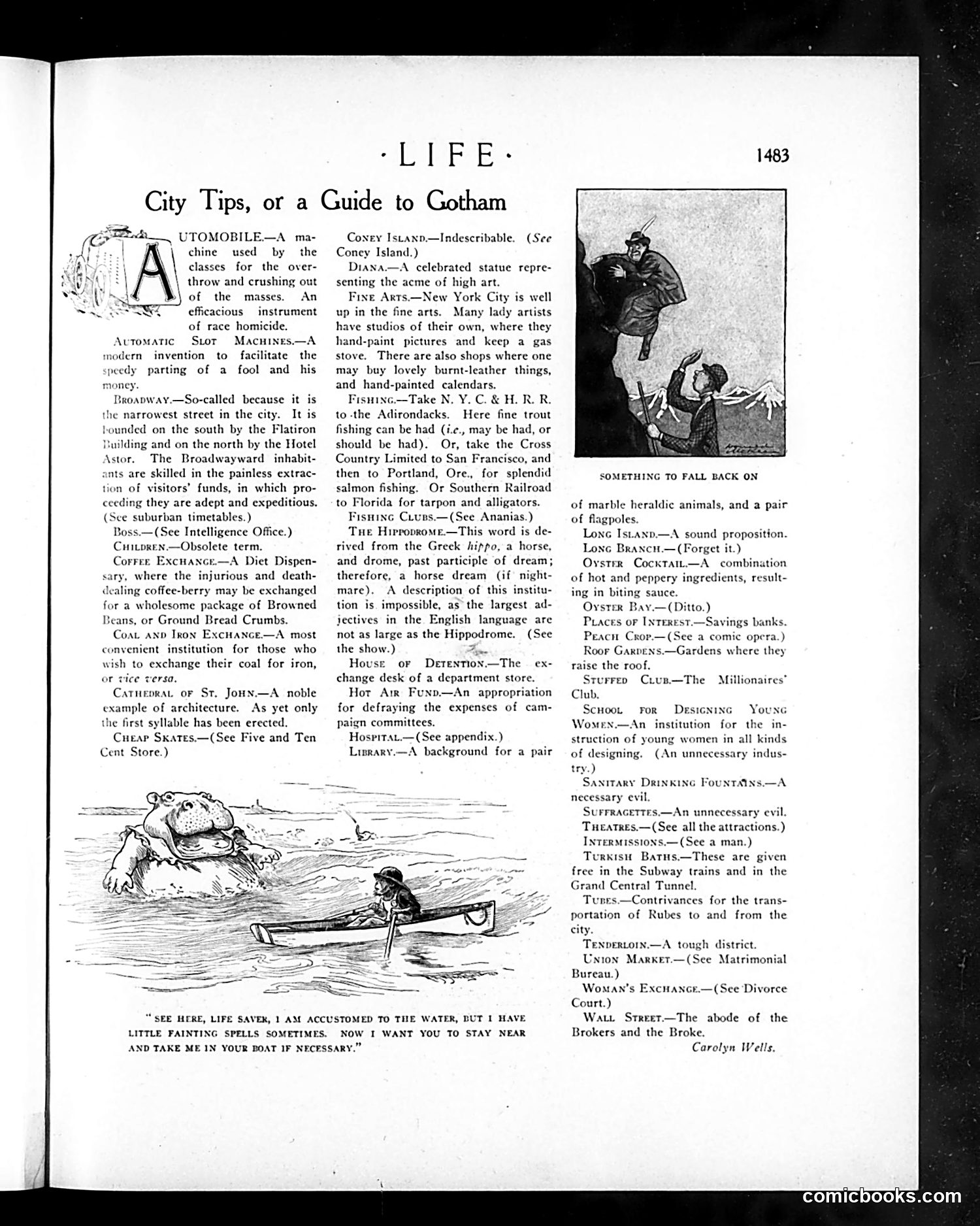
This is a satirical "guide" to New York City that uses mock-definitions to critique urban institutions and social problems. Life magazine's humor here targets: **Social commentary**: Automobiles described as instruments of "race homicide" (reflecting early-1900s concerns about traffic deaths); slot machines as tools for separating fools from money; Broadway pickpockets extracting tourists' funds. **Institutional critique**: Department stores' exchange desks called a "House of Detention"; savings banks labeled "Places of Interest"; the incomplete Cathedral of St. John mocked for having only its first syllable built. **The cartoon** shows a drowning woman asking a lifeguard to stay nearby because she has "fainting spells"—satirizing dependency and helplessness, likely commenting on contemporary attitudes about women's weakness. The author (Carolyn Wells) uses absurdist definitions throughout—libraries as "backgrounds for flagpoles," Oyster Bay as mere "(Ditto)" to Oyster Cocktail—to expose New York's greed, fraud, and social pretension with biting wit.
This is a scathing book review disguised as playful literary criticism. Life's reviewer attacks author Basil King (referred to only as "the author of 'The Inner Shrine'" to maintain mock courtesy) for his three novels, particularly *The Street Called Straight*. The satire compares King to a con artist: a skilled manipulator peddling "counterfeit ideals" and "forged virtues" to sentimental readers. The reviewer acknowledges King's technical storytelling ability—his narrative "swing and movement" distracts readers from recognizing the moral emptiness beneath. *The Inner Shrine* is dismissed as glorifying "mock-modesty and mush-morals"; *The Wild Olive* as a hollow "puppet" with merely surface "virility." The core complaint: King trades in sentimental melodrama presented as realistic psychology, using clever narrative tricks to distract intelligent readers from noticing the intellectual fraud.
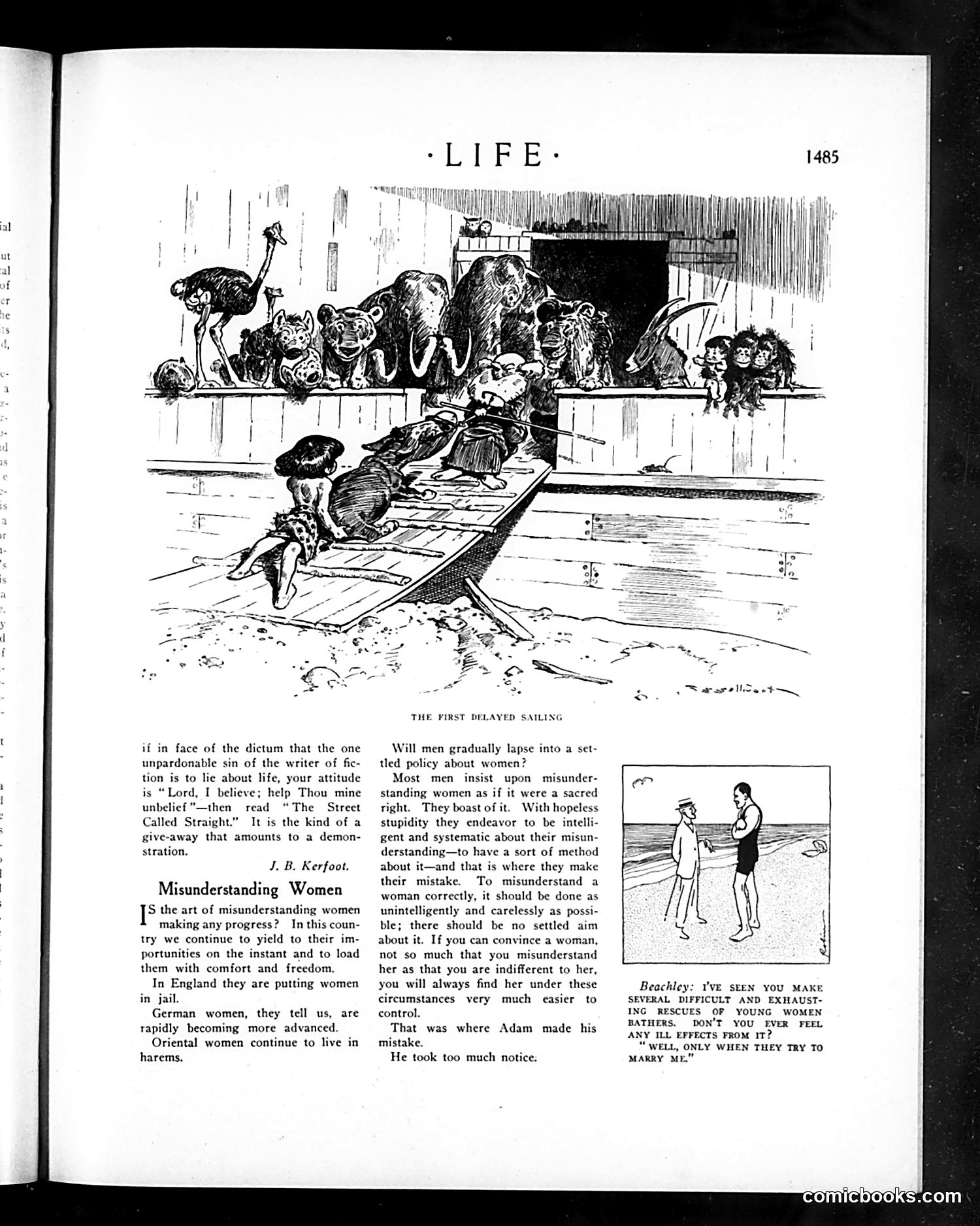
**Top Cartoon ("The First Delayed Sailing"):** Depicts various animals (ostrich, hyenas, elephants, monkeys) lined up at a wooden platform, with a human figure lying on it. The satire appears to critique human behavior by comparing people unfavorably to animals—suggesting humans are as animalistic or foolish as beasts. **Article "Misunderstanding Women":** A satirical essay claiming men *should* misunderstand women to control them. It surveys women's status globally (imprisoned in England, advancing in Germany, confined to harems in the Orient) before arguing that men's greatest power lies in indifference rather than understanding. The biblical reference to Adam "taking too much notice" frames male attention as weakness. **Bottom Cartoon:** A lifeguard explains his "ill effects" from rescuing young women bathers are that they try to marry him—satirizing gold-digging or opportunistic behavior by rescued women. **Context:** This reflects early-20th-century gender attitudes—treating women's liberation movements as absurd while simultaneously mocking both male romantic vulnerability and female agency.
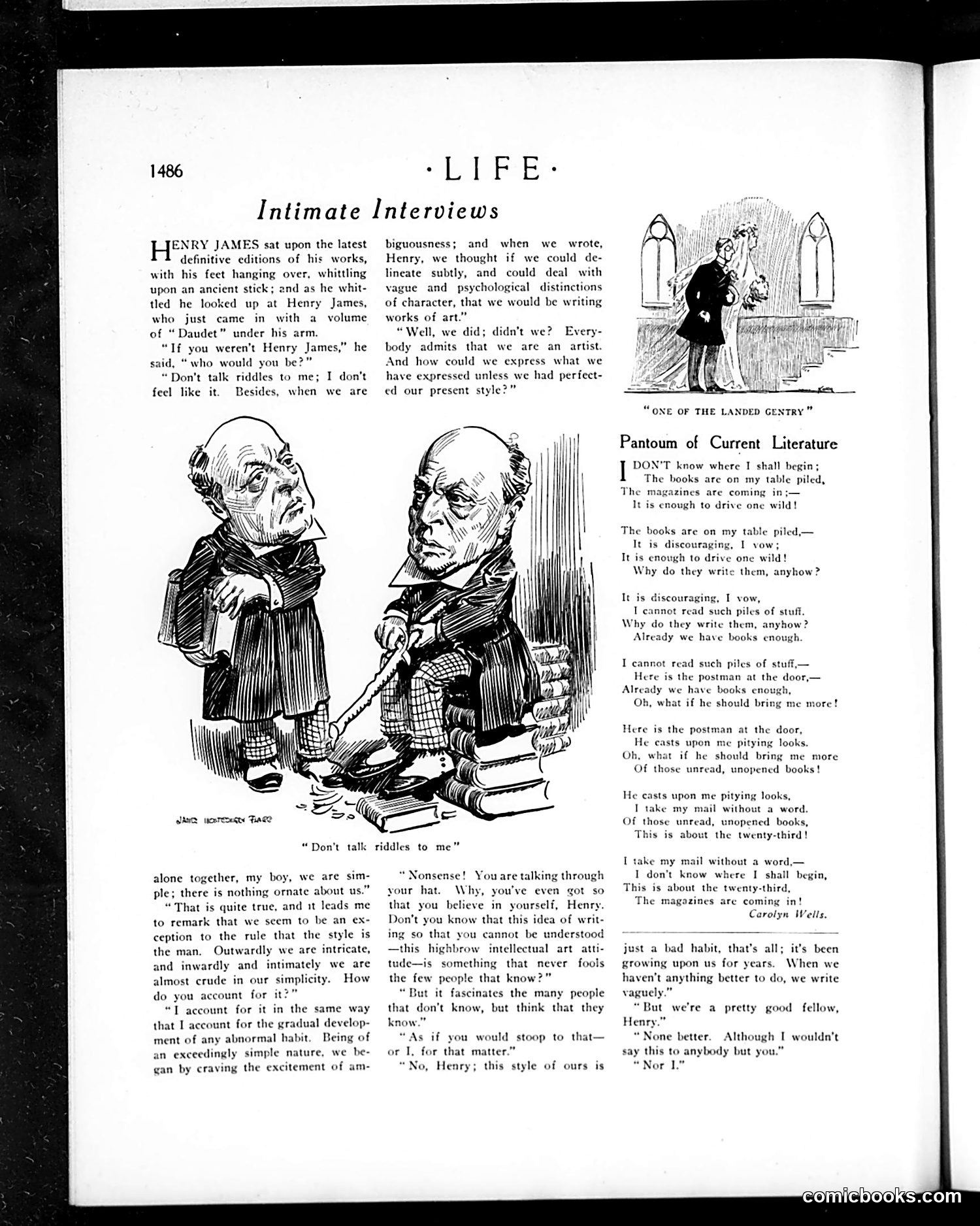
This page satirizes **Henry James**, the famous American novelist known for his elaborate, psychologically complex prose style. The cartoon depicts two figures representing James debating his own literary approach. **The satire's point:** James and his alter ego discuss how their ornate writing style developed from simple habits—they craved "ambiguousness" and deliberately made their work difficult to understand. The conversation mocks James's pretentious artistic justifications while suggesting the complexity is partly affectation and habit rather than genuine necessity. **Key joke:** James admits their obscure style "fascinates the many people that don't know, but think that they know"—satirizing how intellectually intimidating writing attracts readers seeking status rather than understanding. The accompanying poem "Pantoum of Current Literature" reinforces the critique by portraying a reader overwhelmed by the sheer volume of books being published, unable to keep up—implying that verbose, difficult literature contributes to this exhausting cultural overproduction.
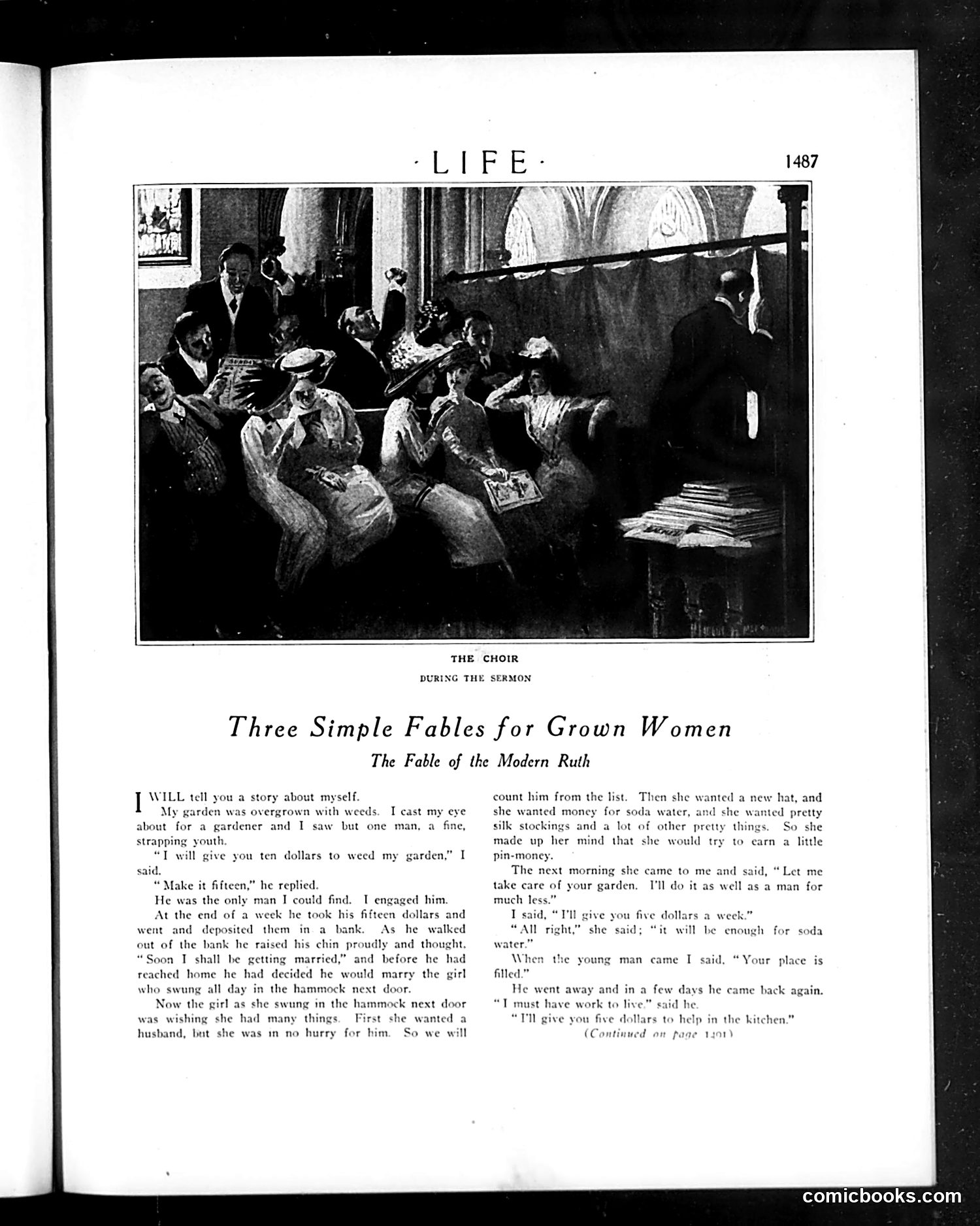
The photograph shows a church choir seated during a sermon, capturing an unguarded moment of social behavior—the women appear to be gossiping, fidgeting, or distracted rather than devoutly attending to the service. This serves as visual satire on hypocrisy: ostensibly pious churchgoers failing to maintain proper religious decorum. The accompanying story, "The Fable of the Modern Ruth," satirizes the economic and social ambitions of early 20th-century women. A woman hires a young gardener for wages, then—recognizing his newfound earning power and marriage prospects—she secures employment in the same household to earn "pin-money" (discretionary income). The satire mocks women's materialism and calculated courtship tactics: rather than genuine love, the girl pursues the young man because he now has financial means. The biblical reference to Ruth (known for loyalty and virtue) underscores the irony—this "modern" version is purely transactional. Together, the image and text critique female duplicity and shallow values in contemporary society.
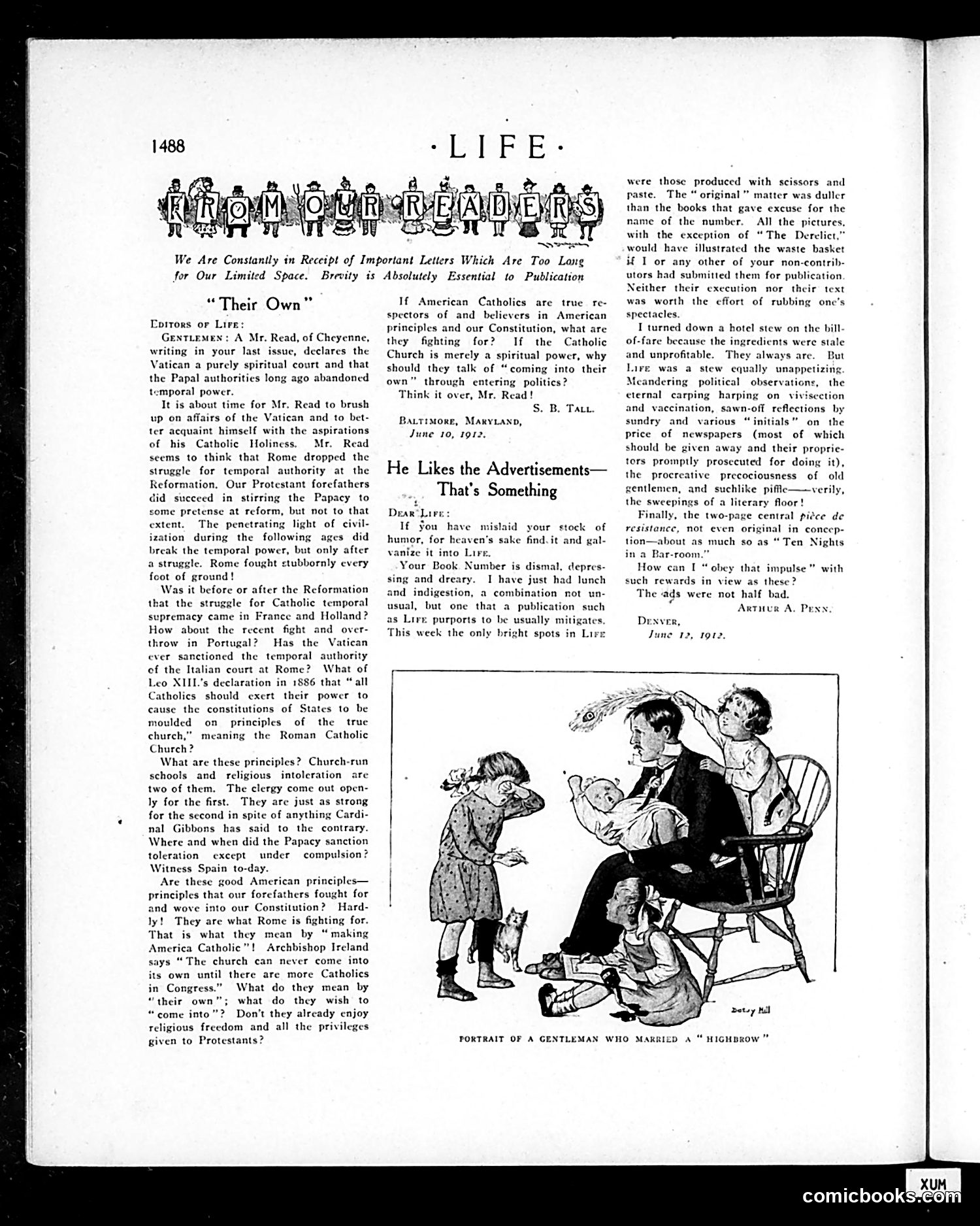
This page contains reader letters and a cartoon satirizing early 20th-century American religious and political tensions. **The Letters:** The main letter (S.B. Tall, Baltimore) attacks Catholic Church influence in American politics, directly challenging earlier claims that the Vatican is purely spiritual. Tall argues the Church actively seeks political power—citing Leo XIII's 1886 declaration and Archbishop Ireland's statements about Catholics "coming into" Congress. He presents this as contradicting American constitutional principles of church-state separation. **The Cartoon:** "Portrait of a Gentleman Who Married a 'Highbrow'" depicts a man surrounded by children while a woman gestures dismissively from above. The satire appears to mock educated or pretentious women (the "highbrow" wife) for abandoning domestic duties, leaving the overwhelmed husband managing the household. This reflects contemporary tensions about women's education and changing gender roles. Both items reflect Progressive-Era anxieties: Catholic political ambitions and debates over women's proper social role.
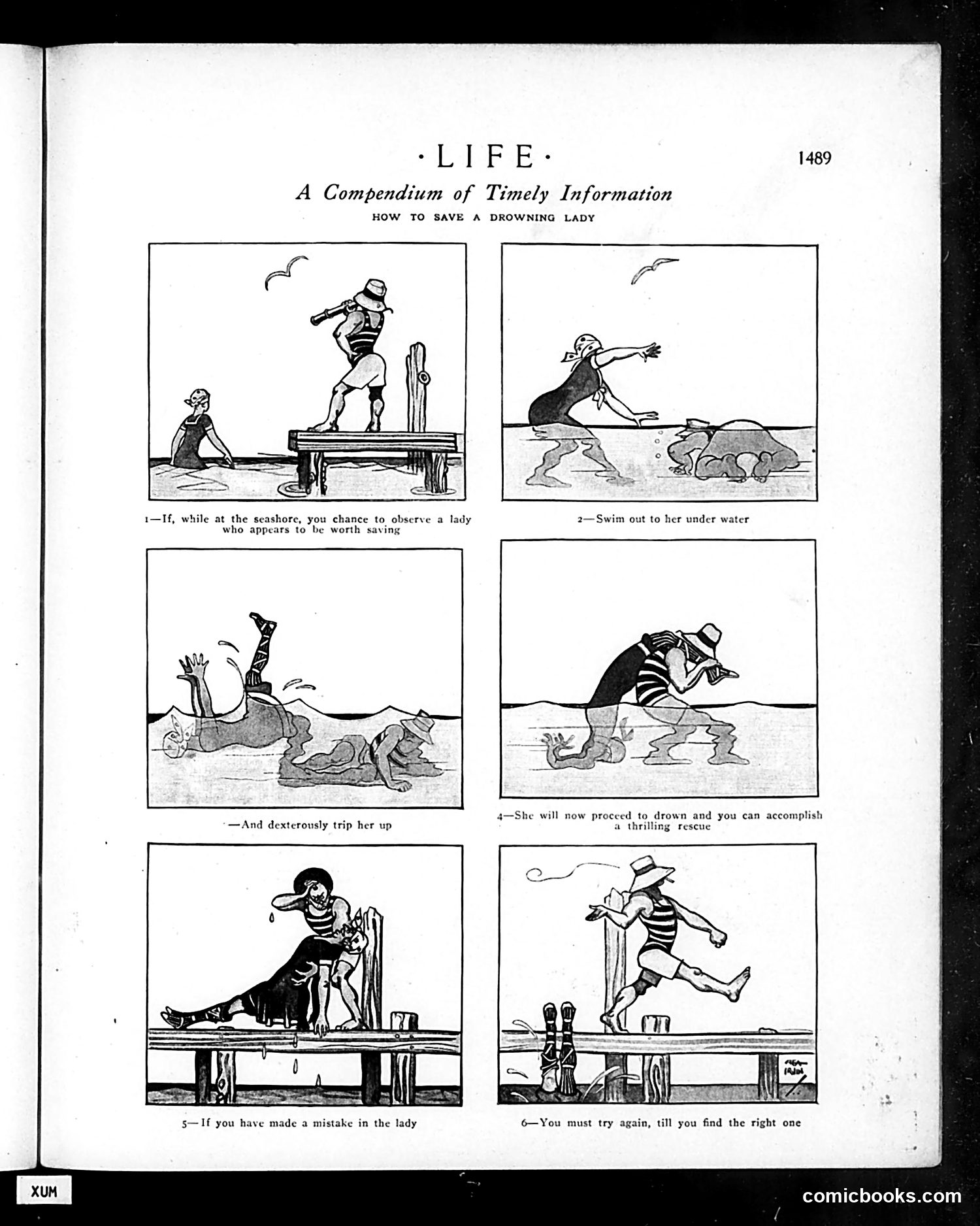
This is a satirical instructional comic mocking courtship and male behavior at the beach. The six-panel sequence presents absurdist "advice" for meeting women: A man observes an attractive woman at the seaside, then deliberately swims underwater to position himself for a dramatic "rescue." He pulls her from the water, appearing heroic. The satire culminates in panels 5-6: if he's grabbed the "wrong lady" (unattractive or undesirable), he should simply let her drown and try again with another woman until finding one "worth saving." The joke relies on the era's assumption that men orchestrate romantic encounters, combined with crude valuations of women's desirability. It satirizes both male vanity (the fantasy rescue scenario) and callous objectification—presented as darkly comedic "common sense." The crude humor reflects early 20th-century attitudes toward gender and courtship that would be considered deeply offensive today.
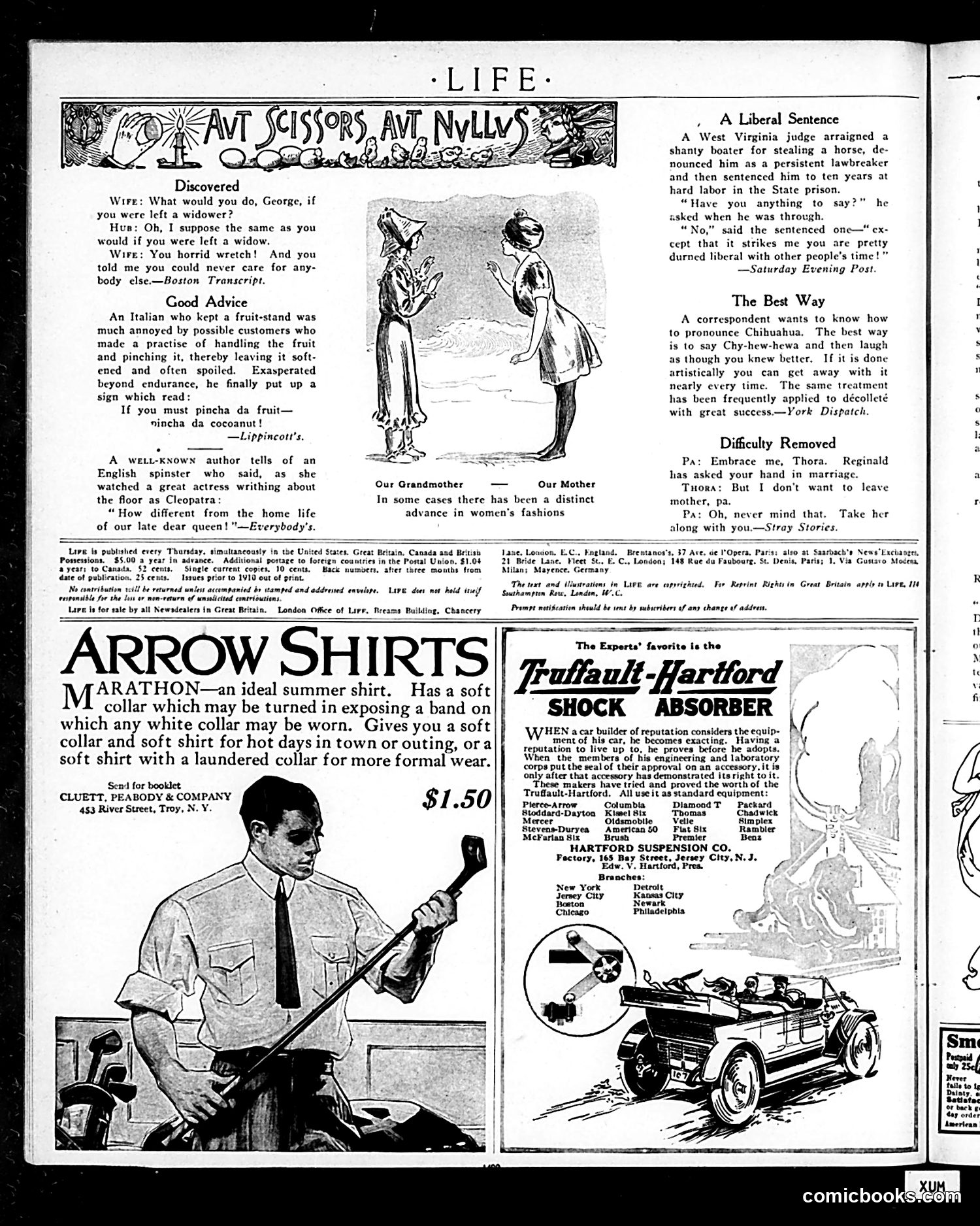
This is a humor page from *Life* magazine featuring short jokes and advertisements. The cartoons rely on early 20th-century domestic stereotypes: **"Discovered"** jokes about a husband's callous response to his wife's hypothetical widowhood—he'd replace her as easily as she'd replace him, shocking her with his candor. **"Good Advice"** mocks Italian immigrants through dialect humor, depicting a fruit vendor's exasperation with customers handling produce. **Other brief jokes** target women's fashion ("advance in women's fashions"), pronunciation difficulties with foreign words like "Chihuahua," and a father easily handing off his unwilling daughter to a suitor. The advertisements—Arrow Shirts ($1.50) and Truffault-Hartford shock absorbers—represent typical early 1900s marketing, appealing to middle-class professionals and auto enthusiasts. The humor is genteel, domestic, and assumes shared cultural references about gender roles, class, and ethnic stereotypes typical of the era.
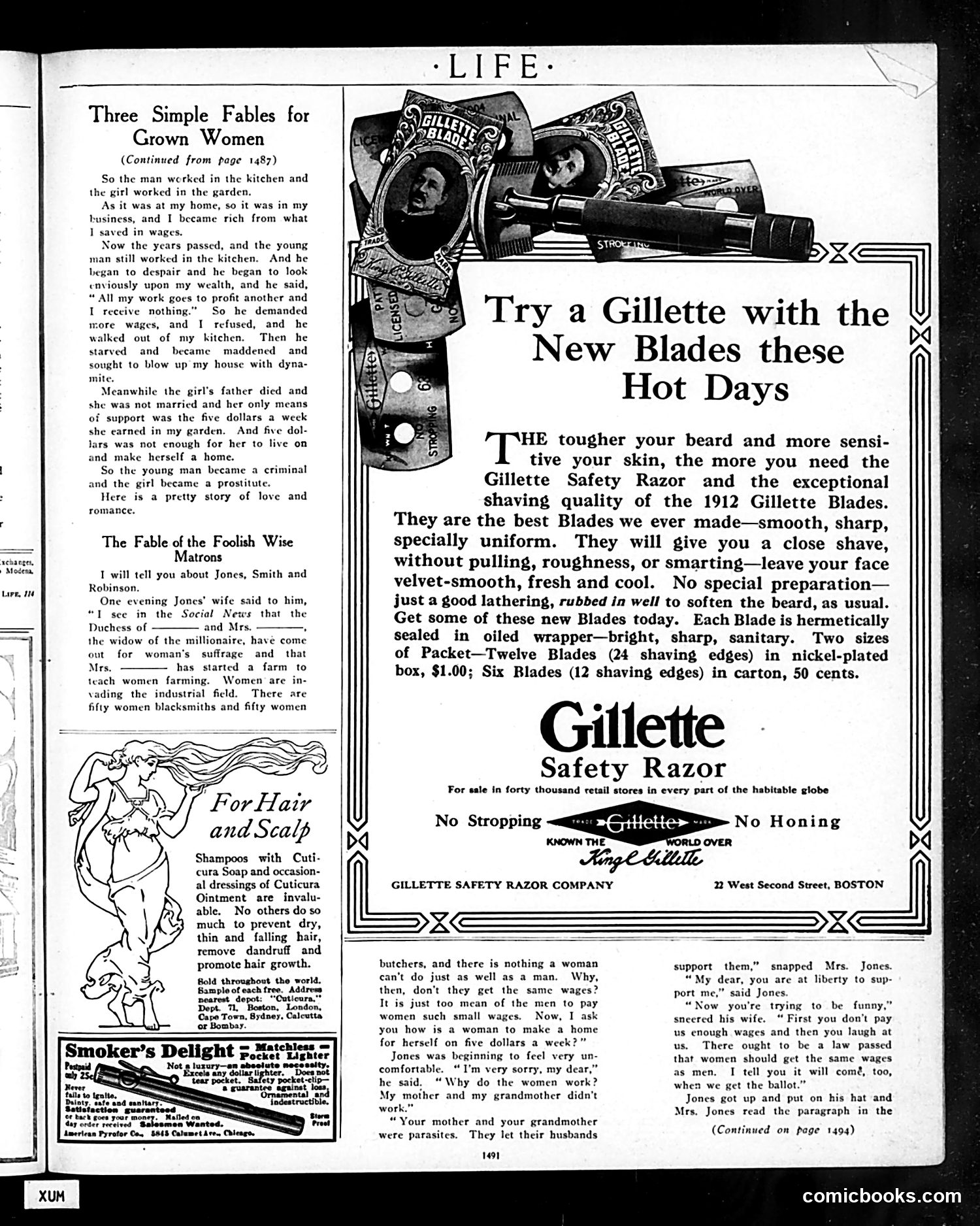
This page contains satirical "fables" mocking women's economic demands and labor activism. The first story depicts a kitchen worker who demands fair wages, then "becomes a criminal," while an underpaid garden worker "becomes a prostitute"—blaming workers' poverty on their own moral failings rather than exploitative wages. The second fable ridicules a wife who argues women deserve equal pay to men. When her husband suggests she support the household instead, she's portrayed as humorless and demanding. The satire suggests women's suffrage and labor activism are absurd complaints by ungrateful parasites. The page also features a Gillette razor advertisement—typical period advertising claiming superior shaving quality. **Modern context:** These fables represent anti-feminist propaganda common in early 20th-century publications, dismissing women's legitimate grievances about unequal wages and legal status as selfish whining. They exemplify how satirical magazines sometimes punched down at working women and progressive causes.
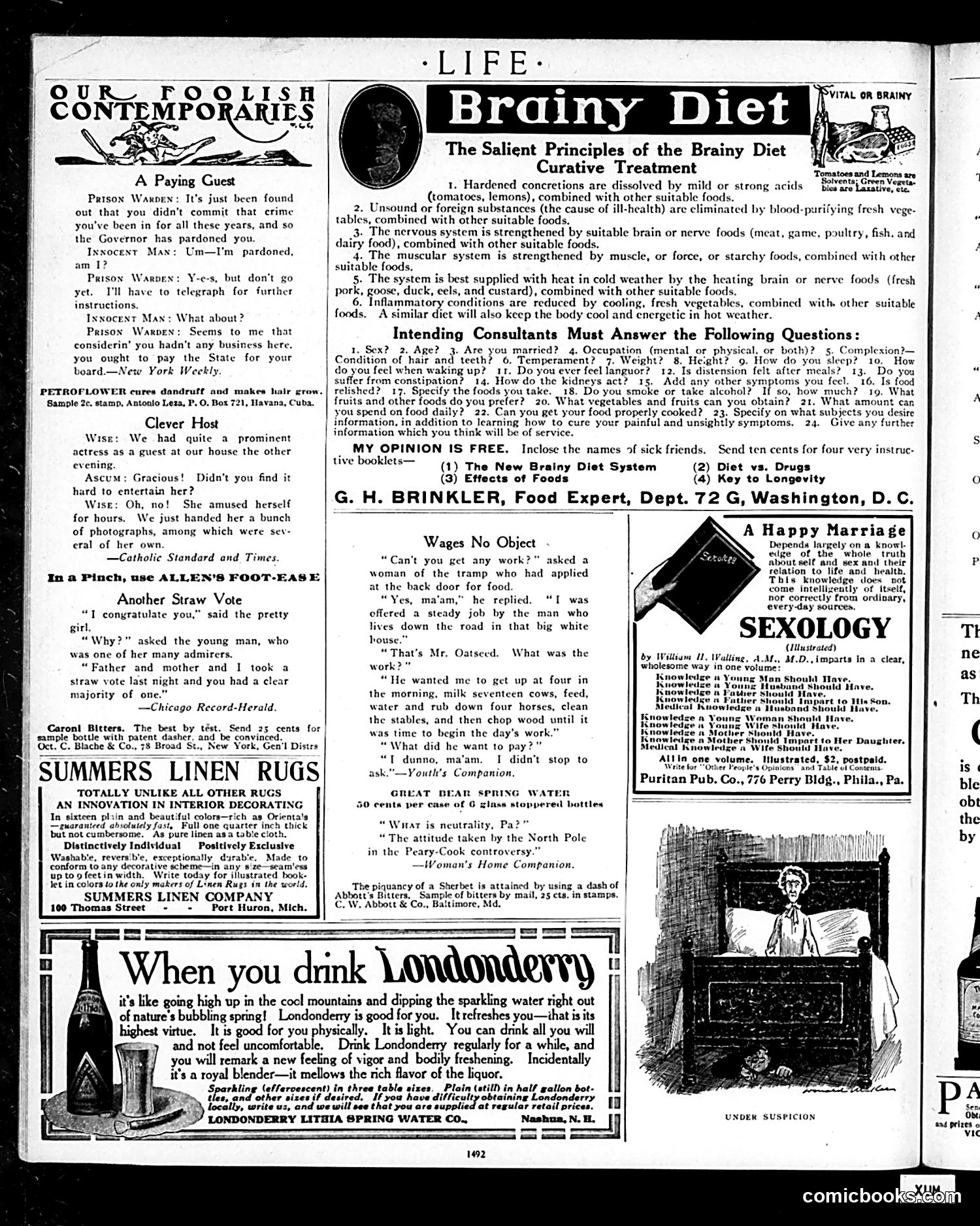
This page is primarily **advertising and advice content** rather than political satire. The main feature is a "Brainy Diet" advertisement by food expert G.H. Brinkler, promoting a pseudo-scientific dietary system based on matching foods to bodily systems (nerves, muscles, etc.). It's typical early-20th-century health quackery, requesting detailed personal information from "consultants" before providing dietary advice. The small cartoons are light social humor: - **"A Paying Guest"**: Absurdist joke about a man pardoned from prison being told he must pay the state for room and board before leaving—satire on bureaucratic absurdity. - **"Clever Host"**: A woman entertains herself by looking at photographs of herself—gentle mockery of vanity. - **"Another Straw Vote"**: A young man wins a family poll as the preferred suitor—mild romantic humor. The remaining advertisements promote patent medicines, rugs, and beverages typical of the era. The page reflects early-1900s American consumer culture and dubious health claims.
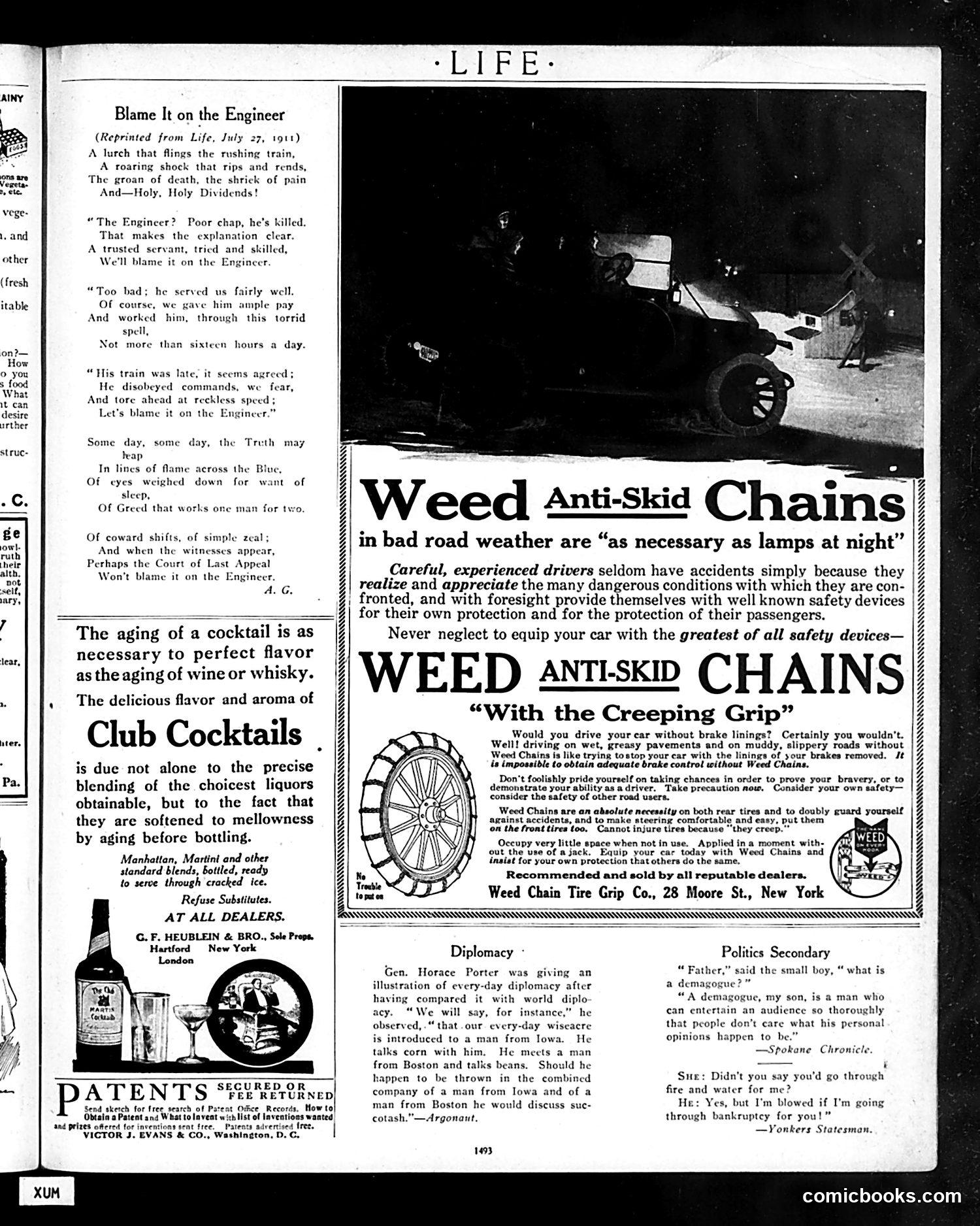
This page contains a **satirical poem titled "Blame It on the Engineer"** (reprinted from 1911) that critiques corporate negligence in railway accidents. The poem describes a train crash where a worker—the engineer—dies, and the railroad company immediately blames him for the disaster while conveniently ignoring their own culpability: they worked him 16+ hours daily, kept him on inadequate shifts, and operated the train recklessly. The dark conclusion suggests that only when truth finally emerges (as "flames across the Blue") will witnesses reveal the actual causes: exhaustion, greed, and corporate cost-cutting. The satire attacks how powerful institutions scapegoat workers to avoid accountability. The rest of the page contains period advertisements (Weed Anti-Skid Chains, Club Cocktails, patents) and two brief humorous anecdotes about diplomacy and political demagoguery—typical Life magazine filler content.
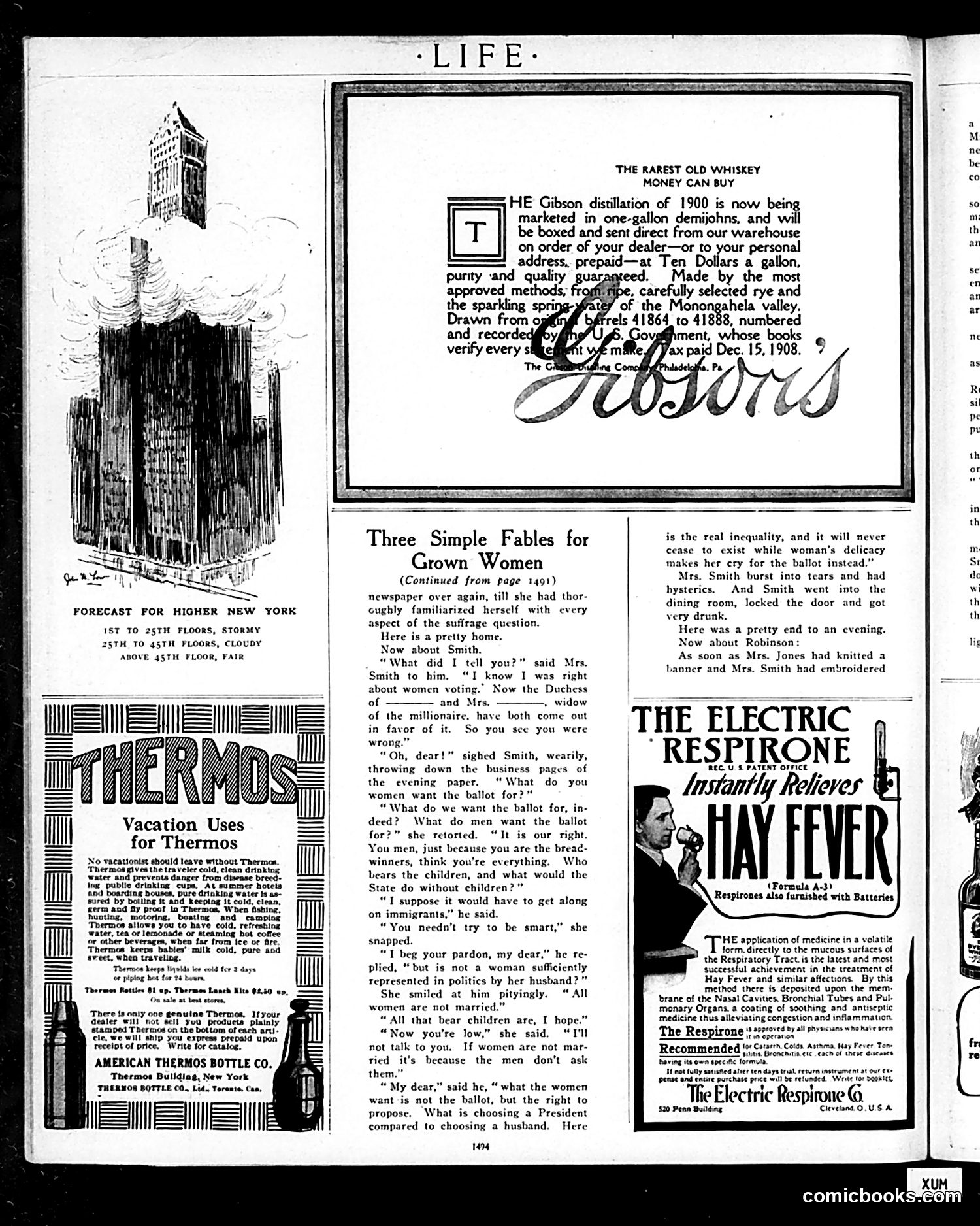
This page from *Life* magazine contains satirical content about women's suffrage alongside period advertisements. **The Main Article: "Three Simple Fables for Grown Women"** The text presents three cautionary tales mocking women's suffrage advocates. In the first fable, Mrs. Smith lectures her husband Smith about voting rights after reading suffrage arguments in newspapers. Smith counters that women are already represented through their husbands' votes, and that women's real desire is the right to propose marriage—a jab suggesting women's demands are absurd or secondary to marriage concerns. The fable ends with Smith getting drunk, implying women's political talk drives men to despair. **The Satire:** *Life* uses exaggerated domestic scenarios to ridicule the suffrage movement, presenting women's political engagement as nagging, hypocritical, and fundamentally unreasonable. The "fables" suggest women's suffrage arguments contradict themselves and distract from "natural" gender roles. **Context:** This anti-suffrage content reflects pre-1920 American attitudes, before the 19th Amendment granted women voting rights.
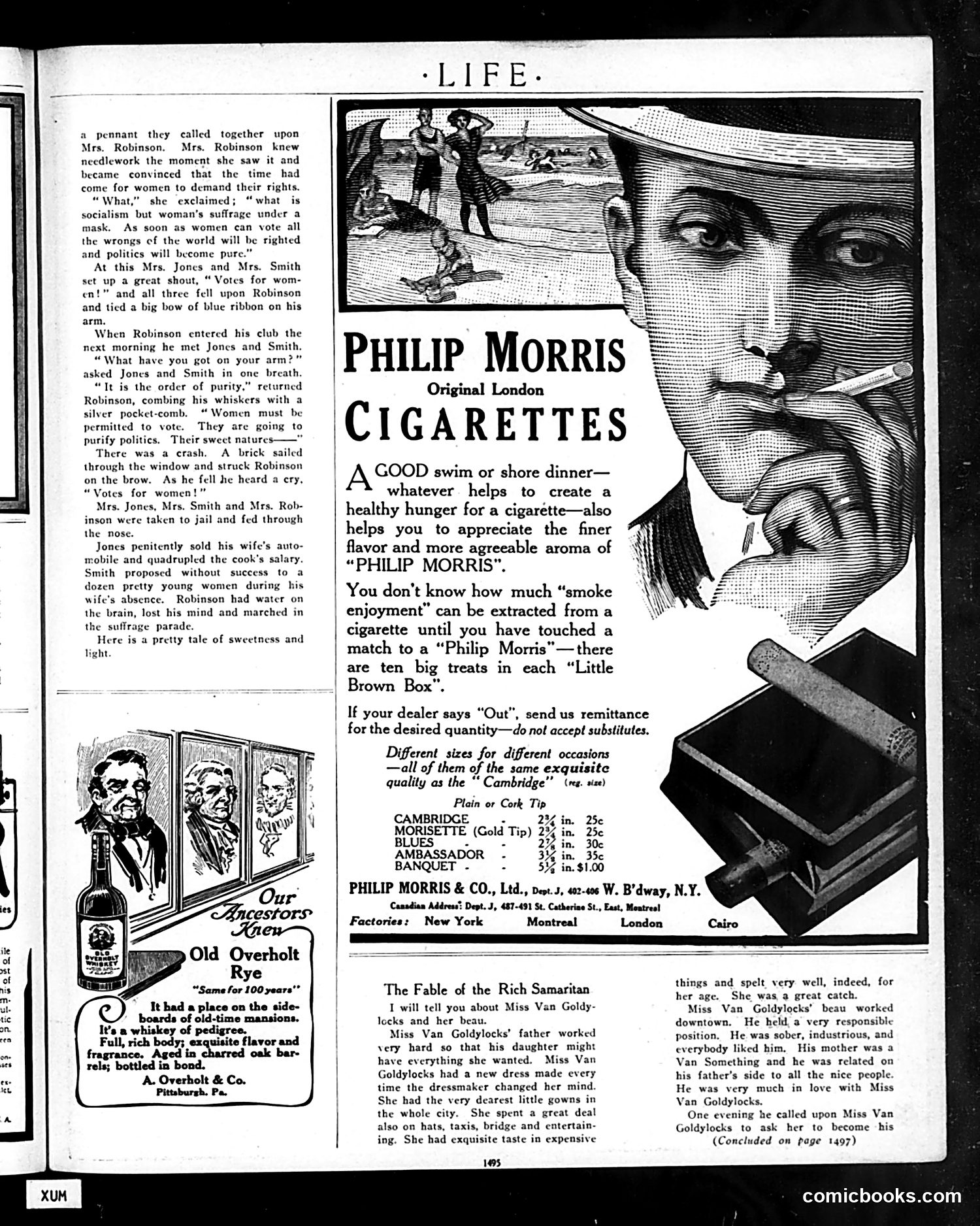
This page contains a satirical story mocking women's suffrage advocates. The narrative depicts three women—Mrs. Robinson, Jones, and Smith—becoming convinced that giving women the vote will purify politics and solve society's problems. They attack a man (Robinson) to force him to wear a blue ribbon supporting "Votes for Women." The satire's point: the story shows this leads to chaos—the women are jailed, one loses her car, another pursues inappropriate romances, and Robinson goes insane and marches in suffrage parades. The final line, "Here is a pretty tale of sweetness and light," is deeply ironic. **The context**: This reflects early 20th-century anti-suffrage arguments that women voters would not actually improve politics as claimed, and that suffragists were irrational or destructive. Life magazine used humor to ridicule suffrage movements. The brick through the window scene suggests violence, implying suffragists were dangerous extremists. The page also contains unrelated advertisements for cigarettes and whiskey.
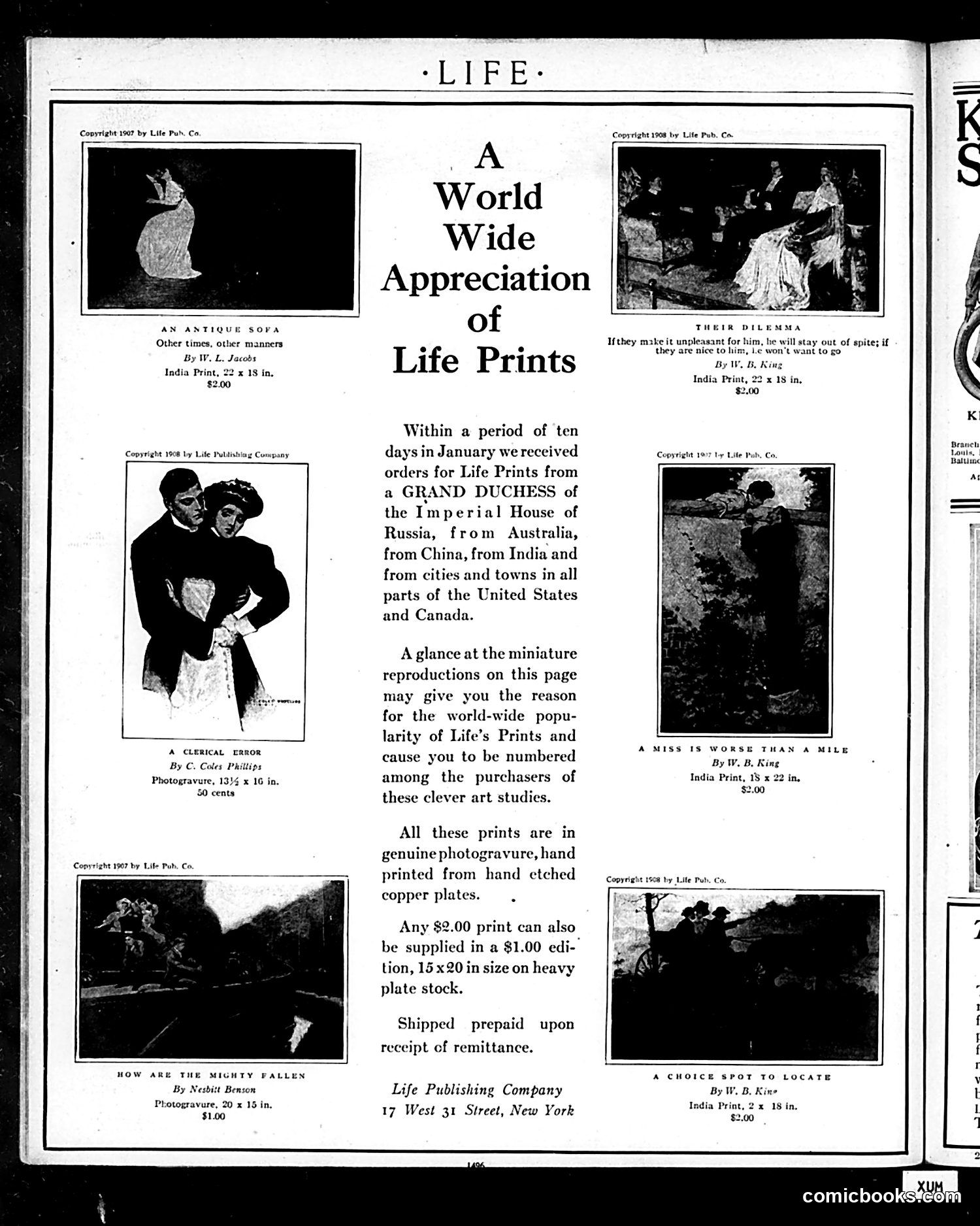
This is primarily an **advertising page** for Life Publishing Company's art prints, not a political cartoon. The page showcases five reproduced artworks available for purchase, ranging from 50 cents to $2.00. The advertisement emphasizes the prints' prestige by noting they've attracted international orders—including from a Grand Duchess of Russia, Australia, China, and India—suggesting cultural sophistication and global appeal. The works displayed include domestic scenes and character studies typical of early 20th-century illustration: "An Antique Sofa" (period manners), "A Clerical Error" (humorous misunderstanding), and pieces by W.B. King exploring social situations. The prints were **hand-etched photogravures**, a premium reproduction technique. The ad stresses accessibility by offering $2 prints in cheaper $1 editions, positioning Life's art as both refined and democratically available to middle-class American consumers during the Progressive Era.
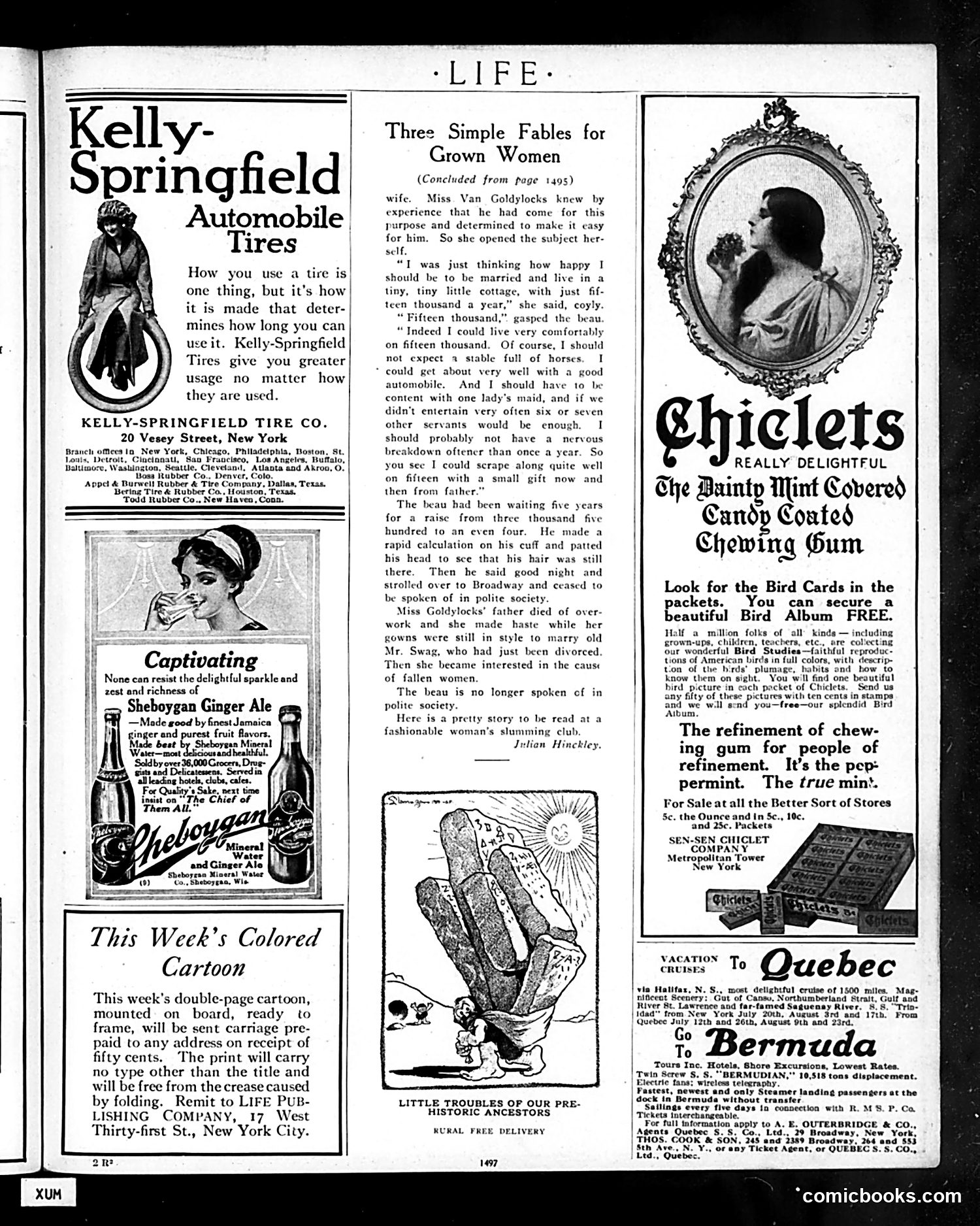
This page is primarily **advertising and serialized content** rather than political satire. The major elements are: **Main Content:** "Three Simple Fables for Grown Women" (conclusion of a story started elsewhere) is a satirical fiction piece about romantic/financial expectations. The narrative mocks an ambitious young woman, Miss Van Goldylocks, who discusses needing fifteen thousand dollars annually to live modestly—requiring servants, an automobile, and fashionable entertainment. The beau flees, recognizing her mercenary nature. **The Cartoon:** "Little Troubles of Our Pre-Historic Ancestors" is a single-panel cartoon making a prehistoric joke, though the specific image detail isn't clearly legible in this OCR'd reproduction. **Advertisements:** The page features typical period ads for Kelly-Springfield tires, Sheboygan ginger ale, Chiclets gum, and vacation packages to Quebec and Bermuda. The satirical thrust targets materialistic women and inflated lifestyle expectations among the social set—a common theme in *Life* magazine humor of this era.
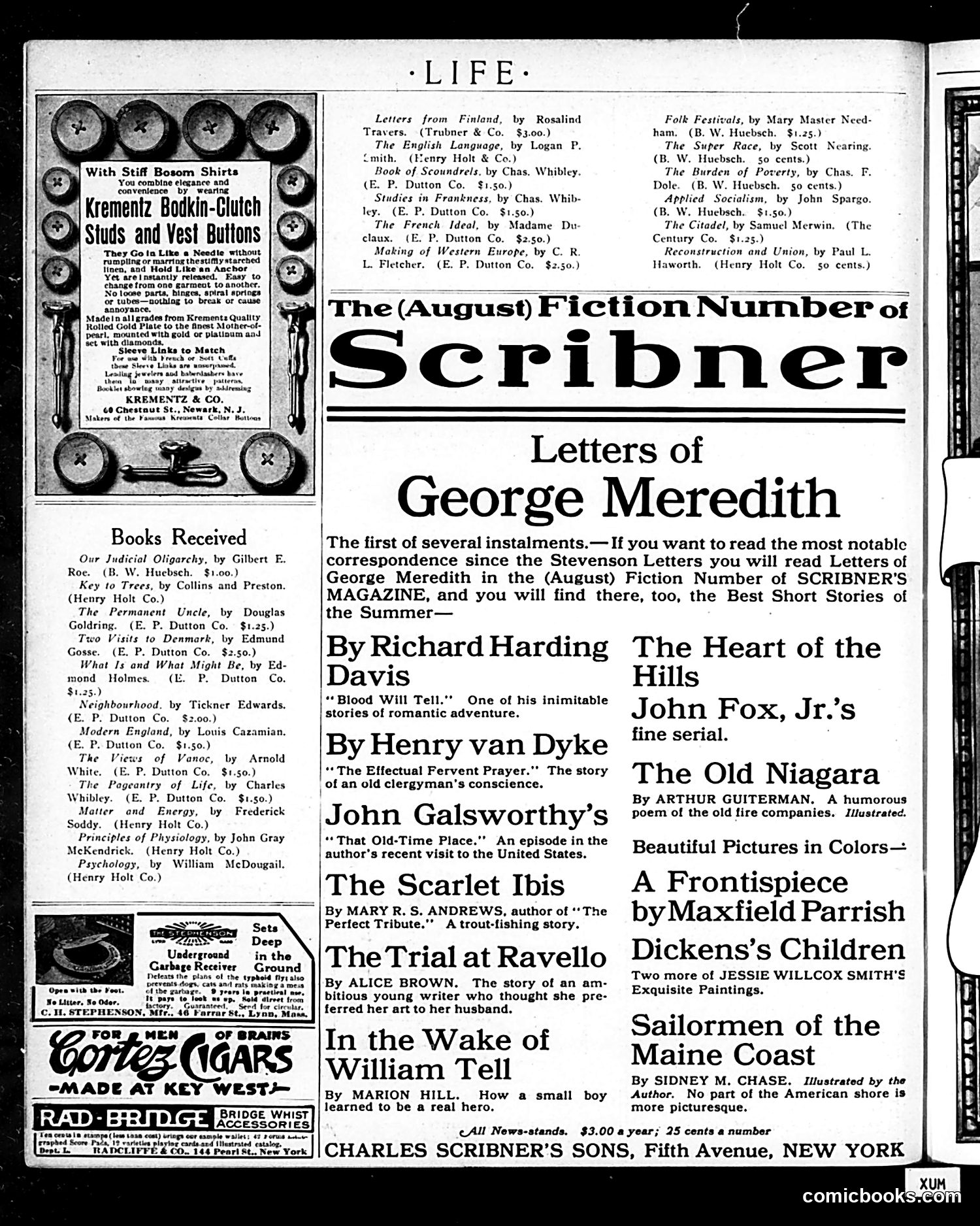
This is primarily a **table of contents and advertising page** from Life magazine's August Fiction Number, not a political cartoon page. The left side features advertisements for **Krementz shirt studs and cufflinks** (luxury men's formal wear) and **Cortez cigars**, alongside a "Books Received" section listing recent publications from major publishers. The right side prominently advertises **Scribner's Magazine's August fiction issue**, featuring the first installment of George Meredith's letters (positioned as comparable to the famous Stevenson Letters), short stories by established authors like Richard Harding Davis and Henry van Dyke, and serials including John Fox Jr.'s "The Heart of the Hills." The page reflects **early 20th-century American literary culture**—emphasizing quality fiction, classical authors, and refined consumer goods. There is **no political satire or cartoon content** visible; it's a straightforward magazine contents and advertisement page.
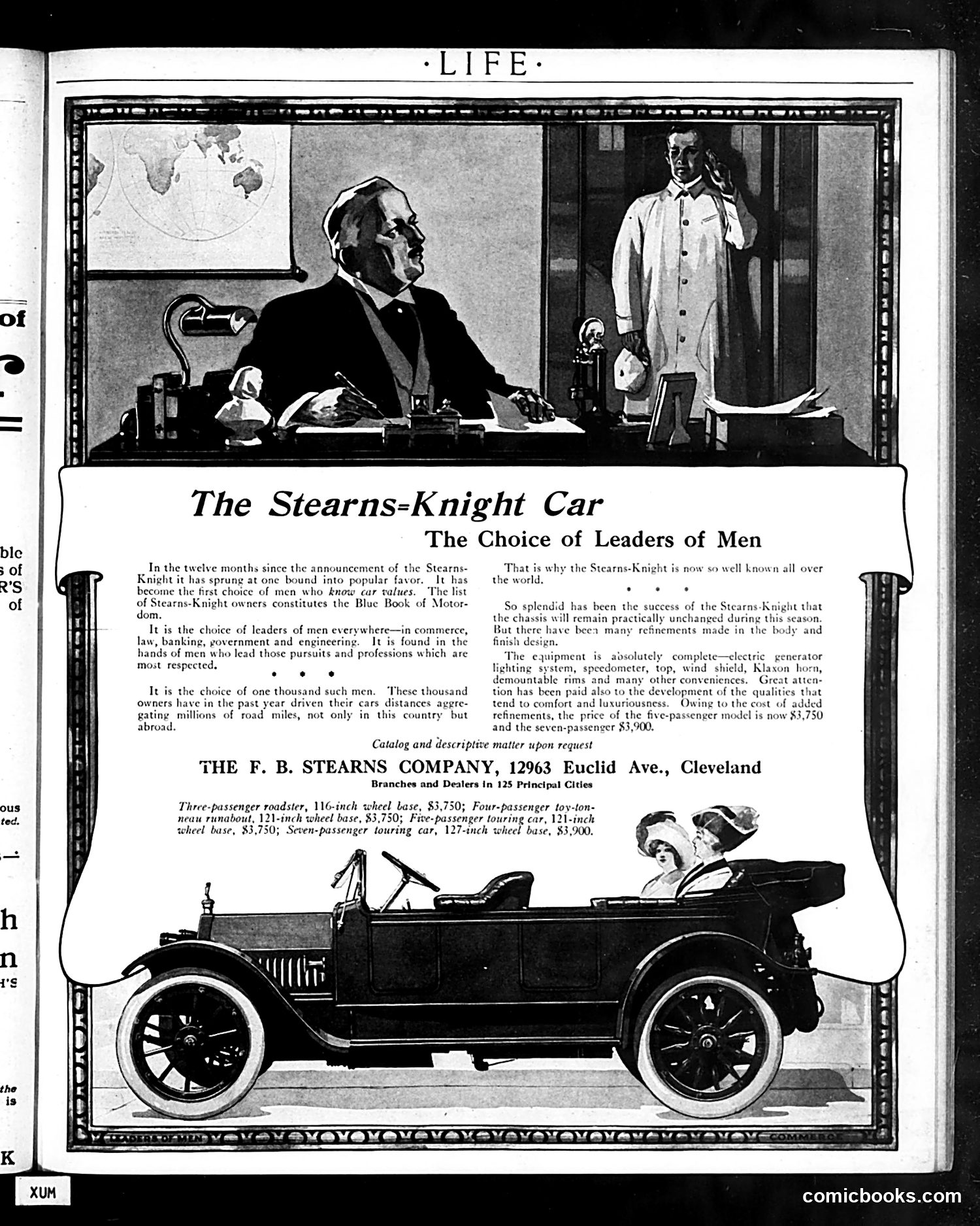
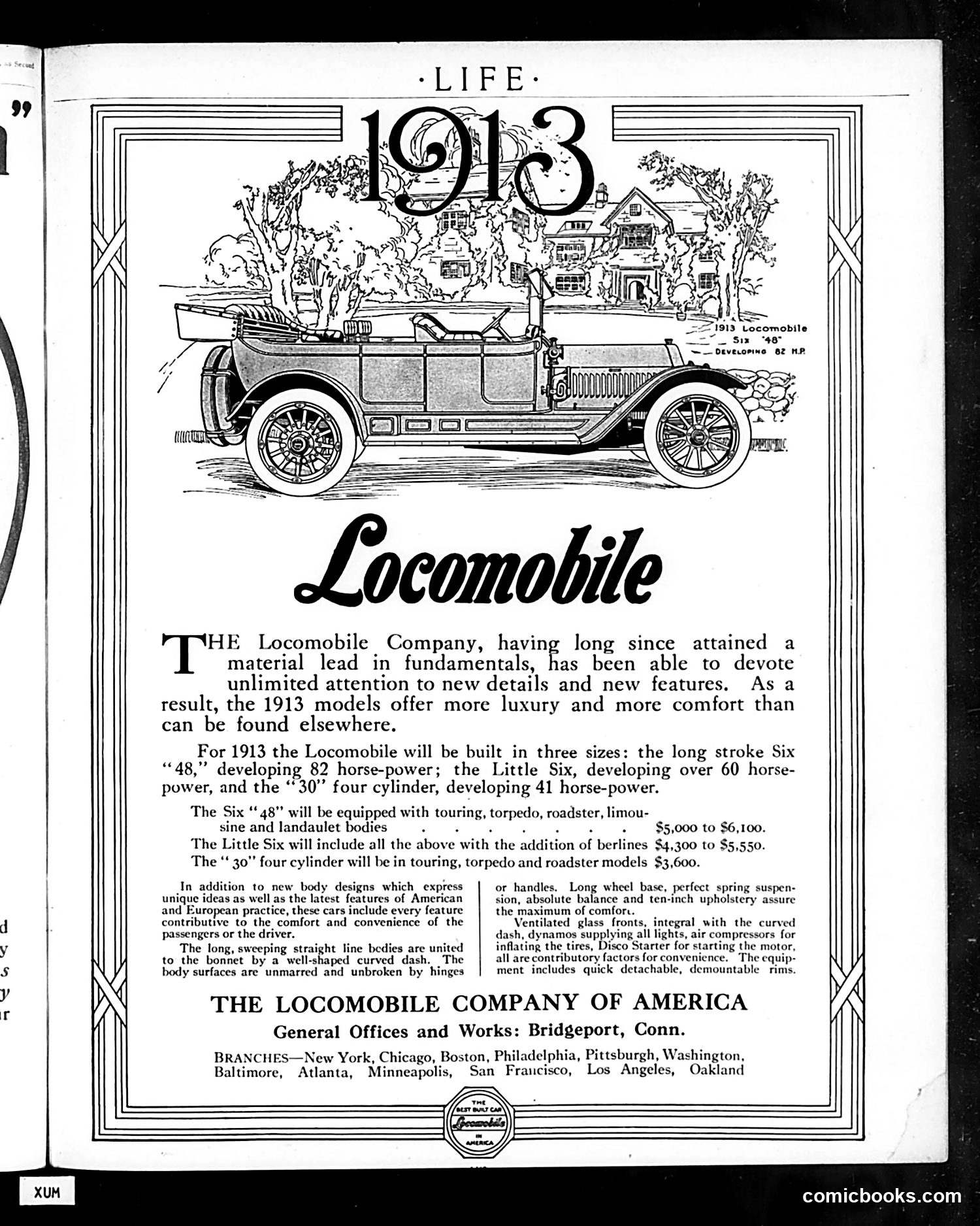
This is primarily a **car advertisement**, not political satire. The page promotes the Stearns-Knight automobile through the rhetorical device of depicting it as the choice of society's elite leaders. The top illustration shows a businessman at his desk with a map and telescope (suggesting world commerce and vision), while an attendant presents the car—visually equating the automobile with professional success and respectability. The text claims the car is chosen by "leaders of men everywhere—in commerce, law, banking, government and engineering," establishing it as a status symbol. The bottom shows the actual vehicle: a five-passenger touring car with open design, typical of 1910s-era automobiles. The marketing strategy is **aspirational branding**: by associating the Stearns-Knight with powerful, respected men and their achievements, the advertisement suggests that purchasing this car signals one's own importance and judgment. The specific pricing ($3,750-$3,900) targets affluent buyers already positioned to see themselves as society's leaders. This reflects early automotive advertising's emphasis on class status rather than practical features.
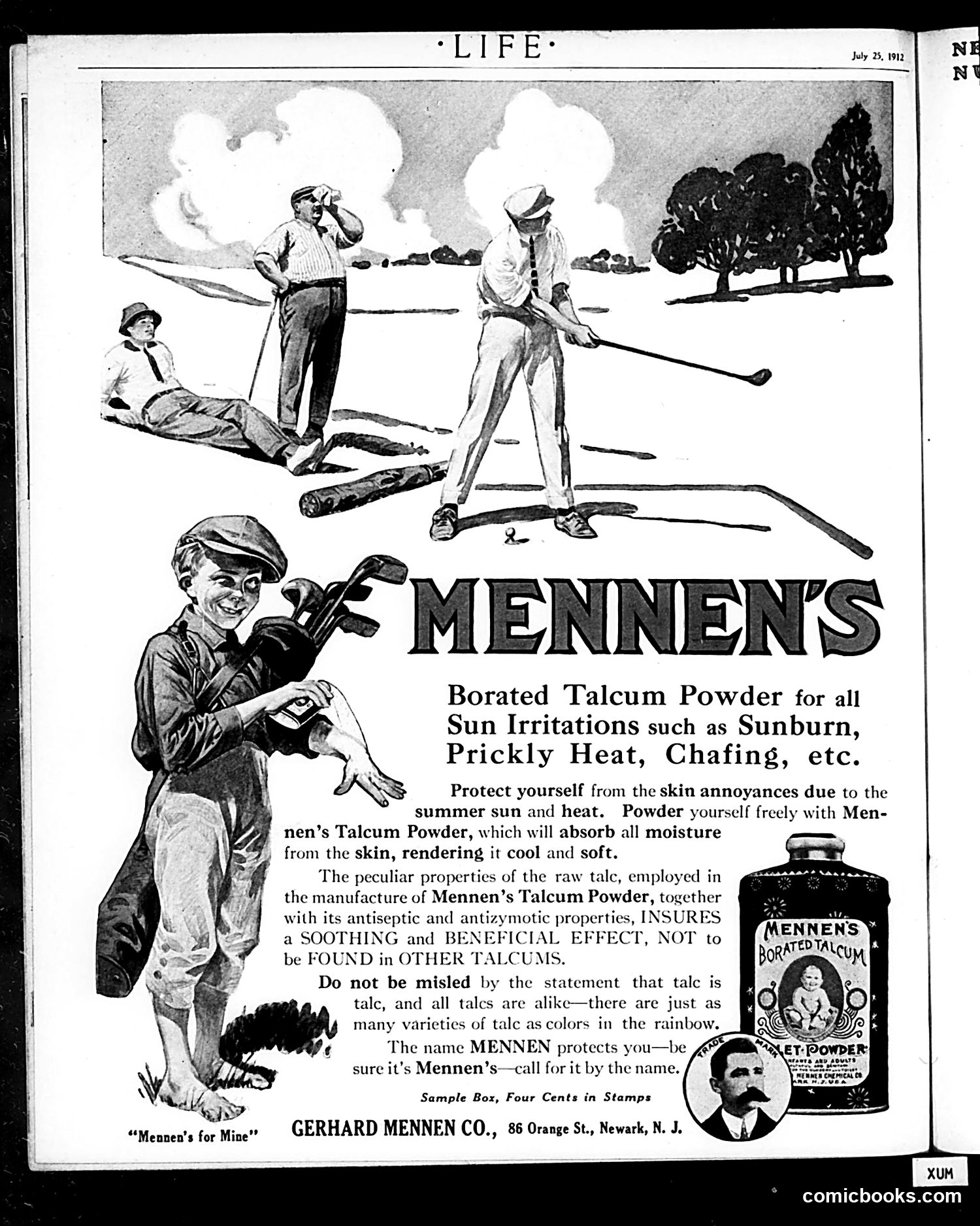
This is primarily a **product advertisement**, not political satire. The page promotes Mennen's Borated Talcum Powder for summer skin irritations like sunburn and chafing. The illustration depicts a **golf scene**—men playing golf in summer heat, with one figure prominently shown applying powder. The golfing context suggests the product's target market: active, outdoor-oriented men concerned with comfort during physical activity. The accompanying illustration labeled **"Mennen's for Mine"** shows a young boy or caddy, presumably to convey the product's universal appeal and safety. The advertisement emphasizes product **differentiation**, warning consumers not to assume "all talcs are alike" and to specifically request "Mennen's" by name—a marketing strategy common in early 20th-century patent medicines and toiletries when brand loyalty was less established. The page reflects **Gilded Age advertising** targeting middle and upper-class men engaged in leisure activities.