
Life, 1912-07-25 · page 29 of 41
Life — July 25, 1912 — page 29: what you’re looking at
What you’re looking at
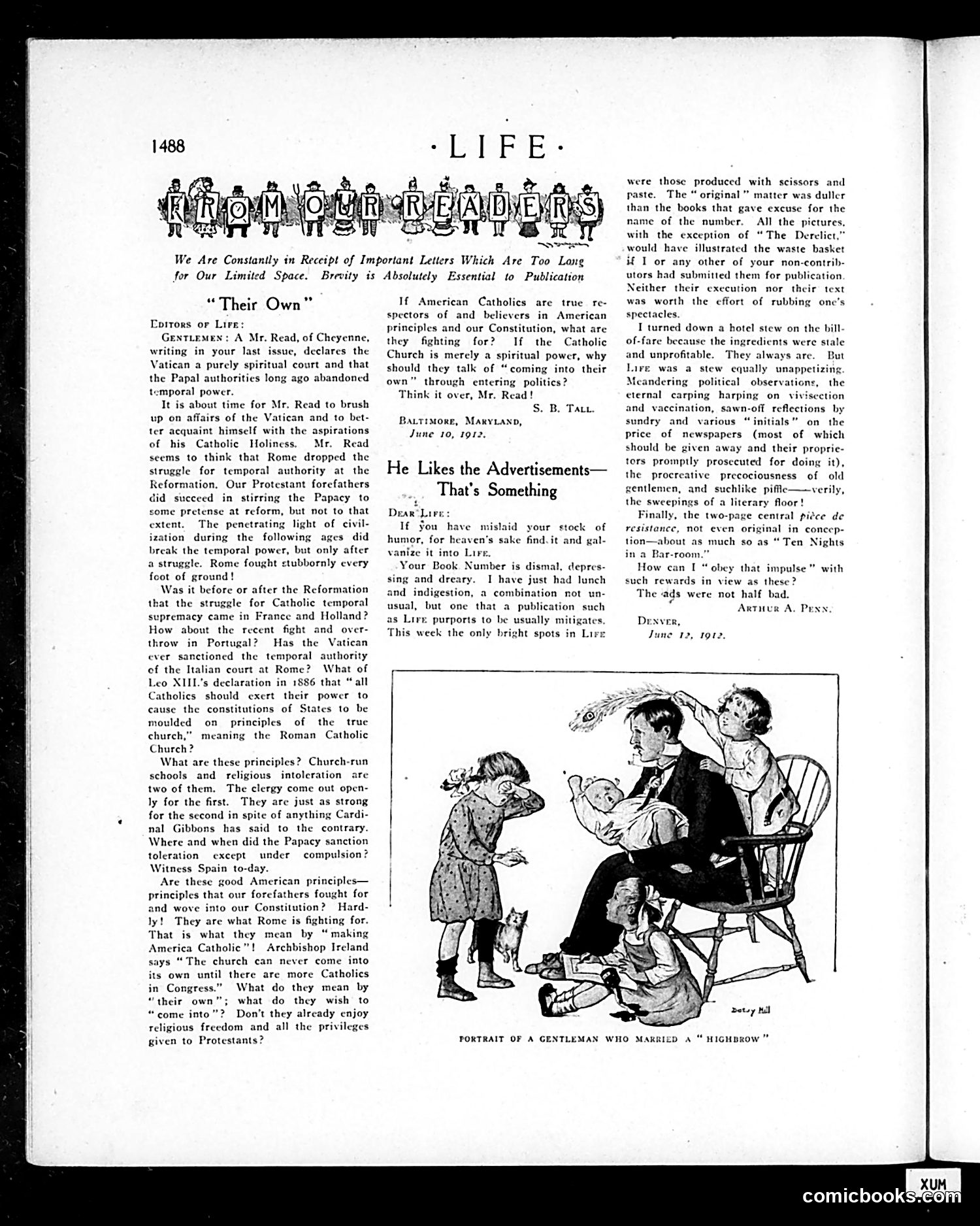
This page contains reader letters and a cartoon satirizing early 20th-century American religious and political tensions. **The Letters:** The main letter (S.B. Tall, Baltimore) attacks Catholic Church influence in American politics, directly challenging earlier claims that the Vatican is purely spiritual. Tall argues the Church actively seeks political power—citing Leo XIII's 1886 declaration and Archbishop Ireland's statements about Catholics "coming into" Congress. He presents this as contradicting American constitutional principles of church-state separation. **The Cartoon:** "Portrait of a Gentleman Who Married a 'Highbrow'" depicts a man surrounded by children while a woman gestures dismissively from above. The satire appears to mock educated or pretentious women (the "highbrow" wife) for abandoning domestic duties, leaving the overwhelmed husband managing the household. This reflects contemporary tensions about women's education and changing gender roles. Both items reflect Progressive-Era anxieties: Catholic political ambitions and debates over women's proper social role.
📄 Transcribed text from this page (OCR, searchable)
Machine-transcribed from the original scan — historical spelling and the odd misread are preserved.
We Are Constantly in Receipt of Important Letters Which Are Too Long Brevity is Absolutely Essential to Publication for Our Limited Space. “Their Own” Cpirors oF Lire: Gentiemen: A Mr. Read, of Cheyenne, writing in your last issue, declares the Vatican a purely spiritual court and that the Papal authorities long ago abandoned temporal power. It is about time for Mr. Read to brush up on affairs of the Vatican and to bet- ter acquaint himself with the aspirations of his Catholic Holiness. Mr. Read seems to think that Rome dropped the struggle for temporal authority at the Reformation. Our Protestant forefathers did succeed in stirring the Papacy to some pretense at reform, but not to that extent, The penetrating light of civil- ization during the following ages did break the temporal power, but only after a struggle. Rome fought stubbornly every foot of ground! Was it before or after the Reformation that the struggle for Catholic temporal supremacy came in France and Holland? How about the recent fight and over- throw in Portugal? Has the Vatican ever sanctioned the temporal authority of the Italian court at Rome? What of Leo XIIL's declaration in 1886 that “all Catholics should exert their power to cause the constitutions of States to be moulded on principles of the true church,” meaning the Roman Catholic Church ? What are these principles? Church-run schools and religious intoleration are two of them, The clergy come out open- ly for the first. They are just as strong for the second in spite of anything Cardi- nal Gibbons has said to the contrary. Where and when did the Papacy sanction toleration except under compulsion? Witness Spain to-day. Are these good American principles— principles that our forefathers fought for and wove into our Constitution? Hard- ly! They are what Rome is fighting for. That is what they mean by “making America Catholic"! Archbishop Ircland “The church can never come into s own until there are more Catholics in Congress.” What do they mean by “their own"; what do they wish to “come into"? Don't they already enjoy religious freedom and all the privileges given to Protestants? If American Catholics are true re- spectors of and believers in American principles and our Constitution, what are they fighting for? If the Catholic Church is merely a spiritual power, why should they talk of “coming into their own” through entering politics? Think it over, Mr. Read! S. B. Tat. Battimore, Maviaxn, June 10, 1912. He Likes the Advertisements— _. That's Something Dear’ Lie If fou mislaid your stock of humor, for heaven's sake find.it and gal- vanize it into Lire Your Book Number is dismal, depres- sing and dreary. I have just had lunch and indigestion, a combination not un- usual, but one that a publication such as Lire purports to be usually n This week the only bright spots in Li have were those produced with scissors and paste. The “ original” matter was duller than the books that gave excuse for the name of the number. All the pictures. with the exception of “The Derelict, would have illustrated the waste basket if 1 or any other of your non-contrib- utors had submitted them for publication Neither their execution nor their text was worth the effort of rubbing one’s spectacles. I turned down a hotel stew on the bill of-fare because the ingredients were stale and unprofitable. They always are. But la a stew equally unappetizing Meandering political observations, the eternal carping harping on tion and vaccination, sawn-off reflections by sundry and various “initials” on the price of newspapers (most of which should be given away and their proprie- tors promptly prosecuted for doing it), the procreative precociousness of old gentlemen, and suchlike piffle—verily, the sweepings of a literary floor! Finally, the two-page central pitce de resistance, not even orig tion—ahout as much so as in a Bar-room.” How can I “obey that impulse” with such rewards in view as these? The ads were not half bad. ‘ Artitur A. Pex. vivis | in concep- "Ten Nights Dexver, June 12, 1912. PORTRAIT OF A GENTLEMAN WHO MARRIED A “ HIGHBROW ” comicbook eam