
Life, 1912-07-25 · page 25 of 41
Life — July 25, 1912 — page 25: what you’re looking at
What you’re looking at
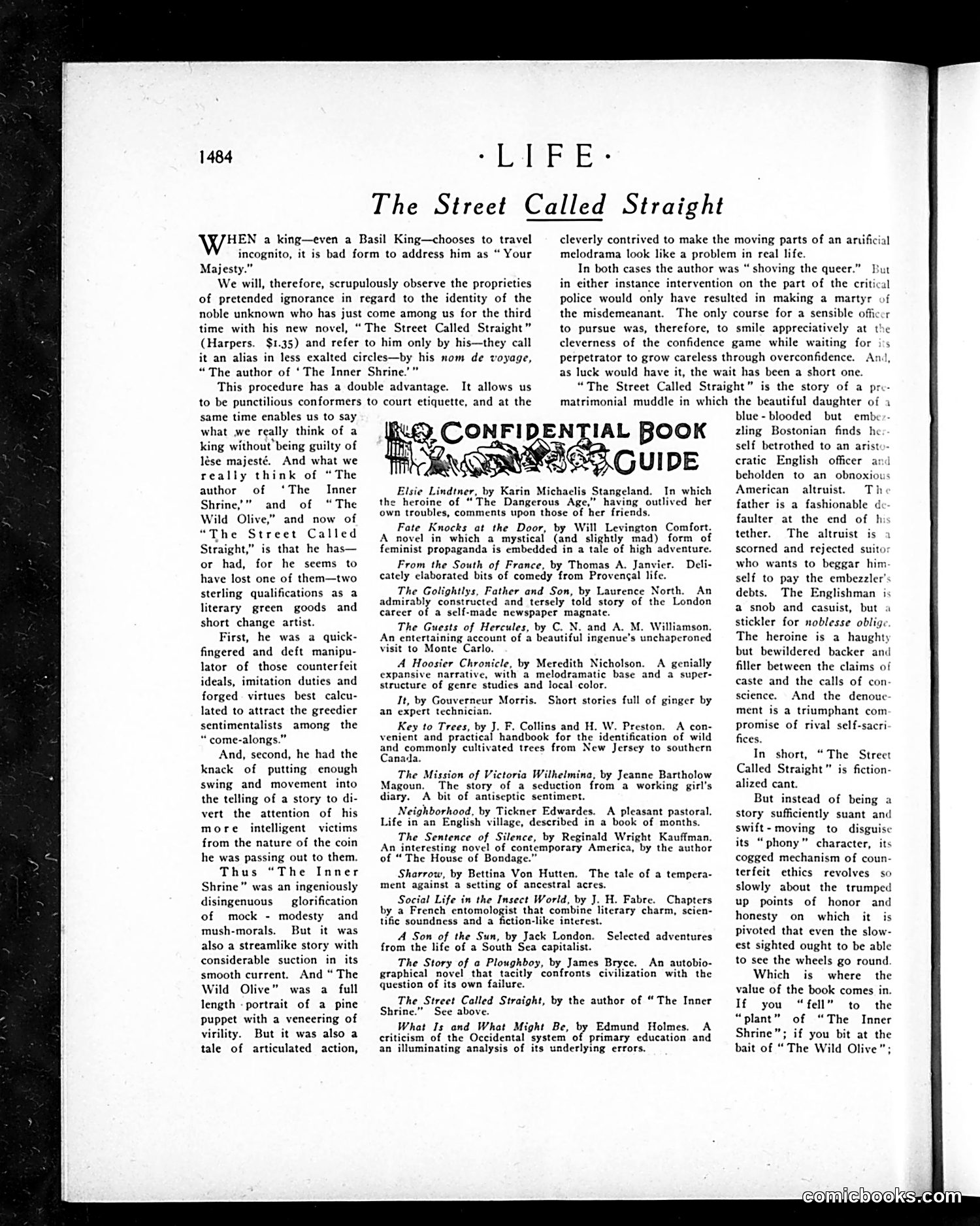
This is a scathing book review disguised as playful literary criticism. Life's reviewer attacks author Basil King (referred to only as "the author of 'The Inner Shrine'" to maintain mock courtesy) for his three novels, particularly *The Street Called Straight*. The satire compares King to a con artist: a skilled manipulator peddling "counterfeit ideals" and "forged virtues" to sentimental readers. The reviewer acknowledges King's technical storytelling ability—his narrative "swing and movement" distracts readers from recognizing the moral emptiness beneath. *The Inner Shrine* is dismissed as glorifying "mock-modesty and mush-morals"; *The Wild Olive* as a hollow "puppet" with merely surface "virility." The core complaint: King trades in sentimental melodrama presented as realistic psychology, using clever narrative tricks to distract intelligent readers from noticing the intellectual fraud.
📄 Transcribed text from this page (OCR, searchable)
Machine-transcribed from the original scan — historical spelling and the odd misread are preserved.
AEE The Street Called Straight WH a king—even a Basil King—chooses to travel incognito, it is bad form to address him as “ Your Majesty.” We will, therefore, scrupulously observe the proprieties of pretended ignorance in regard to the identity of the noble unknown who has just come among us for the third time with his new novel, “The Street Called Straight” (Harpers. $1.35) and refer to him only by his—they call it an alias in less exalted circles—by his nom de voyage, “The author of ‘The Inner Shrine.” This procedure has a double advantage. It allows us to be punctilious conformers to court etiquette, and at the cleverly contrived to make the moving parts of an artificial melodrama look like a problem in real life. In both cases the author was “ shoving the queer.” But in either instance intervention on the part of the critical police would only have resulted in making a martyr of the misdemeanant. The only course for a sensible officer to pursue was, therefore, to smile appreciatively at the cleverness of the confidence game while waiting for i's perpetrator to grow careless through overconfidence. Ani, as luck would have it, the wait has been a short one. “The Street Called Straight” is the story of a pre- matrimonial muddle in which the beautiful daughter of same time enables us to say what we really think of a king without’ being guilty of lése majesté. And what we really think of “The author of ‘The Inner Shrine’” and of “The Wild Olive,” and now of “The Street Called Straight,” is that he has— or had, for he seems to have lost one of them—two sterling qualifications as a literary green goods and short change artist. First, he was a quick- fingered and deft manipu- lator of those counterfeit ideals, imitation duties and forged virtues best calcu- lated to attract the greedier sentimentalists among the “ come-alongs.” And, second, he had the knack of putting enough swing and movement into the telling of a story to di- vert the attention of his more intelligent victims from the nature of the coin he was passing out to them. Thus “The Inner Shrine” was an ingeniously disingenuous glorification of mock - modesty and mush-morals. But it was also a streamlike story with considerable suction in its smooth current. And “ The Wild Olive” was a full length - portrait of a pine puppet with a veneering of virility. But it was also a tale of articulated action, 69 CONFIDENTIAL BOOK Brew Paes Guive Elsie Lindtner, by Karin Michaelis Stangeland. In which the heroine of “The Dangerous Age,” having outlived her own troubles, comments upon those of her friends. Fate Knocks at the Door, by Will Levington Comfort. A novel in which a mystical (and slightly mad) form of feminist propaganda is embedded in a tale of high adventure. From the South of France, by Thomas A. Janvier. Deli- cately elaborated bits of comedy from Provencal life. The Golightlys, Father and Son, by Laurence North. An admirably constructed and tersely told story of the London career of a self-made newspaper magnate. The Guests of Hercules, by C. N. and A. M. Williamson. An entertaining account of a beautiful ingenue’s unchaperoned visit to Monte Carlo. A Hoosier Chronicle, by Meredith Nicholson. A genially expansive narrative, with a melodramatic base and a super- structure of genre studies and local color. It, by Gouverneur Morris. Short stories full of ginger by an expert technician. Key to Trees, by J. F. Collins and H. W. Preston, A con- venient and practical handbook for the identification of wild end commonly cultivated trees from New Jersey to southern fanada. The Mission of Victoria Wilhelmina, by Jeanne Bartholow Magoun. The story of a seduction from a working girl's diary. A bit of antiseptic sentiment. Neighborhood, by Tickner Edwardes. A pleasant pastoral. Life in an English village, described in a book of months. The Sentence of Silence, by Reginald Wright Kauffman. An interesting novel of contemporary America, by the author of “ The House of Bondage.” Sharrow, by Bettina Von Hutten. The tale of a tempera- ment against a setting of ancestral acres. Social Life in the Insect World, by J. H. Fabre. Chapters by a French entomologist that combine literary charm, scien- tific soundness and a fiction-like interest. A Son of the Sun, by Jack London. from the life of a South Sea capitalist. The Story of a Ploughboy, by James Bryce. An autobio- graphical novel that tacitly confronts civilization with the question of its own failure. The Street Called Straight, by the author of “The Inner Shrine.” See above. What Is and What Might Be, by Edmund Holmes. A criticism of the Occidental system of primary education and an illuminating analysis of its underlying errors. Selected adventures blue - blooded but embe zling Bostonian finds he self betrothed to an ari: cratic English officer beholden to an obnoxious American altruist. Th father is a fashionable de- faulter at the end of h tether. The altruist is scorned and rejected suito: who wants to beggar him self to pay the embezzler’s debts. The Englishman is a snob and casuist, but a stickler for noblesse oblige The heroine is a haughty but bewildered backer and filler between the claims of caste and the calls of con- science. And the denouc ment is a triumphant com promise of rival self-sacri fices. In short, “The Street Called Straight” is fiction- alized cant. But instead of being a story sufficiently suant and swift-moving to disguise its “phony” character, its cogged mechanism of coun- terfeit ethics revolves so slowly about the trumped up points of honor and honesty on which it is pivoted that even the slow- est sighted ought to be able to see the wheels go round Which is where the value of the book comes in. If you “fell to the “plant” of “The Inner Shrine”; if you bit at the bait of “ The Wild Olive”;