
Life, 1912-07-25 · page 10 of 41
Life — July 25, 1912 — page 10: what you’re looking at
What you’re looking at
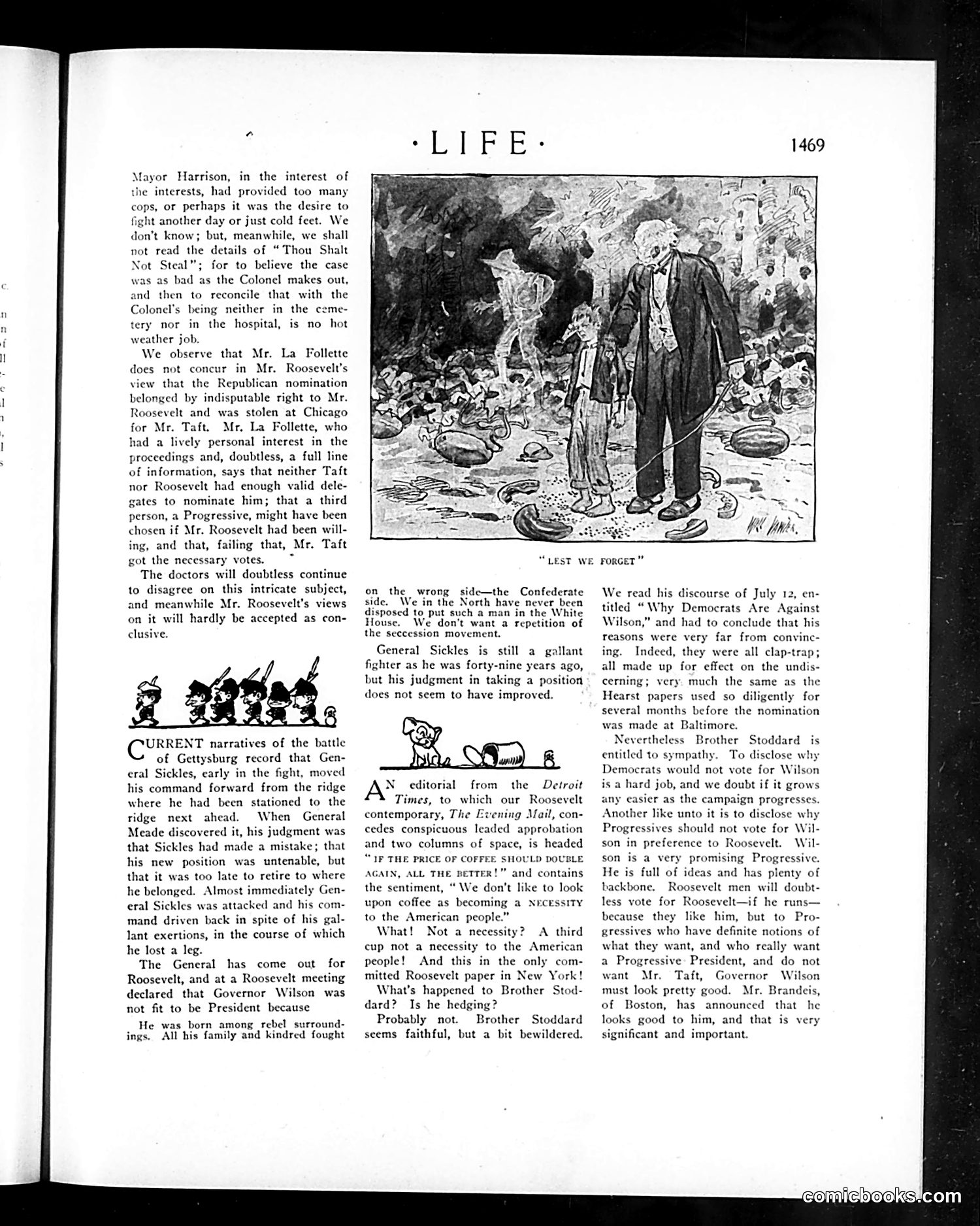
The cartoon depicts a tall figure in formal dress standing among scattered military equipment and debris. Based on the page's text discussing Roosevelt, General Sickles, and political disputes over the 1912 election, this appears to satirize debates about Civil War leadership and Republican Party divisions. The figure likely represents a political leader being reminded of past military failures or controversies—the title "Lest We Forget" suggests historical accountability. The scattered military gear references battlefield consequences. The surrounding text criticizes conflicting accounts of the Battle of Gettysburg and disputes Roosevelt's fitness for office, suggesting the cartoon comments on how leaders justify or obscure past military decisions. The satire implies politicians selectively remember history to suit current political needs.
📄 Transcribed text from this page (OCR, searchable)
Machine-transcribed from the original scan — historical spelling and the odd misread are preserved.
Mayor Harrison, in the interest of the interests, had provided too many cops, or perhaps it was the desire to fight another day or just cold feet. We don’t know; but, meanwhile, we shall not read the details of “Thou Shalt Not Steal"; for to believe the case was as bad as the Colonel makes out, and then to reconcile that with the Colonel's being neither in the ceme- tery nor in the hospital, is no hot weather job. We observe that Mr. La Follette does not concur in Mr. Roosevelt's view that the Republican nomination belonged by indisputable right to Mr. Roosevelt and was stolen at Chicago for Mr. Taft. Mr. La Follette, who had a lively personal interest in the proceedings and, doubtless, a full line of information, says that neither Taft nor Roosevelt had enough valid dele- gates to nominate him; that a third person, a Progressive, might have been chosen if Mr. Roosevelt had been will- ing, and that, failing that, Mr. Taft got the necessary votes. . The doctors will doubtless continue to disagree on this intricate subject, and meanwhile Mr. Roosevelt's views on it will hardly be accepted as con- clusive. URRENT narratives of the battle of Gettysburg record that Gen- eral Sickles, early in the fight, moved his command forward from the ridge where he had been stationed to the ridge next ahead. When General Meade discovered it, his judgment was that Sickles had made a mistake; that his new position was untenable, but that it was too late to retire to where he belonged. Almost immediately Gen- eral Sickles was attacked and his com- mand driven back in spite of his gal- lant exertions, in the course of which he lost a leg. The General has come out for Roosevelt, and at a Roosevelt meeting declared that Governor Wilson was not fit to be President because He was born among rebel surround- ings. All his family and kindred fought on the wrong side—the Confederate side. We in the North have never been disposed to put such a man in the White House. We don't want a repetition of the seccession movement. General Sickles is still a gallant fighter as he was forty-nine years ago, but his judgment in taking a position does not seem to have improved. editorial from the Detroit Times, to which our Roosevelt contemporary, The Evening Mail, con- cedes conspicuous leaded approbation id two columns of space, is headed “IF THE PRICE OF COFFEE SHOULD DOUBLE AGAIN, ALL THE BETTER!” and contains the sentiment, “ We don’t like to look upon coffee as becoming a NECESSITY to the American people.” What! Not a necessity? A third cup not a necessity to the American people! And this in the only com- mitted Roosevelt paper in New York! What's happened to Brother Stod- dard? Is he hedging? Probably not. Brother Stoddard seems faithful, but a bit bewildered. We read his discourse of July 12, titled “Why Democrats Are A, Wilson,” and had to conclude that his reasons were very far from convinc- ing. Indeed, they were all clap-trap; all made up for effect on the undis- cerning; very. much the same the Hearst papers used so diligently for several months before the nomination was made at Baltimore. Nevertheless Brother Stoddard is entitled to sympathy. To disclose why Democrats would not vote for Wilson is a hard job, and we doubt if it grows any easier as the campaign progresses. Another like unto it is to disclose why Progressives should not vote for Wil- son in preference to Roosevelt. Wil- son is a very promising Progressive. He is full of ideas and has plenty of backbone. Roosevelt men will doubt- less vote for Roosevelt—if he runs— because they like him, but to Pro- gressives who have definite notions of what they want, and who really want a Progressive President, and do not want Mr, Taft, Governor Wilson must look pretty good. Mr. Brandeis, of Boston, has announced that he looks good to him, and that is very significant and important.