
Life, 1912-07-25 · page 9 of 41
Life — July 25, 1912 — page 9: what you’re looking at
What you’re looking at
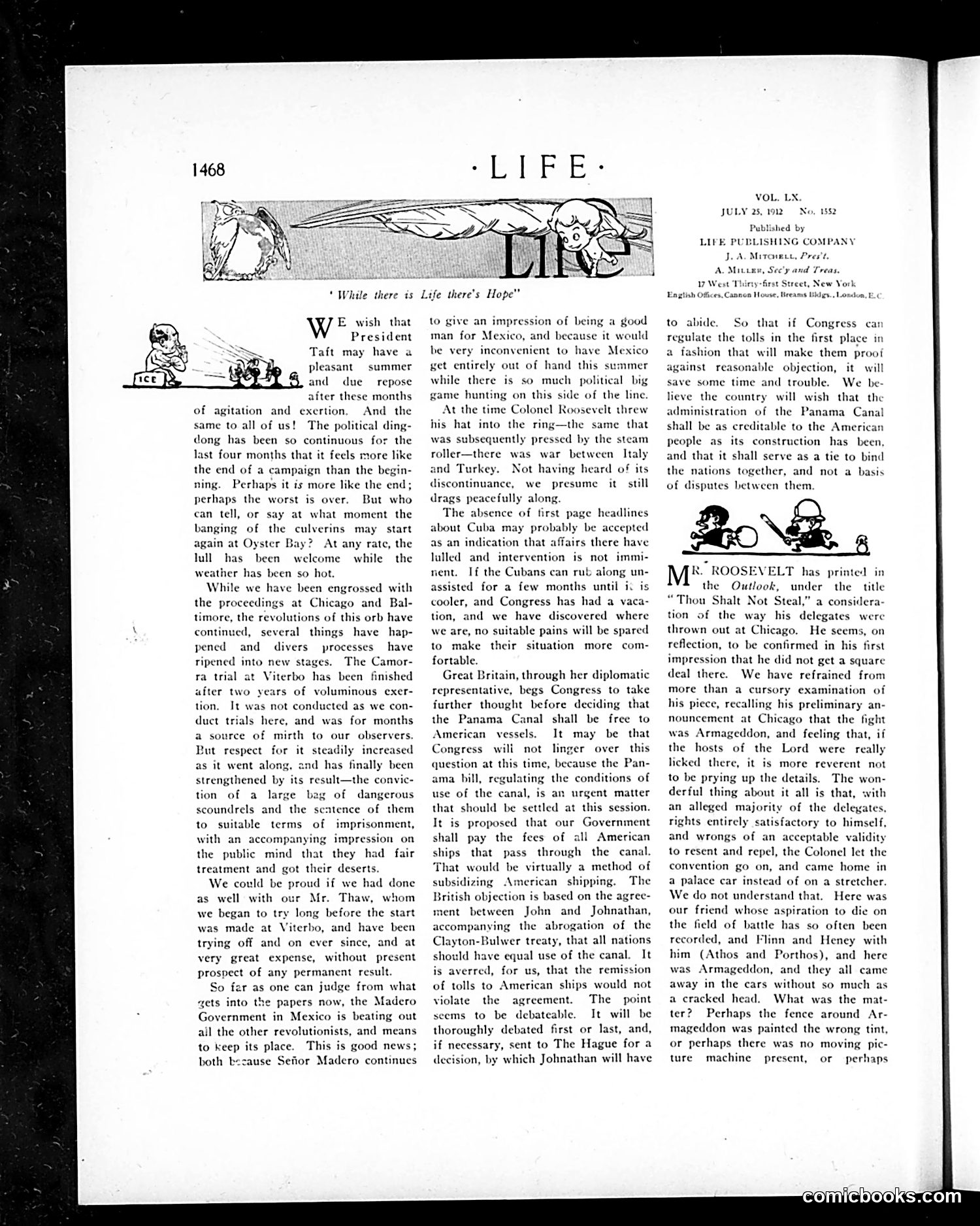
This Life magazine page (July 28, 1912) contains editorial commentary rather than cartoons. The text discusses President Taft's summer plans and Mexican political instability, referencing Colonel Roosevelt's involvement in political activities and comparisons to past diplomatic incidents. The small illustrations appear to be decorative vignettes rather than standalone political cartoons—one shows what looks like a presidential or political figure, another depicts children or small figures. The editorial criticizes the Panama Canal debate, mentioning disagreements between nations over its use, and references Roosevelt's earlier positions on various matters. It touches on diplomatic tensions with Britain regarding canal access rights. Without clearer cartoon imagery or captions, the specific satirical targets remain somewhat obscured, though the general tone suggests criticism of ongoing political maneuvering during the 1912 election year.
📄 Transcribed text from this page (OCR, searchable)
Machine-transcribed from the original scan — historical spelling and the odd misread are preserved.
‘While there is WE wish that President Taft may have a pleasant summer and due repose after these months and exertion, And the same to all of us! The political ding- dong has been so continuous for the last four months that it feels more like the end of a campaign than the begin- ning. Perhaps it is more like the end; perhaps the worst is over. can tell, or say at what moment the banging of the culverins may start again at Oyster Bay? At any rate, the lull has been welcome while the weather has been so hot. While we the proceedii of agitation But who ¢ been engrossed with gs at Chicago and Bal- timore, the revolutions of this orb have continued, several things have hap- and divers processes have ripened into new stages. The Camor- ra trial at Viterbo has been finished after two years of voluminous exer- tion. It was not conducted as we con- duct trials here, and was for months a source of mirth to our observers. But respect for it steadily increased as it went along, and has finally been strengthened by its result—the convic- tion of a pened large bag of dangerous scoundrels and the seatence of them to suitable terms of imprisonment, with an accompanying impression on the public mind that they had fair treatment and got their deserts. We could be proud if we had done as well with our Mr. Thaw, we began to try long before the start was made at Viterbo, and have been trying off and on ever since, and at very great expense, without present prospect of any permanent result. So far as one can judge from what gets into the papers now, the Madero Government in Mexico is beating out all the other revolutionists, and means to keep its place. This is good news; both because Sefior Madero continues whom Life there's Hope” to give an impression of being a good man for Mexico, and because it would be very inconvenient to have Mexico get entirely out of hand this summer while there is so much political big game hunting on this side of the line. At the time Colonel Roosevelt threw his hat into the ring—the same that was subsequently pressed by the steam roller—there was war between Italy and Turkey. Not having heard of its discontinuan we presume it. still drags peacefully along. The absence of first p: headlines about Cuba may probably be accepted as an indication that affairs there have lulled and intervention is not immi: nent. If the Cubans can rub along un- assisted for a few months until ic is cooler, and Congress has had a vaca- tion, and we have discovered where we are, no suitable pains will be spared to make their situation more fortable. Great Britain, through her diplomatic representative, begs Congress to take further thought before deciding that the Panama Canal shall be free to American vessels. It may be that Congress wili not linger over this question at this time, because the Pan- ama bill, regulating the conditions of use of the canal, is an urgent matter that should be settled at this session. It is proposed that our Government shall pay the fees of all American ships that pass through the canal. That would be virtually a method of subsidizing American shipping. The British objection is based on the agree- ment between John and Johnathan, accompanying the abrogation of the Clayton-Bulwer treaty, that all nations should have equal use of the canal. It is averred, for us, that the remission of tolls to American ships would not violate. the agreement. The point seems to be debateable. It will be thoroughly debated first or last, and, if necessary, sent to The Hague for a decision, by which Johnathan will have com- VOL. LX, JULY 25, 192 4382 Published by LIFE PUBLISHING COMPANY J. A. Mirournt, Pres’. A. Mivuns, See’y and Treas. 7 West Thiny-f reet, New Vork ) Offices, Cannon House, Bream rst S Eng! Uhdgs., London, to abide. So that if Congress can regulate the tolls in the first place in a fashion that will make them proof against reasonable objection, it will save some time and trouble. We be- lieve the country will wish that the administration of the Panama Canal shall be as creditable to the American people as its construction has been, and that it shall serve as a tie to bind the nations together, and not a basis of disputes between them. Fe cand I aes oof M* ROOSEVELT has printed in the Outlook, under the title “Thou Shalt Not Steal,” a considera- tion of the way his delegat thrown out at Chicago. were He seems, on reflection, to be confirmed in his first impression that he did not get a square deal there. We have refrained from more than a cursory examination of his piece, recalling his preliminary an- nouncement at Chicago that the fight was Armageddon, and feeling that, if the hosts of the Lord were really licked there, it is more reverent not to be prying up the details. The won- derful thing about it all is that, with an alleged majority of the delegates, rights entirely satisfactory to himself, and wrongs of an acceptable validity to resent and repel, the Colonel let the convention go on, and came home in a palace car instead of on a stretcher. We do not understand that. Here was our friend whose aspiration to die on the field of battle has so often been recorded, and Flinn and Heney with him (Athos and Porthos), and here was Armageddon, and they all came away in the cars without so much as a cracked head. What was the mat- ter? Perhaps the fence around Ar- mageddon was painted the wrong tint, or perhaps there was no moving pic- ture machine present, or perhaps