
A complete issue · 45 pages · 1912
Life — June 27, 1912
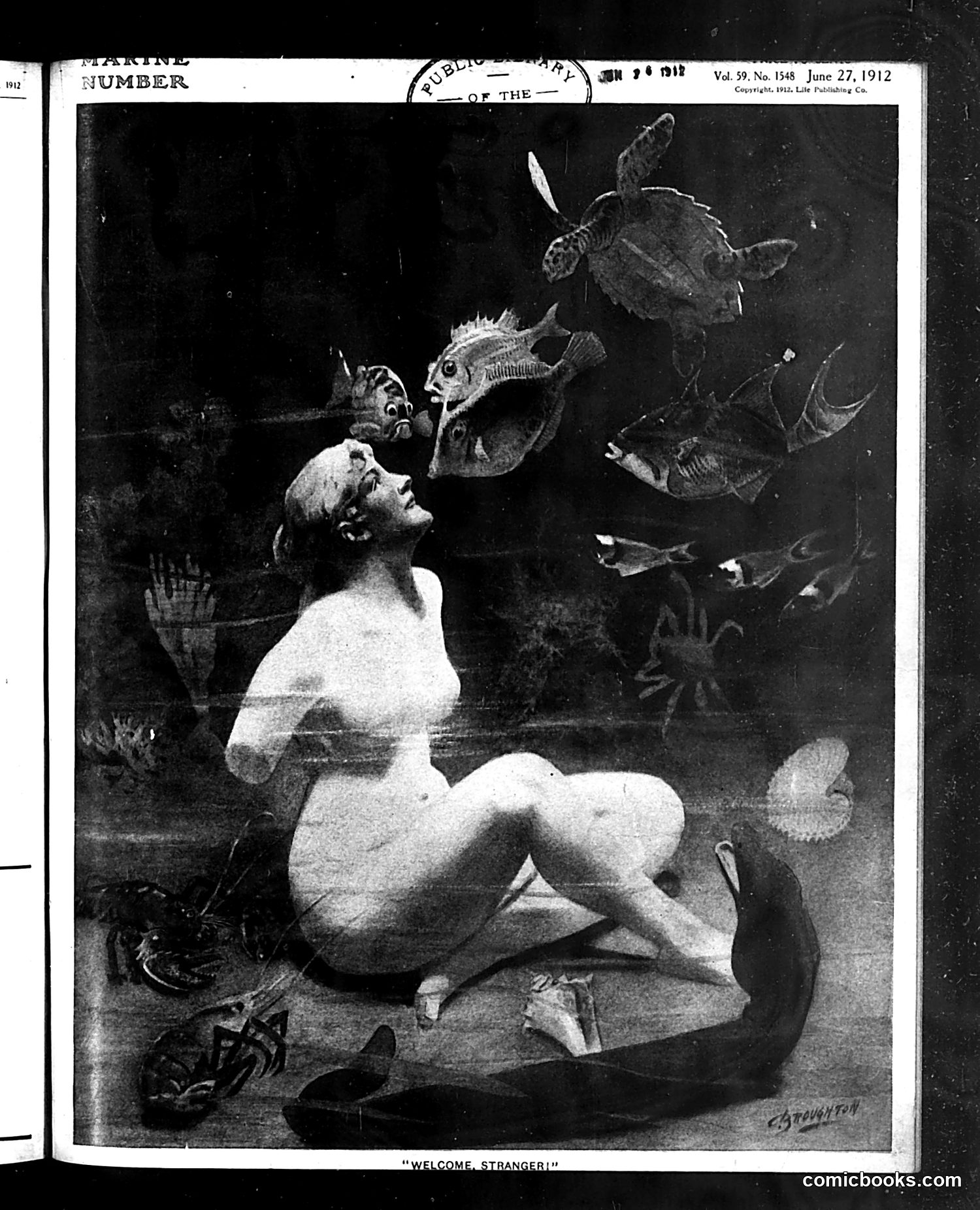
This satirical illustration depicts a nude mermaid-like figure surrounded by various sea creatures in an underwater setting. The caption "Welcome, Stranger!" suggests the figure represents something new or foreign entering established territory. Given the 1912 date, this likely comments on immigration or the arrival of unfamiliar cultural elements into American society. The mermaid's vulnerable, exposed position surrounded by creatures could satirize anxieties about newcomers in an alien environment, or conversely, mock nativist fears of the "foreign" as threatening. The artist's treatment—rendering the figure as fantastical rather than fully human—appears designed to create satirical distance, though the specific political reference remains unclear without additional contextual documentation from that publication period.
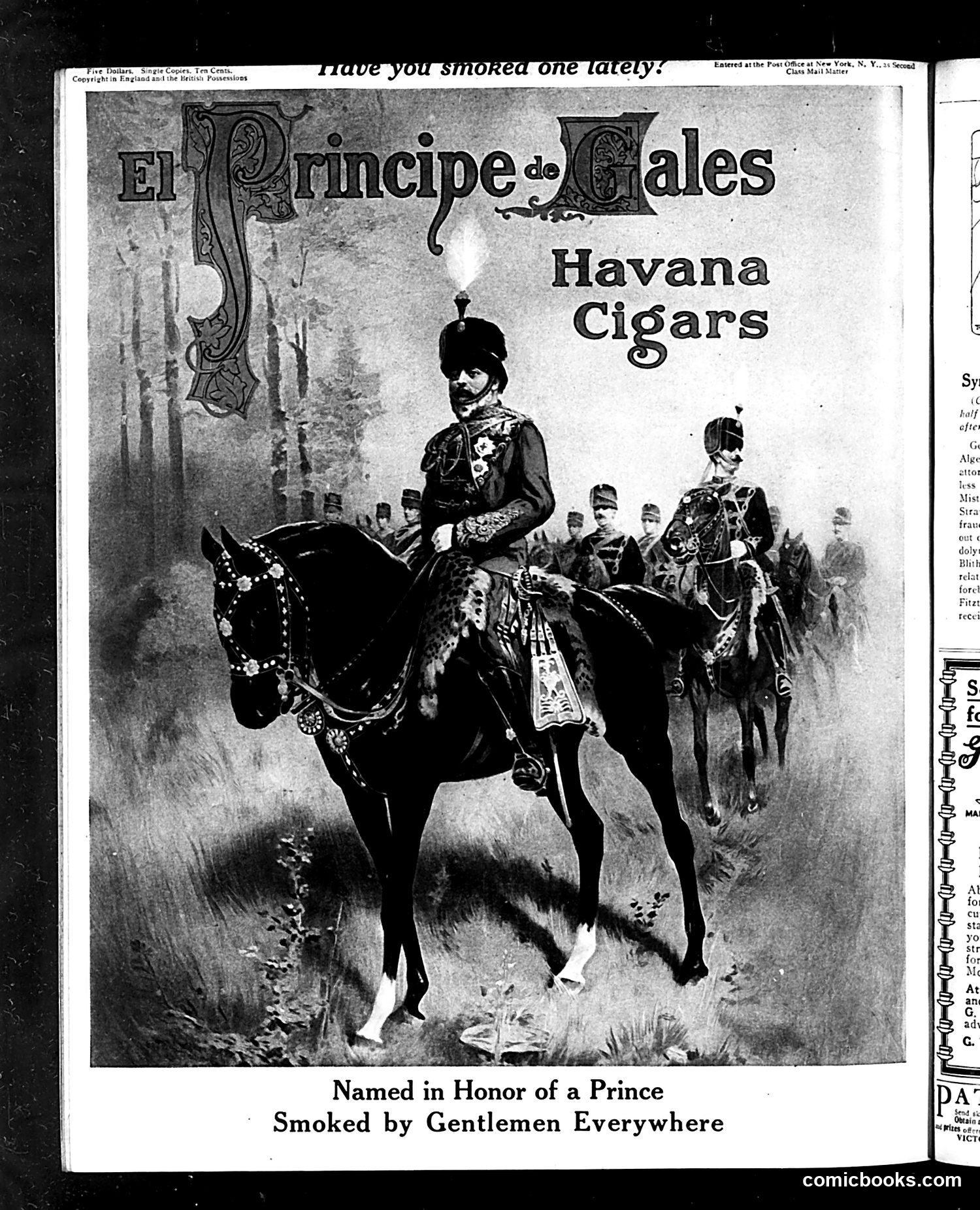
This is a cigar advertisement, not political satire. The page promotes "El Príncipe de Gales" (The Prince of Wales) brand Havana cigars, named in honor of a prince and marketed as "Smoked by Gentlemen Everywhere." The illustration depicts a military or royal figure on horseback in ornate uniform, accompanied by mounted attendants, suggesting aristocratic prestige and sophistication. The elaborate styling—decorative initial letter, formal composition—aims to associate the product with upper-class elegance and international distinction. The brand name references royalty to convey luxury and exclusivity, a common marketing strategy in this era. The "Prince of Wales" association suggested refinement and gentlemanly status to potential consumers.
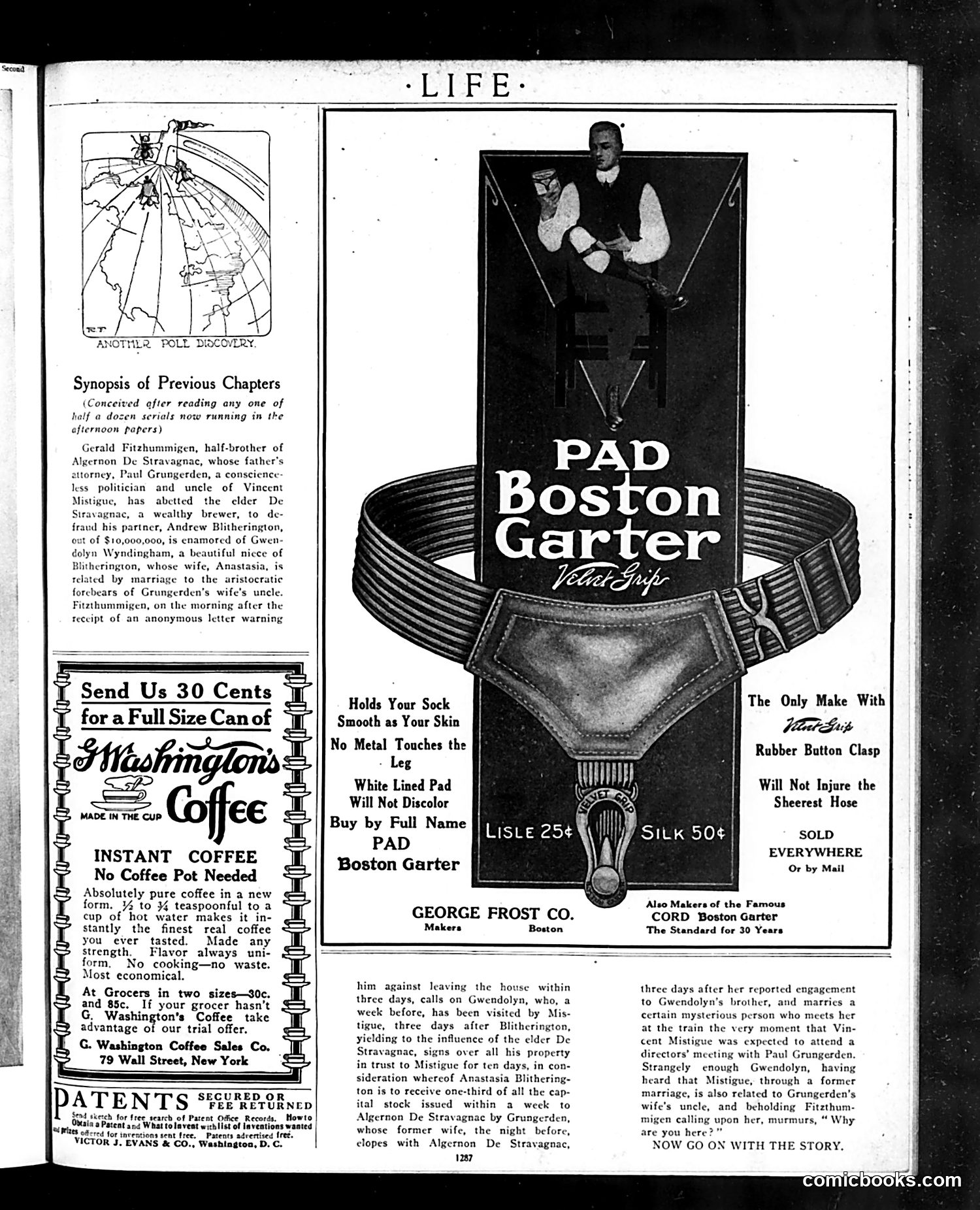
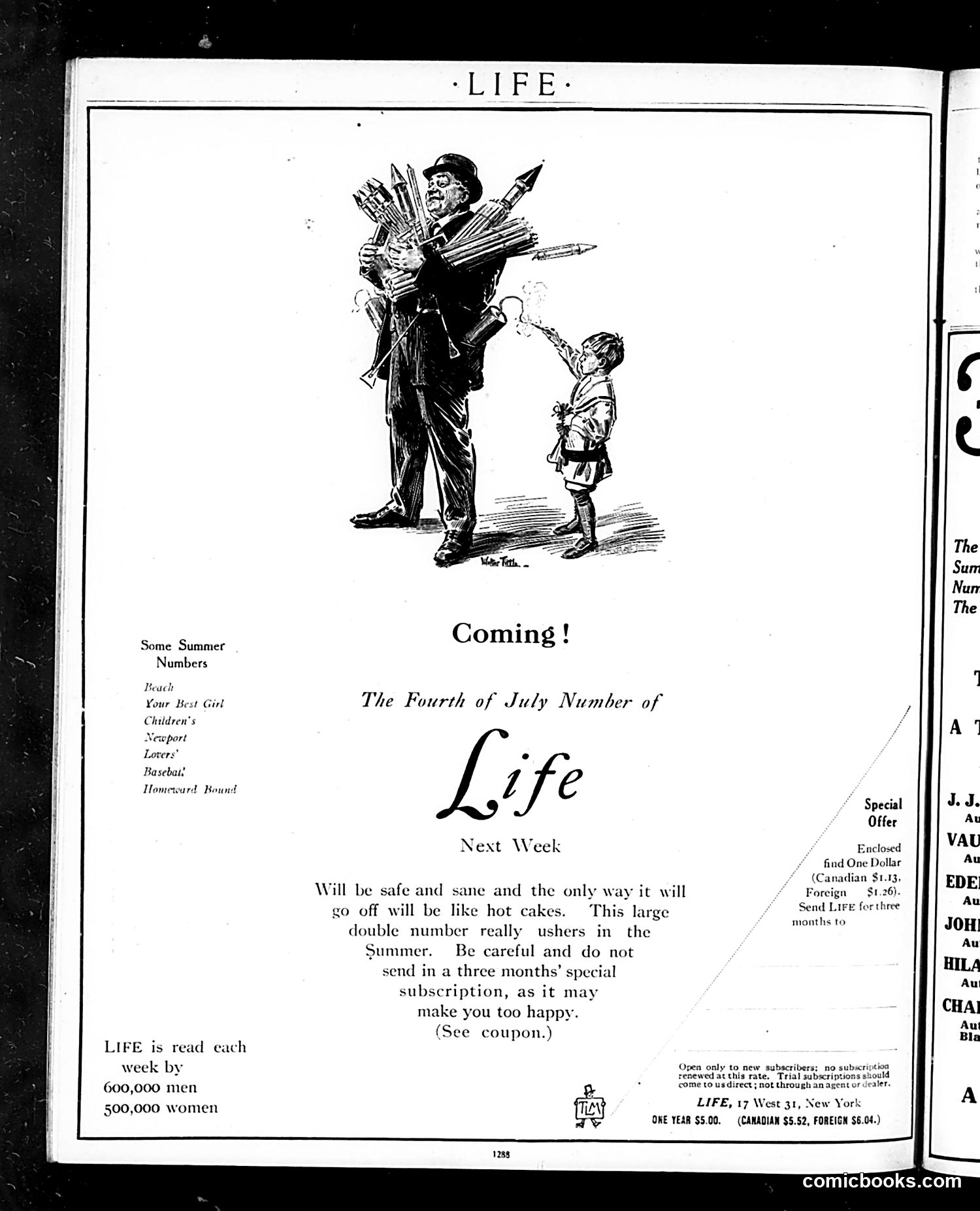
This is primarily an **advertisement for Life magazine's Fourth of July issue**, not political satire. The illustration shows an adult figure carrying numerous weapons and explosives while a small child reaches up toward him—apparently depicting the dangers of fireworks and explosives during Independence Day celebrations. The accompanying text warns that the July 4th number "will be safe and sane and the only way it will go off will be like hot cakes," suggesting Life magazine will provide safe holiday entertainment as an alternative to dangerous fireworks. The phrase "do not send in a three months' special subscription, as it may make you too happy" appears to be humorous self-promotion. This reflects early 20th-century public safety campaigns against fireworks-related injuries during holiday celebrations.
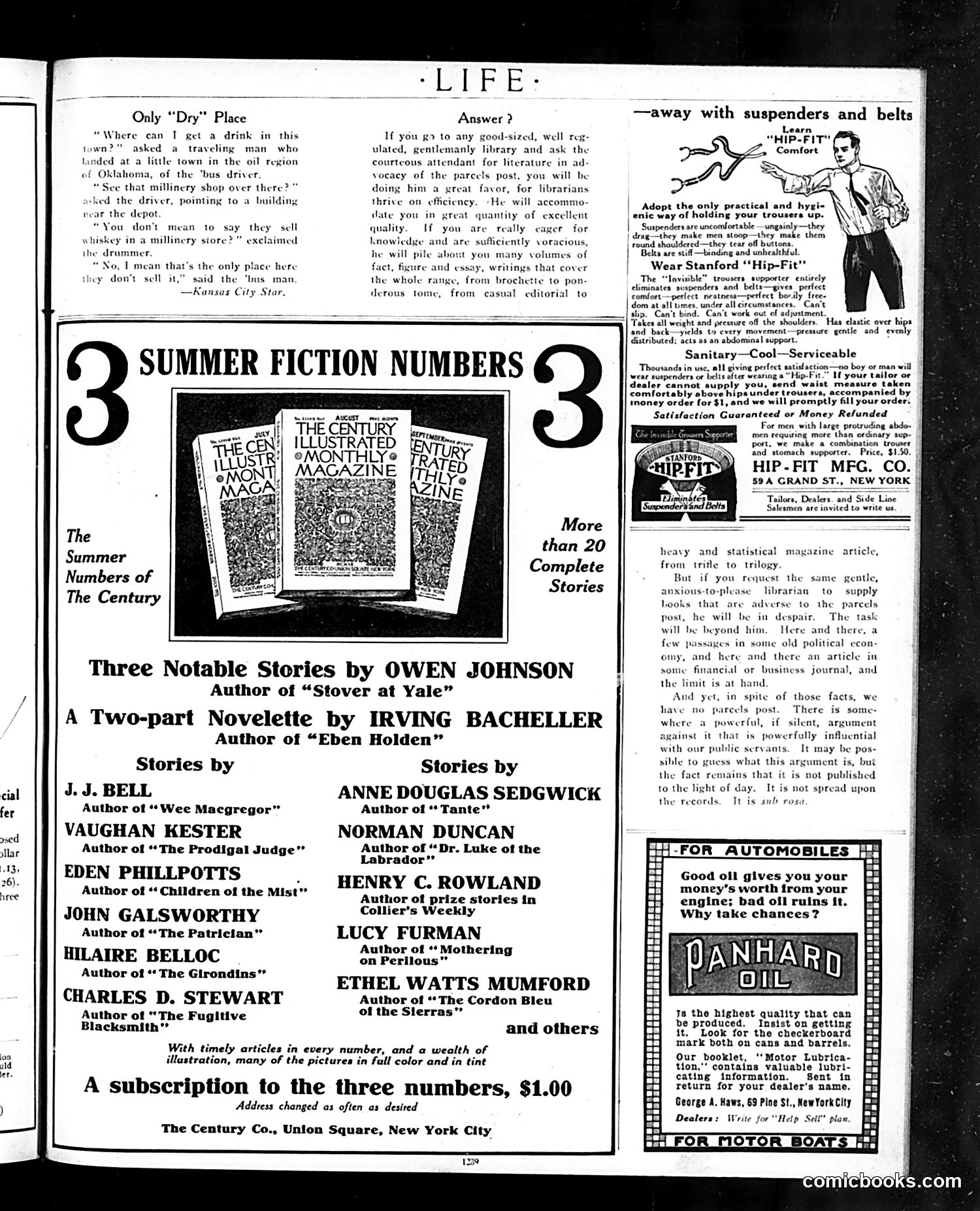
This page is primarily **advertising and promotional content**, not political satire. The left side advertises "Summer Fiction Numbers" of *The Century* magazine, featuring stories by notable authors like Owen Johnson, Irving Bacheller, and others. It's a standard subscription pitch offering three issues for $1.00. The right side contains two distinct items: a humorous short anecdote about a traveler in Oklahoma asking about "dry" places (playing on prohibition-era language), and advertisements for practical goods—Hip-Fit suspenders and Panhard Oil for automobiles. There are **no political cartoons** on this page. The content reflects early 20th-century consumer culture and literary marketing rather than social or political commentary.
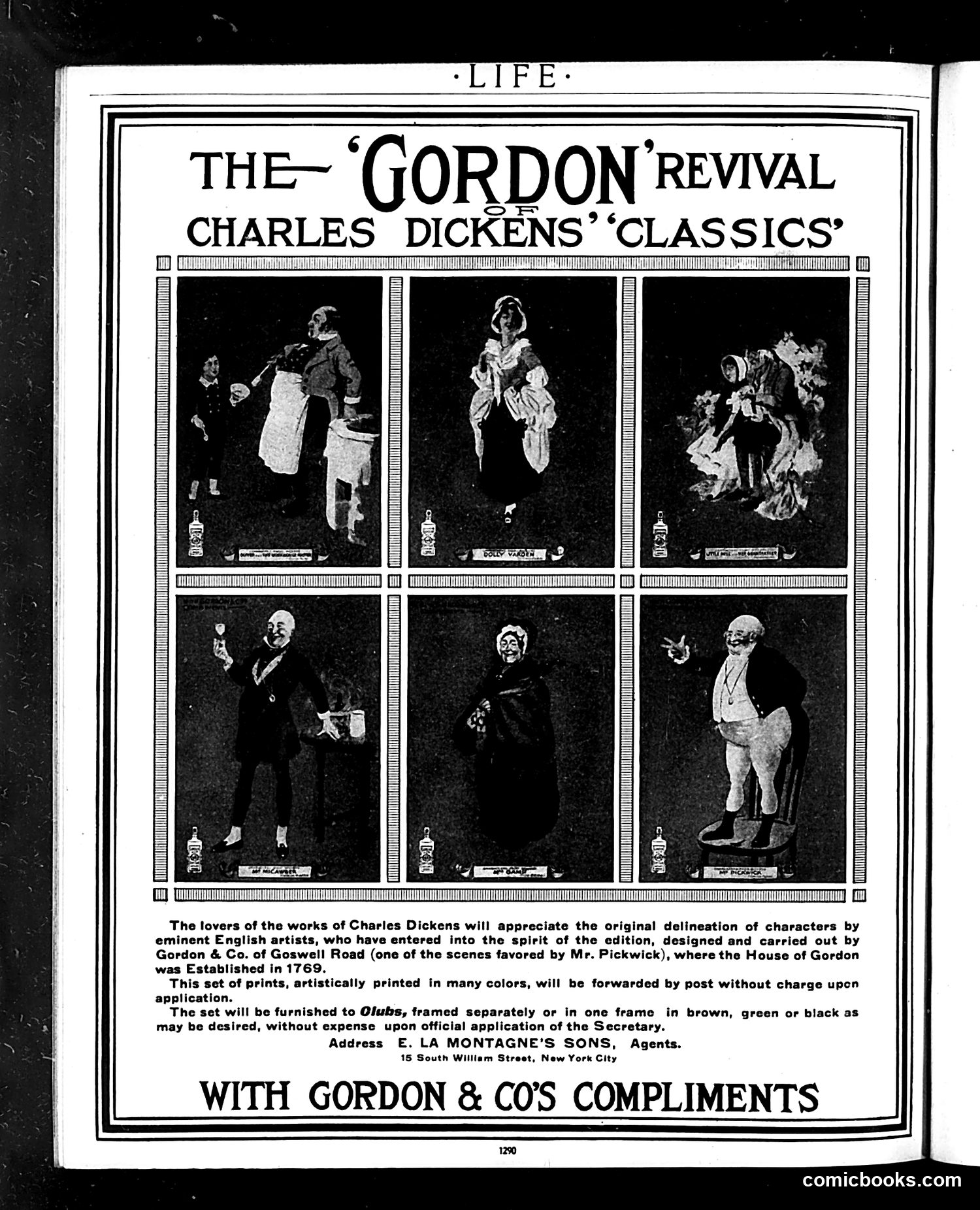
This is primarily **advertising content**, not satire. It promotes a set of artistic prints depicting characters from Charles Dickens novels, published by Gordon & Co. of Goswell Road (a historically significant London location). The six photographs show actors in costume portraying Dickens characters. The text explains these are "original delineations of characters by eminent English artists" available as colored prints for clubs and institutions. The advertisement emphasizes authenticity and literary prestige—linking the prints to Dickens' legacy and a specific London address associated with his work. It's a commercial promotion leveraging Victorian literary nostalgia, addressed to organizations and clubs rather than individual consumers. Gordon & Co. offers complimentary delivery.
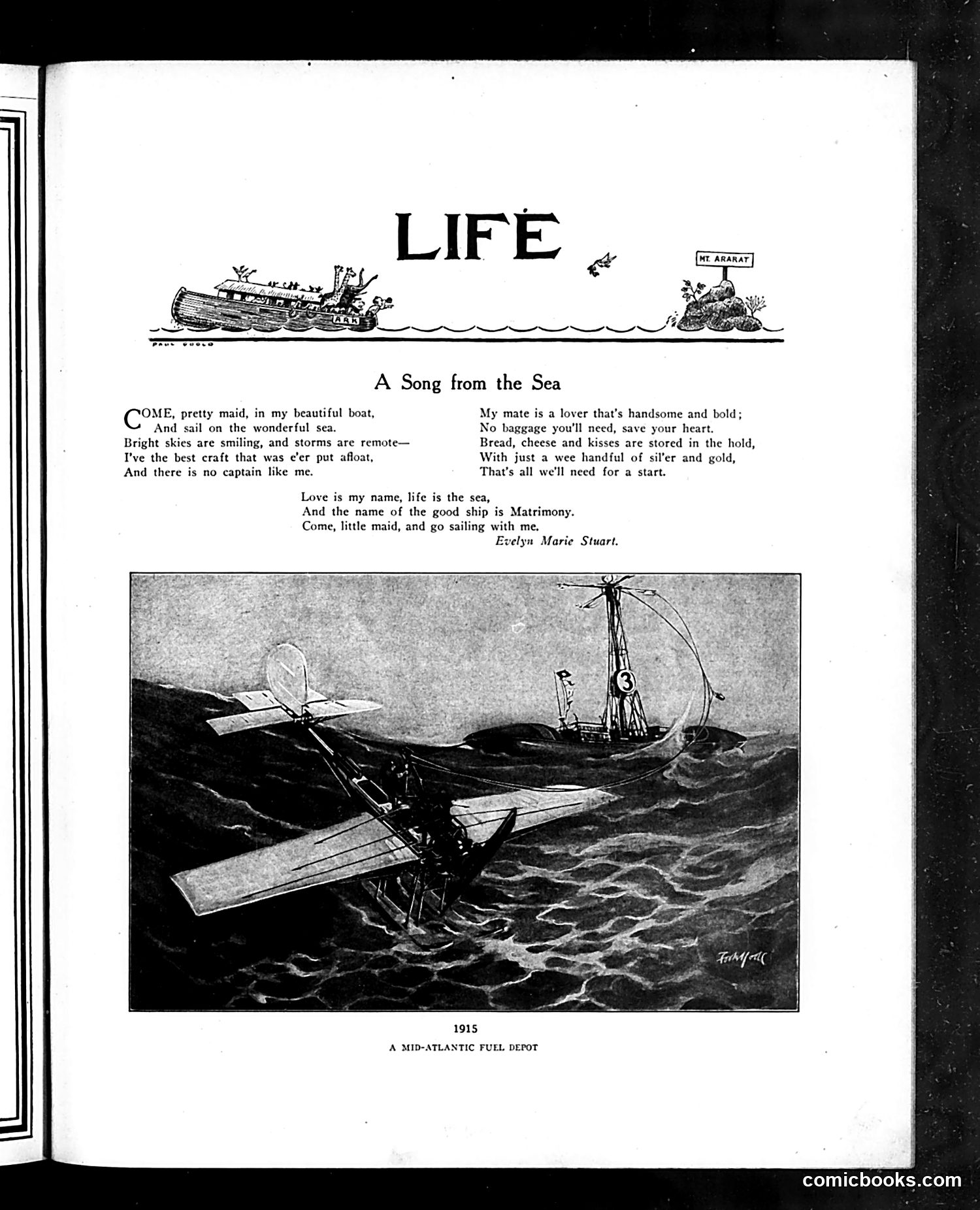
This page presents a romantic poem titled "A Song from the Sea" by Evelyn Marie Stuart, accompanied by an illustration labeled "A Mid-Atlantic Fuel Depot" (1915). The satirical content targets WWI naval activity. The illustration depicts ships in rough waters, seemingly engaged in covert refueling operations mid-ocean. The juxtaposition of the sentimental love poem about sailing with the caption "fuel depot" appears to mock the romantic notion of seafaring during wartime, contrasting idealized maritime romance with the grim reality of wartime logistics and submarine warfare in the Atlantic. The satire likely critiques either German U-boat operations or Allied supply concerns during this period of naval conflict.
This page contains editorial commentary on the 1912 U.S. presidential election, referencing Theodore Roosevelt's Progressive ("Bull Moose") Party challenge against Republican incumbent William Howard Taft. The article criticizes Congressional gridlock and government inefficiency, arguing that the President needs both party support and constitutional powers to govern effectively. It discusses the split between Taft and Roosevelt, noting that Roosevelt's challenge has exposed fundamental weaknesses in the American system. The author argues voters need a "MAN"—a decisive leader—rather than partisan bickering. The text suggests Roosevelt's candidacy, while representing frustration with Taft's presidency, illustrates deeper systemic problems in how presidential power is balanced against Congressional authority.
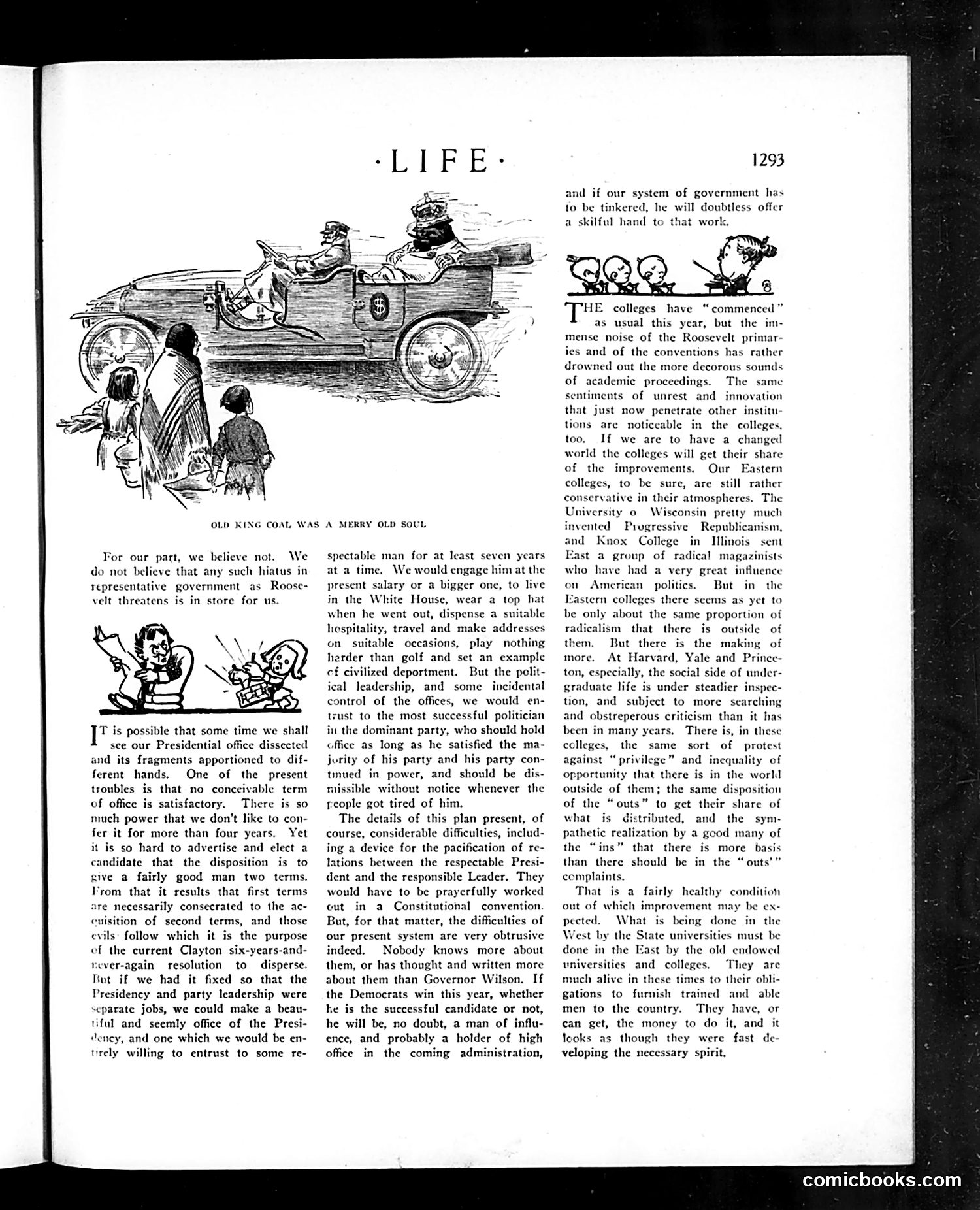
This Life magazine page satirizes American presidential politics and governance structure. The top cartoon depicts "Old King Coal" as a "merry old soul"—a reference to the nursery rhyme, suggesting coal interests exert excessive influence over leadership. The main article argues against concentration of presidential power, advocating instead for a "separate jobs" system where the presidency and party leadership are divided. The author contends this would create more stable, accountable government than the current system where one person holds both roles. The piece also critiques contemporary college activism, noting "Roosevelt primaries" and conventions have disrupted academic institutions with political noise—suggesting colleges are becoming overly politicized during this election period.
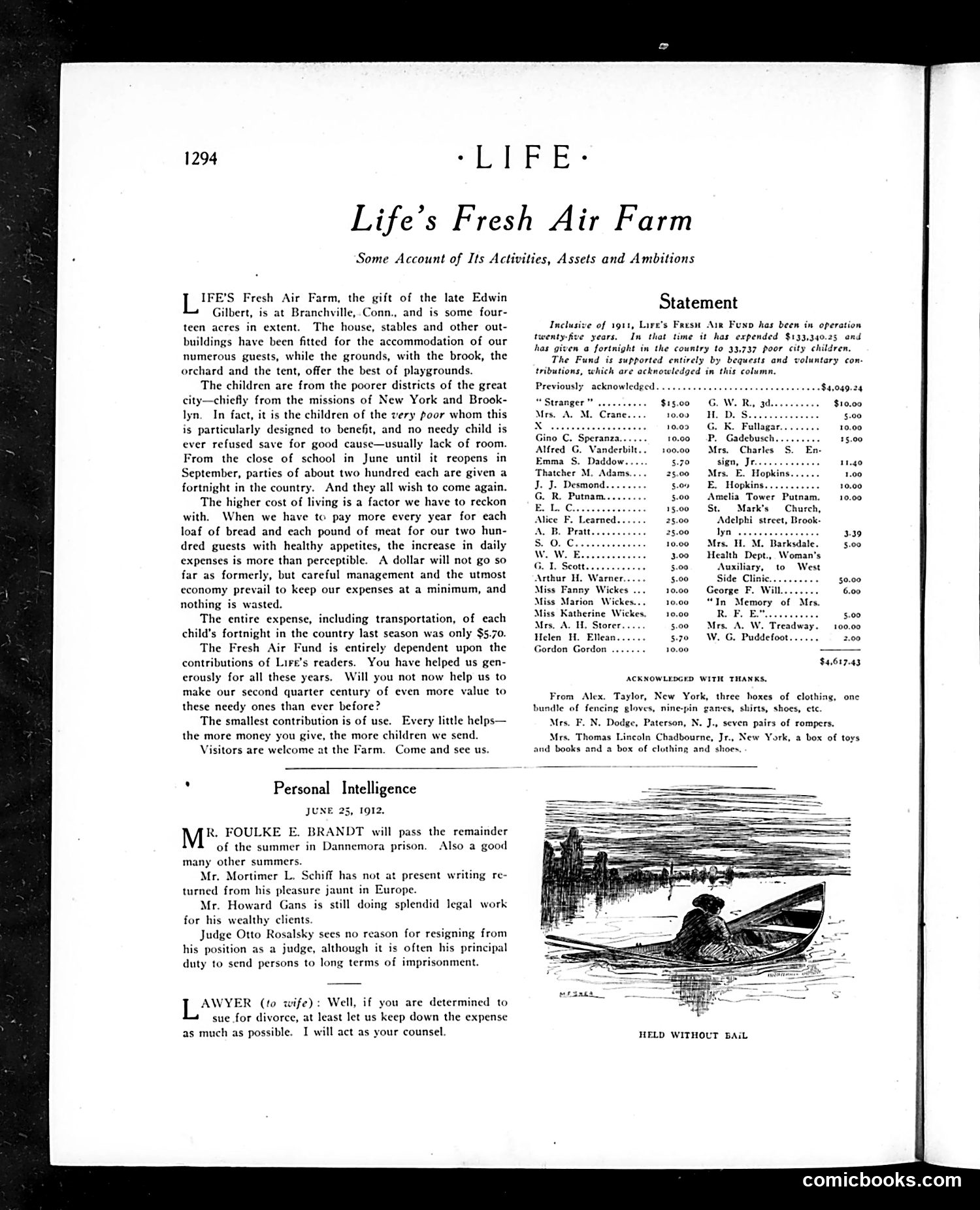
This page contains **two distinct sections**: an article about "Life's Fresh Air Farm" (a charitable institution for poor urban children) with a financial statement, and a "Personal Intelligence" gossip column. The **illustration** depicts a simple line drawing titled "HELD WITHOUT SAIL" showing a person in a rowboat on water near a shoreline with buildings. The drawing's meaning is unclear from context alone—it may be satirizing someone's predicament or illustrating a colloquial phrase. The gossip section mentions several public figures of 1912, including **Judge Otto Rosalsky** and references to legal matters and imprisonment. The "Lawyer" advice column offers cynical commentary on divorce proceedings. The page reflects Life magazine's dual purpose: promoting charitable causes while entertaining readers with satirical social commentary and gossip.
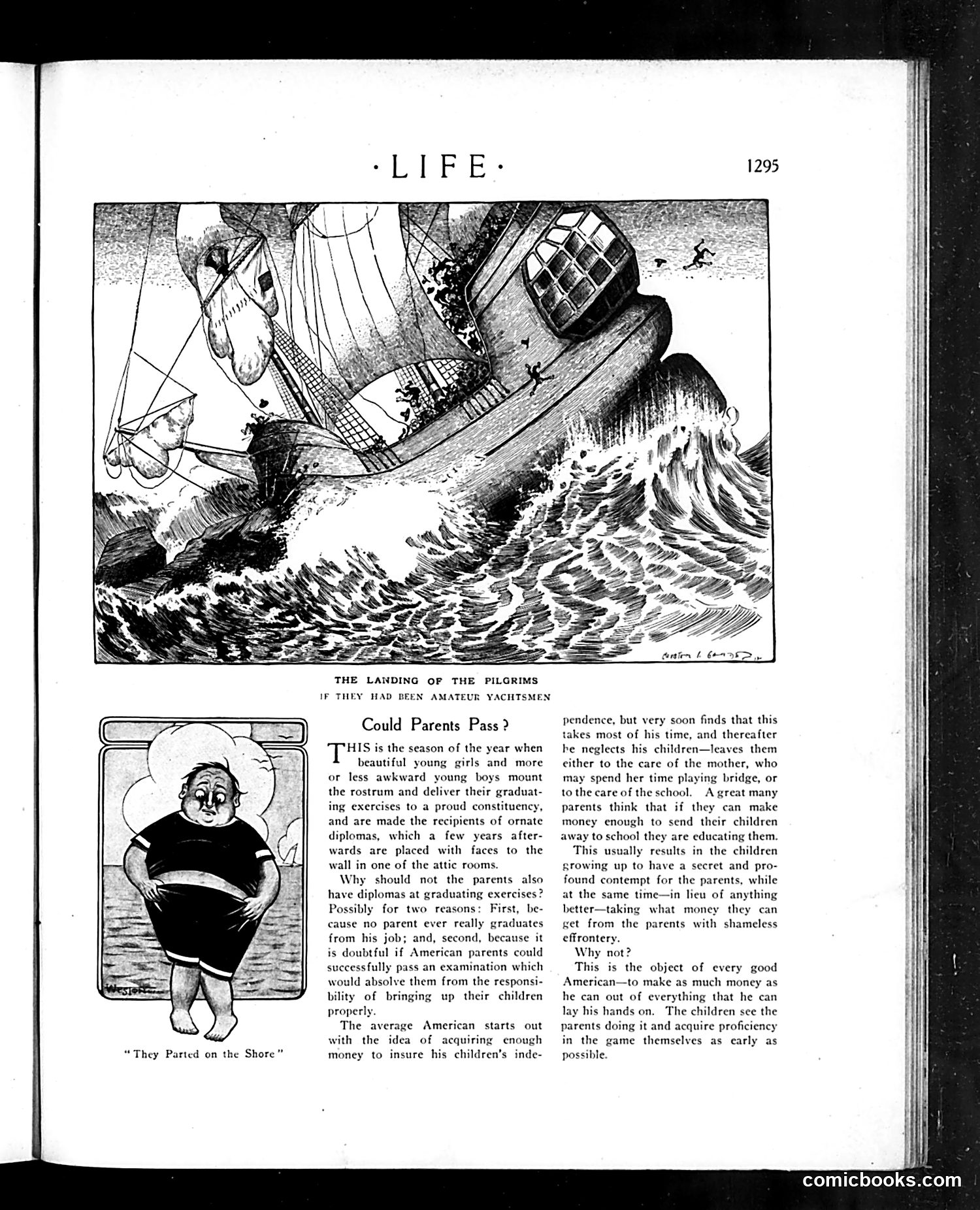
This page contains two satirical pieces critiquing American parenting and class anxiety. **Top illustration**: "The Landing of the Pilgrims (If They Had Been Amateur Yachtsmen)" mocks incompetent amateur sailors, likely referencing contemporary wealthy dilettantes attempting nautical pursuits. **Bottom cartoon and article**: "Could Parents Pass?" satirizes parents' social aspirations regarding their children's education. The piece argues that average Americans prioritize sending children to expensive schools to gain social status and proficiency in moneymaking, rather than for genuine education. The cartoon shows an uncomfortable parent, suggesting parental anxiety about their own inadequacy. The satire targets American materialism and status-seeking, implying that parents view education primarily as a financial investment and social credential rather than intellectual development—a critique of emerging consumer culture and class mobility anxieties in early 20th-century America.
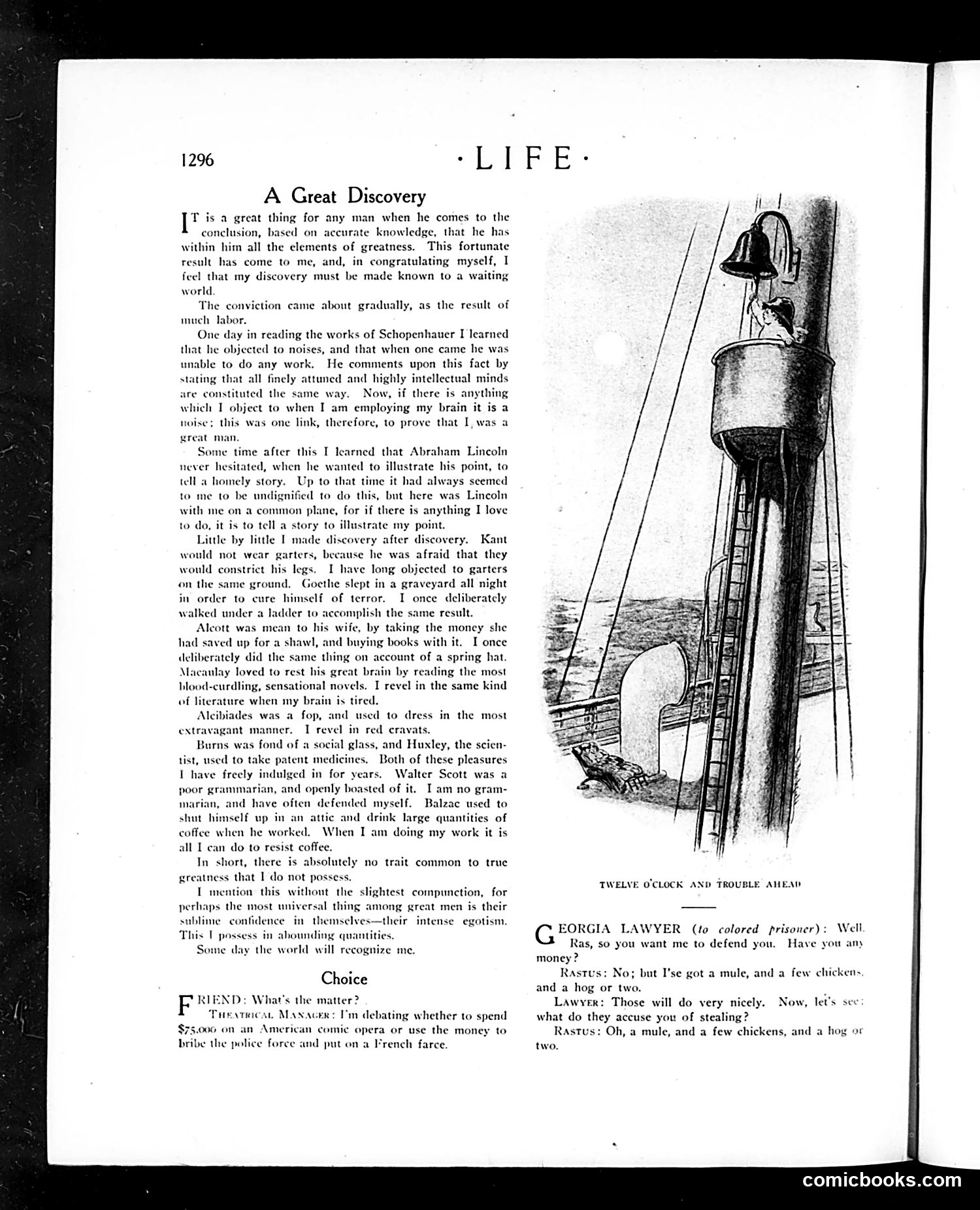
This page contains two distinct pieces: **"A Great Discovery"** (main article): An autobiographical essay where the author describes arriving at the conclusion that he possesses all the elements of greatness—referencing Schopenhauer and Abraham Lincoln as examples. The tone is satirical self-aggrandizement, mocking pretentious intellectuals who overestimate their own importance. **"Choice"** (brief dialogue): A friend asks a theatrical manager whether to spend $75,000 on an American comic opera or bribe a judge to fix a French farce—presenting corruption as a casual financial choice. **"Twelve O'Clock and Trouble Ahead"** (illustration): A ship's bell and rigging sketch accompanies a dialogue between a Georgia lawyer and prisoner named Rastus about stolen livestock, likely containing period racial stereotypes. The page satirizes vanity, corruption, and social pretension typical of Life magazine's satirical approach.
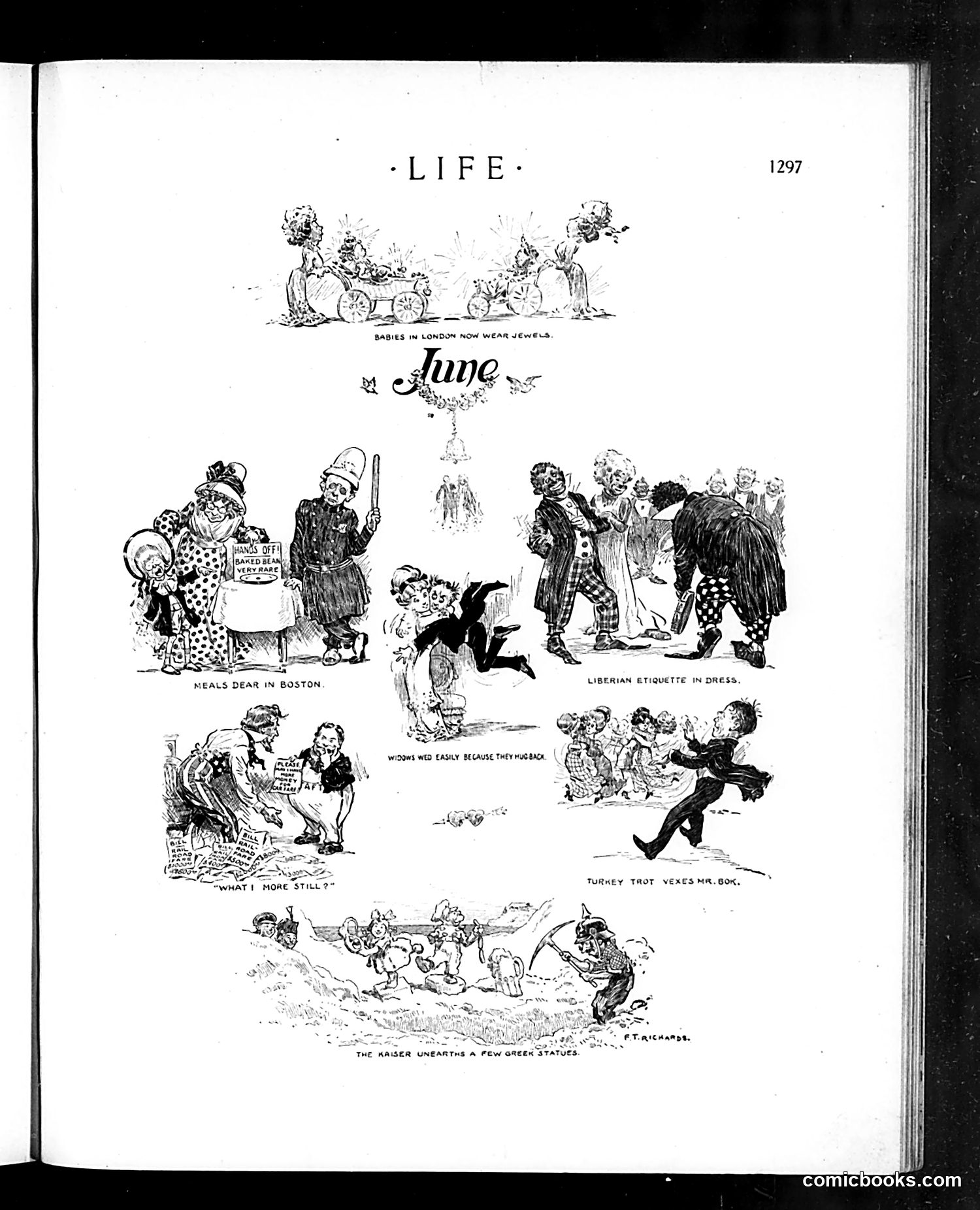
This page contains six satirical cartoon vignettes mocking various June-time social situations: 1. **"Babies in London now wear jewels"** - critiques wealthy British infant fashion excess 2. **"Meals dear in Boston"** - depicts food cost complaints 3. **"Liberian etiquette in dress"** - appears to mock formal dress codes, likely referencing Liberia's colonial elite 4. **"Women did easily because they pushed"** - unclear reference, possibly about female behavior 5. **"Turkey that vexes Mr. Bok"** - likely references Edward Bok (prominent editor), though the specific turkey reference is unclear 6. **"The Kaiser unearthing a few green statues"** - references German Kaiser Wilhelm, satirizing post-WWI reparations/war damages The cartoons employ exaggerated character drawings typical of early 20th-century American satirical humor, targeting contemporary social pretension, economic anxieties, and political figures.
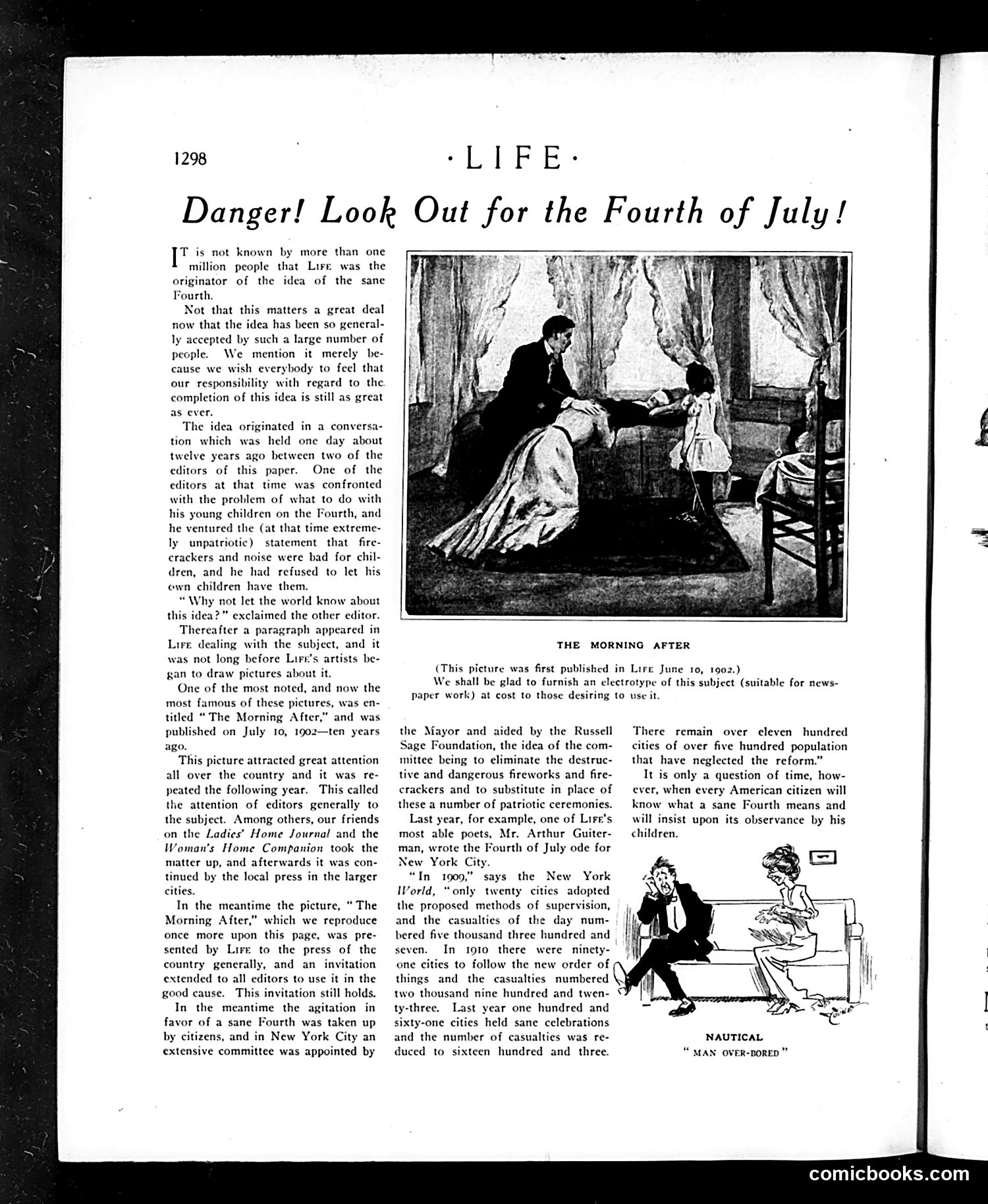
This Life magazine page advocates for safer Fourth of July celebrations. The main illustration shows a distressed mother tending to an injured child the morning after Independence Day festivities—depicting the human cost of firecrackers and fireworks. The accompanying article discusses a decade-long editorial campaign to eliminate "destructive and dangerous fireworks and firecrackers" in favor of patriotic ceremonies. It cites alarming casualty statistics: by 1910, ninety-one cities reported casualties; by 1911, over 1,000 injuries and deaths occurred on the Fourth. The cartoon's satire is implicit—the somber "morning after" scene speaks to the gap between festive ideals and tragic reality, making a public health argument for reforming dangerous holiday traditions.
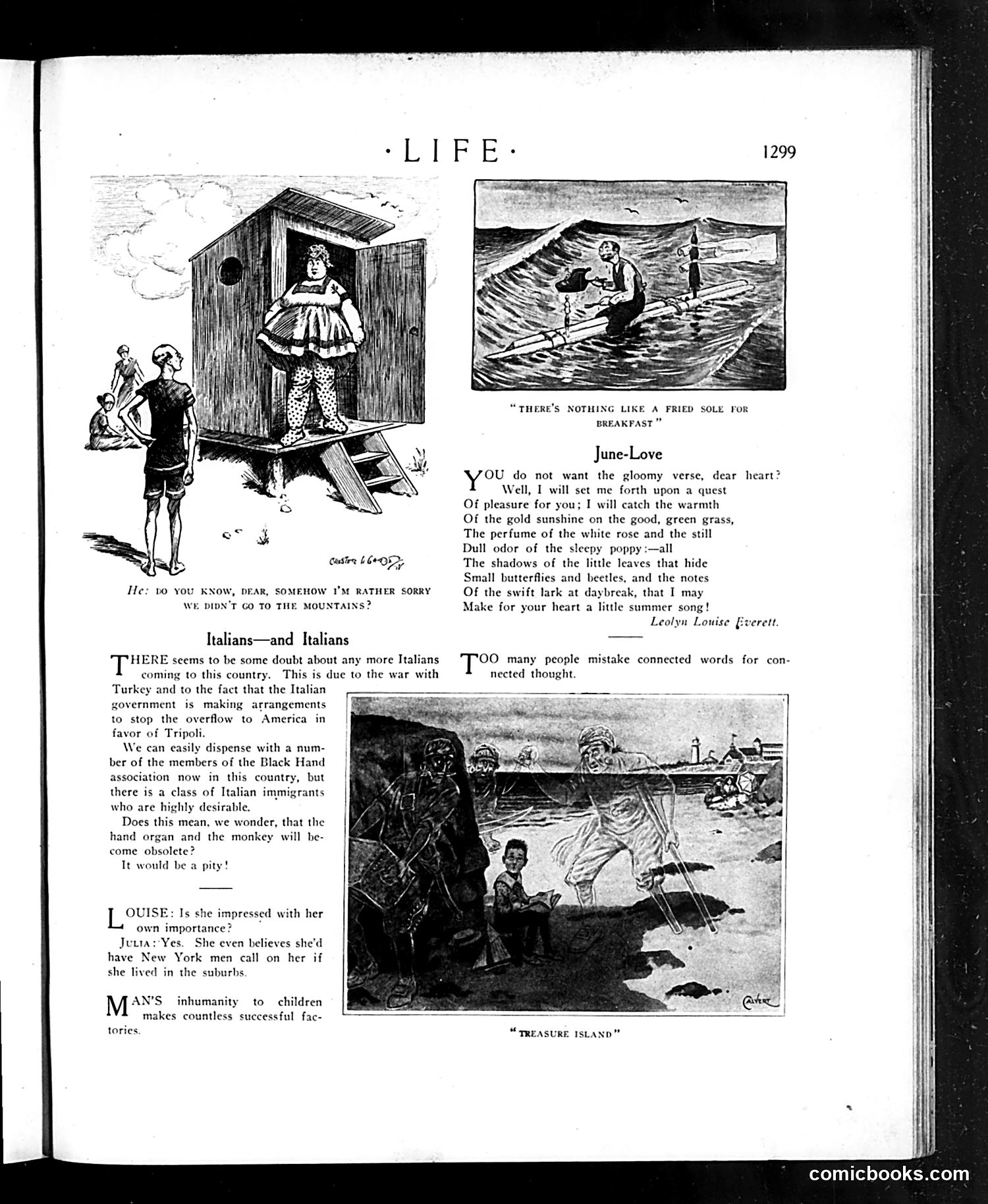
This page contains social commentary typical of early 20th-century *Life* magazine satire: **"Italians—and Italians"**: References Italian immigration and the "Black Hand" (a criminal organization associated with Italian immigrants in American public perception). The article sarcastically suggests that while some Italian immigrants are "undesirable," others are fine—then jokes darkly that organ grinders and their monkeys might become obsolete, implying stereotypical ethnic occupations. The piece mocks both anti-Italian prejudice and the Italian government's effort to redirect emigrants toward Tripoli (Libya) rather than America. **The cartoon "He: 'You know, dear, somehow I'm rather sorry we didn't go to the mountains?'"**: A couple in a large birdhouse-like structure depicts marital discord, with the husband expressing regret—likely satirizing vacation planning disputes or domestic dissatisfaction. **Other brief dialogues** mock feminine vanity and social pretension among women. The page blends poetry ("June-Love") with biting social observation about class, ethnicity, and gender dynamics of the era.
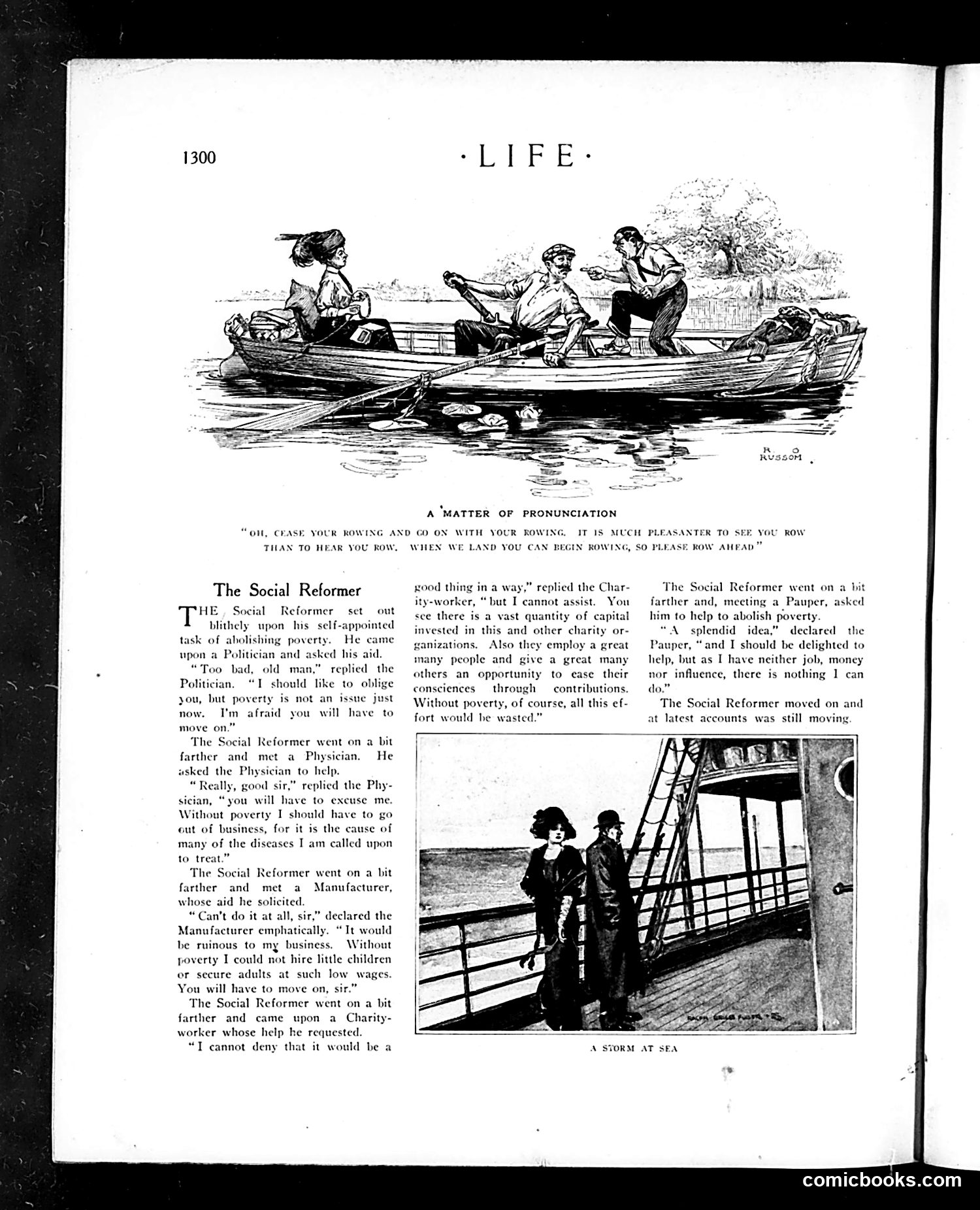
This satirical story mocks the futility of social reform by showing how *every institution* benefits from poverty and thus refuses to help eliminate it. A well-meaning Social Reformer seeks help abolishing poverty from various professionals. Each refuses: - A **Politician** claims poverty isn't a current political issue - A **Physician** needs disease (caused by poverty) for his business - A **Manufacturer** depends on desperate poor workers for cheap labor - A **Charity-worker** profits from poverty—their organizations employ many and let donors "ease their consciences" - A **Pauper** (the only one who agrees it's a good idea) lacks resources to help The joke: systemic poverty persists because the powerful have financial incentives to maintain it, while those who could benefit most are powerless. The reformer "moves on"—making no progress. The cartoon satirizes how self-interest disguises itself as necessity.
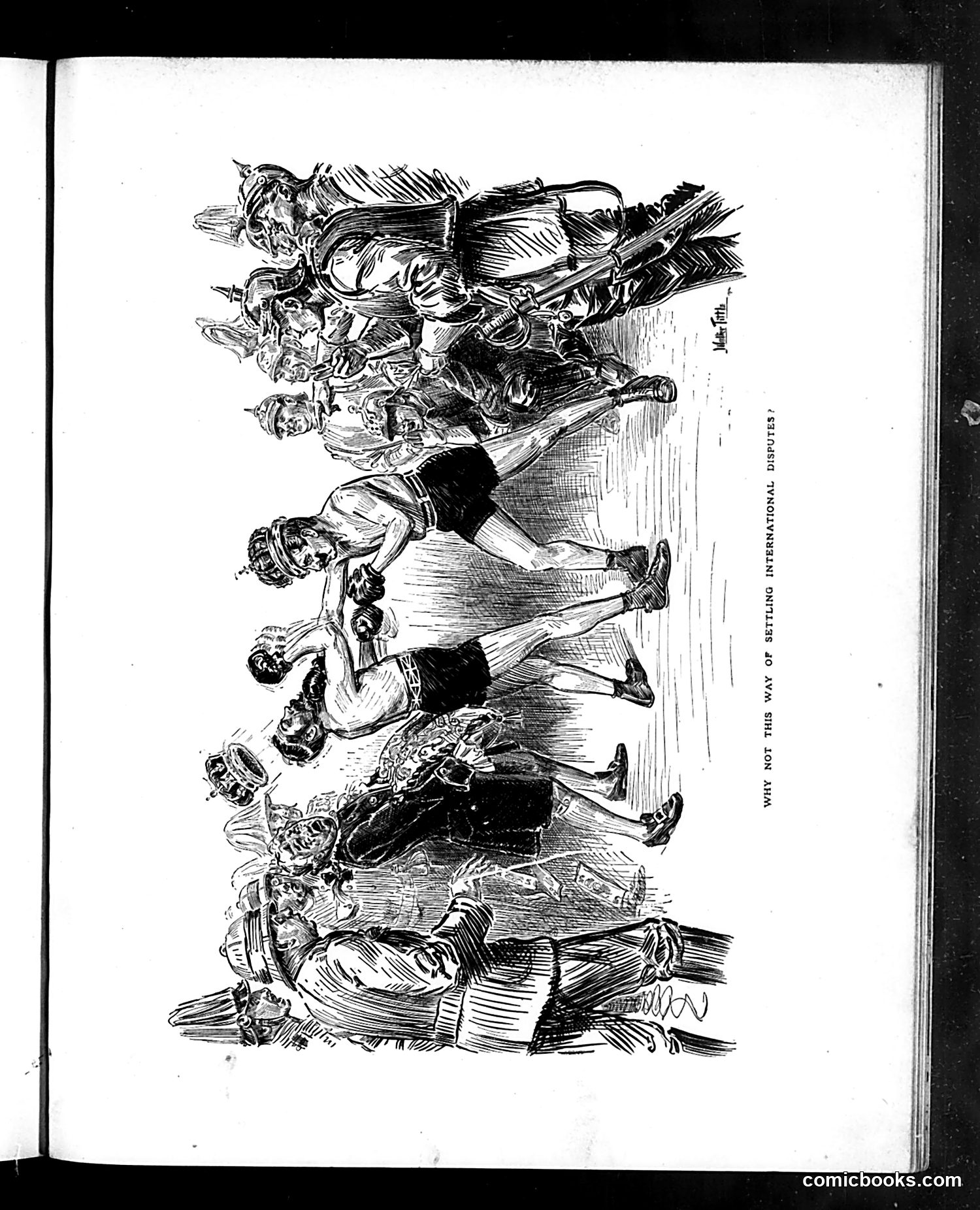
This is a satirical illustration titled "Why Not Try of Attending Internodal Busters" (text appears reversed/unclear in OCR). The cartoon depicts multiple figures in what appears to be a chaotic scene, drawn in a detailed cross-hatched ink style typical of early-to-mid 20th century satirical magazines. The composition shows several people in various poses of distress or agitation, suggesting social or political turmoil. Without clearer text or additional context, the specific identities of the figures and the precise political event being satirized cannot be definitively determined from this image alone. The title's reference to "international" matters suggests it addresses foreign policy or diplomatic concerns of the period. The style and presentation are consistent with Life magazine's satirical approach to contemporary issues.
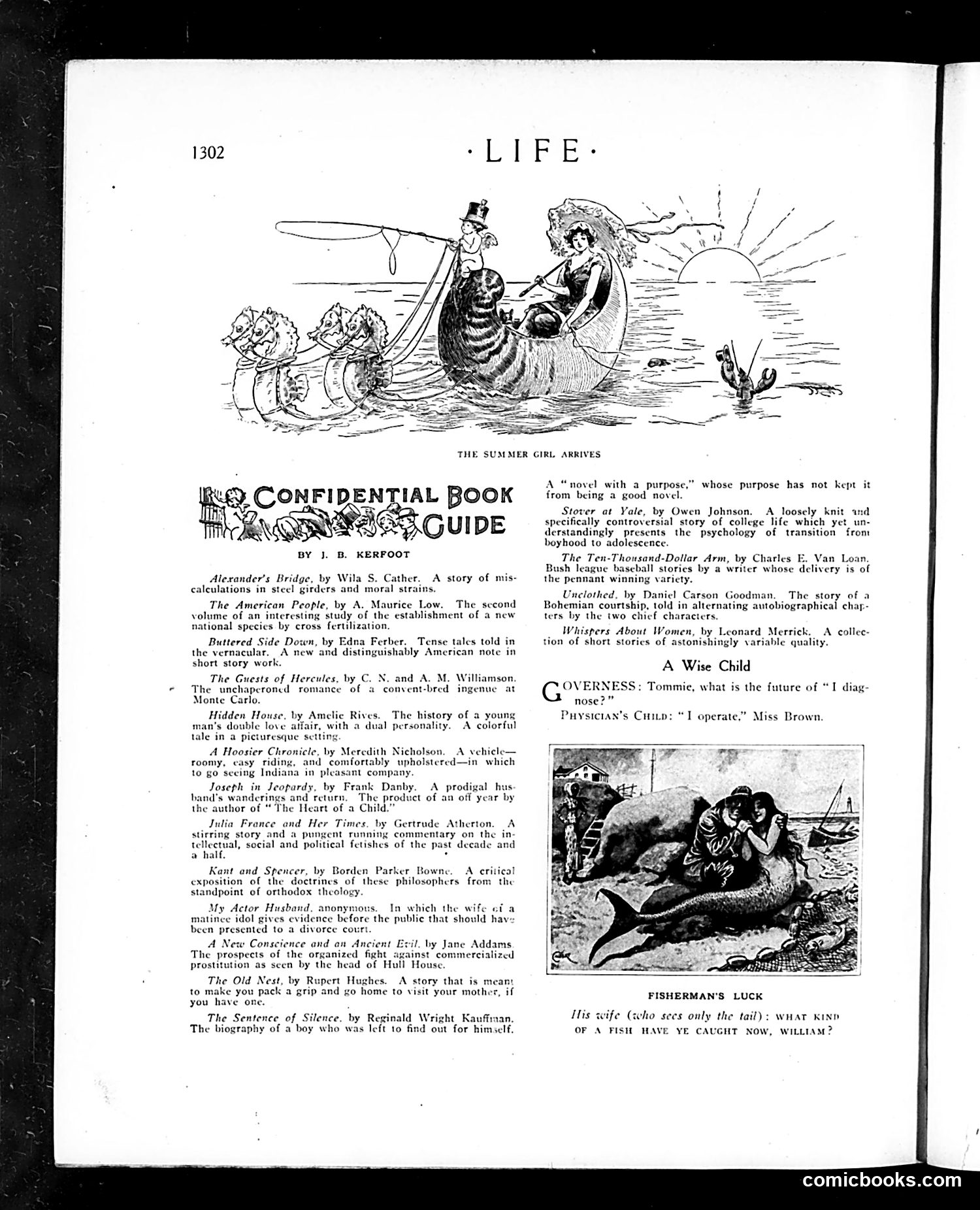
**Top illustration**: Shows a fashionably dressed woman arriving by boat for summer, laden with elaborate luggage and accompanied by attendants. This satirizes the seasonal migration of wealthy urbanites to coastal resorts—a marker of upper-class leisure and excess in the early 1900s. **Bottom cartoon**: A fisherman shows his wife only the tail of his catch, implying the fish is enormous. She, seeing only the tail end, asks what kind of fish it is. This jokes on spousal communication and masculine exaggeration—the husband's boasting about his catch versus her practical, limited perspective. It reflects period humor about marital dynamics and male pride. Both reflect early-20th-century American social hierarchies and gender roles, with satire directed at leisure culture and domestic stereotypes.
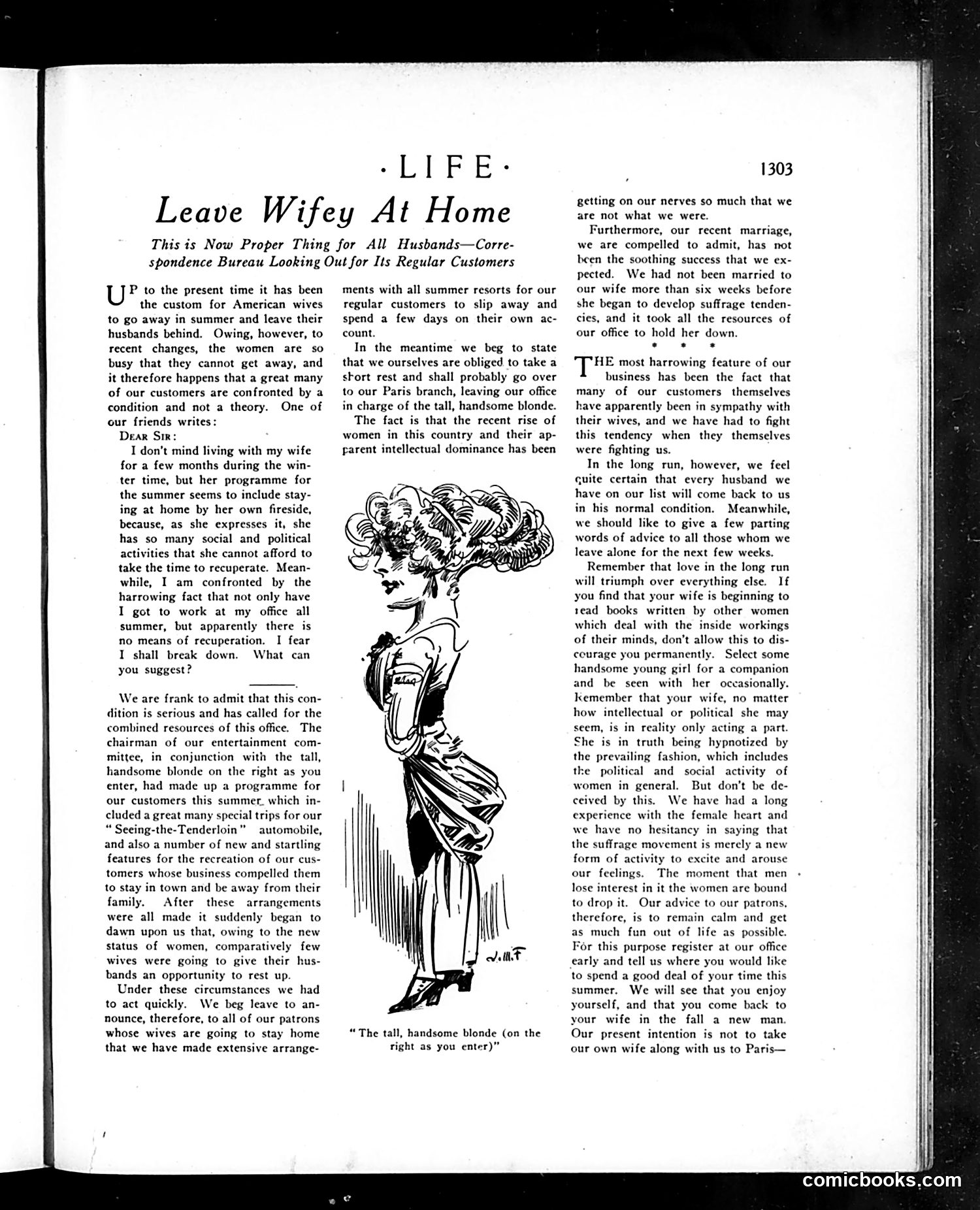
This satire mocks the emerging women's suffrage and independence movement of the early 1900s. The magazine's "Correspondence Bureau" humorously addresses a social crisis: wives are no longer leaving home for summer vacations, instead staying to pursue "social and political activities"—clearly referencing suffrage organizing. The joke centers on male anxiety about women's changing roles. A husband complains he cannot rest because his wife remains home, preoccupied with political activism. The magazine's patronizing "advice" to husbands acknowledges women's "intellectual dominance" while dismissing suffrage as a temporary phase wives will outgrow. The cartoon illustration of the "tall, handsome blonde" receptionist represents the New Woman—employed, independent, and competent enough to manage the office alone. The satire targets both anxious husbands and progressive women, mocking male fears that women's political engagement threatens domestic arrangements and masculine leisure.
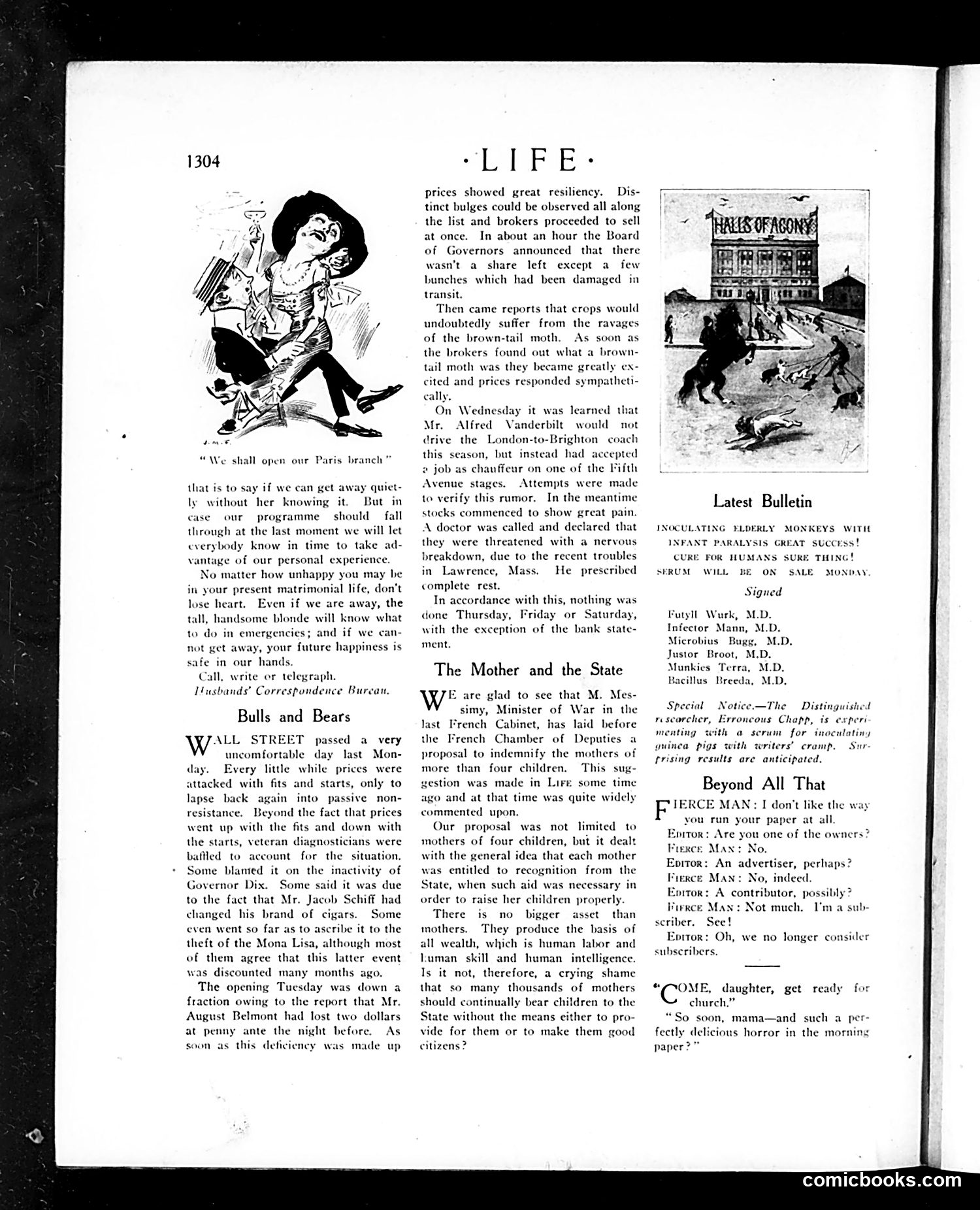
## The Cartoons/Sections: **"Bulls and Bears"** mocks Wall Street's irrational market volatility. The satire ridicules how brokers obsess over trivial rumors—Jacob Schiff changing cigars, the Mona Lisa theft, Alfred Vanderbilt's coaching decisions—treating them as market-moving events. The joke is that stock prices swing wildly based on gossip rather than economic fundamentals. This reflects early 20th-century financial market speculation and the absurdity of broker psychology. **"Latest Bulletin"** is a fake medical announcement with obviously fabricated doctor names ("Infector Mann," "Microbius Bugg," "Munkies Terra"). It satirizes overhyped medical claims and false advertising, particularly regarding polio vaccine development. The "inoculating elderly monkeys" detail lampoons premature announcements of medical breakthroughs—suggesting the cure isn't actually ready despite confident promises. **"The Mother and the State"** discusses a French proposal to compensate mothers of large families, framing motherhood as national economic value. This reflects early 20th-century European natalist policies and debates over state responsibility for family welfare.
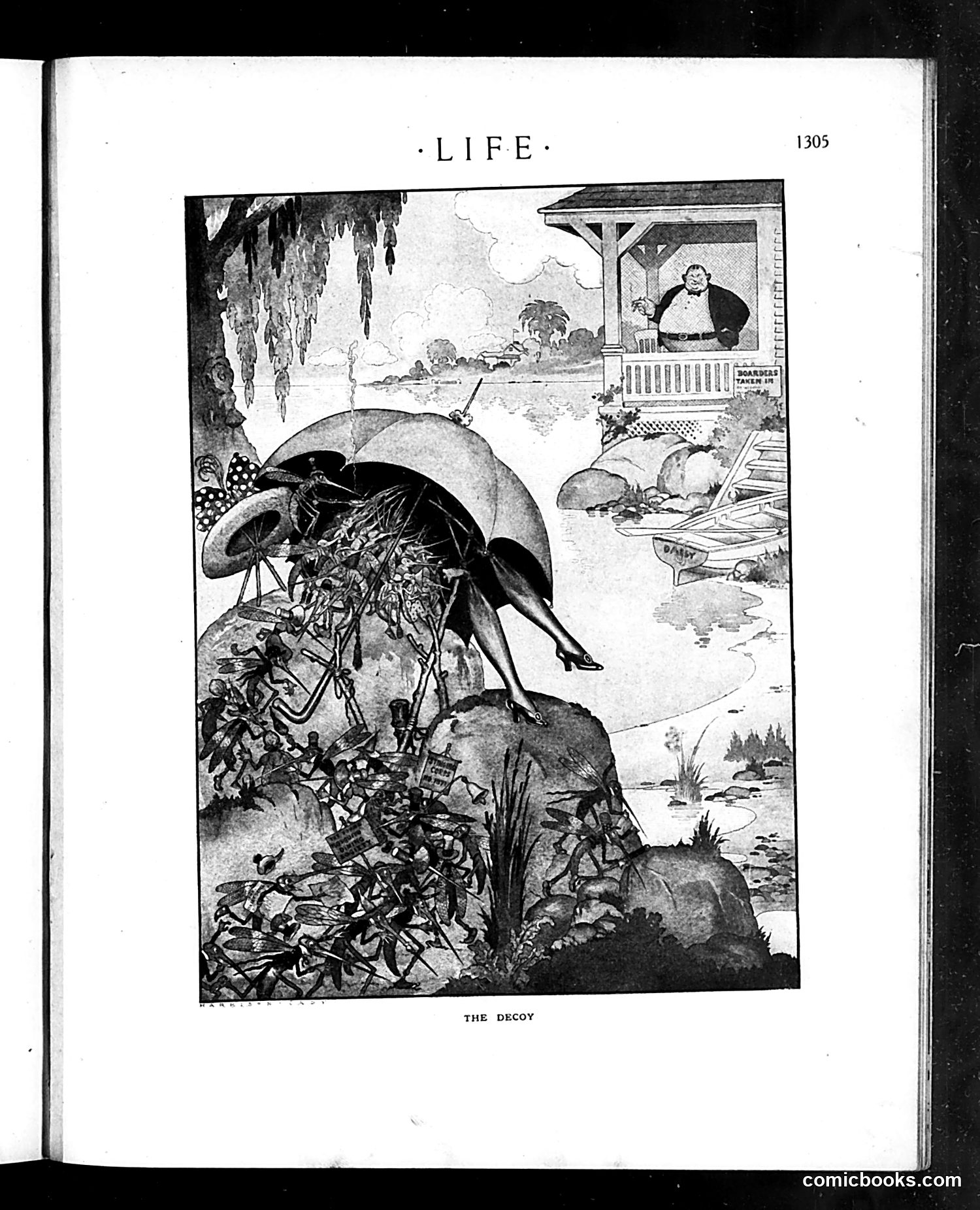
This satirical illustration depicts a woman holding an umbrella, positioned as bait to lure what appears to be a large mosquito or similar insect. The cartoon shows a domestic scene in the background with a house and figure on the porch, suggesting a summer or vacation setting. The joke appears to be about using an attractive woman as a "decoy" to distract or trap insects away from the household—a dark humor commentary on either pest control methods or, more likely, social attitudes toward women's utility in domestic situations. The exaggerated insect and theatrical staging suggest mockery of contemporary anxieties about summer pests or domestic life. Without additional context about the specific publication date, the precise satirical target remains unclear.
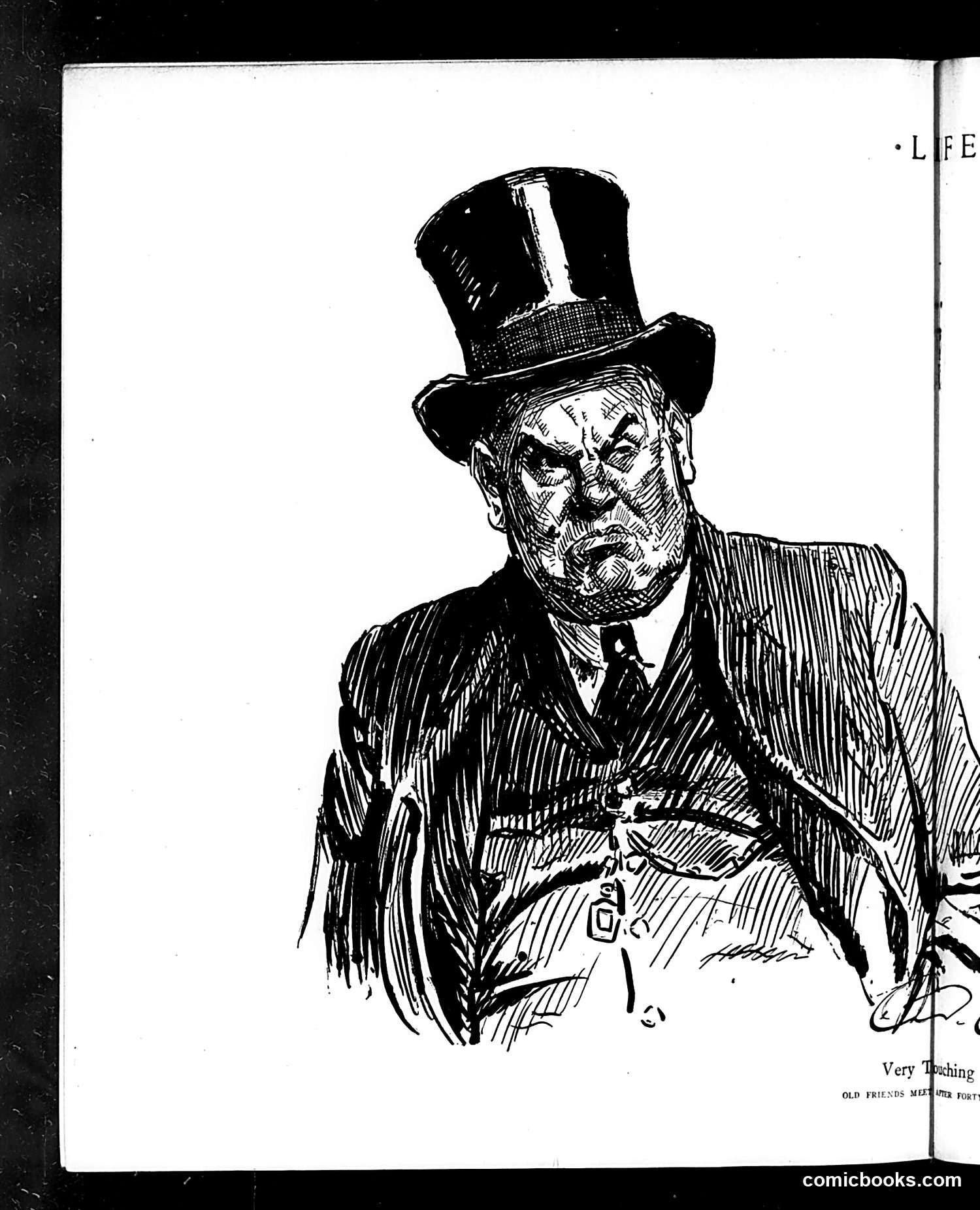
This is a portrait sketch from *Life* magazine showing a well-dressed older gentleman wearing a top hat and formal attire with a vest chain. The caption text at the bottom reads "Very Teaching" and "OLD FRIENDS MEET FOR PORT" (port being a fortified wine, suggesting a social gathering). The sketch appears to be a character study or satirical portrait, but without clearer caption text or additional context on the page, I cannot definitively identify who the figure represents or what specific political or social commentary the cartoon makes. The artistic style and formal dress suggest this depicts someone of social standing, likely from the late 19th or early 20th century, but the incomplete OCR text prevents me from explaining the precise satire intended.
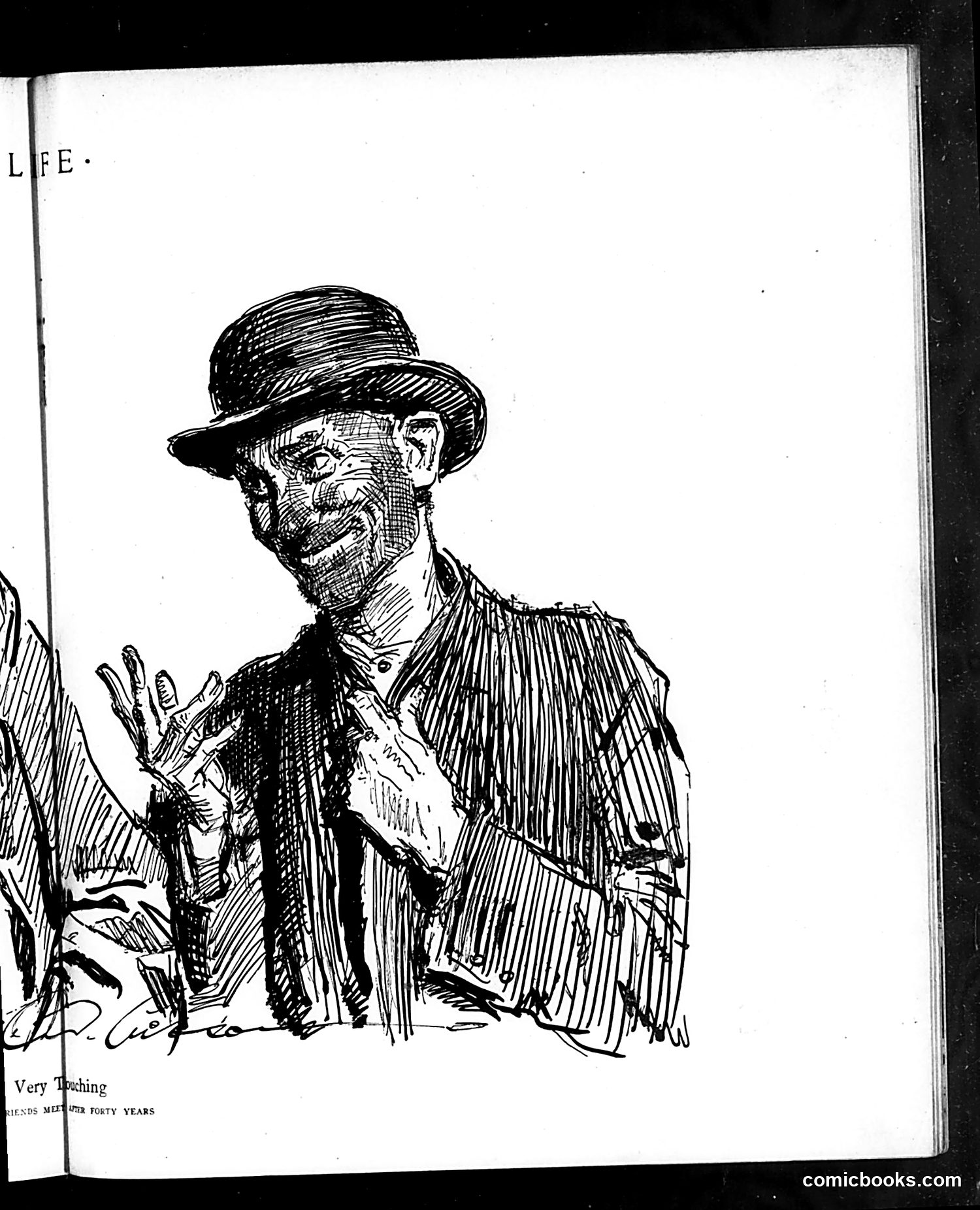
This page from *Life* magazine features a pen-and-ink caricature labeled "Very Teaching" with a subtitle reading "FRIENDS MEET AFTER FORTY YEARS." The drawing depicts a man in a bowler hat and formal suit, rendered with exaggerated facial features typical of early satirical illustration. The style and subject suggest this is a character study or personality sketch rather than commentary on current events. The caption's reference to "friends meeting after forty years" suggests the cartoon illustrates how someone has aged or changed over time—likely commentary on physical transformation or the effects of time. However, without additional context identifying the specific individuals referenced, the exact satirical point remains unclear from the image alone.
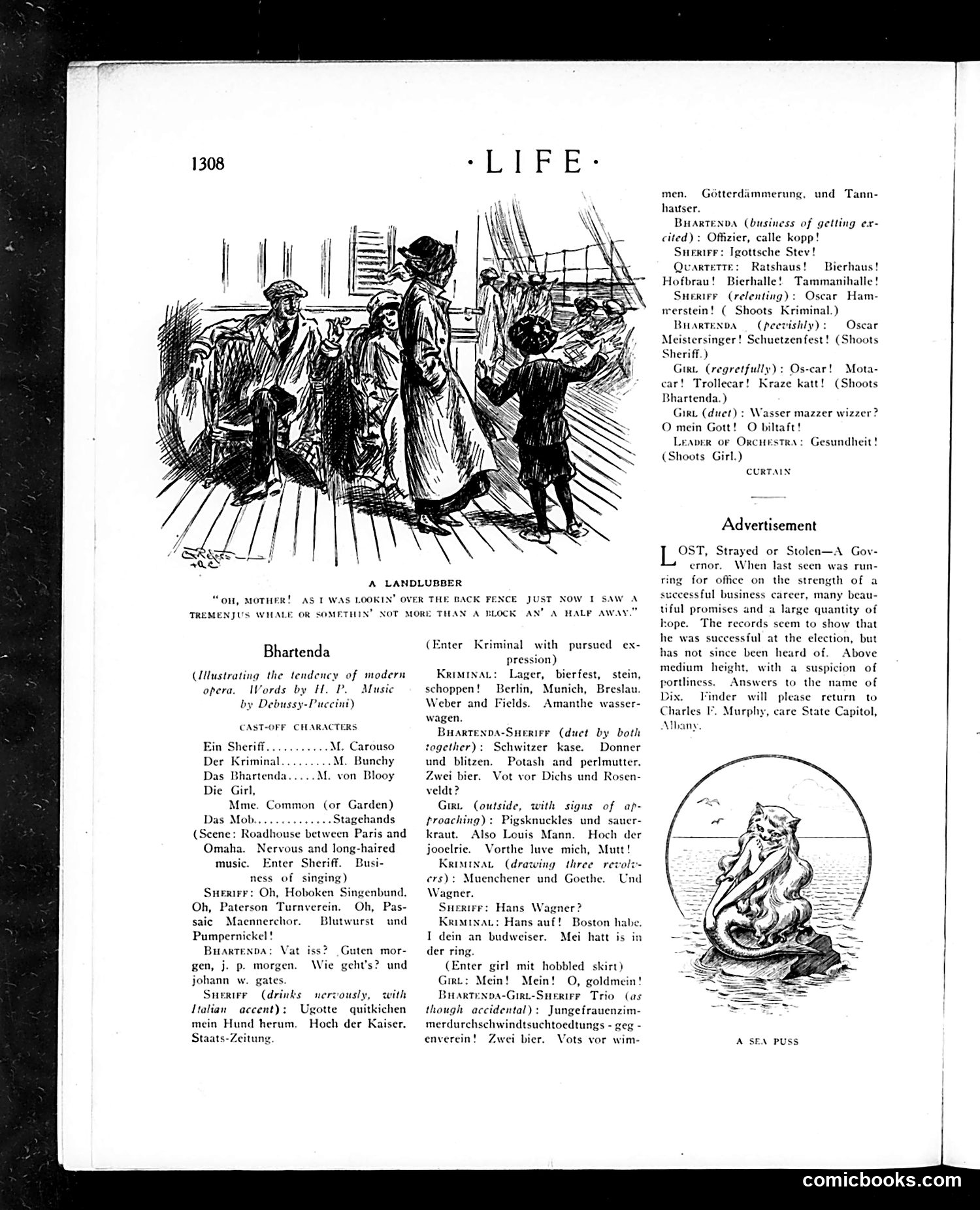
This page satirizes the absurdity of modern opera by mocking its pretentious fusion with lowbrow American culture. "Bhartenda" parodies contemporary operatic trends (attributed to Debussy and Puccini) by inserting a ridiculous plot—a sheriff, a criminal, and a girl in a roadhouse between Paris and Omaha—filled entirely with German beer-hall vocabulary, ethnic stereotypes, and nonsensical Wagner references. The joke targets both opera's self-seriousness and American audiences' fascination with "high culture." Characters speak in exaggerated German-accented English ("Vat iss?" "Hoch der Kaiser"), singing about Lager beer, Tammany Hall, and Budweiser instead of noble themes. The absurd casting (Enrico Caruso as the Sheriff) and random gunfire at the climax further mock the genre's dramatic conventions. The accompanying "Landlubber" cartoon shows a working-class fisherman's tall tale—a simple visual joke about exaggeration.
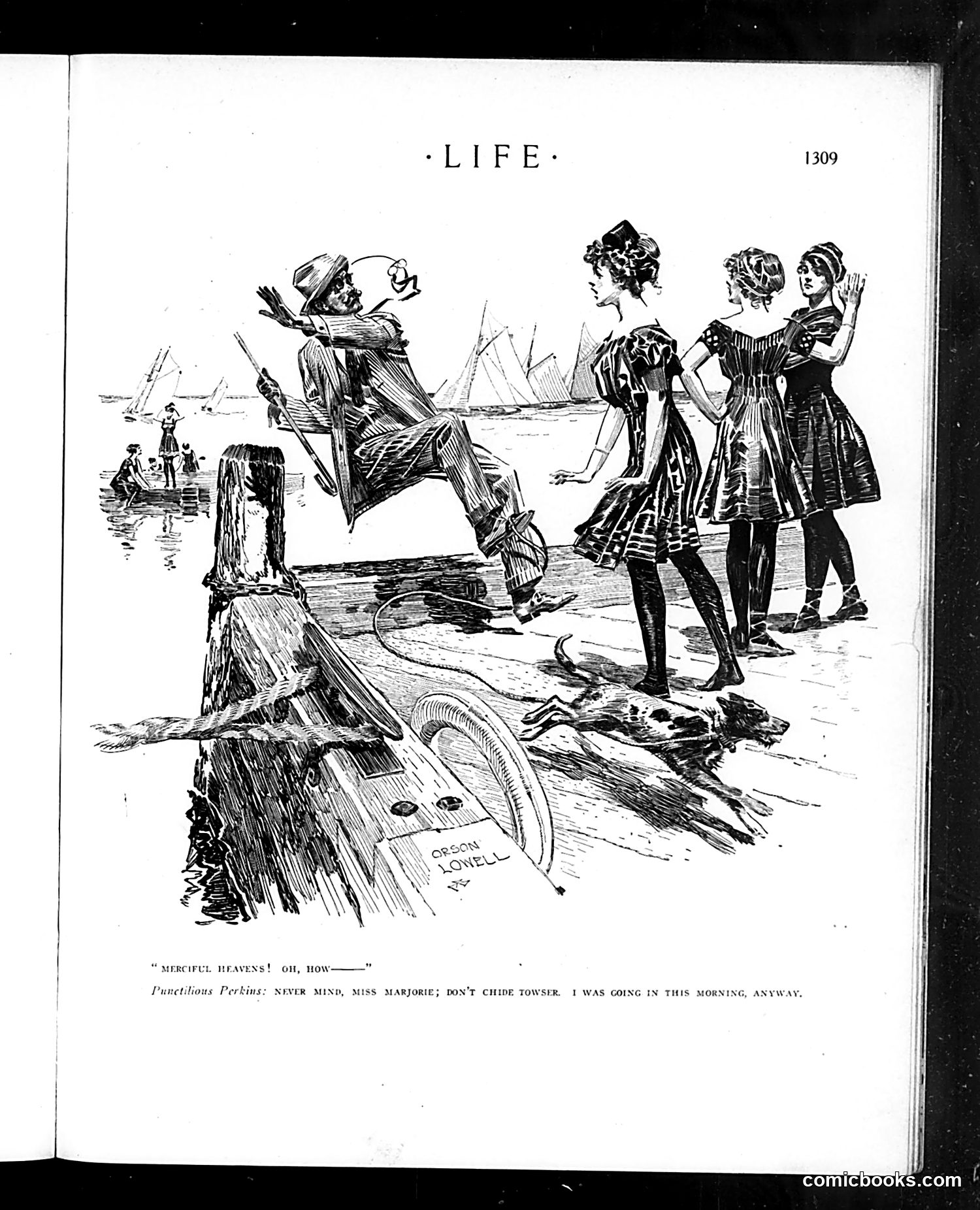
This early 20th-century beach scene depicts a social comedy about class and propriety. A man identified as "Punctilious Perkins" (suggesting he's obsessed with proper etiquette) has apparently been knocked into the water by a dog named Towser. A young woman, Miss Marjorie, appears concerned, but Perkins insists she shouldn't scold the dog—he was planning to go swimming anyway. The humor lies in Perkins' desperate attempt to maintain dignity and composure despite his embarrassing mishap. His formal language and refusal to blame the dog demonstrate how Victorian-era concerns with proper social appearance could lead to absurd situations. The sailing vessels and beachgoers in the background emphasize this is a public social setting where such loss of composure would be particularly mortifying.
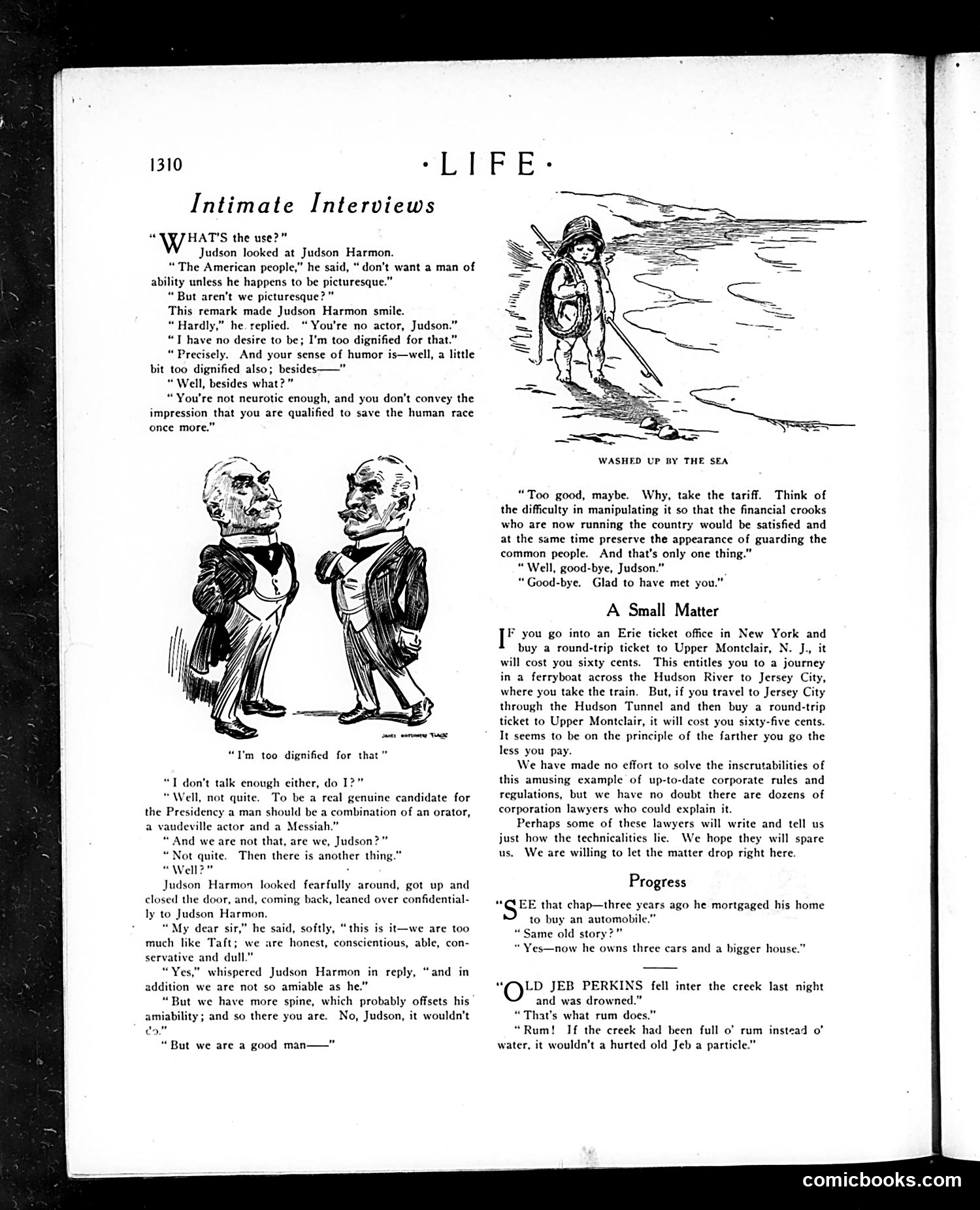
This page satirizes Judson Harmon (likely the Ohio politician and 1912 presidential hopeful) through a dialogue mocking his unsuitability for high office. The cartoon's joke: Harmon is *too* qualified—too honest, dignified, conscientious, and intelligent. The satire suggests the American electorate prefers charismatic performers over competent statesmen, and that political success requires compromising integrity (exemplified by the tariff discussion, where politicians manipulate policy to appease "financial crooks"). The accompanying anecdotes mock corporate illogic (the tunnel ticket pricing) and celebrate working-class resilience (old Jeb Perkins drowning in water rather than rum). The humor reflects Progressive-era skepticism toward both corporate malfeasance and political mediocrity masquerading as leadership.
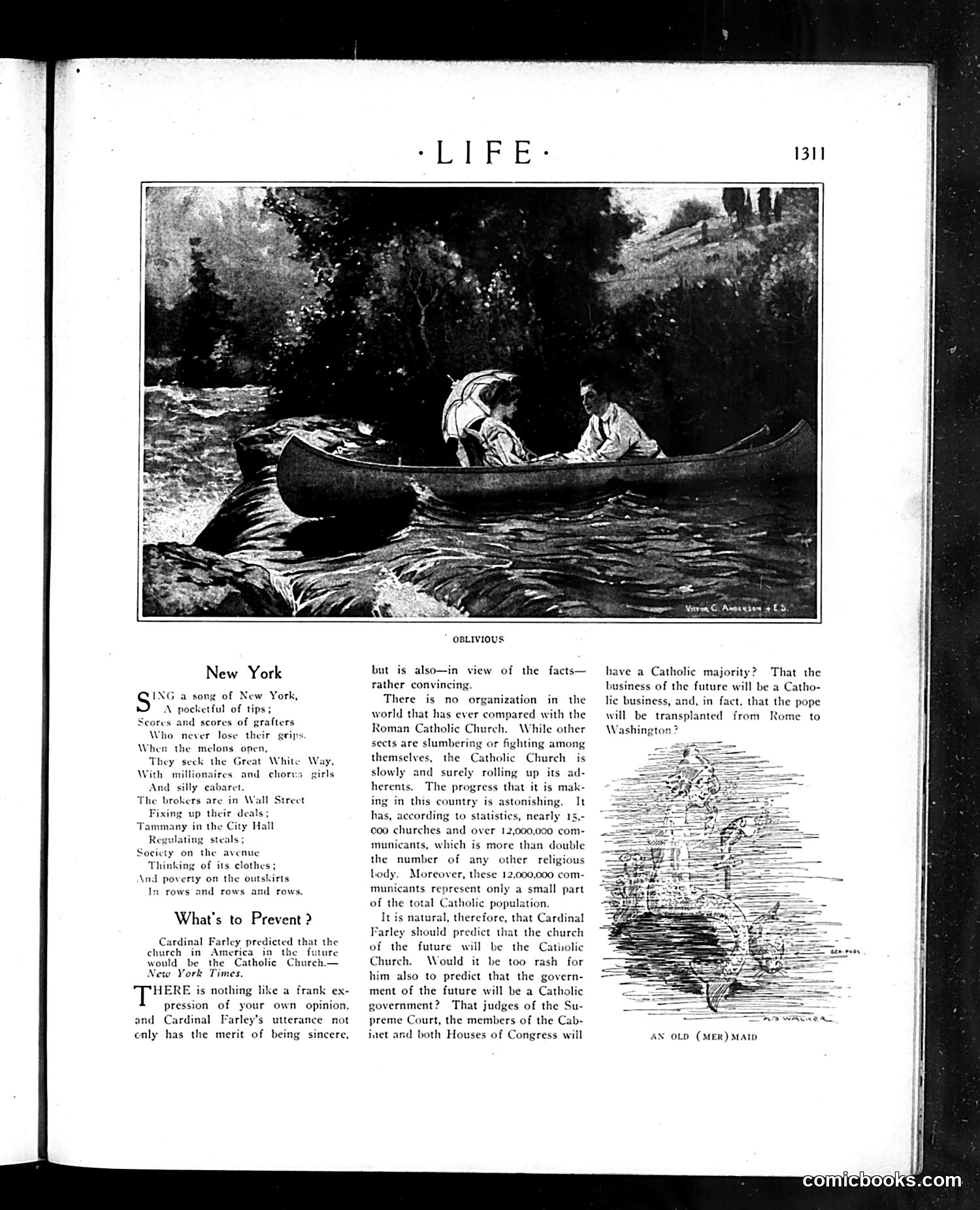
This page satirizes anti-Catholic prejudice in early 20th-century America. The poem "New York" catalogs urban corruption—grafters, Wall Street dealers, Tammany Hall (the notoriously corrupt Democratic machine), and poverty—establishing a cynical baseline. The essay then presents Cardinal Farley's prediction that America's future church will be Catholic, using this as a springboard for heavy-handed sarcasm. The author sarcastically escalates the argument: if the Catholic Church grows as statistically documented (12 million communicants), why wouldn't future judges, congressmen, and even the Pope relocate to Washington? This reflects genuine Protestant anxiety about Catholic demographic growth and political influence in America during this period. The satire targets *nativist fears* by ironically suggesting these fears are logical extensions of existing trends—mocking both anti-Catholic paranoia and Cardinal Farley's confidence simultaneously. The illustration "An Old (Mer) Maid" appears unrelated to the text.
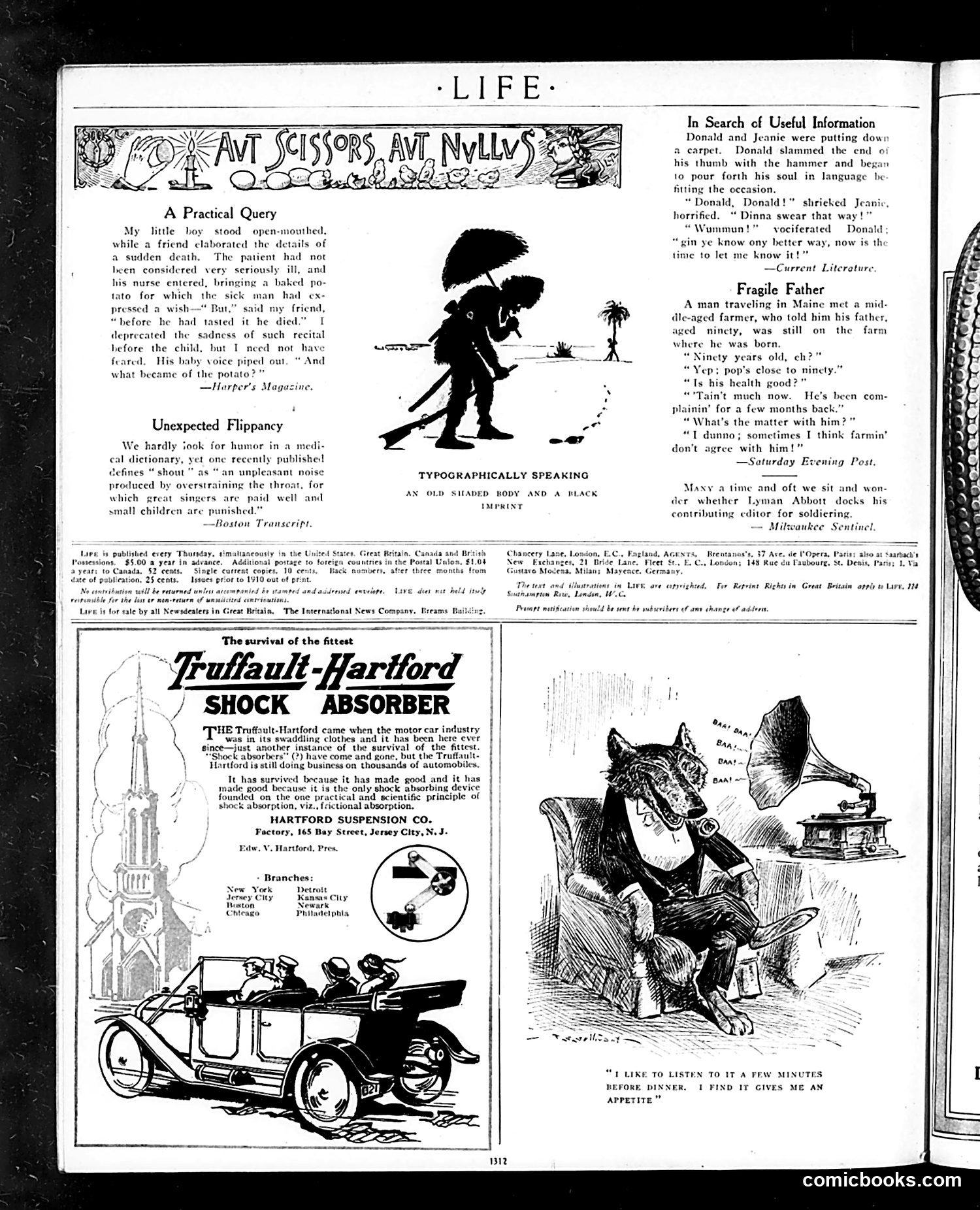
This page from *Life* magazine contains several short humorous anecdotes and advertisements typical of early 20th-century satirical journalism. **The text pieces** are gentle domestic humor: - "A Practical Query" jokes about a child's innocent question after witnessing a death discussion - "Unexpected Flippancy" finds humor in a medical dictionary's definition of "shout" - "Fragile Father" presents a Maine farmer's matter-of-fact discussion of his 90-year-old father - "Typographically Speaking" makes a sly jab at Lyman Abbott (likely a public figure) about his editorial commitment **The main advertisement** promotes the Truffault-Hartford shock absorber for automobiles, emphasizing its longevity and reliability through "survival of the fittest" language—a popular business metaphor of the era. **The cartoons** include a silhouette illustration and a sketch of what appears to be a dog listening to a gramophone, captioned with a joke about appetite stimulation. The page reflects *Life*'s focus on brief, gentle satire and domestic humor rather than hard political commentary.
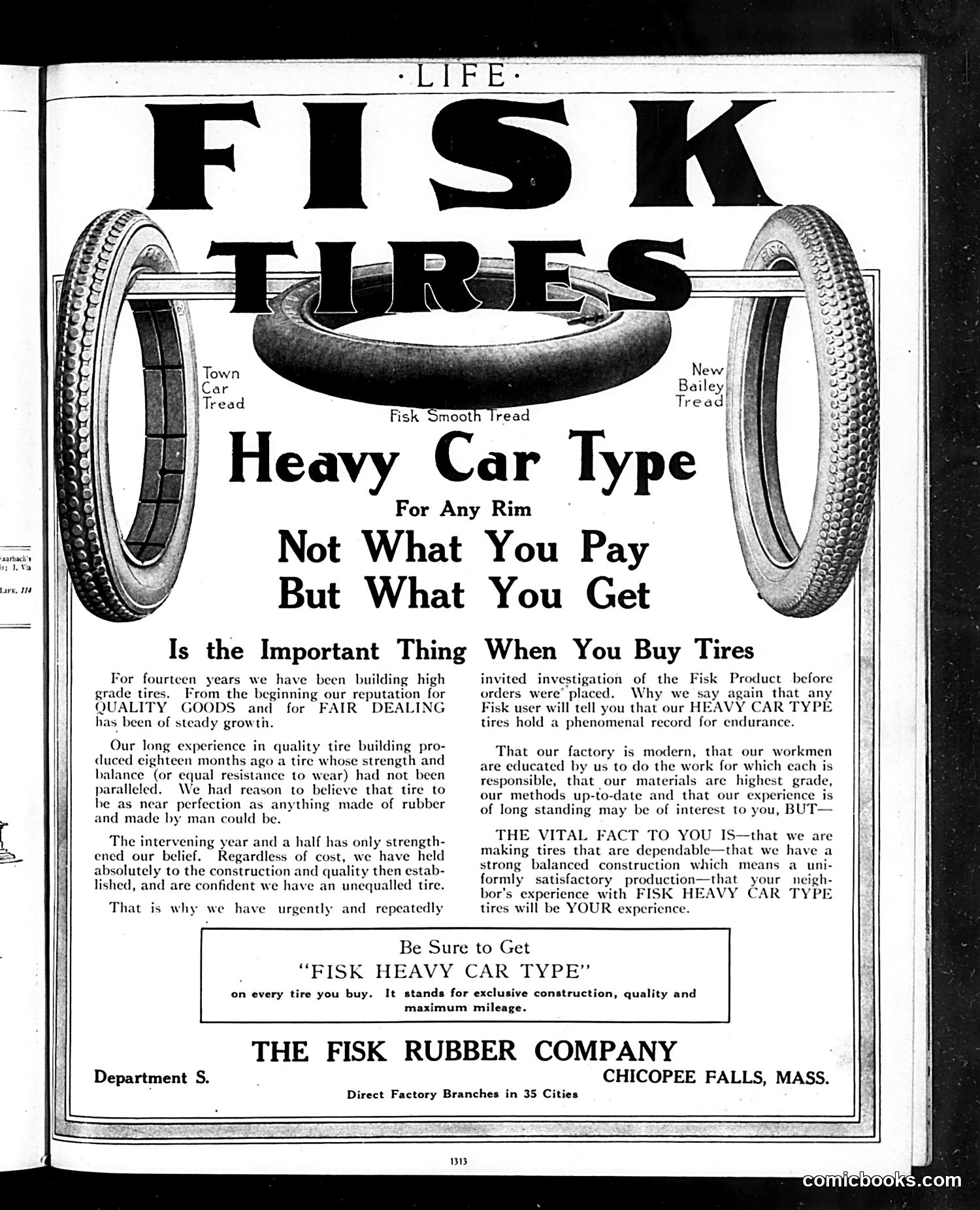
This is a **tire advertisement**, not a political cartoon or satire. It's a full-page ad for Fisk Rubber Company's "Heavy Car Type" tires, published in *Life* magazine. The page uses typical early-20th-century advertising rhetoric: emphasizing fourteen years of reputation, quality construction, and fair dealing. The visual shows two tire cross-sections flanking a central tire image, labeled with different tread types ("Town Car Tread," "Fisk Smooth Tread," "New Bailey Tread"). The ad's selling point—"Not What You Pay But What You Get"—appeals to value-conscious consumers by focusing on durability and endurance rather than price. The company promises that neighbors' positive experiences with their tires will match the buyer's own. There is no satire or political commentary present. This is straightforward commercial advertising from the automobile industry's early era.
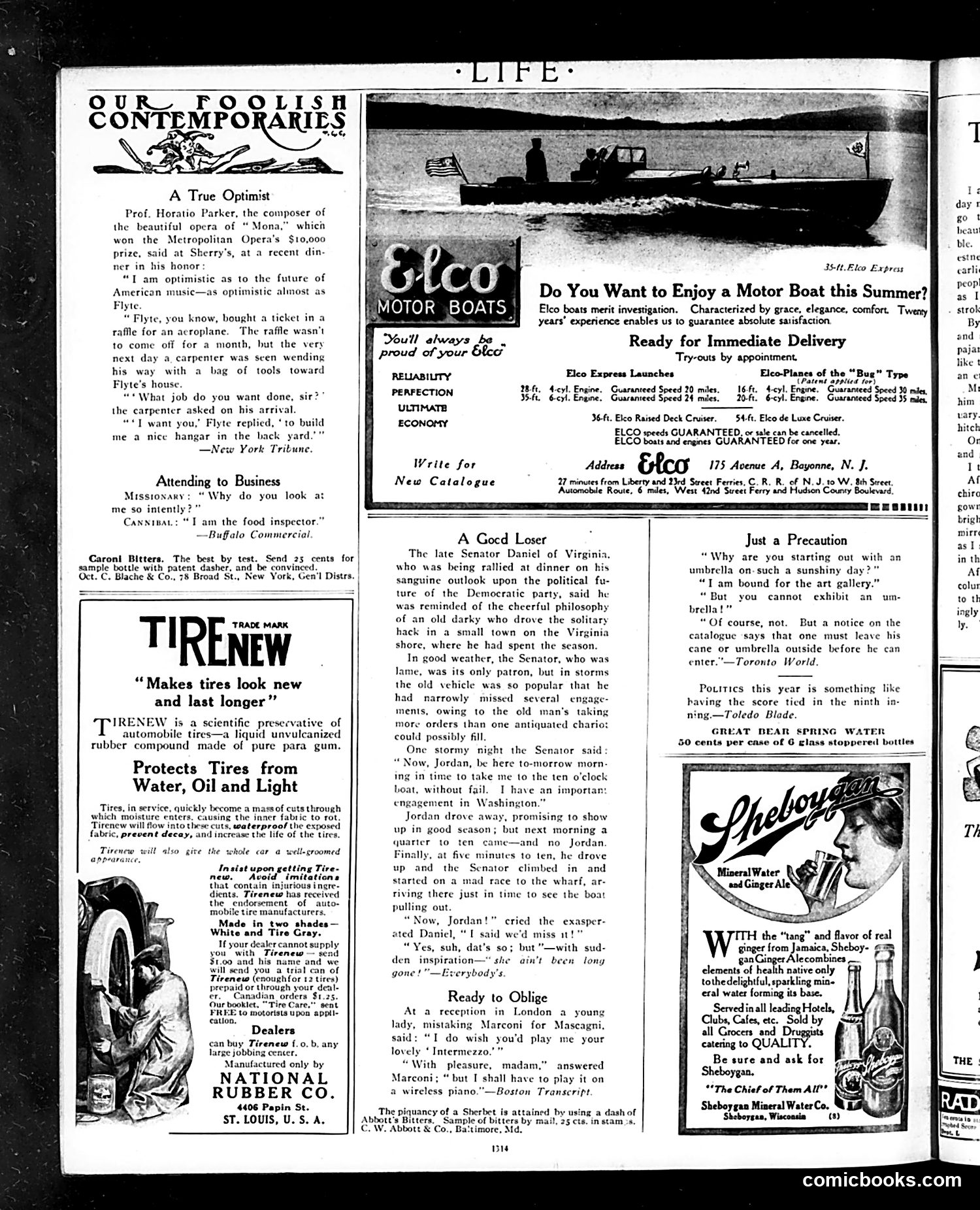
This page mixes satirical commentary with advertisements typical of early 20th-century Life magazine. The main humor pieces include: **"A True Optimist"**: A anecdote about composer Horatio Parker comparing his musical optimism to a man named Flyte, who bought a raffle ticket for an airplane and immediately hired a carpenter to build a hangar—absurdly assuming he'd win. The joke satirizes excessive optimism. **"Attending to Business"**: A brief joke about a missionary confronted by a cannibal claiming to be a "food inspector"—dark humor playing on stereotypical colonial-era depictions. **"A Good Loser"**: An anecdote attributed to late Senator Daniel of Virginia about an old Black taxi driver so popular during storms that he couldn't fulfill all requests. It illustrates finding silver linings in difficult circumstances. The page is otherwise dominated by period advertisements for automobiles, tires, and motorboats, representing consumer goods marketed to Life's affluent readership.
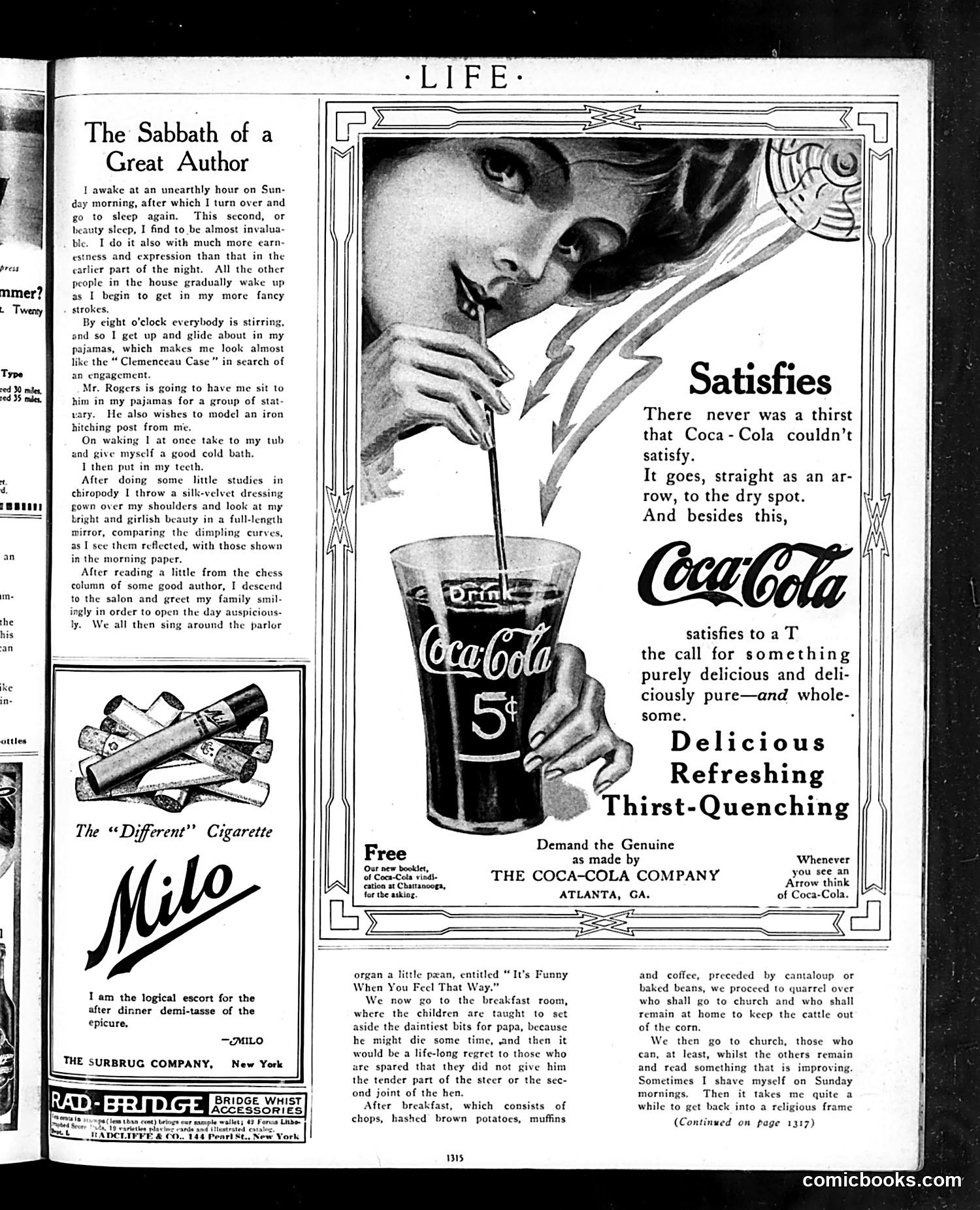
This is a humorous essay (not a political cartoon) satirizing the lazy, self-indulgent Sunday morning routine of a wealthy male author. The joke relies on the contrast between the title's grandiose suggestion and the petty vanities described: sleeping late, admiring himself in mirrors, comparing his "dimpling curves" to those in newspapers, and spending considerable time on grooming before finally facing his family. The satire targets masculine vanity and the contradiction between pretensions to intellectual greatness and trivial morning habits. The mention of sitting for sculptor Rogers and being modeled as an "iron hitching post" adds absurdist humor about artistic pretension. The page also contains period advertisements (Milo cigarettes, Coca-Cola) unrelated to the essay's satire. The date appears early 20th century based on style and references.
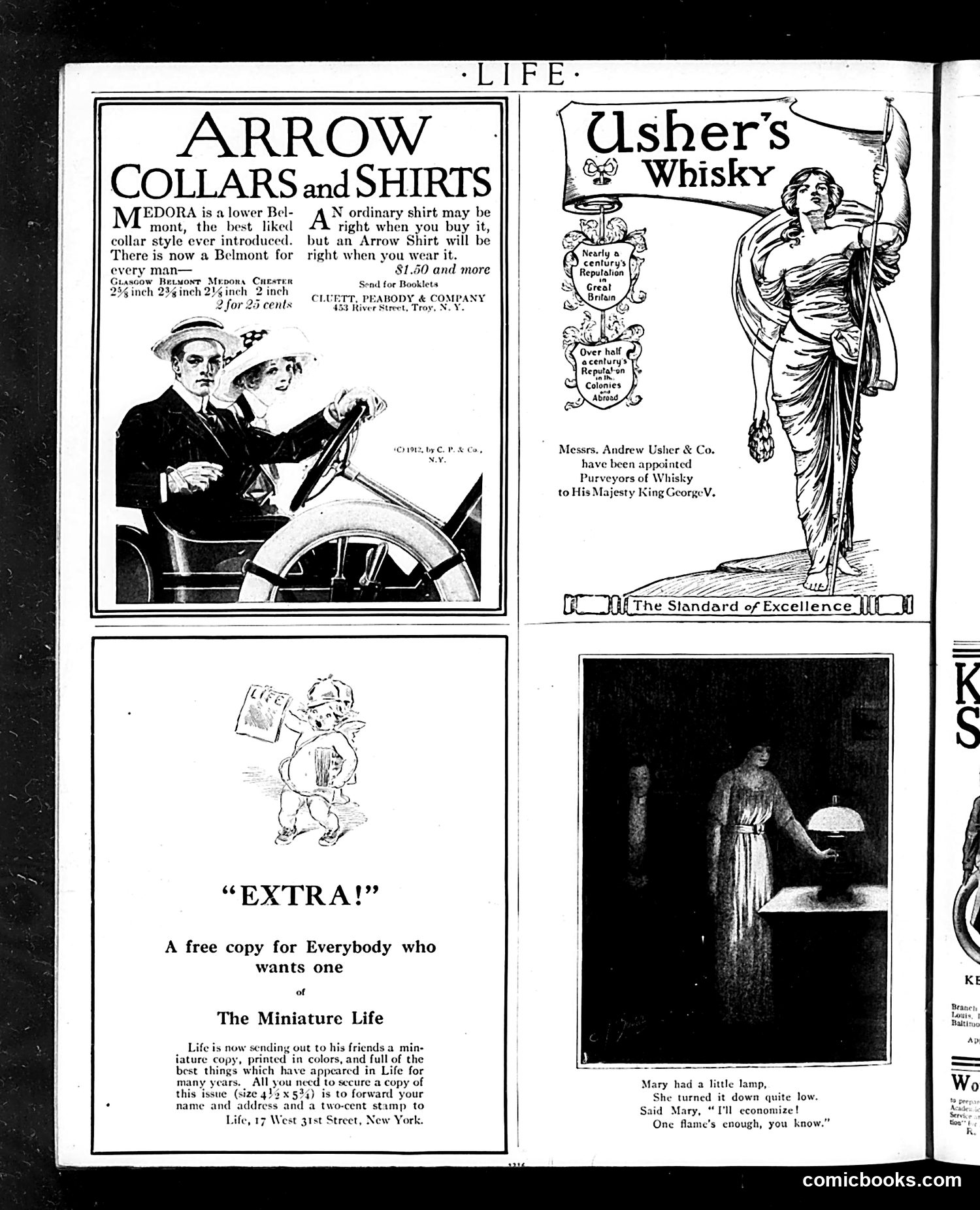
This page consists primarily of **advertisements**, not political cartoons. **Arrow Collars and Shirts** (top left): A standard product ad showing a man and woman in a car, promoting the "Medora" collar style and Arrow brand shirts. The pitch emphasizes reliability—shirts that remain properly fitted after wear. **Usher's Whisky** (top right): A luxury spirits advertisement featuring a classical female figure, emphasizing the brand's "nearly a century's reputation" and its appointment as purveyor to King George V, signaling prestige and royal endorsement. **"Extra!" Promotion** (bottom left): Life magazine promotes a free miniature edition to readers. **Mary's Lamp** (bottom right): A brief, mild joke about wartime or economic conservation—a woman dimming her lamp to economize fuel, with the punchline that one flame suffices. This reflects possible WWI-era rationing concerns. The page contains **no significant political satire**—it's primarily commercial content typical of early 20th-century magazine publishing.
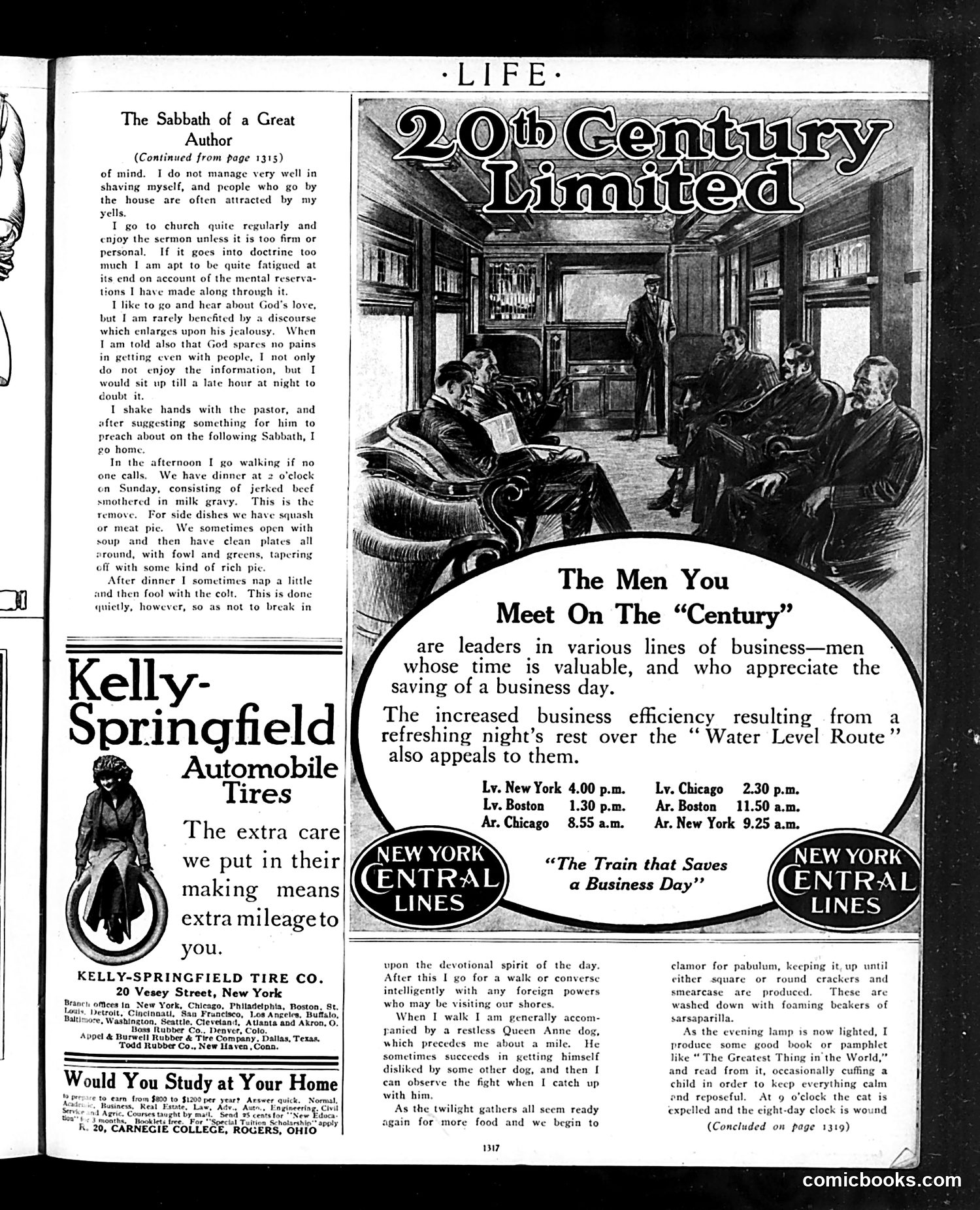
This page contains two distinct elements: **Left side:** A humorous essay titled "The Sabbath of a Great Author" describing an intellectual's Sunday routine—church attendance (where he mentally argues with doctrine), afternoon walks with his Queen Anne spaniel, a substantial dinner, napping, and evening reading. The tone is self-deprecating satire about a learned man's contradictions: he attends church while doubting God's jealousy, walks to avoid company, and keeps a troublemaking dog. **Right side:** A New York Central Lines railroad advertisement featuring an illustration of businessmen in a train car. It promotes "The Century" train as "The Train that Saves a Business Day," emphasizing efficiency for busy executives who value time and rest. The ad includes departure/arrival times between New York, Boston, and Chicago. The page is primarily **advertising-driven**, typical of Life magazine's mixed editorial-commercial format. The author essay provides entertainment while the railroad ad targets affluent business readers—the magazine's core demographic.
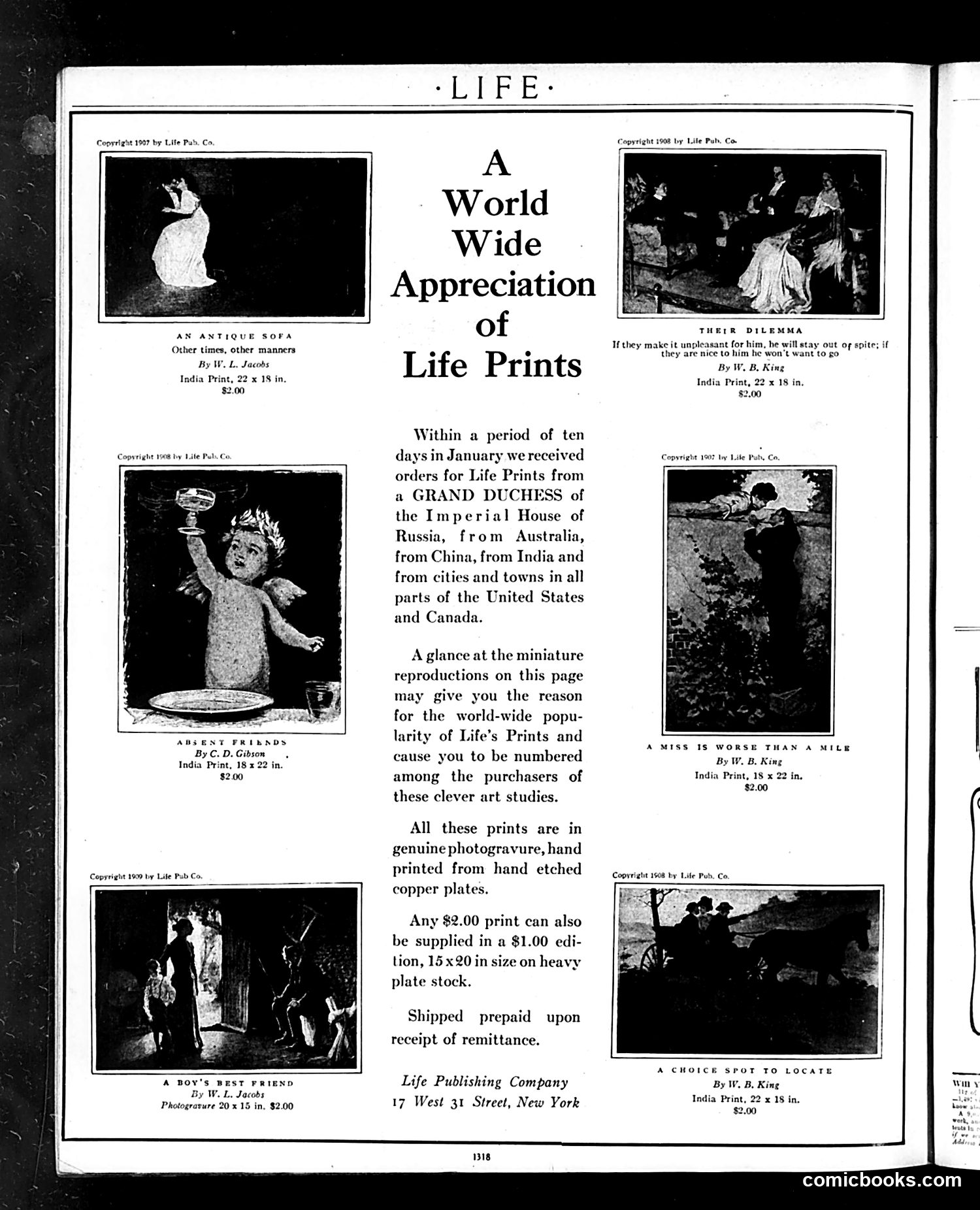
This page advertises photogravure prints sold by Life Publishing Company. Rather than political cartoons, these are humorous domestic genre scenes by popular illustrators like C.D. Gibson and W.L. Jacobs. The prints depict relatable turn-of-the-century situations: "An Antique Sofa" suggests period manners, "Absent Friends" likely shows nostalgia or longing, and "A Boy's Best Friend" appears to feature a child with a dog. "Their Dilemma" presents a paradox about pleasing an unwilling houseguest. "A Miss Is Worse Than a Mile" references a dating or romantic miss-connection. "A Choice Spot to Locate" seems to show people finding a scenic or private spot. The advertisement emphasizes the prints' international appeal—noting orders from a Russian Grand Duchess, Australia, China, and India—to market them as sophisticated, collectible art. They cost $2.00 each.
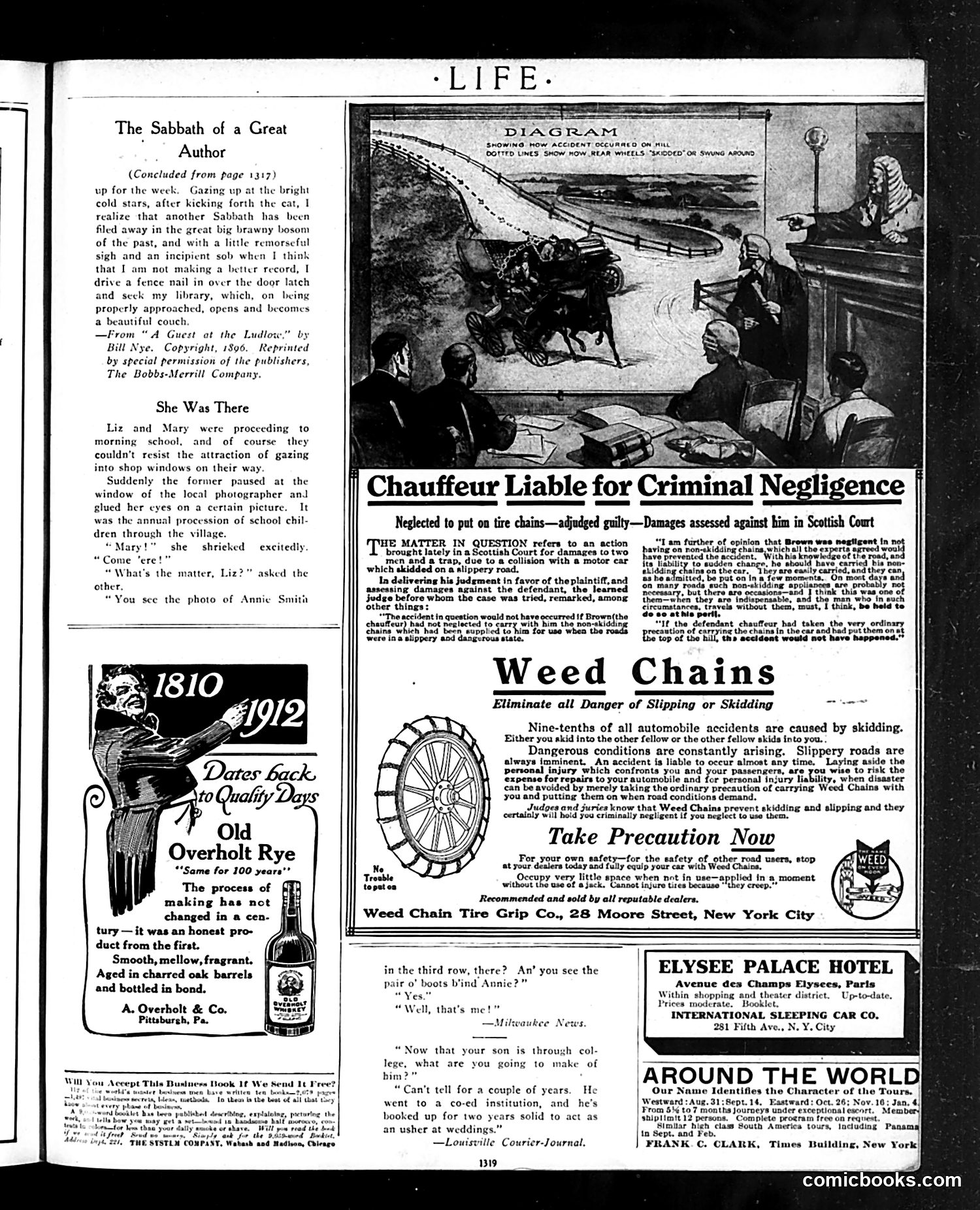
This page combines humorous fiction with period advertising. The top section concludes a satirical story by Bill Nye about an author's leisurely Saturday, emphasizing relaxation over productivity—a gentle jab at writerly procrastination. Below, a brief anecdote called "She Was There" depicts schoolgirls spotting themselves in a photographer's window display, playing on vanity and small-town life. The dominant content is an advertisement for Weed Chains, automobile tire chains. Crucially, it references an actual Scottish court case where a chauffeur was found negligent for *not* using chains on slippery roads, causing a collision. The ad weaponizes this legal precedent as marketing: judges and juries now recognize chains as a safety necessity, so negligence to use them could be legally culpable. This transforms a safety product into a liability-prevention tool, appealing to drivers' legal anxieties during the early automobile era when road safety standards were still developing.
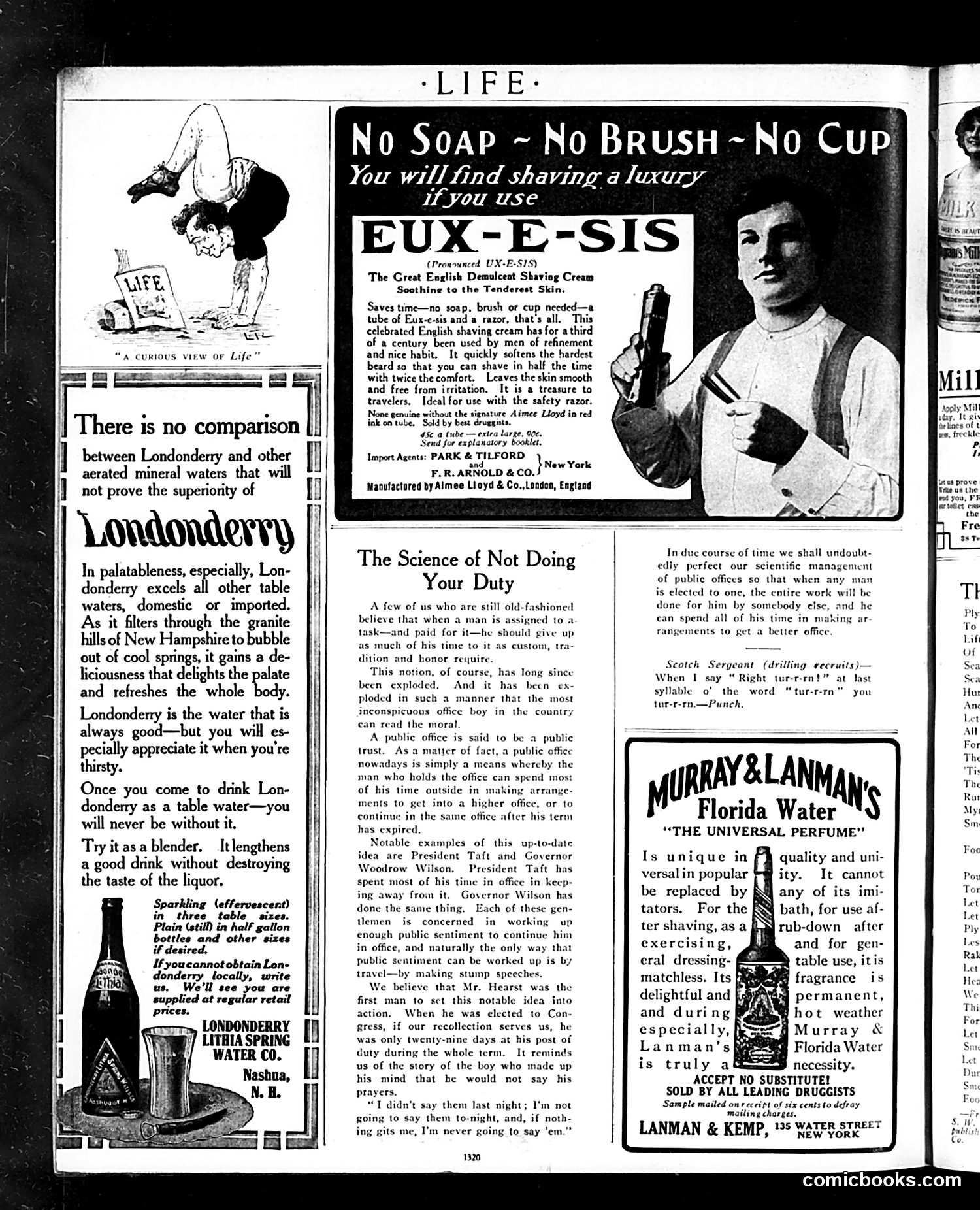
This page primarily consists of **advertisements** rather than political cartoons, though it includes one small satirical illustration. The notable content is an **editorial titled "The Science of Not Doing Your Duty,"** which critiques public officials for neglecting their actual work to pursue higher office through campaigning. The piece sarcastically references **President Taft and Governor Woodrow Wilson** as examples of men who spent minimal time at their posts, instead traveling to make speeches and build political support. It mentions **William Randolph Hearst** as a precedent, noting he attended Congress only 29 days during his term. The article uses biting irony, ending with the hope that eventually public offices will be so "perfected" that elected officials won't need to show up at all. The page's left side features a small cartoon labeled "A Curious View of Life," depicting someone reading LIFE magazine while upside-down—a visual joke about perspective. The remaining content comprises product advertisements for Londonderry mineral water, Eux-e-sis shaving cream, and Murray & Lanman's Florida Water.
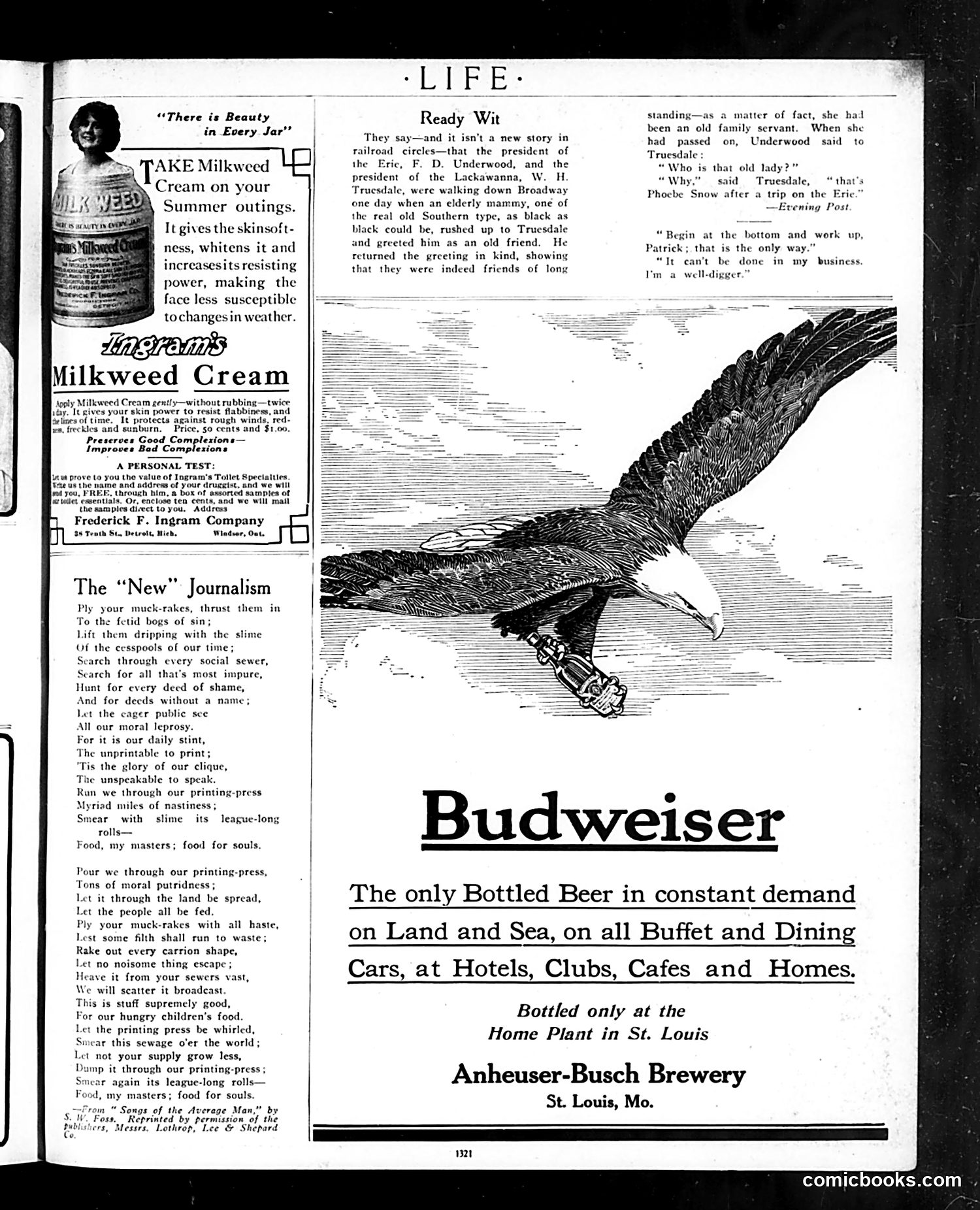
This Life magazine page (circa early 1900s) contains three main elements: **"The New" Journalism** poem (center-left): A satirical critique of sensationalist journalism and "muckraking." The poem mocks newspapers that prioritize exposing scandal, immorality, and sewage-like content for public consumption—treating salacious news as "food for souls." This reflects progressive-era anxieties about yellow journalism and tabloid excess. **"Ready Wit" anecdotes** (top-right): Brief humorous stories featuring railroad executives, including one about a Southern Black servant greeting an old acquaintance. The humor depends on dialect and social conventions of the era. **Advertisements** (left and bottom): Ingram's Milkweed Cream (skin care) and Budweiser beer dominate the page, typical of Life's revenue model. The page is primarily commercial rather than political commentary, though the journalism poem offers social critique about media ethics and sensationalism—concerns that remain relevant today.
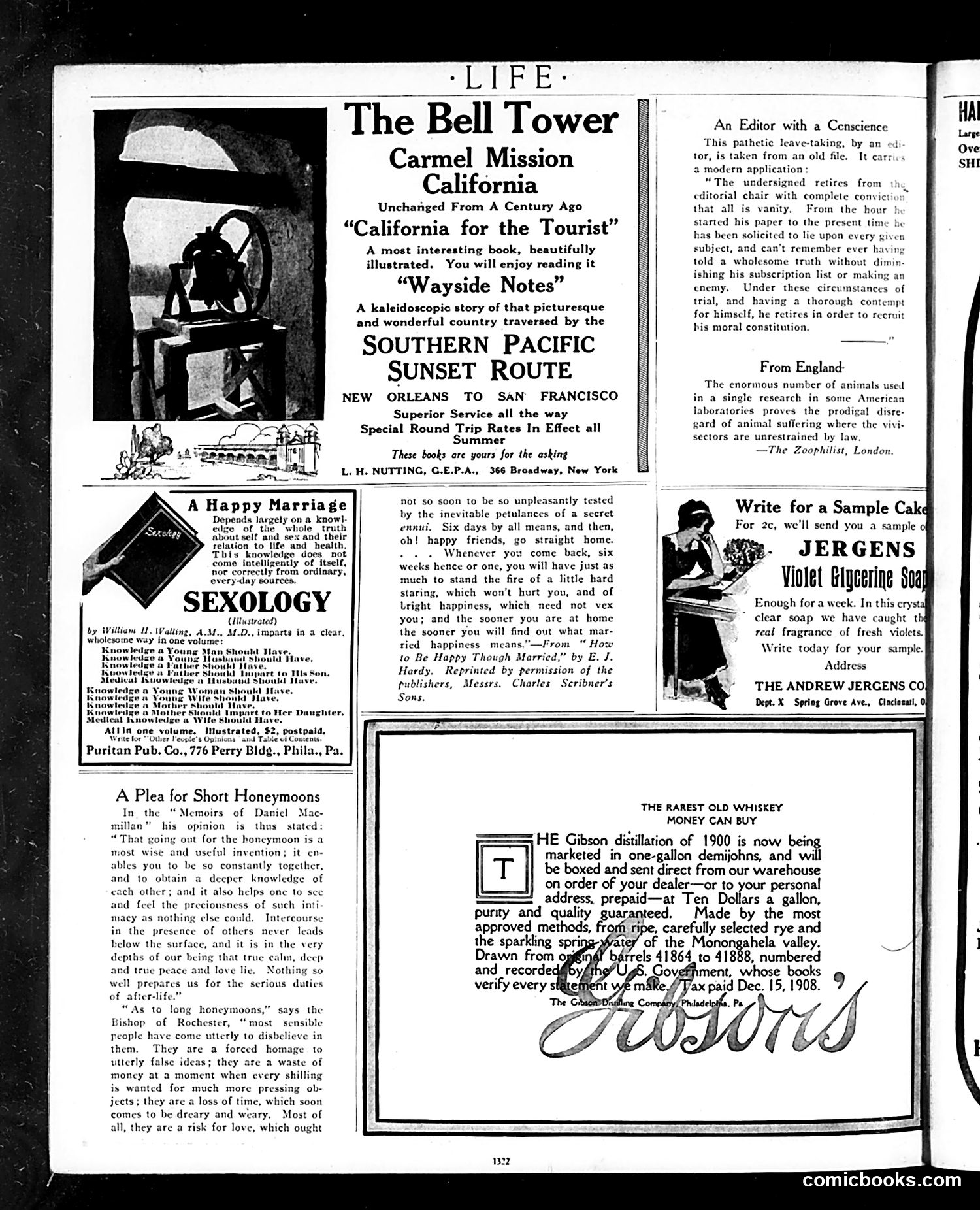
This page is primarily **advertising and filler content**, typical of early 1900s magazines. The main editorial content is a brief, cynical piece titled "An Editor with a Conscience"—a reprint from an old file where an unnamed editor announces his retirement from journalism, claiming he's been pressured to lie about everything and has lost all moral conviction. The satire targets editorial compromise and the corruption of honest journalism by commercial pressure. The rest of the page contains advertisements (whiskey, soap, books on travel and marriage) and a humorous piece arguing for short honeymoons, citing a bishop's opinion that brief togetherness teaches couples about each other without the exhaustion of prolonged intimacy. There are **no political cartoons** on this page. The satirical edge is mild and domestic rather than political.
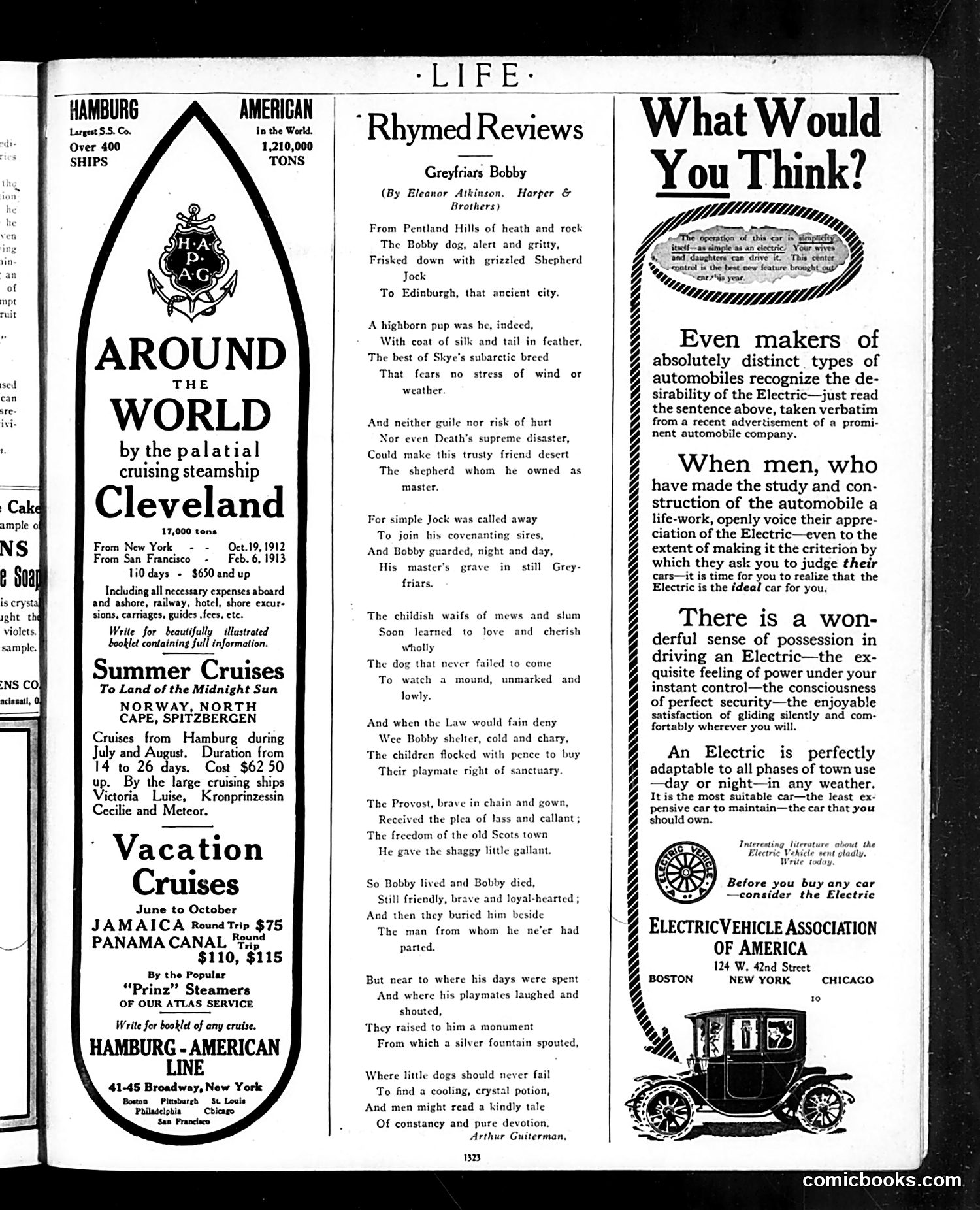
This Life magazine page contains three distinct sections: **Left:** Hamburg-American Line cruise ship advertisements promoting luxury travel, including world cruises aboard the steamship Cleveland and summer Nordic voyages—typical early 1910s leisure advertising. **Center:** A sentimental poem by Arthur Guiterman reviewing Eleanor Atkinson's book "Greyfriars Bobby," about a Scottish terrier's loyal devotion to his deceased shepherd master in Edinburgh. The poem recounts how local children protect the dog and eventually erect a fountain monument to him—celebrating themes of loyalty and constancy. **Right:** An advertisement for electric automobiles by the Electric Vehicle Association of America. The ad uses a rhetorical argument: if competing automobile manufacturers themselves publicly acknowledge the superiority of electric cars, wouldn't you want one? It emphasizes the electric car's quiet comfort, safety, and suitability for urban driving. The page juxtaposes sentimental storytelling with commercial persuasion—both common Life magazine content from this era.
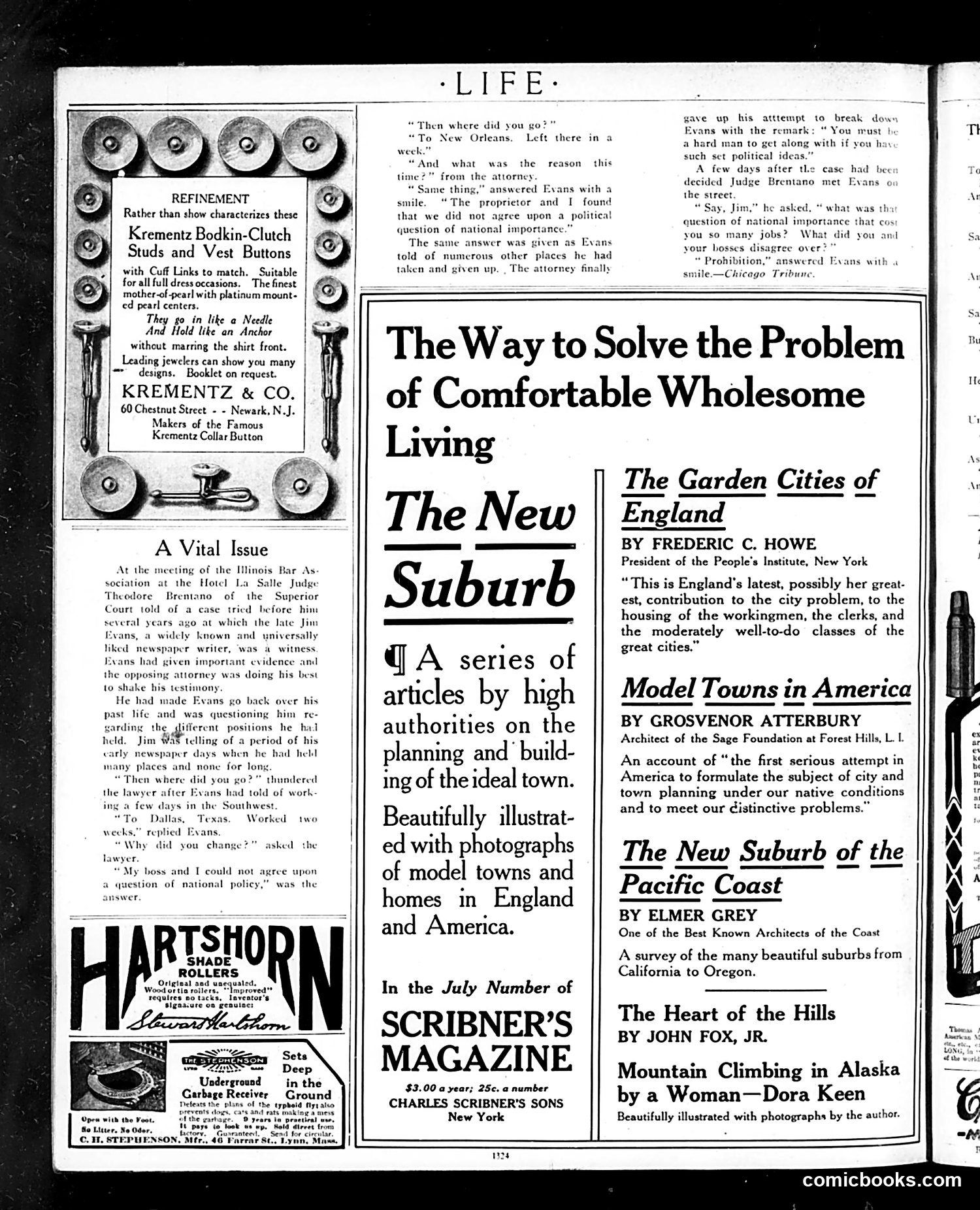
This page's main satirical piece is "A Vital Issue," a story about newspaper writer Jim Evans. Judge Brentano recounts Evans's employment history: Evans repeatedly quit jobs after disagreeing with employers over political questions of "national importance." The joke targets rigid ideological partisanship. Evans's inability to compromise on politics—even minor policy disagreements—caused him to abandon positions repeatedly. When the lawyer tries to shake Evans's testimony by questioning his job-hopping, Evans admits the real reason: irreconcilable political differences. Judge Brentano later compliments Evans as "a hard man to get along with" due to his "set political ideas"—ostensibly praise, but clearly satirizing stubborn dogmatism that sabotages practical employment. The piece mocks both inflexible employees and the era's intense partisan divisions that made everyday professional relationships difficult. It suggests that strict political ideology, while admirable in principle, becomes counterproductive when applied absolutely.
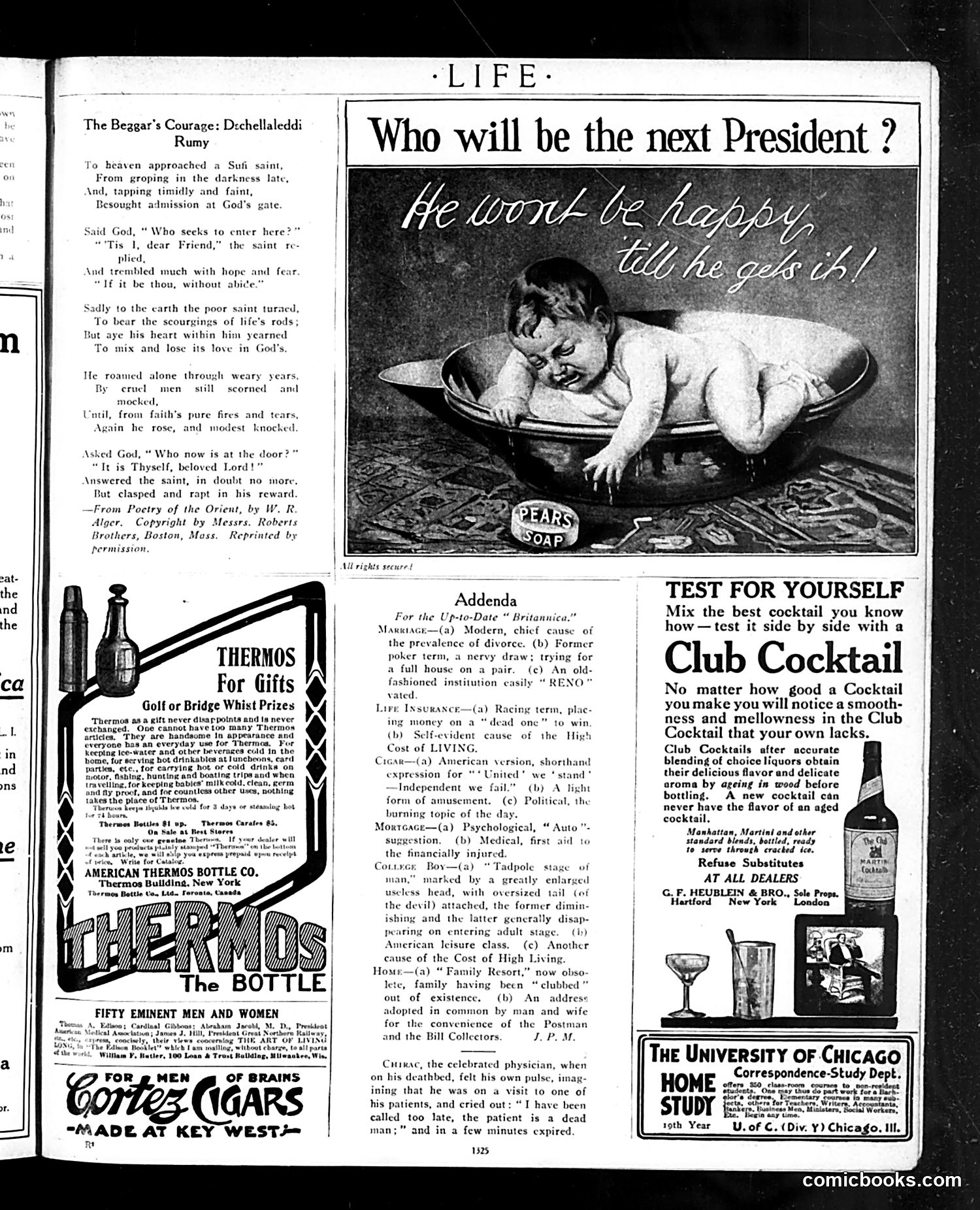
**Main Content:** This page features the satirical "Addenda" section—humorous dictionary definitions mocking contemporary American society circa 1920s. **Key Satire Targets:** - **Marriage**: Redefined as the "chief cause of divorce" and an "old-fashioned institution easily 'RENO'vated" (referencing Reno, Nevada's divorce mills) - **Life Insurance**: Sarcastically linked to the "High Cost of Living" - **Choir/Union**: Political commentary on labor organization as "burning topic of the day" - **Mortgage**: "First aid to the financially injured" - **Cotter Boy**: Described as the "tadpole stage of man" with oversized head, another cause of high living costs - **Home**: Now "obsolete," replaced by clubs; merely a mailing address for bills **The Joke:** Each term receives three definitions—one serious, one absurdist, one biting social commentary. The humor targets economic anxiety, marital instability, labor disputes, and generational excess. **Context:** This reflects 1920s concerns: postwar economic inflation, rising divorce rates, and youth culture critique. The page also includes period advertisements (Thermos bottles, cigars, correspondence courses).
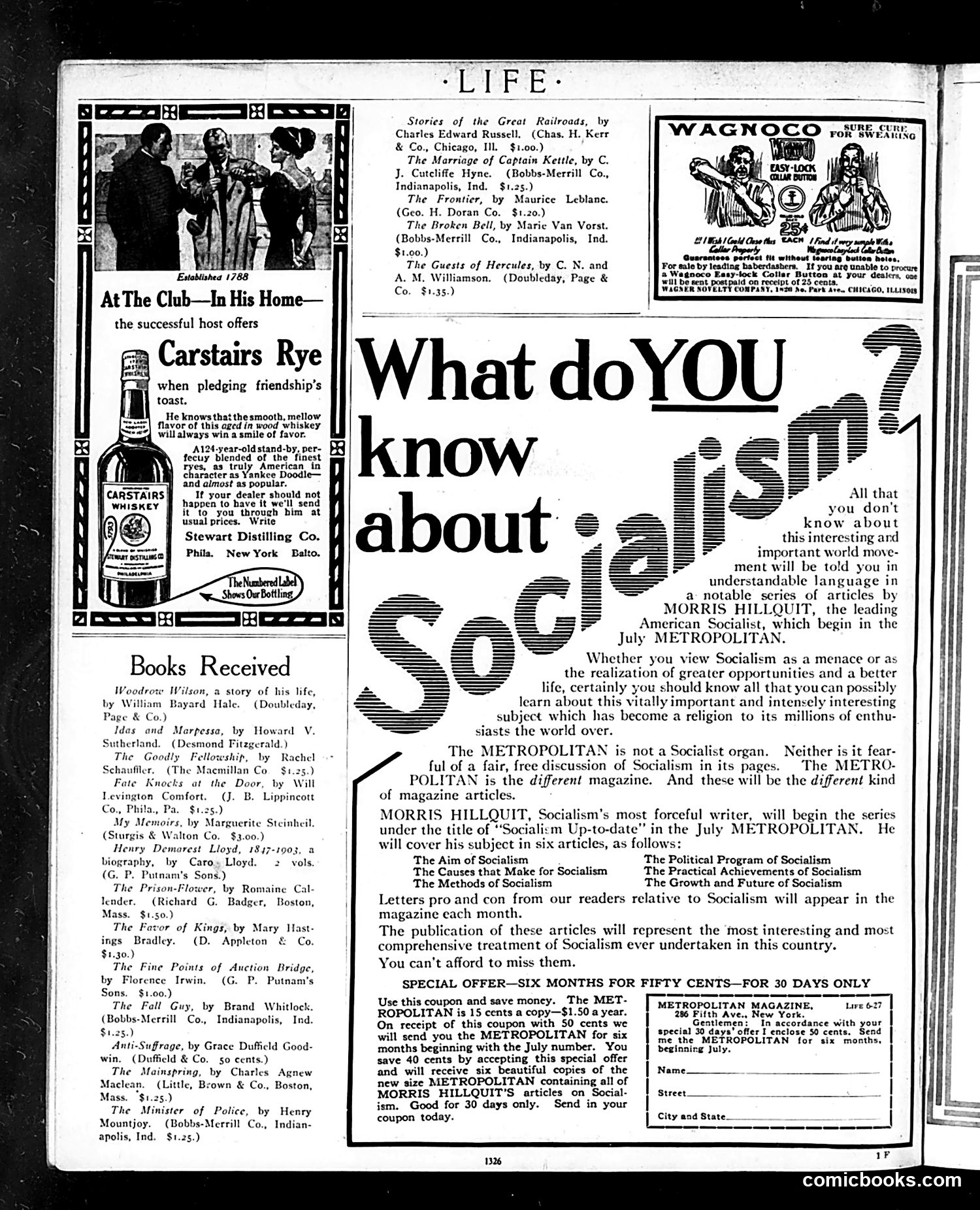
This page is primarily **book advertisements and a major publicity campaign**, not political satire. The dominant content is a full-page advertisement promoting Morris Hillquit's upcoming Socialist series in *The Metropolitan* magazine. **Key Content:** The large central advertisement announces that Morris Hillquit—identified as "Socialism's most forceful writer"—will write six articles on Socialism beginning in July's *Metropolitan*, covering topics like "The Aim of Socialism" and "The Practical Achievements of Socialism." **Historical Context:** This appears designed to introduce mainstream American readers to Socialist thought during the early 20th century. The ad emphasizes that *Metropolitan* is "not a Socialist organ" but offers "fair, free discussion," suggesting an attempt to legitimize Socialism as a serious topic worthy of rational debate rather than dismissal. **Sidebar advertisements** for Carstairs Rye whiskey and Wagnoco collar buttons represent typical commercial content of the era. The "Books Received" section lists contemporary publications, including works on railroads and various novels.
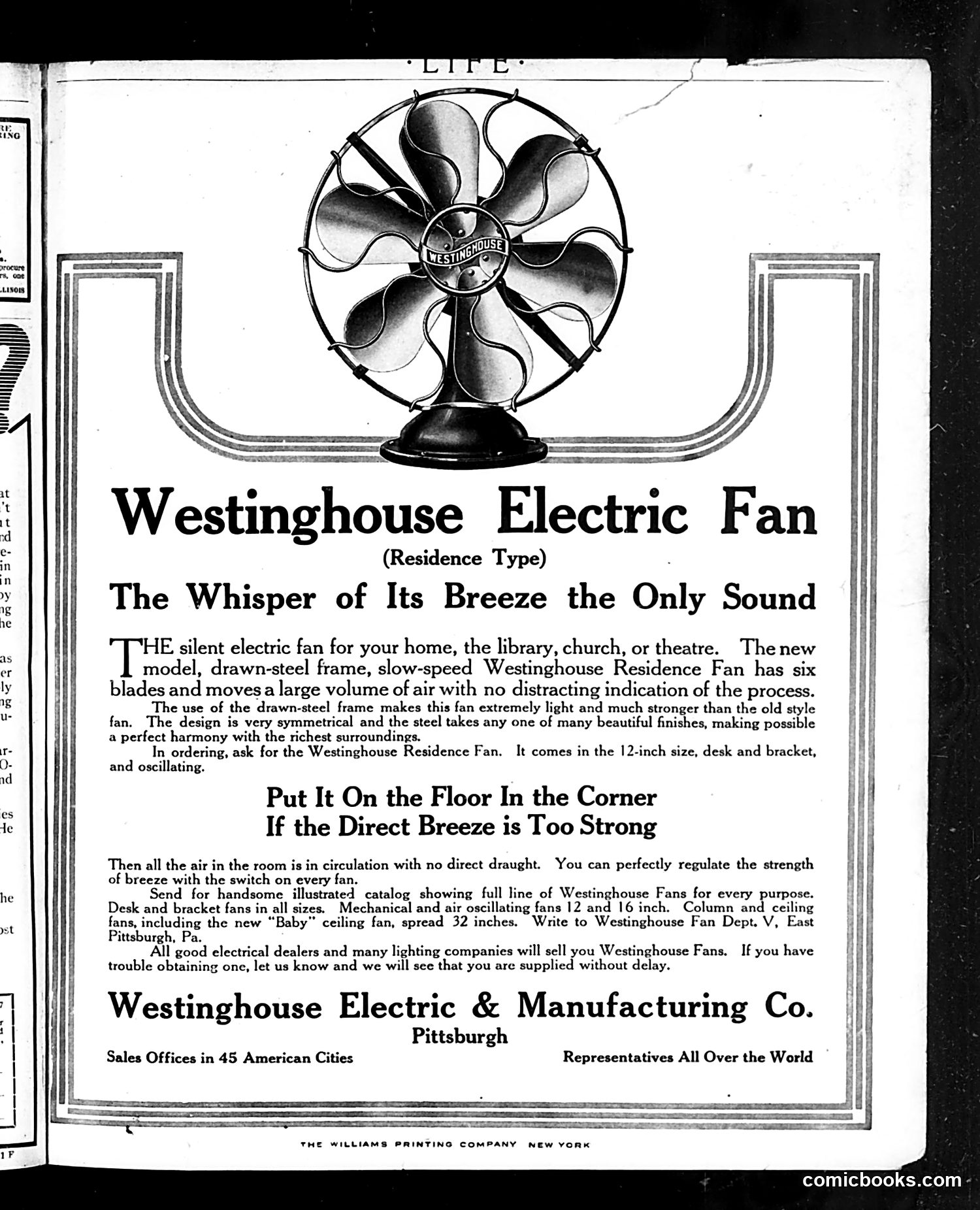
This page is **not a cartoon or satire—it's a straightforward advertisement** for Westinghouse Electric fans from an early 20th-century issue of *Life* magazine. The ad promotes the "Residence Type" electric fan, emphasizing its quiet operation ("The Whisper of Its Breeze the Only Sound") and modern design with a drawn-steel frame. Key selling points include: - Silent, efficient operation suitable for homes, libraries, churches, and theaters - Lightweight and durable construction - Available in multiple sizes and styles (desk, bracket, oscillating, ceiling models) - Adjustable speed for comfort - Aesthetic appeal that harmonizes with interior décor The practical advice—placing the fan in a corner if the breeze is too strong—reflects how novelty electric fans were to consumers. The ad emphasizes Westinghouse's extensive distribution network (45 sales offices nationwide) and promises immediate availability. This is period marketing material, not political satire. It reflects the early-1900s enthusiasm for electrical home appliances as modern luxuries.
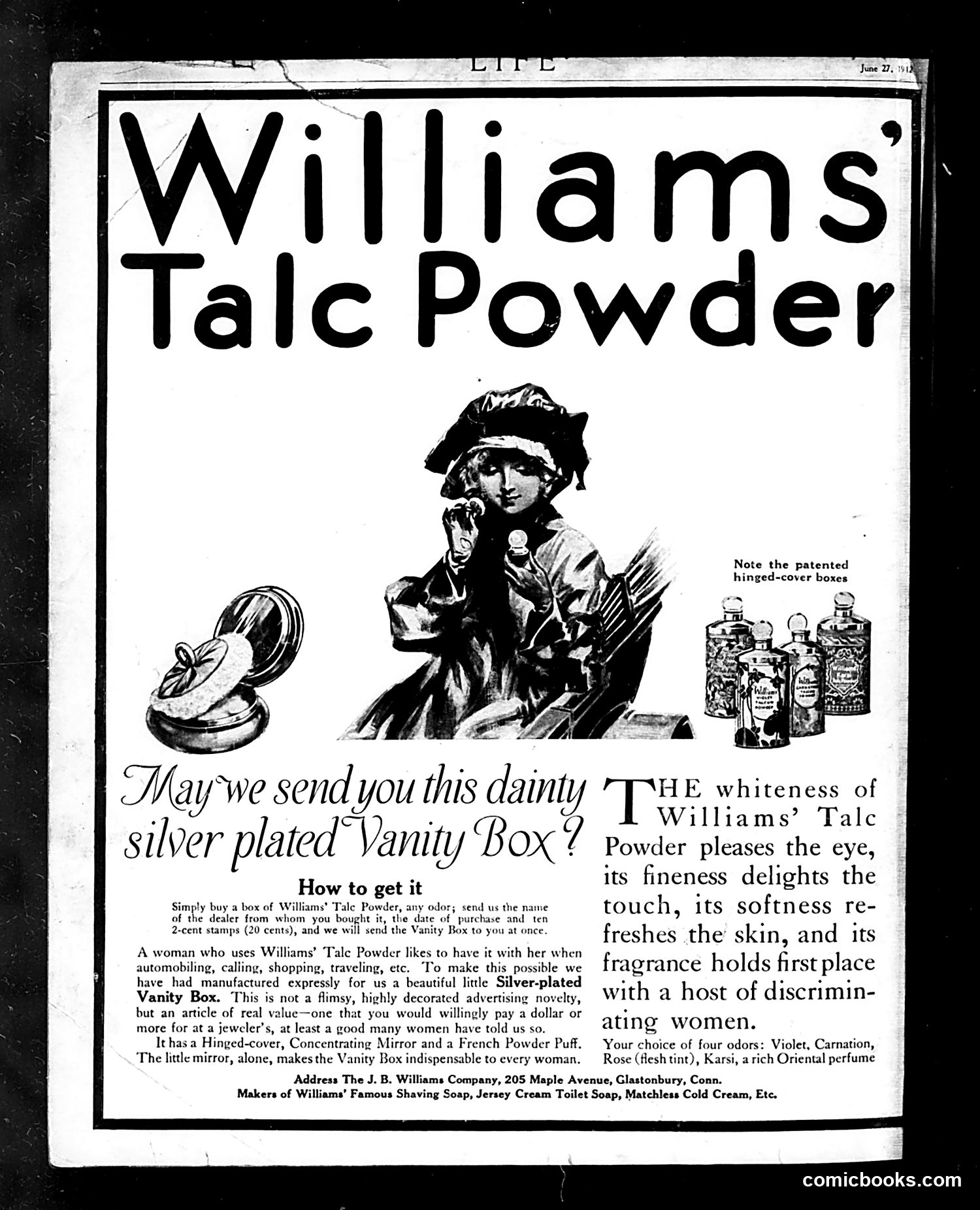
This is **not a cartoon or satire**—it's a straightforward **product advertisement** from Life magazine (June 27, 1914). The page promotes Williams' Talc Powder by offering a promotional incentive: purchase a box of powder, mail in proof of purchase with ten 2-cent stamps, and receive a complimentary silver-plated vanity box (compact mirror). The advertisement employs period marketing strategies targeting women by emphasizing luxury, portability for "automobiling, calling, shopping," and the vanity box's practical features (hinged cover, mirror, powder puff). The illustration shows a fashionable woman of the era applying powder. The four fragrance options listed (Violet, Carnation, Rose, Karsi) reflect early 1900s perfume preferences. The company also manufactured shaving soap and cold cream, indicating diversified personal-care products. This represents typical early 20th-century consumer culture: manufacturers used premium gifts to drive product sales to middle-class women.

I can see this is a very dark, heavily degraded page from what appears to be a historical publication. The image quality is extremely poor—almost entirely black with minimal visible detail. While the OCR text indicates this came from "Life" magazine (referenced at the bottom as "comicbooks.com"), I cannot reliably make out any cartoon illustrations, text, figures, or caricatures from the image itself. Without being able to see the actual content clearly, I cannot identify specific political or social references, explain satirical points, or provide historical context that would be accurate. To properly analyze this page as requested, a clearer or higher-contrast version would be necessary.