
Life, 1912-06-27 · page 11 of 45
Life — June 27, 1912 — page 11: what you’re looking at
What you’re looking at
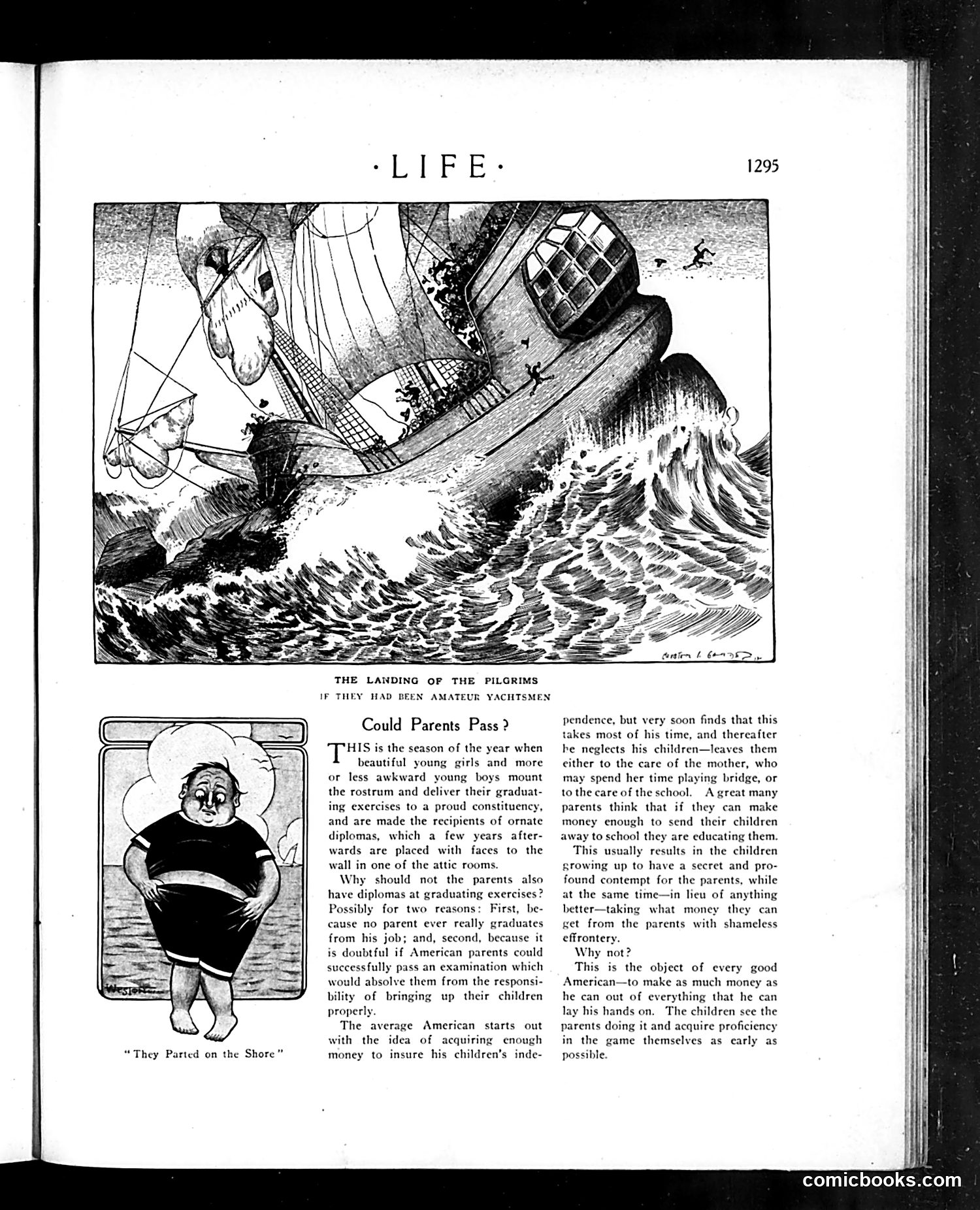
This page contains two satirical pieces critiquing American parenting and class anxiety. **Top illustration**: "The Landing of the Pilgrims (If They Had Been Amateur Yachtsmen)" mocks incompetent amateur sailors, likely referencing contemporary wealthy dilettantes attempting nautical pursuits. **Bottom cartoon and article**: "Could Parents Pass?" satirizes parents' social aspirations regarding their children's education. The piece argues that average Americans prioritize sending children to expensive schools to gain social status and proficiency in moneymaking, rather than for genuine education. The cartoon shows an uncomfortable parent, suggesting parental anxiety about their own inadequacy. The satire targets American materialism and status-seeking, implying that parents view education primarily as a financial investment and social credential rather than intellectual development—a critique of emerging consumer culture and class mobility anxieties in early 20th-century America.
📄 Transcribed text from this page (OCR, searchable)
Machine-transcribed from the original scan — historical spelling and the odd misread are preserved.
“They Parted on the Shore” THE LANDING OF THE PILGRIMS IF THEY HAD BEEN AMATEUR YACHTSMEN Could Parents Pass ? HIS is the season of the year when beautiful young girls and more or less awkward young boys mount the rostrum and deliver their graduat- ing exercises to a proud constituency, and are made the recipients of ornate diplomas, which a few years after- wards are placed with faces to the wall in one of the attic rooms. Why should not the parents also have diplomas at graduating exercises? Possibly for two reasons: First, be- cause no parent ever really graduates from his job; and, second, because it is doubtful if American parents could successfully pass an examination which would absolve them from the responsi- bility of bringing up their children properly: The average American starts out with the idea of acquiring enough money to insure his children’s inde- antcn b 6->5>, pendence, but very soon finds that this takes most of his time, and thereafter he neglects his children—leaves them either to the care of the mother, who may spend her time playing bridge, or to the care of the school. A great many parents think that if they can make money enough to send their children away to school they are educating them. This usually results in the children growing up to have a secret and pro- found contempt for the parents, while at the same time—in lieu of anything better—taking what money they can get from the parents with shameless effrontery. Why not? This is the object of every good American—to make as much money as he can out of everything that he can lay his hands on. The children see the parents doing it and acquire proficiency in the game themselves as carly as possible. . i] comicbooks.com