
Life, 1912-06-27 · page 9 of 45
Life — June 27, 1912 — page 9: what you’re looking at
What you’re looking at
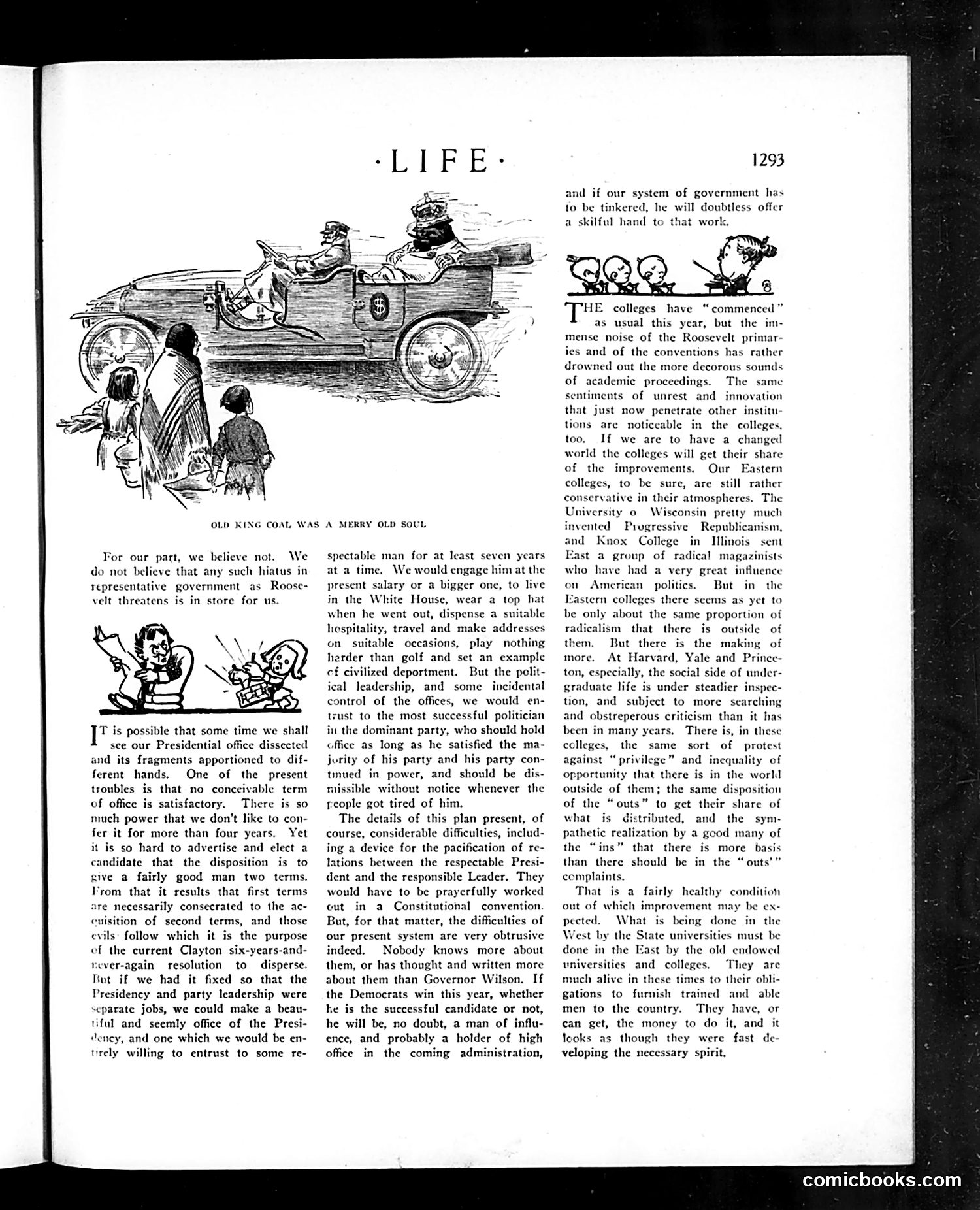
This Life magazine page satirizes American presidential politics and governance structure. The top cartoon depicts "Old King Coal" as a "merry old soul"—a reference to the nursery rhyme, suggesting coal interests exert excessive influence over leadership. The main article argues against concentration of presidential power, advocating instead for a "separate jobs" system where the presidency and party leadership are divided. The author contends this would create more stable, accountable government than the current system where one person holds both roles. The piece also critiques contemporary college activism, noting "Roosevelt primaries" and conventions have disrupted academic institutions with political noise—suggesting colleges are becoming overly politicized during this election period.
📄 Transcribed text from this page (OCR, searchable)
Machine-transcribed from the original scan — historical spelling and the odd misread are preserved.
OLD KING COAL WAS A MERRY OLD SOUL For our part, we believe not. We do not believe that any such hiatus in representative government as Roose- velt threatens is in store for us. iv is possible that some time we shall sce our Presidential office dissected and its fragments apportioned to dif- ferent hands. One of the present troubles is that no conceivable term of office is satisfactory. There is so much power that we don’t like to con- fer it for more than four years. Yet it is so hard to advertise and elect a andidate that the disposition is to give a fairly good man two terms. From that it results that first terms ¢ necessarily consecrated to the ac- cuisition of second terms, and those evils: follow which it is the purpose of the current Clayton six-years-and- never-again resolution to disperse. Tut if we had it fixed so that the Presidency and party leadership were separate jobs, we could make a beau: tiful and seemly office of the Pre: “ency, and one which we would be en- urely willing to entrust to some re- spectable man for at least seven years at a time. We would engage him at the present salary or a bigger one, to live in the White House, wear a top hat when he went out, dispense a suitable hospitality, travel and make addresses on suitable occasions, play nothing harder than golf and set an example cf civilized deportment. But the polit- ical leadership, and some incidental control of the offices, we would en- trust to the most successful politician in the dominant party, who should hold office as long as he satisfied the ma- jority of his party and his party con- tinued in power, and should be dis- miissible without notice whenever the reople got tired of him. The details of this plan present, of course, considerable difficulties, includ- ing a device for the pacification of re- lations between the respectable Presi- dent and the responsible Leader. They would have to be prayerfully worked cut in a Constitutional convention. But, for that matter, the difficulties of our present system are very obtrusive indeed. Nobody knows more about them, or has thought and written more about them than Governor Wilson. If the Democrats win this year, whether ke is the successful candidate or not, he will be, no doubt, a man of influ- ence, and probably a holder of high office in the coming administration, 1293 and if our system of government has to be tinkered, he will doubtless offer a skilful hand to that work. HE colleges have “commenced ” as usual this year, but the im- mense noise of the Roosevelt primar- ies and of the conventions has rather drowned out the more decorous sounds of academic proceedings. The same sentiments of unrest and innovation that just now penetrate other institu tions are noticeable in the colleges. too. If we are to have a changed world the colleges will get their share of the improvements. Our Eastern colleges, to be sure, are still rather tive in their atmospheres. The niversity o Wisconsin pretty much invented Progressive Republicanism, id Knox College in Illinois sent ‘ast a group of radical magazinists who have had a very great influence on American politics. But in’ the Eastern colleges there seems as yet to be only about the same proportion of radi m that there is outside of them. But there is the making of more. At Harvard, Yale and Prince- ton, especially, the social side of under- graduate life is under steadier inspec- tion, and subject to more searching and obstreperous criticism than it has been in many years. There is, in these cclleg the same sort of protest against “privilege” and inequality of opportunity that there is in the world outside of them; the same disposition of the “ out to get their share of what is distributed, and the sym- pathetic realization by a good many of the “ins” that there is more basis than there should be in the “ outs’” complaints. That is a fairly healthy condition out of which improvement may be ex- pected. What is being done in the West by the State universities must be done in the East by the old endowed universities and colleges. They are much alive in these times to their obli- Zations to furnish trained and able men to the country. They have, or can get, the money to do it, and it looks as though they were fast de- veloping the necessary spirit, comicbooks.com