
Life, 1912-06-27 · page 12 of 45
Life — June 27, 1912 — page 12: what you’re looking at
What you’re looking at
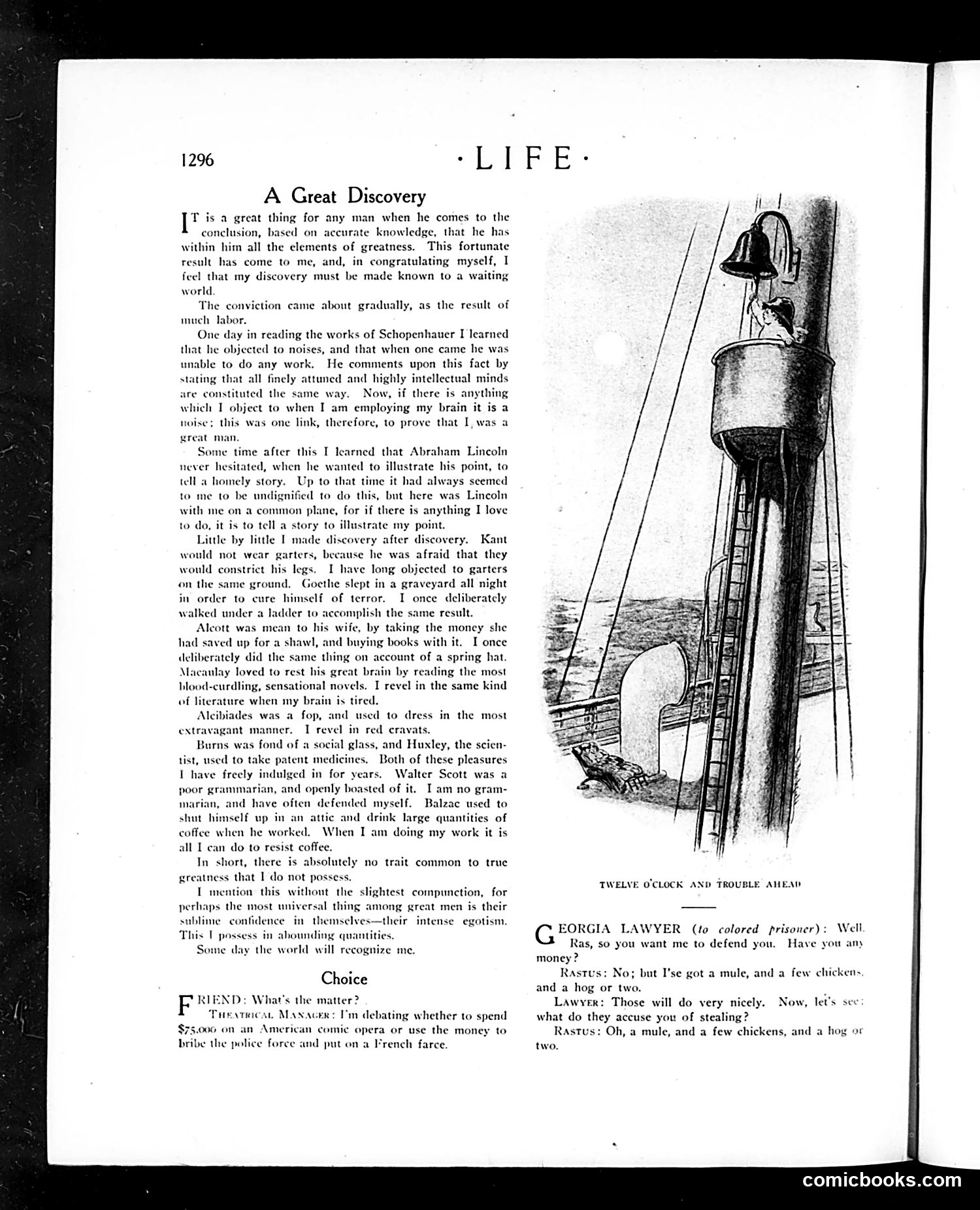
This page contains two distinct pieces: **"A Great Discovery"** (main article): An autobiographical essay where the author describes arriving at the conclusion that he possesses all the elements of greatness—referencing Schopenhauer and Abraham Lincoln as examples. The tone is satirical self-aggrandizement, mocking pretentious intellectuals who overestimate their own importance. **"Choice"** (brief dialogue): A friend asks a theatrical manager whether to spend $75,000 on an American comic opera or bribe a judge to fix a French farce—presenting corruption as a casual financial choice. **"Twelve O'Clock and Trouble Ahead"** (illustration): A ship's bell and rigging sketch accompanies a dialogue between a Georgia lawyer and prisoner named Rastus about stolen livestock, likely containing period racial stereotypes. The page satirizes vanity, corruption, and social pretension typical of Life magazine's satirical approach.
📄 Transcribed text from this page (OCR, searchable)
Machine-transcribed from the original scan — historical spelling and the odd misread are preserved.
1296 A Great Discovery T is a great thing for any man when he comes to the conclusion, based on accurate knowledge, that he has within him all the elements of greatness. This fortunate result has come to me, and, in congratulating myself, I feel that my discovery must be made known to a waiting world. The conviction came about gradually, as the result of much labor. One day in reading the works of Schopenhauer I learned that he objected to noises, and that when one came he was unable to do any work, He comments upon this fact by stating that all finely attuned and highly intellectual minds are constituted the same way, Now, if there is anything which I object to when I am employing my brain it is a noise; this was one link, therefore, to prove that I, was a great man. Some time after this T learned that Abraham Lincoln never hesitated, when he wanted to illustrate his point, to tell a homely story. Up to that time it had ays seemed to me to be undignified to do this, but here was Lincoln with me on a common plane, for if there is anything I love to do, it is to tell a story to illustrate my point. Little by little I made discovery after discovery. Kant would not wear garters, because he was afraid that they would constrict his legs. I have long objected to garters on the same ground. Goethe slept in a graveyard all night in order to cure himself of terror, I once deliberately walked under a ladder to accomplish the same result. Alcott was mean to his wife, by taking the money she had saved up for a shawl, and buying books with it. I once deliberately did the same thing on account of a spring hat. lay loved to rest his great brain by reading the most urdling, sensational novels. I revel in the same kind of literature when my brain is tired. Alcibiades was a fop, and used to dress in the most extravagant manner. T revel in red cravats. Burns was fond of a social glass, and Hux tist, used to take patent medicines, Both of these pleasures 1 ¢ freely indulged in for years. Walter Scott was a poor grammarian, and openly boasted of it. [am no gram- marian, and have often defended myself. Balzac used to shut himself up in an attic and drink large quantities of coffee when he worked. When I am doing my work it is all I can do to resist coffee. In short, there is absolutely no trait common to true greatness that I do not possess. I mention this without the slightest compunction, for perhaps the most universal thing among great men is their sublime confidence in themselves—their intense egotism. This T possess in abounding quantitie: Some day the world will recognize me. Choice FRIEND: Whar’ the matter? $ WeyTICAL MaNacex: I'm debating whether to spend 906 on an American comic opera or use the money to bribe the police force and put on a French farce. “Le l PE TWELVE O'CLOCK AND TROUBLE AHEAD EORGIA LAWYER (to colored prisoner): Well Ras, so you want me to defend you. Have you any money? Rastus: No; but I’se got a mule, and a few chickens and a hog or two. Lawyer: Those will do very nicely. Now, let's sec what do they accuse you of stealing? Oh, a mule, and a few chickens, and a hog or comicbooks.com