
Life, 1912-06-27 · page 8 of 45
Life — June 27, 1912 — page 8: what you’re looking at
What you’re looking at
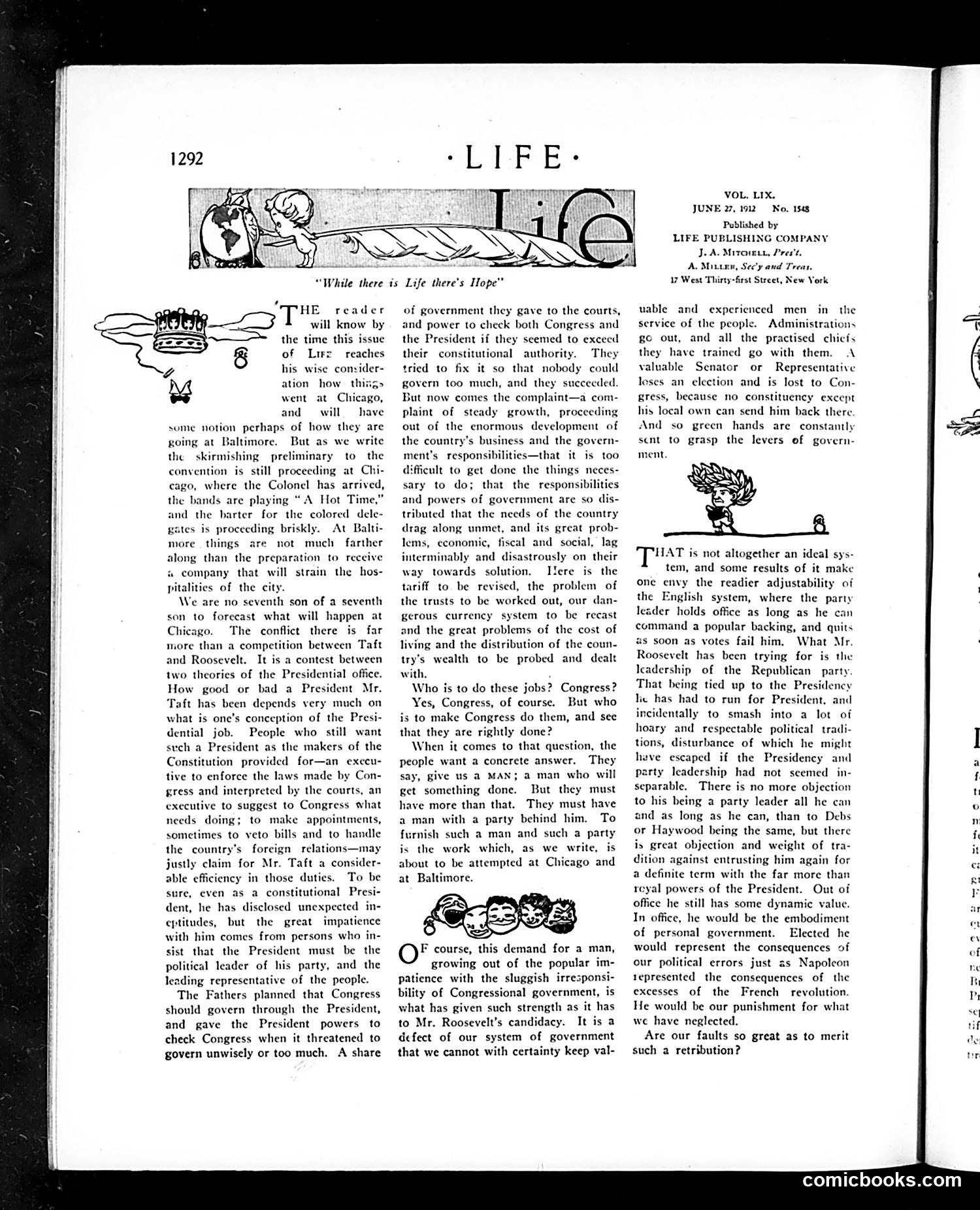
This page contains editorial commentary on the 1912 U.S. presidential election, referencing Theodore Roosevelt's Progressive ("Bull Moose") Party challenge against Republican incumbent William Howard Taft. The article criticizes Congressional gridlock and government inefficiency, arguing that the President needs both party support and constitutional powers to govern effectively. It discusses the split between Taft and Roosevelt, noting that Roosevelt's challenge has exposed fundamental weaknesses in the American system. The author argues voters need a "MAN"—a decisive leader—rather than partisan bickering. The text suggests Roosevelt's candidacy, while representing frustration with Taft's presidency, illustrates deeper systemic problems in how presidential power is balanced against Congressional authority.
📄 Transcribed text from this page (OCR, searchable)
Machine-transcribed from the original scan — historical spelling and the odd misread are preserved.
“While there is Life there's Hope" HE re will know by the time this issue of Lirz reaches his wise conzider- ation how. things went at Chicago, and will have some notion perhaps of how they are going at Baltimore. But as we write the skirmishing preliminary to the convention is still proceeding at Chi- cago, where the Colonel has arrived, the bands are playing “A Hot Time,” and the barter for the colored dele gates is proceeding briskly. At Balt more things are not much farther along than the preparation to receive & company that will strain the hos- pitalities of the city. We are no seventh son of a seventh son to forecast what will happen at Chicago. The conflict there is far more than a competition between Taft and Roosevelt. It is a contest between two theories of the Presidential office. How good or bad a President Mr. Taft has been depends very much on what is one’s conception of the Presi- dential job. People who still, want such a President as the makers of the Constitution provided for—an execu- tive to enforce the laws made by Con- gress and interpreted by the courts, an executive to suggest to Congress what needs doing; to make appointments, sometimes to veto bills and to handle the country’s foreign relations—may justly claim for Mr. Taft a consider- able efficiency in those duties. To be sure, even as a constitutional Presi- dent, he has disclosed unexpected in- eptitudes, but the great impatience with him comes from persons who in- sist that the President must be the political leader of his party, and the leading representative of the people. The Fathers planned that Congress should govern through the President, and gave the President powers to check Congress when it threatened to govern unwisely or too much. A share der of government they gave to the courts, and power to check both Congress and the President if they seemed to exceed their constitutional authorit The: tried to fix it so that nobody could govern too much, and they succeeded. But now comes the complaint—a com- plaint of steady growth, proceeding out of the enormous development of the country’s business and the govern- ment’s responsibilities—that it is too difficult to get done the things neces- sary to do; that the responsibilities and powers of government are so dis- tributed that the needs of the country drag along unmet, and its great prob- lems, economic, fiscal and social, lag interminably and disastrously on their way towards solution, ere is the tariff to be revised, the problem of the trusts to be worked out, our dan- gerous currency system to be recast and the great problems of the cost of living and the distribution of the coun- try’s wealth to be probed and dealt with, Who is to do these jobs? Congress? Yes, Congress, of course. But who is to make Congress do them, and see that they are rightly done? When it comes to that question, the people want a conerete answer. They say, give us a MAN; a man who will get something done. But they must have more than that. They must have a man with a party behind him. To furnish such a man and such a party is the work which, as we write, is about to be attempted at Chicago and at Baltimore. F course, this demand for a man, growing out of the popular im- patience with the sluggish irresponsi- bility of Congressional government, is what has given such strength as it has to Mr. Roosevelt’s candidacy. It is a defect of our system of government that we cannot with certainty keep val- VOL. LIX. JUNE 27, 1912 No, 1588 Published by LIFE PUBLISHING COMPANY J.A. Mitauenn, Pres't, A. Minune, See'y and Treas. ¥ West Thirty-first Street, New Vork uable and experienced men in the service of the people. Administrations go out, and all the practised chicfs they have trained go with them. A valuable Senator or Representative leses an election and is lost to Con- gress, because no constituency except his local own can send him back there. And so green hands are constantly sent to grasp the levers of govern- ment. HAT is not altogether an ideal sys- tem, and some results of it make one envy the readier adjustability of the English system, where the party leader holds office as long as he can command a popular backing, and quits as soon as votes fail him, What Mr. Roosevelt has been trying for is the Icadership of the Republican party That being tied up to the Presidency lic has had to run for President, and identally to smash into a lot of hoary and respectable political tradi- tions, disturbance of which he might hwve escaped if the Presidency and party leadership had not seemed in- separable. There is no more objection to his being a party leader all he can znd as long as he can, than to Debs or Haywood being the same, but there is great objection and weight of tra- dition against entrusting him again for a definite term with the far more than reyal powers of the President. Out of office he still has some dynamic value. In office, he would be the embodiment of personal government. Elected he would represent the consequences of our political errors just as Napoleon tepresented the consequences of the excesses of the French revolution. He would be our punishment for what we have neglected. Are our faults so great as to merit such a retribution? comicbooks.com