
A complete issue · 56 pages · 1912
Life — June 6, 1912
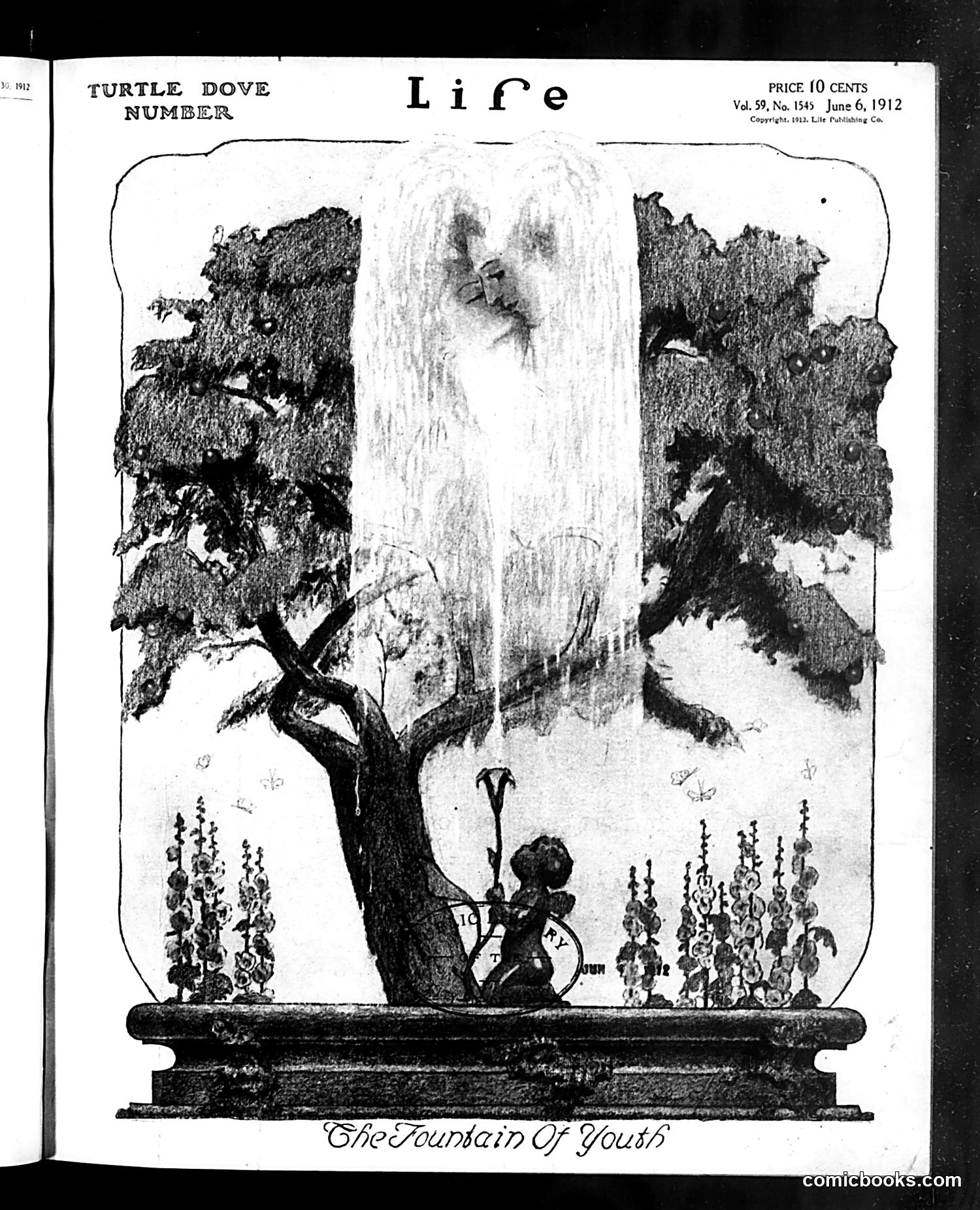
This is the cover illustration for Life's "Turtle Dove Number." The image depicts a classical allegorical scene: a youthful figure plays a stringed instrument beneath a gnarled, ancient tree, from which a fountain springs upward. Flowers bloom in the foreground. The title "The Fountain of Youth" is a legendary concept—the mythical spring that restores youth and vitality. In 1912 context, this likely satirizes contemporary obsessions with youth, beauty treatments, or rejuvenation products that were heavily marketed during the Progressive Era. The contrast between the eternally young musician and the decrepit tree suggests irony about the human desire to defy aging—a timeless vanity the magazine is gently mocking.
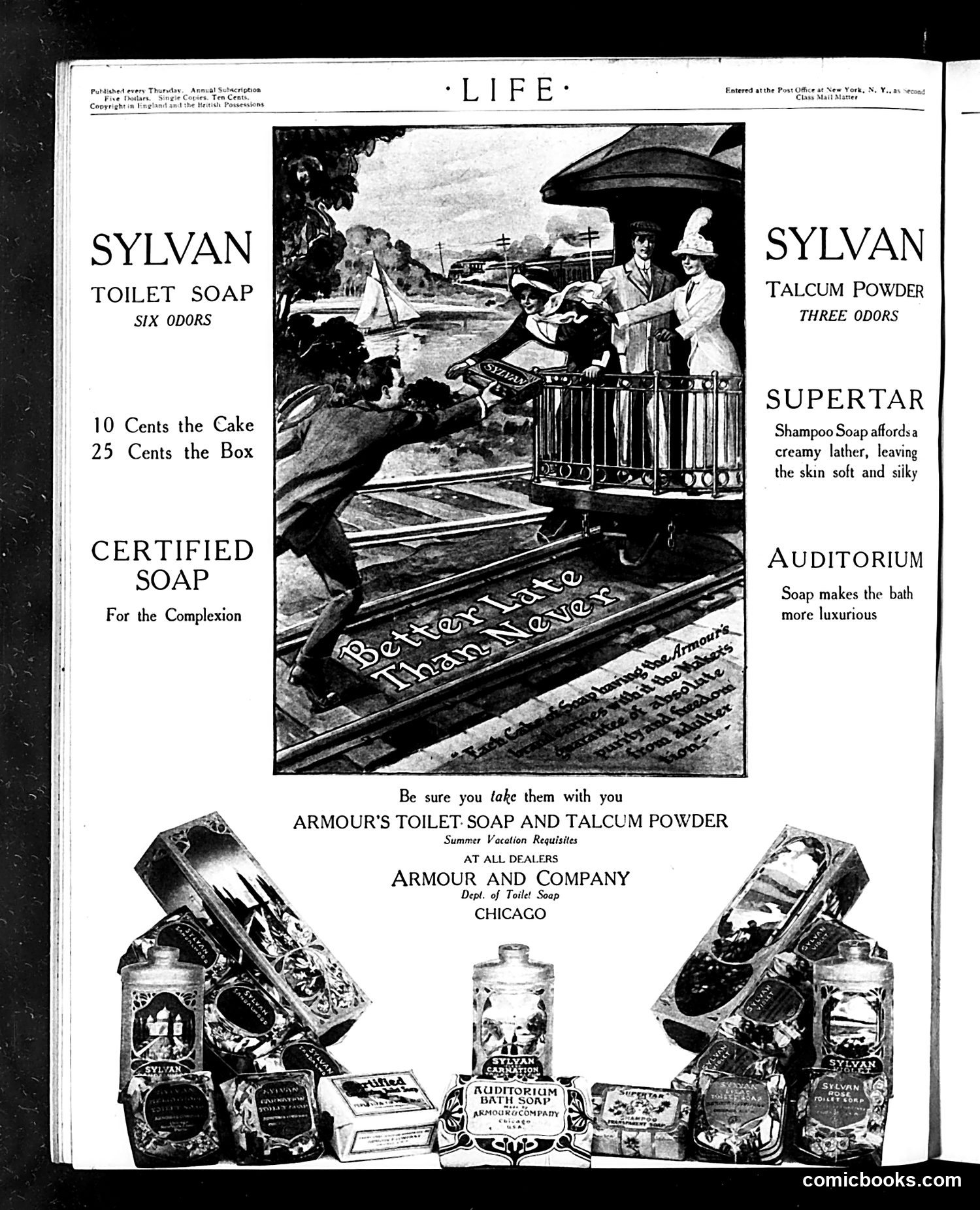
This page is primarily **advertising, not satire or political commentary**. It contains advertisements for Armour and Company's toiletry products (Sylvan brand toilet soap and talcum powder, plus Supertar shampoo soap). The central illustration depicts a leisurely riverside or boating scene with well-dressed people on a dock, appearing to pack items for a vacation. The caption reads "Be sure you take them with you—ARMOUR'S TOILET SOAP AND TALCUM POWDER: Summer Vacation Requisites." The point is straightforward product promotion: these toiletries are "summer vacation requisites" that travelers should pack. The pleasant vacation scene associates the products with leisure, comfort, and genteel summer activities—a common advertising strategy of the era.
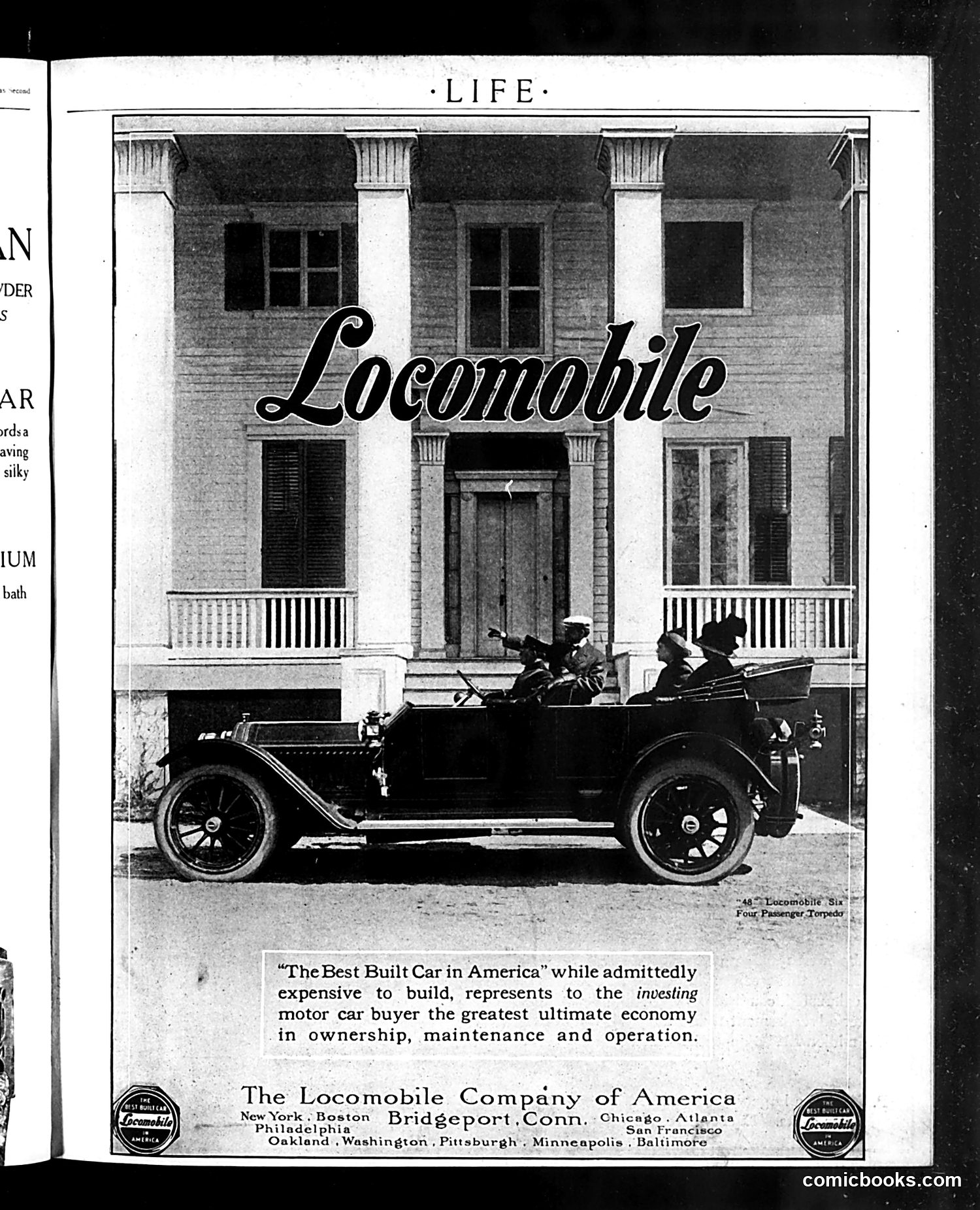
This is primarily an **automobile advertisement**, not satire or political content. It appears from the *Life* magazine archives and promotes the Locomotive automobile—a luxury vehicle manufactured by the Locomotile Company of America. The ad features a photograph of the "48" Locomotile Six, a four-passenger touring car, parked in front of a classical building. Four well-dressed passengers are shown in the vehicle. The marketing copy claims it is "The Best Built Car in America" while acknowledging it is "admittedly expensive to build." The pitch emphasizes long-term value: economy in "ownership, maintenance and operation" justifies the high initial cost. The company lists multiple manufacturing locations: Bridgeport, Connecticut; Indianapolis; Philadelphia; and offices in additional major cities. This is straightforward commercial advertising rather than editorial satire.
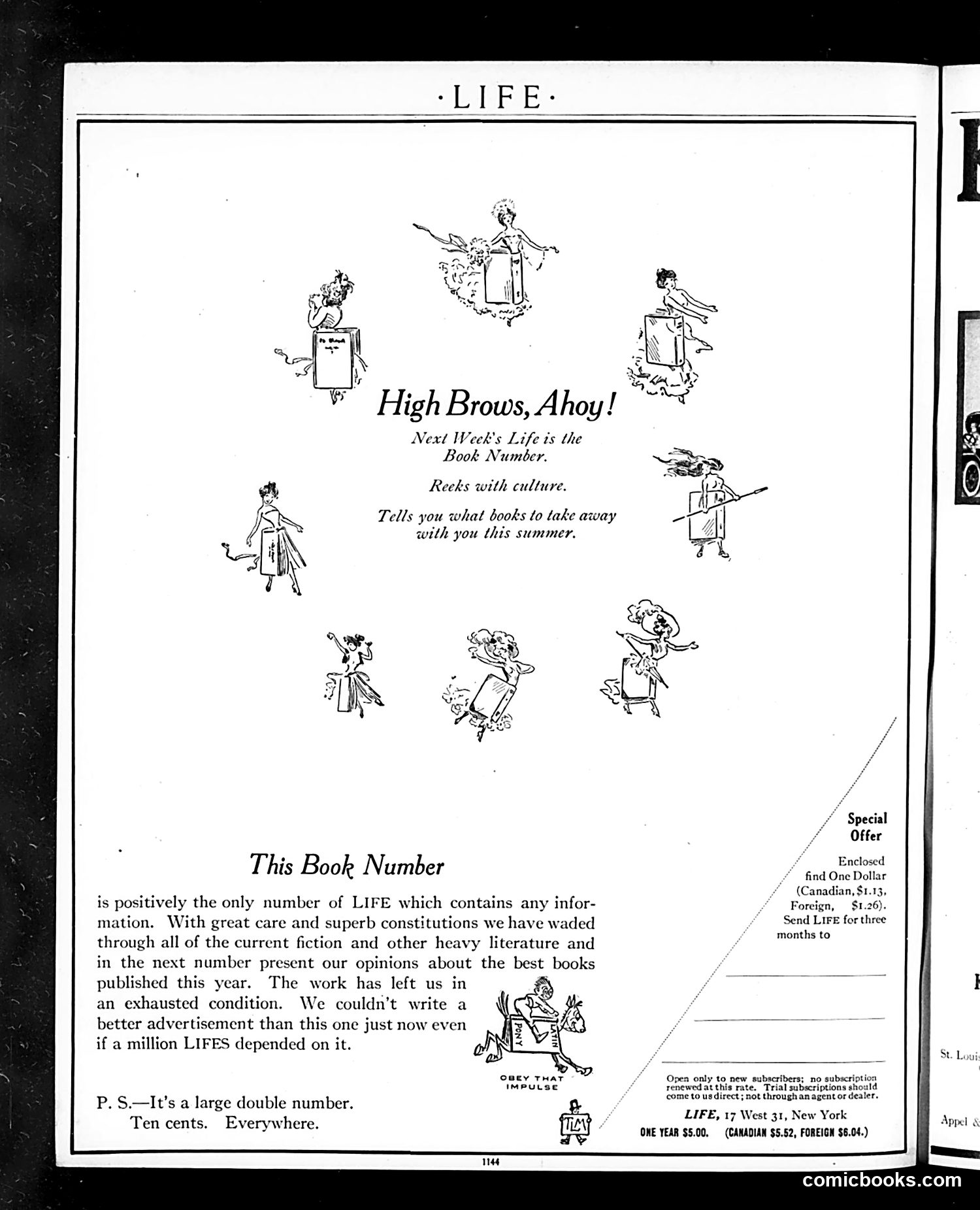
This page is primarily a **promotional advertisement** for Life magazine itself, not political satire. The headline "High Brows, Ahoy!" addresses educated readers, announcing that next week's issue will be a "Book Number" featuring book recommendations for summer reading. The small illustrated figures scattered across the page appear to be **generic representations of cultured people** carrying books—visual metaphors for the magazine's intellectual audience. The cartoon style is whimsical rather than satirical. The text emphasizes that this specific issue contains book reviews and recommendations, claims it's "positively the only number of LIFE which contains any information" about the best current literature, and notes it's a "large double number" selling for ten cents. The "Special Offer" box promotes a subscription deal. This is essentially a **self-promotional advertisement disguised as editorial content**.
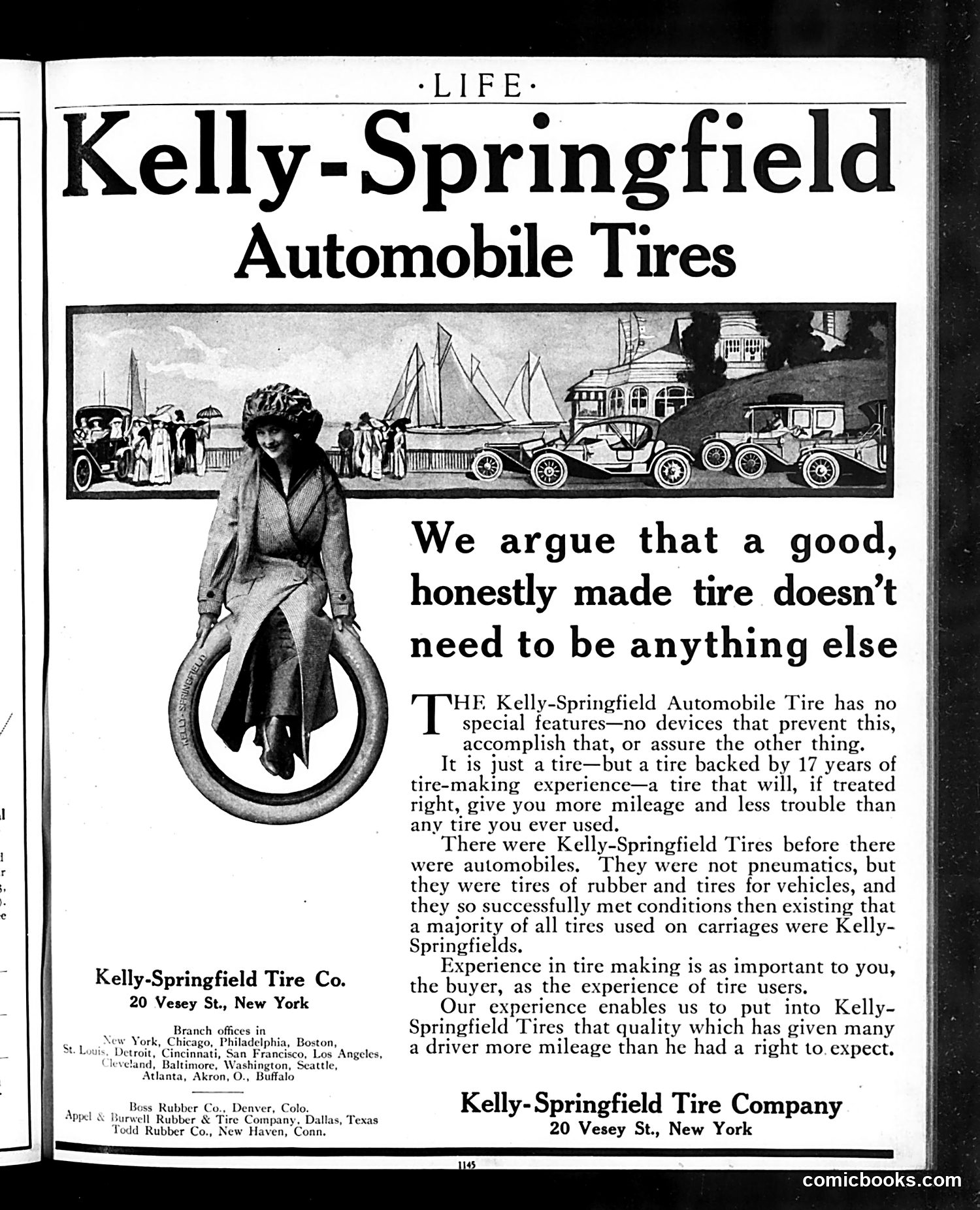
This is a **commercial advertisement**, not satire or political commentary. It presents a woman sitting on a large tire, promoting Kelly-Springfield Automobile Tires. The ad's argument is straightforward: good tires don't need special gimmicks—just honest manufacturing. The text emphasizes 17 years of tire-making experience and claims Kelly-Springfield tires (which predate automobiles, originally made carriage tires) provide reliable mileage and durability. The illustration at the top depicts various leisure activities and transportation, establishing aspirational lifestyle imagery. The woman serves as an attractive visual focal point typical of early 20th-century advertising. This is standard commercial messaging with no satirical intent.
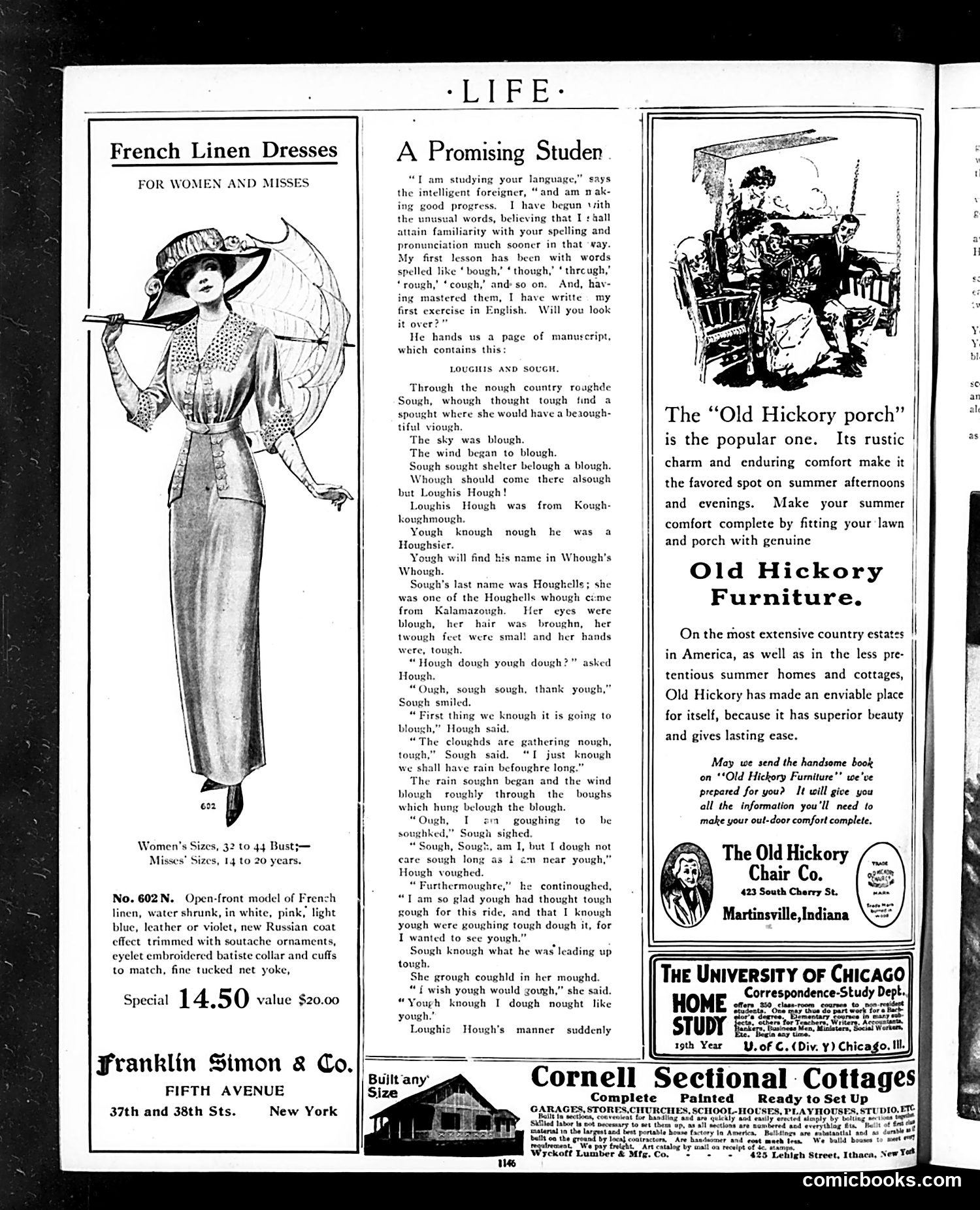
This page is primarily **advertising and fiction** rather than political satire. The left column features a fashion advertisement for French linen dresses by Franklin Simon & Co., showing an elegant woman in a long dress with a wide-brimmed hat—typical 1910s-1920s styling. The center contains "A Promising Student," a humorous short story about language learning, featuring phonetic wordplay with sounds like "tough," "through," and "rough" (words notorious for English pronunciation inconsistency). The joke relies on a foreign student's confusion with English's irregular spelling-to-sound rules. The right side advertises Old Hickory Furniture and the University of Chicago's correspondence program. This appears to be a general-interest magazine page mixing entertainment, practical advice, and commercial advertising—not political commentary.
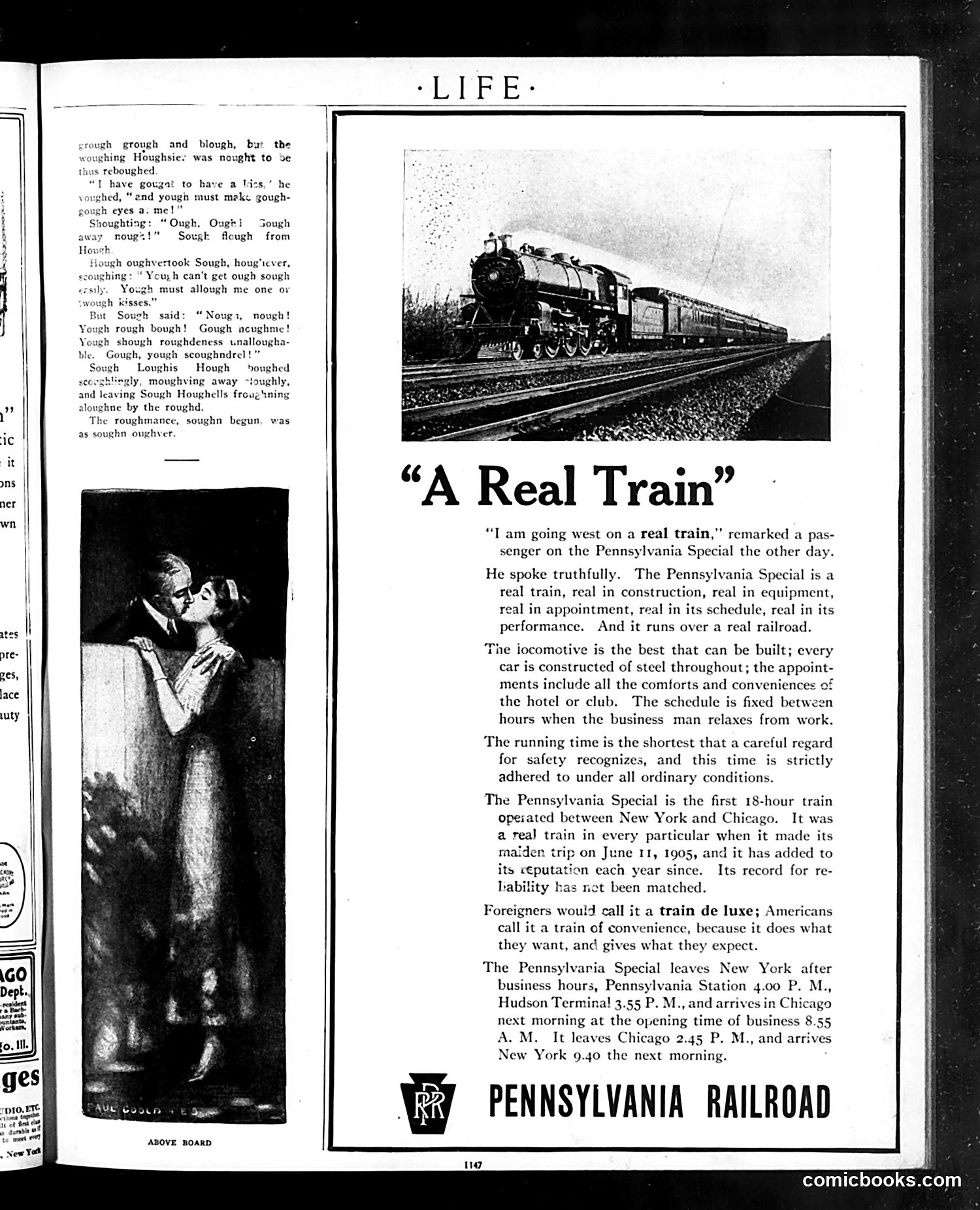
This page contains a story about dialect humor (the "Sough" and "Hough" wordplay at left) paired with a Pennsylvania Railroad advertisement for "A Real Train." The ad's title and content emphasize the Pennsylvania Special's authenticity and reliability—it's "real" in construction, equipment, appointment, schedule, and performance. This repetition of "real" suggests the ad responds to skepticism about train travel quality or railroad claims common in the early 1900s. The photograph shows a locomotive pulling passenger cars. The ad highlights the train's speed (18-hour New York-to-Chicago service), comfort (hotel/club-like appointments), and strict schedule adherence, positioning it as a premium service for businessmen and travelers seeking dependable, luxurious rail travel during an era when such service was competitive and noteworthy.
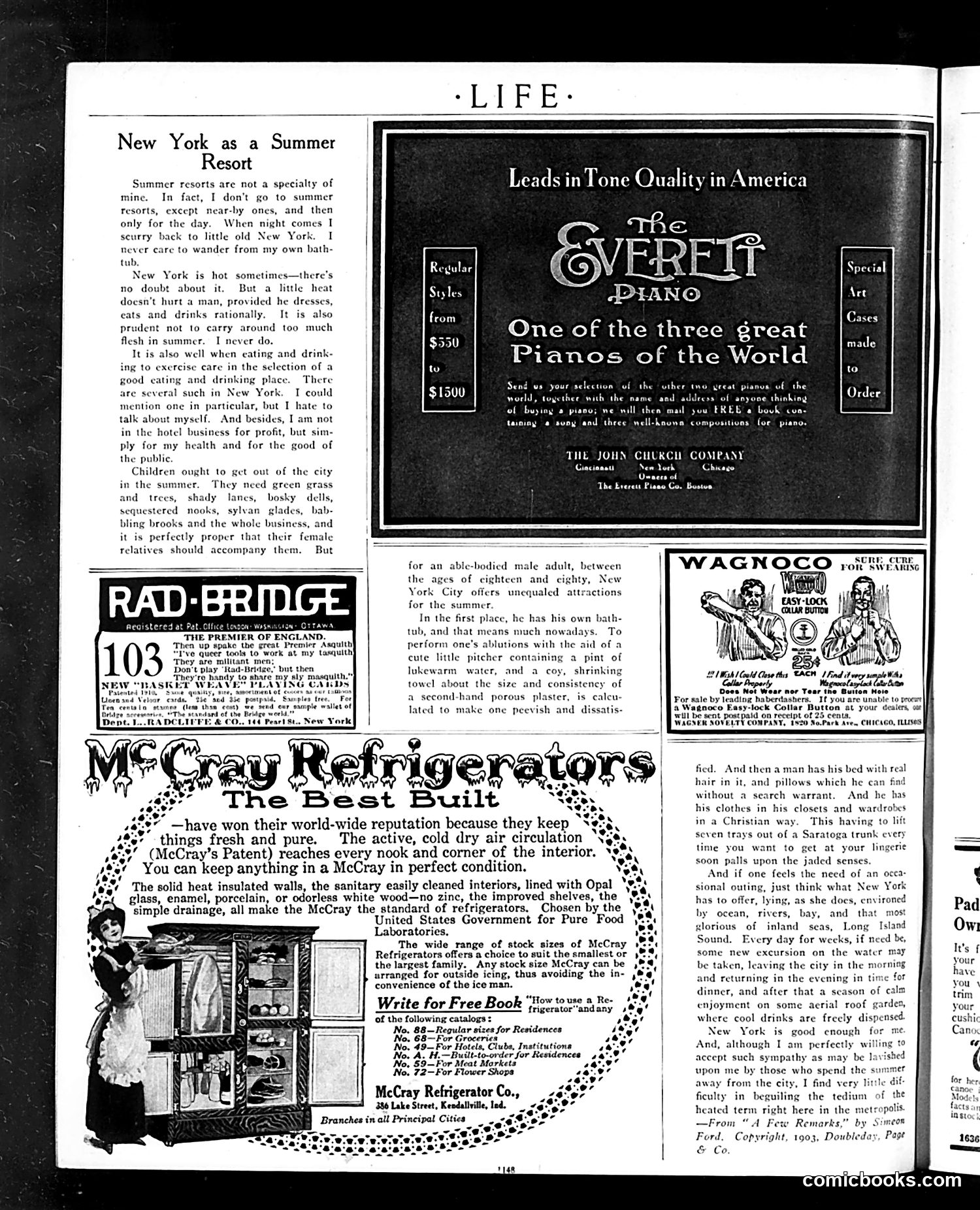
This page is primarily **advertising** with one essay. The advertisements include: - **Everett Piano**: Claims to be "one of the three great Pianos of the World" - **Rad-Bridge**: A patent for some kind of tool or device - **McCray Refrigerators**: "The Best Built" - emphasizing their ability to keep food fresh and pure through "active, cold dry air circulation" - **Wagnoco Easy-Lock Collar Button**: A fastening device for shirt collars The left column contains an essay titled "New York as a Summer Resort," discussing why the author prefers staying in New York City during summer rather than traveling to traditional resort destinations. The piece emphasizes the city's attractions and benefits for recreation. There is **no political cartoon** on this page—it is a commercial/editorial mix typical of early 20th-century Life magazine advertising.
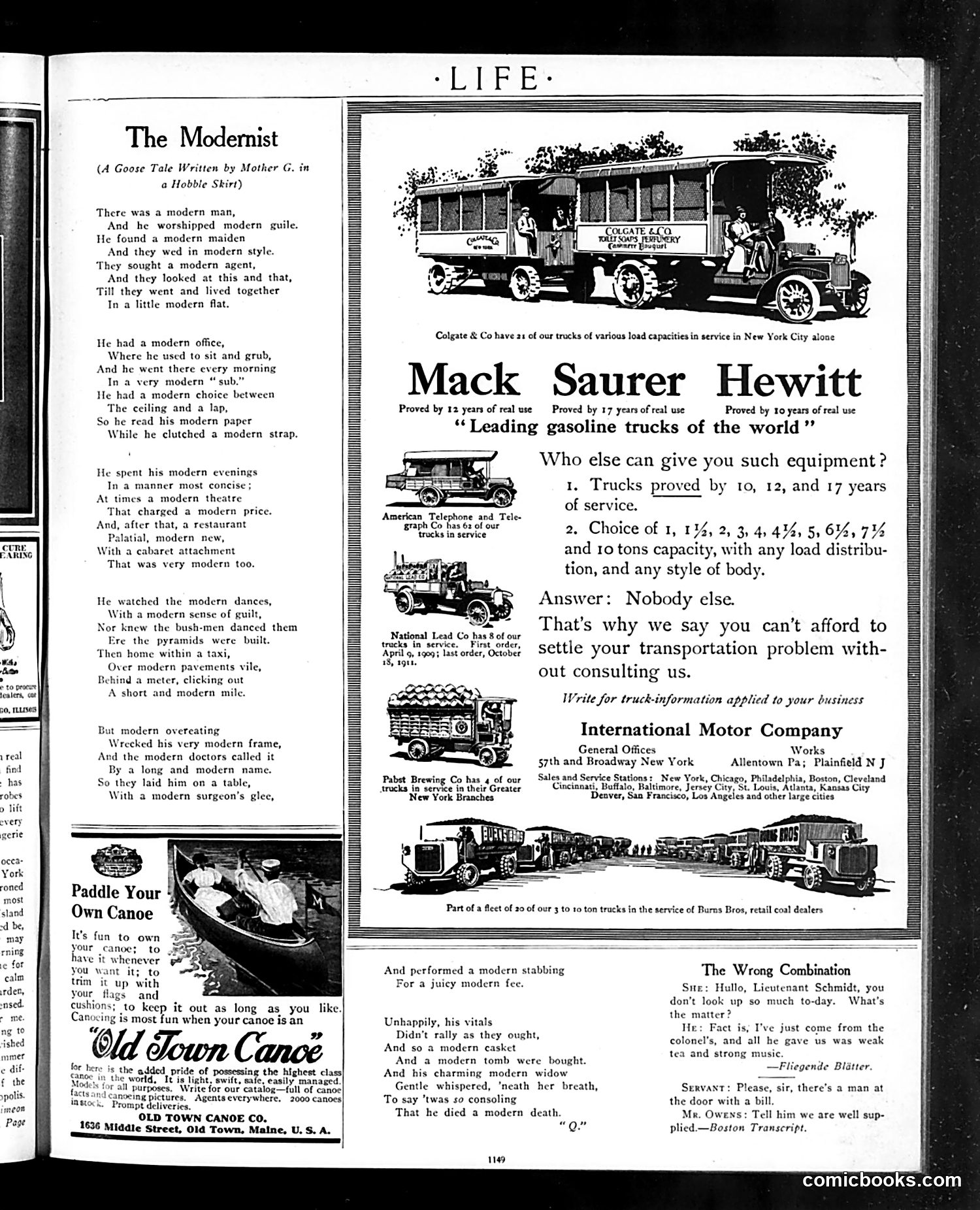
This page is primarily a satirical poem by "Mother G." mocking contemporary "modern" aesthetics and lifestyle choices of the 1920s. The poem ridicules a man who embraces all things fashionably modern—modern office, modern choice, modern evenings, modern dances—culminating in his death from a "modern stabbing" for a "juicy modern fee." The satire suggests that uncritical devotion to modernity is foolish and dangerous. The poem ends with his "charming modern widow" saying it was "too consulting" that he "died a modern death." The rest of the page contains truck advertisements (Mack, Saurer, Hewitt) and a canoe advertisement, with brief humorous snippets about combinations and servant mishaps—typical magazine filler of the era.
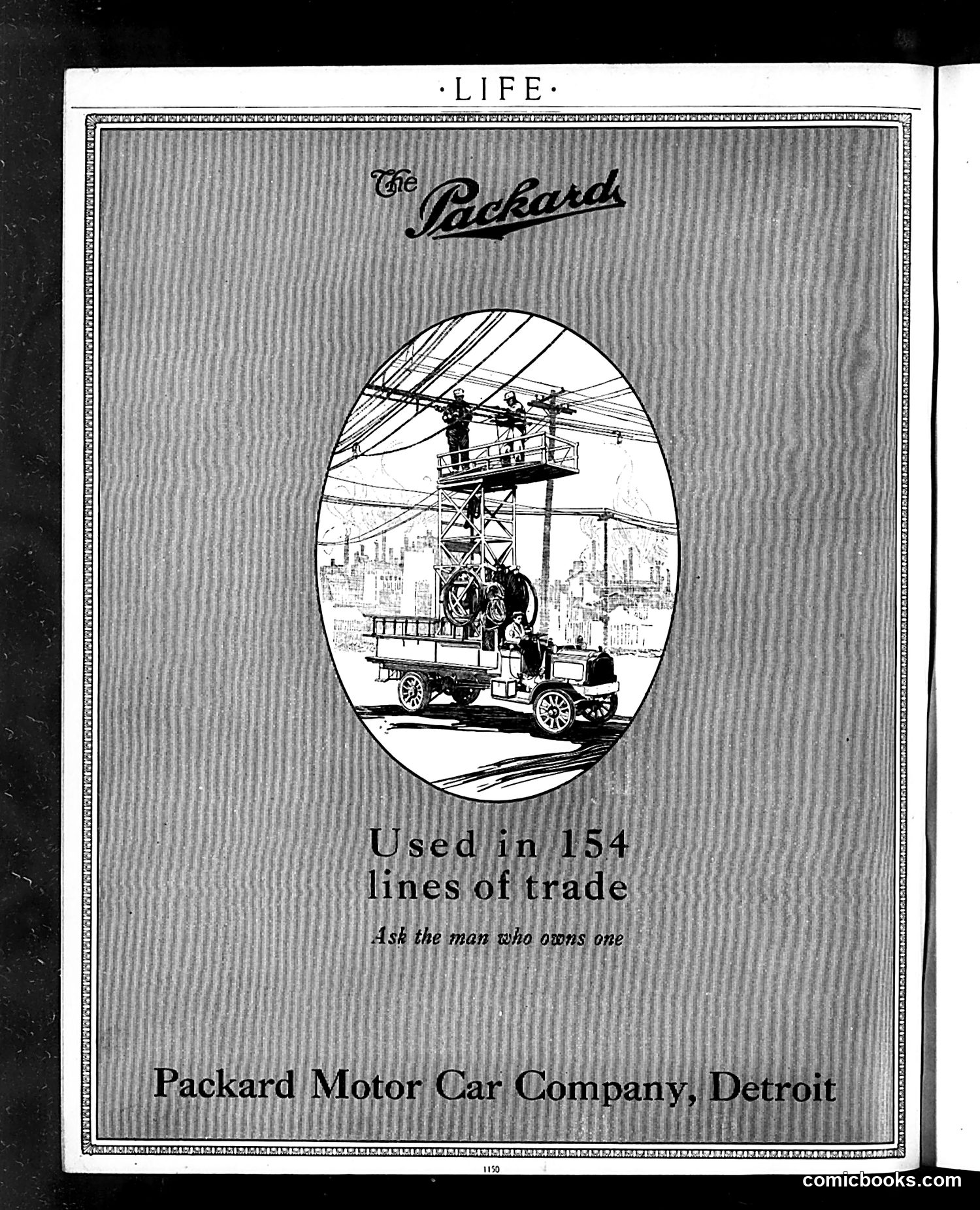
This is a **Packard Motor Car Company advertisement** from *Life* magazine, not a political cartoon. The page promotes Packard automobiles through a practical appeal rather than satire. The central image shows a Packard truck with an elevated work platform, used for utility work (power line maintenance is visible in the background). The advertisement emphasizes industrial utility: the vehicle is "Used in 154 lines of trade," suggesting Packard trucks' versatility across different commercial sectors. The tagline "Ask the man who owns one" was Packard's actual marketing slogan, positioning the brand as reliable based on owner testimonials. This represents early 20th-century advertising strategy emphasizing practical functionality and real-world application rather than luxury or speed—targeting business owners and tradespeople as customers.
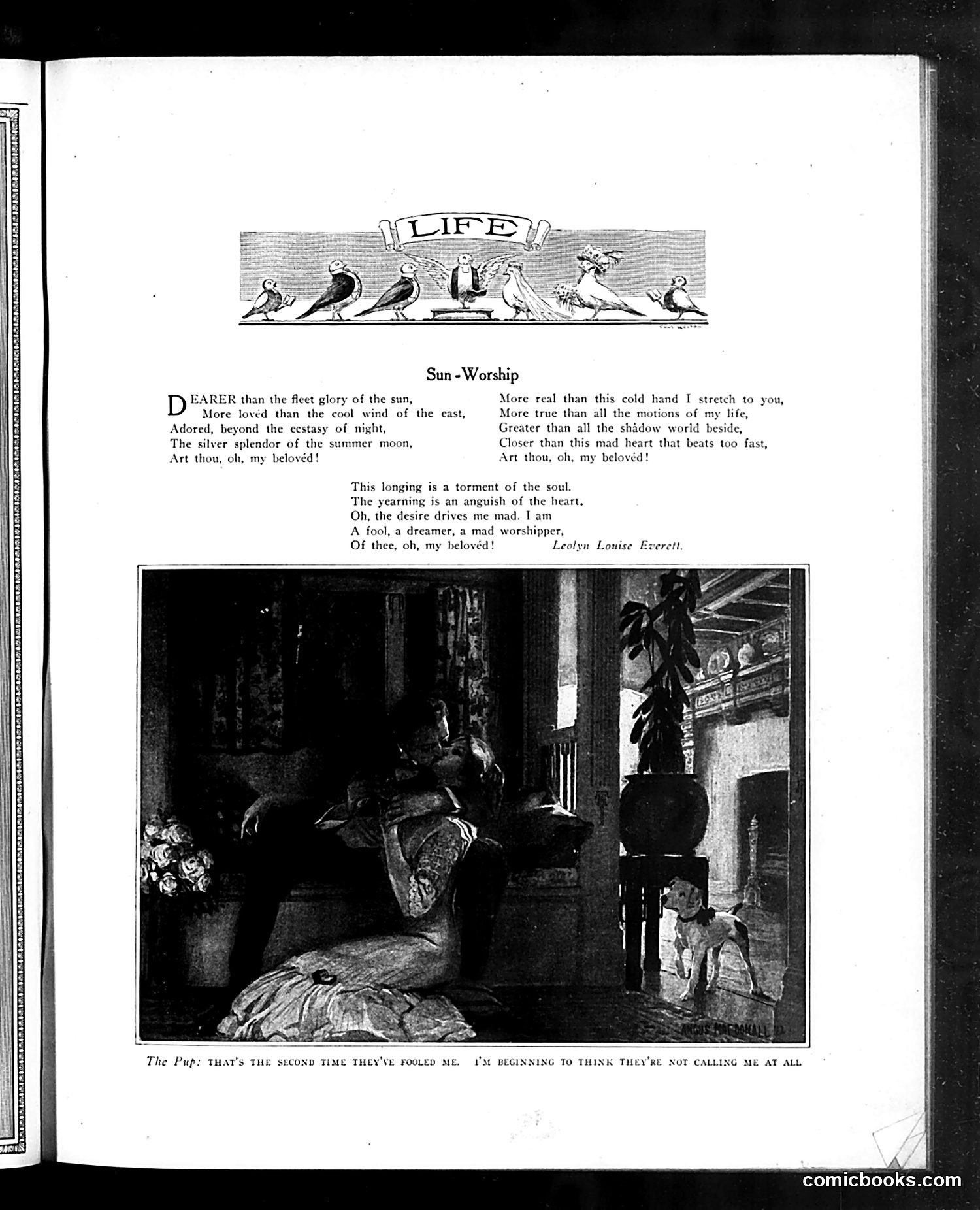
This page features a poem titled "Sun-Worship" by Evelyn Louise Everett, expressing romantic longing and devotion to a beloved person. The accompanying illustration shows an interior scene with figures in what appears to be an intimate or domestic setting. The caption beneath the image reads: "The Pup: THAT'S THE SECOND TIME THEY'VE FOOLED ME. I'M BEGINNING TO THINK THEY'RE NOT CALLING ME AT ALL." This is a visual joke about a dog being repeatedly deceived—likely the pet hears calling sounds but discovers the humans weren't summoning it. The humor contrasts the earnest romantic poem above with the mundane domestic comedy below, a typical *Life* magazine approach of pairing sentimental verse with humorous illustrations that undercut or complicate its sentiment.
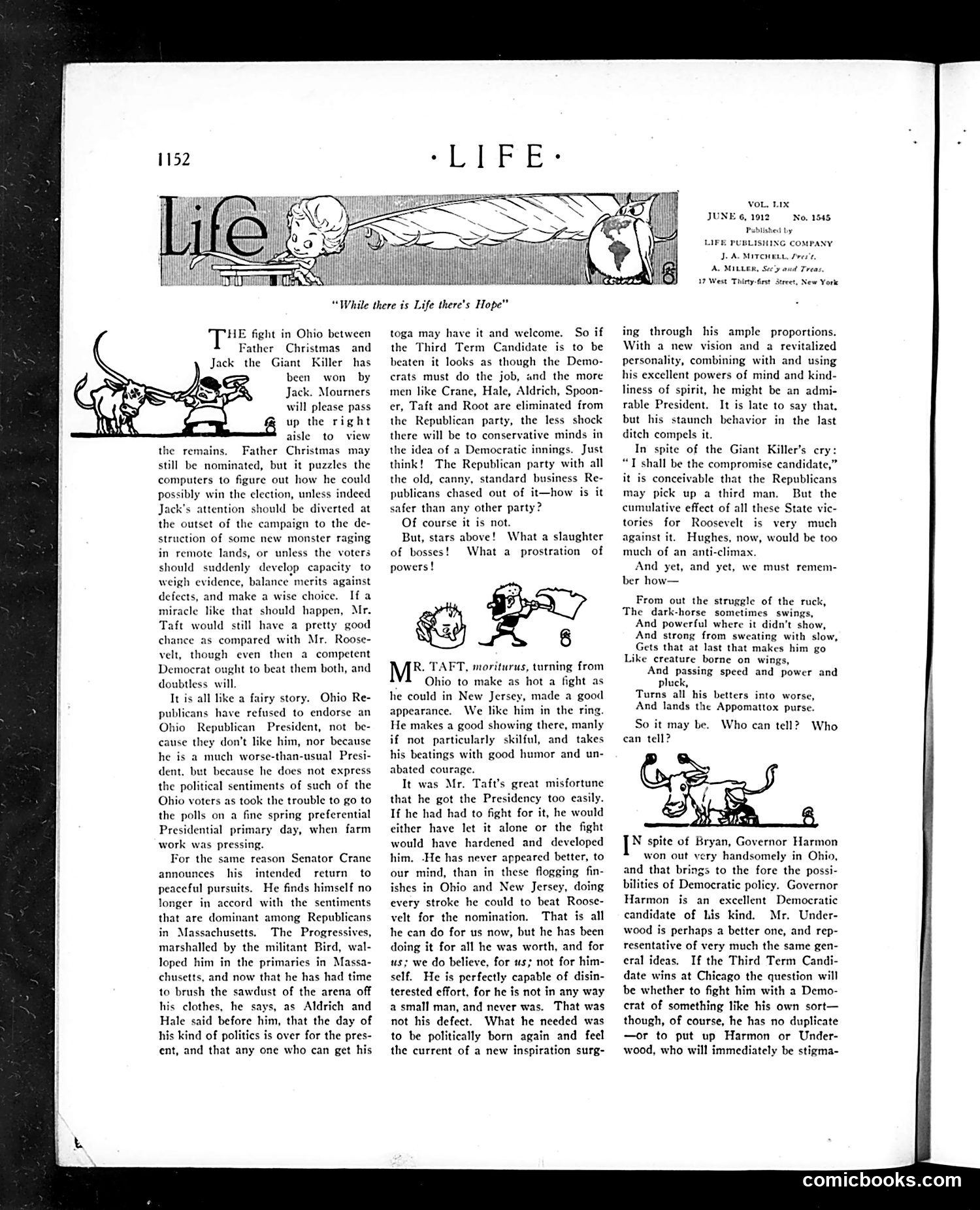
This page discusses the 1912 presidential election, specifically Ohio's Republican primary battle between "Jack the Giant Killer" (likely President Taft) and "Father Christmas" (Theodore Roosevelt). The text criticizes the brutality of their fight while praising Mr. Taft's character and ability to debate Democrats. The cartoons show a bull (representing Ohio Republicans) being gored, and what appears to be a donkey or mule—likely representing Democratic prospects under Governor Harmon. The satire suggests the Republican infighting damages their party while creating Democratic opportunities. The piece argues that despite the GOP's internal strife, their candidate could still defeat Democratic opponents if properly motivated.
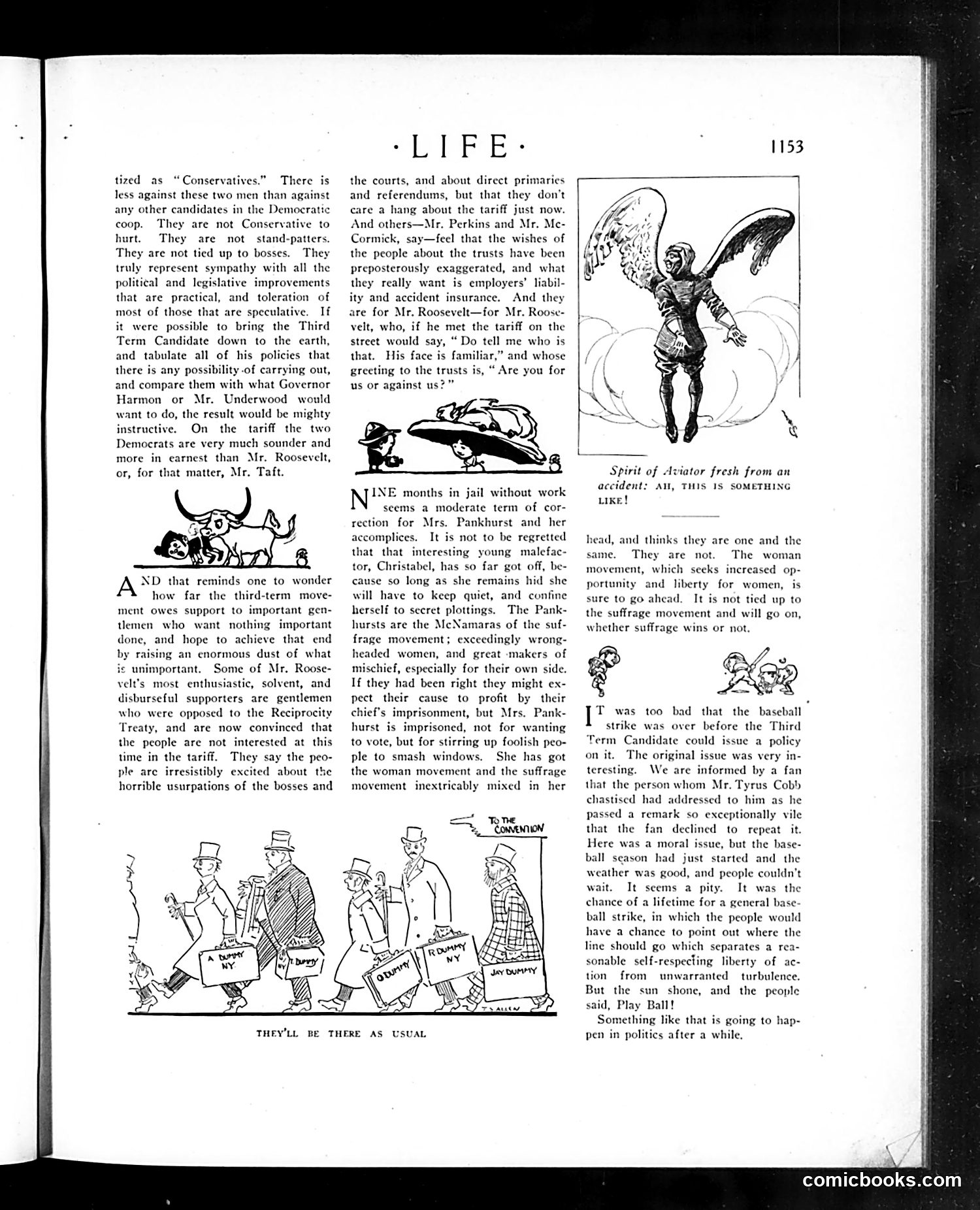
This page satirizes **Progressive Era politics** and the 1912 election. The text criticizes third-party ("Bull Moose") supporters, calling them naive idealists who actually help neither Roosevelt nor Taft by splitting votes. The bottom cartoon titled "THEY'LL BE THERE AS USUAL" depicts various political figures carrying bags labeled with party positions, heading "TO THE CONVENTION"—mocking how politicians mechanically recycle the same platform promises regardless of which candidate or party they support. The flying figure cartoon references **Mrs. Pankhurst's suffrage movement** (mentioned in text), satirizing the women's movement by depicting activism as chaotic and mixed with foolishness. The page's overall message: politicians and movements are fundamentally predictable and self-interested, despite their reform rhetoric.
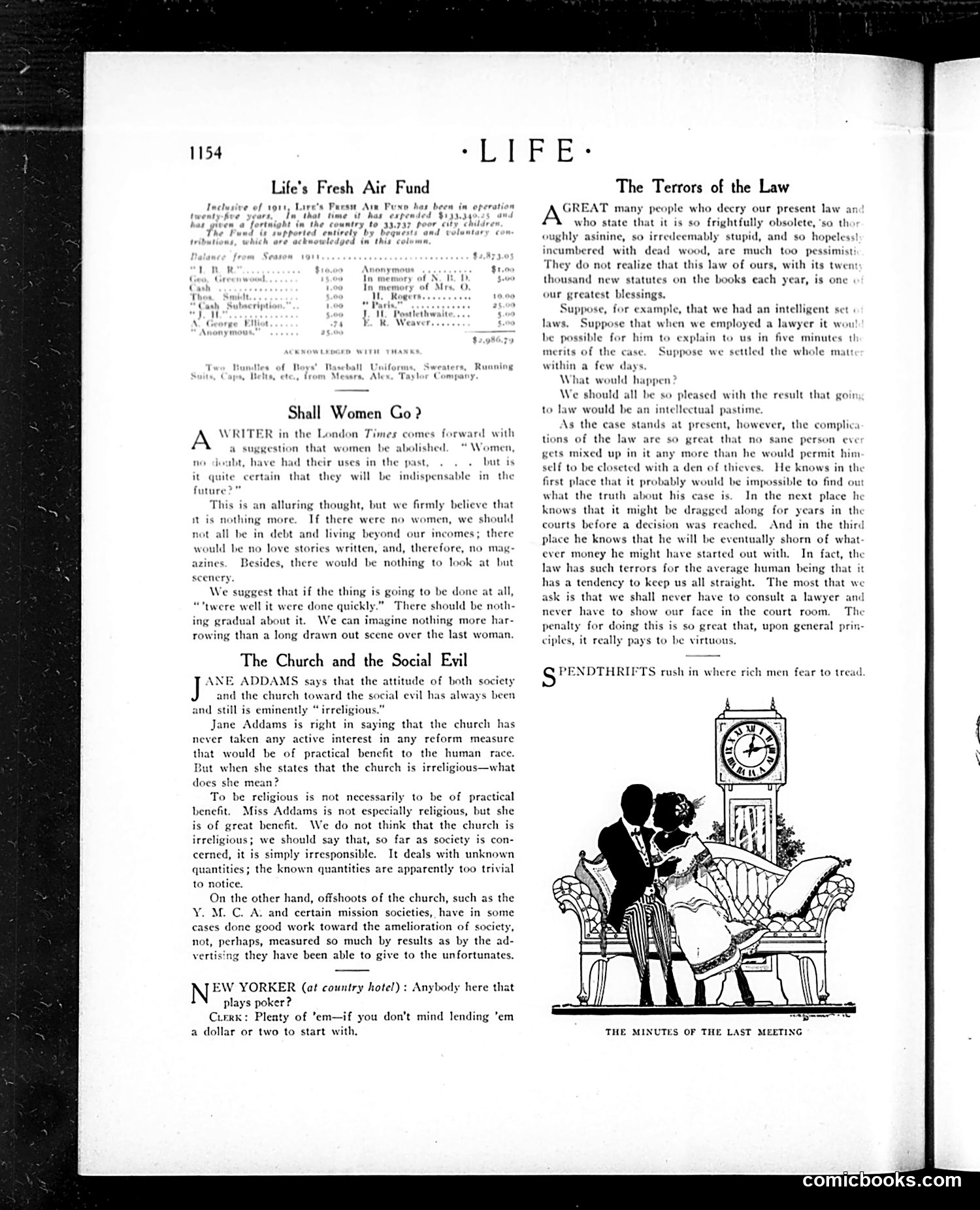
This cartoon satirizes wealthy men's anxiety about labor organizing and socialism. The image shows a nervous, well-dressed man in an armchair next to a grandfather clock, apparently reviewing meeting minutes—likely from a business or club gathering. The caption "SPENDTHRIFTS rush in where rich men fear to tread" suggests the cartoon mocks wealthy men's paranoia about social reform and workers' rights movements. The accompanying text discusses how the church and society ignore practical reforms benefiting "the human race," implying that the wealthy fear such changes. The cartoon visually expresses this fear—the man's anxious posture and formal setting suggest he's worried about what those "minutes" (records of activist meetings) might contain regarding threats to his privileged position.
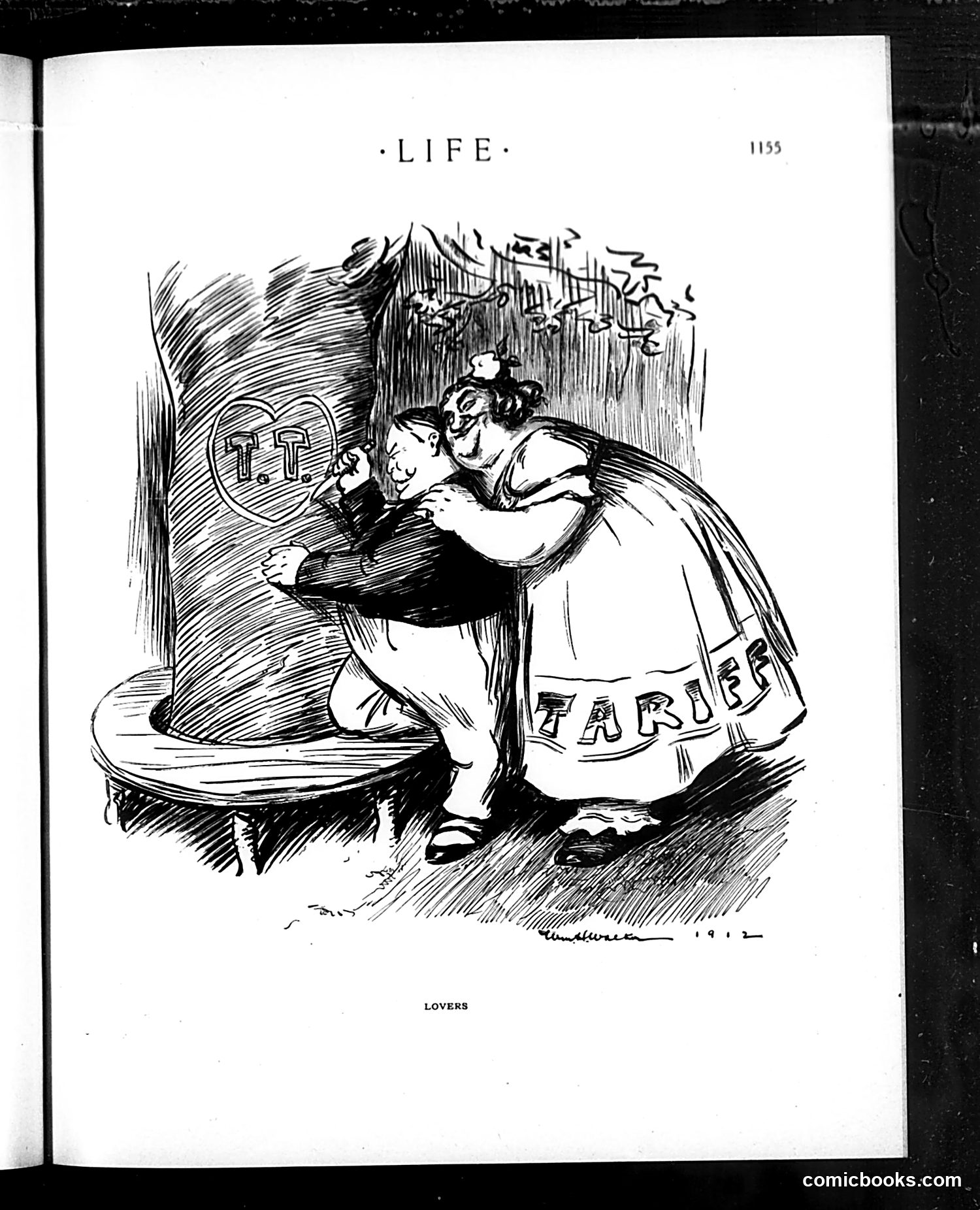
This cartoon depicts two rotund figures in an intimate embrace beside a tree. One wears what appears to be formal attire, while the other wears a robe or cloak labeled "TARIFF." The satire appears to be political commentary on trade policy, personifying the "Tariff" as a romantic partner to a government or business figure. The cartoon suggests a corrupt or inappropriately close relationship between political/commercial interests and protectionist tariff policies—common targets of satirical critique in early 20th-century American magazines. The exaggerated, unflattering caricatures and domestic setting mock what the cartoonist views as an indulgent, self-serving alliance. The specific political context—which administration or tariff debate is referenced—is unclear without additional historical documentation.
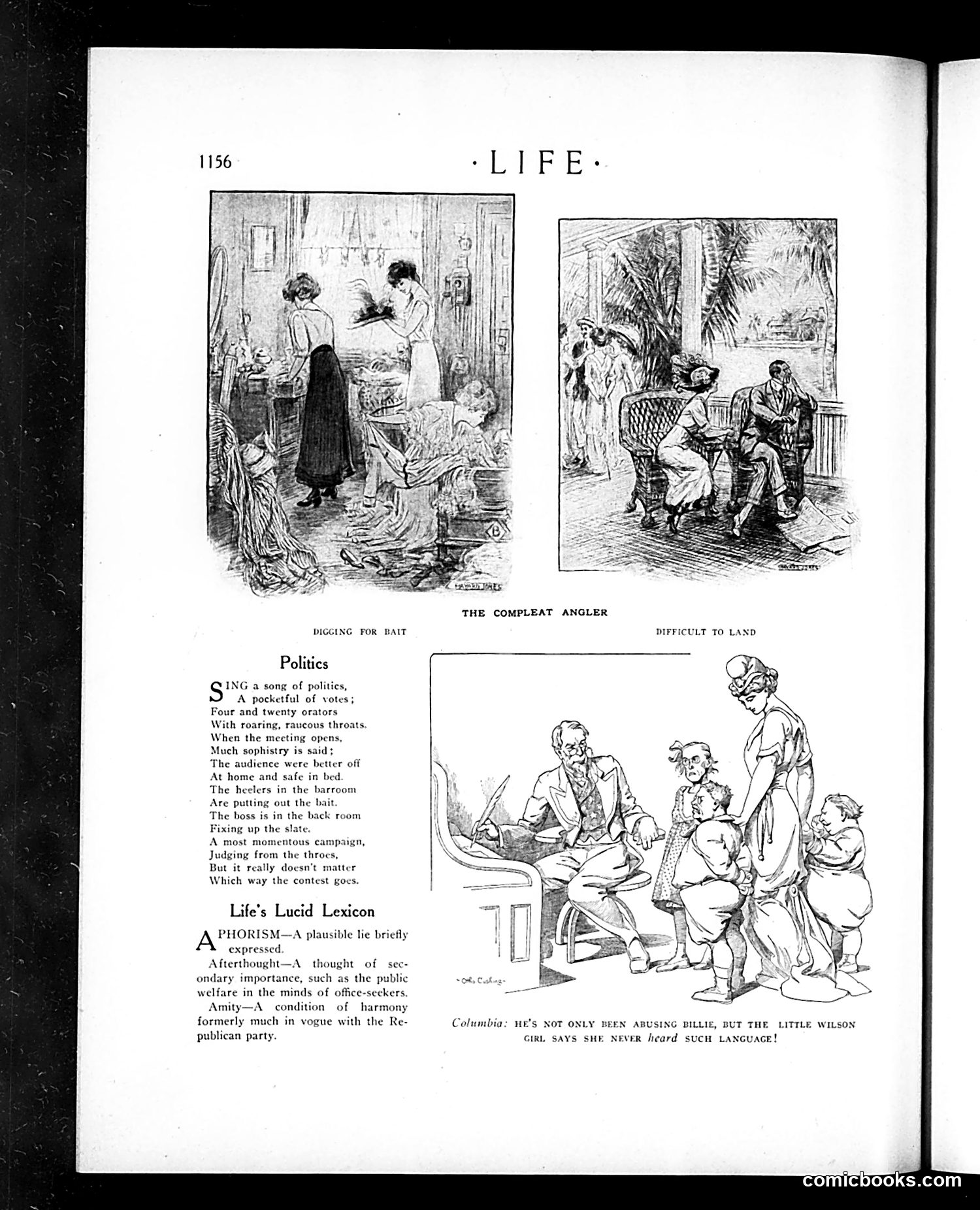
This page satirizes American political corruption and voter manipulation. The poem "Politics" mocks campaign theatrics—orators with "roaring, raucous throats" spouting sophistry while party operatives (called "heelers") work backroom deals to "put out the bait" and fix election outcomes. The message: political campaigns are elaborate theater that don't actually matter because the result is predetermined by bosses controlling "the slate." The satirical "Life's Lucid Lexicon" reinforces this cynicism, defining political terms mockingly: an "aphorism" is "a plausible lie," and "afterthought" describes politicians' disregard for public welfare. The cartoon "The Compleat Angler" (punning on a fishing classic) depicts politics as fishermen landing prey—suggesting voters are bait to be caught. The bottom cartoon references Columbia (America personified) and Wilson, appearing to comment on inappropriate political language or behavior, though the exact context isn't entirely clear from the visible text.
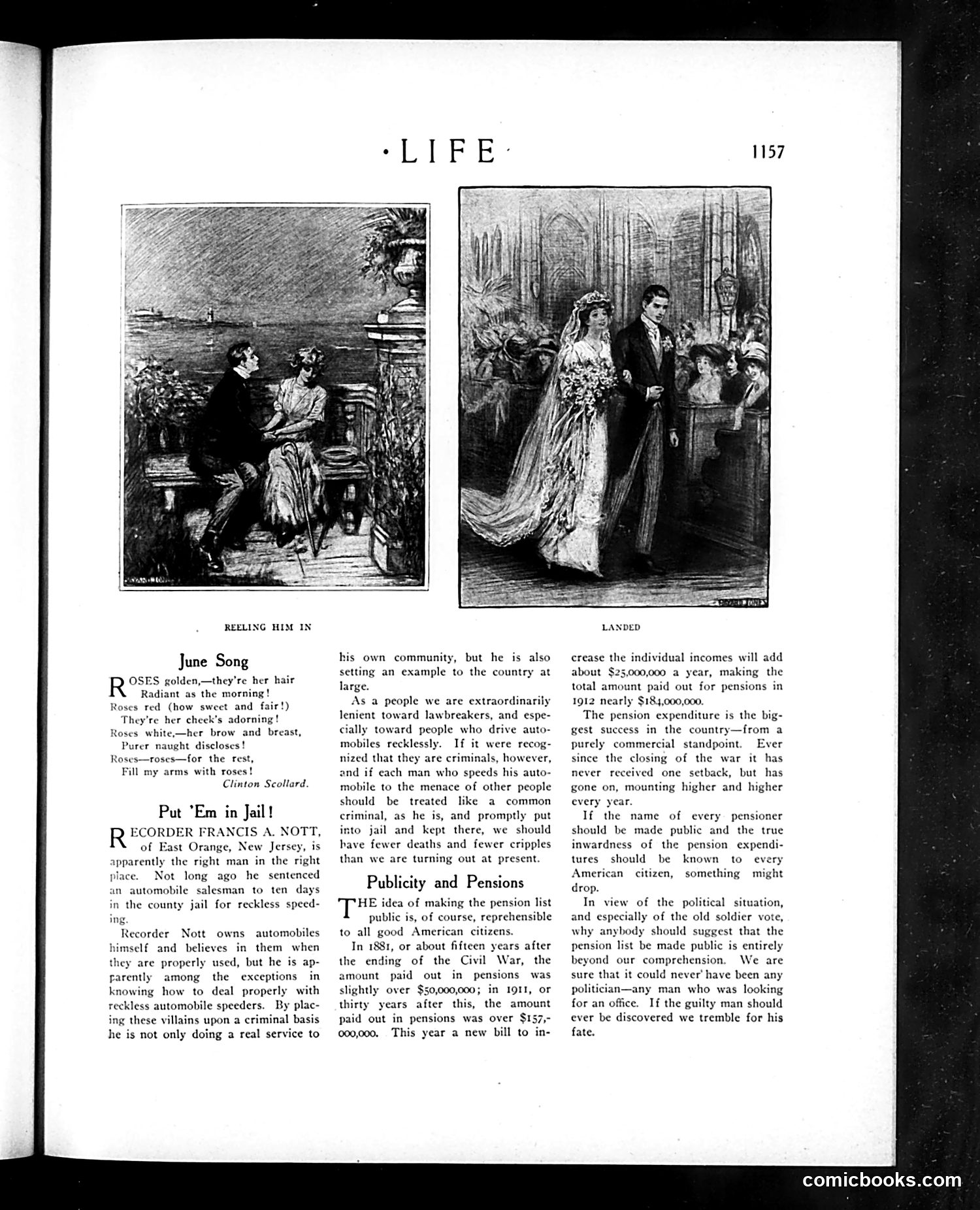
This page contains two illustrations and commentary on early 1900s American social issues. **Left illustration** ("Belling Him In"): A romantic scene accompanying Clinton Scollard's sentimental poem about roses and courtship—likely included for aesthetic contrast with the serious content. **Right illustration** ("Landed"): Depicts a formal wedding ceremony, appearing to illustrate social commentary on marriage and propriety. **Main content focuses on two topics:** 1. **Reckless Automobile Driving**: Praises Recorder Francis Nott of East Orange, New Jersey, for jailing a reckless speeder. The satire argues that if automobile speeding were treated as a serious crime rather than a minor offense, fewer deaths and injuries would result. This reflects early concerns about dangerous driving. 2. **Pension Expenditures**: Criticizes the growing Civil War pension system (growing from $50 million in 1881 to $184 million by 1912) as politically untouchable. The article argues that publicizing pensioner names would reveal wasteful spending, but no politician would dare propose this due to the "old soldier vote." Both pieces satirize American leniency toward lawbreakers and political cowardice regarding fiscal responsibility.
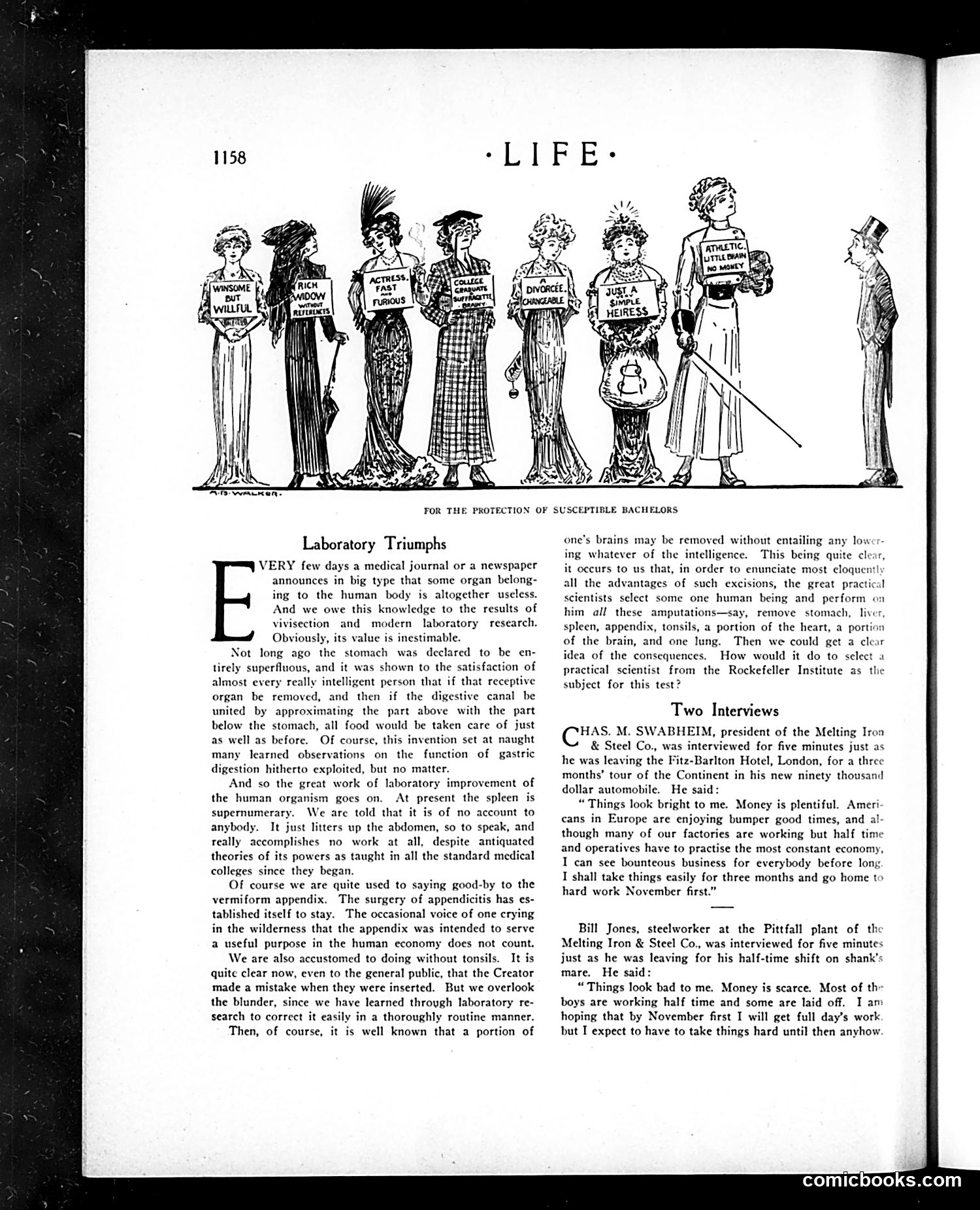
This page satirizes early-20th-century medical overconfidence and economic inequality. **Top Cartoon**: The illustration shows eight types of women "for the protection of susceptible bachelors"—each labeled with dismissive stereotypes (willing wife, rich widow, fast divorcée, etc.). This mocks both contemporary attitudes toward women and satirizes the magazine's own era of gender stereotyping. **"Laboratory Triumphs"**: The essay ridicules medical science's casual dismissal of human organs (stomach, spleen, appendix, tonsils, brain portions) as "useless" based on laboratory research. The satire peaks with a proposal to perform *all* these removals on a Rockefeller Institute scientist to prove their insignificance—revealing the absurdity of the logic. **"Two Interviews"**: This juxtaposes a wealthy industrialist and a steelworker from the same company. Both discuss identical economic conditions, but the rich man sees prosperity while the working man sees hardship. This directly exposes class-based economic perception and corporate hypocrisy during an era of worker hardship and factory shutdowns.
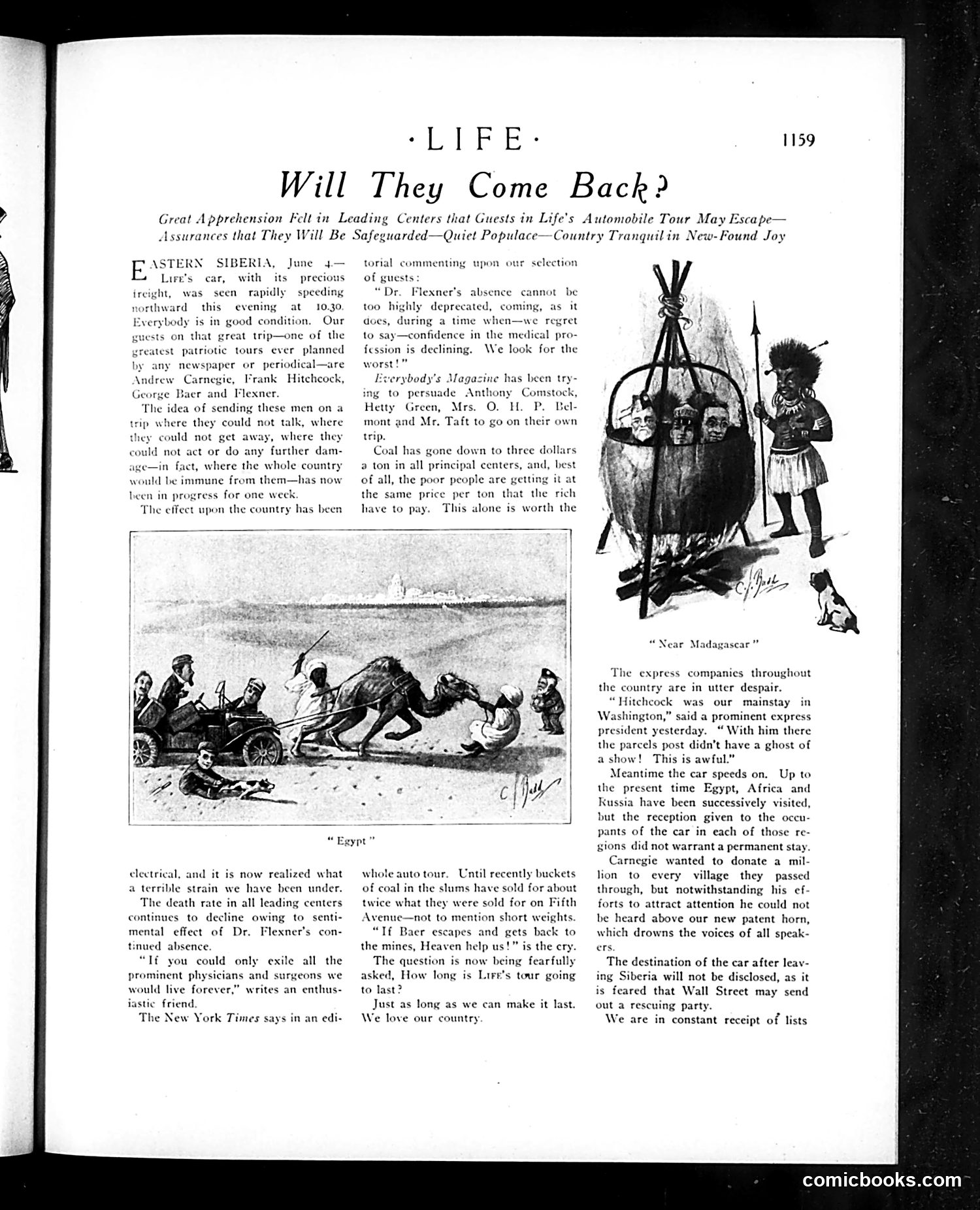
This article satirizes a fictional "Life Magazine automobile tour" sending away prominent figures the publication wants rid of. The passengers—Andrew Carnegie, Frank Hitchcock, George Baer, and Dr. Flexner—represent powerful men whose absence is celebrated as beneficial to the nation. The satire's targets are clear: Carnegie (wealthy industrialist), Baer (coal magnate), Hitchcock (politician/postal official), and Flexner (medical administrator). Their removal allegedly causes: - Coal prices dropping to benefit the poor - Death rates declining - Express companies suffering - General national improvement The cartoons illustrate the tour crossing Egypt and using a camel, with an inset of "Near Madagascar," suggesting absurdly exotic and improbable destinations. The joke's bite lies in suggesting these influential men cause such harm that their prolonged absence is *desirable*—a cutting commentary on their unpopularity and perceived negative impact on American society during the Progressive Era.
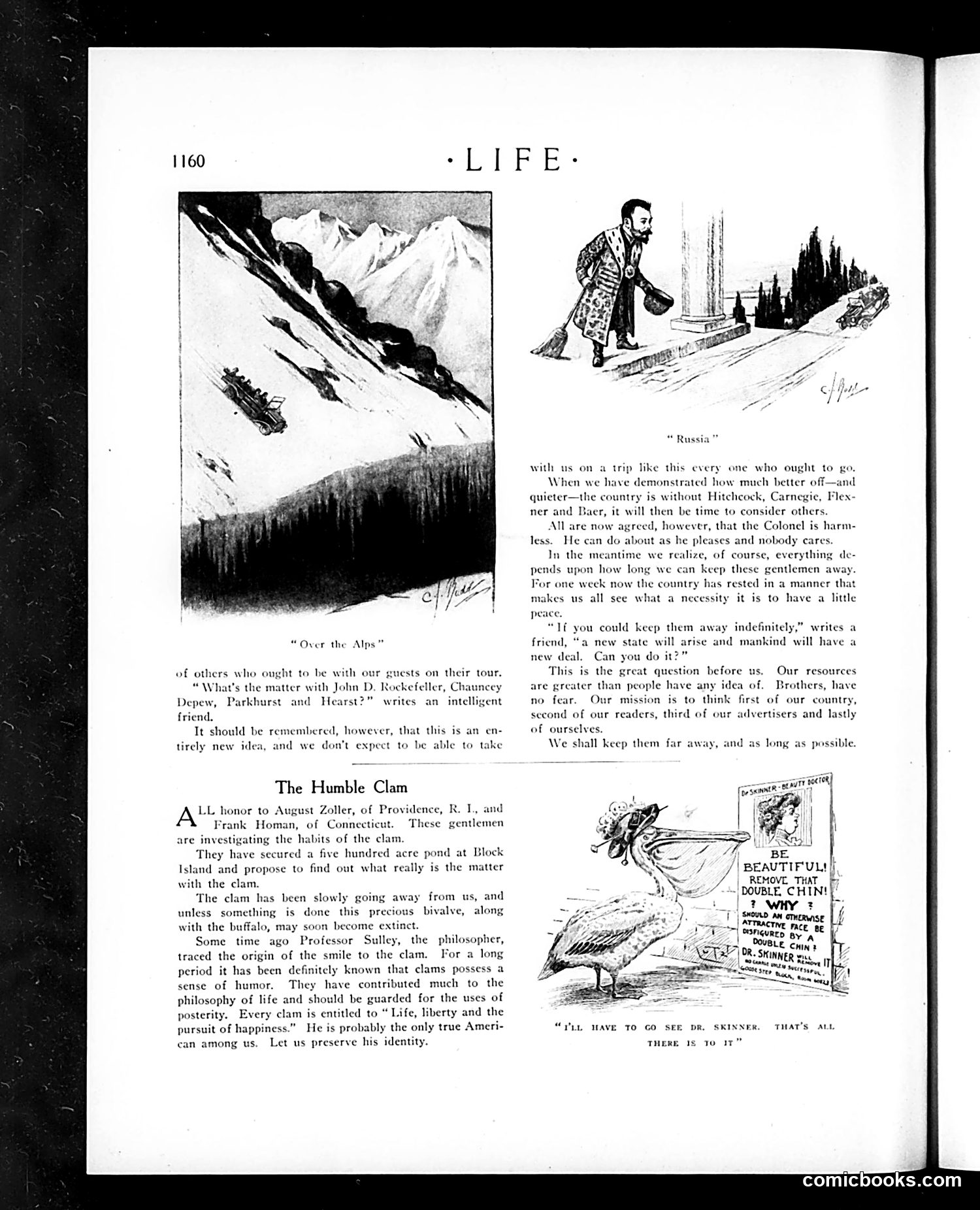
This page contains two satirical pieces: **"Over the Alps"** mocks prominent wealthy industrialists and public figures (Rockefeller, Depew, Parkhurst, Hearst) by suggesting they should be exiled on an extended tour abroad. Life sardonically celebrates their absence, arguing the country is "quieter" and more peaceful without them. The joke is that Life would gladly keep these powerful men away indefinitely—positioning them as burdensome to American society. **"The Humble Clam"** is gentler satire about conservation efforts. It humorously elevates clams to American citizens deserving "Life, liberty and the pursuit of happiness," while mocking the notion that clams possess humor and philosophical worth. The piece playfully suggests researchers are wasting resources studying clam extinction when clams are merely "the only true American among us"—ironically critiquing both pseudo-scientific investigation and American exceptionalism. Both pieces use absurdist humor to critique their subjects.
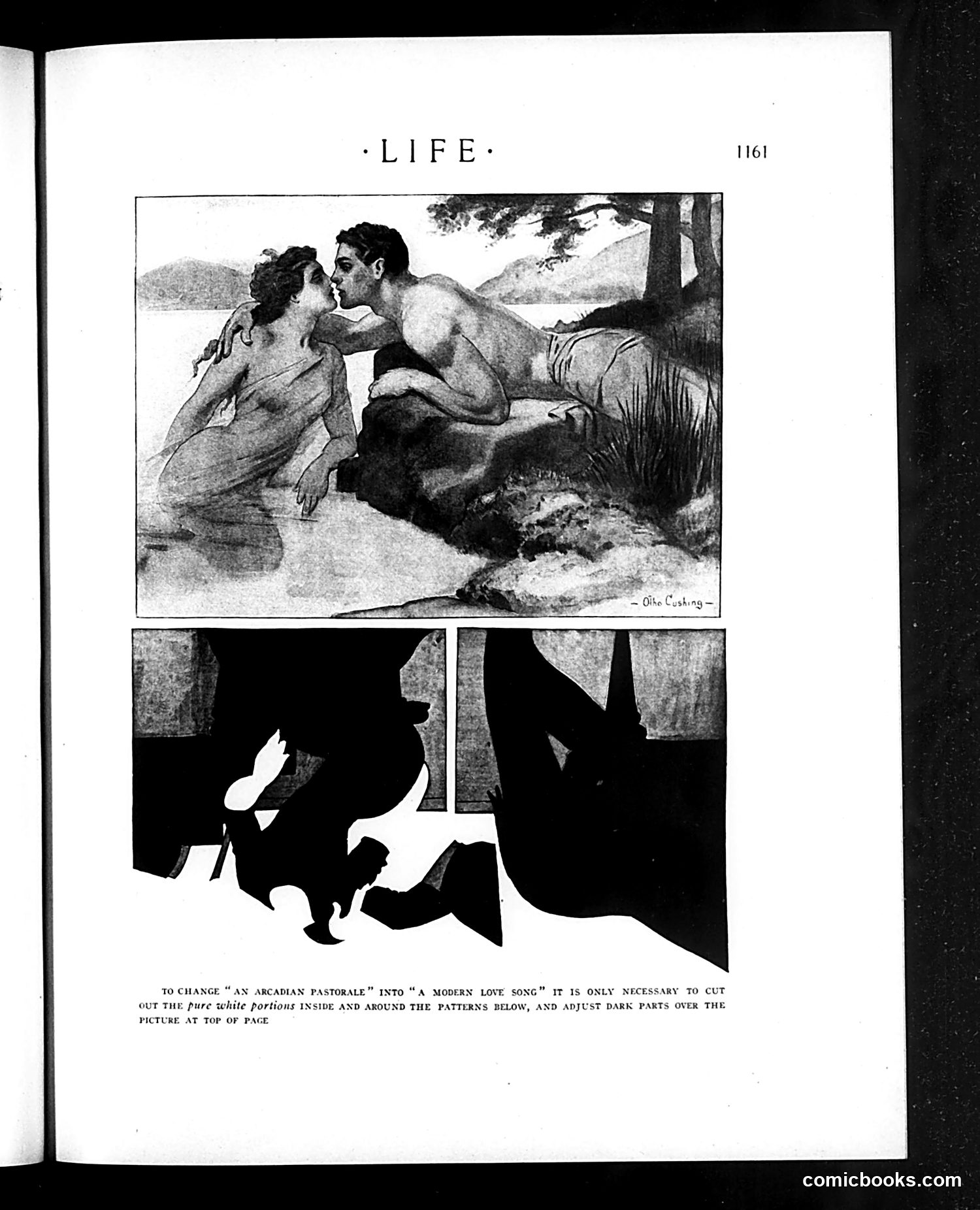
This is an interactive visual puzzle from *Life* magazine (artist signed "Otto Cushing"). The top image shows a classical pastoral scene—two figures in an idealized, romantic landscape by water. The instructions below direct readers to cut out white portions from the abstract black-and-white pattern templates and overlay them on the pastoral image to transform it into "a modern love song." The satire appears to mock modernist art and poetry of the era: by simply repositioning abstract shapes over a traditional romantic scene, the mundane pastoral becomes "modern." This critiques how modernism could obscure or radically reinterpret classical subjects through formal manipulation alone, suggesting the emperor's-new-clothes quality of contemporary artistic movements that claimed to revolutionize perception when they merely rearranged existing elements.
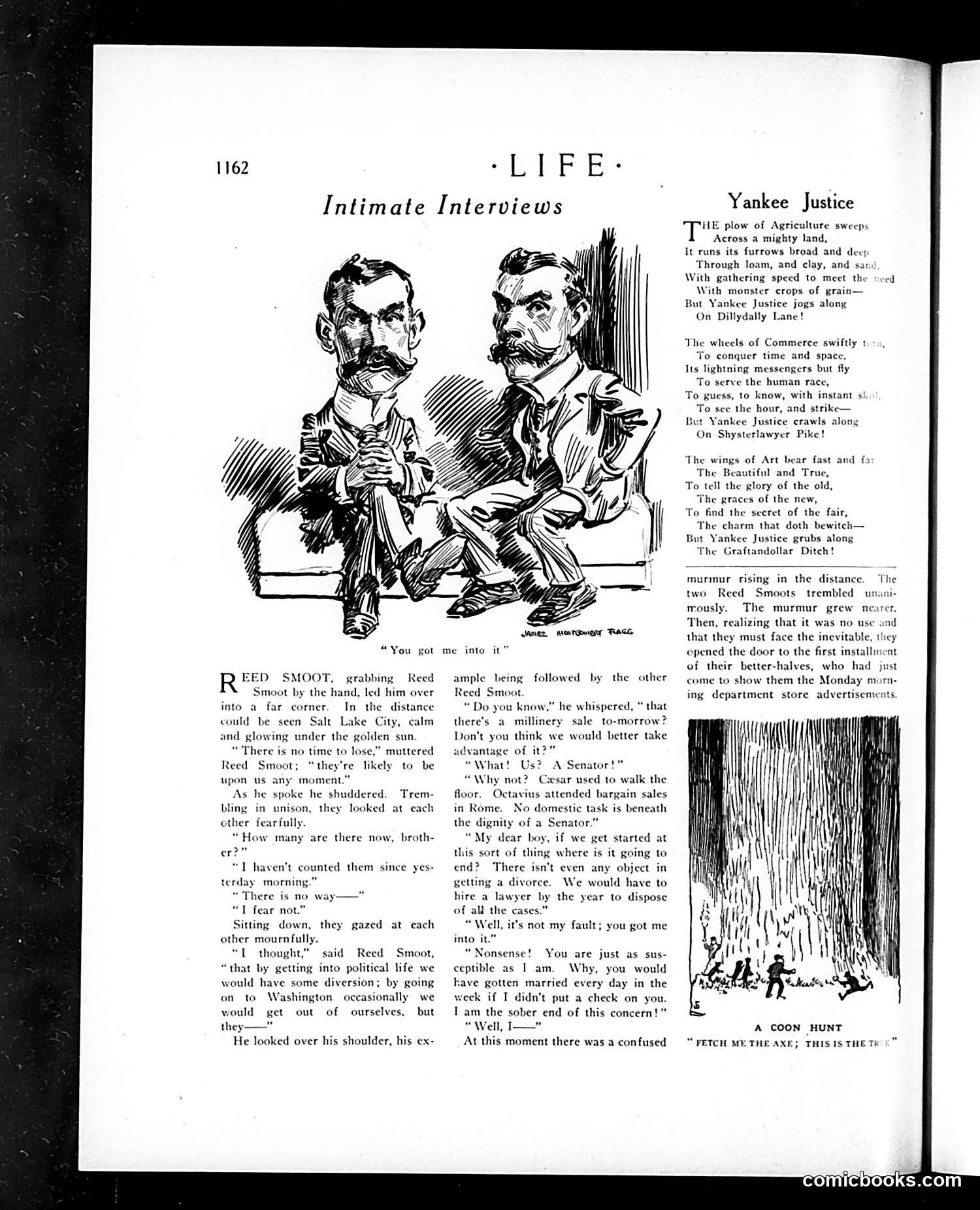
This page satirizes **Reed Smoot**, a real U.S. Senator from Utah (1903-1933), through a fictional dialogue between two versions of himself. The cartoon depicts Smoot and another figure discussing domestic troubles—specifically, multiple wives and marital chaos—which references Smoot's prominent role in anti-polygamy efforts despite his own polygamous Mormon background. The joke is bitter irony: Smoot entered politics hoping for "diversion" but finds himself trapped by domestic entanglements. The accompanying poem, "Yankee Justice," critiques American legal slowness by contrasting swift agriculture and commerce with justice that "jogs along / On Dillydally Lane" and "grubs along / The Graftandollar Ditch"—suggesting the legal system serves wealth rather than fairness. The "Coon Hunt" illustration (bottom right) appears unrelated contextually but typical of period satirical magazines.
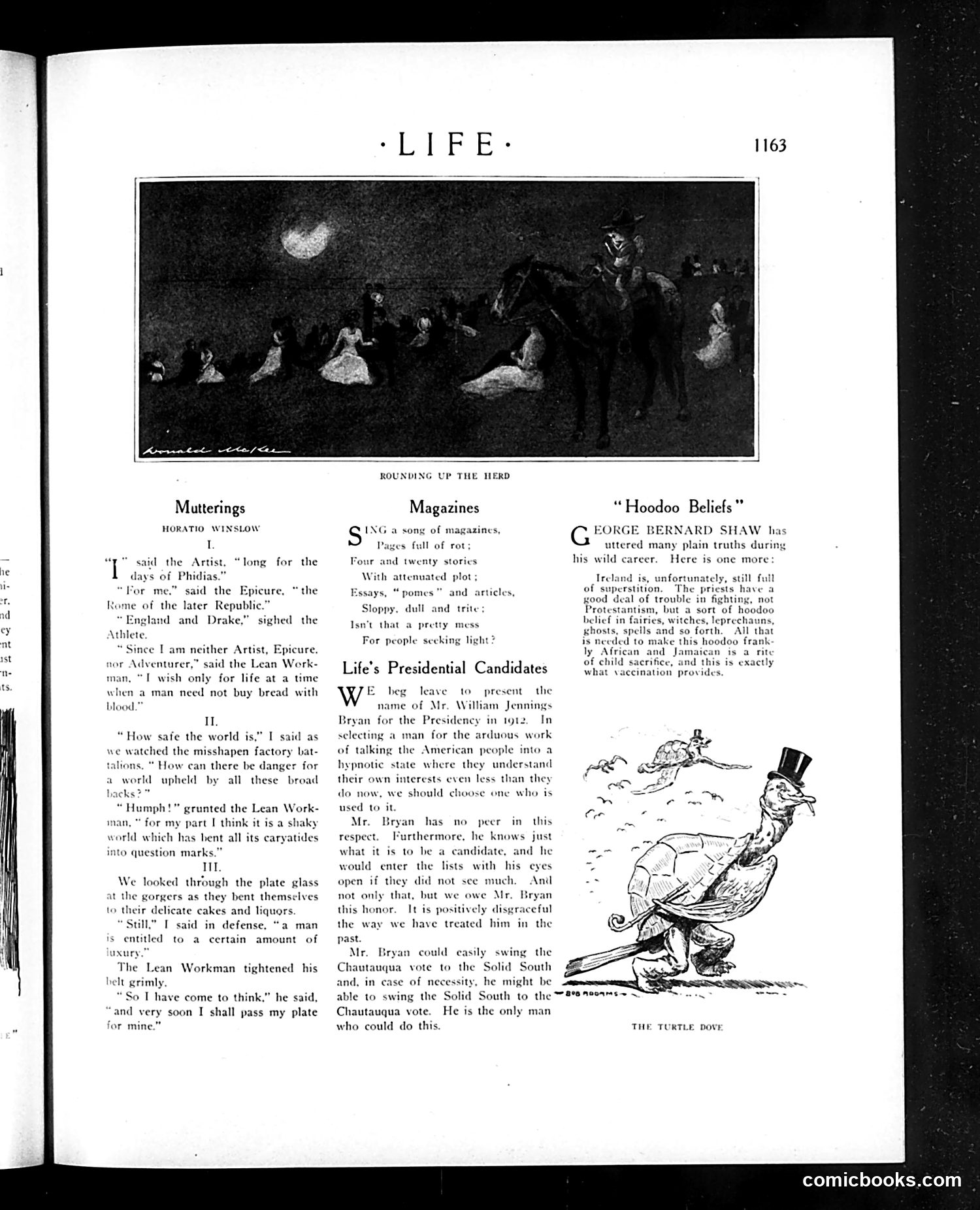
This page contains political satire about William Jennings Bryan's potential 1912 presidential candidacy. The text mockingly endorses Bryan, praising his experience as a repeat candidate who can persuade Americans to ignore their own interests—a jab at his three unsuccessful presidential campaigns and his reputation as a hypnotic public speaker. The top illustration, "Rounding Up the Herd," visually reinforces this metaphor: cowboys herding cattle under moonlight represent political operatives gathering voters like livestock. The "Mutterings" section presents class commentary through a dialogue between an Artist, Epicure, Athlete, and "Lean Workman," contrasting nostalgic upper-class figures with a working-class voice demanding simply to earn bread without bloodshed—likely referencing labor strife and industrial dangers of the era. The "Hoodoo Beliefs" section dismisses Irish Catholic superstitions while sarcastically linking African and Jamaican child sacrifice to vaccination—a cynical reference to anti-vaccination sentiment. "The Turtle Dove" illustration remains unclear in this context.
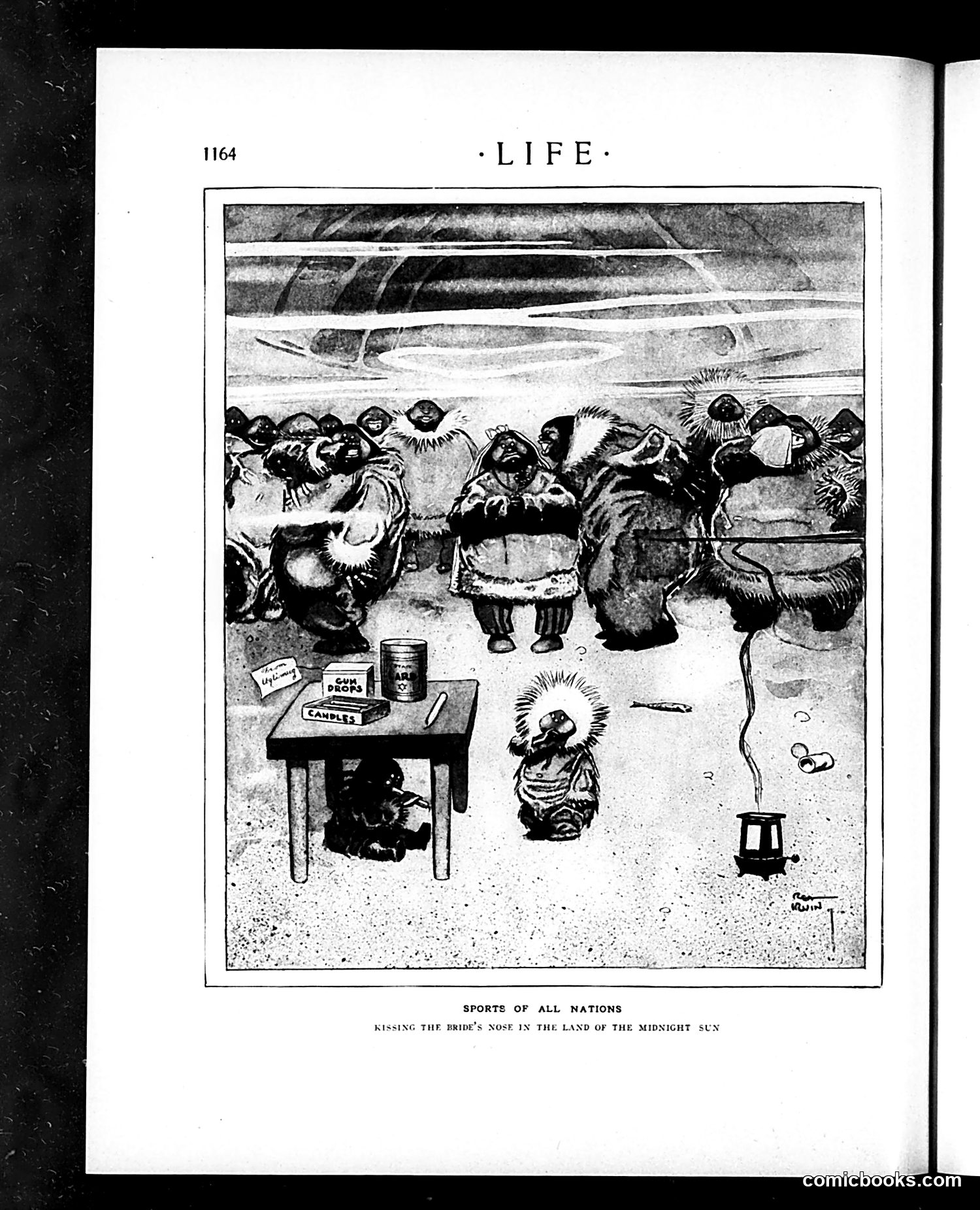
This cartoon depicts Arctic indigenous peoples (likely Inuit/Eskimo, using period terminology) engaged in what the caption labels a "sport": kissing the bride's nose. The scene shows a bride in the center surrounded by onlookers in traditional clothing, with a table displaying trade goods (appears to include candles and other supplies). The satire mocks Western assumptions about "exotic" cultural practices by presenting an indigenous courtship custom as a novelty "sport" comparable to civilized nations' pastimes. The phrase "Land of the Midnight Sun" references the Arctic's extreme daylight conditions. By framing unfamiliar customs as entertainment for sophisticated readers, *Life* magazine's satirists comment on both Western condescension toward indigenous cultures and the arbitrary nature of what different societies consider normal social behavior.
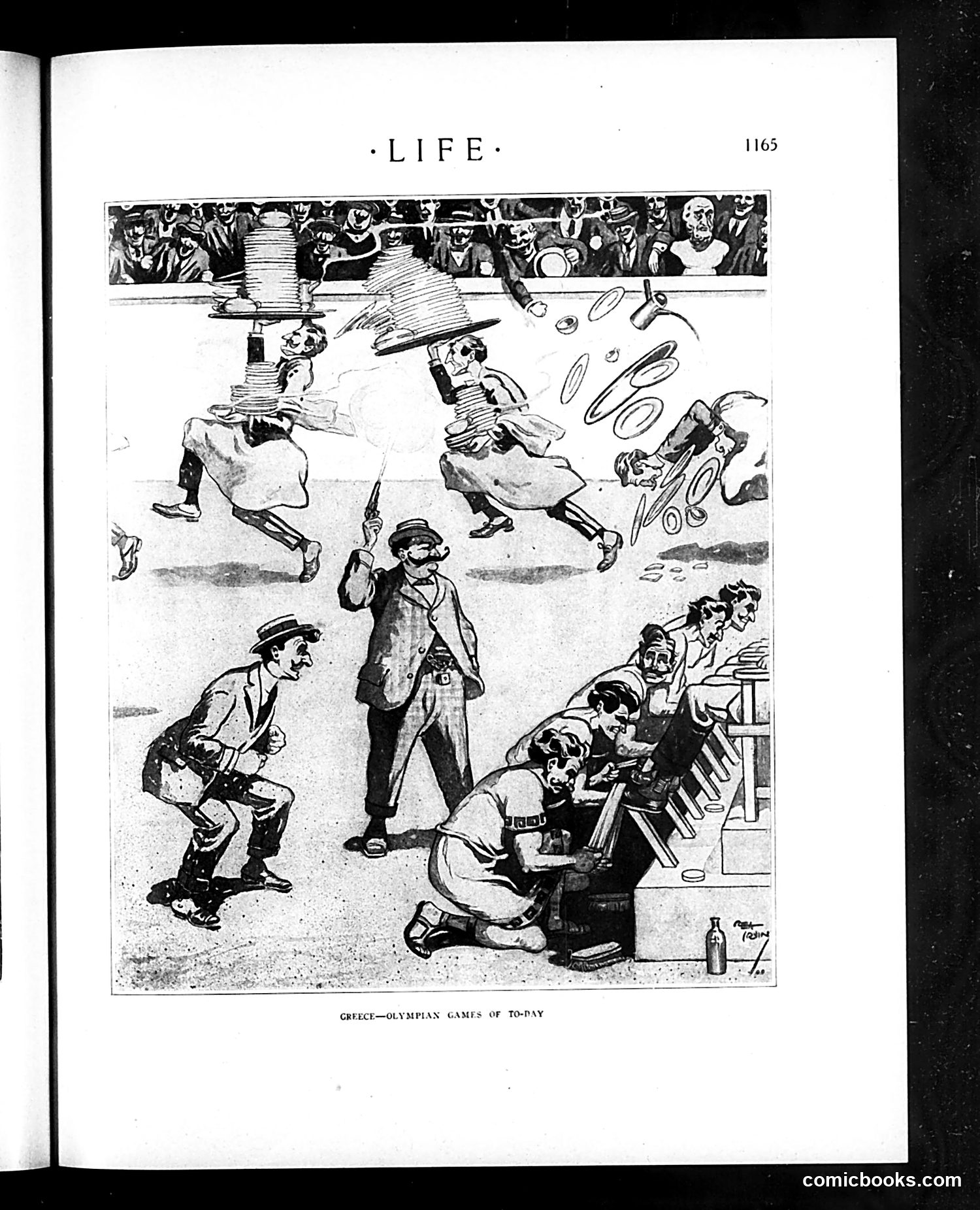
This satirical cartoon depicts modern Greece as a chaotic sporting event. The caption's reference to "Olympian Games" invokes ancient Greek ideals, contrasting them ironically with contemporary Greek dysfunction shown below. The scene shows various figures engaged in comical, disorderly activities rather than athletic competition—people tumbling, colliding, and behaving chaotically while spectators watch from stands above. A central authority figure (possibly a referee or government official) attempts to maintain order with a raised baton, but fails. The satire likely critiques Greece's political instability, economic troubles, or social disorder during the early 20th century, using the ironic comparison to ancient Greek civilization's supposed order and athletic excellence to highlight modern Greece's apparent chaos and mismanagement.
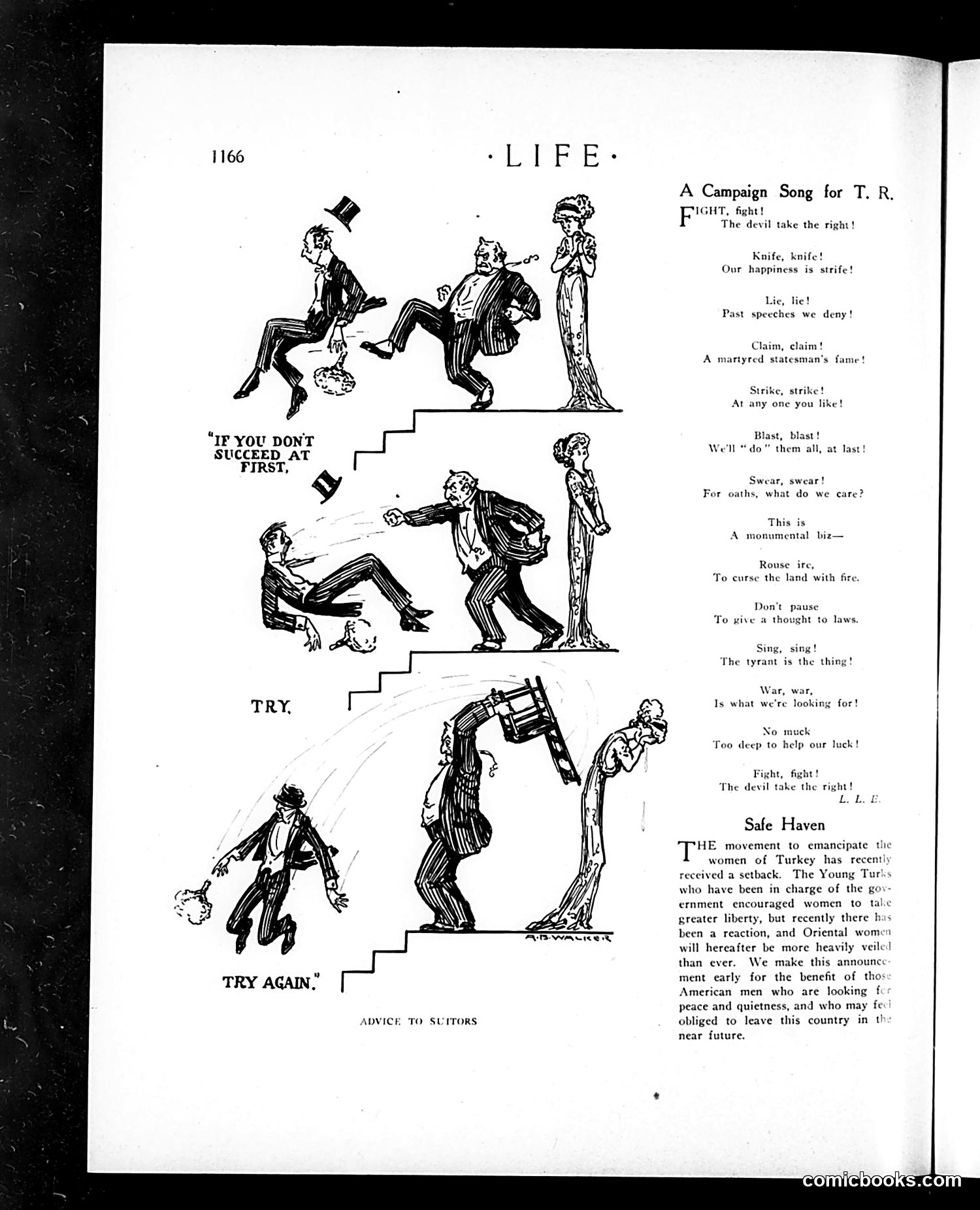
**The Main Cartoon ("Advice to Suitors"):** This satirical cartoon mocks Theodore Roosevelt's political approach through a staircase progression labeled "If you don't succeed at first, try, try again." Figures (appearing to represent Roosevelt and his supporters) repeatedly fail and fall while climbing, illustrating the cyclical nature of aggressive political campaigning and persistence despite setbacks. **The Campaign Song:** The accompanying lyrics parody T.R.'s combative political style, mocking themes of conflict ("fight," "war," "strike"), disregard for truth ("lie"), and lawlessness ("what do we care?" about oaths). The song satirizes what the author sees as reckless, amoral politics prioritizing victory over principle. **"Safe Haven" Article:** This brief piece jokes darkly about Turkish women's emancipation being reversed, sarcastically suggesting American men seeking "peace and quietness" should emigrate—implying that aggressive feminism (aligned with Roosevelt's progressive politics) threatens domestic tranquility. The page collectively satirizes Roosevelt's aggressive progressivism as reckless and destabilizing to traditional social order.
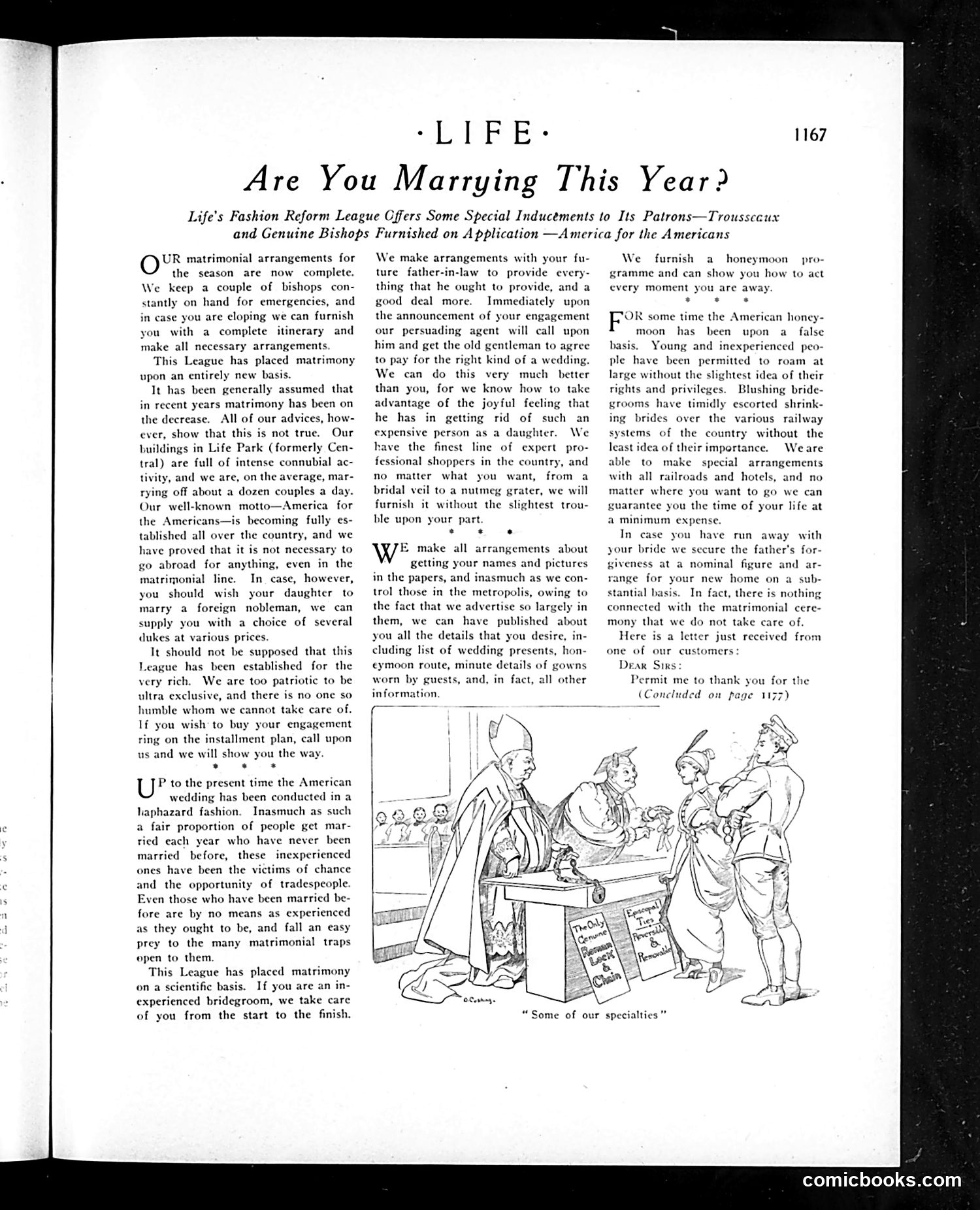
This satirical piece mocks the commercialization and over-organization of American weddings. Life's fictional "Fashion Reform League" offers to manage every aspect of matrimony—from securing bishops to orchestrating honeymoons to controlling newspaper coverage—positioning marriage as a standardized consumer product rather than a personal life event. The cartoon illustrates "Some of our specialties," depicting what appears to be clergy and merchants hawking their wares at a stall, suggesting marriage services are commodities to be purchased like any other goods. The satire targets: - **American consumerism**: treating weddings as packaged commodities - **Social climbing**: offering "foreign noblemen" at "various prices" - **Father-in-law exploitation**: manipulating him into excessive spending - **Media control**: boasting of influencing metropolitan newspapers for coverage - **Inexperienced newlyweds**: the need for a "scientific basis" to conduct honeymoons properly The tagline "America for the Americans" ironically emphasizes domestic commercialism over tradition, suggesting Americans need not look abroad when domestic entrepreneurs can exploit matrimony just as effectively.
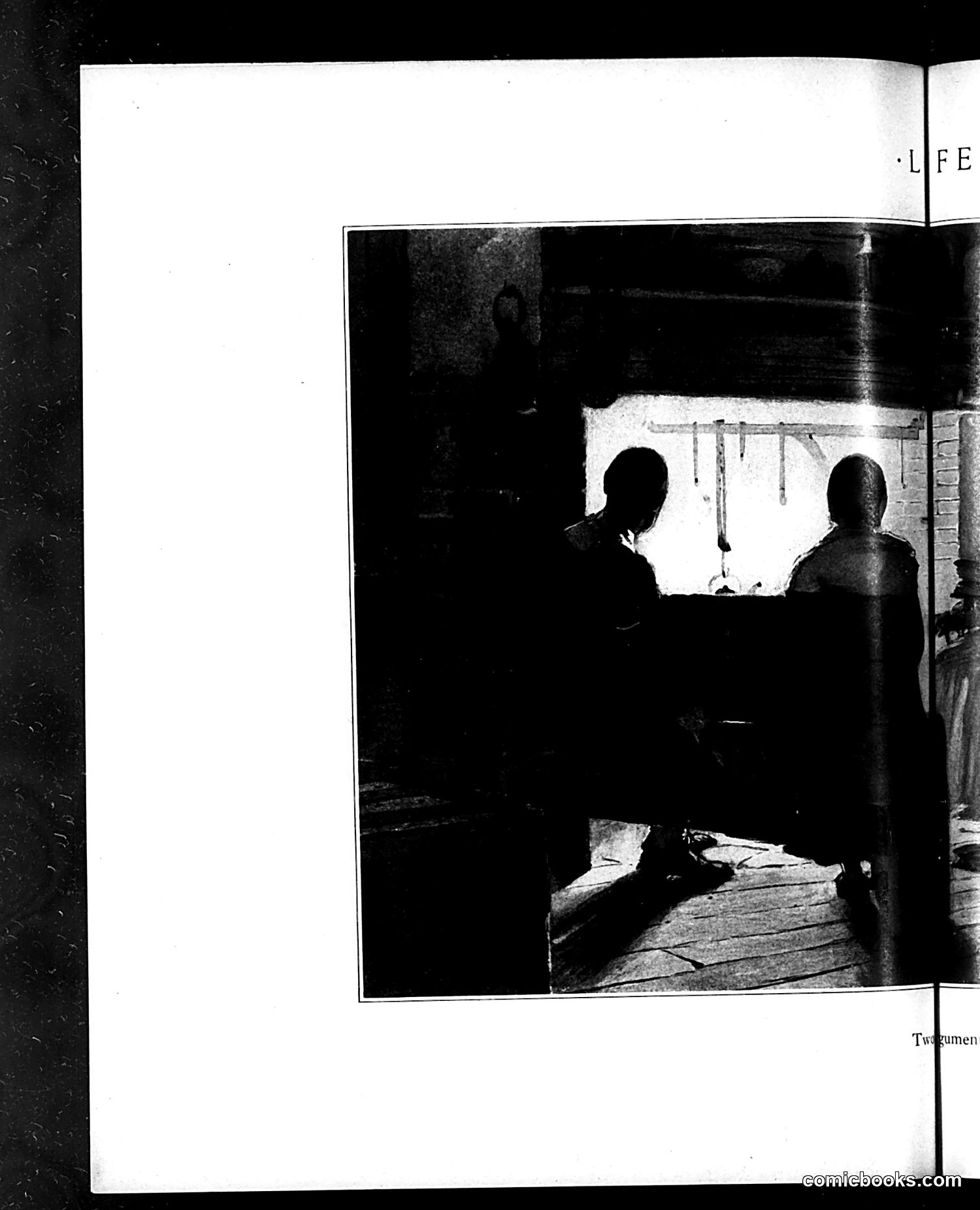
This black and white photograph shows two silhouetted figures in what appears to be an interior space, backlit by a bright window or light source. The dramatic lighting creates a noir-like aesthetic typical of early-to-mid 20th century photography. However, **I cannot definitively identify the specific figures, political references, or satirical point** from the image alone. The photograph's composition—showing two people in shadowed profile against bright background light—suggests it may be documenting a notable meeting or moment, but without visible captions, identifying information, or clearer context on this page, I cannot accurately explain what social or political commentary this was intended to convey to contemporary Life magazine readers.
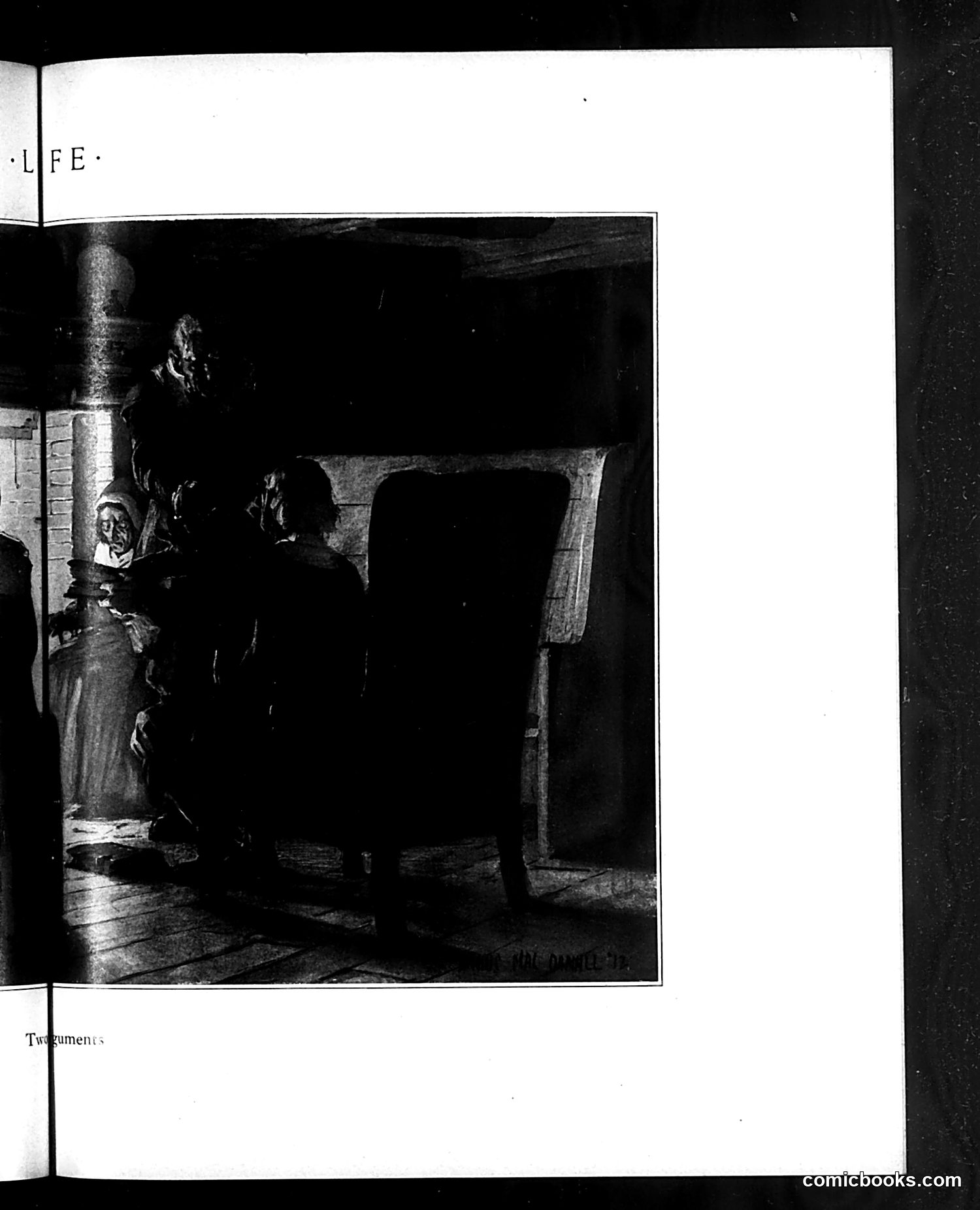
This appears to be a page from Life magazine featuring a dark, shadowy illustration labeled "Two Moments" at the bottom. The image shows silhouetted figures in what seems to be an interior domestic or institutional setting, with one figure prominently positioned in the foreground. However, the image quality is extremely poor—heavily darkened and low-contrast—making it difficult to discern specific details, facial features, or identify particular individuals being caricatured. The artistic style and subject matter suggest social or political commentary typical of Life's satirical approach, but without clearer visibility or additional context clues, I cannot confidently identify the specific figures, historical event, or satirical point being made. To accurately interpret this cartoon's meaning and references, a higher-quality or clearer version would be necessary.
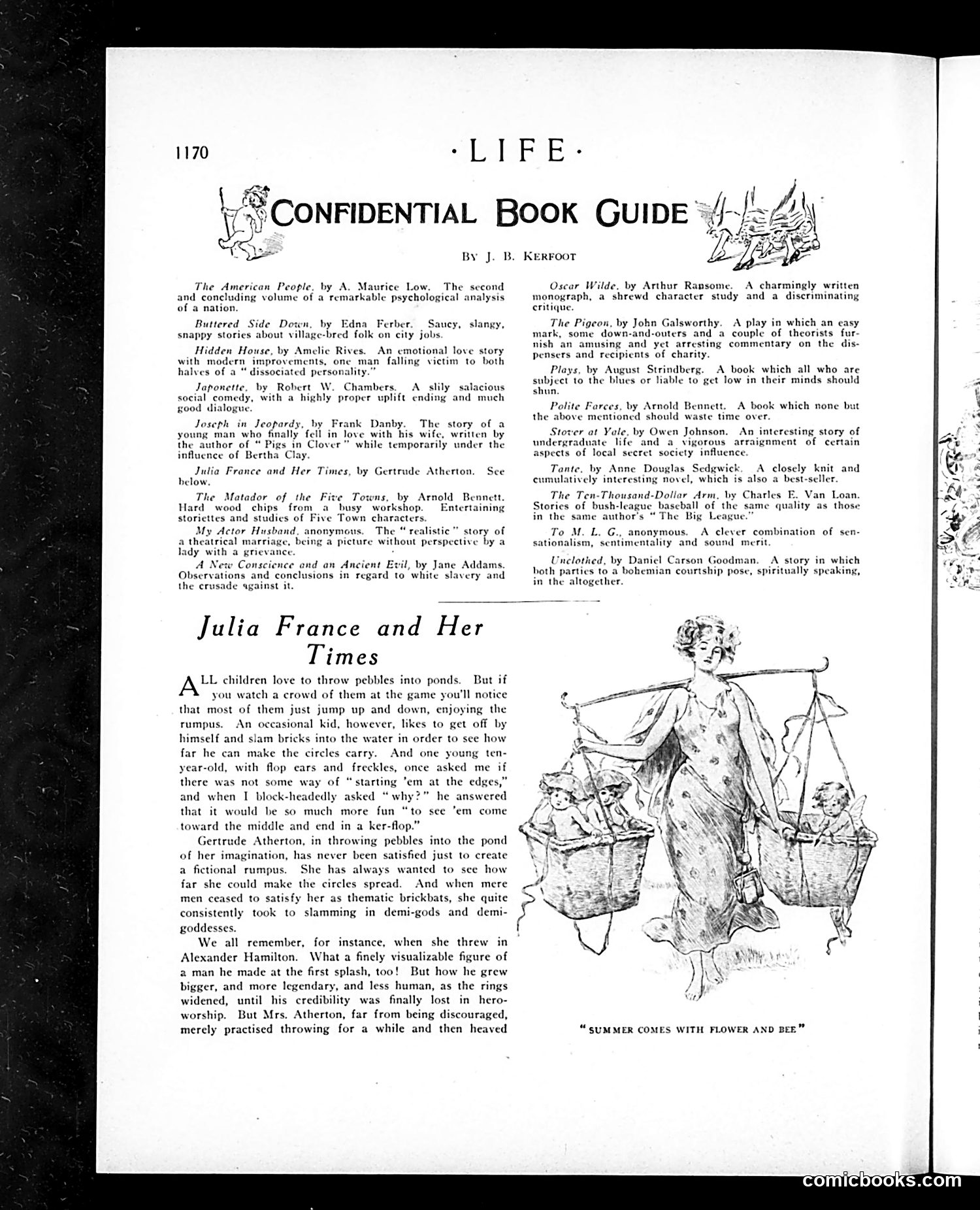
This page contains a "Confidential Book Guide" reviewing contemporary literature (early 1900s), plus an essay on author Gertrude Atherton. **The Main Illustration:** Shows a woman (likely Atherton) with a scale, symbolizing her tendency to weigh or balance themes—matching the essay's metaphor about "throwing pebbles" to create expanding circles. **The Core Satire:** The review uses an extended metaphor: Atherton is like a child throwing increasingly large objects (bricks, then "demi-gods") into a pond to see how far the ripples spread. The satire critiques her as someone who manipulates grand historical/mythological figures (like Alexander Hamilton) as mere fictional props, inflating them beyond credibility in pursuit of dramatic effect. **Key Point:** The reviewer suggests her ambition exceeds her artistic judgment—she seeks impact over authenticity, making her subjects grow "more legendary, and less human" until they collapse into mere hero-worship rather than convincing characterization. The capsule reviews above are typical *Life* magazine literary criticism: brief, witty, sometimes dismissive judgments for educated readers.
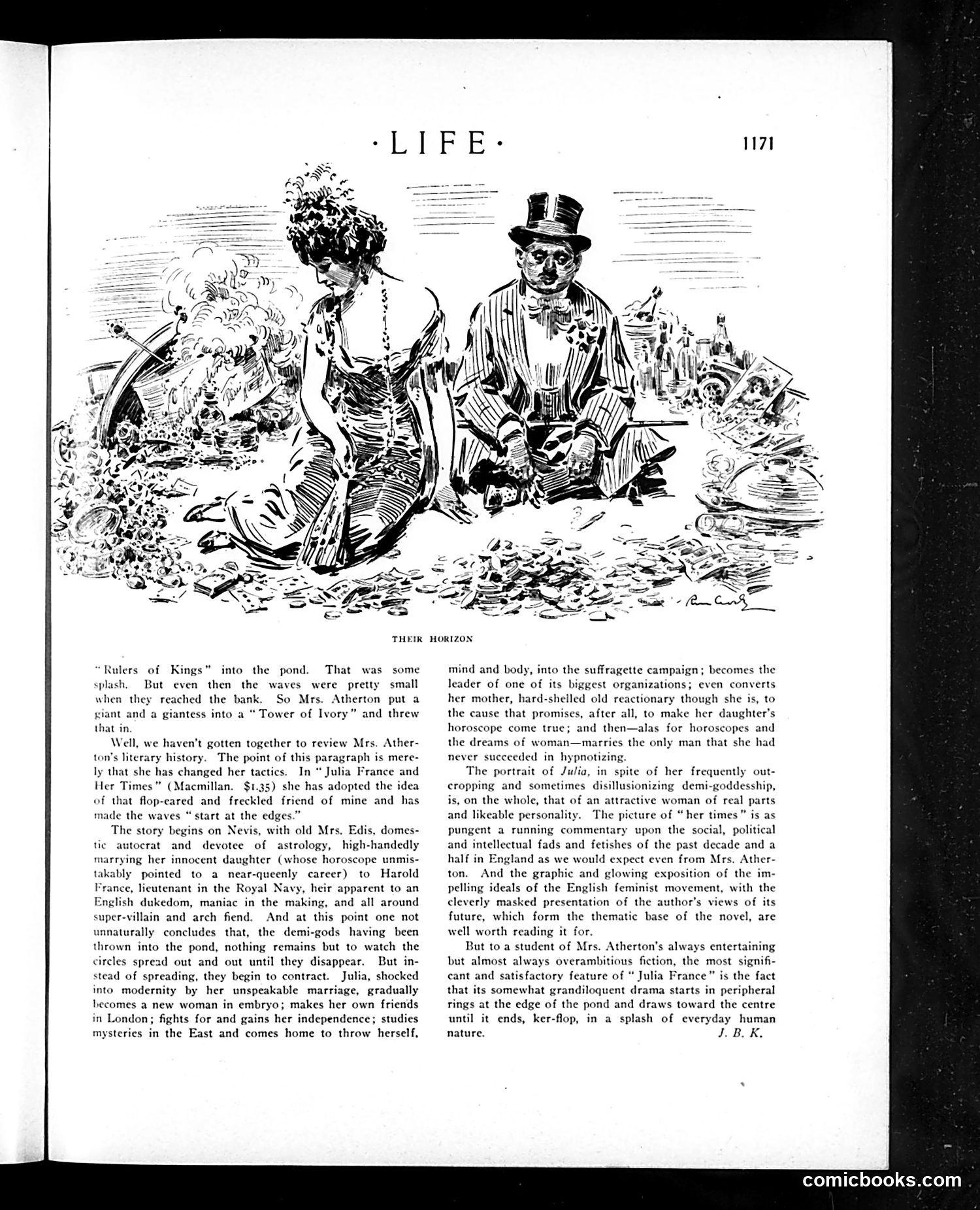
This is a literary review of Gertrude Atherton's novel "Julia France and Her Times" (1916), not a political cartoon. The illustration depicts the book's protagonist and supporting characters. The review uses a extended metaphor about throwing objects into a pond—Atherton's earlier works created small ripples ("Rulers of Kings"), but this novel "starts at the edges" with larger impact. Julia France begins as a victim of an arranged marriage to a naval officer destined for nobility, but "shocked into modernity" by this disastrous union, she becomes a suffragette activist and leader fighting for women's independence and voting rights. The reviewer praises the novel's portrayal of Edwardian-era English social and political movements, particularly the feminist campaign. The ironic conclusion: Julia's horoscope predicts queenly status, but she ultimately achieves this through suffragette work—only to marry and settle into "everyday human nature," subverting romantic expectations. The satire targets both Atherton's tendency toward melodrama and contemporary attitudes about women's ambitions versus marriage.
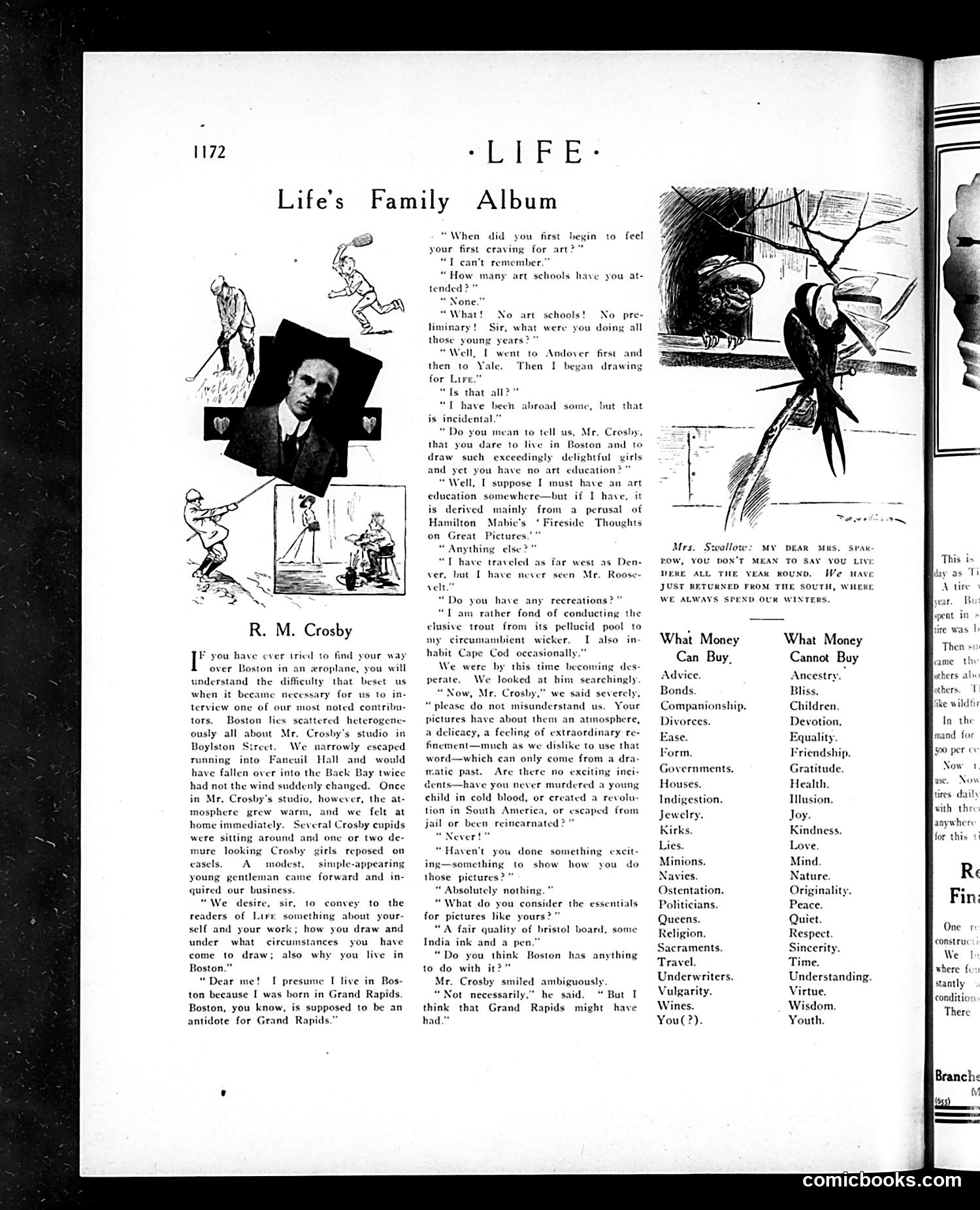
This page features an interview with **R. M. Crosby**, a prominent cartoonist and illustrator for *Life* magazine. The satire lies in the interviewer's frustration: Crosby has achieved artistic success drawing "delightful girls" with remarkable refinement and atmosphere—yet admits he had **no formal art training**, never attended art school, and credits his education mainly to reading Hamilton Mabie's essays on paintings and observing nature (fishing at Cape Cod). The joke mocks pretentious assumptions about artistic credentials. Crosby's casual, matter-of-fact responses—his essentials are merely "bristol board, India ink and a pen"—deflate the interviewer's expectation that great art requires dramatic life experience or institutional training. The secondary cartoon (bottom right) satirizes wealthy socialites who winter in the South, presented as status-conscious and superficial. The paired lists ("What Money Can Buy" vs. "Cannot Buy") offer *Life*'s characteristic moral commentary on materialism versus spiritual values.
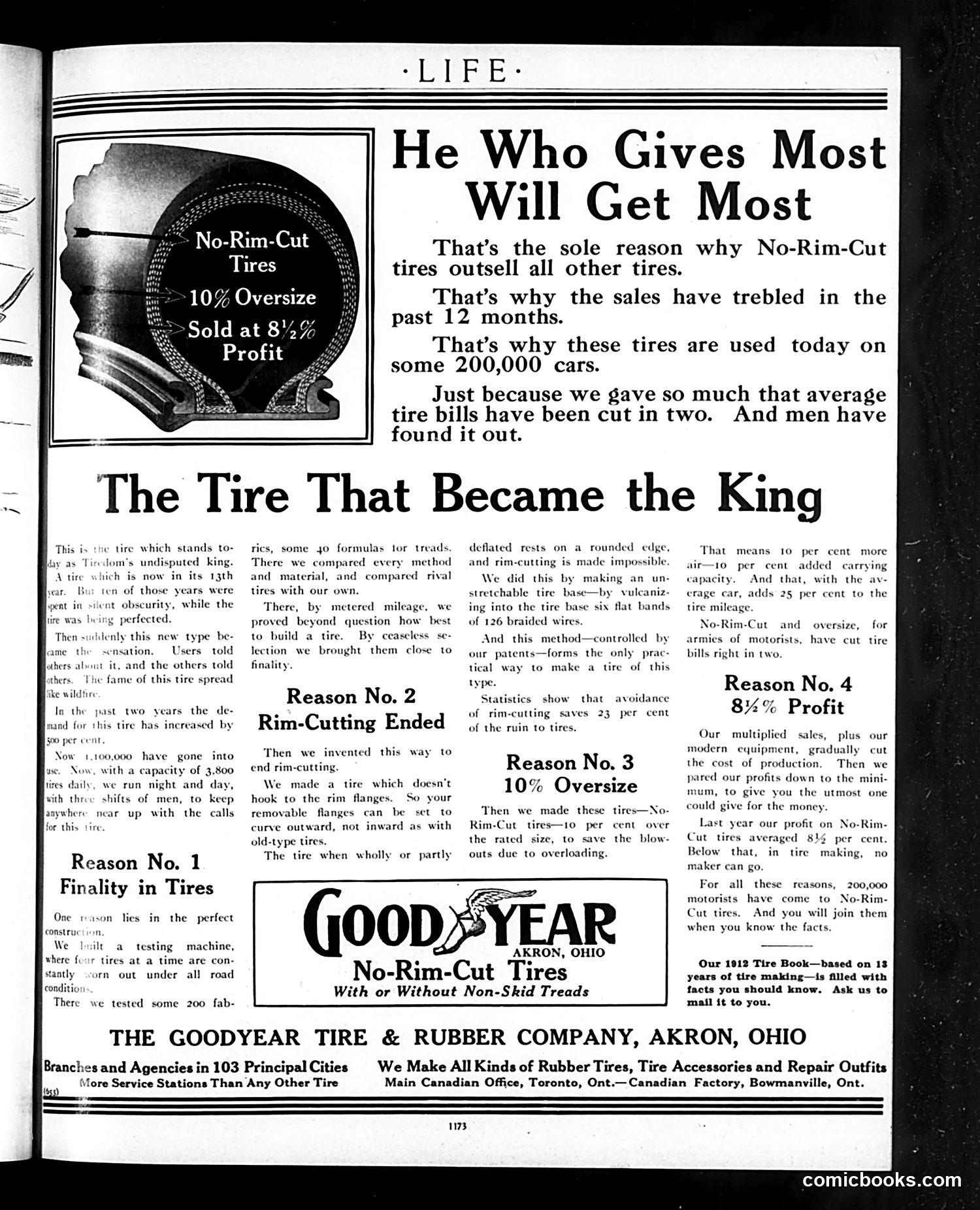
This is primarily a **product advertisement**, not satire. Goodyear presents their No-Rim-Cut tire as "the tire that became the king" through four claimed innovations: 1. **Perfect construction** via rigorous testing 2. **Rim-cutting prevention** using vulcanized braided wire bands (patented) 3. **10% oversizing** for added capacity and mileage 4. **Low profit margins** (8.5%) passed to consumers The headline's paradox—"He Who Gives Most Will Get Most"—reflects early 20th-century capitalist philosophy: generous product value and slim profits drive volume sales, which ultimately maximize total profit. The ad claims 200,000 cars use these tires and sales "tripled in 12 months." The small tire illustration shows the product's construction. There's no political content or caricature—this is straightforward commercial messaging typical of *Life* magazine's advertising pages, emphasizing consumer benefit through engineering superiority and fair pricing.
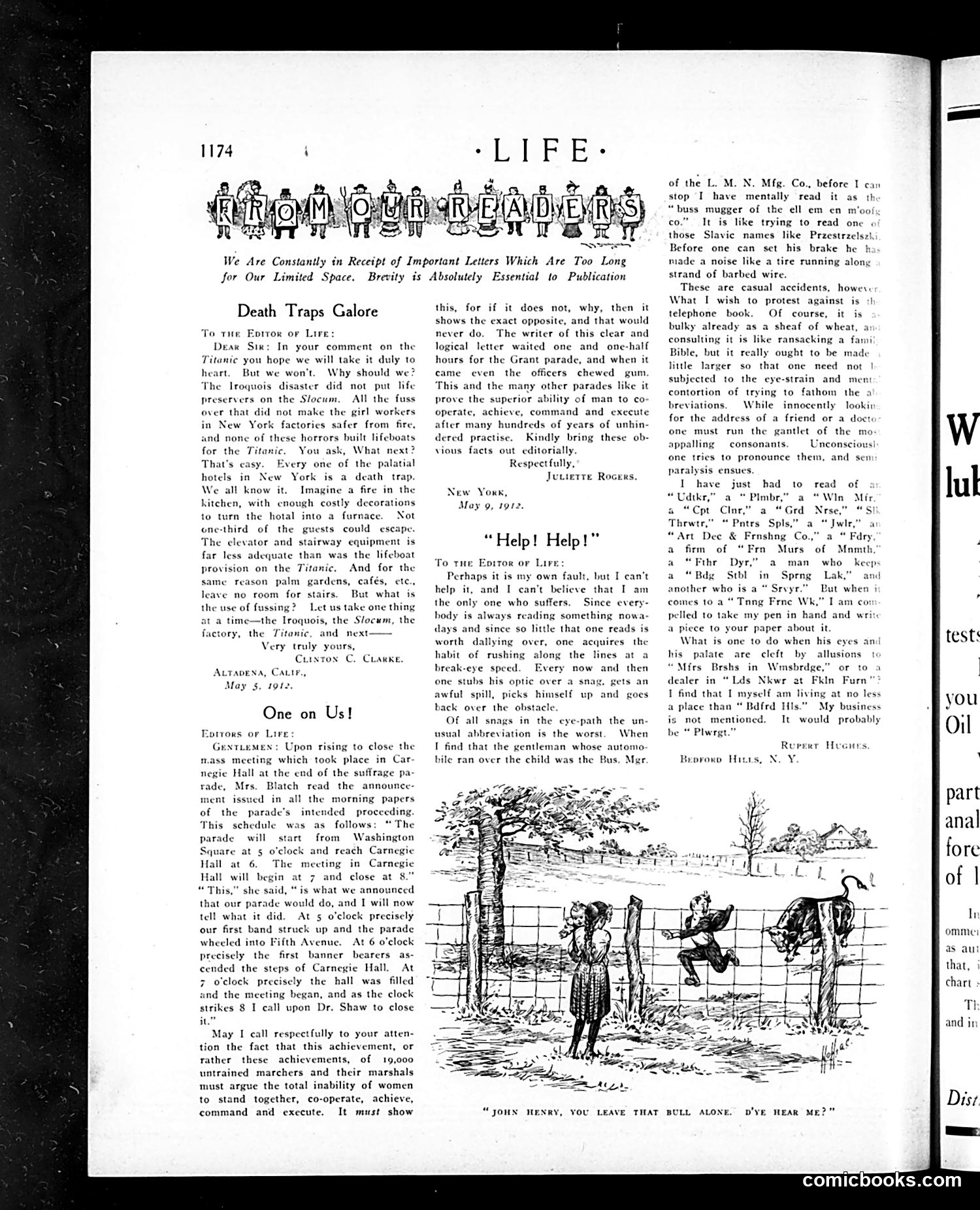
This page contains three humorous reader letters mocking contemporary issues: **"Death Traps Galore":** A letter sarcastically critiques society's selective outrage. After the *Titanic* disaster (April 1912), public concern focused on ocean safety, yet the writer notes New York hotels are equally dangerous firetraps. The point: society ignores everyday hazards affecting working people (factory fires) while obsessing over wealthy travelers' catastrophes. **"One on Us!":** A suffragist's letter uses ironic logic against anti-woman arguments. A women's suffrage parade executed perfectly—19,000 marchers arrived precisely on schedule—yet the letter sarcastically claims this *proves* women cannot organize. The joke exposes the circular logic of opponents: women's success becomes "evidence" of their incompetence. **"Help! Help!":** A complaint about abbreviated names in print (*Bus. Mgr.*, *L. M. N. Mfg. Co.*) that confuse readers. The humor lies in the absurd mental pronunciations these create. The cartoon depicts a rural scene, likely illustrating one of these letters, though context is unclear.
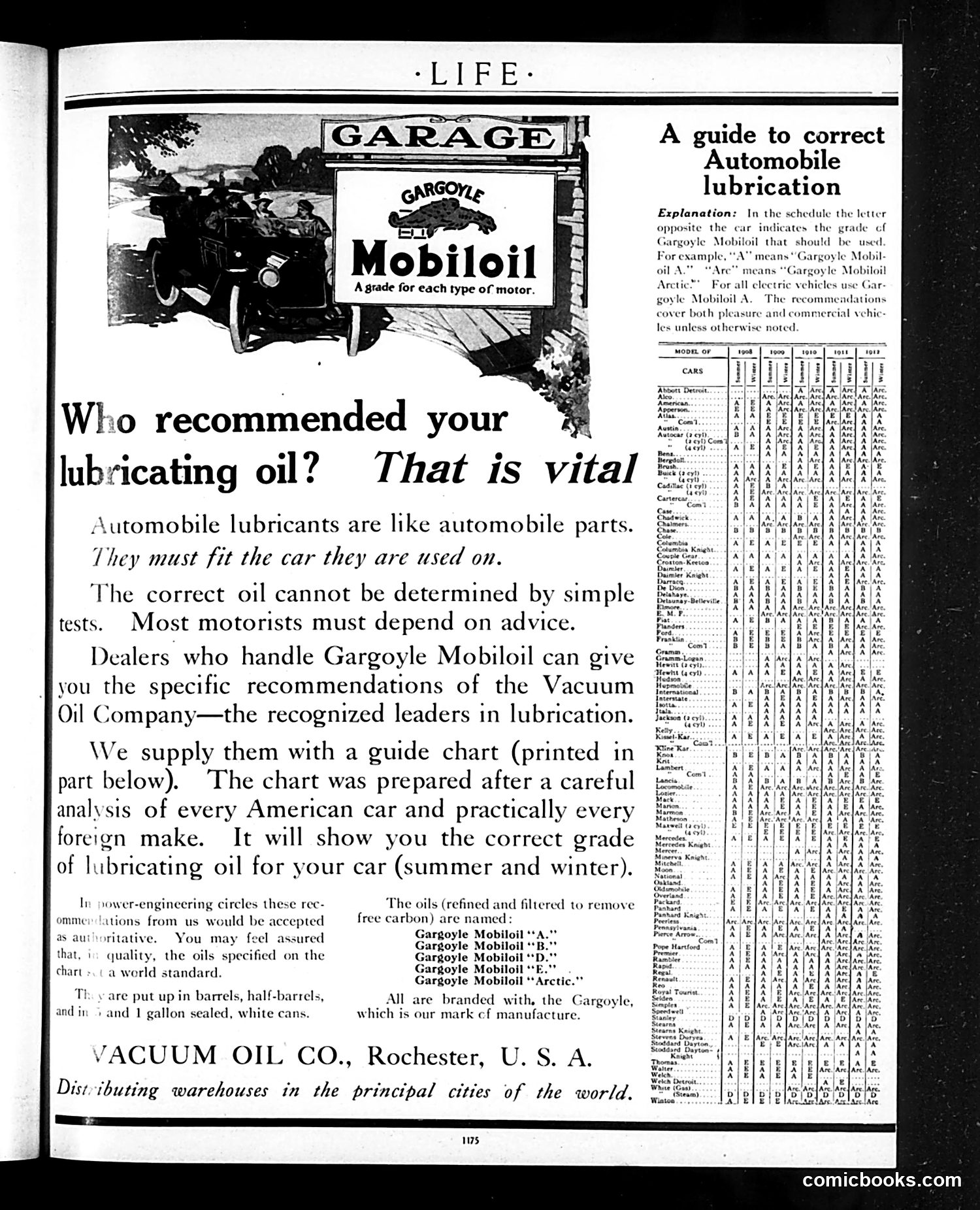
This is **primarily a product advertisement**, not satire or political commentary. It's a 1920s promotion for Gargoyle Mobiloil lubricating oil by the Vacuum Oil Company (Rochester, U.S.A.). **The content:** The page features an illustration of early automobiles at a garage with a large Mobiloil sign, emphasizing that correct oil selection is "vital." The advertisement argues that motorists cannot determine proper oil through simple testing and must rely on dealer recommendations based on their proprietary guide chart. **What's notable for modern readers:** This reflects an era when automobile maintenance was highly specialized knowledge—before standardized industry practices existed. The detailed chart matching specific car models to oil grades (A, B, D, E, "Arctic") suggests oil specifications varied dramatically by vehicle type and season. **The modest satire:** The headline "Who recommended your lubricating oil? *That is vital*" mildly pokes fun at motorists' likely confusion, positioning Vacuum Oil as the authoritative expert solving consumer uncertainty.
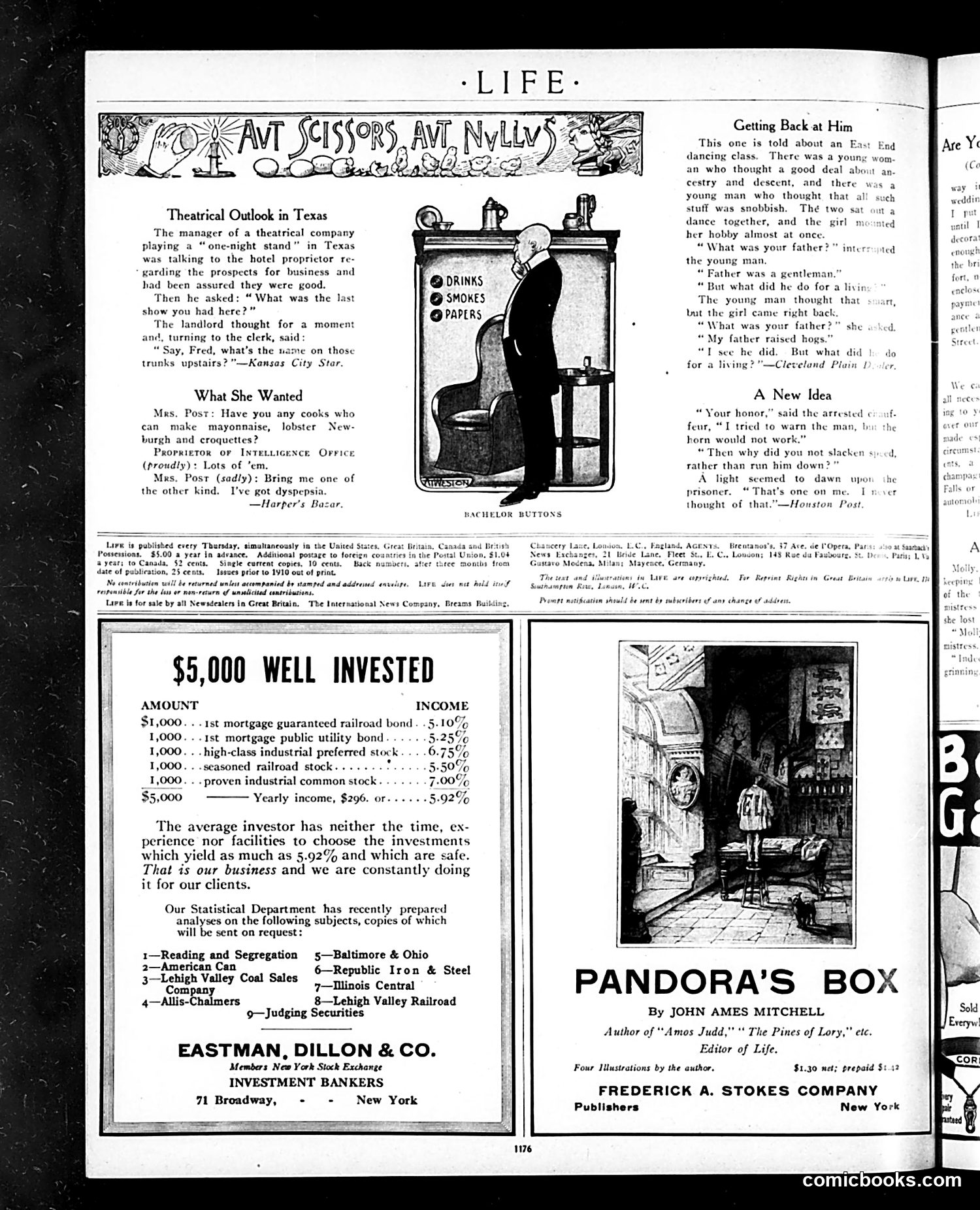
This page contains several short humorous anecdotes typical of Life's satirical format, plus advertisements. **The Cartoons/Jokes:** The "Bachelor Buttons" illustration shows a man at a desk labeled with household items (drinks, smokes, papers), likely satirizing bachelor life's disorder or simplicity. The three brief jokes mock social pretension and hypocrisy: - "Theatrical Outlook": A theater manager can't remember what show last played—suggesting small-town Texas indifference to theater - "What She Wanted": A society woman dismisses fancy cooking because it upsets her digestion—poking fun at upper-class affectation - "Getting Back at Him": A snobby man boasts of aristocratic heritage; the woman retorts her father "raised hogs"—reversing his snobbery with blunt honesty **The Point:** Early 1900s Life magazine used such anecdotes to mock class pretension, particularly among the aspiring middle class claiming superiority through ancestry or refinement. The page also advertises investment services and John Ames Mitchell's book *Pandora's Box*.
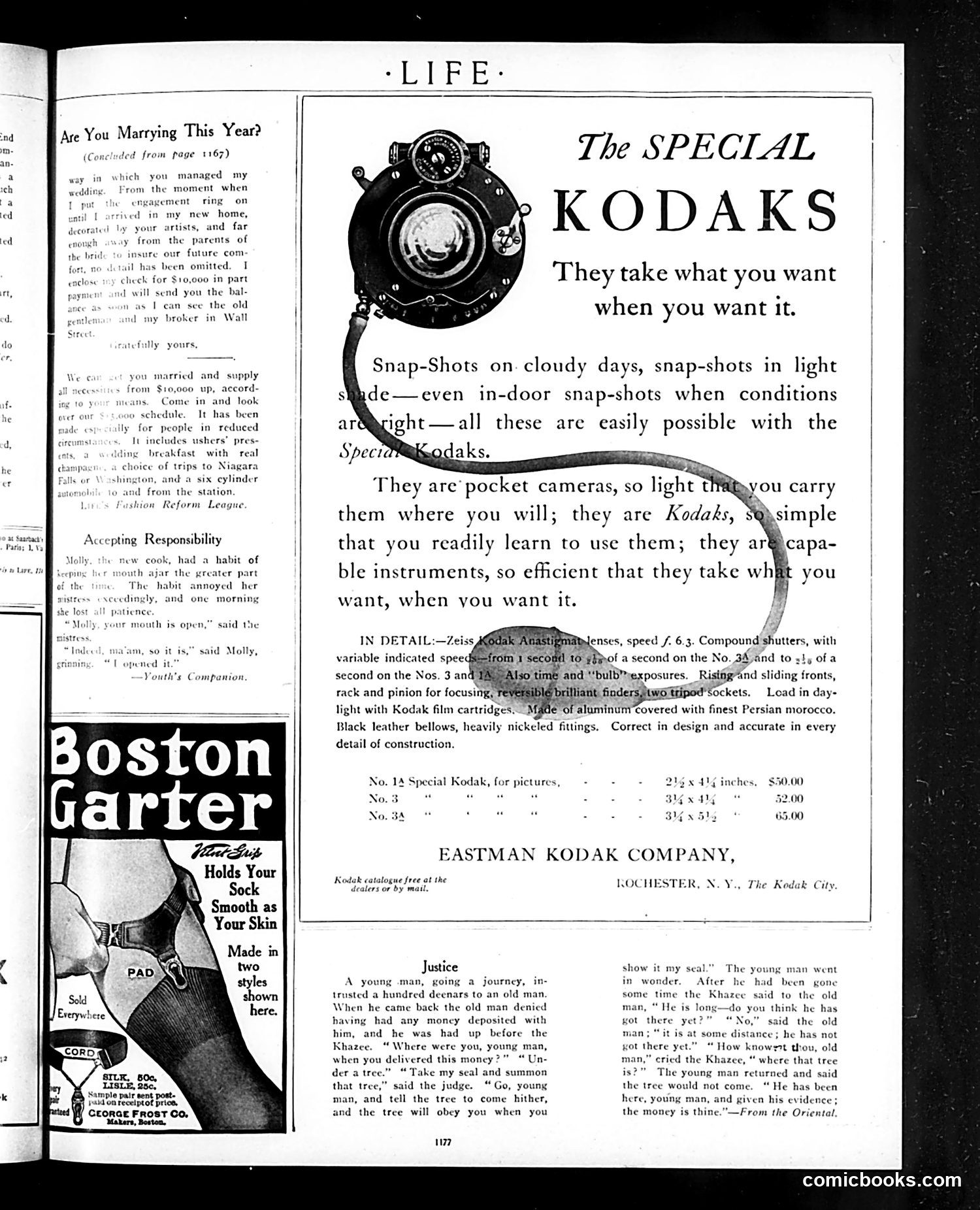
This page contains two distinct elements: **Left side:** A "Boston Garter" sock-holder advertisement emphasizing comfort and practicality—typical early 20th-century marketing focused on a mundane but necessary garment. **Right side:** A full-page Kodak camera advertisement promoting the "Special Kodaks" as convenient, portable photography devices for everyday use. The ad emphasizes accessibility and ease of use for amateur photographers. **Bottom section:** A short satirical story titled "Justice" about an Oriental (likely meant to evoke Middle Eastern or South Asian) legal dispute. A young man deposits money with an old man under a tree; when the old man denies it, a judge cleverly summons the tree as a witness. The tree's "testimony" (its presence at the scene) proves the young man's honesty. The satire mocks formal legal systems by suggesting simple, direct evidence matters more than procedural argument. The page is primarily **advertising-driven** with satirical content as filler material typical of Life magazine's mixed format.
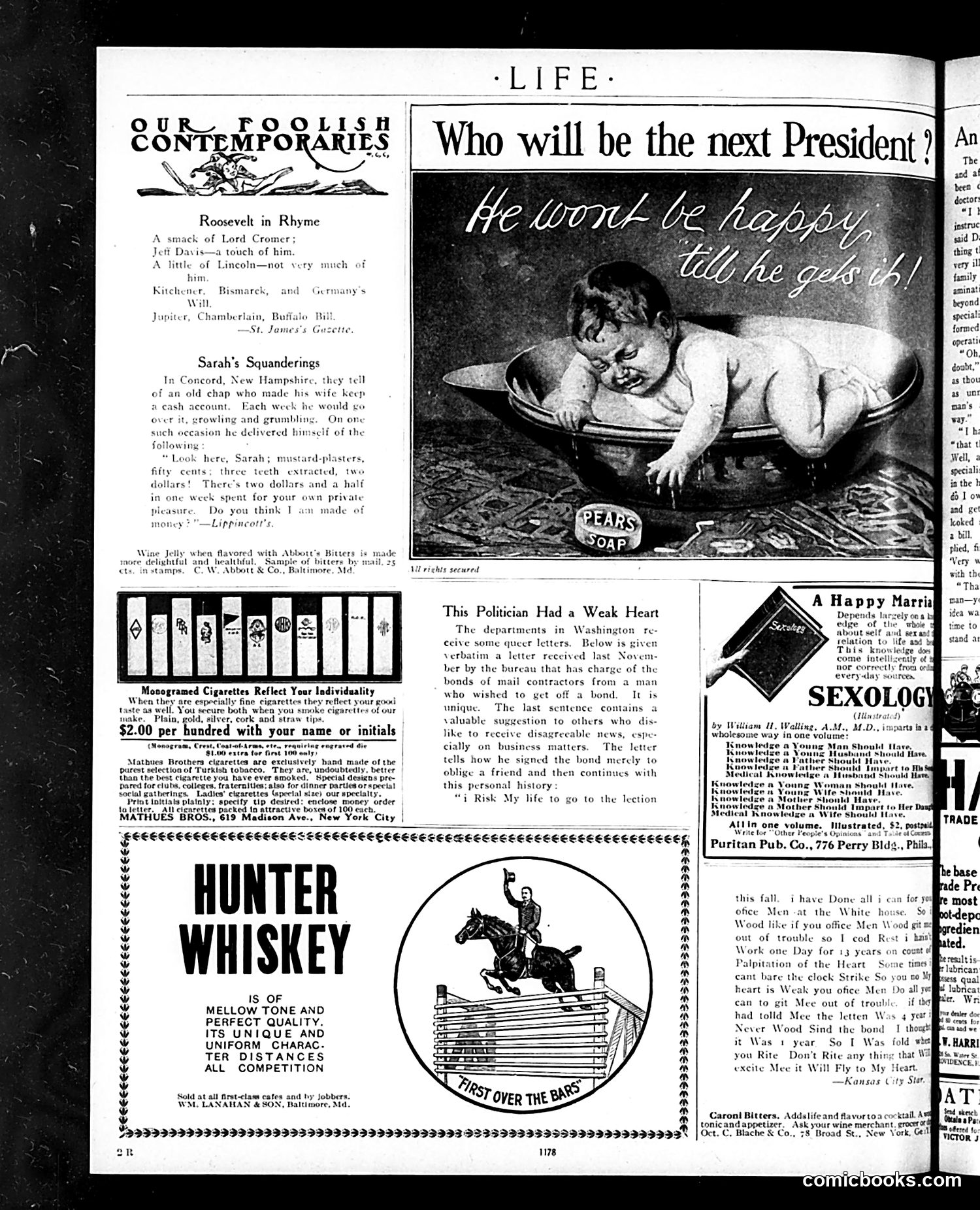
This page from Life magazine contains satirical commentary on early 20th-century American politics and culture. **Main Content:** The top article, "Roosevelt in Rhyme," compares President Theodore Roosevelt to historical figures (Lord Cromer, Jefferson Davis, Lincoln, Kitchener, Bismarck), suggesting he borrows traits from multiple leaders—a mocking assessment of his political identity. **Political Satire:** "This Politician Had a Weak Heart" reproduces a letter from a mail contractor seeking bond release, written in broken English with rambling syntax. The satire targets Washington bureaucrats and their excuses: the man claims he signed bonds only to help a friend and now suffers heart palpitations from stress, pleading to avoid "trouble." Life ridicules both the incompetent writing and the transparent excuse-making of government functionaries. **Other Content:** The page includes advertising (monogrammed cigarettes, Hunter Whiskey, Pears Soap) and unrelated humor pieces. The overall tone is typical of Life's early satirical approach: mocking politicians, bureaucrats, and contemporary social absurdities through exaggeration and reproduction of authentic documents presented as ridiculous evidence.
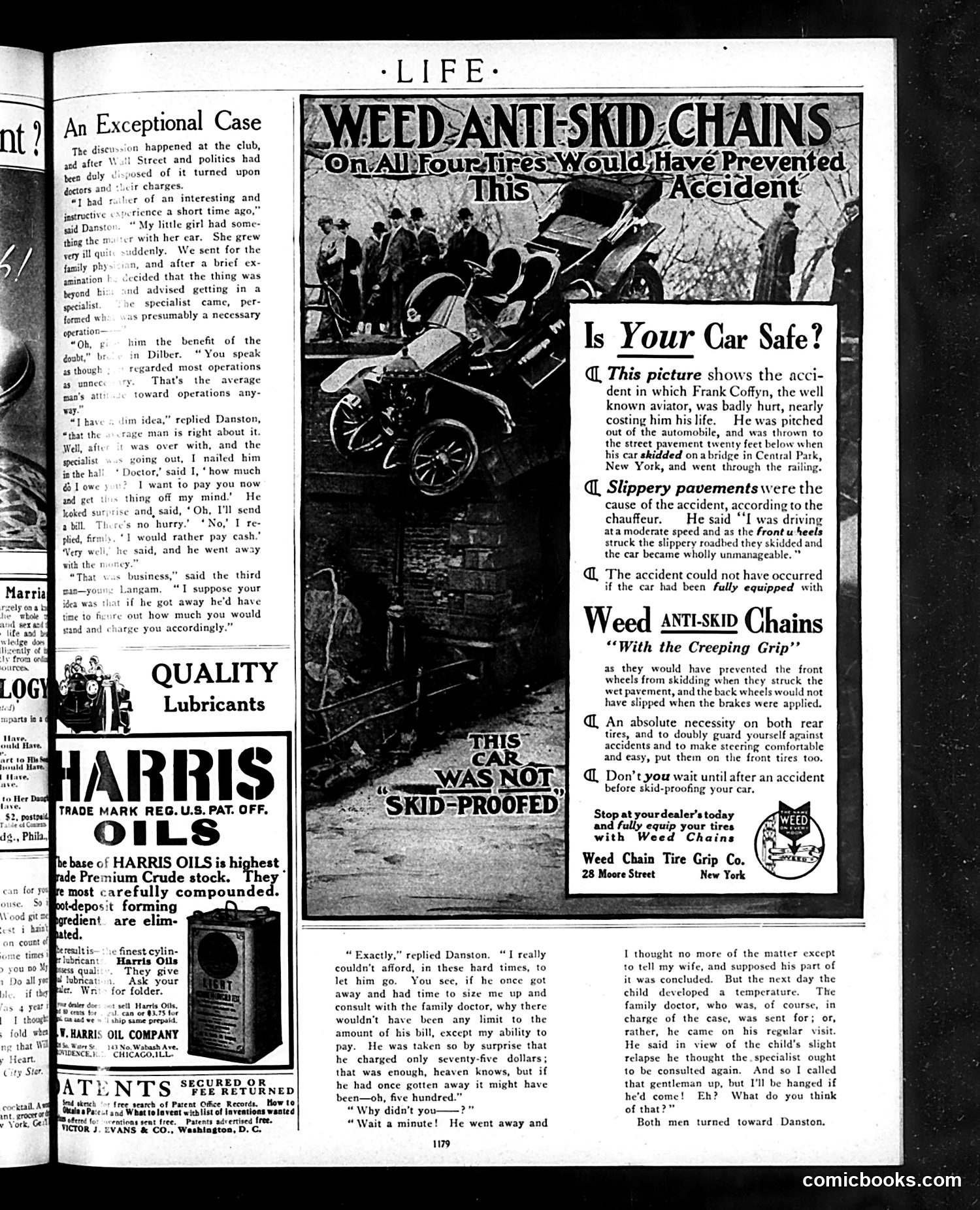
This page contains two distinct elements: **Left Side - "An Exceptional Case"**: A humorous anecdote about a doctor's visit. A man named Danston describes how he rushed to pay his specialist immediately after treatment—not from politeness, but from self-preservation. The joke relies on the era's anxiety about unchecked medical bills. By paying cash on the spot, Danston prevented the doctor from having time to calculate a larger fee based on the patient's perceived ability to pay. The satire targets both doctors' allegedly inflated billing practices and patients' powerlessness against medical costs. **Right Side - Advertisement**: An advertisement for Weed Anti-Skid Chains, automobile safety equipment. It references a real incident involving aviator Frank Coffyn, who was severely injured when his car skidded on a wet bridge in Central Park, New York. The ad argues that anti-skid chains would have prevented the accident, using a dramatic real-world example to sell the product as a safety necessity. Both elements reflect early 20th-century concerns: healthcare cost anxiety and automobile safety hazards.
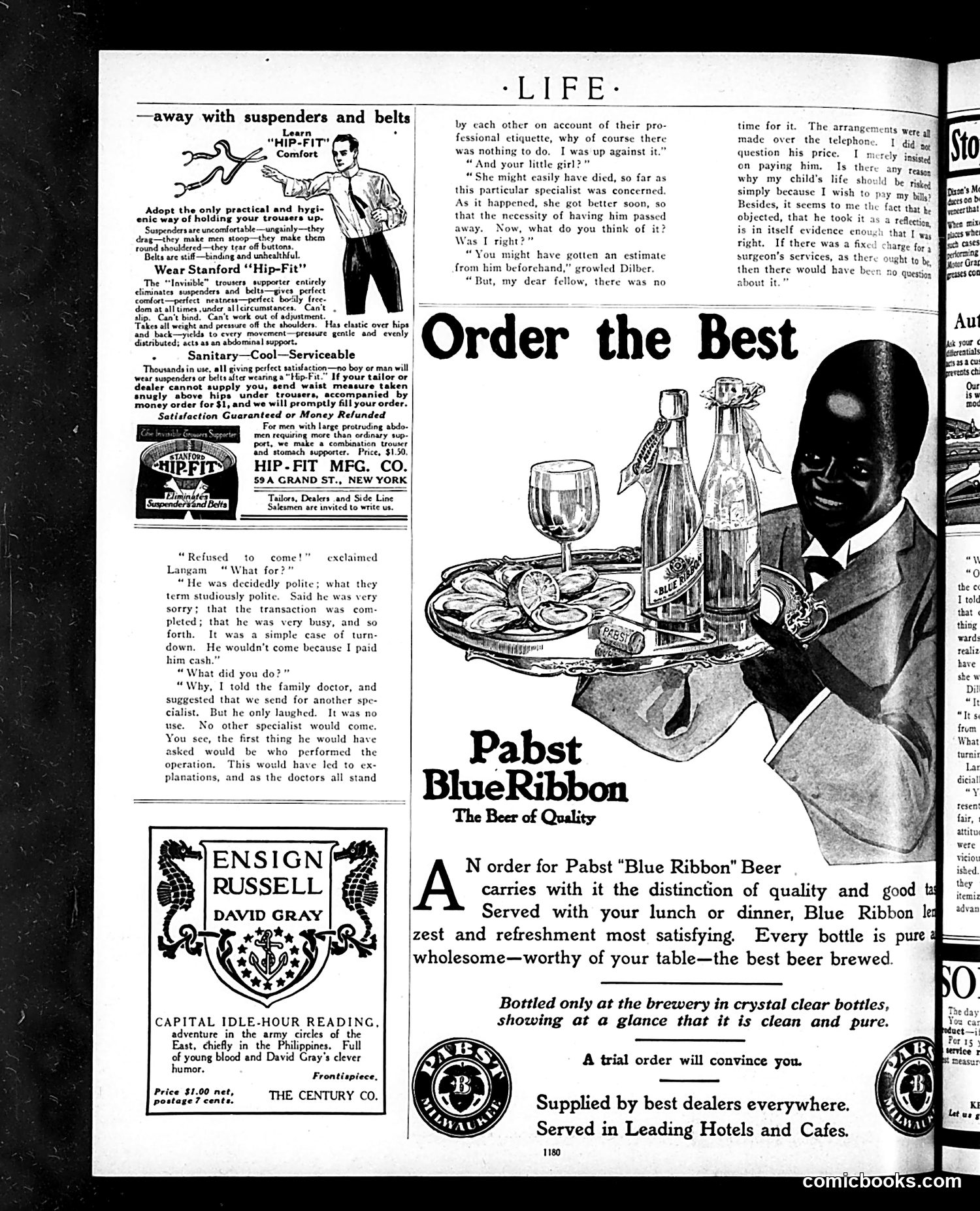
This page contains two distinct elements: **Left side:** A short story excerpt about a physician who refuses a house call after being paid in cash. The narrative critiques professional etiquette among doctors—the specialist won't visit because another doctor performed surgery, creating an unspoken code that prevents cooperation. The patient's child's life is endangered by this rigid professional courtesy. The story satirizes how professional pride and bureaucratic courtesy can override human welfare. **Right side:** A Pabst Blue Ribbon beer advertisement featuring a caricatured Black server with exaggerated features—a deeply racist image typical of early 20th-century advertising. The ad presents the beer as a quality product "worthy of your table." **Context:** This reflects Life magazine's satirical focus on social hypocrisy (the doctor story) alongside the casual, normalized racism embedded in period advertising. Modern readers should recognize the ad's imagery as offensive racial caricature, standard but indefensible by today's standards.
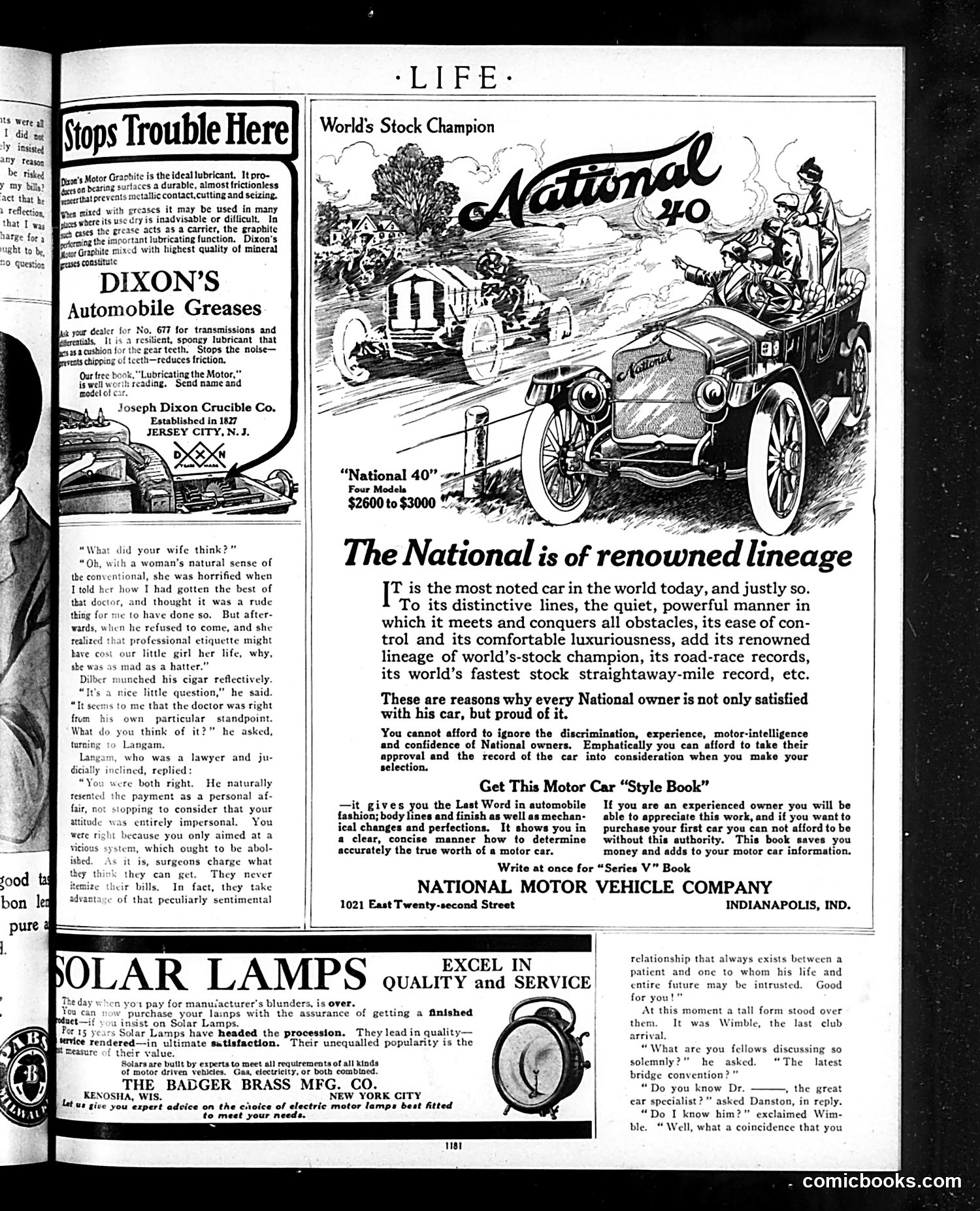
This page is primarily **advertisements**, not political satire. The main content includes: 1. **Dixon's Automobile Greases** (left): A straightforward product ad emphasizing motor lubricant quality. 2. **National 40 Automobile** (center-right): The dominant ad features an illustration of an early 1900s motorcar with passengers, promoting it as "World's Stock Champion" with a "renowned lineage." This appeals to wealthy buyers by emphasizing racing pedigree and performance records. 3. **Solar Lamps** (bottom): A technical ad for automobile lighting equipment. 4. **Embedded humor** (left column): A brief dialogue between characters discussing a doctor's fee dispute—the lawyer character argues both parties are "right" from different perspectives (personal vs. systemic). This is social commentary on professional ethics, not political satire. The page reflects early automotive-era consumer culture, targeting affluent car owners with quality-focused messaging.
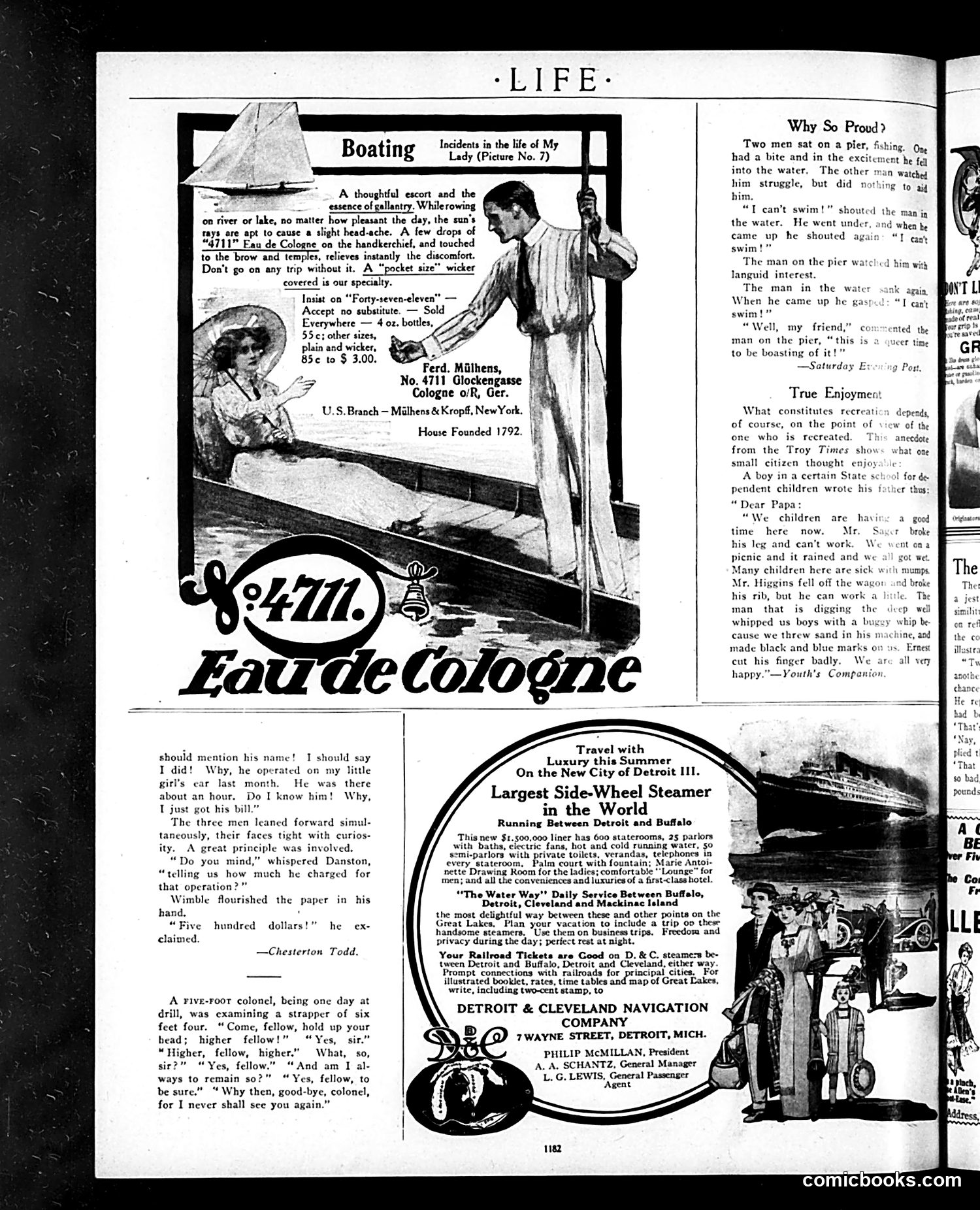
This page combines satirical humor with period advertising. The main cartoon depicts a boating scene illustrating "gallantry"—a man rowing while a woman sits passively, establishing the ironic premise that proper etiquette requires the man to exert himself while she remains comfortable. The Eau de Cologne advertisement cleverly integrates into this narrative, suggesting that cologne applied to the handkerchief relieves the gentleman's headache from rowing. The surrounding anecdotes mock social pretension and absurd behavior. "Why So Proud?" ridicules a man boasting about swimming when rescued from drowning—misplaced vanity. Other brief stories highlight medical overcharging and military absurdity. These reflect Life's satirical tradition of exposing everyday human foolishness and social hypocrisy through short, punchy narratives. The lower half contains a genuine advertisement for the City of Detroit III steamship, showcasing luxury amenities—demonstrating how advertising and editorial content intermingled in this era.
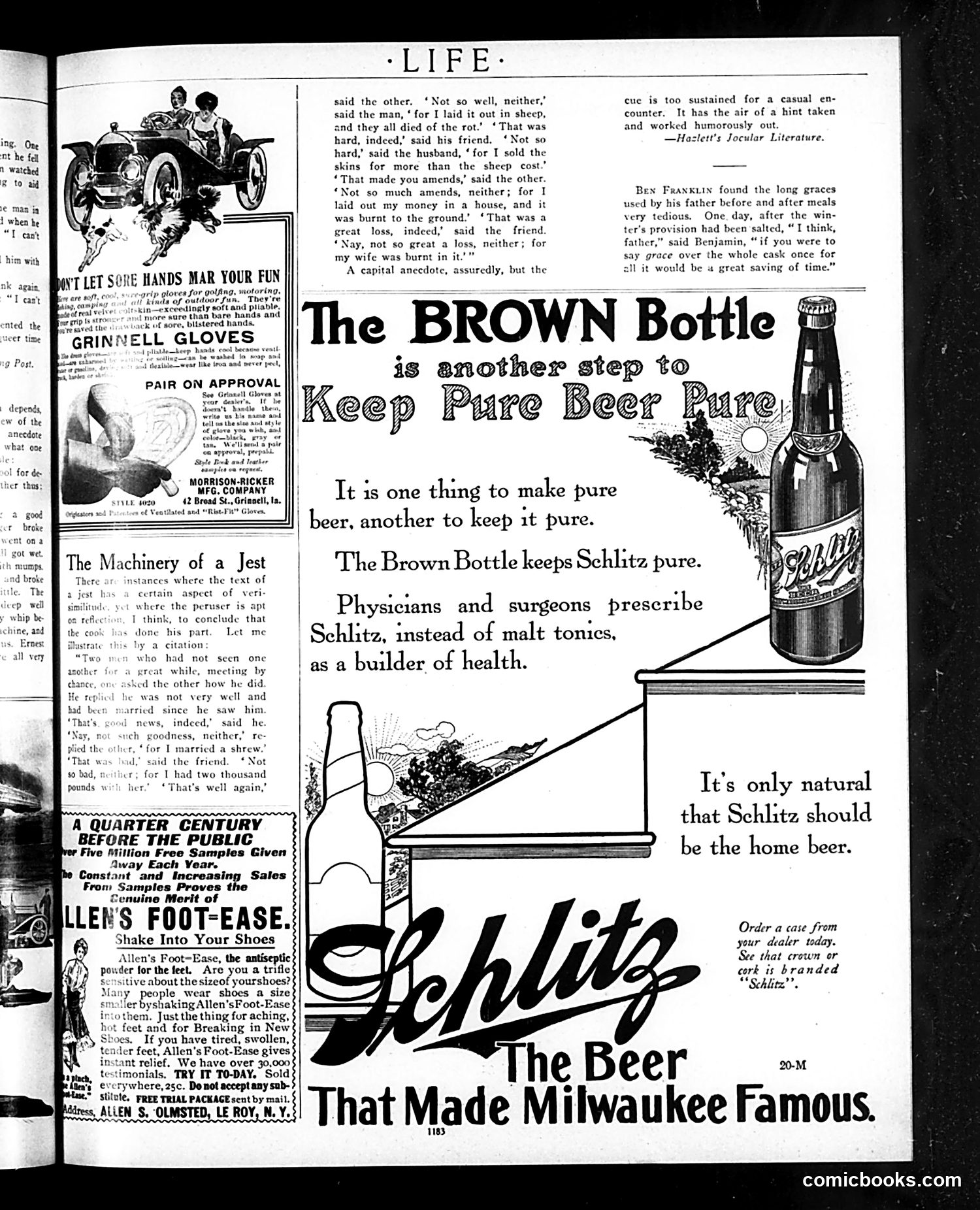
This page is primarily **advertising** rather than satire or editorial cartooning. The dominant content features four separate ads: **Main Advertisement:** The Schlitz beer ad claims the brown bottle keeps beer pure and positions Schlitz as prescribed by physicians "as a builder of health"—a claim reflecting pre-FDA regulations when such health assertions were unregulated. This reflects early 20th-century advertising standards. **Supporting Ads:** - Grinnell Gloves (protective work gloves) - Allen's Foot-Ease (foot powder) - A quarter-page notice for Allen's Foot-Ease The page also includes brief humorous anecdotes (attributed to Hazlett and Ben Franklin) typical of *Life* magazine's satirical content, but these are minor elements. The Schlitz ad is notable historically: it markets beer as medicine, a common pre-prohibition practice when such health claims faced no legal restrictions.
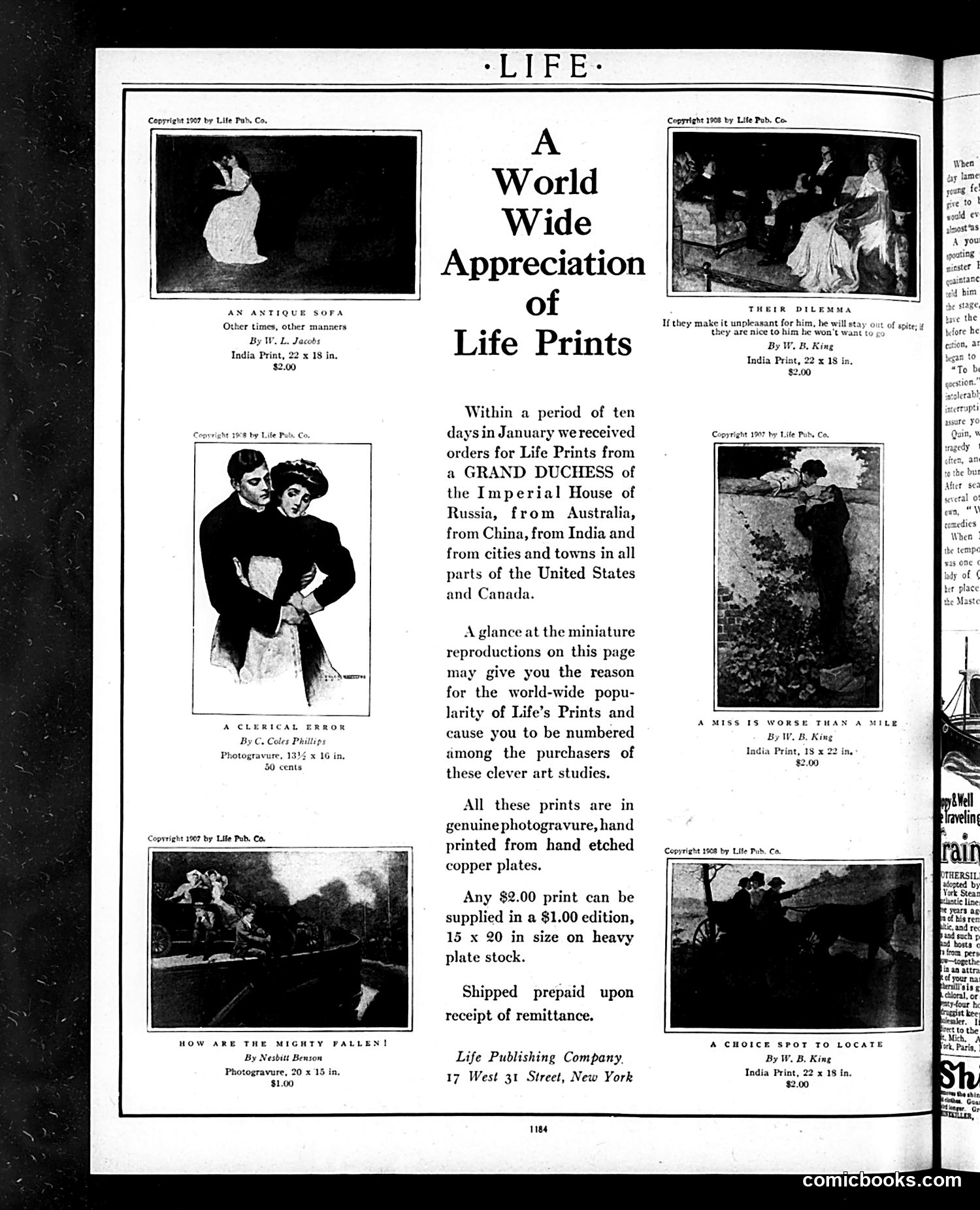
This is primarily an **advertisement** for Life Publishing Company's photogravure prints, not political satire. The page showcases five sample prints available for purchase at $2.00 (or $1.00 for smaller editions). The text boasts of international demand—orders from a Russian Grand Duchess, Australia, China, India, and across North America within ten days. This was a marketing claim emphasizing the prints' sophisticated, world-class appeal. The sample prints shown include domestic and social scenes: "An Antique Sofa," "A Clerical Error" (showing a man and woman), "Their Dilemma," "A Miss Is Worse Than a Mile," and "How Are the Mighty Fallen!"—titles suggesting gentle humor about romantic or domestic situations typical of early 20th-century genteel humor. The prints were hand-etched copper plate photogravures, positioning them as fine art reproductions for middle-class consumers—an accessible luxury item.
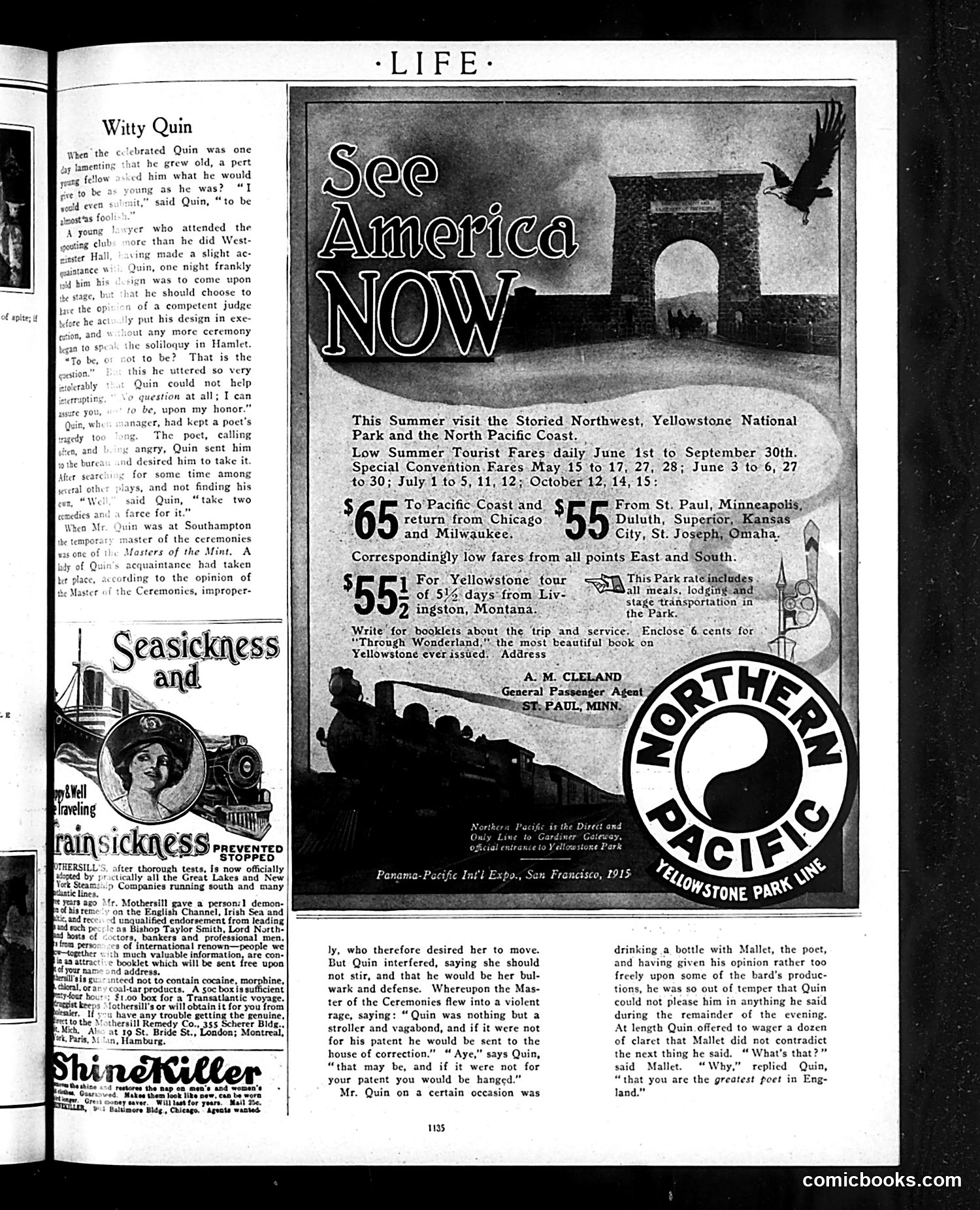
This page contains humorous biographical anecdotes about **David Garrick's contemporary, the 18th-century actor James Quin**—a celebrated performer known for theatrical wit. The text records several apocryphal stories showcasing Quin's clever retorts and verbal sparring: - A young lawyer asks what Quin will be in old age; Quin quips he'll be "an ass" (implying the lawyer already is one) - Quin defends a woman against a Master of Ceremonies, sarcastically suggesting the official deserves hanging despite his authority - Quin wagers with poet Mallet, trapping him into either accepting a backhanded compliment or contradicting himself **The satire targets** aristocratic pretension and pomposity through Quin's sharp comebacks. For modern readers: these were celebrated as examples of wit in an era valuing clever repartee as entertainment and social skill. The page also contains unrelated period advertisements (travel fares, seasickness remedies), typical of *Life* magazine's mixed-content format.
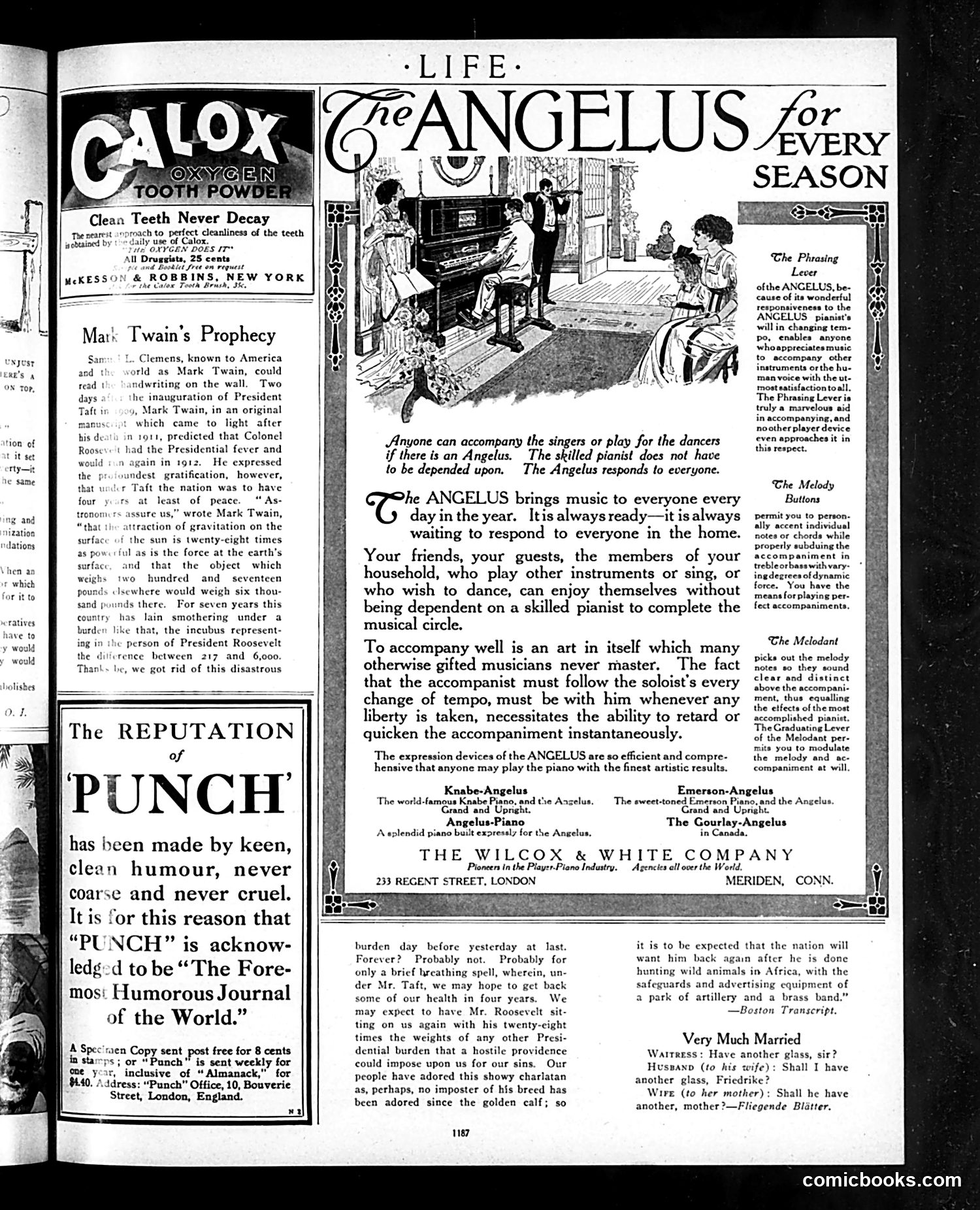
This page is primarily **advertising**, not political satire. The dominant content is a large advertisement for the Angelus player piano, promoting its ability to accompany singers and dancers without requiring a skilled pianist. The only political content is a brief section titled "Mark Twain's Prophecy," which references a manuscript discovered after Twain's 1911 death. The text claims Twain predicted President **Theodore Roosevelt** would attempt a political comeback around 1912 (after leaving office in 1909). Twain allegedly described Roosevelt as a crushing burden—comparing him gravitationally to an object weighing 217 pounds on Earth but 6,000 pounds on the sun. The satire here targets Roosevelt's political ambitions through Twain's metaphor of oppressive weight. Smaller ads for **Calox tooth powder** and the British humor magazine **Punch** round out the page.
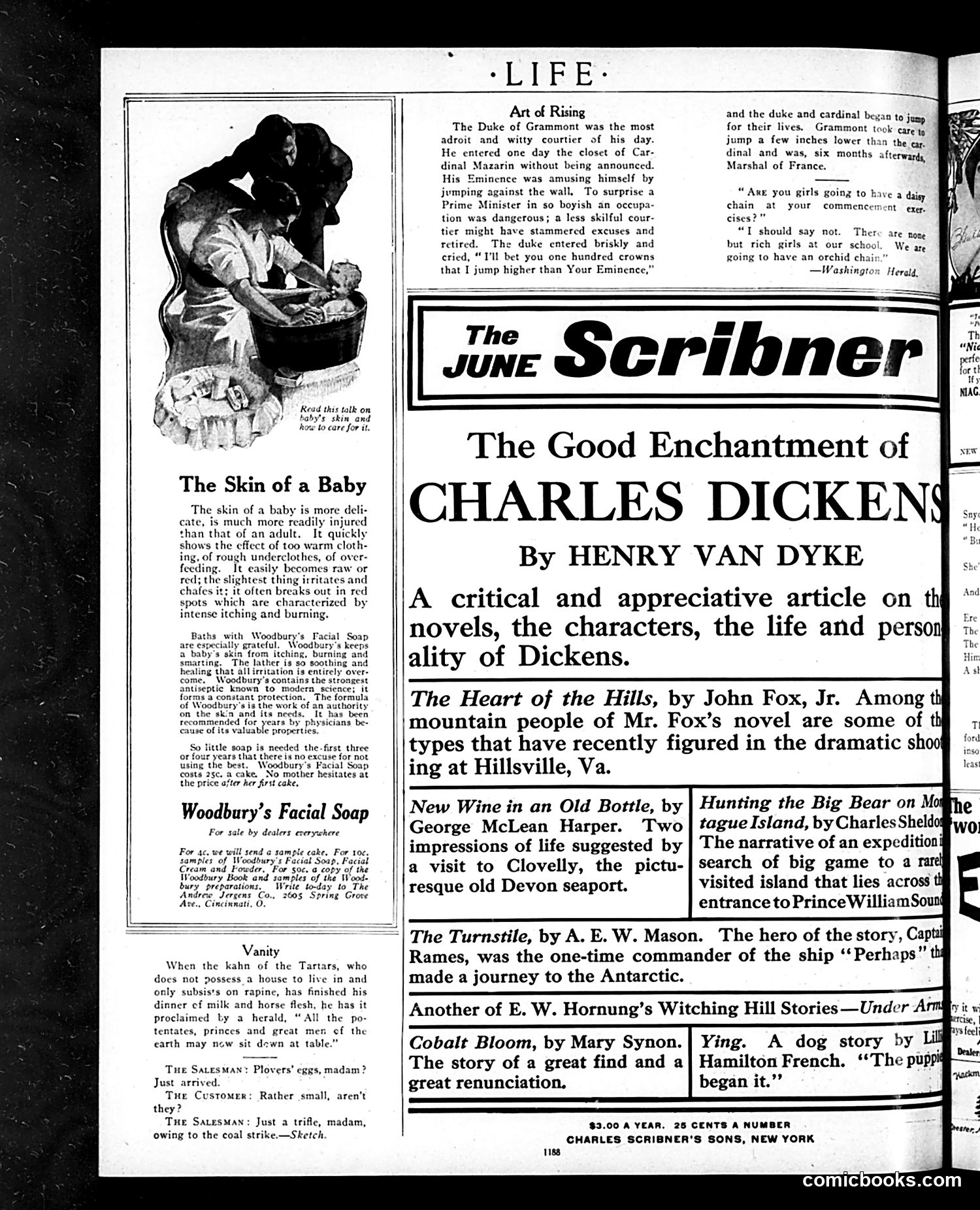
This page mixes advertising with literary content and light satire typical of early 20th-century Life magazine. **Main Content:** The page advertises Woodbury's Facial Soap with an article on infant skincare, alongside a brief anecdote about the Duke of Grammont (a historical French courtier) impressing Cardinal Mazarin through wit and physical prowess—a "how to get ahead" story emphasizing cleverness and boldness. **The Joke:** A short satirical exchange mocks the coal strike's effects: a salesman blames "the coal strike" for unusually small plover's eggs, absurdly suggesting labor disruptions affect bird size. **Literary Section:** "The June Scribner" promotes book reviews, including Henry Van Dyke's essay on Charles Dickens and various novels. **Subtext:** The anecdotes suggest success comes through intelligence and boldness—relevant themes for Life's educated, aspirational audience. The coal-strike joke reflects contemporary labor tensions.
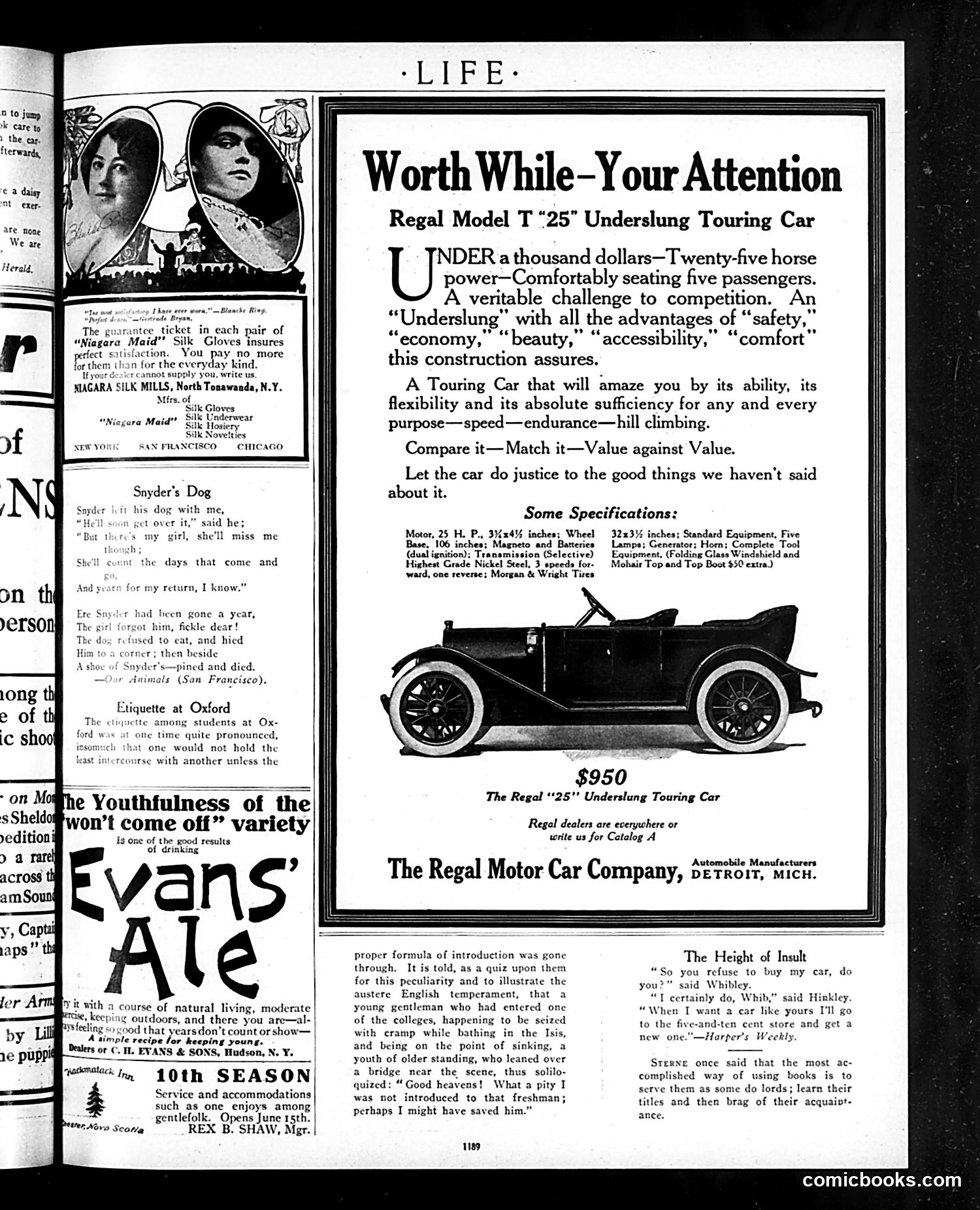
This page mixes advertising with light satirical content typical of early 20th-century Life magazine. **Main Content:** The dominant feature is a full-page advertisement for the Regal Model T "25" Underslung Touring Car, priced under $1,000. The ad emphasizes affordability, safety, comfort, and performance—standard automobile marketing language of the era. **Satirical Pieces:** - "Snyder's Dog": A sentimental poem about a dog that pines to death after its master leaves, while his girlfriend forgets him. This mocks overly melodramatic Victorian sentimentality. - "Etiquette at Oxford": A humorous anecdote about rigid British college protocol—a student refuses to save a drowning classmate because they hadn't been formally introduced. It satirizes stuffy academic formality taken to absurd extremes. - "The Height of Insult": A brief joke about refusing a cheap car. The page represents Life's mix of consumer advertising and gentle social satire aimed at middle-class American readers.
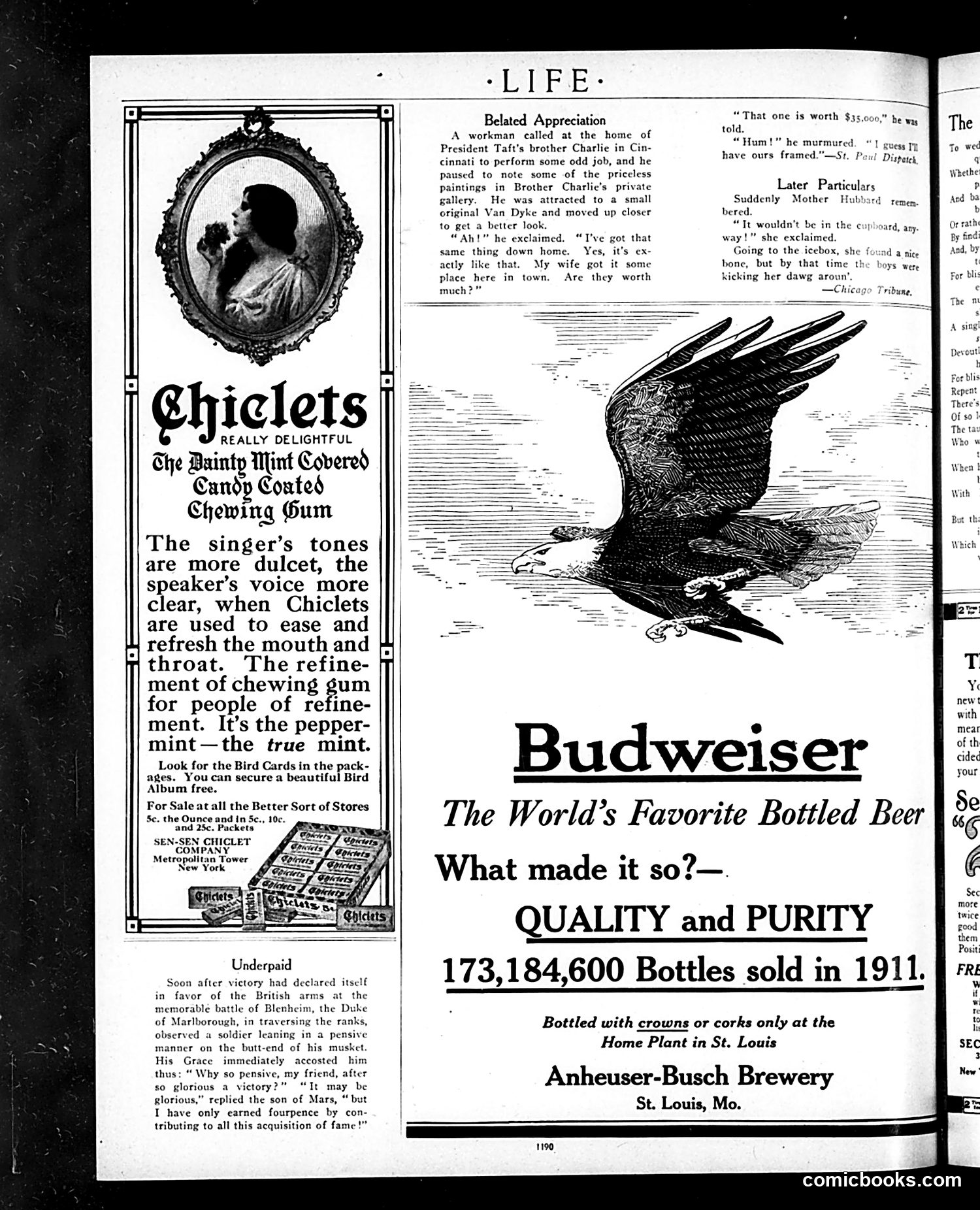
This page combines three distinct pieces: **Left side:** A Chiclets gum advertisement with an ornate portrait frame, marketing the product as refined and clarifying to speech—targeting educated consumers. **Center:** Two short humorous anecdotes. "Underpaid" is a historical joke about a British soldier at the Battle of Blenheim (1704) complaining he earned only fourpence for his glory. "Belated Appreciation" mocks a working-class man who visits President Taft's brother's home and discovers he owns a painting identical to one his wife acquired—suggesting either mass reproduction or coincidental similarity, highlighting class differences in art appreciation. **Right side:** A Budweiser advertisement boasting 173 million bottles sold in 1911, emphasizing "quality and purity"—likely referencing consumer confidence before Prohibition (1920). The page reflects early-1900s concerns: class distinctions, advertising to aspirational audiences, and pre-Prohibition beer marketing.
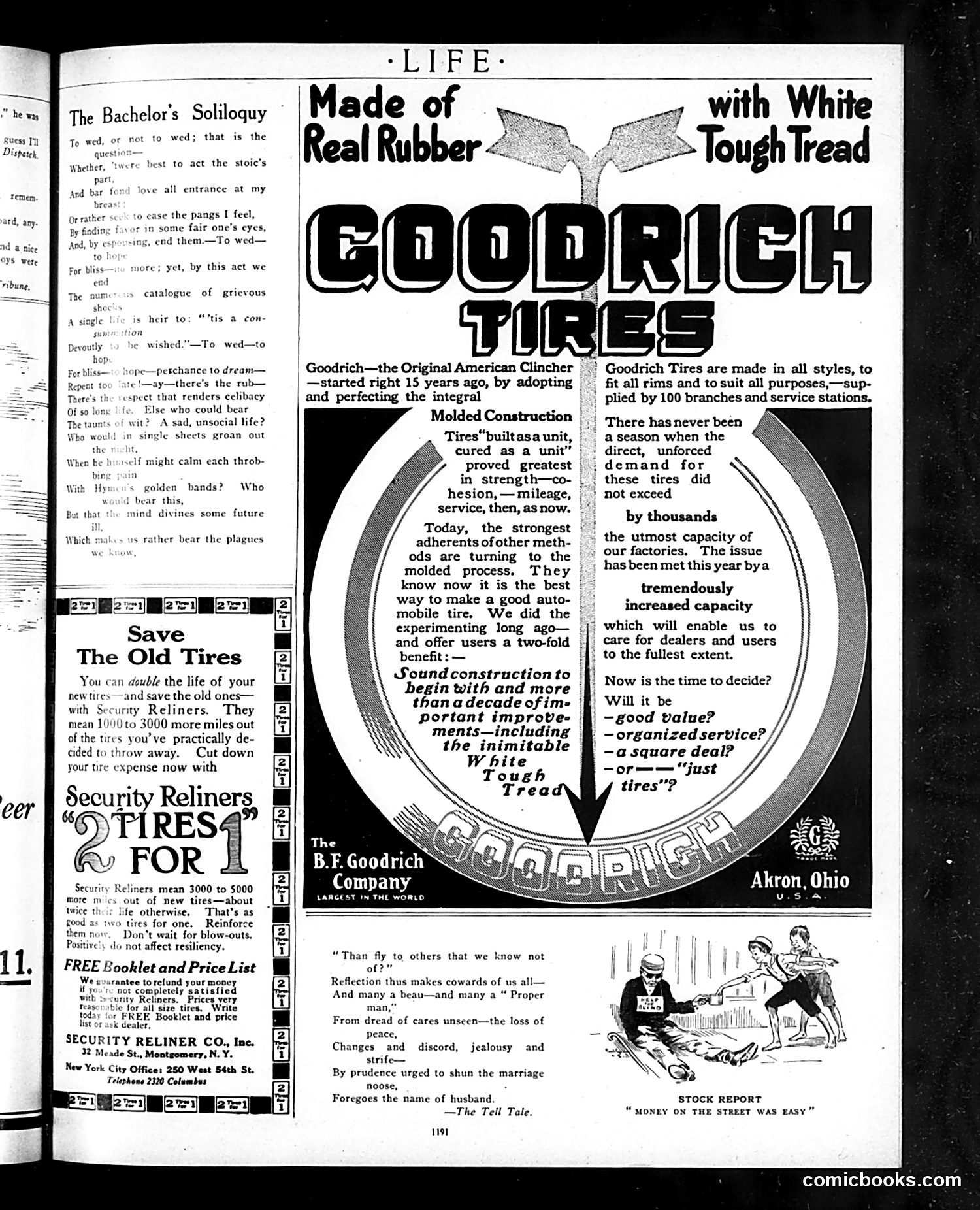
This page combines literary satire with period advertising. **"The Bachelor's Soliloquy"** (left) is a parody of Hamlet's famous soliloquy, reframed as a man debating marriage versus bachelorhood. Rather than existential despair, the speaker weighs romantic love against the "catalogue of grievous shocks" marriage brings—lost freedom, financial burden, domestic discord. The satire mocks both romantic idealism and male anxieties about matrimony, suggesting marriage as a kind of death. **The dominant Goodrich Tires advertisement** (center-right) promotes their "molded construction" tire with "White Tough Tread," claiming superiority over competitors' methods. It addresses dealer concerns about capacity and quality assurance during apparent high demand. **Secondary advertisements** promote Security Reliners (tire reinforcement) and a stock market tip ("Money on the Street Was Easy"). The **small cartoon** (lower right) depicts a couple and child, likely illustrating domestic life—possibly meant to complement the marriage-debate theme above, though its specific meaning is unclear from context alone.
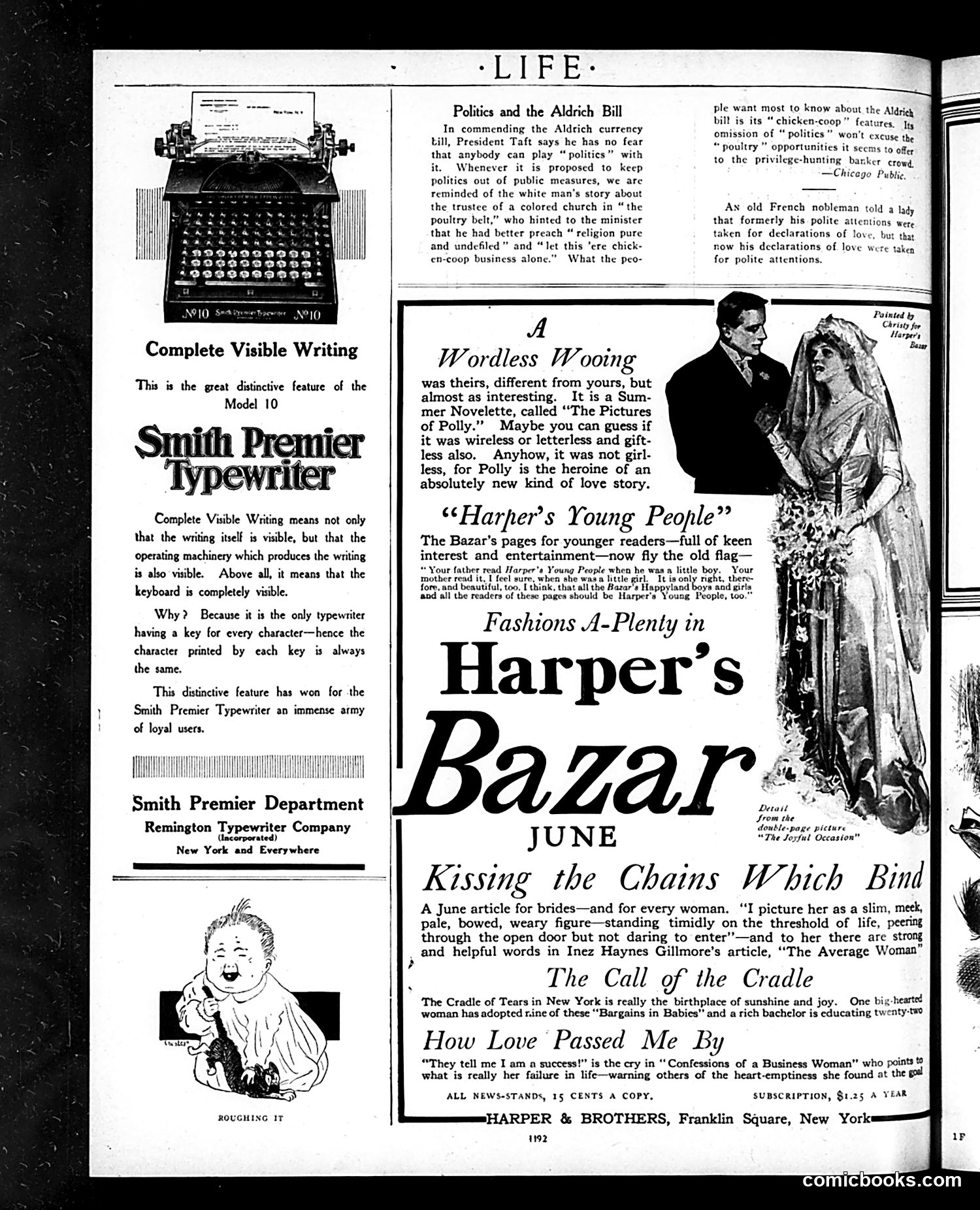
This page is primarily **advertising and magazine promotion** rather than political satire. The left column advertises the **Smith Premier Typewriter**, emphasizing its "Complete Visible Writing" feature where all keys and machinery are visible—a selling point distinguishing it from competitors. The right side promotes **Harper's Bazaar** magazine content, featuring articles on fashion, relationships, and social issues aimed at women readers. Notable pieces include "Kissing the Chains Which Bind" (about marriage constraints) and "How Love Passed Me By" (about a successful businesswoman whose career came at emotional cost). The only political content is a brief **editorial comment on the Aldrich Bill** (currency legislation under President Taft), using a satirical anecdote about a church trustee requesting "religion pure" while ignoring questionable "chicken-coop business"—suggesting politicians claiming to remove "politics" from legislation are hypocritical. The cartoon "Roughing It" (lower left) appears unrelated to this page's main content.
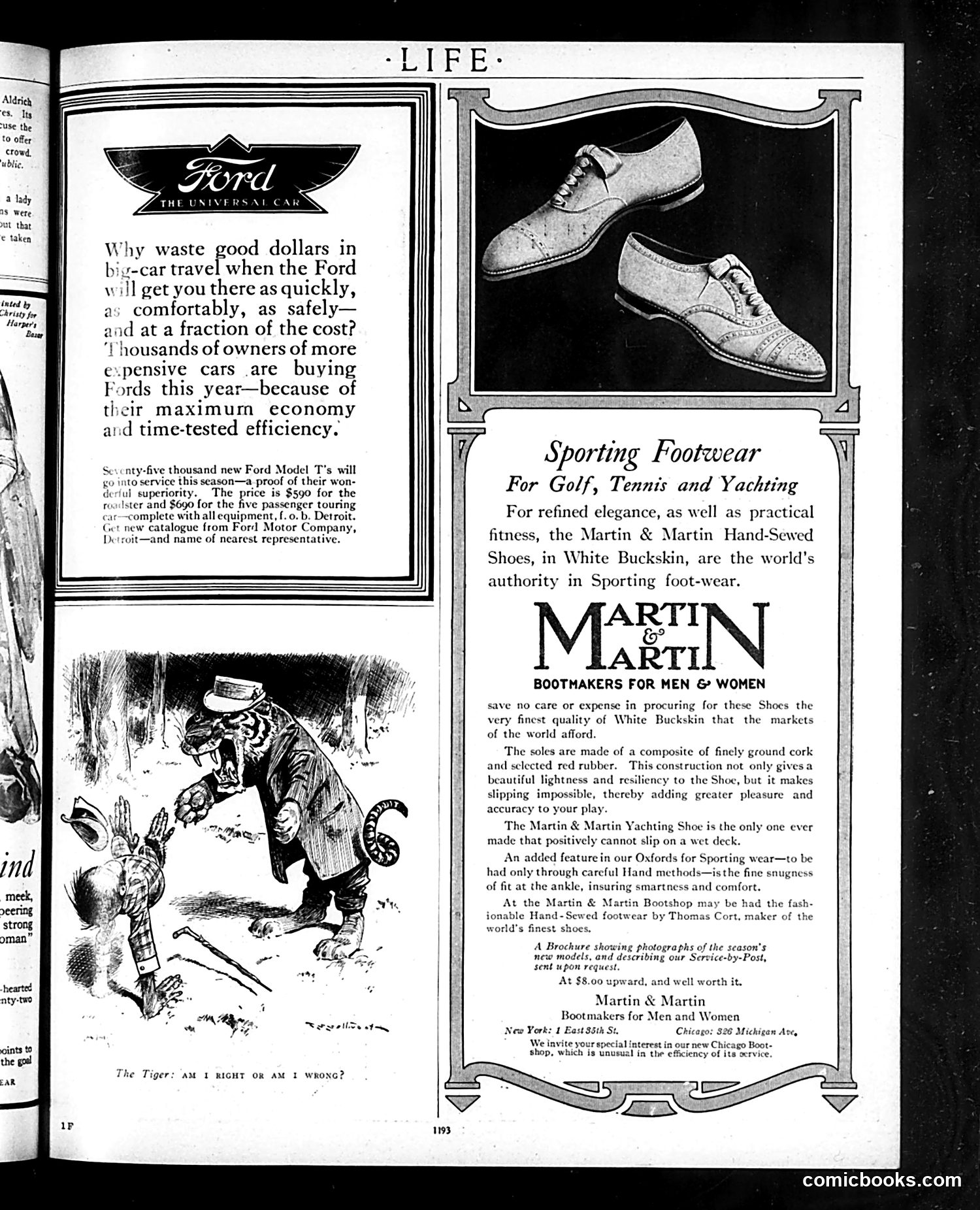
This page is primarily **advertising**, not satirical content. It contains two main ads: **Ford Model T advertisement** (left): Promotes the Ford as economical transportation, noting 75,000 new Model T's entering service. Prices listed ($590-$690) emphasize affordability compared to "more expensive cars." **Martin & Martin Shoes advertisement** (right): Markets hand-sewn white buckskin sporting shoes for golf, tennis, and yachting, emphasizing quality materials and craftsmanship. **"The Tiger" cartoon** (bottom left): A small sketch labeled "AM I RIGHT OR AM I WRONG?" appears to be editorial content, though the image is too small and unclear to identify the specific figure or satirical point being made. The page reflects early 20th-century consumer culture, with the juxtaposition suggesting leisure activities (yachting, golf) enabled by affordable automobile access—a notable social shift for the era.
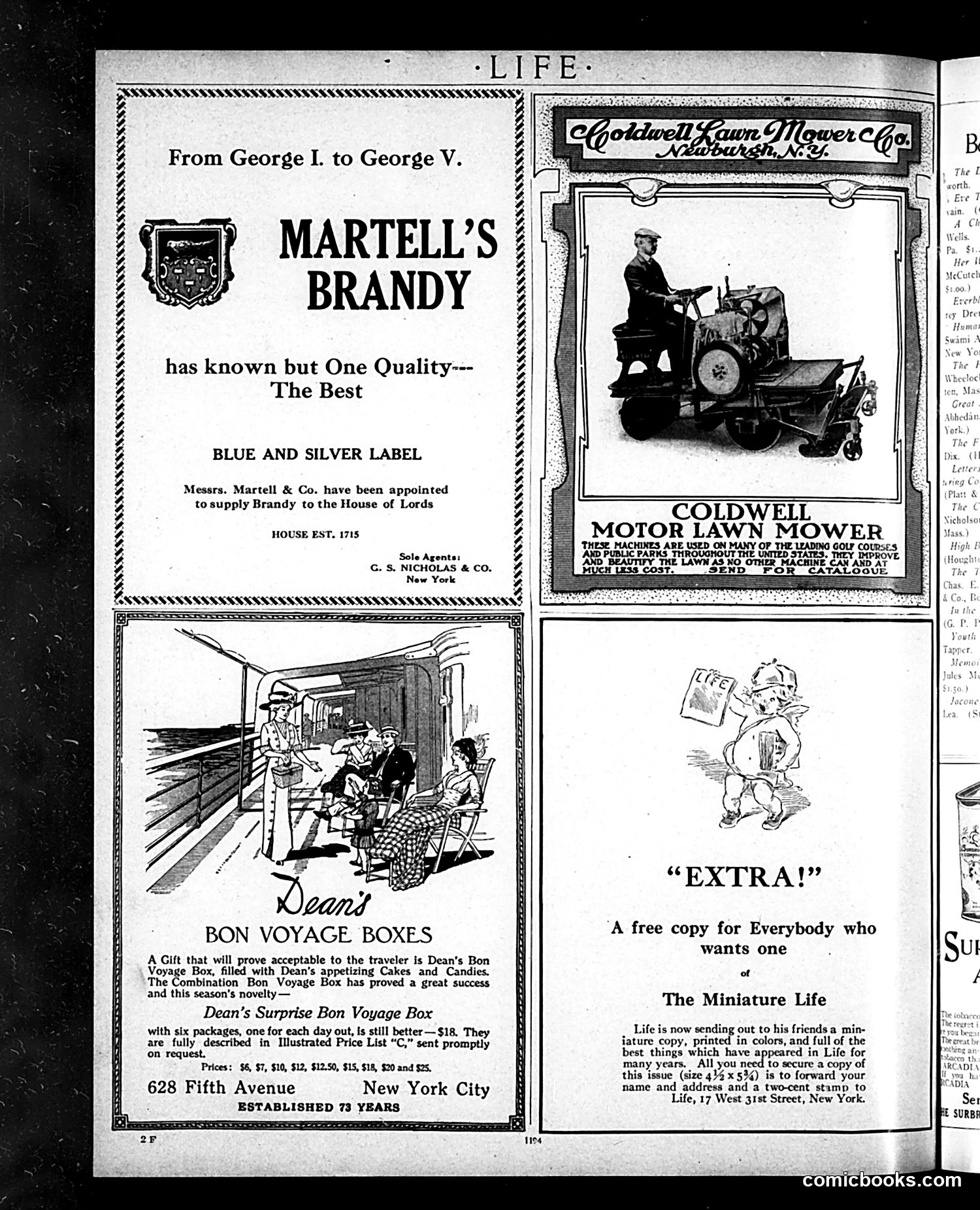
This page consists primarily of **period advertisements** rather than editorial cartoons or satire. The ads include: - **Martell's Brandy**: luxury liquor claiming five centuries of quality, appointed supplier to the British House of Lords - **Dean's Bon Voyage Boxes**: gift boxes of cakes and candies for travelers, with prices ranging $6–$25 - **Coldwell Motor Lawn Mower**: industrial/commercial mowing equipment for golf courses and parks - **The Miniature Life**: promotional offering a miniature color edition of Life magazine itself The page's header "From George I. to George V" references British monarchs across centuries, emphasizing Martell's longevity and prestige. The sole editorial element is a small cartoon figure marked "EXTRA!" advertising the miniature magazine offer. The content reflects early-20th-century consumer culture: luxury goods, travel accessories, and mechanical innovation marketed to affluent readers. There is **no political satire present** on this particular page.
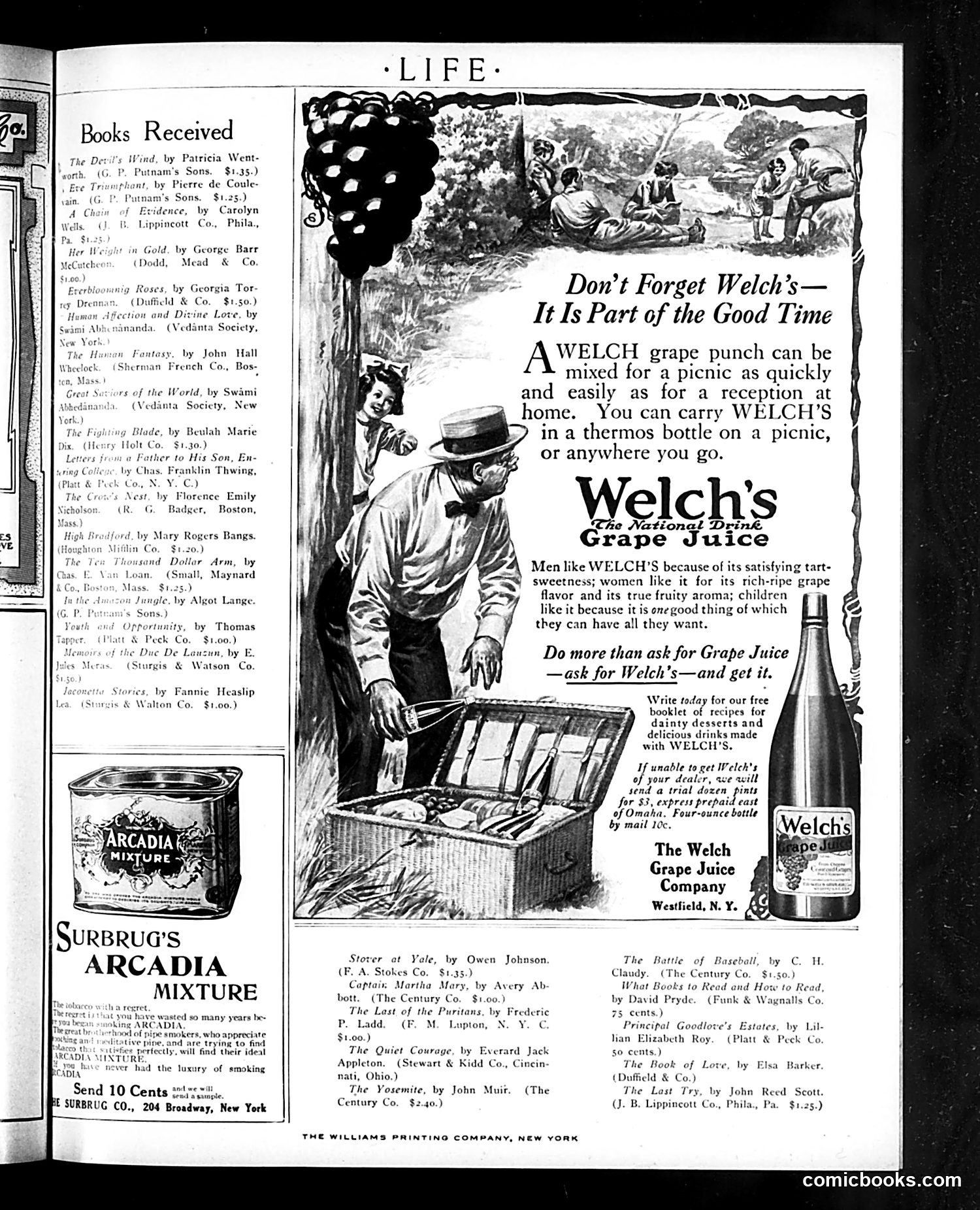
This page is primarily **advertising and book listings**, not political satire. The dominant content is a large advertisement for Welch's Grape Juice featuring an illustrated man opening a picnic basket, with text emphasizing the product's versatility for social occasions. The left column lists newly published books with prices—typical literary notices from an early 20th-century magazine. Below is a smaller ad for Surbrugg's Arcadia Mixture tobacco. **No political cartoon or satire appears on this page.** The Welch's ad uses nostalgic imagery of leisure and picnicking to market the product, but this is commercial messaging rather than commentary. The overall page reflects the magazine's revenue model: selling advertising space alongside editorial content and book reviews for a middle-class readership interested in literature and consumer goods.
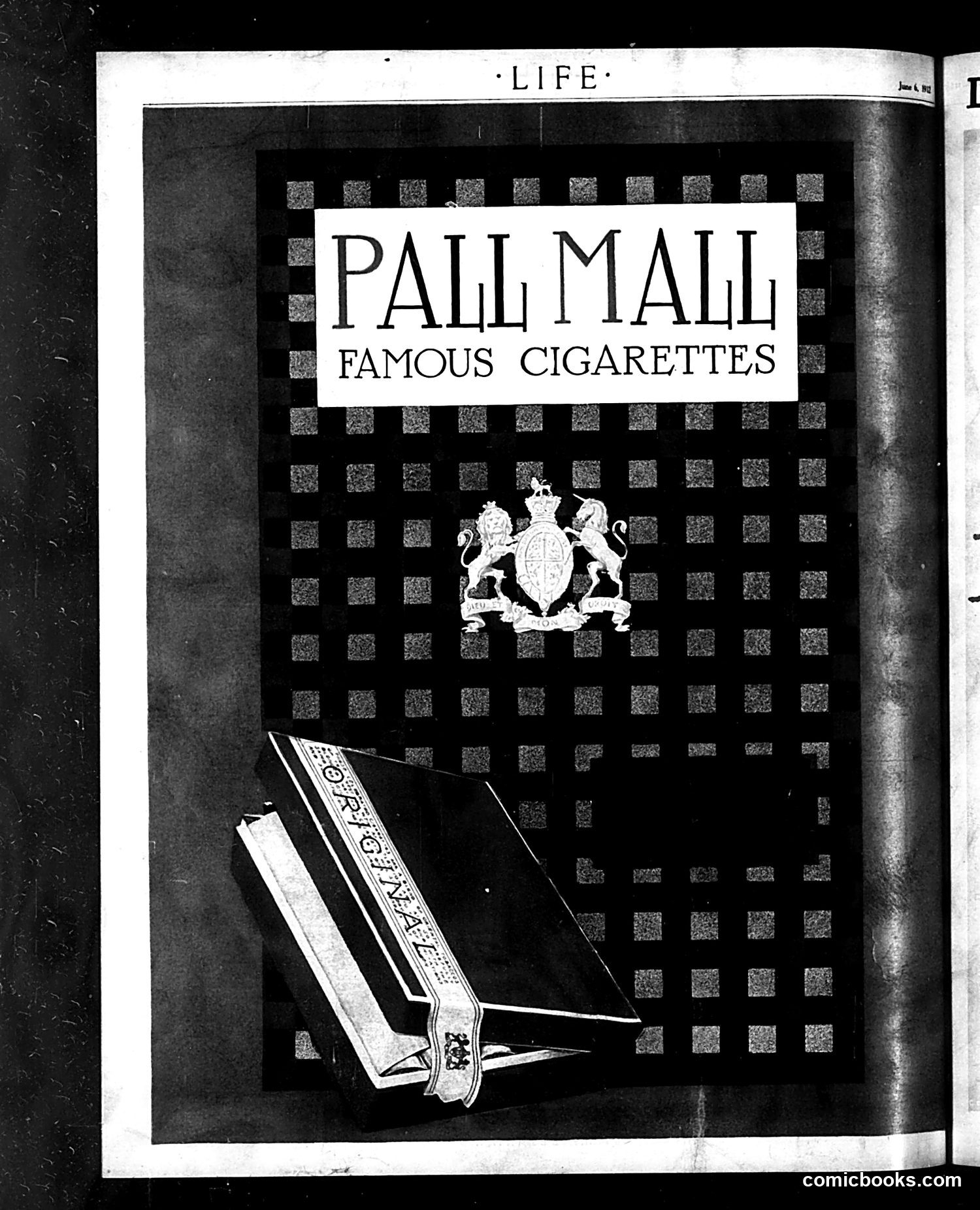
This is a Pall Mall cigarette advertisement from *Life* magazine. The page features the brand name prominently displayed above a royal coat of arms (likely British, suggesting prestige and quality). Below is an illustration of an open Pall Mall cigarette package displayed at an angle. The ad uses aristocratic imagery—the heraldic crest with lion and unicorn supporters—to market cigarettes as a luxury, refined product associated with sophistication and upper-class status. This was a common advertising strategy of the era, when tobacco companies leveraged symbols of wealth and nobility to appeal to consumers. The page itself appears to be primarily an advertisement rather than satirical content.