
Life, 1912-06-06 · page 17 of 56
Life — June 6, 1912 — page 17: what you’re looking at
What you’re looking at
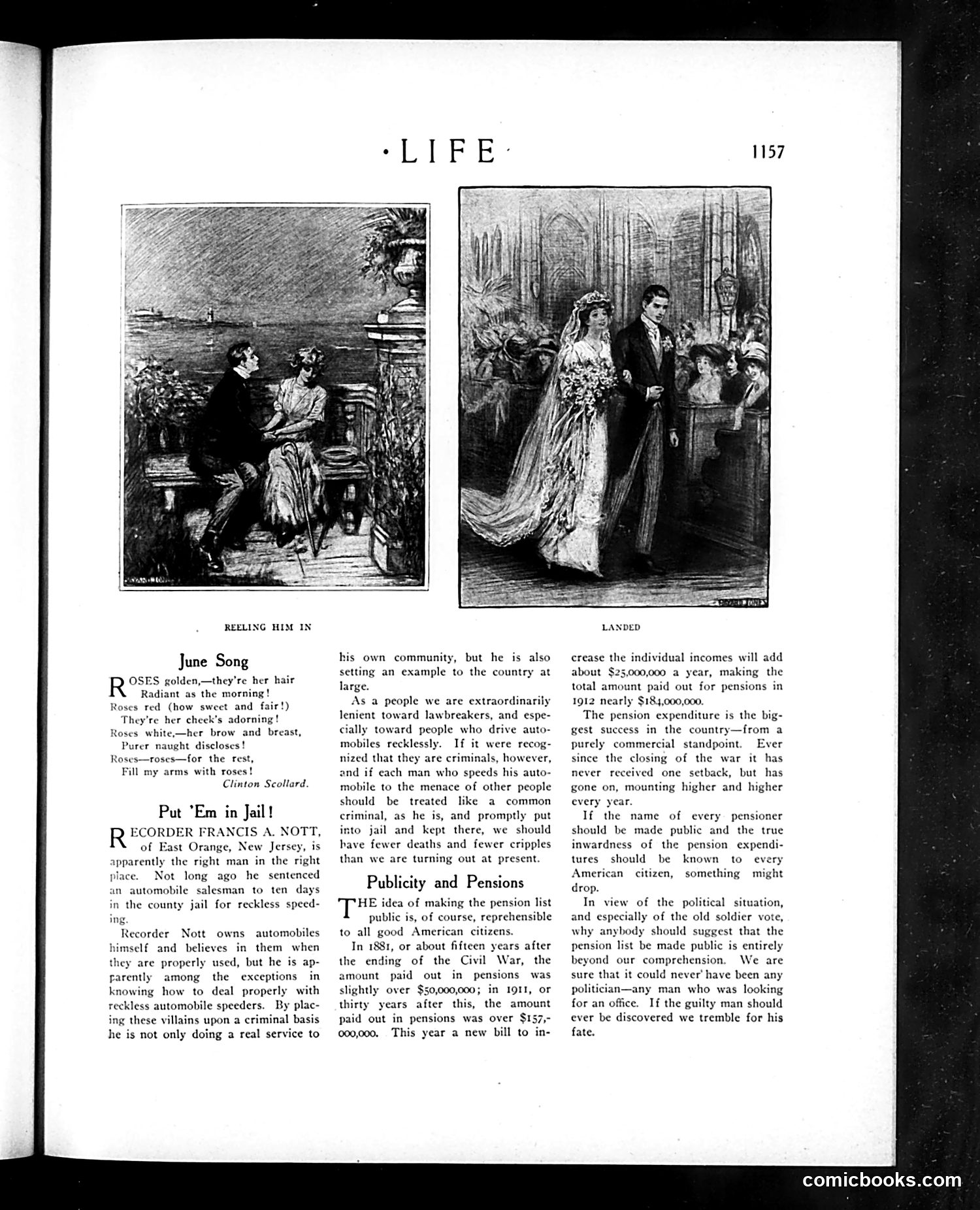
This page contains two illustrations and commentary on early 1900s American social issues. **Left illustration** ("Belling Him In"): A romantic scene accompanying Clinton Scollard's sentimental poem about roses and courtship—likely included for aesthetic contrast with the serious content. **Right illustration** ("Landed"): Depicts a formal wedding ceremony, appearing to illustrate social commentary on marriage and propriety. **Main content focuses on two topics:** 1. **Reckless Automobile Driving**: Praises Recorder Francis Nott of East Orange, New Jersey, for jailing a reckless speeder. The satire argues that if automobile speeding were treated as a serious crime rather than a minor offense, fewer deaths and injuries would result. This reflects early concerns about dangerous driving. 2. **Pension Expenditures**: Criticizes the growing Civil War pension system (growing from $50 million in 1881 to $184 million by 1912) as politically untouchable. The article argues that publicizing pensioner names would reveal wasteful spending, but no politician would dare propose this due to the "old soldier vote." Both pieces satirize American leniency toward lawbreakers and political cowardice regarding fiscal responsibility.
📄 Transcribed text from this page (OCR, searchable)
Machine-transcribed from the original scan — historical spelling and the odd misread are preserved.
HIM IN OSES golden,—they’re her hair Radiant as the morning! Roses red (how sweet and fair!) They're her cheek’s adorning Roses white,—her brow and breast, aught discloses! Roses—roses—for the rest, Fill my arms with roses! Clinton Scollard. Purer =<CORDER FRANCIS 4 OT1 East Orange, New Jers: apparently the right man in the right place. Not long ago he sentenced an automobile salesman to ten days in the county jail for reckless speed- ing. Recorder Nott owns automobiles himself and believes in them when they are properly used, but he is ap- farently among the exceptions in knowing how to deal properly with reckless automobile speeders. By plac- ing these villains upon a criminal basis he is not only doing a real service to his own community, but he is also setting an example to the country at large. As a people we are extraordinarily lenient toward lawbreakers, and espe- cially toward people who drive auto- mobiles recklessly. If it were recog- nized that they are criminals, however, and if each man who speeds his auto- mobile to the menace of other people should be treated like a common criminal, as he is, and promptly put into jail and kept there, we should have fewer deaths and fewer cripples than we are turning out at present. Publicity and Pensions HE idea of making the pension list public is, of course, reprehensible to all good American citizen In 1881, or about fifteen years after the ending of the Civil War, the amount paid out in pensions was slightly over $50,000,000; in 1911, or thirty years after this, the amount paid out in pensions was over $157,- 000,000, This year a new bill to in- LANDED crease the individual incomes will add about $23,000,000 a year, making the total amount paid out for pensions in 1912 nearly $184,000,000. The pension expenditure is the big- gest success in the country—from a purely commercial standpoint. Ever since the ing of the war it has never received one setback, but has gone on, mounting higher and higher every year. If the name of every pensioner should be made public and the true inwardness of the pension expendi- tures should be known to every American citizen, something might drop. In view of the political situation, and especially of the old soldier vote, why anybody should suggest that the pension list be made public is entirely beyond our comprehension. We are sure that it could never’ have been any politician—any man who was looking for an office. If the guilty man should ever be discovered we tremble for his fate. comicbooks.com