
Life, 1912-06-06 · page 31 of 56
Life — June 6, 1912 — page 31: what you’re looking at
What you’re looking at
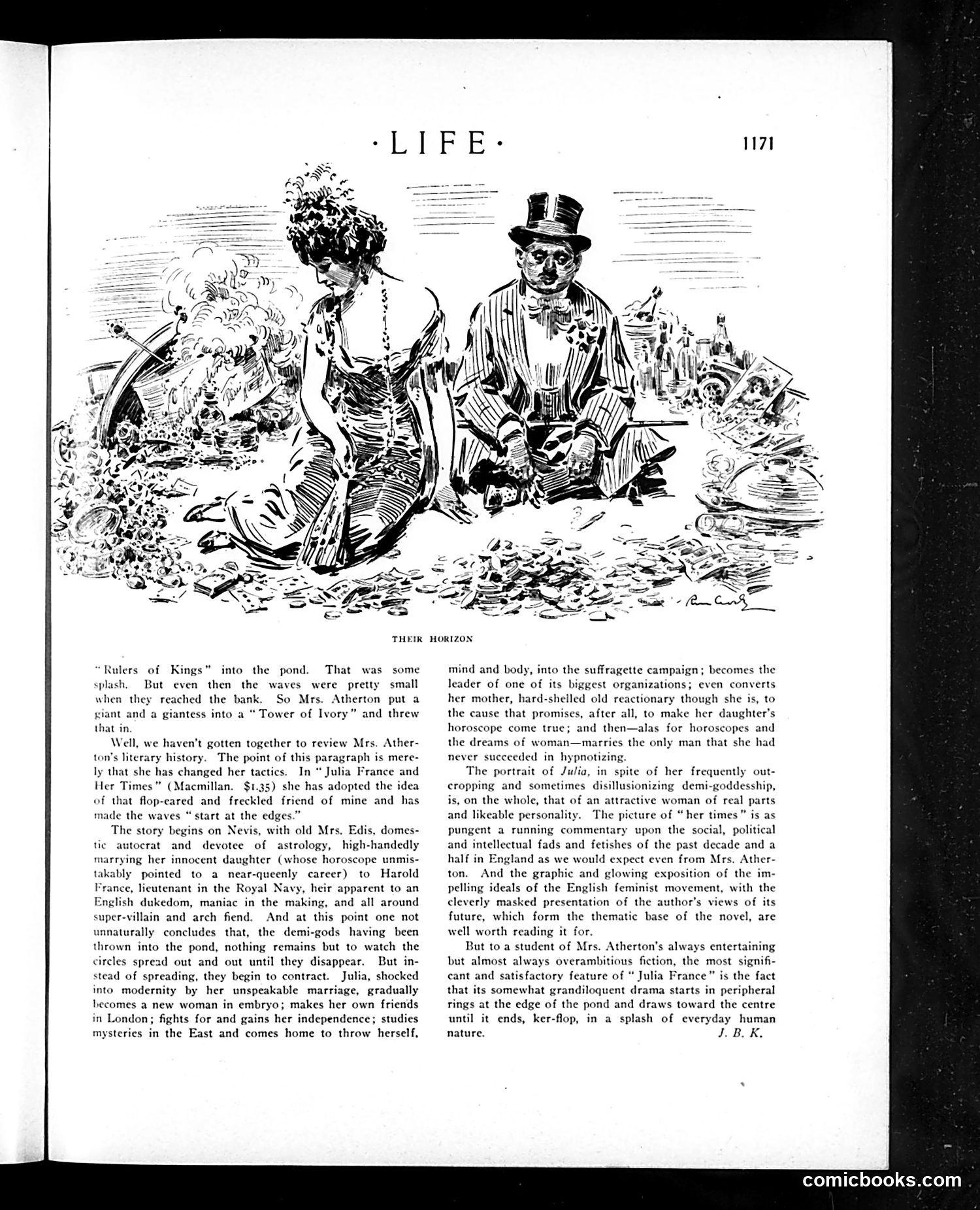
This is a literary review of Gertrude Atherton's novel "Julia France and Her Times" (1916), not a political cartoon. The illustration depicts the book's protagonist and supporting characters. The review uses a extended metaphor about throwing objects into a pond—Atherton's earlier works created small ripples ("Rulers of Kings"), but this novel "starts at the edges" with larger impact. Julia France begins as a victim of an arranged marriage to a naval officer destined for nobility, but "shocked into modernity" by this disastrous union, she becomes a suffragette activist and leader fighting for women's independence and voting rights. The reviewer praises the novel's portrayal of Edwardian-era English social and political movements, particularly the feminist campaign. The ironic conclusion: Julia's horoscope predicts queenly status, but she ultimately achieves this through suffragette work—only to marry and settle into "everyday human nature," subverting romantic expectations. The satire targets both Atherton's tendency toward melodrama and contemporary attitudes about women's ambitions versus marriage.
📄 Transcribed text from this page (OCR, searchable)
Machine-transcribed from the original scan — historical spelling and the odd misread are preserved.
THEIR HORIZON “Rulers of Kings” into the pond. That was some splash, But even then the waves were pretty small when they reached the bank. So Mrs. Atherton put a tiant and a giantess into a “ Tower of Ivory” and threw that in. Well, we haven't gotten together to review Mrs. Ather- ton’s literary history. The point of this paragraph is mere- ly that she has changed her tactics. In “ Julia France and Her Times” (Macmillan. $1.35) she has adopted the idea of that flop-eared and freckled friend of mine and has made the waves “ start at the edges.” The story begins on Nevis, with old Mrs, Edis, domes- tic autocrat and devotee of astrology, high-handedly marrying her innocent daughter (whose horoscope unmis- takably pointed to a near-queenly career) to Harold France, lieutenant in the Royal Navy, heir apparent to an English dukedom, maniac in the making, and all around super-villain and arch fiend. And at this point one not unnaturally concludes that, the demi-gods having been thrown into the pond, nothing remains but to watch the circles spread out and out until they disappear. But in- stead of spreading, they begin to contract. Julia, shocked into modernity by her unspeakable marriage, gradually becomes a new woman in embryo; makes her own friends in London; fights for and gains her independence; studies mysteries in the East and comes home to throw herself, mind and body, into the suffragette campaign; becomes the leader of one of its biggest organizations; even converts her mother, hard-shelled old reactionary though she is, to the cause that promises, after all, to make her daughter's horoscope come true; and then—alas for horoscopes and the dreams of woman—marries the only man that she had never succeeded in hypnotizing. The portrait of Julia, in spite of her frequent cropping and sometimes disillusionizing demi-goddes is, on the whole, that of an attractive woman of real par and likeable personality. The picture of “her times” is as pungent a running commentary upon the social, political and intellectual fads and fetishes of the past decade and a half in England as we would expect even from Mrs. Athe ton. And the graphic and glowing exposition of the im- pelling ideals of the English feminist movement, with the cleverly masked presentation of the author's views of its future, which form the thematic base of the novel, are well worth reading it for. But to a student of Mrs. Atherton’s always entertaining but almost always overambitious fiction, the most signifi- cant and satisfactory feature of “ Julia France” is the fact that its somewhat grandiloquent drama starts in peripheral rings at the edge of the pond and draws toward the centre until it ends, ker-flop, in a splash of everyday human nature, J. BLK. comicbooks.com