
Life, 1912-06-06 · page 13 of 56
Life — June 6, 1912 — page 13: what you’re looking at
What you’re looking at
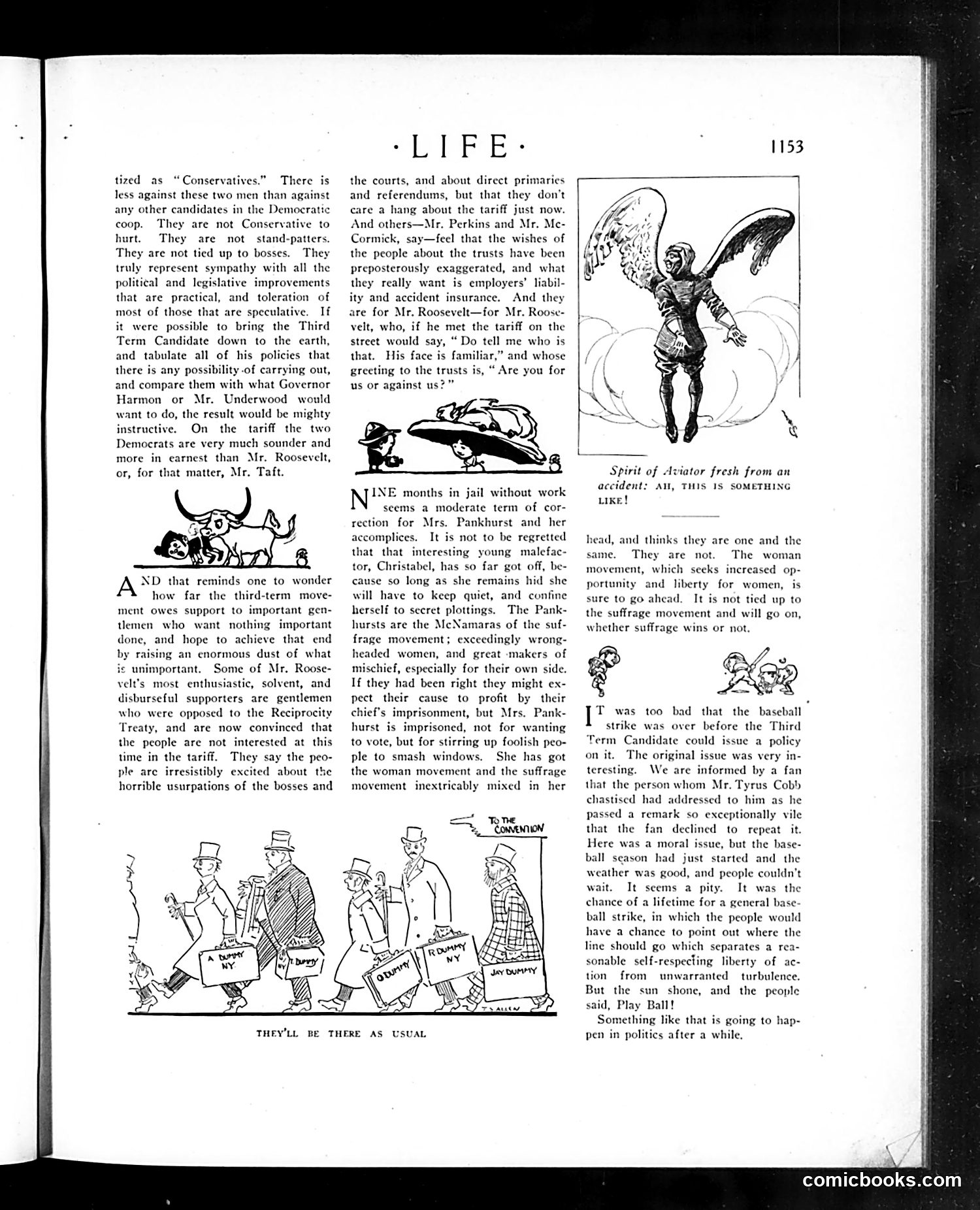
This page satirizes **Progressive Era politics** and the 1912 election. The text criticizes third-party ("Bull Moose") supporters, calling them naive idealists who actually help neither Roosevelt nor Taft by splitting votes. The bottom cartoon titled "THEY'LL BE THERE AS USUAL" depicts various political figures carrying bags labeled with party positions, heading "TO THE CONVENTION"—mocking how politicians mechanically recycle the same platform promises regardless of which candidate or party they support. The flying figure cartoon references **Mrs. Pankhurst's suffrage movement** (mentioned in text), satirizing the women's movement by depicting activism as chaotic and mixed with foolishness. The page's overall message: politicians and movements are fundamentally predictable and self-interested, despite their reform rhetoric.
📄 Transcribed text from this page (OCR, searchable)
Machine-transcribed from the original scan — historical spelling and the odd misread are preserved.
tized as “Conservatives.” There is less against these two men than against any other candidates in the Democratic coop. They are not Conservative to hurt. They are not stand-patters. They are not tied up to bosses. They truly represent sympathy with all the political and legislative improvements that are practical, and toleration of most of those that are speculative. If it were possible to bring the Third Term Candidate down to the earth, and tabulate all of his policies that there is any possibility of carrying out, and compare them with what Governor Harmon or Mr. Underwood would want to do, the result would be mighty instructive. On the tariff the two Democrats are very much sounder and more in earnest than Mr. Roosevelt, or, for that matter, Mr. Taft. ND that reminds one to wonder how far the ‘d-term move- ment owes support to important gen- tlemen who want nothing important done, and hope to achieve that end by raising an enormous dust of what unimportant. Some of Mr. Roose- velt’s most enthusiastic, solvent, and disburseful supporters are gentlemen who were opposed to the Reciprocity Treaty, and are now convinced that the people are not interested at this time in the tariff. They say the peo- ple are irresistibly excited about the horrible usurpations of the bosses and THEY'LL oO a the courts, and about direct primaries and referendums, but that they don’t care a hang about the tariff just now. And others—Mr. Perkins and Mr. Me- Cormick, say—feel that the wishes of the people about the trusts have been preposterously exaggerated, and what they really want is employers’ liabil- ity and accident insurance. And they are for Mr. Roosevelt—for Mr. Roose- velt, who, if he met the tariff on the street would say, “ Do tell me who is that. His face is familiar,” and whose greeting to the trusts is, “ Are you for us or against us?” INE months in jail without work seems a moderate term of cor- rection for Mrs, Pankhurst and her accomplice It is not to be regretted that that interesting young malefac- tor, Christabel, has so far got off, be- cause so long as she remains hid she will have to keep quiet, and confine herself to secret plottings. The Pank- hursts are the MeNamaras of the suf- frage movement; exceedingly wrong- headed women, and great ‘makers of mischief, especially for their own side. If they had been right they might ex- pect their cause to profit by their chief's imprisonment, but Mrs. Pank- hurst is imprisoned, not for wanting to vote, but for stirring up foolish peo- ple to smash windows. She has got the woman movement and the suffrage movement inextricably mixed in her BE THERE AS Spirit of Aviator fresh from an accident: au, THIS 1S SOMETHING uke! d, and thinks they are one and the They are not. The woman movement, which seeks increased op- portunity i same, and liberty for women, is sure to go ahead. It is not tied up to the suffrage movement and will go on, whether suffrage wins or not. was too bad that the baseball strike was over before the Third rerm Candidate could issue a policy on it. The original issue was very in- teresting. We are informed by a fan that the person whom Mr. Tyrus Cobb chastised had addressed to him as he passed a remark so exceptionally vile that the fan declined to repeat it. Here was a moral issue, but the base- ball season had just started and the weather was good, and people couldn't wait. It seems a pity. It was the chance of a lifetime for a general base- ball strike, in which the people would have a chance to point out where the line should go which separates a rea- sonable self-respecting liberty of ac- tion from unwarranted turbulence. But the sun shone, and the people said, Play Ball! Something like that is going to hap- pen in politics after a while, comicbooks.com