
Life, 1912-06-06 · page 18 of 56
Life — June 6, 1912 — page 18: what you’re looking at
What you’re looking at
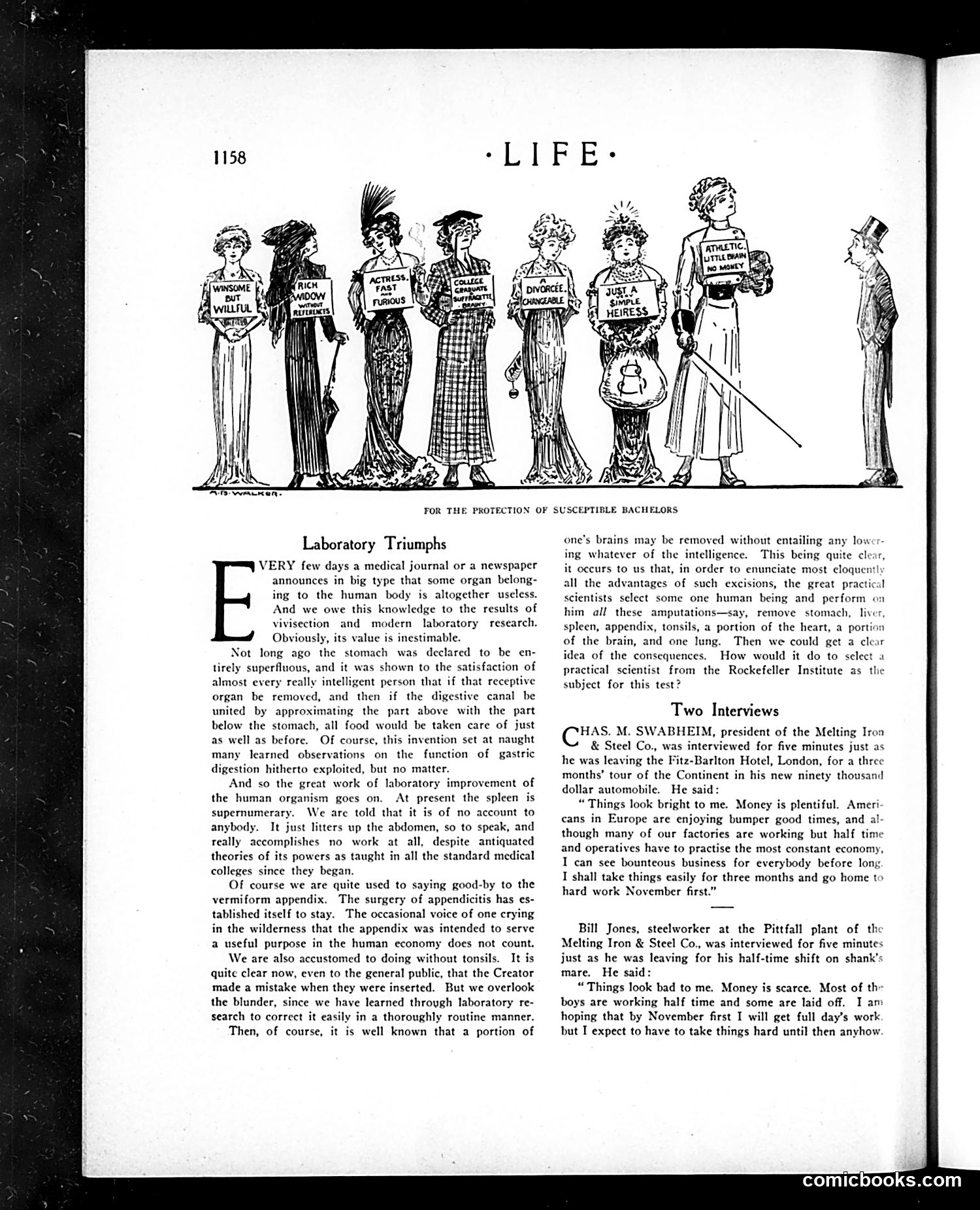
This page satirizes early-20th-century medical overconfidence and economic inequality. **Top Cartoon**: The illustration shows eight types of women "for the protection of susceptible bachelors"—each labeled with dismissive stereotypes (willing wife, rich widow, fast divorcée, etc.). This mocks both contemporary attitudes toward women and satirizes the magazine's own era of gender stereotyping. **"Laboratory Triumphs"**: The essay ridicules medical science's casual dismissal of human organs (stomach, spleen, appendix, tonsils, brain portions) as "useless" based on laboratory research. The satire peaks with a proposal to perform *all* these removals on a Rockefeller Institute scientist to prove their insignificance—revealing the absurdity of the logic. **"Two Interviews"**: This juxtaposes a wealthy industrialist and a steelworker from the same company. Both discuss identical economic conditions, but the rich man sees prosperity while the working man sees hardship. This directly exposes class-based economic perception and corporate hypocrisy during an era of worker hardship and factory shutdowns.
📄 Transcribed text from this page (OCR, searchable)
Machine-transcribed from the original scan — historical spelling and the odd misread are preserved.
FOR THE PROTECTION OF SUSCEPTIBLE BACHELORS Laboratory Triumphs VERY few days a medical journal or a newspaper announces in big type that some organ belong- ing to the human body is altogether useless. And we owe this knowledge to the results of vivisection id modern laboratory research. Obviously, its value is inestimable. Not long ago the stomach was declared to be en- tirely superfluous, and it was shown to the satisfaction of almost every really intelligent person that if that receptive organ be removed, and then if the digestive canal be united by approximating the part above with the part below the stomach, all food would be taken care of just as well as before. Of course, this invention set at naught many learned observations on the function of gastric digestion hitherto exploited, but no matter. And so the great work of laboratory improvement of the human organism goes on. At present the spleen is supernumerary. We are told that it is of no account to anybody. It just litters up the abdomen, so to speak, and really accomplishes no work at all, despite antiquated theories of its powers as taught in all the standard medical colleges since they began. Of course we are quite used to saying good-by to the vermiform appendix. The surgery of appendicitis has es- tablished itself to stay. The occasional voice of one crying in the wilderness that the appendix was intended to serve a useful purpose in the human economy does not count. We are also accustomed to doing without tonsils. It is quite clear now, even to the general public, that the Creator made a mistake when they were inserted. But we overlook the blunder, since we have learned through laboratory re- search to correct it easily in a thoroughly routine manner. Then, of course, it is well known that a portion of one’s brains may be removed without entailing any low ing whatever of the intelligence. This being quite clear, it occurs to us that, in order to enunciate most eloquently all the advantages of such excisions, the great practical scientists select some one human being and perform on him all these amputations—say, remove stomach, liver spleen, appendix, tonsils, a portion of the heart, a portion of the brain, and one lung. Then we could get a clear idea of the consequences. How would it do to select a practical scientist from the Rockefeller Institute as the subject for this test? Two Interviews HAS. M. SWABHEIM, president of the Melting Iron & Steel Co., was interviewed for five minutes just as he was leaving the Fitz-Barlton Hotel, London, for a three months’ tour of the Continent in his new ninety thousand dollar automobile. He said: “ Things look bright to me. Money is plentiful. Ameri cans in Europe are enjoying bumper good times, and al- though many of our factories are working but half time and operatives have to practise the most constant economy, I can see bounteous business for everybody before long. I shall take things easily for three months and go home to hard work November first.” Bill Jones, steelworker at the Pittfall plant of the Melting Iron & Steel Co., was interviewed for five minutes just as he was leaving for his half-time shift on shank’s mare. He said: “Things look bad to me. Money is scarce. Most of th boys are working half time and some are laid off. I am hoping that by November first I will get full day’s work but I expect to have to take things hard until then anyhow. comicbooks.com