
Life, 1912-06-06 · page 30 of 56
Life — June 6, 1912 — page 30: what you’re looking at
What you’re looking at
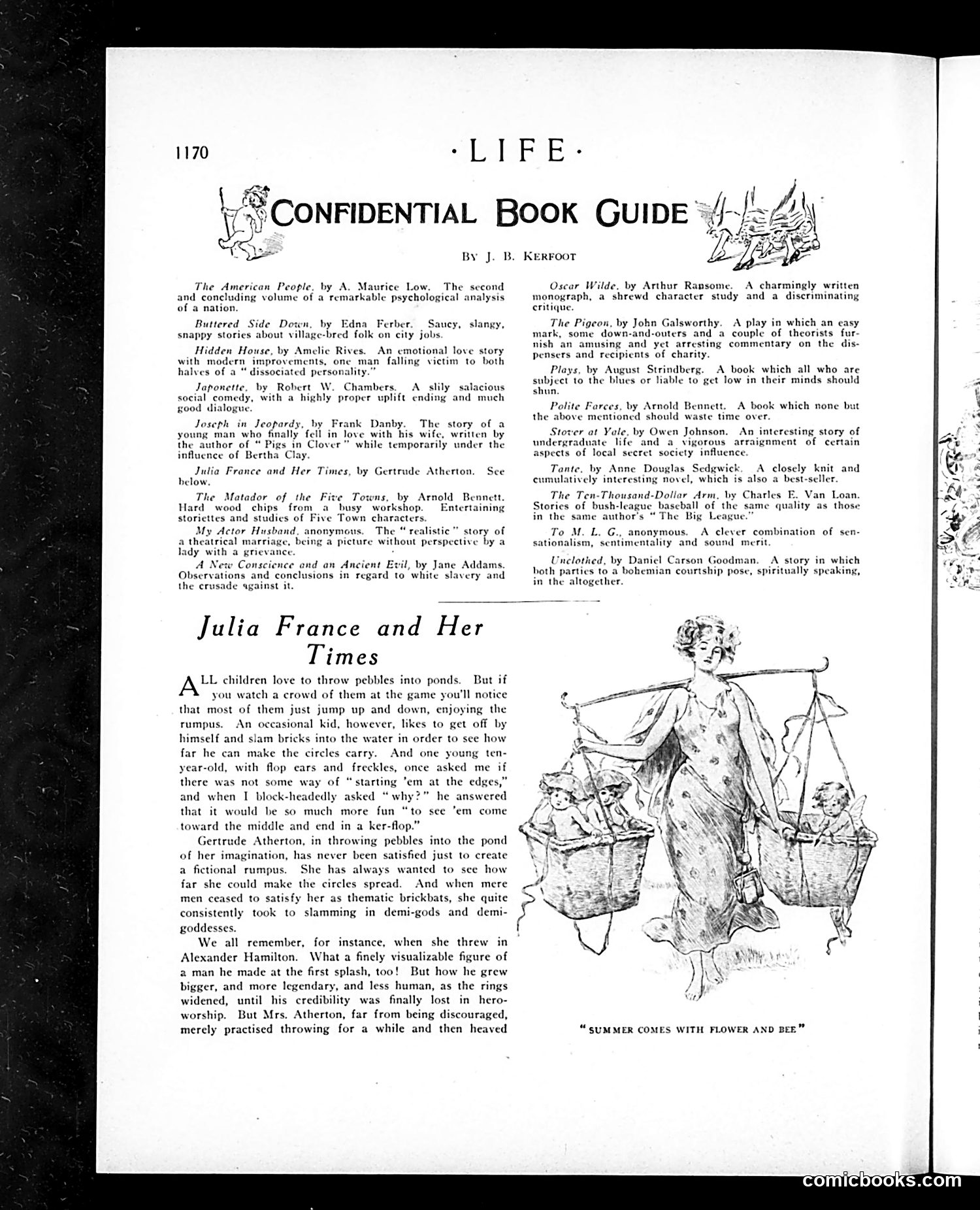
This page contains a "Confidential Book Guide" reviewing contemporary literature (early 1900s), plus an essay on author Gertrude Atherton. **The Main Illustration:** Shows a woman (likely Atherton) with a scale, symbolizing her tendency to weigh or balance themes—matching the essay's metaphor about "throwing pebbles" to create expanding circles. **The Core Satire:** The review uses an extended metaphor: Atherton is like a child throwing increasingly large objects (bricks, then "demi-gods") into a pond to see how far the ripples spread. The satire critiques her as someone who manipulates grand historical/mythological figures (like Alexander Hamilton) as mere fictional props, inflating them beyond credibility in pursuit of dramatic effect. **Key Point:** The reviewer suggests her ambition exceeds her artistic judgment—she seeks impact over authenticity, making her subjects grow "more legendary, and less human" until they collapse into mere hero-worship rather than convincing characterization. The capsule reviews above are typical *Life* magazine literary criticism: brief, witty, sometimes dismissive judgments for educated readers.
📄 Transcribed text from this page (OCR, searchable)
Machine-transcribed from the original scan — historical spelling and the odd misread are preserved.
lel ay By J. B. The American People, by A. Maurice Low. The second and concluding volume of a remarkable psychological analysis of a nation. Buttered Side Down, by Edna Ferber. Saucy, slangy, snappy stories about village-bred folk on city jobs Hidden House, by Amelic Rives. with modern improvements, one m halves of a “ dissociated personali Japonette, by Robert W. Chambers, A slily salacious social comedy, with a highly proper uplift ending and much good dialogue An emotional love story n falling victim to both Joseph in Jeopardy, by Frank Danby. Th young man who finally fell in love with his wife the author of " Pigs in Clover” influence of Bertha Clay story of a written by while temporarily under the Julia France and Her Times, by Gertrude Atherton. below, The Matador of the Five Towns, by Arnold Bennett. Hard wood chips from asy_ workshop. Entertaining storiettes and studics of Five Town characters, My Actor Husband. anonymous. The a theatrical marriage, being a picture withou lady with a grievance A Conscience and an Ancient by Jane Addams. Observations and conclusions in regard to white slavery and the crusade against it. Sce istic” story of perspective by a Julia France and Her Times LL children love to throw pebbles into ponds. you watch a crowd of them at the game you'll notice that most of them just jump up and down, enjoying the But if rumpus. An occasional kid, however, likes to get off by himself and slam bricks into the water in order to see how far he can make the circles carry. And one young ten- year-old, with flop cars and freckles, once asked me if there was not some wv of “starting ‘em at the edges,” and when I -headedly asked “why?” he answered that it would be so much more fun “to see ’em come toward the middle and end in a ker-flop.” Gertrude Atherton of her imagination, ha bloc in throwing pebbles into the pond never been satisfied just to create a fictional rumpus. She has always wanted to sce how far she could make the circles spread. And when mere men ceased to satisfy her as thematic brickbats, she quite consistently took to slamming in demi-gods and demi- goddesses. We all remember, for instance, when she threw in Alexander Hamilton. What a finely visualizable figure of a man he made at the first splash, too! But how he grew bigger, and more legendary, and less human, as the rings widened, until his credibility was finally lost in hero- worship. But Mrs. Atherton, far from being discouraged, merely practised throwing for a while and then heaved : q “CONFIDENTIAL BOOK GUIDE Se ; PE- 45> Oscar Wilde, by Arthur Ransome. A charmingly written monograph, a shrewd character study and a discriminating critique, KERFOOT The Pigeon, by John Galsworthy. A play in which an easy mark, some down-and-outers and a couple of theorists fur- nish an amusing and yet arresting commentary on the dis- pensers and recipients of charity. Plays, by August Strindberg. A book which all who are subject to the blues or liable to get low in their minds should shun, Polite Farces, by Arnold Bennett. A book which none but the above mentioned should waste time over. Stover at Yale, by Owen Johnson. An interesting story of undergraduate life and a Vigorous arraignment of certain aspects of local secret society influence Tante. by Anne Douglas Sedgwick. A closely knit and cumulatively interesting novel, which is also a best-seller. The Ten-Thousand-Dollar Arm, vy Charles E. Van Loan. Stories of bush-league baseball of the ne quality as those in the same author's “The Big League To M. L. G., anonymous, A clever combination of sen- sationalism, sentimentality and sound merit Unelothed, by Daniel Carson Goodman. A story in which both parties to a bohemian courtship pose, spiritually speaking, in the altogether. “SUMMER COMES WITH FLOWER AND BEE”