
A complete issue · 44 pages · 1912
Life — February 22, 1912
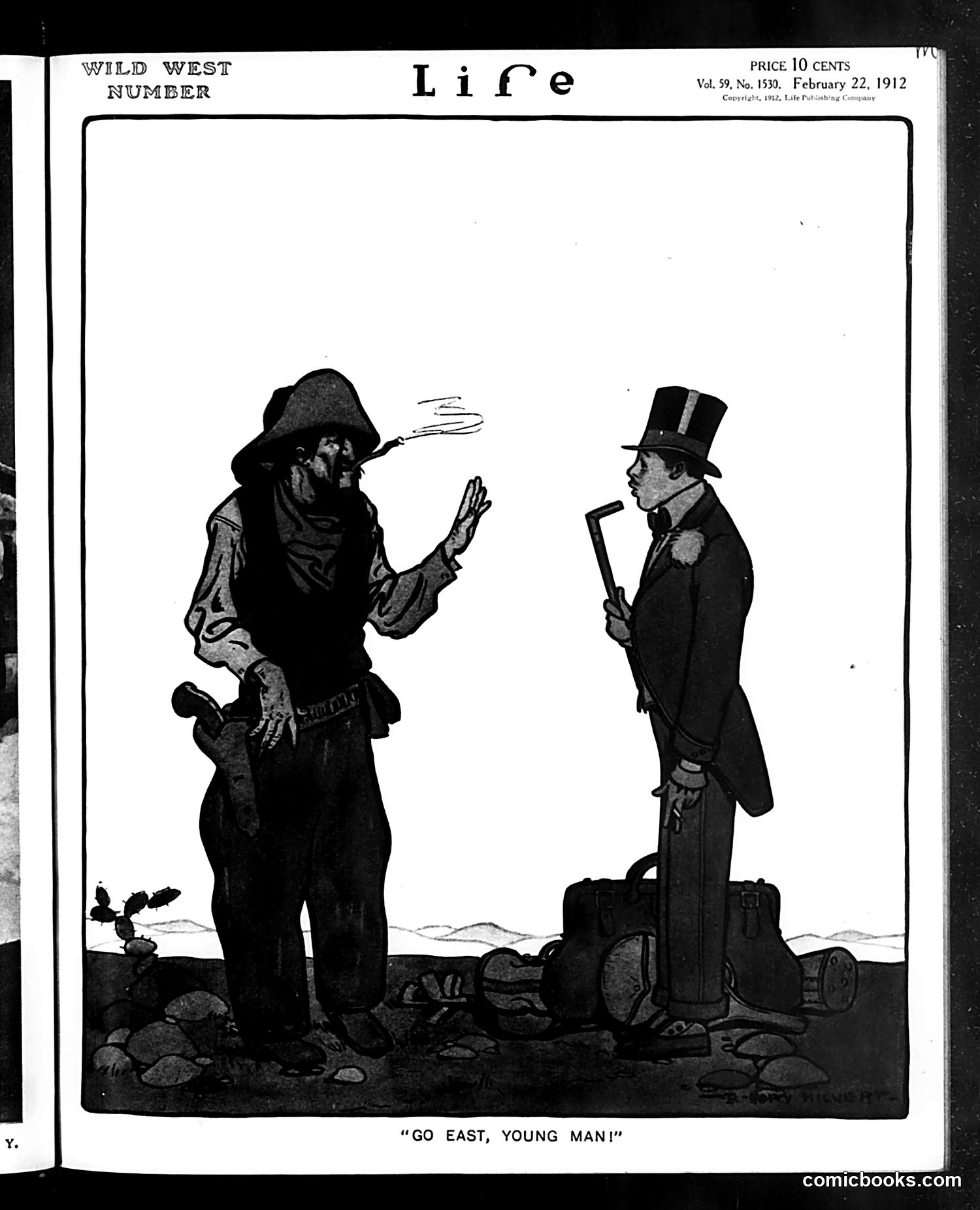
This 1912 *Life* cartoon satirizes westward expansion ideology by inverting the famous Horace Greeley phrase "Go West, young man!" A prosperous gentleman in a top hat (representing Eastern establishment or civilization) directs a ragged, rough-looking prospector or frontiersman toward the East, carrying his meager possessions. The joke critiques the notion that the American West represents opportunity and fortune. Instead, it suggests the frontier has become exhausted or unprofitable—that the real wealth and success now lies back East in established cities and industries. The well-dressed figure's patronizing gesture toward the disheveled prospector implies the "frontier dream" has failed, and ambitious men would do better seeking opportunities in Eastern business and society rather than pursuing the traditional westward path.
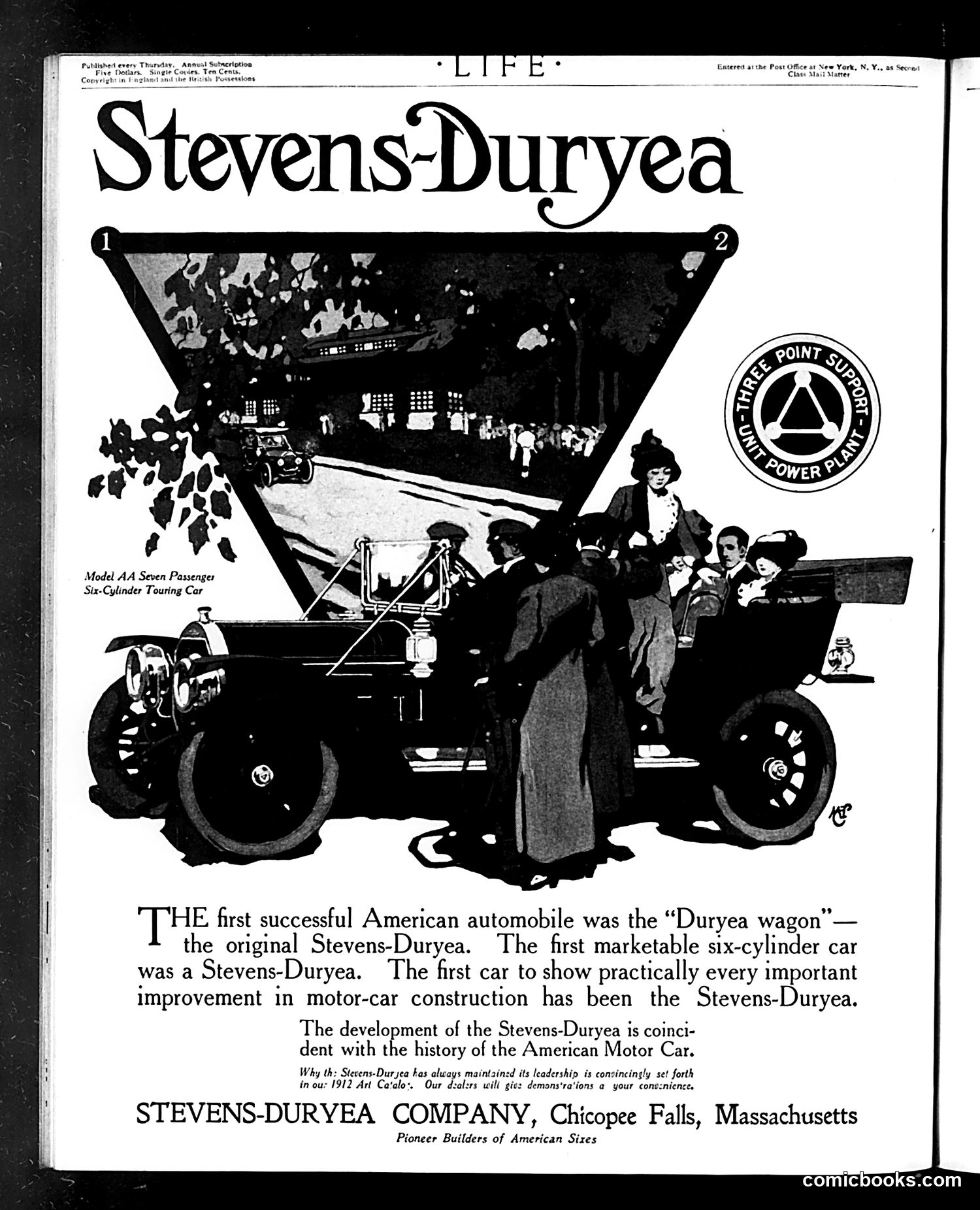
This is **not a cartoon or satire**, but rather a **straightforward automobile advertisement** from *Life* magazine. The page promotes the Stevens-Duryea Model AA, a seven-passenger touring car manufactured in Chicopee Falls, Massachusetts. The advertisement makes historical claims: that the "Duryea wagon" was America's first successful automobile, and that Stevens-Duryea produced the first marketable six-cylinder car. The illustration shows well-dressed passengers (including women and children) enjoying the vehicle, emphasizing its spaciousness and family-friendly design. The "Three Point Support" logo indicates a technical selling point. This represents early automotive industry marketing, when manufacturers competed partly through historical legitimacy claims about their founding innovations.
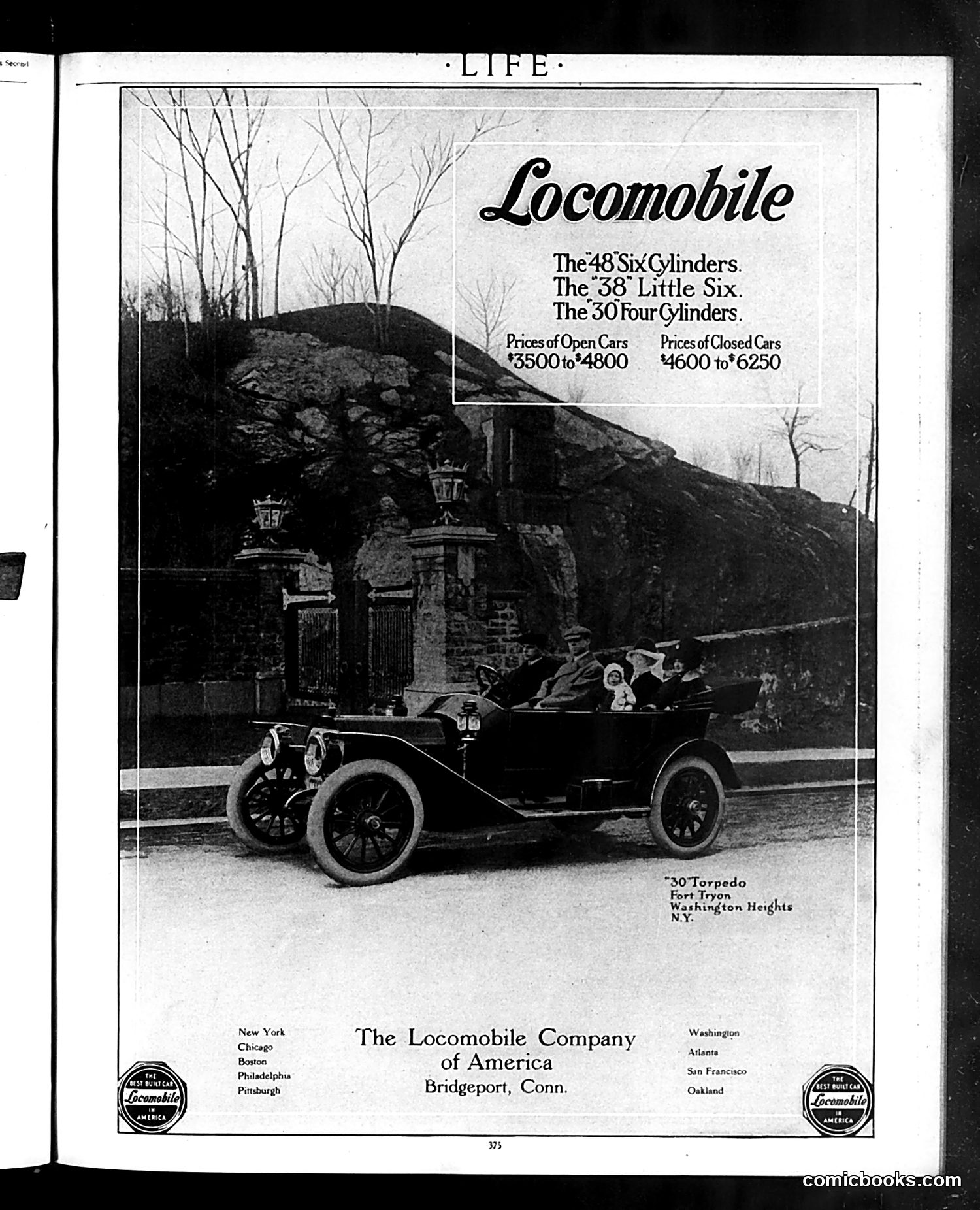
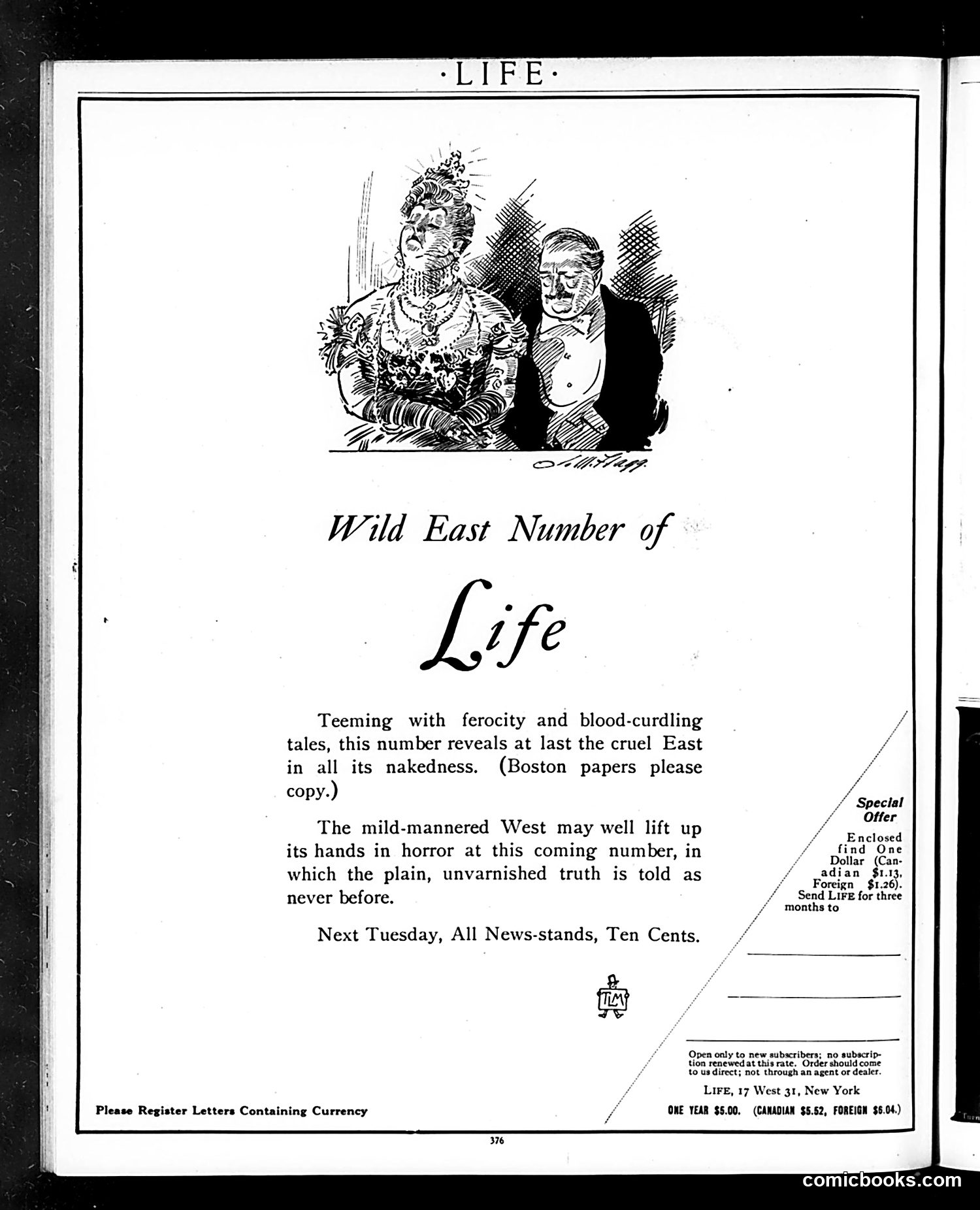
This page is primarily an **advertisement** for an upcoming "Wild East Number" of Life magazine, rather than editorial content. The illustration depicts two figures: a **heavily ornamented woman** (likely representing exaggerated "Eastern" femininity or wealth) alongside a **man in formal Western dress**. The advertisement's text sarcastically promises to reveal "the cruel East in all its nakedness" with "ferocity and blood-curdling tales," contrasting this with "the mild-mannered West." This reflects **early 20th-century American attitudes**: stereotyping the East (possibly Asia or the Middle East) as savage and exotic, while positioning Western civilization as refined and civilized—a common Orientalist trope of the era. The price is 10 cents; the ad directs readers to newsstands "Next Tuesday."
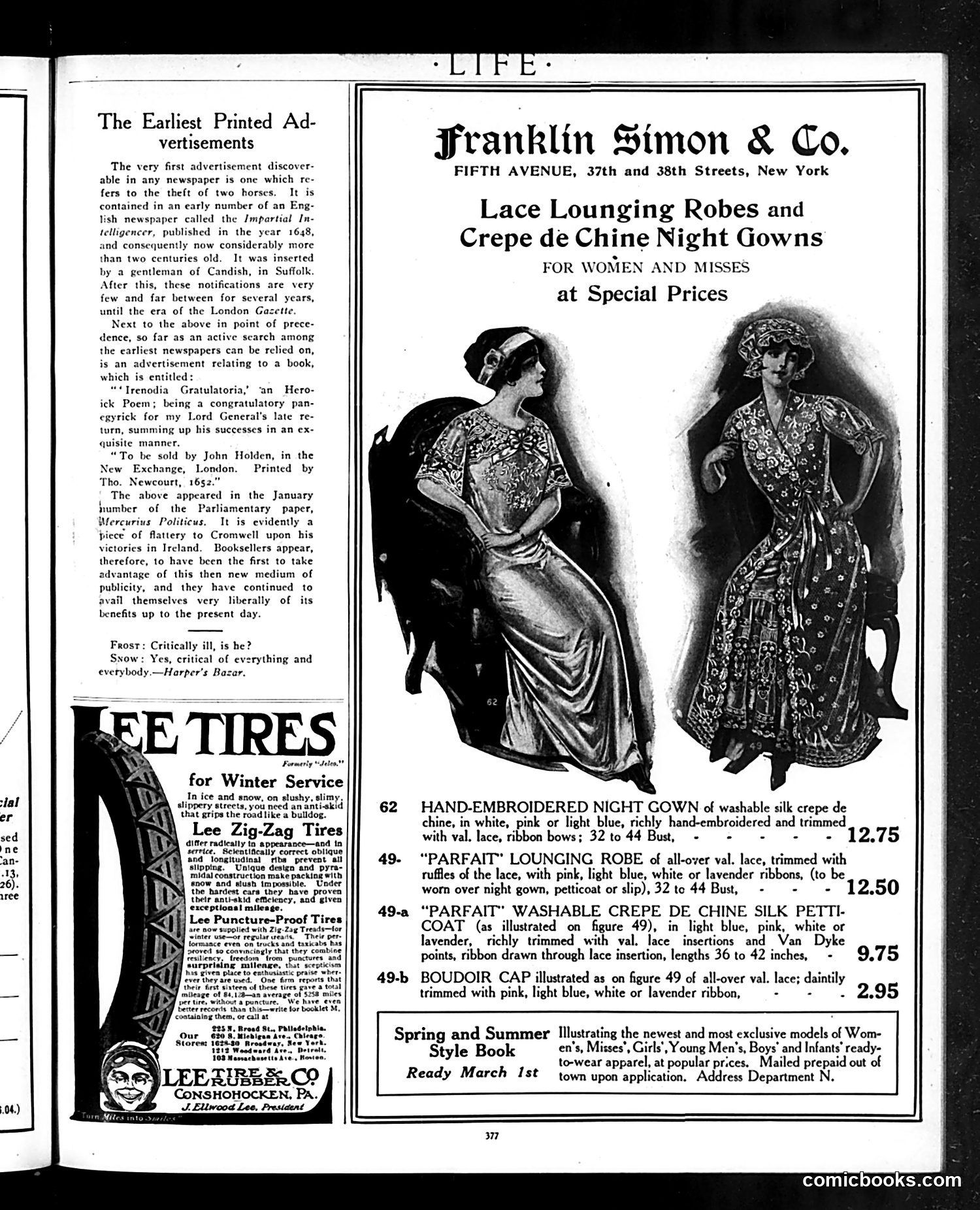
This page is **primarily advertising**, not political satire. The main content features a Franklin Simon & Co. advertisement (center-right) promoting women's nightgowns and lounging robes with illustrated fashion drawings. The left side contains two unrelated items: 1. **"The Earliest Printed Advertisements"** — a historical article discussing early newspaper advertisements from the 1600s, referencing the *Imperial Intelligencer* (1648) and a book advertisement from 1662. 2. **Lee Tires advertisement** — promoting winter tires with a humorous quote attributed to Harper's Bazaar about a character named "Frosh" being "critically ill." There is **no political cartoon** on this page. The content is primarily commercial and historical in nature, typical of Life magazine's mixed format combining articles with advertising.
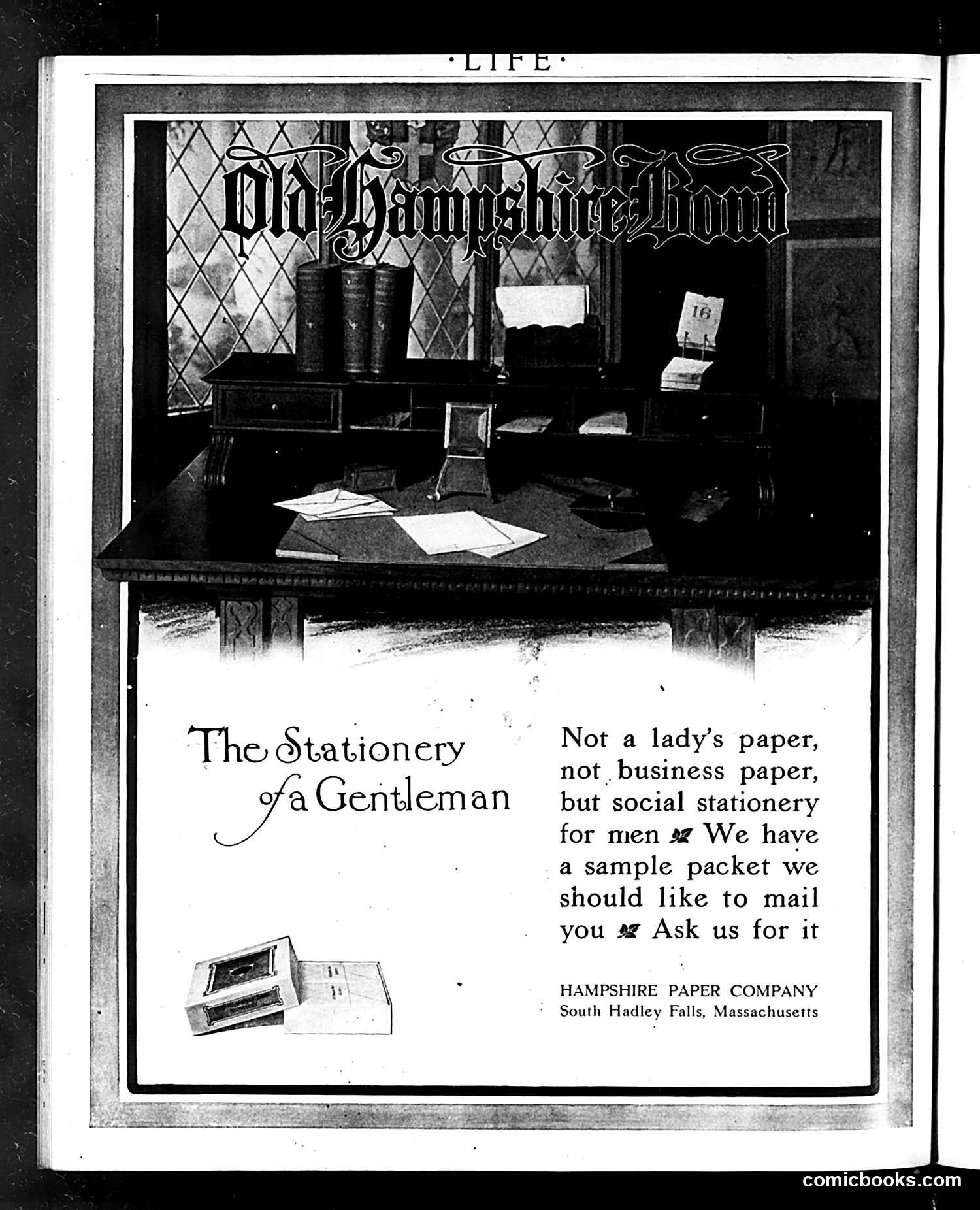
This is a **product advertisement**, not a political cartoon or satire. It promotes stationery from the Hampshire Paper Company of South Hadley Falls, Massachusetts. The ad features a window display showing writing materials and emphasizes a specific market positioning: "The Stationery of a Gentleman." The text explicitly distinguishes this product from "a lady's paper" or "business paper," instead positioning it as "social stationery for men"—suggesting formal personal correspondence rather than commercial or domestic use. The ornate shop display with leaded windows and period furnishings reflects early 20th-century aesthetic marketing. The advertisement invites interested readers to request a sample packet, representing a common direct-mail marketing strategy of the era.
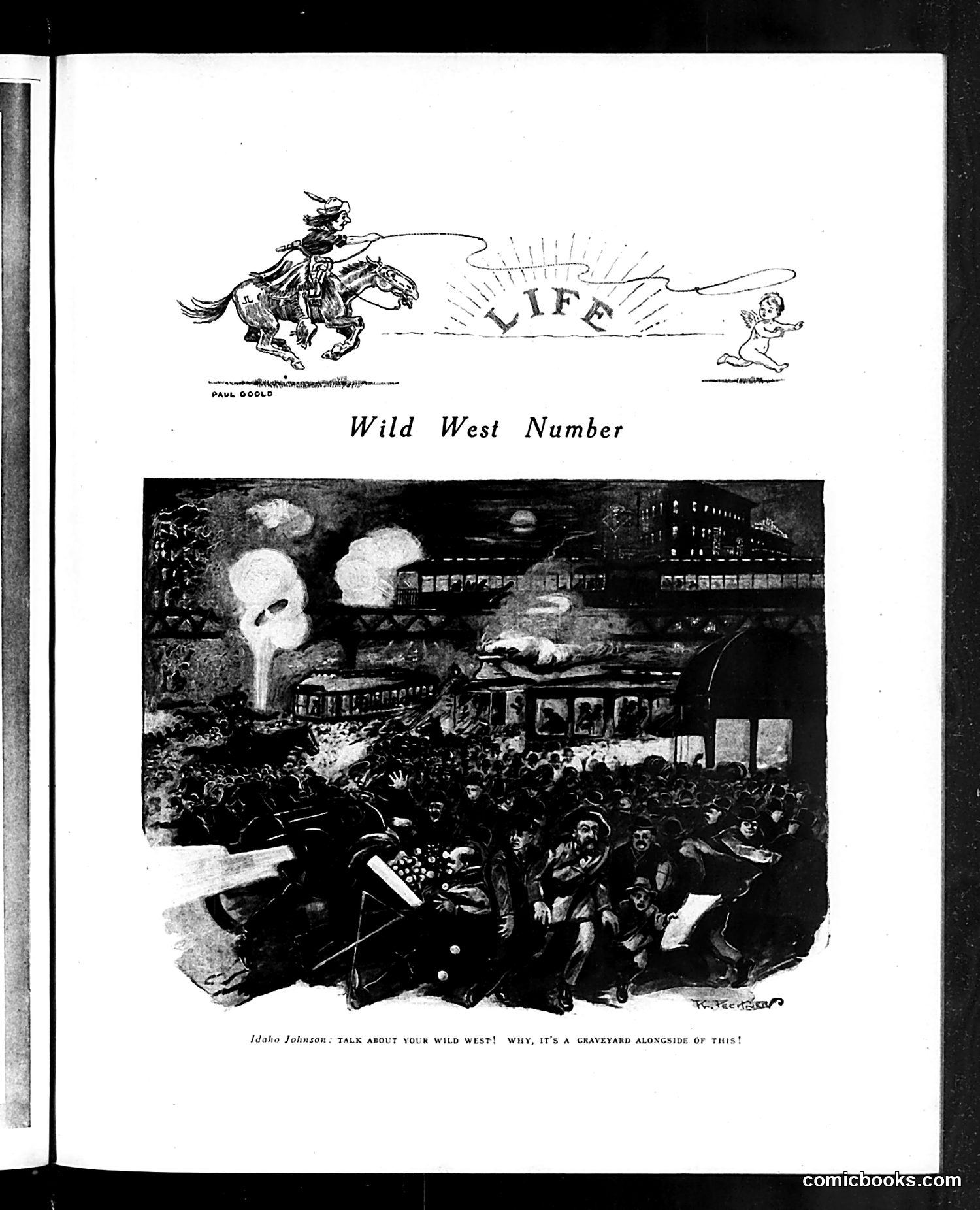
This is a Life magazine "Wild West Number" issue featuring satirical commentary on urbanization. The top illustration by Paul Gould shows a cowboy lassoing the word "LIFE" while a small figure flees—a visual pun on the magazine's title. The main cartoon by T.S. Sullivant depicts a crowded urban railroad station or factory scene with masses of people, smokestacks, and industrial buildings. The caption attributes a quote to "Idaho Johnson," suggesting a rural character confronting modernity: "Talk about your wild west! Why, it's a graveyard alongside of this!" The satire contrasts romanticized frontier imagery with harsh industrial-era urban reality, implying that modern city life—with its crowds, pollution, and mechanization—is more "wild" and dangerous than the actual American West. It critiques industrialization's human cost.
This page contains political discussion about the 1912 presidential race. The text debates whether Colonel Roosevelt will enter the contest as a candidate, with various figures mentioned: Bryan, Hearst, La Follette, Taft, and Lawrence. The central argument discusses Roosevelt's reluctance to formally announce candidacy while his supporters actively seek delegates. The writer suggests Roosevelt maintains plausible deniability—he hasn't declared himself a candidate, yet his backers work on his behalf. The text also critiques Democratic hopes that a "mere majority" wouldn't satisfy Roosevelt, implying he demands overwhelming support. There's skepticism about whether any appeal could convince Roosevelt to run, or whether his candidacy would actually save the Republican Party from internal division. The piece reflects pre-convention political maneuvering in 1912's famous three-way race.
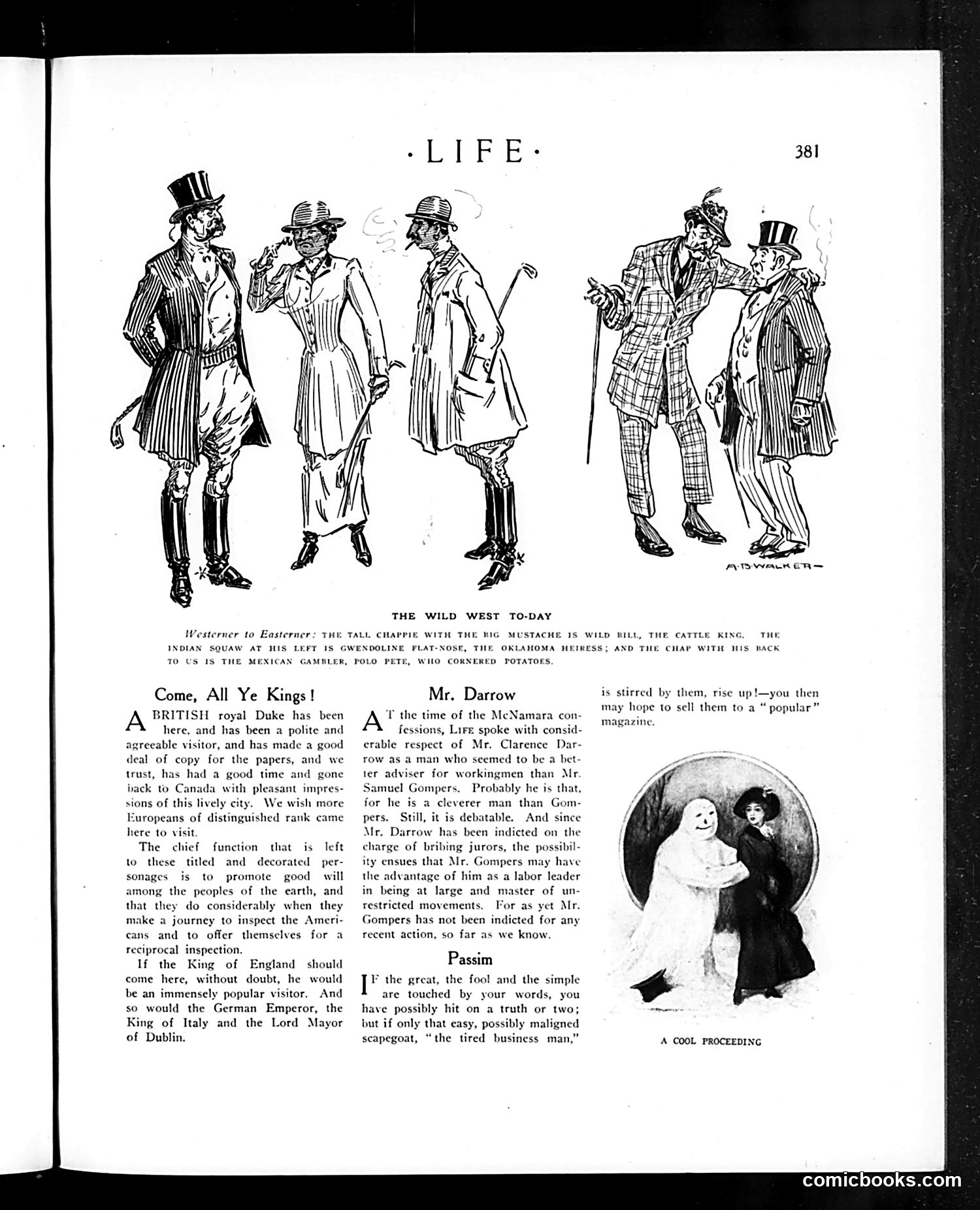
**Top Illustration:** Titled "The Wild West To-Day," this cartoon contrasts authentic Western figures (Wild Bill, cattle king, Indian squaw, Oklahoma heiress, Mexican vaquero, Polo Pete) with modern Eastern dandies in formal dress and top hats. The satire mocks how Eastern city dwellers, particularly wealthy socialites and businessmen, appropriated and played at being "Western" while remaining fundamentally artificial. **Articles Below:** "Come, All Ye Kings!" discusses a British Duke's visit to Canada, suggesting Europe's aristocracy was touring America for inspection. "Mr. Darrow" examines labor leader Clarence Darrow's credibility. "Passim" offers brief social commentary about foolish people being easily manipulated by words. The page satirizes class pretension and the tension between authentic frontier identity and Eastern urban affectation.
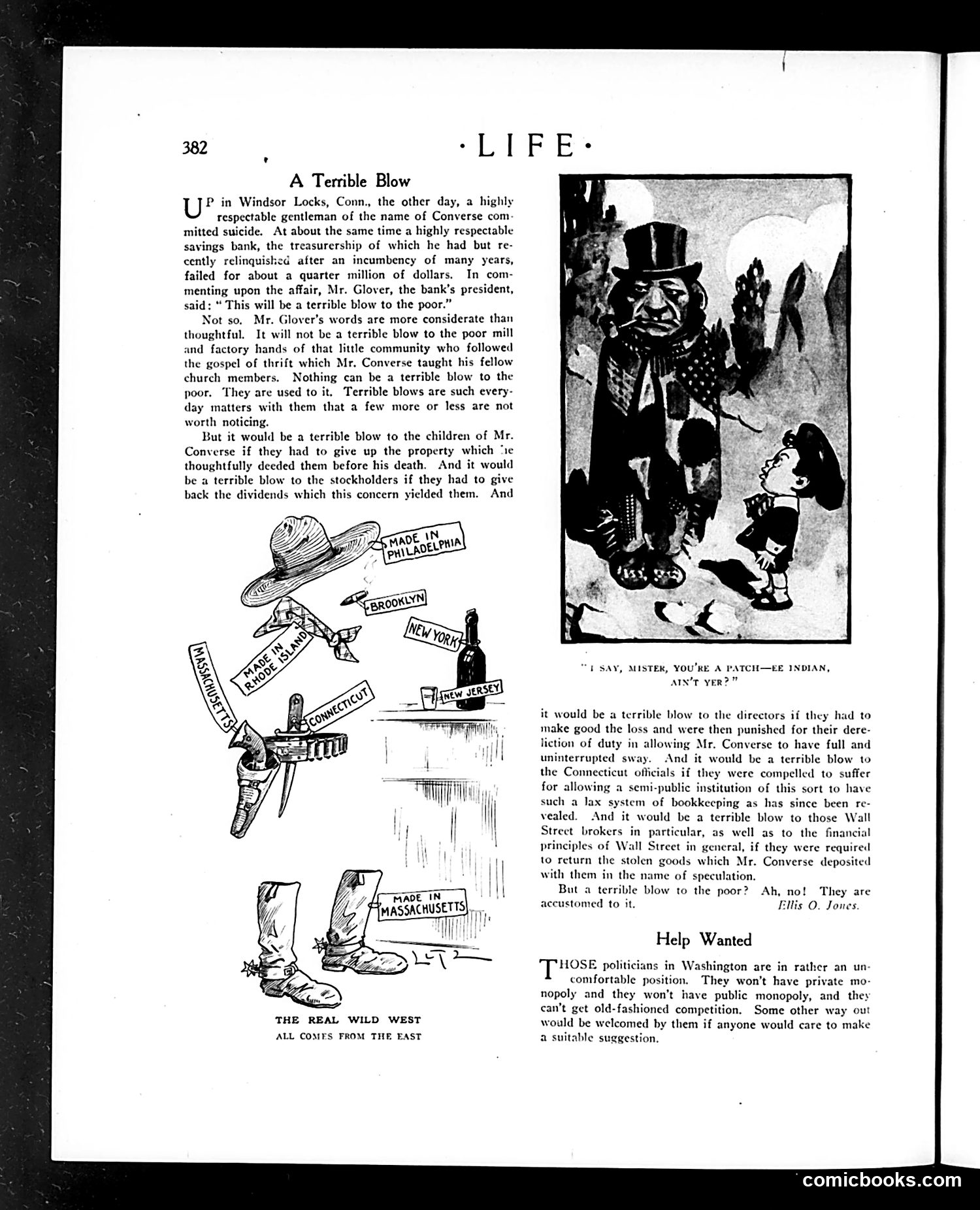
This satirical piece criticizes the hypocrisy of wealthy society's response to a Converse company treasurer's suicide in Connecticut. Mr. Glover, the bank president, expresses concern that the poor will suffer from this "terrible blow," but the text systematically dismantles this false sympathy—noting the actual "terrible blows" would fall on the treasurer's children, stockholders, company directors, and Wall Street brokers who benefited from Converse's operations. The left cartoon shows products labeled with northeastern manufacturing locations (Philadelphia, Brooklyn, New York, Connecticut, Massachusetts), satirizing Eastern industrial exploitation. The caption "THE REAL WILD WEST / ALL COMES FROM THE EAST" inverts frontier mythology, suggesting the moral wildness of industrial capitalism occurs in the civilized East, not the frontier West. The satire argues the poor expect hardship, while the wealthy's self-serving concern masks their complicity.
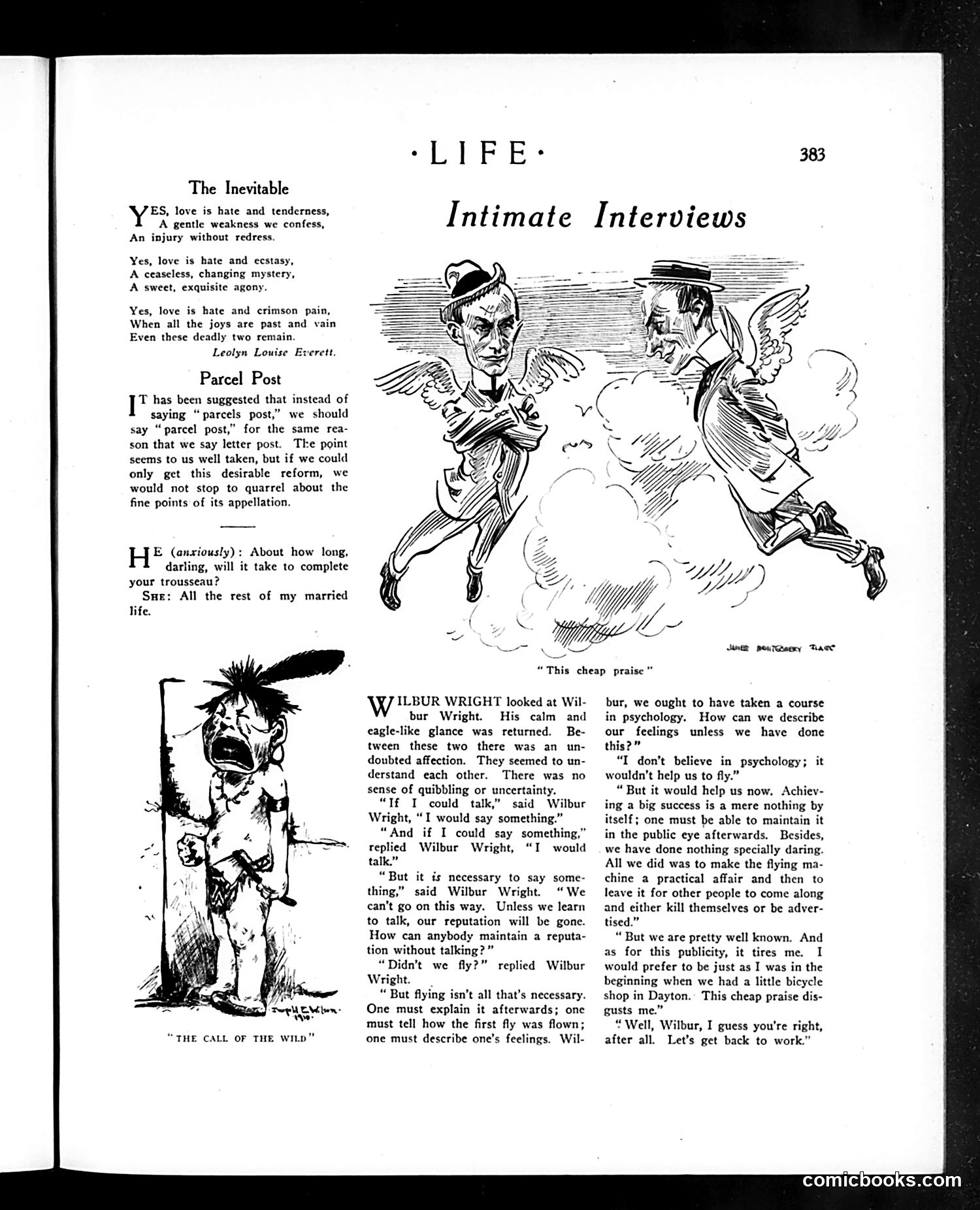
This page contains literary and illustrative content rather than political cartooning. **"The Inevitable"** is a poem by Louisa Louise Everett about love's contradictory nature—simultaneously hateful and tender, painful yet exquisite. **"Parcel Post"** is a brief dialogue joke about a husband asking his wife how long her household tasks will take; she replies "all the rest of my married life"—satirizing domestic drudgery and marital monotony. **"Intimate Interviews"** features an exchange between Wilbur Wright (the aviation pioneer) and his brother about the challenges of public reputation-building. The accompanying caricatured illustrations show winged figures in clouds. The dialogue concerns whether explaining one's accomplishments helps or harms public perception—a commentary on celebrity and self-promotion in the early aviation era.
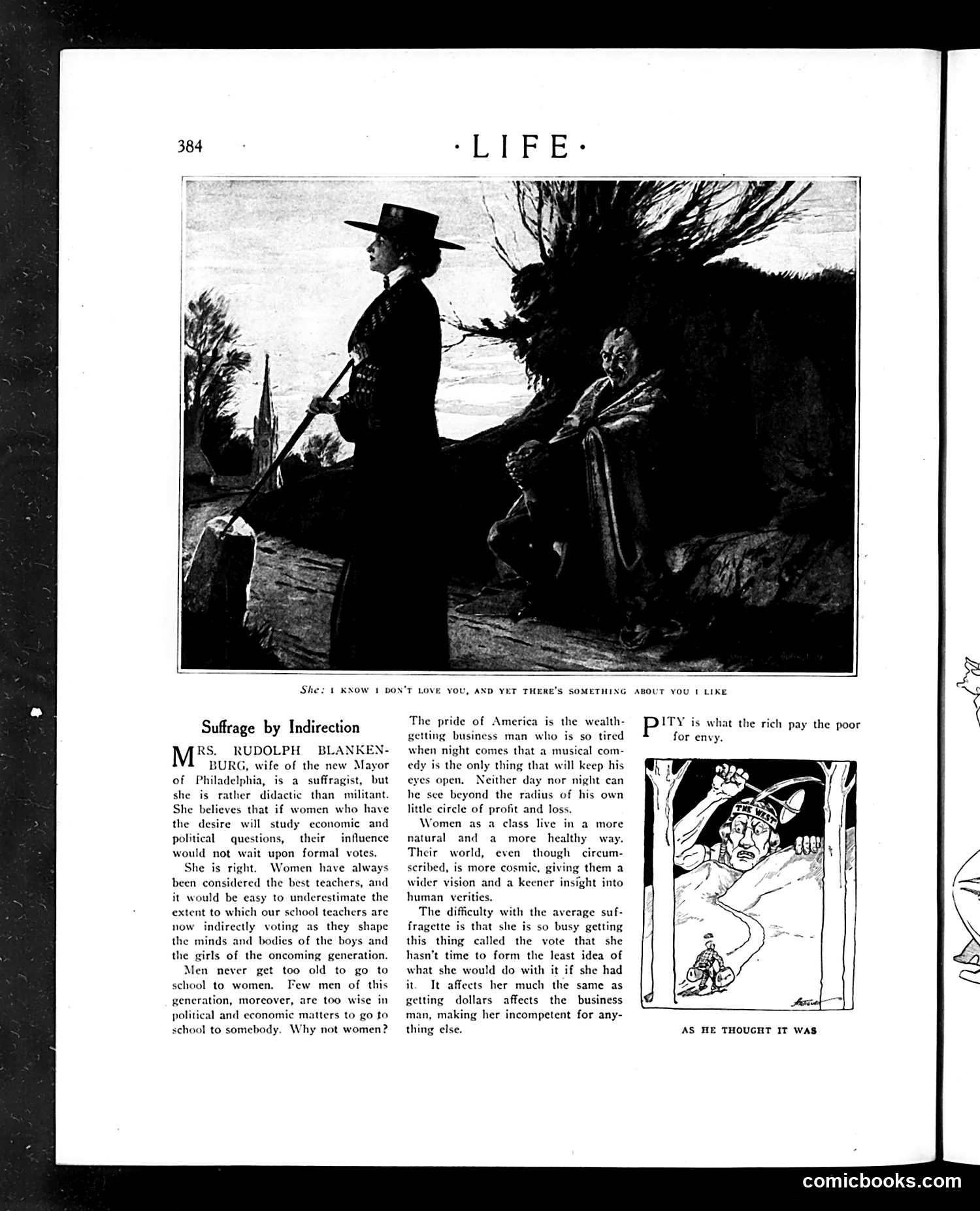
This page contains an article titled "Suffrage by Indirection" by Rudolf Blankenburg, wife of Philadelphia's new Mayor. The text argues that women should influence politics indirectly rather than pursuing direct voting rights—a position opposing women's suffrage. The main illustration shows a silhouetted woman on horseback with a rifle, accompanying what appears to be a soldier or hunter, captioned "She: I know I don't love you, and yet there's something about you I like." The cartoon satirizes the article's anti-suffrage argument by depicting a woman as an active, armed participant in outdoor activities—suggesting women are already capable and engaged beyond the domestic sphere, thereby undermining Blankenburg's case for indirect influence only.
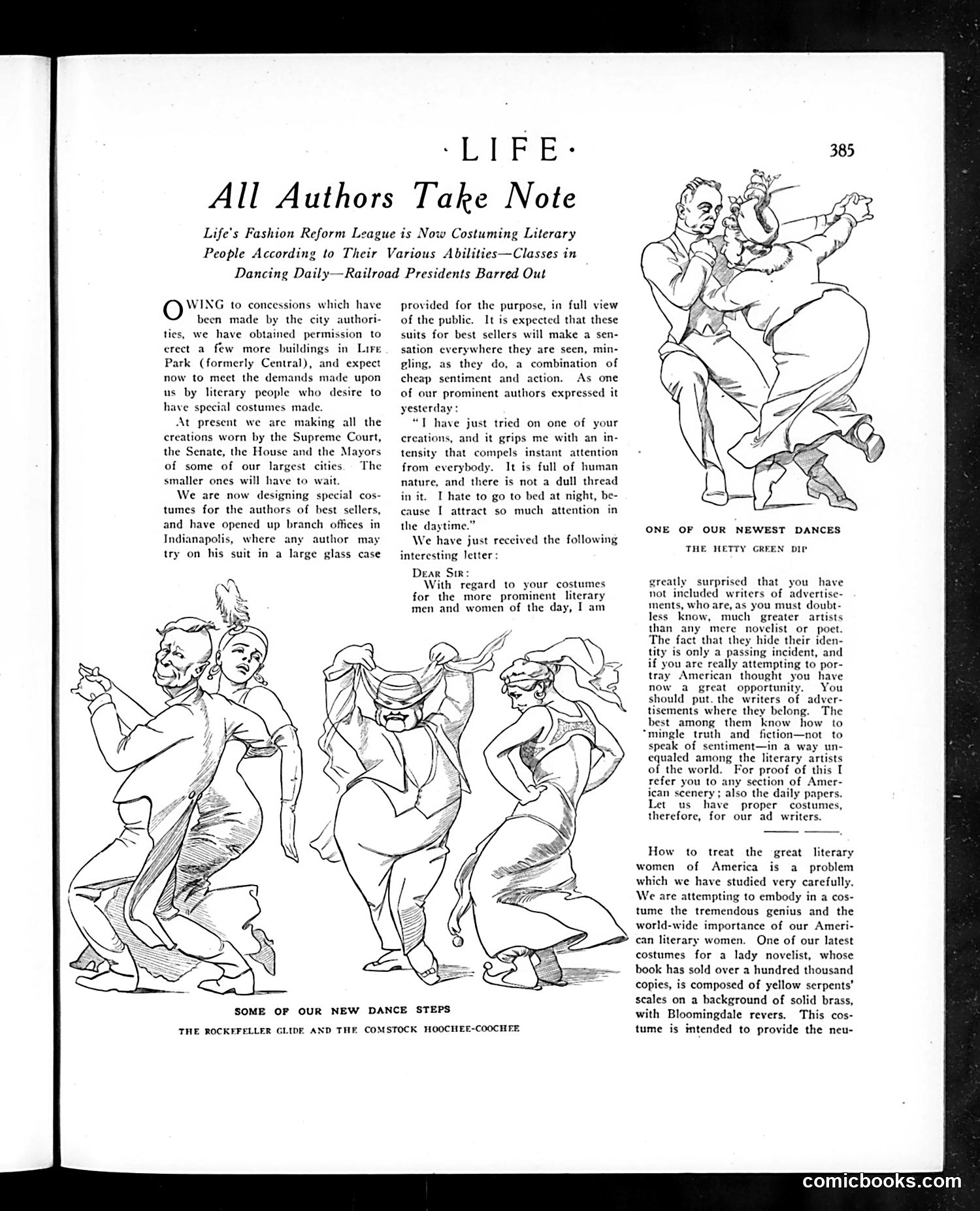
This 1920s *Life* magazine page satirizes a "Fashion Reform League" initiative to costume bestselling authors according to their literary personas. The text mocks this venture as absurd—suggesting prominent writers would be dressed in full view to promote their books. The cartoons illustrate proposed "dance steps" named after literary works and authors: "The Rockefeller Glide and the Comstock Hoochee-Coochee" and "The Nifty Green Dip." These titles blend high-brow literary references with contemporary dance crazes (like the "hoochee-coochee"), creating humor through incongruity. The satire targets both the pretension of literary fashion and the era's commercialization of authors. By pairing serious writers with lowbrow popular dances, *Life* ridicules efforts to make literature entertainment through costumes rather than content.
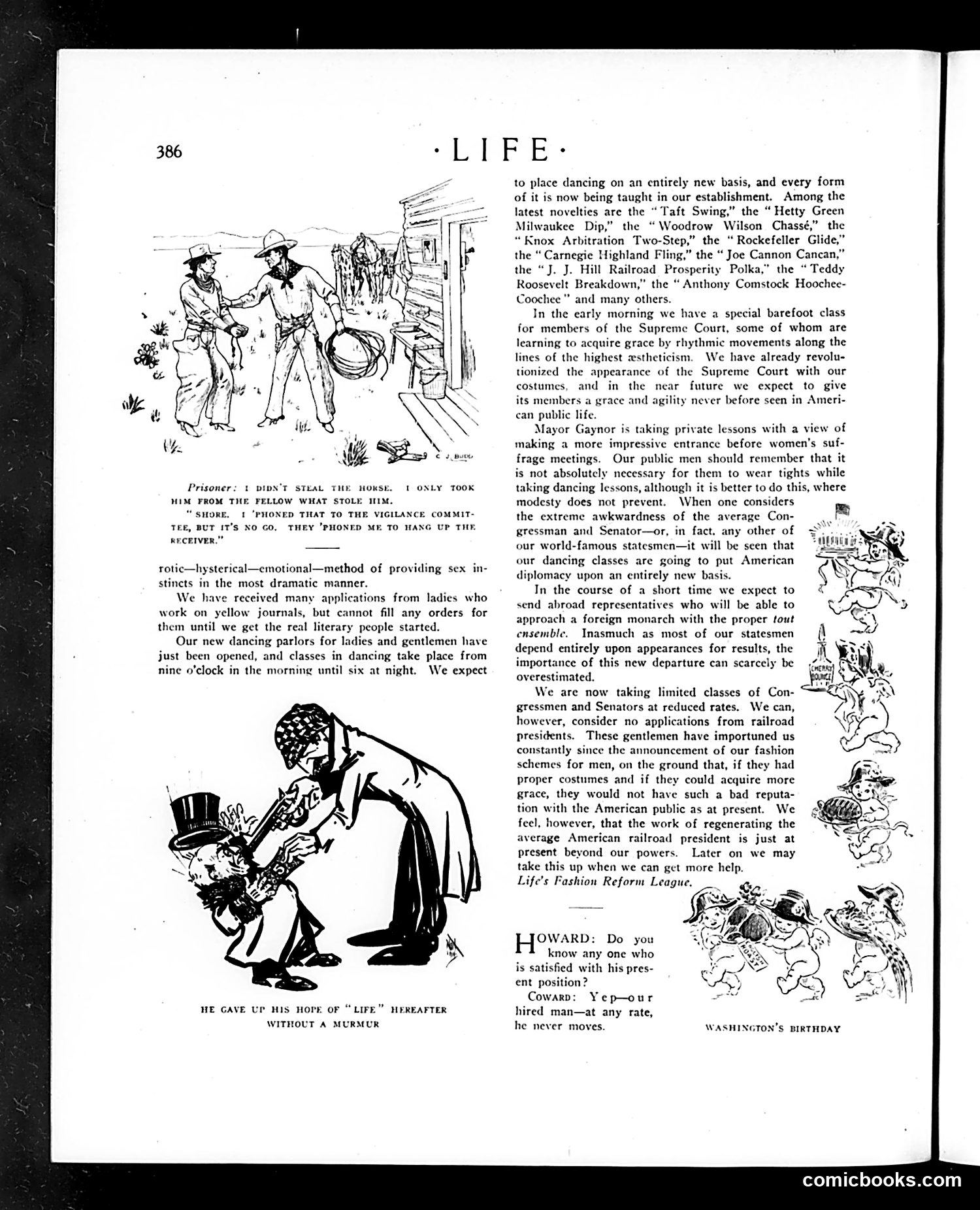
This page satirizes the emerging "fashion reform" movement of the early 1900s, particularly the promotion of dancing as socially respectable exercise. The top cartoon depicts two men in period dress (one appears to be a prisoner or vagrant) discussing stolen horses—a joke about the desperation of the poor. The larger cartoon shows a wealthy gentleman bending over a beggar, captioned "HE GAVE UP HIS HOPE OF 'LIFE' HEREAFTER WITHOUT A MURMUR." This mocks how the wealthy might patronize the poor with superficial gestures rather than genuine help. The text discusses "Life's Fashion Reform League" introducing dancing classes for congressmen and senators, satirizing how the elite adopt health trends while ignoring systemic inequality—a critique of class disparity wrapped in humor about fashionable fitness fads.
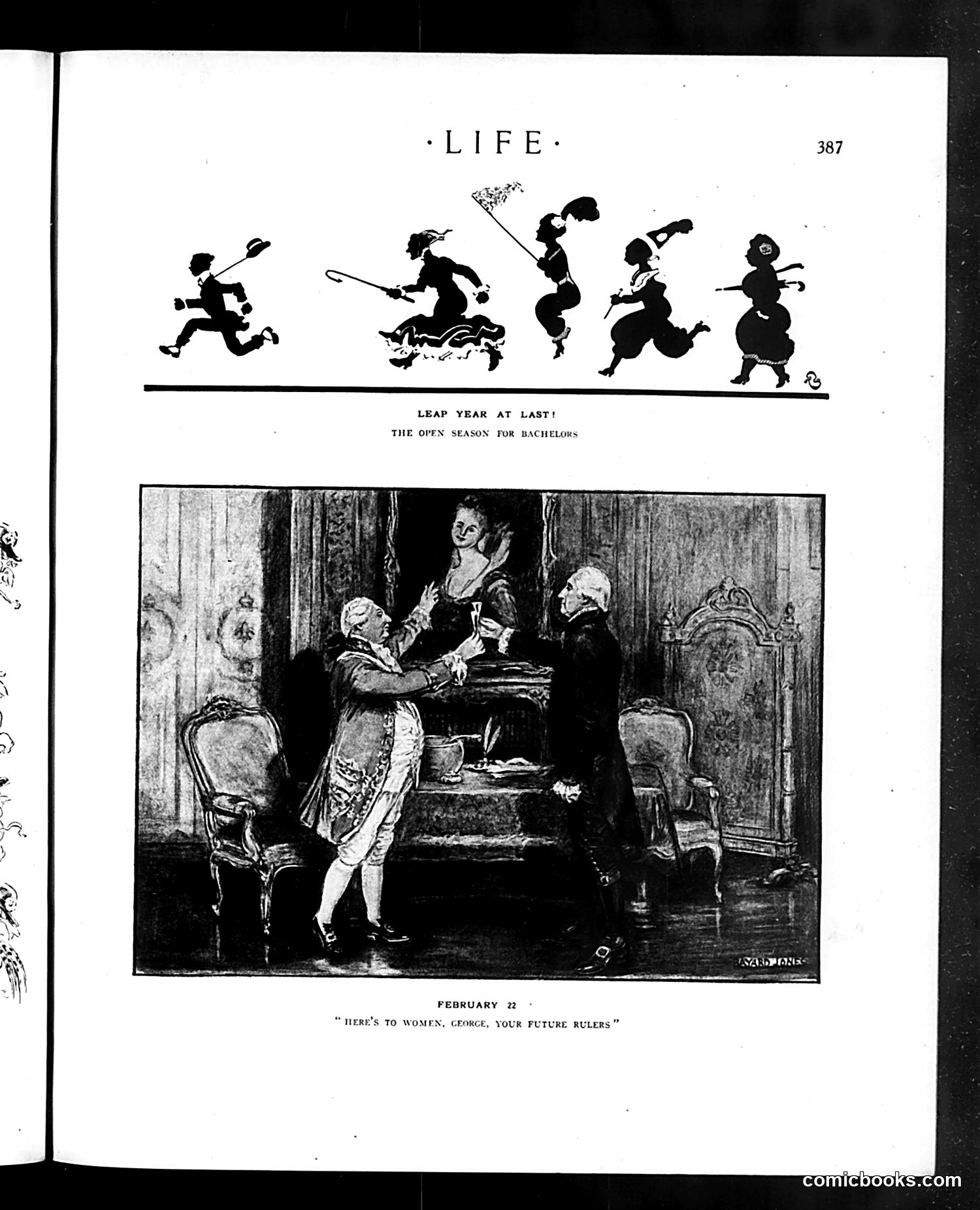
This page satirizes leap year tradition, when women were supposedly permitted to propose to men—reversing normal courtship norms. The silhouettes above show women actively pursuing bachelors in increasingly frantic poses. The illustration below depicts an elegant interior scene where a woman (center) appears to be making her romantic move toward a man, while older male figures sit passively in chairs, seemingly resigned to their fate as targets during this "open season." The caption—"Here's to women, George, your future rulers"—reveals the joke's underlying anxiety: the satire treats women's temporary romantic agency during leap year as a humorous threat to male authority, portraying it as a loss of masculine control. This reflects early 20th-century gender anxieties about women's expanding social roles.
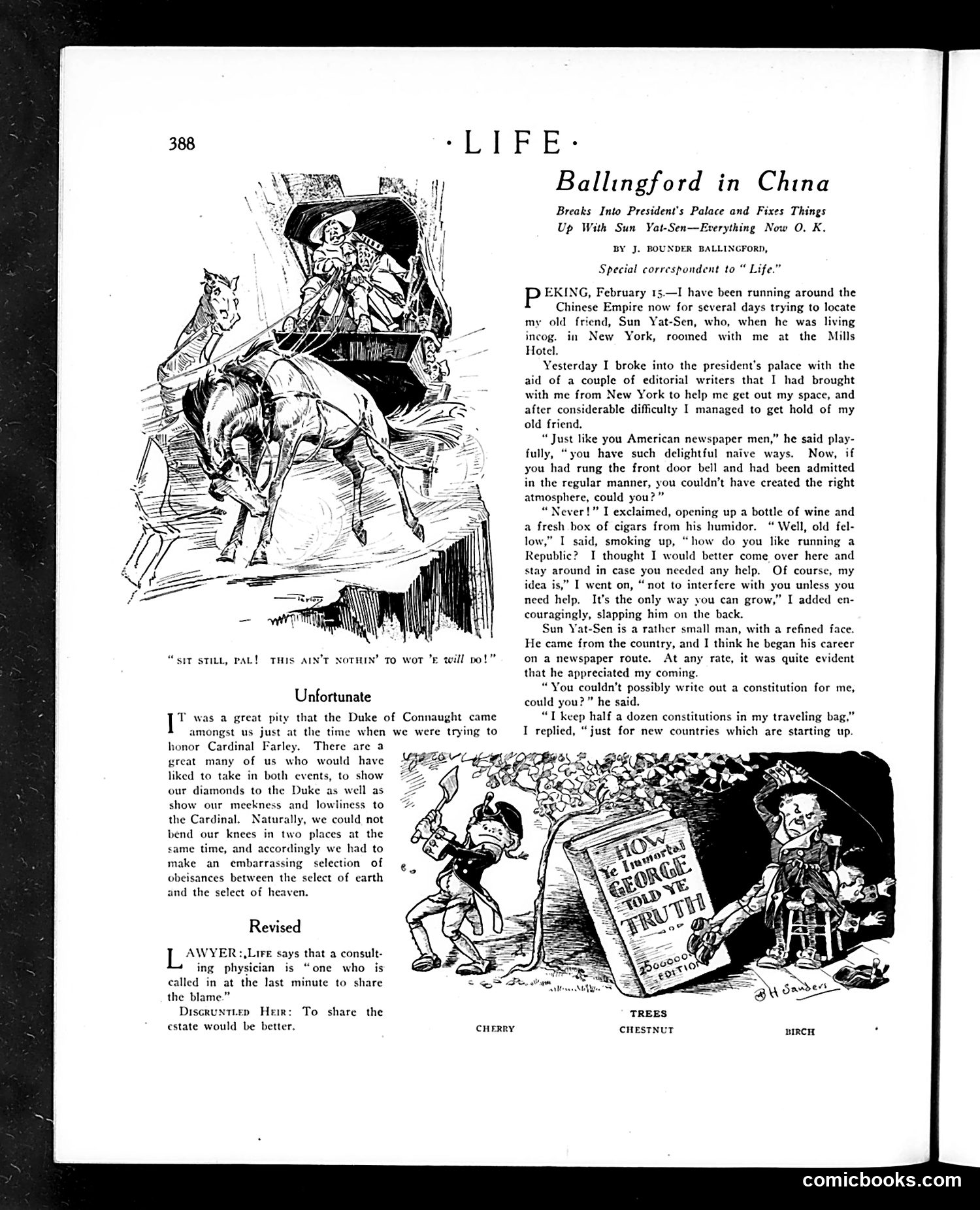
This page contains three distinct pieces of satire: **Main cartoon (top):** A horseman labeled "Ballingford" bursts through a doorway with the caption "SIT STILL, PAL! THIS AIN'T NOTHIN' TO WOT 'E WILL DO!" The imagery satirizes American newspaper correspondents abroad as brash, invasive intruders. **"Ballingford in China" story:** A humorous fictional account where an American reporter casually breaks into Chinese President Sun Yat-Sen's palace and offers to write him a constitution—poking fun at American imperial arrogance and the assumption that Americans could casually "fix" foreign governments. Sun Yat-Sen had recently (1912) established the Chinese Republic, and the satire mocks American presumptuousness about involvement in non-Western affairs. **Brief items:** Two short jokes about the Duke of Connaught's visit conflicting with Cardinal Farley's honor (social comedy about society's divided loyalties), and a lawyer quip about consulting physicians. The overall tone satirizes American interventionism and self-assured naiveté about global affairs.
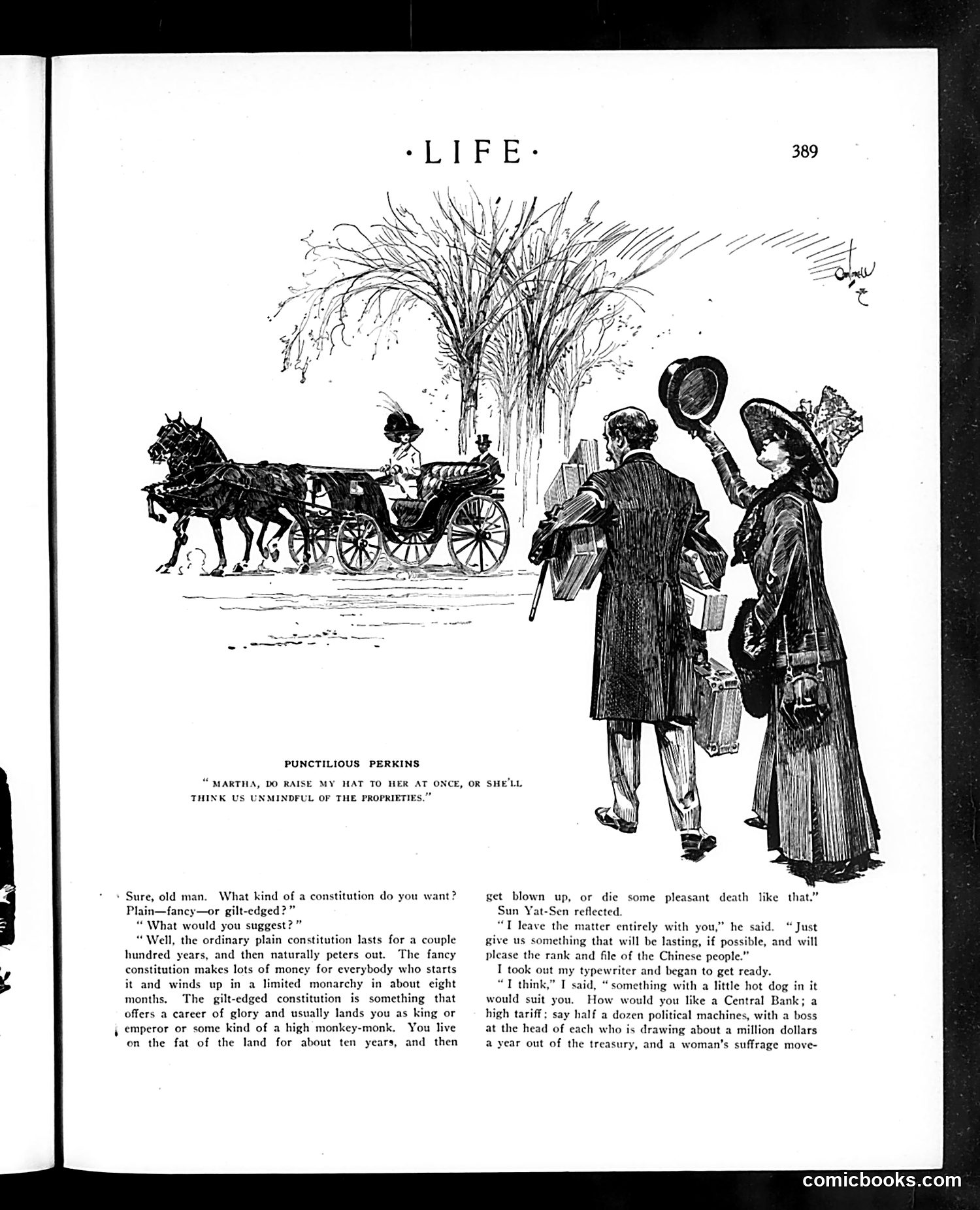
This cartoon satirizes debates about establishing a constitution for China, likely during the early republican period following the 1911 revolution. The figure "Sun Yat-Sen" (founder of modern China) is consulting with an American advisor about what type of governmental structure to adopt. The satire mocks American political corruption by having the advisor cynically offer constitutional "models"—plain, fancy, or "gilt-edged"—each with predictable outcomes. The "fancy" version makes money for its creators before collapsing into monarchy; the "gilt-edged" version enriches leaders for a decade before they're violently overthrown. When Sun Yat-Sen asks for something "lasting" that pleases ordinary Chinese people, the American instead recommends importing American corruption wholesale: central banks, high tariffs, political machines extracting millions, and women's suffrage movements. The joke critiques American hypocrisy—exporting democratic ideals while actually spreading institutional graft, cronyism, and special interests. The cartoon suggests America's "model" constitution is merely a vehicle for concentrated wealth and power, not genuine popular governance.
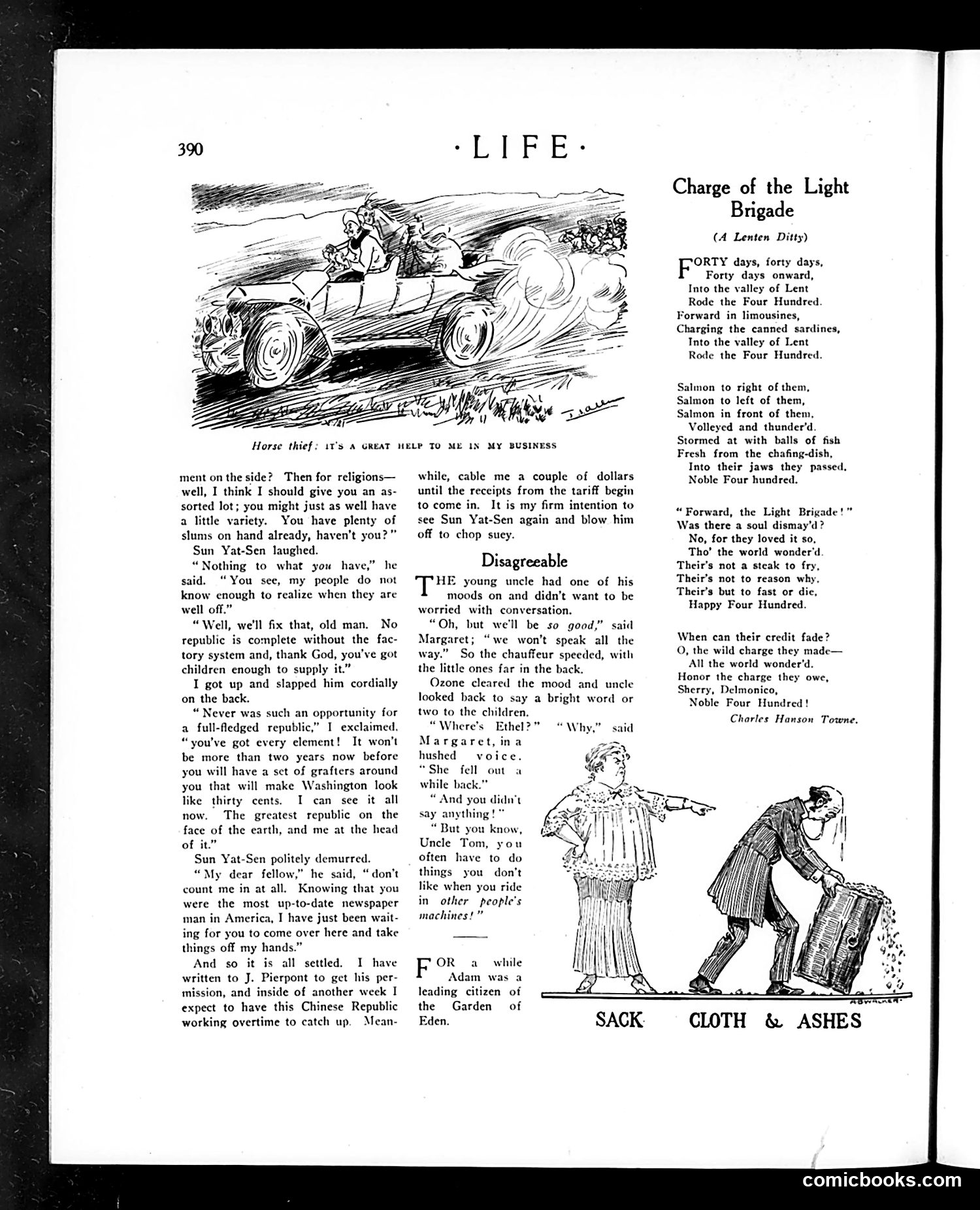
This page contains three satirical pieces targeting American attitudes and social hypocrisy: **"Horse Thief"** (top cartoon): A cynical dialogue between an unnamed American businessman and Sun Yat-Sen (Chinese revolutionary leader). The American boasts he'll "fix" China by imposing factories, child labor, and slums—openly admitting these as features of "progress"—while condescendingly suggesting China lacks the sophistication to recognize its own problems. The satire mocks American imperialism and the export of industrial exploitation as civilization. **"Disagreeable"** (middle): A child callously mentions her sister Ethel "fell out" of a moving car. When questioned, she matter-of-factly explains: you tolerate inconveniences when riding in others' vehicles. The joke darkly satirizes upper-class indifference to harm when it's socially awkward to complain. **"Charge of the Light Brigade"** (right): A parody of Tennyson's famous poem, substituting Lenten fasting observances for military glory. The "Four Hundred" (wealthy society figures) charge forward with canned sardines and salmon, sacrificing steaks and Delmonico restaurants. It mocks ritualistic religious observance among the privileged.
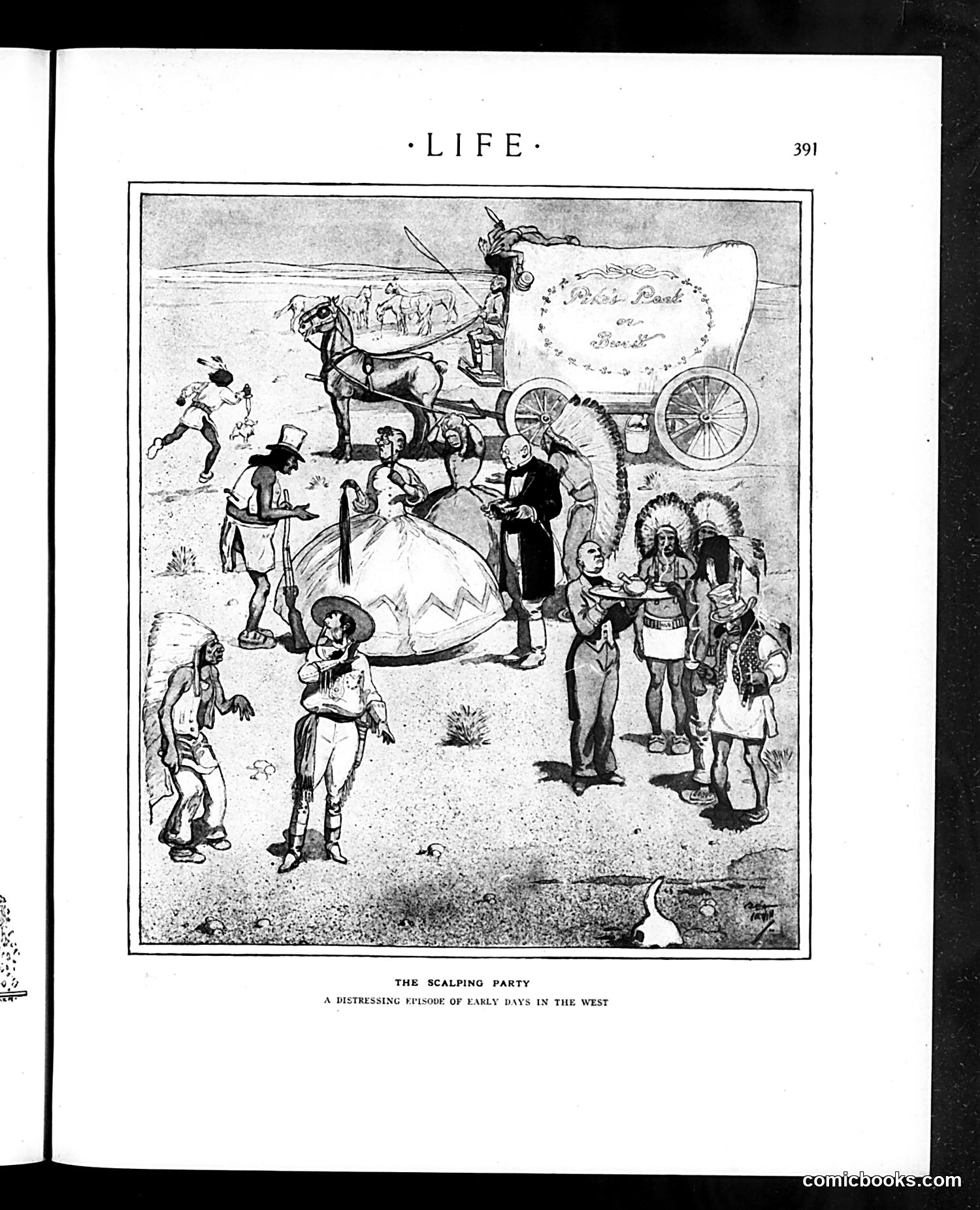
This satirical illustration depicts a wealthy Victorian woman (identifiable by her elaborate ball gown and parasol) surrounded by Native Americans in a mock "scalping party" scenario. The title frames this as "a distressing episode of early days in the West." The satire appears to mock both frontier narratives and Victorian society's fascination with "Wild West" sensationalism. The elegant lady's presence amid this violent scenario—treated as social theater with onlookers and a decorated carriage—suggests Life magazine is ridiculing how Eastern urban audiences romantically consumed and trivialized frontier violence. The juxtaposition of refined civilization (her formal dress, the decorated wagon) with savage imagery lampoons contemporary attitudes toward westward expansion and Native Americans, while skewering the hypocrisy of those who enjoyed such tales from drawing rooms.
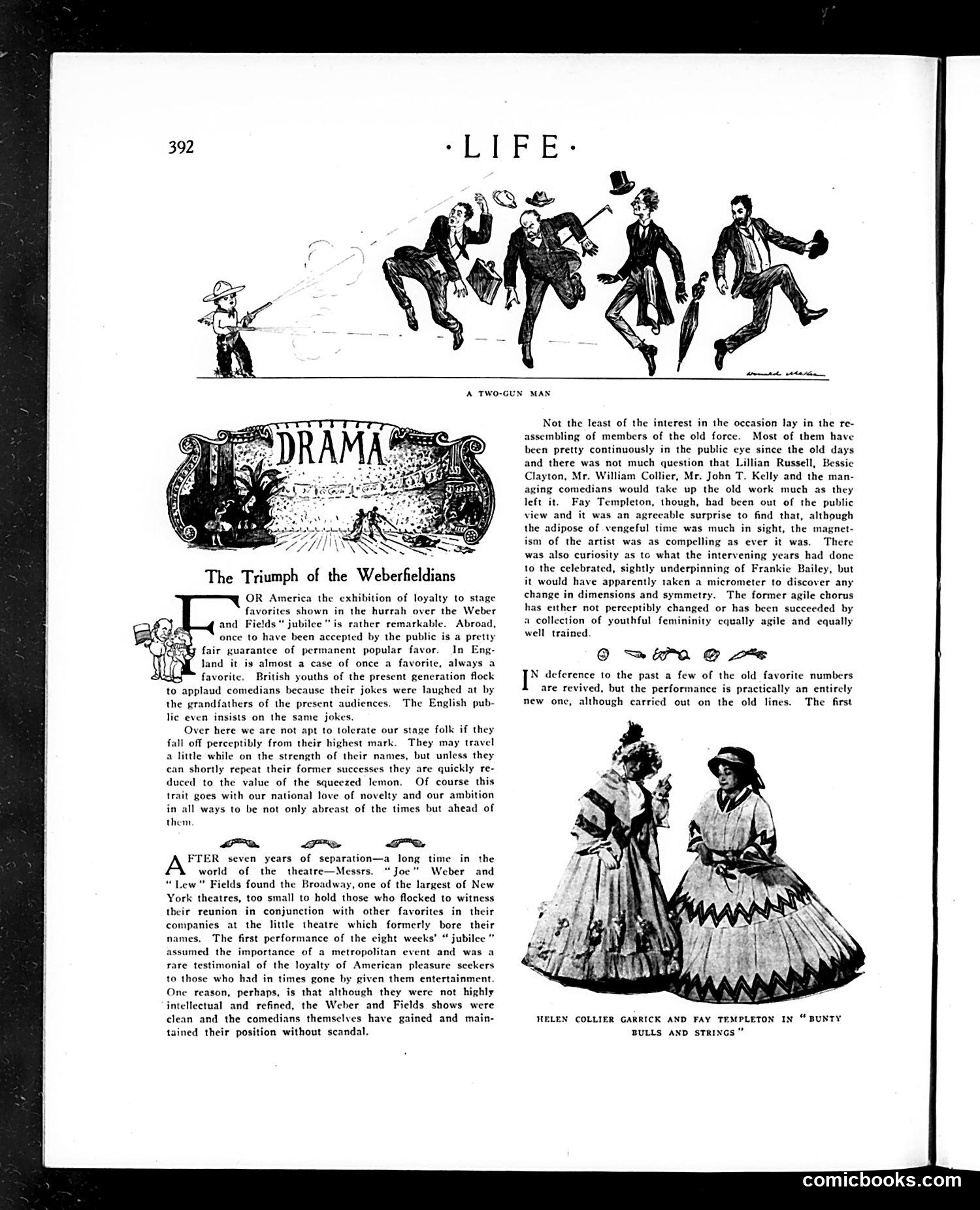
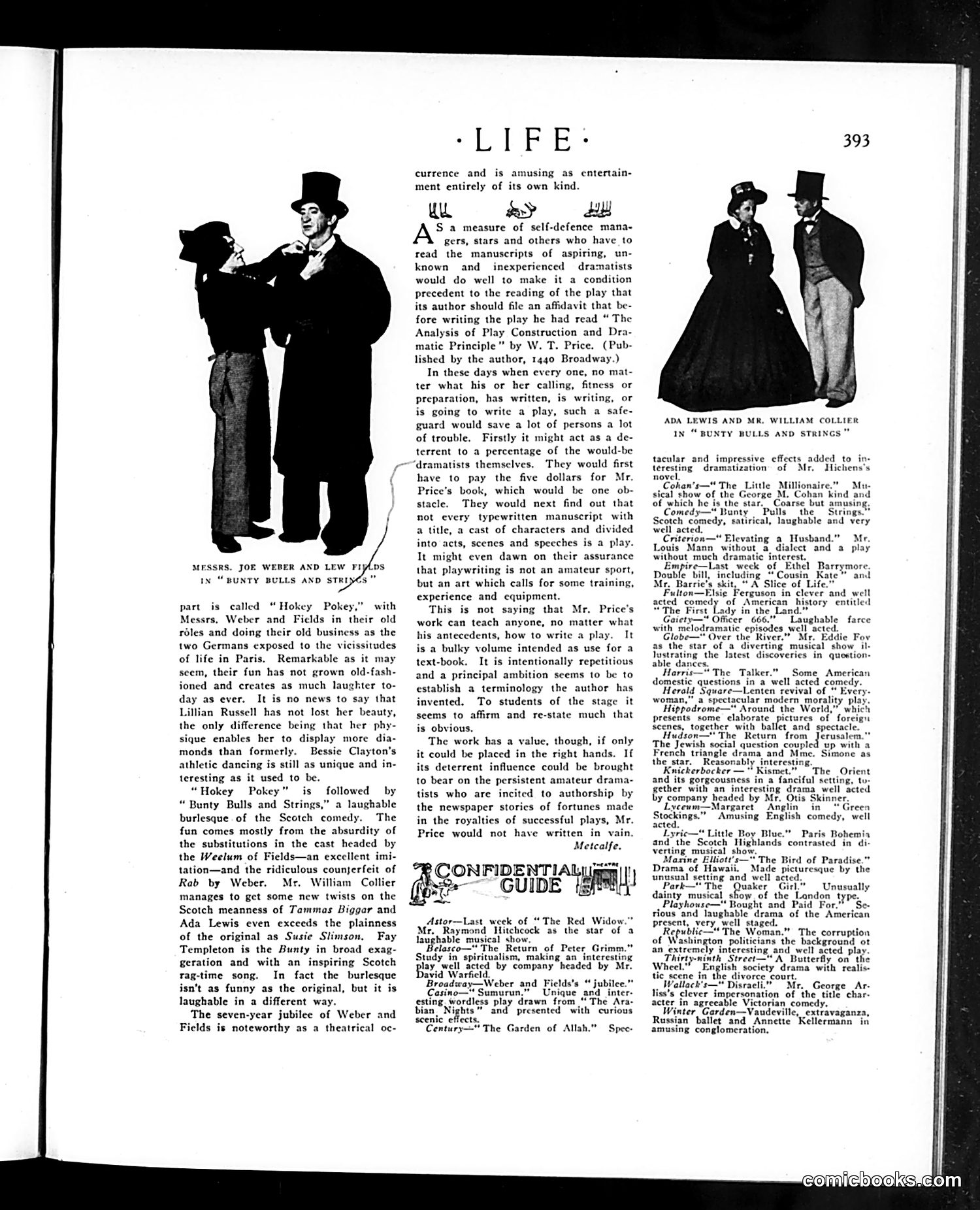
This page celebrates the reunion of comedians Joe Weber and Lew Fields, who reunited after seven years of separation for an eight-week "jubilee" at Broadway's Theatre. The top cartoon depicts a cowboy (appearing to represent American popular taste) shooting five well-dressed men into the air—satirizing how American audiences quickly abandon entertainers who fail to maintain their peak performance, unlike British audiences who loyally support performers indefinitely. The article notes that Weber and Fields' 1890s success stemmed partly from their "clean" shows and scandal-free reputations. The piece expresses surprise that aging performers like Fay Templeton and Frankie Bailey could still draw enormous crowds, crediting their enduring "magnetism" despite visible aging. The photograph shows two performers from the revival production.
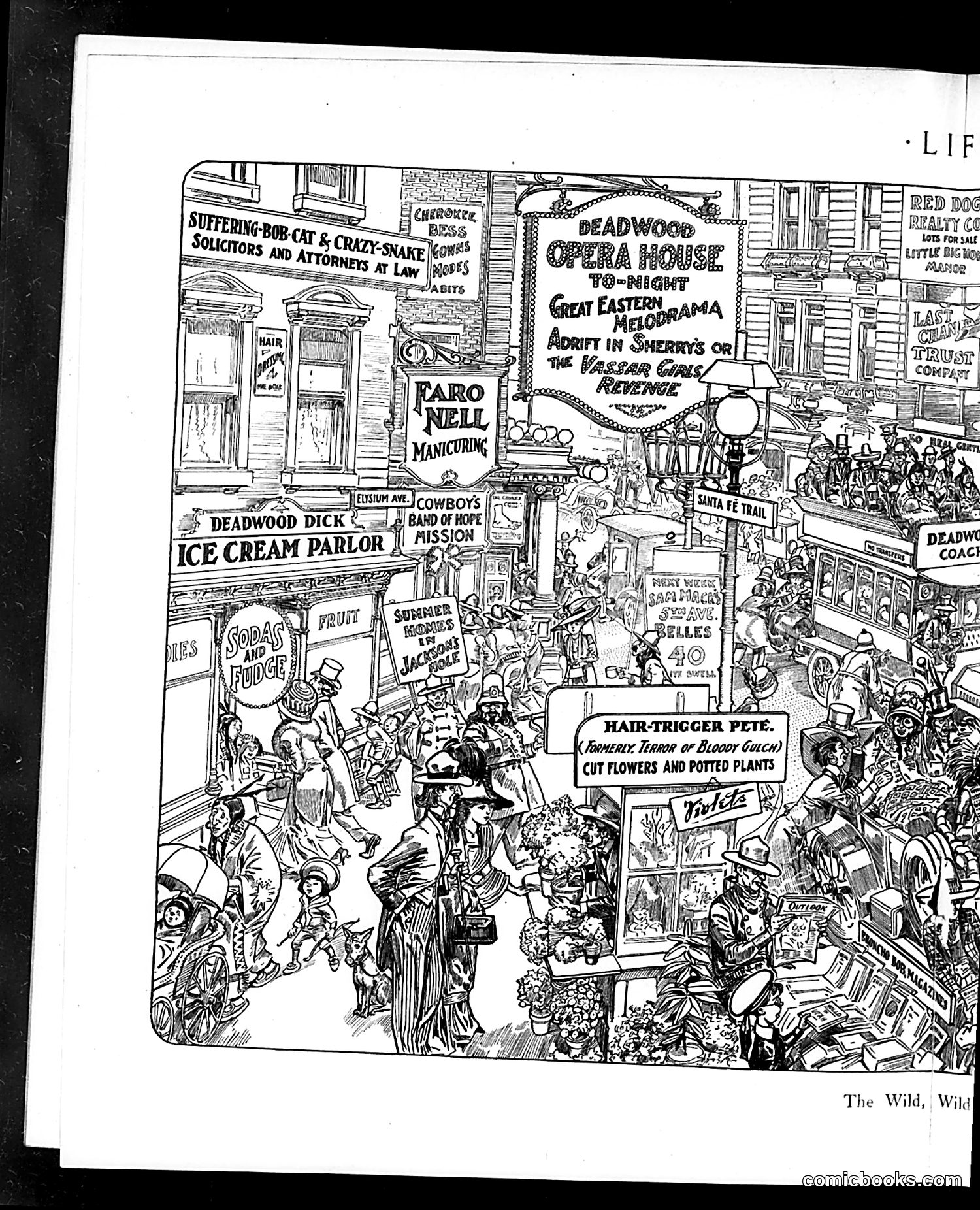
This is a densely detailed satirical illustration depicting a Wild West town street (labeled "Deadwood") filled with commercial establishments and colorful characters. The cartoon mocks the romanticization of the Old West by cramming it with incongruous modern businesses: an ice cream parlor, manicuring salon, flower shop, and opera house all operate alongside saloons and Western stereotypes. The humor relies on anachronism—juxtaposing rough frontier imagery with refined, civilized commerce. "Hair-Trigger Pete" (formerly "Terror of Bloody Gulch") now sells cut flowers and potted plants, suggesting the supposed taming of wild gunfighters into respectable shopkeepers. This satirizes both the mythologization of the West and contemporary consumer culture's ability to domesticate even the most lawless settings into shopping destinations.
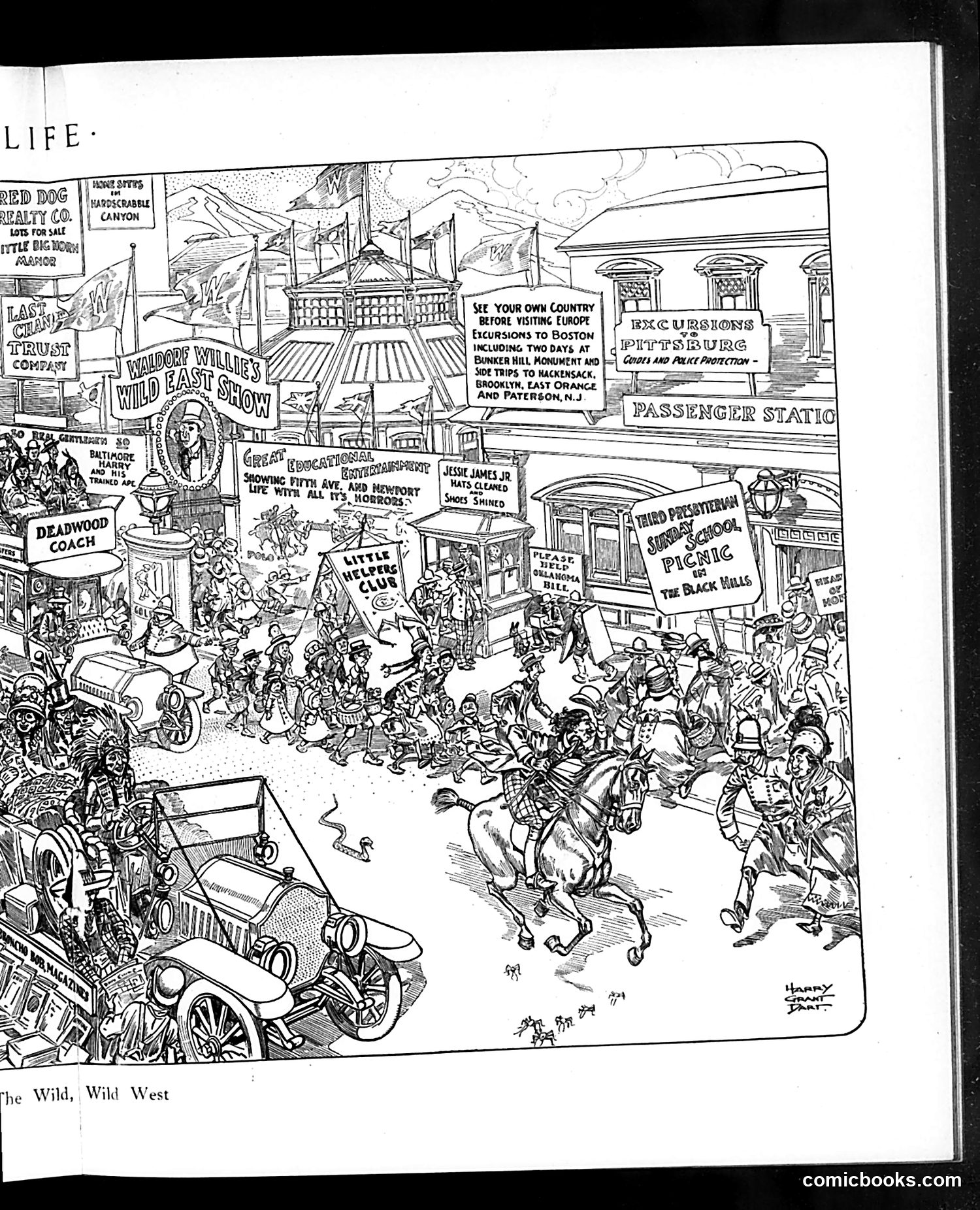
This satirical cartoon depicts a chaotic Wild West scene transplanted to an American city street, complete with a bucking horse, crowds, and period advertisements. The joke targets American tourism: rather than traveling to Europe (as was fashionable among wealthy Americans), the ad ironically urges visitors to explore domestic locations—but treats mundane New Jersey and New York destinations (Hackensack, Brooklyn, Paterson) as if they were exotic frontiers worthy of "Wild West" adventure. The cartoon mocks both American provincialism and the overwrought marketing of ordinary places as tourist attractions. Various period advertisements visible (passenger station, excursions, shows) reinforce the satirical tone about commercialized tourism. The mayhem suggests these "attractions" are hardly civilized destinations, further undercutting their appeal.
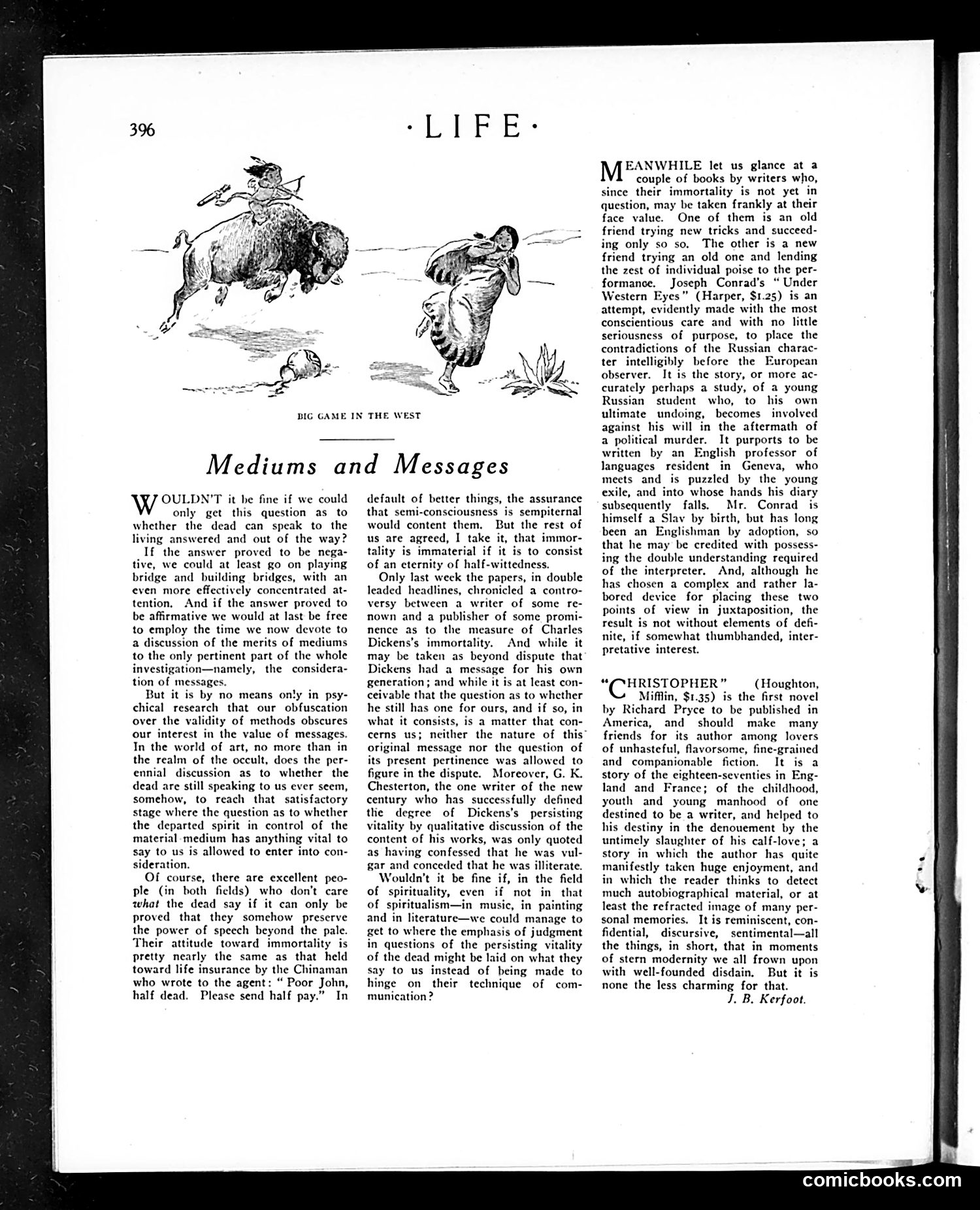
The cartoon depicts a cowboy being bucked off a horse—a straightforward Western scene labeled "Big Game in the West," likely satirizing the popular appeal of Western frontier imagery. The essay "Mediums and Messages" critiques spiritualism and literary criticism. The author argues that both spiritualists and literary scholars obsess over *whether* communication from the dead is possible, while ignoring what the dead actually have to *say*. The example: a recent public dispute between a famous writer and publisher over Charles Dickens's continued relevance focused on Dickens's vulgarity and illiteracy rather than the actual substance of his work. The author finds this absurd—whether discussing séances or literature, we should evaluate *content*, not merely *technique*. The piece reviews two contemporary novels: Conrad's "Under Western Eyes" (attempting but only partially succeeding with Russian character) and a new work by an unnamed author handling traditional material with fresh style.
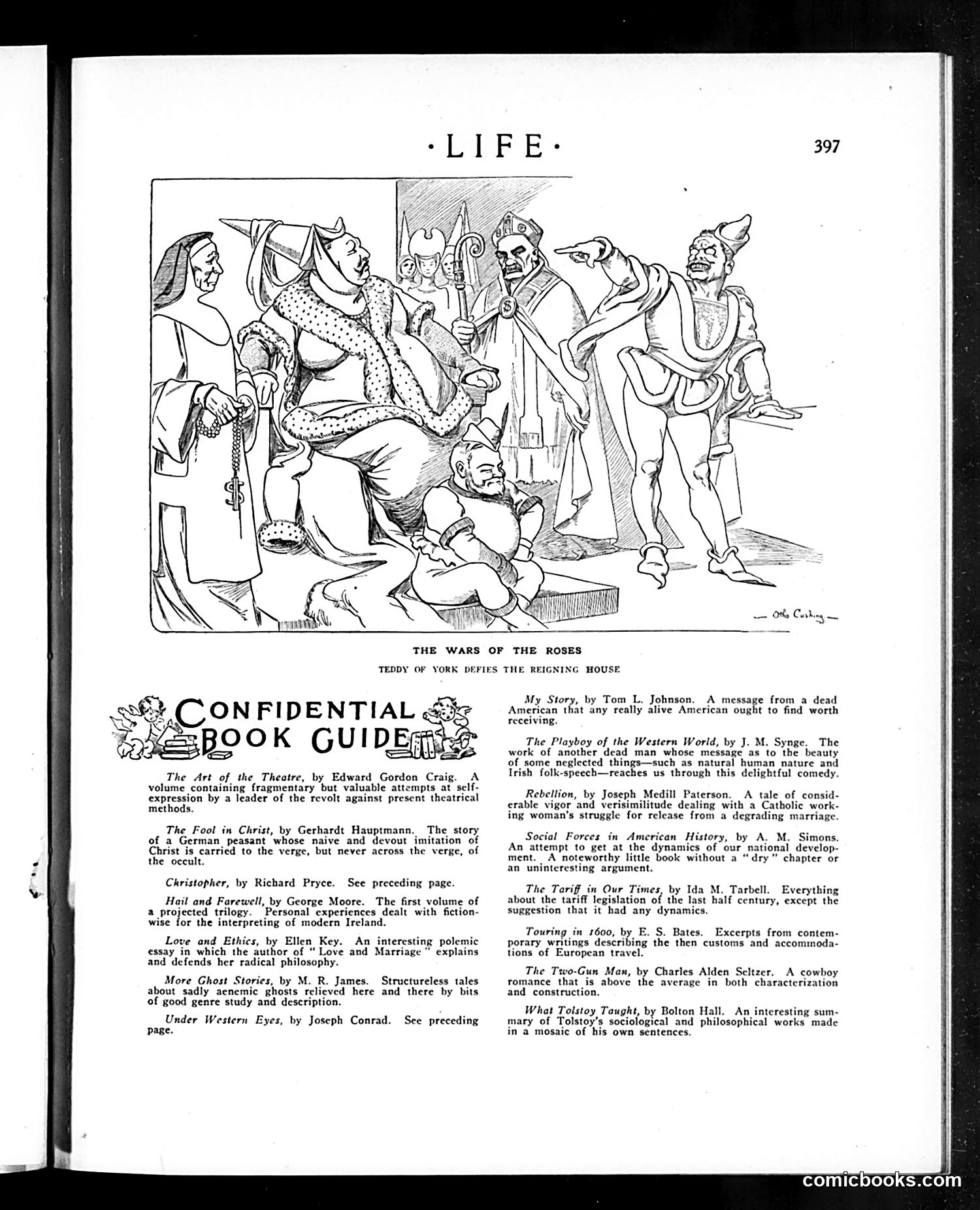
This cartoon satirizes President Theodore Roosevelt as "Teddy of York," invoking the historical Wars of the Roses—the 15th-century English civil conflict between rival noble houses. The caption suggests Roosevelt is defying the "reigning house," likely the Republican Party establishment or President Taft's administration. The elaborate medieval court scene depicts Roosevelt as a powerful noble surrounded by courtiers, clergy, and armed supporters, emphasizing his political dominance and faction-building. The satire suggests Roosevelt poses a threat to party unity through factional conflict—comparing contemporary political strife to the destructive dynastic wars of medieval England. This likely references Roosevelt's 1912 split from the Republican Party to form the Progressive "Bull Moose" Party, which fractured conservative politics and enabled Democrat Woodrow Wilson's election.
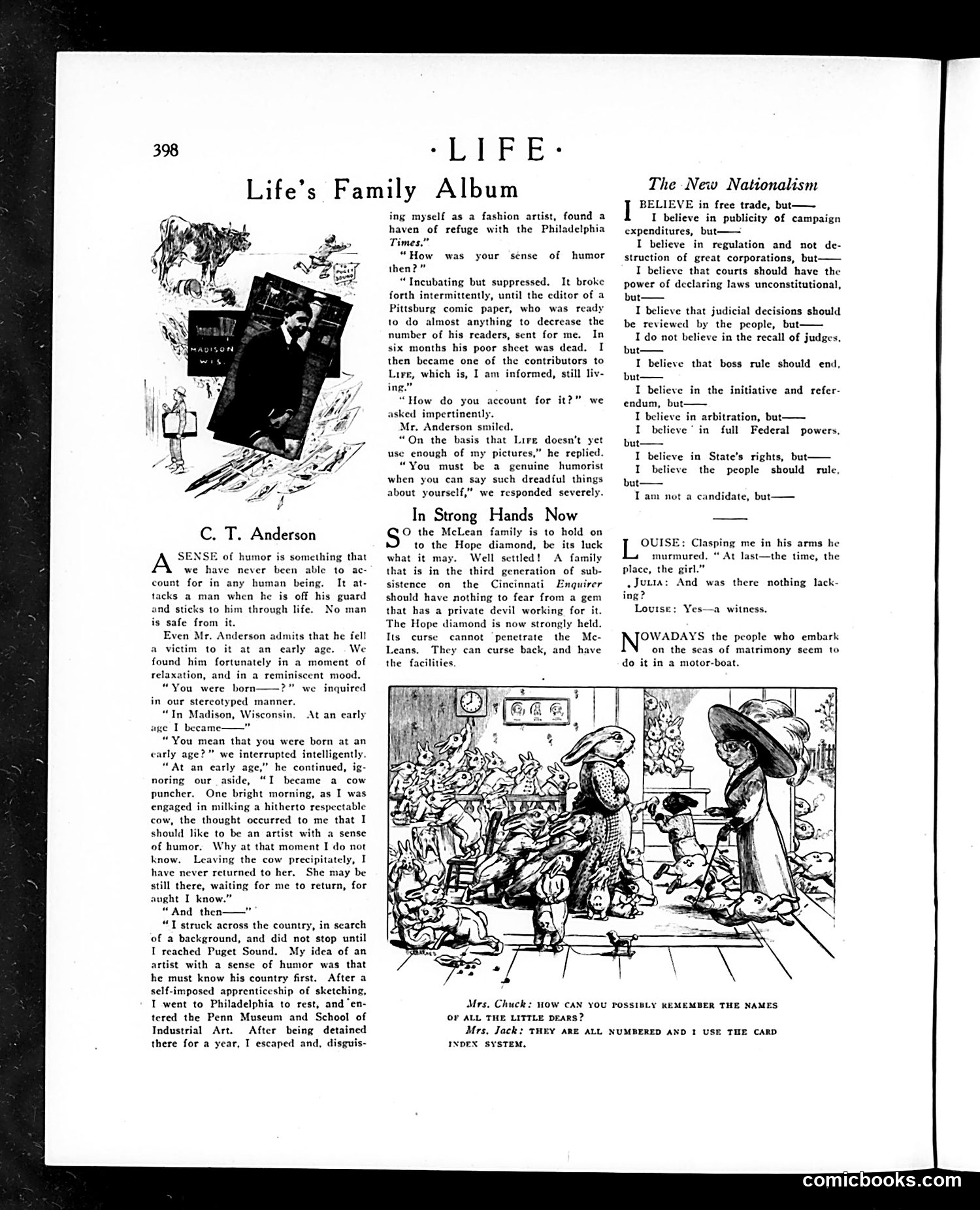
This page features a biographical interview with **C.T. Anderson**, a cartoonist and humorist who worked for Life magazine. Anderson humorously recounts his unconventional career path—from cow puncher to art student to newspaper cartoonist—culminating in his work for Life itself. The satire is self-deprecating: when asked how he accounts for his sense of humor, Anderson quips that Life "doesn't yet use enough of my pictures," a joke at his own employer's expense. The page also includes unrelated satirical content: a jab at the **McLean family** (wealthy Cincinnati newspaper owners) regarding the cursed Hope diamond, suggesting their money insulates them from superstition; "The New Nationalism" mockingly lists political positions filled with contradictory "buts"; and brief society humor about modern courtship and large families. The cartoons are generic domestic scenes typical of early 20th-century magazines.
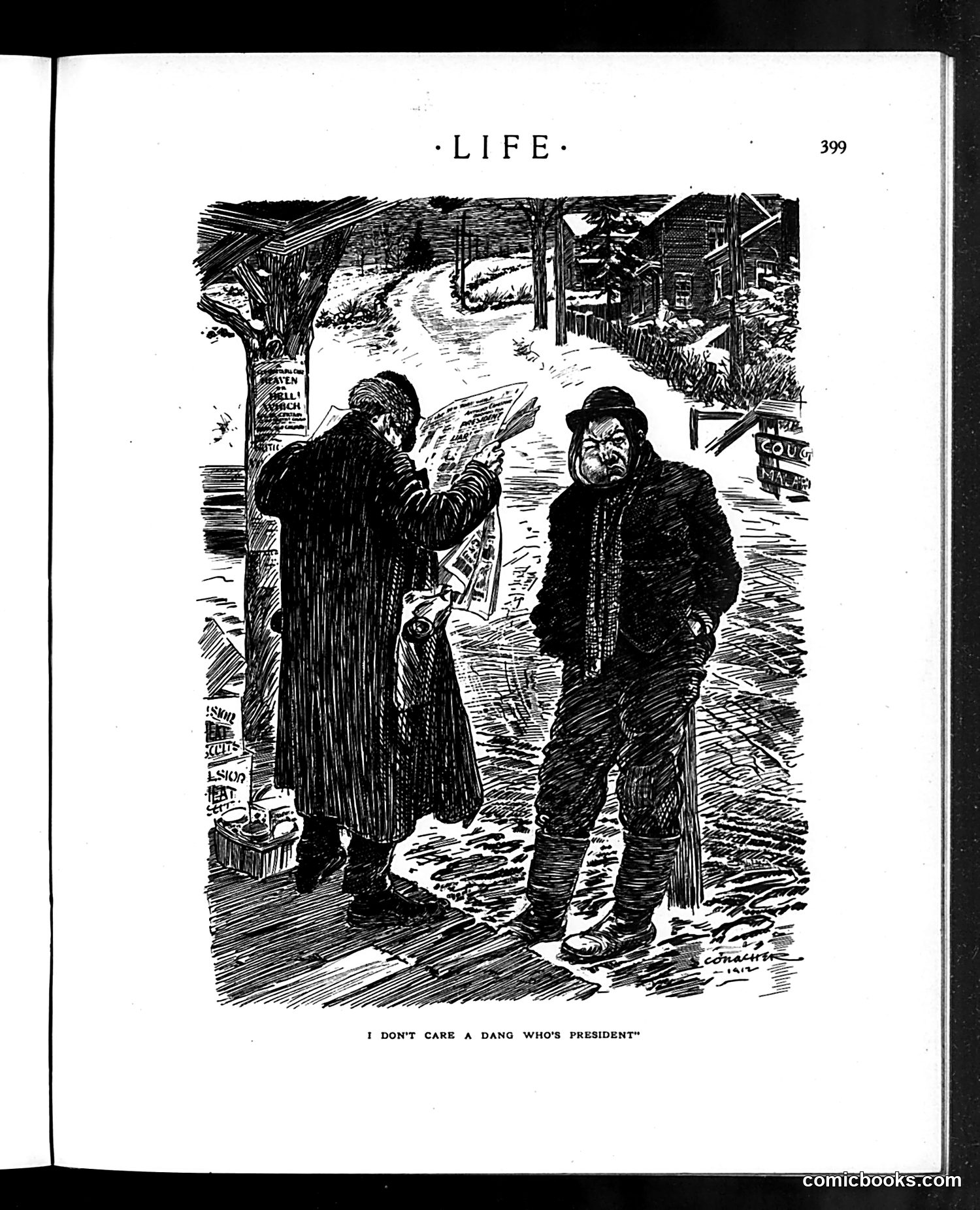
This single-panel cartoon from *Life* magazine (page 399) shows two working-class men on a snowy street. The man on the left reads a newspaper while the figure on the right, drawn with exaggerated features suggesting caricature, responds with the caption: "I DON'T CARE A DANG WHO'S PRESIDENT!" The satire targets political apathy among ordinary citizens, likely during a presidential election period. The cartoon mocks the indifference of working people to high politics—suggesting they're preoccupied with immediate survival concerns (the winter weather, their rough appearance) rather than civic engagement. The exaggerated facial features may indicate class-based stereotyping common in early 20th-century American humor. The overall message criticizes widespread disinterest in presidential politics among the working classes.
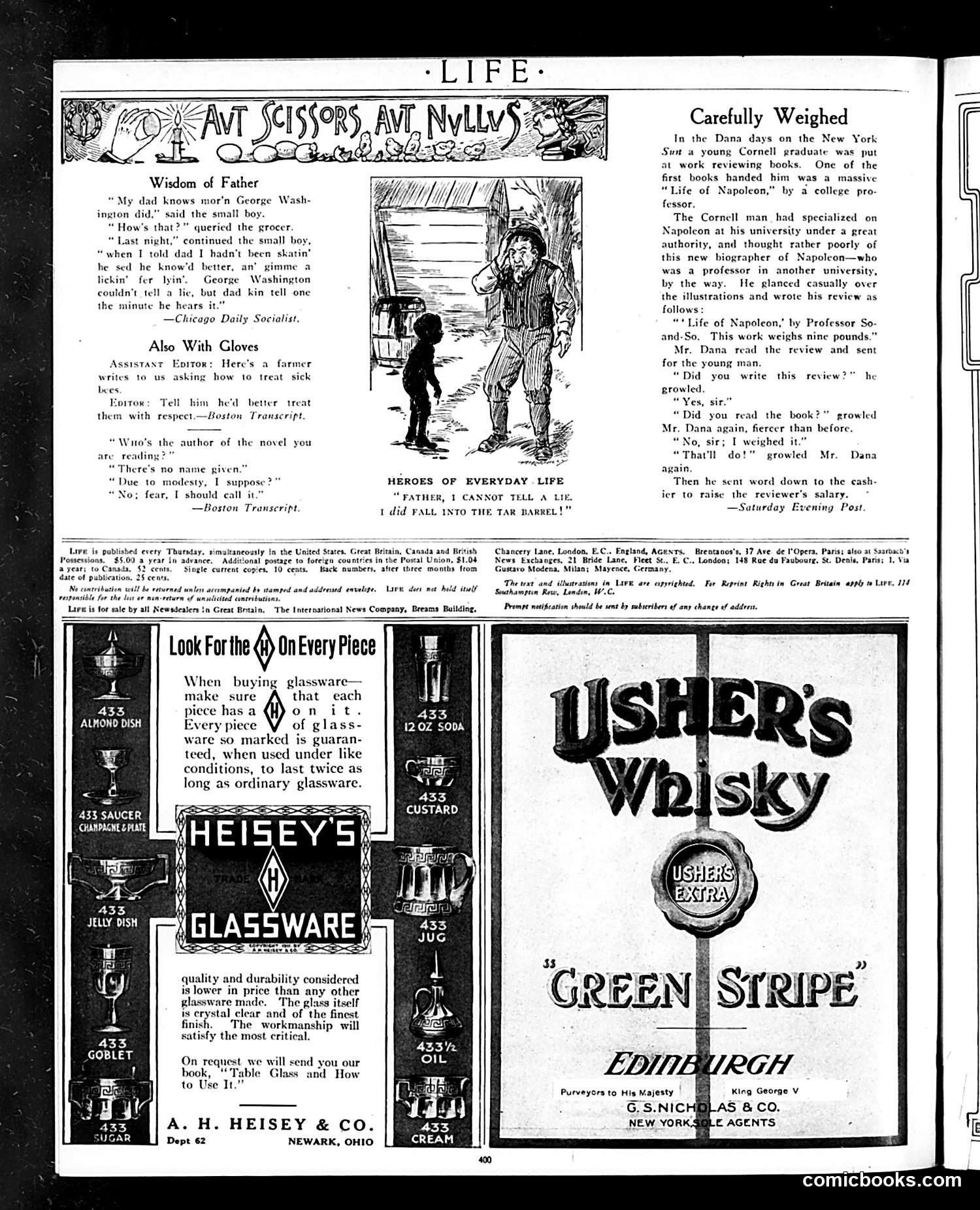
This page contains three distinct sections: **Top: Two Humorous Anecdotes** "Wisdom of Father" and "Also With Gloves" are brief jokes typical of Life's humor columns. The first contrasts George Washington's honesty with a modern father's ability to detect lies. The second is a wordplay joke about treating sick bees with "respect." **Center: "Heroes of Everyday Life"** This cartoon depicts a child who has fallen into a tar barrel, captioning the father's denial. It satirizes parental dishonesty—fathers who punish children for lying while being dishonest themselves. **"Carefully Weighed"** An anecdote about a Cornell-educated book reviewer at the New York Sun who, rather than reading a Napoleon biography by a rival academic, simply weighed it (nine pounds) in his review. Editor Charles Dana, surprisingly, rewarded this clever brevity by raising his salary—celebrating wit over diligent work. **Bottom: Advertisements** Heisey glassware and Usher's Whisky ads fill the remaining space. The page reflects early 20th-century satirical humor targeting hypocrisy, academic pretension, and social foibles.
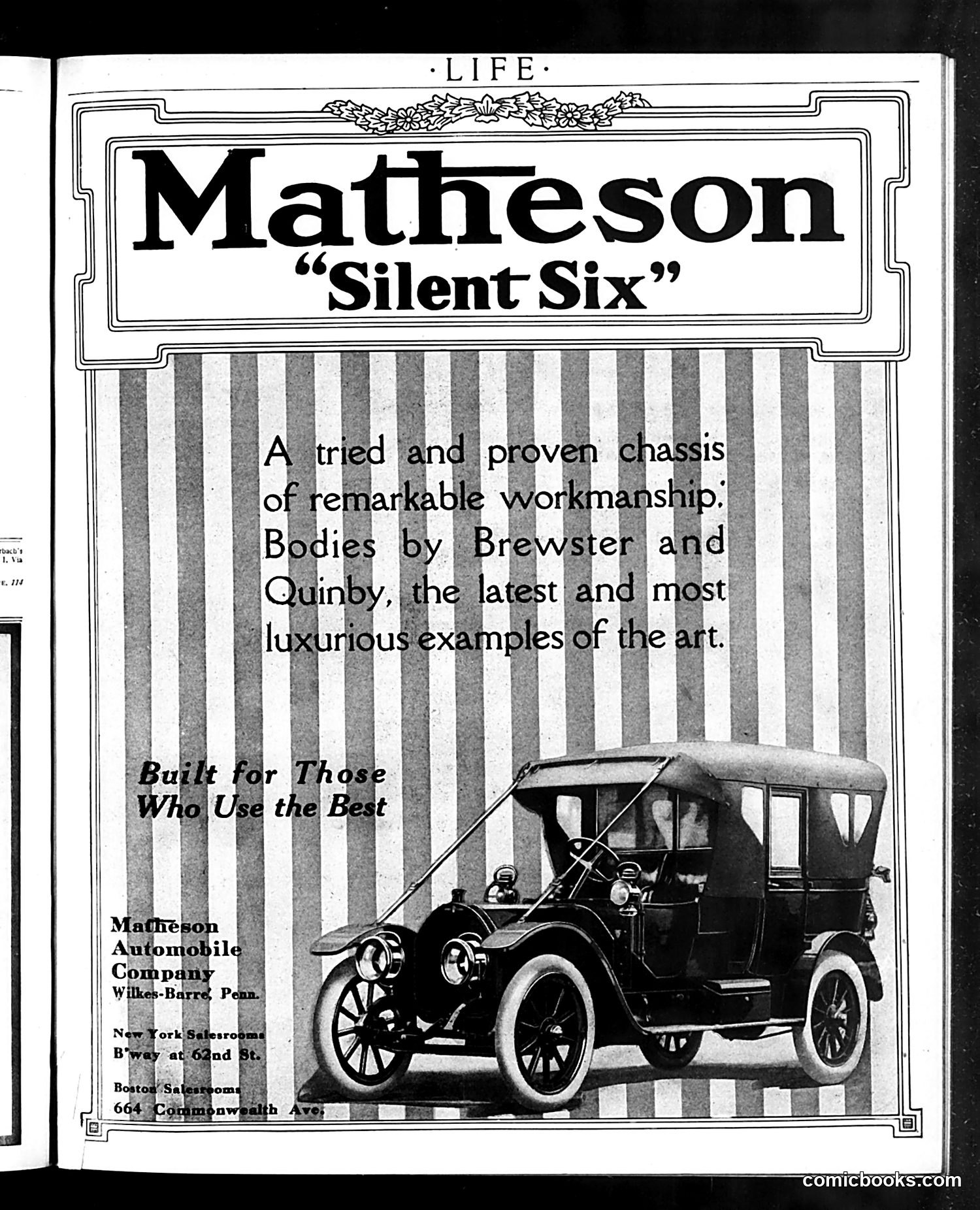
This is a **car advertisement**, not political satire. It promotes the Matheson automobile's "Silent Six" engine, manufactured by the Matheson Automobile Company in Wilkes-Barre, Pennsylvania. The ad emphasizes luxury and quality craftsmanship—specifically praising the chassis design and bodies by Brewster and Quinby. The tagline "Built for Those Who Use the Best" targets wealthy consumers. "Silent Six" likely refers to the engine's smooth, quiet operation compared to contemporary vehicles. The image shows a touring car typical of the early 1900s, suggesting this is vintage advertising aimed at affluent buyers seeking reliable, prestigious automobiles. The striped background is purely decorative design, common to period magazine advertising.
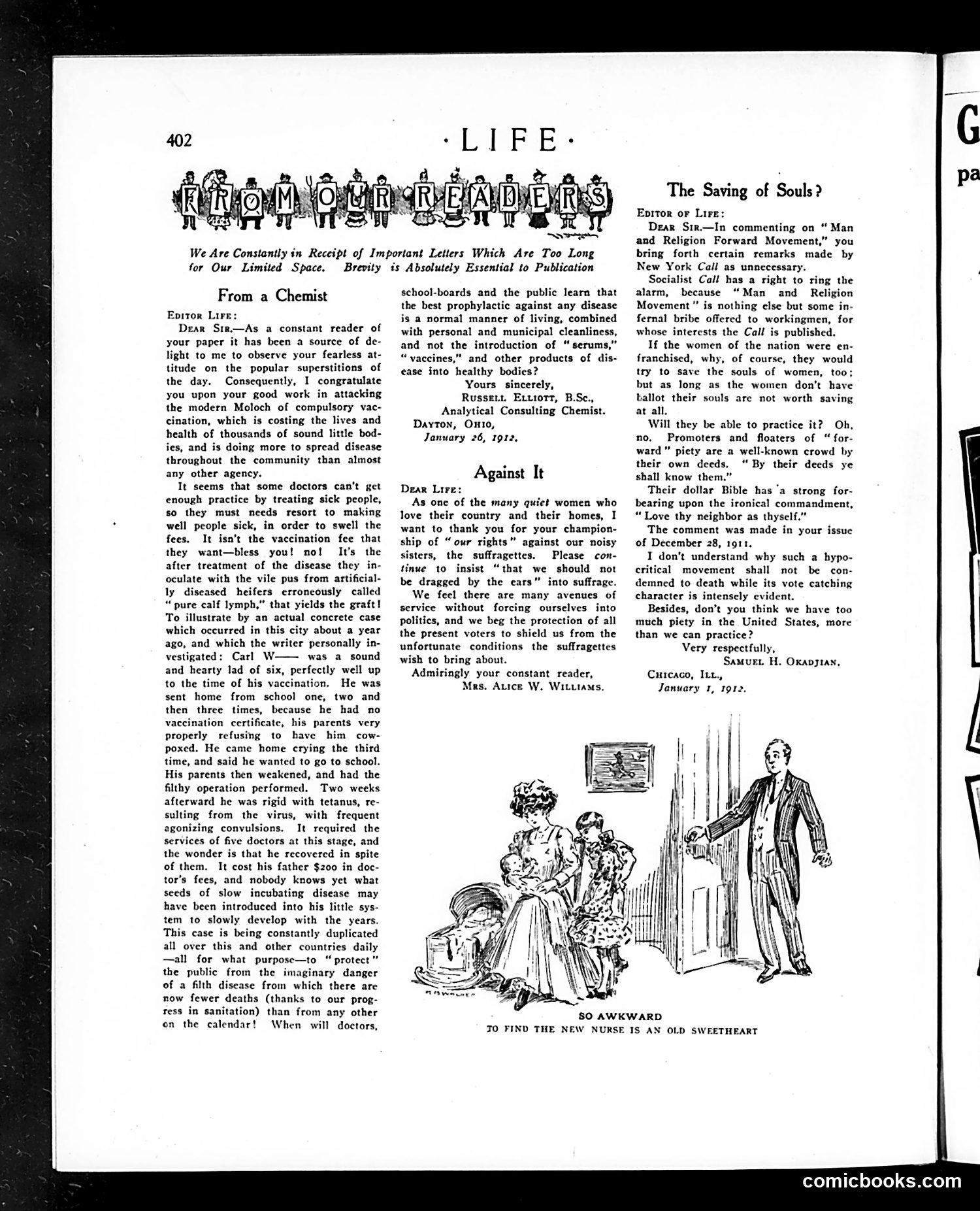
This page from *Life* magazine (January 1912) contains reader letters debating three contentious issues of the era: **Anti-vaccination letter**: A chemist attacks mandatory vaccination as a doctor-profit scheme, claiming it causes disease rather than preventing it. This reflects the anti-vax sentiment that existed even then, though the specific medical arguments (cowpox inoculation causing tetanus) are now known to be false. **Anti-suffrage letter**: A woman opposes women's voting rights, arguing women should avoid "politics" and instead serve through other means. This represents the "silent majority" opposition to the suffragette movement that was intensifying in 1912. **Socialist critique**: A brief letter begins criticizing the "Man and Religion Forward Movement" as patronizing to working-class men. The accompanying illustration shows an awkward elderly man meeting a young woman—likely satirizing the discomfort of courtship across age differences, though the caption's relevance to the letters is unclear. These letters showcase *Life's* role as a forum for competing ideologies on medicine, women's rights, and labor.
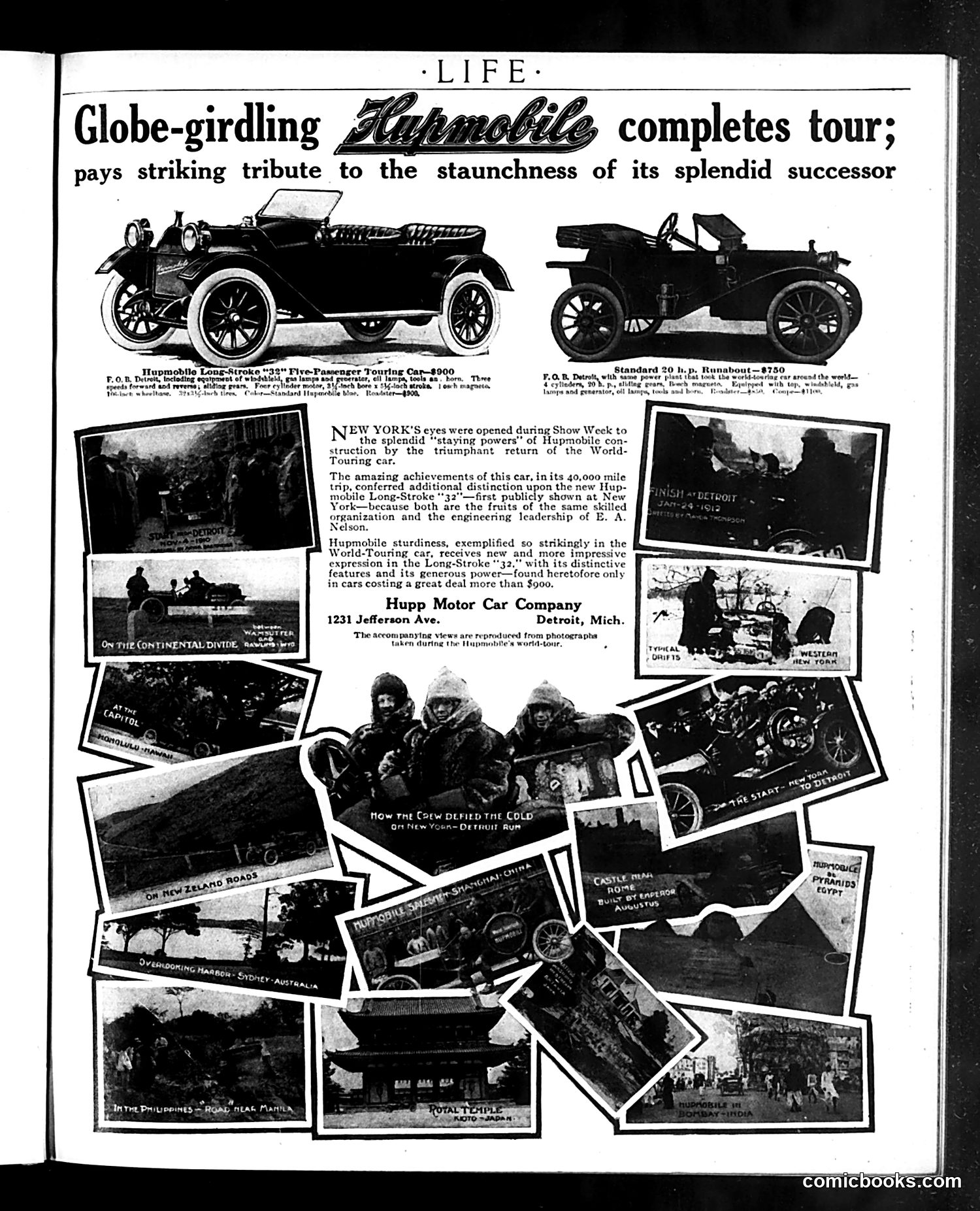
This is primarily **automobile advertising**, not political satire. The page promotes the Hupmobile automobile, specifically celebrating a Hupmobile's completion of a 40,000-mile world tour. **The content:** The advertisement compares two Hupmobile models (the Long-Stroke "32" and Standard models) while emphasizing the reliability proven by the world-touring vehicle's successful journey. Multiple photographs document the car's travels across diverse terrain—continents, deserts, cities, and challenging roads including the Continental Divide, New Zealand, Australia, the Philippines, and Egypt. **The pitch:** Hupmobile uses this real-world durability test as marketing, arguing that engineering excellence demonstrated by the touring car carries over to their new consumer models. The manufacturer claims customers get genuine quality at an affordable $900 price point. **For modern readers:** This represents early automotive advertising's reliance on adventure narratives and performance proof before standardized crash tests or reliability ratings existed. The world tour functioned as primitive marketing validation.
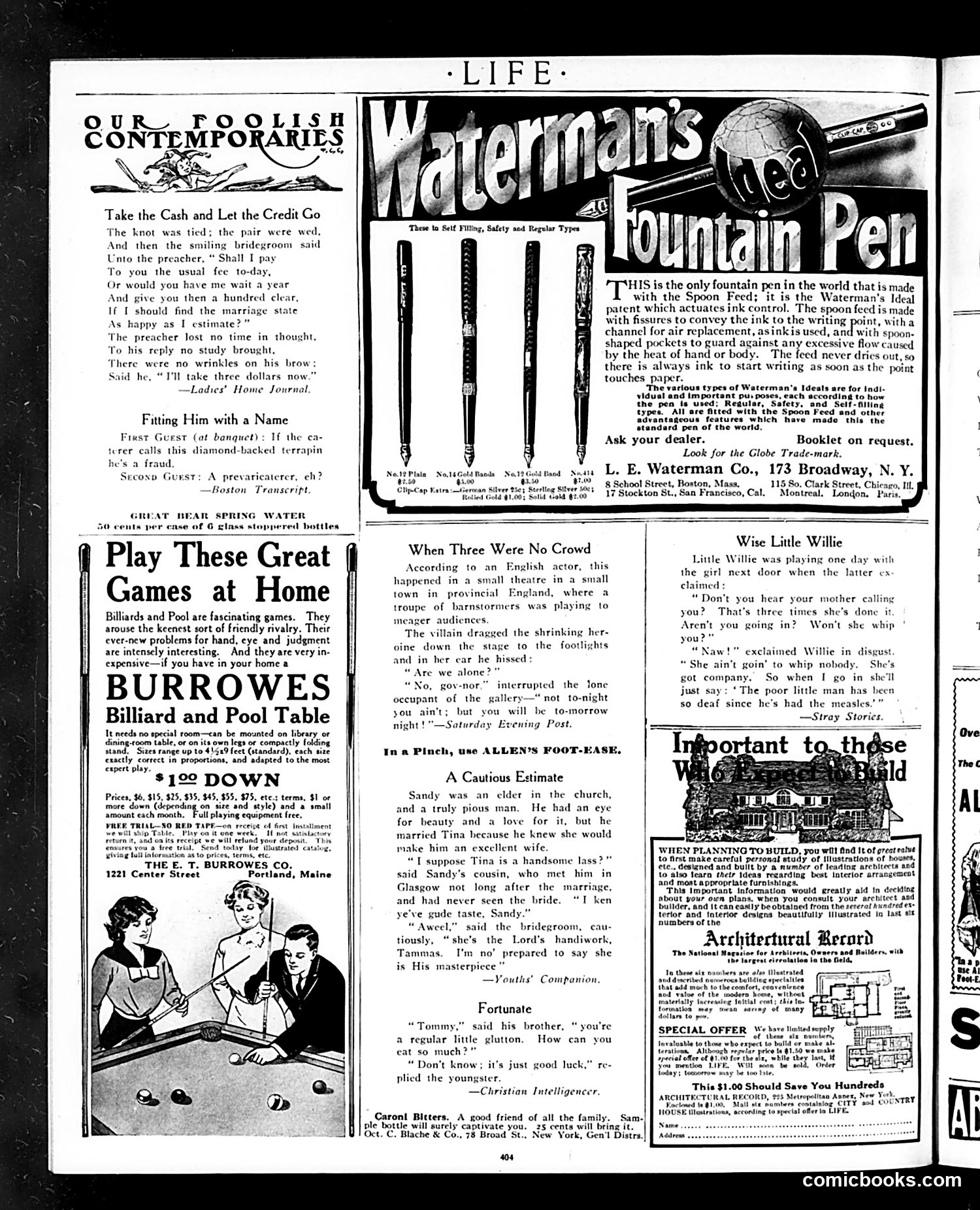
This page from *Life* magazine consists primarily of **advertisements and humorous anecdotes** rather than political cartoons. The content includes: **"Take the Cash and Let the Credit Go"** — a joke about a bridegroom offering a preacher either immediate payment or a larger sum later. The preacher chooses immediate payment, satirizing how financial self-interest trumps optimism about future happiness. **"Fitting Him with a Name"** — a brief exchange mocking pretentious dinner guests who use fancy terminology ("diamond-backed terrapin") to sound cultured while discussing ordinary food. **Humor sections** like "When Three Were No Crowd" and "A Cautious Estimate" offer light, folksy jokes about theatrical audiences and Scottish courtship. **The page is dominated by advertisements** for Waterman's fountain pens, Burrowes billiard tables, and other consumer goods — typical for *Life* magazine's era, which blended satire with substantial advertising revenue. The satirical content is gentle and domestic rather than pointed political commentary.
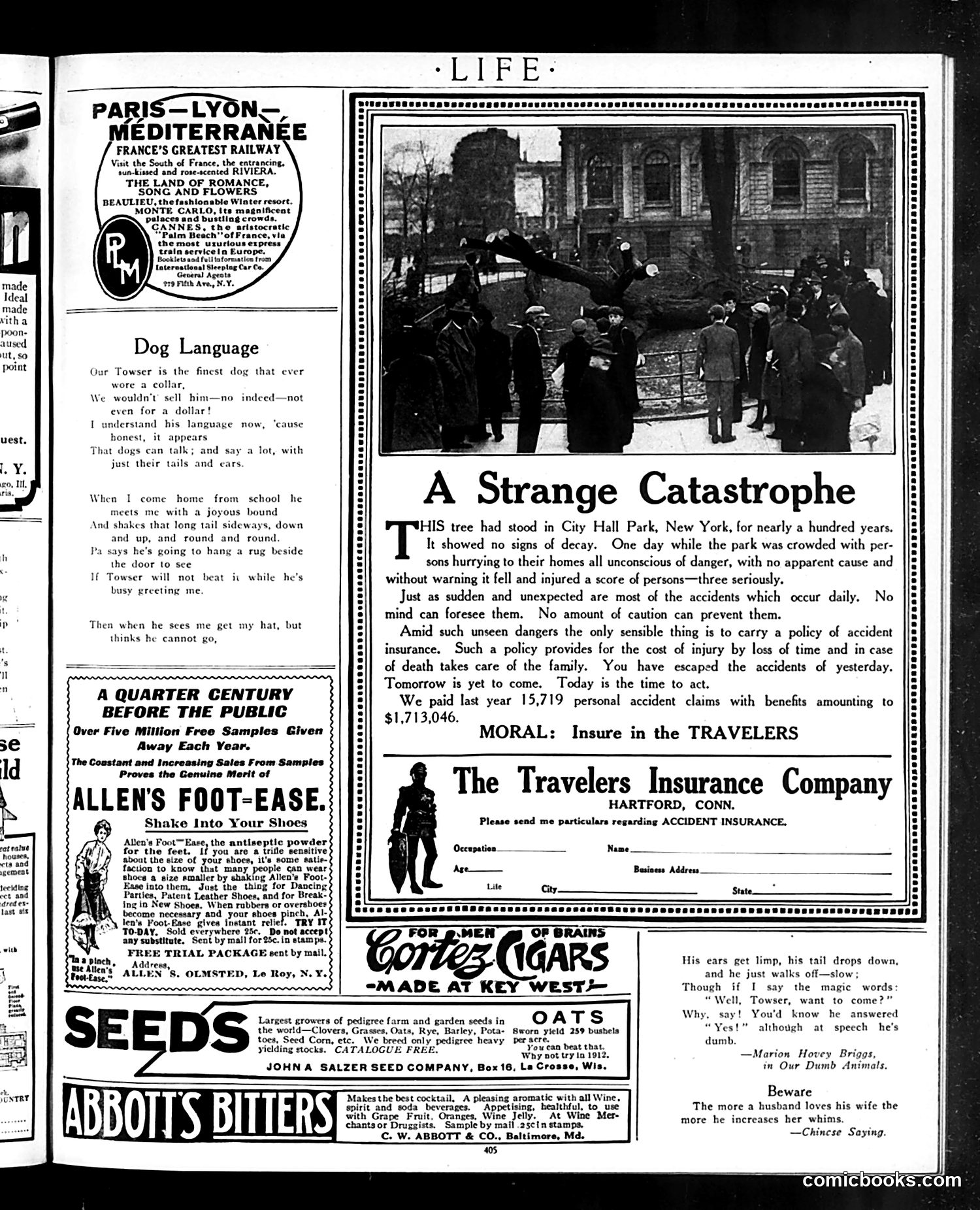
This page is primarily **advertising and light entertainment** rather than political satire. The main content includes: 1. **"Dog Language"** — A sentimental poem about a dog's ability to communicate through body language and behavior, suggesting dogs "talk" with tails and ears. 2. **"A Strange Catastrophe"** — An advertisement for Travelers Insurance Company using a real incident (a tree falling in New York's City Hall Park) to promote accident insurance. The pitch appeals to readers' anxieties about unpredictable dangers. 3. **Multiple product advertisements** — Allen's Foot-Ease powder, seeds, Cortez cigars, Abbott's Bitters, and a Paris-Lyon-Mediterranean railway promotion. 4. **"Beware"** — A brief humorous proverb about marriage. The page reflects **early 20th-century consumer culture**, mixing nostalgic sentiment (the dog poem) with emerging advertising strategies that use fear and statistics to sell insurance. There is no significant political satire visible on this page.
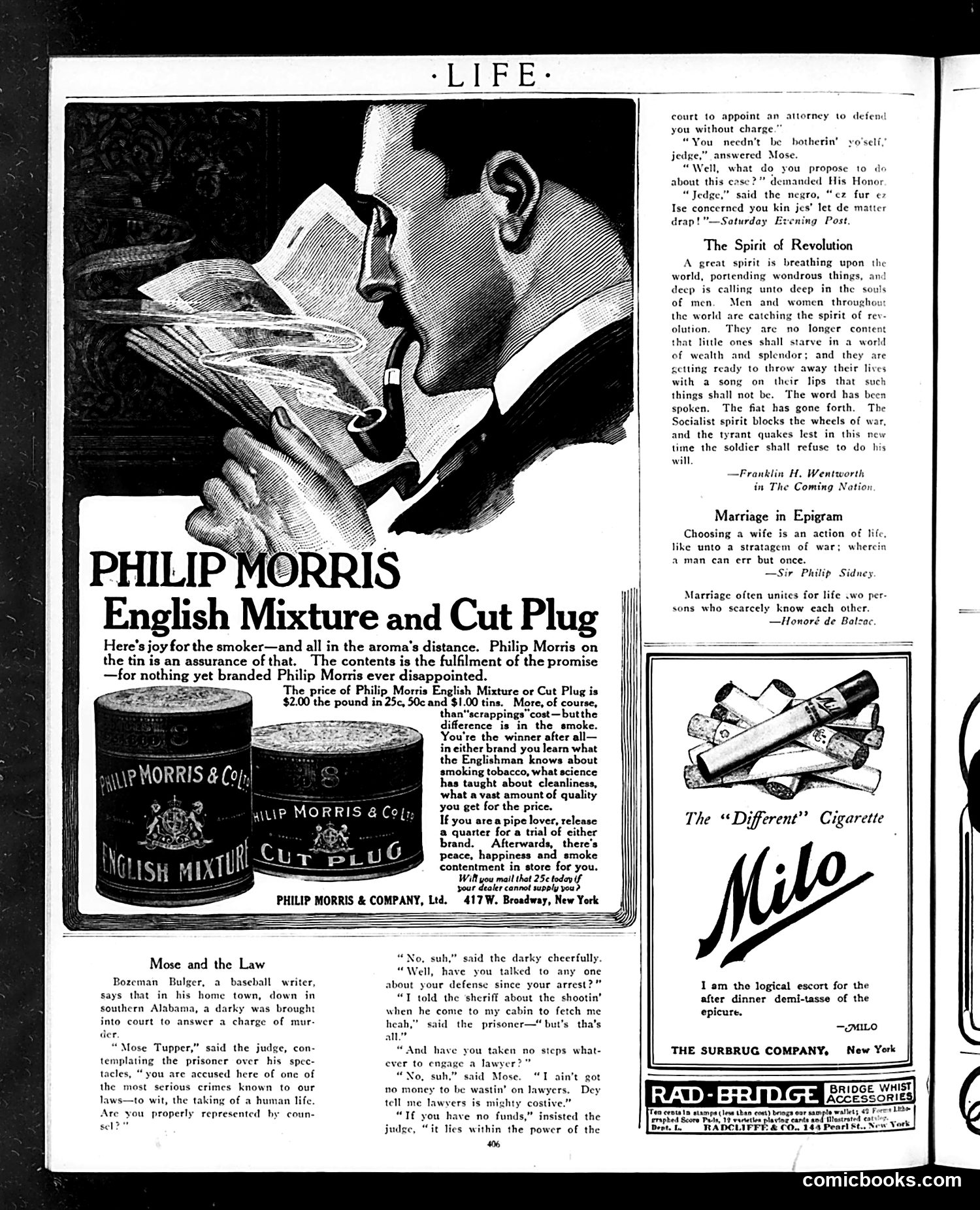
This page contains **no political cartoons**, but rather advertisements and opinion pieces typical of early 20th-century Life magazine. The main content includes: **"Mose and the Law"** — a dialect story depicting a Black defendant named Mose Tupper in an Alabama courtroom, charged with murder. The humor (for contemporary readers) relies on racial stereotypes: Mose's exaggerated dialect, his indifference to legal representation, and casual attitude toward a serious crime. This reflects deeply problematic racial attitudes of the era, presenting Black characters as comical and ignorant of formal institutions. **"The Spirit of Revolution"** — a serious editorial celebrating socialist and anti-war sentiment, suggesting workers will refuse military service. **Opinion pieces** on marriage and other topics round out the editorial content. The remaining space features **advertisements**: Philip Morris tobacco prominently, Milo cigarettes, and bridge whist accessories. The page is primarily **editorial and advertising** rather than satirical cartooning, with racial caricature serving as the era's "humor."
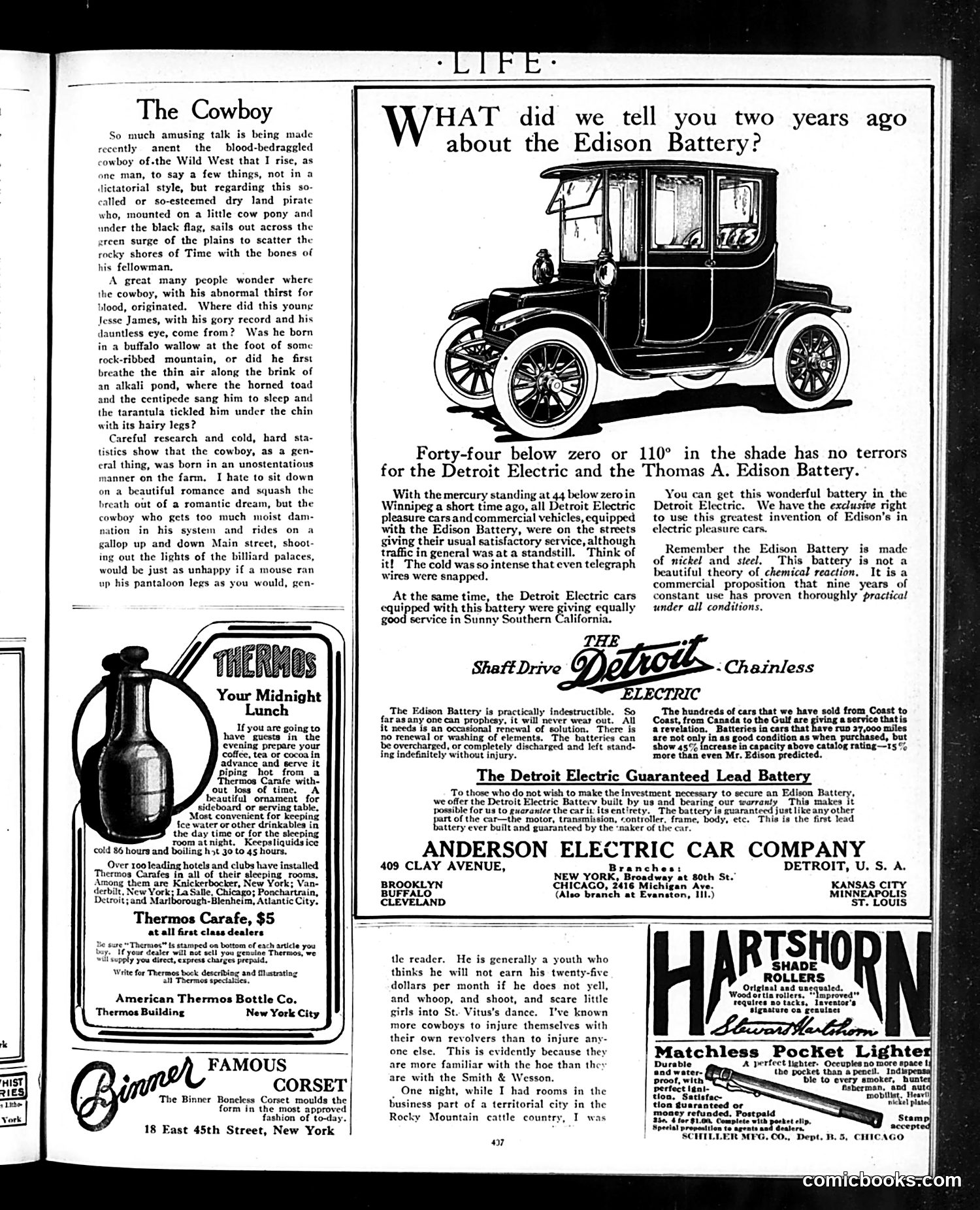
This page contains two distinct elements: **"The Cowboy" Essay**: A satirical piece debunking the romantic myth of the Wild West cowboy. The author argues that contrary to popular imagination, cowboys weren't born in dramatic frontier circumstances but rather on ordinary farms. The joke targets readers' fascination with the "blood-bedraggled" outlaw image—suggesting the reality is far more mundane. The humor lies in deflating the myth: a cowboy would be as upset by a mouse in his pants as anyone else, implying he's just an ordinary person, not a fearless gunslinger. **Detroit Electric Car Advertisements**: Multiple ads promoting electric vehicles and the Edison Battery, emphasizing reliability in extreme temperatures (44 below zero to 110 degrees). This reflects the early 1900s when electric cars were serious competitors to gasoline engines, marketed as practical and dependable. The page is primarily **advertising-driven**, typical of Life magazine's business model, with satirical content secondary.
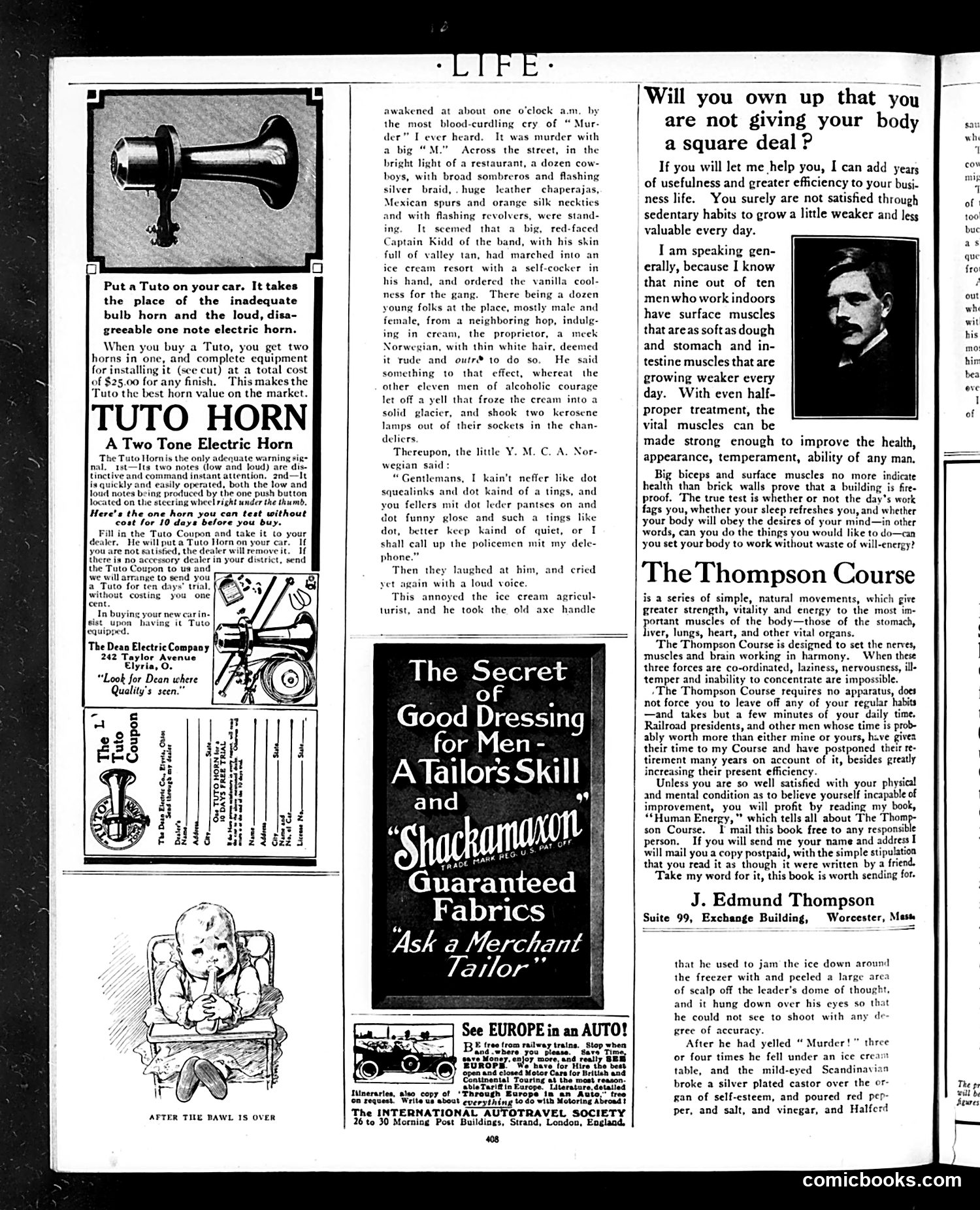
This page contains primarily **advertisements and one humorous narrative sketch**, not political satire. The main content is a comedic story about a confrontation at an ice cream parlor. A meek Norwegian proprietor refuses service to drunk **cowboys** (identifiable by their "sombreros," "silver braid," and "leather chaperajas"). When they become rowdy, he threatens to call police—prompting laughter from the men. The sketch's humor derives from the contrast between the mild-mannered immigrant and the aggressive, alcohol-fueled cowboys, depicting a common American frontier/Old West stereotype. The remaining page content includes advertisements for car horns (Tuto Horn), tailoring services (Shackamaxon fabrics), physical fitness (Thompson Course), and European auto tours. The illustration labeled "After the Bawl is Over" depicts a baby, likely connected to one of these ads. This appears to be from *Life*'s early period when it mixed humor, fiction, and advertising rather than focusing on political commentary.
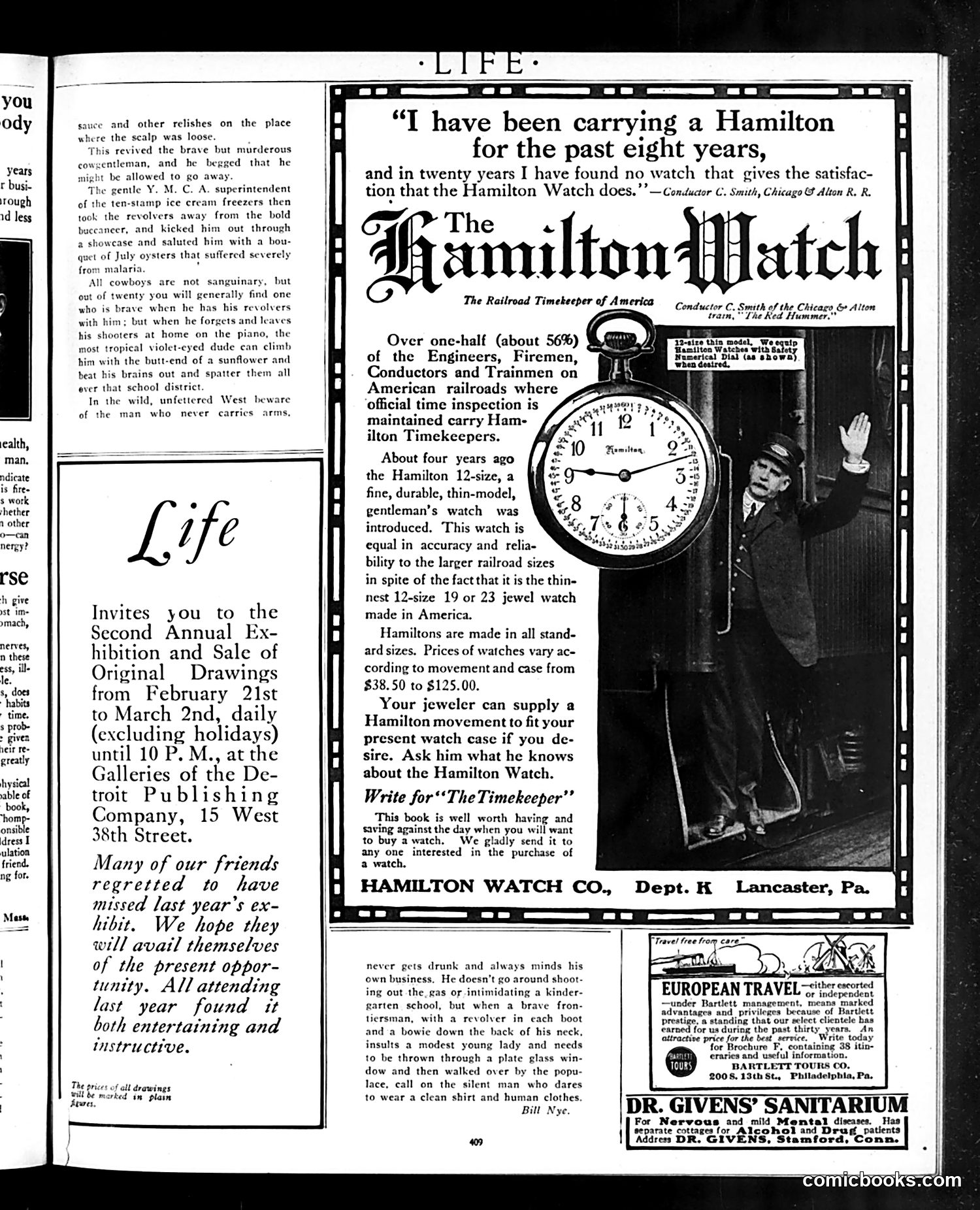
This page is primarily **advertising**, not satire. The dominant feature is a large Hamilton Watch Company advertisement featuring a railroad conductor endorsing their watches. The text claims over 56% of American railroad engineers, firemen, and conductors carry Hamilton timepieces for official time inspection—a practical appeal to precision and reliability. The smaller left column contains a **Life magazine announcement** inviting readers to an art exhibition in Detroit (February 21–March 2), noting that friends missed last year's show and should attend this one. Below the main ad is a brief **Western humor piece** about frontier masculinity: a tough cowboy who carries guns is dangerous and violent, but a quiet, well-dressed man who doesn't carry weapons can still dominate through sheer competence—a tongue-in-cheek reversal of Wild West stereotypes. The remaining ads (European travel, Dr. Givens' sanitarium) are unrelated commercial notices. There is **no political satire** on this page.
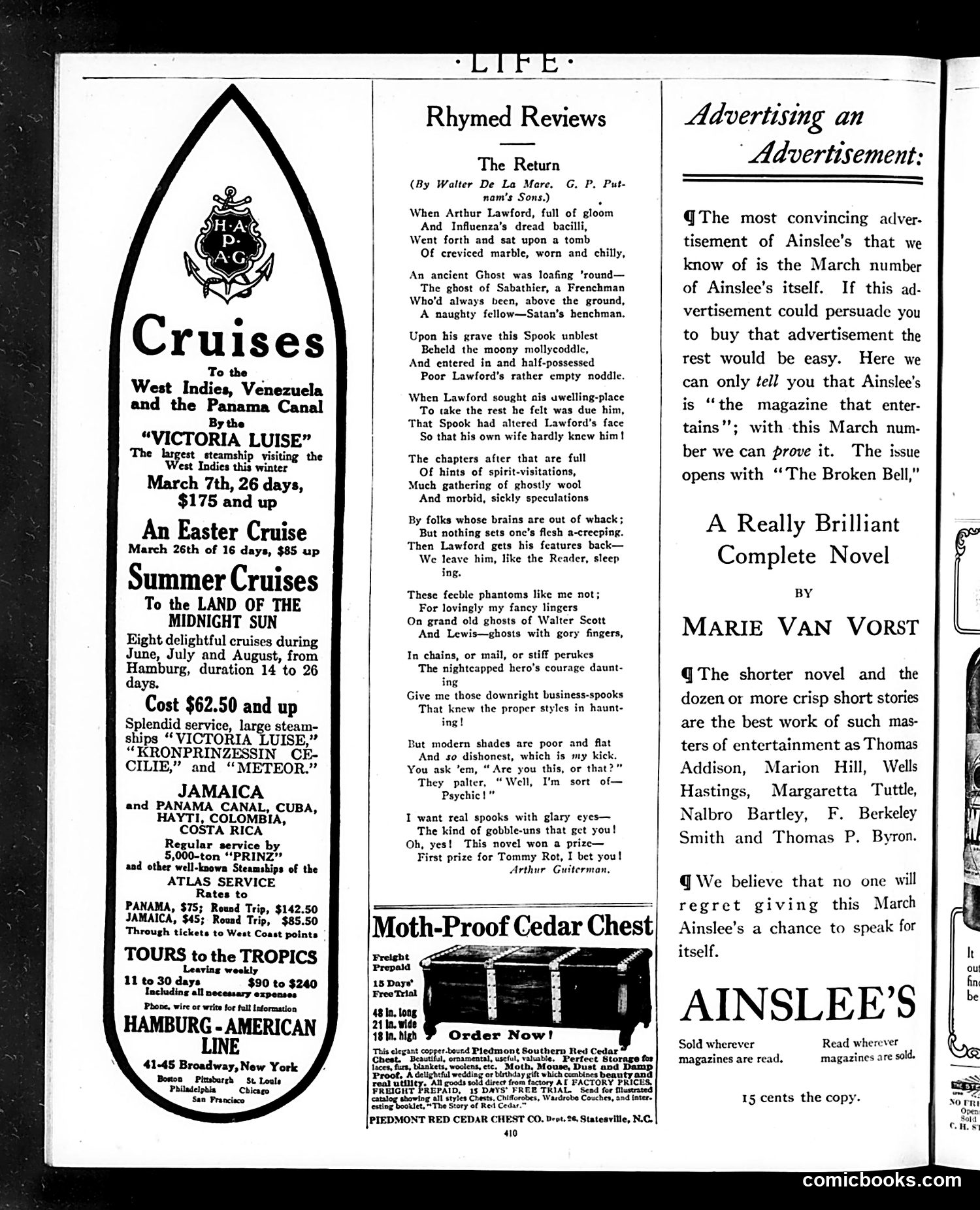
This page is primarily **advertising and magazine promotion**, not political satire. The left column features cruise advertisements from the Hamburg-American Line, offering voyages to Caribbean and tropical destinations (West Indies, Panama Canal, Land of the Midnight Sun), priced from $62.50-$175—luxury travel for affluent readers. The center contains a **book review in verse** by Arthur Guiterman criticizing Walter De La Mare's novel *The Return*. Guiterman mocks the book's ghost story as insufficiently frightening, preferring "real spooks with glary eyes" to De La Mare's tepid supernatural tale. It's lighthearted literary criticism, not political commentary. The right column is a self-referential **advertisement for Ainslee's magazine itself**, claiming the March issue proves the publication "entertains" by featuring a novel by Marie Van Vorst. The bottom advertises a **moth-proof cedar chest**—practical home goods marketed as gifts. There are no political cartoons or caricatures on this page. It represents typical early 20th-century magazine layout: advertising, book reviews, and house ads.
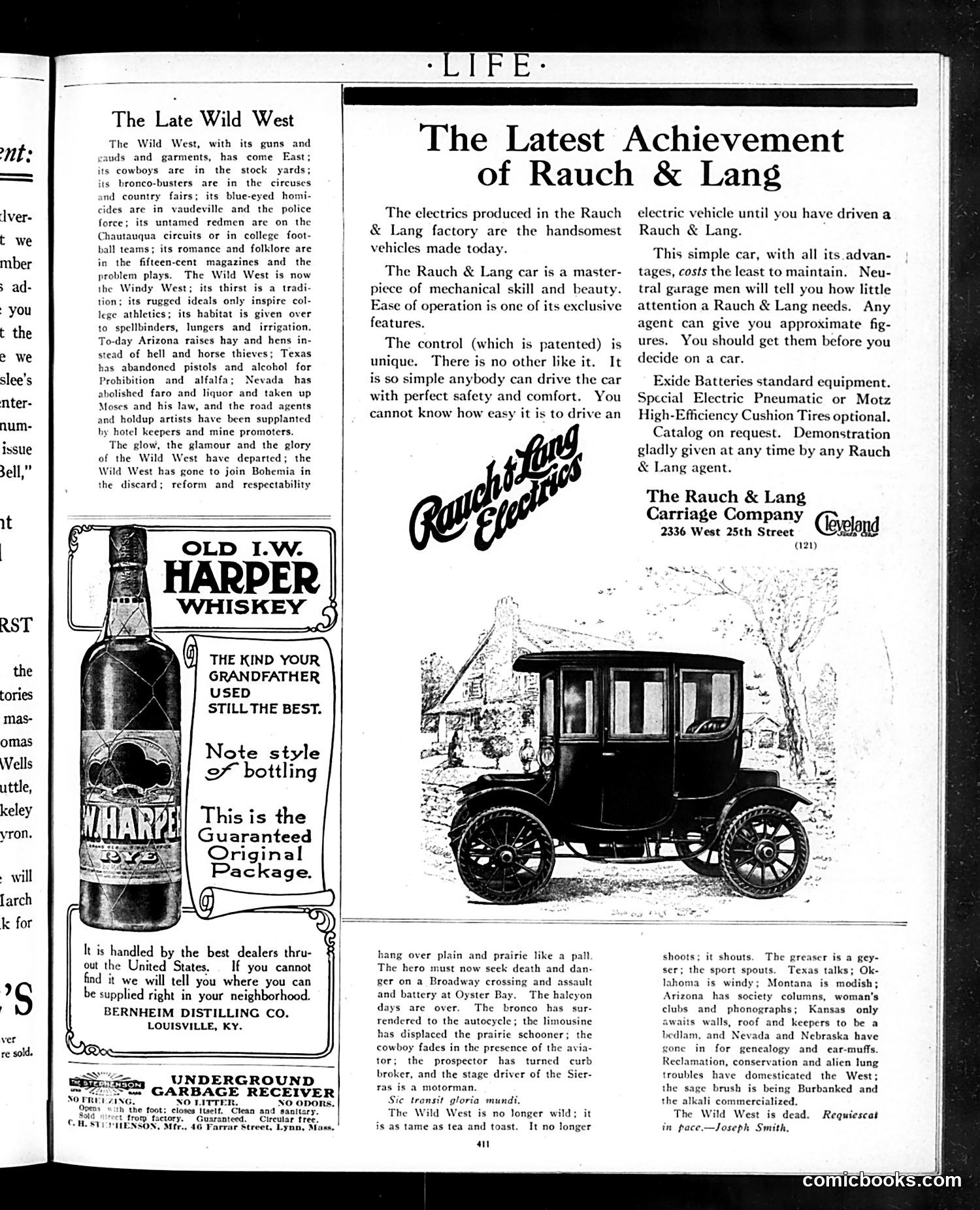
This page presents a nostalgic essay lamenting the disappearance of the American frontier. The author argues that the Wild West—once defined by lawlessness, violence, and romance—has been domesticated by civilization. Cowboys now work in stockyards; outlaws perform in vaudeville; Native Americans lecture on the Chautauqua circuit. Arizona grows hay instead of harboring criminals; Nevada abandoned gambling and drinking. The piece is satirical social commentary on American "progress": modernization and reform have killed the frontier's mythic appeal. The essay uses deadpan irony to show how the West has become respectable, commercialized, and ordinary—replaced by automobiles, irrigation, and proper society clubs. The advertisements (Old I.W. Harper whiskey, Rauch & Lang electric cars) ironically underscore this transformation: even the symbols of frontier excess now market themselves as refined, safe products for genteel consumers.
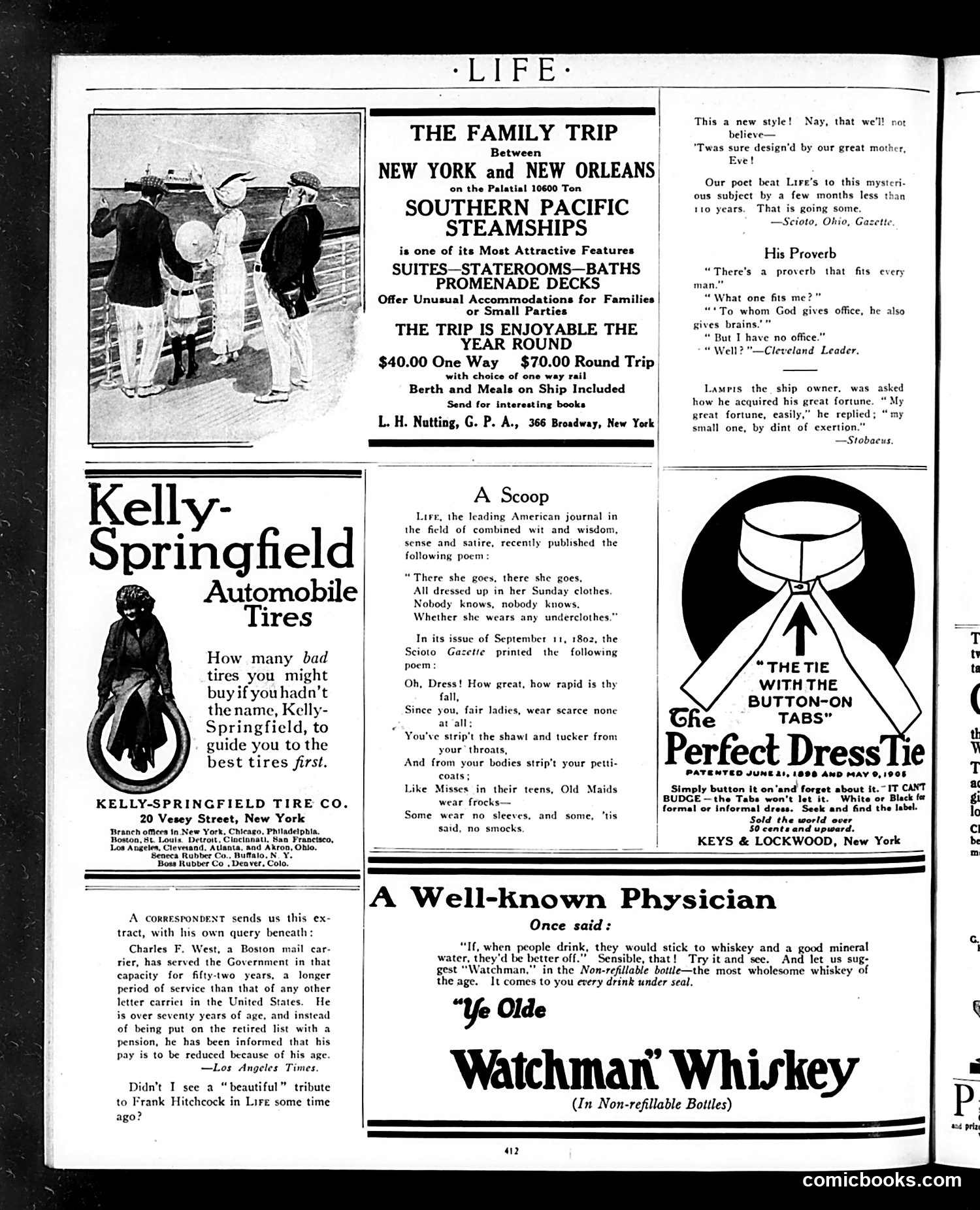
This page is primarily **advertising mixed with humor columns**, typical of Life magazine's format. The main content includes: **Advertisements:** Southern Pacific Steamships (family cruises), Kelly-Springfield automobile tires, and "Ye Olde Watchman' Whiskey" dominate the layout. **Humor Sections:** - "A Scoop" references a satirical poem about women's clothing, claiming Life republished an 1802 poem from the Scioto Gazette mocking fashions (the implication being that female fashion scandals are timeless). - "His Proverb" and other brief jokes play on office politics and wealth-building. - "A Well-Known Physician" reports a Boston mail carrier's pay reduction despite 70+ years of service—a pointed criticism of government bureaucracy. **The Social Context:** This reflects early 1900s concerns: women's fashion, government worker mistreatment, and advertising's growing dominance in magazines. The page demonstrates Life's mix of lighthearted satire with genuine social commentary.
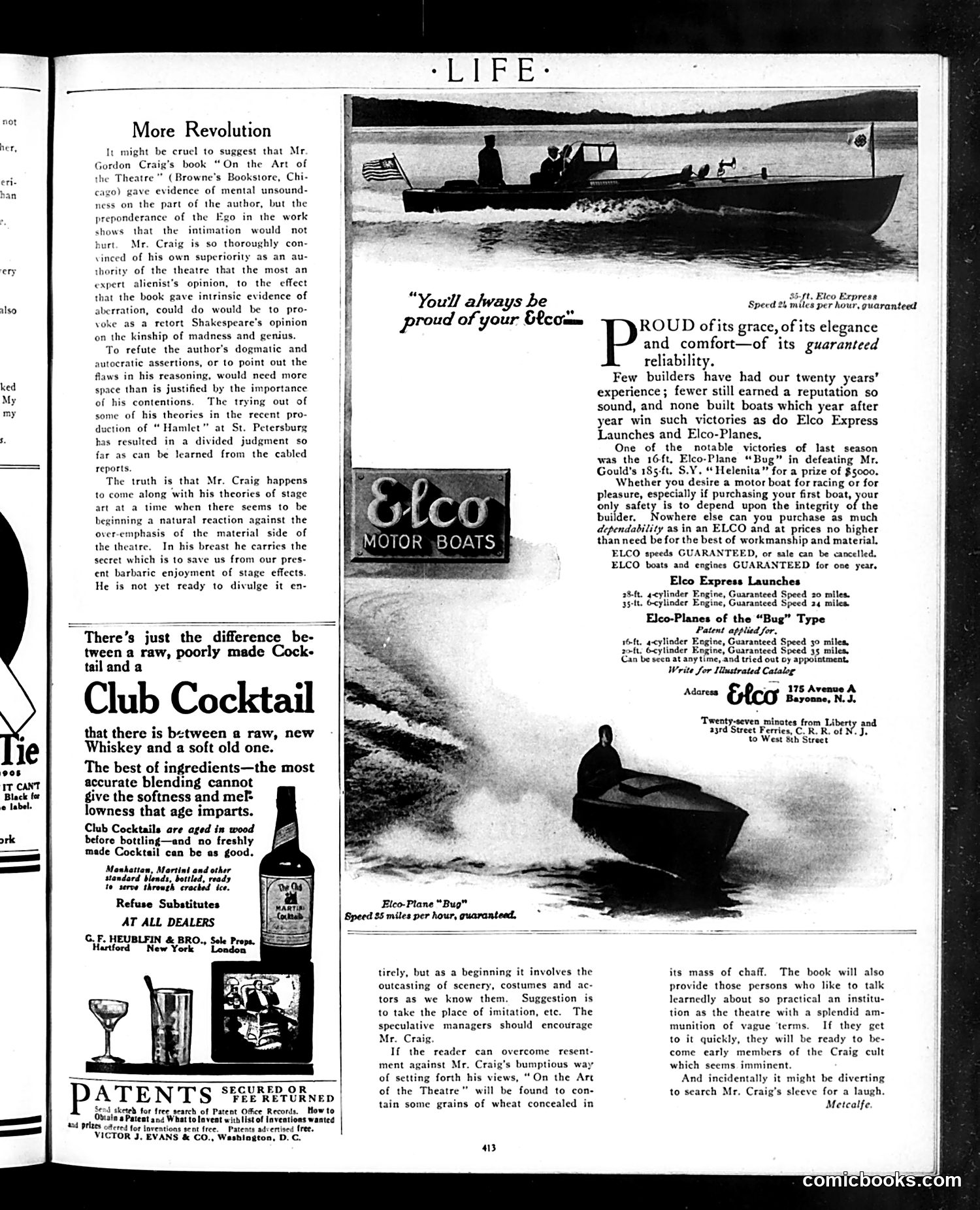
This page contains a **theater criticism essay** ("More Revolution") alongside **advertisements** for Club Cocktails, Elco motorboats, and patent services. The essay critiques **Gordon Craig's theatrical treatise "On the Art of the Theatre."** The writer mocks Craig's ego and dogmatic assertions about stage reform, sarcastically calling him mentally unsound for his self-importance. However, the critic acknowledges Craig represents a legitimate reaction against the theater's over-emphasis on material spectacle—arguing he advocates replacing scenery and realistic acting with suggestion and minimalism. The piece is characteristic of *Life's* satirical theater commentary: it deflates Craig's arrogance while grudgingly admitting his ideas have merit. The tone is arch and superior, typical of early 20th-century intellectual magazines dismissing pretentious theorists. The ads (particularly the Elco boats) are unrelated filler common in period magazines, with no connection to the editorial content.
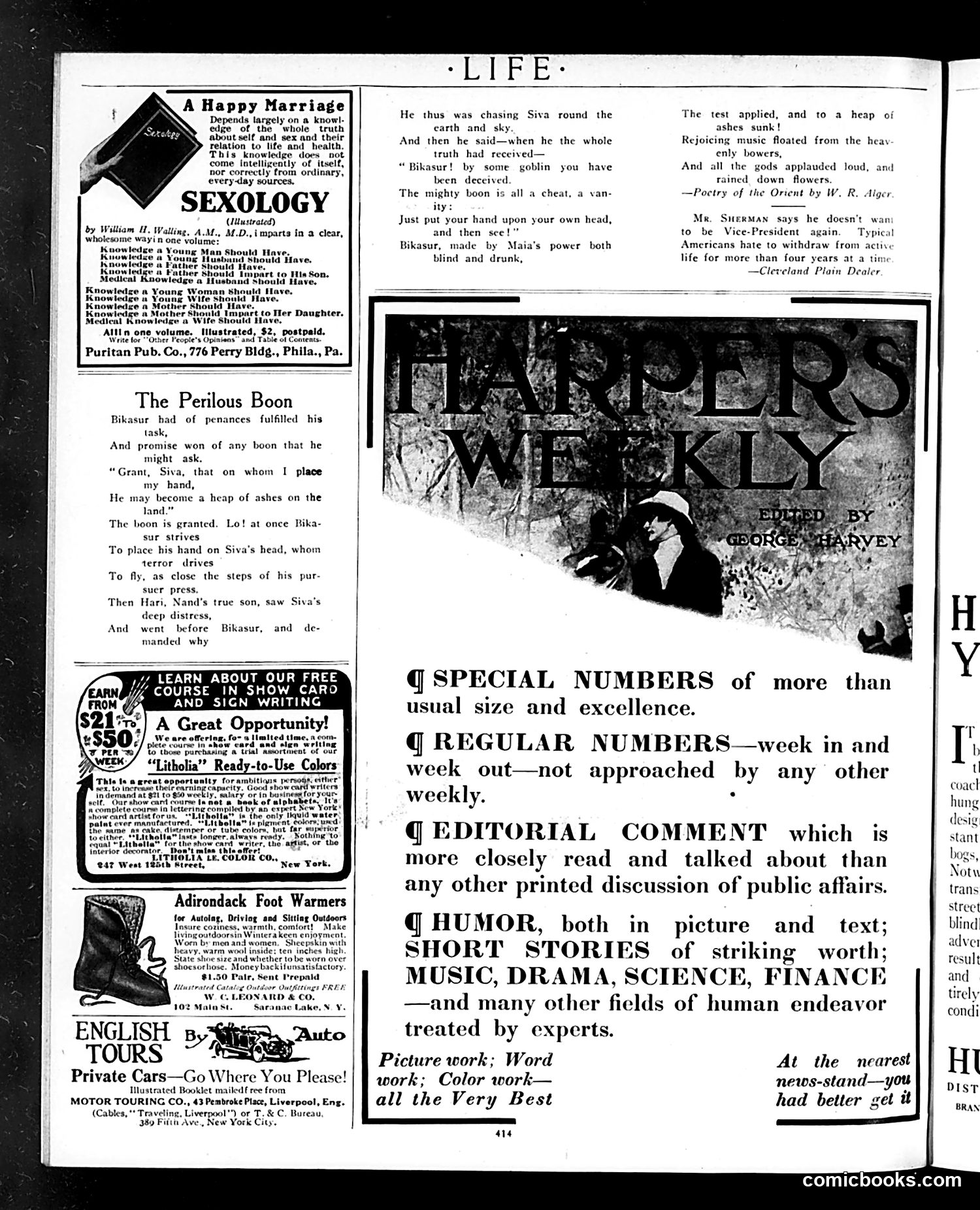
This page is primarily **advertising and promotional content** for Life magazine itself, interspersed with literary and editorial material. The main visual element is a **film advertisement** for "Harpers Weekly" (directed by George Harvey), showing what appears to be a dramatic scene. The text includes "The Perilous Boon," a **mythological narrative poem** from Hindu tradition about the god Siva being chased by Bikasur, who possesses a dangerous boon. The story illustrates divine deception—Siva tricks Bikasur into realizing his curse is illusory. The page's bulk comprises **promotional copy** highlighting Life's editorial strengths: special issues, regular weekly publication, editorial commentary on public affairs, humor, short stories, and coverage of music, drama, science, and finance—"treated by experts." A brief joke references a politician (Mr. Sherman) declining the Vice-Presidency, mocking American reluctance to step back from power. The surrounding **advertisements** promote self-help books (Sexology), art courses, foot warmers, and auto tours—typical early 20th-century periodical fare.
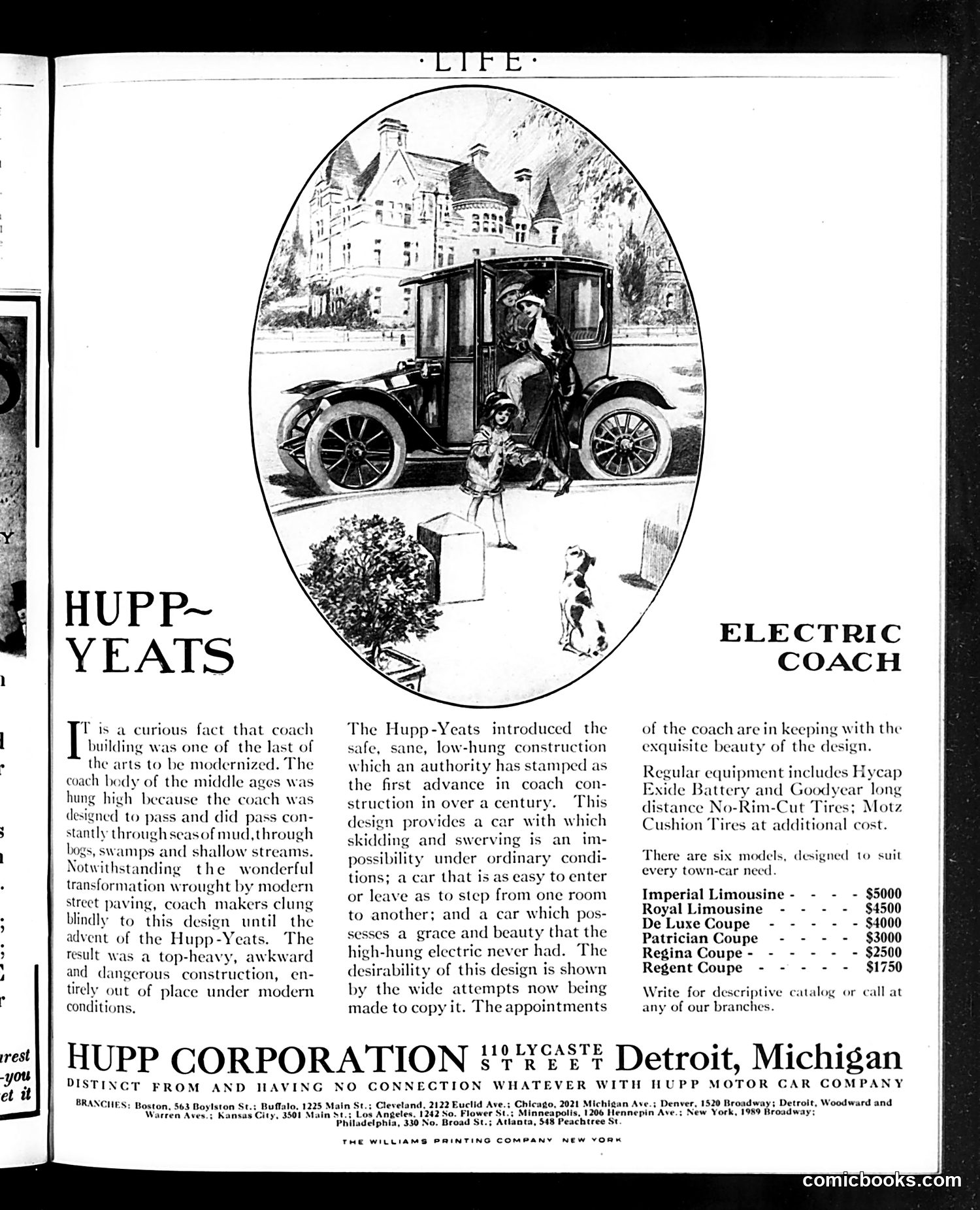
This is primarily a **luxury automobile advertisement**, not a political cartoon. The page promotes the Hupp-Yeats electric coach, a high-end town car. The "satire" is subtle and self-directed: the text humorously critiques traditional coach design, mocking how carriage makers clung to medieval high-suspension designs (originally built to cross mud and swamps) long after modern paved streets made this unnecessary. The Hupp-Yeats positions itself as the modern solution—low-hung, safe, and elegant. The illustration shows an affluent woman and man with a chauffeur beside the vehicle near a mansion, emphasizing luxury and status. The six models range from $1,750 to $5,000 (substantial 1910s prices). Note: The text explicitly distinguishes this Hupp Corporation from the Hupp Motor Car Company, suggesting a legal separation or dispute. This is essentially **high-end automotive marketing** dressed in the language of design progress.
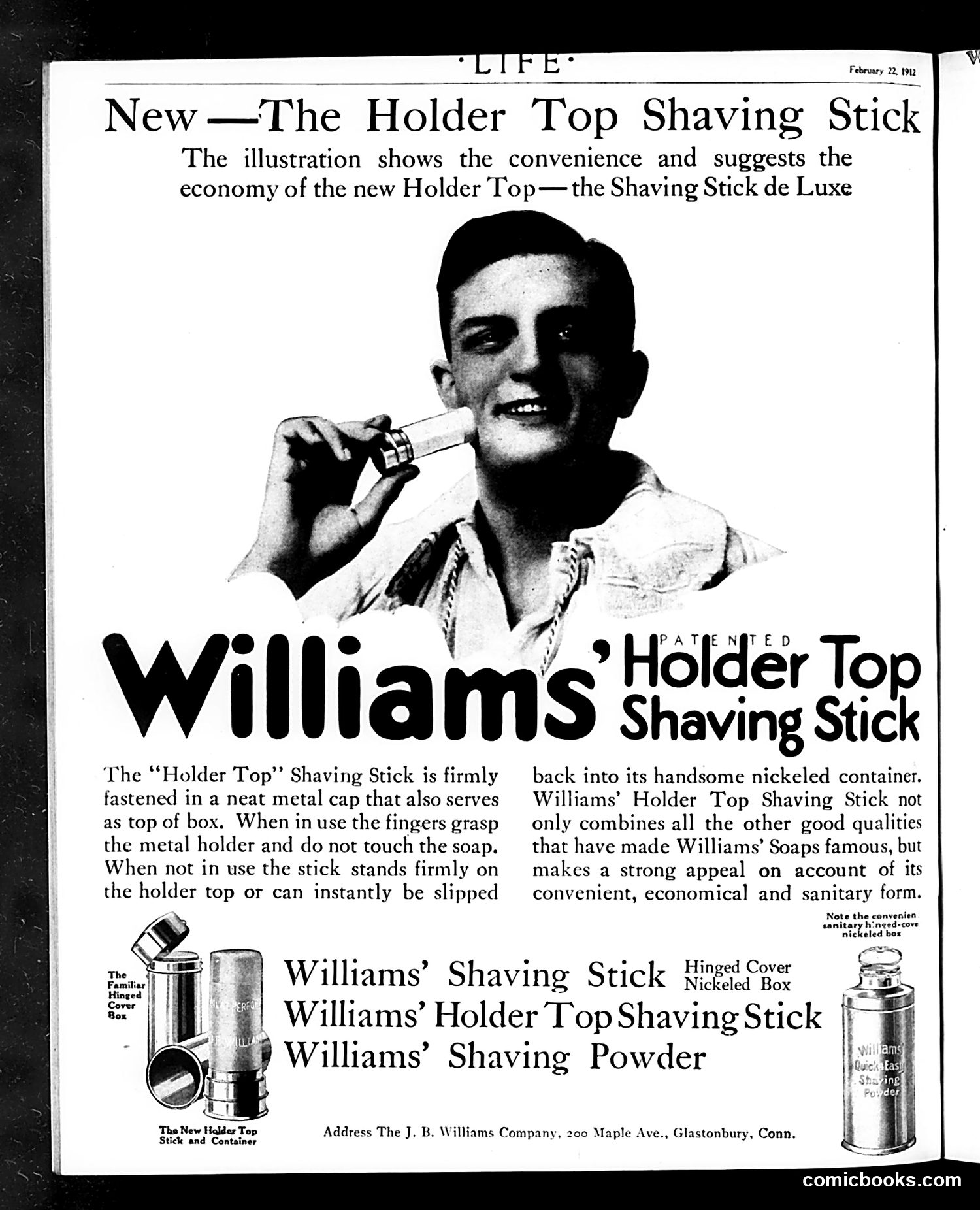
This is a **product advertisement**, not satire or political commentary. It appeared in *Life* magazine on February 22, 1912, promoting the Williams' Holder Top Shaving Stick. The "cartoon" element is minimal—primarily a photograph of a smiling man demonstrating the product. The ad emphasizes the innovation: a metal holder that keeps fingers clean by preventing direct contact with the soap. The stick stores upright in a nickeled container that doubles as the box. The appeal is to **modern convenience and hygiene**—concerns particularly resonant in the early 1900s when sanitation was becoming a public health focus. The ad stresses that this design is "convenient, economical and sanitary." There is no political satire or social critique visible. This is straightforward commercial advertising highlighting a practical improvement to an everyday grooming product, typical of early-20th-century marketing in general-interest magazines.