
Life, 1912-02-22 · page 11 of 44
Life — February 22, 1912 — page 11: what you’re looking at
What you’re looking at
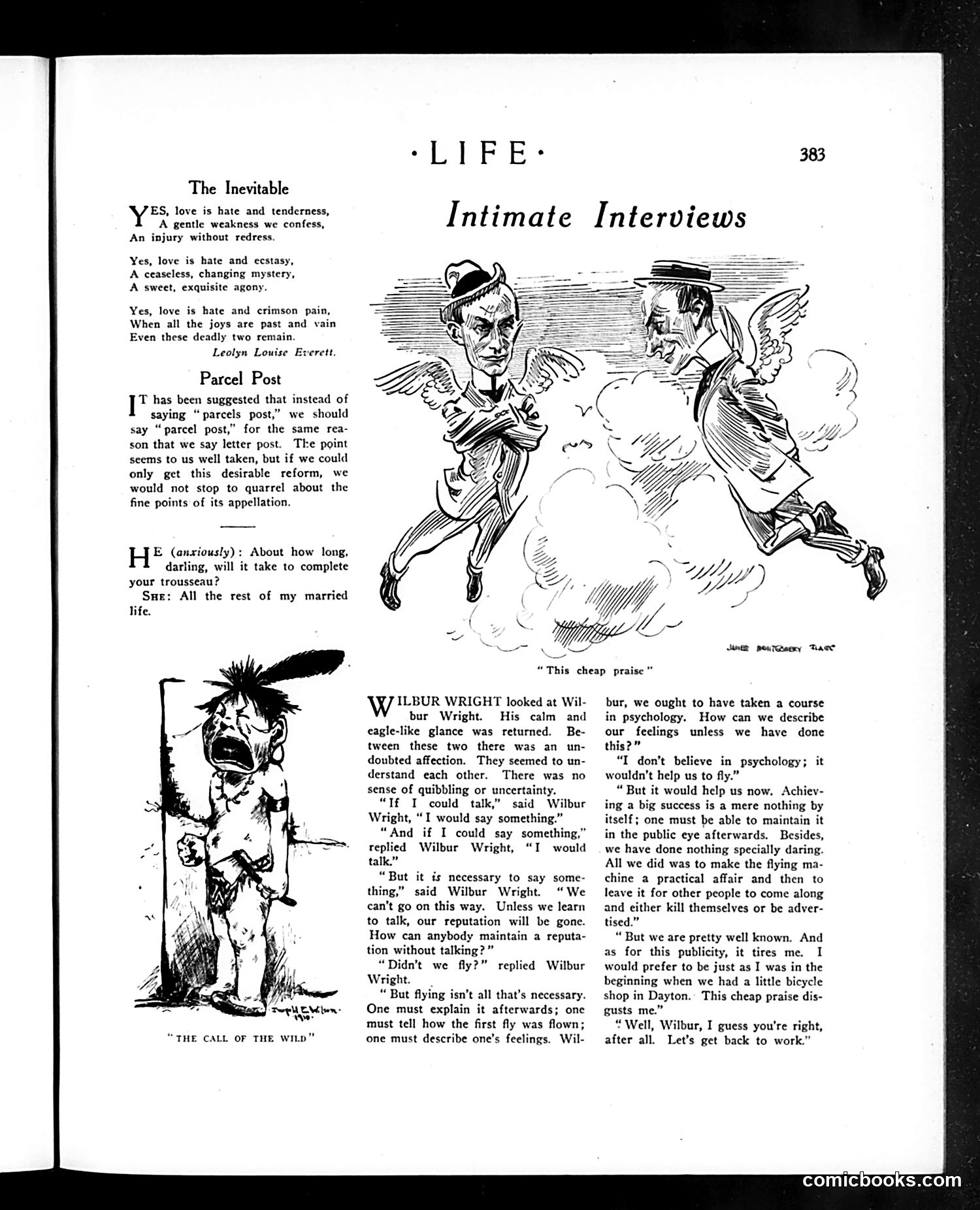
This page contains literary and illustrative content rather than political cartooning. **"The Inevitable"** is a poem by Louisa Louise Everett about love's contradictory nature—simultaneously hateful and tender, painful yet exquisite. **"Parcel Post"** is a brief dialogue joke about a husband asking his wife how long her household tasks will take; she replies "all the rest of my married life"—satirizing domestic drudgery and marital monotony. **"Intimate Interviews"** features an exchange between Wilbur Wright (the aviation pioneer) and his brother about the challenges of public reputation-building. The accompanying caricatured illustrations show winged figures in clouds. The dialogue concerns whether explaining one's accomplishments helps or harms public perception—a commentary on celebrity and self-promotion in the early aviation era.
📄 Transcribed text from this page (OCR, searchable)
Machine-transcribed from the original scan — historical spelling and the odd misread are preserved.
The Inevitable ES, love is hate and tenderness, A gentle weakness we confess, An injury without redress. Yes, love is hate and ecstasy, A ceaseless, changing mystery, A sweet, exquisite agony. Yes, love is hate and crimson pain, When all the joys are past and vain Even these deadly two remain. Leolyn Louise Everett. Parcel Post T has been suggested that instead of saying “parcels post,” we should say “parcel post,” for the same rea- son that we say letter post. Tke point seems to us well taken, but if we could only get this desirable reform, we would not stop to quarrel about the fine points of its appellation. E (anziously): About how long, darling, will it take to complete your trousseau? Swe: All the rest of my married life. “THE CALL OF THE WILD” -LIFE- Intimate Interviews Ne sO G VS “This cheap praise" ILBUR WRIGHT looked at Wil- bur Wright. His calm and eagle-like glance was returned. Be- tween these two there was an un- doubted affection. They seemed to un- derstand each other. There was no sense of quibbling or uncertainty. “If I could talk,” said Wilbur Wright, “I would say something.” “And if I could say something,” replied Wilbur Wright, “I would talk.” “But it ts necessary to say some- thing,” said Wilbur Wright. “We can’t go on this way. Unless we learn to talk, our reputation will be gone. How can anybody maintain a reputa- tion without talking?” “Didn't we fly?” replied Wilbur Wright. “ But flying isn’t all that’s necessary. One must explain it afterwards; one must tell how the first fly was flown; one must describe one’s feelings. Wil- ~ bur, we ought to have taken a course in psychology. How can we describe our feelings unless we have done this?” “I don’t believe in psychology; it wouldn’t help us to fly.” “But it would help us now. Achiev- ing a big success is a mere nothing by itself; one must be able to maintain it in the public eye afterwards. Besides, we have done nothing specially daring. All we did was to make the flying ma- chine a practical affair and then to leave it for other people to come along and either kill themselves or be adver- tised.” “ But we are pretty well known. And as for this publicity, it tires me. I would prefer to be just as I was in the beginning when we had a little bicycle shop in Dayton. This cheap praise dis- gusts me.” “Well, Wilbur, I guess you're right, after all. Let’s get back to work.” comicbooks.com