
Life, 1912-02-22 · page 25 of 44
Life — February 22, 1912 — page 25: what you’re looking at
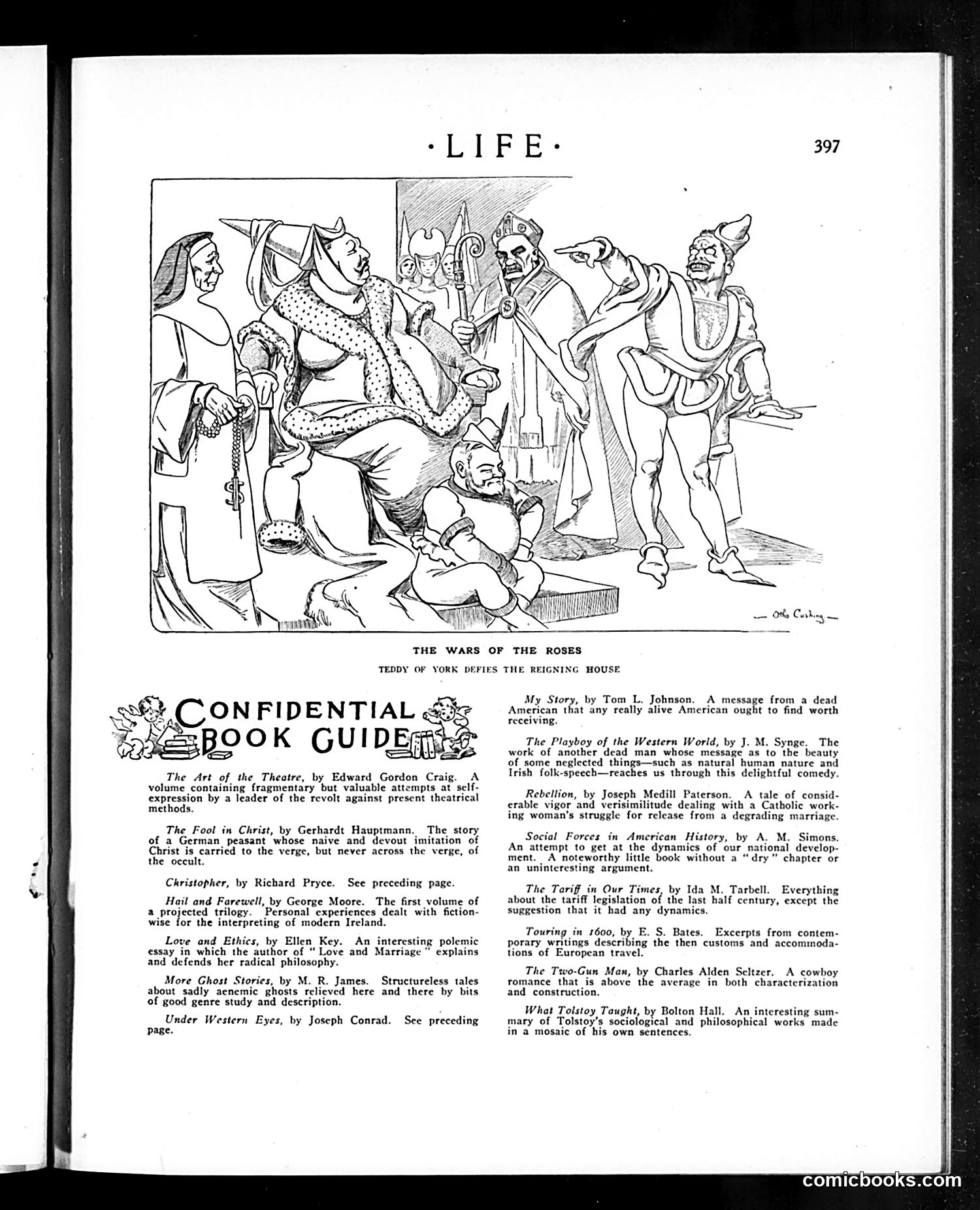
What you’re looking at
This cartoon satirizes President Theodore Roosevelt as "Teddy of York," invoking the historical Wars of the Roses—the 15th-century English civil conflict between rival noble houses. The caption suggests Roosevelt is defying the "reigning house," likely the Republican Party establishment or President Taft's administration. The elaborate medieval court scene depicts Roosevelt as a powerful noble surrounded by courtiers, clergy, and armed supporters, emphasizing his political dominance and faction-building. The satire suggests Roosevelt poses a threat to party unity through factional conflict—comparing contemporary political strife to the destructive dynastic wars of medieval England. This likely references Roosevelt's 1912 split from the Republican Party to form the Progressive "Bull Moose" Party, which fractured conservative politics and enabled Democrat Woodrow Wilson's election.
📄 Transcribed text from this page (OCR, searchable)
Machine-transcribed from the original scan — historical spelling and the odd misread are preserved.
po THE WARS OF THE ROSES TEDDY OF YORK DEFIES THE REIG st CONFIDENTIAL BOOK GUIDES The Art of the Theatre, by Edward Gordon Craig. A volume containing fragmentary but valuable attempts at sclf- expression by a leader of the revolt against present theatrical methods. The Fool in Christ, by Gerhardt Hauptmann. The story of a German peasant whose naive and devout imitation of Christ is carried to the verge, but never across the verge, of the occult. Christopher, by Richard Pryce. See preceding page. Hail and Farewell, by George Moore. The first volume of a projected trilogy. ‘Personal experiences dealt with fiction- wise for the interpreting of modern Ireland. Love and Ethics, by Ellen Key. An interesting polemic essay in which the author of “Love and Marriage” explains and defends her radical philosophy. More Ghost Stories, by M. R. James. Structureless tales about sadly aenemic ghosts relieved here and there by bits of good genre study and description. Under Western Eyes, by Joseph Conrad. page. See preceding 5 HOUSE My Story, by Tom L. Johnson. A message from a dead American that any really alive American ought to find worth receiving. The Playboy of the Western World, by J. M. Synge. The work of another dead man whose message as to the beauty of some neglected things—such as natural human nature and Irish folk-speech—reaches us through this delightful comedy. Rebellion, by Joseph Medill Paterson. A tale of consid- erable vigor and verisimilitude dealing with a Catholic work- ing woman's struggle for release from a degrading marriage. Social Forces in American History, by A, M. Simons. An attempt to get at the dynamics of our national develop- ment. A noteworthy little book without a “dry” chapter or an uninteresting argument. The Tarif in Our Times, by Ida M. Tarbell. Everything about the tariff legislation of the last half century, except the suggestion that it had any dynamics. Touring in 1600, by E. S. Bates. Excerpts from contem- porary writings describing the then customs and accommoda- tions of European travel. The Two-Gun Man, by Charles Alden Seltzer. A cowboy romance that is above the average in both characterization and construction. What Tolstoy Taught, by Bolton Hall. An interesting sum- mary of Tolstoy's sociological and philosophical works made in a mosaic of his own sentences. comicbooks.com