
Life, 1912-02-22 · page 24 of 44
Life — February 22, 1912 — page 24: what you’re looking at
What you’re looking at
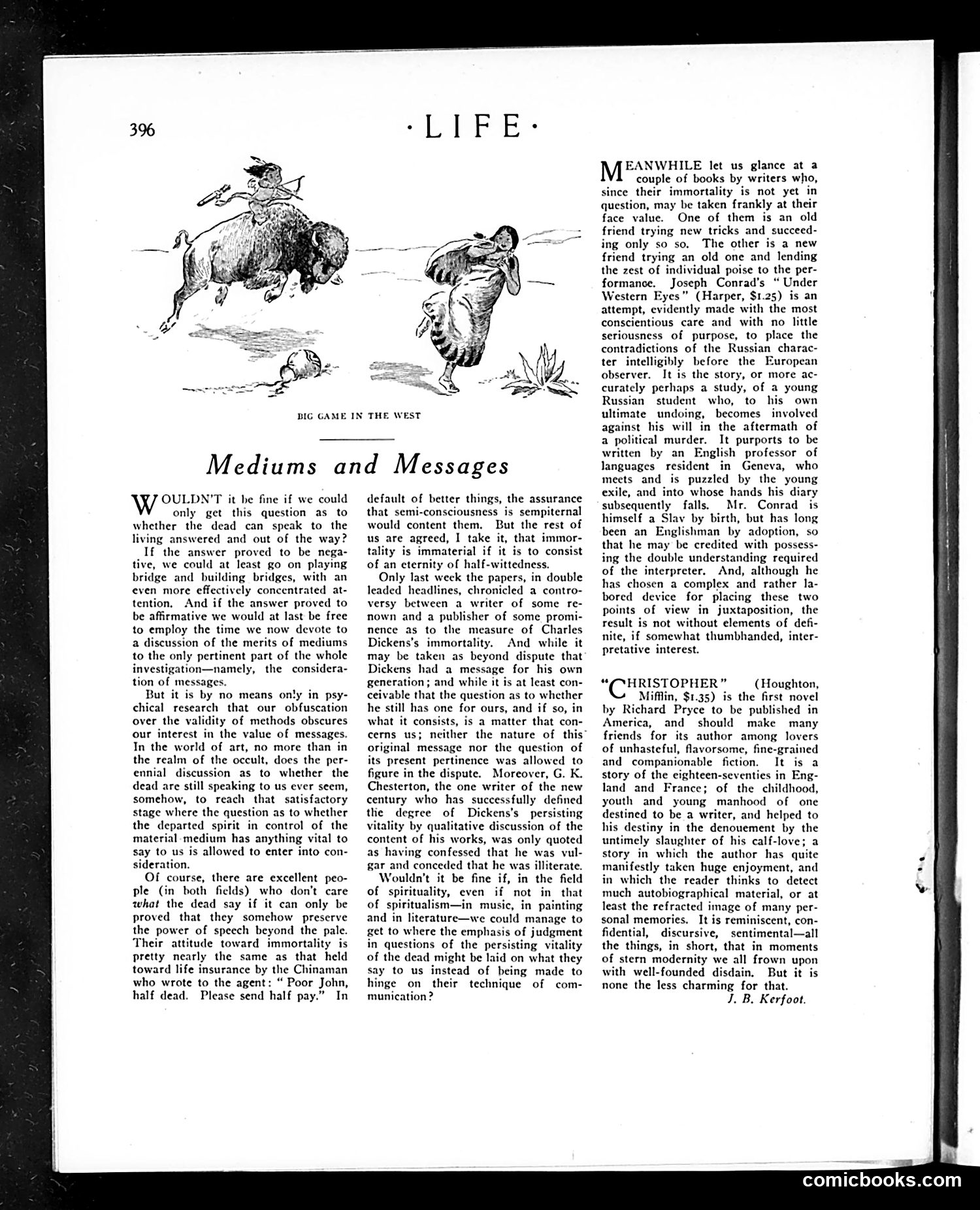
The cartoon depicts a cowboy being bucked off a horse—a straightforward Western scene labeled "Big Game in the West," likely satirizing the popular appeal of Western frontier imagery. The essay "Mediums and Messages" critiques spiritualism and literary criticism. The author argues that both spiritualists and literary scholars obsess over *whether* communication from the dead is possible, while ignoring what the dead actually have to *say*. The example: a recent public dispute between a famous writer and publisher over Charles Dickens's continued relevance focused on Dickens's vulgarity and illiteracy rather than the actual substance of his work. The author finds this absurd—whether discussing séances or literature, we should evaluate *content*, not merely *technique*. The piece reviews two contemporary novels: Conrad's "Under Western Eyes" (attempting but only partially succeeding with Russian character) and a new work by an unnamed author handling traditional material with fresh style.
📄 Transcribed text from this page (OCR, searchable)
Machine-transcribed from the original scan — historical spelling and the odd misread are preserved.
BIG GAME IN THE WEST Mediums and Messages OULDN’T it he fine if we could only get this question as to whether the dead can speak to the living answered and out of the way? If the answer proved to be nega- tive, we could at least go on playing bridge and building bridges, with an even more effectively concentrated at- tention, And if the answer proved to be affirmative we would at last be free to employ the time we now devote to a discussion of the merits of mediums to the only pertinent part of the whole investigation—namely, the considera- tion of messages. But it is by no means onty in psy- chical research that our obfuscation over the validity of methods obscures our interest in the value of messages. In the world of art, no more than in the realm of the occult, does the per- ennial discussion as to whether the dead are still speaking to us ever seem, somehow, to reach that satisfactory stage where the question as to whether the departed spirit in control of the material medium has anything vital to say to us is allowed to enter into con- sideration. Of course, there are excellent peo- ple (in both fields) who don’t care what the dead say if it can only be proved that they somehow preserve the power of speech beyond the pale. Their attitude toward immortality is pretty nearly the same as that held toward life insurance by the Chinaman who wrote to the agent: “ Poor John, half dead. Please send half pay.” In default of better things, the assurance that semi-consciousness is sempiternal would content them. But the rest of us are agreed, I take it, that immor- tality is immaterial if it is to consist of an eternity of half-wittedness. Only last week the papers, in double leaded headlines, chronicled a contro- versy between a writer of some re- nown and a publisher of some promi- nence as to the measure of Charles Dickens’s immortality. And while it may be taken as beyond dispute that Dickens had a message for his own generation; and while it is at least con- ceivable that the question as to whether he still has one for ours, and if so, in what it consists, is a matter that con- cerns us; neither the nature of this original message nor the question of its present pertinence was allowed to figure in the dispute. Moreover, G. K. Chesterton, the one writer of the new century who has successfully defined tlie degree of Dickens’s persisting vitality by qualitative discussion of the content of his works, was only quoted as having confessed that he was vul- gar and conceded that he was illiterate. Wouldn't it be fine if, in the field of spirituality, even if not in that of spiritualism—in music, in painting and in literature—we could manage to get to where the emphasis of judgment in questions of the persisting vitality of the dead might be laid on what they to us instead of being made to hinge on their technique of com- ication ? EANWHILE let us glance at a couple of books by writers who, since their immortality is not yet in question, may be taken frankly at their face value. One of them is an old friend trying new tricks and succeed- ing only so so, The other is a new friend trying an old one and lending the zest of individual poise to the per- formance. Joseph Conrad's “ Under Western Eyes” (Harper, $1.25) is an attempt, evidently made with the most conscientious care and with no little seriousness of purpose, to place the contradictions of the Russian charac- ter intelligibly before the European observer. It is the story, or more ac- curately perhaps a study, of a young Russian student who, to his own ultimate undoing, becomes involved against his will in the aftermath of a political murder. It purports to be written by an English professor of languages resident in Geneva, who meets and is puzzled by the young exile, and into whose hands his diary subsequently falls. Mr. Conrad is himself a Slav by birth, but has long been an Englishman by adoption, so that he may be credited with possess- ing the double understanding required of the interpreter. And, although he has chosen a complex and rather la- bored device for placing these two points of view in juxtaposition, the result is not without elements of defi- nite, if somewhat thumbhanded, inter- pretative interest. “CHRISTOPHER” (Houghton, Mifflin, $1.35) is the first novel by Richard Pryce to be published in America, and should make many friends for its author among lovers of unhasteful, flavorsome, fine-grained and companionable _fictior It is a story of the eighteen-seventies in Eng- land and France; of the childhood, youth and young manhood of one destined to be a writer, and helped to his destiny in the denouement by the untimely slaughter of his calf-love; a story in which the author has quite manifestly taken huge enjoyment, and in which the reader thinks to detect much autobiographical material, or at least the refracted image of many per- sonal memories. It is reminiscent, con- fidential, discursive, sentimental—all the things, in short, that in moments of stern modernity we all frown upon with well-founded disdain. But it is none the less charming for that. J. B, Kerfoot. comicbooks.com