
Life, 1912-02-22 · page 8 of 44
Life — February 22, 1912 — page 8: what you’re looking at
What you’re looking at
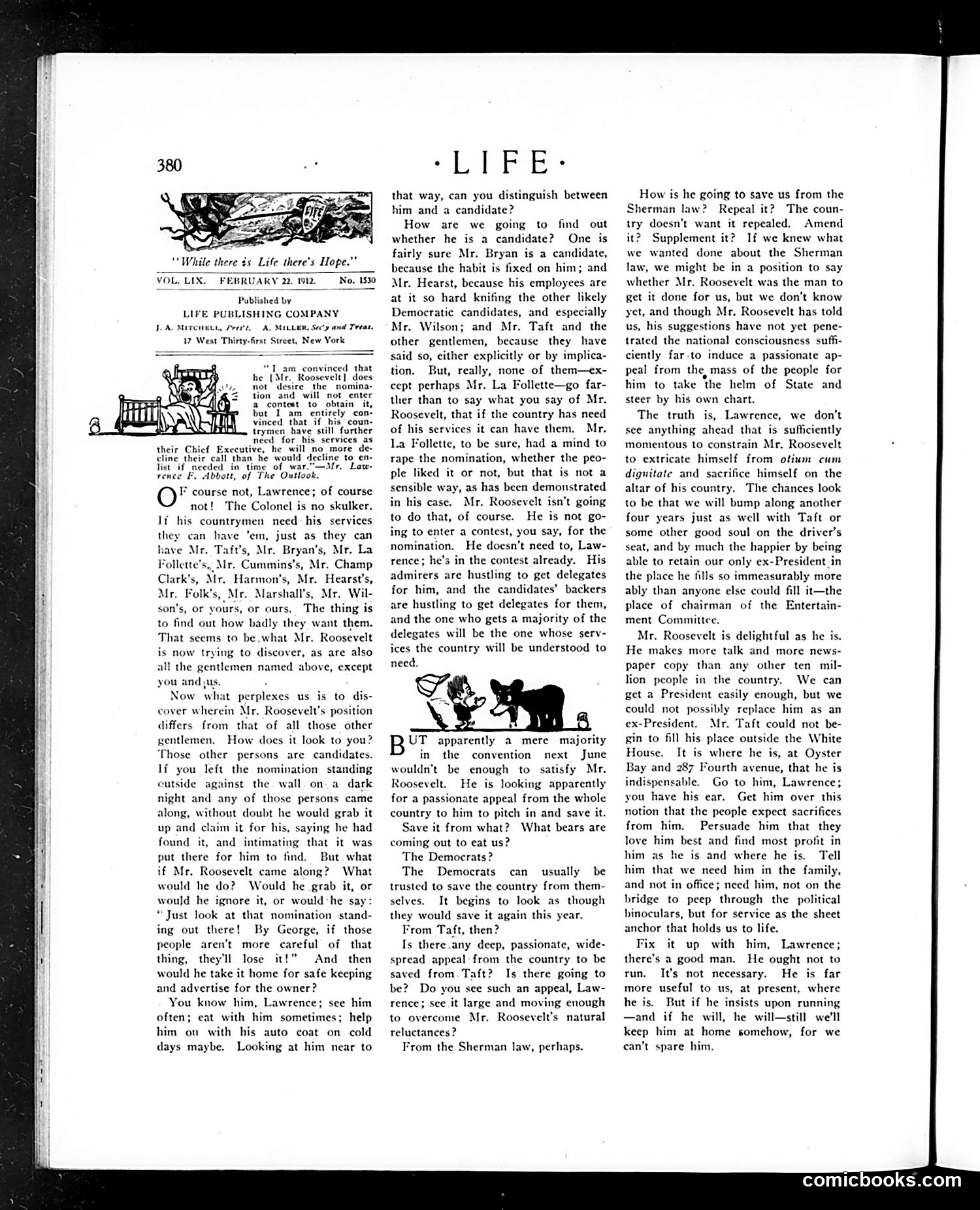
This page contains political discussion about the 1912 presidential race. The text debates whether Colonel Roosevelt will enter the contest as a candidate, with various figures mentioned: Bryan, Hearst, La Follette, Taft, and Lawrence. The central argument discusses Roosevelt's reluctance to formally announce candidacy while his supporters actively seek delegates. The writer suggests Roosevelt maintains plausible deniability—he hasn't declared himself a candidate, yet his backers work on his behalf. The text also critiques Democratic hopes that a "mere majority" wouldn't satisfy Roosevelt, implying he demands overwhelming support. There's skepticism about whether any appeal could convince Roosevelt to run, or whether his candidacy would actually save the Republican Party from internal division. The piece reflects pre-convention political maneuvering in 1912's famous three-way race.
📄 Transcribed text from this page (OCR, searchable)
Machine-transcribed from the original scan — historical spelling and the odd misread are preserved.
“While there ¢s Life there's Hope.’ No. 1530 VOL. LIX. FEBRUARY 2. 192. Published by LIFE PUBLISHING COMPANY A. MILLER, Sec’y and Treas, t Street, New York FAL MITCHELL, Preste, 17 West Thirty. “Tam convinced that he [Mr. Roosevelt] does not desire the nomina- tion and will not enter a contest to obtain it, but Iam entirely con vinced that if his coun- trymen have still further need for his services as their Chief Executive, he will no more de- cline their cail than he would decline to en- list if needed in time of war."—Mr. Law- rence F, Abbott, of The Outlook. F course not, Lawrence; of course not! The Colonel is no skulker, It his countrymen need: his services they n have ‘em, just as they can have Mr. Taft’s, Mr. Bryan’s, Mr. La Follette’s,, Mr. Cummins’s, Mr. Champ Clark’s, Mr. Harmon's, Mr. Hearst’s, Mr. Folk’s, Mr. Marshall's, Mr. Wil- son's, or yours, or ours, The thing is to find out how badly they want them. That seems to be.what Mr. Roosevelt is now trying to discover, as are also all the gentlemen named above, except you and jus. ow what perplexes us is to dis- cover wherein Mr. Roosevelt's position differs from that of all those other gentlemen. How does it look to you? ‘Those other persons are candidates. li you left the nomination standing eutside against the wall on a dark night and any of those persons came along, without doubt he would grab it up and claim it for his, saying he had found it, and intimating that it was put there for him to find. But what if Mr. Roosevelt came along? What would he do? Would he grab it, or would he ignore it, or would he say: “Just look at that nomination stand- ing out there! By George, if those people aren't more careful of that thing, they'll lose it!” And then would he take it home for safe keeping and advertise for the owner? You know him, Lawrence; see him often; eat with him sometimes; help him on with his auto coat on cold days maybe. Looking at him near to bh DPE * that way, can you distinguish between him and a candidate? How are we going to find out whether he is a candidate? One is fairly sure Mr. Bryan is a candidate, because the habit is fixed on him; and Mr. Hearst, because his employees are at it so hard knifing the other likely Democratic candidates, and especially Mr. Wilson; and Mr. Taft and the other gentlemen, because they have said so, either explicitly or by implica- tion. But, really, none of them—ex- cept perhaps Mr. La Follette—go far- ther than to say what you say of Mr. Roosevelt, that if the country has need of his services it can have them. Mr. La Follette, to be sure, had a mind to rape the nomination, whether the peo- ple liked it or not, but that is not a sensible way, as has been demonstrated in his case. Mr. Roosevelt isn't going to do that, of course. He is not go- ing to enter a contest, you say, for the nomination. He doesn’t need to, Law- rence; he’s in the contest already. His admirers are hustling to get delegates for him, and the candidates’ backers are hustling to get delegates for them, and the one who gets a majority of the delegates will be the one whose serv- ices the country will be understood to need. Sa UT apparently a mere majority in the convention next June wouldn't be enough to satisfy Mr. Roosevelt. He is looking apparently for a passionate appeal from the whole country to him to pitch in and save it. Save it from what? What bears are coming out to eat us? The Democrats? The Democrats can usually be trusted to save the country from them- selves. It begins to look as though they would save it again this year. From Taft, then? Is there.any deep, passionate, wide- spread appeal from the country to be saved from Taft? Is there going to be? Do you see such an appeal, Law- rence; see it large and moving enough to overcome Mr. Roosevelt's natural reluctances ? From the Sherman law, perhaps. How is he going to save us from the Sherman law? Repeal it? The coun- try doesn’t want it repealed. Amend it? Supplement it? If we knew what we wanted done about the Sherman law, we might be in a position to say whether Mr. Roosevelt was the man to get it done for us, but we don’t know yet, and though Mr. Roosevelt has told us, his suggestions have not yet pene- trated the national consciousness suffi- ciently far-to induce a passionate ap- peal from the, mass of the people for him to take the helm of State and steer by his own chart. The truth is, Lawrence, we don’t see anything ahead that is sufficiently momentous to constrain Mr. Roosevelt to extricate himself from otium cum dignitate and sacrifice himself on the altar of his country. The chances look to be that we will bump along another four years just as well with Taft or some other good soul on the driver's seat, and by much the happier by being able to retain our only ex-President.in the place he fills so immeasurably more ably than anyone else could fill it—the place of chairman of the Entertain- ment Committce. Mr. Roosevelt is delightful as he is. He makes more talk and more news paper copy than any other ten mil- lion people in the country. We can get a President easily enough, but we could not possibly replace him as an ex-President. Mr. Taft could not be- gin to fill his place outside the White House. It is where he is, at Oyster Bay and 287 Fourth avenue, that he is indispensable. Go to him, Lawrence; you have his ear. Get him over this notion that the people expect sacrifices from him. Persuade him that they love him best and find most profit in him as he is and where he is. Tell him that we need him in the family, and not in office; need him, not on the bridge to peep through the political binoculars, but for service as the sheet anchor that holds us to life. Fix it up with him, Lawrence; there’s a good man. He ought not to run. It’s not necessary. He is far more useful to us, at present, where he is. But if he insists upon running —and if he will, he will—still we'll keep him at home somehow, for we can’t spare him. comicbooks.com