
A complete issue · 44 pages · 1912
Life — January 18, 1912
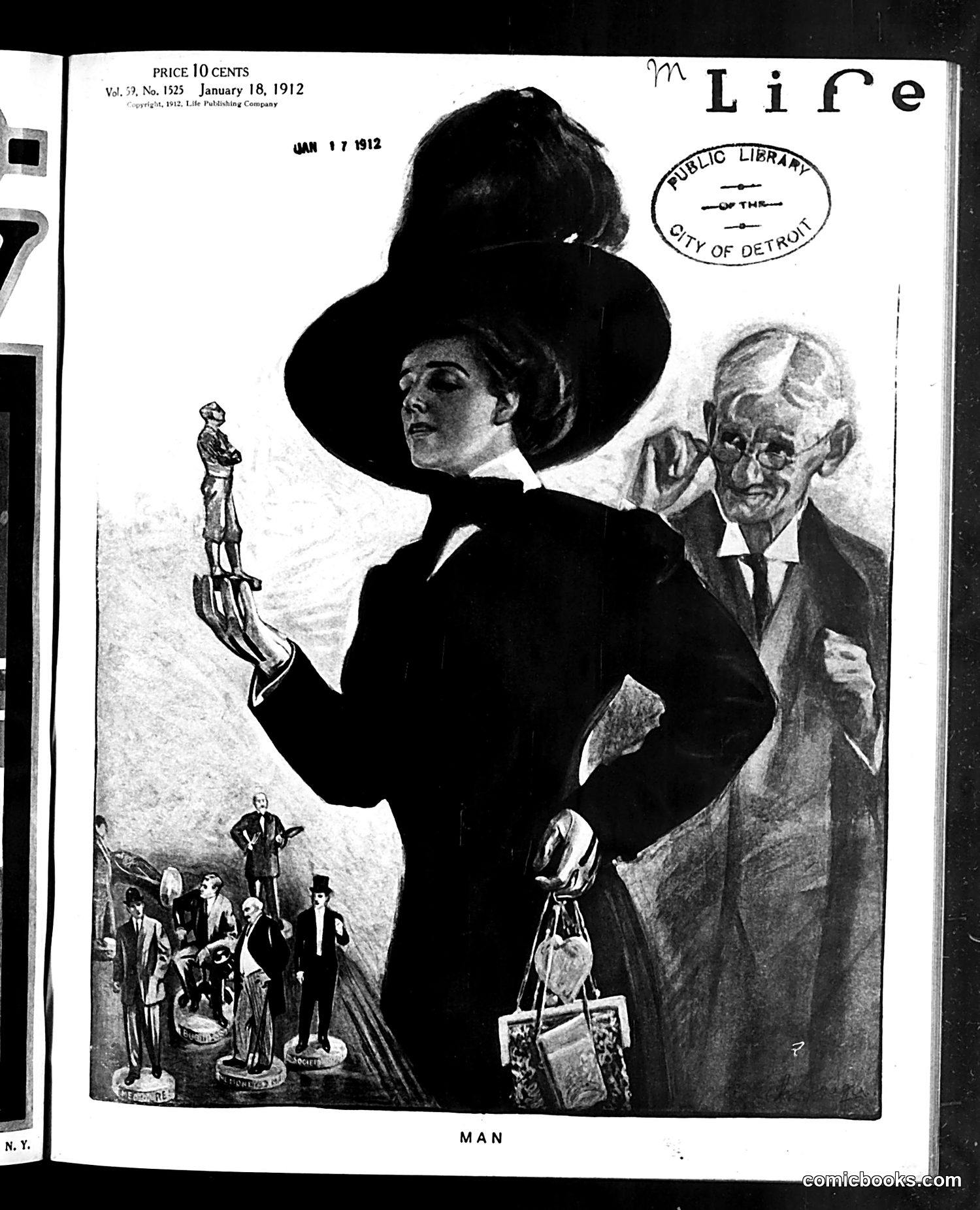
This satirical cover depicts a woman in an enormous, fashionable hat dominating the composition, while a bewildered elderly gentleman peers from behind her. The title "MAN" appears at the bottom, suggesting commentary on gender dynamics. The visual joke satirizes the era's extreme women's fashion—particularly the oversized, elaborate hats that were status symbols—by literally showing a woman's hat dwarfing the male figure. The small figurines at her feet appear to represent men as miniaturized or subordinate to her influence. This reflects early 20th-century anxieties about changing gender roles and women's increasing social power during the suffrage movement era. The satire mocks both excessive fashion trends and contemporary concerns about shifting male authority.
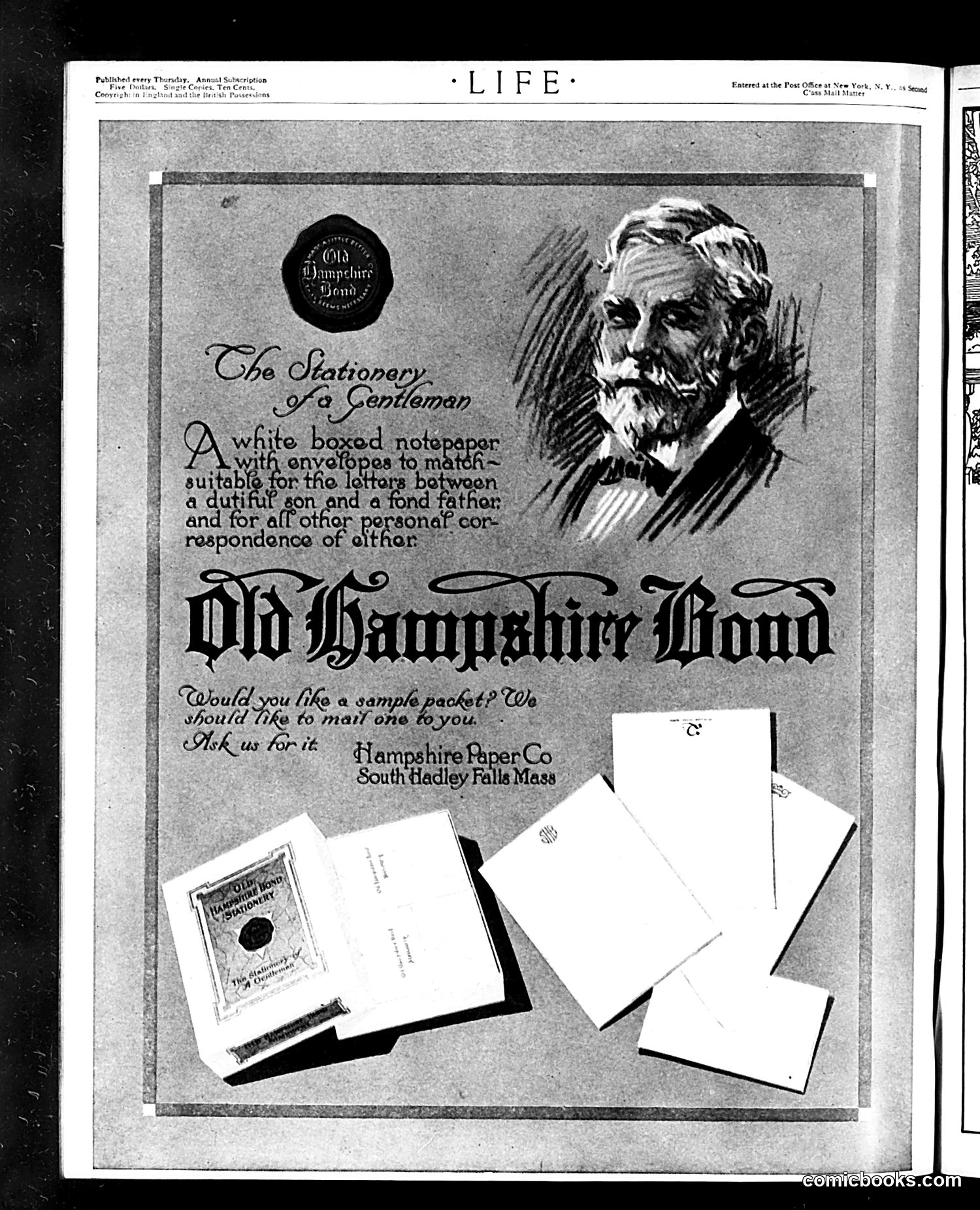
This page is primarily a **product advertisement**, not political satire. It promotes "Old Hampshire Bond" stationery from Hampshire Paper Co. in South Hadley Falls, Massachusetts. The ad features a portrait sketch of an elderly bearded gentleman—likely representing tradition, refinement, or the product's heritage—positioned above elegant stationery samples. The marketing copy frames the product as suitable for "letters between a dutiful son and a fond father" and "other personal correspondence." The "Old Hampshire" branding appeals to nostalgia and New England heritage. This appears in *Life* magazine's advertising section rather than its editorial/satirical content. The ad encourages readers to request a sample packet, a common direct-mail sales tactic of the era.
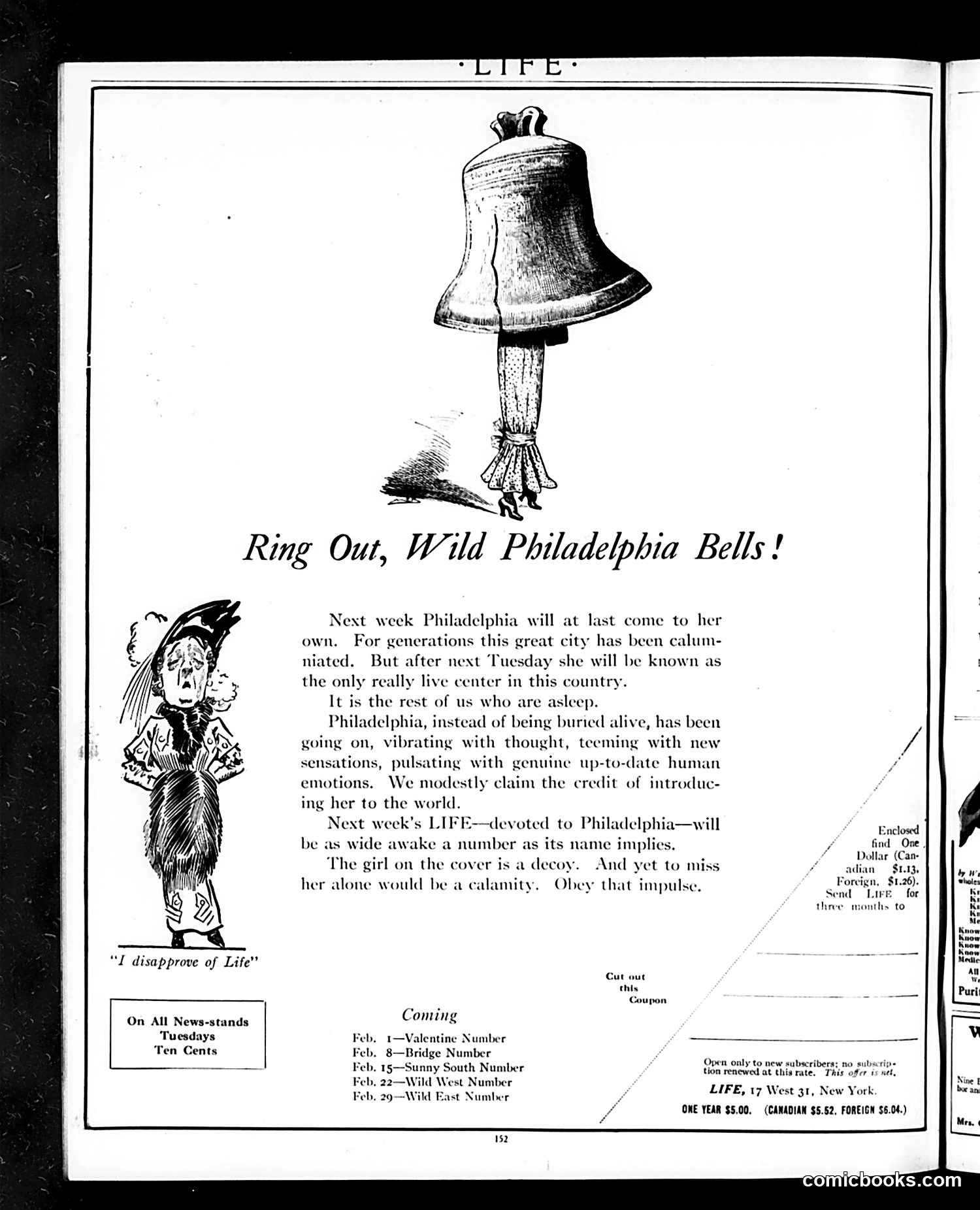
This page announces an upcoming Philadelphia-themed issue of Life magazine. The main illustration shows a bell on stick legs—a visual pun representing Philadelphia's iconic Liberty Bell personified as a character coming "alive." The accompanying text playfully suggests Philadelphia has been "calumniated" (slandered) but will soon be recognized as "the only really live center in this country." The satirical point mocks perceptions of Philadelphia as sleepy or culturally behind, contrasting this with the vibrant, modern city it actually is. The small cartoon figure labeled "I disapprove of Life" (left) appears to be a disapproving observer—likely satirizing critics or conservative detractors of the magazine itself or Philadelphia's progressive character. This is primarily promotional content advertising the upcoming Philadelphia issue, available Tuesdays for ten cents.
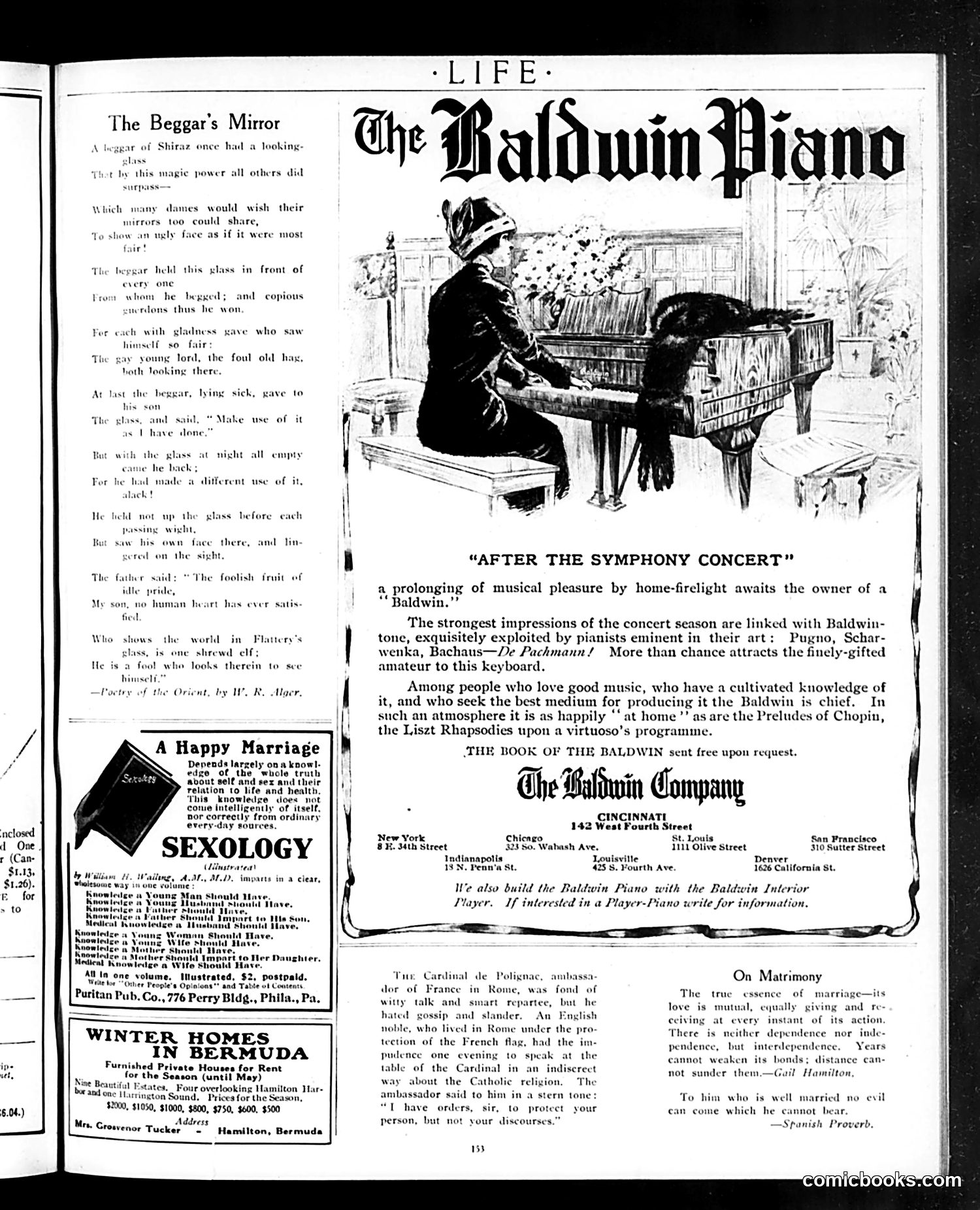
This page is primarily **advertising and lifestyle content** rather than political satire. The main feature is a Baldwin Piano advertisement showing a well-dressed woman at a grand piano, captioned "After the Symphony Concert." The ad emphasizes that Baldwin pianos are favored by professional pianists and appeal to cultured music lovers. The left column contains "The Beggar's Mirror," a morality poem about a beggar with a magic looking glass that reveals people's true character. Below it is an advertisement for a "Sexology" book on marriage relations. There is **no political cartoon on this page**. The content reflects early-20th-century consumer culture and genteel domestic ideals rather than social commentary or satire.
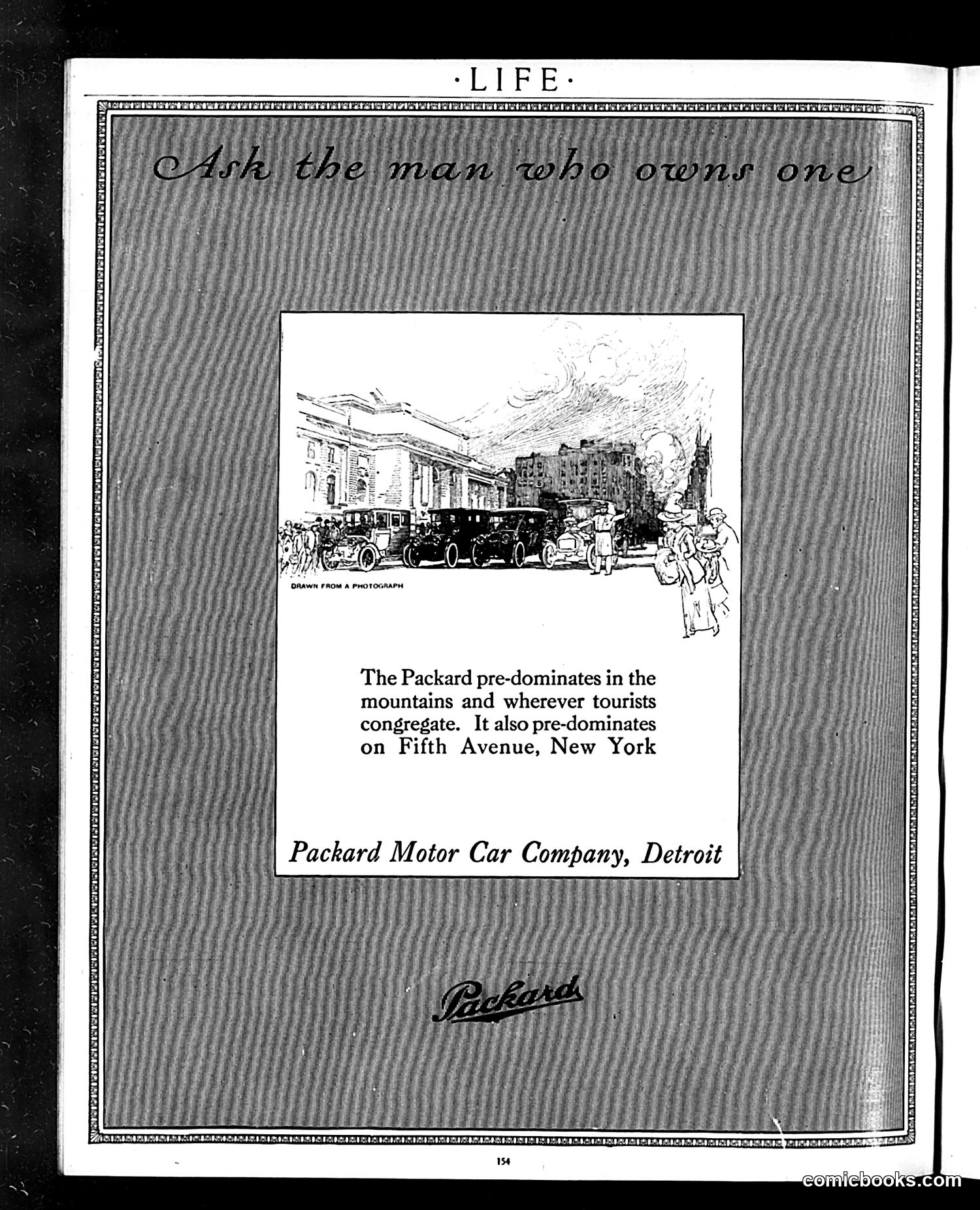
This is primarily a **Packard Motor Car Company advertisement**, not satirical content. The page features: **The Advertisement:** - A sketch showing multiple Packard automobiles parked on Fifth Avenue in New York City, with pedestrians and urban architecture - Text claims the Packard "pre-dominates in the mountains and wherever tourists congregate" and "on Fifth Avenue, New York" **The Satirical Header:** The phrase "Ask the man who owns one" appears at the top—this was Packard's actual advertising slogan, playing on the idea that satisfied owners were the best testimonial. Life's inclusion of this in their magazine suggests gentle mockery of the luxury car's prestige marketing, though the satire is subtle here. **Context:** This reflects early 20th-century automotive advertising targeting wealthy consumers, emphasizing exclusivity and status through association with fashionable locations.
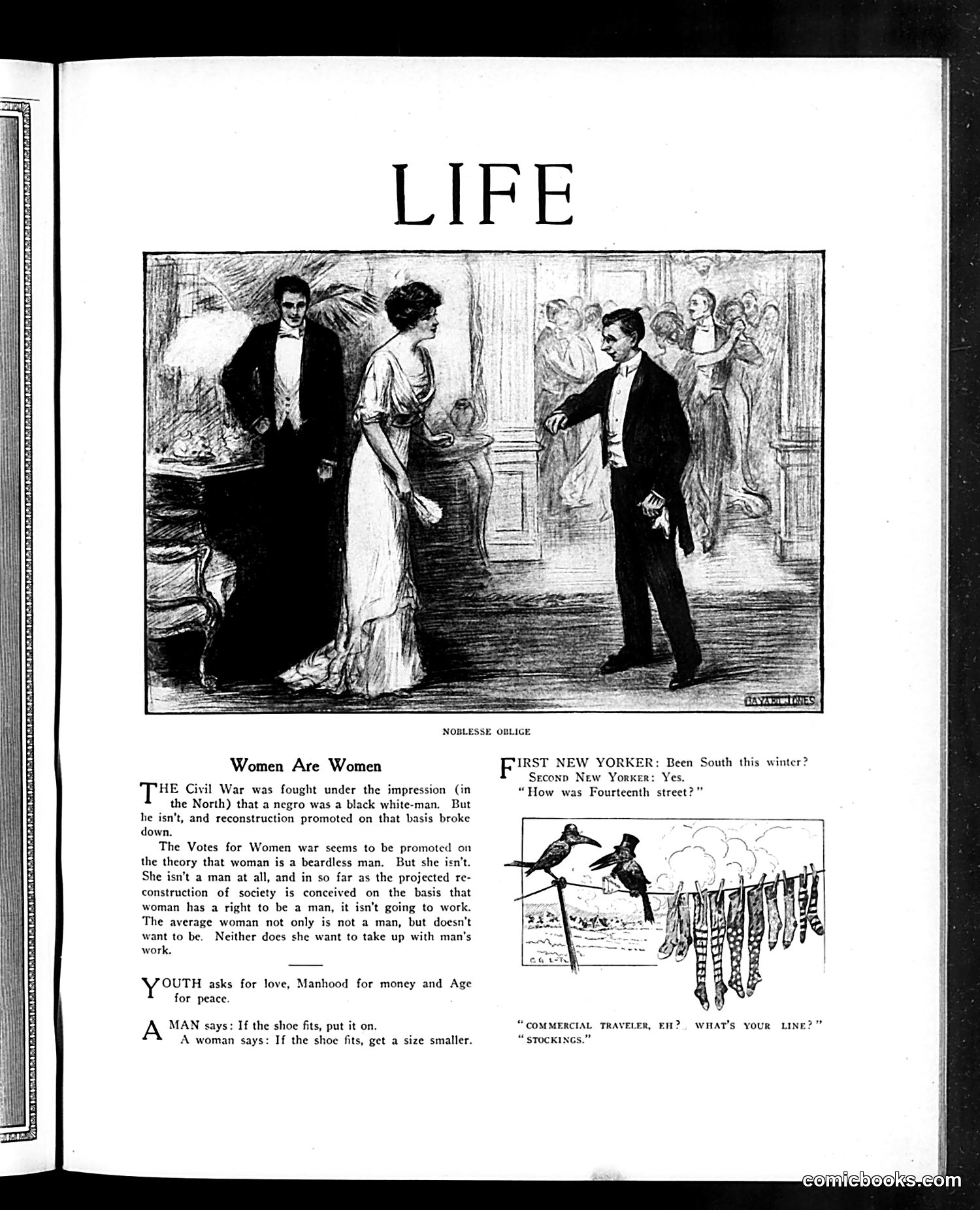
This page from *Life* magazine satirizes gender relations and women's suffrage through the article "Women Are Women" and accompanying illustrations. The main text argues that women's suffrage won't solve society's problems because women aren't fundamentally different from men—they're simply women, not pseudo-men. It critiques the notion that giving women voting rights will dramatically reform politics or society. The top illustration titled "Noblesse Oblige" depicts an elegant social gathering, likely showing the contradiction between upper-class women's refined presentation and their actual desires or capabilities. The two smaller cartoons mock gender differences in practical matters: the shoe-fitting joke plays on the stereotype that women prioritize vanity (buying smaller sizes) over comfort, while the "Commercial Traveler" cartoon involves ambiguous dialogue about stockings—likely double-entendre humor typical of the era. The overall message is skeptical of women's suffrage activism.
This page contains editorial text discussing political controversy surrounding Colonel George Harvey and Governor Woodrow Wilson of New Jersey. The article addresses rumors that Harvey's Weekly magazine damaged Wilson's presidential candidacy among Western voters by publishing unflattering material about him. The text defends Colonel Harvey, asserting he's a man of "proper deportment" who wouldn't conspire against Wilson. However, it acknowledges tension between the two figures and the role Harper's Weekly played in spreading damaging allegations. The small decorative cartoon at the page's top ("While there is Life there's Hope") appears unrelated to the main political discussion—it's a generic ornamental element common in period magazines rather than satirical commentary on the Harvey-Wilson dispute.
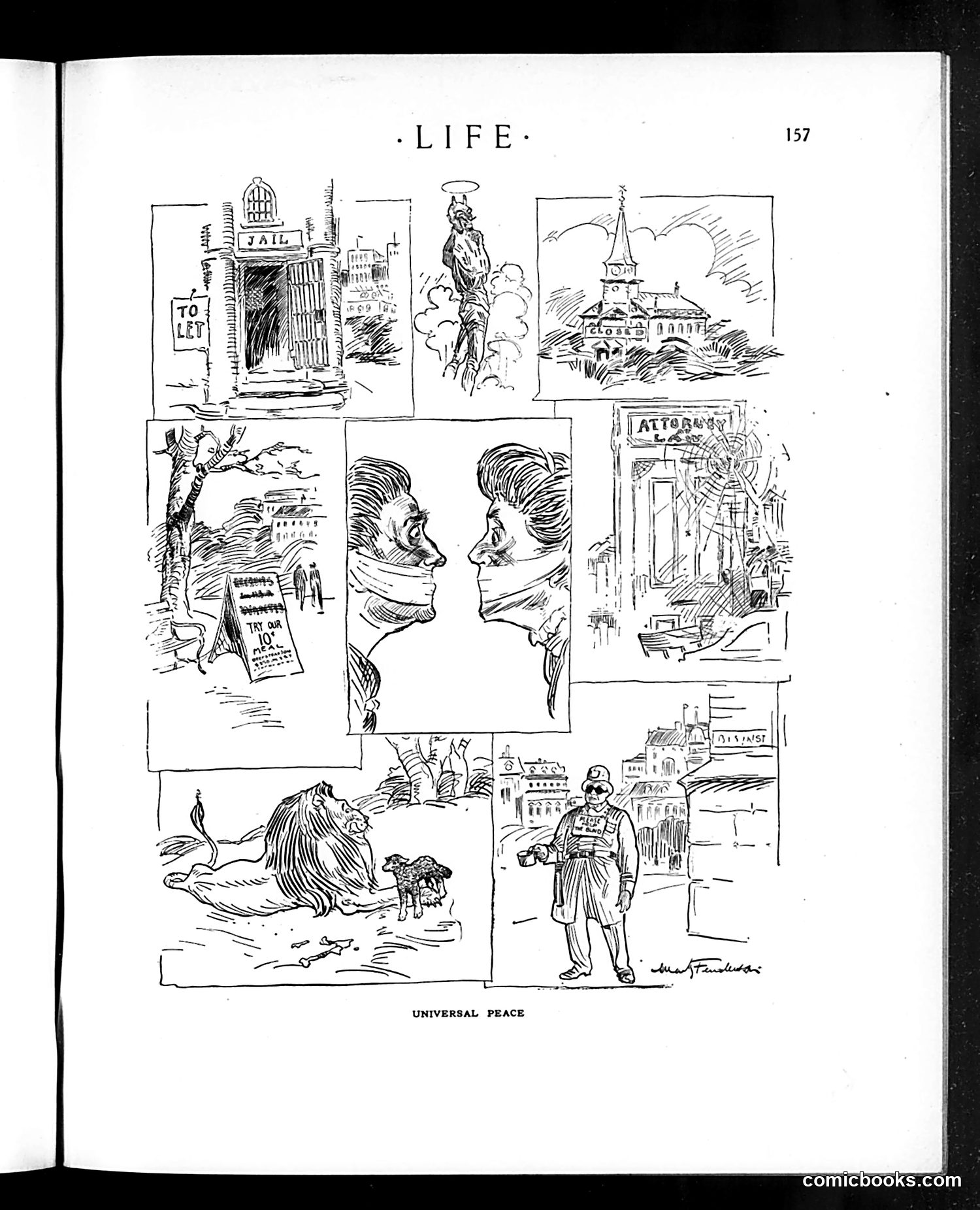
This page from *Life* magazine presents a satirical comic strip titled "Universal Peace," critiquing idealistic peace movements through various scenarios. The panels depict absurd situations: a jail cell labeled "TO LET," an angel figure, a church, two caricatured faces in profile (possibly representing political or national figures in dialogue), a military officer, and a lion lying peacefully with a small dog—the latter referencing the biblical prophecy of universal peace when predators and prey coexist harmlessly. The satire suggests that achieving "universal peace" is naive fantasy. By juxtaposing peaceful imagery with militarism, institutional structures, and even a tamed wild animal, the cartoonist mocks contemporary pacifist ideals as unrealistic, emphasizing the persistence of human conflict, nationalism, and inherent aggression despite aspirations for harmony.
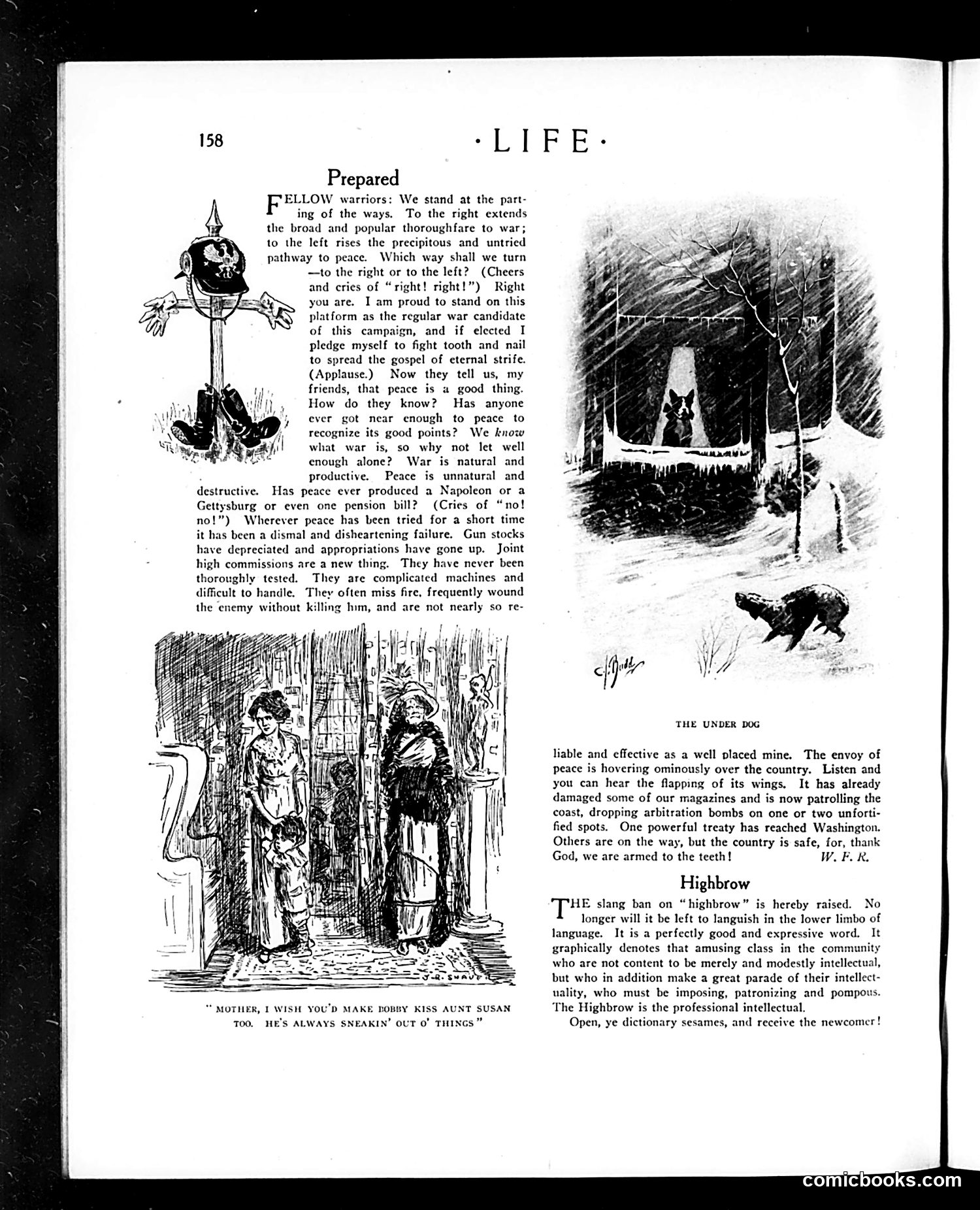
This page contains two distinct satirical pieces: **"Prepared"** (top): A speaker at a podium argues for war as the natural, inevitable path, dismissing peace as failed and impractical. The accompanying illustrations mock this militarism—showing a scarecrow-like military figure and a domestic scene where a mother wishes her son would "make horrid kiss Aunt Susan too. He's always sneakin' out o' things," suggesting war propaganda infiltrates everyday life and corrupts values. **"Highbrow"** (bottom): A brief satire raising the slang ban on "highbrow." The text mocks intellectuals who parade their intelligence and patronize others. The piece suggests this word describes pretentious people who claim superiority, urging dictionaries to accept it. Both pieces critique American society—one attacking pro-war rhetoric, the other skewering intellectual pretension.
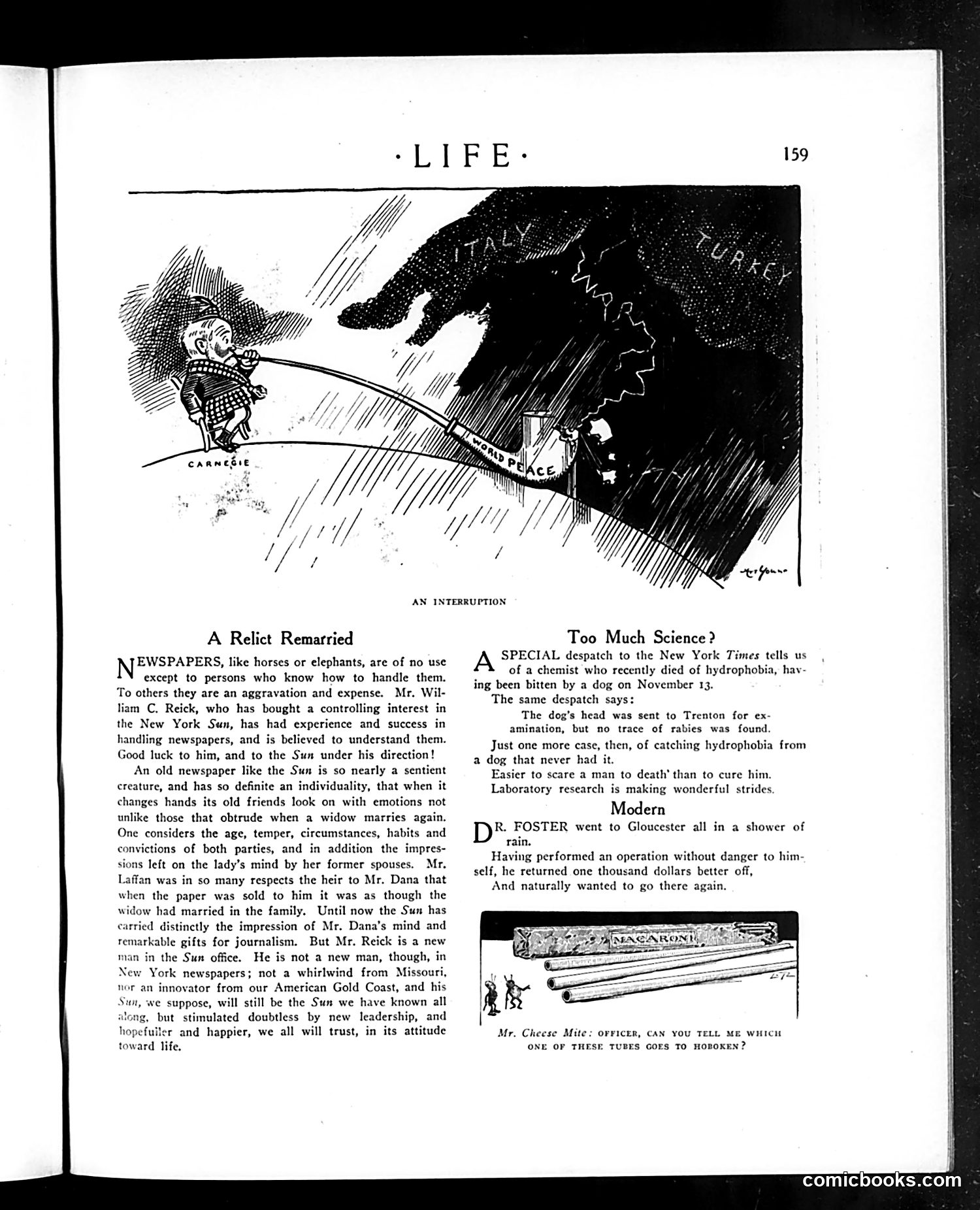
This cartoon depicts a conflict between **Carnegie** (labeled on the left, shown as a small figure being pulled) and what appears to be **militaristic European powers** (the large dark mass on the right, labeled with "ITALY," "TURKEY," and other nations). The cartoon illustrates **Carnegie's peace efforts being disrupted by European military aggression**—likely referencing Andrew Carnegie's famous peace advocacy work during a period of rising international tensions (pre-WWI era). The "interruption" suggests that Carnegie's pacifist initiatives and philanthropic ambitions for world peace are being thwarted by the aggressive military ambitions of European nations engaged in territorial conflicts and imperial expansion. The image satirizes the naive futility of individual peace efforts against powerful national militarism.
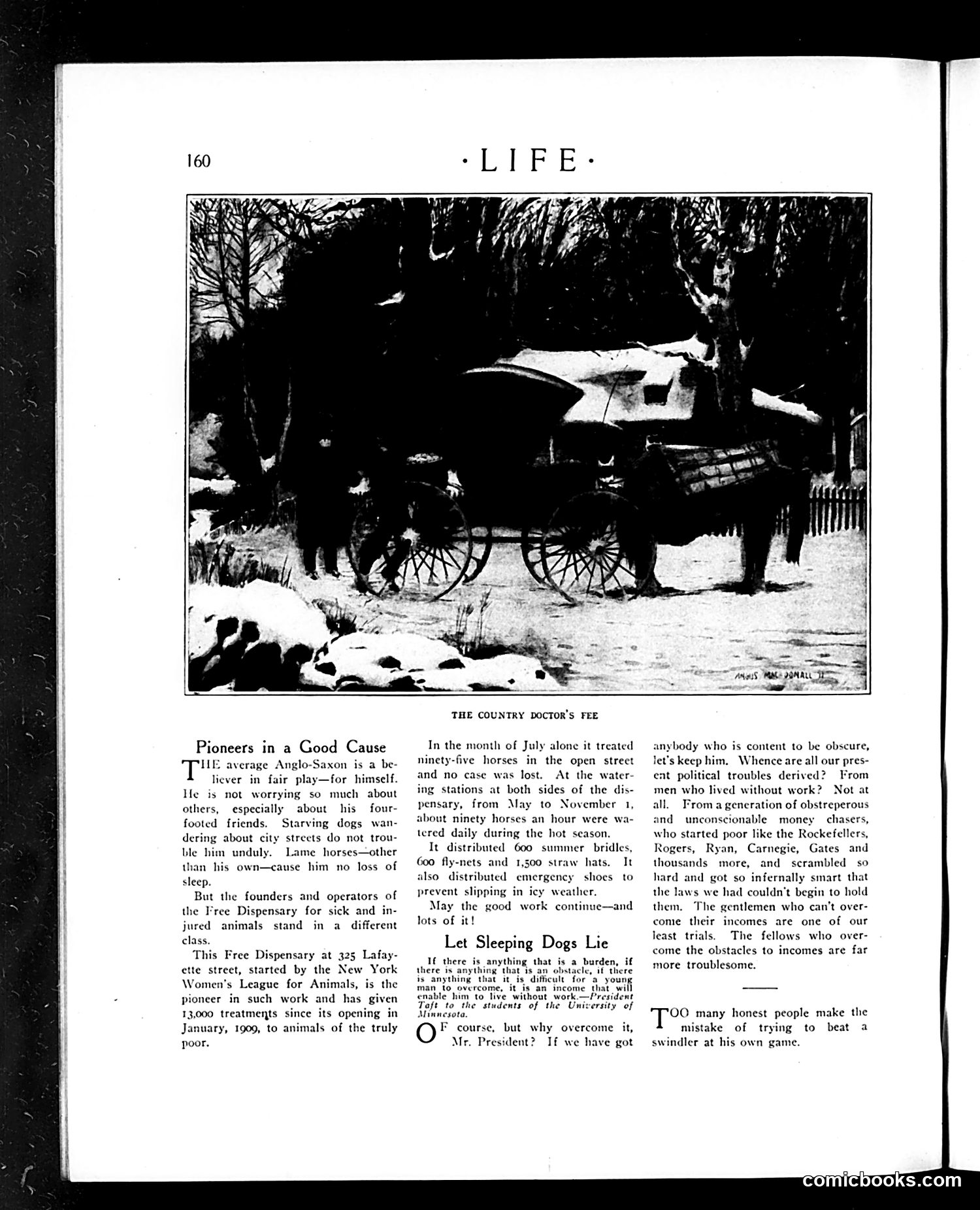
This page from *Life* magazine (page 160) contains three separate articles about charitable work and social issues, accompanied by one illustration titled "The Country Doctor's Fee." The illustration shows a horse-drawn carriage with a doctor's bag, depicting a rural medical scene. The accompanying articles discuss: 1. **"Pioneers in a Good Cause"** — praising the Anglo-Saxon character and the Free Dispensary for sick and lame animals (founded by the New York Women's League for Animals), which has treated 13,000 animals since 1900. 2. **"Let Sleeping Dogs Lie"** — a brief philosophical piece quoting the President of the University of Minnesota about overcoming obstacles through honest work. 3. **"Too many honest people make the mistake..."** — a fragment about beating swindlers at their own game. The content reflects *Life*'s turn-of-century focus on Progressive Era charitable institutions and moral lessons.
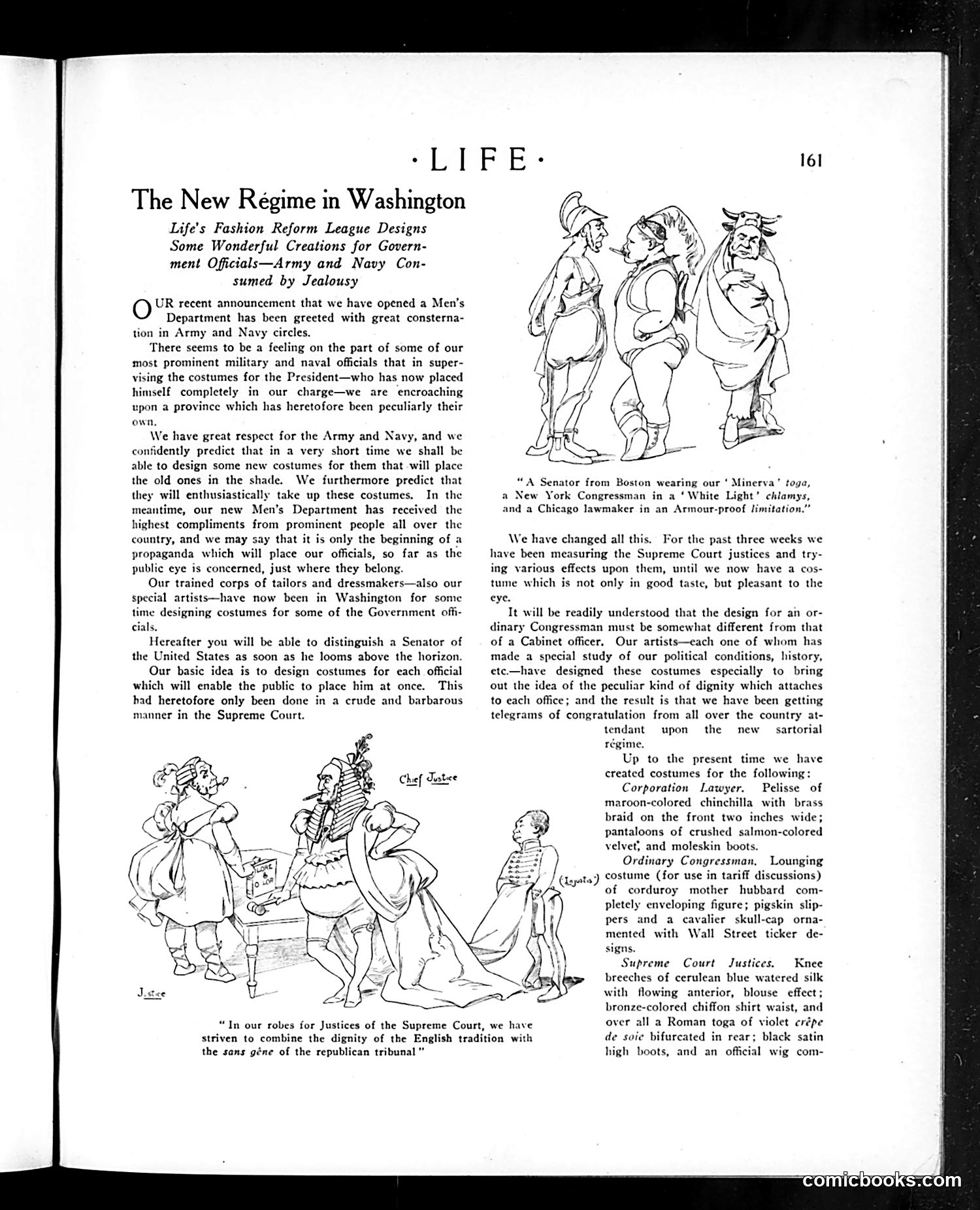
This Life magazine page satirizes the newly opened Men's Department at what appears to be a high-end store, mocking its designs for government officials. The cartoons ridicule proposed costume changes for Supreme Court justices, senators, and congressmen. The satire targets anxiety among military and naval leaders that civilians (particularly the First Lady, who established the Men's Department) are overstepping their authority in military/government matters. The exaggerated costume designs—including absurd elements like "Wall Street ticker" decorations and Roman togas—mock both the pretentious fashion schemes and officials' jealous resistance to civilian influence. The humor lies in depicting respectable government figures in ridiculous attire, suggesting the fashion proposals are both impractical and represent inappropriate civilian overreach into traditionally male-dominated institutional domains.
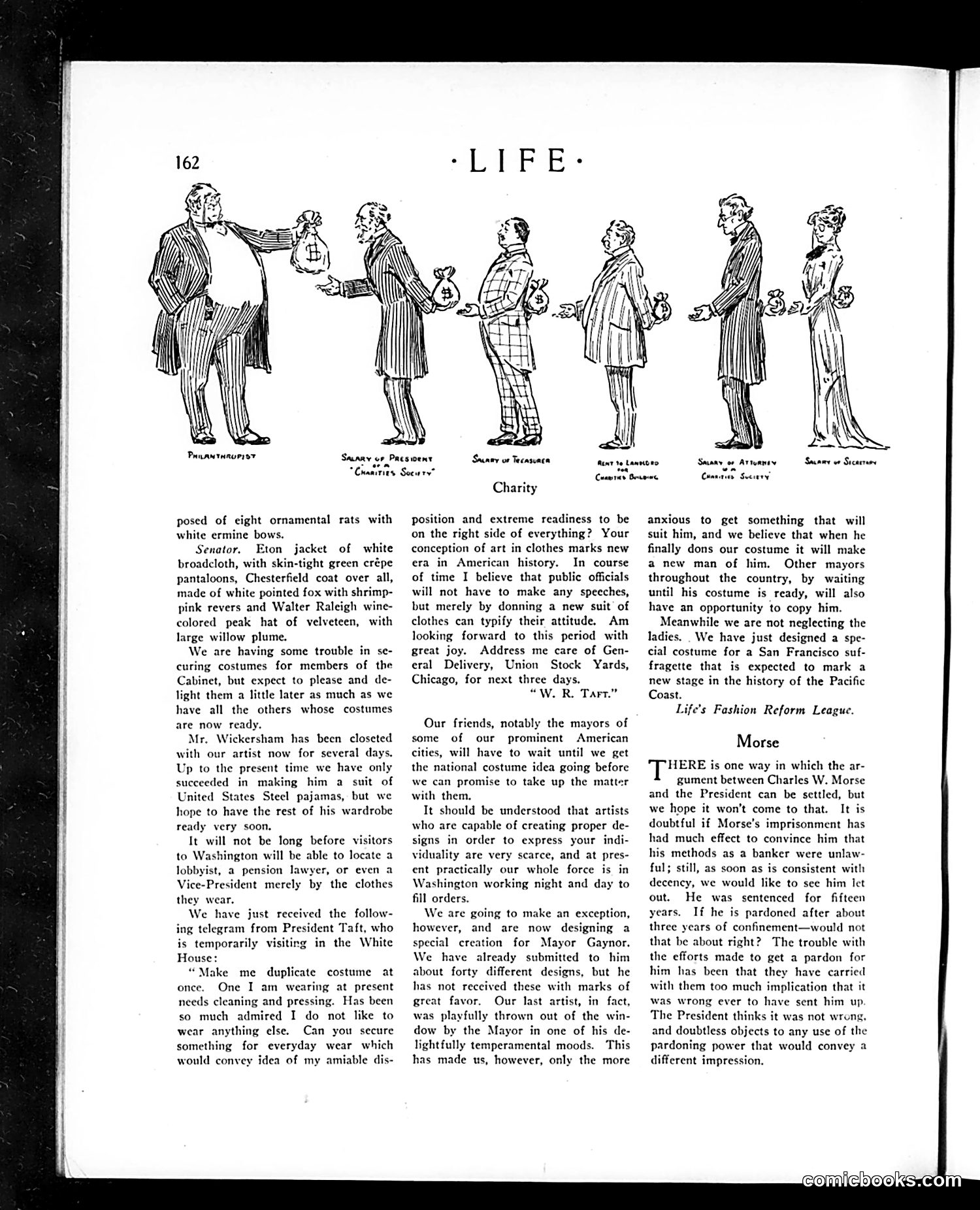
This cartoon depicts a satirical hierarchy of charitable giving in American society. A large, rotund philanthropist on the left distributes small money bags to six progressively thinner figures, labeled (left to right): "Philanthropist," "Salary of President," "Salary of Preacher," "Rent by Landlord," "Salary of Attorney," and "Salary of Servant." The joke critiques wealth distribution: the philanthropist's enormous size contrasts with the diminishing physiques of recipients down the chain, suggesting that charity trickles down in increasingly meager amounts. Each intermediary (president, preacher, attorney, landlord) takes their cut, leaving servants with almost nothing. The satirical point: charitable giving claims moral virtue while systemic inequality ensures the poorest receive crumbs from the wealthy's table.
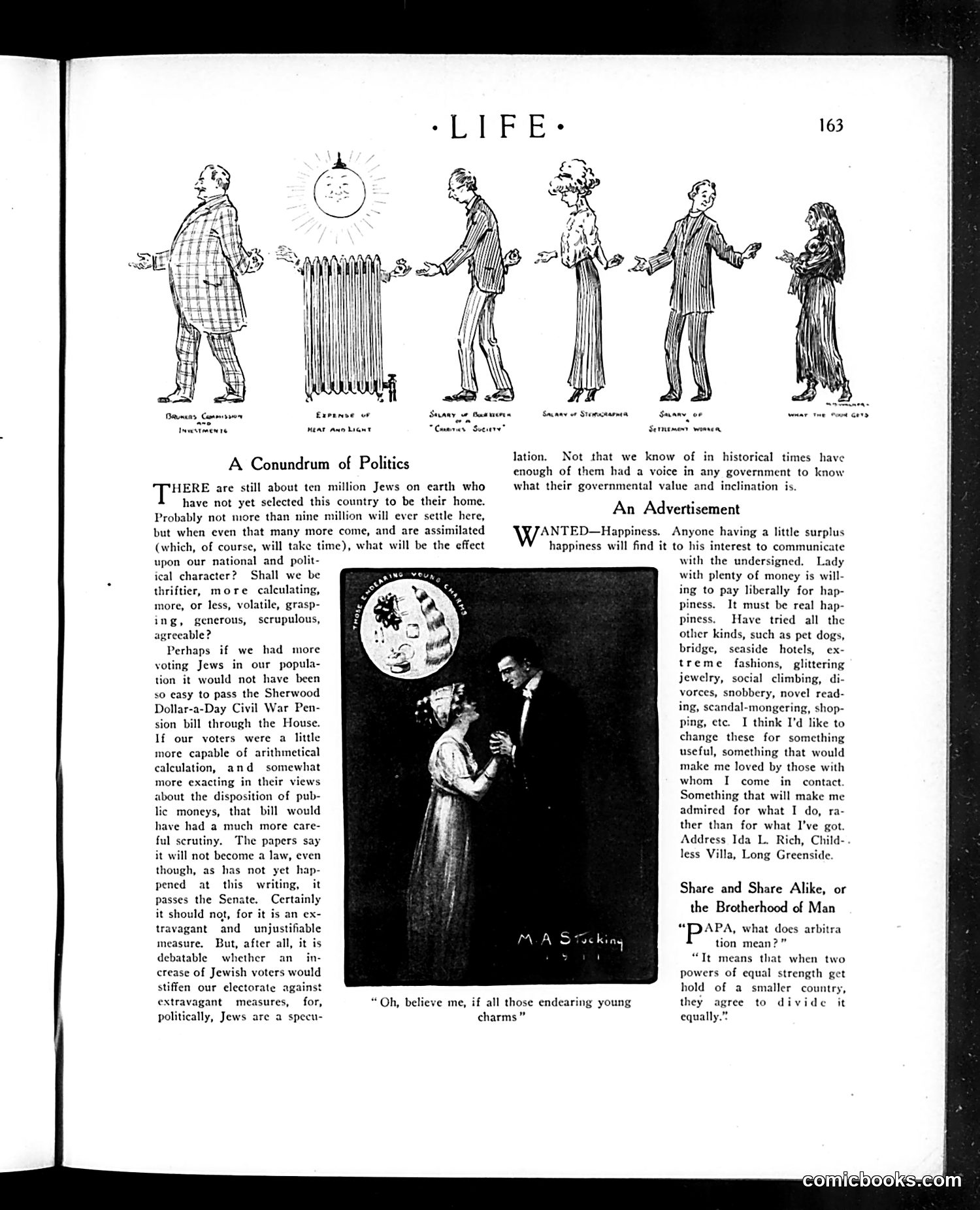
The top cartoon depicts six figures representing different political positions or constituencies, each gesturing while standing near a radiator labeled "EXPENSE OF SEAT AND LIGHT" and other budget items. This appears to satirize politicians arguing over government expenditures. The main article, "A Conundrum of Politics," cynically discusses Jewish immigration to America, speculating whether increased Jewish voters would make the electorate more fiscally responsible—referencing the "Sherwood Dollar-a-Day Civil War Pension bill" as an example of wasteful spending that supposedly wouldn't pass if voters were more arithmetically careful. The advertisements are satirical: one woman seeks to *buy* happiness after exhausting conventional luxuries; another brief dialogue mockingly defines "arbitration" as two powerful nations agreeing to equally divide a smaller country's territory. The page overall reflects turn-of-century American attitudes: ethnic stereotyping mixed with genuine political critique about corruption and fiscal irresponsibility.
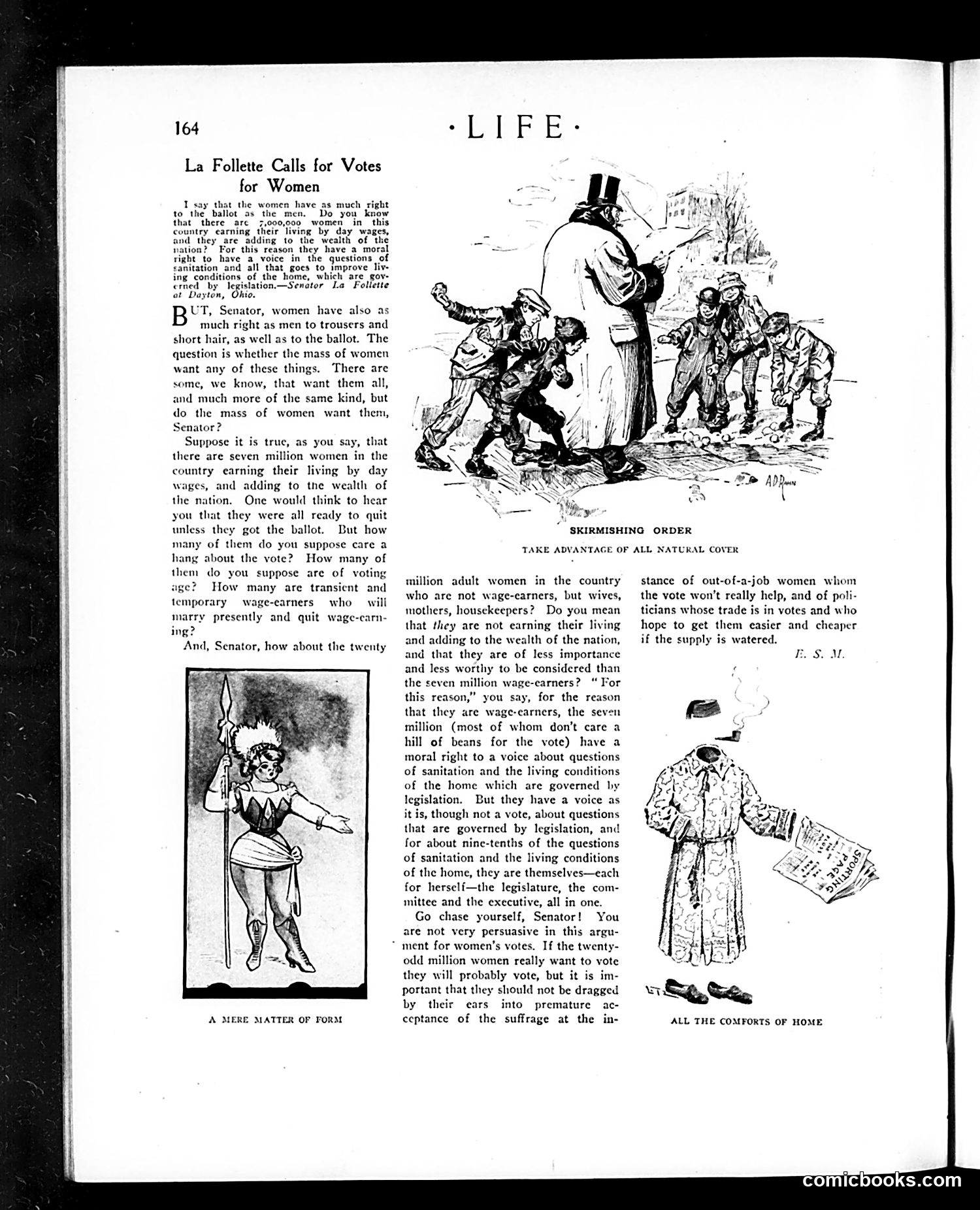
This page presents opposing arguments on women's suffrage. Senator La Follette (Progressive politician) argues women wage-earners deserve voting rights because they contribute economically to the nation. The **rebuttal** (likely by Life's editor) sarcastically dismisses this logic, using several counter-arguments: it questions whether the seven million wage-earning women actually *want* to vote; notes many are temporary workers who'll quit upon marriage; and crucially, challenges why non-wage-earning wives and mothers—who manage household sanitation and living conditions directly—are deemed less worthy of suffrage. The cartoons mock suffrage advocates as extremists: "A Mere Matter of Form" depicts a caricatured woman activist in exaggerated masculine clothing, while "Skirmishing Order" shows suffragists as aggressive invaders. "All the Comforts of Home" sarcastically suggests voting threatens domestic life. The author (E.S.M.) ultimately argues that politicians cynically push suffrage to expand their voter base, not from genuine principle—a common anti-suffrage talking point suggesting women voters could be easily manipulated.
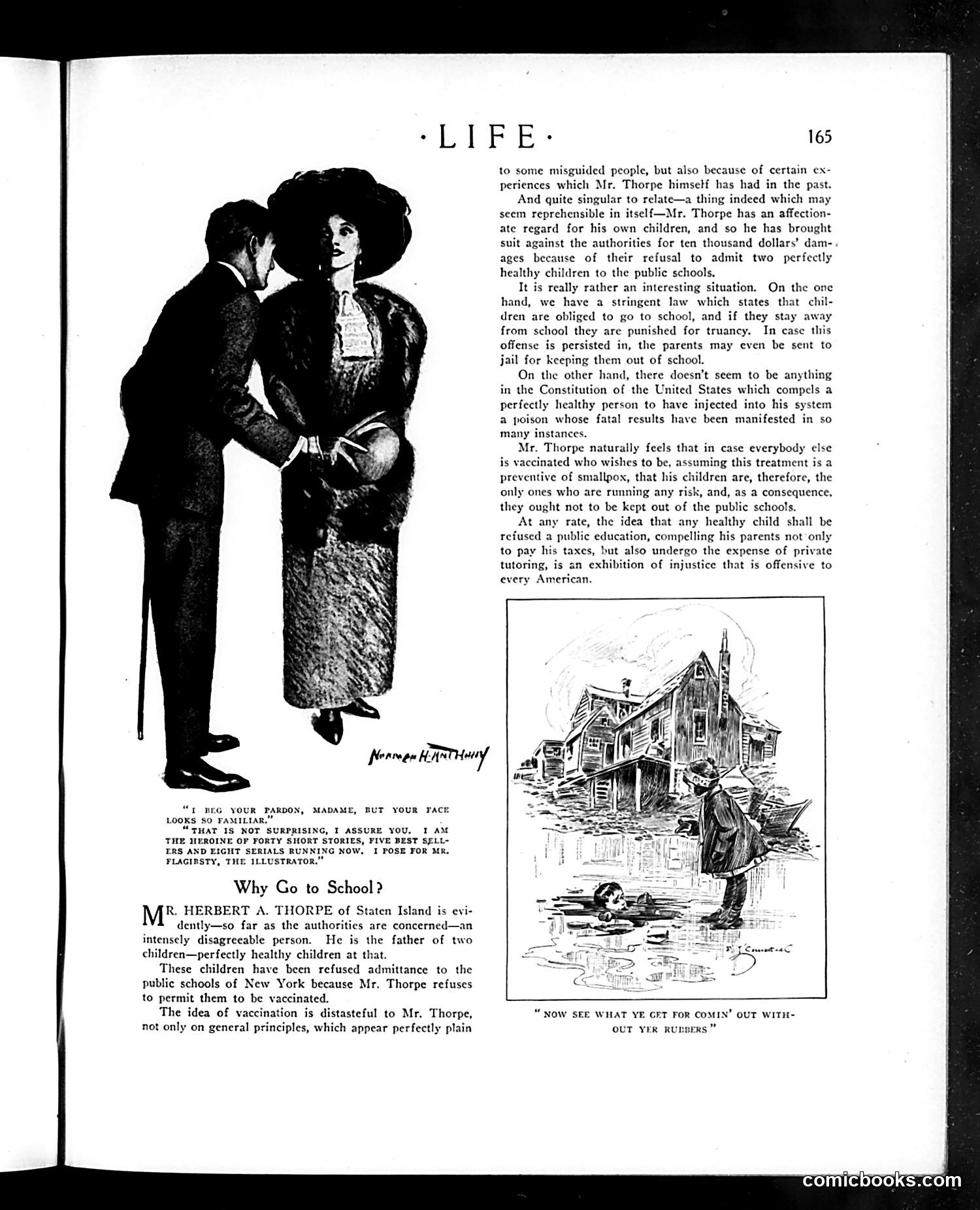
This 1911 *Life* magazine article satirizes Herbert A. Thorpe of Staten Island, who refused to vaccinate his two healthy children for public school admission. The piece presents his legal challenge—suing for $10,000 damages—as absurd yet exposes genuine tension between individual liberty and public health law. The satire cuts both ways: while mocking Thorpe's anti-vaccination stance as irrational ("distasteful"), the article also critiques the government's catch-22—punishing truancy while simultaneously barring vaccinated children from school, forcing expensive private tutoring. The accompanying illustration depicts rural poverty, suggesting vaccination refusal traps families in disadvantage. The top cartoon about the "illustrator's model" is unrelated advertising content. The article's real point: mandatory vaccination represents state overreach, though the author seems skeptical of Thorpe's actual grievance.
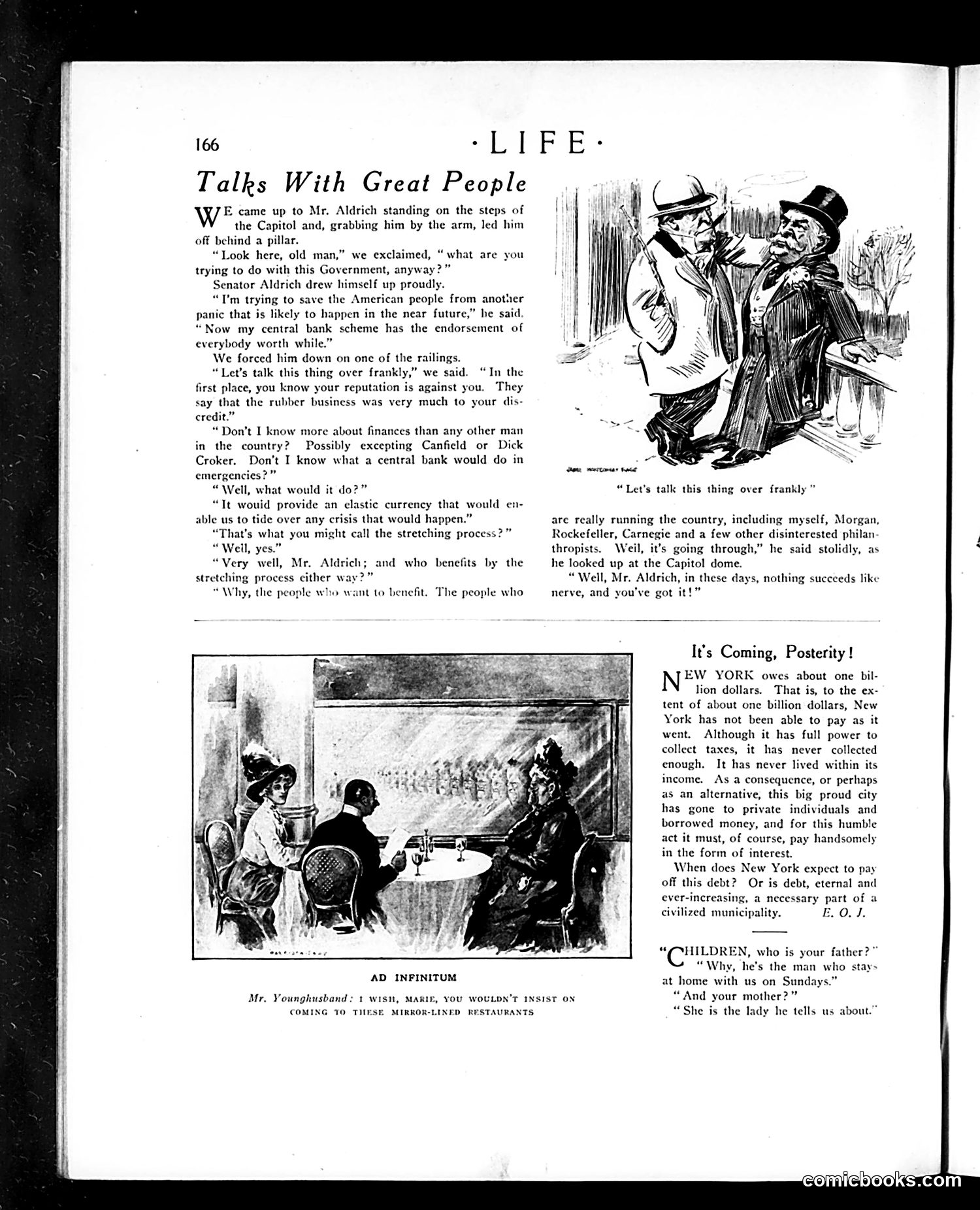
## "Talks With Great People" — Senator Aldrich and Central Banking The top cartoon mocks **Senator Nelson Aldrich**, a wealthy Republican who championed a central banking scheme. The satire targets his apparent hypocrisy: Aldrich claims to protect Americans from financial panic through his central bank proposal, yet his reputation stems from profiting in the rubber business. The joke's punch comes when Aldrich candidly admits that Morgan, Rockefeller, Carnegie, and himself—wealthy industrialists—would benefit from the "elastic currency" system, not ordinary people. The interviewer praises his "nerve" for such brazen honesty about self-serving legislation. ## Lower Cartoons **"Ad Infinitum"** jokes about wealthy New Yorkers frequenting mirror-lined restaurants, with a caption about them avoiding their wives. **"It's Coming, Posterity"** criticizes New York City's billion-dollar debt, questioning whether municipalities can operate perpetually in deficit. The children's joke below plays on absent fathers. **Context**: This reflects Progressive Era skepticism toward finance capitalism and wealthy industrialists' influence over government policy-making.
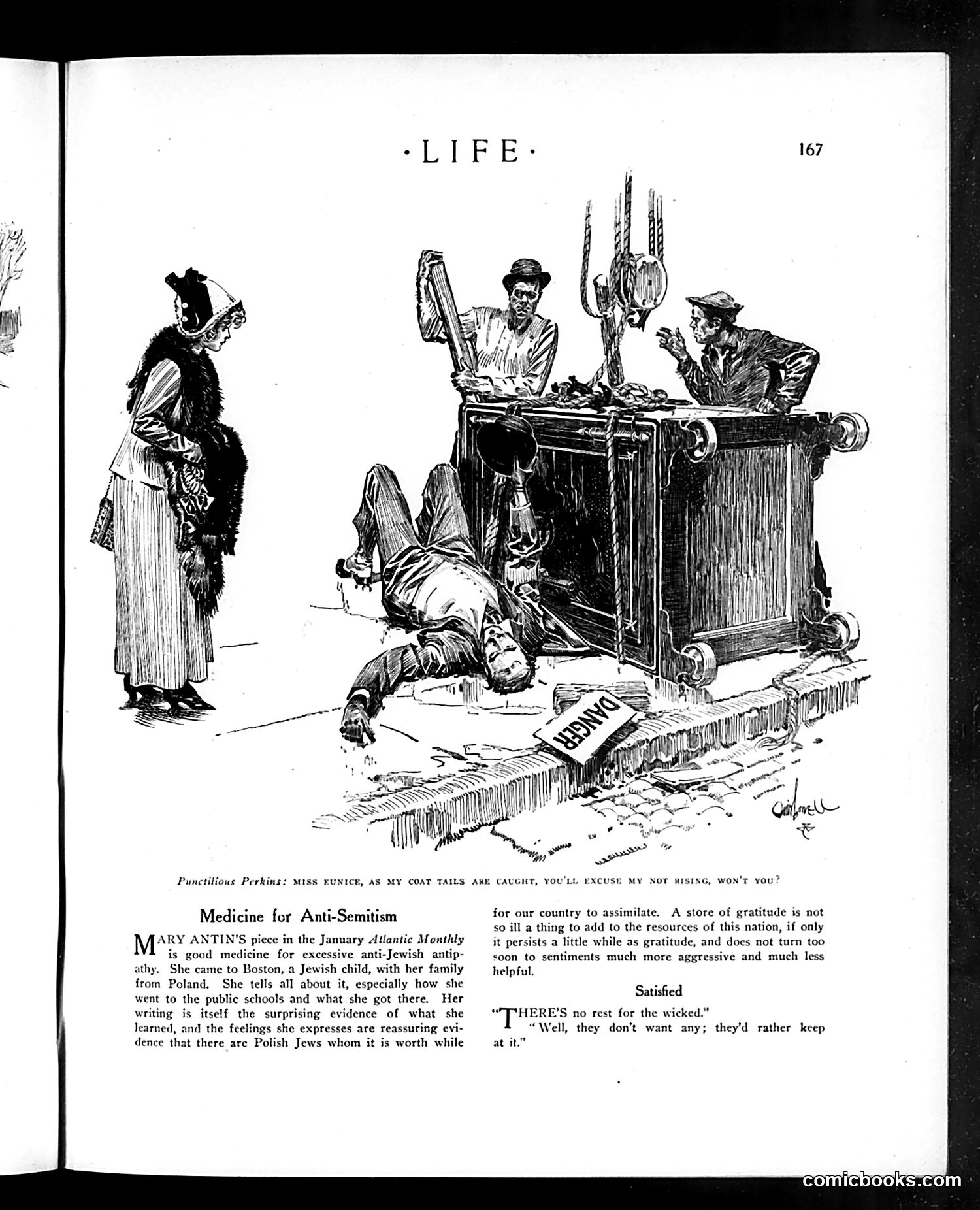
This page contains two satirical pieces from Life magazine (page 167). **Top cartoon** ("Punctilious Perkins"): A man remains seated while greeting a woman, claiming his coat tails are caught in a desk drawer as excuse for not rising—a violation of period etiquette. The humor relies on this transparent pretense of politeness masking laziness. **Bottom section** ("Medicine for Anti-Semitism"): The text praises Mary Antin's autobiographical Atlantic Monthly article about immigrating from Poland as a Jewish child. The author argues her education and eloquent writing demonstrate that Polish Jews are worthy of American assimilation. However, the passage contains a troubling undertone: it frames Jewish gratitude as valuable only if it remains passive and doesn't become "aggressive"—suggesting anxiety about immigrant political activism or assertiveness. **"Satisfied"**: A brief joke playing on the phrase "no rest for the wicked"—wickedness supposedly brings restlessness, but the response suggests some people prefer constant activity anyway.
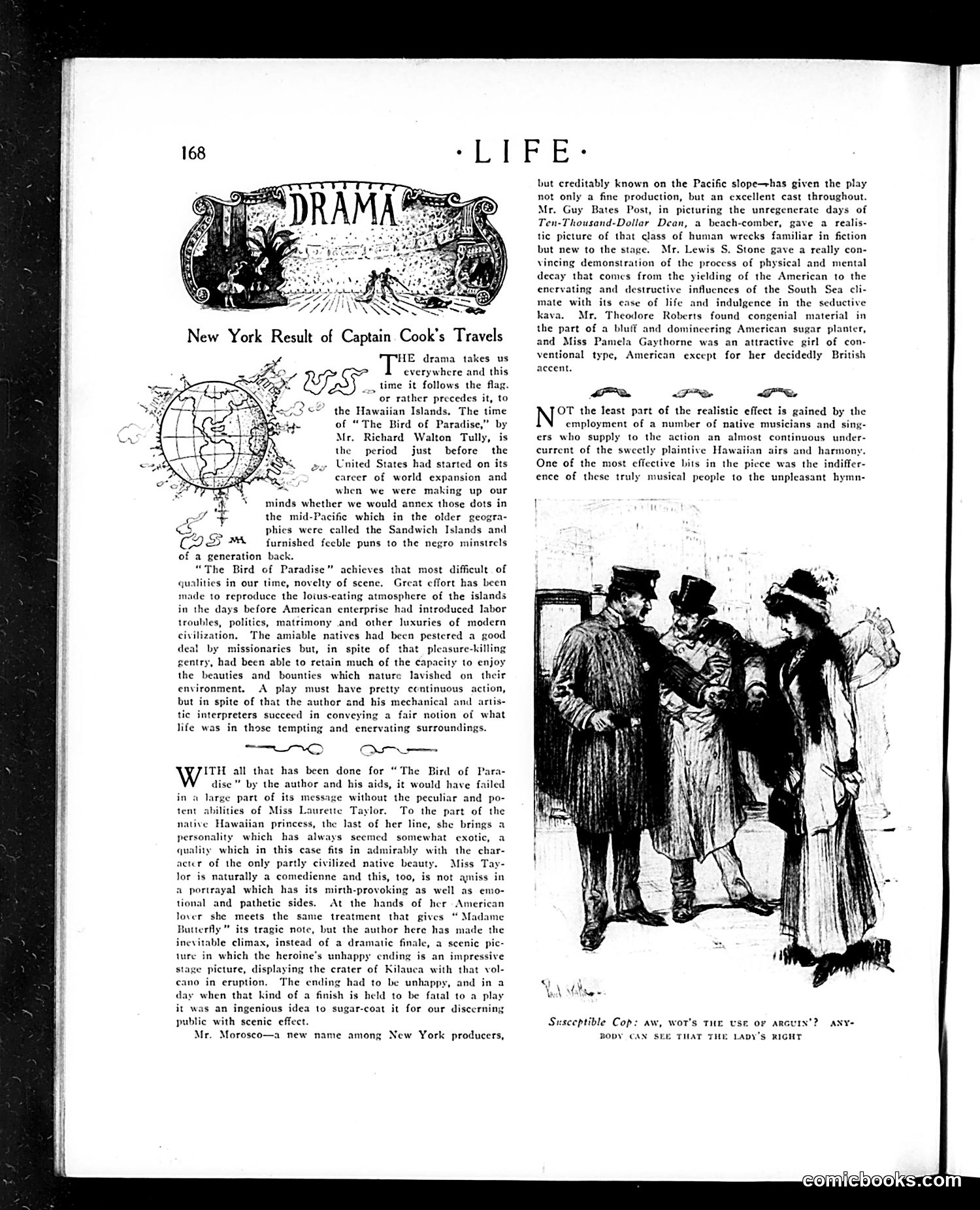
This page reviews a Broadway production of Richard Walton Tully's play *"The Bird of Paradise,"* set in Hawaii before American annexation. The drama depicts the collision between traditional Hawaiian life and American colonization. The satirical cartoon (bottom right, captioned "Susceptible Cop") shows three men in period dress—likely a commentary on susceptibility to foreign or exotic influences, though the specific reference is unclear from the image alone. The review praises the production's exotic atmosphere and cast, particularly actress Laurette Taylor's performance as a Hawaiian princess. It notes the play's "ingenious" decision to end unhappily with a volcanic eruption scene rather than a conventional dramatic finale—sugar-coating tragic inevitability for discriminating audiences. The implicit satire critiques American expansionism and "civilization's" destructive influence on indigenous cultures, framed through theatrical spectacle.
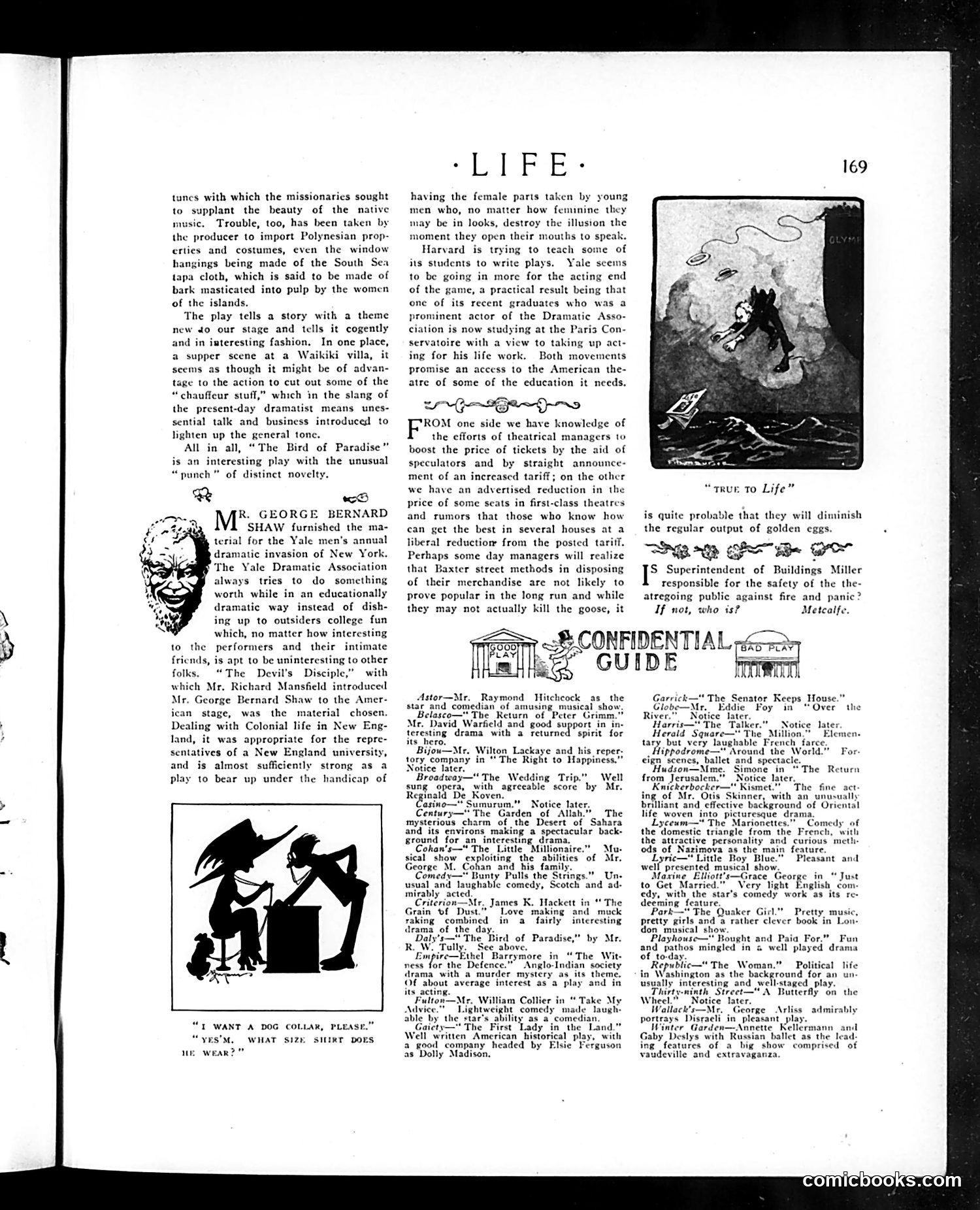
This page contains two distinct elements: **The Main Cartoon ("I Want a Dog Collar, Please"):** A shop clerk misunderstands a customer's request for a dog collar as a shirt size question. The humor relies on a literal misinterpretation—the customer seeks pet supplies while the clerk assumes they're shopping for clothing and needs to know shirt dimensions. This is straightforward slapstick wordplay typical of early 20th-century comic humor. **The Editorial Content:** The page discusses theatrical productions, notably praising Yale's dramatic society for staging George Bernard Shaw's "The Devil's Disciple" rather than frivolous college entertainment. It also critiques Broadway theater managers' pricing practices—comparing aggressive ticket-price increases and speculation to "Baxter street methods" (likely referring to black-market or unethical sales tactics). The piece advocates for legitimate theater education to improve American drama. The content reflects early 1900s concerns about theatrical commercialism versus artistic integrity.
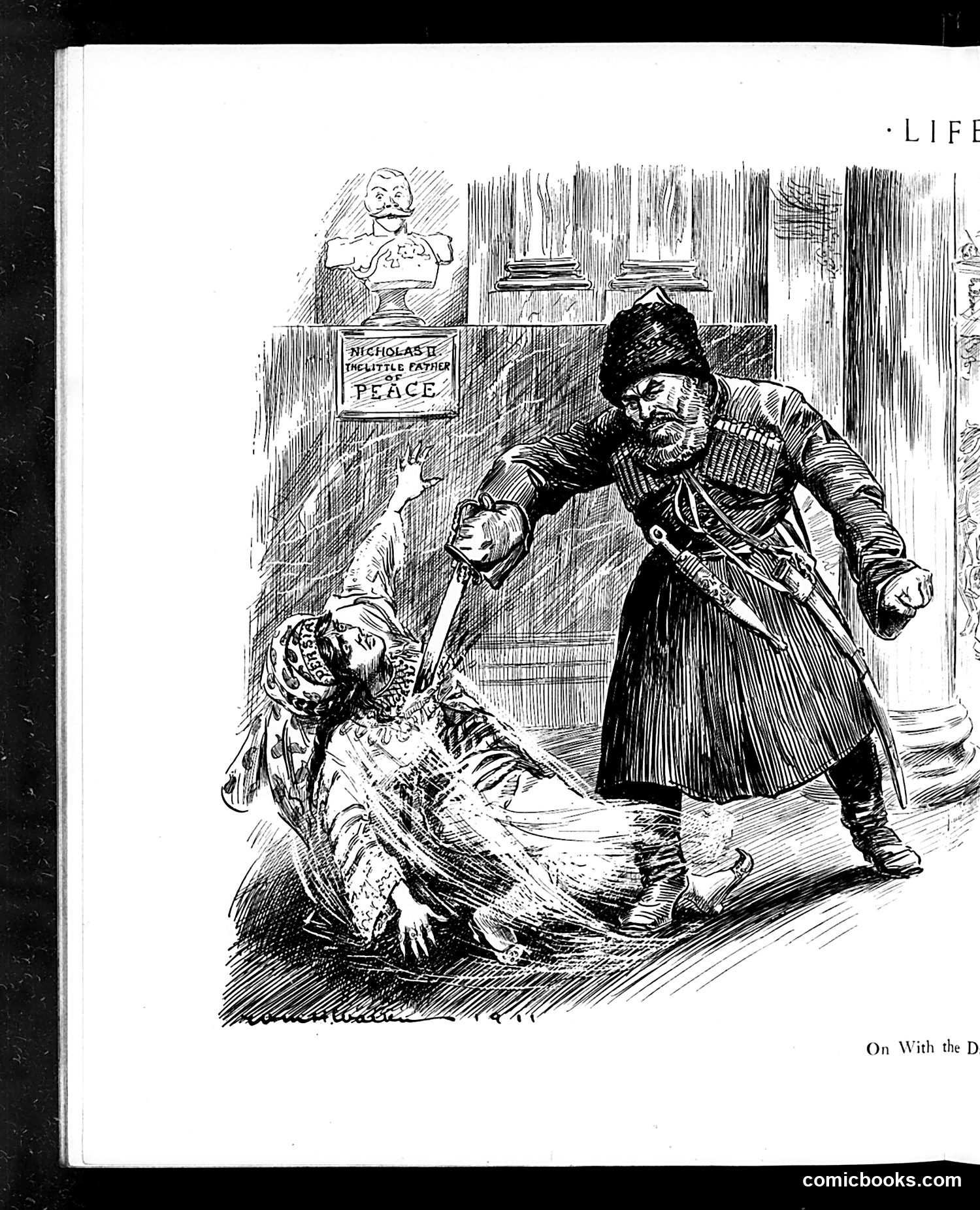
This satirical illustration depicts a military officer—identifiable by his uniform with epaulettes and fur hat—appearing to strike or threaten a kneeling, pleading figure. A bust labeled "NICHOLAS II" and "THE LITTLE FATHER OF PEACE" hangs on the wall behind them, establishing the Russian context. The cartoon appears to satirize Tsar Nicholas II's regime, contrasting his nominal title as "Father of Peace" with the brutal military violence depicted. The kneeling figure likely represents a Russian subject or possibly a revolutionary, while the aggressive officer embodies state oppression. The satire critiques the hypocrisy between Russia's peaceful pretensions and its actual authoritarian violence—a commentary likely from the early 20th century when such tensions were acute in Russian politics.
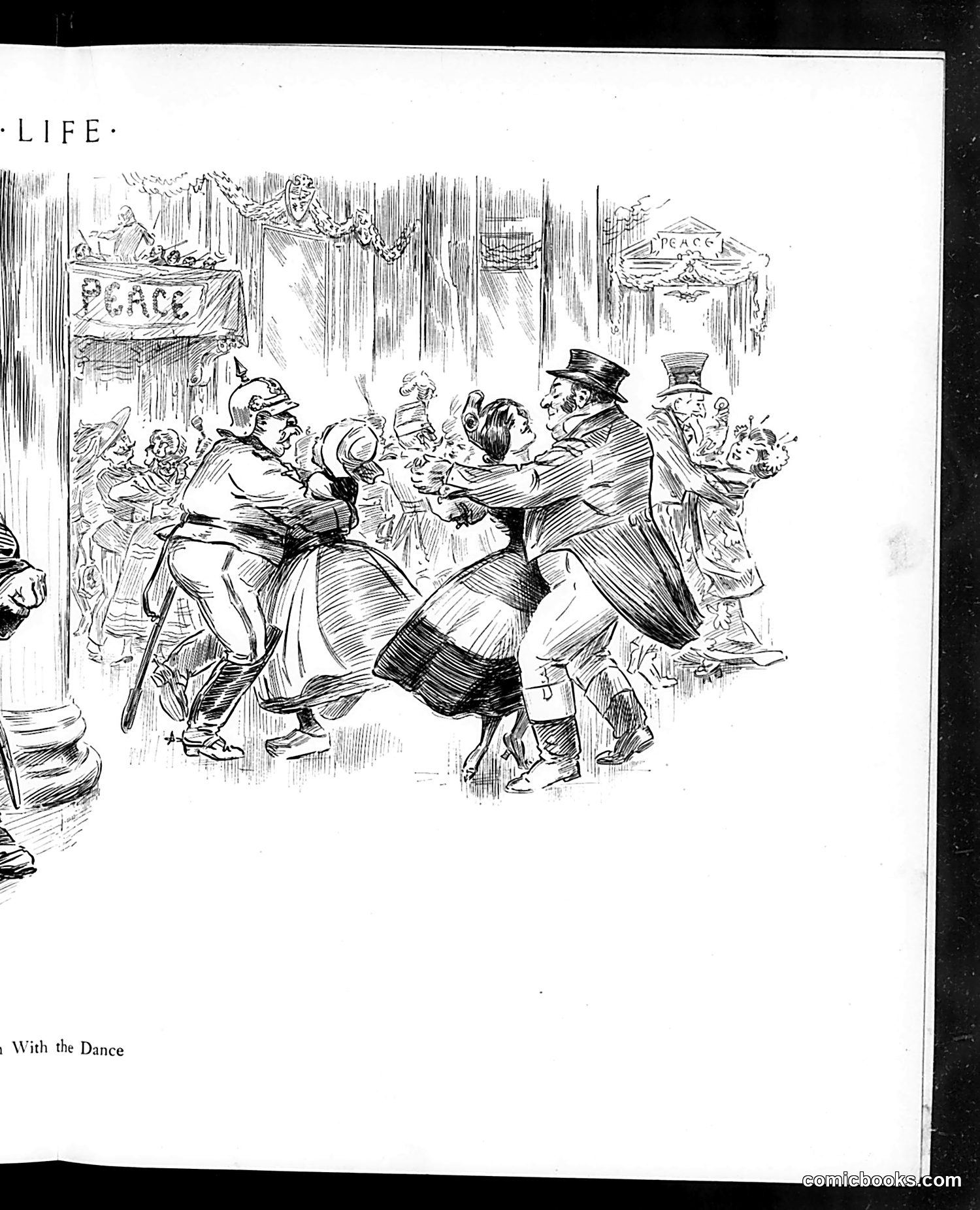
This political cartoon depicts several caricatured figures engaged in a chaotic dance or celebration beneath banners labeled "PEACE." The exaggerated body proportions and physical comedy suggest satirical commentary on political leaders or nations involved in peace negotiations or post-conflict celebrations, likely from the early 20th century (Life magazine's heyday). The figures appear to be politicians or national representatives, their distorted features typical of period caricature. The ironic juxtaposition of "PEACE" banners with frenzied, undignified dancing suggests the cartoonist is mocking either the sincerity of peace efforts or the unseemly behavior of world leaders claiming to pursue peace. Without specific identifying labels visible, the precise historical event cannot be determined with certainty.
This page reviews two recent autobiographies: Tom L. Johnson's "My Story" and Archibald Henderson's authorized biography of George Bernard Shaw. The article contrasts how these two prominent figures handled autobiography's inherent difficulties. **Tom Johnson**, the "fighting Mayor of Cleveland," overcame autobiographical challenges through characteristic directness—simply refusing to acknowledge them, producing a "big, forceful, simple" narrative. **Bernard Shaw**, by contrast, employed what the author calls "outwardly absurd but really very logical" cleverness: he hired Henderson to write his biography *for* him, thereby sidestepping the self-consciousness problem of self-examination. The piece frames both approaches as reflective of these men's public personalities—Johnson as a straightforward progressive reformer, Shaw as a witty intellectual operator. The review suggests these books offer modern readers insight into contemporary American attitudes toward progress and thought. The remainder is a "Confidential Book Guide" listing other recent publications with brief annotations.
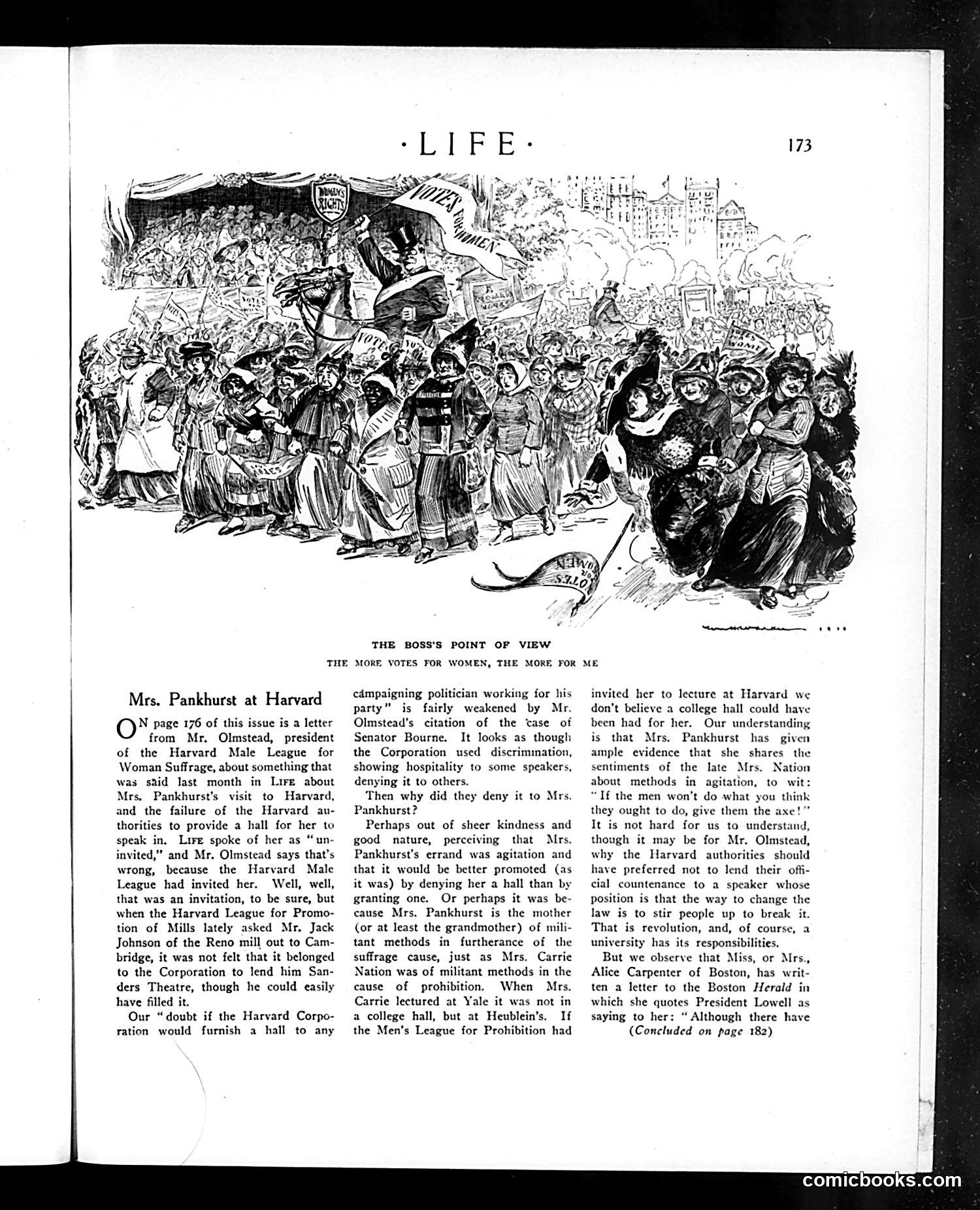
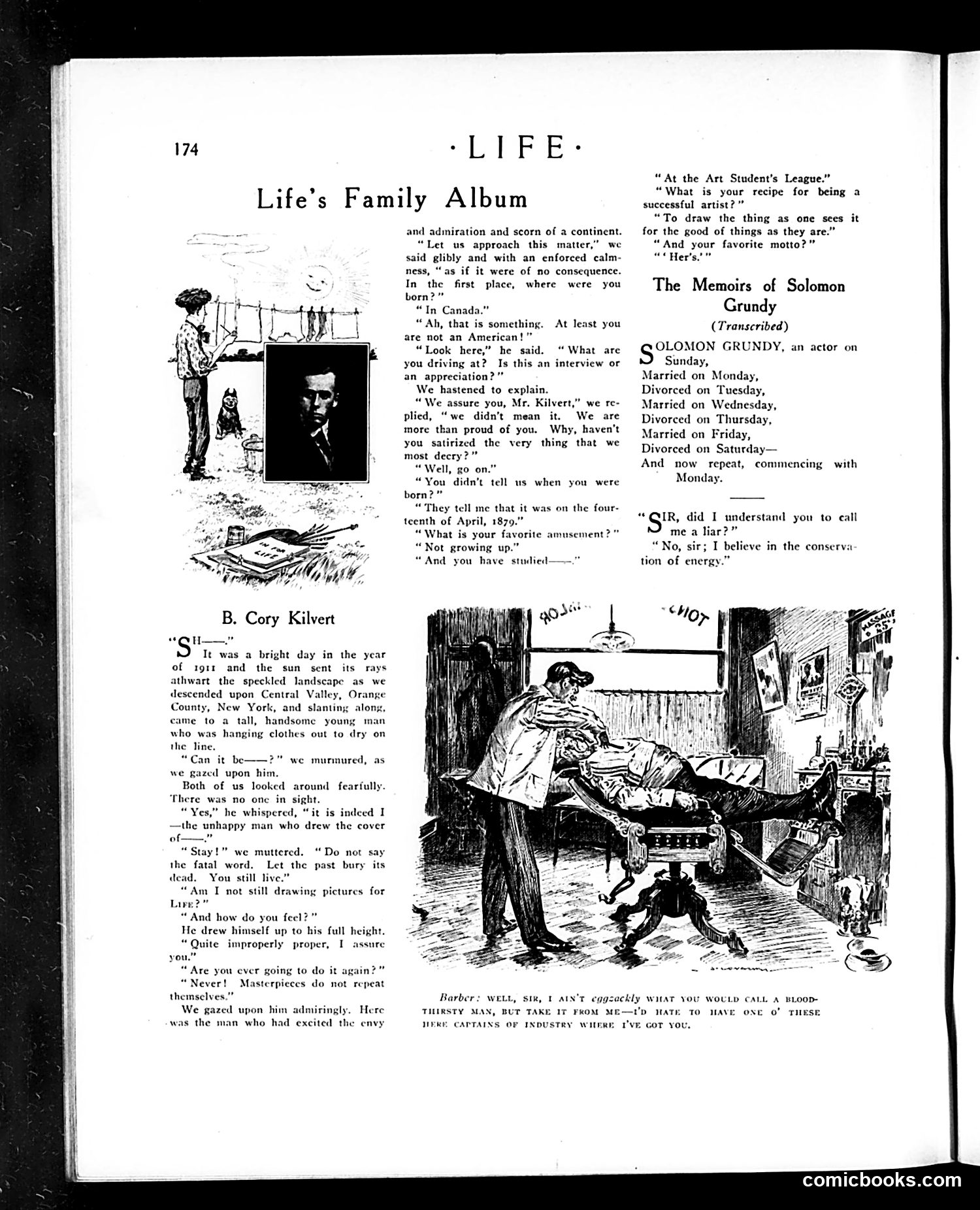
The cartoon depicts a suffragist rally or parade, with the caption "THE MORE VOTES FOR WOMEN, THE MORE FOR ME"—suggesting a cynical male political perspective that women's voting power benefits male politicians seeking to exploit a new voting bloc. The accompanying article discusses **Emmeline Pankhurst's** failed attempt to speak at Harvard in 1911. Harvard refused her an official hall, citing her role as a militant suffragist leader who advocated direct action and law-breaking to advance women's voting rights—comparing her methods to those of prohibitionist Carrie Nation. **The satire's point:** Life magazine defends Harvard's refusal on grounds that universities shouldn't sponsor revolutionary agitation, while simultaneously mocking male politicians' eager courting of female voters once suffrage seemed inevitable. The cartoon captures the hypocrisy: authorities banned Pankhurst as too radical, yet men in power stood ready to capitalize on newly enfranchised women for electoral gain.
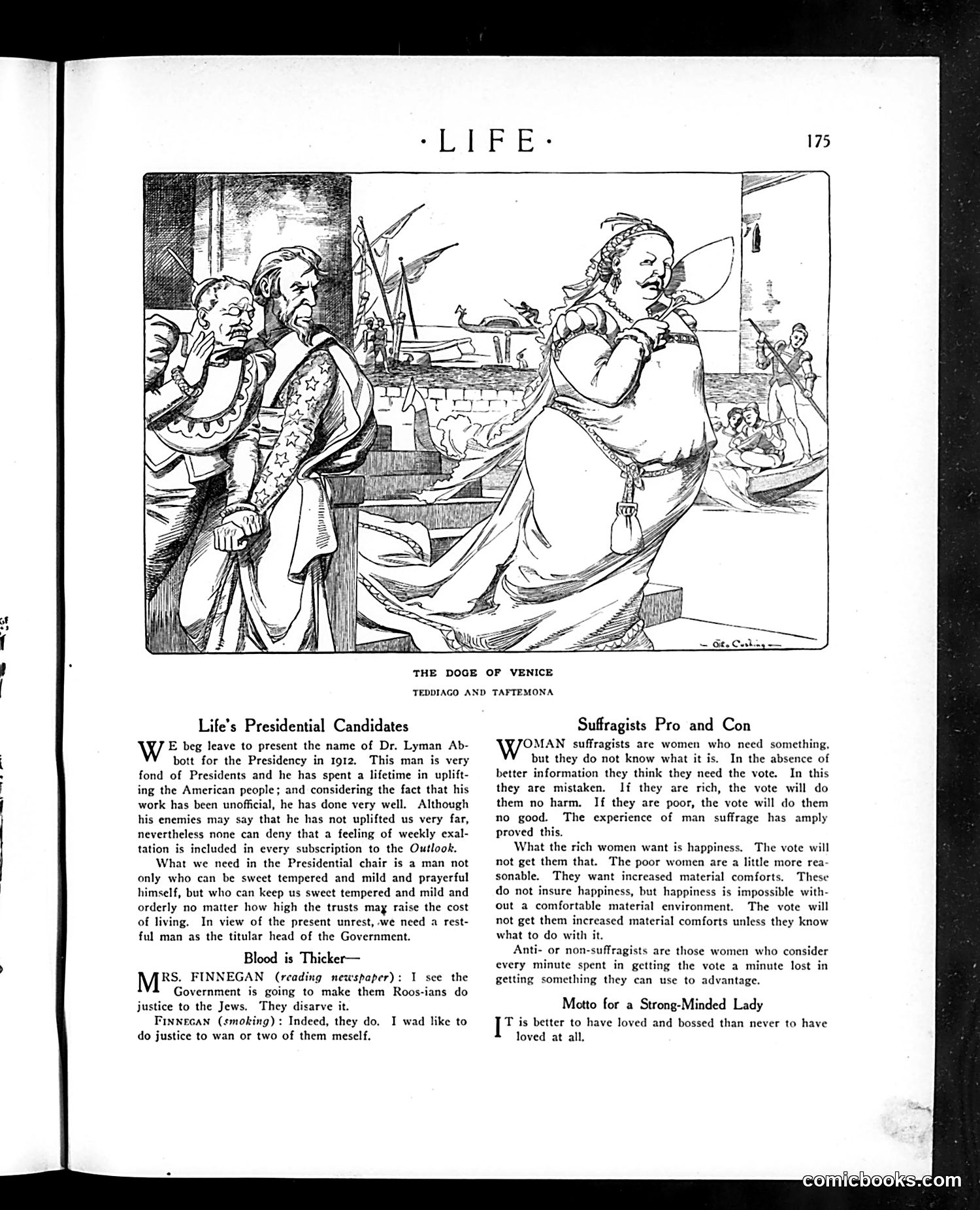
This page from *Life* magazine (circa 1912) contains political satire about the U.S. presidential election and women's suffrage. **Top cartoon** ("The Doge of Venice"): Depicts Lyman Abbott, a prominent clergyman and editor of *The Outlook* magazine, as a presidential candidate. Life sarcastically praises him as someone who has "uplifted" Americans through his weekly magazine, mocking his moral authority and suggesting America needs a calming, "restful" leader amid labor unrest and rising costs of living. **"Blood is Thicker"**: A brief ethnic humor sketch where Irish-American characters (Finnegan and his wife) discuss the government forcing Russia to protect Jews, with crude dialect humor typical of the era. **"Suffragists Pro and Con"**: Life's anti-suffrage argument, claiming wealthy women don't need votes (they're already happy) and poor women need material comforts, not ballots. The piece dismisses women's suffrage as a distraction from practical self-improvement—a common anti-suffrage argument of the 1912 period.
This page presents **reader letters** responding to Life's editorial coverage. The key satire involves **suffrage and academic freedom**: The Harvard letter attacks Life's hypocrisy regarding **Emmeline Pankhurst**, the British suffragist. Life had labeled her an "uninvited speaker," but the letter's author sarcastically notes Life criticizes political lectures at Harvard while selectively applying standards to women's suffrage advocates. The letter implies Life permitted male politicians to address students but barred Pankhurst—demonstrating bias against the suffrage movement. The final letter (partially visible) appears to praise Life ironically—the editor's note "Modesty Forbids Our Publishing This" suggests the compliment was excessive or suspicious, another humorous deflation. The page illustrates **early 1910s debates** over free speech, women's rights, and institutional hypocrisy. Life positioned itself as progressive while Life's editors were actually selective about which reform causes deserved platform access.
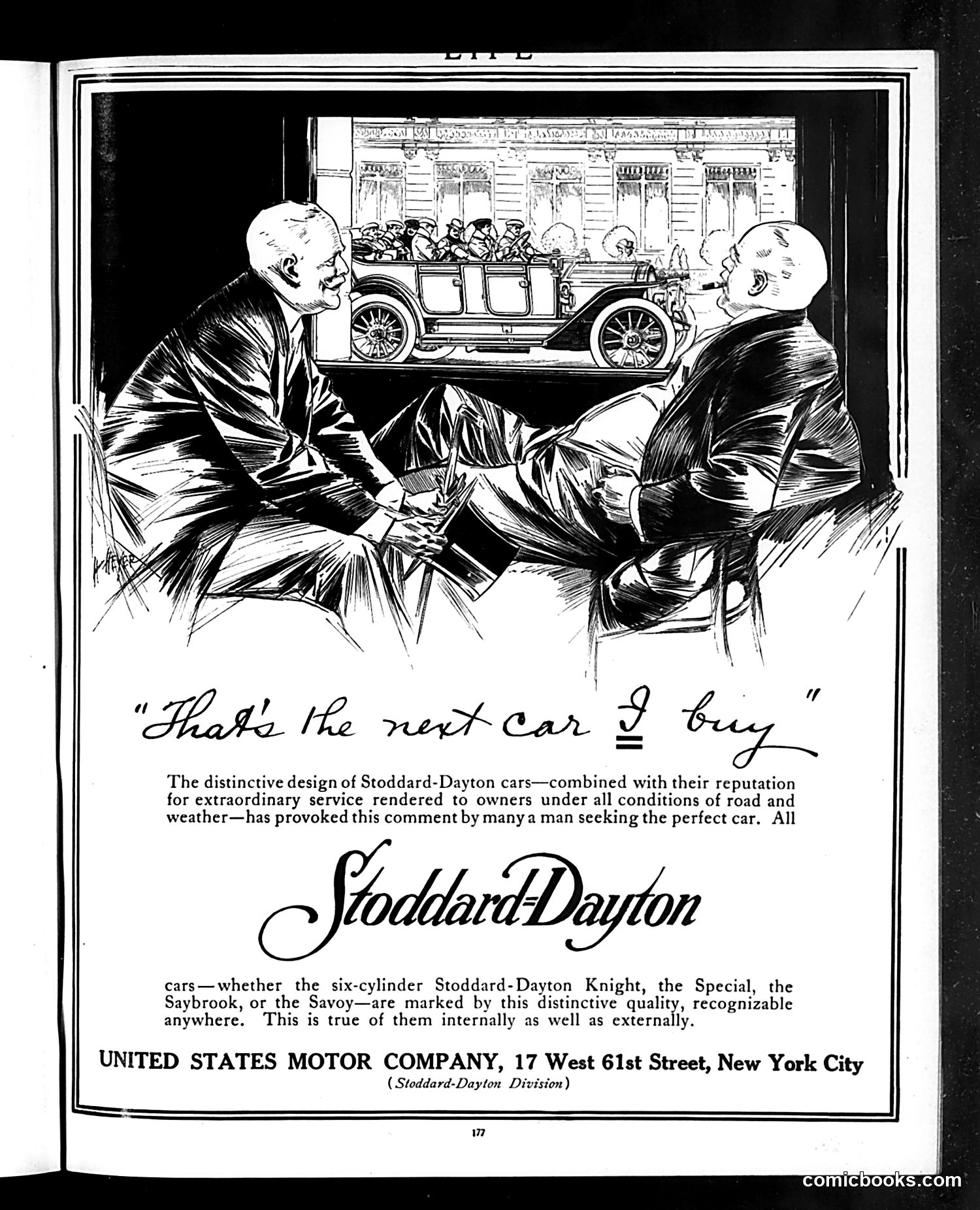
This is **automobile advertising**, not political satire. The page features a Stoddard-Dayton car advertisement from United States Motor Company. The illustration shows two well-dressed men in conversation, with a Stoddard-Dayton automobile visible through a window behind them. One man appears to be expressing interest in purchasing the vehicle, prompting the other's response: "That's the next car I buy." The advertisement's message emphasizes the car's distinctive design and reliable service reputation, suggesting that quality is recognizable "internally as well as externally." The ad lists various Stoddard-Dayton models (Knight, Special, Saybrook, Savoy) to appeal to different buyers. This represents early 20th-century automotive marketing using aspirational imagery and word-of-mouth testimonial appeals.
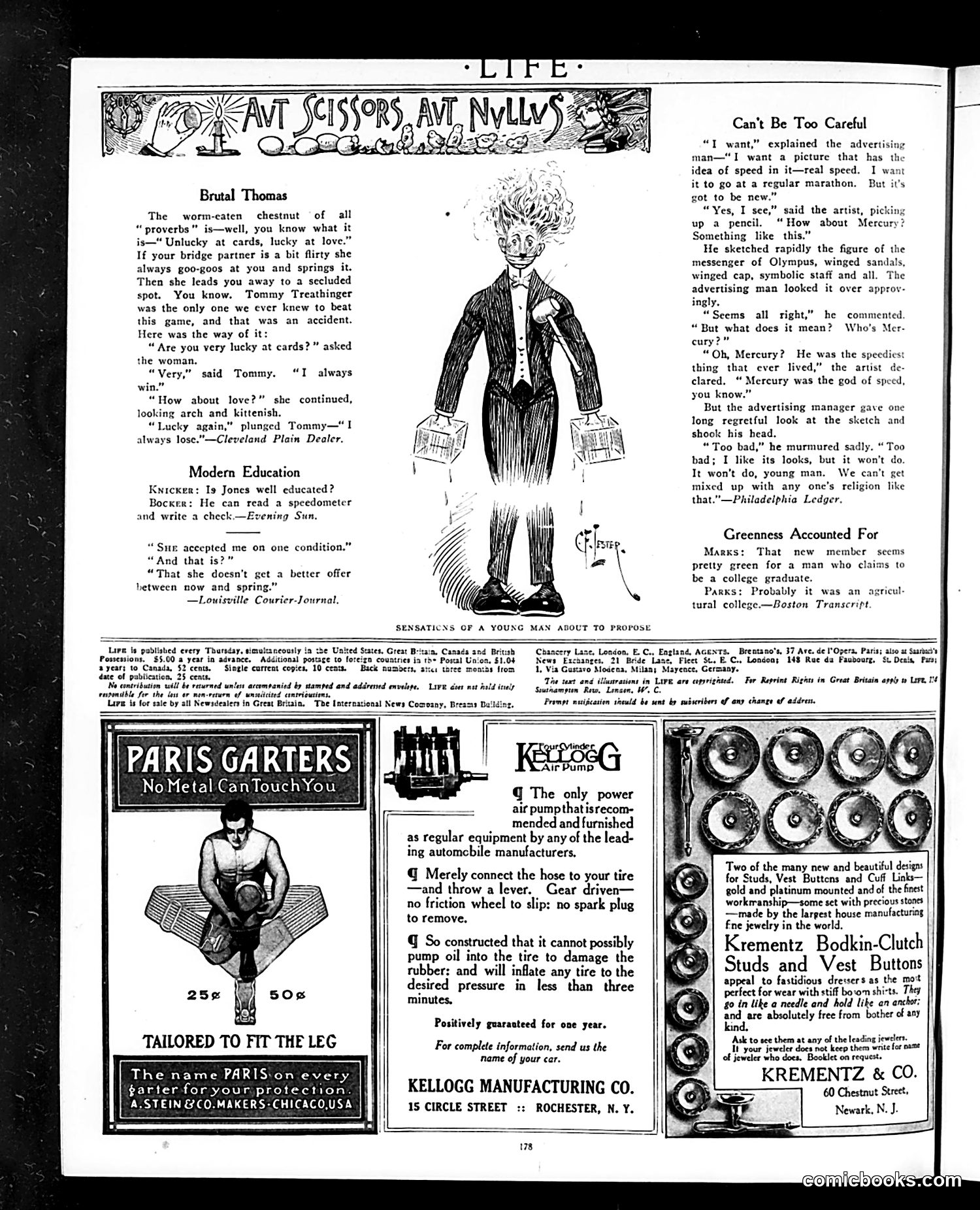
This page contains several short humorous pieces satirizing early 20th-century American social conventions and education. **Main Cartoon**: "Sensations of a Young Man About to Propose" depicts a nervously dressed man—likely representing anxious suitors of the era—preparing for marriage proposal. **Notable Humor Pieces**: - "Brutal Thomas" mocks the old proverb "unlucky at cards, lucky at love" through a man's counterintuitive dating success - "Modern Education" satirizes contemporary college graduates as education-less, capable only of reading speedometers and writing checks—suggesting mechanization replacing classical learning - "Can't Be Too Careful" ridicules an advertising executive who rejects an artist's Mercury illustration, fearing it might "get mixed up with any one's religion"—reflecting anxiety about religious sensitivity in commercial contexts The page also contains period advertisements for Paris Garters, Kellogg air pumps, and Krementz jewelry—typical commercial content alongside editorial satire typical of Life's format during this era.
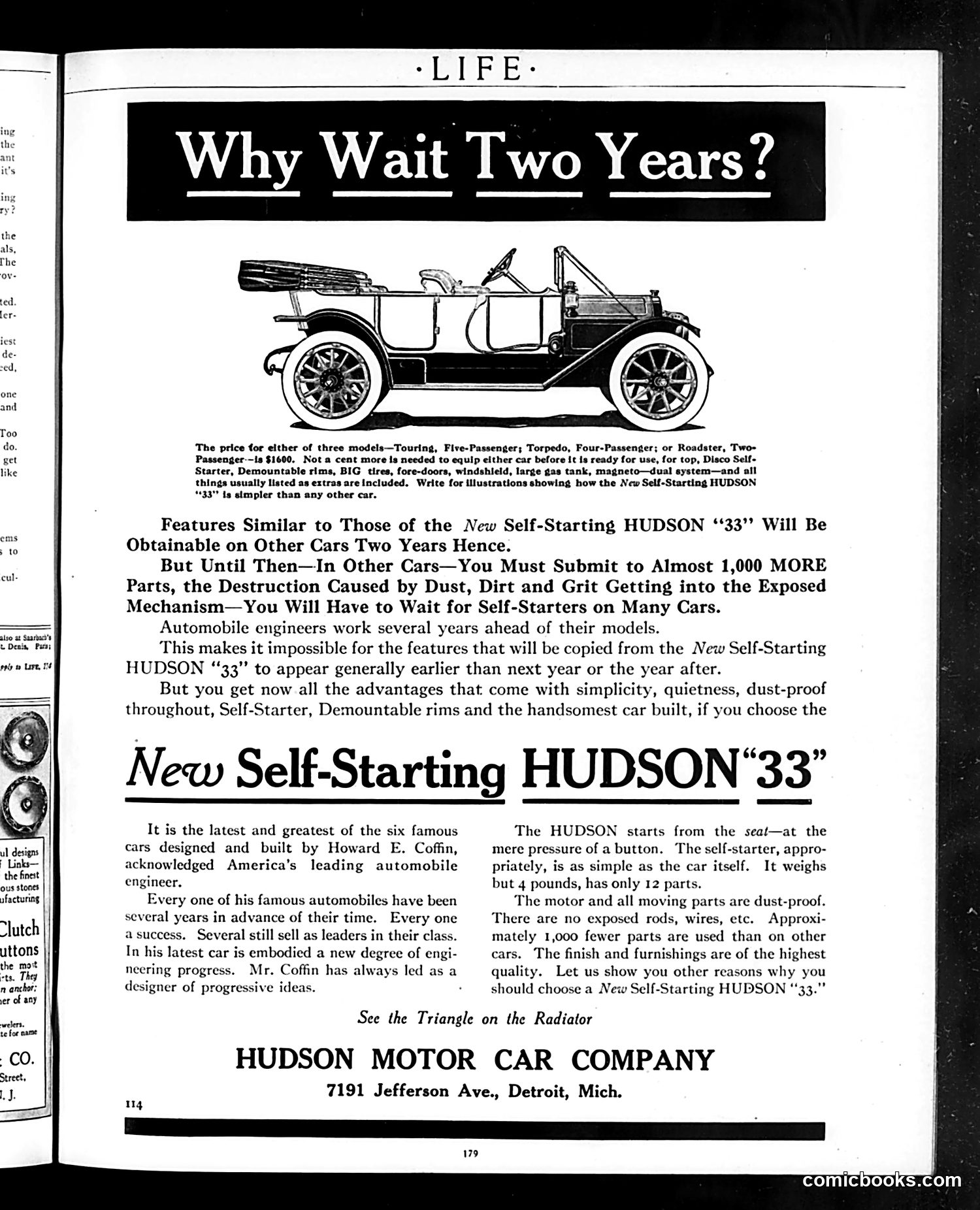
This is a **full-page automobile advertisement**, not political satire. It promotes Hudson's new "33" model with self-starting technology. The rhetorical strategy is competitive rather than humorous: Hudson argues customers should buy *now* rather than wait two years for competitors to copy their innovations. The ad claims the Hudson "33" features approximately 1,000 fewer parts than competing cars, uses a simple electric self-starter (activated by button), and includes dust-proof mechanisms—all currently unavailable elsewhere. The "Why Wait Two Years?" headline frames this as inevitable: other manufacturers will eventually adopt these features, but only after a multi-year lag. The implied message is that Hudson's engineer, Howard E. Coffin, consistently innovates ahead of the industry. This reflects early automotive competition around 1910s technology, when self-starters represented genuine innovation. The ad targets affluent buyers willing to pay $1,600 for technological superiority and simplicity.
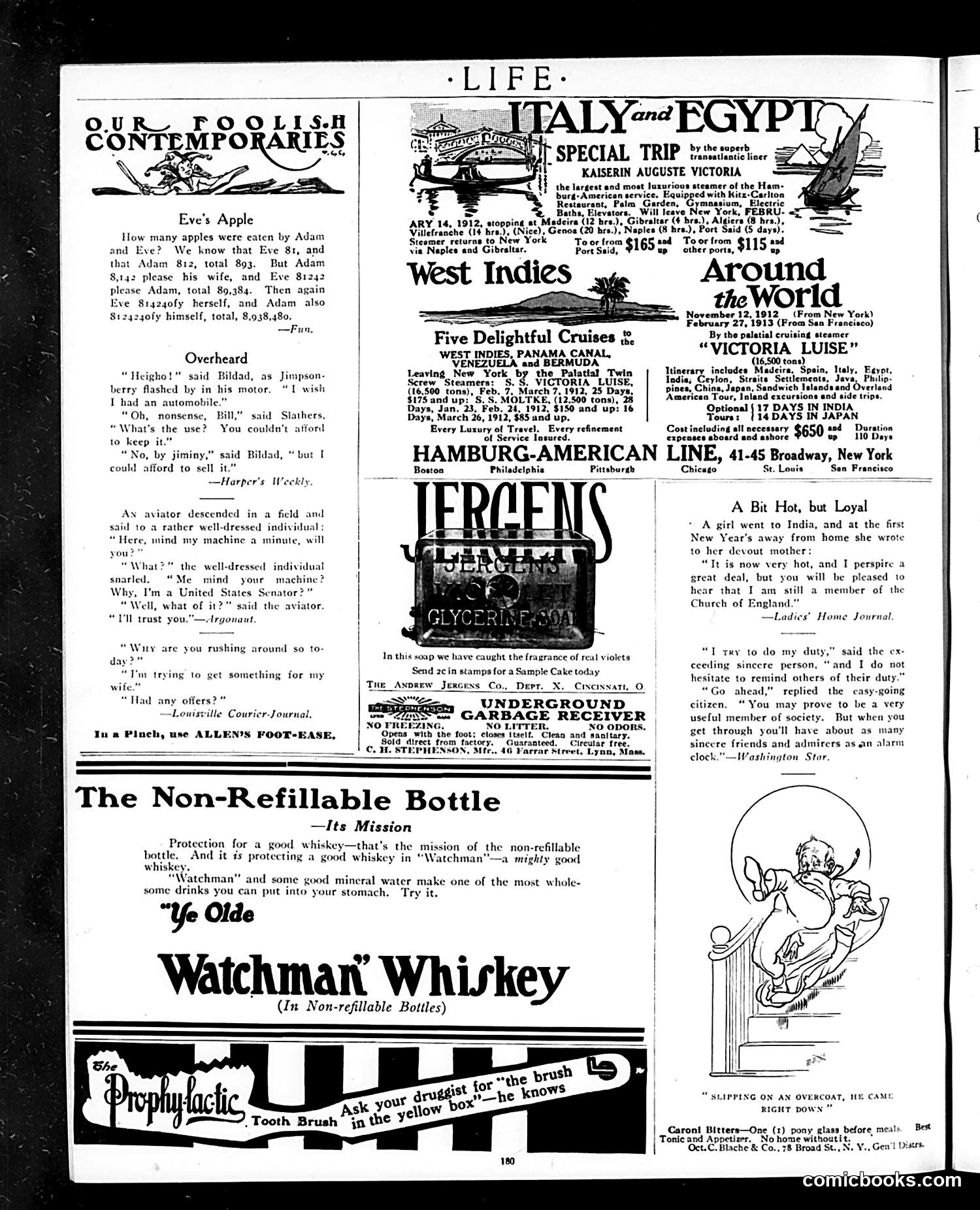
This page is primarily **advertising**, featuring steamship cruises and consumer products (whiskey, tooth brushes, soap). However, it includes several short humorous anecdotes in the "Our Foolish Contemporaries" section—typical of Life's satirical format. The jokes target social pretension and hypocrisy: 1. **The Senator anecdote**: A well-dressed man refuses to watch an aviator's plane because he's a U.S. Senator—too important for such tasks. The aviator's response ("I'll trust you") satirizes the Senator's inflated self-importance by treating him like an unreliable person anyway. 2. **The sincere reformer joke**: A woman insists on reminding others of their duty, yet ends up friendless "as an alarm clock"—mocking self-righteous moralists who alienate people through constant preaching. 3. **Eve's Apple**: A mathematical absurdity about apple-eating, likely poking fun at pedantic number-crunching. The cartoons mock American social types: pompous officials and tedious moral busybodies. The "Girl in India" piece satirizes excessive religiosity among colonial English women.
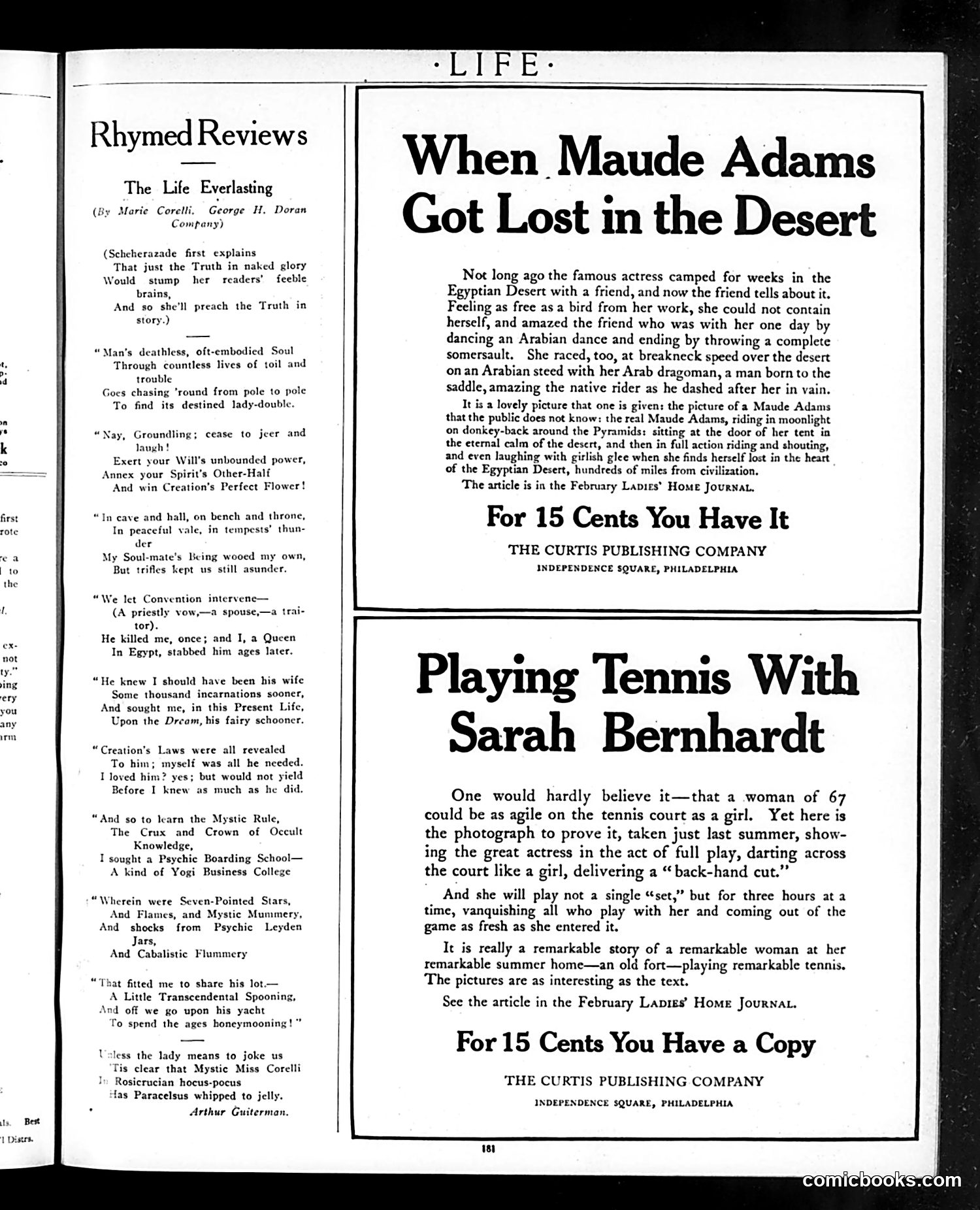
This page contains **advertisements and a satirical poem**, not political cartoons. **Left side:** Arthur Guiterman's mock-serious poem reviews Marie Corelli's "The Life Everlasting," a mystical novel about reincarnated soulmates. The satire mocks Corelli's occult themes—Rosicrucian philosophy, psychic boarding schools, and theosophical concepts popular in early 1900s spiritualism. Guiterman ridicules the overwrought romanticism: souls searching across incarnations, dramatic past-life drama (stabbing in Egypt), and ultimately resolving in "transcendental spooning" on a yacht. **Right side:** Two Curtis Publishing advertisements promoting articles in *Ladies' Home Journal* about celebrities: actress Maude Adams's adventure in the Egyptian Desert, and aging actress Sarah Bernhardt's athletic tennis ability. These highlight remarkable women defying age expectations—contemporary human-interest features rather than satire. The page reveals early-20th-century American middle-class reading interests: spiritualism, celebrity culture, and women's magazines.
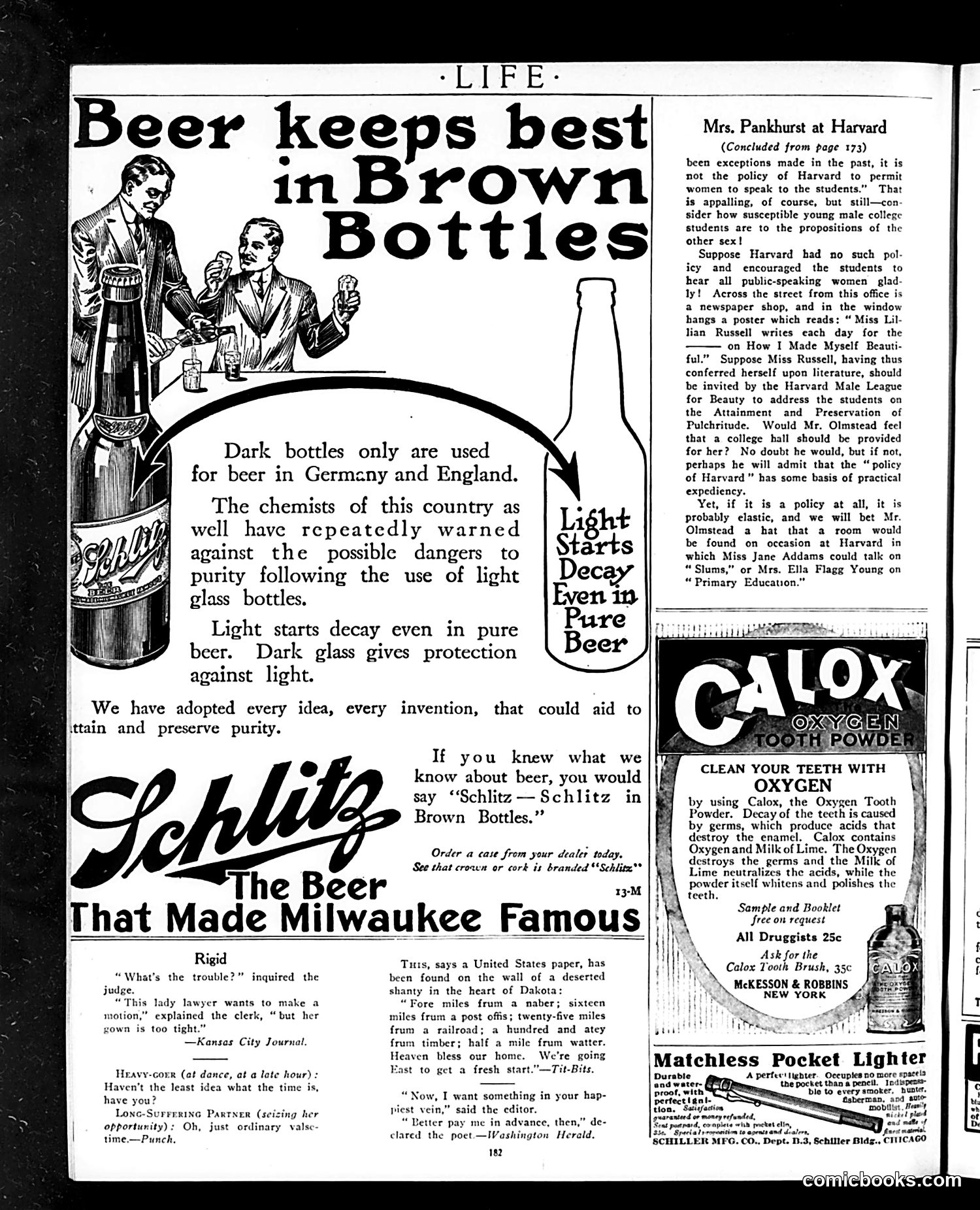
This Life magazine page is dominated by a **Schlitz beer advertisement** (center-left), not political satire. The ad argues that dark brown bottles preserve beer quality better than clear glass, which allows light to cause decay. The copy emphasizes scientific authority ("chemists have repeatedly warned") to market brown bottles as superior for purity. The page also includes: - A brief article about **Mrs. Pankhurst at Harvard** (top right), discussing whether Harvard should permit women speakers. The author argues Harvard's restrictive policy has practical merit, given students' susceptibility to female speakers' influence—a period-typical paternalistic view. - Several short humorous anecdotes about rigid corsets, a lawyer's tight gown, and frontier hardship. - Small advertisements for **Calox Oxygen Tooth Powder** and a **Matchless Pocket Lighter**. The content reflects early 20th-century attitudes about women in public spaces and the era's trust in "scientific" marketing claims.
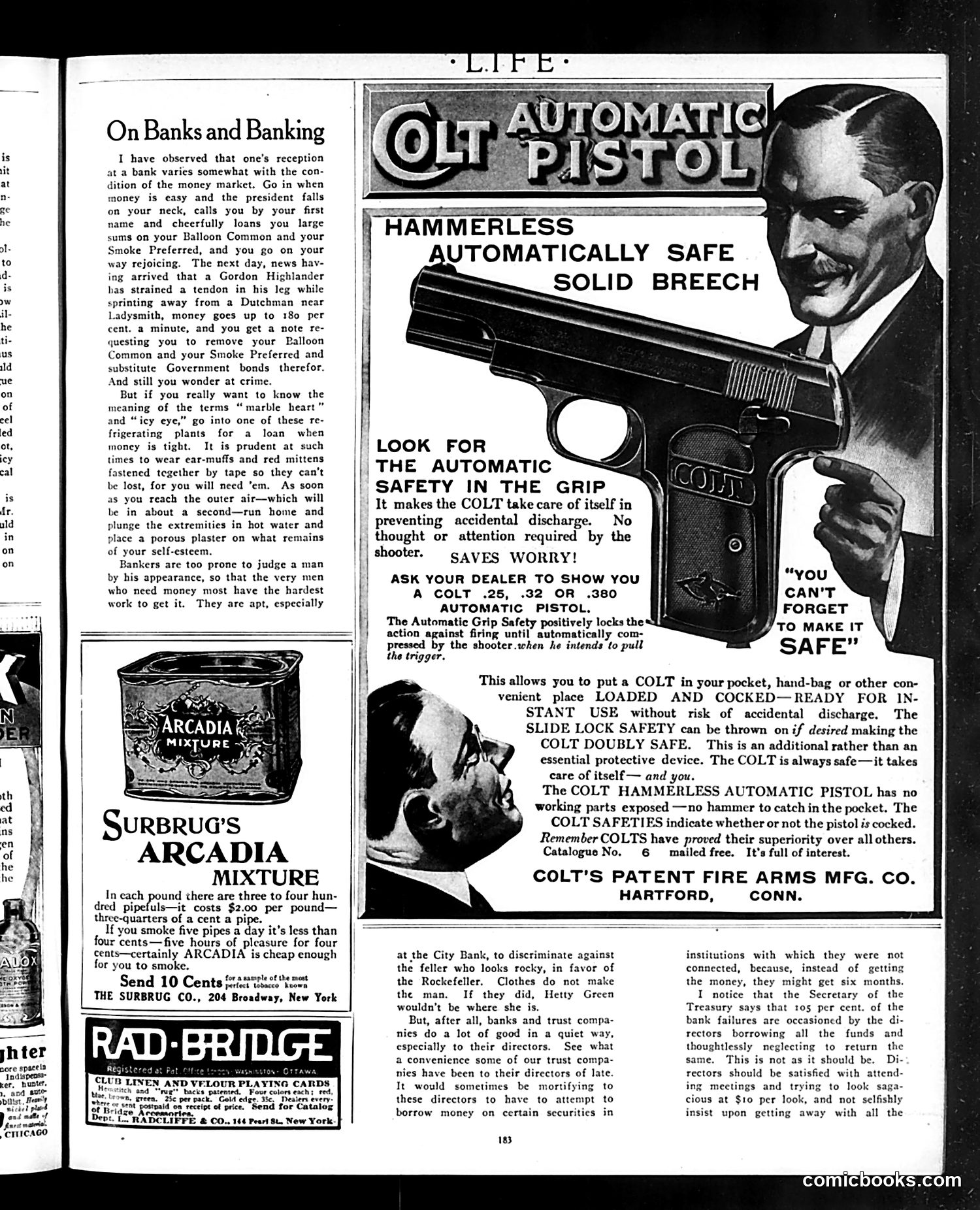
This page contains a satirical essay "On Banks and Banking" alongside period advertisements. **The Essay's Satire:** The unnamed author mocks banker hypocrisy and mood-dependent lending practices. When money is plentiful, banks eagerly loan to anyone holding worthless securities ("Balloon Common," "Smoke Preferred"). When money tightens, the same banks coldly demand clients replace these holdings with government bonds. The essay suggests this capriciousness drives crime—bankers' arbitrary cruelty creates desperation. The author also critiques class bias: bankers judge applicants by appearance, meaning those most needing loans (appearing poor) face the harshest rejection. The reference to "Hetty Green" (a wealthy but famously frugal woman) underscores that clothes don't determine character or creditworthiness. **The Advertisements:** These include tobacco, playing cards, and notably a Colt automatic pistol ad emphasizing "safety" through automatic grip mechanisms—somewhat darkly juxtaposed with the banking critique. The satire reflects Progressive Era skepticism toward financial institutions and their perceived indifference to ordinary people's struggles.
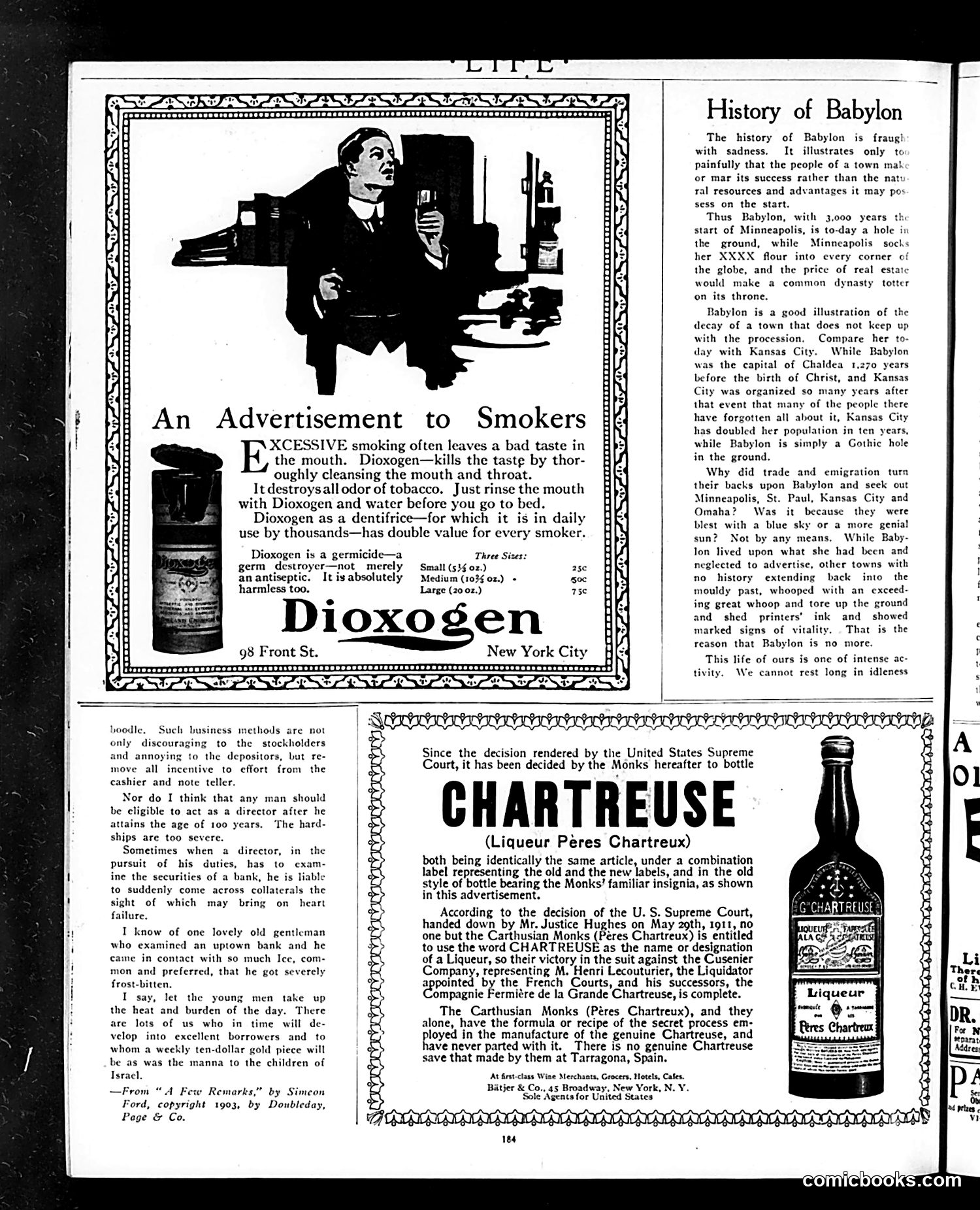
This page primarily contains **advertisements and satirical editorial commentary** rather than political cartoons. The main visual satire is an **essay titled "History of Babylon,"** which uses the ancient city's decline as a metaphor for business stagnation. The piece argues that Babylon failed not due to lack of resources but because it rested on past glory and neglected to "advertise" itself—while newer American cities like Minneapolis and Kansas City aggressively promoted themselves and grew. This is satirizing American business culture's obsession with self-promotion and commercial activity over tradition. The page also includes advertisements for **Dioxogen** (a mouthwash/germicide for smokers) and **Chartreuse liqueur**. The latter references a recent U.S. Supreme Court decision allowing the Monks to bottle Chartreuse in America. The humor is gentle, targeting complacency and outdated business practices rather than specific political figures. It reflects early 1900s American anxieties about progress, competition, and the supremacy of marketing over heritage.
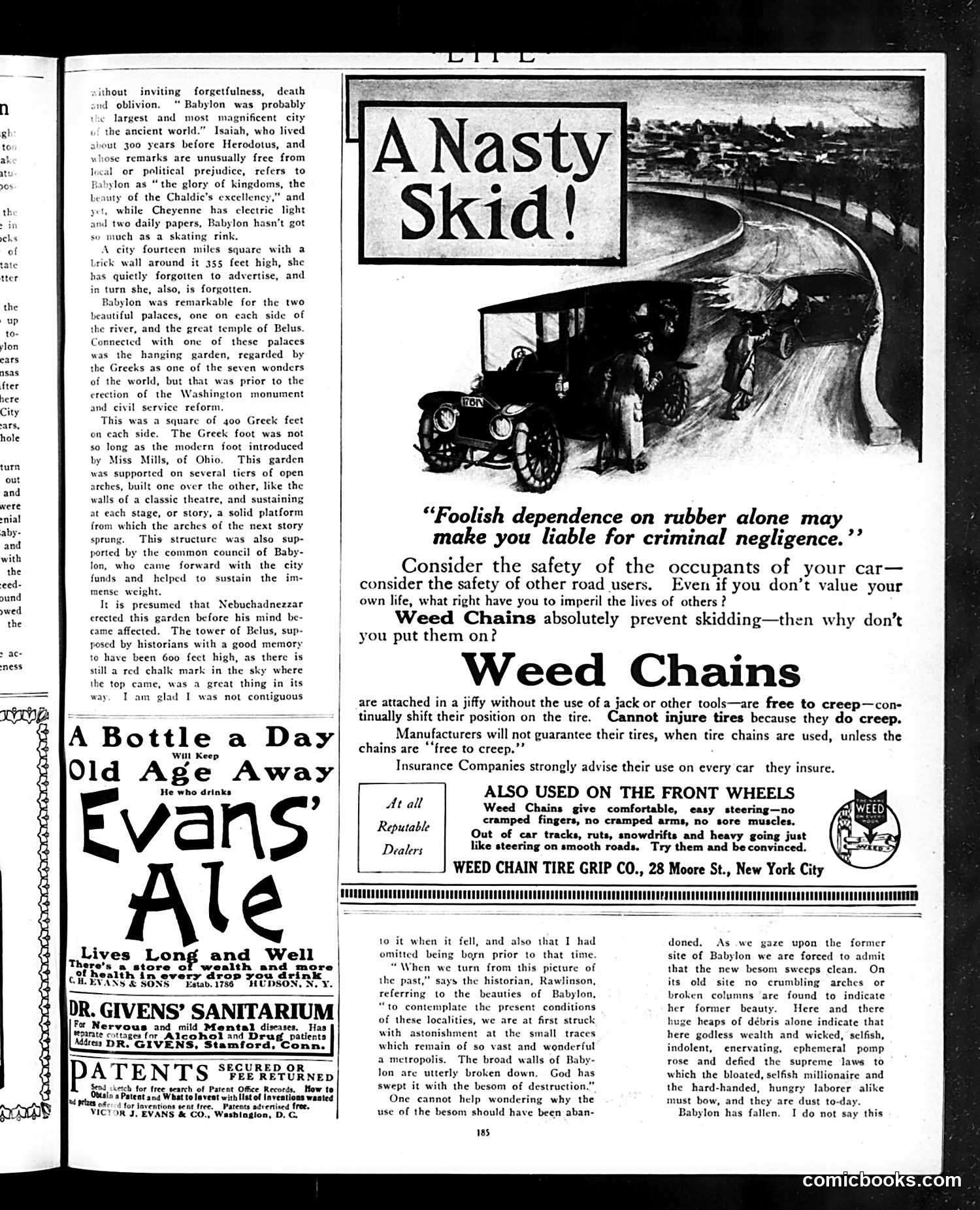
This page is dominated by a **safety advertisement for tire chains**, not political satire. The large central image shows an early automobile skidding dangerously on a wet road, with the headline warning against "foolish dependence on rubber alone." The ad's rhetoric uses **moral shaming** to pressure readers into buying Weed Chains: it invokes "criminal negligence," appeals to concern for "other road users," and notes that insurance companies "strongly advise their use." This reflects an era when automobile safety was still novel and chains were genuinely necessary for winter driving. The surrounding page contains **unrelated content**: text about ancient Babylon's forgotten grandeur (comparing it unfavorably to modern Cheyenne), and small ads for Evans' Ale, Dr. Givens' Sanitarium, and patent services—typical magazine filler of the period. The overall page appears to be from an early 20th-century *Life* magazine issue.
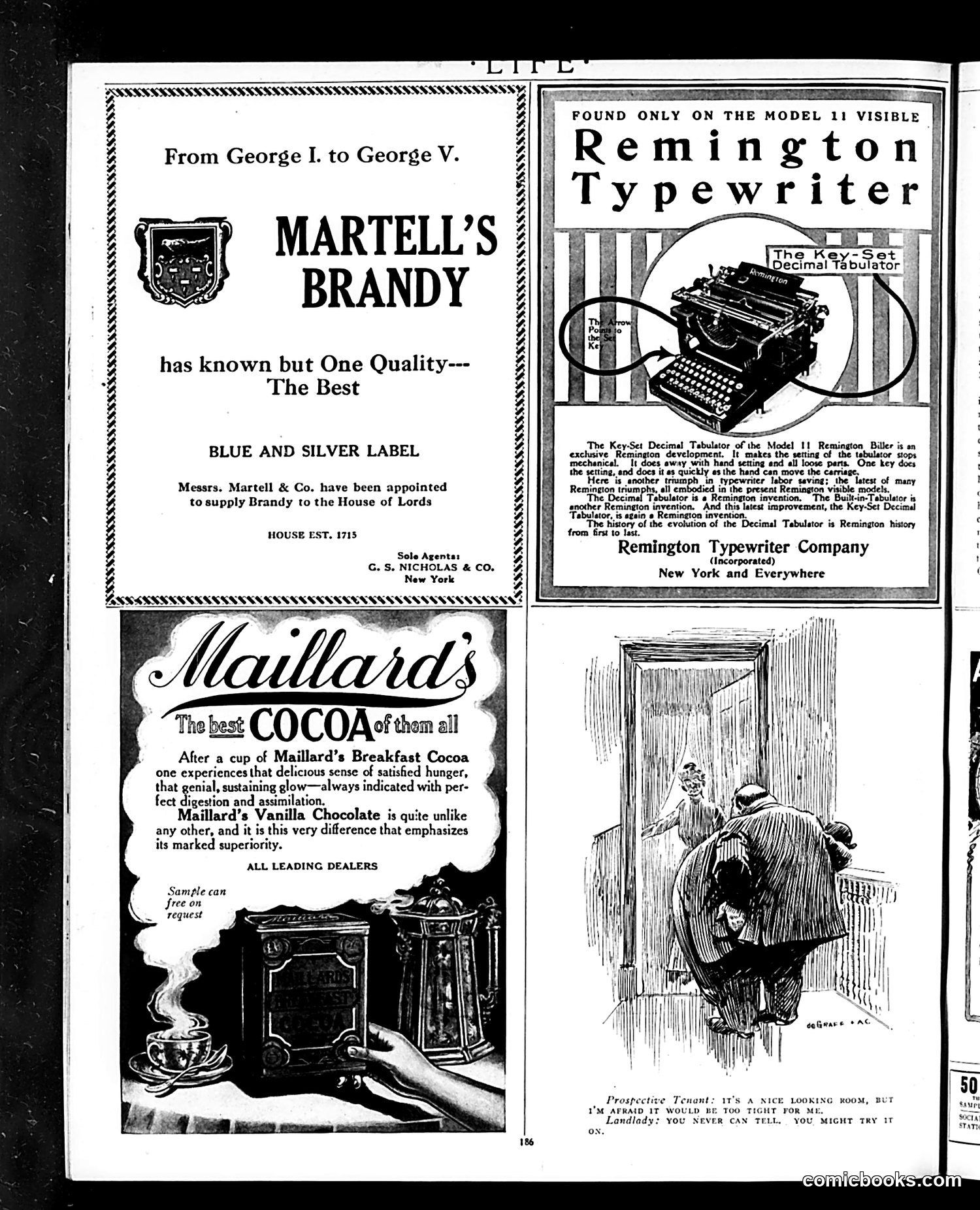
This page is primarily **advertising**, not satire or political commentary. It contains four advertisements: 1. **Martell's Brandy**: Claims unbroken quality "from George I to George V"—referencing British monarchs to suggest centuries of tradition and reliability. 2. **Remington Typewriter Model 11**: Highlights the "Key-Set Decimal Tabulator" as an exclusive innovation for business efficiency. 3. **Maillard's Cocoa**: Markets breakfast cocoa and vanilla chocolate as superior products available at leading dealers. 4. **Single-panel cartoon** (bottom right): A landlord-tenant joke where a prospective tenant worries a room is too small, and the landlady cryptically suggests he "try it"—implying people can adapt to cramped spaces, or possibly a darker implication about unfortunate outcomes. The cartoon is generic humor unrelated to the advertisements. The page reflects early 20th-century consumer culture marketing to middle and upper-class readers.
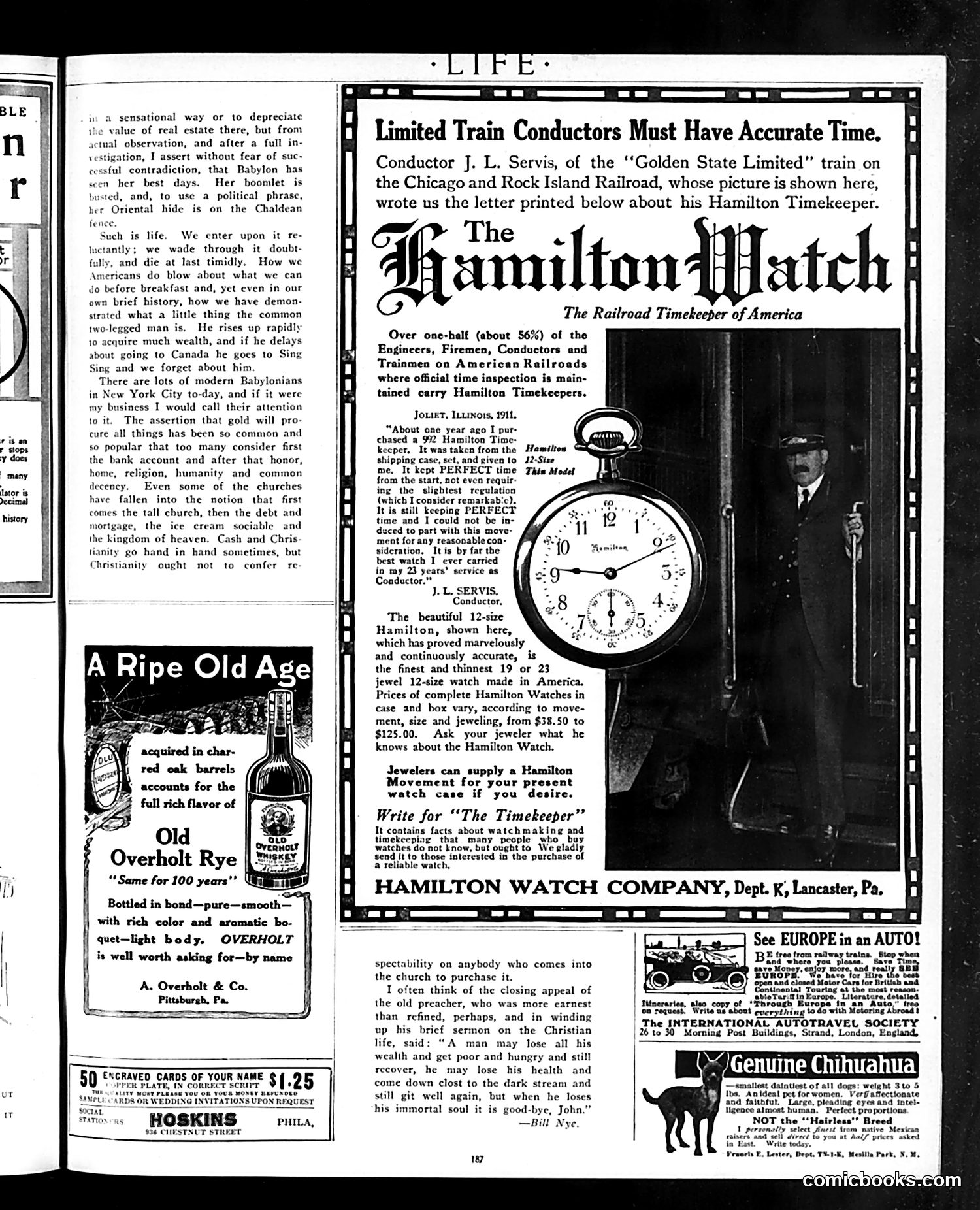
This page is primarily **advertising**, not political satire. The main content is a full-page advertisement for **Hamilton Watches**, featuring a testimonial from Conductor J.L. Servis of the Chicago and Rock Island Railroad's "Golden State Limited" train. The ad's appeal is straightforward: it claims that over 56% of American railroad engineers, firemen, conductors, and trainmen carry Hamilton timepieces because accuracy is essential for railroad operations. Servis's letter testifies to the watch's reliability over 23 years of service. The page also contains smaller ads for **Old Overholt Rye whiskey** and other products. The left-hand text column appears to be editorial content discussing morality, wealth, and religion in American life—unrelated to the advertisements. There is **no political cartoon or satire visible** on this page. It represents typical early 20th-century magazine layout mixing editorial content with advertisements.
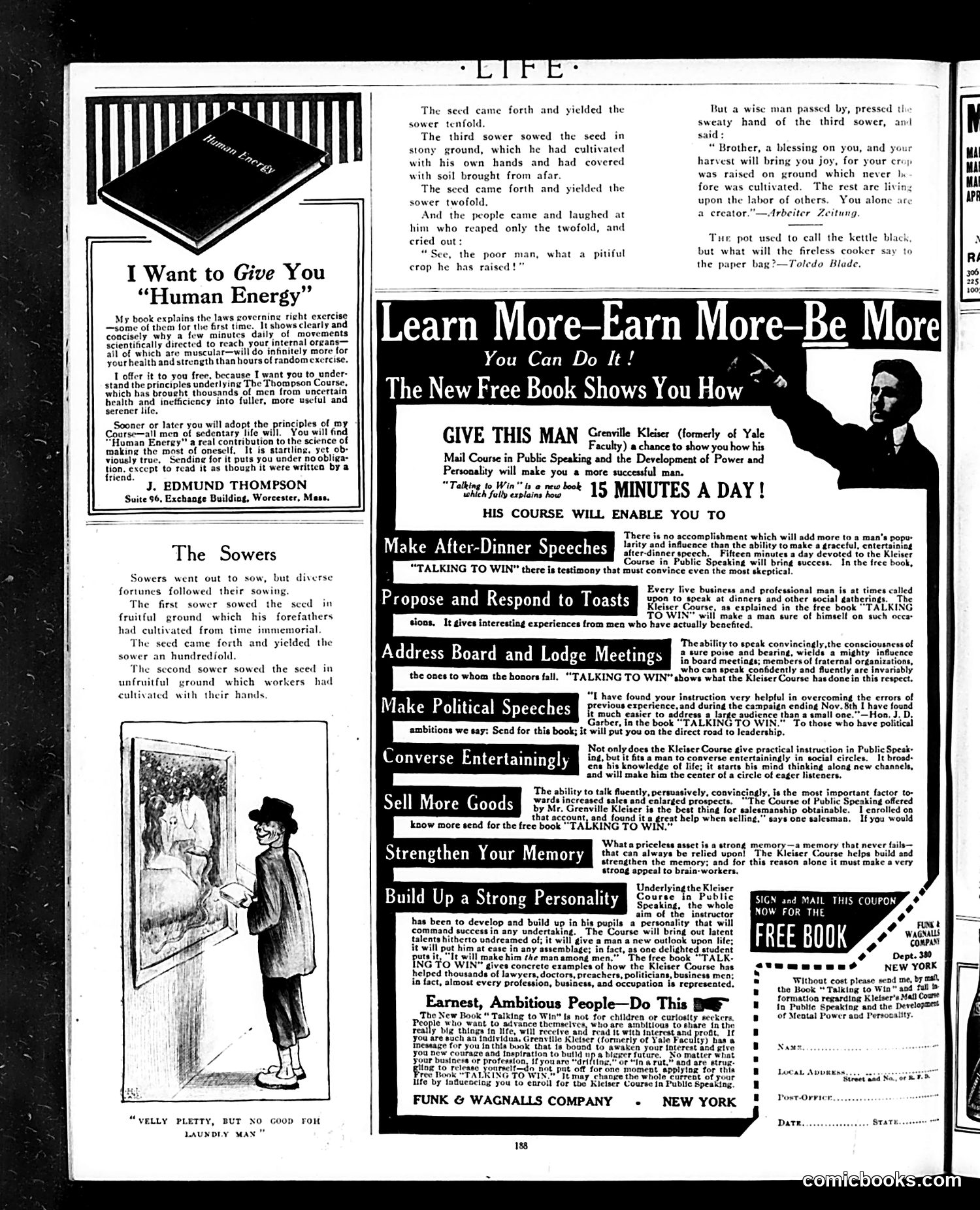
This page mixes a parable with early 20th-century self-help advertising. **"The Sowers" section** retells the Biblical parable of the sower, but reinterprets it with socialist messaging (note the attribution to *Arbeiter Zeitung*, a workers' publication). The moral shifts from spiritual to economic: the poor farmer who cultivated rocky ground through his own labor deserves respect, while those profiting from others' work do not. This reflects labor-movement ideology critiquing inherited wealth and unearned advantage. **The advertisements** (right side) promote Grenville Kleiser's "Talking to Win"—a mail-course promising self-improvement through public speaking and personality development in just 15 minutes daily. These ads promise social mobility: better business success, political influence, and personal charisma. **The irony**: The parable criticizes those who benefit from inherited advantage, while the ads sell self-improvement schemes to working people seeking upward mobility—a tension characteristic of early-1900s American capitalism.
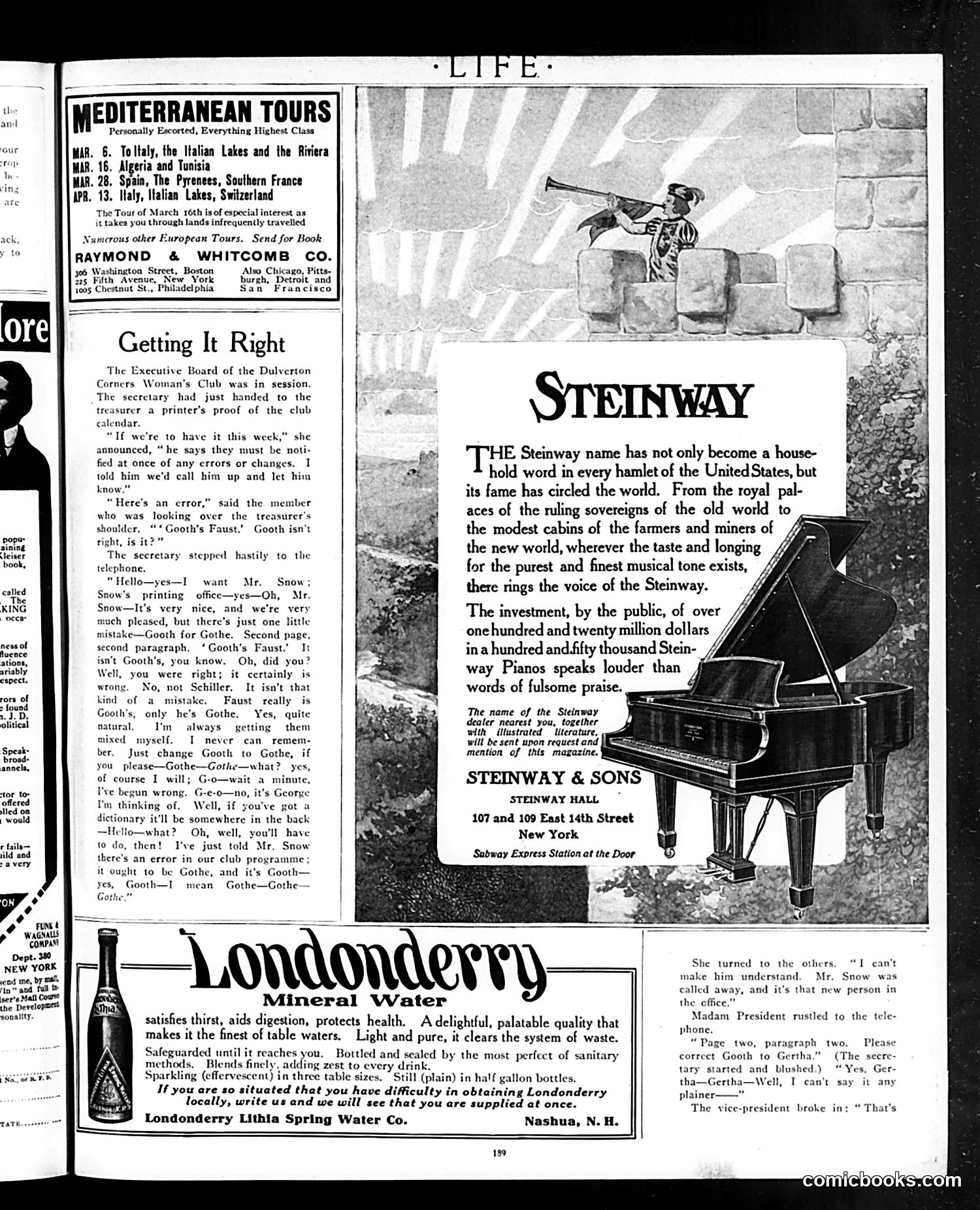
This page contains primarily **advertisements and a humor story**—not political satire. **"Getting It Right"** is a comedic sketch about a Woman's Club secretary struggling to communicate a spelling correction over the telephone. She needs to change "Gooth's Faust" to "Gothe's Faust" (the correct German spelling of Goethe), but the printing office's new employee misunderstands repeatedly, confusing Gooth/Gothe with other names. The humor derives from the old telephone miscommunication trope—a staple of early 20th-century comedy. **The advertisements** promote: - Mediterranean tours by Raymond & Whitcomb Co. - Steinway pianos (emphasizing their global prestige and sound quality) - Londonderry mineral water No political figures, caricatures, or social commentary are present on this page. It's simply entertainment and commercial content typical of *Life* magazine's format during this era.
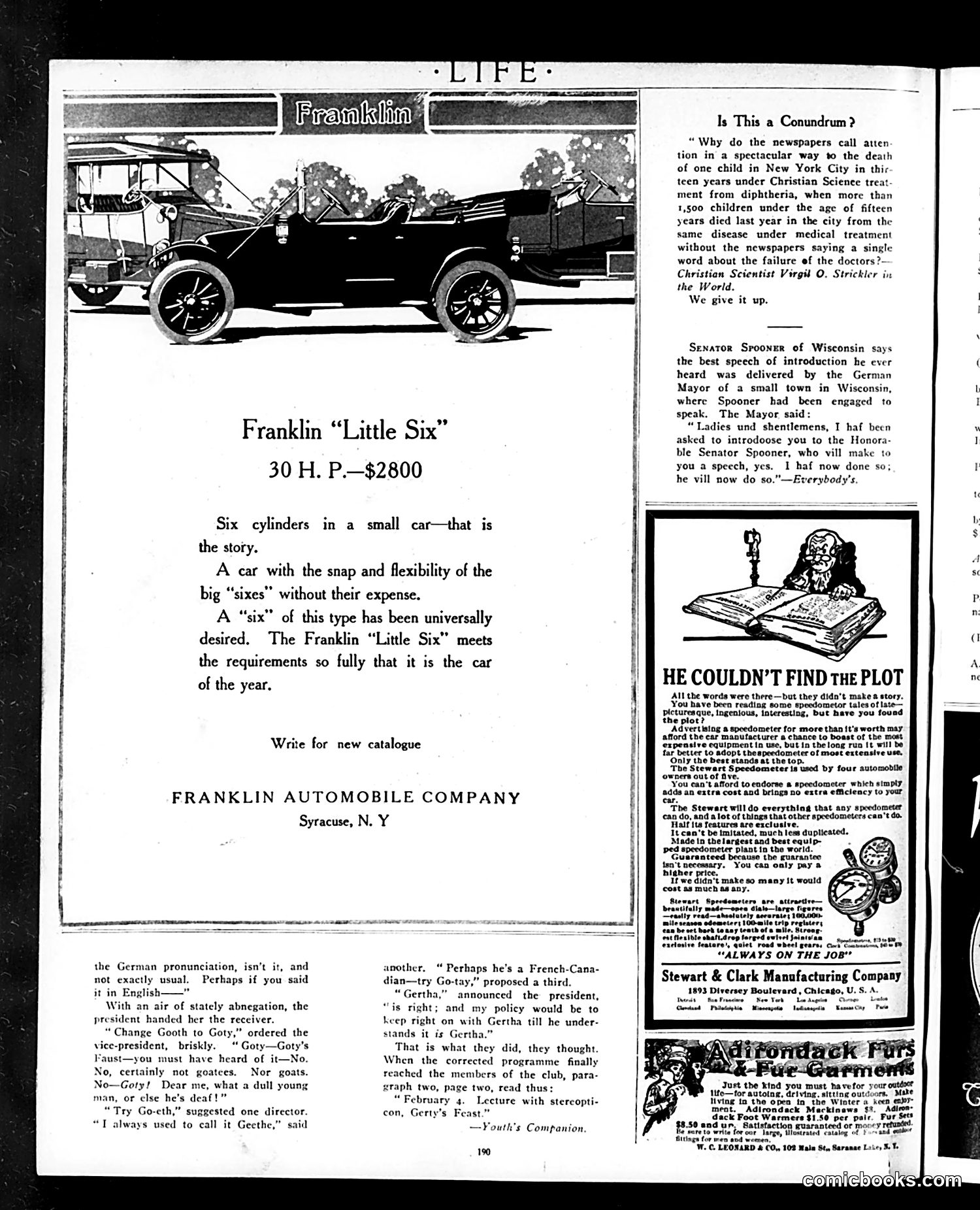
This page combines automobile advertising with satirical commentary typical of Life magazine's format. **Main Content:** The Franklin "Little Six" advertisement dominates, promoting a six-cylinder automobile at $2,800—positioned as offering the performance of larger "sixes" at lower cost and expense. **Satirical Sections:** 1. **"Is This a Conundrum?"** – A Christian Scientist challenges newspaper sensationalism: why do papers highlight one child's death from diphtheria under Christian Science treatment while ignoring 1,500+ deaths under conventional medical treatment? The satire attacks selective reporting and medical establishment bias. 2. **Senator Spooner anecdote** – A humorous story about a German-American mayor's malapropism-filled introduction of Senator Spooner, mocking ethnic speech patterns and formal ceremony. 3. **"He Couldn't Find the Plot"** – Satirizes speedometer advertisements that emphasize technical specs over practical value, using a literary metaphor (a story without plot). 4. **"Gerty's Feast"** anecdote – Jokes about mispronunciation and organizational bungling when correcting a German name to "Goty." The page reflects early-20th-century American attitudes toward medical practices, ethnic humor, and commercial advertising critique.
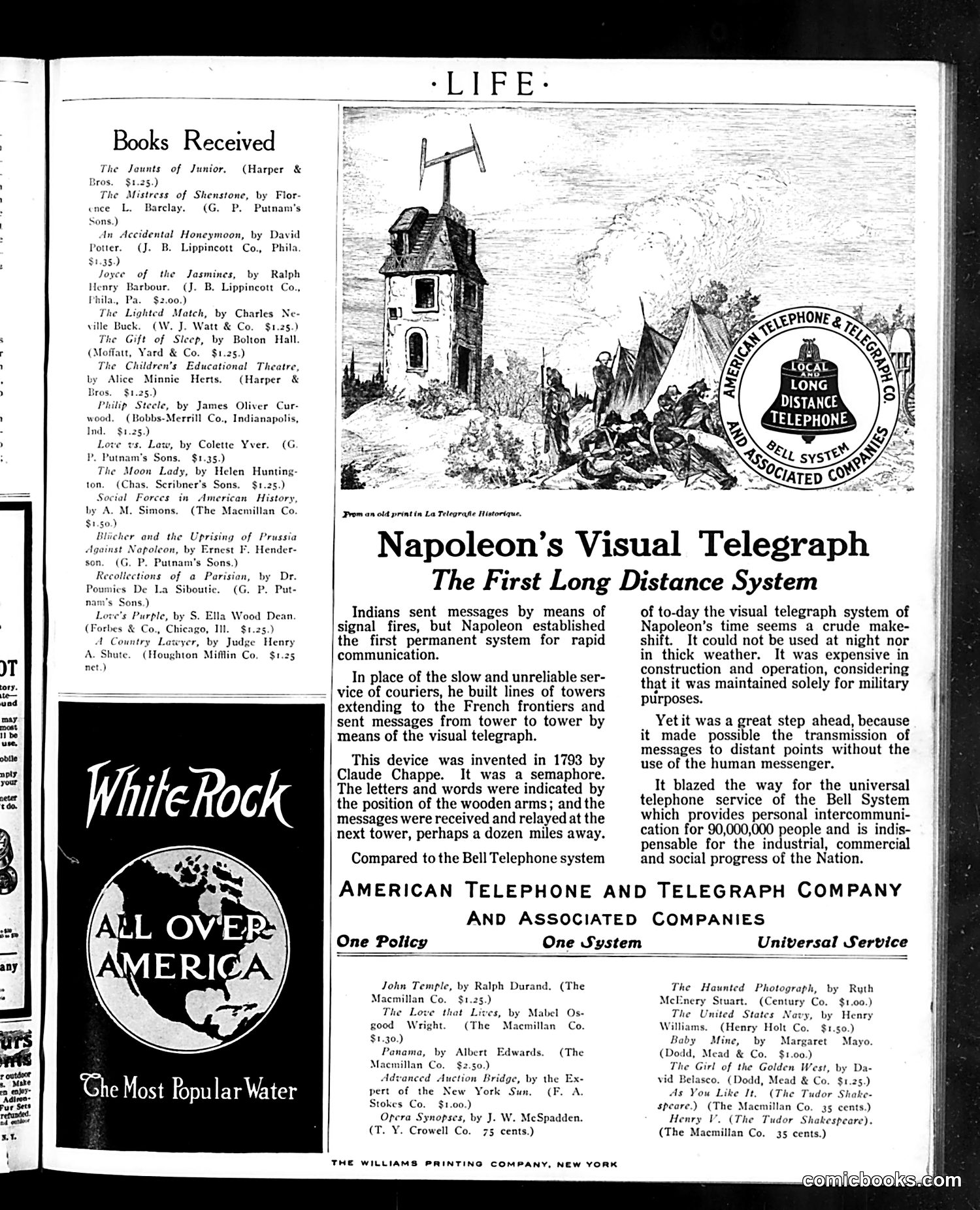
This page is primarily a **book review section and advertising**, not political satire. The main content is a lengthy advertisement for American Telephone and Telegraph Company disguised as historical commentary. The ad compares Napoleon's 1793 visual telegraph system (semaphore towers using wooden arms) to modern Bell Telephone service. It frames the comparison as promotional messaging: Napoleon's system was limited (no night use, unreliable weather performance), whereas the Bell System enables "intercommuncation for 90,000,000 people" and drives "industrial, commercial and social progress." The left side features a "White Rock" water advertisement with a globe map. The page itself contains no political cartoons or satire—it's a straightforward product advertisement using historical comparison as a rhetorical device to emphasize technological progress and Bell's superiority. The engraved illustration of the telegraph tower is historical reference material, not editorial commentary.
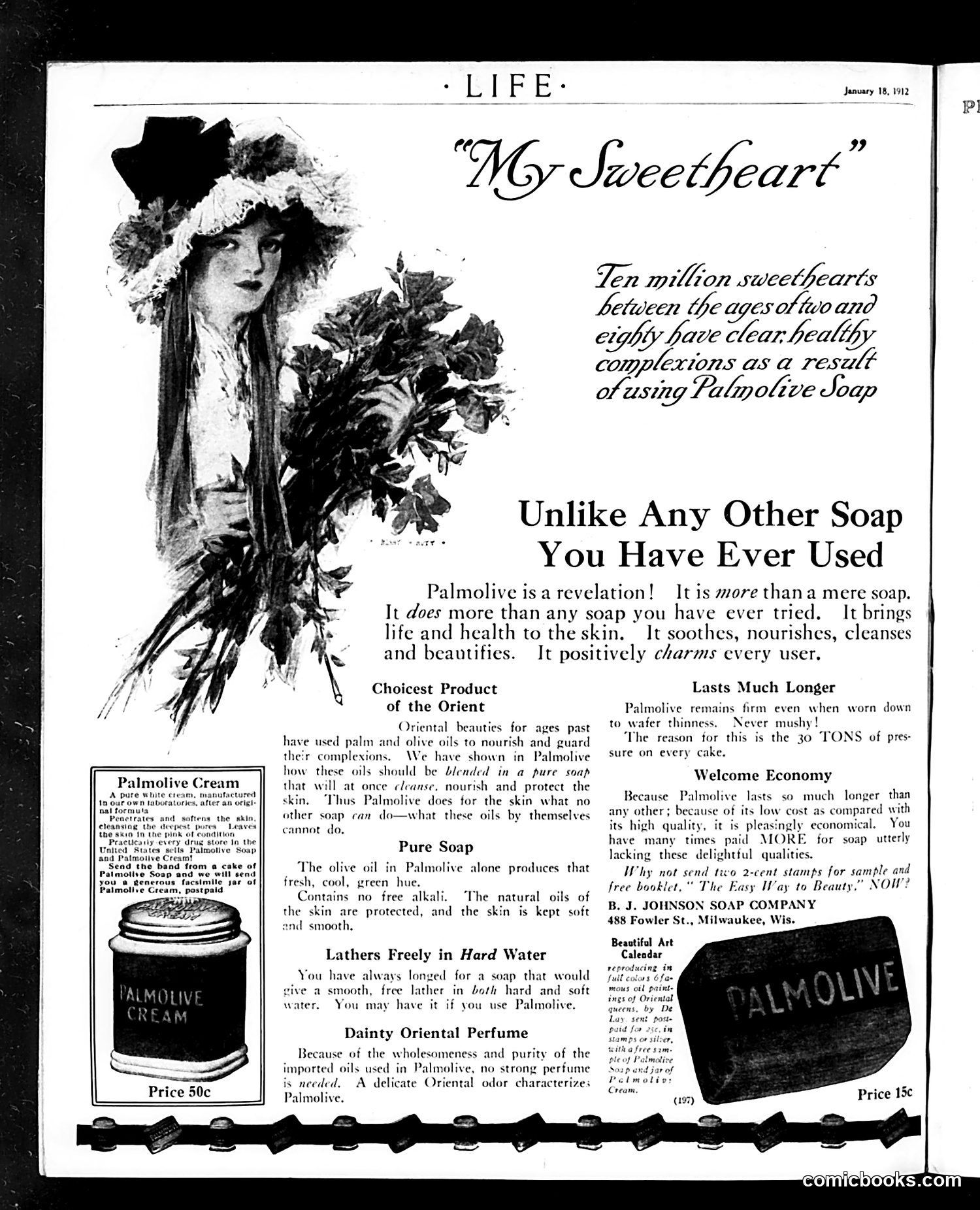
This is primarily a **product advertisement**, not a political cartoon. It promotes Palmolive Soap to American consumers. The page features an idealized illustration of a young woman in fashionable Edwardian dress and hat, holding flowers—representing the "sweetheart" in the headline. The ad makes claims typical of early 20th-century soap marketing: that palm and olive oils from the "Orient" produce clear complexions, that the soap lathers in hard water, and that it lasts longer than competitors while remaining economical. The ad exploits contemporary fascination with "Oriental" beauty secrets and exoticizes colonial-era trade goods. It uses pseudo-scientific language ("30 TONS of pressure") to suggest superiority. The claim that "ten million sweethearts" use the product is unsubstantiated marketing hyperbole. This reflects the era's aggressive advertising practices and gendered marketing targeting women's appearance and household economy.