
Life, 1912-01-18 · page 24 of 44
Life — January 18, 1912 — page 24: what you’re looking at
What you’re looking at
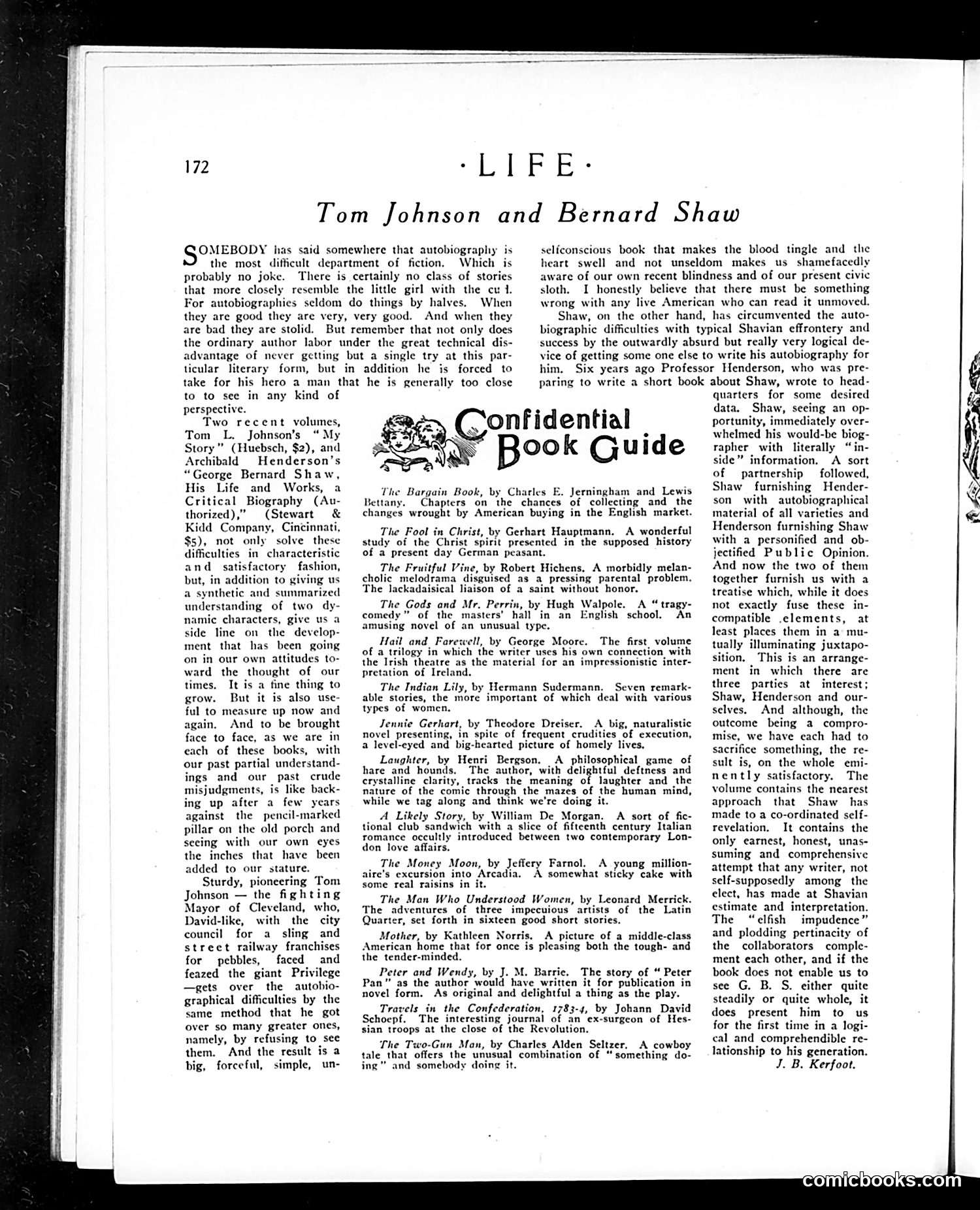
This page reviews two recent autobiographies: Tom L. Johnson's "My Story" and Archibald Henderson's authorized biography of George Bernard Shaw. The article contrasts how these two prominent figures handled autobiography's inherent difficulties. **Tom Johnson**, the "fighting Mayor of Cleveland," overcame autobiographical challenges through characteristic directness—simply refusing to acknowledge them, producing a "big, forceful, simple" narrative. **Bernard Shaw**, by contrast, employed what the author calls "outwardly absurd but really very logical" cleverness: he hired Henderson to write his biography *for* him, thereby sidestepping the self-consciousness problem of self-examination. The piece frames both approaches as reflective of these men's public personalities—Johnson as a straightforward progressive reformer, Shaw as a witty intellectual operator. The review suggests these books offer modern readers insight into contemporary American attitudes toward progress and thought. The remainder is a "Confidential Book Guide" listing other recent publications with brief annotations.
📄 Transcribed text from this page (OCR, searchable)
Machine-transcribed from the original scan — historical spelling and the odd misread are preserved.
‘LIFE: Tom Johnson and Bernard Shaw OMEBODY has said somewhere that autobiography is seliconscious book that makes the blood tingle and the the most difficult department of fiction, Which is heart swell and not unseldom makes us shamefacedly probably no joke. There is certainly no class of stories aware of our own recent blindness and of our present civic that more closely resemble the little girl with the cu 4. sloth. I honestly believe that there must be something For autobiographies seldom do things by halves. When wrong with any live American who can read it unmoved. they are good they are very, very good. And when they are bad they are stolid. But remember that not only does the ordinary author labor under the great technical dis- success by advantage of never getting but a single try at this par- Shaw, on the other hand, has circumvented the auto- biographic difficulties with typ’ he outwardly absurd but really very logical de- vice of getting some one else to write his autobiography for al Shavian effrontery and ticular literary form, but in addition he is forced to him. Six years ago Professor Henderson, who was pre- take for his hero a man that he is generally too close to to see in any kind of perspective. Two recent volumes, Tom L. Johnson’s “My Story” (Huebsch, $2), and Archibald Henderson’s “George Bernard Shaw His Life and Works, Critical Biography (Au- thorized),” (Stewart & Kidd Company, Cincinnati, $5), not only solve these difficulties in characteristic and sat tory fashion, but, in addition to giving us a synthetic and summarized understanding of two d: namic characters, give us a side line on the develop- ment that has been going on in our own attitudes to- ward the thought of our times. It is a fine thing to grow. But it is also use- ful to measure up now and again. And to be brought ¢ to face, as we are in h of these books, with our past partial understand- ings and our past crude misjudgments, is like back- ing up after a few years against the pencil-marked pillar on the old porch and secing with our own eyes the inches that have been added to our stature. Sturdy, pioneering Tom Johnson — the fighting Mayor of Cleveland, who, David-like, with the city council for a sling and street railway franchises for pebbles, faced and feazed the giant Privilege —gets over the autobio- graphical difficulties by the same method that he got over so many greater ones, namely, by refusing to see them. And the result is a big, forceful, simple, un- Gonfidential | ¥ Book Guide The Bargain Book, by Charles E. Jerningham and Lewis Bettany. Chapters on the chances of collecting and the changes wrought by American buying in the English market. The Fool in Christ, by Gerhart Hauptmann. A wonderful study of the Christ spirit presented in the supposed history of a present day German peasant. The Fruitful Vine, by Robert Hichens, A morbidly melan- cholic melodrama disguised as a pressing parental problem. The lackadaisical liaison of a saint without honor. The Gods and Mr, Perrin, by Hugh Walpole. A “ tragy- comedy” of the masters’ hall in an English school, An amusing novel of an unusual type. Hail and Farewell, by George Moore. The first. volume of a trilogy in which the writer uses his own connection with the Irish theatre as the material for an impressionistic inter- pretation of Ireland. The Indian Lily, by Hermann Sudermann. Seven remark- able stories, the more important of which deal with various types of women, Jennie Gerhart, by Theodore Dreiser. A big, naturalistic novel presenting, in spite of frequent crudities of execution, a level-eyed and’ big-hearted picture of homely lives, Laughter, by Henri Bergson. A philosophical game of hare and hounds. The author, with delightful deftness and crystalline clarity, tracks the meaning of laughter and the nature of the comic through the mazes of the human mind, while we tag along and think we're doing it. A Likely Story, by William De Morgan, A sort of fic- tional club sandwich with a slice of fifteenth century Italian romance occultly introduced between two contemporary Lon- don love affairs. The Money Moon, by Jeffery Farnol, A young million- aire's excursion into Arcadia. A somewhat sticky cake with some real raisins in it. The Man Who Understood Women, by Leonard Merrick. The adventures of three impecuious artists of the Latin Quarter, set forth in sixteen good short stories. Mother, by Kathleen Norris. A picture of a middle-class American home that for once is pleasing both the tough- and the tender-minded. Peter and Wendy, by J. M. Barrie. The story of “ Peter Pan” as the author would have written it for publication in novel form. As original and delightful a thing as the play. Travels in the Confederation, 1783-4, by Johann David Schoepf. The interesting journal of an ex-surgeon of Hes- sian troops at the close of the Revolution. The Two-Gun Man, by Charles Alden Seltzer. A cowboy tale that offers the unusual combination of “something do- ing" and somebody doing it. paring to write a short book about Shaw, wrote to head- quarters for some desired data. Shaw, seeing an op- portunity, immediately over- whelmed his would-be biog- rapher with literally “ in- side” information, A sort of partnership followed, Shaw furnishing Hender- son with autobiographical material of all varieties and Henderson furnishing Shaw with a personified and ob- jectified Public Opinion. And now the two of them together furnish us with a treatise which, while it does not exactly fuse these in- compatible .elements, at least places them in a mu- tually illuminating juxtapo- sition, This is an arrange- ment in which there are three parties at interest; Shaw, Henderson and our- selves, And although, the outcome being a compro- mise, we have each had to sacrifice something, the re- sult is, on the whole emi- nently satisfactory. The volume contains the nearest approach that Shaw has made to a co-ordinated self- revelation, It contains the only earnest, honest, unas- suming and comprehensive attempt that any writer, not self-supposedly among the elect, has made at Shavian estimate and interpretation. The “clfish impudence” and plodding pertinacity of the collaborators comple- ment each other, and if the book does not enable us to see G. B. S. either quite steadily or quite whole, it does present him to us for the first time in a logi- cal and comprehendible re- lationship to his generation. J.B. Kerfoot.