
Life, 1912-01-18 · page 20 of 44
Life — January 18, 1912 — page 20: what you’re looking at
What you’re looking at
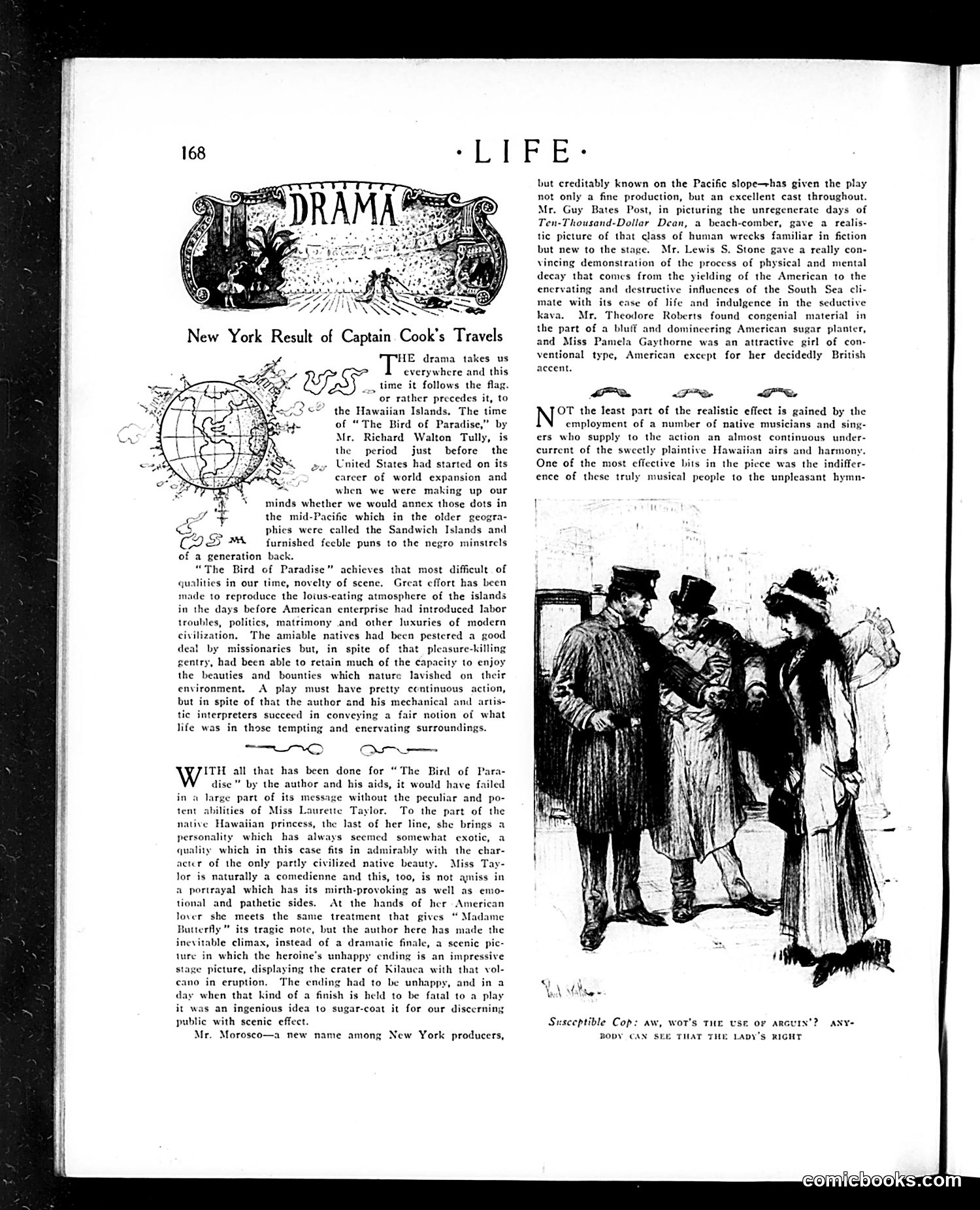
This page reviews a Broadway production of Richard Walton Tully's play *"The Bird of Paradise,"* set in Hawaii before American annexation. The drama depicts the collision between traditional Hawaiian life and American colonization. The satirical cartoon (bottom right, captioned "Susceptible Cop") shows three men in period dress—likely a commentary on susceptibility to foreign or exotic influences, though the specific reference is unclear from the image alone. The review praises the production's exotic atmosphere and cast, particularly actress Laurette Taylor's performance as a Hawaiian princess. It notes the play's "ingenious" decision to end unhappily with a volcanic eruption scene rather than a conventional dramatic finale—sugar-coating tragic inevitability for discriminating audiences. The implicit satire critiques American expansionism and "civilization's" destructive influence on indigenous cultures, framed through theatrical spectacle.
📄 Transcribed text from this page (OCR, searchable)
Machine-transcribed from the original scan — historical spelling and the odd misread are preserved.
*LIPE* New York Result of Captain Cook’s Travels HE drama takes us everywhere and this _., time it follows the flag. or rather precedes it, to the Hawaiian Islands. The time of “The Bird of Paradise,” by Mr, Richard Walton Tully, is the period just before the United States had started on its carcer of world expansion and when we were making up our minds whether we would annex those dots in the mid-Pacific which in the older geogra- phies were called the Sandwich Islands and furnished feeble puns to the negro minstrcls of a generation back. “The Bird of Paradise” achieves that most difficult of qualities in our time, novelty of scene. Great effort has been le to reproduce the loius-eating atmosphere of the islands in the days before American enterprise had introduced labor troubles, politics, matrimony and other luxuries of modern i ion, The amiable natives had been pestered a good by missionaries but, in spite of that pleasure-killing gentry, had been able to retain much of the capacity to enjoy the beauties and bounties which naturc lavished on their environment. A play must have pretty continuous action, but in spite of that the author and his mechanical and artis- tic interpreters succeed in conveying a fair notion of what life was in those tempting and enervating surroundings. ITH all that has been done for “The Bird of Pa dise” by the author and his aids, it would have failed in a large part of its message without the peculiar and po- tent abilities of Miss Laurette Taylor. To the part of the jan princess, the last of her line, she brings a personality which has always seemed somewhat exotic, a quality which in this case fits in admirably with the char- acter of the only partly civilized native beauty. Miss Tay- lor is naturally a comedienne and this, too, is not amiss in a portrayal which has its mirth-provoking as well as emo- tional and pathetic sides. At the hands of her American lover she meets the same treatment that gives “ Madame Butterfly” its tragic note, but the author here has made the inevitable climax, instead of a dramatic finale, a scenic pi ture in which the heroine's unhappy ending is an impressive stage picture, displaying the crater of Kilauca with that vol- cano in eruption. The ending had to be unhappy, and in a day when that kind of a finish is held to be fatal to a pla it was an ingenious idea to sugar-coat it for our discernir public with scenic effect. Mr. Morosco—a new name among New York producers, native Hawa but creditably known on the Pacific slope-rhas given the play not only a fine production, but an excellent cast throughout. Mr. Guy Bates Post, in picturing the unregenerate days of Ten-Thousand-Dollar Dean, a beach-comber, gave a realis- tic picture of that class of human wrecks familiar in fiction but new to the stage. Mr. Lewis S, Stone gave a really con- vineing demonstration of the process of physical and mental decay that comes from the yielding of the American to the enervating and destructive influences of the South Sea cli- mate with its ease of life and indulgence in the seductive kava. Mr, Theodore Roberts found congenial material in the part of a bluff and domineering American sugar planter, and Miss Pamela Gaythorne was an attractive girl of con- ventional type, American except for her decidedly British accent. OT the least part of the realistic effect is gained by the employment of a number of native musicians and sing- ers who supply to the action an almost continuous under- current of the sweetly plaintive Hawaiian airs and harmony. One of the most effective bits in the picce was the indiffer- ence of these truly musical people to the unpleasant hymn- Susceptible Cop: aw, wor's THE USE OF ARGUIN'? ANY= BODY CAN SEE THAT THE LADY'S RIGHT