
Life, 1912-01-18 · page 25 of 44
Life — January 18, 1912 — page 25: what you’re looking at
What you’re looking at
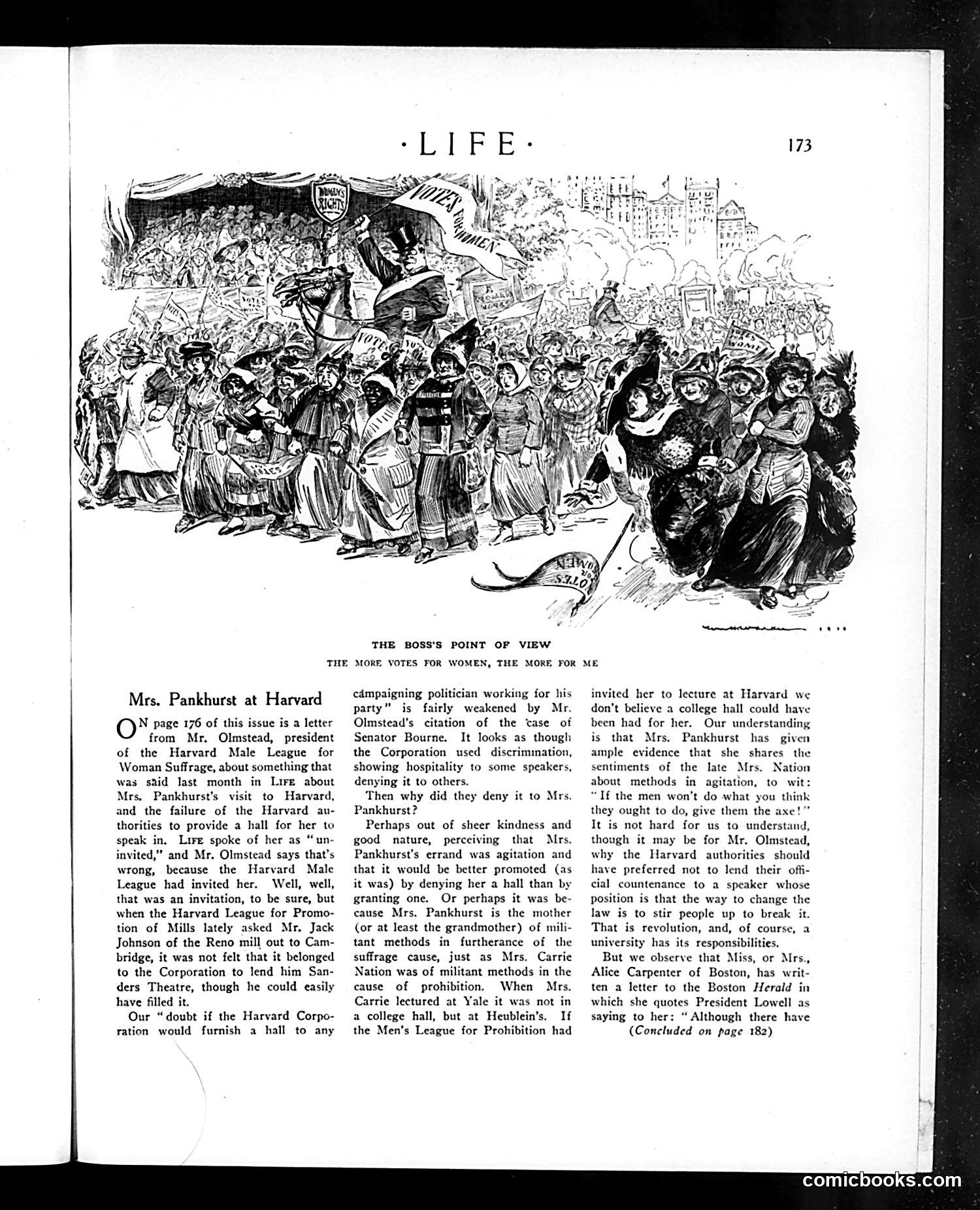
The cartoon depicts a suffragist rally or parade, with the caption "THE MORE VOTES FOR WOMEN, THE MORE FOR ME"—suggesting a cynical male political perspective that women's voting power benefits male politicians seeking to exploit a new voting bloc. The accompanying article discusses **Emmeline Pankhurst's** failed attempt to speak at Harvard in 1911. Harvard refused her an official hall, citing her role as a militant suffragist leader who advocated direct action and law-breaking to advance women's voting rights—comparing her methods to those of prohibitionist Carrie Nation. **The satire's point:** Life magazine defends Harvard's refusal on grounds that universities shouldn't sponsor revolutionary agitation, while simultaneously mocking male politicians' eager courting of female voters once suffrage seemed inevitable. The cartoon captures the hypocrisy: authorities banned Pankhurst as too radical, yet men in power stood ready to capitalize on newly enfranchised women for electoral gain.
📄 Transcribed text from this page (OCR, searchable)
Machine-transcribed from the original scan — historical spelling and the odd misread are preserved.
THE BOSS'S POINT OF VIEW THE MORE VOTES FOR WOMEN, THE MORE FOR ME Mrs. Pankhurst at Harvard N page 176 of this issue is a letter from Mr, Olmstead, president of the Harvard Male League for Woman Suffrage, about something that was said last month in Lire about Mrs, Pankhurst’s visit to Harvard, and the failure of the Harvard au- thorities to provide a hall for her to speak in. Lire spoke of her as “un- invited,” and Mr. Olmstead says that’s wrong, because the Harvard Male League had invited her. Well, well, that was an invitation, to be sure, but when the Harvard League for Promo- tion of Mills lately asked Mr. Jack Johnson of the Reno mill out to Cam- bridge, it was not felt that it belonged to the Corporation to lend him San- ders Theatre, though he could easily have filled it. Our “doubt if the Harvard Corpo- ration would furnish a hall to any campaigning politician working for his party” is fairly weakened by Mr. Olmstead’s citation of the ‘tase of Senator Bourne. It looks as though the Corporation used discrimination, showing hospitality to some speakers, denying it to others. Then why did they deny it to Mrs. Pankhurst? Perhaps out of sheer kindness and good nature, perceiving that Mrs. Pankhurst’s errand was agitation and that it would be better promoted (as it was) by denying her a hall than by granting one. Or perhaps it was be- cause Mrs, Pankhurst is the mother (or at least the grandmother) of mili- tant methods in furtherance of the suffrage cause, just as Mrs. Carrie Nation was of militant methods in the cause of prohibition. When Mrs. Carrie lectured at Yale it was not in a college hall, but at Heublein’s. If the Men’s League for Prohibition had invited her to lecture at Harvard we don’t believe a college hall could have been had for her. Our understanding is that Mrs. Pankhurst has given ample evidence that she shares the sentiments of the late Mrs. Nation about methods in agitation, to wit: “If the men won't do what you think they ought to do, give them th aad It is not hard for us to understand, though it may be for Mr. Olmstead, why the Harvard authorities should have preferred not to lend their offi- cial countenance to a speaker whose position is that the way to change the law is to stir people up to break it. That is revolution, and, of course, a university has its responsibilities. But we observe that Miss, or Mrs., Alice Carpenter of Boston, has writ- ten a letter to the Boston Herald in which she quotes President Lowell as saying to her: “Although there have (Concluded on page 182) comicbooks.com