
Life, 1912-01-18 · page 14 of 44
Life — January 18, 1912 — page 14: what you’re looking at
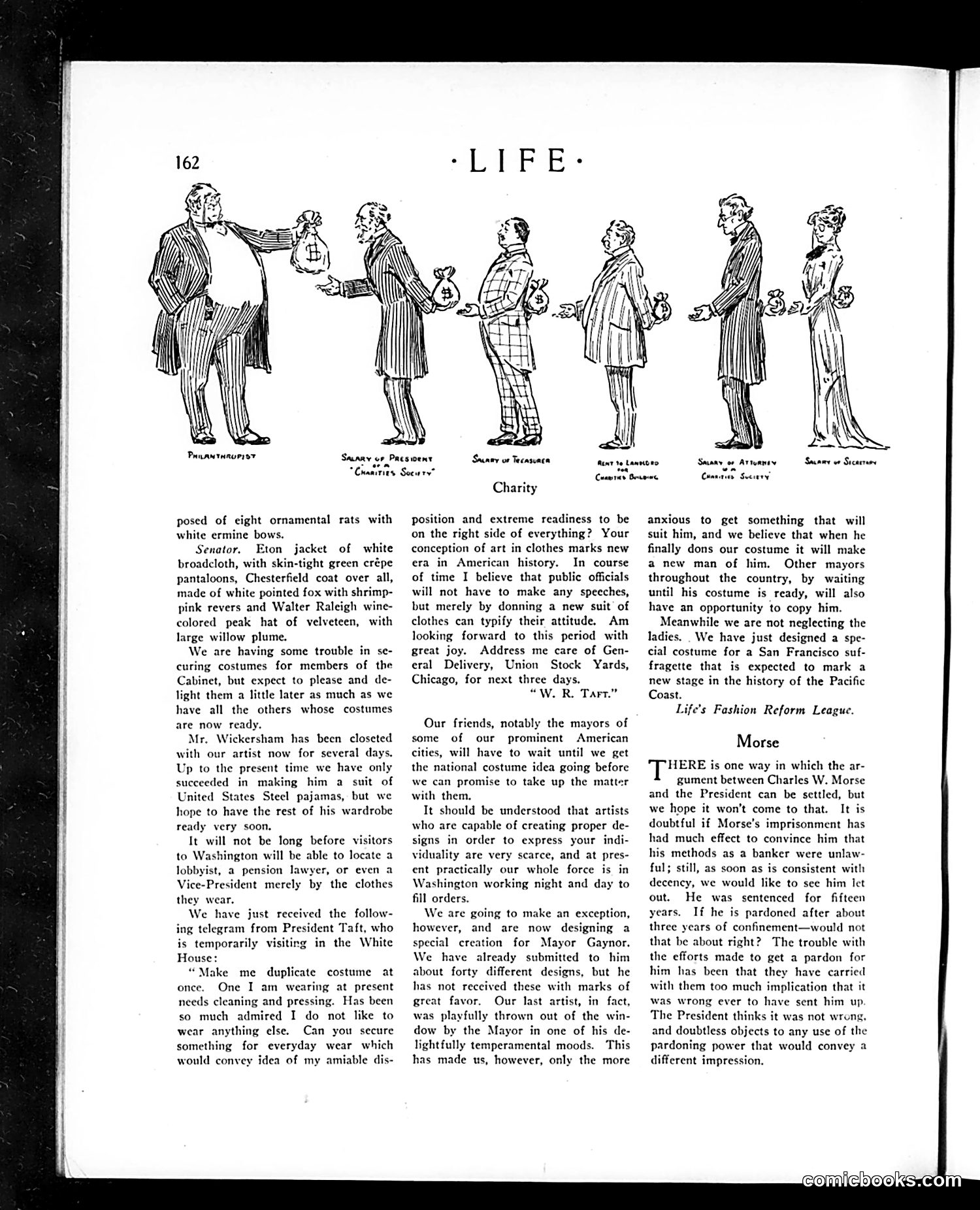
What you’re looking at
This cartoon depicts a satirical hierarchy of charitable giving in American society. A large, rotund philanthropist on the left distributes small money bags to six progressively thinner figures, labeled (left to right): "Philanthropist," "Salary of President," "Salary of Preacher," "Rent by Landlord," "Salary of Attorney," and "Salary of Servant." The joke critiques wealth distribution: the philanthropist's enormous size contrasts with the diminishing physiques of recipients down the chain, suggesting that charity trickles down in increasingly meager amounts. Each intermediary (president, preacher, attorney, landlord) takes their cut, leaving servants with almost nothing. The satirical point: charitable giving claims moral virtue while systemic inequality ensures the poorest receive crumbs from the wealthy's table.
📄 Transcribed text from this page (OCR, searchable)
Machine-transcribed from the original scan — historical spelling and the odd misread are preserved.
Panantnnuris? naairies Secure” posed of eight ornamental rats with white ermine bows. Senator. Eton jacket of white broadcloth, with skin-tight green crépe pantaloons, Chesterfield coat over all, made of white pointed fox with shrimp- pink revers and Walter Raleigh wine- colored peak hat of velveteen, with large willow plume. We are having some trouble in se- curing costumes for members of the Cabinet, but expect to please and de- light them a little later as much as we have all the others whose costumes are now ready. Mr. Wickersham has been closeted with our artist now for several days. Up to the present time we have only succeeded in making him a suit of United States Steel pajamas, but we hope to have the rest of his wardrobe ready very soon, It will not be long before visitors to Washington will be able to locate a lobbyist, a pension lawyer, or even a Vice-President merely by the clothes they wear, We have just received the follow- ing telegram from President Taft, who is temporarily visiting in the White House: “Make me duplicate costume at once. One I am wearing at present needs cleaning and pressing. Has been so much admired I do not like to wear anything else. Can you secure something for everyday wear which would convey idea of my amiable dis- Srenwy or Tecaseaca Charity position and extreme readiness to be on the right side of everything? Your conception of art in clothes marks new era in American history. In course of time I believe that public officials will not have to make any speeches, but merely by donning a new suit of clothes can typify their attitude. Am looking forward to this period with great joy. Address me care of Gen- eral Delivery, Union Stock Yards, Chicago, for next three days. “W. R. Tart.” Our friends, notably the mayors of some of our prominent American cities, will have to wait until we get the national costume idea going before we can promise to take up the matter with them. It should be understood that artists who are capable of creating proper de- signs in order to express your indi- viduality are very scarce, and at pres- ent practically our whole force is in Washington working night and day to fill orders. We are going to make an exception, however, and are now designing a special creation for Mayor Gaynor. We have already submitted to him about forty different designs, but he has not received these with marks of great favor. Our last artist, in fact, was playfully thrown out of the win- dow by the Mayor in one of his de- lightfully temperamental moods. This has made us, however, only the more Aunt 9 Lamnioeo Cumm ras Brtone, © Smany or Artem Sram oo Sicarrane Seeery, anxious to get something that will suit him, and we believe that when he finally dons our costume it will make a new man of him. Other mayors throughout the country, by waiting until his costume is ready, will also have an opportunity to copy him. Meanwhile we are not neglecting the ladies. _We have just designed a spe- cial costume for a San Francisco suf- fragette that is expected to mark a new stage in the history of the Pacific Coast. Life's Fashion Reform League. Morse HERE is one way in which the ar- gument between Charles W. Morse and the President can be settled, but we hope it won't come to that. It is doubtful if Morse’s imprisonment has had much effect to convince him that his methods as a banker were unla ful; still, as soon as is consistent with decency, we would like to see him let out. He was sentenced for fifteen years. If he is pardoned after about three years of confinement—would not that be about right? The trouble with the efforts made to get a pardon for him has been that they have carried with them too much implication that it was wrong ever to have sent him up. The President thinks it was not wrong. and doubtless objects to any use of the pardoning power that would convey a different impression.