
Life, 1912-01-18 · page 21 of 44
Life — January 18, 1912 — page 21: what you’re looking at
What you’re looking at
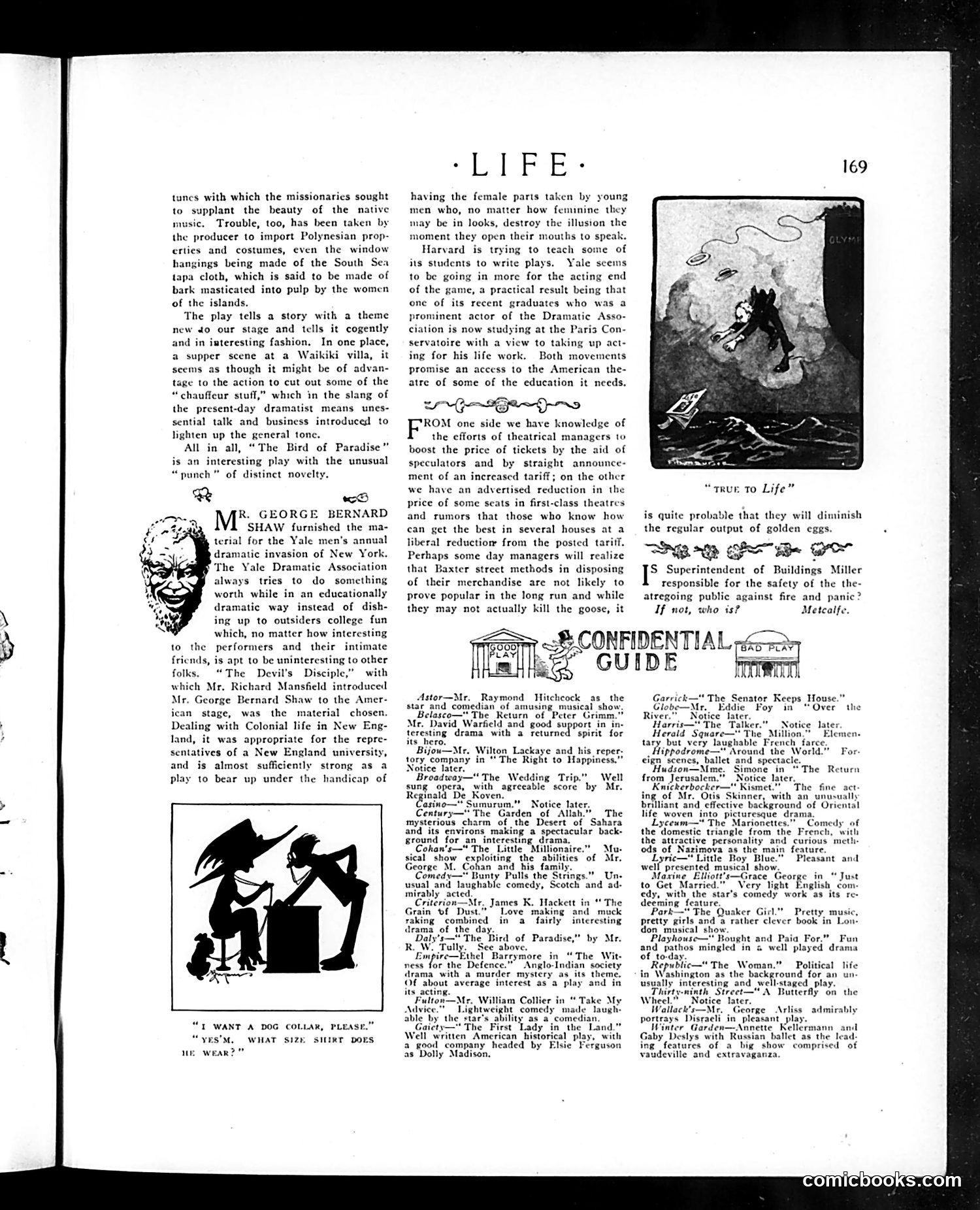
This page contains two distinct elements: **The Main Cartoon ("I Want a Dog Collar, Please"):** A shop clerk misunderstands a customer's request for a dog collar as a shirt size question. The humor relies on a literal misinterpretation—the customer seeks pet supplies while the clerk assumes they're shopping for clothing and needs to know shirt dimensions. This is straightforward slapstick wordplay typical of early 20th-century comic humor. **The Editorial Content:** The page discusses theatrical productions, notably praising Yale's dramatic society for staging George Bernard Shaw's "The Devil's Disciple" rather than frivolous college entertainment. It also critiques Broadway theater managers' pricing practices—comparing aggressive ticket-price increases and speculation to "Baxter street methods" (likely referring to black-market or unethical sales tactics). The piece advocates for legitimate theater education to improve American drama. The content reflects early 1900s concerns about theatrical commercialism versus artistic integrity.
📄 Transcribed text from this page (OCR, searchable)
Machine-transcribed from the original scan — historical spelling and the odd misread are preserved.
tuncs with which the missionarics sought to supplant the beauty of the native music, Trouble, too, has been taken by the producer to import Polynesian prop- erties and costumes, even the window hangings being made of the South Sea tapa cloth, which is said to be made of bark masticated into pulp by the women of the islands. The play tells a story with a theme new 40 our stage and tells it cogently and in interesting fashion. In one place, a supper scene at a Waikiki villa, it scems as though it might be of advan- tage to the action to cut out some of the “chauffeur stuff,” which in the slang of the present-day dramatist means unes- sential talk and business introduced to lighten up the general tone. All in all, “The Bird of Paradise” is an interesting play with the unusual “punch” of distinct novelty. Re <3 R. GEORGE BERNARD SHAW furnished the ma- terial for the Yale men's annual dramatic invasion of New York. The Yale Dramatic Association always tries to do something worth while in an educationally dramatic way instead of dish- ing up to outsiders college fun which, no matter how interesting to the performers and their intimate fricnds, is apt to be uninteresting to other folks. “The Devil's Disciple,” with which Mr. Richard Mansfield introduced Mr. George Bernard Shaw to the Amer- ican stage, was the material chosen. Dealing with Colonial life in New Eng- land, it was appropriate for the repre- sentatives of a New England university, and is almost sufficiently strong as a play to bear up under the handicap of fi “1 WANT A DOG COLLAR, PLEAS: “YES'M, WHAT SIZE SIUIRT DOES ME Wear?" *LIPE- having the female paris taken by young men who, no matter how feminine they may be in looks, destroy the illusion the moment they open their mouths to speak. Harvard is trying to teach some of its students to write plays. Yale seems to be going in more for the acting end of the game, a practical result being that one of its recent graduates who was a prominent actor of the Dramatic Asso- ciation is now studying at the Paris Con- servatoire with a view to taking up act- ing for his life work. Both movements promise an access to the American the- atre of some of the education it needs. ROM one side we have knowledge of the efforts of theatrical managers to boost the price of tickets by the aid of speculators and by straight announce- ment of an increased tariff; on the other we have an advertised reduction in the price of some seats in first-class theatres and rumors that those who know how can get the best in several houses at a liberal reductiow from the posted tariff. Perhaps some day managers will realize that Baxter street methods in disposing of their merchandise are not likely to prove popular in the long run and while they may not actually kill the goose, it Astor—Mr. Raymond Hitchcock as. the star and comedian of amusing musical show Belasco—" The Return of Peter Grimm. Mr. David Warfield and good support in in- teresting drama with a feturned spirit. for its hero. Bijou—Mr. Wilton Lackaye and his reper: tory company in ‘The Right to Happiness.” Notice later. Broadway— The Wedding Trip.” Well sung opera, with agreeable score by Mr. Reginald De_Koven. ‘asino—" Sumurum.” Notice later. Century—" The Garden of Allah.” The mysterious charm of the Desert of Sahara and its environs making a spectacular back- ground for an interesting drama, Cohan'’s—" The Little Millionaire.” | Mu- sical show exploiting the abilities of Mr. George M. Cohan and his family, Comedy—" Bunty Pulls the Strings.” Uns usual and laughable comedy, Scotch and ad- mirably acted, Criterion—Mr, James K. Hackett in “The Grain vf Dust.” Love making and muck raking combined in a fairly interesting drama of the day. Daly’s—" The. Bird of Paradise," by Mr. RW. Tully. See above. Empire—Ethel Barrymore in “The Wit- ness for the Defence.” Anglo-Indian society drama with a murder mystery as its theme. Of about average interest. as a play and in its act Fulton—Mr. William Collier in Take My. Advice.” Lightweight comedy made laugh: able by the star's ability as a comedian Gaicty—"* The First Lady in the Land.” Well written American historical play, with a good company headed by Elsie Ferguson as Dolly Madison, is quite probable that they will diminish the regular output of golden eggs. SB Ga OO S Superintendent of Buildings Miller responsible for the safety of the the- atregoing public against fire and panic? If not, who is? Metcalfe. Garrick—" The Senator Keeps House.” Globe—Mr. Eddie Foy in“ Over River.” Notice later. Harris—" The Talker.” Herald Square—" Th tary but very laughable : _Hippodrome—" Around the World.” For eign scenes, ballet and spectacle. Hudson—Mme, Simone in “The Return from Jerusalem." Notice later, _ Knickerbocker—" Kismet.” The fine act- ing of Mr. Otis Skinner, with an unusually brilliant and effective background of Oriental life woven into picturesque drama. Lyceum—* The Marionettes.” Comedy of the domestic triangle from the French, with the attractive personality and curious meth- ods of Nazimova as the main feature. Lyric—" Little Boy Blue.” Pleasant and well presented musical show. Maxine Etliott's—Grace George in“ Just to Get Married.” Very light English edy, with the star's comedy work as its re deeming feature. Park—" The Quaker Girl." Pretty. music, pretty girls and a rather clever book in Lon: don musical show Playhouse—" Bought and Paia For.” Fu and pathos mingled in a well played dram of to-day. Republic—" The Woman.” Political life in Washington as the background for an un- usually interesting and well-staged play. Thirty-ninth Street—"A Butterfly on the Wheel.” Notice later. Wallack’s—| orge Arliss portrays Disraeli in pleasant play. Winter Garden—Annette Kellermann and Gaby Deslys with Russian ballet as the lead: ing features of a big show comprised of vaudeville and extravaganza admirably