
A complete issue · 44 pages · 1911
Life — November 16, 1911
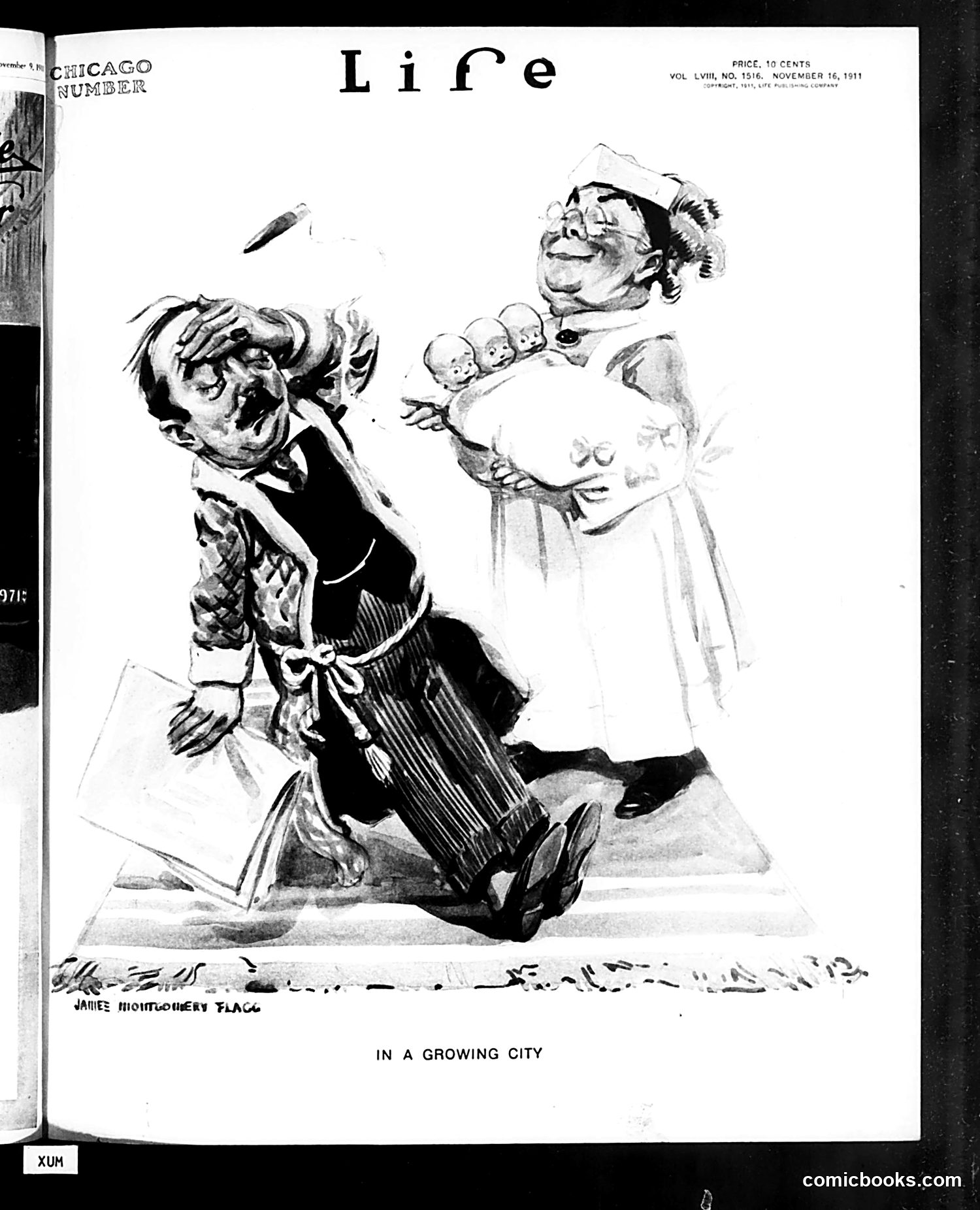
This cartoon by James Montgomery Flagg depicts an exaggerated scene titled "In a Growing City." The image shows two caricatured figures in what appears to be slapstick comedy: a man in formal dress (left) is being struck or knocked down, while a woman (right) holds what looks like eggs or projectiles, appearing to throw them at him. The satire likely comments on urban chaos or social friction during rapid city growth in early 1900s America. The physical comedy and caricatured features were typical of Life magazine's humorous social commentary. However, without additional context from the magazine's text or advertisements, the specific incident or social issue being referenced remains unclear. The cartoon relies on visual humor common to the period.
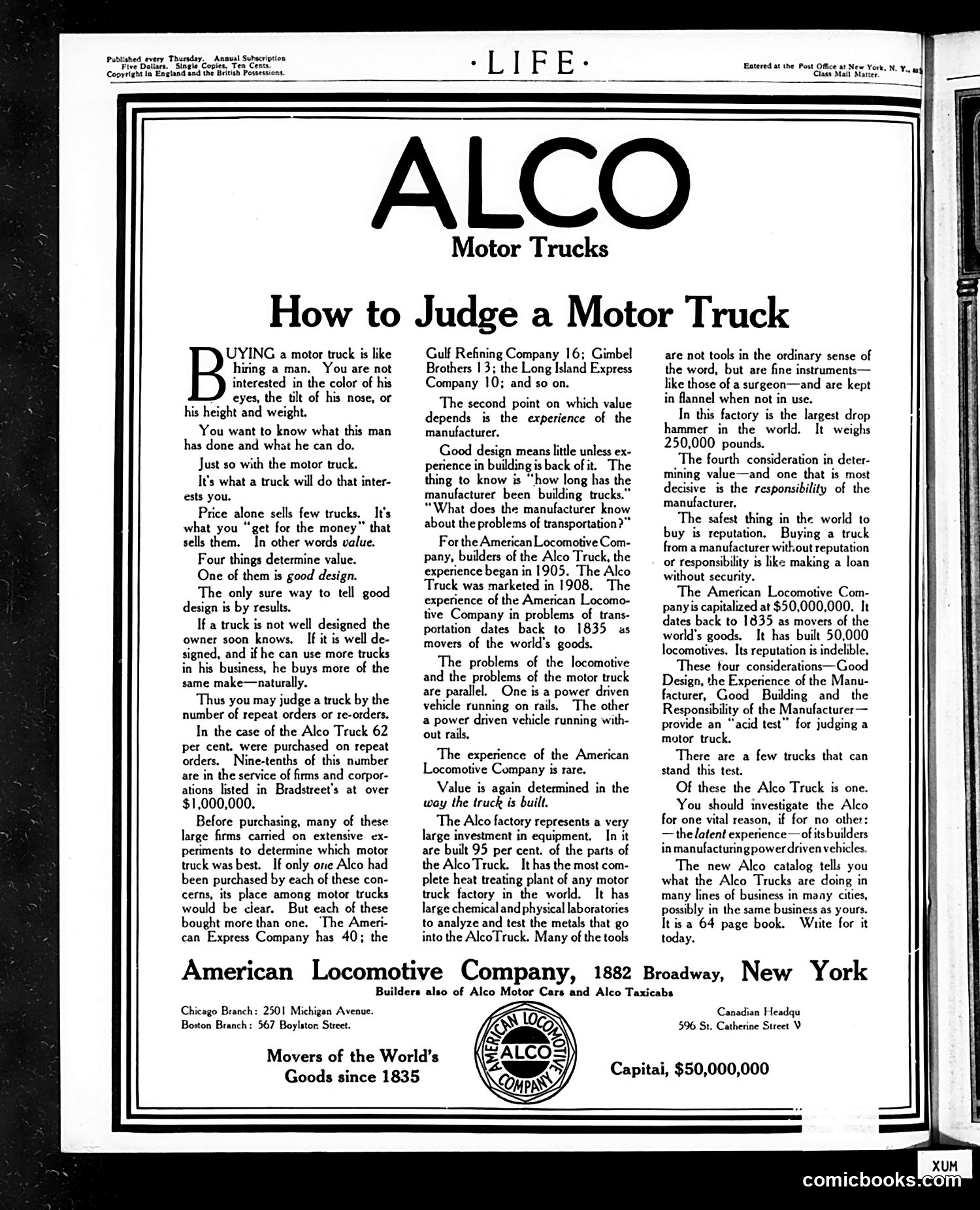
This page is **not a cartoon or satire** — it's a straightforward advertisement for Alco Motor Trucks, published in *Life* magazine. The ad uses the rhetorical device of "How to Judge a Motor Truck" to educate potential buyers about four value determinants: good design, manufacturer experience, reputation, and responsibility. It emphasizes that the American Locomotive Company has been in the transportation business since 1835, lending credibility. The advertisement positions Alco as the superior choice by highlighting their extensive experience, superior manufacturing facilities with laboratories, and the truck's reliability. The large capital figure ($50,000,000) underscores the company's financial stability and legitimacy. This represents early 20th-century industrial advertising strategy: establishing brand authority through historical pedigree rather than humor or satire.
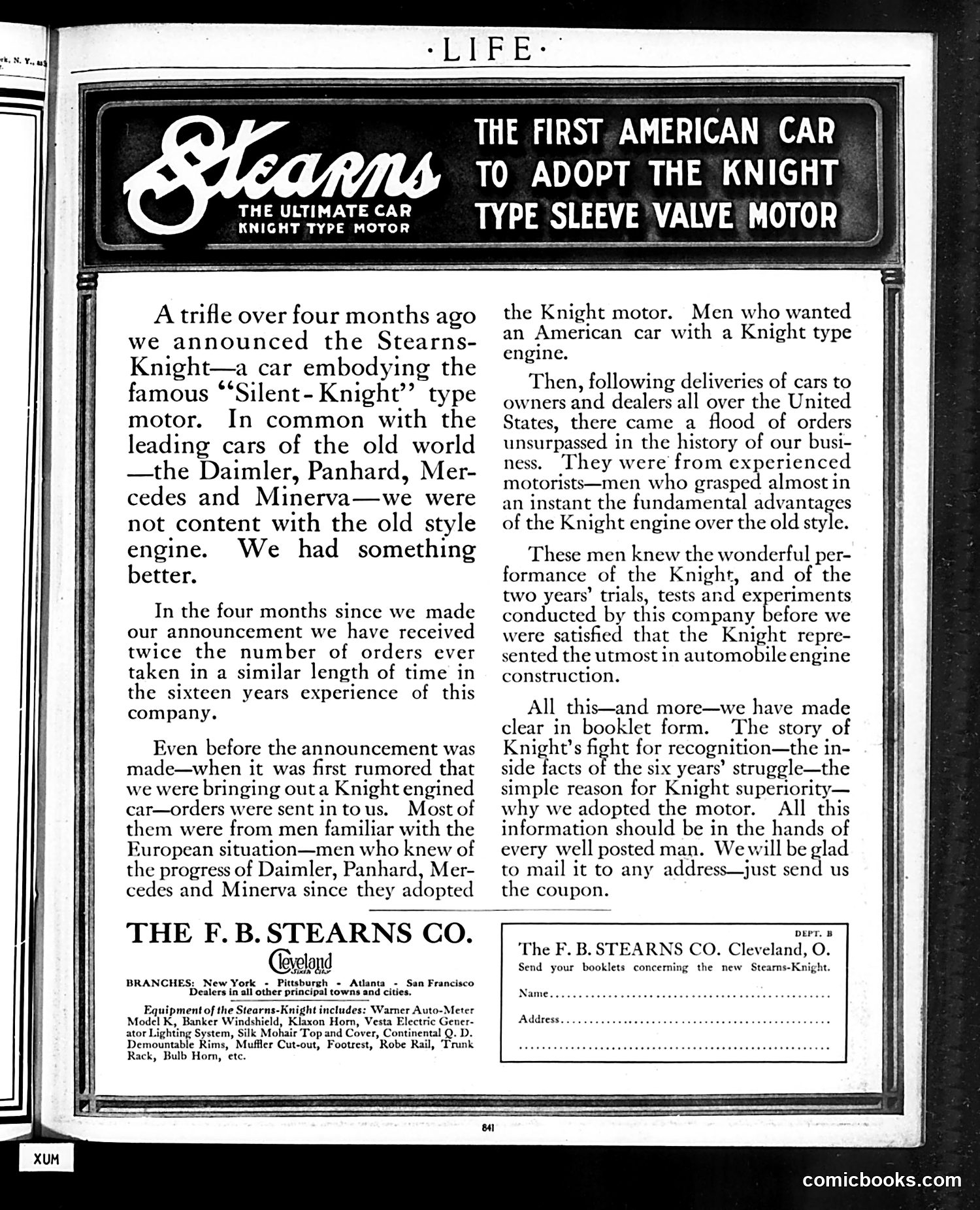
This page is **not a political cartoon or satire**—it's a straightforward automobile advertisement from *Life* magazine. The F. B. Stearns Company advertises their "Stearns-Knight" automobile, claiming it's "the first American car to adopt the Knight type sleeve valve motor." The text emphasizes that in just four months since announcement, they received double the typical orders for a similar period in the company's sixteen-year history. The ad compares favorably to European luxury cars (Daimler, Panhard, Mercedes, Minerva), positioning the Stearns-Knight as superior American engineering. It appeals to experienced motorists who recognize the Knight engine's advantages, and offers a booklet explaining the motor's technical superiority. This is vintage industrial advertising, not satirical commentary.
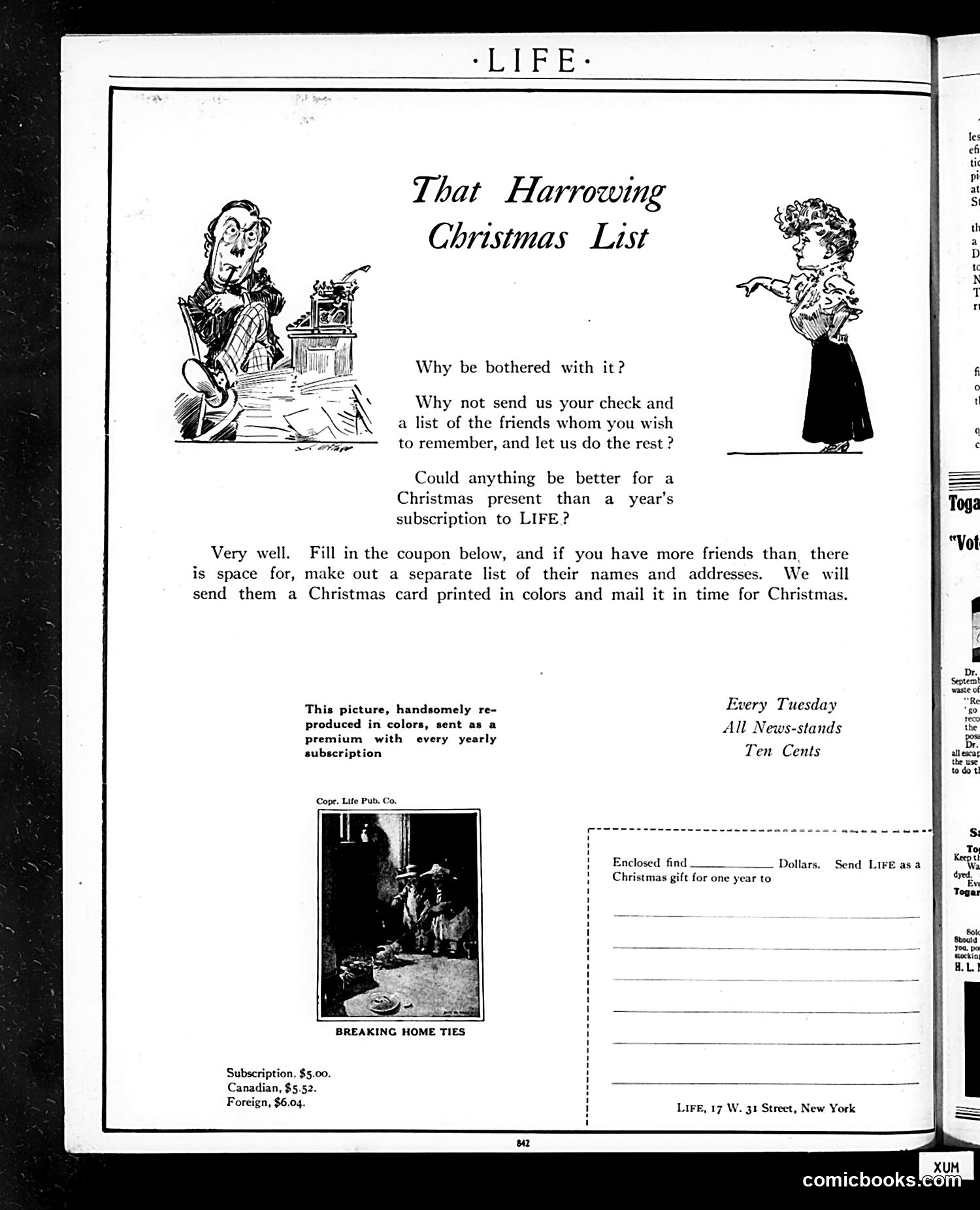
This page is primarily a **Christmas gift advertisement** for Life magazine subscriptions, not political satire. The cartoon depicts the universal stress of holiday gift-giving: on the left, a distressed person sits at a desk surrounded by papers, overwhelmed by their Christmas list; on the right, a woman appears frustrated or exhausted. The ad's pitch is satirical: instead of struggling to buy individual gifts for many people, subscribers should simply send Life magazine subscriptions—positioned as the ideal present. The magazine promises to include a handsome color-printed Christmas card for each recipient. The accompanying illustration titled "Breaking Home Ties" appears unrelated to the advertisement itself, serving as sample premium artwork included with subscriptions.
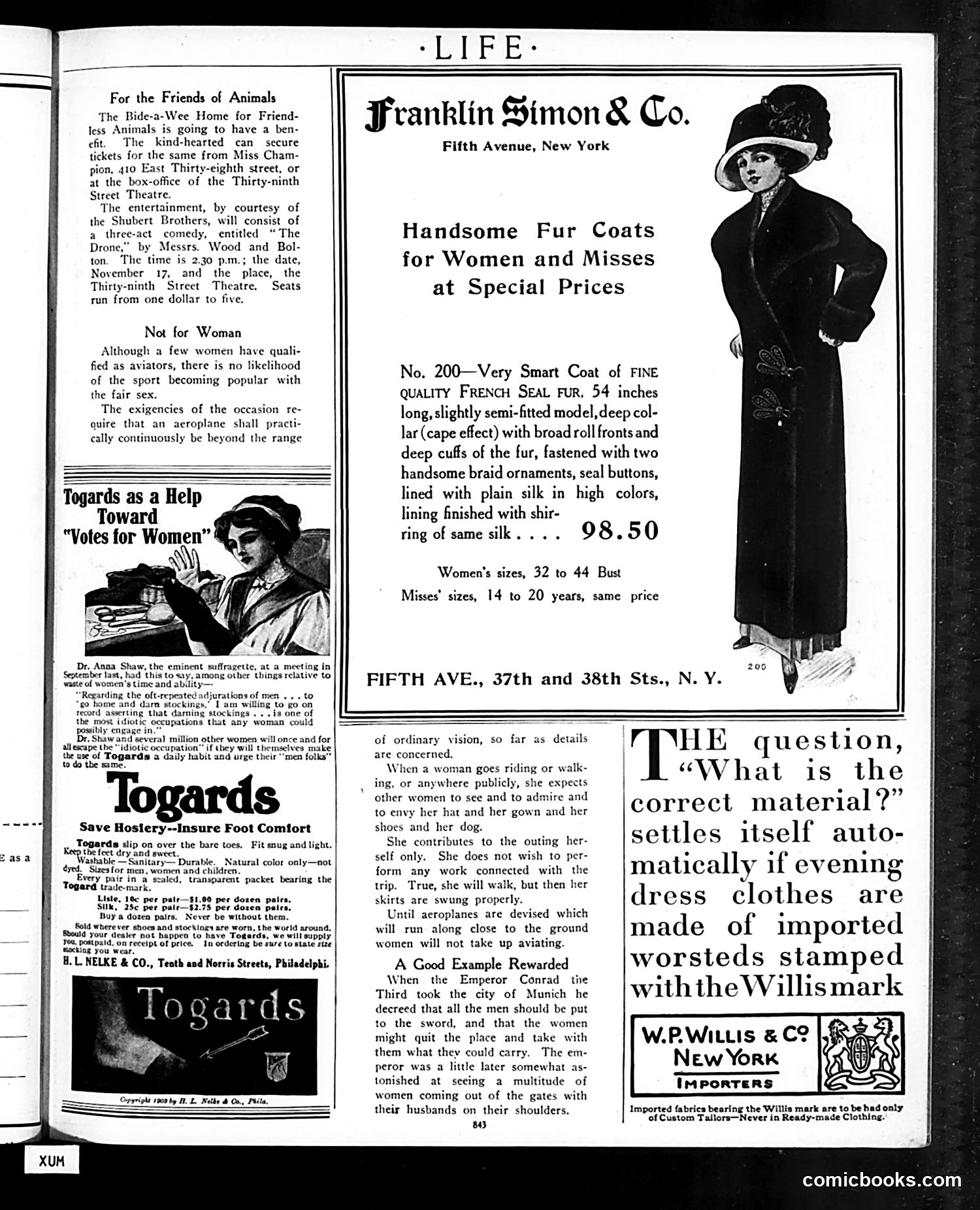
This page is primarily **advertising** for women's fashion and products, with a small editorial section about women's suffrage. The key content is the cartoon featuring **Dr. Anna Shaw**, identified as "the eminent suffragette." Shaw appears to be knitting or doing handwork while discussing voting rights for women. The caption quotes her advocating that women should vote and urging men to support suffrage ("urge their 'men folks' to do the same"). The surrounding ads for fur coats, hosiery, and imported fabrics suggest Life's intended audience: affluent women. The juxtaposition of suffrage discussion with luxury goods reflects the magazine's satirical approach—possibly mocking wealthy women's activism or targeting educated female consumers interested in both politics and fashion. The page dates to the suffrage era (pre-1920), when the movement was actively debated in American media.
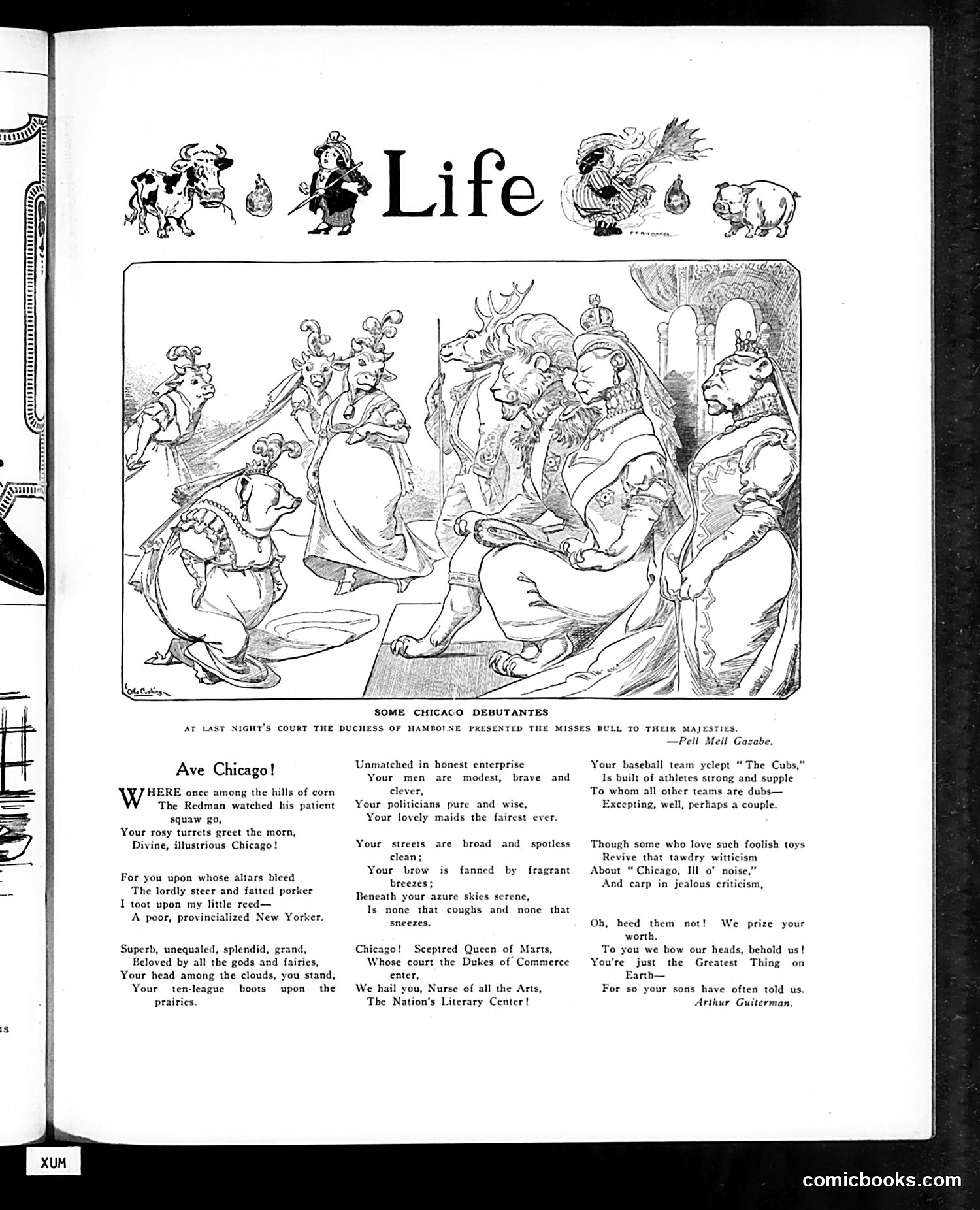
This page from *Life* magazine features a satirical cartoon titled "Some Chicago Deputantes" with accompanying verse titled "Ave Chicago!" **The Cartoon:** The illustration depicts what appears to be Chicago political or social figures depicted as exaggerated, portly characters in formal dress at what the caption describes as "a court" where "the Duchess of Hamburge presented the Misses Bull to their Majesties." The heavy caricaturing suggests mockery of Chicago's social elite or political establishment. **The Satire:** The poem "Ave Chicago!" uses mock-heroic language praising Chicago while simultaneously critiquing it—referencing the Cubs baseball team, calling citizens "modest, brave and clever," and sarcastically praising their "fair" maids and "spotless" streets. The final stanza suggests Chicago residents are foolish but claims their worth anyway. The overall intent appears to be good-natured ridicule of Chicago's aspirations to cultural sophistication and social refinement.
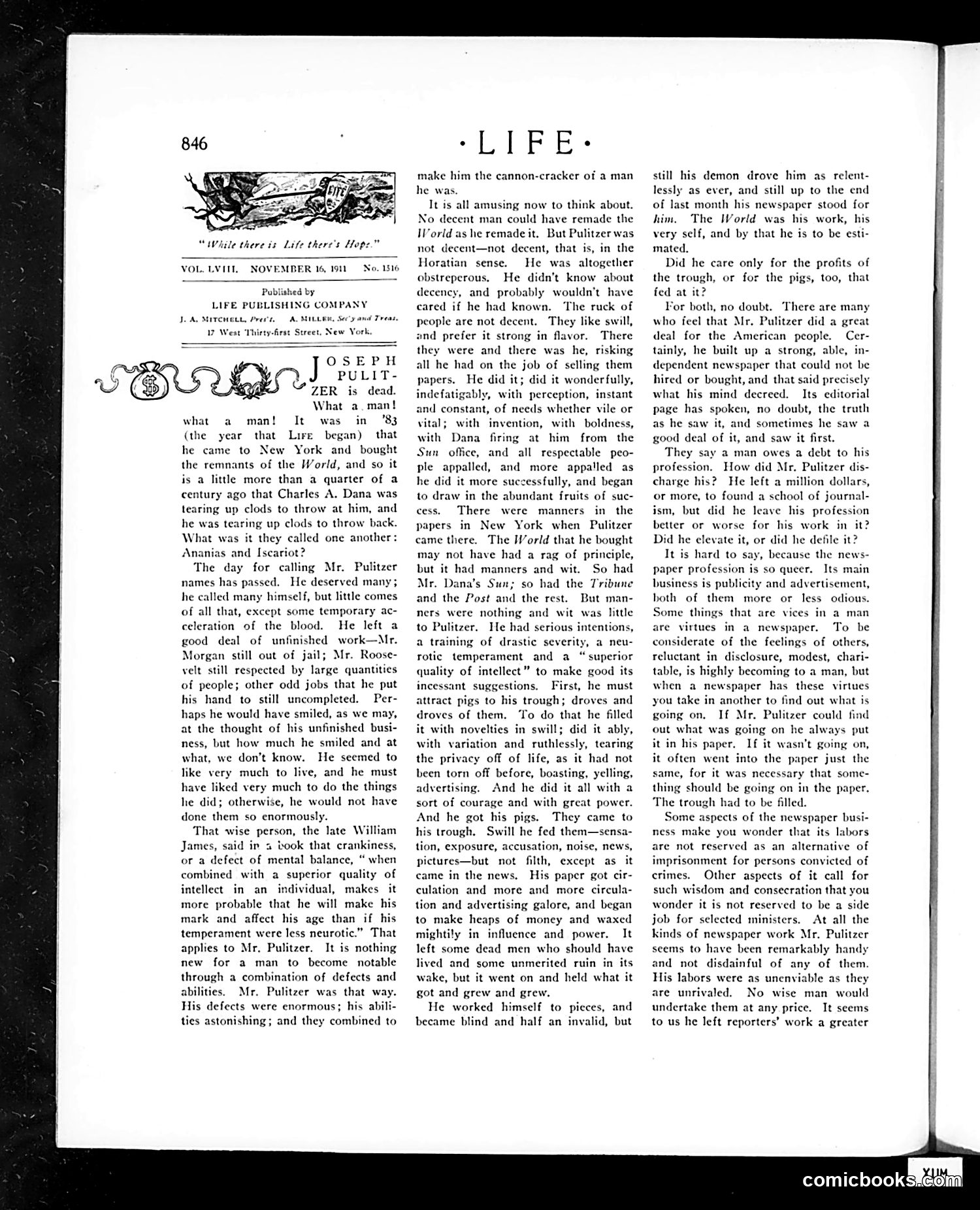
This page from *Life* magazine (Vol. LVIII, November 16, 1911) features an article titled "JOSEPH PULITZER IS DEAD" alongside a small illustration captioned "Where there is Life there's Hope." The article is a satirical obituary-style essay about the recently deceased newspaper publisher Joseph Pulitzer. The text critiques Pulitzer's aggressive, sensationalist journalism style—his use of "pigs," "doves," and "novelties" to attract readers and boost circulation and advertising revenue. The author suggests Pulitzer's methods were manipulative yet effective, transforming his newspaper into a powerful influence despite lacking principle. The piece reflects turn-of-the-century debates about journalistic ethics, questioning whether Pulitzer's commercial success represented progress or moral compromise in American publishing.
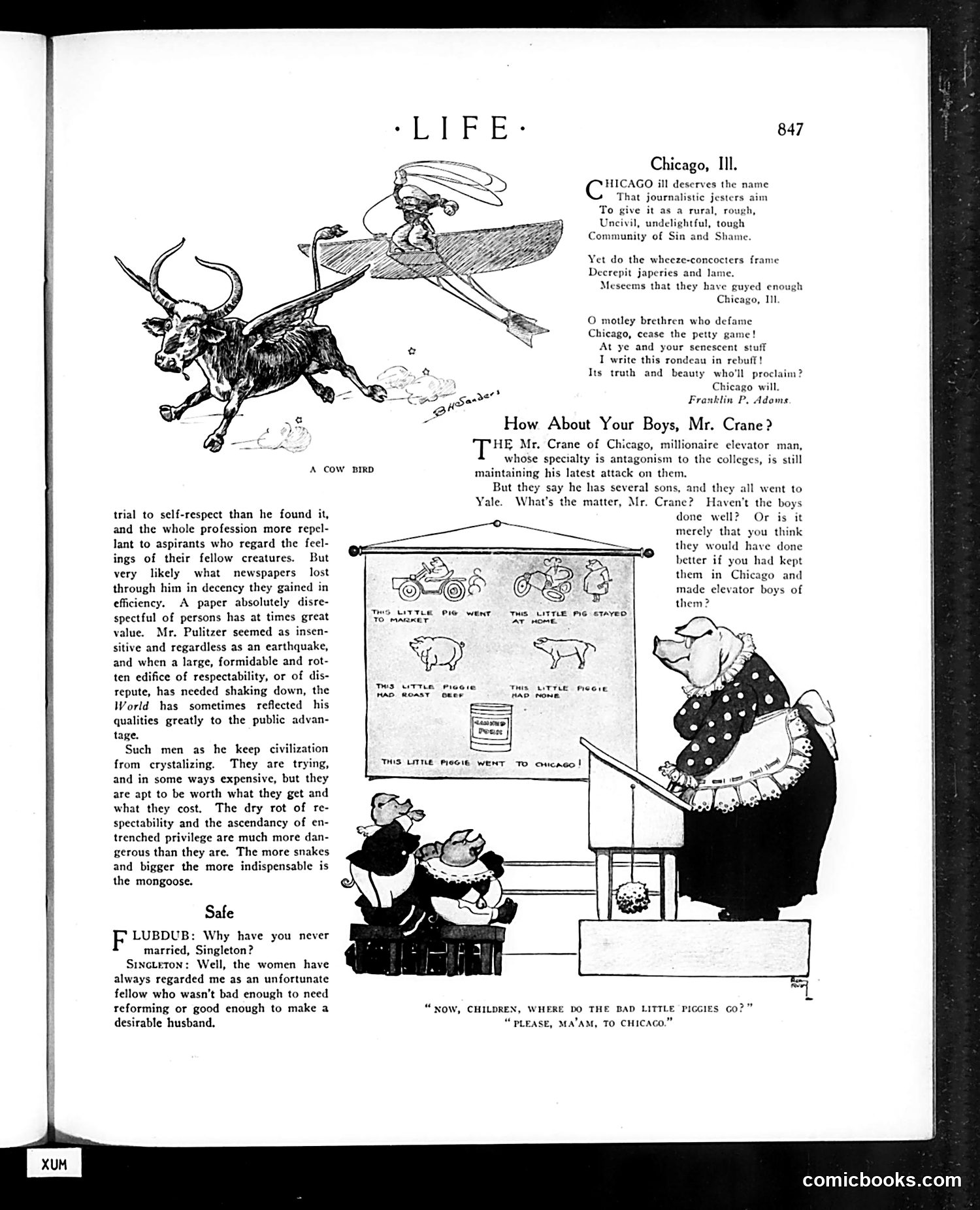
This page satirizes Chicago's reputation and prominent citizens. The top section attacks the city's crude image with a poem by Franklin P. Adams. "A Cow Bird" illustration mocks Chicago's rough character. The main cartoon, "How About Your Boys, Mr. Crane?" targets **Mr. Crane, a Chicago millionaire** and college antagonist whose sons attended Yale. The satire suggests Crane should have kept his boys in Chicago instead, implying the city's wealth could produce "elevator boys"—a dig at the family's perceived pretension versus practical achievement. The bottom cartoon, "Safe," is a brief joke about bachelorhood, unrelated to Chicago themes. The "Little Piggies" comic strip shows a narrative about pigs going to Chicago, reinforcing the city's animal/crude associations popular in period satire.
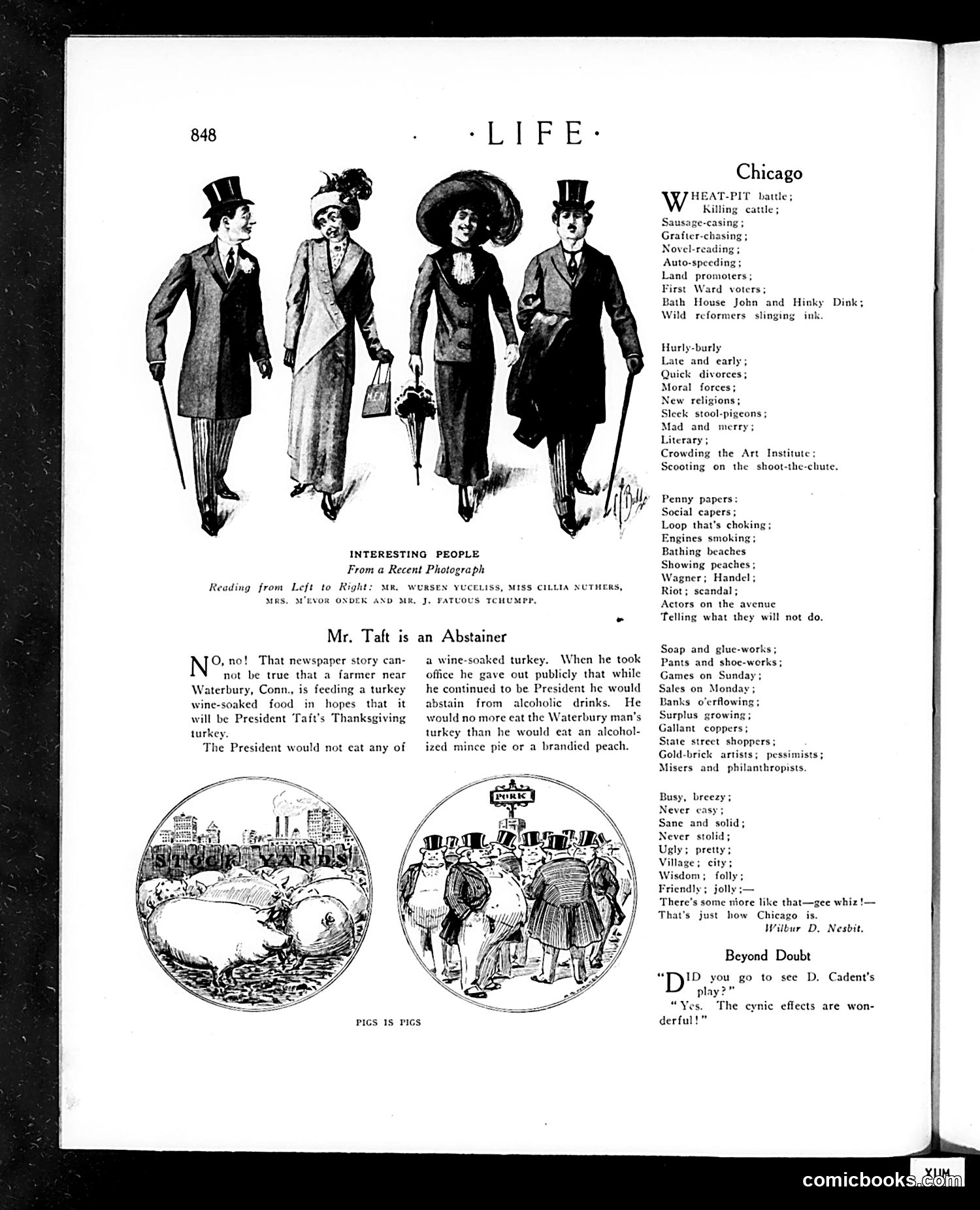
**Top Illustration:** Four well-dressed "Interesting People" from Chicago, identified left-to-right as Mr. Wurses Vuceless, Miss Cilia Nuthers, Mrs. M'Vor Under, and Mr. J. Fatcow's Triumph. These appear to be caricatured Chicago society figures, though the humorous names suggest the identities are satirical rather than literal. **Main Article:** "Mr. Taft is an Abstainer" debunks a false rumor that President Taft was eating wine-soaked turkey, clarifying his actual temperance stance. **Bottom Cartoons:** "Pigs is Pigs" shows contrasting scenes—one pastoral, one urban—illustrating Chicago's dual nature as both agricultural and industrial city. The page satirizes Chicago society, politics, and local contradictions through illustrated humor.
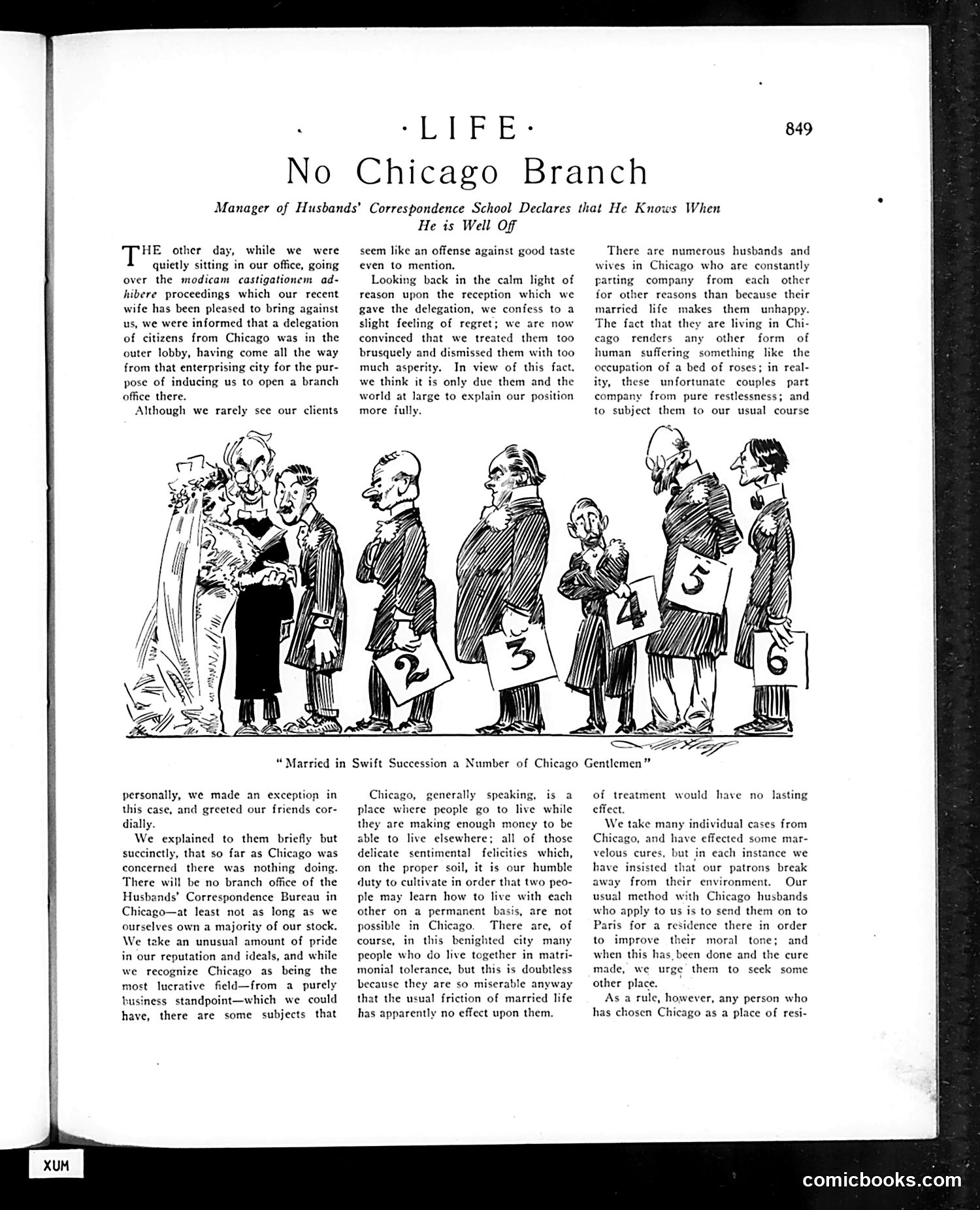
This satirical piece critiques a **Chicago correspondence school for husbands**—an actual business that claimed to teach men how to maintain happy marriages. The cartoon shows numbered men in a queue, labeled "Married in Swift Succession a Number of Chicago Gentlemen," suggesting husbands cycling through the program. The satire targets both the school's dubious efficacy and Chicago's reputation for marital unhappiness. The text ironically explains the school's defensive position: they treat unhappy couples dismissively, yet claim success. The piece mocks the premise that such instruction could fix marriages, and suggests Chicago's particular social climate makes unhappy marriages especially common. The cartoon's humor relies on the absurdity of commercialized marriage "fixing"—a distinctly early-20th-century American phenomenon.
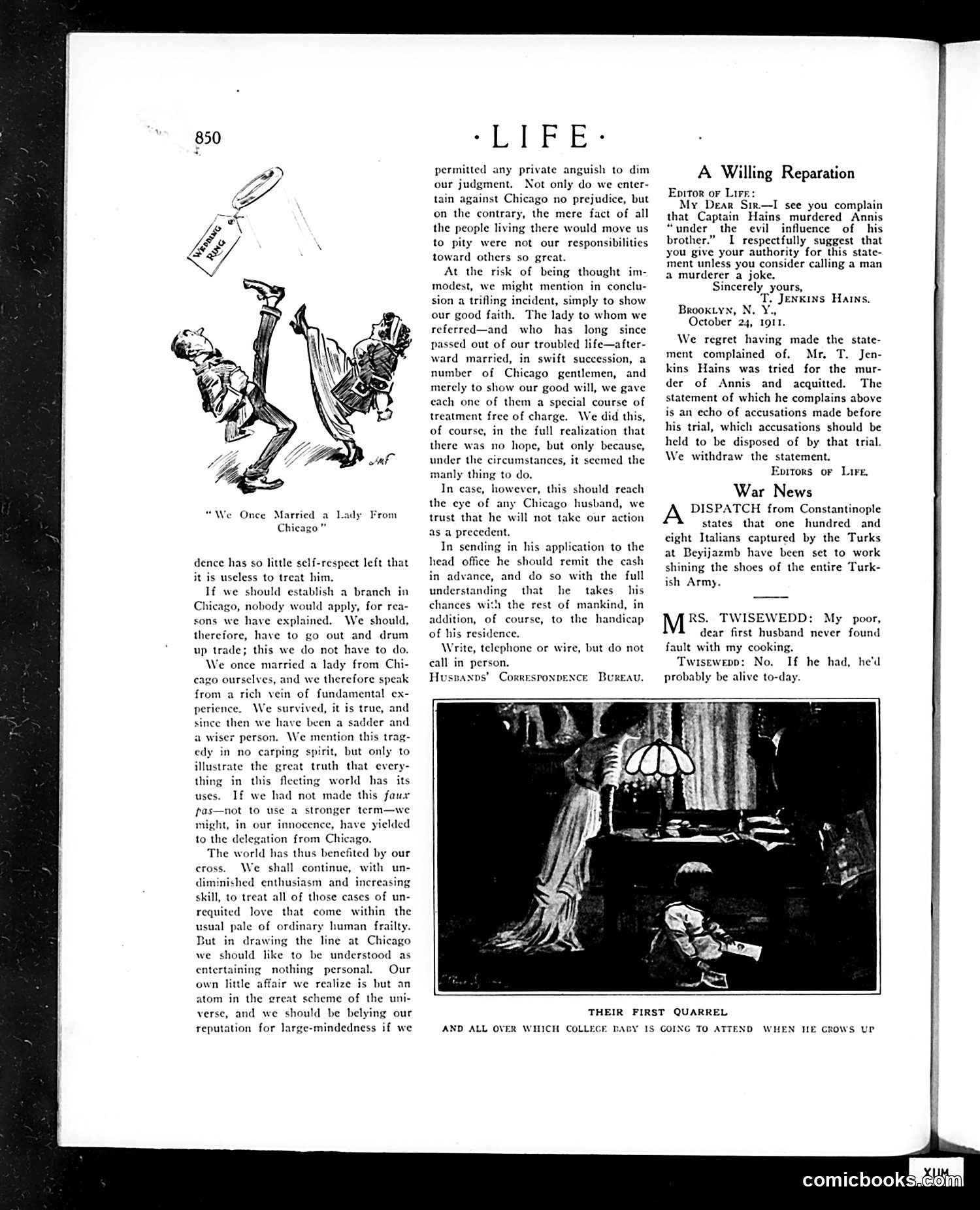
The cartoon titled "We Once Married a Lady From Chicago" depicts a man being violently attacked or thrown by what appears to be a woman wielding a large club or bat. The accompanying text discusses a marital dispute involving Captain Hains, who was accused of murdering a man under the "evil influence" of his brother. The piece includes a retraction/apology acknowledging they made false statements about Hains during his trial. The satire appears to mock marital conflict—specifically using the Hains case as reference point. It suggests that marrying a Chicago woman leads to literal violence, playing on contemporary anxieties about women's aggression and marital discord. The cartoon trivializes serious legal proceedings through comedic exaggeration of domestic conflict.
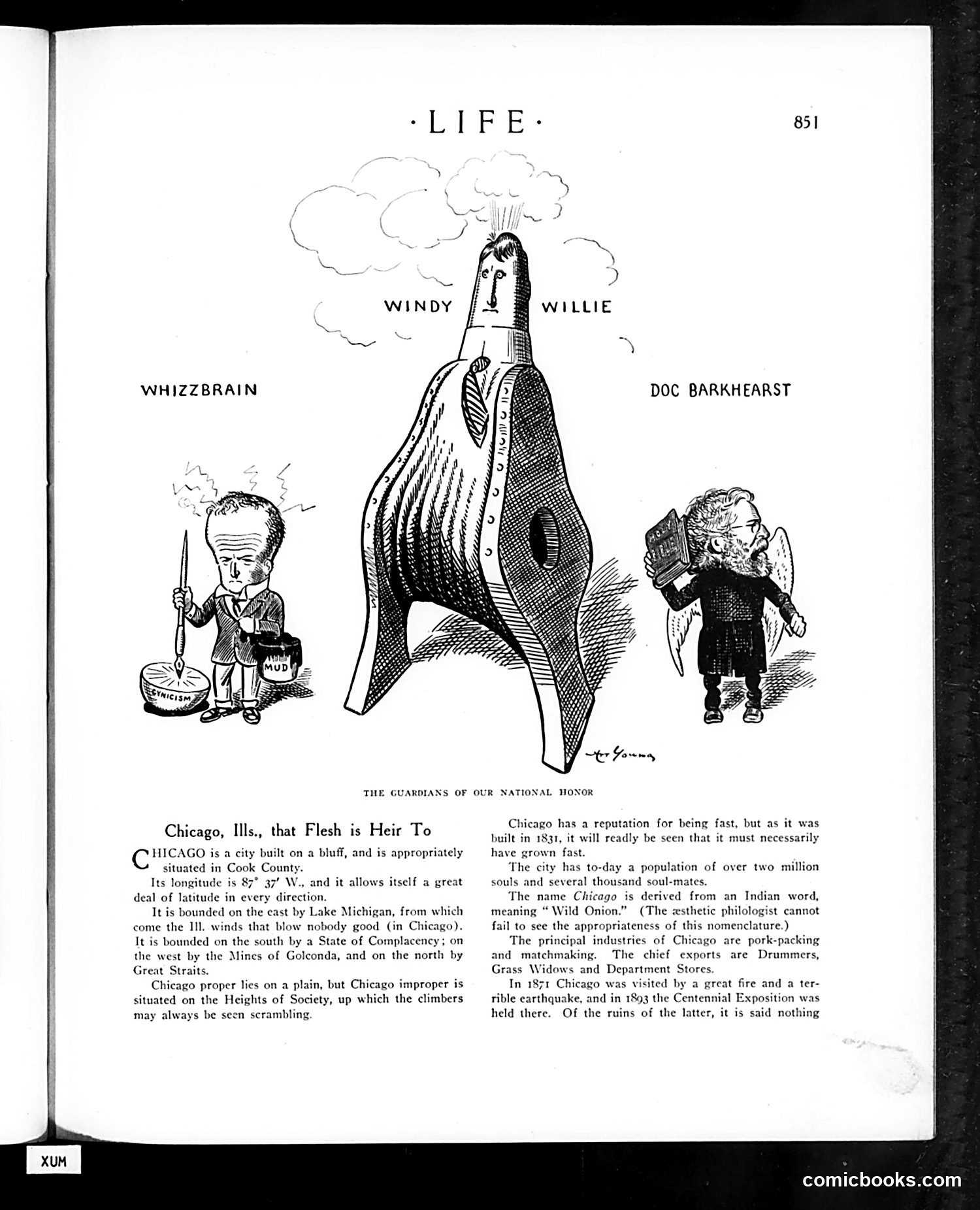
This political cartoon satirizes three prominent Chicago figures as "guardians of our national honor." The central figure, "Windy Willie," is depicted as an enormous, inflated character surrounded by clouds—a visual pun on Chicago's nickname "Windy City" and mockery of bombastic rhetoric. On the left, "Whizzbrain" holds a sword and appears to represent military or aggressive posturing. On the right, "Doc Barkhearst" carries what appears to be a book, possibly referencing intellectual or medical authority. The exaggerated proportions and absurd characterizations suggest these figures are being ridiculed as pompous or ineffectual "guardians." The satire critiques Chicago's civic leaders, implying their boastful claims of protecting national honor are hollow or laughable. The cartoon's tone is decidedly mocking.
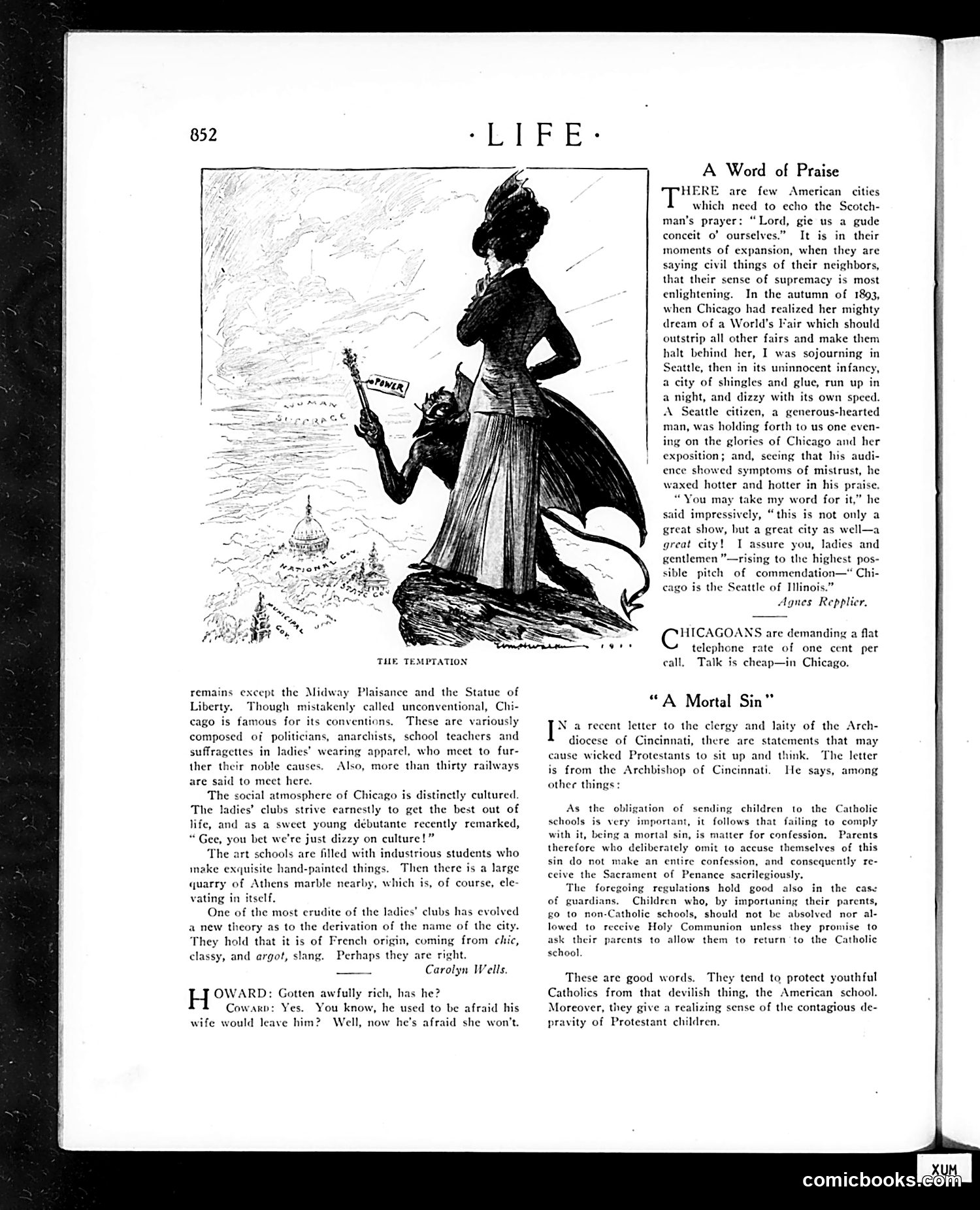
This editorial cartoon satirizes Chicago's boastfulness following its successful 1893 World's Columbian Exposition. The image depicts a wealthy, well-dressed woman (representing Chicago or American cities generally) being tempted by a small figure holding what appears to be a banner labeled "PARIS." The accompanying text critiques American cities' tendency toward self-aggrandizement and competitive superiority claims over neighbors. The "temptation" suggests Chicago is being lured away from its civic achievements by European glamour or rivalry. The cartoon reflects late-19th-century regional American competition, particularly tensions between industrial cities like Chicago and established Eastern centers. It satirizes Midwestern civic pride while questioning whether cities should be so preoccupied with outshining rivals rather than genuine civic development.
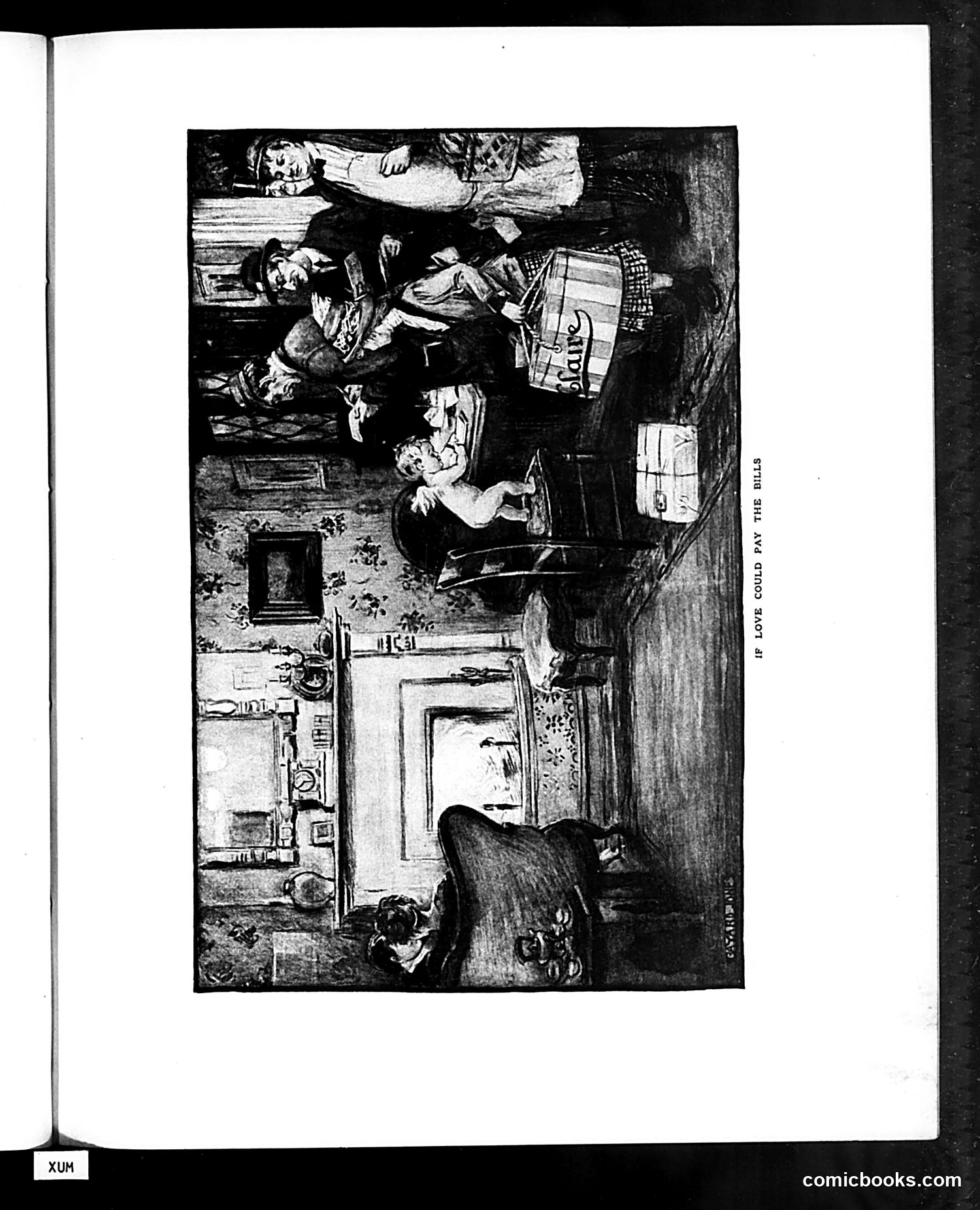
This page contains a single illustration rotated 90 degrees, depicting an interior domestic scene viewed from above. The image shows what appears to be a bedroom or living space with multiple figures, furniture, and household items arranged in a cluttered manner. The caption reads: "IF LOVE COULD BY THE BILLS" However, without clearer OCR text or additional context from surrounding pages, I cannot definitively identify: - The specific political or social figures being caricatured - The particular historical event or social condition being satirized - The intended audience's contemporary understanding The illustration's style and the caption suggest social commentary about economic hardship and domestic life, likely from the early-to-mid 20th century. The rotated perspective adds compositional interest typical of magazine illustration of that era.
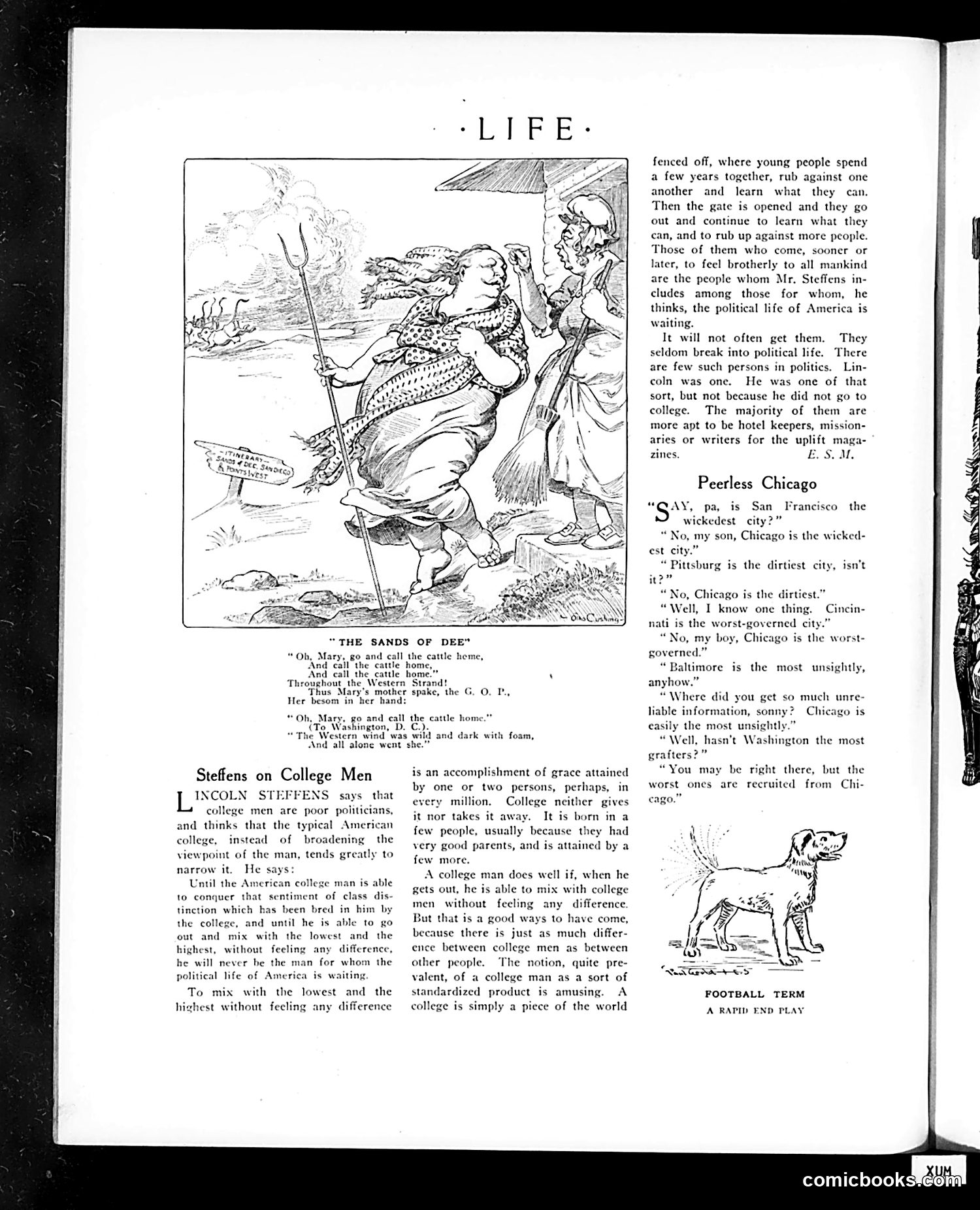
The main cartoon parodies a famous Victorian poem ("The Sands of Dee") to mock Republican Party (G.O.P.) leadership calling back their wayward members to Washington. Mary represents the Republican rank-and-file who have strayed; her "mother" (the G.O.P. leadership) desperately summons them home like cattle. The dark, drowning imagery suggests political peril. The accompanying article by Lincoln Steffens critiques college-educated men as ineffective in American politics, arguing they're disconnected from common people and class-conscious—too narrow to truly lead. The "Peerless Chicago" section is humorous dialogue where a father repeatedly corrects his son that Chicago (not various other cities) holds every negative distinction: wickedest, dirtiest, worst-governed, most unsightly. It satirizes Chicago's notorious corruption and poor governance during the Progressive Era.
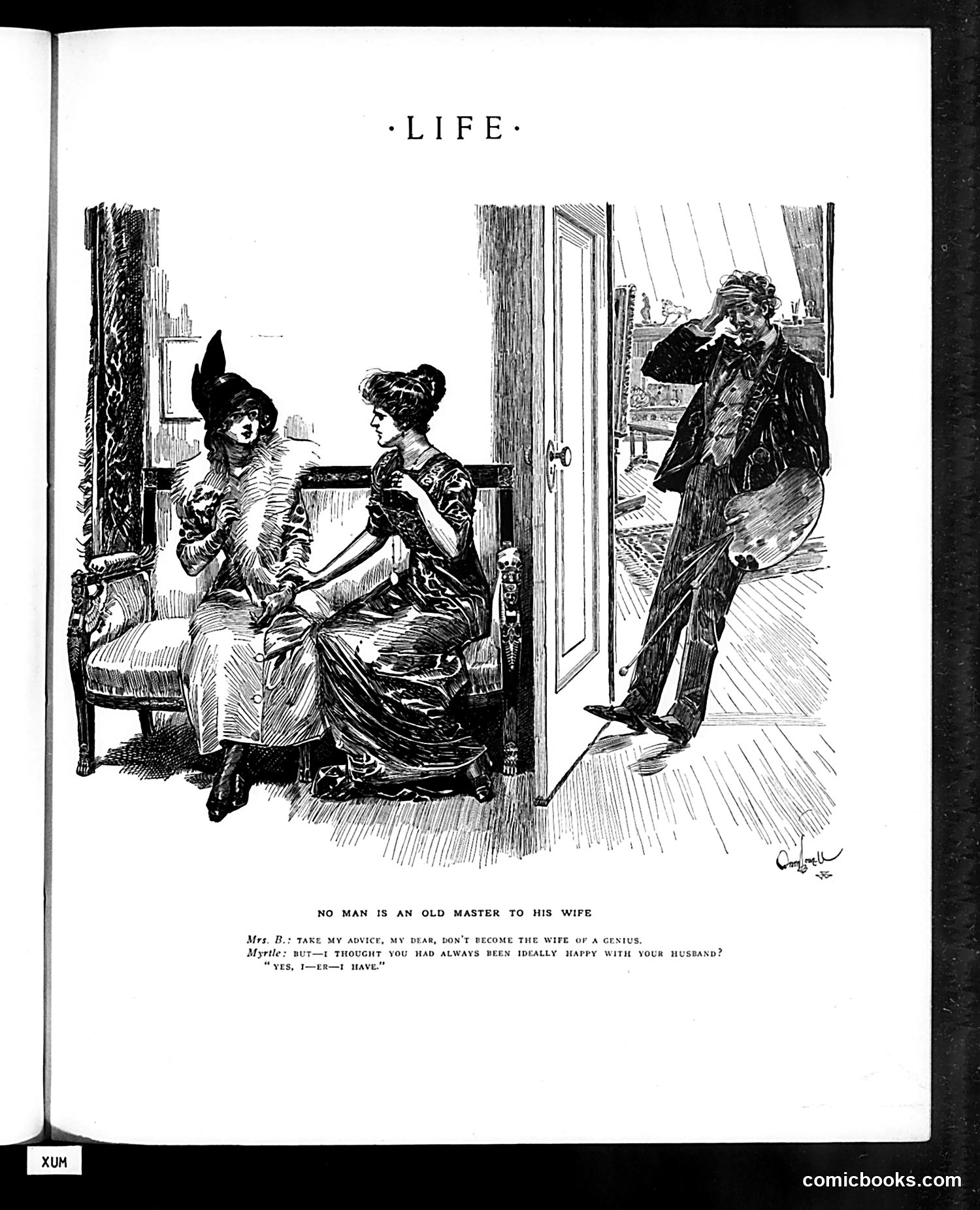
This satirical cartoon from *Life* magazine mocks the romantic ideal of marrying a "genius." Two women converse in an elegant interior: Mrs. B. warns her friend Myrtle against marrying a man of genius, despite claiming happiness with her own husband. Myrtle's confused response—"I thought you'd always been ideally happy"—reveals the contradiction, and Mrs. B.'s awkward deflection ("Yes, I—er—I have") suggests her marriage is actually miserable. The satire targets the era's romanticization of genius and artistic temperament. The title invokes the proverb structure to argue that even brilliant men make difficult husbands. The cartoon criticizes both the myth of the tortured genius and women's resignation to unhappy marriages, presented as a wry commentary on matrimonial reality versus social pretense.
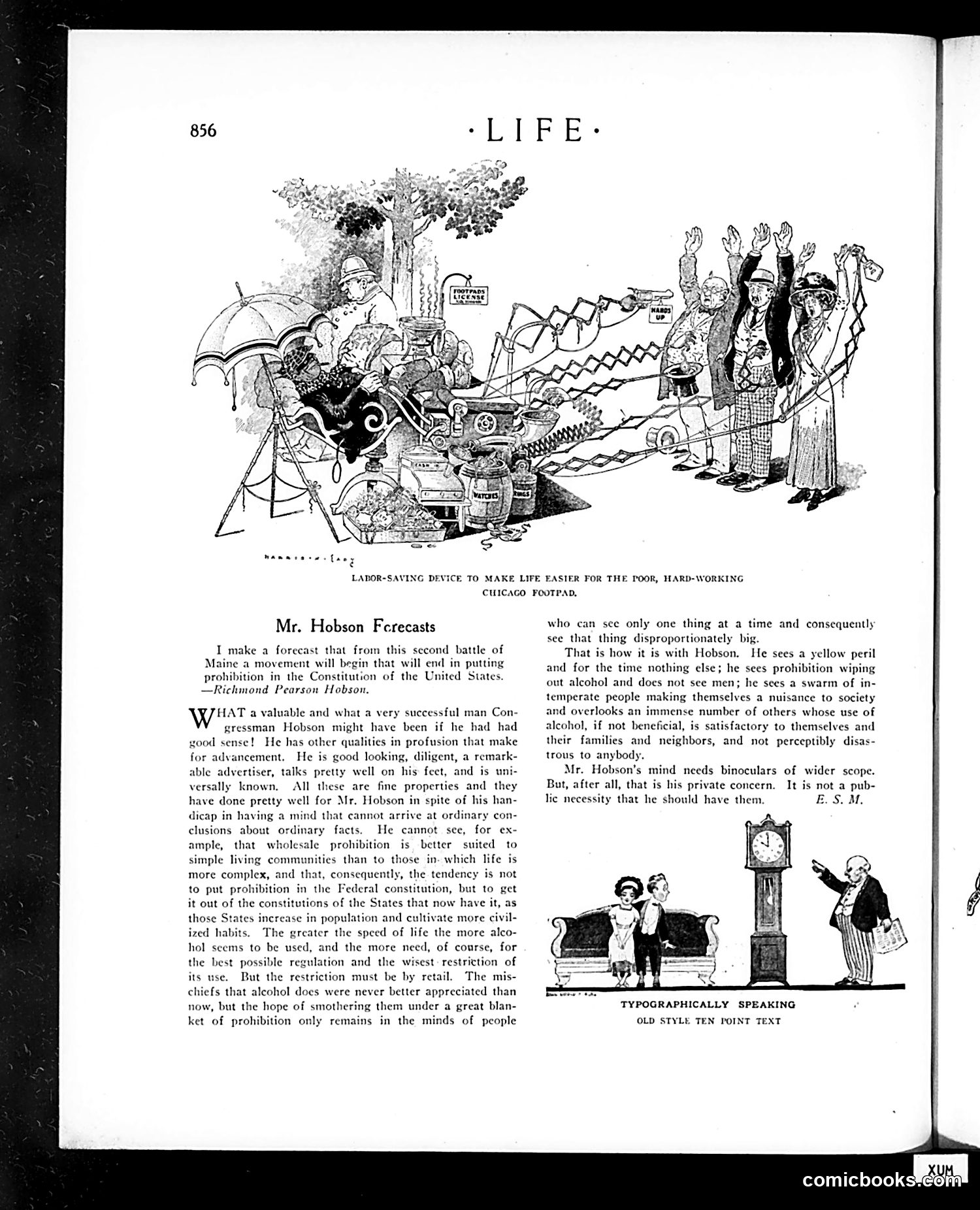
The top cartoon satirizes Chicago crime by depicting a "labor-saving device" supposedly designed to help "the poor, hard-working Chicago footpad" (slang for street criminal/mugger). The elaborate, absurd contraption mocks both criminal ingenuity and the notion that crime requires assistance—a dark joke about Chicago's notorious crime problems. The main article attacks Congressman Richmond Pearson Hobson's advocacy for nationwide alcohol prohibition. The author (E.S.M.) argues Hobson is well-intentioned but intellectually limited, obsessing over prohibition as a cure-all while ignoring social complexities. The piece criticizes single-issue thinking, arguing that alcohol regulation works better at local/state levels in complex urban societies than through federal prohibition. The author suggests Hobson sees only "one thing at a time" and "disproportionately"—a scathing critique of prohibition advocates' tunnel vision during this pre-Prohibition era debate.
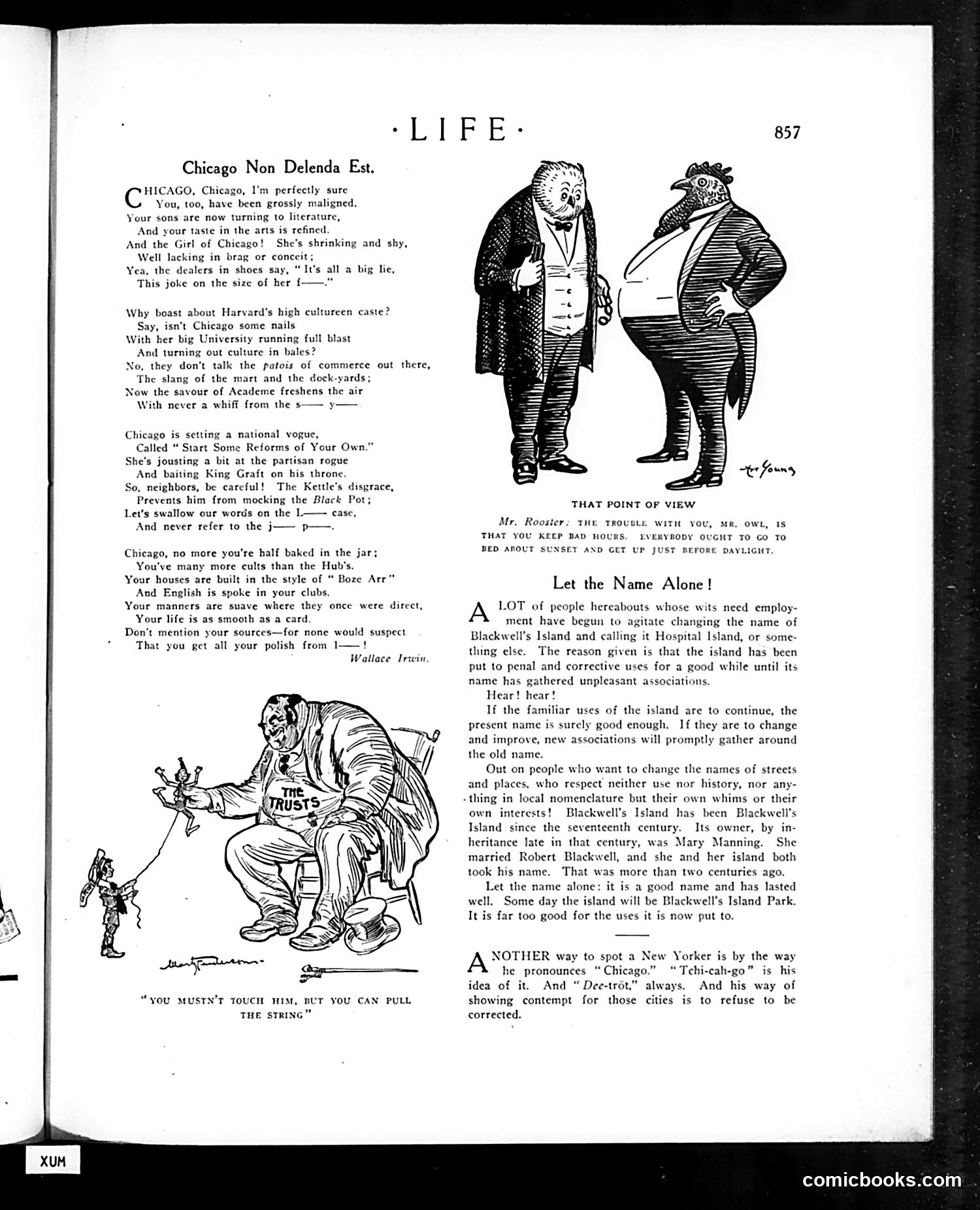
This page contains satirical commentary on Chicago's social aspirations and New York attitudes. The top poem "Chicago Non Delenda Est" (playfully referencing the Roman phrase "Carthago delenda est") mocks Chicago's attempt to rebrand itself as a cultured, refined city. The satire notes Chicago wants to shed its reputation for crude commercialism ("the slang of the mart and the dock-yards") and present itself as an intellectual center with universities and refined manners. The jabs at shoe-dealers' comments about "the Girl of Chicago" and references to the "L—— case" (likely the Everleigh Club scandal) suggest the city's notoriety persists despite its cultural pretensions. The animal cartoon below shows a Rooster criticizing an Owl's nocturnal habits—likely a parable about differing urban lifestyles or work cultures. The editorial "Let the Name Alone!" defends Blackwell's Island's historical name against proposals to rename it "Hospital Island" to distance it from penal associations. The writer argues historical names shouldn't be erased for marketing purposes. Finally, a brief note mocks New Yorkers' affected pronunciation of "Chicago" as "Tchi-cah-go"—regional snobbery about Midwest cities.
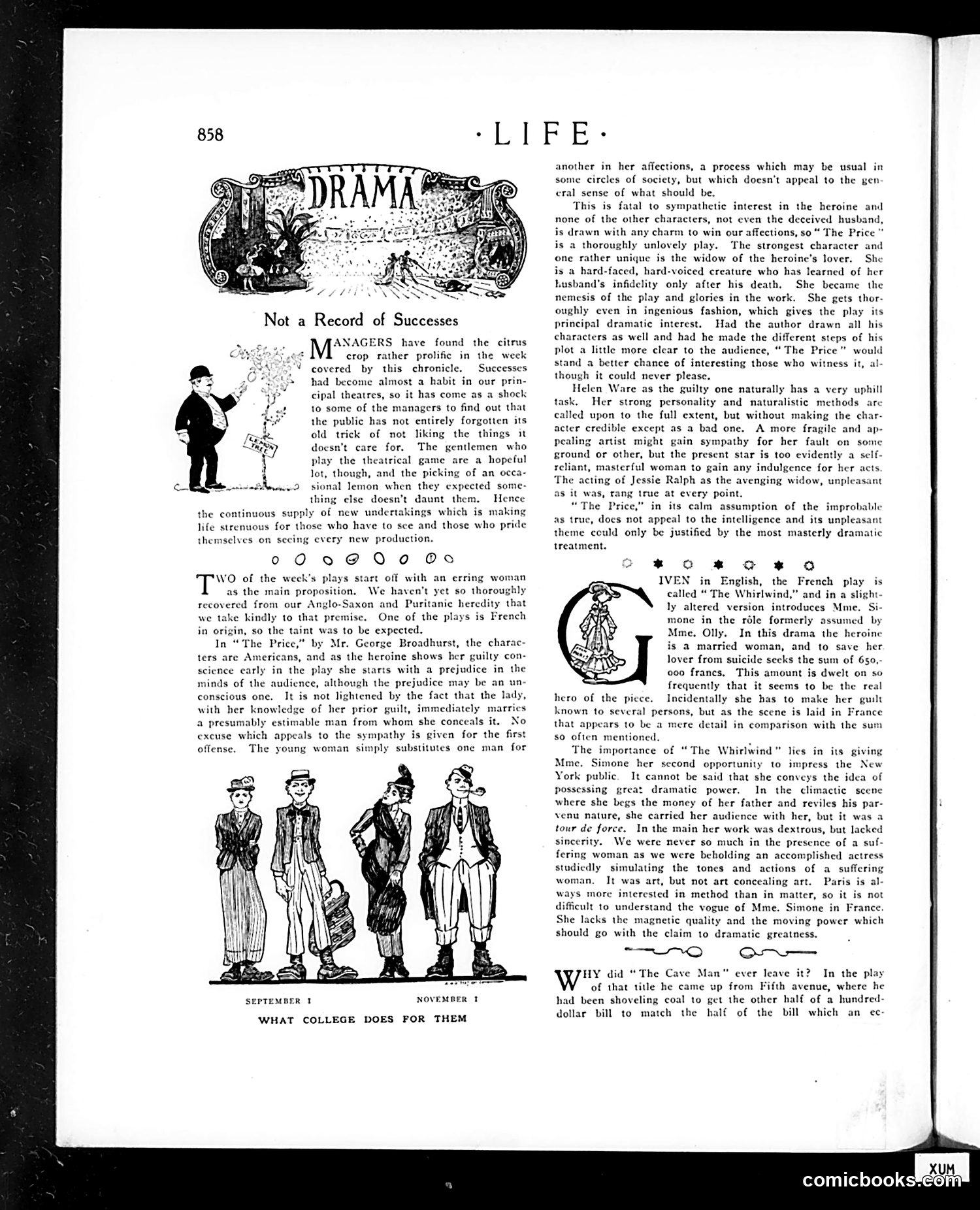
This theater column critiques two recent Broadway plays, adopting a sardonic tone about theatrical success. The writer notes that managers are shocked when audiences reject shows—implying New York producers habitually overestimate public appetite for mediocre work. "The Price," a George Broadhurst play, centers on an American woman who conceals a prior affair from her new husband. The critic condemns it as dramatically inert because audiences cannot sympathize with the protagonist's deception. The sole compelling character is the wronged widow seeking revenge—a morally questionable figure who paradoxically becomes the play's emotional anchor. Helen Ware, cast as the guilty woman, struggles because her "strong personality" makes her unsympathetic rather than tragic. Jessie Ralph's vengeful widow performs more effectively. The second play, "The Whirlwind" (a French work adapted for English stages), features actress Mme. Simone in a similar "morally compromised woman" role, though here she's married and steals money for her lover. The satirical thrust: Broadway's obsession with "erring women" plots reflects lingering Puritanical squeamishness, yet these plays fail because they neither justify nor humanize their female characters' transgressions.
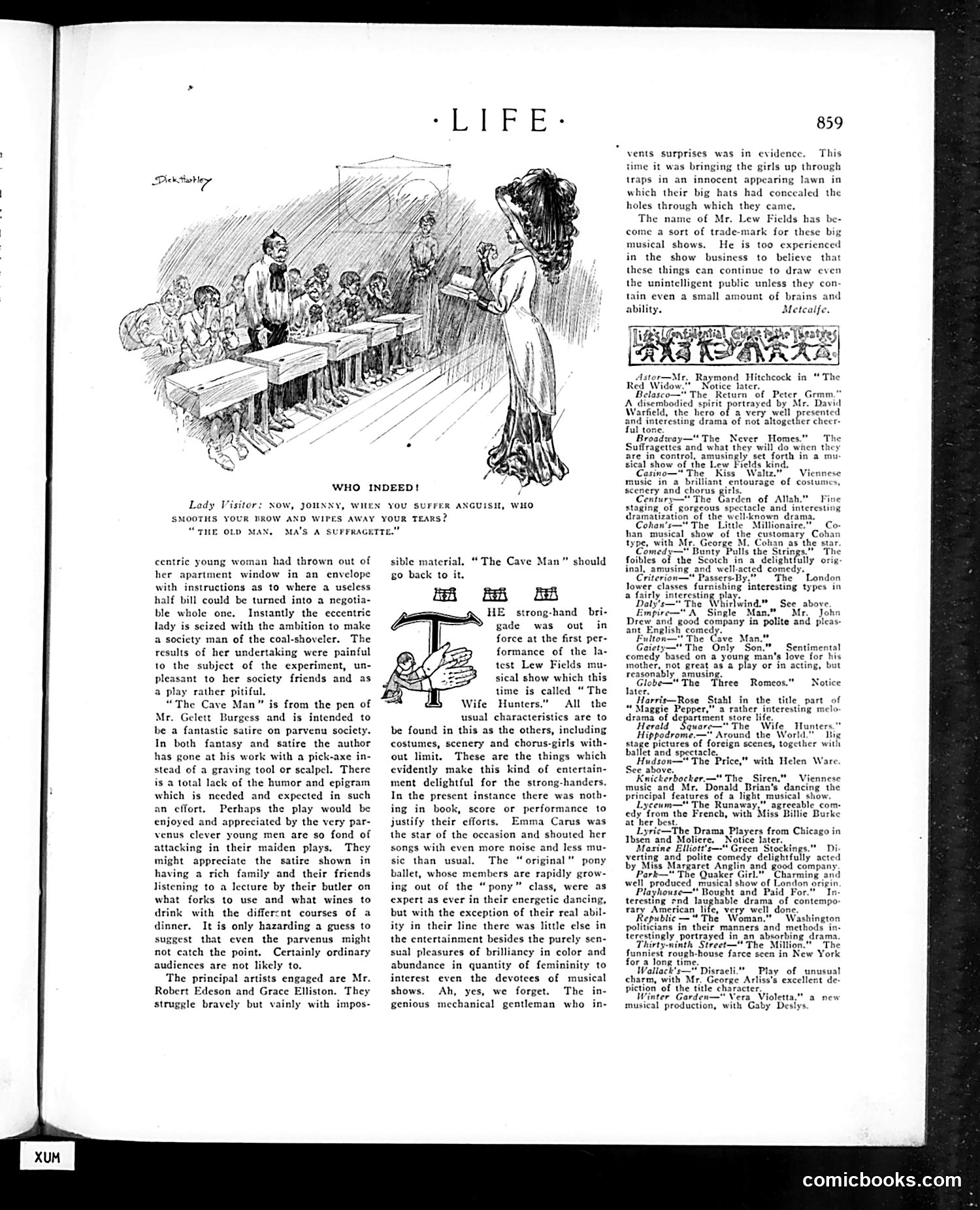
This single-panel cartoon satirizes Victorian gender roles and parenting. A society lady visitor asks a young boy ("Johnny"), "When you suffer anguish, who smooths your brow and wipes away your tears?" The boy replies, "The old man" — meaning the working-class male servant or janitor, not his mother. The joke targets sentimental assumptions about motherhood and feminine nurturing. It suggests that in upper-class households, even children recognize that practical male workers provide actual comfort, while society ladies perform only superficial maternal duties. The accompanying text indicates this relates to a play called "The Cave Man" about satirizing nouveau-riche society through exaggerated social pretense. The humor relies on class commentary: the contradiction between idealized motherhood and the reality of privilege where servants do the actual caretaking.
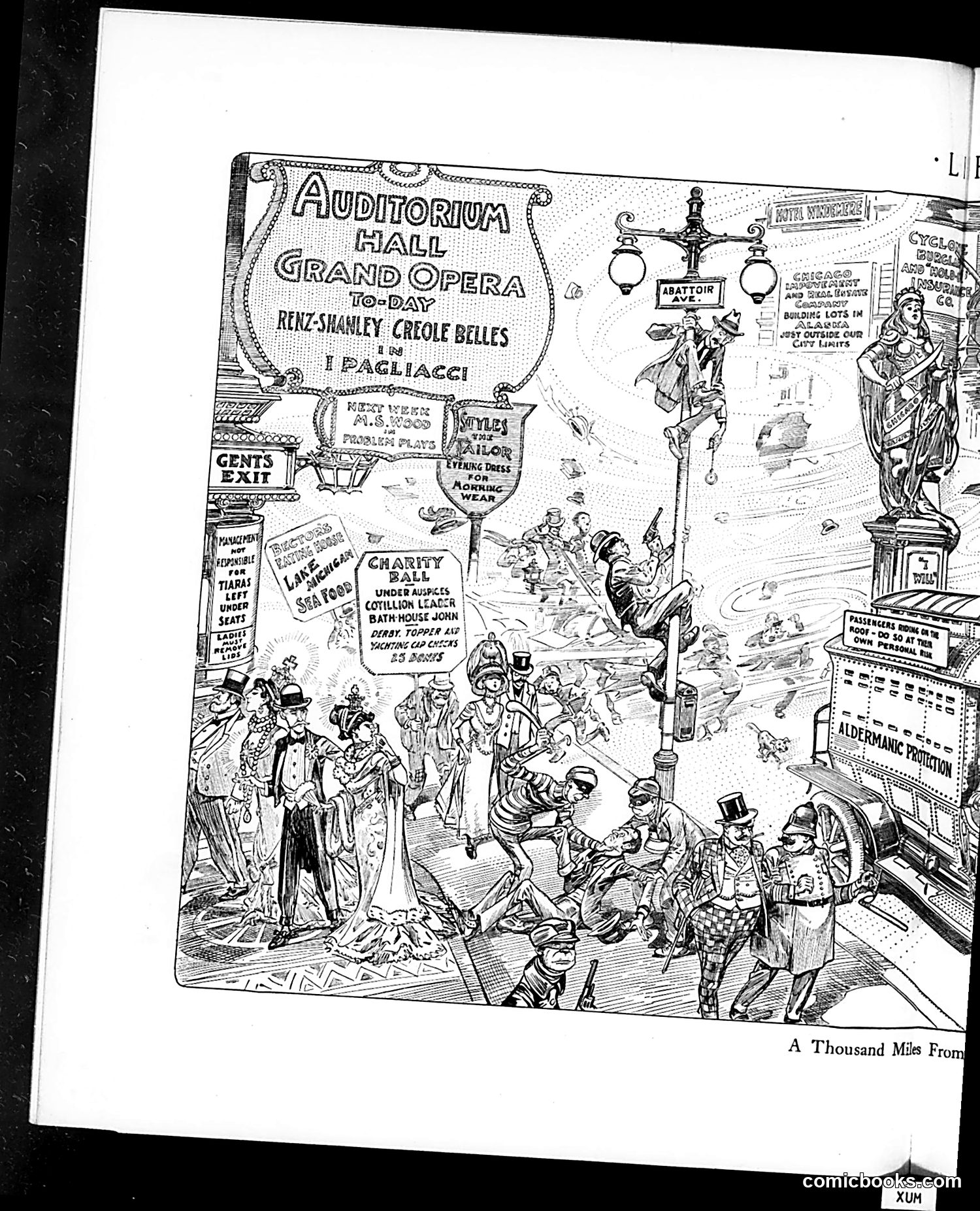
This page advertises an Auditorium Hall performance featuring the "Grand Opera" with "Renz-Shanley Creole Belles" and "I Pagliacci." The illustration satirizes early 20th-century New Orleans street life and entertainment culture, depicting a chaotic scene of performers, well-dressed attendees, and various city characters mingling outside the venue. The "Charity Ball" reference and mentions of "Bathhouse John" (a famous New Orleans political figure known for organizing charitable events) suggest this mocks the mixing of high culture (opera) with lowbrow street entertainment and the city's colorful political establishment. The ornate signage and crowded composition humorously contrast operatic pretension with the rough-and-tumble reality of New Orleans society. The satire likely targets both the opera-goers' pretentiousness and the city's colorful characters.
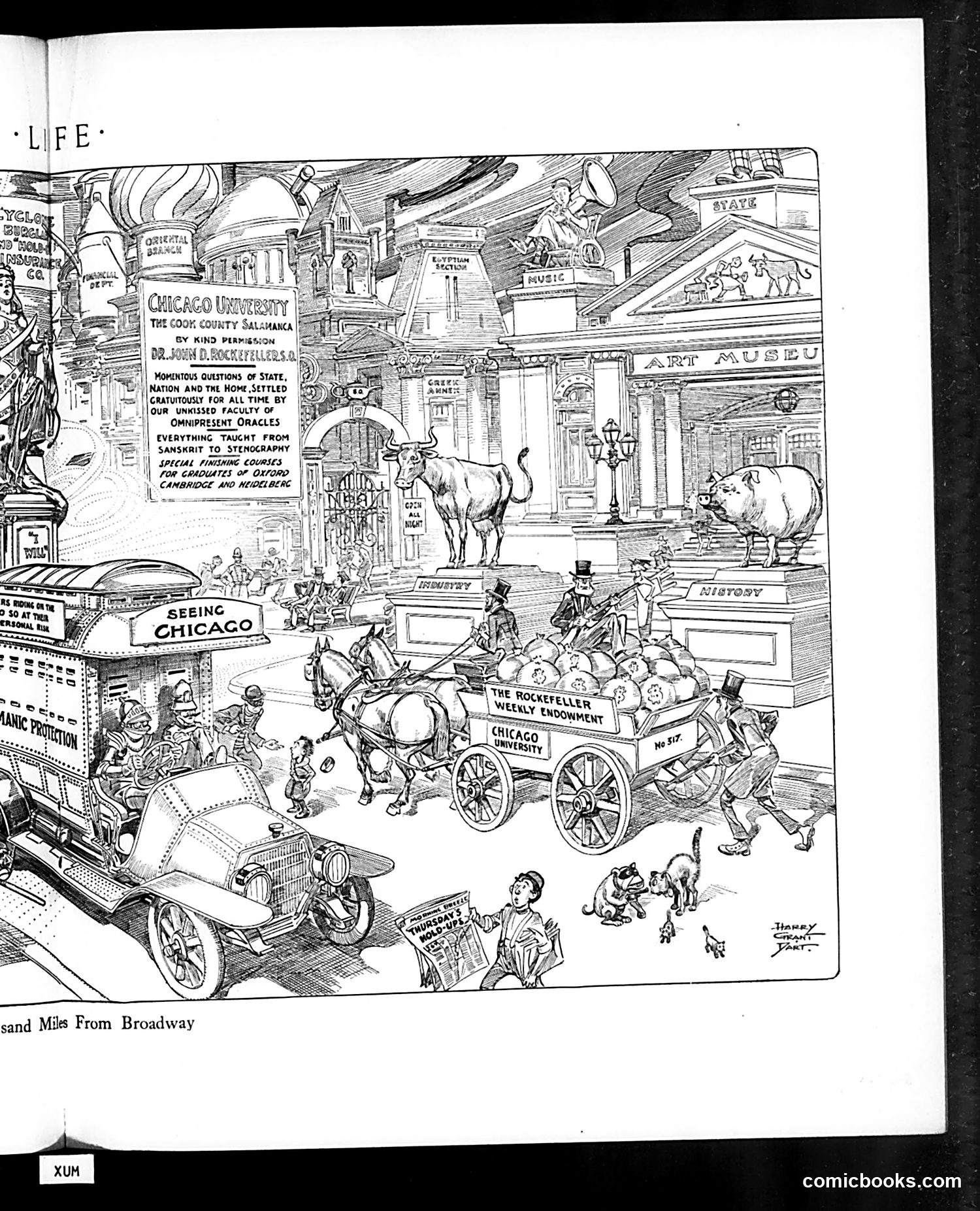
This is a satirical cartoon about **Chicago University** (founded by John D. Rockefeller, referenced in the text). The central joke mocks the institution's grandiose claims and Rockefeller's philanthropic control. The text parodies the university's pretensions—claiming it settles "momentous questions of State, Nation and the Home" through an "omnipresent" faculty, and teaches everything from "Sanskrit to Stenography" with "special finishing courses" rivaling Oxford, Cambridge, and Heidelberg. The visual chaos depicts a bustling street scene with horses, wagons, and a "Rockefeller Weekly Embodiment" cart, suggesting the university is more carnival than serious academy. The architectural backdrop displays various labeled departments (Art, Music, History, Chemistry) as temple-like structures. **The satire**: American universities, especially Rockefeller's, were perceived as ostentatious, over-claiming authority on all subjects, and serving wealthy patrons' interests rather than genuine scholarship. The cartoon ridicules both institutional pomposity and the notion that massive funding could instantly create a world-class university.
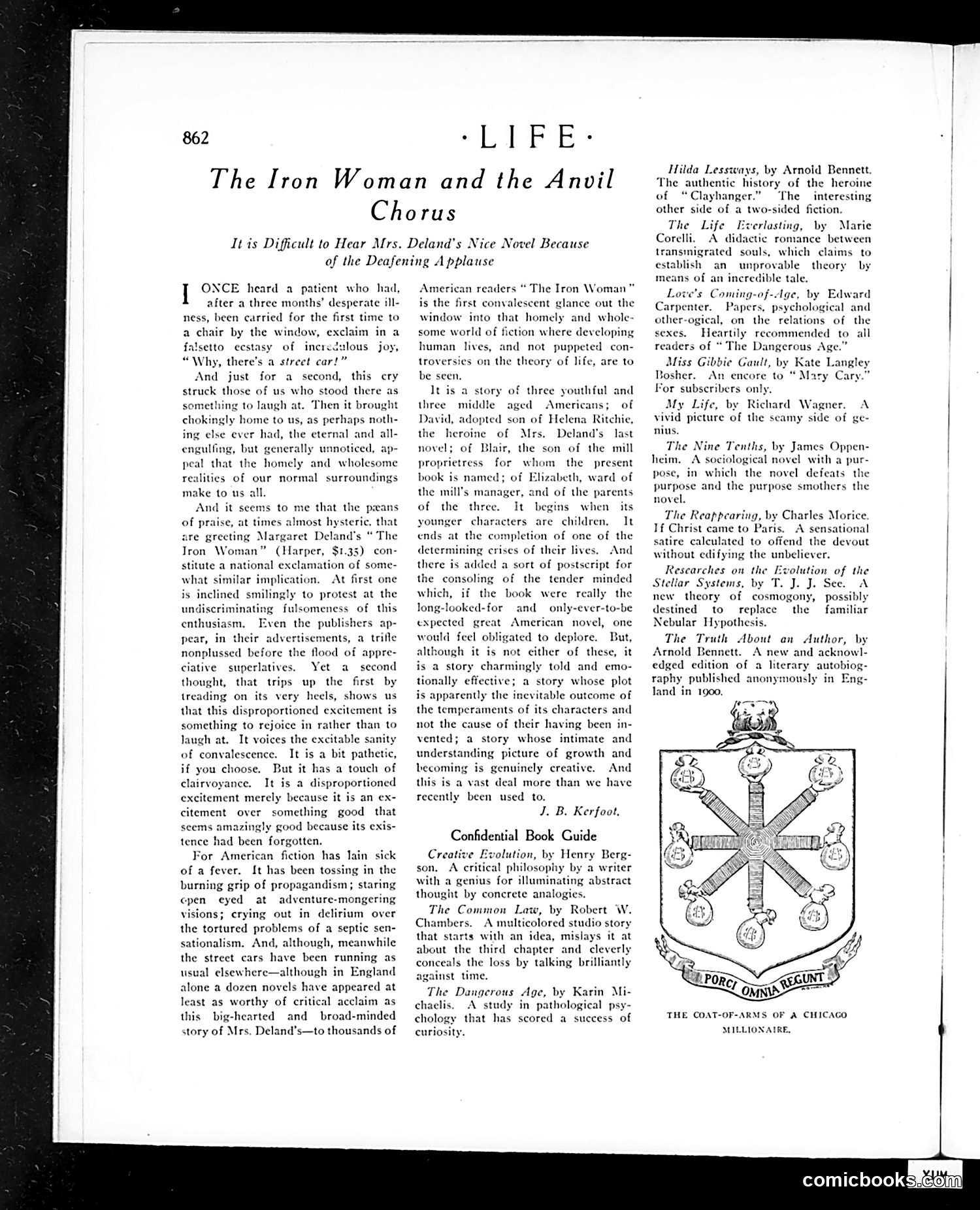
This is a book review essay—not a political cartoon—praising Margaret Deland's novel *The Iron Woman*. The author uses an extended metaphor: American fiction has been "sick with fever," delirious with propagandism and sensationalism. The enthusiastic public reception of Deland's book represents a "convalescent" recovery—a patient glimpsing normalcy again after illness. The review celebrates the novel as a return to wholesome realism focused on human development rather than lurid drama or polemical messaging. The "Iron Woman" title refers to the protagonist, Helena Ritchie. The coat-of-arms illustration on the right is unrelated decorative material (a Chicago millionaire's heraldic emblem), typical of *Life* magazine's layout. This reflects early 1900s literary criticism valuing character-driven domestic fiction over sensationalism.
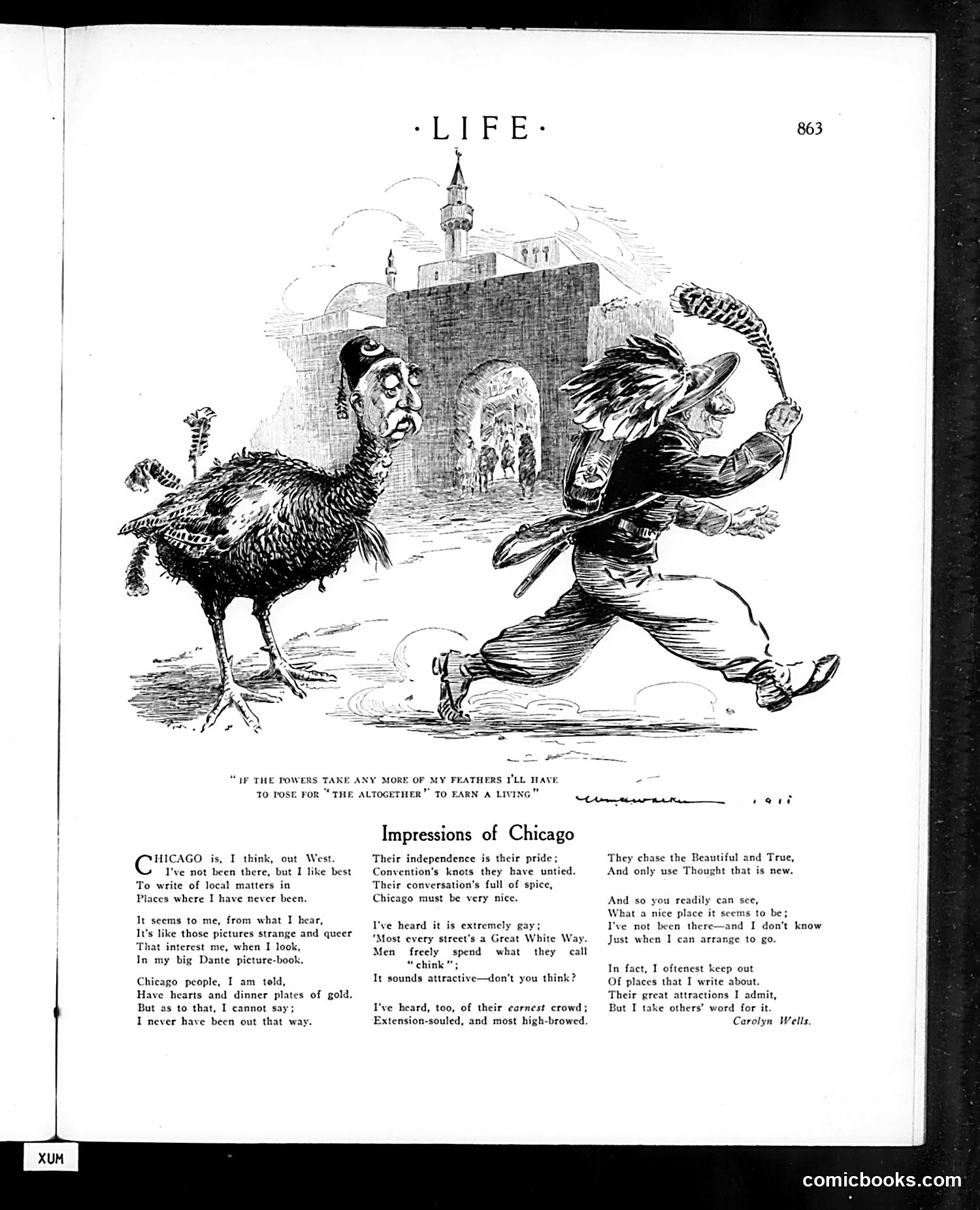
This page satirizes Chicago's rapidly growing wealth and cultural pretensions in the early 1900s. The cartoon depicts a caricatured figure (likely representing Chicago or a Chicago businessman) being plucked of feathers by "the Powers"—a reference to the city's industrial and financial elite who are extracting wealth. The figure threatens to pose "altogether" (nude) to survive, mocking Chicago's desperation to maintain its lavish lifestyle. Carolyn Wells's accompanying poem humorously describes Chicago as a place of excess and affectation: residents with "hearts and dinner plates of gold," streets like Broadway's "Great White Way," free spending of money ("chink"), and pretentious intellectual pursuits. The satire's key point: Wells admits she's *never been there* but writes about it anyway—mocking both Chicago's inflated reputation and the absurdity of commentary based on hearsay rather than observation. The humor targets Gilded Age excess and unearned cultural pretension.
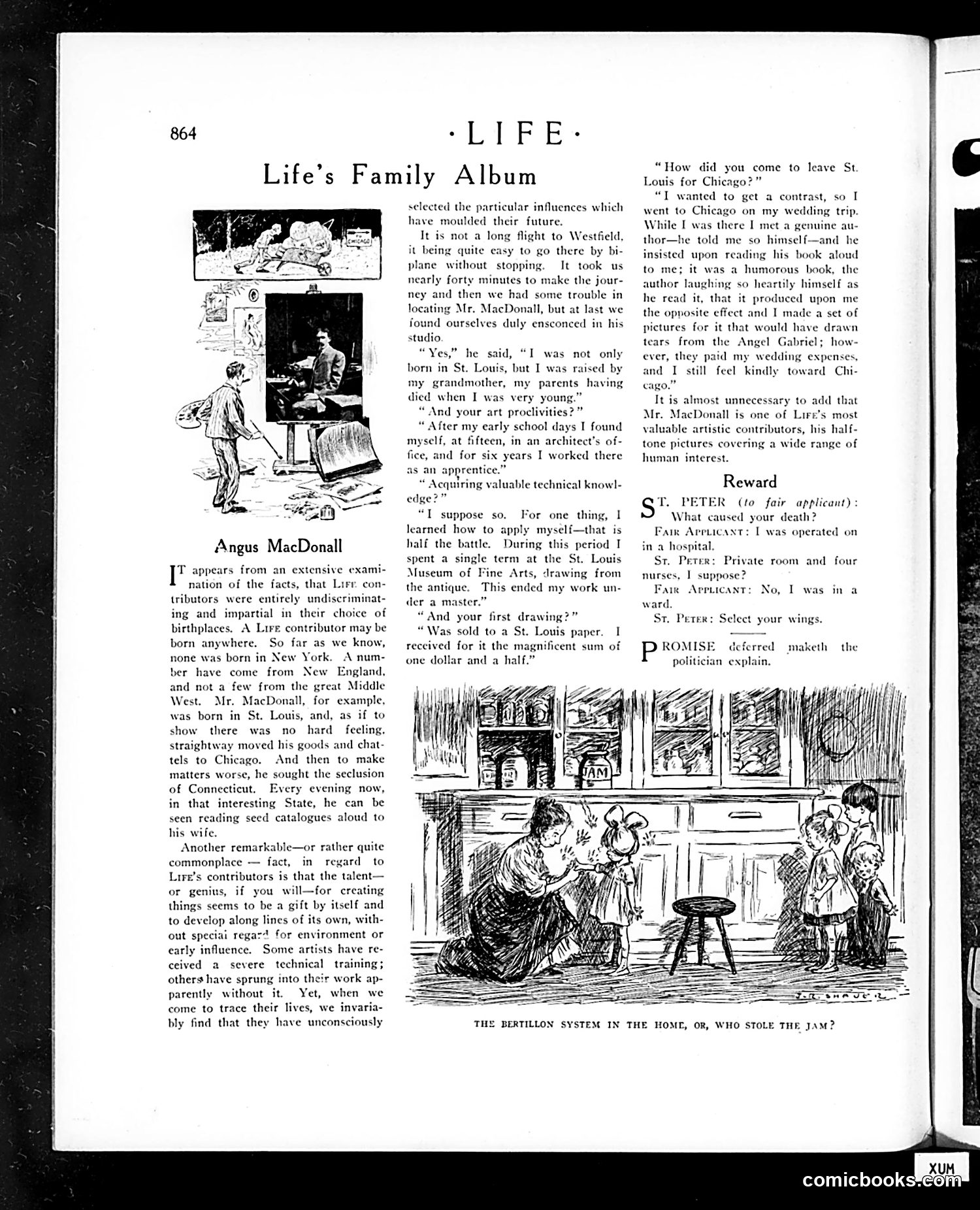
This page features a biographical profile of **Angus MacDonall**, a Life magazine contributor and artist. The text humorously traces his life from St. Louis birth through various relocations to Connecticut, emphasizing the ironic disconnect between birthplace and artistic talent development. The main cartoon at bottom, titled "The Bertillon System in the Home, or, Who Stole the Jam?", uses the Bertillon system (early criminal identification method using body measurements) as a satirical frame. It depicts a domestic scene where a mother interrogates children about missing jam—playing detective with exaggerated seriousness, as if solving a major crime. A small "Reward" dialogue between St. Peter and a "fair applicant" makes dark humor about afterlife class distinctions: those who died in private hospital rooms with nurses get better accommodations than those who died in charity wards. The cartoons poke gentle fun at both pseudoscientific detective methods and social inequality, typical of Life magazine's satirical approach to contemporary life and manners.
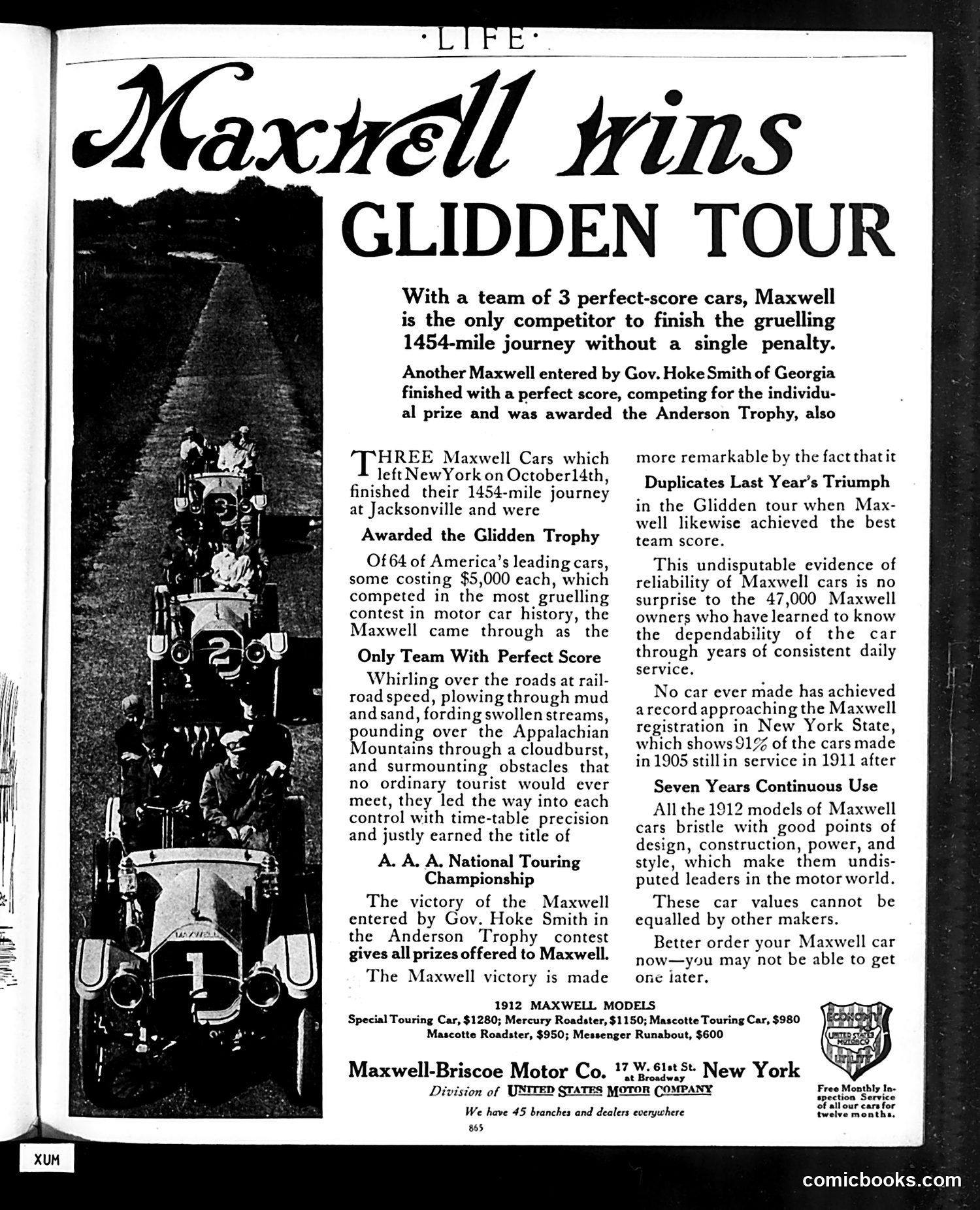
This is a **car advertisement**, not satire. The page celebrates Maxwell automobiles winning the prestigious 1911 Glidden Tour—a grueling 1454-mile cross-country endurance race that tested automotive reliability. The key claims: Maxwell was the *only team* to finish with a perfect score (zero penalties) among 64 competing vehicles, some costing $5,000 (expensive for the era). Governor Hoke Smith of Georgia entered a separate Maxwell that also achieved perfect scores, winning both team and individual prizes. The advertisement emphasizes reliability through statistics: 91% of 1905 Maxwell models were still in service in 1911 after six years of continuous use—presented as remarkable evidence of durability. Pricing ranges from $600-$1280 for various 1912 models. For modern readers: The Glidden Tour was the early automotive equivalent of today's motorsport competitions—a way manufacturers demonstrated vehicle dependability during the era when cars were still proving their viability against horse transportation.
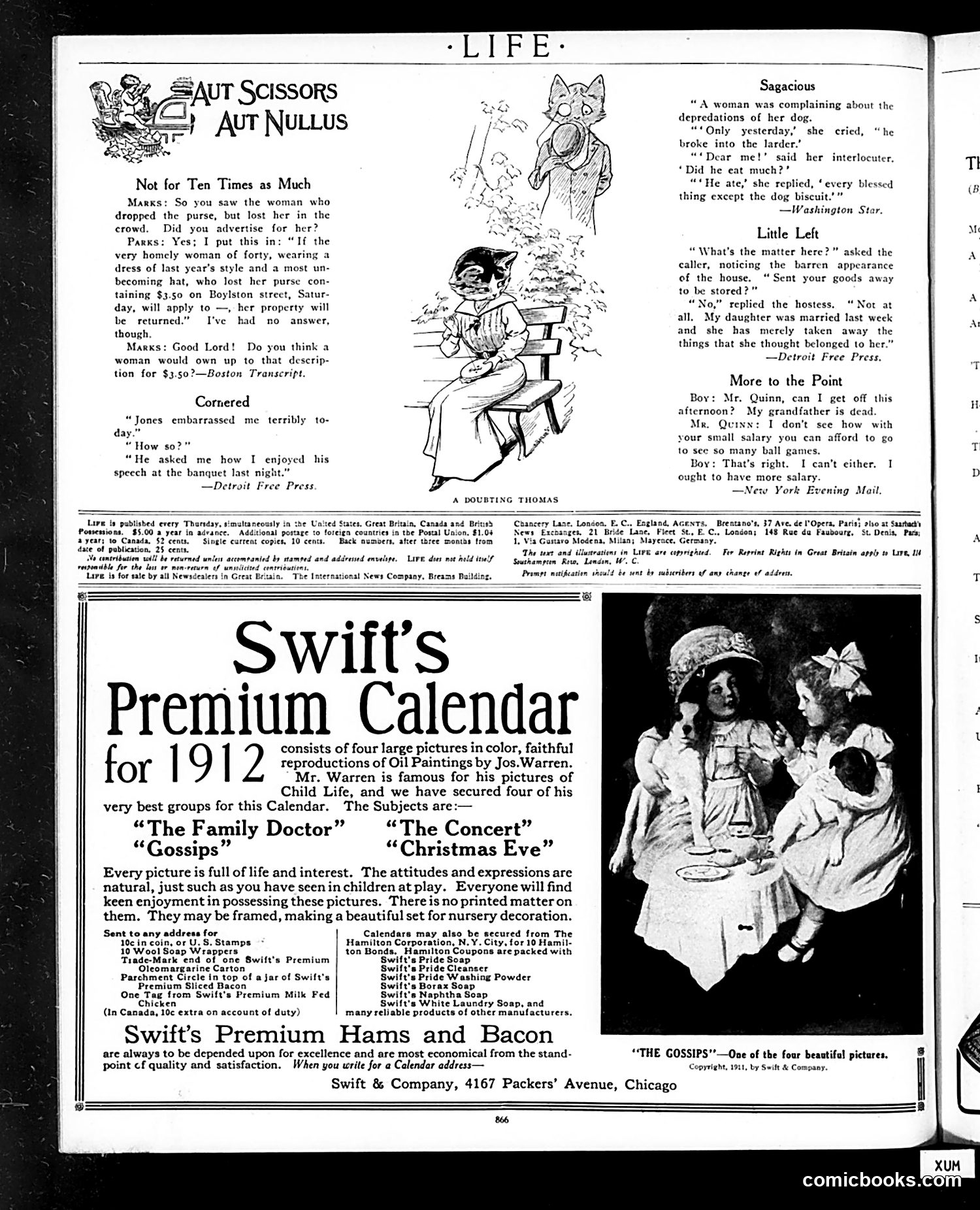
This page from *Life* magazine (circa 1911-1912) contains several brief satirical jokes and a large Swift & Company product advertisement. **The cartoons/jokes:** - "Not for Ten Times as Much": A man's humorous attempt to recover a lost purse by advertising for an extremely unflattering description of the woman who lost it—the satire being that no woman would claim such an unflattering description, even for money. - "Cornered": A man embarrassed after being asked directly about his opinion of another's boring banquet speech. - "Sagacious": A woman humorously complaining that her newly married daughter removed all household items after the wedding. - "Little Left" and "More to the Point": Additional brief jokes about domestic life and employment. - "A Doubting Thomas": An illustration (unclear caption connection) showing domestic scenes. **The dominant content** is Swift & Company's advertisement for a 1912 premium calendar featuring oil paintings by Jos. Warren depicting children and family scenes. The calendar could be obtained by collecting product wrappers or coupons from Swift's meat and soap products. The page reflects early 20th-century American advertising and domestic humor.
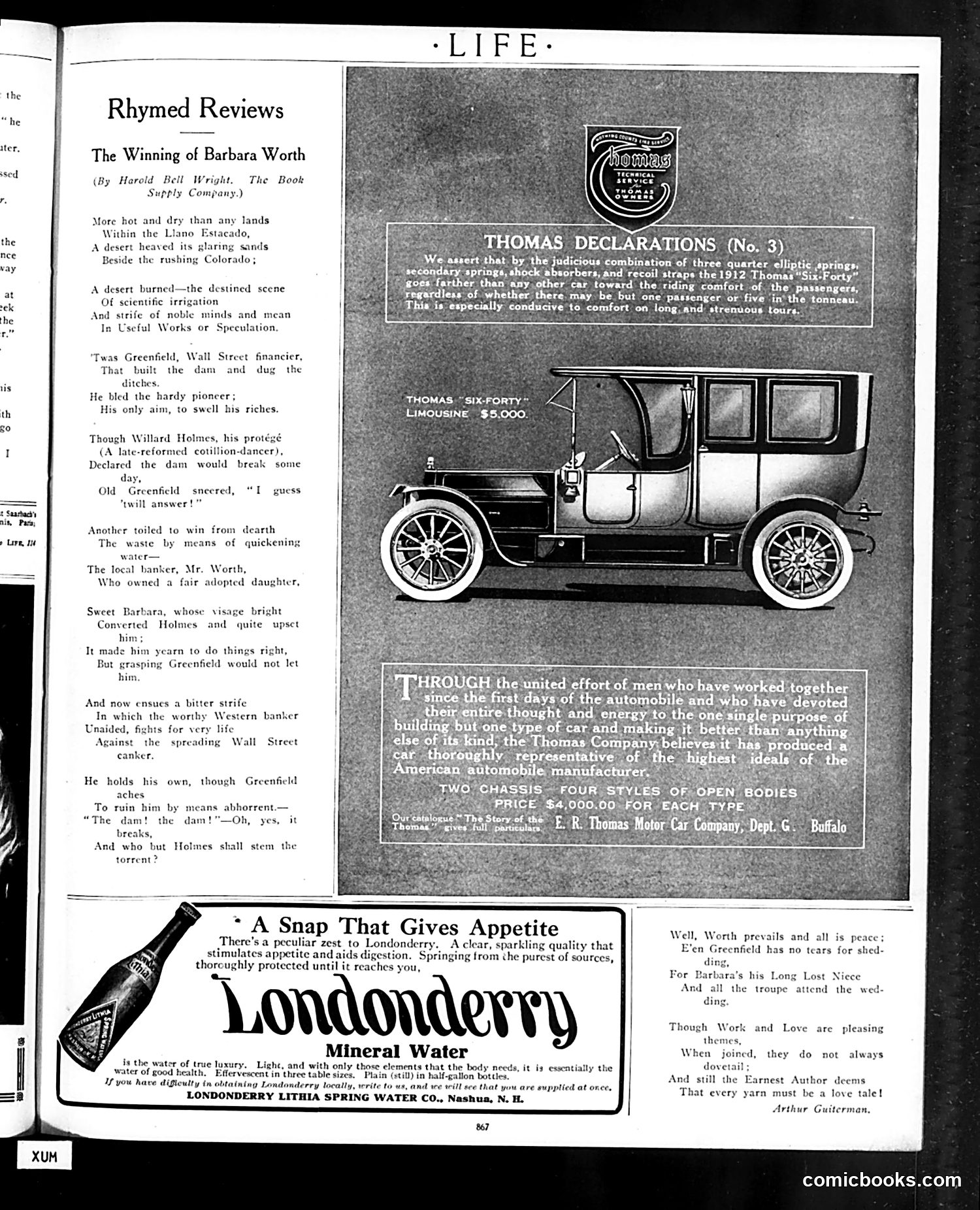
This page reviews Harold Bell Wright's novel through humorous verse. The poem summarizes the plot: a Wall Street financier (Greenfield) exploits Western pioneers by building a dam for profit, while a reformed socialite (Holmes) and a banker (Worth) fight against his greed. A dam breaks, Holmes saves the day, and Worth discovers Barbara is his lost niece—conveniently resolving the romantic and class-conflict tensions. The satire targets both the novel's melodramatic plot and American literary conventions. Critic Arthur Guiterman mocks how Wright forces a love story onto his Western irrigation narrative, suggesting serious fiction often sacrifices coherence for romantic sentiment. The verse gently ridicules the contrived happy ending and the "earnest author's" predictable formula of combining noble work, romantic struggle, and sentimental resolution. The Thomas automobile advertisement represents period product placement, unrelated to the content.
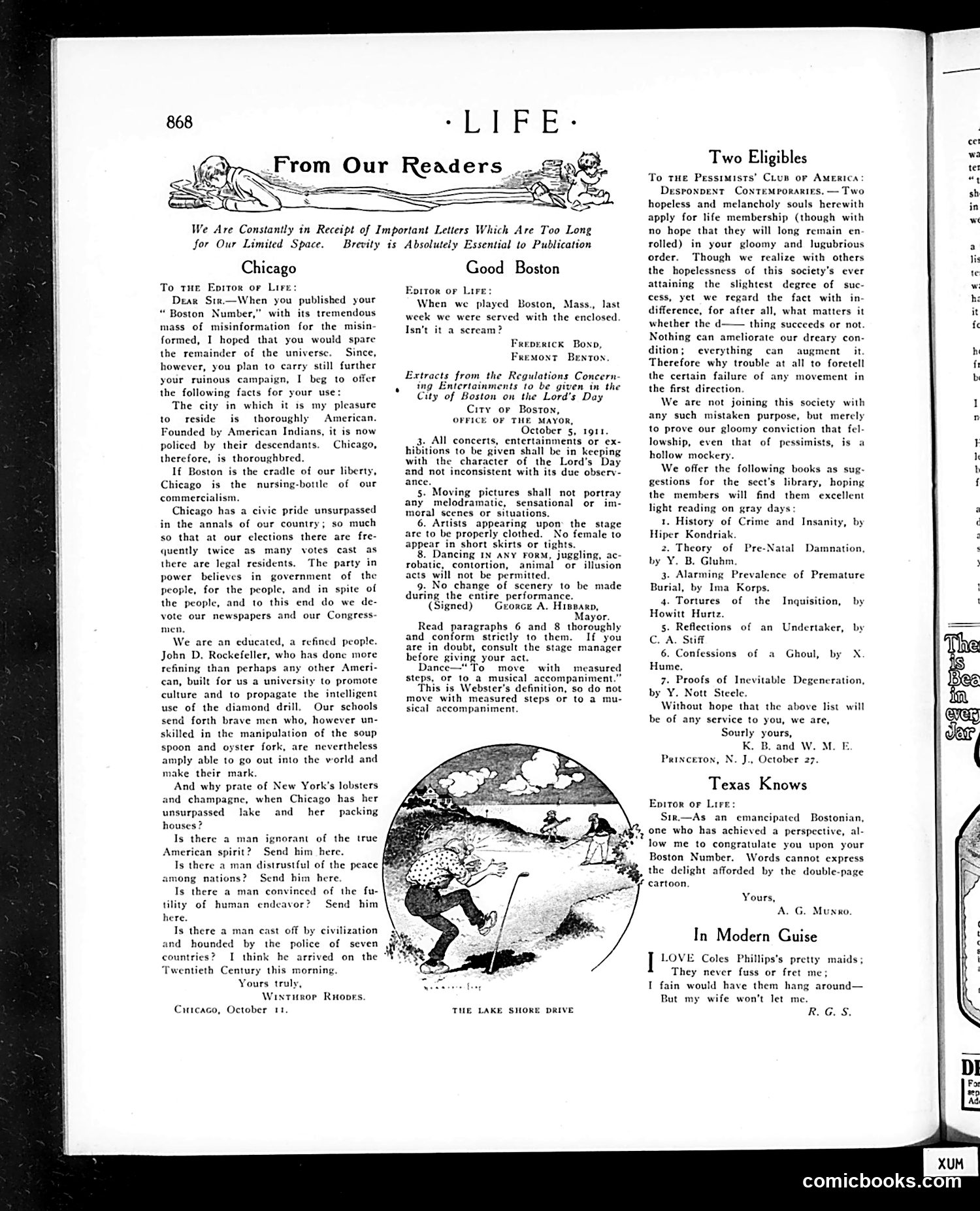
This page contains reader letters satirizing regional American rivalries and municipal censorship. **The Chicago Letter** mocks Boston's self-regard by presenting Chicago as equally proud—but comically so. Writer Winthrop Rhodes claims Chicago is "thoroughly American" (founded by Native Americans), has superior civic pride (voting twice as many ballots as legal voters exist), and attracts America's criminals and desperate. The satire inverts boasts: praising Rockefeller's "refining" while referencing exploitative oil practices, and celebrating the packing industry while subtly critiquing labor conditions. **The Boston Letter** presents actual Boston Sunday entertainment regulations that seem absurdly restrictive—banning female performers in short skirts, all dancing, scenery changes, and "melodramatic" content on the Lord's Day. The regulations' contradictions (defining dancing then forbidding measured movement to music) become self-evident, mocking Puritan moral policing disguised as piety. Both letters use exaggeration and deadpan humor to critique American urban culture, regional provincialism, and religious hypocrisy circa 1911.
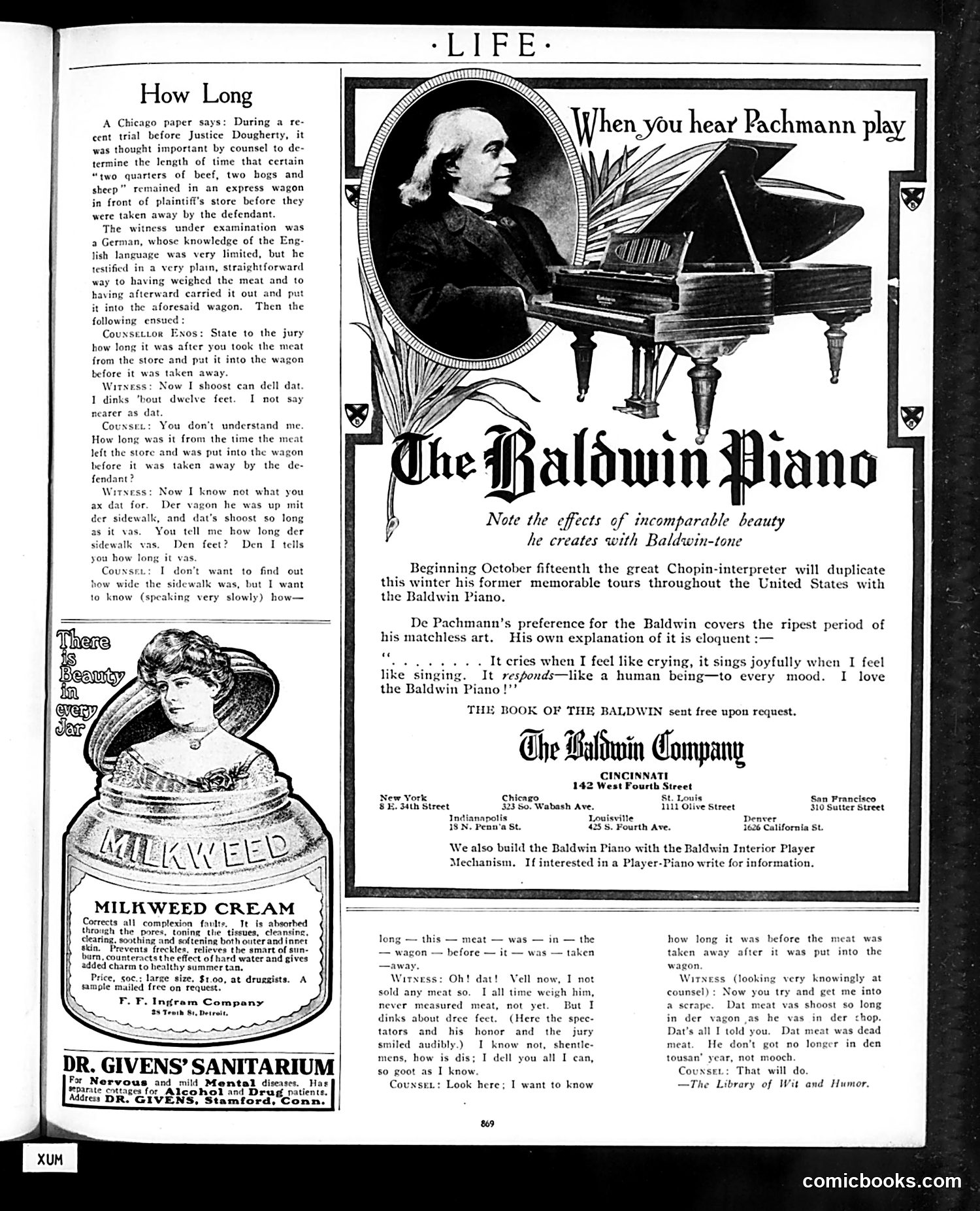
This page contains a humorous courtroom dialogue satirizing language barriers and witness testimony confusion. A German immigrant witness, unable to understand English well, repeatedly misinterprets the lawyer's question about *time duration* as questions about *physical distance*. When asked "how long" the meat remained in the wagon, the witness answers in feet ("dwelve feet"), references the sidewalk's length, and compares the meat's duration to its spatial dimensions. The joke hinges on the witness's literal-minded, language-disabled responses that frustrate the counsel's attempts to establish a simple timeline. The satire mocks both the immigrant's linguistic confusion and the lawyer's inability to clarify his question—a commentary on early-20th-century American attitudes toward foreign-born residents and courtroom absurdities. The accompanying ads (Milkweed Cream, Baldwin Piano, Dr. Givens' Sanitarium) are typical period product placement unrelated to the humor.
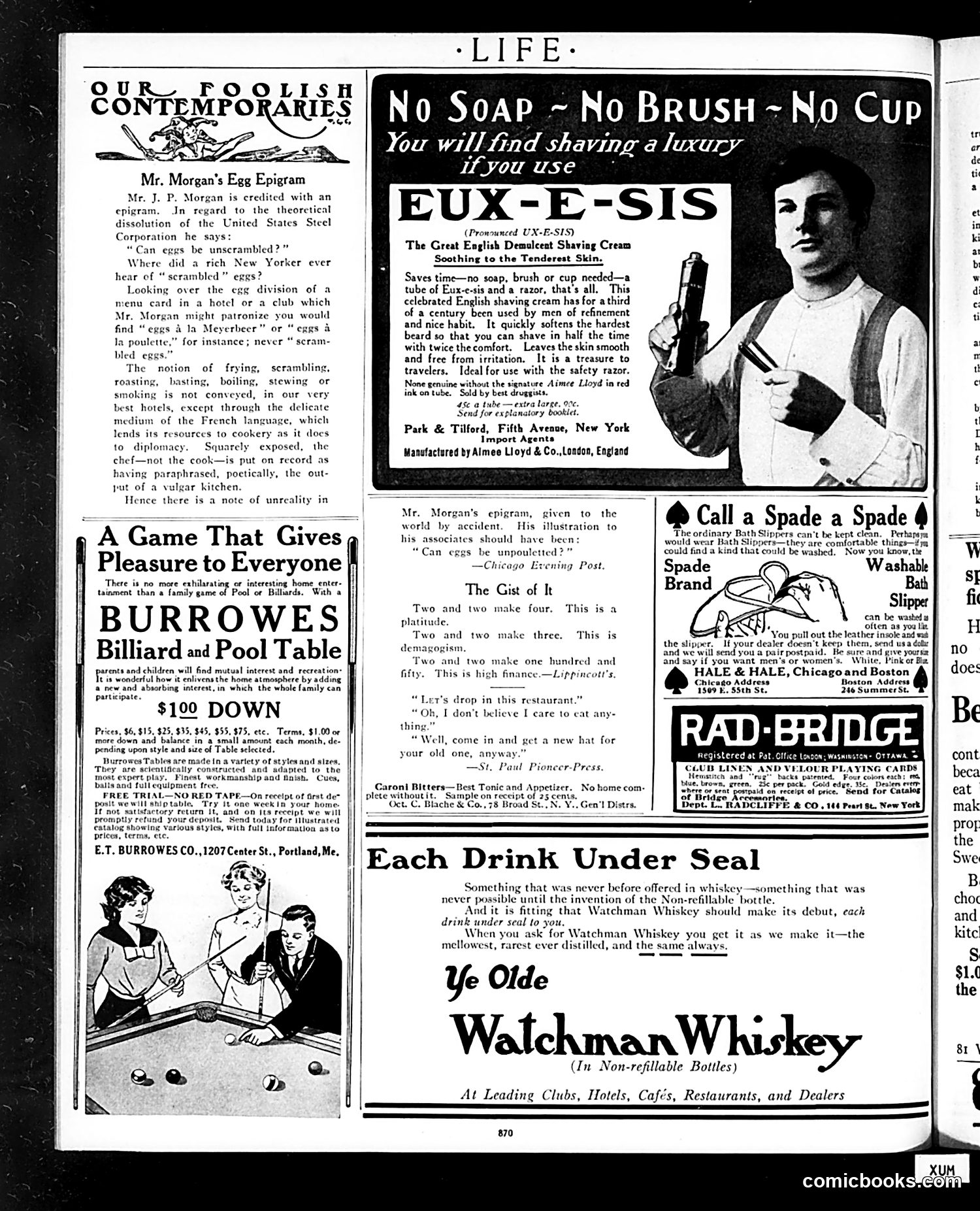
This page is primarily **advertising**, with minimal satire. The notable content includes: **"Mr. Morgan's Egg Epigram"**: A brief satirical piece mocking J.P. Morgan's famous quote "Can eggs be unscrambled?" when discussing U.S. Steel dissolution. The satire points out the absurdity: a wealthy New Yorker would never actually encounter "scrambled eggs" on menus—chefs use pretentious French names instead ("eggs à la Meyerbeer"). The joke critiques both Morgan's tired metaphor and the affected language of high society. **Remaining Content**: The page consists almost entirely of product advertisements (Eux-e-sis shaving cream, Burrowes billiard tables, Watchman Whiskey, etc.) with minor humorous copy. A small cartoon shows people playing pool/billiards. **Modern Context**: To understand the Morgan reference, readers would need to know about early 1900s corporate disputes and Morgan's prominence as a financier. The satire relies on recognizing the gap between wealthy men's public pronouncements and their actual lived experience.
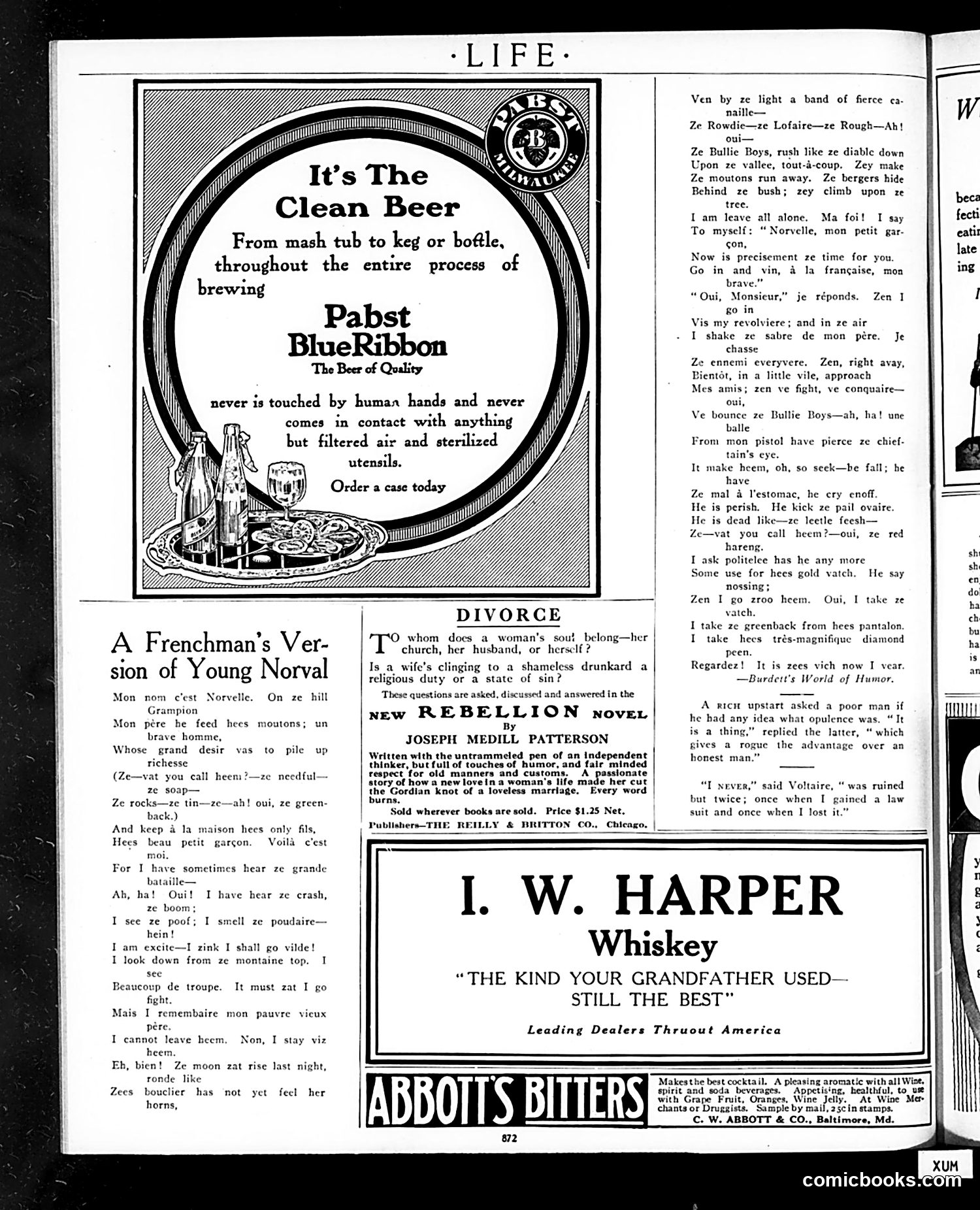
This piece satirizes romantic Scottish literature—likely referencing the sentimental poem "Young Norval" (1808)—by recasting it through a comedic French accent. The narrator is a French boy whose father raises sheep in the Scottish Highlands. When English "ruffians" (the "Bullie Boys") attack, he heroically defends his village, kills their leader, and steals his watch and diamond pin. The satire works through exaggerated French phonetics ("ze," "vat," "zink") and the contrast between pretentious Romantic heroism and crude theft. The joke: the noble Scottish tale becomes a story of a foreigner committing petty robbery while affecting bravery. It mocks both the overwrought sentimentality of the literary source and French stereotypes. The page is primarily **advertisements** (Pabst Blue Ribbon, I.W. Harper Whiskey, Abbott's Bitters, a novel).
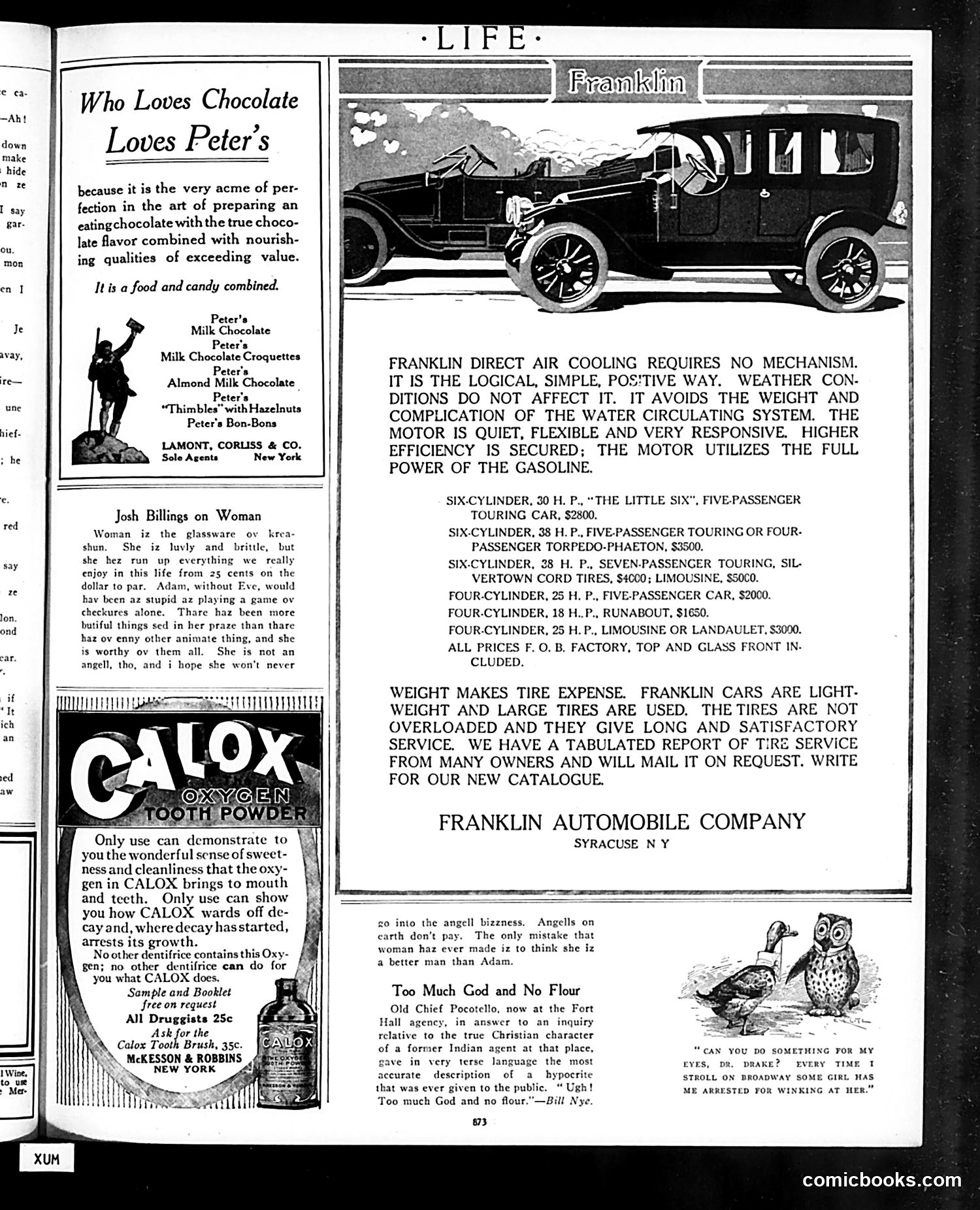
This page is primarily **advertising** with two minor text pieces. The main advertisements feature: - **Peter's Chocolate** (food product) - **Calox Tooth Powder** (dental hygiene) - **Franklin Automobile Company** (vehicles with detailed specifications and pricing) The editorial content includes: **"Josh Billings on Woman"** – A humorous piece using phonetic dialect humor (popular in 19th-century American comedy). It presents backhanded compliments about women, asserting they're valuable yet comparing them unfavorably to men, culminating in the joke that women's only mistake is thinking they're "better man than Adam." **"Too Much God and No Flour"** – A brief anecdote attributed to Bill Nye, quoting Chief Pocatello's criticism of a hypocritical Indian agent. The humor relies on the stereotype of Native American speech patterns and offers a satirical critique of religious hypocrisy. There's also a small cartoon captioned "CAN YOU DO SOMETHING FOR MY EYES, DR. DRAKE?" featuring apparently flirtatious behavior resulting in arrest. These pieces reflect early-20th-century humor conventions heavy on dialect comedy and gentle social satire.
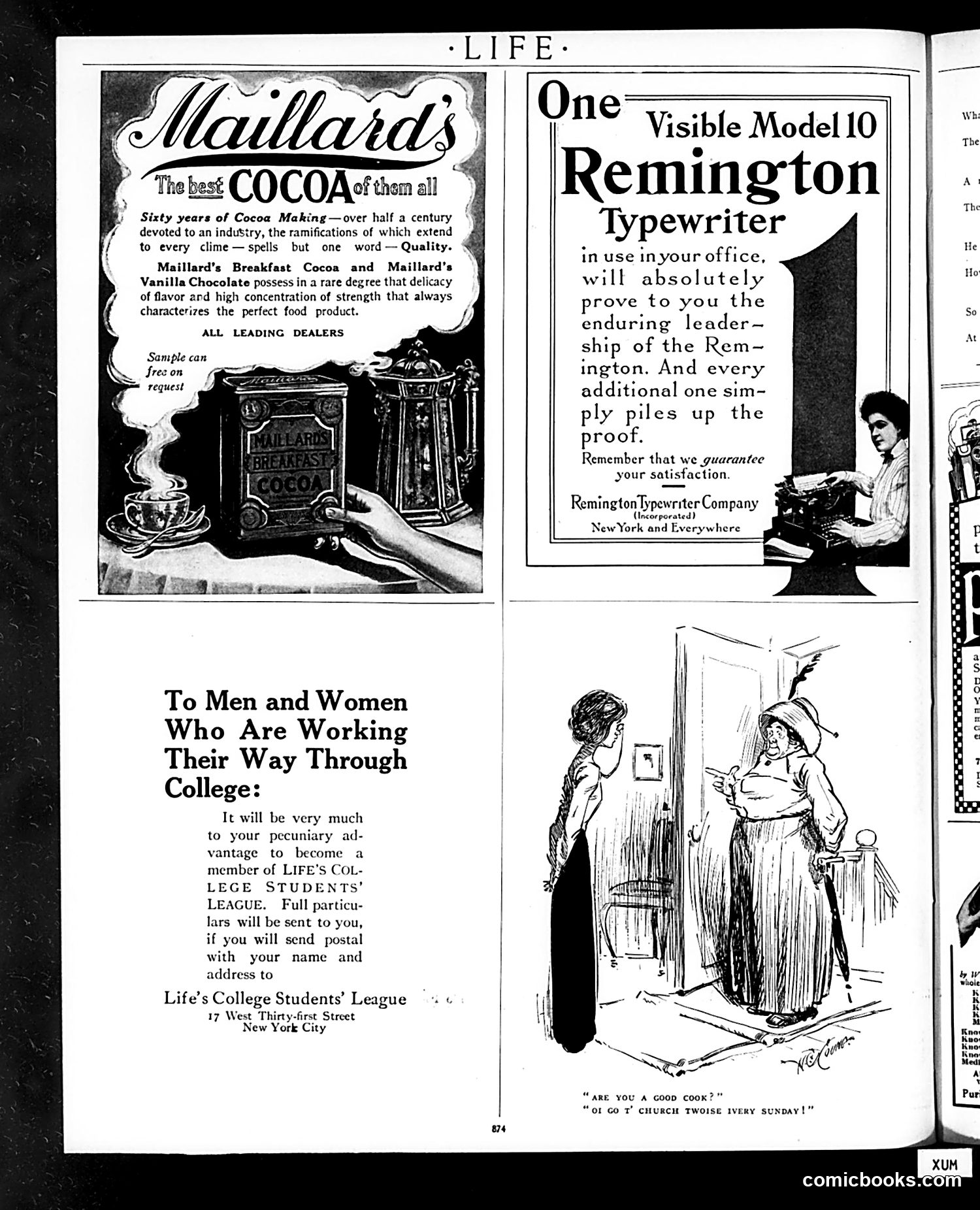
This page contains primarily **advertisements** rather than satirical editorial content. The ads include Maillard's cocoa (emphasizing quality and 60 years of tradition), and a Remington typewriter promoted as an office essential. The single **cartoon** at bottom depicts two women in what appears to be a domestic interior. One asks "Are you a good cook?" The other responds "Of go t' church twice every Sunday!" The joke reflects **early 20th-century gender expectations**: the cartoon satirizes how women might deflect from cooking ability by pointing to religious devotion instead—suggesting either that church attendance was considered an acceptable substitute for domestic skills, or that pious women were assumed competent homemakers regardless of actual cooking ability. It's gentle satire on gendered social assumptions and the priorities placed on women's roles. The page also includes a notice recruiting college students to join Life's College Students' League.
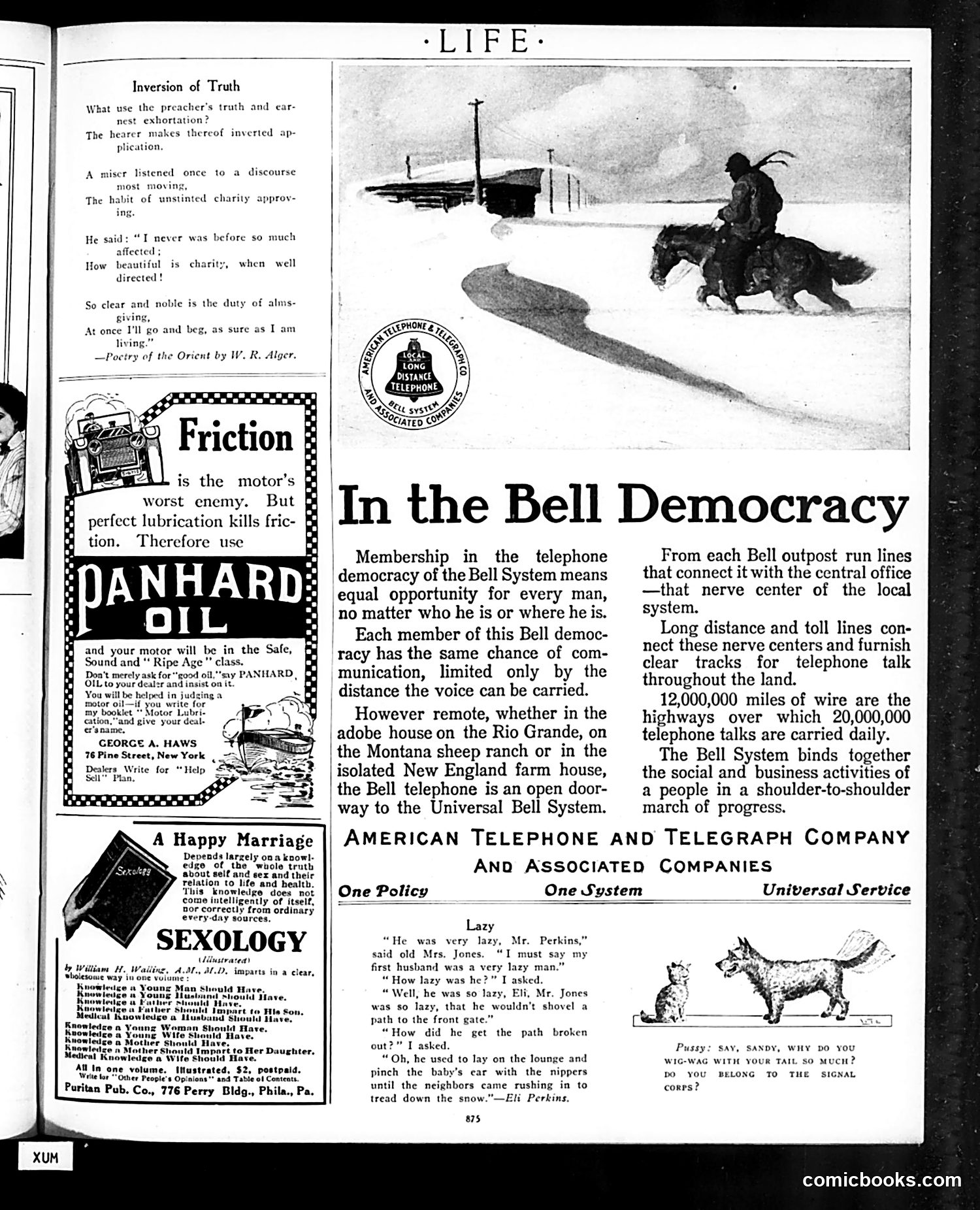
**Main Content:** This page is primarily **advertising**, featuring AT&T's "Bell Democracy" pitch—a corporate propaganda piece equating the telephone system with democratic access and progress. The ad uses statistics (12 million miles of wire, 20 million daily calls) to suggest the Bell System democratically connects all Americans regardless of location or status. **Satirical Elements:** The page includes a literary piece titled "Inversion of Truth" about a miser who hears a sermon on charity but applies it selfishly—the preacher's earnest message gets twisted to serve the listener's existing character. This ironic contrast appears **deliberately juxtaposed** with AT&T's earnest corporate messaging, though whether intentionally satirical or simply editorial placement is unclear. **Bottom Cartoon:** A brief joke about two dogs: one asks why the other wags its tail so much, asking if it "belongs to the signal corps." This plays on World War I–era military terminology, treating the dog's tail-wagging as military signaling. **Overall:** A mix of vintage advertising, light humor, and possibly inadvertent irony.
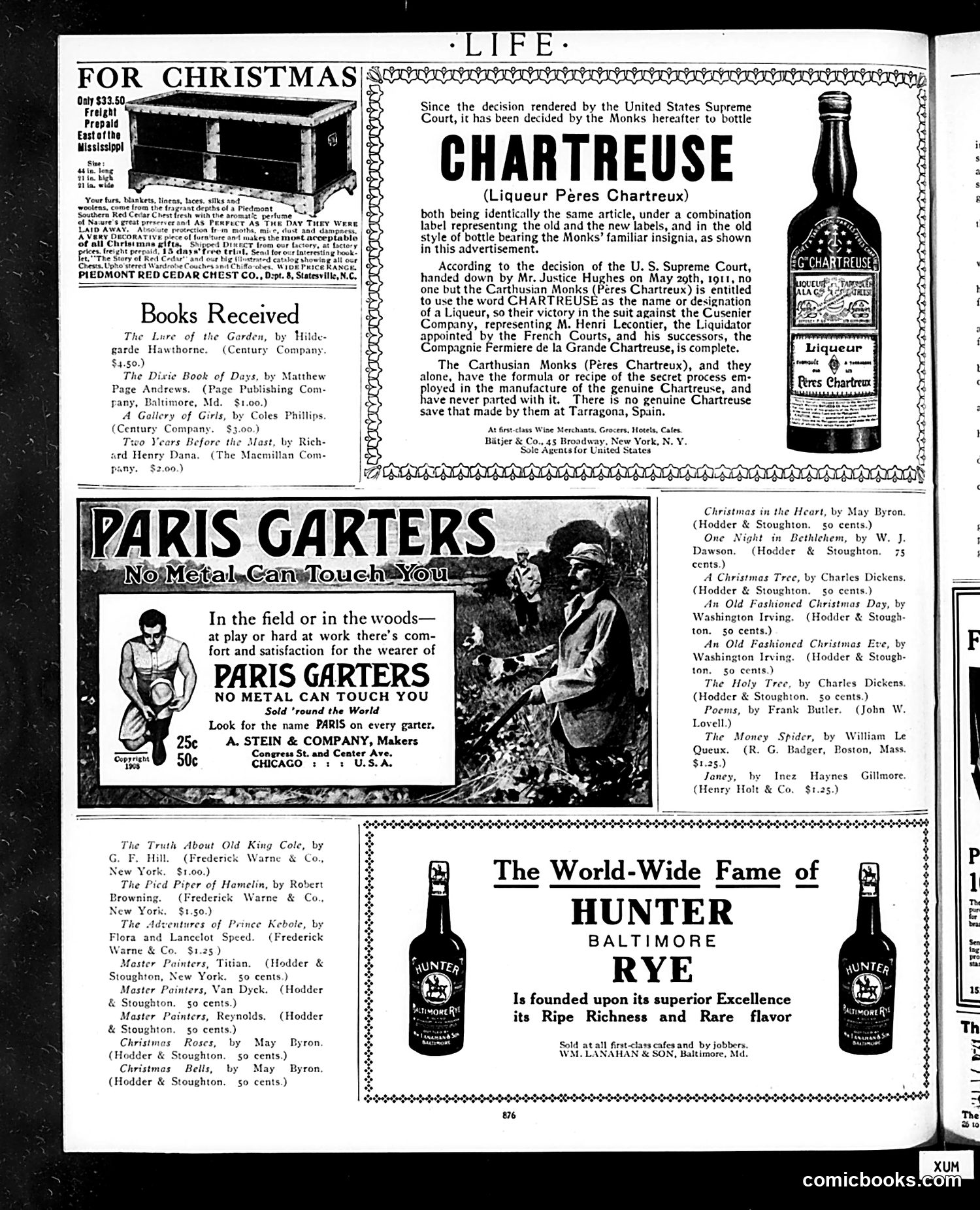
This is primarily **an advertising page** from Life magazine, not a satirical cartoon page. The content centers on holiday gift advertisements and book reviews. The main featured advertisement concerns **Chartreuse liqueur**—specifically a legal dispute resolved by the U.S. Supreme Court (Justice Hughes, May 1911). The text explains that only the **Carthusian Monks (Pères Chartreux) have the right to use the name "Chartreuse"** after winning a lawsuit against a competing company (Cusenier Company). This was significant because it protected the monks' exclusive trademark on their liqueur formula. Below are period advertisements for **Paris Garters** (25-50 cents, marketed as metallic-free) and **Hunter Baltimore Rye** whiskey. The "Books Received" section lists Christmas-themed publications, including works by Charles Dickens and Washington Irving. For modern readers: This represents early 20th-century intellectual property law and holiday consumer culture, with liqueur and spirits prominently advertised alongside classic literature.
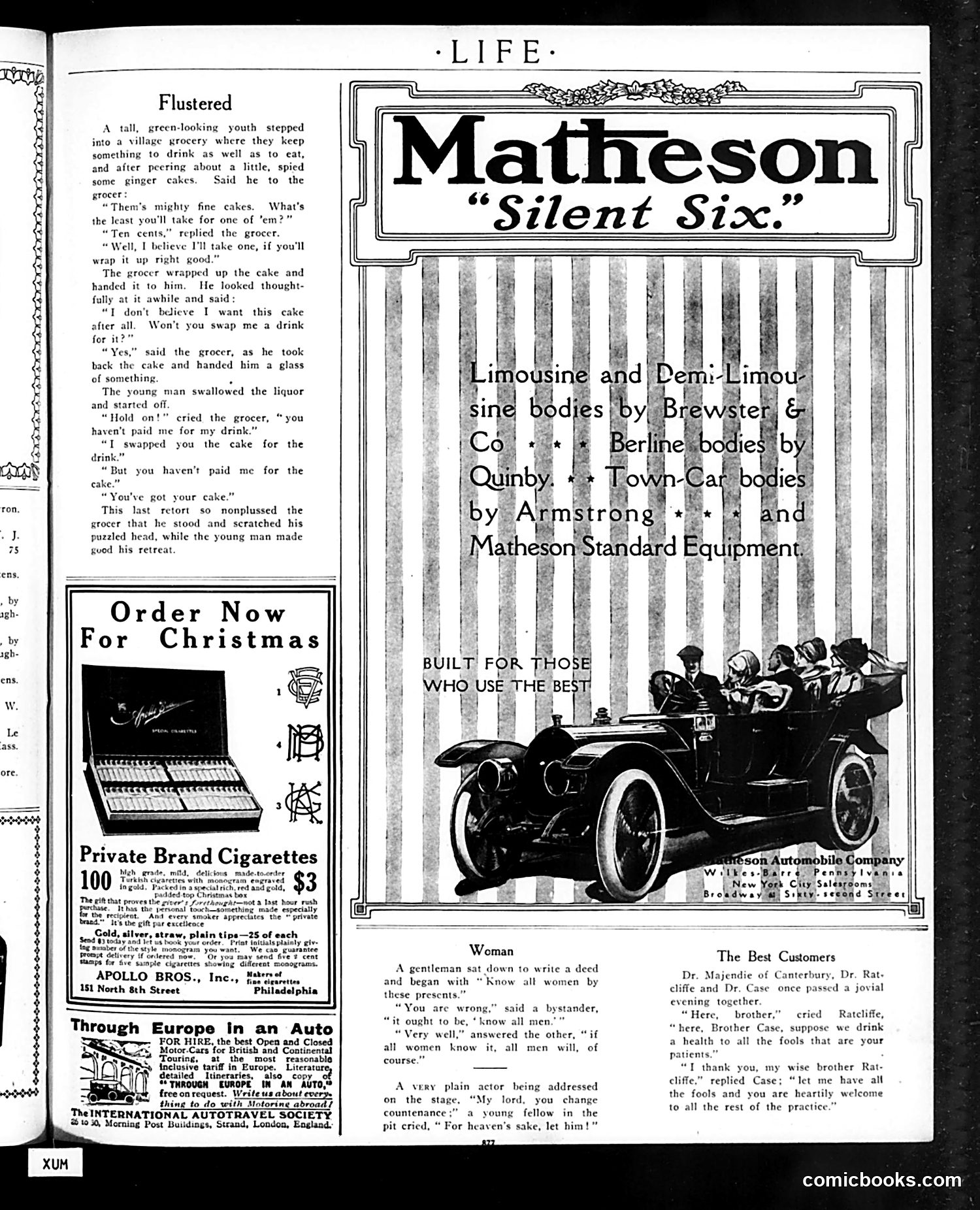
This is a humorous short story illustrating a clever con or logical trap. A sickly young man enters a grocery and purchases a cake for ten cents. He then trades the cake back to the grocer for a drink, consumes it, and leaves without paying for the drink—claiming he already paid via the cake swap. The grocer is caught in a logical bind: he has the cake (so the customer paid for *something*), but the customer consumed the drink without compensation. The joke's point is the customer's cunning exploitation of the transaction's ambiguity—he's essentially gotten a free drink by creating circular reasoning about payment. This reflects period humor valuing wit and quick thinking, even at another's expense. The grocer's "puzzled head" and the customer's successful "retreat" suggest admiration for the young man's cleverness despite his dishonesty.
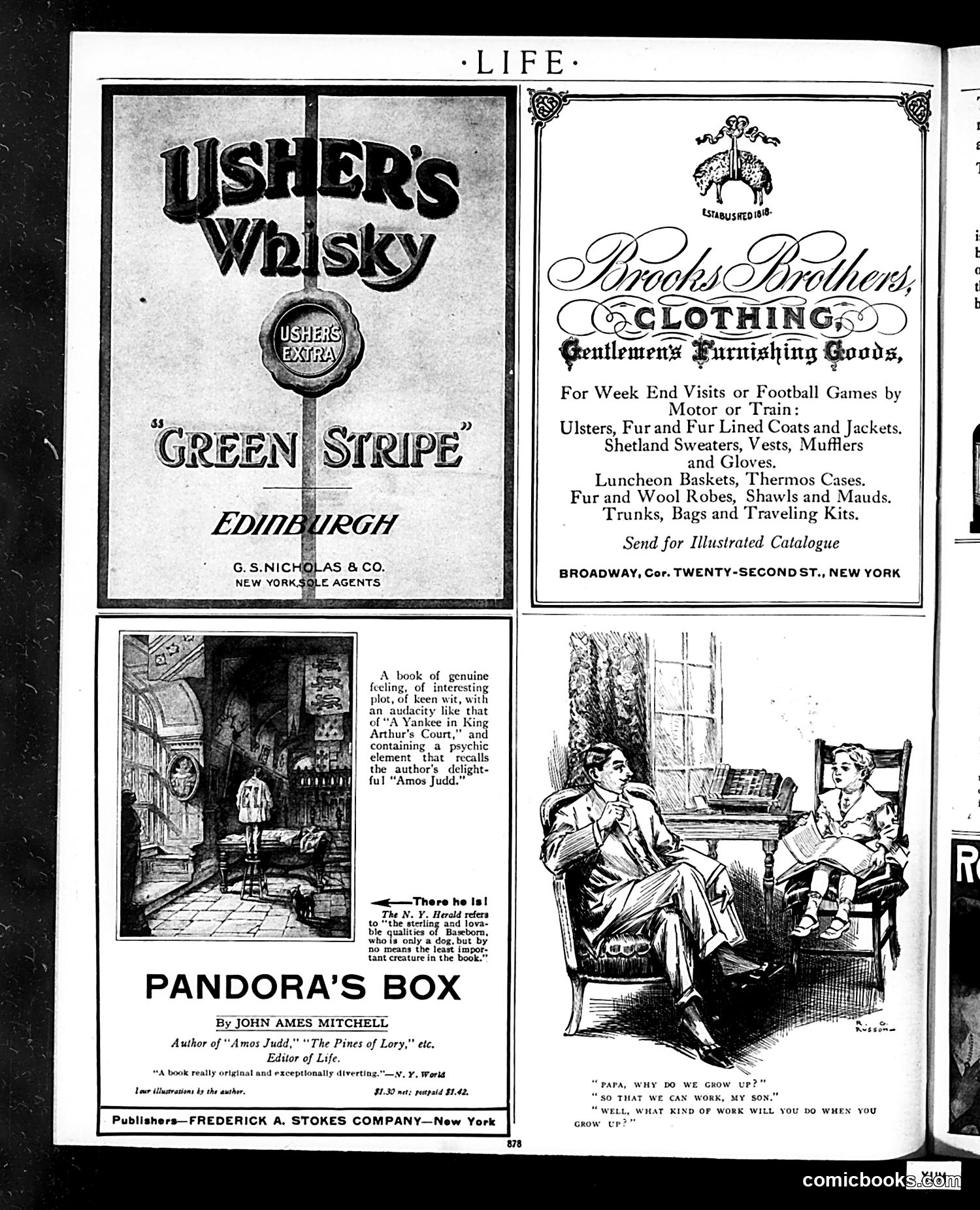
This page is primarily **advertising and promotional content**, not satirical cartoons. It contains: 1. **Usher's Whisky ad** (top left): Standard liquor advertisement featuring the "Green Stripe" brand from Edinburgh, emphasizing Scottish origin. 2. **Brooks Brothers ad** (top right): Upscale clothing merchant advertising gentlemen's furnishings for leisure activities—weekend trips, football games, travel. 3. **"Pandora's Box" book promotion** (bottom left): John James Mitchell (who was *Life* magazine's editor) promoting his own novel, with positive reviews quoted. 4. **"Papa, Why Do We Grow Up?" cartoon** (bottom right): A modest domestic scene with father and child discussing work and growth—appears to be sentimental rather than satirical, possibly promoting a book or story. The page reflects *Life's* primary function as a **commercial vehicle** mixing advertising with literary promotions, typical of early 20th-century American magazines.
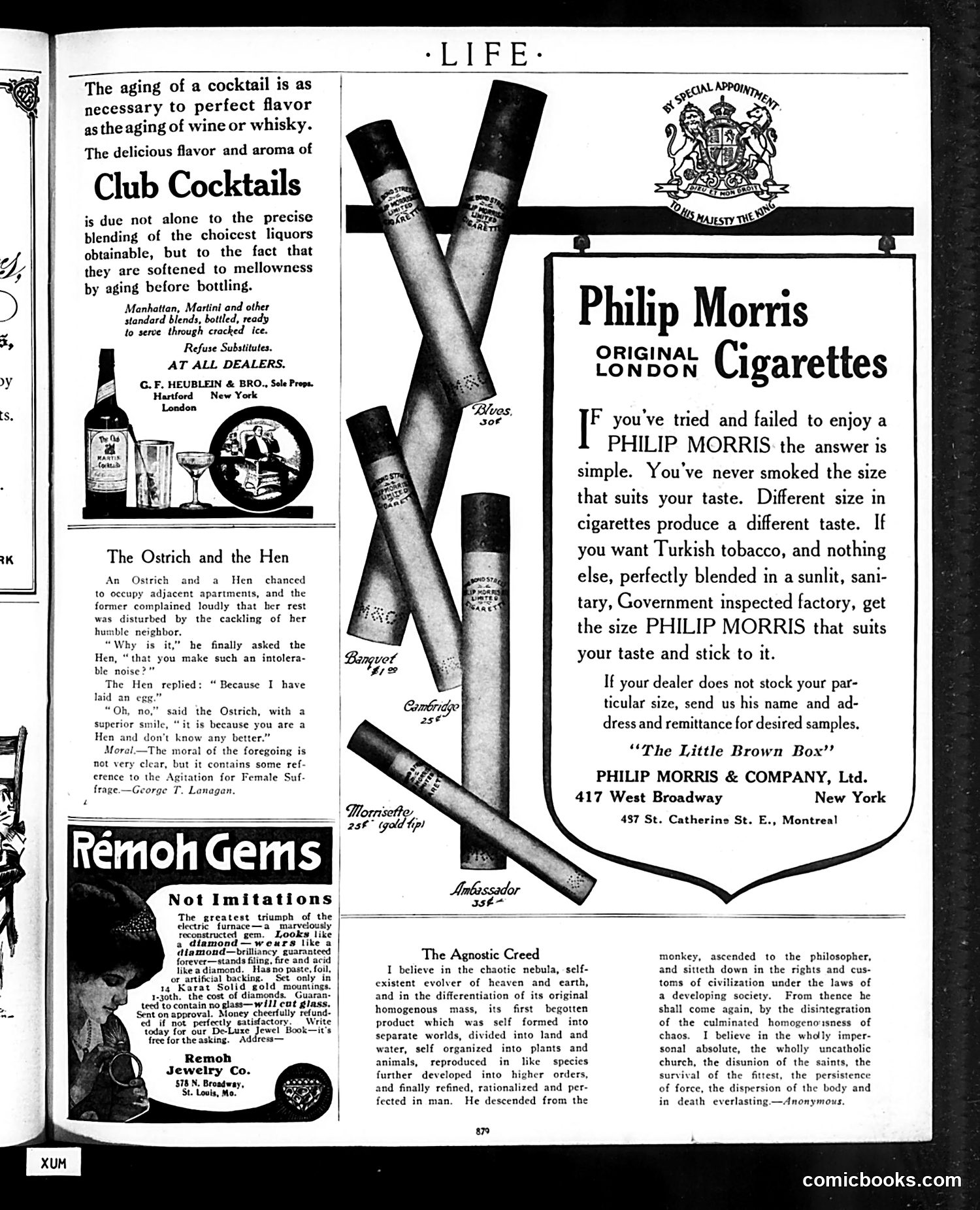
This is primarily an **advertising page** from Life magazine, circa early 20th century, featuring multiple commercial advertisements with one satirical piece embedded. The main advertisements promote **Club Cocktails** (pre-aged cocktail mixers), **Philip Morris cigarettes** (emphasizing Turkish tobacco and size variety), and **Remoh Gems** (synthetic diamonds). The satirical content is "**The Ostrich and the Hen**"—a brief moral fable mocking female suffrage. An ostrich complains about a hen's noise; the hen explains she's laid an egg. The ostrich dismissively replies she makes noise because she's a hen and "doesn't know any better"—implying women are intellectually inferior. The moral suggests women shouldn't have voting rights, using animal behavior as crude analogy. Also included is "**The Agnostic Creed**," presenting evolutionary theory and secular philosophy as a religious catechism—likely satirizing both religious fundamentalists' fears of atheism and agnostic philosophy itself.
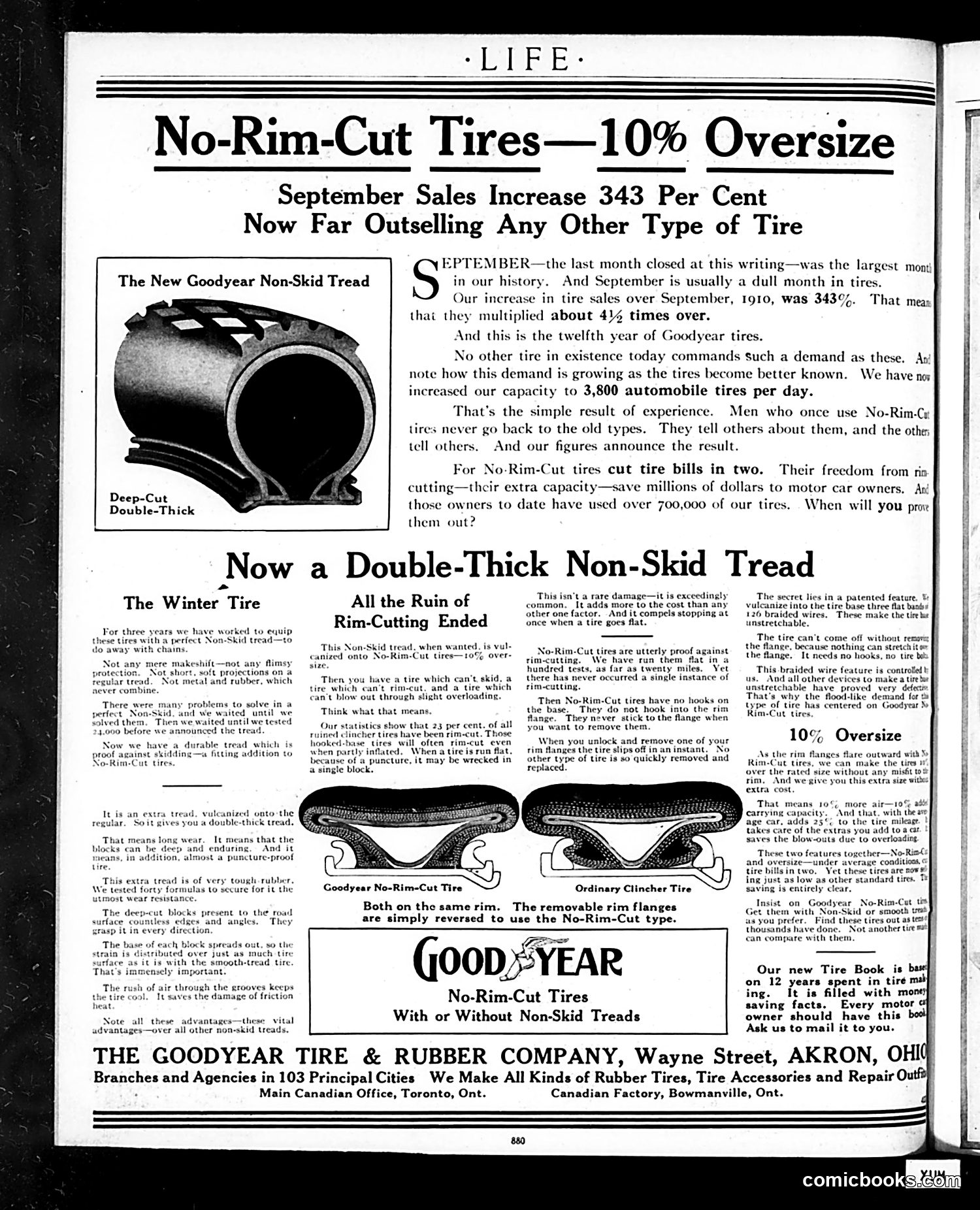
This is a **full-page advertisement**, not satire or political commentary. The Goodyear Tire & Rubber Company is promoting its "No-Rim-Cut" tire technology, which was apparently a significant innovation around 1911. **Key claims being advertised:** - September tire sales increased 343% (a "4½ times over" multiplier) - Over 700,000 of these tires already sold - The tire features a vulcanized "double-thick" tread for winter driving and anti-skid performance - A patented design prevents the tire from slipping off the rim (hence "No-Rim-Cut") - The 10% oversized option provides extra air capacity **For modern readers:** This reflects early-automobile-era marketing—the era when pneumatic tires were still relatively new technology, rim-cutting was a genuine mechanical problem, and driving chains were standard winter equipment. The aggressive sales-increase claims and testimonial approach mirror modern advertising, but the technical problems addressed are entirely obsolete.
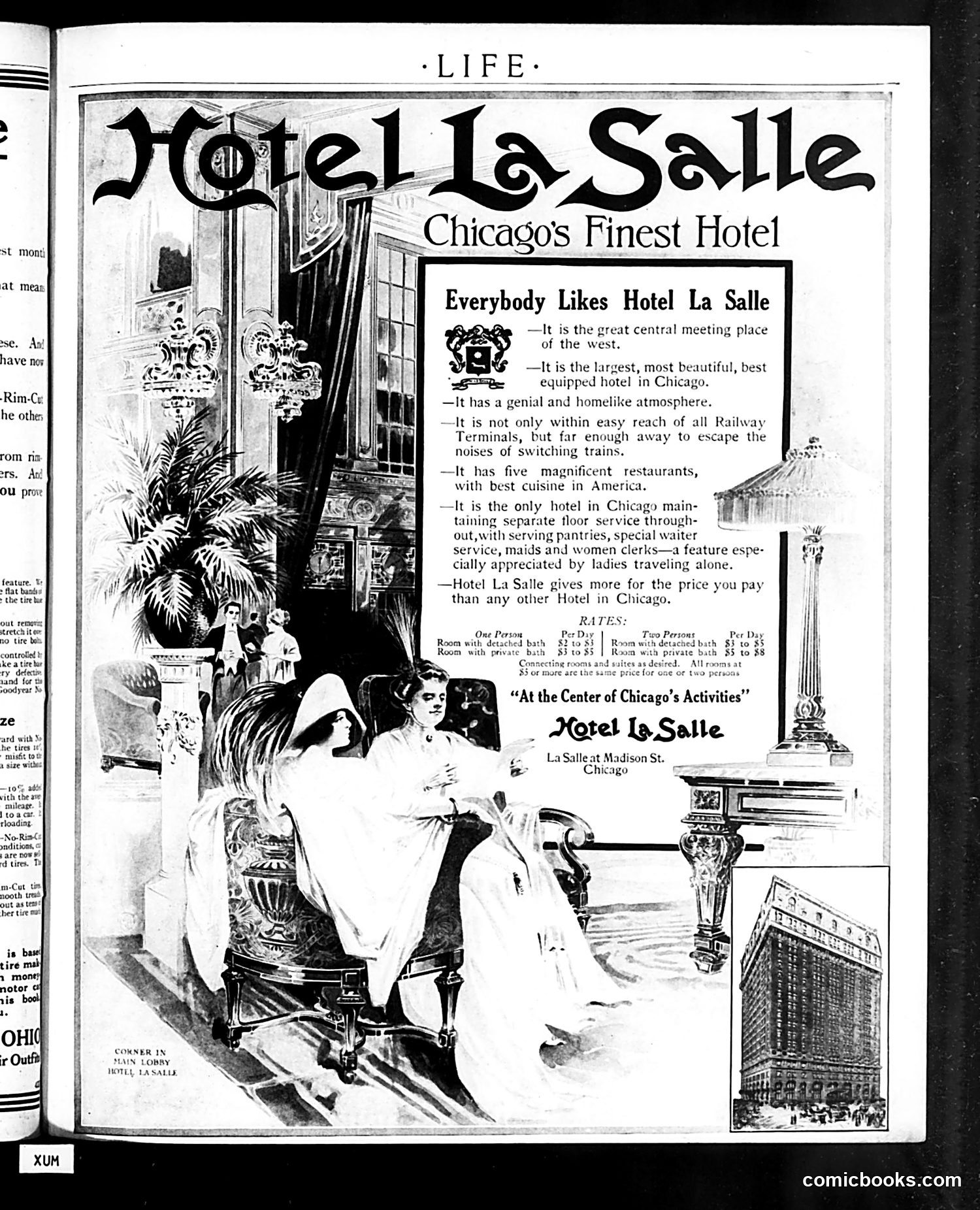
This is a **full-page hotel advertisement**, not political satire. It promotes Chicago's Hotel La Salle as "Chicago's Finest Hotel," positioned at Madison Street "at the center of Chicago's activities." The ad emphasizes luxury amenities: five restaurants, separate floor service, and notably, a women-only floor with female staff—"especially appreciated by ladies traveling alone," reflecting early 20th-century concerns about women's safety and propriety in public spaces. The illustration shows elegantly dressed guests in an ornate lobby with decorative plants and classical columns. The building photograph appears in the lower right corner. This appears in *Life* magazine's advertising section, typical for publications of this era. The layout and typography are characteristic of early 1900s luxury hospitality marketing—appeals to affluence, convenience, and respectability rather than any satirical commentary.
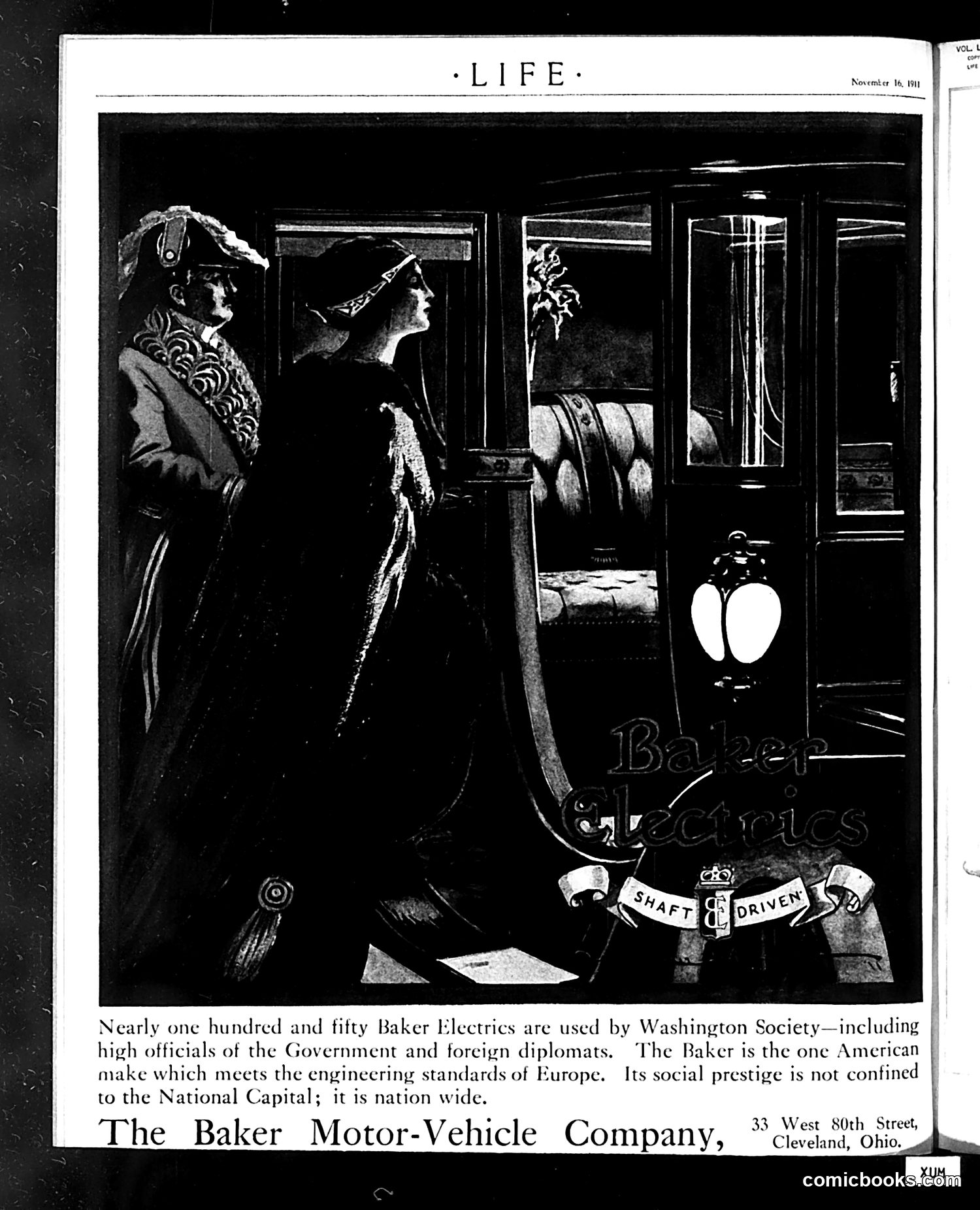
This is primarily a **Baker Electric automobile advertisement**, not political satire. The image depicts two elegantly dressed women—appearing to be of high social standing based on their elaborate clothing and jewelry—examining or entering a Baker Electric vehicle. The advertisement's pitch targets wealthy, socially prominent consumers by claiming Baker Electrics are used by Washington's elite, including government officials and foreign diplomats. The implication is that owning a Baker confers social prestige and meets European engineering standards—positioning it as the sophisticated choice for the upper class. The "Shaft Driven" emblem visible on the vehicle emphasizes technical superiority. This is essentially aspirational marketing: buy this car to join Washington's elite circles. The date (November 18, 1911) places this during the early automobile era when electric vehicles competed with gasoline engines, primarily among wealthy consumers.