
Life, 1911-11-16 · page 24 of 44
Life — November 16, 1911 — page 24: what you’re looking at
What you’re looking at
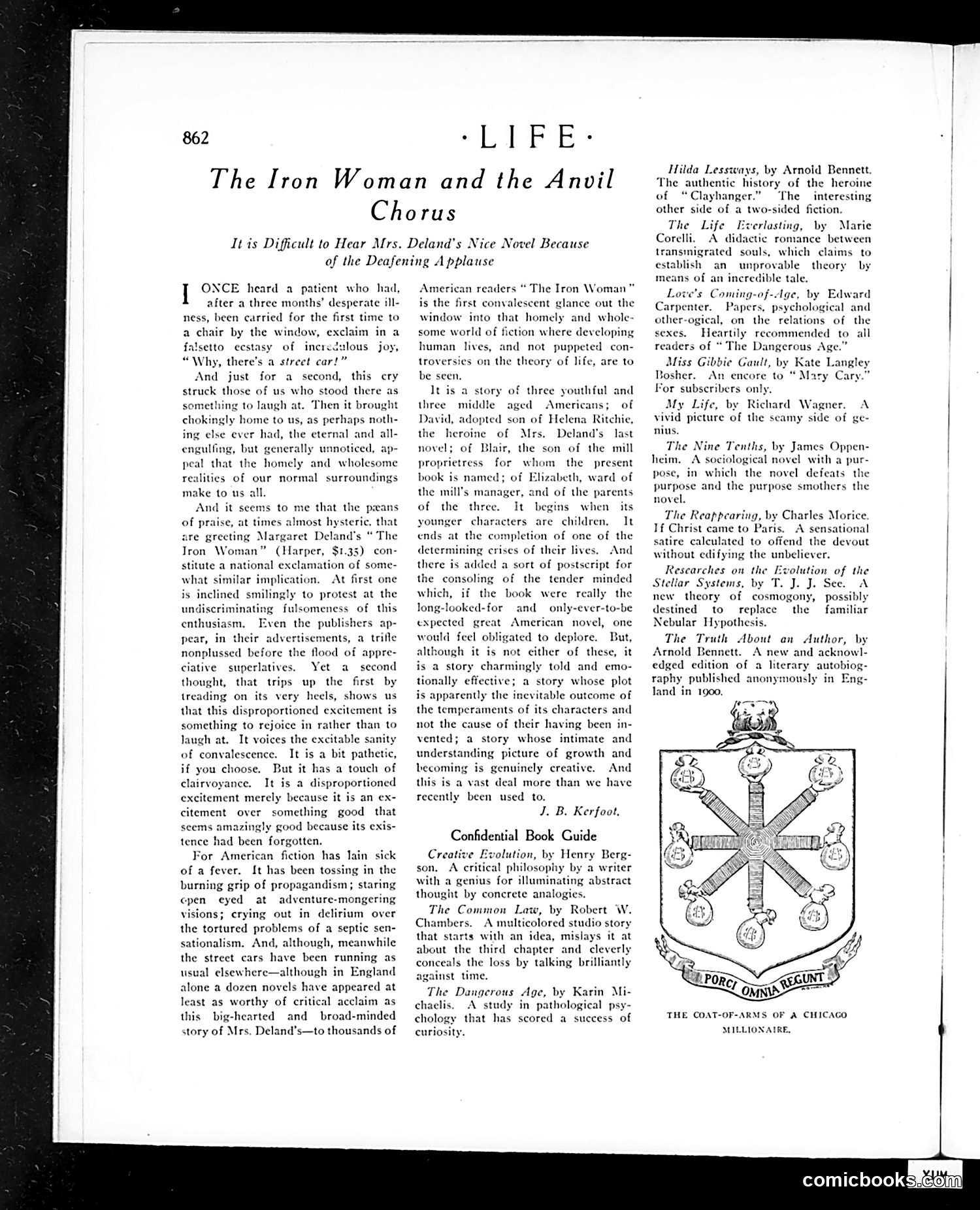
This is a book review essay—not a political cartoon—praising Margaret Deland's novel *The Iron Woman*. The author uses an extended metaphor: American fiction has been "sick with fever," delirious with propagandism and sensationalism. The enthusiastic public reception of Deland's book represents a "convalescent" recovery—a patient glimpsing normalcy again after illness. The review celebrates the novel as a return to wholesome realism focused on human development rather than lurid drama or polemical messaging. The "Iron Woman" title refers to the protagonist, Helena Ritchie. The coat-of-arms illustration on the right is unrelated decorative material (a Chicago millionaire's heraldic emblem), typical of *Life* magazine's layout. This reflects early 1900s literary criticism valuing character-driven domestic fiction over sensationalism.
📄 Transcribed text from this page (OCR, searchable)
Machine-transcribed from the original scan — historical spelling and the odd misread are preserved.
862 “LIP E The Iron Woman and the Anvil Chorus It is Difficult to Hear Mrs. Deland's Nice Novel Because of the Deafening Applause ONCE heard a patient who had, after a three months’ desperate ill- ness, been carried for the first time to a chair by the window, exclaim in a fatsetto ecstasy of incredulous joy, “Why, there's a street car!” And just for a second, this cry struck those of us who stood there as something to laugh at. Then it brought chokingly home to us, as perhaps noth- ing else ever had, the eternal and all- engulfing, but generally unnoticed, ap- peal that the homely and wholesome realities of our normal surroundings to us all. And it seems to me that the pans of praise, at times almost hysteric, that ure greeting Margaret Deland’s “ The Jron Woman” (Harper, $1.35) con- stitute a national exclamation of some- what similar implication. At first one is inclined smilingly to protest at the undiscriminating fulsomeness of this enthusiasm, Even the publishers ap- pear, in their advertisements, a trifle nonplussed before the flood of appre- ciative superlatives. Yet a second thought, that trips up the first by treading on its very heels, shows us that this disproportioned excitement is something to rejoice in rather than to Jaugh at. It voices the excitable sanity of convalescence. It is a bit pathetic, if you choose, But it has a touch of clairvoyance. It is a disproportioned excitement merely because it is an ex- citement over something good that seems amazingly good because its exis- tence had been forgotten. For American fiction has lain sick of a fever. It has been tossing in the burning grip of propagandism; staring cpen eyed at adventure-mongering visions; crying out in delirium over the tortured problems of a septic sen- sationalism. And, although, meanwhile the street cars have been running as usual elsewhere—although in England alone a dozen novels have appeared at least as worthy of critical acclaim as this. big-hearted and broad-minded story of Mrs, Deland’s—to thousands of American readers “ The Iron Woman” is the first convalescent glance out the window into that homely and whole- some world of fiction where developing human lives, and not puppeted con- son the theory of life, are to trovers: be seen. It is a story of three youthful and three middle sed Americans; of David, adopted son of Helena Ritchie, the heroine of Mrs. Deland’s last novel; of Blair, the son of the mill proprietress for whom the present book is named; of Elizabeth, ward of the mill's manager, and of the parents of the three. It begins when its younger characters are children, It at the completion of one of the determining crises of their lives. And there is added a sort of postscript for the consoling of the tender minded which, if the book were really the long-looked-for and only-eve expected great America would feel obligated to deplore. But, although it is not cither of these, it is a story charmingly told and emo- tionally effective; a story whose plot is apparently the inevitable outcome of the temperaments of its characters and not the cause of their having been in- vented; a story whose intimate and understanding picture of growth and becoming is genuinely creative. And this is a t deal more than we have recently been used to. J. B. Kerfoot. Confidential Book Guide Creative Evolution, by Henry Berg- son. A critical philosophy by a writer with a genius for illuminating abstract thought by concrete analog The Common Law, by Robert W. Chambers. A multicolored studio story that starts with an idea, mislays it at about the third chapter and cleverly conceals the loss by talking brilliantly against time. The Dangerous Age, by Karin Mi- chaelis, A study in pathological psy- chology that has scored a success of curiosity. ends to-be n novel, one Hilda Lessways, by Arnoid Bennett The authentic history of the heroine of “Clayhanger.” ‘The _ interesting other side of a two-sided fiction. The Life rlasting, by Marie Corelli. A didactic romance between transmnigrated souls, which claims to establish an unprovable theory by means of an incredible tale. Love's Coming-of-clge, by Edward rpenter. Papers, psychological and cal, on the relations of the Cc other- sexes. Heartily recommended to all readers of “The Dangerous A Miss Gibbie Gault, by Kate Langley Bosher. An encore to “ Mary Cary.” For subscribers only. My Life, by Richard Wagner, A vivid picture of the scamy side of ge- nius. The Nine Tenths, by James Oppen- heim. A sociological novel with a pur- pose, in which the novel defeats the purpose and the purpose smothers the novel, The Reappearing, by Charles Morice. If Christ came to Pa A sensational satire calculated to offend the devout without edifying the unbeliever. Researches on the Evolution of the Stellar Systems, by T. J. J. See. A new theory of cosmogony, possibly destined to replace the familiar Nebular Hypothesis. The Truth About an Author, by Arnold Bennett. A new and acknow edged edition of a literary autobiog raphy published anonymously in En land in 1900, THE COAT-OF-ARMS OF A CHICAGO MILLION AIRI comicbooksscom