
Life, 1911-11-16 · page 18 of 44
Life — November 16, 1911 — page 18: what you’re looking at
What you’re looking at
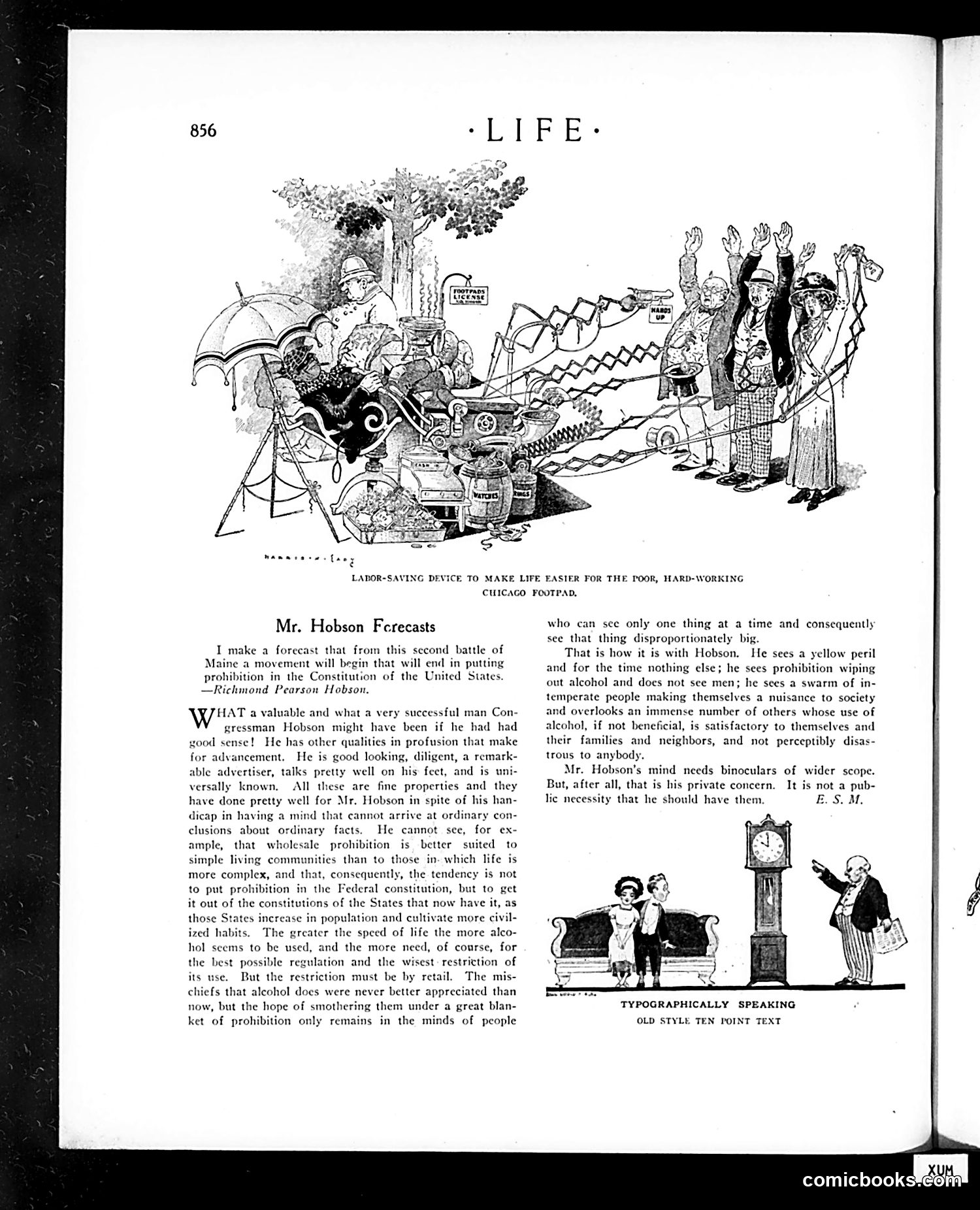
The top cartoon satirizes Chicago crime by depicting a "labor-saving device" supposedly designed to help "the poor, hard-working Chicago footpad" (slang for street criminal/mugger). The elaborate, absurd contraption mocks both criminal ingenuity and the notion that crime requires assistance—a dark joke about Chicago's notorious crime problems. The main article attacks Congressman Richmond Pearson Hobson's advocacy for nationwide alcohol prohibition. The author (E.S.M.) argues Hobson is well-intentioned but intellectually limited, obsessing over prohibition as a cure-all while ignoring social complexities. The piece criticizes single-issue thinking, arguing that alcohol regulation works better at local/state levels in complex urban societies than through federal prohibition. The author suggests Hobson sees only "one thing at a time" and "disproportionately"—a scathing critique of prohibition advocates' tunnel vision during this pre-Prohibition era debate.
📄 Transcribed text from this page (OCR, searchable)
Machine-transcribed from the original scan — historical spelling and the odd misread are preserved.
LADOR-SAVING DEVICE TO MAKE LIFE EASIER FOR THE POOR, HARD-WORKING CUICAGO FOOTPAD, Mr. Hobson Ferecasts I make a forecast that from this second battle of Maine a movement will begin that will end in putting prohibition in the Constitution of the United States. Richmond Pearson Hobson. HAT a valuable and what a very successful man Con- gressman Hobson might have been if he had had good sense! He has other qualities in profusion that make for advancement, He is good looking, diligent, a remark- able advertiser, talks pretty well on his feet, and is uni- versally known. All these are fine properties and they have done pretty well for Mr. Hobson in spite of his han- dicap in having a mind that cannot arrive at ordinary con- clusions about ordinary facts. He cannot see, for ex- ample, that wholesale prohibition is better suited to simple living communities than to those in. which life is more complex, and that, consequently, the tendency is not to put prohibition in the Federal constitution, but to get it out of the constitutions of the States that now have it, as those States increase in population and cultivate more civil- ized habits. The greater the speed of life the more alco- hol seems to be used, and the more need, of course, for the best possible regulation and the wisest: restriction of its use. But the restriction must be by retail. The mis- chiefs that alcohol does were never better appreciated than now, but the hope of smothering them under a great blan- ket of prohibition only remains in the minds of people who can see only one thing at a time and consequently see that thing disproportionately big. That is how it is with Hobson. He sees a yellow peril and for the time nothing else; he sees prohibition wiping out alcohol and does not see men; he sees a swarm of in- temperate people making themselves a nuisance to society and overlooks an immense number of others whose use of alcohol, if not beneficial, is satisfactory to themselves and their families and neighbors, and not perceptibly disas- trous to anybody. Mr. Hobson's mind needs binoculars of wider scope. But, after all, that is his private concern. It is not a pub- lic necessity that he should have them. E.S.M,. TYPOGRAPHICALLY SPEAKING OLD STYLE TEN POINT TEXT comicbookMeum