
Life, 1911-11-16 · page 8 of 44
Life — November 16, 1911 — page 8: what you’re looking at
What you’re looking at
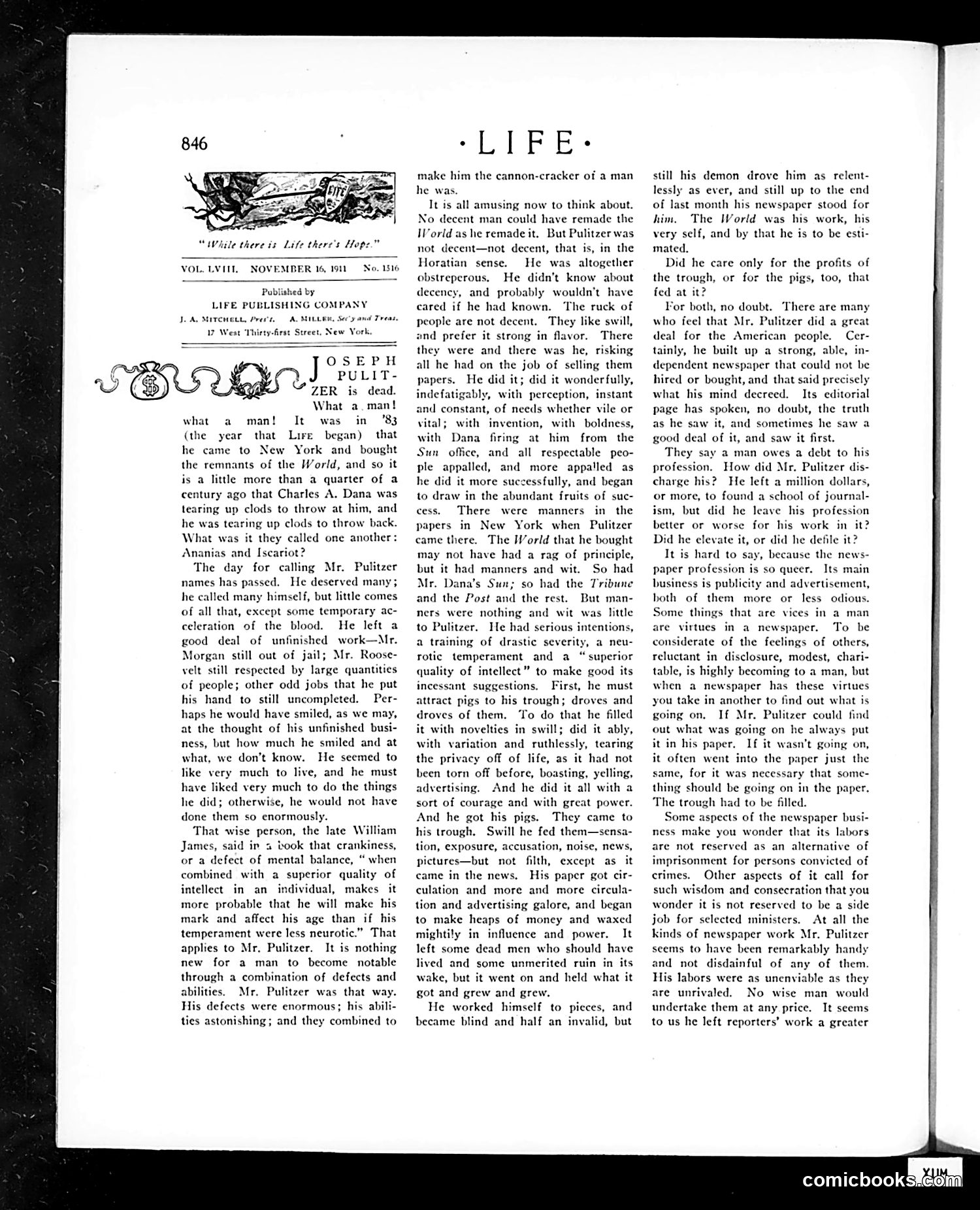
This page from *Life* magazine (Vol. LVIII, November 16, 1911) features an article titled "JOSEPH PULITZER IS DEAD" alongside a small illustration captioned "Where there is Life there's Hope." The article is a satirical obituary-style essay about the recently deceased newspaper publisher Joseph Pulitzer. The text critiques Pulitzer's aggressive, sensationalist journalism style—his use of "pigs," "doves," and "novelties" to attract readers and boost circulation and advertising revenue. The author suggests Pulitzer's methods were manipulative yet effective, transforming his newspaper into a powerful influence despite lacking principle. The piece reflects turn-of-the-century debates about journalistic ethics, questioning whether Pulitzer's commercial success represented progress or moral compromise in American publishing.
📄 Transcribed text from this page (OCR, searchable)
Machine-transcribed from the original scan — historical spelling and the odd misread are preserved.
No. 1516 Lat, NOVEMBER 16, 1911 Published by LIFE PUBLISHING COMPANY AL MILLER, See'y Sew York. J. AL MITCHELL, Preset, Treas. first Street, OSEPH J PULIT- SZER is dead. What a. man! what a man! It was in '83 (the year that Lire began) that he came to New York and bought the remnants of the World, and so it is a little more than a quarter of a century ago that Charles A. Dana was tearing up clods to throw at him, and he was tearing up clods to throw back. What was it they called one another: Ananias and Iscariot? The day for calling Mr. Pulitzer names has passed. He deserved many; he called many himself, but little comes of all that, except some temporary ac- celeration of the blood. He left a good deal of unfinished work—Mr. Morgan still out of jail; Mr. Roose- velt still respected by large quantities of people; other odd jobs that he put his hand to still uncompleted. Per- haps he would have smiled, as we may, at the thought of his unfinished busi- ness, but how much he smiled and at what, we don’t know. He seemed to like very much to live, and he must have liked very much to do the things he did; otherwise, he would not have done them so enormously. That wise person, the late William James, said ir a book that crankiness, or a defect of mental balance, “ when combined with a superior quality of intellect. in an individual, makes it more probable that he will make his mark and affect his age than if his temperament were less neurotic.” That applies to Mr, Pulitzer. It is nothing new for a man to become notable through a combination of defects and abilities. Mr, Pulitzer was that way His defects were enormous; his abili- ties astonishing; and they combined to LIFE make him the cannon-cracker of a man he was. It is all amusing now to think about. No decent man could have remade the World as he remade it. But Pulitzer was not decent—not decent, that is, in the Horatian sense. He was altogether obstreperous. He didn’t know about decency, and probably wouldn't have cared if he had known. The ruck of people are not decent. They like swill, and prefer it strong in flavor. There they were and there was he, risking all he had on the job of selling them papers. He did it; did it wonderfully, indefatigably, with perception, instant and constant, of needs whether vile or vital; with invention, with boldness, with Dana firing at him from the Sun office, and all respectable peo- ple appalled, and more appalled as he did it more successfully, and began to draw in the abundant fruits of suc- cess. There were manners in the papers in New York when Pulitzer came there. The World that he bought may not have had a rag of principle, but it had manners and wit. So had Mr. Dana’s Sun; so had the Tribune and the Post and the rest. But man- ners were nothing and wit was little to Pulitzer. He had serious intentions, a training of drastic severity, a neu- rotic temperament and a “ superior quality of intellect” to make good its incessant suggestions. First, he must attract pigs to his trough; droves and droves of them. To do that he filled it with novelties in swill; did it ably, with variation and ruthlessly, tearing the privacy off of life, as it had not been torn off before, boasting, yelling, advertising. And he did it all with a sort of courage and with great power. And he got his pigs. They came to his trough, Swill he fed them—sensa- tion, exposure, accusation, noise, news, pictures—but not filth, except as it came in the news. His paper got cir- culation and more and more circula- tion and advertising galore, and began to make heaps of money and waxed mightily in influence and power. It left some dead men who should have lived and some unmerited ruin in its wake, but it went on and held what it got and grew and grew. He worked himself to pieces, and became blind and half an invalid, but still his demon drove him relent- lessly as ever, and still up to the end of last month his newspaper stood for him, The World was his work, his very self, mated. Did he care only for the profits of the trough, or for the pigs, too, that fed at it? For both, no doubt. There are many who feel that Mr, Pulitzer did a great deal for the American people. Cer- tainly, he built up a strong, able, in- dependent newspaper that could not be hired or bought, and that said precisely what his mind decreed. Its editorial page has spoken, no doubt, the truth as he saw it, and sometimes he saw a good deal of it, and saw it first. They say a man owes a debt to his profession. How did Mr. Pulitzer dis- charge his? He left a million dollars, or more, to found a school of journal- sm, but did he leave his profession better or worse for his work in it? Did he elevate it, or did he defile it? It is hard to say, because the news- paper profession is so queer. Its main business is publicity and advertisement, both of them or less odious. Some things that are vices in a man are virtues in a newspaper. To be considerate of the feelings of others, reluctant in disclosure, modest, chari- table, is highly becoming to a man, but when a newspaper has these virtues you take in another to find out what is going on, If Mr. Pulitzer could find out what was going on he always put it in his paper, If it wasn’t going on, it often went into the paper just the same, for it was necessary that some- thing should be going on in the paper. The trough had to be filled. Some aspects of the newspaper busi- ness make you wonder that its labors are not reserved as an alternative of imprisonment for persons convicted of crimes. Other aspects of it call for such wisdom and consecration that you wonder it is not reserved to be a side job for selected ministers. At all the kinds of newspaper work Mr. Pulitzer seems to have been remarkably handy and not disdainful of any of them. His labors were as uncnviable as they are unrivaled. No wise man would undertake them at any price. It seems to us he left reporters’ work a greater and by that he is to be esti- more comicbookMen a