
Life, 1911-11-16 · page 20 of 44
Life — November 16, 1911 — page 20: what you’re looking at
What you’re looking at
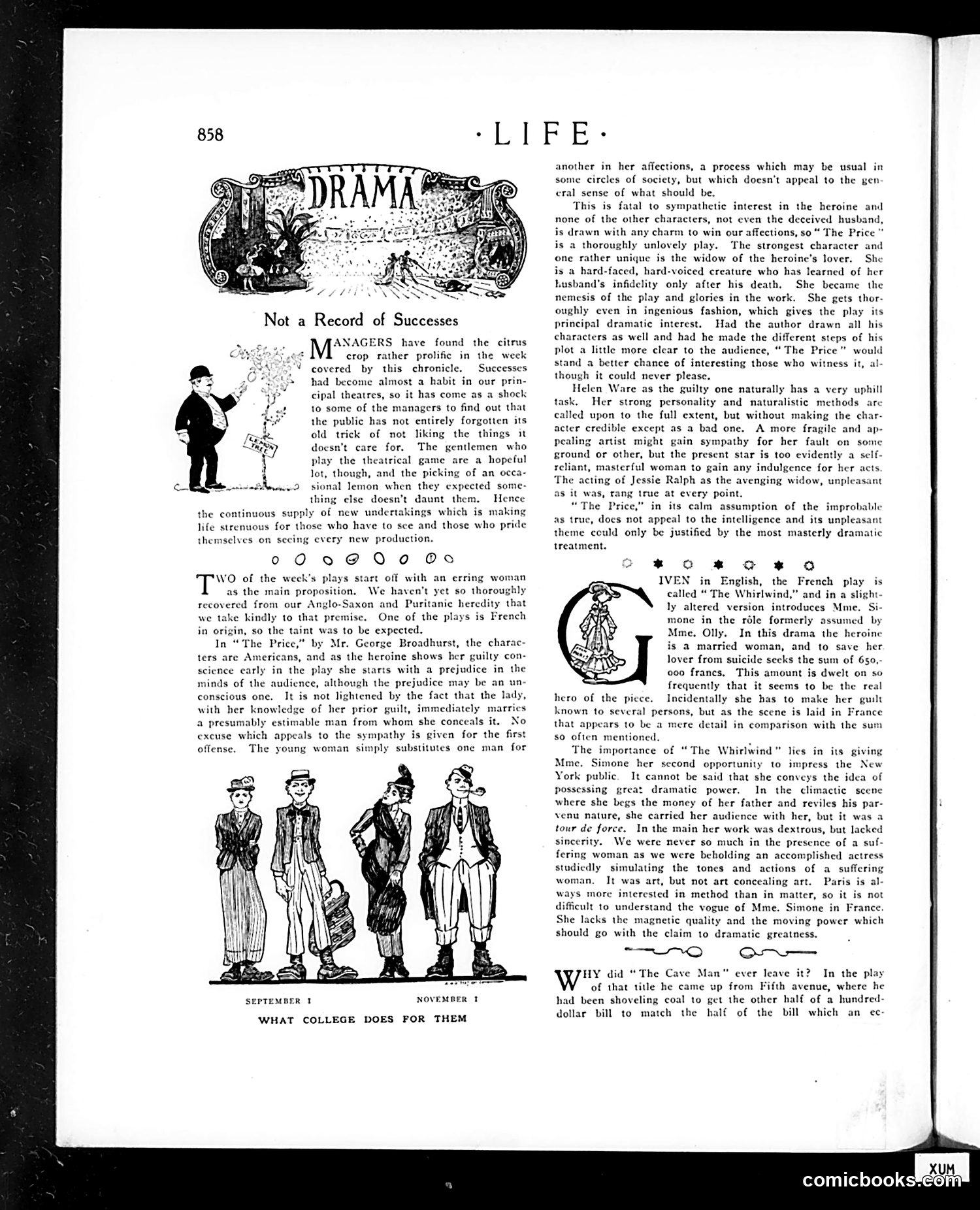
This theater column critiques two recent Broadway plays, adopting a sardonic tone about theatrical success. The writer notes that managers are shocked when audiences reject shows—implying New York producers habitually overestimate public appetite for mediocre work. "The Price," a George Broadhurst play, centers on an American woman who conceals a prior affair from her new husband. The critic condemns it as dramatically inert because audiences cannot sympathize with the protagonist's deception. The sole compelling character is the wronged widow seeking revenge—a morally questionable figure who paradoxically becomes the play's emotional anchor. Helen Ware, cast as the guilty woman, struggles because her "strong personality" makes her unsympathetic rather than tragic. Jessie Ralph's vengeful widow performs more effectively. The second play, "The Whirlwind" (a French work adapted for English stages), features actress Mme. Simone in a similar "morally compromised woman" role, though here she's married and steals money for her lover. The satirical thrust: Broadway's obsession with "erring women" plots reflects lingering Puritanical squeamishness, yet these plays fail because they neither justify nor humanize their female characters' transgressions.
📄 Transcribed text from this page (OCR, searchable)
Machine-transcribed from the original scan — historical spelling and the odd misread are preserved.
*LIFE: Not a Record of Successes ANAGERS have found the citrus crop rather prolific in the week covered by this chronicle. Successes had become almost a habit in our prin- cipal theatres, so it has come as a shock to some of the managers to find out that the public has not entirely forgotten its old trick of not liking the things it doesn't care for. The gentlemen who y the theatrical game are a hopeful lot, though, and the picking of an occa- sional lemon when they expected sor thing else doesn’t daunt them. Hence the continuous supply of new undertakings which is making life strenuous for those who have to sce and those who pride themselves on secing every new production. 0009000 086 WO of the week’s plays start off with an erring w as the main proposition, We haven't recovered from our Anglo-Saxon and Puritanic heredity that we take kindly to that premise. One of the plays is French n origin, so the taint was to be expected. In “The Price,” by Mr. George Broadhurst, the charac- ters are Americans, and as the heroine shows her guilty con- science early in the play she starts with a prejudice in the minds of the audience, although the prejudice may be an un- conscious one. It is not lightened by the fact that the lady, with her knowledge of her prior guilt, immediately marries a presumably estimable man from whom she conceals it, No excuse which appeals to the sympathy is given for the first offense. The young woman stitutes one man for SEPTEMBER 1 NOVEMBER T WHAT COLLEGE DOES FOR THEM another in her affections, a process which may be usual in some circles of society, but which doesn’t appeal to the gen eral sense of what should be. This is fatal to sympathetic interest in the heroine and none of the other characters, not even the deceived husband, is drawn with any charm to win our affections, so“ The Price” is a thoroughly unlovely play. The strongest character and one rather unique is the widow of the heroinc’s lover. She is a hard-faced, hard-voiced creature who has learned of her husband's infidelity only after his death, She became the nemesis of the play and glories in the work. She gets thor- oughly even in ingenious fashion, which gives the play its principal dramatic interest. Had the author drawn all his characters as well and had he made the different steps of his plot a little more clear to the audience, “The Price” would stand a better chance of interesting those who witness it, al- though it could never please. Helen Ware as the guilty one naturally has a very uphill task. Her strong personality and naturalistic methods are called upon to the full extent, but without making the char acter credible except as a bad one. A more fragile and ap pealing artist might gain sympathy for her fault on some ground or other, but the present star is too evidently a sclf- reliant, masterful woman to gain any indulgence for her The acting of Jessie Ralph as the as it was, rang true at every point, “The Price,” in its calm assumption of the improbable as true, docs not appeal to the intelligence and its unpleasant theme could only be justified by the most masterly dr: treatment. enging widow, unpleasant eo *# GO € 6 IVEN in English, the French play is called “ The Whirlwind,” and in a slight- ly altered version introduces Mme. Si- mone in the role formerly assumed by Mme. Olly. In this drama the heroine is a married woman, and to save her lover from suicide secks the sum of 650, 000 francs, This amount is dwelt on so frequently that it seems to be the real hero of the piece. Incidentally she bas to make her guilt known to several persons, but as the scene is laid in France that appears to be a mere detail in comparison with the sum so often mentioned. The importance of “The Whirlwind" lies in its giving Mme. Simone her second opportunity to impress the New York public. It cannot be said that she conveys the idea of possessing great dramatic power. In the climactic scene where she begs the moncy of her father and reviles his par- venu nature, she carried her audience with her, but it was a tour de force. In the main her work was dextrous, but lacked sincerity, We were never so much in the presence of a suf- fering woman as we were beholding an accomplished actress studiedly simulating the tones and actions of a suffering woman. It was art, but not art concealing art. Paris is al- ways more interested in method than in matter, so it is not difficult to understand the vogue of Mme. Simone in France. She lacks the magnetic quality and the moving power which should go with the claim to dramatic greatness. —-O on HY did “The Cave Man" ever leave it? In the play of that title he came up from Fifth avenue, where he had been shoveling coal to get the other half of a hundred dollar bill to match the half of the bill which an ec- comicbookeunl